International Journal of Emerging Technology and Advanced Engineering
Website: www.ijetae.com (ISSN 2250-2459, Volume 2, Issue 9, September 2012)290
SOFTWARE TESTING TECHNIQUES ADOPTED IN
CORPORATE SECTORS: A PRECISE STUDY
Sushruta Mishra
1, Aarti Pradhan
21,2Department of Computer Science and Engineering Gandhi Engineering College, BBSR, INDIA
Abstract- Software testing forms an integral part of software development. It is an activity carried out to evaluate the performance of a program and it ensures that it meets the desired result. There are several techniques of software testing but an efficient approach to test a software is basically a process of analyzing the program and strictly adhering to a route procedure. It is not possible to determine all possible errors in a program but it is possible to minimize the errors occurring in a program by selecting the right technique of testing at the right time so that the software becomes more effective and robust. I this paper we have discussed several software testing techniques adopted in industries and have presented a precise analysis of these techniques.
Keywords- Correctness testing, Performance testing, Security testing, Black-box testing, White-box testing
I. INTRODUCTION
A Program is a set of well defined instructions executed in a particular manner. While developing a program it strictly follows a certain process. This process constitutes a set of identifiable phases. They are as follows:
Defining a problem Designing a program Developing a program
Performance analysis of the program Final arrangement of the product
Now while developing a program it is important to verify the correctness of the program developed and for this purpose software testing is performed to check if a program for specified inputs gives accurate and expected results. Software testing is an important component of software quality assurance and many software organizations spend up to 40% of their resources on testing. There are a many definitions of software testing, but one can shortly define that it is a process of executing a program with the aim of finding errors. Software testing is a set of activities conducted with the intent of finding errors in software. It also verifies and validate whether the program is working correctly with no bugs or not. It analyzes the software for finding bugs. Software testing is not just used for finding and fixing of bugs but it also ensures that the system is working as per the specifications.
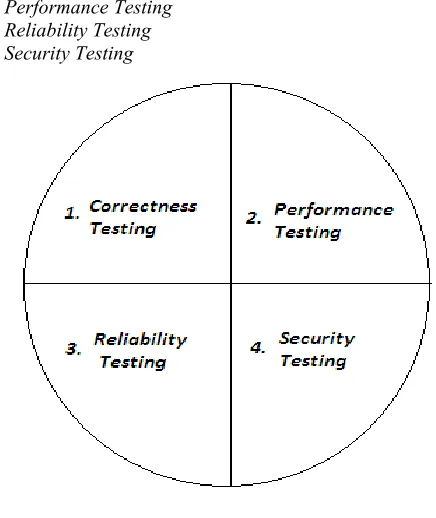
Software testing is a series of process which is designed to make sure that the computer code does what it was designed to do. Quality assurances, ensuring reliability, validation or verification are the basic purpose of testing.[6][7][8] Software testing can be classified into four major categories.[4]
[image:1.612.332.550.305.564.2]1. Correctness Testing 2. Performance Testing 3. Reliability Testing 4. Security Testing
Fig. 1 Various Testing Techniques
II. SOFTWARE TESTING TECHNIQUES
Software testing is a well defined process which is used to measure the quality of software developed. It is also a process of uncovering errors and bugs in a program which makes it more feasible task. It is useful process of executing program with the intent of finding bugs.
Correctness Testing
International Journal of Emerging Technology and Advanced Engineering
Website: www.ijetae.com (ISSN 2250-2459, Volume 2, Issue 9, September 2012)291
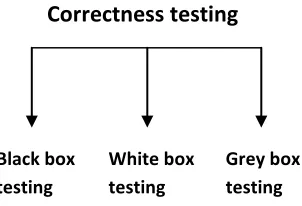
Correctness testing denotes the correct behavior of a system. Either a white box point of view or black box point of view can be taken in testing software as a tester may or may not know the inside detail of the software module under test. The ideas of white box, black box or grey box testing are not limited to correctness testing only.Fig. 2 Types of Correctness Testing
White Box Testing
[image:2.612.90.241.225.328.2]White box testing based on an analysis of internal working and structure of a piece of software. White box testing is the process of giving the input to the system and checking how the system processes that input to generate the required output. It is necessary for a tester to have the full knowledge of the source code. White box testing is applicable at integration, unit and system levels of the software testing process. In white box testing one can be sure that all parts through the test objects are properly executed. [2][8]
Fig. 3 White-Box Testing
Some synonyms of white box testing are [5] Logic Driven Testing, Design Based Testing, Open Box Testing, Structural Testing. Some important types of white box testing techniques are:
1. Control Flow Testing 2. Branch Testing 3. Path Testing 4. Data flow Testing 5. Loop Testing
There are some merits and demerits of white box testing Merits
1. Side effects are beneficial.
2. Errors in hidden codes are revealed.
3. Approximate the partitioning done by execution equivalence.
4. Developer carefully gives reason about implementation. Demerits
1. It is very expensive.
[image:2.612.61.276.518.586.2]2. Missed out the cases omitted in the code.
Fig.4 Black-Box Testing
Black Box Testing
Basically Black box testing is an integral part of „Correctness testing‟ but its ideas are not limited to correctness testing only. Correctness testing is a method which is classified by purpose in software testing. Black box testing is based on the analysis of the specifications of a piece of software without reference to its internal working. The goal is to test how well the component conforms to the published requirement for the component. Black box testing have little or no regard to the internal logical structure of the system, it only examines the fundamental aspect of the system. It makes sure that input is properly accepted and output is correctly produced. In black box testing, the integrity of external information is maintained. The black box testing methods in which user involvement is not required are functional testing, stress testing, load testing, ad-hoc testing, exploratory testing, usability testing, smoke testing, recovery testing and volume testing, and the black box testing techniques where user involvement is required are user acceptance testing, alpha testing and beta testing. Other types of Black box, testing methods includes graph based testing method, equivalence partitioning, boundary value analysis, comparison testing, orthogonal array testing, specialized testing, fuzz testing, and traceability metrics. [2]
There are various merits and demerits of black box testing- [5]
Correctness testing
Black box testing
Grey box testing White box
International Journal of Emerging Technology and Advanced Engineering
Website: www.ijetae.com (ISSN 2250-2459, Volume 2, Issue 9, September 2012)292
Merits
1. Black box tester has no “bond” with the code. 2. Tester perception is very simple.
3. Programmer and tester both are independent of each other.
4. More effective on larger units of code than white box testing.
Demerits
1. Test cases are hard to design without clear specifications. 2. Only small numbers of possible input can actually be
tested.
3. Some parts of the back end are not tested at all. Grey Box Testing
[image:3.612.100.220.452.565.2]Grey box testing techniques combined the testing methodology of white box and black box. Grey box testing technique is used for testing a piece of software against its specifications but using some knowledge of its internal working as well. [2] Grey box testing may also include reverse engineering to determine, for instance, boundary values or error messages. Grey box testing is a process which involves testing software while already having some knowledge of its underline code or logic. The understanding of internals of the program in grey box testing is more than black box testing, but less than clear box testing. [9]
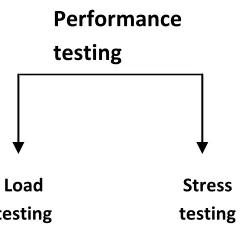
Fig. 5 Types of Performance Testing
Performance Testing
'Performance Testing' involve all the phases as the mainstream testing life cycle as an independent discipline which involve strategy such as plan, design, execution, analysis and reporting. This testing is conducted to evaluate the compliance of a system or component with specified performance requirement. [2] Evaluation of a performance of any software system includes resource usage, throughput and stimulus response time.
By performance testing we can measure the characteristics of performance of any applications.
One of the most important objectives of performance testing is to maintain a low latency of a website, high throughput and low utilization. [5]
Some of the main goals of performance testing are: [5] Measuring response time of end to end
transactions.
Measurement of the delay of network between client and server.
Monitoring of system resources which are under various loads.
Some of the common mistakes which happen during performance testing are: [5]
1. Ignoring of errors in input. 2. Analysis is too complex. 3. Erroneous analysis.
4. Level of details is inappropriate. 5. Ignore significant factors. 6. Incorrect Performance matrix. 7. Important parameter is overlooked. 8. Approach is not systematic.
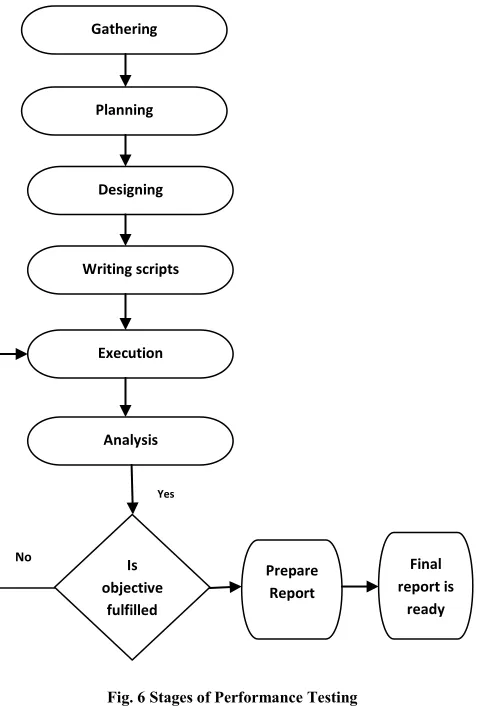
There are seven different stages in performance testing process: [5]
Stage 1 Requirement Study Stage 2 Test plan
Stage 3 Test Design Stage 4 Scripting Stage 5 Test Execution Stage 6 Test Analysis Stage 7 Report preparation
There are two kinds of performance testing: Load Testing
Load Testing is an industry term for the effort of performance testing. The main feature of the load testing is to determine whether the given system is able to handle the anticipated no. of users or not. This can be done by making the virtual user to exhibit as real user so that it will be easy to perform load testing. It is carried only to check whether the system is performing well or not. The main objective of load testing is to check whether the system can perform well for specified user or not. Load testing increases the up time for critical web applications by helping us to spot the bottle necks in the system which is under large user stress. Load testing is also used for checking an application against heavy load or inputs such as testing of website in order to find out at what point the website or applications fails or at what point its performance degrades. [2][5]
Performance
testing
Load testing
International Journal of Emerging Technology and Advanced Engineering
Website: www.ijetae.com (ISSN 2250-2459, Volume 2, Issue 9, September 2012) [image:4.612.52.292.135.488.2]293
Fig. 6 Stages of Performance Testing
Two ways for implementing load testing are
1. Manual Testing: It is not a very practical option as it is very iterative in nature and it involves two activities and they are Measure response time and then compare results. 2. Automated Testing: As compared to manual load testing the automated load testing tools provide more efficient and cost effective solutions. Because with automated load testing, tools test can easily be rerun any number of times and decreases the chances of human error during testing. [5]
Stress Testing
We can define stress testing as performing random operational sequence, at larger than normal volume, at faster than normal speed and for longer than normal periods of time, as a method to accelerate the rate of finding defects and verify the robustness of our product, or we can say stress testing is a testing, which is conducted to evaluate a system or component at or beyond the limits of its specified requirements to determine the load under which it fails and how. Stress testing also determines the behavior of the system as user base increases. In stress testing the application is tested against heavy loads such as large no. of inputs, large no. of queries, etc. [2] [5]
There are some pros and cons of stress testing. Cons
1. Not able to test the correctness of a system. 2. Defects are reproducible.
3. Not representing real world situation. Pros
1. No other type of test can find defect as stress testing. 2. Robustness of application is tested.
3. Very helpful in finding deadlocks. Reliability Testing
„Reliability Testing‟ is very important, as it discover all the failures of a system and removes them before the system is deployed. Reliability testing is related to many aspects of software in which testing process is included; this testing process is an effective sampling method to measure software reliability. Based on reliability information, the risk of using software can also be assessed. Robustness testing and stress testing are the variances of reliability testing. By Robustness we mean how software component works under stressful environmental conditions. Robustness testing only watches the robustness problem such as machine crashes, abnormal terminations etc. Robustness testing is very portable and scalable. [4] Security Testing
Security testing makes sure that only the authorized personnel can access the program and only the authorized personnel can access the functions available to their security level.
Planning
Designing
Prepare Report Execution
Writing scripts
Analysis Gathering requirements
Is objective
fulfilled
Final report is
ready Yes
International Journal of Emerging Technology and Advanced Engineering
Website: www.ijetae.com (ISSN 2250-2459, Volume 2, Issue 9, September 2012) [image:5.612.60.229.136.290.2]294
Security testing ofFig. 7 Types of Security Testing
Any developed system or (system under development) is all about finding the major loopholes and weaknesses of a system which can cause major harm to the system by an authorized user. [1][2] Security testing is very helpful for the tester for finding and fixing of problems. It ensures that the system will run for a long time without any major problem. It also ensures that the systems used by any organization are secured from any unauthorized attack. In this way, security testing is beneficial for the organization in all aspects. [1][2]
Five major concepts which are covered by security testing are
Confidentiality: By security testing, we will ensure the confidentiality of the system i.e. no disclosure of the information to the unknown party other than intended recipient.
Integrity: By security testing, we will maintain the integrity of the system by allowing the receiver to determine that the information which he is getting is correct.
Authentication: Security testing maintains the authentications of the system and WPA, WPA2, WEP are several forms of authentication.
Availability: Information is always kept available for the authorized personnel whenever they needed and assures that information services will be ready for use whenever expected.
Authorization: Security testing ensures that only the authorized user can access the information or particular service. Access control is an example of authorization.
Different types of security testing in any organization are as follows: [3]
1. Security Auditing and Scanning: Security Auditing includes direct inspection of the operating system and of the system on which it is developed.
In Security Scanning the auditor scan the operating system and then tries to find out the weaknesses in the operating and network.
2. Vulnerability Scanning: Various vulnerability scanning software performs Vulnerability Scanning, which involves the scanning of the program for all known vulnerability. 3. Risk Assessment: Risk Assessment is a method in which the auditors analyze the risk involved with any system and all the probability of loss which occurs because of that risk. It is analyzed through interviews, discussions, etc.
4. Posture Assessment and Security Testing: Posture Assessment and Security Testing help the organization to know where it stands in context of security by combining the features of security scanning, risk assessment and ethical hacking.
5. Penetration Testing: Penetration Testing is an effective way to find out the potential loopholes in system and it is done by a tester which forcibly enters into the application under test. A tester enters into the system with the help of combination of loopholes that the application has kept open unknowingly.
6. Ethical Hacking: Ethical Hacking involves large no. of penetration test on a system under test. To stop the forced entry of any external elements into a system this is under security testing.
III. CONCLUSION
Software testing is an important technique for the improvement and measurement of a software system quality. Software testing is a component of software quality control (SQC). SQC means control the quality of software engineering products, which is conducting using tests of the software system These tests can be: unit tests (this testing checks each coded module for the presence of bugs), integration tests (interconnects sets of previously tested modules to ensure that the sets behave as well as they did as independently tested modules), or system tests (checks that the entire software system embedded in its actual hardware environment behaves according to the requirements document). SQC also includes formal check of individual parts of code, and the review of requirements documents. Large losses can be avoided if timely testing and discovering bugs in initial phases of testing are conducting. . In my paper, I have described some of the most prevalent and commonly used strategies of software testing which are classified by purpose. The successful use of these techniques in industrial software development will validate the results of the research and drive future research. [6]
Security testing
Penetration testing
Risk assessment Ethical hacking Vulnerability scanning Security scanning Security auditing
International Journal of Emerging Technology and Advanced Engineering
Website: www.ijetae.com (ISSN 2250-2459, Volume 2, Issue 9, September 2012)295
REFERENCES[1 ] Software testing-Brief introduction to security testing by Nilesh Parekh published on 14-07-2006 available at http://www.buzzle.com/editorial/7-14-2006-102344.asp
[2 ] Software testing glossary available at http://www.aptest.com/glossary.html#performance testing
[3 ] Open source security testing methodology manual of PETE HERZOG and the institute for security and open methodology-ISECOM.
[4 ] Software testing by Jiantao Pan available at http://www.ece.cmu.edu/~roopman/des 899/sw_testing/
[5 ] Software Testing by Cognizant Technology Solution.
[6 ] Paper by Lu Luo available at http://www.cs.cmu.edu/~luluo/Courses/17939Report.pdf
[7 ] Security testing-Wikipedia the free encyclopedia Available at http://en.wikipedia.org/wiki/securitytetsig.
[8 ] White box testing from Wikipedia, the free Encyclopedia.