International Journal of Emerging Technology and Advanced Engineering
Website: www.ijetae.com (ISSN 2250-2459, Volume 2, Issue 9, September 2012)243
DIVERSITY analysis in MIMO systems using
OSTBC(Orthogonal Space Time Block Codes
Lakshmi Prasanna.P
1, G.Rama Krishna
21Lakshmi Prasanna.P student of Dept of ECE &Gudlavalleru engineering college
2G.Rama Krishna Assistant Professor in Dept of ECE &Gudlavalleru engineering college
Abstract— Communication systems become one of our modern technology and which demands for the development of speed reliable communication links with Multiple Input Multiple Output systems. MIMO is one of the prime technologies that can achieve the goal of 4G. As MIMO systems utilizes multiple no of antennas both at the transmitter and receiver Therefore the necessary requirement to reduce the fading resulting from signal fluctuations in the channel is Diversity. Hence MIMO systems use inherent spatial diversity. In this paper we presented the diversity analysis of MIMO systems using STBC codes and OSTBC codes .and measured the BER vs. Eb/N0 values.
Keywords—MIMO, STBC, OSTBC, BER, Diversity.
I. INTRODUCTION
In earlier days we have Single Input Single Output (SISO) systems available, which consist of a single transmitting antenna and a single receiving antenna of a communication system. Speed of such SISO systems is not sufficient for the applications which require very high speed due to the increasing demands of the user in communication systems like internet etc. In order to attain high speed wireless reliable communication links we have the need for MIMO systems. Later on we have different configurations like SIMO, MISO [2] etc.
MIMO has multiple Input transmitting antennas and multiple output receiving antennas and, finally, MIMO-multiuser (MIMO-MU), which refers to a Configuration, that comprises a base station with multiple transmit/receive antennas interacting with multiple users, each with one or more antennas [1]. MIMO antenna cam be either at transmitter or receiver or at both. This system consists of several antenna elements, plus adaptive signal processing, at both transmitter and receiver. It exploits multipath instead of mitigating it [3]. Multiple input multiple output (MIMO) systems have attracted much attention because of high spectrum efficiency. The single most effective technique to accomplish reliable communication over a wireless channel is diversity which attempts to provide the receiver with the independently faded copies of transmitted signal with the hope that at least one of the replicas will be received correctly.
Diversity may be realized in many different ways, including frequency diversity, time diversity, antenna diversity, modulation diversity, etc. Many different detection techniques are developed to get the diversity gain introduced by MIMO techniques [9]. One of them is spatial Diversity technique in terms of Spatial Time Block codes (STBC) which is a old technique .As an advancement of this codes we designed Orthogonal Space Time Block codes and compare the performance of MIMO systems to achieve high BER.
Space Time Block Codes
In this paper both 2x2 & 8x2 MIMO systems are compared with space time and orthogonal space time block codes , initially we used STBC and obtained the performance.
ML detector
The ML receiver performs optimum vector decoding and is optimal in the sense of minimizing the error probability. ML receiver is a method that compares the received signals with all possible transmitted signal vector which is modified by channelmatrix H and estimates transmit symbol vector x according tothe Maximum Likelihood principle , which is shown as:
MRC:
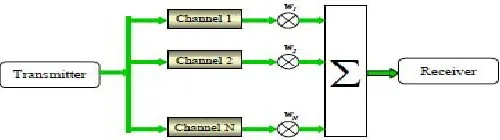
The received signals are weighted with respect to their SNR and then summed and is shown in the figure
[image:1.612.327.577.616.686.2]International Journal of Emerging Technology and Advanced Engineering
Website: www.ijetae.com (ISSN 2250-2459, Volume 2, Issue 9, September 2012)244
International Journal of Emerging Technology and Advanced Engineering
Website: www.ijetae.com (ISSN 2250-2459, Volume 2, Issue 9, September 2012)245
II. ORTHOGONAL SPACE TIME BLOCK CODES
A. MIMO systems using OSTBC
This paper shows a Matlab simulation for diversity in MIMO systems and which applies both transmitter and receiver diversity for 2x2 and 8x2 MIMO systems. OSTBC ,which are consruvted from known designs called orthogonal designs, and are received easily by ML decoder,Used in a 2x2 MIMO system and for 8x2 with 8 transmitting antennas and 2 receiving antennas ,we achieved a diversity order of 16,this paper uses MRC combiner to apply diversity at receiver and also ML detector as a decoder .The following block diagrams represents the system.
Figure (2):Block diagram of 2x2 MIMO system
Figure (3):Block diagram of 8x2 MIMO system
Based on the following Ostbc code is given by G2 transmitters =[ S1 S2 : -S1 –S2]
And S =[G2 ,G2*],wher S x S* = nI And n=2 ∑Si X Sj (i,j=1,2)
B. Main steps for matlab coding
1.The Matlab code begins by the input data i.e, a stream of digital data is to be considered
2.This data was modulated by Bpsk modulator
3.Then data was encoded by using STBC /OSTBC encoder for both 2x2 and 8x2 MIMO systems
4.And is forwarded through AWGN channel.
5.At the receiver MRC is used for 2x2 MIMO system and for 8x2 both MRC and ML detector are used 6. Finally BER are compared.
TABLEI
COMPARISION OF MIMO SYSTEMS USING STBC
Sl.no 2x2 MIMO 8x2 MIMO
1 Provides only transmitter and receiver diversity Provides both transmitter and receiver diversity 2 MRC is only used
at the receiver
MRC is only used at the receiver
3 A threshold
detector is used ML detector is used
4. BPSK modulation is used
BPSK modulation is used 5. BER is calculated BER is
calculated
[image:3.612.346.533.159.446.2]C. TABLE III
Table II
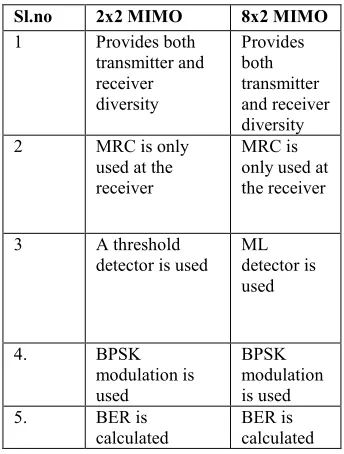
comparision of MIMO systems using OSTBC
Sl.no 2x2 MIMO 8x2 MIMO
1 Provides both transmitter and receiver diversity Provides both transmitter and receiver diversity 2 MRC is only
used at the receiver
MRC is only used at the receiver
3 A threshold detector is used
ML detector is used
4. BPSK modulation is used
BPSK modulation is used 5. BER is
[image:3.612.58.260.311.364.2] [image:3.612.358.530.467.694.2]International Journal of Emerging Technology and Advanced Engineering
Website: www.ijetae.com (ISSN 2250-2459, Volume 2, Issue 9, September 2012)246
D. RESULTS
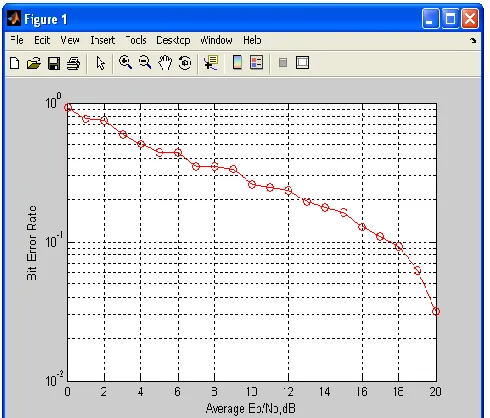
Figure (4): 2x2 MIMO system using STBC
Figure (2): 8x2 MIMO system using STBC
Figure (5): shanon channel capacity for 2x2 and 8x2 MIMO systems using STBC
Figure (6): MIMO channel capacity for 2x2 and 8x2 MIMO systems using STBC
Figure (7):2x2 and 8x2 MIMO system using OSTBC
REFERENCES
[1 ] Clarke, Patrick, de Lamar, Rodrigo C. on Joint transmit diversity Optimization and relay selection for Multi-Relay cooperative MIMO systems using stochastic algorithms, communications letters, IEEEVol15, 2011
[2 ] Gomez calero, C, Cuellar NavarreteL, de Hare L, Martinez R,
Broadcating on A 2X2 MIMO DVB-T2 System design, new channel estimation scheme and Measurements with polarization diversity, IEEETransactions on vol57, 2011
[3 ] Debjyoti Ghosh, Samarendra Nath Sur, Saptarshi Dutta Choudhary,
Basudev Basak, Madhur Mohan Comparative Study of STBC MIMO System in Scattering Environment,IJCA,vol1,2011
[4 ] Chan-Byoung Chae, Forenza, A,Heath R.W,McKay.M, Collings I,
Adaptive MIMO transmission techniques for broadband wireless communication systems [Topics in Wireless Communications], Communications Magazine, IEEE Vol 48 , 2010
[5 ] Sharma, S.K, Ahmad, S.N,Conference on Performance of MIMO
Space-Time Coded Wireless Communication systems,
[image:4.612.350.546.136.298.2] [image:4.612.53.298.157.366.2] [image:4.612.53.292.389.695.2]International Journal of Emerging Technology and Advanced Engineering
Website: www.ijetae.com (ISSN 2250-2459, Volume 2, Issue 9, September 2012)247
[6 ] Larry T. , Weifeng S., and Ray L., On the Robustness of space-time
coding technique based on a general space–time covariance model, IEEE Transactions On Vehicular Technology,Vol. 55, No. 1, January 2006
[7 ] Ruly Lai-U Choi, Murch, R.D, New Transmit schemes and