Journal of Chemical and Pharmaceutical Research, 2015, 7(6):290-294
Research Article
CODEN(USA) : JCPRC5
ISSN : 0975-7384
Insights into the physiochemical characterization and classification of
antiviral and viral proteins
Sajitha Lulu S.
a, Thabitha A.
a, Madhusmita Rout
a, Mohana Priya A.
aand Vino S.
*ba
Bioinformatics Division, School of Bio Sciences and Technology, VIT University, Vellore, Tamilnadu, India bMedical Biotechnology Division, School of Bio Sciences and Technology, VIT University, Vellore, Tamilnadu, India
_____________________________________________________________________________________________
ABSTRACT
Physiochemical properties of amino acid features have frequently been used in reliable statistical method for classification of antiviral proteins. Antiviral proteins were protecting host cells from the entry of highly pathogenic viruses or deadly viruses. Viral recognization and host immunity against viral entry is still emerging research field in recent years. So we focused more on antiviral protein and its specificity. The protein structural features like amino acid composition ratio, hydrophobicity, hydrophilicity, positive charge, and negative charge calculated for viral and antiviral protein PROFEAT online tool. On the basis of physical properties, analysis was done with Pearson 2-tailed correlation using SPSS 22.0 software. Our proposed method will provide insight into important features and characteristics to identify novel antiviral proteins which inhibits viral replication during viral infection.
Keywords: Viral reorganization, Hydrophobicity, Hydrophilicity, Pearson 2-tailed correlation, Viral replication.
_____________________________________________________________________________________________
INTRODUCTION
Antiviral proteins are shown to be active against several life threatening viruses such as, HIV, influenza virus, dengue virus, West Nile virus, herpes simplex virus, cytomegalovirus, polio virus. Almost half a century our efforts focus on antiviral research [1-3]. To overcome viral effects in host so many drugs were available like acyclovir for herpes simplex virus (HSV) infection, and azidothymidine (AZT), stavudine and efavirenz for human immunodeficiency virus (HIV) infection [4-9]. This can be a cost effective and time-consuming process and side effects due to severe toxicity [10]. Certain antiviral peptides or proteins having lower toxicity, like enfuvirtide used for the treatment of HIV viral infection [11]. Collection of Antiviral peptides was compiled into databases such as, AVPred and HIPdb which are highly effective against specific viruses with experimental validation [12, 13].
Recent studies showed that several antiviral therapeutics agents are known to prevent the binding of viruses to the host cells either by interrupting the signalling process [14, 15] or inhibiting the replication of viruses [16–18] which involves DNA polymerase, reverse transcriptase and integrase [19]. Very few researches have been done in predicting and examining the antiviral proteins. In addition, they explored two different approaches such as amino acid composition, and physicochemical features to predict effective antiviral proteins [17]. Their results confirmed that, based on the physiochemical properties, support vector machine (SVM) approach and random forests (RF) were a prominent method to identify antiviral proteins. Physicochemical properties of amino acids are useful resources to identify antiviral proteins.
EXPERIMENTAL SECTION
Dataset construction:
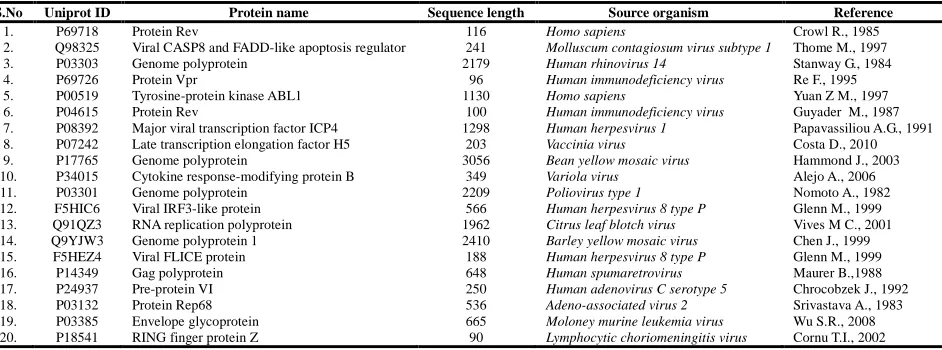
[image:2.595.78.538.181.356.2]Sequences of Antiviral proteins were collected from Uniprot database using keywords like 'antiviral protein', 'viral protein'. The obtained data validated with literature and dataset created for both viral and antiviral proteins. Datasets organized into several columns like Uniprot ID, protein name, PDB accession numbers, resolution, sequence, sequence length, source organism, and reference (Table 1 and Table 2).
Table 1. Anti-Viral Proteins and its features
S.No Uniprot ID Protein name Sequence length Source organism Reference
1. Q7Z2W4 Zinc finger CCCH-type antiviral protein 1 902 Homo sapiens Wang X., 2012
2. Q02793 Antiviral protein SKI8 397 Saccharomyces cerevisiae Arora C., 2004
3. Q7Z434 Mitochondrial antiviral-signaling protein 540 Homo sapiens Seth R.B., 2005 4. P35207 Antiviral helicase SKI2 1,287 Saccharomyces cerevisiae Widner W.R., 1993
5. P10297 Antiviral protein I 313 Phytolacca americana Monzingo A.F., 1993
6. P21326 Antiviral protein MAP 278 Mirabilis jalapa Habuka N., 1989
7. Q8WXG1 Radical S-adenosyl methionine domain-containing protein 2 361 Homo sapiens Rivieccio M.A., 2006 8. P09922 Interferon-induced GTP-binding protein Mx1 631 Mus musculus Tumpey T.M., 2007 9. Q9N0Y2 Interferon-induced GTP-binding protein Mx2 711 Canis familiaris Nakamura T., 2005 10. Q8IUX4 DNA dC->dU-editing enzyme APOBEC-3F 373 Homo sapiens Wiegand H.L., 2004
11. Q9UII4 E3 ISG15--protein ligase HERC5 1024 Homo sapiens Tang Y., 2010
12. O95786 Probable ATP-dependent RNA helicase DDX58 925 Homo sapiens Miyashita M., 2011 13. O14879 Interferon-induced protein with tetratricopeptide repeats 3 490 Homo sapiens Schmeisser H.,2010
14. Q8IYM9 E3 ubiquitin-protein ligase TRIM22 498 Homo sapiens Eldin P., 2009
15. Q61190 Interleukin-10 receptor subunit beta 349 Mus musculus Trost M., 2009 16. Q15646 2'-5'-oligoadenylate synthase-like protein 514 Homo sapiens Marques J., 2008 17. Q8CBB9 Radical S-adenosyl methionine domain-containing protein 2 362 Mus musculus Zhang Y., 2007 18. Q9R0T8 Inhibitor of nuclear factor kappa-B kinase subunit epsilon 717 Mus musculus Hemmi H., 2004 19. Q8R5F7 Interferon-induced helicase C domain-containing protein 1 1025 Mus musculus Kato H., 2006 20. Q93VT9 60S ribosomal protein L10-1 220 Arabidopsis thaliana Carvalho C.M., 2008
Table 2. Viral protein and its features
S.No Uniprot ID Protein name Sequence length Source organism Reference
1. P69718 Protein Rev 116 Homo sapiens Crowl R., 1985
2. Q98325 Viral CASP8 and FADD-like apoptosis regulator 241 Molluscum contagiosum virus subtype 1 Thome M., 1997
3. P03303 Genome polyprotein 2179 Human rhinovirus 14 Stanway G., 1984
4. P69726 Protein Vpr 96 Human immunodeficiency virus Re F., 1995
5. P00519 Tyrosine-protein kinase ABL1 1130 Homo sapiens Yuan Z M., 1997
6. P04615 Protein Rev 100 Human immunodeficiency virus Guyader M., 1987
7. P08392 Major viral transcription factor ICP4 1298 Human herpesvirus 1 Papavassiliou A.G., 1991 8. P07242 Late transcription elongation factor H5 203 Vaccinia virus Costa D., 2010
9. P17765 Genome polyprotein 3056 Bean yellow mosaic virus Hammond J., 2003
10. P34015 Cytokine response-modifying protein B 349 Variola virus Alejo A., 2006
11. P03301 Genome polyprotein 2209 Poliovirus type 1 Nomoto A., 1982
12. F5HIC6 Viral IRF3-like protein 566 Human herpesvirus 8 type P Glenn M., 1999 13. Q91QZ3 RNA replication polyprotein 1962 Citrus leaf blotch virus Vives M C., 2001
14. Q9YJW3 Genome polyprotein 1 2410 Barley yellow mosaic virus Chen J., 1999
15. F5HEZ4 Viral FLICE protein 188 Human herpesvirus 8 type P Glenn M., 1999
16. P14349 Gag polyprotein 648 Human spumaretrovirus Maurer B.,1988
17. P24937 Pre-protein VI 250 Human adenovirus C serotype 5 Chrocobzek J., 1992
18. P03132 Protein Rep68 536 Adeno-associated virus 2 Srivastava A., 1983
19. P03385 Envelope glycoprotein 665 Moloney murine leukemia virus Wu S.R., 2008 20. P18541 RING finger protein Z 90 Lymphocytic choriomeningitis virus Cornu T.I., 2002
Physiochemical property prediction:
The viral and antiviral proteins were classified by obtaining hydrophilic and hydrophobic amino acid ratio, negative and positive charge amino acid ratio, number of helix, sheet and coil present on each individual protein. These all characteristics were obtained by using PROFEAT online tool. Simple python scripts can also be used to calculate the composition of amino acids, hydrophobic, hydrophilic, charge residues and the length of protein sequence. Graph Pad prism 6 has been used for graph generation.
Statistical method:
Pearson's Correlation coefficient helps to analyze the relation between two variables. In that the degree of the variables are linearly related in a sample. Pearson correlation coefficient ranges in value from -1.00 to +1.00. In Pearson's Correlation (2-tailed) significant values is less than 0.05.
RESULTS AND DISCUSSION
[image:2.595.74.545.383.558.2]constitute for second highest total death worldwide. Hence, our aim is to classify the viral and antiviral proteins using physiochemical properties of amino acid.
Feature importance of amino acid composition:
In this study five physicochemical properties for amino acid were examined. Each property contains 20 numerical values to represent 20 amino acids. The feature of a protein sequence is described mainly by the number of positively and negatively charged amino acids and composition of amino acids present. Amino acid composition is the ratio of each amino acid in a peptide. The ratio of an amino acid with type of protein (X) was calculated
AAC(X) ~ N/L
[image:3.595.73.542.217.406.2]Where N is the number of the amino acid with type and L is the length of protein X.
Figure 1. Distribution of amino acid composition of antiviral and viral proteins
The blue bars represent 20 antiviral protein composition and red bars represent 20 viral protein composition
The statistical distribution of amino acid composition ratio of antiviral protein is present more compare to viral protein except asparagine, serine, threonine, valine, tyrosine, and lysine (figure1).
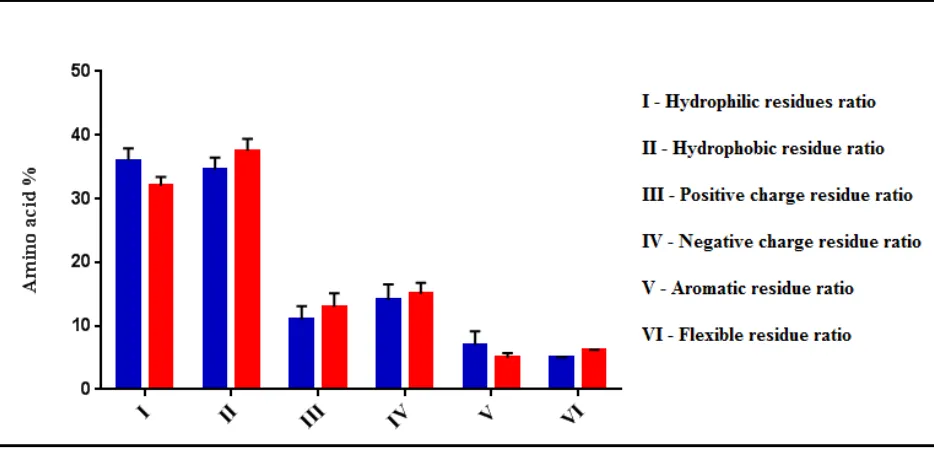
Figure 2. Distribution of physiochemical properties of antiviral and viral proteins
The blue bars represent 20 antiviral protein composition and red bars represent 20 viral protein composition
[image:3.595.74.541.477.704.2]Arg) and negative charge amino acids (Asp, Glu) are present in the surface of the protein. The hydrophilic amino acids can interact with solvents through hydrogen bonds either by donating or accepting protons. The salt bridges (side chain-side chain, side chain- main chain) are also formed by the charged amino acids in protein
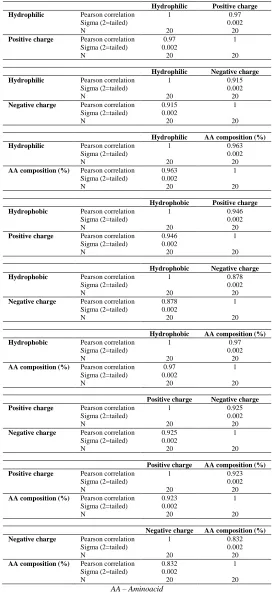
Table 3. The correlation results of physiochemical properties
Hydrophilic Positive charge
Hydrophilic Pearson correlation 1 0.97
Sigma (2=tailed) 0.002
N 20 20
Positive charge Pearson correlation 0.97 1
Sigma (2=tailed) 0.002
N 20 20
Hydrophilic Negative charge
Hydrophilic Pearson correlation 1 0.915
Sigma (2=tailed) 0.002
N 20 20
Negative charge Pearson correlation 0.915 1
Sigma (2=tailed) 0.002
N 20 20
Hydrophilic AA composition (%)
Hydrophilic Pearson correlation 1 0.963
Sigma (2=tailed) 0.002
N 20 20
AA composition (%) Pearson correlation 0.963 1
Sigma (2=tailed) 0.002
N 20 20
Hydrophobic Positive charge
Hydrophobic Pearson correlation 1 0.946
Sigma (2=tailed) 0.002
N 20 20
Positive charge Pearson correlation 0.946 1
Sigma (2=tailed) 0.002
N 20 20
Hydrophobic Negative charge
Hydrophobic Pearson correlation 1 0.878
Sigma (2=tailed) 0.002
N 20 20
Negative charge Pearson correlation 0.878 1
Sigma (2=tailed) 0.002
N 20 20
Hydrophobic AA composition (%)
Hydrophobic Pearson correlation 1 0.97
Sigma (2=tailed) 0.002
N 20 20
AA composition (%) Pearson correlation 0.97 1
Sigma (2=tailed) 0.002
N 20 20
Positive charge Negative charge
Positive charge Pearson correlation 1 0.925
Sigma (2=tailed) 0.002
N 20 20
Negative charge Pearson correlation 0.925 1
Sigma (2=tailed) 0.002
N 20 20
Positive charge AA composition (%)
Positive charge Pearson correlation 1 0.923
Sigma (2=tailed) 0.002
N 20 20
AA composition (%) Pearson correlation 0.923 1
Sigma (2=tailed) 0.002
N 20 20
Negative charge AA composition (%)
Negative charge Pearson correlation 1 0.832
Sigma (2=tailed) 0.002
N 20 20
AA composition (%) Pearson correlation 0.832 1
Sigma (2=tailed) 0.002
N 20 20
AA – Aminoacid
compare to viral proteins. In viral proteins, the hydrophobic, positive and negative charge and flexible (Gly) amino acid ratios are greater than antiviral proteins.
Statistical analysis:
The statistical analysis of the physicochemical properties of the antiviral protein was done. The following properties were examined, including amino acid composition, charge, hydrophobicity, hydrophilicity. The Pearson’s r for the correlation between the two variables close to 1 and positive value that, hydrophilic and positive charge is 0.970, hydrophilic and negative charge is 0.915, hydrophilic and amino acid composition ratio is 0.963, hydrophobic and positive charge is 0.946, hydrophobic and negative charge is 0.878, hydrophobic and amino acid composition ratio is 0.970, positive charge and negative charge is 925, positive charge and amino acid composition ratio is 923, negative charge and amino acid composition ratio is 832 which shows strong relationship between two variables and positive correlation i.e., one variable increases in value and the second variable also increase in value (Table 3).
CONCLUSION
Antiviral proteins have inhibitory effect against viral infections. These proteins exhibit specific changes for different types of viral influence in various organisms. According to our current work, the antiviral proteins are found to be more hydrophilic or water soluble in nature. Viral proteins are hydrophobic in nature and having more charged residues. These hydrophilic and hydrophobic natures have a powerful impact on three dimensional structure of the protein. Our analysis demonstrated that, finding the characteristics of viral and antiviral protein providing gateway for antiviral drug discovery.
Acknowledgement
We are grateful to the management of VIT University for supporting this investigation.
REFERENCES
[1] MA Wainberg. Antiviral Res., 2009, 81(1), (1–5).
[2] E De Clercq. Annu Rev Pharmacol Toxicol., 2011, 51, (1–24). [3] HJ Field; E De Clercq. Microbiol Today., 2004, 31, 58–61.
[4] HJ Schaeffer; L Beauchamp; P de Miranda; GB Elion; DJ Bauer; P. Collins. Nature., 1978, 272(5654), 583–585. [5] H Mitsuya; KJ Weinhold; PA Furman; MH St Clair; SN Lehrman. Proc Natl Acad Sci U S A., 1985, 82(20), 7096– 7100.
[6] M Baba; R Pauwels; P Herdewijn; E De Clercq; J Desmyter. Biochem Biophys Res Commun., 1987, 142(1), 128–134.
[7] Y Hamamoto; H Nakashima; T Matsui; A Matsuda; T Ueda. Anti microb Agents Chemother., 1987, 31(6), 907– 910.
[8] TS Lin, RF Schinazi, WH Prusoff. Biochem Pharmacol., 1987, 36(17), 2713–2718.
[9] SD Young; SF Britcher; LO Tran; LS Payne; WC Lumma. Antimicrob Agents Chemother., 1995, 39(12), 2602– 2605.
[10] W Lewis; MC Dalakas. Nat Med., 1995, 1, 417–422.
[11] C Wild; T Greenwell; T Matthews. AIDS Res Hum Retroviruses., 1993, 9(11), 1051–1053. [12] N Thakur; A Qureshi; M Kumar. Nucleic Acids Res., 2012, 40, W199–204.
[13] A Qureshi; N Thakur; M Kumar. PLoS One., 2013, 8(1), e54908.
[14] DM Rausch; KM Hwang; M Padgett; AH Voltz; A Rivas. Ann N Y Acad Sci., 1990, 616, 125–148. [15] W Pang; SC Tam; YT Zheng. Antivir Chem Chemother., 2009, 20, 1–18.
[16] JM Louis; F Dyda; NT Nashed; AR Kimmel; DR Davies. Biochemistry., 1998, 37, 2105–2110. [17] I Oz Gleenberg; O Avidan; Y Goldgur; A Herschhorn; A Hizi. J Biol Chem., 2005, 280, 21987–21996. [18] IO Gleenberg; A Herschhorn; A Hizi. J Mol Biol., 2007, 369, 1230–1243.