THE ROLE OF EXPERIENCED PRACTITIONERS IN ENGINEERING
EDUCATION: THE END OF AN ERA?
Nigel Craig1, Stuart Tennant2, Mike Murray3, Alan Forster4 and Nick Pilcher5
1Nigel Craig, School of Engineering & Built Environment, Glasgow Caledonian University, Glasgow, UK.
2
Stuart Tennant, School of Engineering & Computing, University of the West of Scotland , Paisley, UK. 3
Mike Murray, Department of Civil & Environmental Engineering, University of Strathclyde, Glasgow, UK
4Alan M. Forster, School of Energy, Geoscience, Infrastructure and Society, Heriot-Watt University,
Edinburgh, UK.
5
Nick Pilcher, The Business School, Edinburgh Napier University, Edinburgh, UK.
Abstract:
Delivering excellence in higher engineering education is dependent on many variables. This includes programme design, delivery and content, university support and the knowledge, experience and enthusiasm of faculty members. Over the past decade there has been a notable shift in engineering faculty recruitment policy. No longer is the professional and industrial experience of the engineering practitioner revered as a co-opted member of the engineering department. Despite their potential contribution as grounded, practical and relevant engineering lecturers, their impoverished knowledge of research funding mechanisms and lack of research capital is an acute disadvantage. This is a discussion paper exploring the marginalization of experienced practitioners in engineering education and the changing role of the educator as a career academic. The career academic is highly qualified and typically well versed in research activity; however, unlike their industrial counterparts they are devoid of any meaningful practical engineering experience. This changing role of the educator in engineering education has far-reaching consequences for teaching and learning and future industry skills. Given the longstanding connection between theory and practice in engineering education, this departure in pedagogical policy arguably signals the end of an era. The systematic fragmentation of engineering theory from industrial practice within higher education institutes arguably needs to be challenged. Recent government rhetoric to focus on the pedagogical aspects through a Teaching Excellence Framework is arguably aiming at the wrong target. Instead, reconstructing engineering programmes fit for the twenty-first century will require alternative teaching strategies, revitalised industrial advisory boards and uncommon leadership within engineering faculties.
Keywords; engineering education, policy, industrial practice.
1. INTRODUCTION
Over the past decade there has been a notable shift in engineering faculty recruitment policy. No longer is the professional and industrial experience of the engineering practitioner revered as a co-opted member of the engineering department. Despite their potential contribution as grounded, practical and relevant engineering lecturers, their impoverished knowledge of research funding mechanisms and lack of research capital being brought into the institution is an acute disadvantage. In contrast, in an era where research is championed, the career academic brings much hope and promise to an institution. The potential to win significant research grants, to be able to supervise PhD students, and to publish income generating high quality research articles are all facets that many institutions now seek in new staff. Perhaps inevitably however, employing one type of academic over another replaces one system, or era, with another. In this case, the era of the practitioner academic is coming to an end, to be replaced by the era of the career academic. In an engineering education context however, we will argue that this has a number of negative implications for the student experience. We outline and discuss these below, both in terms of their potential origin, and their impact.
This in essence is a discussion paper presented in a conventional format. Following a brief overview of the career academic, a framework for critical reflection is presented. The adopted framework draws upon three closely coupled themes; namely context, connectivity and change. Thereafter the discussion explores impacts and reviews strategies designed to mitigate the current separation of theory from practice taking place in many engineering facilities across the UK. In conclusion, the future role of the experience practitioner in engineering education is evaluated and avenues of further study identified.
2. THE CAREER ACADEMIC
The professional character of a career academic may be defined as “a research-active university staff member with very limited professional or practical experience of working in the industry in which they are a scholar,” (Tennant et al., 2015 p.729). It is important to note that labelling a university lecturer as a career academic is not a criticism. In contrast to traditional engineering faculties, the recruitment and employment of academics with little or no practical experience beyond campus boundaries is arguably a more familiar occurrence in other academic fields, namely the Arts and Humanities. Nor is the recruitment of career academics wholly negative within an engineering context. It could be reasonably argued that personal motivation and aptitude for teaching and learning is unrelated to a baseline professional or industrial background. In other words, a professional background in engineering practice does not guarantee a high standard of teaching provision, conversely possession of a PhD does not automatically secure research publication or funding. However, Alplay and Jones (2012) suggest lecturers who have an industry background exhibit a greater commitment to teaching and can relate this to their professional background. The primary criticism regarding career academics in an engineering context is arguably twofold. The first concern is the erosion of professional balance (professional distribution of faculty staff members) and second, professional parity (equal weighting and recognition for both research and teaching focused faculty staff members).
professionalism within engineering is alternative and highly contextual. Creating an engineering faculty/school devoid of academics with professional experience rooted in industry and practice inevitably impacts on programme content and delivery and more importantly the overall student experience. In addition to the tangible contributions regarding academic content, the tacit knowledge and understanding distilled over many years of experience, and the considerable industry networks that accompany practice in the field are no longer accessible as an intrinsic value-added component of the engineering faculty. In short, an imbalance between the number of career academics with experience in university ‘realpolitik’ and research know-how and industry practitioners entering academia cannot but fail to undermine and impoverish the learning experience for engineering students.
The increasing popularity of career academics in engineering has been endorsed and subsequently reinforced by the funding mechanisms currently applied in UK Higher Education (HE); most notably, the introduction of the Research Assessment Exercise (RAE) and more recently the Research Excellence Framework (REF). Since its inception in 1986 there have been six RAE’s (1986, 1989, 1992, 1996, 2001 & 2008) and one REF (2014) (Jump, 2013). Access to research funding and an annual block grant is based on an independent, third party panel evaluation of research value. The better the research rating a university receives, the higher the grant funding it receives. In addition, research status is likely to be reflected positively in national and international university league tables. League table positions will be drawn upon to compare (albeit crudely) university ‘performance’ with other comparable and not so comparable universities and will ultimately be employed to market institutional ‘goods’ which will hopefully attract greater numbers of (fee paying) students.
Given the temptation for institutions of research funding, career academics are a perfectly rationale addition to any engineering faculty. However, this changing role of the educator in engineering education has far-reaching consequences for teaching and learning and future industry skills. Given the longstanding connection between theory and practice in engineering education, this departure in pedagogical policy arguably signals the end of an era.
3. CONTEXT, CONNECTIVITY & CHANGE
To make sense of current academic recruitment practice, the rise of the career academic and its influence on professional outlook, identity and HE provision, a structure for critical reflection is helpful. The adopted framework draws upon three closely coupled themes; namely context, connectivity and change.
3.1 Context
are undeniably going to be of use should they be ones the students are now studying (Pilcher et al. In review), but this context can only be a purely academic one.
In comparison, the practical academic will be able to provide contexts and examples for their lectures that are industry based and ground the material in the real world that the students will be going on to. Such contextualisation has been noted in other subject areas to help lecturers “create reality” (in Nursing (Bentley and Pegram, 2003, p.172)), and show key links with the practical arena (also in the medical profession and the legal profession (Uziak et al., 2013). Yet, given the increasing employment of career academics in engineering and construction (Tennant et al., 2015) the ability of the lecturing staff to provide such context and connectivity is being challenged.
3.2 Connectivity
It is arguably crude to talk about undergraduates as a homogeneous group. According to Williams (2013 p.105), “the past fifty years have witnessed unprecedented growth in the diversity of the student body and today there are more female, working-class, black and ethnic minority students in universities and other HE institutions than ever before.” Regardless of origin and diversity of the student population, as a collective body participating in HE and by extension the exchange of knowledge and truth (or alternatively as consumers / clients) would suggest the requirement of either an intellectual and/or commercial connectivity between provider (HE) and consumer (student). Anecdotal evidence suggests that most engineering students require ‘degrees of connectivity’.
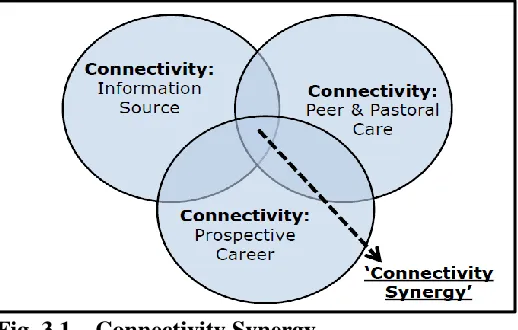
[image:4.612.74.333.480.645.2]Connection may take three basic forms; connection between student and lecturer(s) and/or student (information source), connection between student and university (peer & pastoral care) and connection between programme of study and the world of work (prospective career). From a student perspective it could be argued that excellence in teaching and learning requires ‘connectivity synergy’, (as displayed in Figure 3.1) where the combined effect is greater than the sum of individual parts.
Fig. 3.1 – Connectivity Synergy
demands for a more ‘research focused learning environment’ carries the incumbent risk of disconnecting the student from professional, pragmatic and industry focused learning. Not only is there a possibility that contact between student and lecturer will begin to acquire an arm’s-length, asocial characteristic, but in addition the traditional fraternity between student and university may also become ‘loosely’ coupled.
Whilst the impact of detachment may undermine motivation, progression and educational attainment; non-attendance also inhibits undergraduate acquisition of the softer skills often demanded by potential employers. In an era where the recruitment of the career academic is becoming increasingly ‘fashionable’ alongside the notion of a digital degree and virtual classroom it is important that vocational programmes such as engineering continue to value the ‘professional and industry’ dimension and build-in social capital (Anonymous, 2014). The notion of social capital has strong parallels with anticipatory socialisation (see Sang et al., 2009). This is an important and yet frequently overlooked characteristic of teaching excellence and the successful ‘priming’ of young people for a professional career in the engineering sector.
Maintaining a social as well as educational ‘synergy’ between student, lecturer, university and the world of work is crucial. Safeguarding student connectivity is not necessarily a barrier to change; programme delivery should evolve, innovation and technological change can become embedded and alternative teaching strategies encouraged. However, ‘teaching excellence’ must acknowledge and remain sympathetic to the explicit and tacit ‘connectivity’ needs of the evermore demanding student population and the role industry experience can play. It is an interesting paradox that research-led teaching is routinely endorsed as a ‘means’ to ‘enhance’ programme delivery. Yet, if poorly designed and inadequately resourced, research-led teaching may facilitate the fragmentation of key learning relationships and undermine the social capital of a university education.
3.3 Change
Over the past twenty five years, there have been significant changes in governance. Two policy changes are notable for their impact; first The Further and Higher Education Act 1992 and second the Dearing Report published in 1997. For many, the former heralded the beginning of the present-day mass higher education system (Scott, 1995). Whereas this removed the binary line between HE and Polytechnics (England & Wales) / Central Institutions (Scotland) (McNay, 2006, Jarvis, 2014), the latter (see Dearing, 1997) brought to centre stage the economic rationality of pursuing a university degree (Williams, 2013). Such an endorsement of free market ideology and student mobility has been further reinforced in the recently published Higher Education Green paper (BIS, 2015).
In addition, the dominance of research excellence has altered the demographic staff profile of many engineering faculties (Graham, 2012, Morgan, 2014). This changing role of lecturer in engineering education has widespread consequences for teaching, student learning and future industry skills. Students relate to storytelling (Broome and Peirce, 1997). It bridges theory with ‘contextual practice’ and ‘regulates’ industry and professional expectations (anticipatory socialisation). Yet, if lecturers do not have any practical industry experience, their ability to tell stories to contextualise their content material is absent. Although such pedagogical anxiety about potential short-comings for vocational programmes such as construction (Tennant et al., 2015) is not new, the changing role of the educator in engineering education has far-reaching consequences for teaching and learning and for providing future industry skills. Given the longstanding connection between theory and practice in engineering education, this departure in pedagogical policy arguably signals the end of an era.
4. DISCUSSION
Reflecting on the ‘context / connectivity / change’ tripartite relationship, the imminent challenge for HE, student enhancement and teaching excellence is not additional support services that continue to address students’ needs through the lens of a consumer/customer of higher education ‘services. On the contrary, the capacity for information collection and distribution is both advanced and viable. The challenge for HE is rather to preserve the professional and social contract and continue to build-in engineering capital. The systematic fragmentation of engineering theory from industrial practice within higher education institutes arguably needs to be challenged.
In an effort to mitigate the separation of theory from practice, structured interventions are required. One intervention could be to encourage short term industrial secondment for lecturing staff. Indeed, there is evidence to suggest the success of such initiatives (Westacott, 2013), and the claims that such schemes give lecturers “first-hand experience of an industrial environment and knowledge of current industry practices which will may improve the quality of industrial relevance in their teaching” (Royal Academy of engineering, 2015). Nevertheless, the take up on such schemes is arguably dependent on encouragement from the institution for such schemes to be followed, and such encouragement is unlikely to be forthcoming in an environment whereby research is championed. One solution might be to formulate such schemes so that they included data generation and collection for the lecturers involved. In this way, a bridge could be made between teaching and research in the practical arena.
One other way such practical experience could be better introduced is arguably through industry-institution partnerships. Such partnerships would allow students to be lectured by industry experienced individuals and may help establish partnerships for students to then go on to do work placements and other schemes. Nevertheless, this also is perhaps something which may at first sight appear ideal, but on closer inspection looks less suitable. Firstly, there may the issue of cost, with regard to how the industry professionals who do the lecturing are paid. Further, how such material is then integrated into a curriculum and assessment schedule is complex; does this mean that the industry professionals will write the assessments and mark them? Does it mean that careful integration of the curriculum needs to be fostered? If such lectures are standalone and not part of the curriculum however, how will such material be assessed and seen as contributing to their courses by the students involved?
5. CONCLUSION
Recent government rhetoric to focus on the pedagogical aspects through a TEF is arguably aiming at the wrong target. Instead, reconstructing engineering programmes fit for the twenty-first century will require alternative teaching strategies, revitalised industrial advisory boards and uncommon leadership within engineering faculties. Arguably, it is crucial that such courses take account of the need for context, connectivity, and change. The context needs to be provided, this in turn will help create connectivity between the students and the course, and in order for any of these elements to occur, it is essential that change take place within our education institutions.
Above we have suggested that three ways to achieve this may be to develop workplace secondment schemes for lecturers, to give greater rewards to teaching, and to establish more engineering/industry based partnerships. Nevertheless, such initiatives themselves are not straightforward, and it is also possible that a combination of them rather than initiating them discretely is what would be most successful. Ultimately though, we argue that change needs to come from the top. As the Further Education Act of 1992, and the Dearing Report of 1997 set in motion the trends and movements that have led to the end of the era of the practitioner lecturer, we argue that it would be through similar government led initiatives that the situation could be reversed or returned to a healthier balance of practice and theory. We argue that this needs to take place to reinstate the value of practice in engineering education, and that more is required to be done than the soon to be introduced TEF. Instead, more focus and value and reward needs to be accorded to the practical nature of the profession again. Only in this way can the era of the practitioner lecturer return.
REFERENCES
ALPLAY, E. & JONES, M. E. 2012. Engineering educationin research intensive universities. European Journal of Engineering Education, 37, 609 - 626.
ANONYMOUS 2014. The digital degree; The future of universities. Economist, 28, 20 - 22. BIS 2015. Fullfilling our Potential: Teaching Excellence, Social Mobility and Student Choice.
BROOME, T. H. & PEIRCE, J. 1997. The Heroic Engineer. Journal of Engineering Education, 87, 51 - 55.
DEARING, R. 1997. National Committee of Inquiry into Higher Education Report of the National Committee, the Dearing Report. Norwich: HMSO.
FURTHER AND HIGHER EDUCATION ACT 1992. (c.13). London: Stationery Office.
GRAHAM, R. 2012. Achieving excellence in engineering education: the ingredients of successful change. The Royal Academy of Engineering.
JARVIS, D. S. L. 2014. Regulating higher education: Quality assurance and neo-liberal managerialism in higher education - A critical introduction. Policy and Society, 32, 155 - 166.
JUMP, P. 2013. Evolution of the REF [Online]. Times Higher Education:
https://www.timeshighereducation.com/features/evolution-of-the-ref/2008100.article (accessed 14/04/2016).
LEA, M. R. & STIERER, B. 2011. Changing academic identities in changing academic workplaces: learning from academics’ everyday professional writing practices. Teaching in Higher Education, 16, 605 - 616.
MCNAY, I. 2006. Delivering Mass Higher Education - The Reality of Policy in Practice. In: MCNAY, I. (ed.) Beyond Mass Higher Education. Maidenhead: SRHE and Open University Press.
MORGAN, R. 2014. The Universe of Engineering: A call to action. Royal Academy of Engineering.
NIXON, J., MARKS, A., ROWLAND, S. & WALKER, M. 2001. Towards a New Academic Professionalism: A manifesto of hope. British Journal of Sociology of Education, 22, 227 - 244.
PEEL, D. 2006. Planning Educational Research and the UK Research Assessment Exercise. Journal for Education in the Built Environment, 1, 30 - 50.
SANG, K., ISON, S., DAINTY, A. R. J. & POWELL, A. 2009. Anticipatory socialisaltion amongst architects: a qualitiative examination. Education + Training, 51, 309 - 321. SCOTT, P. 1995. The Meanings of Mass Higher Education, Buckingham, SRHE and Open
University Press.
TENNANT, S., MURRAY, M., FORSTER, A. & PILCHER, N. 2015. Hunt the shadow not the substance: the rise of the career academic in construction education. Teaching in Higher Education, 20, 723 - 737.
WILLIAMS, A. 2013. Consuming Higher Education: Why Learning Can't be Bought, London, Bloomsbury Academic.