DOI: 10.1534/genetics.110.125567
A Genome-Wide Enhancer Screen Implicates Sphingolipid Composition
in Vacuolar ATPase Function in
Saccharomyces cerevisiae
Gregory C. Finnigan,* Margret Ryan* and Tom H. Stevens*
,1*Institute of Molecular Biology, University of Oregon, Eugene, Oregon 97403
Manuscript received December 1, 2010 Accepted for publication December 23, 2010
ABSTRACT
The function of the vacuolar H1-ATPase (V-ATPase) enzyme complex is to acidify organelles; this
process is critical for a variety of cellular processes and has implications in human disease. There are five accessory proteins that assist in assembly of the membrane portion of the complex, the V0domain. To
identify additional elements that affect V-ATPase assembly, trafficking, or enzyme activity, we performed a genome-wide enhancer screen in the budding yeast Saccharomyces cerevisiae with two mutant assembly factor alleles,VMA21with a dysfunctional ER retrieval motif (vma21QQ) andvma21QQin combination withvoa1D, a nonessential assembly factor. These alleles serve as sensitized genetic backgrounds that have reduced V-ATPase enzyme activity. Genes were identified from a variety of cellular pathways including a large number of trafficking-related components; we characterized two redundant gene pairs, HPH1/ HPH2 and ORM1/ORM2. Both sets demonstrated synthetic growth defects in combination with the
vma21QQallele. A loss of either theHPHorORMgene pairs alone did not result in a decrease in vacuolar acidification or defects in V-ATPase assembly. While the Hph proteins are not required for V-ATPase function, Orm1p and Orm2p are required for full V-ATPase enzyme function. Consistent with the documented role of the Orm proteins in sphingolipid regulation, we have found that inhibition of sphingolipid synthesis alleviates Orm-related growth defects.
T
HE vacuolar H1-ATPase (V-ATPase) is a multisub-unit complex that is highly conserved across euk-aryotes (Graham et al. 2003). It functions to actively acidify cellular compartments by coupling the hydro-lysis of ATP to the translocation of protons across membranes through a conserved rotary mechanism (Hirata et al. 2003; Yokoyama et al. 2003; Imamura et al.2005). Organelle acidification plays a crucial role in various cellular functions such as vesicular traffick-ing, endocytosis, neurotransmitter uptake, membrane fusion, and ion homeostasis (Kane2006; Forgac2007). Specialized isoforms of the V-ATPase complex can be found on different cellular membranes including the plasma membrane (Forgac 2007). A number of hu-man diseases have been associated with or directly linked to defects in the V-ATPase complex: osteopet-rosis (Frattiniet al.2000), renal tubular acidosis (Karet et al. 1999), and cancer cell migration (Martinez -Zaguila´ n et al. 1999). The V-ATPase is an essential complex for all eukaryotes with the exception of some fungi.The budding yeastSaccharomyces cerevisiaerequires the V-ATPase to survive under specific environmental
con-ditions, including alkaline conditions or otherwise toxic levels of metals (Eide et al. 2005; Kane 2006). Yeast utilize the proton gradient created by the V-ATPase to drive sequestration of Ca21 and Zn21 ions within the vacuole (Klionsky et al. 1990). A variety of proton-exchange antiporter pumps reside on the vacuolar membrane and other organelles that participate in maintaining nontoxic cytosolic levels of various ions and metals including calcium and zinc (Misetaet al. 1999; MacDiarmidet al.2002). Deletion of any of the V-ATPase component proteins results in a number of specific growth and cellular phenotypes, including sensitivity to excess metals and a lack of vacuolar acid-ification. This makes yeast a useful model system to study the V-ATPase complex (Grahamet al.2003; Kane 2006). Complete disruption of V-ATPase function in yeast results in a characteristic Vma–phenotype: failure
to grow on media buffered to pH 7.5 (Kane 2006). Additionally, numerous genetic screens have demon-strated that a loss of the V-ATPase renders yeast sensitive to a variety of metals (including zinc and calcium) and drugs (Eideet al. 2005; Kane2007). Yeast lacking the V-ATPase complex do not acidify their vacuoles as shown through a lack of quinacrine staining (Weisman et al.1987).
The V-ATPase enzyme in yeast contains 14 protein subunits within two domains: the V1 portion is re-sponsible for hydrolyzing ATP, and the V0 portion Supporting information is available online athttp://www.genetics.org/
cgi/content/full/genetics.110.125567/DC1.
1Corresponding author: Institute of Molecular Biology, University of
shuttles protons across a lipid bilayer (Forgac 2007). The V1domain (subunits A–H) is peripherally associ-ated, and the V0domain (subunits a, d, e, c, c9, and c99) is imbedded within the membrane except subunit d, which is a peripheral membrane protein. The func-tional V-ATPase enzyme requires the presence of all of these subunits. Subunit a has two isoforms in yeast, the absence of one of them is not sufficient to cause a Vma–phenotype. Yeast contain two populations of the
V-ATPase complex and their localization is dictated by the incorporation of one of two isoforms of subunit a,Stv1porVph1p(Manolsonet al.1992, 1994). While higher eukaryotes contain numerous isoforms for many of the different V-ATPase subunits (Marshanskyand Futai2008),Stv1p/Vph1pis the only structural differ-ence between the two yeast enzymes. V-ATPase com-plexes containing theVph1protein are trafficked to the vacuolar membrane whileStv1p-containing V-ATPases are retained within the Golgi/endosomal network (Manolsonet al.1994). Similarly, higher eukaryotes use different isoforms of subunit a to direct the localiza-tion of the V-ATPase to specific cellular compartments (Forgac 2007). One mechanism of V-ATPase regula-tion occurs through the rapid, reversible dissociaregula-tion of the V1and V0domains (Kane2006).
In the absence of any V1subunit, the V0domain is still properly assembled and targeted to the vacuole (Grahamet al.2003). In the absence of the V0domain, V1is still assembled (Tomasheket al.1997). Loss of any V0subunit protein prevents proper V0assembly and ER exit (Graham et al. 2003), and Vph1p undergoes ubiquitin-dependent ER-associated degradation (ERAD) (Hilland Cooper2000). Assembly of the V0domain occurs in the ER and requires the presence of a number of additional proteins (Forgac2007). Five ER-localized assembly factors have been identified in yeast that are required for full V-ATPase function yet are not part of the final complex:Vma21p,Vma22p,Vma12p,Pkr1p, andVoa1p(Hirataet al.1993; Hilland Stevens1995; Malkuset al.2004; Davis-Kaplanet al.2006; Ryanet al. 2008). Deletion ofVMA21,VMA12, orVMA22causes a failure of the V0subunits to properly assembly in the ER and a complete loss of V-ATPase function, resulting in a full Vma– phenotype (Graham et al.2003). Yeast
lacking PKR1 show a limited amount of V0 assembly (Davis-Kaplanet al.2006) and yeast lackingVOA1 dis-play only a slight reduction in V-ATPase enzyme activity (Ryanet al.2008). Consequently,pkr1Dcells score a par-tial Vma–phenotype whilevoa1Dcells appear normal.
Genetic screens in S. cerevisiae have been critical in identifying the components of the V-ATPase and its asso-ciated factors (Ohyaet al.1991; Hoet al. 1993; Sambade et al. 2005). However, the most recently discovered V-ATPase assembly factor,Voa1p, was identified by pro-teomics andvoa1Dcells have no detectable growth phe-notype (Ryan et al. 2008). Voa1p physically associates with theVma21p-V0complex early in V-ATPase assembly
and deletion of VOA1 displays a dramatic growth phenotype in conjunction with a specific mutant allele of the VMA21 assembly factor, vma21QQ (Ryan et al. 2008). In yeast, it has been shown thatVma21pplays a critical role in V-ATPase assembly and chaperones the completed V0subcomplex out of the ER to the Golgi (Hilland Stevens1994; Malkuset al.2004).Vma21p is retrieved back to the ER through a conserved, C-terminal dilysine motif and participates in multiple rounds of assembly and transport (Hilland Stevens 1994; Malkuset al.2004). Mutation of the dilysines to diglutamine residues, as invma21QQ, results in misloc-alization of yeast Vma21p to the vacuolar membrane and a significant loss of V-ATPase function.
The identification of V-ATPase assembly factors like Voa1pthat do not display a full Vma–are not likely to be
found using traditional forward genetic screens. Also, pathways involved in promoting full V-ATPase function may act independently of V1and/or V0 assembly and require a sensitized genetic background to produce a detectible growth phenotype. However,vma21QQ mu-tant yeast and, more so, the vma21QQ voa1D double mutant are two cases where the V-ATPase is partially compromised for function (Hill and Stevens 1994; Ryan et al. 2008). We have chosen to use these two assembly mutants in genome-wide enhancer screens to identify additional factors that assist in promoting full V-ATPase function by searching for genes that will cause an increase in calcium or zinc sensitivity when deleted.
Here we report the identification ofHPH1andORM2
in a genome-wide search for V-ATPase effectors. We describe the characterization of these two redundant yeast gene pairs,HPH1/HPH2andORM1/ORM2, both of which display synthetic growth defects when deleted in combination with thevma21QQmutant. Both sets of genes were found to have specific growth phenotypes on zinc and calcium media. Deletion of either gene pair did not affect vacuolar acidification or assembly of the V0 domain. However, deletion ofORM1andORM2results in a reduction of V-ATPase activity. The Orm proteins have very recently been shown to be negative regulators of sphingolipid synthesis (Breslow et al. 2010; Han et al.2010). Consistent with these reports, we find that disruption of sphingolipid biogenesis is able to suppress Orm-related growth defects.
MATERIALS AND METHODS
into the BamHI andSalI sites of YEp351 to create pGF127. pGF87 was created using homologous recombination and
in vivo ligation by gapping pRS415 and cotransforming a PCR fragment containingprVPH1TVPH1TGFPTSp_HIS5
(am-plified from pGF06) with flanking sequence to the pRS415 vector.
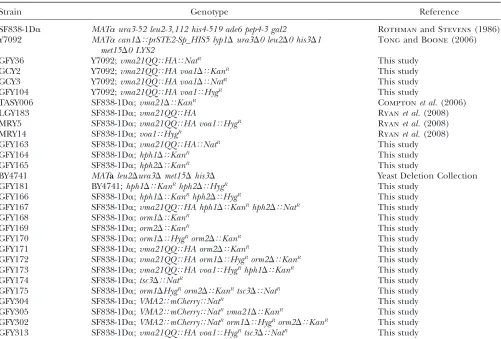
Yeast strains used in this study are listed in Table 2. GFY164 was created by PCR amplifying thehph1DTKanRcassette plus
500 bp flanking sequence from corresponding BY4741 strains of the genome deletion collection (Open Biosystems, Hunts-ville, AL). It was subcloned into pCR4Blunt-TOPO, ream-plified by PCR, transformed into SF838-1Da, and selected on YEPD plus G418 (Gold Biotechnology, St. Louis, MO). Strains containing deletion cassettes other than KanR(HygRor NatR)
were created by PCR amplifying either the HygR or NatR
cassette from pAG32 or pAG25, respectively (Goldsteinand McCuster 1999) and transforming the fragment into the corresponding KanR genome deletion strain to exchange
drug resistance markers. Deletions in the SF838-1Da strain (GFY164, GFY165, GFY166, GFY168, GFY169, and GFY170) were constructed by PCR amplifying the appropriate gene locus (including 500 bp of 59-UTR and 39-UTR flanking sequence), transforming into wild-type (WT) SF838-1Da, and selecting for the appropriate drug resistance. GFY167, GFY171, and GFY172 were created using LGY183 as the par-ental strain. GFY173 was created using MRY5 as the parpar-ental strain. All deletion strains in SF838-1Dawere confirmed by diagnostic PCR from genomic DNA with primers comple-mentary to the 59-UTR (750–1000 bp upstream of the start codon) and internal to the drug resistance gene. A disruption cassette was created to deleteTSC3by first PCR amplifying theTSC3open reading frame with 500 bp of flanking UTR, subcloning in pCR4Blunt-TOPO, and introducing a unique restriction site within the ORF. TheTSC3gene was subcloned into pRS316 and the entire ORF was replaced by the NatR
cassette using homologous recombination. The deletion cas-sette was amplified and cloned into pCR4Blunt-TOPO for use in creating both GFY174 (using SF838-1Daas the parental strain), GFY175 (using GFY170 as the parental strain), and GFY313 (using MRY5 as the parental strain). pGF20 was created by first swapping GFP for mCherry (Shaner et al. 2004) in pRS316VMA2-GFP and introducing a uniquePmeI restriction site downstream of mCherry using site-directed mutagenesis. Second,in vivoligation was used to insert the
ADH1terminator and NatRcassette at the 39 end ofVMA2
-mCherry. A single, C-terminal mCherry (PCR amplified from pGF20 including the NatR cassette) was integrated at
theVMA2locus in strains GFY170, SF838-1Da, and TASY006. This created yeast strains GFY302, GFY304, and GFY305, respectively.
The synthetic genetic array (SGA) query strains were created from yeast parental strain Y7092 (Tongand Boone 2006). After PCR amplifying the vma21QQTHATNatR locus
with 500 bp of flanking sequence from GFY163 genomic DNA, the PCR product was transformed into Y7092 to create GFY36. To create GCY3, GCY2 (vma21QQTHAvoa1DTKanR)
was transformed with the NatR cassette to replace the KanR
cassette. Both the VMA21 and VOA1 loci were PCR ampli-fied with flanking sequence and the PCR product was trans-formed into Y7092. GFY104 was created by PCR amplifying both the VMA21andVOA1loci from MRY5 (vma21QQTHA
voa1THygR) with 500 bp of flanking sequence and
trans-forming the fragment into GCY3.
Culture conditions:Yeast were cultured in YEPD (1% yeast extract, 2% peptone, and 2% dextrose), YEPD buffered to pH 5.0 using 50 mmsuccinate/phosphate plus 0.01% adenine, or synthetic minimal media with dextrose (SD) and the appro-priate amino acids. Growth tests were performed by culturing exponentially growing yeast in rich medium to a cell density of 1.0 OD600, serially diluted fivefold, and spotted onto agar
plates. Plates used included YEPD pH 5.0, YEPD14.0 mmor 5.0 mmZnCl
2, YEPD1100 mmCaCl2, and YEPD125 mmor
50 mmCaCl
2pH 7.5 (using 50 mmHEPES).
Synthetic genetic array screen: A synthetic genetic en-hancer screen was performed as previously described (Tong et al.2001; Tongand Boone2006). Briefly, the query strains (GFY36, GCY3, and GFY104) were mated to theMATahaploid genome deletion collection (BY4741,his3D1leu2D0,met15D0,
ura3D0) and double or triple haploid mutants were selected. The final haploid mutant array was spotted onto YEPD pH 5.0, YEPD1ZnCl2, or YEPD1CaCl2pH 7.5 and incubated at 30°
for 2–3 days. Scans of each plate were visually scored for colony size on each plate type used; colonies were scored for increased sensitivity to calcium or zinc. The genome deletion collection was also arrayed under identical conditions and scored in the same way. Colonies that showed equivalent sensitivity to either metal as a single deletion strain and as part of the double (or triple) mutant collection were not scored as positive hits. Only mutants that displayed a synthetic growth defect that was not present (or not as strong) in either of the single mutant strains were scored as positive hits. Gene ontology (GO) analysis was performed using the Saccharomy-ces Genome Database (SGD) GO term finder (version 0.83) using aP-value cutoff of 0.01.
Whole cell extract preparation and immunoblotting:Whole cell extracts were prepared as previously described (Ryanet al. 2008). Briefly, cultures were grown overnight in SD dropout media and then diluted to 0.25 OD600/ml in YEPD pH 5.0 and
grown to a cell density of OD600¼1.0. A total of 10 OD600of
the culture was centrifuged, resuspended in 0.25 ml Thorner buffer (8 murea, 5% SDS, and 50 mmTRIS pH 6.8), and vortexed with 0.2 ml of glass beads. Following centrifugation, protein concentrations were determined using a modified Lowry protein assay (Markwellet al.1978). Equal amounts of protein were separated by SDS–PAGE, transferred to nitrocel-lulose membrane, and probed with antibodies. Antibodies used TABLE 1
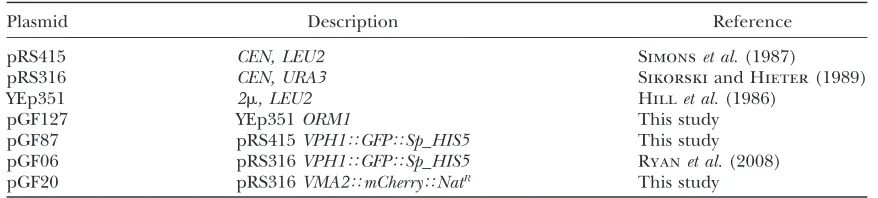
Plasmids used in this study
Plasmid Description Reference
pRS415 CEN, LEU2 Simonset al.(1987)
pRS316 CEN, URA3 Sikorskiand Hieter(1989)
YEp351 2m, LEU2 Hillet al.(1986)
pGF127 YEp351ORM1 This study
pGF87 pRS415VPH1TGFPTSp_HIS5 This study
pGF06 pRS316VPH1TGFPTSp_HIS5 Ryanet al.(2008)
included monoclonal primary anti-Vph1p(10D7; Invitrogen), anti-Vma1p(8B1; Invitrogen), and anti-Dpm1p(5C5; Invitro-gen), and secondary horseradish peroxidase-conjugated anti-mouse antibody ( Jackson ImmunoResearch Laboratories, West Grove, PA). Blots were visualized by ECL detection.
Fluorescence microscopy: Yeast were stained with quina-crine as previously described (Flanneryet al.2004). Briefly, cells were grown overnight in YEPD pH 5.0 plus adenine, and diluted to a cell density of 0.25 OD600/ml in YEPD. Yeast were
harvested at a density of 0.8–1.0 OD600/ml and 1 ml of culture
was placed on ice for 5 min. Cells were pelleted and resus-pended in 200 mmquinacrine, 100 mm Hepes pH 7.6, and 50mg/ml of concanavalin A tetramethylrhodamine (Invitro-gen) in YEPD for 10 min at 30°. Following staining with quinacrine, cells were placed on ice and washed three times in 100 mmHepes pH 7.6 plus 2% glucose (4°). Microscopy images were obtained using an Axioplan 2 fluorescence microscope (Carl Zeiss, Thornwood, NY). A3100 objective was used as well as AxioVision software (Carl Zeiss).
V-ATPase activity assay: Yeast vacuoles were isolated from wild-type (SF838-1Daand BY4741),vma21DTKanR(TASY006),
vma21QQTHA(LGY183),orm1DTHygRorm2DTKanR(GFY170),
vma21QQTHAvoa1THygR(MRY5),vma21QQTHAorm1DTHygR
orm2DTKanR(GFY172), andhph1DTKanRhph2DTHygR(GFY166
and GFY181) strains as previously published (Uchida et al. 1985). Modifications to this protocol included harvesting cells at 1.8–2.2 OD600/ml and use of a tighter-fitting dounce
homog-enizer (five strokes). Fresh vacuoles were assayed by a coupled spectrophotometric assay (Conibear and Stevens 2002). In
this assay system, ATP hydrolysis is coupled to NADH oxidation (340 nm) in a reaction mixture containing 50mg/ml vacuole membrane protein, 25 mmMES, 25 mmMOPS, 25 mmKCl, 5 mmMgCl2, 1 mmNaN3, 0.05 mmNa3VO4, 2 mm phospho-enolpyruvate, 0.5 mmNADH, 30 units/ml pyruvate kinase, and 37 units/ml lactate dehydrogenase; pH 7 (KOH), with and without 1mmconcanamycin A. Reactions were initiated by add-ing Mg21
-ATP to 2 mmand thermostatted at 30°. For each mutant strain, one to three separate vacuole preparations were assayed, and the assay was repeated two to six times for each preparation. Concanamycin A-sensitive ATPase activities were determined by calculating the activity as a percentage of wild-type activity for each biological replicate. For samples with multiple vacuole pre-parations, these percentages were averaged and the error was presented as the standard error of the mean. For samples with only a single biological preparation, the error is presented as the standard deviations for replicate assays.
RESULTS
Genome-wide SGA screen for V-ATPase effectors:
To identify new genes that assist in promoting full V-ATPase function, we performed three SGA Vma–
enhancer screens using the S. cerevisiae haploid dele-tion mutant collecdele-tion (4741 mutants). Since a loss of
VOA1 only displayed a synthetic growth defect upon combination with the vma21QQ mutation, additional TABLE 2
Strains used in this study
Strain Genotype Reference
SF838-1Da MATaura3-52 leu2-3,112 his4-519 ade6 pep4-3 gal2 Rothmanand Stevens(1986)
Y7092 MATacan1DTprSTE2-Sp_HIS5 lyp1Dura3D0 leu2D0 his3D1
met15D0 LYS2
Tongand Boone(2006)
GFY36 Y7092;vma21QQTHATNatR This study
GCY2 Y7092;vma21QQTHA voa1DTKanR This study
GCY3 Y7092;vma21QQTHA voa1DTNatR This study
GFY104 Y7092;vma21QQTHA voa1THygR This study
TASY006 SF838-1Da;vma21DTKanR Comptonet al.(2006)
LGY183 SF838-1Da;vma21QQTHA Ryanet al.(2008)
MRY5 SF838-1Da;vma21QQTHA voa1THygR Ryanet al.(2008)
MRY14 SF838-1Da;voa1THygR Ryanet al.(2008)
GFY163 SF838-1Da;vma21QQTHATNatR This study
GFY164 SF838-1Da;hph1DTKanR This study
GFY165 SF838-1Da;hph2DTKanR This study
BY4741 MATaleu2Dura3Dmet15Dhis3D Yeast Deletion Collection
GFY181 BY4741;hph1DTKanRhph2DTHygR This study
GFY166 SF838-1Da;hph1DTKanRhph2DTHygR This study
GFY167 SF838-1Da;vma21QQTHA hph1DTKanRhph2DTNatR This study
GFY168 SF838-1Da;orm1DTKanR This study
GFY169 SF838-1Da;orm2DTKanR This study
GFY170 SF838-1Da;orm1DTHygRorm2DTKanR This study
GFY171 SF838-1Da;vma21QQTHA orm2DTKanR This study
GFY172 SF838-1Da;vma21QQTHA orm1DTHygRorm2DTKanR This study
GFY173 SF838-1Da;vma21QQTHA voa1THygRhph1DTKanR This study
GFY174 SF838-1Da;tsc3DTNatR This study
GFY175 SF838-1Da;orm1DHygRorm2D
TKanRtsc3DTNatR This study
GFY304 SF838-1Da;VMA2TmCherryTNatR This study
GFY305 SF838-1Da;VMA2TmCherryTNatRvma21DTKanR This study
GFY302 SF838-1Da;VMA2TmCherryTNatRorm1DTHygRorm2DTKanR This study
factors might only be identified in a sensitized genetic background. The three query mutants used were
vma21QQTNatR, vma21QQ voa1DTNatR, and vma21QQ voa1THygR (subsequent experiments were all
per-formed with thevoa1THygRallele, designated asvoa1D).
TheVMA21andVOA1loci are tightly linked; only 146 bp separate their open reading frames. We chose to use both mutants containing theVOA1disruption as it has been shown that a complete deletion of this open reading frame results in a decrease in the steady-state levels ofVma21p, whereas thevoa1THygR
allele does not lowerVma21plevels (Ryanet al.2008). Therefore, the
voa1DTNatR allele served as an additional sensitized
genetic background.
Yeast that contain Vma21p having the mutated retrieval/retention signal, vma21QQ, show a partial growth defect on elevated calcium media buffered to pH 7.5 and have reduced V-ATPase activity (Hilland Stevens1994; Ryanet al.2008). Additionally,vma21QQ
voa1Dyeast are also compromised for V-ATPase func-tion yet do not display a full Vma–phenotype (Ryanet al.
2008).
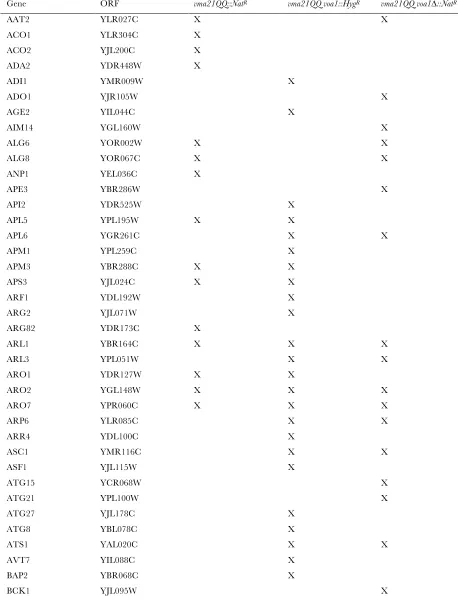
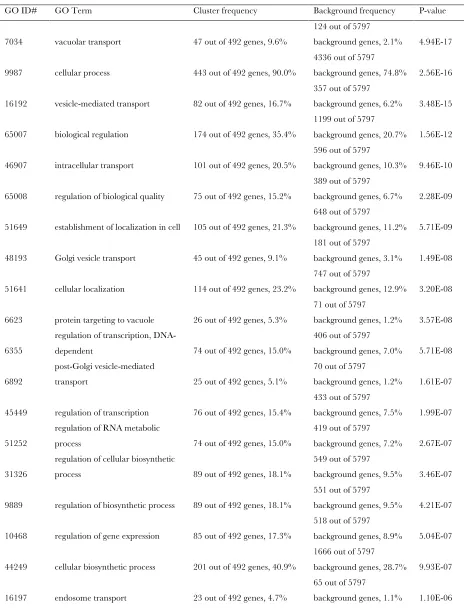
The haploid double or triple mutant yeast were plat-ed onto rich mplat-edia and mplat-edia containing either zinc (2.75 mmor 7.0 mm) or calcium (50 mmor 100 mm) buffered to pH 7.5 in quadruplicate. Yeast that displayed increased sensitivity to these conditions were scored as positive hits. Genes were identified from a diverse set of cellular processes such as protein modification, metab-olism, chromatin remodeling, and transcriptional reg-ulation (Figure 1 andsupporting information,Table S1). A comprehensive GO analysis was performed for cate-gories of genes that were enriched in our SGA screens (Table S2). Some of the most highly enriched categories included vacuolar transport (P-value of 4.943 1017),
vesicle-mediated transport (P-value of 3.4831015), and
intracellular transport (P-value of 9.4631010). Genes
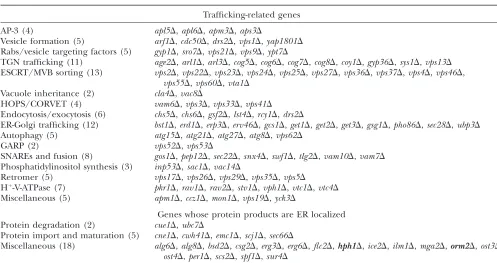
identified by the three SGA screens that correspond to elements of protein trafficking, vacuolar morphology, and the V-ATPase complex are listed in Table 3 and several were chosen for further study.
Since we were searching for genes that showed increased sensitivity to zinc or calcium when deleted in combination withvma21QQor vma21QQ voa1D, we did not identify any of the essential V-ATPase subunits or assembly factors (those with a VMA designation) as expected. Also,VOA1was not identified in thevma21QQ
SGA screen because it is genetically linked to theVMA21
locus. For the voa1D locus to be paired with the
vma21QQmutation during the SGA protocol, a cross-over event would be required between these two loci. However, we did identify V-ATPase subunitsVPH1,STV1, the assembly factor PKR1, and genes within the vac-uolar transporter chaperone (VTC) and regulator of vacuolar and endosomal membrane (RAVE) complexes. In addition, genes involved in ER-resident processes including protein folding and degradation were
identi-fied (Table 3). A number of genes were found that have been poorly characterized according to the SGD and these were most interesting to us. We chose to examine Orm2pfor further study because it was an ER-localized, integral membrane protein. Also, Hph1p has been identified as an ER-localized binding partner of calci-neurin (Heath et al. 2004). Due to the genetic link between calcineurin and the V-ATPase (Tanida et al. 1995), we also choseHPH1for further study.
HPH1/HPH2 or ORM1/ORM2 null mutants cause
synthetic growth defects invma21QQyeast:Thehph1D
mutation was moved to the SF838-1Da genetic back-ground and carefully tested by serial dilution in com-parison to Vma– and Vma-compromised strains. The
growth phenotypes ofvma21QQ voa1Dyeast deleted for
HPH1were tested on media containing 50 mmcalcium buffered to pH 7.5 (Figure 2A). Whereas wild-type yeast were able to grow under these conditions, yeast deleted forVMA21were unable to grow as they lack functional V-ATPase complexes. vma21QQ voa1D yeast showed a compromised level of growth under these conditions and a deletion ofHPH1in this strain caused a further increase in sensitivity (Figure 2A).HPH1has a homolog in S. cerevisiae, HPH2, and both Hph1p and Hph2p reside in the ER membrane (Heathet al.2004). It has been reported that deletions in HPH1andHPH2 dis-play a synthetic growth defect under alkaline condi-tions of pH 8.8 (Heathet al.2004). Since a reduction in V-ATPase function results in increased sensitivity to calcium or zinc, we determined whether a loss of the HPHgenes results in a metal-specific phenotype. Loss of either HPH1 or HPH2 did not result in any sensi-tivity to excess zinc yet deletion of both HPH genes caused a dramatic growth defect on 5.0 mm ZnCl2 (Figure 2B). BothHPH1andHPH2were also deleted in a strain containing thevma21QQ mutation and tested on the less stringent conditions of 4.0 mmZnCl2. Both
WT but the vma21QQ hph1D hph2D mutant was fully sensitive under these conditions and unable to grow (Figure 2C). Interestingly, the hph1D hph2D double mutant did not show any sensitivity to 4.0 mm ZnCl2 but displayed a dramatic shift in sensitivity between 4.0 mmand 5.0 mmZnCl2.
The SGA screens also identified cells lackingORM2
as an enhancer of the assembly factor mutant strains
vma21QQ and vma21QQ voa1D on media containing
either zinc or calcium. The orm2D was recreated in SF838-1Da cells expressing vma21QQ and tested on media containing 25 mmcalcium buffered to pH 7.5. Loss ofORM2invma21QQ yeast caused a slight increase in the sensitivity of this strain compared tovma21QQ
yeast (Figure 3A).ORM2has a homolog inS. cerevisiae,
ORM1, and the double orm1D orm2D mutant shows synthetic growth defects under various environmental stress conditions including elevated mercury or the reducing agent DTT (Hjelmqvist et al. 2002). We tested whether a loss of bothORM1andORM2caused an increase in sensitivity to 25 mmcalcium at pH 7.5. While deletion ofORM1 did not result in any growth defect, yeast deleted forORM2were partially sensitive
under these conditions (Figure 3B). However, the
orm1D orm2D double mutant displayed a synthetic growth defect under these conditions. Due to the high similarity betweenORM1andORM2(67% identical), we tested whether ORM1 and ORM2 are functionally redundant. Overexpression ofOrm1pwas able to fully rescue the growth defect of anorm2Dstrain (Figure 3C). These data suggest that ORM1 andORM2 are a func-tionally redundant gene pair; we chose to examine the effect of a loss of bothOrm1pandOrm2pon the V-ATPase.
Finally, we compared the growth ofvma21QQand
orm1Dorm2Dyeast to the triplevma21QQ orm1Dorm2D mutant using less stringent conditions of unbuffered 100 mmCaCl2. Since a loss of bothORM1andORM2 was only sensitive under stringent growth conditions, we tested whether reducing V-ATPase function using
the vma21QQ mutant would result in a more
dra-matic growth phenotype. Similar to theHPH1/2genes, a loss of both ORMgenes in vma21QQ yeast caused a severe growth defect (Figure 3D). This suggests that the ORMgenes are required when V-ATPase activity is reduced.
TABLE 3
Genes identified by genome-wide SGA screens for V-ATPase effectors that are trafficking related or whose protein products are ER localized
Trafficking-related genes
AP-3 (4) apl5D,apl6D,apm3D,aps3D
Vesicle formation (5) arf1D,cdc50D,drs2D,vps1D,yap1801D Rabs/vesicle targeting factors (5) gyp1D,sro7D,vps21D,vps9D,ypt7D
TGN trafficking (11) age2D,arl1D,arl3D,cog5D,cog6D,cog7D,cog8D,coy1D,gyp36D,sys1D,vps13D ESCRT/MVB sorting (13) vps2D,vps22D,vps23D,vps24D,vps25D,vps27D,vps36D,vps37D,vps4D,vps46D,
vps55D,vps60D,vta1D
Vacuole inheritance (2) cla4D,vac8D
HOPS/CORVET (4) vam6D,vps3D,vps33D,vps41D
Endocytosis/exocytosis (6) chs5D,chs6D,gsf2D,lst4D,rcy1D,drs2D
ER-Golgi trafficking (12) bst1D,erd1D,erp3D,erv46D,gcs1D,get1D,get2D,get3D,gsg1D,pho86D,sec28D,ubp3D
Autophagy (5) atg15D,atg21D,atg27D,atg8D,vps62D
GARP (2) vps52D,vps53D
SNAREs and fusion (8) gos1D,pep12D,sec22D,snx4D,swf1D,tlg2D,vam10D,vam7D Phosphatidylinositol synthesis (3) inp53D,sac1D,vac14D
Retromer (5) vps17D,vps26D,vps29D,vps35D,vps5D
H1-V-ATPase (7) pkr1D,rav1D,rav2D,stv1D,vph1D,vtc1D,vtc4D
Miscellaneous (5) apm1D,ccz1D,mon1D,vps19D,yck3D
Genes whose protein products are ER localized
Protein degradation (2) cue1D,ubc7D
Protein import and maturation (5) cne1D,cwh41D,emc1D,scj1D,sec66D
Miscellaneous (18) alg6D,alg8D,bsd2D,csg2D,erg3D,erg6D,flc2D,hph1D,ice2D,ilm1D,mga2D,orm2D,ost3D,
ost4D,per1D,scs2D,spf1D,sur4D
Genes found in our screens that are involved in either protein trafficking or are ER localized are listed above. A comprehensive list of all genes identified in all three screens can be found inTable S1. Screens were performed with query strainsvma21QQ voa1THygR(GFY104),vma21QQ voa1DNatR(GCY3), andvma21QQ-NatR(GFY36). Colonies from the final double or triple mutant
strains were analyzed for fitness defects on rich media plus 2.75 mmor 7.0 mmZnCl
2or rich media buffered to pH 7.5 plus 50 mm
or 100 mmCaCl
2. The haploid deletion library was also tested and scored under identical media conditions. Fitness defects of
Vacuolar acidification, V0 assembly, and V-ATPase
localization are normal in HPH and ORM mutants:
Yeast disrupted for V-ATPase function show decreases in vacuolar acidification (Davis-Kaplanet al.2006; Ryan et al.2008). To determine whether the growth defects seen with both theHPHandORMmutants result from a loss of V-ATPase function, we assayed vacuolar acidifi-cation by fluorescent staining with quinacrine (Figure 4). Wild-type yeast displayed accumulation of quina-crine within the acidified vacuole while vma21Dyeast showed no quinacrine staining. As previously shown, yeast mutant for either vma21QQ or voa1D displayed wild-type levels of quinacrine staining and vacuolar aci-dification (Ryanet al.2008; Figure 4). As expected, the
vma21QQ voa1Ddouble mutant accumulated a very low level of quinacrine (Figure 4). Surprisingly, both the double mutants (hph1D hph2Dandorm1Dorm2D) and the triple mutant (vma21QQ hph1D hph2D) had fully acidified vacuoles (Figure 4). Only thevma21QQ orm1D Figure2.—HPH1andHPH2display synthetic growth
de-fects with V0 assembly mutants. (A) Exponentially growing
cultures of wild type (WT; SF838-1Da), vma21D (21D;
TASY006), vma21QQ voaTHygR (21QQ voa1D; MRY5), and
vma21QQ voa1THygR hph1D (21QQ voa1D hph1D; GFY173)
were serially diluted and spotted onto rich media buffered to pH 5.0 or rich media buffered to pH 7.5 plus 50 mmCaCl2. (B) Exponentially growing cultures of wild type, hph1D (hph1D; GFY164),hph2D(hph2D; GFY165), andhph1Dhph2D (hph1Dhph2D; GFY166) were spotted onto rich media or rich media plus 5.0 mmZnCl
2. (C) Cultures of wild type,vma21D, vma21QQ (21QQ; LGY183), hph1D hph2D, and vma21QQ hph1Dhph2D(21QQ hph1Dhph2D; GFY167) were serially di-luted and spotted onto rich media buffered to pH 5.0 or rich media plus 4.0 mmZnCl
2.
Figure3.—ORM1and ORM2display synthetic growth ef-fects in cells expressing vma21QQ. (A) Exponentially grow-ing cultures of wild type (WT; SF838-1Da), vma21D (21D; TASY006), vma21QQ(21QQ; LGY183), andvma21QQ orm2D (21QQ orm2D; GFY171) were serially diluted and spotted onto rich media buffered to pH 5.0 or rich media buffered to pH 7.5 plus 25 mm CaCl
2. (B) Cultures of wild type, orm1D
(orm1D; GFY168),orm2D(orm2D; GFY169), and orm1Dorm2D (orm1Dorm2D; GFY170) spotted onto rich media and rich me-dia buffered to pH 7.5 plus 25 mmCaCl
2. (C) Cultures of wild
type,orm2D, andorm2Dtransformed with a high-copy vector expressing ORM1 were spotted onto rich media and rich media buffered to pH 7.5 plus 50 mmCaCl
2. (D)
Exponen-tially growing cultures of wild type,vma21D,vma21QQ,orm1D
orm2D mutant displayed a partial loss of quinacrine staining, indicating reduced V-ATPase function.
While there was no detectable difference in vacuolar acidification, it is possible that the HPH and ORM mutants have slightly reduced levels of the V-ATPase present on the vacuole that might not be apparent using fluorescent microscopy but still be consistent with the observed growth phenotypes. We assayed the levels of Vph1pwithin these mutant strains by Western blotting to examine any defects in V0assembly (Figure 5). In wild-type yeast,Vph1protein is extremely stable (.4-hr half-life; Graham et al.1998; Hilland Cooper2000) and incorporated into the V0 subcomplex. However, Vph1pis rapidly degraded (25–30 min half-life) if there is a V0assembly defect in the ER (Graham et al.1998; Hill and Cooper 2000). As predicted, the levels of Vph1pinvma21Dyeast were greatly reduced compared to wild-type levels. In contrast,voa1D,hph1Dhph2D, and
orm1D orm2D yeast all displayed wild-type levels of Vph1p. This result indicates there is no V0 assembly defect in these strains that would result in increased turnover of Vph1p. The vma21QQ mutant showed a slight decrease in Vph1p levels. Careful analysis has shown that this decrease was mirrored in HPH and ORM mutant strains also containing the vma21QQ
mutation (vma21QQ hph1Dhph2Dandvma21QQ orm1D
orm2D). Only vma21QQ voa1D yeast showed a clear reduction inVph1pthat was greater than that seen in thevma21QQmutant. The ER-resident proteinDpm1p was probed as a loading control. The steady-state levels of the V1subunit Vma1pdid not change in any of the queried mutants.
The localization of the V-ATPase was also examined in both theORM andHPHmutant strains. Yeast express-ing both the V0subunitVph1p-GFP and the V1subunit
Vma2p-mCherry were visualized by fluorescent micros-copy. In wild-type yeast, Vph1p-GFP localized to the limiting membrane of the vacuole and colocalized with Vma2p-mCherry (Figure 6). There was also a pool of Vma2p-mCherry staining within the cytosol in a diffuse pattern. Invma21Dyeast,Vph1p-GFP was found in both cortical and perinuclear ER structures and Vma2p -mCherry was only localized within the cytosol. Yeast mutant for orm1D orm2D showed both V0 and V1 lo-calized to the vacuolar membrane similar to wild-type cells (Figure 6). Strains mutant for hph1D hph2D lo-calizedVph1p-GFP to the vacuole (data not shown).
Loss of the ORM genes (but not the HPH genes)
results in reduced V-ATPase enzyme activity:Since it is
possible that the growth defects seen in the HPH and ORM strains could result from defects in V-ATPase enzyme function (rather than from assembly defects), we performed V-ATPase activity assays on isolated vacu-ole membranes in these mutant strains. We measured vacuole membranes from the hph1D hph2D strain to have 88% V-ATPase activity, whereas the orm1D orm2D mutant had 67% activity relative to wild-type yeast (Table 4). We also tested V-ATPase enzyme activity for thehph1D
hph2Dmutant in a separate genetic background (BY4741) and found no difference from wild-type vacuole mem-branes (116% of WT; Table 4). We determined the
vma21QQ mutant activity to be 22% of wild-type yeast despite the appearance of fully acidified vacuoles. The double vma21QQ voa1D mutant showed a dramatic decrease to 9%. Thevma21QQ orm1Dorm2Dtriple mutant had a comparable reduction of V-ATPase activity to 8% relative to wild-type yeast. These results indicate that the Hph proteins do not affect the activity of the V-ATPase and that the Orm proteins are required for full V-ATPase function.
Figure 4.—Loss of HPH1/HPH2 or ORM1/ ORM2does not result in a loss of vacuolar acid-ification. Exponentially growing cultures of wild type (WT; SF838-1Da),vma21D(21D; TASY006),
vma21QQ (21QQ; LGY183), voa1TH (voa1D;
MRY14), vma21QQ voa1TH (21QQ voa1D;
The Orm proteins function in sphingolipid
regula-tion: Two reports have recently demonstrated that
Orm1pandOrm2pare negative regulators of the serine palmitoyltransferase (SPT) complex responsible for the first and rate-limiting enzymatic step of sphingolipid synthesis (Breslowet al.2010; Hanet al.2010). Since loss ofOrm1pandOrm2phas been shown to result in increased sphingolipid production (Breslow et al. 2010; Hanet al.2010), we tested whether inhibition of the SPT complex alleviated the defects seen in anorm1D
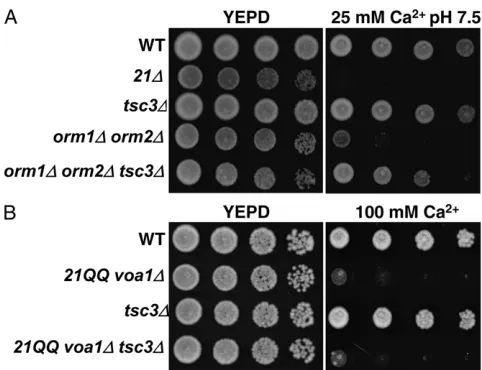
orm2Dmutant. Tsc3pis a small protein that associates with the SPT enzyme and is required for full activity of this complex (Gable et al.2000). We deletedTSC3in theorm1D orm2Dmutant and tested the triple mutant strain on media containing elevated calcium and buffered to pH 7.5 (Figure 7A). Yeast lackingTSC3did not display any growth defect under these conditions. However, loss ofTSC3allowed for increased growth of
the orm1D orm2D strain. Additionally, suppression by deletion ofTSC3was specific to the orm1D orm2D mu-tant, as loss of this regulator did not suppress the cal-cium sensitivity of thevma21QQ voa1Dmutant (Figure 7B). These results suggest that the growth defects seen in theorm1Dorm2Dmutant strain are due to perturba-tion of sphingolipid synthesis.
DISCUSSION
The goal of this study was to identify additional factors that contribute to V-ATPase function that may have been missed by previous forward genetic screens. The power of enhancer and suppressor screens is evident from work in both Drosophila melanogaster and Caeno-rhabditis elegans where it is often necessary to use a sensitized background to uncover new genetic pathways ( Jorgensenand Mango2002; StJohnston2002). In the case of the yeast V-ATPase, parallel genetic pathways are most likely not the main obstacles for identifying subtle effectors of this complex. Instead, the V-ATPase enzyme within the cell requires a dramatic decrease in enzyme function or assembly before cellular growth phenotypes become evident (Ryan et al. 2008). The discovery of the fourth and fifth factors that participate in V0 assembly (Pkr1p and Voa1p) demonstrates the complexity of the assembly processes required for the V-ATPase enzyme complex. While Voa1p has been shown to physically associate with the V0 subcomplex in the ER (Ryanet al.2008), no physical association has been characterized for Pkr1pdespite a strong genetic link to the assembly factor Vma21p (Graham and Stevens 1998; Davis-Kaplan et al. 2006; data not shown). Growth phenotypes associated with perturba-tion of the V-ATPase are only evident upon a significant reduction in enzyme activity to20% of wild type as in the case of the mutant assembly factor allele,vma21QQ
(Hilland Stevens1994). This retrieval-defective mu-tant allele of the highly conserved assembly factor, Figure5.—Vph1p levels are not reduced in strains lacking
either HPH1/HPH2 or ORM1/ORM2. Whole cell extracts were prepared from wild type (WT; SF838-1Da), vma21D (21D; TASY006),vma21QQ(21QQ; LGY183),voa1TH(voa1D;
MRY14), vma21QQ voa1TH (21QQ voa1D; MRY5), hph1D
hph2D(hph1Dhph2D; GFY166), and vma21QQ hph1D hph2D (21QQ hph1Dhph2D; GFY167), orm1Dorm1D(orm1Dorm2D; GFY170), andvma21QQ orm1Dorm2D (21QQ orm1D orm2D; GFY172). Proteins were separated by SDS–PAGE and probed with anti-Vph1p and anti-Vma1p antibodies. Anti-Dpm1p antibody was used as a loading control. The molecular mass (kilodaltons) of the nearest marker is shown on the left.
Figure6.—V1and V0are localized to the vac-uole membrane in Orm mutant yeast. A single mCherry was integrated at the VMA2 locus in the following strains: wild type (WT; GFY304),
vma21D(21D; GFY305), andorm1Dorm2D(orm1D
Vma21p, is a unique scenario to serve as a genetic tool for enhancer (and suppressor) screens because (i) the levels of functional V-ATPase are sufficiently low to allow
for phenotypic scoring, and (ii) the V-ATPase is not compromised for enzyme function, but rather, is defec-tive for assembly due to the limited supply ofVma21pin the ER.
In performing genome-wide enhancer screens with
the vma21QQ and vma21QQ voa1D alleles, a large
number of genes involved in vesicular trafficking path-ways, endosomal sorting complex required for transport (ESCRT) machinery, vesicle formation, and vacuolar morphology were identified. Deletion of some traffick-ing-related genes has been shown to result in sensitivity to zinc, calcium, or alkaline conditions (Serranoet al. 2004; Sambade et al. 2005; Pagani et al. 2007). Our strategy for screening effectively detected reduced V-ATPase activity levels to10% of wild-type yeast (scored as,50% of activity in thevma21QQmutant strain). It is therefore not surprising that we have identified addi-tional genes involved in trafficking pathways that were not previously found in forward genetic screens. For instance, many of the vacuolar protein sorting (VPS) genes have not been identified in previous genome-wide screens for Vma– phenotypes (Sambade et al. 2005). The genetic relationship between these sorting pathways and vacuolar acidification most likely results from aberrant sorting of the V-ATPase. There are many ways by which disruption of vesicular trafficking can result in mislocalization of the V-ATPase enzyme. For example, loss of the AAA-ATPase Vps4p results in an aberrant multivesicular body that traps vacuole-bound TABLE 4
V-ATPase activity and quinacrine staining of mutants
Strain % wild-type ATPase activity Quinacrine
Wild type (SF838-1Da) 100 1111
Wild type (BY4741) 100 1111a
vma21D 160.3 (1)d —
hph1Dhph2D(SF838-1Da) 8866 (4)b 1111
hph1Dhph2D(BY4741) 11660.7 (1)d 1111a
orm1Dorm2D 6766 (3) 1111
voa1D 75c 1111
vma21QQ 2261 (3) 1111
vma21QQ voa1D 960.5 (2) 1
vma21QQ orm1Dorm2D 860.5 (2) 11
Loss of bothORM1andORM2results in a decrease in V-ATPase activity. Activity assays were performed for wild-type strains (WT; SF838-1Da and WT; BY4741),vma21D (vma21D; TASY006), vma21QQ (vma21QQ; LGY183), voa1TH(voa1D; MRY14), orm1D
orm1D(orm1Dorm2D; GFY170),vma21QQ voa1TH(vma21QQ voa1D; MRY5),hph1Dhph2DSF838-1Da(hph1Dhph2D; GFY166),
hph1Dhph2DBY4741 (hph1Dhph2D; GFY181), andvma21QQ orm1Dorm2D(vma21QQ orm1Dorm2D; GFY172). A continuous, cou-pled spectrophotometric assay (Conibearand Stevens2002) was used to assay freshly prepared vacuole membranes for conca-namycin A-sensitive ATPase activity. The wild-type strain SF838-1Dahad an average specific activity of 0.817mmol min1mg1
(average ofn¼7 independent vacuole isolations) and the wild-type strain BY4741 has a specific activity of 0.836mmol min1
mg1 (1 vacuole isolation). The specific activity of mutant samples was divided by the wild-type specific activity measurement
for each independent vacuolar preparation to produce a relative percentage. For samples prepared more than once (biological replicates indicated in parentheses), the different percentages were averaged to produce the percentage of wild-type activity mea-surements6the standard error of the mean. Quinacrine staining is derived from Figure 3.
a
Data not shown.
b
Three of four measurements forhph1Dhph2D(SF838-1Da) averaged 97% of wild type.
c
From Ryanet al.(2008).
d
For strains with only a single biological preparation, the error is expressed as the standard deviation of technical replicates.
cargo in this compartment (Raymond et al. 1992). In addition, loss of the syntaxinPep12p(another class of trafficking mutants) results in mislocalization ofVph1p (Gerrardet al.2000). If the V-ATPase is not targeted to the vacuolar membrane, the pH gradient necessary to drive the sequestration of excess metals is not estab-lished, and the result is an increased sensitivity in our screen. Due to the complexity of protein sorting from the Golgi to the vacuole, there are many components that are required for proper transport of the V-ATPase to the vacuole membrane (Bowersand Stevens2005). It will be of interest to determine whether disruption of other trafficking pathways is able to affect metal sensitivity without perturbation of V-ATPase localization and function.
We chose to characterize two gene families, HPH1
andORM2, whose protein products had been previously reported to localize to the ER; both have homologs within budding yeast, HPH2 and ORM1, respectively (Hjelmqvistet al.2002; Heathet al.2004).HPH1and
HPH2have been characterized as new components of calcineurin signaling (Heath et al. 2004). Genetic screens have also found that deletion of any of the essential subunits of the V-ATPase is synthetic lethal with a loss of calcineurin (Tanidaet al.1995; Parsonset al. 2004). We therefore investigated the involvement of the Hph proteins in the function and/or assembly of the V-ATPase complex in the ER.
HPH1andHPH2have been previously reported to be functionally redundant and sensitive to high salinity or alkaline conditions (Heathet al.2004). We have found a unique set of growth phenotypes associated with a loss ofHPH1andHPH2on media containing excess metals. Thehph1Dhph2Dmutant did not display any sensitivity to elevated calcium (data not shown) yet displayed a nonlinear shift in zinc sensitivity. This was unusual, as our previously observed V-ATPase mutants with a partial reduction in function,pkr1D,vma21QQ, and vma21QQ voa1D(data not shown), exhibit growth defects onboth zinc and calcium to varying degrees and have a gradual response to increasing concentrations of ZnCl2. Pre-liminary work has also demonstrated that the zinc sensitivity of the hph1D hph2D mutant was not com-pletely dependent on calcineurin (data not shown). On the basis of our results, we propose that the growth defect ofhph1Dhph2Dyeast on ZnCl2likely results from a V-ATPase independent mechanism. It is unclear whether the zinc sensitivity inHphmutants results from an effect on vacuole-localized Zn21
transportation or some other mechanism.
Genome-wide screens for zinc or calcium (at pH 7.5) sensitivity have found genes that do not directly con-tribute to V-ATPase function yet show sensitivity to ex-cess metals (Sambadeet al.2005; Paganiet al.2007). An example is deletion of the vacuolar zinc transporter Zrc1p, which confers zinc sensitivity even though vac-uolar acidification is normal (data not shown). Also, a
loss of the serine proteaseKex2presults in both calcium and zinc sensitivity yet does not cause any defect in vacuolar acidification (Sambadeet al.2005). Identifying which genetic pathways are directly linked to metal sensitivity independent of V-ATPase function will re-quire further study.
The Orm proteins are also functionally redundant, integral membrane proteins that localize to the ER in yeast (data not shown). Since loss of both ORM genes caused a reduction in vacuolar acidification and V-ATPase enzyme activity in the context of thevma21QQ
mutation, we propose that Orm1p and Orm2p are necessary for full V-ATPase function. However, the phenotype associated with disruption of only theORM genes does not completely phenocopy a loss of other assembly factors (such as PKR1 or the combination
vma21QQ voa1D). Key differences highlight the poten-tial mechanism through which the Orm proteins may impact the V-ATPase including the lack of an apparent V0assembly defect. It is unlikely that the Orm proteins transiently participate in V0assembly of the V-ATPase, as we were unable to determine any physical association of Orm2p with theVma21p-V0 subcomplex (data not shown).
We also examined whether a variety of cargo proteins (including both subdomains of the V-ATPase) were aberrantly targeted upon a loss of the Orm proteins. Resident ER (Vma21p), Golgi (Vps10p), plasma mem-brane (Pma1p, Ste3p, and Snf3p), and vacuolar pro-teins (Sna3p,Zrt3p,Vcx1p,Pho8p, andCps1p) did not display changes in localization patterns compared to wild-type yeast (data not shown). Consistent with these data, we found normal V1V0localization of the V-ATPase to the vacuole membrane, suggesting an indirect involve-ment ofOrm1pandOrm2p. A more likely scenario in-volves perturbation of V-ATPase function through other cellular pathways.
Recently, two studies have characterizedOrm1pand Orm2pas negative regulators of sphingolipid synthesis (Breslowet al.2010; Hanet al.2010). Both groups have reported that the Orm proteins physically associate with and regulate the SPT complex in the ER. Interestingly, inhibition of the SPT enzyme complex was found to alleviate phenotypes associated with a loss ofORM1and
ORM2, including cold sensitivity and sensitivity to tunicamycin (Hanet al.2010). Our data are consistent with these findings and it is likely thatORM1andORM2
indirectly affect V-ATPase function through perturba-tion of sphingolipid producperturba-tion. This interpretaperturba-tion is in agreement with the effect of the lipid environment on the assembly, transport, or function of various enzymes including the amino acid permease Gap1p (Lauwers et al. 2007), uracil permeaseFur4p(Hearnet al.2003), and plasma membrane H1
-ATPasePma1p(Wangand Chang2002; Gaigget al.2006).
group synthesis (fen1D andsur4D) resulted in pertur-bation of vacuolar acidification, a decrease in V-ATPase enzyme activity, and a functionally compromised V1 domain (Chung et al. 2003). This previous study re-ported destabilization of the V-ATPase; specifically, a portion of the V1subdomain dissociates from the mem-brane during vacuole memmem-brane preparation of the
sur4Dmutant. Since loss of the Orm proteins results in a similar change in the lipidome assur4Dyeast (Breslow et al.2010), loss of the V1subdomain during vacuolar preparation could explain whyvma21QQ orm1Dorm2D cells display levels of V-ATPase activity similar tovma21Q
voa1D yeast but higher vacuolar acidification in vivo. Since they are negative regulators, deletion ofORM1
and ORM2 results in an increase in the sphingolipid composition of the cell (Breslow et al. 2010). Loss of the Orm proteins results in a subtle decrease in V-ATPase function and this differs from both thesur4D andfen1Dmutations. However, this connection between sphingolipid regulation and V-ATPase function would have been missed in previous forward genetic screens. Overproduction of sphingolipids likely results in an altered lipid environment for the V-ATPase as sphingo-lipids play crucial roles for many cellular functions (Hanada2003; Cowartand Obeid2007).
The use of sensitized genetic backgrounds to identify factors that have subtle effects on V-ATPase function has revealed genes involved in a variety of cellular pathways. We have identified the Orm proteins and implicated sphingolipid regulation as important contributors to full V-ATPase enzyme activity. Future genome-wide screens that specifically assay V-ATPase function will aid in sepa-rating genes, likeHPH1andHPH2, which do not directly affect enzyme activity, from those that are dedicated ef-fectors of V-ATPase assembly, transport, or enzyme func-tion. Finally, further characterization of the precise mechanism by which alteration of sphingolipids and the cellular lipid composition affect function of the V-ATPase will be of great interest and provide a more com-plete understanding of this crucial molecular machine.
We thank Laurie Graham and Emily Coonrod for reading the manuscript and members of the Stevens lab for discussions. This work was supported by the National Institutes of Health grant GM-38006 (to T.H.S.) and training grant S T32 GM-007257 (to G.C.F.).
Note added in proof: A very recent study implicatedHPH1/HPH2 in V-ATPase biogenesis (Pin˜ aet al.,Euk. Cell,10:63–71, 2011). Pin˜ a
et al.report thatVph1p is degraded equally rapidly invma21Dand hph1Dhph2Dmutants (Pin˜ aet al.2011; Figure 3D), in contrast to
our findings thatVph1p levels are normal inhph1Dhph2Dmutants, but significantly reduced invma21Dmutants (our Figure 5). Rapid turnover ofVph1p inhph1Dhph2Dyeast is inconsistent with near-normal growth in the presence of 250 mM Ca21(Pin˜ aet al.2011; Figure 3A) and 4 mM Zn21(our Figure 2C). Additionally, the stability ofVph1p in wild-type yeast determined by Pin˜ aet al.is inconsistent
with previously published measurements (>5 hours; Grahamet al.,
1998). Finally and most importantly, our study reports that vacuoles fromhph1Dhph2Dyeast (in two different genetic backgrounds) have 100% of wild-type V-ATPase activity, whereasvma21Dcells have no measureable V-ATPase activity (our Table 4). In contrast to Pin˜ aet al.,
based on our data, we conclude that the HPH1/HPH2genes do not play a role in V-ATPase biogenesis.
LITERATURE CITED
Bowers, K., and T. H. Stevens, 2005 Protein transport from the late
Golgi to the vacuole in the yeastSaccharomyces cerevisiae.Biochim. Biophys. Acta1744:438–454.
Breslow, D. K., S. R. Collins, B. Bodenmiller, R. Aebersold,
K. Simonset al., 2010 Orm family proteins mediate
sphingoli-pid homeostasis. Nature463:1048–1053.
Chung, J. H., R. L. Lesterand R. C. Dickson, 2003 Sphingolipid
requirement for generation of a functional V1component of the
vacuolar ATPase. J. Biol. Chem.278:28872–28881.
Compton, M. A., L. A. Grahamand T. H. Stevens, 2006 Vma9p
(subunit e) is an integral membrane V0 subunit of the yeast
V-ATPase. J. Biol. Chem.281:15312–15319.
Conibear, E., and T. H. Stevens, 2002 Studying yeast vacuoles.
Methods Enzymol.351:408–432.
Cowart, L. A., and L. M. Obeid, 2007 Yeast sphingolipids: recent
developments in understanding biosynthesis, regulation, and function. Biochim. Biophys. Acta1771:421–431.
Davis-Kaplan, S. R., M. A. Compton, A. R. Flannery, D. M. Ward,
J. Kaplanet al., 2006 PRK1encodes an assembly factor for the
yeast V-type ATPase. J. Biol. Chem.281:32025–32035.
Eide, D. J., S. Clarke, T. M. Nair, M. Gehl, M. Gribskovet al.,
2005 Characterization of the yeast ionome: a genome-wide analysis of nutrient mineral and trace element homeostasis in
Saccharomyces cerevisiae.Genome Biol.6:R77.
Flannery, A. R., L. A. Grahamand T. H. Stevens, 2004 Topological
characterization of the c, c9, and c99 subunits of the vacuolar ATPase from the yeast Saccharomyces cerevisiae. J. Biol. Chem. 279:39856–39862.
Forgac, M., 2007 Vacuolar ATPases: rotary proton pumps in
phys-iology and pathophysphys-iology. Nat. Rev. Mol. Cell Biol.8:917–929. Frattini, A., P. J. Orchard, C. Sobacchi, S. Giliani, M. Abinun
et al., 2000 Defects in TCIRG1 subunit of the vacuolar proton pump are responsible for a subset of human autosomal recessive osteopetrosis. Nat. Genet.25:343–346.
Gable, K., H. Slife, D. Bacikova, E. Monaghanand T. M. Dunn,
2000 Tsc3p is an 80-amino acid protein associated with serine palmitoyltransferase and required for optimal enzyme activity. J. Biol. Chem.275:7597–7603.
Gaigg, B., A. Toulmayand R. Schneiter, 2006 Very long-chain
fatty acid-containing lipids rather than sphingolipidsper seare required for raft association and stable surface transport of newly synthesized plasma membrane ATPase in yeast. J. Biol. Chem. 281:34135–34145.
Gerrard, S. R., B. P. Leviand T. H. Stevens, 2000 Pep12p is a
mul-tifunctional yeast syntaxin that controls entry of biosynthetic, en-docytic and retrograde traffic into the prevacuolar compartment. Traffic1:259–269.
Graham, L. A., K. J. Hilland T. H. Stevens, 1998 Assembly of the yeast
vacuolar H1-ATPase occurs in the endoplasmic reticulum and re-quires a Vma12p/Vma22p assembly complex. J. Cell Biol.142:39–49. Graham, L. A., A. R. Flanneryand T. H. Stevens, 2003 Structure and
assembly of the yeast V-ATPase. J. Bioenerg. Biomembr.35:301–312. Goldstein, A. L., and J. H. Mccuster, 1999 Three new dominant
drug resistance cassettes for gene disruption inSaccharomyces cer-evisiae.Yeast15:1541–1553.
Han, S., M. A. Lone, R. Schneiterand A. Chang, 2010 Orm1 and
Orm2 are conserved endoplasmic reticulum membrane proteins regulating lipid homeostasis and protein quality control. Proc. Natl. Acad. Sci. USA107:5851–5856.
Hanada, K., 2003 Serine palmitoyltransferase, a key enzyme of
sphingolipid metabolism. Biochim. Biophys. Acta1632:16–30. Hearn, J. D., R. L. Lesterand R. C. Dickson, 2003 The uracil
trans-porter Fur4p associates with lipid rafts. J. Biol. Chem.278:3679–3686. Heath, V. L., S. L. Shaw, S. Royand M. S. Cyert, 2004 Hph1p and
Hph2p, novel components of calcineurin-mediated stress re-sponses inSaccharomyces cerevisiae.Eukaryot. Cell3:695–704. Hill, J. E., A. M. Myers, T. J. Koerner and A. Tzagoloff,
Hill, K., and A. A. Cooper, 2000 Degradation of unassembled
Vph1p reveals novel aspects of the yeast ER quality control sys-tem. EMBO J.19:550–561.
Hill, K. J., and T. H. Stevens, 1994 Vma21p is a yeast membrane
protein retained in the endoplasmic reticulum by a di-lysine mo-tif and is required for the assembly of the vacuolar H1-ATPase complex. Mol. Biol. Cell5:1039–1050.
Hill, K. J., and T. H. Stevens, 1995 Vma22p is a novel endoplasmic
reticulum associated protein required for assembly of the yeast vacuolar H1-ATPase complex. J. Biol. Chem.270:22329–22336. Hirata, R., N. Umemoto, M. N. Ho, Y. Ohya, T. H. Stevenset al.,
1993 VMA12is essential for assembly of the vacuolar H(1 )-ATPase subunits onto the vacuolar membrane inSaccharomyces cerevisiae.J. Biol. Chem.268:961–967.
Hirata, T., A. Iwamoto-Kihara, G. H. Sun-Wada, T. Okajima, Y. Wada
et al., 2003 Subunit rotation of vacuolar-type proton pumping ATPase: relative rotation of the G as to c subunit. J. Biol. Chem. 278:23714–23719.
Hjelmqvist, L., M. Tuson, G. Marfany, E. Herrero, S. Balcells
et al., 2002 ORMDL proteins are a conserved new family of endoplasmic reticulum membrane proteins. Genome Biol. 3: RESEARCH0027.
Ho, M. N., K. J. Hill, M. A. Lindorferand T. H. Stevens, 1993
Iso-lation of vacuolar membrane H(1)-ATPase-deficient yeast mu-tants; theVMA5andVMA4 genes are essential for assembly and activity of the vacuolar H(1)-ATPase. J. Biol. Chem.268:221–227. Imamura, H., M. Takeda, S. Funamoto, K. Shimabukuro, M. Yoshida
et al., 2005 Rotation scheme of V1-motor is different from that of
F1-motor. Proc. Natl. Acad. Sci. USA13:17929–17933.
Jorgensen, E. M., and S. E. Mango, 2002 The art and design of
genetic screens:Caenorhabditis elegans.Nat. Rev. Genet.3:356–369. Kane, P. M., 2006 The where, when, and how of organelle
acidifica-tion by the yeast vacuolar H1-V-ATPase. Microbiol. Mol. Biol. Rev. 70:177–191.
Kane, P. M., 2007 The long physiological reach of the yeast vacuolar
H1-ATPase. J. Bioenerg. Biomembr.39:415–421.
Karet, F. E., K. E. Finberg, R. D. Nelson, A. Nayir, H. Mocanet al.,
1999 Mutations in the gene encoding B1 subunit of H1-ATPase cause renal tubular acidosis with sensorineural deafness. Nat. Genet.21:84–90.
Klionsky, D. J., P. K. Herman, and S. D. Emr, 1990 The fungal
vac-uole: composition, function, and biogenesis. Microbiol. Rev.54: 266–292.
Lauwers, E. G. Grossman, and B. Andre´, 2007 Evidence for coupled
biogenesis of yeast Gap1 permease and sphingolipids: essential role in transport activity and normal control by ubquitination. Mol. Biol. Cell18:3068–3080.
MacDiarmid, C. W., M. A. Milanickand D. J. Eide, 2002 Biochemical
properties of vacuolar zinc transport systems ofSaccharomyces cerevi-siae.J. Biol. Chem.277:39187–39194.
Malkus, P., L. A. Graham, T. H. Stevens and R. Schekman,
2004 Role of Vma21p in assembly and transport of the yeast vac-uolar ATPase. Mol. Biol. Cell15:5075–5091.
Manolson, M. F., D. Proteau, R. A. Preston, A. Stenbit, B. T.
Robertset al., 1992 TheVPH1gene encodes a 95-kDa
inte-gral membrane polypeptide required forin vivoassembly and activity of the yeast vacuolar H1-ATPase. J. Biol. Chem.267: 14294–14303.
Manolson, M. F., B. Wu, D. Proteau, B. E. Taillon, B. T. Roberts
et al., 1994 STV1gene encodes functional homologue of the 95-kDa yeast vacuolar H1-ATPase subunit Vph1p. J. Biol. Chem.269: 14064–14074.
Markwell, M. A., S. M. Haas, L. L. Bieber and N. E. Tolbert,
1978 A modification of the Lowry procedure to simplify protein determination in membrane and lipoprotein samples. Anal. Biochem.87:206–210.
Marshansky, V., and M. Futai, 2008 The V-type H1-ATPase in
vac-uolar trafficking: targeting, regulation and function. Curr. Opin. Cell Biol.20:1–20.
Martı´nez-Zaguila´ n, R., N. Raghunand, R. M. Lynch, W. Bellamy,
G. M. Martinezet al., 1999 pH and drug resistance. I.
Func-tional expression of plasmalemmal V-type H1-ATPase in drug-resistant human breast carcinoma cell lines. Biochem. Pharma-col.57:1037–1046.
Miseta, A., R. Kellermayer, D. P. Aiello, L. Fu, and D. M.Bedwell,
1999 The vacuolar Ca21/H1exchanger Vcx1p/Hum1p tightly con-trols cytosolic Ca21levels in S. cerevisiae. FEBS Lett.451:132–136. Ohya, Y., N. Umemoto, I. Tanida, A. Ohta, H. Iida et al.,
1991 Calcium-sensitiveclsmutants ofSaccharomyces cerevisiae show-ing a Pet-phenotype are ascribable to defects of vacuolar mem-brane H(1)-ATPase activity. J. Biol. Chem.266:13971–13977. Pagani, M. A., A. Casamayor, R. Serrano, S. Atrianand J. Arin´ o,
2007 Disruption of iron homeostasis inSaccharomyces cerevisiae
by high zinc levels: a genome-wide study. Mol. Microbiol.65: 521–537.
Parsons, A. B., R. L. Brost, H. Ding, Z. Li, C. Zhanget al.,2004
In-tegration of chemical-genetic and genetic interaction data links bioactive compounds to celluar target pathways. Nat. Biotechnol. 22:62–69.
Raymond, C. K., I. Howald-Stevenson, C. A. Vater and T. H.
Stevens, 1992 Morphological classification of the yeast
vacu-olar protein sorting mutants: evidence for a prevacuvacu-olar com-partment in class E vps mutants. Mol. Biol. Cell3:1389–1402. Rothman, J. H., and T. H. Stevens, 1986 Protein sorting in yeast:
mutants defective in vacuole biogenesis mislocalize vacuolar pro-teins into the late secretory pathway. Cell47:1041–1051. Ryan, M., L. A. Grahamand T. H. Stevens, 2008 Voa1p functions
in V-ATPase assembly in the yeast endoplasmic reticulum. Mol. Biol. Cell19:5131–5142.
Sambade, M., M. Alba, A. M. Smardon, R. W. Westand P. M. Kane,
2005 A genomic screen for yeast vacuolar membrane ATPase mutants. Genetics170:1539–1551.
Sambrook, J., and D. W. Russel, 2001 Molecular Cloning: A
Labora-tory Manual, Ed 3. Cold Spring Harbor Laboratory Press, Cold Spring Harbor, NY.
Serrano, R., D. Bernal, E. Simo´ nand J. Arin´ o, 2004 Copper and Iron
are the limiting factors for growth of the yeastSaccharomyces cerevisiae
in an alkaline environment. J. Biol. Chem.279:19698–19704. Shaner, N. C., R. E. Campbell, P. A. Steinbach, B. N. G. Giepmans,
A. E. Palmeret al., 2004 Improved monomeric red, orange and
yellow fluorescent proteins derived fromDiscosomasp. red fluo-rescent protein. Nat. Biotechnol.22:1567–1572.
Sikorski, R. S., and P. Hieter, 1989 A system of shuttle vectors and
yeast host strains designed for efficient manipulation of DNA in
Saccharomyces cerevisiae.Genetics122:19–27.
Simons, R. W., F. Houmanand N. Kleckner, 1987 Improved single
and multicopy lac-based cloning vectors for protein and operon fusions. Gene53:85–96.
StJohnston, D., 2002 The art and design of genetic screens:
Dro-sophila melanogaster.Nat. Rev. Genet.3:176–188.
Tanida, I., A. Hasegawa, H. Iida, Y. Ohyaand Y. Anraku, 1995
Coop-eration of calcineurin and vacuolar H(1)-ATPase in intracellular Ca21homeostasis of yeast cells. J. Biol. Chem.270:10113–10119. Tomashek, J. J., L. A. Graham, M. U. Hutchins, T. H. Stevensand
D. J. Klionsky, 1997 V1-situated stalk subunits of the yeast
vacu-olar proton-translocating ATPase. J. Biol. Chem.272:26787–26793. Tong, A. H., and C. Boone, 2006 Synthetic genetic array analysis in
Saccharomyces cerevisiae.Methods Mol. Biol.313:171–192. Tong, A. H., M. Evangelista, A. B. Parsons, H. Xu, G. D. Bader
et al., 2001 Systematic genetic analysis with ordered arrays of yeast deletions mutants. Science294:2364–2368.
Uchida, E., Y. Oshumiand Y. Anraku, 1985 Purification and
prop-erties of H1-translocating, Mg12-adenosine triphosphatase from
vacuolar membrane of Saccharomyces cerevisiae. J. Biol. Chem. 260:1090–1095.
Wang, Q., and A. Chang, 2002 Sphingoid base synthesis is required for
oligomerization and cell surface stability of the yeast plasma mem-brane ATPase, Pma1. Proc. Natl. Acad. Sci. USA99:12853–12858. Weisman, L. S., R. Bacallaoand W. Wickner, 1987 Multiple
meth-ods of visualizing the yeast vacuole permit evaluation of its mor-phology and inheritance during the cell cycle. J. Cell Biol.105: 1539–1547.
Yokoyama, K., M. Nakano, H. Imamura, M. Yoshidaand M. Tamakoshi,
2003 Rotation of the proteolipid ring in the V-ATPase. J. Biol. Chem.278:24255–24258.
GENETICS
Supporting Information
http://www.genetics.org/cgi/content/full/genetics.110.125567/DC1.
A Genome-Wide Enhancer Screen Implicates Sphingolipid Composition
in Vacuolar ATPase Function in
Saccharomyces cerevisiae
Gregory C. Finnigan, Margret Ryan and Tom H. Stevens
Copyright
Ó
2011 by the Genetics Society of America
G. C. Finnigan et al.
2 SI
TABLE S1
Genes identified by genome-wide SGA screens for V-ATPase effectors
Gene ORF vma21QQ::NatR vma21QQ voa1::HygR vma21QQ voa1∆::NatR
AAT2 YLR027C X X
ACO1 YLR304C X
ACO2 YJL200C X
ADA2 YDR448W X
ADI1 YMR009W X
ADO1 YJR105W X
AGE2 YIL044C X
AIM14 YGL160W X
ALG6 YOR002W X X
ALG8 YOR067C X X
ANP1 YEL036C X
APE3 YBR286W X
API2 YDR525W X
APL5 YPL195W X X
APL6 YGR261C X X
APM1 YPL259C X
APM3 YBR288C X X
APS3 YJL024C X X
ARF1 YDL192W X
ARG2 YJL071W X
ARG82 YDR173C X
ARL1 YBR164C X X X
ARL3 YPL051W X X
ARO1 YDR127W X X
ARO2 YGL148W X X X
ARO7 YPR060C X X X
ARP6 YLR085C X X
ARR4 YDL100C X
ASC1 YMR116C X X
ASF1 YJL115W X
ATG15 YCR068W X
ATG21 YPL100W X
ATG27 YJL178C X
ATG8 YBL078C X
ATS1 YAL020C X X
AVT7 YIL088C X
BAP2 YBR068C X
G. C. Finnigan et al. 3 SI
BCK2 YER167W X X X
BDF1 YLR399C X
BEM1 YBR200W X
BEM2 YER155C X X X
BEM4 YPL161C X X X
BMH1 YER177W X
BRE1 YDL074C X X X
BRE2 YLR015W X
BSD2 YBR290W X X
BST1 YFL025C X
BTS1 YPL069C X
BUD14 YAR014C X
BUD30 YDL151C X
CAJ1 YER048C X
CAT5 YOR125C X
CBF1 YJR060W X X X
CCC2 YDR270W X
CCR4 YAL021C X X
CCW12 YLR110C X
CCZ1 YBR131W X X
CDC50 YCR094W X
CEX1 YOR112W X
CHD1 YER164W X
CHS5 YLR330W X X
CHS6 YJL099W X
CKA1 YIL035C X
CKB1 YGL019W X X X
CKB2 YOR039W X X X
CLA4 YNL298W X X
CNB1 YKL190W X
CNE1 YAL058W X
COG5 YNL051W X X
COG6 YNL041C X
COG7 YGL005C X X
COG8 YML071C X X
COY1 YKL179C X
CPR2 YHR057C X
CPR7 YJR032W X
CRZ1 YNL027W X X X
CSF1 YLR087C X X X
G. C. Finnigan et al.
4 SI
CTF18 YMR078C X
CTF4 YPR135W X
CTK1 YKL139W X X X
CUE1 YMR264W X
CWH41 YGL027C X
CYK3 YDL117W X
CYS3 YAL012W X
DAL81 YIR023W X
DBF2 YGR092W X
DBP7 YKR024C X X
DFG16 YOR030W X
DFG5 YMR238W X
DIA2 YOR080W X
DLT1 YMR126C X X X
DOA1 YKL213C X
DOM34 YNL001W X
DPH1 YIL103W X
DPH2 YKL191W X
DPH5 YLR172C X
DRS2 YAL026C X X X
DST1 YGL043W X
DUF1 YOL087C X
EAF3 YPR023C X
EAF7 YNL136W X
ECM38 YLR299W X
ECM40 YMR062C X
EFT2 YDR385W X
ELF1 YKL160W X
ELM1 YKL048C X X
ELP2 YGR200C X
ELP3 YPL086C X
ELP4 YPL101W X
ELP6 YMR312W X X
EMC1 YCL045C X
ERD1 YDR414C X
ERG3 YLR056W X X X
ERG6 YML008C X X X
ERP3 YDL018C X
ERV46 YAL042W X
FET3 YMR058W X X
G. C. Finnigan et al. 5 SI
FIG4 YNL325C X
FKS1 YLR342W X
FLC2 YAL053W X
FMC1 YIL098C X
FMP21 YBR269C X
FPS1 YLL043W X
FRA1 YLL029W X
FRT1 YOR324C X
FTR1 YER145C X
FUI1 YBL042C X
FUM1 YPL262W X
FYV10 YIL097W X
GAL11 YOL051W X
GAS1 YMR307W X
GCN1 YGL195W X
GCR2 YNL199C X
GCS1 YDL226C X
GEF1 YJR040W X
GET1 YGL020C X X
GET2 YER083C X X X
GIM4 YEL003W X
GIS4 YML006C X
GLY1 YEL046C X
GOS1 YHL031C X X
GPA2 YER020W X
GSF2 YML048W X
GSG1 YDR108W X X X
GSH1 YJL101C X X
GSH2 YOL049W X
GUP1 YGL084C X X
GVP36 YIL041W X
GYP1 YOR070C X X X
HAC1 YFL031W X
HAL5 YJL165C X X
HCR1 YLR192C X X
HEX3 YDL013W X
HGH1 YGR187C X
HMT1 YBR034C X
HOC1 YJR075W X
HSC82 YMR186W X
G. C. Finnigan et al.
6 SI
ICE2 YIL090W X X
IDH2 YOR136W X X
IKI3 YLR384C X
ILM1 YJR118C X
ILV1 YER086W X
IMG2 YCR071C X
INO2 YDR123C X
INP53 YOR109W X
IOC2 YLR095C X
IRA2 YOL081W X
IRC13 YOR235W X
IRC14 YOR135C X X
IRC21 YMR073C X
IRC25 YLR021W X
ISW1 YBR245C X
JJJ3 YJR097W X
KAR3 YPR141C X
KCS1 YDR017C X
KEM1 YGL173C X X X
KES1 YPL145C X
KEX1 YGL203C X
KEX2 YNL238W X X
KRE1 YNL322C X
KRE28 YDR532C X X
KTI12 YKL110C X
LCL1 YPL056C X
LEO1 YOR123C X X
LGE1 YPL055C X X X
LIP2 YLR239C X X
LIP5 YOR196C X
LPD1 YFL018C X
LSB3 YFR024C-A X
LSM1 YJL124C X X
LSM6 YDR378C X
LST4 YKL176C X
LYS14 YDR034C X X X
MAC1 YMR021C X X
MAF1 YDR005C X
MBF1 YOR298C-A X
MCK1 YNL307C X