FOR AN INFINITELY LONG SOLID CYLINDER
MONCEF AOUADIReceived 20 June 2005; Revised 8 January 2006; Accepted 12 March 2006
The theory of generalized thermoelastic diffusion, based on the theory of Lord and Shul-man, is used to study the thermoelastic-diffusion interactions in an infinitely long solid cylinder subjected to a thermal shock on its surface which is in contact with a permeat-ing substance. By means of the Laplace transform and numerical Laplace inversion the problem is solved. Numerical results predict finite speeds of propagation for thermoe-lastic and diffusive waves and the presence of a tensile stress region close to the cylinder surface. The problem of generalized thermoelasticity has been reduced as a special case of our problem.
Copyright © 2006 Hindawi Publishing Corporation. All rights reserved.
1. Introduction
Thermodiffusion in an elastic solid is due to coupling of the fields of temperature, mass diffusion and that of strain. Heat and mass exchange with the environment during ther-modiffusion in an elastic solid. These days, oil companies are interested in the process of thermodiffusion for more efficient extraction of oil from oil deposits. Diffusion can be defined as the random walk of an ensemble of particles from regions of high concen-tration to regions of lower concenconcen-tration. In integrated circuit fabrication, diffusion is used to introduce “dopants” in controlled amounts into the semiconductor substrate. In particular, diffusion is used to form the base and emitter in bipolar transistors, form inte-grated resistors, form the source/drain regions in MOS transistors, and dope polysilicon gates in MOS transistors. In most of theses applications, the concentration is calculated using what is known as Fick’s law. This is a simple law that does not take into consid-eration the mutual interaction between the introduced substance and the medium into which it is introduced or the effect of the temperature on this interaction.
Nowacki [7–10] developed the theory of thermoelastic diffusion. In this theory, the coupled thermoelastic model is used. This implies infinite speeds of propagation of ther-moelastic waves. In the coupled theory of therther-moelasticity the velocity of heat propaga-tion is assumed to be infinitely large. To eliminate this paradox a generalized thermoe-lasticity theory has been developed subsequently. The development of this theory was Hindawi Publishing Corporation
International Journal of Mathematics and Mathematical Sciences Volume 2006, Article ID 25976, Pages1–15
accelerated by the advent of the second sound effects observed experimentally in materi-als at a very low temperature. In heat transfer problems involving very short time intervmateri-als and/or very high heat fluxes, it has been revealed that the inclusion of the second sound effects to the original theory yields results which are realistic and very much different from those obtained with classical theory of elasticity. The first theory was developed by Lord and Shulman [6]. In this theory a modified law of heat conduction including both the heat flux and its time derivative replaces the conventional Fourier law. The heat equation associated with this a hyperbolic one and, hence, automatically eliminates the paradox of infinite speeds of propagation inherent in the coupled theory of thermoelas-ticity.
Recently Sherief et al. [15] developed the theory of generalized thermoelastic diffusion with one relaxation time, which allows the finite speeds of propagation of waves. This de-velopment provides a chance to study the wave propagation in such an interesting media. Sherief and Saleh [16] investigated the problem of a thermoelastic half-space in the con-text of the theory of generalized thermoelastic diffusion with one relaxation time. Singh [17] discussed the reflection phenomena of waves from free surface of an elastic solid with generalized thermodiffusion. Aouadi studied in [2] the generalized thermoelastic diffusion problem with variable electrical and thermal conductivity.
Great attention has been devoted to the study of thermoelastic interactions of an infin-itely long electrically and thermally conducting annular cylinder. In the context of Lord-Shulman theory, Sherief and Ezzat [14], Santawa and Roychoudhuri [12], Sherief [13], and He et al. [4] studied magneto-thermoelastic interactions of an infinitely long cylinder when the surface of the cylinder is subjected to different boundary conditions. Recently, Aouadi [1] investigated discontinuities of solutions in an axisymmetric cylinder under three thermoelastic theories.
The above investigations are concerned with elastic solid without considering the dif-fusion phenomena. This paper is devoted to the study of the interaction between the pro-cesses of elasticity, heat, and diffusion in an infinitely long solid cylinder in the context of the theory of generalized thermoelastic diffusion with one relaxation time. Numerical results predict finite speeds of propagation for thermoelastic and diffusive waves and the presence of a tensile stress region close to the cylinder surface.
2. Formulation of the problem
Following, Sherief et al. [15,16] are the governing equations for an isotropic, homoge-nous elastic solid with generalized thermodiffusion at constant temperature T0 in the absence of body forces:
(i) the constitutive equations:
σi j=2μei j+δi j
λekk−β1
T−T0
−β2C
, (2.1)
P= −β2ekk+bC−c
T−T0
; (2.2)
(ii) the equation of motion in the absence of external body forces:
σi j,j=ρ∂
2u
i
(iii) the equation of heat conduction:
∂ ∂t+τ0
∂2
∂t2
ρcET+T0β1ekk+cT0C
=kT,ii; (2.4)
(iv) the equation of mass diffusion:
Dβ2ekk,ii+DcT,ii+
∂ ∂t+τ
∂2
∂t2
C=DbC,ii, (2.5)
whereβ1=(3λ+ 2μ)αtandβ2=(3λ+ 2μ)αc,αtandαcare, respectively, the coefficients of linear thermal and diffusion expansions,λandμare Lam´e’s constants.Tis the absolute temperature of the medium,T0is the reference uniform temperature of the body chosen such that|(T−T0)/T0| 1,kis the coefficient of thermal conductivity,cEis the specific heat at constant strain.σi jare the components of the stress tensor,ei jare the components of the strain tensor,P is the chemical potential, Cis the concentration of the diffusive
material in the elastic body,Dis the diffusion coefficient,cis a measure of
thermodiffu-sion effect,bis a measure of diffusive effect, andρis the mass density.τ0is the thermal relaxation time, which will ensure that the heat conduction equation will predict finite speeds of heat propagation, andτis the diffusion relaxation time, which will ensure that
the equation satisfied by the concentrationCwill also predict finite speeds of propagation of matter from one medium to the other.
As the density is assumed to be a constant, the equation of motion (2.3) for this theory remain the same as the one for the thermoelastic theory (see [2,15–17]). The remaining governing equations, namely, the equation of heat conduction and constitutive relations are different from those for the thermoelastic theory by including mass diffusion terms. The generalized thermoelastic problem can be reduced as a special case of the thermoe-lastic diffusion theory.
We consider an infinitely long isotropic solid cylinder. (r,ϕ,z) are taken as the cylin-drical coordinates withz-axis along the axial direction of the cylinder. The surface of the cylinder which in contact with a permeating substance (such a gas) is subjected in a time
t=0 to a thermal shock. We note that due to symmetries of the cylinder, the only non-vanishing displacement component is the radial oneur=u(r,t). The strain tensor has the following components:
err=∂u
∂r, eϕϕ=
u
r, erϕ=eϕz=erz=ezz=0. (2.6)
The cubic dilatationeis thus given by
e=∂u
∂r +
u
r =
1
r ∂(ru)
The stress-strain relations have the form
σrr=2μ∂u
∂r +λe−β1
T−T0−β2C,
σϕϕ=2μur+λe−β1
T−T0
−β2C,
σzz=λe−β1
T−T0
−β2C.
(2.8)
The motion (2.3) then reduces to
σrr,r+σrr−σϕϕ
r =ρ
∂2u
∂t2. (2.9)
Thus from (2.8)–(2.9), we obtain
(λ+ 2μ)∂e
∂r−β1 ∂T
∂r −β2 ∂C
∂r =ρ
∂2u
∂t2. (2.10)
Applying the operator (1/r)(∂/∂r)(r) to both sides of the above equation, we obtain
(λ+ 2μ)∇2
e−β1∇2
T−β2∇2
C=ρ∂
2e
∂t2, (2.11)
where the Laplacian operator∇2is given by
∇2= ∂2
∂r2+ 1
r ∂
∂r. (2.12)
The generalized equation of heat conduction (2.4) reduces to
k∇2
T=
∂ ∂t+τ0
∂2
∂t2
ρcET+T0β1e+cT0C
. (2.13)
The diffusion equation (2.5) takes the form
Db∇2
C=Dβ2e+Dc∇2T+
∂
∂t+τ
∂2
∂t2
C. (2.14)
Now we introduce the following nondimensional variables:
r∗=c1η0r, u∗=c1η0u, θ=β1
T−T0
λ+ 2μ , C
∗= β2C
λ+ 2μ,
σi j∗= σi j
λ+ 2μ, P
∗= P
β2
, t∗=c2
wherec2
1=(λ+ 2μ)/ρ,η0=ρc1/k. In terms of these nondimensional variables, (2.11)– (2.14) take the following form (dropping the asterisks for convenience):
∂2e
∂t2 = ∇
2e− ∇2θ− ∇2C,
∇2
θ=
∂ ∂t+τ0
∂2
∂t2
θ+εe+εα1C
,
α3∇2
C=α2
∂
∂t+τ
∂2
∂t2
C+∇2
e+α1∇2
θ.
(2.16)
The constitutive equations reduce to
σrr=e−β22
u
r −θ−C, (2.17)
σϕϕ= −2
β2
∂u
∂r +e−θ−C, (2.18)
σzz=
1− 2
β2 e−θ−C, (2.19)
P=α3C−e−α1θ, (2.20)
where
ε= T0β
2 1
ρ2c
Ec21
, α1=aρc 2 1
β1β2, α2=
μ
Dη, α3=
bρc2 1
β22
, β2=λ+ 2μ
μ . (2.21)
In order to solve the problem, the surface of the cylinder is taken to be traction free and subjected to a time dependent thermal shock. The chemical potential is also assumed to be a known function of time on the surface of the cylinder. The homogeneous initial conditions are supplemented by the following boundary conditions.
(1) The surface of the cylinder is traction free, this gives
σrr(a,t)=0. (2.22)
This means that the surface of the cylinder is traction free, that is, nonmechanical loads on the surface.
(2) The thermal boundary condition is that the surface of the cylinder is subjected to a thermal shock:
θ(a,t)=θ0H(t), (2.23)
whereH(t) is the Heaviside unit step function. This means that the heat is applied on the surface of the cylinder to keep it at a constant temperatureθ0fort≥0.
(3) The chemical potential is also assumed to be a known function of time at the surface of the cylinder:
3. Solution in the Laplace transform domain
Introducing the Laplace transform defined by the formula
¯
f(x,s)=£f(x,t)=
∞
0 f(x,t)e
−stdt, e(s)>0, (3.1)
into (2.16) and using the homogeneous initial conditions, we obtain
s2e= ∇2e− ∇2θ− ∇2C, ∇2
θ=s1 +τ0s
θ+εe+εα1C
,
α3∇2C=α
2s(1 +τs)C+∇2e+α1∇2θ.
(3.2)
The above system of equations can be written in the form
∇6−a1∇4+a2∇2−a 3
( ¯e, ¯θ, ¯C)=0, (3.3)
where
a1= s
α3−1
α3s+
1 +τ0s
α1ε
2 +α1
+α3(ε+ 1)−1
+ (1 +τs)α2
,
a2= s
2
α3−1
1 +τ0s
εα1s+α3s+α2(1 +τs)(ε+ 1)
+α2s(1 +τs)
,
a3= s
4α 2
α3−1
1 +τ0s(1 +τs).
(3.4)
Equation (3.3) can be factorized as
∇2−k2 1
∇2−k2 2
∇2−k2 3
( ¯e, ¯θ, ¯C)=0, (3.5)
wherek1,k2, andk3are the roots with positive real parts of the characteristic equation
k6−a
1k4+a2k2−a3=0. (3.6)
The solution of (3.3), which is bounded asr→0, is given by
¯
θ(r,s)= 3
i=1
Ai(s)I0
kir
, e¯(r,s)= 3
i=1
Ai(s)I0
kir
, C¯(r,s)= 3
i=1
Ai (s)I0
kir
, (3.7)
first kind of order zero. Substituting from (3.7) into (3.2), we get
Ai(s)= k
2
i
k2
i −s
1 +τ0s1−εα1
εs1 +τ0s
α1+ 1
k2
i −α1s2
Ai(s),
Ai(s)=k
4
i −k2i
s1 +τ0s
(1 +ε) +αs2+s31 +τ 0s
εs1 +τ0s
α1+ 1
k2
i −α1s2
Ai(s).
(3.8)
We thus have
¯
e(r,s)= 3
i=1
k2
i
k2
i −s
1 +τ0s
1−εα1
εs1 +τ0s
α1+ 1
k2
i−α1s2
Ai(s)I0
kir
,
¯
C(r,s)= 3
i=1
k4
i−k2i
s1 +τ0s
(1 +ε) +s2+s31 +τ 0s
εs1 +τ0s
α1+ 1
k2
i−α1s2
Ai(s)I0
kir.
(3.9)
In the Laplace transform domain, from (2.7) and (3.9), we get
¯
u(r,s)= 3
i=1
kik2i−s
1 +τ0s1−εα1
εs1 +τ0s
α1+ 1
k2
i−α1s2
Ai(s)I1kir. (3.10)
Thus, from (2.17), (2.20), (3.1), and (3.9)–(3.10) it can be obtained that
¯
σrr(r,s)= 1
β2εs1 +τ 0s
3
i=1
k2i −s
1 +τ0s
1−εα1
α1+ 1k2i−α1s2
β2s2I0
kir
−2ki
r I1
kir
Ai(s),
¯
P(r,s)=α2(1 +τs)
ε1 +τ0s
3
i=1
k4
i −ki2
s1 +τ0s
(1 +ε) +αs2+αs31 +τ 0s
k2i
α1+ 1
ki2−αα1s2
Ai(s)I0
kir
.
(3.11)
Making Laplace transform of both sides of boundary conditions (2.22)–(2.24), we thus arrive at the following set of linear equations:
3
i=1
k2i−s
1 +τ0s
1−εα1
α1+ 1ki2−α1s2
β2s2I0
kia
−2ki
a I1
kia
Ai(s)=0,
3
i=1
Ai(s)I0
kia
=θ0
s ,
3
i=1
k4
i −ki2
s1 +τ0s
(1 +ε) +αs2+αs31 +τ 0s
k2i
α1+ 1
ki2−αα1s2
Ai=Ps0 ε
1 +τ0s
α2
1 +τs.
(3.12)
Particular case. If we neglect the diffusion effect by eliminating (2.2) and (2.5), and by puttingβ2=c=0 in (2.1) and (2.4), the expressions for temperature, displacement, and stress in a generalized thermoelastic medium are given by
¯
θ(r,s)= 2
i=1
εs1 +τ0s
k2
i −s
1 +τ0s
Ai(s)I0(kir), u¯(r,s)=
2
i=1 1
kiAi(s)I1
kir,
¯
σrr(r,s)=
2
i=1
β2− εs
1 +τ0s
k2
i −s
1 +τ0s
I0kir− 2 kirI1
kirAi(s),
(3.13)
where
Ai(s)=(−1)if3−sΔiθ0, i=1, 2,
fi=
β2− εs
1 +τ0s
λ1
k2i −s
1 +τ0s
I0
kia
− 2
kiaI1
kia
,
Δ= f1n2−f2n1, ni= εs
1 +τ0s
k2i−s
1 +τ0s
I0
kia
,
(3.14)
wherek1andk2are the roots with positive real parts of the characteristic equation
k4−k2s2+s1 +τ
0s(1 +ε)+s31 +τ0s=0. (3.15)
4. Inversion of the transforms
We will now outline the numerical inversion method to obtain the solution of the prob-lem in the physical domain. Following Honig and Hirdes [5], the Laplace transformed function can be inverted as follows:
f(r,t)=£−1f¯(r,s)= 1 2πi
v+i∞
v−i∞e
stf¯(r,s)ds. (4.1)
Lets=v+iw(v,w∈R), the above formulation can be written as
f(r,t)=evt 2π
∞
−∞e
iwtf¯(r,v+iw)dw. (4.2)
Expanding the functionh(r,t)=e−vtf(r,t) in a Fourier series in the interval [0, 2T], Durbin [3] derived the approximation formula
f(r,t)=evt
T
−1 2e
¯
f(r,v)+ ∞ k=0 e ¯ f
r,v+ ikπ
T cos kπ T t − ∞
k=0 m
¯
f
r,v+ ikπ
T sin kπ T t
−F1(r,v,t,T),
Table 5.1. Values of the constants.
αc=1.98(10)−4m3/kg ρ=8954 kg/m3 αt=1.78(10)−5K−1
cE=383.1 J/(kg K) μ=3.86(10)10kg/(m s2) λ=7.76(10)10kg/(m s2)
ρ=8954 kg/m3 k=386 W/(m K) D=0.85(10)−8kg s/m3
c=1.2(10)4m2/(K s2) b=0.9(10)6m5/(kg s2) η
0=8886.73 s/m2
T0=293 K τ0=0.02 s τ=0.2 s
whereF1(r,v,t,T) is the discretization error. It can be made arbitrarily small if the free parametervTis large (see [5]). As the infinite series in (4.3) can only be summed up to an infinite numberNof terms, hence the approximation value for f(r,t) is
fN(r,t)=e vt
T
−1 2e
¯
f(r,v)+ N
k=0
e
¯
f
r,v+ ikπ
T
cos
kπ
T t
− m
¯
f
r,v+ ikπ
T
sin
kπ
T t
.
(4.4)
Two methods are used to reduce the total error. First, the Korrecktur method is used to reduce the discretization error. Next, theε-algorithm is used to reduce the truncation error and hence to accelerate convergence. The details can be seen in [5].
It should be noted that a good choice of the free parametersN and vTis not only important for the accuracy of the results but also for the application of the Korrecktur method and the methods for the acceleration of convergence. The values ofvandTare chosen according to the criteria outlined in [5].
5. Numerical results
The copper material was used and chosen for purposes of numerical evaluations. The materials constants of the problem are thus given inTable 5.1in SI units [18].
Using these values, it was found that
ε=0.0168, β2=4, α1=5.43, α2=0.533, α3=36.240. (5.1) It should be noted that a unit of nondimensional time corresponds to 6.5(10)−12s, while a unit of nondimensional length corresponds to 2.7(10)−8m.
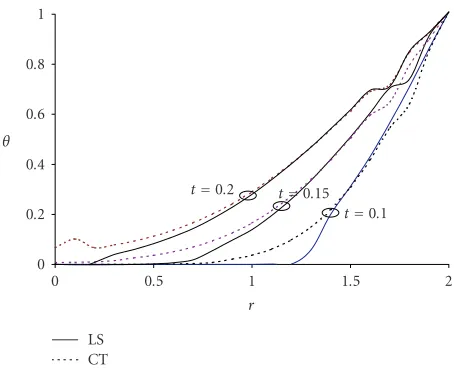
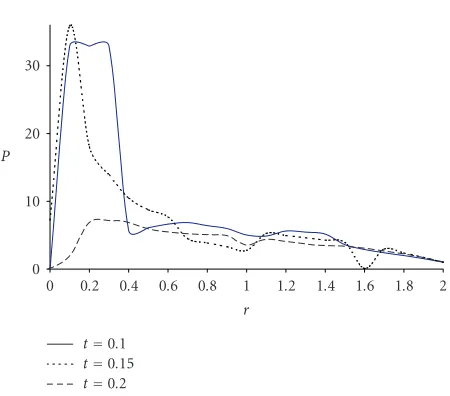
The numerical technique outlined above was used to obtain the temperature, radial displacement, radial stress, and concentration as well as the chemical potential distribu-tions inside the cylinder (a=2). These distributions are shown in Figures5.1–5.5, respec-tively. The computation was carried out for three values of time, namely,t=0.1,t=0.15, andt=0.2. For the sake of brevity some computational results are not being presented here.
2 1.5
1 0.5
0
r
0 0.2 0.4 0.6 0.8 1
θ
LS CT
t=0.2 t=0.15
[image:10.468.121.348.69.255.2]t=0.1
Figure 5.1. Temperature distribution.
τ0=0). It was found that near the surface of the cylinder where the boundary condi-tions dominate, the coupled and the generalized theories give very close results. Inside the cylinder, the solution is markedly different. This is due to the fact that thermal waves in the coupled theory travel with an infinite speed of propagation as opposed to a finite speed in the generalized case. In the coupled case, the solution fills the whole cylinder im-mediately. Thus, the solution is not identically zero (though it may be very small) for any small value of time. The solution obtained using the equations of generalized thermoe-lasticity, however, exhibits the behavior of finite speeds of wave propagation. For small values of time the solution is localized in a finite region of spaces surrounding the sur-face of the cylinder and is identically zero outside this region. This region grows with increasing time until it fills the hole cylinder. Its edge is the location of the wavefront. For large values of time, both theories give almost identical results. This is due to the short duration of the second sound effects.
Figure 5.2(b)shows that the medium adjacent to the cylinder surface undergoes ex-pansion deformation because of thermal shock while the others undergo compressive deformation. The deformation is a dynamic process. With the passage of time, the ex-pansion region moves insides gradually and becomes larger and larger. Thus the radial displacement becomes larger and larger. At a given instant, the nonzero region of radial displacement is finite, which is due to the wave effect of heat. It indicates that heat trans-fers into the deep of the medium with a finite velocity with the time passing. The more the considered instant, the more the thermal disturbed region and the radial displace-ment correspondingly.
2 1.8
1.6 1.4
1.2 1
r
−0.05 −0.03 −0.01 0.01 0.03 0.05
u
LS CT
(a)
2 1.9 1.8 1.7 1.6 1.5 1.4 1.3 1.2 1.1 1
r
−0.03 0 0.03 0.06
u
t=0.1
t=0.15
t=0.2
[image:11.468.115.356.58.472.2](b)
Figure 5.2. (a) Radial displacement distribution fort=0.1. (b) Radial displacement distribution.
of tensile stress close to the cylinder surface may be due to the influences of cross effects arising from the coupling of the fields of temperature, mass diffusion, and strain. Due to these cross effects, the thermal excitation results in that an additional mass concentration generates the additional field of thermal stresses.
2 1.5
1 0.5
0
r
0
−0.1 −0.2 −0.3 −0.4 −0.5 −0.6 −0.7
σrr
LS CT
(a)
2 1.8 1.6 1.4 1.2 1 0.8 0.6 0.4 0.2 0
r
−2 −1 0 1 2
σrr
t=0.1
t=0.15
t=0.2
[image:12.468.118.351.71.451.2](b)
Figure 5.3. (a) Radial stress distribution fort=0.1. (b) Radial stress distribution.
Figure 5.5shows the chemical potential distribution (P0=1). From the boundary of the cylinder surface, the chemical potential increases from unity value to a maximum value at some distance from the cylinder surface and then gradually decrease to a zero value atr=0, which confirm that the thermoelastic and diffusive waves propagate with finite speeds.
6. Concluding remarks
2 1.8 1.6 1.4 1.2 1 0.8 0.6 0.4 0.2 0
r
−2.5 −2 −1.5 −1 −0.5 0 0.5 1
C
t=0.1
t=0.15
[image:13.468.117.351.71.212.2]t=0.2
Figure 5.4. Concentration distribution.
2 1.8 1.6 1.4 1.2 1 0.8 0.6 0.4 0.2 0
r
0 10 20 30
P
t=0.1
t=0.15
t=0.2
Figure 5.5. Chemical potential distribution.
such problems. This approach gives exact solutions in the Laplace domain without any assumed restrictions on the actual physical quantities that appear in the governing equa-tions of the problem considered.
[image:13.468.123.348.298.496.2]corresponds to the propagation of wavefronts from the surfaces of the cylinder. This is not the case for the coupled theory where thermal effects extends to the whole cylinder immediately.
(3) The results presented in this paper should prove useful for researchers in material science, designers of new materials, low-temperature physicists, as well as for those work-ing on the development of a theory of hyperbolic thermodiffusion. Cross effects of heat and mass diffusion exchange with the environment arising from and inside nuclear reac-tors influence their design and operations [11]. Study of the phenomenon of diffusion is also used to improve the conditions of oil extractions (seeking ways of more efficiently recovering deposits) [17].
Acknowledgment
The author would like to thank the reviewers for their critical review and valuable com-ments which improved the paper thoroughly.
References
[1] M. Aouadi, Discontinuities in an axisymmetric generalized thermoelastic problem, International Journal of Mathematics and Mathematical Sciences 2005 (2005), no. 7, 1015–1029.
[2] , Variable electrical and thermal conductivity in the theory of generalized thermoelastic
diffusion, Zeitschrift f¨ur Angewandte Mathematik und Physik 57 (2006), no. 2, 350–366.
[3] F. Durbin, Numerical inversion of Laplace transforms: an efficient improvement to Dubner and
Abate’s method, The Computer Journal 17 (1974), 371–376.
[4] T. He, X. Tian, and Y. Shen, A generalized electromagneto-thermoelastic problem for an infinitely
long solid cylinder, European Journal of Mechanics—A/Solids 24 (2005), no. 2, 349–359.
[5] G. Honig and U. Hirdes, A method for the numerical inversion of Laplace transforms, Journal of Computational and Applied Mathematics 10 (1984), no. 1, 113–132.
[6] H. Lord and Y. Shulman, A generalized dynamical theory of thermoelasticity, Journal of the Me-chanics and Physics of Solids 15 (1967), no. 5, 299–309.
[7] W. Nowacki, Dynamic problems of thermodiffusion in elastic solids, Proceedings of Vibration Problems 15 (1974), 105–128.
[8] , Dynamical problem of thermodiffusion in solids. I, Bulletin de l’Acad´emie Polonaise des Sciences. S´erie des Sciences Techniques 22 (1974), 55–64.
[9] , Dynamical problem of thermodiffusion in solids. II, Bulletin de l’Acad´emie Polonaise des Sciences. S´erie des Sciences Techniques 22 (1974), 205–211.
[10] , Dynamical problem of thermodiffusion in solids. III, Bulletin de l’Acad´emie Polonaise des Sciences. S´erie des Sciences Techniques 22 (1974), 257–266.
[11] J. L. Nowinski, Theory of Thermoelasticity with Applications, Sijthoff& NoordhoffInternational, Alphen Aan Den Rijn, 1978.
[12] B. Santawa and S. K. Roychoudhuri, Magneto-thermo-elastic interactions in an infinite isotropic
elastic cylinder subjected to aperiodic loading, International Journal of Engineering Science 35
(1997), no. 4, 437–444.
[13] H. H. Sherief, Problem in electromagneto thermoelasticity for infinitely long solid conducting
cir-cular cylinder with thermal relaxation, International Journal of Engineering Science 32 (1994),
no. 7, 1137–1149.
[14] H. H. Sherief and M. A. Ezzat, A problem in generalized magneto-thermoelasticity for an infinitely
[15] H. H. Sherief, F. A. Hamza, and H. Saleh, The theory of generalized thermoelastic diffusion, Inter-national Journal of Engineering Science 42 (2004), no. 5-6, 591–608.
[16] H. H. Sherief and H. Saleh, A half-space problem in the theory of generalized thermoelastic di
ffu-sion, International Journal of Solids and Structures 42 (2005), no. 15, 4484–4493.
[17] B. Singh, Reflection of P and SV waves from free surface of an elastic solid with generalized
ther-modiffusion, Journal of Earth System Science 114 (2005), no. 2, 159–168.
[18] L. Thomas, Fundamentals of Heat Transfer, Prentice-Hall, New Jersey, 1980.
Moncef Aouadi: Department of Mathematics and Computer Science, Rustaq Faculty of Education, P.O. Box 10, Rustaq 329, Sultanate of Oman