IMF STRUCTURAL CONDITIONALITY: How Much Is Too Much?
Morris Goldstein
Dennis Weatherstone Senior Fellow, Institute for International Economics
Revision of paper presented at NBER Conference on
“Economic and Financial Crises in Emerging Market Economies”
Woodstock, Vermont 19-21 October 2000
I am grateful to Masood Ahmed, Mark Allen, Caroline Atkinson, C. Fred Bergsten, Barry Eichengreen, Marty Feldstein, Stanley Fischer, Tim Geithner, Stefan Ingves, Paul Keating,
Mohsin Khan, Robert Lafrance, Carl Lindgren, Robert Litan, Michael Mussa, Yung Chul Park, Jacques Polak, James Powell, Miguel Savastano, Todd Stewart, Ohno Wijnholds,John
Williamson, and Yukio Yoshimura for helpful comments on an earlier draft, and to Trond Augdal for superb research assistance. I also want to thank Stanley Fischer
and his colleagues at theIMF for sharing with me the Fund’s data on structural conditions in Fund programs.
I. INTRODUCTION
“... detailed conditionality (often including dozens of conditions) has burdened IMF programs in recent years and made such programs unwieldy, highly conflictive, time consuming to negotiate, and often ineffectual.”
“The IMF sho uld cease lending to countries for long-term development assistance (as in sub-Saharan Africa) and for long-term structural transformation (as in post-Communist transition economies)... The current practice of extending long-term loans in exchange for member countries’ agreeing to conditions set by the IMF should end.”
Meltzer Report [2000, pp. 7,8, and 43]
“Both the Fund and the Bank have tried to do too much in recent years, and they have lost sight of their respective strengths. They both need to return to basics... [The Fund] should focus on a leaner agenda of monetary, fiscal, and exchange rate policies, and of banking and financial-sector surveillance and reform.”
Council on Foreign Relations Task Force Report [1999, p. 18-19] “The one common theme that runs through perceptions of ESAF at the country level is a feeling of a loss of control over the policy content and the pace of implementation of reform programs.”1
External Evaluation of the ESAF [Botcheway et al, 1998, p. 20] “The IMF should eschew the temptation to use currency crises as an opportunity to force fundamental structural and institutional reforms on countries, however useful they may be in the long term, unless they are absolutely necessary to revive access to international funds.”
Martin Feldstein [1998, p. 32]
“..the IMF’s activities are not related to those specified in its charter for the simple reason that the par-value system of exchange rates it was to monitor no longer exists. In the tradition of skilled bureaucracies, the IMF has turned to new areas and has managed to expand substantially its financial resources and, in the process, its influence.”
George Shultz [1995, p.5]
“The IMF has not been established to give guidance on social and political priorities, nor has its voting system been designed to give it the moral authority to oversee priorities of a noneconomic nature. Its functions have to be kept narrowly technical....and the Fund has to accept that the authorities of a country are the sole judges of its social and political priorities.”
David Finch [1983, pp. 77-78]2
1
ESAF is the Fund’s Enhanced Structural Adjustment Facility, established in 1987 to provide long-term concessional assistance to low-income countries facing protracted balance-of-payments problems.
“... the IMF programs in East Asia are far from optimal for restoring financial market confidence in the short term.... they have covered a very wide range of policies beyond the immediate financial crisis.... Most of the structural reforms, however, simply detract attention from the financial crisis. They have taken government expertise, negotiating time, and political capital away from the core issues of financial markets, exchange rate policy, and the like.”
Steve Radelet and Jeff Sachs [1998, pp. 67-68]
“In view of the size of the current deficits and the difficulties that may arise in private intermediation, the Fund must be prepared, when necessary, to lend in larger amounts than in the past. Also, the structural problems faced by many countries may require that adjustment take place over a longer period than has been typical in the frame work of Fund programs in the past.”
IMF World Economic Outlook [1980]
“The Fund approach to adjustment has had severe economic costs for many of these [developing] countries in terms of declines in the levels of output and growth rates, reductions in employment and adverse effects on income distribution.”
Report by the Group of Twenty-Four [1987, p. 9]
“Our prime objective is growth. In my view, there is no longer any ambiguity
about this. It is towards growth that our programs and their conditionality are aimed.” “Only the pursuit of ‘high-quality’ growth is worth the effort. What is such
growth? It is growth that can be sustained over time without causing domestic and external financial imbalance; growth that has the human person at its center... growth that, to be sustainable, is based on a continuous effort for more equity, poverty alleviation, and empowerment of poor people; and growth that promotes protection of the environment, and respect for national cultural values. This is what our programs are, more and more, and must aim for.”
From speeches by former IMF Managing Director, Michel Camdessus. [1990, 2000a, respectively]
“In recent years, some critics of the IMF have gone to the opposite extreme, arguing that the IFIs should have done more, especially in the context of the economies in transition to develop an appropriate framework of property rights in support of markets.... in considering the future of the two institutions, their activities need to be geared to strengthening the private sector and the appropriate role of government in relation to it.”
Anne Krueger [1998, p. 2003]
2
. “I do not accept the view that when it comes to our poorer member countries, we should not be lending to them, but should turn it over to someone else.... Is the poverty reduction and growth facility ... which we are working on jointly with the World Bank ... going to be an improvement in the way we deal with countries? Absolutely. Why? Because ... it forces us, in cooperation with the World Bank, to make sure that the macroeconomic framework is consistent with what needs to be done for social reasons. Macroeconomic instability is bad for everyone everywhere... That is why we should remain in these countries.... But we cannot do that in a way that ignores the fact that poverty is the main problem confronting these countries, and that there must be massive efforts, spearheaded by the World Bank, to reduce poverty in these countries.”
Stanley Fischer, IMF First Deputy Managing Director [2000a] “A changed IMF is needed for the changed world we now have... As we look to the future we need to redouble our efforts to find better approaches if not answers to fundamental questions...How do we balance concerns about intrusiveness in national affairs and a desire to promote national ownership of reform programs with a desire to see governments take bolder steps to, for example, build stronger social safety nets, implement core labor standards, empower civil society groups, reduce the role of government in the economy, and address critical issues related to governance, corruption, and crony capitalism?”
U.S. Treasury Secretary Summers [1999]
“...the proposed eligibility criteria [for IMF lending in the Meltzer report] are too narrow. Even where they are met, they would be unlikely to protect economies from the broad range of potential causes of crises. The criteria focus on the
financial sector, and yet even problems that surface in the financial sector often have their roots in deeper economic and structural weaknesses. One simply cannot predict with confidence what the next generation of crises will be and therefore we need to preserve the IMF’s ability to respond flexibly to changing circumstances.”
U.S. Treasury Response to the Meltzer Report [2000a, p.17]
“A central part of the programs in the Asian crisis countries was an unprecedented body of structural reforms...The overriding question is whether it was appropriate to place so much emphasis on structural reform measures in the financial and corporate sectors... The answer is clearly yes.”
IMF Report (Lane et al. [1999]) on Fund Programs in Indonesia, Korea, and Thailand “... the bottom line of the ‘era of the IFIs,’ despite obvious shortcomings, has been an unambiguous success of historic proportions in both economic and social terms.”
Minority Dissent, Meltzer Report (Bergsten et al. [2000, p. 111])
As suggested above, an active debate has long been underway -- and has intensified in the wake of the Asian crisis -- about the appropriate scope and intrusiveness of IMF policy conditionality. In this paper, I take up one key element of that debate, namely, the role of structural policies in IMF-supported adjustment programs. By “structural
policies,” I mean policies aimed not at the management of aggregate demand but rather at either improving the efficiency of resource use and/or increasing the economy’s
produc tive capacity. Structural policies are usually aimed at reducing/dismantling government- imposed distortions or putting in place various institutional features of a modern market economy. Such structural policies include, inter alia: financial-sector policies; liberalization of trade, capital markets, and of the exchange rate system; privatization and public enterprise policies; tax and expenditure policies (apart from the overall fiscal stance); labor market policies; pricing and marketing policies; transparency and disclosure policies; poverty-reduction and social safety-net policies; pension policies; corporate governance policies (including anti-corruption measures); and environmental policies.
To set the stage for what follows, it is worth summarizing the main concerns and criticisms that have been expressed about the IMF’s existing approach to structural policy conditionality.3 These typically take one or more of the following forms.
First, there is a worry that wide-ranging and micro- managed structural policy recommendations will be viewed by developing-country borrowers as so costly and intrusive as to discourage unduly the demand for Fund assistance during crises.4 Even
3
Neither these concerns and criticisms, nor the counter-arguments outlined later in this section, should be interpreted as my own views. I provide my own summary assessment of past Fund structural conditionality in Section VI.
4
though the cost of borrowing from the Fund (the so-called rate of charge) is much lower than the cost of borrowing from private creditors -- particularly during times of stress -- we observe that developing countries usually come to the Fund “late in the day” when their balance-of-payments problems are already severe.5 This suggests that developing countries place a non-trivial shadow price on the policy conditions associated with Fund borrowing. The concern is that if these conditions become too onerous, emerging
economies will wait even longer to come to the Fund (as Thailand did in 1997) and/or will turn to regional official crisis lenders that offer easier policy conditionality (e.g., in 1998 Malaysia was one of the first beneficiaries of low-conditionality Miyazawa
Initiative funds, and Asian countries could eventually decide to elevate the infant Chiang-Mai swap arrangements into a full- fledged Asian Monetary Fund).6 The outcome -- so the argument goes -- would then be even more difficult initial crisis conditions, greater resort to the anti-social behavior that the Fund was established to prevent, and a tendency toward Gresham’s Law of conditionality (where weak regional conditionality would drive out not only the unnecessary but also the necessary elements of Fund
conditionality).
A second concern is that insistence on deep structural reforms in cases of illiquidity (rather than insolvency) will serve only to frighten private investors about the size of the problem, thereby rendering more difficult the restoration of confidence and the rollover of short-term capital flows that are the keys to resolving the liquidity crisis.7 No country (including the G-7 countries) is without some structural weaknesses but it is argued that
5 The Fund’s rate of charge averaged about 4.5 percent in 1997-2000; in contrast, emerging-market bond spreads (relative to U.S. Treasuries) have fluctuated from 375 to 1700 basis points since the outbreak of the Thai crisis in mid-1997.
6
however desirable structural policy reforms may be for the performance of the economy over the longer term, it is a mistake to suggest that such reforms are indispensable to resolving the crisis (when they are not). Among the Asian crisis countries, Korea is identified as a case where solvency was never in question and where less emphasis on structural refo rm both in the diagnosis and the policy prescription would have produced a milder crisis.
Concern number three is with equal treatment of countries -- one of the Fund’s key operating principles. Here, the argument is that the Fund has been asking for sweeping structural reforms from developing countries that it would not ask of industrial countries were the latter in similar circumstances. As Paul Volcker put it, “When the Fund consults with a poor and weak country, the country gets in line. When it cons ults with a big and strong country, the Fund gets in line.”8 While differences across countries in economic and political power are a fact of life, the argument is that requiring developing countries to undertake more structural remedies (than would their industrial-country counterparts) undermines local “ownership” of Fund programs. It also works at cross-purposes from simultaneous efforts to forge a consensus on strengthening the international financial architecture in (mixed developing country/industrial-country) groups like the G-20 and the Financial Stability Forum.
Yet a fourth criticism is that permitting the Fund to stray from its core competence of macroeconomic and exchange rate policies into a host of structural policy areas results in poor crisis management, weakens the Fund’s overall reputation for competent analysis and advice (with adverse spillovers for the credibility of its recommendations in core 7
See Radelet and Sachs [1998]. 8
policy areas), and runs counter to a sensible division of labor and an application of comparative advantage among the various international financial institutions (IFIs). In this connection, critics have maintained: that the Fund bungled bank closures in
Indonesia and precipitated a credit crunch in the crisis countries by requiring an unduly rapid increase in bank capitalization;9 that the Fund lacks both the expertise and staff resources to make timely and sound policy recommendations in areas as diverse as corporate governance, trade policy, privatization, poverty reduction, and environmental management; and that “mission creep” on the part of both the Fund and the Bank, cum a blurring of responsibilities between them, reduces the public and legislative support necessary to fund them adequately.10 Long-term structural reforms (at least outside the financial sector) and poverty reduction should be the main business of the World Bank -- not of the Fund.
A fifth charge is that the way the Fund has been managing its structural policy conditionality is flawed. Specifically, the argument is that multiplication of structural performance conditions, the specification of “micro” policy measures, and the increasing reliance on (qualitative) structural benchmarks and program reviews (as monitors of policy performance) have combined both to increase the uncertainty facing Fund borrowers and to lower the incentive to follow through with structural reform. Performance criteria were instituted not only to assure the Fund that its financial resources were being used for the purposes intended but also to assure the borrowing country that if it undertook certain pre-specified policy actions it would be eligible to
9
See, for example, Stiglitz [1999]. 10
draw.11 Also, because performance criteria were relatively few in number, easily
measured, and macro in their impact, they both conveyed a relatively clear message about which policy actions were deemed (by the Fund) to carry the highest priority and
provided a fairly predictable link with bottom- line economic outcomes (e.g.,
improvement in the balance of payments). But when a Fund program contains say, on the order of 50 or more qualitative structural policy conditions, when many of these
conditions are very micro in nature, and when both fulfillment of these conditions and eligibility to draw require judgmental calls by the Fund, signals, impacts, and incentives will be more muddled. Should meeting 30 of 50 structural policy conditions be
interpreted as a “good overall effort” that merits Fund support, or should it be viewed as a significant non-compliance with the program?
Suffice to say that these criticisms of the Fund’s structural policy conditionality have not gone unchallenged. Again, in the spirit of motivating the subsequent discussion, it is well to consider the following counter-arguments.
Although the structural policy conditions the Fund attaches to its loans are often demanding and threaten vested interests within the country, emerging economies recognize that a Fund program represents their best chance to make real traction on the structural weaknesses that have underpinned their crisis vulnerability. Private capital markets, while they sometimes supply strong disciplining force, are not perfect
substitutes for either the Fund’s specific policy advice or its financing; indeed, in more than a few cases, private creditors will not extend credit in large amounts until the Fund
11
has blessed a country’s policies.12 Turning the steering wheel over temporarily to an outside party is always costly but better the Fund than one or two large G-7 countries. Ironically, the structural policy measures that have drawn the most critical fire in several of the Asian crisis countries (Indonesia and Korea) were for a long time high on the priority list of domestic reformers, but they could not get those reforms implemented (over the opposition of the ruling elite) in a non-crisis situation.13 At this point, there is no plan to turn Asian swap or credit arrangements into a serious rival to the Fund, at least with respect to offering large bail-outs under competing policy conditionality. Also, very few crisis countries (in Asia or elsewhere) have seen capital controls as the preferred mode of crisis management. Just as it’s not optimal for a host country to establish the weakest regulatory and prudential regime simply because it gives market participants the most freedom of action, it is not optimal (from the viewpoint of developing countries) to make Fund structural policy conditionality too easy or flexible. Fund “gaitsu” -- warts and all -- may still the best option out there for jump-starting structural reform.
The distinction between illiquidity and insolvency is not regarded as particularly helpful in most crisis situations since the dividing line between the two often rests on the quality of crisis management, and since countries differ from firms both in the nature of the relevant collateral and in their willingness (as opposed to ability) to pay.14 While investor panic was an important part of the Asian crisis story, so too were “bad
12 Fischer [2000a, p. 1] argues that the fundamental reason why one needs an institution like the IMF is that “... the international financial system left to itself does not work perfectly, and it is possible to make it work better for the sake of the people who live in that system.” Also, see Masson and Mussa [1995] and Krueger [1998]. Rodrik [1995] notes that an experiment in which private creditors attempted to specify and monitor conditionality in Peru was soon discontinued.
13
See Haggard [2000]. On the role of domestic reformers in the Asian crisis countries, he concludes as follows: “...it is misguided to see the course of policy solely as a response to external political pressures from the international financial institutions and the United States... At least in some important policy areas, domestic groups were reaching surprisingly similar conclusions on the need for reform.” (p. 12).
fundamentals” that increased downside risk. For example, in the run-up to the Korean crisis: 7 of the 30 largest chaebol were essentially bankrupt; there were large terms of trade losses in 1996 (especially for semi-conductors); non-performing loans in the banking system and leverage in the corporate sector were already high; there was a low return on invested capital; capital inflows were biased toward short-term capital and against foreign direct investment; there was a lack of transparency (including on the country’s short-term foreign liabilities); and substantial political uncertainty exacerbated the government’s credibility problem.15 Yes, many of these structural problems were long standing and despite them, Korea had shown impressive growth performance over several decades. And yes, Korea has staged an impressive V-shaped recovery without
eliminating all these structural problems. Nevertheless, it does not follow that Korea could have regained market confidence without making a good “start” on structural reform in 1997-98. Fund financing cum debt rescheduling and an (eventua l) turn to easier monetary and fiscal policies -- without any structural policy reform -- would not have turned the situation around. Treating only the symptoms and not the (structural) root cause of the problem is not the way to restore confidence. Looking at pre-crisis fiscal positions in the crisis countries without considering the contingent government liabilities associated with financial-sector restructuring provides a misleading picture of
fundamentals.16 And the alleged negative effect of Fund public pronouncements on market confidence is said to be much exaggerated. Once Thailand’s fall “woke up”
14
See Fischer [1999]. 15
See Roubini’s comments in McHale [2000b]. Claessens et al. [1999] also found that (pre-crisis) the four countries most seriously affected by the Asian crisis ranked low on the quality of the regulatory
environment in an international comparison of middle -income emerging economies in East Asia and Latin America.
16
market participants to the poor health of banks and corporates in the rest of Asia and every large G-10 bank and security house in the region was issuing weekly reports on the rising share of non-performing loans in Asian financial systems, it is very unlikely that a Fund statement claiming it was only a short-term liquidity crisis would have turned the tide (after all, the Fund’s then Managing Director was already telling all who would listen that the crisis was really “a blessing in disguise”).17
Reflecting, inter alia, their less preferred access (in terms of maturity, currency, and predictability) to international capital markets, their weaker institut ional framework (ranging from judicial systems to insolvency regimes), and their track record of higher political instability, developing countries are different from industrial countries.
Recognizing this difference is not unequal treatment but seeing the world as it is. If the Asian crisis countries -- despite their impressive performance on economic growth, inflation, and macro- fundamentals over a long period -- were regarded by private financial markets as just like industrial countries, they could have “done an Australia” and got out of the crisis by lowering interest rates and letting their exchange rates
depreciate moderately -- and this without any Fund assistance.18 In the event, they could not do that. Nor will the crisis countries be able to sustain their recoveries if they lapse back into the same structural weaknesses they had before. As such, it is not realistic to expect a developing country that gets into a crisis to live by the same structural policy conditionality as would a troubled industrial country.19 For the foreseeable future,
17
See Goldstein [1998] and Ahluwalia [2000] on the “wake up” hypothesis as an explanation of the contagion in the Asian crisis.
18
See Krugman [1998] on what the “confidence game” means for monetary and fiscal policies in developing countries during a crisis versus what is asked from industrial countries.
19
See Eichengreen and Hausman [2000] on financing differences between developing countries and industrial countries.
developing countries will have to contend with a history of banking, debt, and currency crises, and restoration of confidence will often require a different dose and mix of macroeconomic and structural policies than would be the case for industrial countries. There is no indication that disagreement over past Fund structural policy conditionality is hampering the work of groups like the G-20 and the FSF; quite the contrary, those groups are making real progress in areas like the application of international financial standards. The Fund has developed considerable expertise in dealing with banking and financial-sector problems in developing countries. Over the past five years, more than 45
specialists (including former bank supervisors) have been added to the staff of the Fund’s Monetary and Exchange Affairs Department alone. Admittedly, bank closures in
Indonesia did not go well. But since deposit insurance arrangements were not in place, since the authorities were willing to close only a small share of the insolvent banks, and since there were concerns about the moral hazard effects of a blanket guarantee, there was no easy alternative to that action.20 Likewise, if stricter bank capitalization
requirements had not been instituted in the crisis countries, we would have seen rampant “double or nothing” lending behavior by insolvent lenders and an even higher fiscal bill for the bank clean-up. Evidence on the existence of a credit crunch in the crisis countries in 1997-98 is far from clear cut.21
In areas outside the Fund’s comparative advantage, the Fund draws heavily on other IFIs with the requisite expertise -- and especially on the World Bank. This collaboration is particularly close on poverty reduction and social safety net issues but also applies increasingly to corporate governance, privatization, trade policy, and environmental
20
See Lindgren et al. [1999]. 21
impacts. Eliminating all overlap between the Fund and the Bank (on fiscal and banking reform) is neither feasible nor desirable. The Fund’s major focus in the poor countries remains on the macroeconomic framework -- a specialization which no other IFI is as qualified to handle. A merger of the Fund and the Bank is unappealing -- both because it would sacrifice the speed and efficiency that comes with still a rather small IMF, and because a mega-IFI would have too much power across a wide spectrum of macro and microeconomic issues.
Yes, the Fund has given increased emphasis in recent years to economic growth and to social conditions in the design and implementation of its programs with developing countries -- just as it was responsive to the unique opportunity and massive need for institution building systems in the fledging market economies and new democracies of Eastern Europe. The world has changed. If the Fund did not change with it and if the Fund did not embrace the same objectives in its programs as its members pursue in their national economic policies, there would be little chance that Fund programs would be either agreed or implemented.22
Structural policies are not like macroeconomic policies and indicators of policy compliance have to reflect those differences. You can’t measure progress on banking supervision or privatization the same way you track net domestic credit or international reserves. Performance benchmarks for structural policies have to be qualitative and a measure of discretion is needed to evaluate the results. Also, because of the
interdependencies among structural policies, a macroeconomic impact will come only if progress is made on many fronts simultaneously. Furthermore, the devil is in the details. It makes a big difference if the borrowing country responds to a Fund condition for a
large cut in the budget deficit by slashing expenditure on health and education versus the curtailment of the national car project. And because both the implementation of and pay-off from structural projects take longer than macroeconomic and exchange rate policies, it is necessary to measure progress along the way. All of this produces many detailed structural performance tests and some uncertainty about whether the overall effort will warrant Fund financial support, but there are no shortcuts that would work better. The rest of the paper elaborates on these issues and sets out some additional arguments and factual material relevant for gauging what IMF structural policy conditionality should be like in the future. In Section II, I ask what if any guidance on structural policy involvement can be gleaned from the Fund’s charter and/or guidance notes from its Executive Board. I then discuss three alternative mandates for Fund lending within which structural policy conditionality might operate -- ranging from a narrow one based on correction of balance-of-payments problems and resolution of the current crisis, to broader ones that add avoidance of future crises and pursuit of “high quality” economic growth to the agenda. Section III looks at various dimensions of Fund structural policy involvement and conditionality -- both in the Asian crisis countries over the past three years and more broadly over the past several decades. It also offers some tentative conclusions on the effectiveness of that conditionality, with particular emphasis on the compliance with Fund conditionality. Because very little factual material has been published heretofore on Fund structural policy conditionality, Section III contains a number of tables and charts documenting the patterns in such conditionality. In Section IV, I speculate on why the scope and micro- management of Fund structural policy conditionality have increased in recent years. Section V lays out a set of potential
22
approaches to streamlining Fund structural policy conditionality. Finally, Section VI provides some brief concluding remarks that summarize my own views on Fund
structural policy conditionality. A postscript summarizes the findings of a group of very recent Fund reports on conditionality -- including one (IMF [2001c]) with an expanded data base on Fund structural conditions -- that appeared after (the body of ) this paper was written.
II. STRUCTURAL POLICIES AND THE MANDATE OF THE IMF A. Scripture and Field Manuals
One starting point for figuring out how involved the Fund should be in structural policies would be to look at the Fund’s basic marching orders. These range from the IMF’s charter (called the “Articles of Agreement”) to specific guidance notes issued by the Fund’s Executive Board to Fund staff.
Table 1 reproduces (from Article I of the Articles of Agreement) the Fund’s purposes. While amendments have been made to other parts of the charter over the past fifty five years, not so with the purposes. Two things are immediately obvious from even a casual reading. There are many purposes --not just one; and there are a number of terms and concepts -- such as “confidence,” “national and international prosperity,” “temporary,” and “exchange system”-- that are (and indeed, have been) susceptible to multiple interpretations.
It is clear (at least to me) that a primary objective is not only to correct balance-of- payments disequilibria but also to do so in a particular way, that is, in a way that doesn’t involve either excessive deflation/unemployment at home or beggar-thy-neighbor
policies. This is how I interpret the phrases: (in paragraph 5) “... without resorting to measures destructive of national and international prosperity;” and (in paragraph 3) “... to avoid competitive exchange depreciation.” Such an interpretation is of course also
consistent with the Fund’s establishment as a response to the beggar-thy- neighbor and Great Depression problems of the 1920s and 1930s.
There is also clear support for measures that promote openness to international trade and a multilateral system of payments, and opposition to measures that hamper this openness. Capital movements are not mentioned. Again, this is consistent with the perceived (trade/output vicious circle) lessons of the 1920s and 1930s, and with the then popular view about the perils of destabilizing capital flows.
While there is no denying that a key task of the Fund at the time of its creation was to oversee a system of fixed but adjustable exchange rates, I interpret the promotion of “exchange stability” (in paragraph 3) as going beyond any particular form of exchange arrangements (be it adjustable pegs, currency boards, floating rates, etc). Put another way, I don’t see the raison d’être of the Fund as having disappeared in the early 1970s along with the arrival of floating exchange rates. If the intention were otherwise, paragraph 3 would presumably have referred to “exchange rate” stability, and there would be no purposes other than that one.
Although Article I makes it plain that the framers regarded “... high levels of
employment and income” and “...development of productive resources” as good things, it doesn’t say that the Fund should pursue those objectives by whatever means available. Instead, they specify that the Fund should facilitate “... the expansion and balanced
growth of international trade” and “contribute thereby” to buoyant domestic economic activity.
Where else might one look in the Fund’s charter for advice relevant to structural policy conditionality? Many would say the revised (in 1976) Article IV, which deals with general obligatio ns of member countries and with the Fund’s surveillance
responsibilities. Here, economic growth, and to a lesser extent, international capital movements, get greater play (than in the Fund’s purposes). Specifically, the new Article IV recognizes specifically that the essential purpose of the international monetary system is to provide a framework that both “... facilitates the exchange of goods, services, and capital among countries, and that sustains sound economic growth.” More noteworthy, member countries assume the general obligation to “... endeavor to direct ... economic and financial policies toward the objective of fostering orderly economic growth with reasonable price stability,” and the Fund assumes the obligation to oversee the
“compliance” of each member country with this obligation.
Since “economic and financial policies” directed toward orderly economic growth potentially covers a lot of ground, the practical upshot of the revised Article IV was that it gave the Fund a much broader license to conduct wide-ranging surveillance and annual consultations with members. Ever since then, the Fund’s Article IV consultation reports have covered a host of policy areas, including many that would be designated as
structural policies.23 Even though Article IV carries the title, “Obligations Regarding Exchange Arrangements,” it embodied the view that you had to look at the underlying domestic policy determinants of a stable exchange rate system to see if countries were
23
For a review and analysis of the content of Fund surveillance, see Crow et al. [1999].
meeting their international obligations.24 Yes, Article IV is about Fund surveillance -- not about Fund policy conditionality. But the fact that the former has been given much wider scope (since at least the mid-1970s) probably has contributed somewhat to a wider field of view in Fund lending arrangements as well (more on that in Section IV).
But what about more specific directives relating to performance criteria agreed and issued by the Fund’s Executive Board. In my view, the most relevant document is probably the conditionality guidelines for stand-by arrangements, issued in 1979; see Table 2. To make a long story short, while the guidelines permits the number and content of performance criteria to vary with a country’s problems and institutional arrangements, guideline 9 specifies, inter alia, that performance criteria will “...normally be confined to macroeconomic variables,” and that “performance criteria may relate to other variables only in exceptional cases when they are essential for the effectiveness of the member’s program because of their macroeconomic impact.” My interpretation of all this is that, at least in Fund standby arrangements, the intention was to limit the number of structural-policy performance criteria and to avoid “micro” conditionality (that is, measures that don’t have macroeconomic impact). While these guidelines have been revisited many times during later Board reviews of conditionality, they have been repeatedly endorsed. But one must also take note that a variety of other lending arrangements (besides standbys) has been created in the Fund with the support of the membership over the past thirty years (ranging from a facility to assist transition economies cope with the shift away from state trading to multilateral market-based trading, to one that was to assist countries experiencing liquidity problems related to Y2K ). More to the point of this
24
Eichengreen [1999] has made a similar argument that the Fund can’t expect to be successful at promoting international financial stability without addressing sources of financial instability at the national level.
paper, some of those lending windows are directly aimed at protracted balance-of-payments problems and at supporting comprehensive efforts at macroeconomic and structural reform. These include the Extended Fund Facility (EFF, established in 1974), and both the Structural Adjustment Facility (SAF, established in 1986) and Enhanced Structural Adjustment Facility (ESAF, established in 1987); eligibility for both the SAF and the ESAF is restricted to low-income countries.25 For these lending windows, structural policy involvement is at the heart of the exercise and there is little guidance on how many or what kinds of structural policy measures would be viewed as “out of bounds.”
Given the prominence of governance issues in the Asian crisis, a final guidance note worth noting is the one issued in July 1997 by the Fund’s Executive Board on “The Role of the IMF in Governance Issues.” While the note states right at the beginning that “... the responsibility for governance issues lies first and foremost with the national authorities..,” it seems to give the Fund staff quite wide berth to include governance and corruption measures in Fund conditionality if they can make the case that governance problems have some direct macroeconomic impact. In addition, while the note urges the Fund staff to rely on other institutions’ expertise in areas of their purview, it states that the Fund could nevertheless recommend conditionality in those areas (outside the Fund’s expertise) if the staff considered that such measures were “.... critical to the successful implementation of the program.” Given the timing and context of this guidance note (just at the outset of the Asian crisis), some Fund staff have expressed the view (to me) that the Fund’s Board was sending them a signal that they would henceforth not support programs that ignored serious and widespread governance and corruption problems.
25
To sum up, the Fund’s existing marching orders on structural policy conditionality are Janus-faced enough so that both supporters of narrow conditionality and those of more comprehensive conditionality can find their own biblical passages to buttress their arguments. On the one side, I don’t see in the Fund’s charter a broad agenda aimed at high quality growth. What I see instead is a focus on balance-of-payments adjustment, trade opening, elimination of payments restrictions, efforts to increase stability of the exchange rate system, and a directive to avoid modes of external adjustment that make recession/deflation deeper than necessary and that impose undue costs on other
countries.26 This is not to deny that the Fund’s membership may want to pursue high-quality growth (and poverty reduction) for a variety of reasons, including moral
imperatives. It’s just that I can’t find that commandment on the original stone tablets. In a similar vein, the Fund’s conditionality guidelines for standby arrangements appear to have had the intention of limiting the number of structural performance criteria,
particularly if they are micro in nature. On the other side of the ledger, the Fund’s overall surveillance responsibilities (under the revised Article IV) are quite wide ranging as regards structural policies, a succession of specific lending windows has been established over the past 25 years or so with an explicit structural policy orientation, and guidance notes on “new” structural policy issues like governance and corruption give the Fund staff considerable leeway to include such measures in conditionality so long as they can make a case that they are critical to the success of the program. Perhaps more telling, I could find no evidence of concern about the scope or intrusiveness of structural policy conditionality in the published summaries (so-called Public Information Notices, or
26
It’s also relevant to note that, unlike the charter of the EBRD, the Fund’s charter says nothing about promoting “democracy;” see Polak [1991] for a discussion of political influences on Fund lending.
PINs) of Executive Board meetings on the Thai, Indonesian, and Korean programs over the past three years -- even though the number and detail of structural conditions in those three programs are extraordinary (see Section III below).
B. Three Alternative Mandates
If there is relatively little guidance available about the appropriate intrusiveness of Fund structural policy conditionality from official sources, one might consider what different mandates for the Fund would imply about such conditionality. Here, I consider three possibilities, starting with the narrowest and ending with the broadest (and most ambitious).
(a) Mandate I: the Fund’s primary focus would be on macroeconomic and financial stability; its crisis management guideline would be to assist a country to get out of the current crisis as soon as possible (without imposing undue costs on itself or its
neighbors).
An announced IMF focus on macroeconomic and financial stability would be similar to the increasing popular practice of national central bank announcing that their primary objective is price stability. It doesn’t preclude giving some consideration to other objectives but it makes clear which objective is king and where the authority’s central responsibility lies. The emphasis on getting out of the current crisis would mean that crisis management/resolution -- and not crisis prevention -- should guide program design. Crisis-prevention measures would presumably then be handled by the country on its own after the current crisis is resolved.
Would Mandate I preclude Fund structural policy conditionality during a crisis? The answer, I believe, is no. But the extent of the structural conditions would be limited to measures directly related to resolution of the current crisis and their form would depend both on the nature of the crisis and the institutional structure in place in the crisis country; in addition, the design of essential structural policy conditions outside the Fund’s core competence (monetary, fiscal, exchange rate, and financial sector policies) would need to be handled by other IFIs. A few examples should suffice to illustrate the point.
Suppose that key contributory factors to a balance-of-payme nts crisis were an overvalued exchange rate and overly expansionary monetary and fiscal policies. Also assume that correction of relative prices was being thwarted by widespread indexation agreements in wage contracts. Assume that the alternatives to devaluation as an
adjustment tool are a more draconian tightening of monetary or fiscal policy (that would drive the domestic economy into deep recession) and/or a large hike in tariff and non-tariff barriers. In that case, reduction or elimination of those indexation provisions could be regarded as “essential” to external adjustment (without either excessive deflation or beggar-thy- neighbor effects ) and a labor-market performance test could be part of conditionality.27
Next consider a case where the primary source of the external disequilibrium is a large budget deficit. Assume that the necessary fiscal adjustment needs to be large, that the economy is expected to undergo a serious contraction, that the incumbent government is quite unpopular at home (because there is a long history of cronyism and corruption), and that there is no social safety net to speak of. In that situation, it could be argued that the
Fund program needs to contain a few structural measures (e.g., the closing of a
government cartel or monopoly) to send a visible signal to the public that some patronage is being taken away from well-connected government cronies and therefore that the program will be “even-handed” -- and this even if the structural measures themselves have no macroecono mic impact and lie outside the Fund’s core competence.28 Here, these structural measures might be defended as necessary to establish “confidence.” Similarly, the creation of an unemployment insurance scheme or some other form of social safety net could be viewed as necessary to sustain popular support for the fiscal correction effort over the one or two- year program period.
Next, picture a situation where there is a banking crisis underway without a deposit insurance system in place. Depositors are withdrawing deposits from a group of weak banks and the government is supporting the weak banks’ ability to meet withdrawals by providing liquidity assistance to those banks. The deposit run is spreading and the liquidity injections are pumping up the monetary aggregates and driving down the exchange rate. It is also known that substantial funds will soon be needed to recapitalize insolvent banks and to increase capital at solvent but still weak banks. Because its debt burden is already high, the government cannot fund all the bank clean- up costs on its own. It will need help from private creditors abroad. Here too, one could defend structural conditions relating to bank closures and/or to deposit insurance reform as essential for resolving the current crisis; without them, the authorities will not be able to
27
Another example where labor market policies could be considered essential to overcoming the current crisis is when a banking crisis cannot be overcome without financial-sector and corporate restructuring, and the latter cannot be accomplished without revision of restrictive laws governing employee layoffs.
28
Allen [1993, p. 18] takes such a view: “Structural policies can also help build and maintain the political consensus that will support macroeconomic stabilization -- for example, by combating unproductive and politically unpopular rent-seeking activities.”
control monetary policy and to halt the free fall of the currency. If the immediate aim of raising funds from abroad is being hampered by restrictions on capital inflows and/or by poor disclosure that prevents foreign creditors from judging the worth of domestic banks, removal/correction of restrictions/disclosure practices too might be defended as
legitimate elements in conditionality.
In contrast to the above scenarios, consider a crisis situation brought on say, by a large terms-of-trade shock or a shift in investor sentiment stemming from contagion in a neighboring country. Assume also that there are many structural policy weaknesses and institutional gaps but that these are not serious enough or linked closely enough to
monetary, fiscal, and exchange rate policies to prevent the crisis from being resolved with traditional macroeconomic instruments plus some Fund financing. Here, however
desirable structural measures may be for longer-term performanc e, they would not be included as conditions for the program. A plain vanilla Fund program will do the job. Another relevant question is whether Mandate I would still permit the Fund to make a contribution to poverty reduction in poor countries. The answer is yes, but only in so far as macroeconomic and financial stability itself contributes to poverty reduction, or because the Fund (in collaboration with the Bank) sees the incorporation of social safety nets into crisis resolution programs as necessary for the successful implementation of those programs. Longer-term efforts (outside of crises) to fight poverty would then be handled by the Bank and the regional development banks.
(b) Mandate II: the Fund’s primary focus would be (as in I) on macroeconomic and financial stability: its crisis guideline would be to assist a country not only to get out of the current crisis but to minimize the chances of getting into another one down the road.
While the Fund’s core competence remains the same in Mandate II as in I, the big difference is that the Fund now incorporates crisis prevention as well as crisis resolution in program design. An implicit judgement here is that the country needs to use the crisis as a mechanism to reduce its crisis vulnerability and that it would not be able to do this on its own (i.e., without a Fund program) after the current crisis is resolved. Better then to “make hay while the sun shines” and combine crisis resolution and crisis prevention in the current program. If confidence in the crisis economy is very low, the Fund might also argue that investors will not return unless there is evidence that the probability of another (near-term) crisis is low; this in turn requires proof that the old (crisis-prone) “system” is changing and structural reform would be part and parcel of such proof.
Mandate II increases substantially the scope for structural policy conditionality -- even without going into non-core areas of economic policy. Again, a few examples convey the flavor.
Assume that the country has a long-standing problem of undisciplined monetary policy and that monetary policy excesses are also a key factor in the current crisis. In that case, the Fund might argue that a performance criterion that simply says that monetary policy will be tightened within the existing regime will not be credible. In this situation, the program might contain structural policy conditionality that either specifies granting independence to the central bank or that takes the monetary reins out of the central bank’s hands by establishing a currency board or single currency.
One could tell a similar story about long-standing weaknesses in fiscal policy that lead a country to accumulate a very heavy external debt burden. When say, a large, negative shock occurs to the terms of trade (e.g., oil prices fall), foreign investors run for the exits
and a debt crisis breaks out. Assume that the chronically weak fiscal position owes much to a narrow tax base, to a host of large loss- making public enterprises, and to the absence of a proper expenditure-control and budgeting departments in the Ministry of Finance. In parallel with the immediately-preceding example, the Fund might argue that a
performance criterion that simply targets a lower fiscal deficit for the next year will not be credible. As such, the Fund program could contain structural conditions for widening the tax base, for privatizing state enterprises, and for establishing new administrative units in the Ministry of Finance.
Carrying forward the same theme, imagine a banking crisis whose proximate
determinants are a sharp contraction of economic activity and/or a sharp rise in interest rates connected with a defense of a fixed exchange rate. But assume also that there was a large backlog of non-performing loans brought on by: state-owned banks that lent
without any regard to creditworthiness of borrowers; commercial banks that had long demonstrated a proclivity toward “connected lending;” lax loan classification procedures that encouraged the “evergreening” of bad loans and that grossly overstated the true value of bank capital; a legal framework that made it difficult for banks to seize collateral from bankrupt borrowers; lack of effective banking supervision from a bank supervisory agency that had neither the political independence nor the mandate or resources to do its job; and lender moral- hazard, stoked by repeated episodes of bailing out bank depositors and creditors. Against such a background, the Fund might maintain that a program that merely specified closing insolvent banks and recapitalizing others to international standards would amount to flushing money down the drain. Even if the
vulnerabilities produced a repetition (thereby exacerbating the problem of “prolonged use” of Fund resources). Better then -- so the argument would go -- to require structural policy conditions that would change each of these poor banking and supervisory
practices.
The same kind of argument could be made about the need for conditions (on bank bail-outs and the like) to control “moral hazard” problems, which, by definition, relate to the effect of inappropriately-priced insurance arrangements (extended this period) on the risk-taking behavior of policyholders next period. Put in other words, it is precisely the worry about avoiding the next crisis that makes it necessary to put additional conditions on how you manage the current crisis.
(c) Mandate III: the Fund’s focus would be on macroeconomic and financial stability and on sustainable growth; its crisis guideline would be to assist the country not only to get out of the current crisis and to reduce its crisis vulnerability but also to put in place the conditions for sustainable high-quality growth. The difference here with respect to Mandates I and II is that “high quality” growth now occupies a more central role both in the Fund’s overall mandate and in its crisis- fighting strategy. Under this more holistic approach, conditionality would likely encompass measures that are viewed as necessary to improve economic growth and protect the poor and the vulnerable, as well as measures to improve the country’s resilience to future crises. A hypothetical country scenario can again help to illustrate the differences involved.
Consider a country that is suffering from persistently weak economic growth, a chronic budget deficit, a weak external position, pervasive state intervention, heavy public
negative terms-of-trade shock and/or a group of bank failures may have pushed this country into crisis but for the last decade or more it may never have been very far away from crisis.
Reflecting the focus on economic growth (under Mandate III), the Fund and the country authorities might agree that the program ought to have a three year rather than a one year tenure, so that any aggregate demand reductions could be made more gradual and so that there would be more time for structural reform to take hold. In addition, the Fund might ask that the country only make good progress toward external payments viability during the program period rather than to actually achieve such viability. In an effort to reduce distortions that create an anti-export bias and that hamper efficient resource allocation, the program might well call for: scaling-back the extent of price controls and state intervention in marketing of exports, foodstuffs, fertilizer, and petroleum products; reduction/elimination of surrender requirements and controls on foreign exchange allocation; reduced reliance on quantitative restrictions on imports and a reduction in the level and dispersion of tariff rates; privatization of selected public enterprises and the entering into “performance contracts” with existing managers of public enterprises; liberalization of interest rates (and other measures to move from state to market
allocation of credit); development of financial markets for inter-bank funds, government securities, and stocks; and the phasing-out of government-owned banks.
To protect the most vulnerable groups, such a program would probably also place conditions on the composition of government expenditure cuts, as well as an overall target for the budget deficit. Specifically, these structural conditions could call, inter alia, for a shift in government expenditure away from military and “showcase” expenditures
toward expenditure on primary education and health care; severance pay and retraining for workers released from public enterprises that are being privatized; a gradual (rather than abrupt) reduction of price controls on commodities that loom large in poor people’s budgets; and the creation of an unemployment insurance system. There might likewise be provisions for special credit arrangements for agricultural producers and for small and medium-sized businesses, and the differential impact of currency devaluation on urban consumers versus agricultural exporters might be subject to partial compensation. As part of efforts to combat corruption problems, audits and public disclosure of findings might be required of certain financial institutions and/or of government-sponsored monopolies, and employment practices in the civil service could be subject to review. And core labor standards might be put forward if there were strong evidence of significant departures from them.
To sum up, what gets included in Fund structural policy conditionality depends in good measure on the nature of the crisis and on the extent of interdependence between
traditional Fund macroeconomic policy instruments and structural policies. But the intrusiveness of conditionality also depends on how broad are the objectives of the Fund and the country authorities. Trying to get out of the current crisis is one thing. Trying to ward off a future crisis is quite another. And trying to spur high-quality growth in a low-income country with a host of government- induced distortions and large institutional gaps is something else again. Yet another relevant factor, particularly as regards the intensity or degree of detail in Fund conditionality, is how much confidence the Fund and creditor governments have in the willingness of the crisis country to carry through on its policy commitments; the greater the skepticism on that score, the greater are likely to be
the number of prior actions and other performance tests included in programs. But that takes us into the next section.
III. THE STRUCTURAL CONTENT OF FUND POLICY CONDITIONALITY AND ITS EFFECTIVENESS
Thus far, I have summarized arguments about Fund structural policy conditionality and discussed how the Fund’s mandate might affect the scope and details of such
conditionality. But I have not discussed the available facts on Fund structural policy conditionality, nor the existing literature on the effectiveness of conditionality. That is the subject of this section. First, I ask how commonplace, wide-ranging, and detailed
structural policy conditions have been in Fund programs; whether structural policy conditionality seems to be increasing over time; in what policy areas structural conditionality has been most intensive; and what performance tests have been used to monitor this conditionality. Second, I then ask what we know about the effectiveness of that structural policy conditionality, including the track record on compliance with Fund conditionality. Most of these questions are not entirely straightforward to answer -- both because the relevant data are available only in pieces, and because the “counterfactual” to Fund policy conditionality (that is, what would happen in the absence of a Fund program) is extremely difficult to know or to estimate.
A. Structural Policies in Fund Programs
Since there is no comprehe nsive index of Fund structural policy conditionality that is available over a long time period, one has to rely on a set of statistics to tell the story.29 In
29
In the Postscript to this paper, I discuss several very recent IMF studies on conditionality (IMF [2001) that trace the evolution of Fund structural conditionality since the mid -1980s; one of these studies
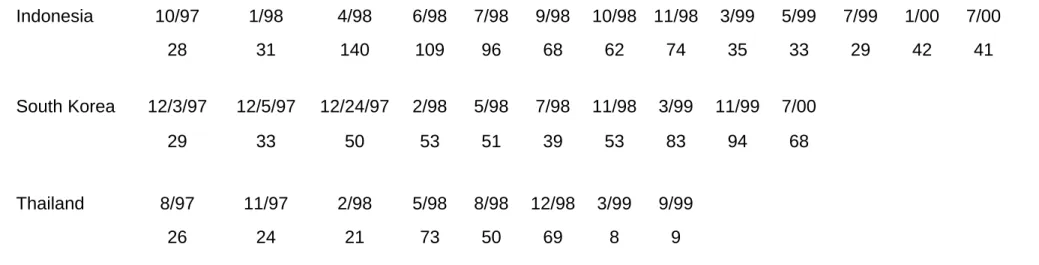
what follows, I review, in turn: (i) data on the number of total structural policy conditions per program year for a sample of 20 Standby arrangements (SBAs) and 12 Extended Fund arrangements (EFFs) for the 1996-99 period; (ii) data on the average number of structural performance criteria for all Fund programs over the 1993-99 period; (iii) data on the number of structural policy conditions (overwhelmingly structural benchmarks) in recent (1997-2000) Fund programs with three Asian crisis countries (Indonesia, South Korea, and Thailand); (iv) data on the average number of structural benchmarks per Fund program for 33 transition economies over the 1993-99 period; and (v) data on the number of structural benchmarks in earlier SAF programs. For each body of data, I am interested not only in the scope and intensity of structural policy conditionality, but also in the trend, the differences across different types of Fund programs (SBAs, EFFs, and SAF/ESAF/PRGF programs), and the distribution across structural policy areas. Before getting to all that, a brief digression on the instruments that the Fund uses to monitor compliance with conditionality is warranted. For the purposes of this paper, four of these are of interest.
Performance criteria (PCs) are meant to provide a direct link between program
implementation and disbursement of Fund resources. If the criterion is met on the agreed test date (typically set at quarterly intervals), the member country is assured of
disbursement; if the criterion is not met, the country cannot draw unless a “waiver” is obtained. Waivers are granted when a country’s noncompliance with performance criteria is viewed by the Fund as inconsequential or when it reflects significant exogenous
(IMF [2001]) also includes an index of total Fund structural conditions going back to 1989. The key qualitative conclusions of this section are not altered by reference to the longer data series.
developments not foreseen at the time the program was framed.30 PCs are expected to be under the control of the borrower, capable of being precisely and objectively formulated and monitored, and subject to relatively short (usually less than 45 days) reporting lags. In the structural area, a PC could, for example, specify that elimination of restriction x on current payments be accomplished by date y, or that three insolvent finance companies be closed by date z. Prior actions are policy measures that the country agrees to take before a Fund agreement goes into effect. They are apt to be employed when severe imbalances exist and the country is viewed as having had a poor track record of implementation (in earlier Fund programs). Structural benchmarks (SBMs) are indicators which aim to delineate the expected path of reform for individual structural policy measures and that can facilitate the eva luation of progress for these actions. Because many structural policies cannot be expressed in quantitative form, structural benchmarks are usually expressed qualitatively; for example, if the program calls for privatization of the state-owned telephone company, submitting the privatization bill to the legislature by date x could be one structural benchmark. Failure to meet structural benchmarks conveys a negative signal but does not automatically render a country ineligible to draw; instead, a decision about eligibility would be judgmental and would likely be taken in a broader mid-year program review --itself an instrument of conditionality -- with an eye toward the country’s overall progress on the structural front. Program reviews, like SBMs, assess implementation of policies not amenable to monitoring via PCs (because of their
30
Waivers also require that the authorities have taken the necessary action to bring the prog ram back on track if this is necessary to meet its objectives.
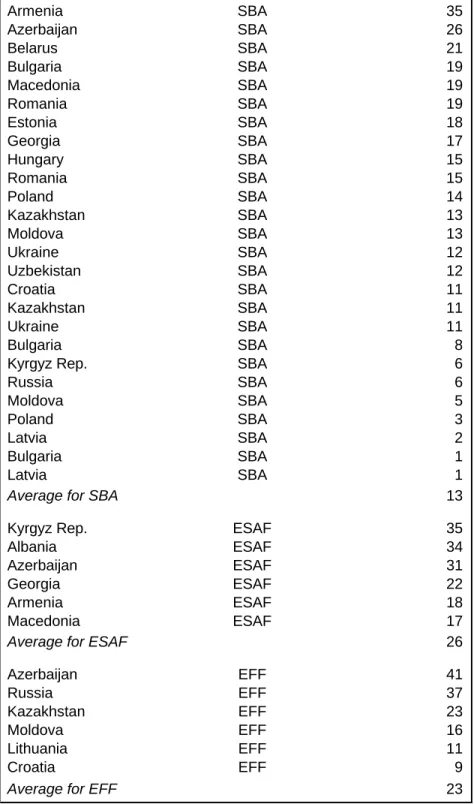
imprecise or qualitative nature). Reviews are broader than individual SBMs and can be used, for example, to assess whether there needs to be a change in program design.31 (i) Number of (total) structural policy conditions per program year -- At this point, the most comprehensive measure of Fund structural policy conditionality is that produced by the Fund itself via its so-called MONA database (which stands for Monitoring Fund arrangements). It is the only series available that combines information on all four types of structural conditions, namely, performance criteria, structural benchmarks, prior actions, and conditions for completion of program reviews. When only one of those structural policy conditions is used, there is a danger that you are seeing only one part of the elephant. The Fund’s index of programmed structural policy measures is then divided by the length of the period to obtain figures on number of programmed structural policy measures per annum. The rub is that this comprehensive measure is available only for the 20 Standby arrangements (SBAs) and 12 Extended Fund arrangements (EFFs) over the 1996-99 period.32 To my knowledge, this comprehensive measure of Fund struc tural policy conditions has not been published before.
Table 3 presents the goods. Three conclusions stand out. First, the number of structural policy conditions that would be typical for say, a three-year EFF Fund program over the last few years is high; specifically, it would be more than fifty (3 times the annual average of 18 measures per annum).33 For a typical one-year SBA, it would be
somewhere between 9 and 15 (depending on whether we used the median or the mean).
31
When conditionality includes a program review, the text of the arrangement specifies what elements are to be reviewed; the review also assesses whether or not the program’s objectives are in jeopardy.
32
See the Postscript for a summary of data going back to 1989. 33
Because the data in Table 3 are expressed as the number of conditions per annum rather than per program, I need to assume that the number of conditions varies proportionally with time to arrive at conclusions about the number in conditions in a “typical” three-year program.
This is a far cry from the “only in exceptional cases” guideline called for in the (1979) conditionality guidelines (for SBAs). Second, the median number of structural policy conditions is much higher (double) for EFFs than for SBAs. This is not surprising. As noted earlier, EFFs must have a structural policy orientation; SBAs may have structural conditionality too but don’t necessarily have to (if structural problems are not viewed as serious or pressing). Note that the difference between SBAs and EFFs vanishes when one looks at the mean number of conditions -- a finding that could well reflect the
presence of a few SBAs with very high structural policy content. And third, there is quite a lot of variation across both SBAs and EFFs in the extent of structural policy
conditionality. Since these data are thus far available only for the 1996-99 period as a whole, there is nothing that can be said here about trends.
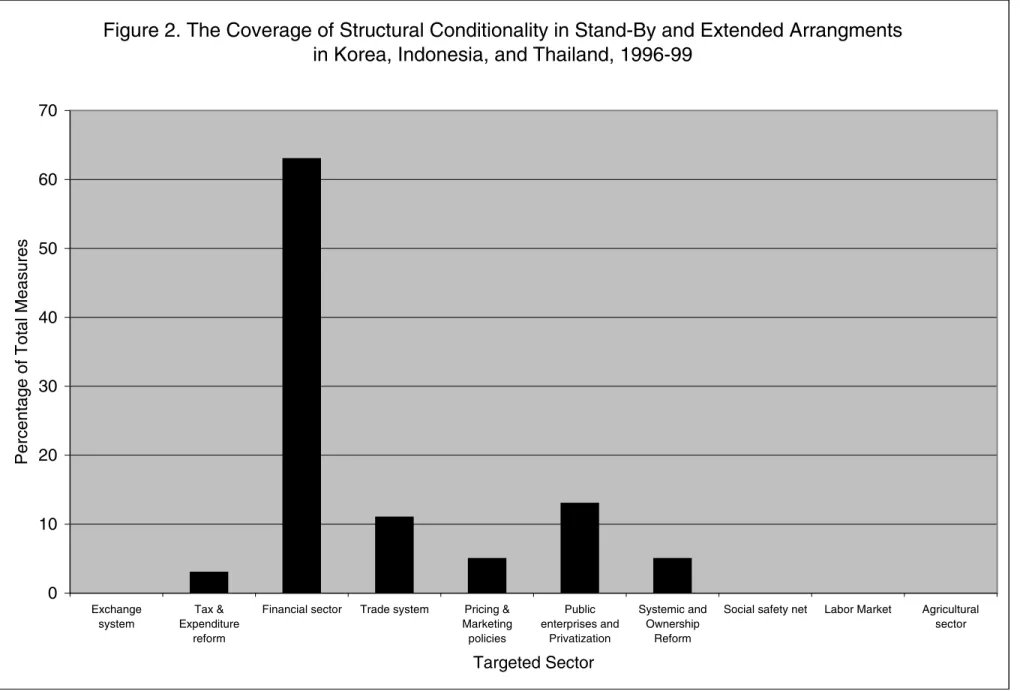
The Fund has broken down its comprehensive measure of structural policy conditions into ten broad policy areas. The results are portrayed in Figure 1. In short, what we see there is that about two-thirds of structural policy conditions are concentrated in three areas: financial-sector policies, tax and expenditure reforms, and public enterprises and privatizations. Since the Fund’s core competence is often identified to be monetary, fiscal, exchange rate, and financial-sector policies (see, for example, the Council on Foreign Relations [1999]), this would seem to belie the charge that, on average, most of the Fund’s focus in structural policies is far afield from its main expertise -- or to put it in other words, that Fund structural policy conditionality is typically a “mile wide and an inch thick.” At the same time, Figure 1 does show that Fund structural policy
conditionality has reached into a number of “non-core” structural policy areas (e.g., labor markets, social safety nets).
(ii) Average number of structural performance criteria per program -- The Fund’s MONA database also contains information on performance criteria (PCs) for the longer 1993-99 period. Tables 4, 5, and 6 below present the average number of performance criteria per program for all Fund programs, for ESAF/PRGF programs, and for SBA and EFF programs, respectively; separate figures are also given for the transition economies and (in Table 4) for the Asian economies. In these tables, “quantitative performance criteria” refer to macroeconomic variables (e.g., the nominal value of the fiscal deficit, net domestic credit of the central bank, the stock of net international reserves, etc) that are used to track compliance with monetary, fiscal, exchange rate, and external debt policies. “Structural performance criteria” are the ones meant to assess compliance with important structural policy commitments. Note that the data here are calculated per program -- not per program year. This is more informative in some respects but also carries the disadvantage that the annual figures can be biased upward (downward) if there are more (less) multi- year arrangements agreed in a given year. Note also that because we are dealing only with one component of structural policy conditionality in Tables 4-6, we have to be careful about generalizing about the overall intrusiveness of Fund structural policy conditionality from these figures.
Five main conclusions emerge from Tables 4-6. One is that “structural” PCs are on average less numerous than for quantitative macroeconomic PCs -- with the notable exception of the three programs for the Asian crisis economies in 1997 (see the upper two panels of Table 5 versus the lower one). A second conclusion is that the number of
structural PCs in the programs with the three Asian crisis economies in 1997 (an average of 14 per program) was way above (roughly four times) both the average for all Fund