TinySec: A Link Layer Security Architecture for
Wireless Sensor Networks
Chris Karlof
[email protected]
UC BerkeleyNaveen Sastry
[email protected]
UC BerkeleyDavid Wagner
[email protected]
UC BerkeleyABSTRACT
We introduce TinySec, the first fully-implemented link layer security architecture for wireless sensor networks. In our design, we leverage recent lessons learned from design vul-nerabilities in security protocols for other wireless networks such as 802.11b and GSM. Conventional security protocols tend to be conservative in their security guarantees, typi-cally adding 16–32 bytes of overhead. With small memories, weak processors, limited energy, and 30 byte packets, sensor networks cannot afford this luxury. TinySec addresses these extreme resource constraints with careful design; we explore the tradeoffs among different cryptographic primitives and use the inherent sensor network limitations to our advan-tage when choosing parameters to find a sweet spot for secu-rity, packet overhead, and resource requirements. TinySec is portable to a variety of hardware and radio platforms. Our experimental results on a 36 node distributed sensor net-work application clearly demonstrate that software based link layer protocols are feasible and efficient, adding less than 10% energy, latency, and bandwidth overhead.
Categories and Subject Descriptors
D.4.6 [Operating Systems]: Security and Protection
Cryp-tographic controls
General Terms
Security, Design
Keywords
Sensor Network Security, Link Layer Security
1.
INTRODUCTION & MOTIVATION
There is considerable excitement about new applications enabled by sensor networks, and we are on the cusp of a broader deployment of these technologies. However, one
Permission to make digital or hard copies of all or part of this work for personal or classroom use is granted without fee provided that copies are not made or distributed for profit or commercial advantage and that copies bear this notice and the full citation on the first page. To copy otherwise, to republish, to post on servers or to redistribute to lists, requires prior specific permission and/or a fee.
SenSys’04, November 3–5, 2004, Baltimore, Maryland, USA.
Copyright 2004 ACM 1-58113-879-2/04/0011 ...$5.00.
challenge that faces us is the question of how to secure sen-sor networks: without adequate security, widespread deploy-ment could be curtailed.
We have taken up this challenge and introduce TinySec, a lightweight, generic security package that developers can easily integrate into sensor network applications. We fore-see TinySec will cover the basic security needs of all but the most security critical applications. As a part of this, we were motivated by an observation about 802.11 wireless networks: several studies report that 50-80% of all 802.11 wireless networks operate in the clear, without any crypto-graphic protection whatsoever [24, 36, 37, 45]. To achieve high deployment rates in sensor networks, we believe that a security system must be easy to use and minimally impact performance. Failure to meet either requirement creates a justifiable reason for developers to leave out security.
We base the design of TinySec on existing security primi-tives that other researchers have proven to be secure. Using these primitives, we design a lightweight and efficient link-layer security protocol that is tailored to sensor networks. We describe a complete solution, defining packet formats and application interfaces, and provide a detailed perfor-mance characterization. Previous work, such as SNEP [33], analyzed aspects of the design space. Many of their design choices are sound, but further experience with sensor net-works lead us to reevaluate their work as researchers gain more understanding of the limitations and capabilities of the devices. Correspondingly, we note that much of the value of a link-layer security system comes from the higher level al-gorithms with which it is paired. We designed TinySec with this in mind and built TinySec as a research platform for use in testing and evaluating higher level security packages. One of the major barriers to deploying security on sensor networks is that current sensor devices have limited compu-tation and communication capabilities. Since cryptography is not free, these performance constraints pose a non-trivial challenge for any system that would incorporate cryptogra-phy into sensor networks. We expect that people will use Moore’s law to drive down the cost of these devices and not to increase their performance capabilities. But with a careful analysis, we can use the inherent limitations to our advantage. For example, the bandwidth of the wireless chan-nel used in sensor networks is significantly less than that of conventional networks. This implies that even a powerful adversary is limited in how many packets per second she can inject or eavesdrop on. Designing protocols that rely on properties such as these is one strategy we take in reducing overhead. Our design choices are driven by sensor network
capabilities and realities; this ultimately separates TinySec from other low overhead security protocols.
Before this work, an interesting open problem was whether software cryptography could achieve acceptable performance on typical sensor platforms, or whether hardware assistance would be needed. Many previous systems (e.g., GSM, Blue-tooth, 802.15.4) took the stance that hardware is needed. In contrast, we show that, with sufficient engineering effort, it is possible to encrypt and authenticate all communications entirely in software, without special hardware, and without major performance degradation.
The main contributions of this paper are:
• We introduce TinySec, the first fully-implemented
pro-tocol for link-layer cryptography in sensor networks. We have incorporated our implementation of TinySec into the official TinyOS release.
• We explore some of the tradeoffs between performance,
transparency, and cryptographic security, and we pro-pose a design that meets the needs of applications in the sensor network space.
• We measure the bandwidth, latency, and energy costs
of our implementation of TinySec and show that they are minimal for sensor network applications. This demon-strates for the first time that it is feasible to imple-ment acceptable cryptographic protection for sensor networks entirely in software.
• TinySec is a research platform that is easily extensible
and has been incorporated into higher level protocols. We have evidence of several sensor network security projects using TinySec in their research.
2.
SENSOR NETWORKS
We use the term sensor network to refer to a
heteroge-neous system combining tiny sensors and actuators with general-purpose computing elements. We envision sensor networks will consist of hundreds or thousands of low-power, low-cost wireless nodes deployed en masse to monitor and affect the environment. Applications include habitat mon-itoring [5, 31, 39], burglar alarms, inventory control, medi-cal monitoring and emergency response [44], and battlefield management [17].
A representative sensor node is the Mica2 [23], a several cubic inch sensor/actuator unit with a CPU, radio, power source, and optional sensing elements. The processor is a 8 MHz 8-bit Atmel ATMEGA128L CPU with 128 kB of instruction memory, 4 kB of RAM for data, and 512 kB of flash memory. It features a low-powered radio from Chipcon, delivering up to 19.2 kbps application bandwidth on a single shared channel and with a range of up to around hundred meters. At full power, the Mica2 sensor node can run for only two weeks or so before exhausting its batteries.
Mica2 sensor nodes run TinyOS [23], an event-driven op-erating system for networked applications in wireless em-bedded systems. The memory footprint of TinyOS is small, with the core components requiring only 400 bytes of data and instruction memory. TinyOS supports other hardware platforms as well.
It is clear that we must discard many preconceptions about network security: sensor networks differ from other dis-tributed systems in important ways. These devices have
very little computational power; even efficient public-key cryptography and fast symmetric ciphers must be used with care. There is considerable pressure to ensure that our se-curity protocols use a minimal amount of the limited RAM. Additionally, communication bandwidth is extremely dear: each bit transmitted consumes about as much power as exe-cuting 800–1000 instructions [23], and as a consequence, any message expansion caused by security mechanisms comes at significant cost. Energy is the scarcest resource of all: each milliamp consumed is one milliamp closer to death, and as a result, nearly every aspect of sensor networks must be de-signed with power in mind.
2.1
Security risks and threat models in sensor
networks
Because sensor networks use wireless communication, they are vulnerable to attacks which are more difficult to launch in the wired domain. Many wired networks benefit from their inherent physical security properties. It is unlikely that an adversary will dig up the Internet backbone and splice into the line. However, wireless communications are diffi-cult to protect; they are by nature a broadcast medium. In a broadcast medium, adversaries can easily eavesdrop on, intercept, inject, and alter transmitted data. In addition, adversaries are not restricted to using sensor network hard-ware. They can interact with the network from a distance by using expensive radio transceivers and powerful worksta-tions.
Sensor networks are vulnerable to resource consumption attacks. Adversaries can repeatedly send packets to drain the nodes’ batteries and waste network bandwidth. Since sensor networks will be deployed in a variety of physically insecure environments, adversary can steal nodes, recover their cryptographic material, and pose as authorized nodes in the network. However, we do not address these threats. Our focus is on guaranteeing message authenticity, integrity, and confidentiality. We do not address resource consump-tion attacks, physical tamper resistance, or node capture attacks.
2.2
Motivation for link-layer security in
sen-sor networks
In conventional networks, message authenticity, integrity, and confidentiality are usually achieved by an end-to-end security mechanism such as SSH [47], SSL [3], or IPSec [4] because the dominant traffic pattern is end-to-end commu-nication; intermediate routers only need to view message headers and it is neither necessary nor desirable for them to have access to message bodies.
This is not the case in sensor networks. The dominant traffic pattern in sensor networks is many-to-one, with many sensor nodes communicating sensor readings or network events over a multihop topology to a central base station. However, neighboring nodes in sensor networks often witness the same or correlated environmental events, and if each node sends a packet to the base station in response, precious energy and bandwidth are wasted. To prune these redundant messages to reduce traffic and save energy, sensor networks use in-network processing such as aggregation and duplicate elim-ination [29, 30]. Since in-network processing requires inter-mediate nodes to access, modify, and suppress the contents of messages, it is unlikely we can use end-to-end security mechanisms between each sensor node and the base station
to guarantee the authenticity, integrity, and confidentiality of these messages.
End-to-end security mechanisms are also vulnerable to
certain denial of service attacks. If message integrity is
only checked at the final destination, the network may route packets injected by an adversary many hops before they are detected. This kind of attack will waste precious energy and bandwidth. A link-layer security architecture can de-tect unauthorized packets when they are first injected into the network. Link-layer security mechanisms have been pro-posed for wired networks to resist similar denial of service attacks [22].
For the above reasons, we decided on a link-layer secu-rity architecture for TinySec. Link-layer secusecu-rity mecha-nisms guarantee the authenticity, integrity, and confidential-ity of messages between neighboring nodes, while permitting in-network processing. Despite the problems enumerated above, end-to-end security mechanisms can still useful in
sensor networks and complement TinySec.1
3.
DESIGN GOALS
We have three goals for a link layer security mechanism in sensor networks: security, performance, and usability.
3.1
Security goals
A link layer security protocol should satisfy three basic
security properties: access control, message integrity, and
message confidentiality.
Access control and message integrity.
Access control means the link layer protocol should prevent unauthorized parties from participating in the network. Legitimate nodes should be able to detect messages from unauthorized nodes and reject them. Closely related to message authenticity is message integrity: if an adversary modifies a message from an authorized sender while the message is in transit, the re-ceiver should be able to detect this tampering. We providemessage authentication and integrity by including amessage
authentication code with each packet. We discuss message authentication codes in more detail in Section 4.
Confidentiality.
Confidentiality means keeping information secret from unauthorized parties. It is typically achieved with encryption. Preferably, an encryption scheme should not only prevent message recovery, but also prevent adver-saries from learning even partial information about the mes-sages that have been encrypted. This strong property isknown as semantic security [8]. Semantic security implies
adversaries should have no better than a 50% chance in cor-rectly answering any yes or no question about an encrypted message. We discuss mechanisms for achieving semantic se-curity in more detail in Section 4.
Explicit omission: Replay protection.
An adversary that eavesdrops on a legitimate message sent between two autho-rized nodes and replays it at some later time engages in areplay attack. Since the message originated from an autho-rized sender, the same receiver will accept it again.
Re-1
By removing the link-layer protocol headers, the TinySec packet format could be used in an end-to-end security pro-tocol as well. We do not address this modification in this paper.
play protection is a difficult problem when there is a limited amount of state that each recipient keeps.
A common defense is to include a monotonically increas-ing counter with every message and reject messages with old counter values. With this policy, every recipient must main-tain a table of the last value from every sender it receives. However, for RAM-constrained sensor nodes, this defense becomes problematic for even modestly sized networks. As-suming nodes devote only a small fraction of their RAM for this neighbor table, an adversary replaying broadcast mes-sages from many different senders can fill up the table. At this point, the recipient has one of two options: ignore any messages from senders not in its neighbor table, or purge en-tries from the table. Neither is acceptable; the first creates a DoS attack and the second permits replay attacks. This is a realistic concern. If each counter requires 4 bytes and there is only 100 bytes of RAM available for the neighbor table (2.5% of the total RAM), networks larger than 25 nodes will be vulnerable.
However, the application layer may be better equipped to manage the replay table if it expects certain communica-tion patterns or has informacommunica-tion about the network topology. This type of information is typically not available at the link layer. For example, if the physical topology implies that only nodes 1, 2, 3, 4 should be able to communicate with node 5, an application running on node 5 can efficiently manage the neighbor table by only keeping replay counter entries for these four nodes. For this reason, we believe replay protec-tion belongs not in the link-layer, but rather in higher layers of the protocol stack. By using information about the net-work’s topology and communication patterns, the applica-tion and routing layers can properly and efficiently manage a limited amount of memory devoted to replay detection.
3.2
Performance
A system using cryptography will incur increased over-head in the length of messages sent as well as in extra de-mands on the processor and RAM. The increased message length can decrease message throughput and increase la-tency, but more importantly for sensor networks, it will also increase power consumption. We would like to impose only a modest increase in power consumption when using TinySec and achieve comparable channel utilization and latency.
Due to the extreme resource limitations in sensor net-works, it is important to carefully tune the strength of the security mechanisms in a way that provides reasonable pro-tection while limiting overhead. This is in sharp contrast to conventional network security where the difference between 8 or 16 bytes of overhead is often inconsequential. Cryp-tography designed for conventional networks is conservative because it can afford to be. In sensor networks, 8 bytes is nearly 25% of the total packet size, and overly conservative choices of security parameters will consume resources too quickly.
3.3
Ease of use
Security platform.
We expect higher level security proto-cols will rely on the link-layer security architecture as a prim-itive. For example, key distribution protocols, some of which utilize public key cryptography, could use TinySec to create secure pairwise communication between neighboring nodes. To reduce the effort in implementing these protocols,Tiny-Sec must provide the right set of interfaces to facilitate their development.
Transparency.
A major challenge in deploying security mech-anisms is the difficulty in properly using and implementing them. Frequently, application programmers are unsure of appropriate security parameters. Also, if the secure commu-nication mechanism requires different APIs than the stan-dard mechanism, then migrating legacy applications will be difficult. Of course, if it is not easy to enable the security features, many users and programmers will disable it and continue to operate insecurely.To alleviate these problems, an important design goal of TinySec is that it should be transparent to applications run-ning on TinyOS. To achieve this goal, we structured Tiny-Sec as a link-layer security protocol. We believe that trans-parency will play a crucial role in enabling widespread de-ployment of TinySec and other security mechanisms.
At the same time, we try to make it easy for security-aware applications to customize the level of security that TinySec provides: application programmers should be able to adjust the security performance tradeoffs if they have a greater understanding of their application’s security needs.
Portability.
An additional goal of TinySec is that it should be portable. TinyOS runs on a host of different platforms, including processors manufactured by Texas Instruments, Atmel, Intel x86, and StrongArm. TinyOS also supports two radio architectures: the Chipcon CC1000 and the RFM TR1000. A radio stack bridges these two pieces of hardware. A link layer security architecture should fit into the radio stack so that porting the radio stack from one platform to another is a simple job.4.
SECURITY PRIMITIVES
In this section, we give background on some well-studied cryptographic primitives commonly used to achieve our se-curity goals. We apply these primitives in TinySec.
Message authentication codes (MACs).
A common so-lution for achieving message authenticity and integrity is touse amessage authentication code(MAC).2
A MAC can be viewed as a cryptographically secure checksum of a message. Computing a MAC requires authorized senders and receivers to share a secret key, and this key is part of the input to a MAC computation. The sender computes a MAC over the packet with the secret key and includes the MAC with the packet. A receiver sharing the same secret key recomputes the MAC and compares it with the received MAC value. If they are equal, the receiver accepts the packet and rejects it otherwise. MACs must be hard to forge without the se-cret key. This implies if an adversary alters a valid message or injects a bogus message, she cannot compute the corre-sponding MAC value, and authorized receivers will reject these messages.
2
There is an unfortunate name collision between the cryp-tographic and networking community. We will refer to the acronym “MAC” only in the cryptographic sense and use “media access control” to refer to protocols governing ac-cess to channel.
Initialization vectors (IVs).
Recall we want our encryp-tion mechanism to achieve semantic security (Secencryp-tion 3.1). One implication of semantic security is that encrypting the same plaintext two times should give two different cipher-texts. A common technique for achieving semantic security is to use a unique initialization vector (IV) for each invo-cation of the encryption algorithm. An IV can be thought of as a side input to the encryption algorithm. The main purpose of IVs is to add variation to the encryption process when there is little variation in the set of messages. Since the receiver must use the IV to decrypt messages, the se-curity of most encryption schemes do not rely on IVs being secret. IVs are typically sent in the clear and are included in the same packet with the encrypted data. We discuss IVs further in Section 5, including their necessary length and how to generate them.It might seem that given the resource constraints in sen-sor networks, we could give up semantic security to eliminate the additional packet overhead required by an IV. However, semantic security is almost always necessary and desirable, even in resource constrained environments. Consider ap-plication messages with low entropy, such as YES or NO messages that are sent periodically to report environmental events such as movement. Without using an IV, all encryp-tions of YES messages are identical. Once an adversary determines what a YES message looks like, confidentiality is lost; the adversary can determine the contents of every YES/NO message by simply looking at its encryption.
5.
DESIGN OF TINYSEC
5.1
Existing schemes are inadequate
Using cryptography to secure an untrusted channel has been well-studied in the literature, and there are a plethora of existing schemes that try to achieve this goal. In the networking community, protocols such as IPSec, SSL/TLS, and SSH all do a satisfactory job of securing Internet com-munications. However, these protocols are too heavy-weight for use in sensor networks. Their packet formats add many bytes of overhead, and they were not designed to run on computationally-constrained devices.
The wireless, cellular telephony, and ad-hoc networking communities have developed schemes closer to our needs, but even there, the existing designs have serious limitations. The closest previous work is SNEP [33], which specifically targets sensor networks, but SNEP was unfortunately nei-ther fully specified nor fully implemented. Refer to Sec-tion 10 for further discussion of these wireless security mech-anisms.
The conclusion is that existing schemes are either insecure or too resource intensive for use in sensor networks, and we must design a new scheme.
5.2
TinySec design
TinySec supports two different security options: authen-ticated encryption (TinySec-AE) and authentication only (TinySec-Auth). With authenticated encryption, TinySec encrypts the data payload and authenticates the packet with a MAC. The MAC is computed over the encrypted data and the packet header. In authentication only mode, TinySec authenticates the entire packet with a MAC, but the data payload is not encrypted.
5.2.1
Encryption
Using semantically secure encryption typically requires two design decisions: selecting an encryption scheme and specifying the IV format. In our design of TinySec, we use a specially formatted 8 byte IV, and we use cipher block chain-ing (CBC) [8]. In this section, we introduce the structure of our IV format and argue why CBC is the most appropriate encryption scheme for sensor networks.
TinySec IV format.
Recall that our goal is to see how much we can reduce the cost of security. The length of our IV, and the way we generate IVs, can have a dramatic effect on both security and on performance. If the IV is too long, we will add unnecessary bits to the packet, which translates to a significant cost in overall throughput and in energy drain. At the same time, if the IV is too short, we run the risk that the IV will repeat, and then our security warranty is void.How long is long enough? By the pigeonhole principle, a
n-bit IV is guaranteed to repeat after 2n+1 packets are sent,
no matter how we choose the IV. If we use an-bit counter,
repetitions will not occur before that point. However, for some IV generation strategies, repetitions may occur earlier.
If we choose each IV as a randomn-bit value, then by the
birthday paradox, we expect (probabilistically) to see the
first repetition after roughly 2n/2
packets have been sent. Therefore, we use a counter in our IV, and we transmit it in the packet so that the receiver can learn the value of the counter.
The structure of the IV is dst||AM||`||src||ctr, where dst
is the destination address of the receiver, AM is the
ac-tive message (AM) handler type,`is the length of the data
payload,src is the source address of the sender, andctr is
a 16 bit counter. The counter starts at 0, and the sender increases it by 1 after each message sent. We analyze the security of this construction in Section 6.2.
Encryption schemes.
In this section we argue why CBC is the most appropriate encryption scheme for sensor networks. Symmetric key encryption schemes generally fall into two categories: stream ciphers and modes of operation using block ciphers.A stream cipher (typically) uses a key K and IV as a
seed and stretches it into a large pseudorandom keystream
GK(IV). The keystream is thenxored against the message:
C = (IV, GK(IV)⊕P). The fastest stream ciphers are
faster than the fastest block ciphers [41], which might make them look tempting in a resource-constrained environment. However, stream ciphers have a devastating failure mode: if the same IV is ever used to encrypt two different packets,
then it is often possible to recover both plaintexts.3
Guaranteeing that IVs are never reused requires IVs to be fairly long, say, at least 8 bytes. Since one of our goals is to minimize packet overhead, we believe adding 8 additional bytes to a 30-byte packet is unacceptable. The alternative is require shorter IVs and accept that IV reuse will occur. Therefore, we were guided by the following principle: “Use an encryption scheme that is as robust as possible in the presence of repeated IVs.” Stream ciphers clearly violate
3
GivenC= (IV, GK(IV)⊕P) andC0= (IV, GK(IV)⊕P0),
one can recoverP⊕P0, which is a lot of information about
P andP0. When plaintexts have sufficient redundancy, one
can often recover most or all ofP andP0 fromP⊕P0 [15].
this principle, so the only alternative is to use a mode of operation based on a block cipher [11].
A block cipher is a keyed pseudorandom permutation over small bit strings, typically 8 or 16 bytes. Examples of block ciphers include DES, AES, RC5, and Skipjack. Since we usually want to encrypt and authenticate messages longer
than 8 or 16 bytes, block ciphers require amode of operation
to encrypt longer messages. For a k byte block cipher, a
mode of operation typically breaks a message into segments
of k bytes and uses the block cipher in a special way to
encrypt the message block by block.
Using a block cipher for encryption has an additional ad-vantage. Since the most efficient message authentication code (MAC) algorithms use a block cipher, the nodes will need to implement a block cipher in any event. Using this block cipher for encryption as well conserves code space.
If we use block ciphers for encryption, we must choose a mode of operation. One natural choice is counter (CTR) mode [8]; however, CTR mode is a stream cipher mode of operation, and shares all the problems as any other stream cipher. Therefore, we rejected CTR mode.
Another natural choice is cipher block chaining (CBC) mode [8]. CBC mode is better: it degrades more gracefully in the presence of repeated IVs. In particular, if we encrypt
two plaintexts P, P0 with the same IV under CBC mode,
then the ciphertexts will leak the length (in blocks) of the
longest shared prefix ofP andP0, and nothing more. For
in-stance, if the first block ofP is different from the first block
of P0, as will typically be the case, then the cryptanalyst
learns nothing apart from this fact. Consequently, CBC leaks only a small amount of information in the presence of repeated IVs, a significant improvement over a stream cipher. CBC mode is provably secure when IVs do not re-peat [8].
CBC mode was designed to be used with a random IV, and CBC mode has a separate leakage issue when used with
a counter as IV. Suppose we encrypt two plaintexts P, P0
underIV, IV0, respectively. IfP
1⊕IV =P10⊕IV0 (where
P1 denotes the first block of P, etc.), then the first block
of ciphertexts will be equal, and this discloses the value
P1⊕P10. In some cases, this can leak partial information
about plaintexts. For instance, suppose the IV is a counter,
and letIV, IV0be two consecutive IVs. We will often have
IV0 = IV ⊕1. If the plaintexts occasionally satisfy the
same pattern, i.e.,P0=P⊕1, then we will have occasional
leakage. This is undesirable.
Fortunately, there is a simple fix that allows CBC mode to be used with any non-repeating IV. The fix is to pre-encrypt the IV, and we reject standard CBC mode in favor of this variant.
Naively using CBC mode for encryption with a 8-byte block cipher results in ciphertexts which are multiples of 8 bytes. This may result in message expansion, which in-creases power consumption. We use a technique known as ciphertext stealing [35] to ensure the ciphertext is the same length as the underlying plaintext. Encrypting data pay-loads of less than 8 bytes will produce a ciphertext of 8 bytes because ciphertext stealing requires at least one block of ci-phertext. However, the fixed overhead of sending a message (turning on the radio, acquiring the channel, and sending the start symbol) generally discourages short messages.
Block cipher choice.
Conventional wisdom says when a block cipher is needed, choose either AES or Triple-DES. However, Triple-DES is too slow for software implementa-tion in embedded microcontrollers. Our initial experiments showed that AES was quite slow, too. Therefore, we rejectedAES.4
We surveyed other block ciphers to find one that is well-suited for sensor networks. We found RC5 and Skipjack to most appropriate for software implementation on embedded microcontrollers. We discuss the performance of these ci-phers in Section 9.1. Although RC5 is slightly faster, it is patented. Also, for good performance, RC5 requires the key schedule to be precomputed, which uses 104 extra bytes of RAM per key. Because of these drawbacks, the default block cipher in TinySec is Skipjack.
5.2.2
Message integrity: The need for a MAC
One might ask if encryption is enough; do we need an au-thentication mechanism when messages are encrypted? His-tory has proven that using encryption without authentica-tion is insecure [10, 12, 27]. For example, flipping bits in unauthenticated encrypted messages can cause predictable changes in the plaintext [12], and without an authentica-tion mechanism to guarantee integrity, receivers are unable to detect the changes. Unauthenticated messages are also vulnerable to cut-and-paste attacks [10]. In a cut-and-paste attack, an adversary breaks apart an unauthenticated en-crypted message and constructs another message which de-crypts to something meaningful. For example, if all the au-thorized nodes share a single key, an adversary can extract the encrypted data payload from a message to one node and send it to different node. Since the encrypted payload is un-altered, the second node will successfully decrypt and accept the message.
To address these vulnerabilities, TinySec always authen-ticates messages, but encryption is optional. Message confi-dentiality is only necessary when there is something to keep secret. Consider a burglar alarm. The actual contents of an alarm message could be empty; receiving an alarm mes-sage signals an intrusion. Encryption is unnecessary and only increases latency, computation, and power consump-tion. However, most all applications require packet authen-ticity, meaning authorized nodes will not accept invalid mes-sages injected by an adversary. In our burglar alarm exam-ple, this means adversaries cannot trigger false alarms.
TinySec uses a cipher block chaining construction, CBC-MAC [9], for computing and verifying CBC-MACs. CBC-CBC-MAC is efficient and fast, and the fact that it relies on a block cipher as well minimizes the number of cryptographic prim-itives we must implement in the limited memory we have available. CBC-MAC is provably secure [9], however the standard CBC-MAC construction is not secure for variably sized messages. Adversaries can forge a MAC for certain messages. Bellare, Kilian, and Rogaway suggest three alter-natives for generating MACs for variable sized messages [9].
The variant we use xors the encryption of the message
length with the first plaintext block.
4
We have since been informed that AES can be imple-mented efficiently on our platform, with performance not much worse than RC5 and Skipjack. AES does have the small disadvantage that its block length is longer. However, in retrospect, AES might be a perfectly suitable replace-ment.
5.3
Packet format
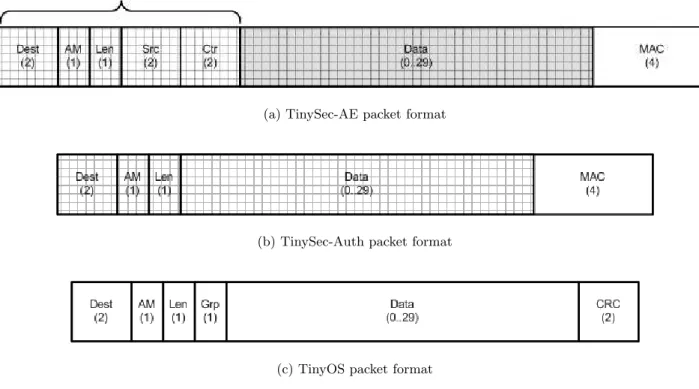
We based TinySec’s packet format on the current packet format in TinyOS. We show the differences between Tiny-Sec packets and TinyOS packets in Figure 1. The common fields are destination address, active message (AM) type, and length. Active message types are similar to port num-bers in TCP/IP. The AM type specifies the appropriate han-dler function to extract and interpret the message on the receiver. These fields are unencrypted because the benefits of sending them in the clear generally outweigh any extra protection from keeping them secret. To save power, a
sen-sor node may employearly rejectionby turning off its radio
after determining the message is not addressed to it. With broadcast messages, nodes can employ early rejection on the AM field as well. If the address and AM type are en-crypted, early rejection cannot be invoked until after these fields are decrypted. This wastes power if rejection is fre-quent. Encrypting the length field adds little to security since the length of message can be inferred regardless.
To detect transmission errors, TinyOS senders compute a 16-bit cycle redundancy check (CRC) over the packet. The receiver recomputes the CRC during reception and verifies it with the received CRC field. If they are equal, the receiver accepts the packet and rejects it otherwise. However, CRCs provide no security against malicious modification or forgery of packets. To guarantee message integrity and authentic-ity, TinySec replaces the CRC with a MAC. The MAC pro-tects the entire packet, including the destination address, AM type, length, source address and counter (if present), and the data (whether encrypted or not). This protects the data from tampering. It also prevents attackers from re-directing a packet intended for one node to another node, and prevents packet truncation and other attacks. Since MACs detect malicious changes, they also detect transmis-sion errors, and TinySec does not require a CRC.
The TinyOS packet format contains a group field to pre-vent different sensor networks from interfering with each other. It can thought of as a kind of weak access control mechanism for non-malicious environments. Since TinySec enforces access control with a MAC, the group byte is un-necessary in TinySec. Instead, different networks should use different keys.
6.
SECURITY ANALYSIS
6.1
Message integrity and authenticity
The security of CBC-MAC is directly related to the length of the MAC. Conventional security protocols use MACs of 8 or 16 bytes, again erring on the side of caution. We show here that our choice of a 4 byte MAC is not detrimental in the context of sensor networks.
We can model TinySec’s CBC-MAC as a function that produces 4 bytes of output [9]. Given a 4 byte MAC, then,
an adversary has a 1 in 232
chance in blindly forging a valid MAC for a particular message. If an adversary repeatedly
attempts blind forgeries, she should succeed after about 231
tries. Note that adversaries cannot determine off-line if a forgery will be successful or not; an adversary can only test the validity of an attempted forgery by sending it to an
authorized receiver. This implies she must send about 231
packets before she can succeed at forging the MAC for a sin-gle malicious packet. In conventional networks, this number
(a) TinySec-AE packet format
(b) TinySec-Auth packet format
(c) TinyOS packet format
Figure 1: The TinySec and TinyOS packet formats. The byte size of each field is indicated below the label. Fields that have been hatched are protected by the MAC. In TinySec-AE, the data field, shaded gray, is encrypted.
is not large enough for security. However, in sensor net-works, this may provide an adequate level of security. Ad-versaries can try to flood the channel with forgeries, but on a 19.2kb/s channel, one can only send 40 forgery attempts
per second, so sending 231
packets at this rate would take over 20 months. Battery-operated sensor nodes do not have enough energy to receive that many messages. Furthermore, the adversary will have launched a quite effective denial of service attack since they need to occupy the radio channel for such a long time.
Clearly, it is both desirable and feasible to detect when such a attack is underway. A simple heuristic is probably sufficient: nodes could signal the base station when the rate of MAC failures exceeds some predetermined threshold.
6.2
Confidentiality
The security of CBC mode encryption reduces to the length
of the IV, but this security assumes no IV reuse.5
With an 8 byte counter or 16 byte random IV, avoiding repetition is relatively easy. Although TinySec uses an 8 byte IV, we limited ourselves to 4 additional bytes of overhead in the packet to represent the IV. The other 4 bytes of the IV bor-row from the existing header fields: the destination address, the AM type, and the length.
TinySec partitions the last 4 bytes of the IV intosrc||ctr,
wheresrcis the source address of the sender andctris a 16
bit counter starting at 0. We selected this format because
5
The security of CBC mode also depends on the security of underlying block cipher, but we assume Skipjack is a secure block cipher.
the other alternatives are insecure. Having every node gen-erate IVs from a 4 byte counter starting at 0 is bad idea; the first packet sent from one node will reuse the same IV as the first packet sent from all other nodes. Generating IVs randomly is also a poor choice; the birthday paradox
implies we can expect a collision after 216
total packets in the network.
Our format for the last 4 bytes strives to maximize the number of packets each node can send before there is a global
repetition of an IV value. Thesrc||ctrformat of the last 4
bytes guarantees each node can send at least 216
packets
before IV reuse occurs. For a network of nnodes all
send-ing packets at approximately the same rate, this results in
aboutn·216
total packets before we expect an instance of IV reuse. In conventional networks, end hosts transmitting at
1 Mb/s will send 216
packets in less than an hour. However, since sensor nodes must conserve power to be long-lived, we envision the average data rate in most sensor networks will be dramatically less than conventional networks. For ex-ample, the sensors deployed at Great Duck Island send a reading once every 70 seconds [39]. We expect data rates to be on the order of 1 packet per minute, hour, or day. At one packet per minute per node, IV reuse will not occur for over 45 days.
IV reuse is only a problem when we reuse the same IV with the same key. If IV reuse is imminent, a key update protocol can be used to exchange new TinySec keys. Other researchers are currently exploring key update protocols in TinySec, and we do not address them here.
We specifically selected CBC mode for TinySec because of its robustness to information leakage when IVs repeat.
In contrast to stream ciphers, where a repeated IV can re-veal the plaintext of both messages, in CBC mode IV reuse reveals only the length (in blocks) of the longest shared prefix of the two messages. The first 4 bytes of the IV,
dst||AM||`, help prevent information leakage during the
un-fortunate event of a counter on a node repeating. If a
counter value for a particular source address is reused, there
is only potential information leakage when the dst||AM||`
values are exactly the same for both messages. The means both messages were sent to the same destination and AM type, and both messages have the same length. Moreover, even in this case, information only leaks if both plaintexts agree in their first block. Consequently, information only leaks when one node sends two different packets with the same first 8 bytes and IV, to the same destination, with the same AM type, and of the same length.
In summary, the combination of carefully formatted IVs, low data rates, and CBC mode for encryption enables Tiny-Sec to provide strong confidentiality guarantees for appli-cations in sensor networks. Conventional network security protocols are overly conservative because they can afford to be. In sensor networks we cannot afford this luxury. Fortu-nately, by selecting the right cryptographic primitives and using them carefully, we can tune down the security param-eters and get the most out of the overhead.
7.
KEYING MECHANISMS
A keying mechanism determines how cryptographic keys are distributed and shared throughout the network. The TinySec protocol is not limited to any particular keying mechanism; any can be used in conjunction with TinySec. In this section, we discuss the tradeoffs among different pos-sible keying mechanisms in sensor networks. See Table 1 for a summary.
The appropriate keying mechanism for a particular net-work depends on several factors such as the target threat model, ease of use, and the networking and security require-ments of applications. In cryptographic design, a good rule of thumb is to use different keys for different applications.
When we refer to aTinySec key, we mean a pair of Skipjack
keys, one for encrypting data, and one for computing MACs. The simplest keying mechanism is to use a single wide TinySec key among the authorized nodes. A network-wide shared key provides a baseline level of security, max-imizes usability, and minmax-imizes configuration. Any autho-rized node can exchange messages with any other authoautho-rized node, and all communication is encrypted. Messages from unauthorized nodes are rejected. Key distribution is rela-tively simple; nodes are loaded with the shared key before deployment. This also makes it easy to secure legacy ap-plications, since TinySec is transparent and can be enabled without disrupting existing code.
However, network-wide keying cannot protect against node capture attacks. If an adversary compromises a single node or learns the secret key, she can eavesdrop on traffic and inject messages anywhere in the network. To address the node capture threat, we need a keying mechanism with finer granularity.
A more robust option is for nodes to share a key for com-munication only if they need to communicate with each other. The simplest example of this idea is per-link key-ing, where we use a separate TinySec key for each pair of nodes who might wish to communicate. This provides
bet-ter resilience against node capture attacks: a compromised node can only decrypt traffic addressed to it and can only inject traffic to its immediate neighbors. This approach has drawbacks. Key distribution becomes challenging, but re-cent research is beginning to address this issue [14, 16, 19,
28]. Also, per-link keying limits passive participation [26],
a type of in-network processing where nodes take actions
based on messages they overhear, andlocal broadcast, where
nodes can cheaply send a packet to all their neighbors. Since a node cannot decrypt and authenticate messages not ad-dressed to it, passive participation and local broadcast are incompatible with per-link keying.
A less restrictive approach is for groups of neighboring nodes to share a TinySec key rather than each pair. This enables passive participation and local broadcast, but key distribution and setup is still an issue. Group keying pro-vides an intermediate level of resilience to node capture at-tacks: a compromised node can decrypt all messages from nodes in its group, but cannot violate the confidentiality of other groups’ messages and cannot inject messages to other groups.
8.
IMPLEMENTATION
We have implemented TinySec for the Berkeley sensor nodes. TinySec currently runs on the Mica, Mica2, and Mica2Dot platforms, each using Atmel processors; the Mica sensor node uses the RFM TR1000 radio, while the Mica2 and Mica2Dot nodes use the Chipcon CC1000 radio. Addi-tionally, TinySec is integrated into the TOSSIM simulator, which runs on an Intel x86 platform. Others have ported TinySec to a Texas Instruments microprocessor. Given the broad range of platforms that TinySec runs on, we believe it will be easily portable to both new processors as well as new radio architectures.
We implemented TinySec in 3000 lines of nesC code [21], the programming language used for TinyOS. Our implemen-tation of TinySec requires 728 bytes of RAM and 7146 bytes
of program space.6
We modified the default TinyOS 1.1.2 radio stack to in-corporate TinySec. We modified the stack to re-direct byte
level radio events to theTinySecMmodule.
Integration into TinyOS required some modifications to the scheduler. When the media access control layer
success-fully acquires the channel, it signalsTinySecM. At this point,
the security module begins the cryptographic computations. The cryptographic computations must be completed by the time the radio finishes sending the start symbol. To achieve the real-time deadline, we modified the TinyOS scheduling process. TinyOS provides a rudimentary form of process
management. Tasks run until completion in FIFO order.
One option for implementing TinySec would be to submit a task with the cryptographic operations to the scheduler. However, if the task queue is non-empty, the cryptographic operations may not complete in time, since they must wait until the task queue empties. We instead implement a two-priority scheduler, where cryptographic operations are run
6
We have subsequently improved the RAM usage of our TinySec implementation, which requires 256 bytes of RAM and 8152 bytes of ROM. Our optimizations save 472 bytes of RAM at the expense of 6% slower block cipher operations. All performance results in this paper use the old implemen-tation, but we do not expect significant differences with our new implementation.
Keying mechanism Benefits Costs
Single network-wide key Simple; easy to deploy; supports passive
participation and local broadcast
Not robust to node compromise Per-link keys between
neighboring nodes
Graceful degradation in the presence of com-promised nodes
Needs a key distribution protocol; prohibits passive participation and local broadcast
Group keys Graceful degradation in the presence of
compromised nodes; supports passive participation and local broadcast
Requires key distribution; trades off robust-ness to node compromise for added function-ality
Table 1: A summary of different keying mechanisms for link-layer security.
with high priority and all other tasks run at low priority. The two-priority scheduler ensures that cryptographic oper-ations complete on time so that encryption and decryption execute concurrently with packet transmission and recep-tion.
TinySec is cipher independent. We have implemented
both RC5 and Skipjack and can switch between them with-out difficulty.
Since the maximum data payload in TinyOS is 29 bytes, we can safely use the upper two bits of the length byte to indicate which level of protection is enabled on that packet: TinySec-AE, TinySec-Auth, or unprotected TinyOS pack-ets. When sending a packet, the TinySec stack encodes the TinySec mode of the packet into the length bit.
For ease of deployment, we implemented a network-wide shared key model. We modified the application build pro-cess to include the key at compile time to ease key deploy-ment hassles. The build process maintains a key file at the developer’s machine and uses a key from the file. Other re-searchers have extended TinySec to use finer grained keying mechanisms. Refer to Section 9.2 for further details.
To enable the TinySec stack, an application writer needs
only to specify “TINYSEC=true” on the command line to
make(or in theMakefile). Messages sent in this
configura-tion will then be sent using TinySec-Auth. We chose this as the default TinySec mode since it imposes a minimal amount of overhead (Section 9.1). An application writer can send authenticated and encrypted packets with TinySec-AE by simply making a function call to switch modes.
TinySec is currently distributed with the official TinyOS releases.
9.
EVALUATION
9.1
Measurements
TinySec increases the computational and energy costs of sending a packet. For application writers to adopt TinySec, these costs must be modest compared to the benefits that TinySec provides. There are two main components to these costs: larger packet sizes when using TinySec, and the ex-tra computation time and energy needed for cryptography. The costs due to increased packet length will be borne by all implementations, even those using cryptographic hard-ware. Naturally, the computation costs will vary based on the implementation.
To analytically estimate the costs of the cryptography, we first calculate the effect of packet lengths in TinySec. Re-call that TinySec increases packet lengths by 1 or 5 bytes (according to whether TinySec-Auth or TinySec-AE is in use). Longer packets cost us in several ways: first, they
re-Cipher & Time Time
Impl. (ms) (byte times)
RC5 (C) 0.90 2.2
Skipjack (C) 0.38 0.9
RC5 (C, assembly) 0.26 0.6
Table 3: Time to execute cipher operations on the Mica2 sensor nodes. We display the time both in milliseconds and in byte times.
duce bandwidth; second, because the communications chan-nel is fairly slow, they increase latency; third, they increase energy consumption, because the radio must be turned on longer when transmitting longer packets. We first calculate the expected contribution to TinySec’s overhead that comes solely from increased packet sizes. Table 2 shows the extra time needed to transmit a packet using TinySec. We ex-pect TinySec-AE to increase packet latencies (compared to the current TinyOS stack) by 8.0%; for TinySec-Auth, the corresponding figure is 1.5%. Note that sending a packet involves sending many more bits than just the data and its associated header; as a part of the media access control pro-tocol, a 28 byte start symbol and additional synchronization bytes are also sent. This reduces the impact of adding an additional byte of overhead to a header, since there is a high fixed cost for sending a packet.
Next, we implemented TinySec and experimentally mea-sured its performance costs. In these experiments, we empir-ically determined TinySec’s impact on bandwidth, energy, and latency on the Berkeley Mica2 sensor nodes. We used a variety of microbenchmarks and macrobenchmarks to eval-uate TinySec. In addition to allowing us to obtain latency figures, the macrobenchmark allowed us to evaluate the dif-ficulty in enabling TinySec for an existing, large sensor net-work application.
We introduce the termbyte time to refer to the duration
that it takes to transmit a single byte of data over the radio. On the Mica2, a byte time is 0.42 ms. Measuring time in byte times is a convenience that allows us to relate the time of an operation to the packet length.
Cipher performance.
We tested the performance of two 64-bit block ciphers, Skipjack and RC5, to determine their speed. We must be able to complete a block cipher operation quickly since the cryptographic operations are overlapped with the radio operations; if the cipher operation doesn’t complete in time, the data needed for the radio will not be available. More importantly, faster block ciphers consume less energy.Application Packet Total Time to Increase Over Current
Data (b) Overhead (b) Size (b) Transmit(ms) TinyOS Stack
Current TinyOS Stack 24 39 63 26.2 —
TinySec-Auth 24 40 64 26.7 1.6%
TinySec-AE 24 44 68 28.3 7.9%
Table 2: Table listing the expected latency overhead incurred by TinySec. The packet overhead includes space needed for the header and media access control information, such as the start symbol. Since TinySec increases the packet size by a fixed amount, it will increase the time needed to send the packet over the radio. This impacts bandwidth, latency, and the energy needed to send a packet. We confirm this predicted overhead increase experimentally.
Energy Increase (mAH) Current TinyOS 0.000160 — Stack TinySec-Auth 0.000165 3% TinySec-AE 0.000176 10%
Table 4: Total energy consumed to send a 24 byte packet.
The results in Table 3 indicate that both RC5 and Skip-jack are reasonable choices for use in link layer security: each block cipher operation takes less than a byte time. Because each such operation operates on 8 bytes, this is reasonably fast. We use the rule of thumb that the block cipher op-eration should complete in under a few byte times. If it does not, we can encounter problems when the radio must wait for the processor to complete the cryptographic oper-ation. Note that our initial C-only version of RC5 was not fast enough in all cases, so we optimized its inner loop using in-line assembly code to get better performance. We have not optimized Skipjack similarly, but we believe it would be possible to improve Skipjack’s performance so that it is fairly competitive with RC5. As we mentioned, we settled on Skipjack for the default TinySec configuration even though it is slower than our best RC5 implementation since it has minimal key setup costs and is free from patent issues. We use Skipjack as our cipher for all of our experiments.
Energy costs.
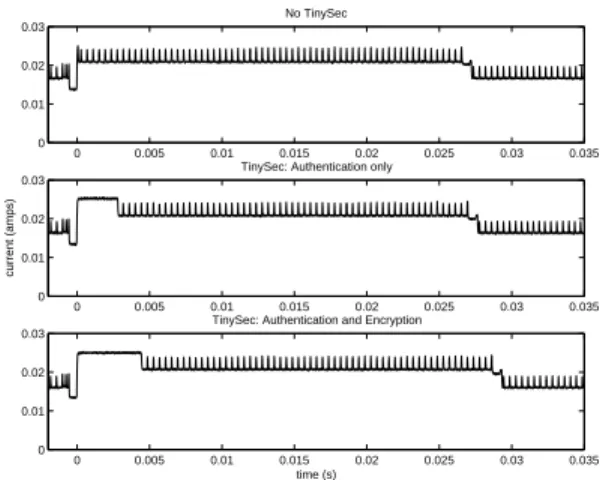
To determine the energy overhead in using TinySec, we sampled the instantaneous current drawn by a transmitter sending 24 bytes of application data. Fig-ure 2 shows the current as a function of time for sending the packet. We provide graphs for the current TinyOS stack (no security), TinySec-Auth, and TinySec-AE.The radio exposes a byte-level interface. Small periodic spikes occur once every byte time. When the radio is in transmit mode, the radio stack delivers a new byte to the radio once every byte time. When the radio isn’t transmit-ting, the stack samples the radio once a byte time looking for the start symbol from a new packet.
There are a number of features of the graph that illustrate TinySec’s implementation. The large power draw at the start of sending a packet for both TinySec graphs is due to the cryptographic operations. When sending a packet, Tiny-Sec overlaps the MAC and encryption computation with the sending of the start symbol. The start symbol lasts for 28 bytes. For the largest possible packet size using TinySec-AE, a maximum of 10 block cipher operations are required,
0 0.005 0.01 0.015 0.02 0.025 0.03 0.035 0 0.01 0.02 0.03 No TinySec 0 0.005 0.01 0.015 0.02 0.025 0.03 0.035 0 0.01 0.02
0.03 TinySec: Authentication only
current (amps) 0 0.005 0.01 0.015 0.02 0.025 0.03 0.035 0 0.01 0.02 0.03
TinySec: Authentication and Encryption
time (s)
Figure 2: The power consumption for sending a packet. All packets contained 24 byte payloads. The top graph shows the power consumption when send-ing the packet with the current TinyOS stack (no se-curity). In the middle graph, we use TinySec-Auth, while the bottom graph uses TinySec-AE. Notice the large power draw at the beginning of sending as the encryption and MAC computation is overlapped with the sending of the start symbol. Additionally, note that when sending with TinySec, the packets are larger in length.
1 2 3 4 5 6 7 8 9 10 11 12 13 14 15 16 17 18 0 5 10 15 20 25 30 35 Number of senders
Total received packets/second
Authentication and encryption Authentication No TinySec
Figure 3: Bandwidth, plotted as a function of the number of send-receive pairs. We compare TinySec-Auth and TinySec-AE to the bandwidth without us-ing TinySec.
hence the block cipher must take no more than 28/10 = 2.8 byte times per operation. The block cipher uses the proces-sor heavily, leading to a large initial power draw while the packet is encrypted. As one would expect, the computation period is larger when using encryption since there are more block cipher operations.
The power consumption measurements show that the send-ing period for TinySec-AE is about 5 byte times longer than without TinySec. Also, TinySec-Auth is longer by a single additional byte time. This is due to the extra packet over-head that TinySec imposes.
After integrating to calculate the area under the curves for the sending period, we find that the total energy consumed for sending a packet with the default stack is 0.00016 mAH. Using TinySec-Auth, it is 0.000165 mAH, a 3% increase. Using TinySec-AE, the total energy to send a packet is 0.000176 mAH, a 10% increase over the energy costs for sending a packet without TinySec.
Comparing these figures to Table 2 illustrates an interest-ing point: the cryptographic operations do not consume a significant amount of energy. TinySec’s energy costs come from two sources: increased packet lengths, and extra com-putation from the cryptography. Using the fact that TinySec-AE performs about twice as many block cipher operations as TinySec-Auth, it is possible to estimate the relative mag-nitude of these two sources of energy overhead. We esti-mate that, of TinySec-Auth’s measured 3% energy overhead, roughly 1% comes from increased packets lengths and 2% from extra computation. Of TinySec-AE’s measured 10% energy overhead, perhaps 6% comes from increased packet lengths and 4% from extra computation. Our measurements provide an upper bound on the energy savings that ware support for cryptography could provide: at best, hard-ware could eliminate the energy costs due to the crypto-graphic computations, but even hardware-accelerated ver-sions of TinySec would still have to pay the energy overhead associated with TinySec’s increased packet lengths.
This demonstrates that hardware support is not a pre-condition for efficient link-layer cryptography in sensor net-works; software cryptography achieves acceptable energy costs. Also, as we have shown, even hardware-assisted cryp-tography would not perform significantly better than Tiny-Sec’s software-only implementation.
Throughput.
To measure the maximum throughput when using TinySec, we computed the total number of packets that could be sent in a 30 second time period. In this ex-periment, we configured a network of nodes so that multiple nodes would simultaneously transmit as rapidly as possible. Since the number of senders affects the channel utilization, we varied the number of senders. This allows us to char-acterize the throughput at different regimes. We sent 24 bytes of application data using the current TinyOS stack, TinySec-Auth, and TinySec-AE. We measured the number of packets that were successfully received. The results are in Figure 3.TinySec-Auth’s bandwidth characteristics are nearly iden-tical to those of the current TinyOS stack. TinySec-AE, with its 5 byte larger packets, consistently achieved 6% lower throughput when more than 5 senders participated. With fewer senders, channel contention is less of an issue, so the packet length overhead does not affect the throughput. We expect sensor networks to largely operate in the latter regime,
4 5 6 7 8 9 10 11 12 150 200 250 300 350 400 450 500 550 600 650 Route time (ms) Number of hops
TinySec: authentication and encryption TinySec: authentication only No security
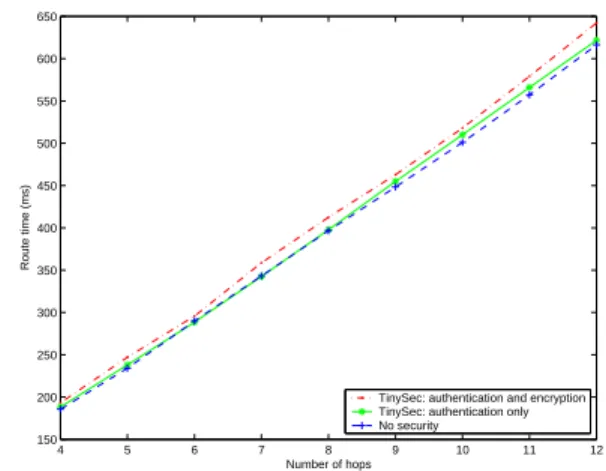
Figure 4: End-to-end latency in a large system using TinySec. We measured the time to route a message over a number of hops. We used 37 nodes in this experiment. Note that TinySec increases end-to-end latency. As shown in Figure 5, the extra latency can be fully explained by TinySec’s impact on packet sizes: longer packets take longer to transmit and hence increase latency.
since at higher bandwidths, the lifetime of the network will be limited.
As further confirmation that the throughput difference is only due to the differences in packet length and not the computational costs, we reran the experiments with the to-tal packet size adjusted to be the same for all three radio stacks. We compared TinySec-AE with a 24 byte data pay-load, TinySec-Auth with a 28 byte data paypay-load, and the current TinyOS stack with a 29 byte payload so that all three packets were 36 bytes in total. We then reran the bandwidth tests, again varying the number of senders, and all three stacks delivered the same bandwidth. We thus conclude that the bandwidth difference is fully explained by the difference in packet sizes, and not due to any increased computation costs.
Latency macrobenchmarks.
For our final test, we inte-grated TinySec into a large existing TinyOS sensor network application. The test had two purposes: we wanted to mea-sure the latency when routing packets and to see how usable TinySec is with a large existing system.The NEST Pursuit-Evasion Midterm Demo Game is a sensor network application that tracks the movements of a mobile evader using magnetometers. The sensor nodes are deployed in a field and form a landmark based routing tree [40]. Separately, autonomous mobile pursuer robots collect data from the sensor networks to follow the evaders. Nodes that have magnetometer readings from the the evader
route the data to a centrallandmark node that routes it to
the mobile pursuers.
In our test, we set up 36 nodes in a 6 foot by 7.75 foot grid. The total network diameter was 10 hops. Additionally, we used a base station connected to a computer to control the network and snoop on traffic. For our tests, we measured the time it took for a message to go from the base station to a sensor network node and get routed through the landmark to another node which broadcasts a reply back to the base
4 5 6 7 8 9 10 11 12 −1 0 1 2 3 4 5 6 7 8 9
Extra latency over no security in byte times
Number of hops
Authentication and encryption Authentication
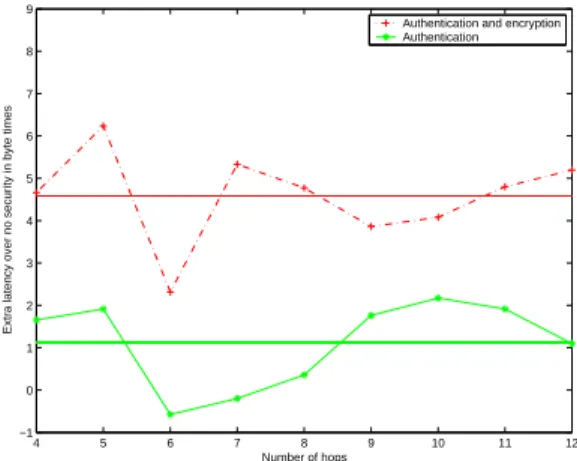
Figure 5: The increase in latency when routing pack-ets using TinySec. We display the results in byte times, the time it takes to transmit one byte of in-formation over the radio. This shows that TinySec’s impact on end-to-end latency is caused by the in-creased length of TinySec packets. There is a close correspondence between theory and practice: us-ing authentication and encryption increases packet length by 5 bytes, and empirically, we see that la-tency is increased by 4.6 byte times; similarly, using authentication alone increases packet lengths by 1 byte, and empirically it increases latency by 1.1 byte times. Note that we have normalized by the route distance.
station. Since all routes in our landmark routing scheme
pass through the landmark, sending a message fromAtoB
takes at least two hops. Additionally, the base station must
send a message toA telling it to initiate its transmission,
andBsends a message back to the base station. This means
that all paths in our test are at least 4 hops in length. We measured the round-trip time it took to transmit pack-ets across paths of different hop lengths. For each route length, we routed 200 packets with the current TinyOS radio stack (no security), with Auth, and with TinySec-AE. The media access control protocol waits a uniformly random amount of time before sending the packet. The sum of many uniformly distributed random variables approaches a normal distribution, which is what we see with the longest routes. Note that the carrier sense in the media access con-trol protocol is occasionally wrong, so that it backs off for a longer time; this leads to a heavy tail in the distribution.
To compare the different radio stacks to each other, we average the individual experimental results to obtain an av-erage single route time per route length. We plot the results in Figure 4. Each data point represents the average elapsed time needed to transmit the packets across a route of a given hopcount. Routing with TinySec-Auth takes longer than with the current TinyOS radio stack; routing with TinySec-AE takes longer than both. As one example, across 12-hop routes, the total difference between TinySec-AE and the cur-rent TinyOS stack is 26 ms. As before, the latency difference can be explained by the increased packet size.
We would expect the total time to transmit a packet to increase by 5 byte times per link when using TinySec-AE. Since each byte time is 0.42 ms, over a 12 hop route, latency
is expected to be 25.20 ms worse; we observed a 26 ms differ-ence. We quantify this effect more precisely in Figure 5. We compare the average byte time difference between the two TinySec modes and the current TinyOS radio stack. We normalize the result by the hop count. The outliers from the heavy tail skew the average, so we remove those values from consideration. Recall the heavy tail is due to the me-dia access control protocol backing off erroneously, and are not material to the metric we are measuring. In the chart, then, we see byte time differences that we measure match our expectations: it takes an extra 5 byte times to trans-mit a TinySec-AE packet one hop, and 1 extra byte-time to transmit a TinySec-Auth packet.
Summary.
In all cases, the energy, bandwidth, and latency overhead of using TinySec is less than 10%. Much of the overhead can be fully explained by the increased packet length that TinySec imposes. There is an additional en-ergy cost to performing the cryptographic computations, amounting to less than 1/2 of the total energy increase of TinySec-AE. Thus, TinySec will be very competitive with hardware solutions.9.2
Ease of Use
We use an indirect means to evaluate TinySec’s ease of use. In the first test, noted above in our latency measure-ments, we integrated TinySec into a large, existing applica-tion. Including TinySec did not require any changes to the application code and only required a one line change to the makefile. Other applications can enable TinySec with the same ease.
TinySec has gathered a number of external users. In par-ticular, we are aware of five other projects that are using TinySec as a research platform to enable their research in key distribution. TinyPK uses RSA to authenticate network downloaded code and to exchange TinySec keys [43]; it is built on top of TinySec, and relies upon TinySec for link-layer security. TinyCrypt, still in development at Harvard, aims to use elliptic curve cryptography to exchange TinySec keys for the Mica2 sensor nodes [32]. Meanwhile, researchers at SRI have designed a scheme for key exchange, group man-agement, and key revocation [18]; they use TinySec’s packet format for transport-level security. Also, SecureSense pro-vides dynamic security service composition using the Tiny-Sec infrastructure [46], and the Bosch corporation used a modified version of TinySec to implement a prototype bur-glar alarm security system. Finally, our TinySec implemen-tation is included in the current TinyOS public release and is available for routine use as well.