Secure and Efficient Protocols for Iris and Fingerprint
Identification
Marina Blanton1and Paolo Gasti2 1
Department of Computer Science and Engineering, University of Notre Dame 2 Department of Information and Computer Science, University of California, Irvine
Abstract. Recent advances in biometric recognition and the increasing use of biometric data prompt significant privacy challenges associated with the possible misuse, loss, or theft of biometric data. Biometric matching is often performed by two mutually distrustful parties, one of which holds one biometric image while the other owns a possibly large biometric collection. Due to privacy and liabil-ity considerations, neither party is willing to share its data. This gives rise to the need to develop secure computation techniques over biometric data where no information is revealed to the parties except the outcome of the comparison or search. To address the problem, in this work we develop and implement the first privacy-preserving identification protocol for iris codes. We also design and implement a secure protocol for fingerprint identification based on FingerCodes with a substantial improvement in the performance compared to existing solu-tions. We show that new techniques and optimizations employed in this work allow us to achieve particularly efficient protocols suitable for large data sets and obtain notable performance gain compared to the state-of-the-art prior work.
1
Introduction
Recent advances in biometric recognition make the use of biometric data more prevalent for authentication and other purposes. Today large-scale collections of biometric data include face, fingerprint, and iris images collected by the US Department of Homeland Security (DHS) from visitors through its US-VISIT program [21], iris images collected by the United Arab Emirates (UAE) Ministry of Interior from all foreigners and also fingerprints and photographs from certain types of travelers [23], and several others. While biometry serves as an excellent mechanism for authentication and identification of individuals, such data is undeniably extremely sensitive and must be well protected. Furthermore, once leaked biometric data cannot be revoked or replaced. For these rea-sons, biometric data cannot be easily shared between organizations or agencies. How-ever, there could be legitimate reasons to carry out computations on biometric data be-longing to different entities. For example, a non-government agency may need to know whether a biometric it possesses appears on the government watch-list. In this case the agency would like to maintain the privacy of the individual if no matches are found, and the government also does not want to release its database to third parties.
The above requires carrying out computation over biometric data in a way that keeps the data private and reveals only the outcome of the computation. In particular, we study
the problem of biometric identification, where a clientCis in a possession of a biomet-ricX and a serverSpossesses a biometric databaseD. The client would like to know whetherX appears in the databaseDby comparing its biometric to the records inD. The computation amounts to comparingXto eachY ∈Din a privacy-preserving man-ner. This formulation is general enough to apply to a number of other scenarios, ranging from a single comparison ofX andY to the case where two parties need to compute the intersection of their respective databases. We assume that the result of comparing biometricsX andY is a bit, and no additional information aboutX orY should be learned by the parties as a result of secure computation. With our secure protocols, the outcome can be made available to either party or both of them; for concreteness in our description, we have the client learn the outcome of each comparison.
In this work we assume that both the client’s and the server’s biometric images have been processed and have representations suitable for biometric matching, i.e., each raw biometric image has been processed by a feature extraction algorithm. For the types of biometric considered in this work, this can be performed for each image independently and we do not discuss this further.
Prior work. Literature on secure multi-party computation is extensive. Starting from the seminal work on garbled circuit evaluation [39], it has been known that any function can be securely evaluated by representing it as a boolean circuit. Similar results are also known for securely evaluating any function using secret sharing techniques (e.g., [36]) or homomorphic encryption (e.g., [11]). In the last several years a number of tools have been developed for automatically creating a secure protocol from a function de-scription written in a high-level language. Examples include Fairplay [30], VIFF [14], TASTY [18], and others. It is, however, well-known that custom optimized protocols are often constructed for specific applications due to the inefficiency of generation solu-tion. Such custom solutions are known for a wide range of application (e.g., set opera-tions [29, 17], DNA matching [38], k-means clustering [9], etc.), and this work focuses on secure biometric identification using iris codes and fingerprints. Furthermore, some of the optimizations employed in this work can find their uses in protocol design for other applications, as well as general compilers and tools such as TASTY [18].
With the growing prevalence of applications that use biometrics, the need for se-cure biometric identification was recognized in the research community. A number of recent publications address the problem of privacy-preserving face recognition [16, 37, 33]. This problem was first treated by Erkin et al. [16], where the authors designed a privacy-preserving face recognition protocol based on the Eigenfaces algorithm. The performance of that solution was consequently improved by Sadeghi et al. [37]. More recently, Osadchy et al. [33] designed a new face recognition algorithm together with its privacy-preserving realization called SCiFI. The design targeted to simultaneously address robustness to different viewing conditions and efficiency when used for secure computation. As a result, SCiFI is currently recognized as the best face identification algorithm with efficient privacy-preserving realization. SCiFI takes 0.31 sec (during the online phase) [33] to compare two biometrics, and therefore would take about 99 sec to compare a biometric to a database of 320 images (which is the database size used in the experiments in several prior publications).
Another very recent work by Barni et al. [3] designs a privacy-preserving protocol for fingerprint identification using FingerCodes [25]. FingerCodes use texture informa-tion from a fingerprint to compare two biometrics. The algorithm is not as discrimi-native as fingerprint matching techniques based on location of minutiae points, but it was chosen by the authors as particularly suited for efficient realization in the privacy-preserving framework. As of the time of this writing, similar results for other types of biometrics or other fingerprint matching techniques are not available in the literature. We narrow this gap by providing a secure two-party protocol for widely used iris identi-fication, as well as address fingerprint identification. Our protocols follow the standard algorithms for comparing two biometrics, yet they are very efficient and outperform the state-of-the-art protocols with a notable reduction in the overhead.
Bringer et al. [8] describe a biometric-based authentication mechanism with privacy protection of biometric, where the Hamming distance is used as the distance metric. The authentication server is composed of three entities that must not collude, and one of them, the matcher, learns the computed Hamming distance. In our work, however, no information beyond the outcome of the comparison is revealed, the computation itself is more complex and corresponds to the actual algorithm used for iris code com-parisons, and there is no need for additional or third-party entities. Barbosa et al. [2] extend the framework with a classifier to improve authentication accuracy and propose an instantiation based on Support Vector Machine using homomorphic encryption. Our contributions. In this work we treat the problem of privacy preserving biomet-ric identification. We develop new secure protocols for two types of biometbiomet-ric, iris and fingerprints, and achieve security against semi-honest adversaries. While iris codes are normally represented as binary strings and use very similar matching algorithms, there is a variety of representations and comparison algorithms for fingerprints. In this paper, we study FingerCodes that use fixed-size representations and an efficient comparison algorithm.3Our protocols were designed with efficiency in mind to permit their use on relatively large databases, and possibly in real time. While direct performance compari-son of our protocols and the results available in the literature is possible only in the case of FingerCode, we can use complexity of the computation to draw certain conclusions. The results we achieve in this work are as follows:
1. Our secure FingerCode protocol is extremely fast and allows the parties to com-pare two fingerprintsX andY using a small fraction of a second. For a database of 320 biometrics, the online computation can be carried out in 0.45 sec with the communication of 279KB. This is an over 30-fold improvement in both communi-cation and computation over the privacy-preserving solution of [3], as detailed in Section 5, and a significant improvement over an adaptation of [37] to this context. 2. Iris codes use significantly longer representations (thousands of bits) and require more complex transformation of the data. Despite the length and complexity, our solution allows two iris codes to be compared in 0.15 sec. With respect to the state-of-the-art face recognition protocol SCiFI, which also relies on Hamming distance computation, our protocol achieves lower overhead despite the fact that the compu-tation involves an order of magnitude larger number of more complex operations.
3
We also construct a secure protocol for minutiae-based fingerprint comparisons, but its descrip-tion and implementadescrip-tion appear in the full version of this work [7] due to space constraints.
2
Description of Computation
In what follows, we assume that clientC holds a single biometricX and server S
holds a database of biometricsD. The goal is to learn whetherC’s biometric appears inS’s database without learning any additional information. This is accomplished by comparingX to each biometricY ∈D, and as a result of each comparisonClearns a bit that indicates whether the comparison resulted in a match.
Iris. Let an iris biometricX be represented as anm-bit binary string. We useXito
denotei-th bit ofX. In iris-based recognition, after feature extraction, biometric match-ing is normally performed by computmatch-ing the Hammmatch-ing distance between two biometric representations. Furthermore, the feature extraction process is such that some bits of the extracted stringX are unreliable and are ignored in the matching process. Infor-mation about such bits is stored in an additionalm-bit string, called mask, where its
i-th bit is set to 1 if the i-th bit ofX should be used in the matching process and is set to 0 otherwise. For biometricX, we useM(X)to denote the mask associated withX. Often, a predetermined number of bits (e.g., 25% in [20] and 35% in [4]) is considered unreliable in each biometric template. Thus, to compare two biometric rep-resentationsXandY, their Hamming distance takes into account the respective masks. That is, if the Hamming distance between two iris codes without masks is computed as:
HD(X, Y) = (||X⊕Y||)/m= (Pm
i=1Xi⊕Yi)/m, the computation of the Hamming
distance that uses masks becomes [15]:
HD(X, M(X), Y, M(Y)) = ||(X⊕Y)∩M(X)∩M(Y)||
||M(X)∩M(Y)|| (1) In other words, we have HD(X, M(X), Y, M(Y)) = Pmi=1((Xi⊕Yi)∧M(Xi)∧M(Yi))
Pm
i=1(M(Xi)∧M(Yi)) .
Throughout this work, we assume that the latter formula is used and simplify the nota-tion toHD(X, Y). Then the computed Hamming distance is compared with a specific thresholdT, and the biometricsX andY are considered to be a match if the distance is below the threshold, and a mismatch otherwise. The thresholdT is chosen based on the distributions of authentic and impostor data. (In the likely case of overlap of the two distributions, the threshold is set to achieve the desired levels of false accept and false reject rates based on the security goals.)
Two iris representations can be slightly misaligned. This problem is caused by head tilt during image acquisition. To account for this, the matching process attempts to compensate for the error and rotates the biometric representation by a fixed amount to determine the lowest distance. Each biometric is represented as a two-dimensional array, therefore a circular shift is applied to each row by shifting its representation by a small fixed number of times, which we denote by c. The minimum Hamming distance across all runs is then compared to the threshold. That is, if we letLSj(·)(resp., RSj(·)) denote a circular left (resp., right) shift of the argument by a fixed number of bits (2 bits in experiments conducted by the biometrics group at our institution, where application of the Gabor filter during feature extraction results in a complex number, which is quantized into a 2-bit value), the matching process becomes:
min(HD(X,LSc(Y)), . . ., HD(X,LS1(Y)), HD(X, Y),
Throughout this work we assume that the algorithms for comparing two biometrics are public, as well as any constant parameters such asT. Our protocols, however, maintain their security and performance guarantees if the (fixed) thresholds are known only to the server who owns the database.
Fingerprints. Work on fingerprint identification dates many years back with a number of different approaches currently available (see, e.g., [31] for an overview). The most popular and widely used techniques extract information about minutiae from a finger-print and store that information as a set of points in the two-dimensional plane. Fin-gerprint matching can also be performed using a different type of information extracted from a fingerprint image. One example is FingerCode [25] which uses texture informa-tion from a fingerprint scan to form fingerprint representainforma-tionX. While FingerCodes are not as distinctive as minutiae-based representations and are best suited for use in combination with minutiae to improve the overall matching accuracy [31], FingerCode-based identification can be implemented very efficiently in a privacy-preserving proto-col. In particular, each FingerCode consists of a fixed numbermelements ofℓbits each. Then FingerCodesX = (x1, . . ., xm)andY = (y1, . . ., ym)are considered a match if
the Euclidean distance between their elements is below the thresholdT: r
Xm
i=1(xi−yi)
2< T? (3)
Barni et al. [3] was the first to provide a privacy-preserving protocol for FingerCode-based biometric identification. We show that the techniques employed in this work im-prove both computation and communication of the protocol of [3] by a large factor.
3
Preliminaries
Security model. We use the standard security model for secure two-party computation in presence of semi-honest participants (also known as honest-but-curious or passive). In particular, it means that the parties follow the prescribed behavior, but might try to compute additional information from the information obtained during protocol execu-tion. Security in this setting is defined using simulation argument: the protocol is secure if the view of protocol execution for each party is computationally indistinguishable from the view simulated using that party’s input and output only. This means that the protocol execution does not reveal any additional information to the participants. The definition below formalizes the notion of security for semi-honest participants:
Definition 1. Let parties P1 andP2 engage in a protocolπ that computes function
f(in1,in2) = (out1,out2), where ini andouti denote input and output of partyPi, respectively. LetVIEWπ(Pi)denote the view of participantPi during the execution
of protocolπ. More precisely,Pi’s view is formed by its input, internal random coin
tossesri, and messagesm1, . . ., mtpassed between the parties during protocol
execu-tion, i.e.,VIEWπ(Pi) = (ini, ri, m1, . . ., mt).We say that protocolπis secure against
semi-honest adversaries if for each partyPi there exists a probabilistic polynomial
time simulatorSisuch that{Si(ini, f(in1,in2))} ≡ {VIEWπ(Pi),outi},where “≡”
Homomorphic encryption. Our constructions use a semantically secure additively homomorphic encryption scheme. In an additively homomorphic encryption scheme, Enc(m1)·Enc(m2) =Enc(m1+m2)which also implies thatEnc(m)a=Enc(a·m).
While any encryption scheme with the above properties (such as the well known Paillier encryption scheme [34]) suffices for the purposes of this work, the construction due to Damg˚ard et al. [13, 12] (DGK) is of particular interest here. We also note that in Paillier encryption scheme, a public key consists of ak-bit RSA modulusN =pq, wherepand
qare prime, and an elementgwhose order is a multiple ofN inZ∗
N2. Given a message m ∈ZN, encryption is performed asEnc(m) =gmrnmodN2, wherer
R
←ZN and
notationa ←R Ameans thatais chosen uniformly at random from the setA. In DGK encryption scheme [13, 12], which was designed to work with small plaintext spaces and has shorter ciphertext size than other randomized encryption schemes, a public key consists of (i) a (small, possibly prime) integeruthat defines the plaintext space, (ii)
k-bit RSA modulusN =pq such thatpandqarek/2-bit primes,vp andvq aret-bit
primes, anduvp|(p−1)anduvq|(q−1), and (iii) elementsg, h∈Z∗N such thatghas
orderuvpvqandhhas ordervpvq. Given a messagem∈Zu, encryption is performed
asEnc(m) =gmhrmodN, wherer← {R 0,1}2.5t. We refer the reader to the original
publications [34] and [13, 12], respectively, for any additional information.
Garbled circuit evaluation. Originated in Yao’s work [39], garbled circuit evaluation allows two parties to securely evaluate any function represented as a boolean circuit. The basic idea is that, given a circuit composed of gates, one partyP1creates a garbled circuit by assigning to each wire two randomly chosen keys.P1also encodes gate in-formation in a way that given keys corresponding to the input wires (encoding specific inputs), the key corresponding to the output of the gate on those inputs can be recov-ered. The second party,P2, evaluates the circuit using keys corresponding to inputs of bothP1andP2(without learning anything in the process). At the end, the result of the computation can be recovered by linking the output keys to the bits which they encode. Recent literature provides optimizations that reduce computation and communi-cation overhead associated with circuit construction and evaluation. Kolesnikov and Schneider [27] describe an optimization that permits XOR gates to be evaluated for free, i.e., there is no communication overhead associated with such gates and their eval-uation does no involve cryptographic functions. This optimization is possible when the hash function used for creating garbled gates can be assumed to be correlation robust (see [28, 27] for more detail). Under the same assumptions, Pinkas et al. [35] addition-ally give a mechanism for reducing communication complexity of binary gates by 25%: now each gate can be specified by encoding only three outcomes of the gate instead of all four. Finally, Kolesnikov et al. [26] improve the complexity of certain commonly used operations such as addition, multiplication, comparison, etc. by reducing the num-ber of non-XOR gates: adding two n-bit integers requires 5n gates,nof which are non-XOR gates; comparing twon-bit integers requires4ngates,nof which are non-XOR gates; and computing the minimum oft n-bit integers (without the location of the minimum value) requires7n(t−1)gates,2n(t−1)of which are non-XOR gates.
With the above techniques, evaluating a non-XOR gates involves one invocation of the hash function (which is assumed to be correlation robust). During garbled circuit
evaluation,P2directly obtains keys corresponding toP1’s inputs fromP1and engages in the oblivious transfer (OT) protocol to obtain keys corresponding toP2’s inputs. Oblivious Transfer. In 1-out-of-2 Oblivious Transfer,OT12, one party, the sender, has as its input two stringsm0, m1 and another party, the receiver, has as its input a bitb. At the end of the protocol, the receiver learnsmb and the sender learns nothing.
Similarly, in 1-out-of-NOT the receiver obtains one of theNstrings held by the sender. There is a rich body of research literature on OT, and in this work we use its efficient implementation from [32] as well as techniques from [24] that reduce a large number of OT protocol executions toκof them, whereκis the security parameter. This, in particular, means that obtaining the keys corresponding toP2’s inputs in garbled circuit evaluation byP2incurs only small overhead.
4
Secure Iris Identification
As indicated in equation 1, computing the distance between two iris codes involves per-forming the division operation. While techniques for carrying out this operation using secure multi-party computation are known (see, e.g., [1, 9, 6, 10]), their performance in practice even using very recent results is far from satisfactory for this application As an example, Blanton [5] reports that two-party evaluation of garbled circuits produced by Fairplay takes several seconds for numbers of length 24–28 bits, but circuits for longer integers could not be constructed due to the rapidly increasing memory requirements of Fairplay. Hoens et al. [19] report that building a multi-party division protocol us-ing homomorphic encryption alone requires on the order of an hour to carry out the operation for 32-bit integers. Fortunately, in our case the computation can be rewrit-ten to completely avoid this operation and replace it with multiplication. That is, using the notation HD(X, Y) = ||(X ⊕Y)∩M(X)∩M(Y)||/||M(X)∩M(Y)|| =
D(X, Y)/ M(X, Y),instead of testing whetherHD(X, Y)< T? , we can test whether
D(X, Y) < T? ·M(X, Y). While the computation of the minimum distance as used in equation 2 is no longer possible, we can replace it with equivalent computation that does not increase its cost. Now the computation becomes:
D(X,LSc(Y))< T? ·M(X,LSc(Y))∨· · ·∨D(X,RSc(Y))< T? ·M(X,RSc(Y)) (4) When this computation is carried over real numbers,T lies in the range [0, 1]. In our case, we need to carry the computation over the integers, which means that we “scale up” all values with the desired level of precision. That is, by using ℓbits to achieve desired precision, we multiplyD(X, Y)by2ℓand letT range between 0 and2ℓ. Now
2ℓD(X, Y)andT·M(X, Y)can be represented using⌈logm⌉+ℓbits.
Security. Due to space constraints, we defer the security analysis of our iris identifica-tion protocol, described in Secidentifica-tions 4.1 and 4.2 below, to Appendix A.
4.1 Base Protocol
In what follows, we first describe the protocol in its simplest form. Section 4.2 presents optimizations and the resulting performance of the protocol.
In our solution, the clientCgenerates a public-private key pair(pk, sk)for a ho-momorphic encryption scheme and distributes the public keypk. This is a one-time setup cost for the client for all possible invocations of this protocol with any number of servers. During the protocol itself, the secure computation proceeds as specified in equation 4. In the beginning,Csends its inputs encrypted withpkto the serverS. At the server side, the computation first proceeds using homomorphic encryption, but later the client and the server convert the intermediate result into a split form and finish the computation using garbled circuit evaluation. This is due to the fact that secure two-party computation of the comparison is the fastest using garbled circuit evaluation [26], but the rest of the computation in our case is best performed on encrypted values.
To computeD(X, Y) =Pm
i=1(Xi⊕Yi)∧M(Xi)∧M(Yi)using algebraic
compu-tation, we useXi⊕Yi=Xi(1−Yi)+(1−Xi)Yiand obtainD(X, Y) =Pmi=1(Xi(1− Yi) + (1−Xi)Yi)M(Xi)M(Yi).M(X, Y)is computed asP
m
i=1M(Xi)M(Yi). Then
ifSobtains encryptions ofXiM(Xi),(1−Xi)M(Xi), andM(Xi)for eachifromC,
the server will be able to computeD(X, Y)andM(X, Y)using its knowledge of the
Yi’s and the homomorphic properties of the encryption. Figure 1 describes the protocol,
in which after receivingC’s encrypted valuesSproducesEnc(M(Xi))’s and proceeds to computeD(X, Yj)andM(X, Yj)in parallel for eachY in its database, whereYj
denotes biometricY shifted byjpositions andjranges from−ctoc. At the end of steps 3(a).i and 3(a).ii the server obtainsEnc(2ℓD(X, Yj) +rj
S)for a randomly chosenr j Sof
its choice, and at the end of step 3(a).iiiSobtainsEnc(T·M(X, Yj)+tj
S)for a random tjSof its choice. The server sends these values to the client who decrypt them. Therefore,
at the end of step 3(a)CholdsrCj = 2
ℓD(X, Yj) +rj Sandt j C =T·M(X, Y j) +tj S
andSholds−rjSand−t j
C, i.e., they additively share2
ℓD(X, Yj)andT ·M(X, Yj).
What remains to compute is2c+ 1comparisons (one per eachYj) followed by2c
OR operations as specified by equation 4. This is accomplished using garbled circuit evaluation, whereC entersrjC’s andt
j
C’s andSentersr j S’s andt
j
S’s and they learn a
bit, which indicates whetherY was a match. Note that sincerjC’s,r
j S’s,t
j C’s andt
j
S’s are used as inputs to the garbled circuit and
will need to be added inside the circuit, we want them to be as small as possible. There-fore, instead of providing unconditional hiding by choosingtjSandr
j
CfromZ
∗
N(where Nis frompk), the protocol achieves statistical hiding by choosing these random values to beκbits longer than the values that they protect, whereκis a security parameter.
4.2 Optimizations
Pre-computation and offline communication. Similar to prior literature on secure biometric identification [16, 37, 33, 3], we distinguish between offline and online stages, where any computation and computation that does not depend on the inputs of the par-ticipating parties can be moved to the offline stage. In our protocol, first notice that most modular exponentiations (the most expensive operation in the encryption scheme) can be precomputed. That is, the client needs to produce2mencryptions of bits. Because bothmand the average number of 0’s and 1’s in a biometric and a mask are known, the client can produce a sufficient number of bit encryptions in advance. In particular,
Input:Chas biometricX,M(X)and key pair(pk, sk);Shas a databaseDcomposed ofY, M(Y)biometrics.
Output:Clearns what records inDresulted in match withX if any, i.e., it learns a bit as a result of comparison ofXwith eachY ∈D.
Protocol steps:
1. For eachi= 1, . . ., m,Ccomputes encryptionshai1, ai2i=hEnc(XiM(Xi)),Enc((1−
Xi)M(Xi))iand sends them toS.
2. For eachi= 1, . . ., m,Scomputes encryption ofM(Xi)by settingai3 =ai1·ai2 = Enc(XiM(Xi))·Enc((1−Xi)M(Xi)) =Enc(M(Xi)).
3. For each recordY in the database,SandCperform the following steps in parallel: (a) For each amount of shiftj=−c, . . .,0, . . ., c,Srotates the bits ofY by the
appro-priate number of positions to obtainYj
and proceeds with allYj
’s in parallel. i. To compute (Xi ⊕ Yij)M(Xi)M(Yij) = (Xi(1 − Yij) + (1 −
Xi)Yij)M(Xi)M(Yij)in encrypted form,S computesb j i =a (1−Yij)M(Yij) i1 · aY j iM(Y j i) i2 =Enc(XiM(Xi)(1−Yij)M(Y j i) + (1−Xi)M(Xi)YijM(Y j i)).
ii. Sadds the values contained inbji’s to obtainbj=Qm i=1b j i =Enc( Pm i=1(Xi⊕ Yij)M(Xi)M(Yij)) = Enc(||(X⊕Y j)∩M(X)∩M(Yj)||) .Sthen “lifts up” the result, blinds, and randomizes it ascj= (bj)2ℓ ·Enc(rj
S), wherer j S
R
← {0,1}⌈logm⌉+ℓ+κ, and sends the resultingcjtoC.
iii. To obtainT(||M(X)∩M(Yj)||),Scomputesdji =a M(Yij) i3 =Enc(M(Xi)· M(Yij))anddj = (Qm i=1d j i) T = Enc(T(Pm i=1M(Xi)M(Yij))).S blinds
and randomizes the result asej=dj·Enc(tj
S), wheret j S R ← {0,1}⌈logm⌉+ℓ+κ, and sendsej toC.
iv. Cdecrypts the received values and setsrjC=Dec(cj)andtj
C =Dec(e j)
. (b) CandSperform2c+ 1comparisons and OR of the results of the comparisons using
garbled circuit.C enters rjC’s andtjC’s, S enters−rSj’s and−tjS’s, andC learns bitbcomputed asWc j=−c((r j C−r j S) ?
<(tjC−tjS)). To achieve this,Screates the garbled circuit and sends it toC.Cobtains keys corresponding to its inputs using OT, evaluates the circuit, andSsends toCthe key-value mapping for the output gate.
Fig. 1. Secure two-party protocol for iris identification.
ofM(X)’s bits are set to 1 and 25% to 0 during biometric processing. Letp0 andp1 (q0 andq1) denote the fraction of 0’s and 1’s in an iris code (resp., its mask), where
p0+p1 =q0+q1 = 1. Therefore, to have a sufficient supply of ciphertexts to form tupleshai1, ai2i, the client needs to precompute(2q0+q1(p1+ε) +q1(p0+ε))m= (1 +q0+ 2q1ε)mencryptions of 0 and(q1(p1+ε) +q1(p0+ε))m=q1(1 + 2ε)m encryptions of 1, whereεis used as a cushion since the number of 0’s and 1’s inX
might not be exactlyp0andp1, respectively. Then at the time of the protocol the client simply uses the appropriate ciphertexts to form its transmission.
Similarly, the server can precompute a sufficient supply of encryptions ofrjS’s and
tjS’s for all records. That is, the server needs for produce2(2c+ 1)|D|encryptions of different random values of length⌈logm⌉+ℓ+κ, where|D|denotes the size of the databaseD. The server also generates one garbled circuit per recordY in its database (for step 3(b) of the protocol) and communicates the circuits to the client. In addition,
the most expensive part of the oblivious transfer can also be performed during the offline stage, as detailed below.
Optimized multiplication. Server’s computation in steps 3(a).i and 3(a).iii of the pro-tocol can be significantly lowered as follows. To compute ciphertextsbji,S needs to
calculatea(1−Y j i)M(Y j i) i1 ·a YijM(Yij)
i2 . Since the bitsY
j
i andM(Y j
i )are known toS, this
computation can be rewritten using one of the following cases: – Yij = 0andM(Y
j
i) = 0: in this case both(1−Y j i)M(Y j i )andY j i M(Y j i )are
zero, which means thatbji should correspond to an encryption of 0 regardless ofai1 andai2. Instead of havingScreate an encryption 0, we setbji to the empty value,
i.e., it is not used in the computation ofbjin step 3(a).ii.
– Yij= 1andM(Y j
i ) = 0: the same as above.
– Yij = 0andM(Y j i ) = 1: in this case(1−Y j i )M(Y j i ) = 1andY j i M(Y j i ) = 0,
which means thatSsetsbji =ai1. – Yij = 1andM(Y j i ) = 1: in this case(1−Y j i )M(Y j i ) = 0andY j i M(Y j i ) = 1,
andStherefore setsbji =ai2.
The above implies that onlyq1mciphertextsbji need to be added in step 3(a).ii to form bj (i.e.,q
1m−1 modular multiplications to compute the hamming distance between
m-element strings).
Similar optimization applies to the computation ofdji andd
j in step 3(a).iii of the
protocol. That is, whenM(Yij) = 0,d j
i is set to the empty value and is not used in the
computation ofdj; whenM(Yj
i) = 1,Ssetsd j
i =ai3. Consequently,q1mciphertexts are used in computingdj.
To further reduce the number of modular multiplications, we can adopt the idea from [33], which consists of precomputing all possible combinations for ciphertexts at positionsiandi+ 1and reducing the number of modular multiplications used during processing a database record in half. In our case, the value of bjib
j
i+1 requires com-putation only when M(Yij) = M(Y
j
i+1) = 1. In this case, computing ai1a(i+1)1,
ai1a(i+1)2,ai2a(i+1)1, andai2a(i+1)2, for each oddibetween 1 andm−1will cover all possibilities. Note that these values need to be computed once for all possible shift amounts of the biometrics (since only server’sY’s are shifted). Depending on the distri-bution of the set bits in eachM(Y), the number of modular multiplication now will be betweenq1m/2(whenM(Yi) =M(Yi+1)for each oddi) andm(q0+ (1−2q0)/2) =
m/2(whenM(Yi)=6 M(Yi+1)for as many oddi’s as possible). This approach can be
also applied to the computation ofdj (where only the value ofa
i3a(i+1)3needs to be precomputed for each oddi) resulting in the same computational savings during com-putation of the hamming distance. Furthermore, by precomputing the combinations of more than two values additional savings can be achieved during processing of eachY. Optimized encryption scheme. As it is clear from the protocol description, its perfor-mance crucially relies on the perforperfor-mance of the underlying homomorphic encryption scheme for encryption, addition of two encrypted values, and decryption. Instead of utilizing a general purpose encryption scheme such as Paillier, we turn our attention to schemes of restricted functionality which promise to offer improved efficiency. In par-ticular, the DGK additively homomorphic encryption scheme [13, 12] was developed to be used for secure comparison, where each ciphertext encrypts a bit. In that setting,
it has faster encryption and decryption time than Paillier and each ciphertext has size
k using a k-bit RSA modulus (while Paillier ciphertext has size 2k). To be suitable for our application, the encryption scheme needs to support larger plaintext sizes. The DGK scheme can be modified to work with longer plaintexts. In that case, at decryption time, one needs to additionally solve the discrete logarithm problem where the base is 2-smooth using Pohlig-Hellman algorithm. This means that decryption uses additional
O(n)modular multiplications forn-bit plaintexts. Now recall that in the protocol we encrypt messages of length⌈logm⌉+ℓ+κbits. The use of the security parameterκ
significantly increases the length of the plaintexts. We, however, notice that the DGK encryption can be setup to permit arithmetic on encrypted values such that all compu-tations on the underlying plaintexts are carried modulo2n for anyn. For our protocol
it implies that (i) the blinding valuesrSj andt j
S can now be chosen from the range
[0,2n−1], wheren=⌈logm⌉+ℓ, and (ii) this provides information-theoretic hiding
(thus improving the security properties of the protocol). This observation has a pro-found impact not only on the client decryption time in step 3(a).iv (which decreases by about an order of magnitude), but also on the consecutive garbled circuit evaluation, where likewise the circuit size is significantly reduced in size.
Circuit construction. We construct garbled circuits using the most efficient techniques from [35] and references therein. By performing addition modulo2n and eliminating
gates which have a constant value as one of their inputs, we reduce the complexity of the circuit for addition ton−1non-XOR gates and5(n−1)−1total gates. Similarly, after eliminating gates with one constant input, the complexity of the circuit for comparison ofn-bit values becomesnnon-XOR gates and4n−2gates overall. Since in the protocol there are two additions and one comparison per eachj followed by2cOR gates, the size of the overall circuit is14(n−1)(2c+ 1) + 2cgates,(3n−2)(2c+ 1) + 2cof which are non-XOR gates. Note that this circuit does not use multiplexers, which are required (and add complexity) during direct computation of minimum.
Oblivious transfer. The above circuit requires each party to supply2n(2c+ 1)input bits, and a new circuit is used for eachY inD. Similar to [18], the combination of techniques from [24] and [32] achieves the best performance in our case. Let the server create each circuit and the client evaluate them. Using the results of [24], performing
OT2
1 the total of2n(2c+ 1)|D|times, where the client receives aκ-bit string as a re-sult of each OT for a a security parameterκ, can be reduced toκinvocations ofOT2 1 (that communicates to the receiverκ-bit strings) at the cost of4κ·2n(2n+ 1)|D|bits of communication and4n(2c+ 1)applications of a hash function for the sender and 2n(2c+ 1)applications for the receiver. Thenκ OT2
1 protocols can be implemented us-ing the construction of [32] with low amortized complexity, where the sender performs 2 +κand the receiver performs2κmodular exponentiations with the communication of2κ2bits andκpublic keys. The OT protocols can be performed during the offline stage, while the additional communication takes place once the inputs are known. Further reducing online communication. If transmitting2mciphertexts during the online stage of the protocol (which amounts to a few hundred KB for our set of param-eters) constitutes a burden, this communication can be performed at the offline stage before the protocol begins. This can be achieved using the technique of [33]. We refer the reader to the full version [7] for details of applying this technique to our solution.
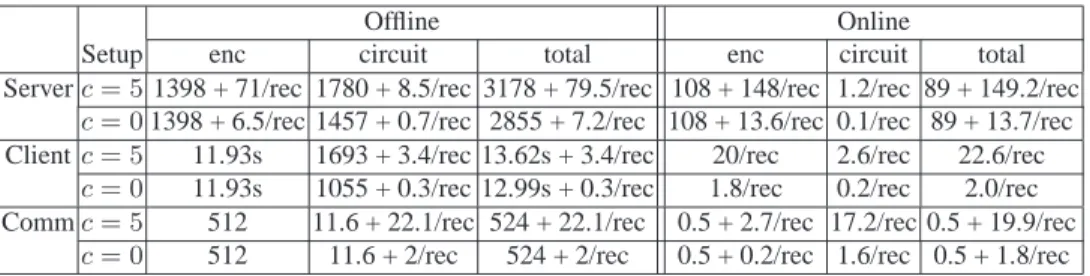
Offline Online
Setup enc circuit total enc circuit total Serverc= 51398 + 71/rec 1780 + 8.5/rec 3178 + 79.5/rec 108 + 148/rec 1.2/rec 89 + 149.2/rec
c= 01398 + 6.5/rec 1457 + 0.7/rec 2855 + 7.2/rec 108 + 13.6/rec 0.1/rec 89 + 13.7/rec Clientc= 5 11.93s 1693 + 3.4/rec 13.62s + 3.4/rec 20/rec 2.6/rec 22.6/rec
c= 0 11.93s 1055 + 0.3/rec 12.99s + 0.3/rec 1.8/rec 0.2/rec 2.0/rec Commc= 5 512 11.6 + 22.1/rec 524 + 22.1/rec 0.5 + 2.7/rec 17.2/rec 0.5 + 19.9/rec
c= 0 512 11.6 + 2/rec 524 + 2/rec 0.5 + 0.2/rec 1.6/rec 0.5 + 1.8/rec Table 1. Breakdown of the performance of the iris identification protocol. Time is expressed in milliseconds unless otherwise stated, and communication overhead in KB.
4.3 Implementation and Performance
We implemented the secure iris identification protocol in C using MIRACL library [22] for cryptographic operations. The implementation used DGK encryption scheme [13, 12] with a 1024-bit modulus and another security parametertset to 160, as suggested in [13, 12]. To simplify comparisons with prior work, throughout this work we use
k = 1024security parameter for public-key cryptography andκ= 80for symmetric and statistical security. The experiments were run on an Intel Core 2 Duo 2.13 GHz with 3GB of RAM and gcc version 4.4.5 on Linux.
Table 1 shows performance of the secure iris identification protocol and its compo-nents. The performance was obtained using the following set of parameters: the size of iris code and maskm = 2048(this value ofmis used in commercial iris recognition software), 75% of bits are reliable in each iris code, and the lengthnof values is 20 bits. All optimizations described earlier in this section were implemented. In our implemen-tation, upon receipt of client’s data, the server precomputes all combinations for pairs of ciphertextsbibi+1in step 3(a).ii (one-time cost of the total of4(m/2)modular multipli-cations) and all combinations of 4 elementsdidi+1di+2di+3 in step 3(a).iii (one-time cost of11(m/4)modular multiplications). This cuts the server’s time for processing each Y by more than a half. Furthermore, the constant overhead associated with the OT (circuit) can be reduced in terms of both communication and computation for both parties if public-key operations are implemented over elliptic curves.
The table shows performance using different configurations with the amount of ro-tationc= 5and no rotation withc= 0(this is used when the images are well aligned, which is the case for iris biometrics collected at our institution). In the table, we divide the computation and communication into offline precomputation and online protocol execution. No inputs are assumed to be known by any party at precomputation time. Some of the overhead depends on the server’s database size, in which case the computa-tion and communicacomputa-tion are indicated per record (using notacomputa-tion “/rec”). The overhead associated with the part of the protocol that uses homomorphic encryption is shown separately from the overhead associated with garbled circuits. The offline and online computation for the part based on homomorphic encryption is computed as described in Section 4.2. For circuits, garbled circuit creation, communication, and some of OT is performed at the offline stage, while the rest of OT (as described in Section 4.2) and garbled circuit evaluation takes place during the online protocol execution.
Input:Chas biometricX = (x1, . . ., xm)and DGK encryption key pair(pk, sk);S has a
databaseDcomposed of biometricsY = (y1, . . ., ym).
Output:Clearns what records inDresulted in match withX if any, i.e., it learns a bit as a result of comparison ofXwith eachY ∈D.
Protocol steps:
1. Ccomputes and sends toSencryptionsEnc(−2x1), . . .,Enc(−2xm),Enc(Pm i=1x2i).
2. For eachY = (y1, . . ., ym)∈D,SandCperform in parallel:
(a) S computes the encrypted distancedbetweenX andY asd = Enc(Pm i=1x2i)· Enc(Pm i=1y 2 i)· Qm i=1Enc(−2xi)yi = Enc( Pm i=1(xi−yi)2), blinds it asd′ =
d·Enc(rS), whererS← {R 0,1}n, and sendsd′toC. (b) Cdecrypts the value it receives and setsrC=Dec(d′).
(c) CandSengage in a secure protocol that computes((rC−rS) mod 2n)
?
< T2using garbled circuit evaluation.Screates the circuit and sends it toCalong with the key-value mapping for the output gate.Cobtains keys corresponding to its inputs fromS using OT, evaluates the circuit, and learns the result.
Fig. 2. Secure two-party protocol for FingerCode identification.
It is evident that our protocol design and optimizations allow us to achieve notable performance. In particular, comparison of two iris codes, which includes computation of 2(2c+ 1) = 22Hamming distances over 2048-bit biometrics in encrypted form, is done in 0.15 sec. This is noticeably lower than 0.3 sec online time per record reported by the best currently known face recognition protocol SCiFI [33], which computes a single Hamming distance over 900-bit values. That is, despite an order of magnitude larger number of operations and more complex operations such as division, computation of minimum, etc., we are able to outperform prior work by roughly 50%. This in particular implies that using the techniques suggested in this work (and DGK encryption scheme in particular) performance of SCiFI and other existing protocols can be improved to a fraction of the previously reported time. When iris images are well aligned and no rotation is necessary our protocol requires only 14 msec online computation time and under 2KB of data to compare two biometrics.
5
Secure Fingerprint Identification
In this section we illustrate how a number of the techniques developed in this work for iris identification can be applied to other types of biometric computations such as FingerCodes. In particular, we show that the efficiency of the secure protocol for Fin-gerCode identification [3] can be improved by an order of magnitude.
The computation involved in FingerCode comparisons is very simple, which re-sults in an extremely efficient privacy-preserving realization. Similar to [3], we rewrite the computation in equation 3 as Pm
i=1(xi −yi)2 = Pmi=1(xi)2 +Pmi=1(yi)2 −
Pm
i=12xiyi < T2. In our protocol, the Euclidean distance is computed using
ho-momorphic encryption, while the comparisons are performed using garbled circuits. The secure FingerCode protocol is given in Figure 2: the client contributes encryp-tions of−2xiandP(xi)2to the computation, while the server contributesP(yi)2and
Offline Online
enc circuit total enc circuit total Server 3.6 + 3.9/rec 1448 + 0.37/rec 1451.6 + 4.3/rec 0.22 + 1.37/rec 0.05/rec 0.22 + 1.42/rec Client 61 1025 + 0.15/rec 1086 + 0.15/rec 4.7 + 0.92/rec 0.16/rec 4.7 + 1.08/rec Comm 0 11.6 + 1.26/rec 11.6 + 1.26/rec 2.12 + 0.12/rec 0.74/rec 2.12 + 0.86/rec Table 2. Breakdown of the performance of the FingerCode identification protocol. Time is ex-pressed in milliseconds and communication overhead in KB.
computes encryption of−2xiyi from−2xi. Note that by usingEnc(−2xi)instead of
Enc(xi), the server’s work for eachY is reduced since negative values use significantly longer representations. The protocol in Figure 2 uses DGK encryption with the plain-text space of[0,2n−1]. To be able to represent the Euclidean distance, we need to set n=⌈logm⌉+ 2ℓ+ 1, whereℓis the bitlength of elementsxiandyi. This implies that
all computation on plaintexts is performed modulo2n; for instance,2n−2x
i is used
in step 1 to formEnc(−2xi). The circuit used in step 2(c) takes twon-bit values, adds them modulo2n, and compares the result to a constant as described in Section 4.2.
Finally, some of the computation can be performed offline: for the client it includes precomputing the random values used in them+ 1ciphertexts it sends in step 1 (com-putation ofhrmodN), and for the server includes precomputingEnc(r
S)and
prepar-ing a garbled circuit for eachY, as well as one-time computation of random values for Enc(Pm
i=1(yi)2)since the reuse of such randomness does not affect security. The client
and the server also perform some of OT functionality prior to protocol initiation. In the FingerCode protocol of [3], each fingerprint in the server’s database is rep-resented bycFingerCodes that correspond to different orientations of the same finger-print, which improves the accuracy of matching. The protocol of [3], however, reports all matches within thecFingerCodes corresponding to the same fingerprint, and this is what our protocol in Figure 2 computes. If it is desirable to output only a single bit for allcinstances of a fingerprint, it is easy to modify the circuit evaluated in step 2(c) of the protocol to compute the OR of the bits produced by the originalccircuits.
Security. The security of this protocol is straightforward to show and we omit the details of the simulator from the current description.
Implementation and performance. The FingerCode parameters can range as m = 16–640,ℓ =4–8, andc = 5. We implement the protocol using parametersm = 16 andℓ = 7(the same as in [3]) and thereforen= 19. The performance of our secure FingerCode identification protocol is given in Table 2. No inputs (XorY) are assumed to be known at the offline stage when the parties compute randomization values of the ciphertexts. For that reason, a small fixed cost is inquired in the beginning of the protocol to finish forming the ciphertext using the data itself. We also note that, based on our additional experiments, by using Paillier encryption instead of DGK encryption, the server’s online work increases by an order of magnitude, even if packing is used.
It is evident that the overhead reported in the table is minimal and the protocol is well suited for processing fingerprint data in real time. In particular, for a database of 320 records used in prior work (64 fingerprints with 5 FingerCodes each used in [3]), client’s online work is 0.35 sec and the server’s online work is 0.45 sec, with online
communication of 279KB. As can be seen from these results, computation is no longer the bottleneck and this secure two-party protocol can be carried out extremely effi-ciently. Compared to the solution in [3] that took 16 sec for the online stage with the same setup, the computation speed up is by a factor of 35. Communication effi-ciency, however, is what was specifically emphasized in the protocol of [3] resulting in 10101KB online overhead for a database of size 320. Our solution therefore improves such result by a factor of 35. We also would like to note that all offline work in [3] is for ciphertext precomputation (since no garbled circuits are used) and is non-interactive, while in our protocol circuit transmission and input-independent portions of OT can be done prior to the protocol itself and involve interaction. We, however, note that the overall (offline and online) computation for|D| = 320is 1.48 sec for the client and 3.27 sec for the server with the total of 692KB communication, which is still at least several times lower than the online portion of the time and communication in [3].
Privacy-preserving face recognition techniques by Sadeghi et al. [37] can also be adapted to perform secure FingerCode comparisons. They were developed for a differ-ent context, but also involve computing Euclidean distances using homomorphic en-cryption, followed by garbled circuits-based comparisons of the results. (Comparison of face images also includes projecting a client’s face to a different vector space as the first step of the protocol, but it is not needed here.) The authors of [37] use Paillier homomorphic encryption for distance computation, where packing of multiple values into a single ciphertext is used at certain points of the protocol. In particular, ciphertext
d′ that the server sends to the client in step 2(b) contains up tot = ⌊k−κ
n ⌋distances
(fork-bit modulus and statistical security parameterκ), wheret= 49in our case. This results in fewerEnc(rS)to form, transmit, and decrypt.
When we compare communication of our protocol with that based on techniques of [37], we obtain that the initial transmission of client biometric is lower by a factor of 2 in our protocol. The circuit size, and thus corresponding work and communica-tion, is slightly larger in [37] due to handling of additionalκbits pertdistances. The communication associated with transmission of encrypted blinded distances, however, is significantly lower in [37] due to packing. Overall, we obtain that communication of both solutions is very similar because the communication overhead is heavily domi-nated by garbled circuits. For the distance computation, [37] report runtime of 6.08 sec for the client and 0.47 sec for the server for|D| = 320, while distance computation in our protocol (including precomputation) is 0.36 sec for the client and 1.69 sec for the server for the same|D|. In [37] the number of dimensionsm= 12, while we have
m= 16, but the length of values isn= 50in [37], while we haven= 19. The compu-tation itself in [37] is more expensive (including interaction between the parties, which we do not have) due to the need to transform client’s data, but faster machines are used. To obtain a better insight on how performance of Paillier encryption with packing compares to that of DGK encryption for our application, we implemented our protocol using techniques of [37] (note that distance computation is more efficient than what is described in [37]). We used a 1024-bit modulus and a number of optimizations sug-gested in [34] for best performance. In particular, small generatorg = 2 was used to achieve lower encryption time, and decryption is sped up using pre-computation and Chinese remainder computation (see [34], section 7 for more detail). For
opti-mally packed values which result in the lowest overhead per record, we obtain that the server’s precomputation is 31.9 + 1.31/rec (all in msec), server’s online work is 1.0 + 24.68/rec, client’s precomputation is 545.4, and client’s online work is 509.6 + 0.22/rec. For|D|= 320, we obtain the client’s overall runtime of 1.13 sec and server’s runtime of 8.24 sec, where the increase in time compared to the performance in [37] can be explained by largerm and slower machines (note that this is the opposite of what is reported in [37]; the server clearly performs the majority of distance computa-tion work). We obtain that our approach is faster by a factor of almost 5 than the use of Paillier encryption with packing as suggested in [37] and online work is faster by a factor of 9.3. And as previously described, the circuit overhead of [37] is slightly larger due to the need to achieve statistical hiding of computed distances.
6
Conclusions
The protocol design presented in this work suggests certain principles that lead to an efficient implementation of a privacy-preserving protocol for biometric identification: (i) representation of client’s biometric plays an important role; (ii) operations that ma-nipulate bits are the fastest using tools other than encryption; (iii) a proper tuning of encryption tools can result in a significant speedup. Using these principles and a num-ber of new techniques in this work we develop and implement secure protocols for iris and fingerprint identification that use standard biometric recognition algorithms. The optimization techniques employed in this work allow us to achieve notable performance results for different secure biometric identification protocols.
In particular, we develop the first privacy-preserving two-party protocol for iris codes using current biometric recognition algorithms. Despite the length of iris codes’ representation and the complexity of their processing, our protocol allows a secure com-parison between two biometrics to be performed in 0.15 sec with communication of under 18KB. Furthermore, when the iris codes are known to be well-aligned and their rotation is not necessary, the overhead decreases by an order of magnitude to 14 msec computation and 2KB communication per comparison.
Two FingerCodes used for fingerprint recognition can be compared at low cost, which allowed us to develop an extremely efficient privacy-preserving protocol. Com-paring two fingerprints requires approximately 1 msec of computation, allowing thou-sands of biometrics to be processed in a matter of seconds. Communication overhead is also very modest with less than 1KB per biometric comparison. Compared to prior privacy-preserving implementation of FingerCode [3], we simultaneously improve on-line computation and communication by a factor of more than 30.
Acknowledgments
We would like to thank Keith Frikken for suggestion to reduce communication of the iris identification protocol from3mto2m ciphertexts. We would also like to thank Stefan Katzenbeisser and the anonymous reviewers for their insightful comments and observations. Portions of this work were sponsored by the Air Force Office of Scientific Research grant AFOSR-FA9550-09-1-0223.
References
1. M. Atallah, M. Bykova, J. Li, K. Frikken, and M. Topkara. Private collaborative forecasting and benchmarking. In ACM Workshop on Privacy in the Electronic Society (WPES), pages 103–114, 2004.
2. M. Barbosa, T. Brouard, S. Cauchie, and S. de Sousa. Secure biometric authentication with improved accuracy. In Australasian conference on Information Security and Privacy
(ACISP), pages 21–36, 2008.
3. M. Barni, T. Bianchi, D. Catalano, M. Di Raimondo, R. Labati, P. Failla, D. Fiore, R. Lazzeretti, V. Piuri, F. Scotti, and A. Piva. Privacy-preserving fingercode authentication. In ACM Workshop on Multimedia and Security (MM&Sec), pages 231–240, 2010.
4. N. Barzegar and M. Moin. A new user dependent iris recognition system based on an area preserving pointwise level set segmentation approach. EURASIP Journal on Advances in
Signal Processing, pages 1–13, 2009.
5. M. Blanton. Empirical evaluation of secure two-party computation models. Technical Report TR 2005-58, CERIAS, Purdue University, 2005.
6. M. Blanton and M. Aliasgari. Secure computation of biometric matching. Technical Report 2009-03, Department of Computer Science and Engineering, University of Notre Dame, 2009.
7. M. Blanton and P. Gasti. Secure and Efficient Protocols for Iris and Fingerprint Identification. Cryptology ePrint Archive, Report 2010/627, 2010. http://eprint.iacr.org/.
8. J. Bringer, H. Chabanne, M. Izabachene, D. Pointcheval, Q. Tang, and S. Zimmer. An appli-cation of the Goldwasser-Micali cryptosystem to biometric authentiappli-cation. In Australasian
conference on Information Security and Privacy (ACISP), volume 4586 of LNCS, pages 96–
106, 2007.
9. P. Bunn and R. Ostrovsky. Secure two-party k-means clustering. In ACM Conference on
Computer and Communications Security (CCS), pages 486–497, 2007.
10. O. Catrina and A. Saxena. Secure computation with fixed-point numbers. In Financial
Cryptography and Data Security, pages 35–50, 2010.
11. R. Cramer, I. Damg˚ard, and J. Nielsen. Multiparty computation from threshold homomorphic encryption. In Advances in Cryptology – EUROCRYPT, pages 280–300, 2001.
12. I. Damg˚ard, M. Geisler, and M. Krøig˚ard. A correction to efficient and secure comparison for on-line auctions. Cryptology ePrint Archive, Report 2008/321, 2008.
13. I. Damg˚ard, M. Geisler, and M. Krøig˚ard. Homomorphic encryption and secure comparison.
Journal of Applied Cryptology, 1(1):22–31, 2008.
14. I. Damg˚ard, M. Geisler, and M. Krøig˚ard. Asynchronous multiparty computation: Theory and implementation. In Public Key Cryptography (PKC), pages 160–179, 2009.
15. J. Daugman. How iris recognition works. IEEE Transactions on Circuits and Systems for
Video Technology, 14(1):21–30, 2004.
16. Z. Erkin, M. Franz, J. Guajardo, S. Katzenbeisser, I. Lagendijk, and T. Toft. Privacy-preserving face recognition. In Privacy Enchancing Technologies Symposium (PETS), pages 235–253, 2009.
17. K. Frikken. Privacy-preserving set union. In Applied Cryptography and Network Security
(ACNS), pages 237–252, 2007.
18. W. Henecka, S. Kogl, A.-R. Sadeghi, T. Schneider, and I. Wehrenberg. TASTY: Tool for Automating Secure Two-partY computations. In ACM Conference on Computer and
Com-munications Security (CCS), pages 451–462, 2010.
19. T. Hoens, M. Blanton, and N. Chawla. A private and reliable recommendation system using a social network. In IEEE International Conference on Information Privacy, Security, Risk
20. K. Hollingsworth, K. Bowyer, and P. Flynn. The best bits in an iris code. IEEE Transactions
on Pattern Analysis and Machine Intelligence, 31(6):964–973, June 2009.
21. U.S. DHS US-VISIThttp://www.dhs.gov/files/programs/usv.shtm. 22. Multiprecision Integer and Rational Arithmetic C/C++ Library. http://www.shamus.ie/. 23. IrisGuard Press Release. http://cl.ly/3KIB.
24. Y. Ishai, J. Kilian, K. Nissim, and E. Petrank. Extending oblivious tranfers efficiently. In
Advances in Cryptology – CRYPTO, pages 145–161, 2003.
25. A. Jain, S. Prabhakar, L. Hong, and S. Pankanti. Filterbank-based fingerprint matching. IEEE
Transactions on Image Processing, 9(5):846–859, 2000.
26. V. Kolesnikov, A.-R. Sadeghi, and T. Schneider. Improved garbled circuit building blocks and applications to auctions and computing minima. In Cryptology and Network Security
(CANS), pages 1–20, 2009.
27. V. Kolesnikov and T. Schneider. Improved garbled circuit: Free XOR gates and applications. In International Colloquium on Automata, Languages and Programming (ICALP), pages 486–498, 2008.
28. Y. Lindell, B. Pinkas, and N. Smart. Implementing two-party computation efficiently with security against malicious adversaries. In Security and Cryptography for Networks (SCN), pages 2–20, 2008.
29. K. Nissim M. Freedman and B. Pinkas. Efficient private matching and set intersection. In
Advances in Cryptology – EUROCRYPT, pages 1–19, 2004.
30. D. Malkhi, N. Nisan, B. Pinkas, and Y. Sella. Fairplay – a secure two-party computation system. In USENIX Security Symposium, pages 287–302, 2004.
31. D. Maltoni, D. Maio, A. Jain, and S. Prabhakar. Hanbook of Fingerprint Recognition.
Springer, second edition, 2009.
32. M. Naor and B. Pinkas. Efficient oblivious transfer protocols. In ACM-SIAM Symposium On
Discrete Algorithms (SODA), pages 448–457, 2001.
33. M. Osadchy, B. Pinkas, A. Jarrous, and B. Moskovich. SCiFI – A system for secure face identification. In IEEE Symposium on Security and Privacy, pages 239–254, 2010. 34. P. Paillier. Public-key cryptosystems based on composite degree residuosity classes. In
Advances in Cryptology – EUROCRYPT’99, volume 1592 of LNCS, pages 223–238, 1999.
35. B. Pinkas, T. Schneider, N. Smart, and S. Williams. Secure two-party computation is prac-tical. In Advances in Cryptology – ASIACRYPT, volume 5912 of LNCS, pages 250–267, 2009.
36. T. Rabin and M. Ben-Or. Verifiable secret sharing and multiparty protocols with honest majority. In ACM Symposium on Theory of Computing (STOC), pages 73–85, 1989. 37. A.-R. Sadeghi, T. Schneider, and I. Wehrenberg. Efficient privacy-preserving face
recogni-tion. In International Conference on Information Security and Cryptology (ICISC), pages 229–244, 2009.
38. J. Troncoso-Pastoriza, S. Katzenbeisser, and M. Celik. Privacy preserving error resilient DNA searching through oblivious automata. In ACM Conference on Computer and
Commu-nications Security (CCS), pages 519–528, 2007.
39. A. Yao. How to generate and exchange secrets. In IEEE Symposium on Foundations of
Computer Science (FOCS), pages 162–167, 1986.
A
Security Analysis of the Iris Protocol
Security of the iris protocol relies on the security of the underlying building blocks. In particular, we need to assume that (i) the DGK encryption scheme is semantically secure (which was shown under a hardness assumption that uses subgroups of an RSA
modulus [13, 12]); (ii) garbled circuit evaluation is secure (which was shown assuming that the hash function is correlation robust [27], or if it is modeled as a random ora-cle); and (iii) the oblivious transfer is secure as well (to achieve this, techniques of [24] require the hash function to be correlation robust and the use of a pseudo-random num-ber generator, while techniques of [32] model the hash functions as a random oracle and use the computational Diffie-Hellman (CDH) assumption). Therefore, assuming the security of the DGK encryption, CDH, and using the random oracle model for hash functions is sufficient for our solution.
To show the security of the protocol, we sketch how to simulate the view of each party using its inputs and outputs alone. If such simulation is indistinguishable from the real execution of the protocol, for semi-honest parties this implies that the protocol does not reveal any unintended information to the participants (i.e., they learn only the output and what can be deduced from their respective inputs and outputs).
First, consider the clientC. The client’s input consists of its biometricX,M(X) and the private key, and its outputs consists of a bitbfor each record inS’s database
D. A simulator that is given these values simulatesC’s view by sending encrypted bits ofC’s input to the server as prescribed in step 1 of the protocol. It then simulates the messages received by the client in step 3(a).iii using encryptions of two randomly chosen stringsrCj andtjC of lengthn. The simulator next creates a garbled circuit for the computation given in step 3(b) that, on input client’srCj’s andt
j
C’s computes bitb,
sends the circuit to the client, and simulates the OT. It is clear that given secure imple-mentation of garbled circuit evaluation in the real protocol, the client cannot distinguish simulation from real protocol execution. Furthermore, the values thatCrecovers in step 3(a).iv of the protocol are distributed identically to the values used in the real protocol execution that uses DGK encryption (and they are statistically indistinguishable when other encryption schemes are used).
Now consider the server’s view. The server has its databaseD consisting ofY,
M(Y)and the thresholdT as the input and no output. In this case, a simulator with access toDfirst sends toSciphertexts (as in step 1 of the protocol) that encrypt bits of its choice. For eachY ∈D,Sperforms its computation in step 3(a) of the protocol and forms garbled circuits as specified in step 3(b). The server and the simulator engage in the OT protocol, where the simulator uses arbitrary bits as its input to the OT protocol and the server sends the key-value mapping for the output gate. It is clear that the server cannot distinguish the above interaction from the real protocol execution. In particular, due to semantic security of the encryption schemeS learns no information about the encrypted values and due to security of OTS learns no information about the values chosen by the simulator for the garbled circuit.