Views
for
Multilevel
Database
Security
DOROTHY E. DENNING, SELIM G. AKL, SENIOR MEMBER, IEEE, MARK HECKMAN, TERESA F. LUNT, MATTHEW MORGENSTERN,'
PETER G. NEUMANN, SENIOR MEMBER, IEEE,
AND ROGER R. SCHELL, MEMBER, IEEE
Abstract-Because views on relational database systems mathemat-icallydefine arbitrary sets of stored and derived data, they have been proposed as a way of handling context- and content-dependent classi-fication, dynamic classiclassi-fication, inference, aggregation, and sanitiza-tion in multilevel database systems. This paper describes basic view concepts for a multilevel-secure relational database model that ad-dresses the above issues. All data entering the database are labeled according to views called classification constraints, which specify ac-cessclassesfor related data. In addition, views called aggregation con-straints restrict access to aggregates of information. All data accesses areconfined to a third set of views called access views.
Index Terms-Classification, multilevel security, protection, rela-tionaldatabases, security, views
I. INTRODUCTION
HE
objective
of this paper is to describe basic view l concepts for a multilevel-secure relational database model. The model is being developed as part of a three-yearproject to design a system that will meet the Depart-ment of Defense Trusted Computer System EvaluationCriteria [1] for class Al. The project goals include pro-ducing a security policy, formal model, formal top-level
specifications, and implementation specifications. Although the concept of using views for security goes back at least as far as the CODASYL work [2], our
ap-proach builds more on the view concept introduced in IBM's System Rdatabase system (now called SQL/DS), which was inspired by Codd's fundamental work on re-lational databases [3]. In System R, a view is a derived relation expressed in the Structured Query Language SQL. The access control mechanisms of System R are tied to
views inthat views (as well as base relations) are the
ob-jects ofauthorization [4] (see also Date [5] and Denning
[6]). The rationale for this decision was that views are at
a higher level of abstraction than the physical data and
allow the specification and enforcement of context- and content-dependent constraints. For the same reason, Stonebraker
17]
adopted a high-level approach in theManuscript receivedDecember 20, 1985; revised August 1, 1986. This workwassupported by the U.S. Air Force, Rome Air Development Cen-ter, under Contract F30602-85-C-0243 and by theNational Science Foun-dation under Grant MCS-8313650.
D. E.Denning, T. F.Lunt, M. Morgenstern, and P. G. Neumann are with SRIInternational,Menlo Park, CA 94025.
S. G.Akl is with theDepartment of ComputerandInformationScience,
Queen'sUniversity,Kingston, Ont. K73 3N6, Canada.
M. Heckman and R. R. Schell are with Gemini Computers, Inc., Car-mel,CA93922.
IEEELog Number 8611563.
INGRES'relational system, although the strategy there uses querymodification rather than views.
Concurrent with the development work at IBM, Neu-mann observed that views provided an attractive method
for implementing a secure relational data management system on top ofSRI'sProvablySecureOperating System
(PSOS) [8]. In the PSOS approach, a view is restricted to a subset of a single relation and serves as acapability for selective access to the relation.
Neither the IBM nor SRI projects addressed the issues that would be raised if'views were used to classify data and enforce mandatory security. Proposals to use secure views as a basis for multilevel-secure database systems wereindependently made by Claybrook [9] and by Den-ning [10], who at that time was helping to organize the 1982 Woods Hole SummerStudyonMultilevel Database Management Security sponsored by the National Acad-emy ofSciences, Air Force Studies Board. Denning ob-served that because views can define arbitrary sets of stored and derived data, they could provide a means of
addressing the problems of context- and
content-depen-dent classification, inference, aggregation, and
sanitiza-tion on a dynamic database. A study group led by Den-ning and Neumann discussed the benefits and issues associated with classifying views, concluding that the benefitsjustifiedfurtherresearch, but that thereweremany openproblems and issues [11]. Theapproach outlinedin
this paper addresses these issues and provides abasis for
a system design basedon secureviews.
Ourpreliminary model has several key aspects.
First,
we explicitly allow the specification ofderived data in a database schema so that the
relationships
between stored and derived data(whichcan cause inferences)canbefor-mally expressed. Next, we
distinguish
betweenviewsthatretrieve
or
update data,
called
accessviews,
and viewsthat
classify
the
data,
called
classification
constraints.Accessviewsallow retrieval of data upthroughthe user's clearance froma relation that also mayhave
higher-level
data, without the needtoretrieve froma
higher-level
con-tainer-our model has no containers. Data retrieved
through access views can be
joined
andmanipulated
fordisplay to theuser. In addition, the dataretrieved canbe
multilevel, withsupport forclassificationdowntothe ele-ment level. Data enter the database through the access
views and arelabeled onentry according toclassification constraints. Classification constraints
specify
accessclasses andrelationships among storedand derived
data,
0098-5589/87/0200-0129$01.00
© 1987 IEEEthereby providing a means of handling context- and
con-tent-dependencies, inferences, and sanitization. A third set ofviews called aggregation constraints serve to define and controlaccess to aggregates ofinformation.
Because our objective is a class Al system, it is
imper-ative that our formal model of the reference monitor be tractable. We plane to achieve this objective by layering ourdesign and placing only the essential (namely, man-datory) security features in the layer that comprises the reference monitor. Most of the database system, includ-ing the query processor, will reside above the reference
monitor layer. Aconsequenceof this approach is that
cer-tain features in our policy model-e.g., for
content-dependent classification and sanitization-will rely on trusted processesthatreside in layers abovethe reference monitor. Our preliminary design, outlined in Section VI, builds on existing technology for security kernels.
Because
we are in the first year of a three-year effort, ourpolicy model and design are somewhat tentative and incomplete; thereremainseveral open problems and many details to be resolved. The concepts described in this pa-per represent aninitial step in our research.II. BASIC CONCEPTS A. Access Classes
Fundamental to any multilevel security policy is a set of access classes that represent the classifications
associ-ated with information and the clearance associated with users. Each access class is an element of a lattice struc-ture having a partial ordering relation "2" (e.g., see
Denning [6]). For access classes
Li
and L2, Li 2 L2 meansthat access classLi dominates access class L2. (If LI > L2, we sayLi
strictly dominates L2). Note that what we call "access class" is identical to what someother authors have called "security level." We prefer "access class" to 1) avoid the(incorrect) implicationthat "level" applies onlyto totalorderings and2) avoid
con-fusion with the term "multilevel" in DoD Directive
5200.28, which refers specifically to just the totally or-deredclassifications CONFIDENTIAL, SECRET, etc.
Alldata in the database areassignedanaccess class, or
classification.
Inaddition, each user
hasan associated
ac-cessclass,
or clearance. To access data in the database,the user's clearance must dominate the classification of
the data. Anaccess class associated with dataor auseris
specified by a security label.
Our model leaves unspecified the exact representation and
interpretation
ofaccessclass. Foragivensystem, theaccess class may consist of a secrecy component, an
in-tegrity
component, or both (as in the I.P. -Sharp model[12]). The secrecy component could be a secrecy level,
secrecy
category,
or pair <secrecy level, secrecy cate-gory>, where secrecylevel is TOP-SECRET, SECRET,CONFIDENTIAL, UNCLASSIFIED, etc., and secrecy category is a set consistingofformal compartments (e.g.,
CRYPTO). Similarly, the integrity component could be
an integrity level, integrity category, or pair <integrity
level, integrity category> such as introduced by Biba [13]. The lattice on the access classes is defined as the Cartesian product of lattices on the individual compo-nents. Note that when integrity is integrated with secrecy, integrity levels are ordered in reverse so that LI > L2 means that access class Li has a higher secrecy compo-nent but lower integrity compocompo-nent that access class L2. This isbecause a user ispermittedto read down in secrecy but up in integrity, and write up in secrecy but down in integrity.
B. RelationalDataModel
We shall develop ourconcept of secure data views in
terms of the relational data model. The relational data
model consists of relations (also called tables) together
with a relational algebra for defining new relations in
termsofother relations (the relational model also includes
entityand referential integrity rules that govern the exis-tenceof certain records; these are not relevant to the con-cepts discussed here). Each relation R is defined by a schema R(Al, A2, * . ,Ak)that specifies a set of
attri-butes Al, A2, * *
*,
Ak. The relation consists of a set of records (also called tuples or rows), where the elements in a record have data values in the domains of theattri-butes. The relationalalgebra consists of operators for se-lecting whole or partial records having certain values from relations and forjoining data in different relations.
To illustrate ourdatabase concepts, we introduce as an example a Flight database. The database is defined by the
following schemas, which specify arelationITEMgiving
itemnumbers, names, and weights; a relation FLIGHTS
giving flight numbers, departure dates, destinations, and
total cargo weight; and a relation PAYLOAD giving the
quantityof items onboard the flights: ITEM(ITEM#, ITEMNAME, WEIGHT)
FLIGHTS(FLIGHT#, DATE, DEST, WEIGHT) PAYLOAD(FLIGHT#, ITEM#, QTY, WEIGHT)
The set of schemas defining the relations in the data-base is itself represented as a relation: RELATIONS
(RELNAME, ATTRNAME), which contains an entry for each attribute of each relation (sometimes two rela-tions are used, one for the relation names and the other for the attributes). For example, the entry
(viz.
tuple)
<FLIGHTS, WEIGHTS> specifies that the FLIGHTS
relation contains the attribute WEIGHT. The RELA-TIONS relation may include other attributes- e.g., for
specifying domain type. C. Multilevel Relations
To deal with multilevel security, we provide the
ab-straction ofmultilevel relations, with the assignment of
accessclasses down to the element level. Ourpreliminary design actually supports multilevel relations at the view
layeronly; hence the multilevel relations would more
ap-propriately be called multilevel virtual relations. The multilevel virtual relations will be mapped onto single-level base relations, which in turn are mapped onto
sin-gle-level segments orfiles. Because this mapping will be transparent to the user, we will continue to regard rela-tions as being multilevel. Ourpreliminary design is dis-cussed in greaterdetail in Section VI.
When an access class is defined for an entire attribute (or record) of a relation, that access class applies toeach
data element associated with the attribute (or record) rather than to the attribute (or record) as an aggregate. Moreover, requiringthat all data elements associated with a particular attributehave the same access class does not necessarily imply that the name ofthat attribute need be atthe same access class; the access class associated with the attribute nameisdeterminedbythe accessclass of the attribute's entry in the RELATIONS relation. Thus, the name of an attribute can have an access class dominated by the access classes ofthe values associated with the
attribute,inorder toallowa user toseetherelation schema but not its data (e.g., to inserttuples into the relation).
Inlatersections, we shall illustrate how access classes canbe associated with our Flight database. We shall as-sume that all access classes may be 4-tuples <secrecy
level, secrecy category, integrity level, integrity cate-gory>, but make the simplifying assumption in the illus-trations that all but the secrecy level are fixed; thus each access class will be specified simply as TOP-SECRET,
SECRET, etc. By holdingthe integrity component fixed,
ourexamples will be free of possible integrity violations. (In addition to the mandatory integrity policy embodied in the access classes, we include a policy for database integrity, including integrity constraints, concurrency controls, and trusted recovery [14].)
D. Database
In the relational model a database is a finite set of named relations. The data in a relation can be represented eitherphysically as stored data orlogically as aderivation
rule that defines how the data is computed (derivation rules, which are arbitrary formulas in the query language, aredescribed later).
The reason formodeling derived data is that it allows
interdependencies and inference rules among stored and derived data to be expressed within a single framework. For example, consider the attribute WEIGHT from the ITEM relation and the attributes QTY and WEIGHT
from the PAYLOAD relation. Suppose that PAY-LOAD.WEIGHT is derived data, defined in terms of the
join ofthetwo relations as follows (using a SQL-like no-tation where ": means assignment and "=" means
comparison):
PAYLOAD.WEIGHT:
ITEM.WEIGHT * PAYLOAD.QTY
where ITEM.ITEM# = PAYLOAD.ITEM# Now, the relationship among ITEM.WEIGHT,
PAY-LOAD.QTY, and
PAYLOAD.WEIGHT
placescon-straints on how the data are classified; for example, if
PAYLOAD.WEIGHT is regarded asTOP-SECRET, then it would not be secure to classify both ITEM.WEIGHT and PAYLOAD.QTY as SECRET since a user with a SE-CRET clearance could access these attributes and deduce PAYLOAD.WEIGHT. More generally, it would not be secure to classify any two of the attributes lower than the third, and this is true regardless of whether PAY-LOAD.WEIGHT is actually stored in the database. We will show how this problem is handled later.
As another example, suppose that a sum is taken over all records in a relation, where the individual elements used to compute the sum are all SECRET, and that it is desired to release the sum at a lowerlevel, say CONFI-DENTIAL, on the grounds that itsufficiently sanitizes the individual elements. Hereagain, thedecisionwhether the sumcan be marked downdepends only on the inferences that can be drawn fromit,andnot onwhether it isactually
stored in the database.
It is not necessary or indeed practical to represent all conceivable derivations in the database schema-that is, the database need not represent theinferential closure. As inthe relationalmodel, users can compute their own views of the data represented in the, database using the query language.
E. Views
A view is a mapping (multivalued function) from a database (set ofrelations) to a relation (or set thereof).
Forsecurity, we are particularlyconcerned aboutthe sub-set of data in the database that is used to compute the
resulting relation. We shall call this subset of elements the view source. In general, the source will consist of
thosedataelementswhose attributes are named(explicitly
or implicitly) in the view mapping and whose tuples are selected by conditions in the mapping. The elements in the source may bejoined and manipulated (e.g., by
nu-merical operators) to compute the result. We call this re-sult the view target. We require that a view target corre-spond to a complete or partial relation (or set thereof) in the database-that is, that the attributes and tuples in the result correspondto (stored or derived) attributes and tu-ples in the database (the correspondence need not
neces-sarily be 1-1). The target of a view can overlap with its source.
Fora view V, we will express the derivationsource target in an SQL-like query language that includes the relational and arithmetic operators. We can express our definition of PAYLOAD.WEIGHT as a view as follows: view PAYLOAD.WEIGHT
ITEM.WEIGHT * PAYLOAD.QTY
where ITEM.ITEM# =
PAYLOAD.ITEM#
Here the source is all elements associated with the
attri-butes ITEM.ITEM#, ITEM.WEIGHT,
PAYLOAD.ITEM#, andPAYLOAD.QTY. The target is
the elements associated with PAYLOAD.WEIGHT.
domains of the attributes. (Atleast initially, we have made the simplifying assumption that parameters cannot bind to-a relation or attribute name in the schema or to a
func-tion.)
The following definition for a view HEAVIER-THAN(x) specifies as its source and target all records in the ITEM relation where WEIGHT > x for parameter x.view HEAVIER-THAN(x) :=1TEM.all where ITEM.WEIGHT > x
(The parameter x is bound to an actual value at the time
the view is evaluated-e.g., when a query on the view is made. The notation "R.all" means all attributes in rela-tionR.)
Theterm "view" is sometimes used to refer to the
ac-tual datareturned when a view specification is applied to an instance of the database. Here, we shall reserve the term "view" for the specification or mapping function, and use "view instance" orsimply "data" torefer to the data bound to a view at view applicationtime.
Every view V is defined by a view specification or
def-inition, which has an access class. If the access class of
the view specification isnotdominated bythe access class of a user, then that view cannot be applied by that user. This has consequences for views that are used to label
data, as we shall discuss later.
We shall use views for two distinct purposes: labeling newdata with an access class and accessing data. Views forlabeling newdata arecalled classification constraints, while views for accessing data are called access views. First we shall describe views for labeling data. Next we shall describe views foraccessing data. Thenweshall re-turn tothe aggregationproblem.
III. LABELING DATA WITH ACCESS CLASSES
Dataentering the database as inserts orupdates are
as-signed an access class according to a setofclassification
constraints.
ment depends on its value or on the value or access class of another element or tuple in the database.
* Source-Level-The access class of a data element is the access class of the user or information source.
* Source-Label-The access class of a data element is obtained from the security label providedby the sourceor
specified by the user entering the data.
Whenever a classification constraint yields an access class that is lower than (i.e., strictly dominated by) the user's login class, then assigning that class reflects a downgrade operation. Requiring user confirmation of the
assignedaccess class via a "trustedpath" [1] canprovide
additional assurance that this downgrade is correct. The following classification constraints on the Flight
database specifythat all dataassociatedwith the attributes FLIGHT#, ITEM#, and QTY of relation PAYLOAD are tobeclassifiedSECRET, whereas all data associated with the attribute WEIGHT is to be classified TOP-SECRET (i.e., classification is attheattributelevel as in the
Hinke-Schaefer [15]
design).
classification constraints on PAYLOAD
FLIGHT#, ITEM#, QTY class SECRET
WEIGHT
class TOP-SECRET
This is an example of type-dependent classification con-straints.
Value-dependent classification constraints provide a means of classifying data at the tuple or element level,
where the classification is context- or content-dependent
(or, moregenerally, dependent onanyinformation inthe
database). Forexample, thefollowing content-dependent
constraints classify the records in the FLIGHTS relation at either SECRET or TOP-SECRET depending on their
destination: classification constraints on FLIGHTS
ALL
class TOP-SECRET where FLIGHTS.DEST = 'Iran' class SECRET where else
A. Classification Constraints
A classification constraint specifies an access class to
beassigned to all data in its target. Theaccess class can beexpressedas a constantoras aformulaoverthe access classes ofthedata in the sourceusing the latticeoperators "G" (for least upper bound) and "0" (greatest lower bound). The setofall classification constraints is denoted by ,CC.
Weplanto supportthe following types of classification constraints (or combinationsthereof):
* Type-Dependent-Theaccessclass ofadata element is determined solely by its type (i.e., the attribute with
which itis associated).
* Value-Dependent-The access class of a data
ele-Assuming we do not wantto make this classification rule available to SECRET users, the rule must be classified TOP-SECRET. Doing so, however, means that an addi-tional rule, atthe SECRET level, is needed in order that aSECRET user can insertnewrecords into the FLIGHTS
relation. Such a constraint might specify that all records
are tobe classified SECRET:
classification constraint on FLIGHTS
ALL
class SECRET
Consequently, if a SECRET user inserts a record with DEST = 'Iran', then that record will be classified SE-CRET. If the SECRET user attempts to insert a record with a primary key (FLIGHT#) corresponding to an
ex-isting TOP-SECRET record, the
"'duplicate"
record will be inserted into the relation. This is because theexistingrecord must be completely invisible to the user and all database subjects operating onthe user's behalf in order toavoidintroducing covertchannels. This does not, how-ever, violatetherequirementfor "no duplicate keys"
be-Derivation Axiom:
vy ED.target, y.class =
G {x.classlx
ED.source}.
The following is a derivation rule that classifies
PAY-LOAD.WEIGHT:
derivation rule on PAYLOAD
PAYLOAD.WEIGHT := PAYLOAD.QTY * ITEM.WEIGHT where PAYLOAD.ITEM# = ITEM.ITEM#
The access class for each element of PAYLOAD. cause the concept of key can be extended to include its WEIGHT iscomputed to be:
accessclass. Weusethetermpolyinstantiation torefer to
the extension ofobject name to include its access class
ITEM,ITEM#.class,
PAYLOAD.ITEM#.class,.
With value-dependent classificationconstraints, the ac- The access class computed by a derivation rule is used cessclass for new data can depend onthe access class of to attach a convenience label to derived data presented to related data in the database. Given the preceding con- a user and to locate certain inference problems (seeSec-straints, the following showshowdata in the PAYLOAD tion III-E). If derived data is stored back into the data-relation can be classified according tothe access classof base, then the computed access class can be assigned to theflight they areassociated with:
classification constraint on PAYLOAD ALL
class FLIGHTS.FLIGHT#.class
where PAYLOAD.FLIGHT# = FLIGHTS.FLIGHT#
This classification constraint assigns the access class
associated with aflight
(denoted
by FLIGHTS.FLIGHT#. class) to all fields of all payload records for that flight (assuming thattheFLIGHTS relation hasarecord for thatflightthat is visible to the userinserting the
payload
rec-ord).It isoftendesirable to insert datainto a database where the accessclass associated with theincoming data is
sup-plied with the data. For example, items may be inserted in the ITEM relation through messages that contain an
item number, name, weight, and access class for the item (i.e., for the entire record). This would be done with a
source-labeled classificationconstraint.
Weshallnowdiscusstwospecial types ofclassification constraints, derivation rules and sanitization rules. B. DerivationRules
Aderivation rule specifies how derived data are
com-puted. Because derived data generally reveal information
the stored data only if: 1) it dominates the access class associatedwith the user onwhosebehalfit wascomputed;
or 2) the downgrade is authorized and confirmed by the user.
C. Sanitization Rules
Asanitization ruleis like a derivation rule, except that it sanitizes its source sothatthe access class of the target canbe strictlydominated bythe least upper bound of the source access classes. Let
SR
be the set of all sanitizationrules; because sanitization rules are classification
con-straints,SR C CC. ForSESR, the followingaxiom states that the access class assigned by the constraintto the tar-get data mustbe at leastthe least upper bound of the ac-cessclassesofall data thatcanbeinferredfromthetarget about the source, but at mostthe leastupperbound of the access classes of all datain the source:
Sanitization Axiom:
Vy E S. target, y.class 2 ()
{x.
classIx
E S. source A S.target -x},
andy.class c G
{x.
classIx
e S.source}
about the source data, each derivation rule is also inter-pretedas aclassification constraint, where theaccessclass associated with the derived data is computed as the least
upperbound oftheaccess classesofall datainthesource (derivations that sanitize theirsource aredescribed in the
next subsection).
LetDRbe the set ofall derivation rules; since
deriva-tion rules are classification constraints, we have DR C CC. Fora derivation rule DEDR, theaccessclass ofthe
derived data is expressed bythe following axiom:
where
y -- xmeans thatx canbe inferred from y.Infer-ence canbe defined in several ways. The following uses classical information
theory
(the basics are inDenning
[6]) to state that the relative
equivocation
(reduction
inuncertainty) of x
given
y is at least h for somethresholdh e [0, 1]:
y -+ x =
[requiv(y,
x)
2h],
whereH(x) is the uncertainty of x (in bits) and
Hy
(x) is the uncertainty of x given y (equivocation). If ydiscloses noinformation about x, then
Hy
(x) = H(x), and requiv ( y, x) = 0; if ydiscloses the exact value of x, thenHy
(x) =0, and requiv ( y, x) = 1; thus, the value of requiv is al-ways between 0 and 1. Setting h = 1 implies that exact
disclosure is required for inference. The relation y - x
could also be formulated in terms oflogic orconfidence intervals. The proofthat a sanitization axiom is satisfied requires a demonstration that the assigned access class is correct with respectto the given definition of inference.
The following is an example of a sanitization rule for
attribute FLIGHTS.WEIGHT, which represents the sum
ofall payload weights foragiven flight:
straints is saidto becompleteif an accessclass is defined for each element; it is consistent if no two constraints,
both of which must be satisfied simultaneously, define
conflicting classes. We are presently investigating the
conditions under which completeness and consistency can be determined by analyzing the constraints with respect tothe database schema, andalgorithms fordoing so. E. DerivationRulesas anInference Tool
Although derivation rules specify an access class for deriveddata, an accessclass for derived datamay also be
specified by a classification constraint that reflects what itsperceivedclassification shouldbe. Thetwoconstraints
canthen beanalyzedforconsistencytodeterminewhether sanitization rule on FLIGHTS
FLIGHTS.WEIGHT := sum(PAYLOAD.WEIGHT)
where count(PAYLOAD.ITEM#) > 10
and FLIGHTS.FLIGHT# = PAYLOAD.FLIGHT#
class G {FLIGHTS.FLIGHT#.class, PAYLOAD.FLIGHT#.class,
SECRET}
The above rule sanitizes the values of PAYLOAD. WEIGHT, thereby excluding the attribute PAYLOAD. WEIGHT from the access class specification (all data in
this example are classified at the attribute level). The ac-cess class specification includes all other attributes in the source (even though the total weight discloses no infor-mation about flight numbers), and also states that the
re-sulting access class will be at least SECRET. The clause
"count(PAYLOAD.WEIGHT) > 10" ensures that a minimumnumber of items is on board each flight so that no singleweightcan be inferred from the sum.
A common form of sanitization involves removing the
precisionfrom sensitivedata. Consider a relation schema:
LOCATION(OBJECT, LONG, LAT,
GROSS-LONG,
GROSS-LAT)
where LONG and LAT give geographical longitude and
latitude to 8 significant digits and GROSS-LONG and GROSS-LATgiveonly2 digits of precision. Suppose that LONG (and LAT) are SECRET. The following shows how GROSS-LONG could be defined CONFIDENTIAL
through asanitization rule:
sanitization rule on LOCATION GROSS-LONG := round(LONG,6)
class CONFIDENTIAL
whereround(x, d)roundsx by removing d
digits
ofpre-cision.
The following is anotherexampleofsanitization.
Sup-posethatAand B arelarge SECRET numbers and that C
istheciphertext encryptionofplaintextAunderSECRET key B, where encryptionismultiplicationmoduloaprime.
Then C could be releasedas UNCLASSIFIED
through
asanitization rule.
D. ConsistencyandCompleteness
The set CC of all classification constraints must be
complete and consistent. A set of classification
con-there is an inferenceproblem associatedwiththe derived data.
For example, consider again the derivation rule for
PAYLOAD.WEIGHT, which we shall write in brief as PAYLOADWEIGHT = ITEM.WEIGHT * PAY-LOAD.QTY, ignoring for the moment the fact that both
ITEM.ITEM#andPAYLOAD.ITEM#areincluded in the source in orderto do the
join.
Letusfurther abstract this to C = A*B. Consider thefollowing
classification con-straints and derivation rules:classification constraints on R A, B class SECRET C class TOP-SECRET derivation rule on R C := A * B
Heretheuserhas added the additional classification
con-straint for C (which is not needed for completeness
be-causealabelfor C is computed from the derivationrule).
Now, because the firsttwoclassification constraints label A and B as SECRET, the derivation rule for C will label Cas SECRET, thereby conflicting with the classification
constraint forC, whichspecifiesthat Cis TOP-SECRET. This inconsistency reveals an inference problem: if Cis
TOP-SECRET, then simplylabeling it as TOP-SECRET
is not enough because it can be derived from A and B. The usermightthenredefine theconstraintssothatatleast
oneof A and B is TOP-SECRET.
Returning
toourFlight
database, the situation is some-what more complicated because thejoin
attributes ITEM.ITEM# and PAYLOAD.ITEM# are also in thesource for PAYLOAD.WEIGHT. If either of the join at-tributes are classified higher than ITEM.WEIGHT and PAYLOAD.QTY, then PAYLOAD.WEIGHT will be forced to the higher access class. This could be avoided by expressing the derivation as the following sanitization rule (and demonstrating that ITEM# cannot be inferred fromPAYLOAD.WEIGHT):
lation, be stored at relation-low. This means that a user knows in advance that there may be invisible data asso-ciated with an attribute.
Mandatory security, namely the simple security and *-properties [20], will be enforced inthe reference
mon-itor (seeSection VI). sanitization rule on PAYLOAD
PAYLOAD.WEIGHT:= PAYLOAD.QTY * ITEM.WEIGHT
where PAYLOAD.ITEM# = ITEM.ITEM#
class (3 {ITEM.WEIGHT.class, PAYLOAD.QTY.class}
IV. VIEWS FOR AcCESSING DATA
Data inthe database are accessed through access views, which controldatabase retrieval and
update.
A. Access Views
All accesses to the database for retrieval, update, in-sert, and delete are controlled by a set AV of views called access views. Because access views are generally referred toas "views" in the literature, henceforth we shall refer tothem simply as views. A view specifies some subset of
the databaseand canalso specify computations. The view
specificationhas a classification, and the view has an as-sociated authorization list for discretionary security.
Foraview VEAV, the security'requirements are stated in terms of two axioms. The first deals with mandatory
security, and the second with discretionary security. B. Filtering Axiom
The first axiom for access views specifies the filtering
requirement: that all data bound to the source of V (when the view is evaluated) are dominated by the login access
classof the userU, denoted U.class. As previously noted, restricting the classification of the source data is essential in order to prevent userinferences [17]-[19].
FilteringAxiom:
U.class 2 x.class, vx E V.source.
Inpractice, the filtering logically removes all data from the view source that is not dominated by U. class as fol-lows:
1) If novalue for anattribute isdominated by U. class, then the attribute is deleted.
2) If no value for an entire record is dominated by U.class, then the record is deleted.
3) If, afterremoving
attributes
andrecords, anelement remains that is not dominated by U.class, the elementisreplaced by nil (meaning "undefined") andassigned the accessclass UNCLASSIFIED.
Notethat thereplacement ofclassifieddata by nil val-uesdoesnotcompletely hidethe data inthattheexistence
of data at higher access classes is disclosed (although it may not bealways possibletodistinguishbetweenhidden data and other undefineddata). However, such
hiding
doesnot provide a leakage path, because we require that the
relation schema, includingaspecificationforthe range of
access classes that can be assigned toelements in the
re-The user's clearance, of course, must dominate the lo-gin access class:
Login Access ClassAxiom:
U.clearance 2 U.class.
A user may update multilevel data through a single view. For example, a TOP-SECRET user could update a
tuple containing both SECRET and TOP-SECRET attri-butes. Although permitting multilevel updates is highly desirable, it also introduces some risk. One way of
con-trolling this risk is to limit the range over which a multi-level update can be performed (e.g., to two adjacent ac-cess classes); another is to require that all such updates originate from the user via a "trusted path" (rather than from software).
When aqueryresult isdisplayed to the user, thedisplay
will include the following as convenience labels: the se-curity markings for all source data; the labels computed by all derivation rules; and a label for the
query
result as an aggregate, computed as the least upper bound of the access classes for all data accessedduring theprocessingofthe query. Because the system adheres to the *-prop-erty, theseare conveniencelabels only, and the query re-sult must beprotected at the access class of the user(which
may be higherthan any of the computed labels). This is because the database subjects running on behalf of the user inherit the user's access class and,
therefore,,
have access to data inthataccess class.C. Discretionary Access
The second axiom on access views states that U can
perform
anoperation o on Vonly ifo is specificallyau-thorized to U on V:
Discretionary AccessAxiom:
access
(
U, V,o)
D auth(
U, V,o).
In addition to the above axioms, we require that all views used for update, insert, and delete be
well-de-fined-i.e., that the data in the target can bemappedback onto the source. In general, this requires that the target for each such view be stored (rather than derived) data and include a keyforeach relation named.
Views need not be revoked when a user's clearance
changes (revocation is needed only if the discretionary policy changes), since the reference monitor, which
en-forces mandatory security, will not return any data to a user through a view unless the access class of the user dominates the access class of the data, and will not
ac-knowledge the existence of a view to a user unless the access class of the user dominates the access class of the view specification. To illustrate, consider the following
SECRETview,which retrieves theflightnumber and date of all flights: view FLIGHT-DATES FLIGHT# := FLIGHTS.FLIGHT# DATE := FLIGHTS.DATE class SECRET auth retrieve
Becausetheviewdefinitionis SECRET, users with
clear-ancesless than SECRET will not have access to the view. Moreover, SECRET users retrieving data through the view will not have access to any TOP-SECRET data. In particular, under the classification constraints on FLIGHTS given earlier, all flights to Iran will be invisible toSECRET users. The "auth" specification states which
operations are permitted to which users; for simplicity,
we have stated operations only. A user authorized to use this view couldissue aretrieval against it-forexample,
retrieve DATEfrom FLIGHT-DATES
where FLIGHT# = 1735
Aview can contain predicates thatdepend on arbitrary
statesof the database. For example, supposethat our da-tabase includes a single-record relation STATE with
at-tributeTIMEgiving thecurrenttime, andarelation USER
with attribute UID giving the user identifier for each
logged-in user, and an attribute CONNECT giving the type oflogin connection for the user. Letting "*" denote the userid of the user applying a view, theprecedingview could be written as follows in order to require that all accesses be from local terminals during the hours 8:00 AMto 5:00 PM: view FLIGHT-DATES FLIGHT# := FLIGHTS.FLIGHT# DATE := FLIGHTS.DATE where STATE.TIME > = 0800 and STATE.TIME <= 1700
and USER.CONNECT = 'local'
and USER.UID = * class SECRET
auth retrieve
Note that we include all access predicates in the view
ratherthanexpressing them separately through special ac-cessrules as is done in INGRES [7] and byBonyun [21]. For many applications, users want data presented graphically or statistically, or they want some complex calculation to be performed over the data. Users may compose one or more views and use numeric and statis-tical operators and operators for formatting and display. Many of theseoperators (e.g., thoseused forformatting)
will be invisible to the user and implicit in the retrieve
command. In general, users are free to form queries across views for which they areauthorized.
V. AGGREGATION
We now turn to the aggregation problem, that is, re-stricting access tocollectionsof data beyond that required for the individual elements. The aggregation problem arises when data are brought together through associa-tions to provide a larger context. Although one could in principledefineanaggregate to be anarbitrary set of data,
the casesofpractical interest seem to fallinto the
follow-ing categories:
1) Qualitative Associations: These correspond to as-sociations among different attributes of the schema or among different instances of the same attribute, and fall
into two subcategories:
a) EntityAssociations: Here, it is theassociation be-tween different entities (as represented by relations) that is sensitive. Examples are the association between the sourceand receiverof atransmission, and between aflight
anditem (meaning theitem is intheflight's payload). b) PropertyAssociations: Here, associations among some of theproperties (as represented by attributes) of a
single entity are moresensitive than theproperties taken
separately. An example is an association between
longi-tudeand latitude for anobject, which mightbe more sen-sitive than eithercoordinate alone.
2) Quantitative Associations: These correspond to
size-based associations where any collection of more than ntuples overthe sameattributes is considered to be more
sensitive than a single tuple. For example, an insurance agent might beallowed to retrieve the dollarvalue of
in-dividual insurance policies, but is not allowedto retrieve
more than n ofthem. Or, a particular cashier might be authorized to write checks drawn on the company's
ac-count, but maynotwrite checks totalingmorethann dol-lars in any oneday.
Inthefollowing sections, we discuss three methods for
dealing withaggregation problems: 1)databasedesign, 2) sanitization, and 3) discretionary aggregationconstraints. A. Database Design
Many qualitative associations can be handled through
database design. Consider firstassociations among entity
types, whereeach entitytypeisrepresented bya relation.
Here, we can representthe association either by a separate relation that containsjoin attributes for both relations, or
byjoin attributes that are stored in either or both ofthe
entity relations. In general, thesejoin attributes will be
primary or secondary keys, but entities can be related by non-key attributes as well. If the joinattributesare stored in the entity relations, then the association can be pro-tectedby classifying atleastoneofeachpairof attributes used forjoining the relations at the higher access class. Wherethe association is representedentirely byaseparate relation (i.e., no meaningful associations can be madeby joining the relations for the separate entities), the entire relation may beclassified up.
To illustrate how anassociation canbe protected, sup-pose in the Flight database that all flights and items are classified SECRET, but that the association between flights and' items istobe regardedasTOP-SECRET. Since this associationisrepresented entirely by the PAYLOAD relation (nomeaningful associations canbe made by join-ing the attributes in FLIGHTS and ITEM), the problem is readily solved by classifying the entire PAYLOAD
relation TOP-SECRET. (Classifying only PAY-LOAD. ITEM# as TOP-SECRET would not solve the problem since the result of PAYLOAD. WEIGHT/PAY-LOAD.QTYcould be joined with ITEM. WEIGHTtoget
ITEM#).
Associations among different instances of the same en-tity type can be similarly handled by classifying the as-sociationatthe higheraccessclass. To illustrate, suppose that knowing that employees Smith, Jones, and Davisare working togetheron aprojectmayreveal SECRET infor-mation about the mission of the project, although other project and employee information may be CONFIDEN-TIAL. We can store employee information in a CONFI-. DENTIAL relation EMPLOYEES(EMPLOYEE-ID, NAME, DEPT-NO, TITLE), and we can store project information in a CONFIDENTIAL relation PROJ-ECTS(PROJECT-ID, PROJECT-NAME, BUDGET). EMPLOYEES includes tuples <12345, Smith, 15,
Car-tographer>, <14000, Jones, 9, Driver>, and <10800,
Davis, 11, Explosives-Expert>. PROJECTS includes
tu-ples <21, Product-X, 250000> and <19, Special-De-liveries, 500000>.. The association of employees and the projects they are assignedto canbe stored in the relation WORKS-ON(PROJECT-ID, EMPLOYEE-ID), where classificationcanbeatthetuple level. If WORKS-ON has all three of thetuples <19, 12345>, <19, 14000>, and
<19, 10800> (indicating that Smith, Jones, and Davis are all working together on the Special-Deliveries proj-ect), then these three tuples would be classified SECRET, whereas the other tuples in WORKS-ON would be clas-sified CONFIDENTIAL (unless therewereother projects that Smith, Jones, and Davis work together on).
B. Sanitization
Sanitization rules are required for mostproperty asso-ciations and quantitative associations. With respect to
property associations, we note that simply assigning a higheraccess class toone or more of the attributes form-ing theaggregateoften doesnotaddress the problem. For example, considerarelationR(ID, A, B, C) with key ID, where ID,A, B, and Care each' SECRET, but the asso-ciation(A, B) is TOP-SECRET. We could splitupAand Bby storing one-sayA-in a separate relation (ID, A), withthejoin attribute IDlabeledasTOP-SECRET. How-ever, this would also prevent making SECRET
associa-tions between A and IDandA and C. We have the same problem if we simply classify attribute A higher in the original relation R. Such cases are better dealt with as sanitization problems, using sanitization rules. With this approach, we protect the aggregate at the higher access
class, andrequire a sanitization rule to release subsets of the aggregate to users at lower access classes. (In this case, we require aproof,that the sanitization is sufficiently lossy with respect to the whole rather than to the individ-ual elements.) This has the additional advantage that the reference monitor can provide mandatory security for the aggregate, even though the reference monitor does not know about aggregatedefinitions made at the view layer. If the aggregate were not protected at the higher access
class, then the aggregate would be vulnerable to
unau-thorized disclosure ifthe view manager couldbe circum-vented.
Similarly, quantitative associations can be handled by
sanitization. To illustrate, consider the familiar "phone book" problem, where the entries inthe phone book for a well-known agency are at one access class, but the
en-tirephone book,oreven a setof more than n entries from thebook, is at ahigheraccess class. Here weprotect the entire phone book at the higher access class (its actual
classification) and require sanitization to release an indi-vidual phone number to users at lower accessclasses. This corresponds to how thephonebook is treated inthe
man-ual world.
C. Aggregation Constraints
Aggregation constraints are used for qualitative and
quantitative associations of a discretionary nature when the aggregation problemcannotbe solvedthrough design alone.
An aggregation constraint Wis a view that is defined
by anattribute set, W. attset,andacount, W. count, which
specifies alower bound onthe number oftuples overthe attributes in W.attset required to form the aggregate. A relation aggregate-restrict specifies what users are
indi-vidually orcollectively restricted access to an aggregate. In'particular, a user U is restricted access to an aggregate Wif Ubelongstoagroup Gwhereaggregate-restrict (G,
W) Restrictions areplaced on individualusers by
form-ing singleton groups.
We assume that the scope of each aggregation con-straintis minimal. This means thata minimal setof
attri-butes is specified (i.e., any smalle-r set ofattributes does not cause an aggregation problem), and, for quantitative aggregation, aminimal number of records
is'specified.
Access to an aggregate W is controlled through
addi-tional restrictions on access views. For a given set of ac-cess views VS, wesay that VS covers W if andonly ifthe
set of attributes named in VS includes all attributes in W. attset. A set of view instantiations, denoted VI, con-tains W, written VI v
W,
ifand only ifthe views in VI coverWandthe number oftuplesreturned by VIis atleastW. count. Thefollowing axiom then statesthat if a group of users G hascollectively accessed anaggregate W, then it must notbe the case that aggregate-restrict ( G, W):
Aggregate Access Axiom:
access(G, VI)
A VI v W DAs an example, consider the following aggregation constraint, which defines FLIGHT-AGG toconsist of any
10 or more complete tuples in FLIGHTS: aggregation constraint FLIGHT-AGG
FLIGHTS.ALL count = 10
restrict
{Smith},
{Jones, Young}The aggregate is restricted to Smith individually, and to
Jones andYoung collectively (butnotto Smith and Jones
collectively, for example). Neither of these two groups would be allowed to retrieve more than 10 records over
time from any set ofviews overthe entire FLIGHTS re-lation. However, because all attributes in FLIGHTS are
needed to formthe aggregate, the users could retrieve an unlimited number of records from a view that accesses, say, only the FLIGHT# and DEST fields. Records accu-mulated overtime mightbe excluded from the aggregate whentheybecomeoutdated (perhapsaftersome predeter-mined elapsed time).
Onemightwantaggregationrestrictionstoapplyto
sin-gleviewinstantiationsonly, andnot toaccumulationsover
time. This option might be specified in an aggregation constraint.
Because aggregation constraints are discretionary
ac-cess controls, they have the limitations of any other dis-cretionary controls. Forexample, they providelittle pro-tectionagainst Trojan Horses or collusion between users.
VI. SYSTEM DESIGN
The preceding sections have outlined ahigh-level
pol-icy model for a secure database system based on views.
The axioms state the security conditions that must be
sat-isfied by the system and eachinstance of the database. In thissection, we give arough sketch of atentative system
design to support ourview concepts.
We decompose the system into a set of k layers. Each
layer ibuilds on lower layers and implements a security
policy
Pi,
which is a set of triples (U, I, o) specifyingthatuser U canperformoperation o on information I. Each
layer has the property that its policy further constrains access by requiring that additional axioms be satisfied;
thus, Pi
CPi
-1 for i = 2, . * *, k. Our formal modelwill parallel the design layers.
The following is a possible decomposition that takes
advantage of existing kernel technology. The layers are
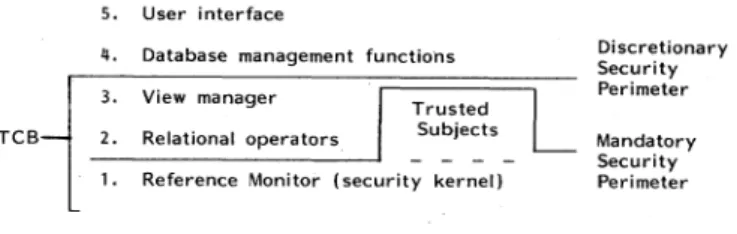
listed from top to bottom, with the boundaries for the trusted computing base (TCB) and reference monitor as shown inFig. 1.
Layer 1 is a security kernelimplementing the Bell and LaPadula model [20]. The kernel supportsmandatory
se-curity (secrecyandintegrity) for single-level objects (such
as files, etc.), subjects (users, processes, etc.), process and memory management, and other resource managers. With respect to the view model, this layer supports the underlying physical representation ofthe database, user
clearances,
andlogin accessclass. Thekernel
will be usedto implement the higher layers. We envisage using the GEMSOS security
kernel
[22] in our design.5. User interface
4. Database management functions
3. View manager Trusted TCB- 2. Relational operators Subjects
1. Reference Monitor (security kernel)
Discretionary Security Perimeter Mandatory Security Perimeter
Fig. 1. System decomposition.
The reference monitor enforcesfiltering. Byfilteringall datapassedfrom this layertohigher (untrusted) layers in thedatabase system, a TrojanHorse in the query
proces-sor cannot leak high-level data by encoding it in a
low-levelresponse
[18].
Layer 2 implements single-level base relations. This
layer providestherelational operators as well as other
nu-mericorsymbolicoperatorsprovidedbythe database
sys-tem (e.g., for computing statistics) and implements the
access methods, including indexstructures.
Layer 3, the view manager, implements views. This
layerprovides the mapping of multilevel views onto the
single-level base relations of Layer 2, and decomposes
transactions on multilevel views into single-level
trans-actions on the single-level base relations of Layer 2. Layer
3 supports classification constraints, including derivation and sanitization rules, aggregation constraints, and dis-cretionary access controls (e.g., access-control lists or user/group/world vectors). Itis responsible for
checking
that a set of constraints is complete and consistent, and forassigning-access classes to the data (through calls on
Layer 1).
As shown in the figure, we have identified distinct se-curity perimeters with respect to mandatory and discre-tionary security. The TCB encompasses both. Although
classification and aggregation constraints are within the TCB, they are outside the reference monitorbecausethey arepotentially quite complex and rely to some extent on
the correct implementation of the relational operators. The mandatory security perimeter includes the refer-ence monitor as well as "trusted subjects" to perform
downgradesarising from sanitization and rule-based clas-sification (specifically, toallow data to beassignedan
ac-cess class that is lower thanthat of the userentering the data). The trusted subjects will require a demonstration
that information at a high access class cannot leakthrough
them to a low access class. Fordowngrades arising from the classification constraints, userconfirmation of the
ac-cess classes to be assigned to data may also be required for increased assurance. For sanitization, we may restrict the data that can be retrieved and limit the amount by which the data can bemarked down. We will also have to show that the sanitization rules lose sufficient infor-mation about the source.
The discretionary security perimeter includes every-thing through Layer 3, the view manager. AlthoughLayer
3 cannotcompromisethemandatorysecrecy andintegrity provided by Layer 1, it is still a part of the TCB.
(Every-thing aboveLayer3 is untrusted in thesense of theTCB, although user application environments at Layer 5 may themselves enforce more refined application policies.)
Because Layer3 is constrained by the reference monitor
of Layer 1, which ensuresenforcement ofthe mandatory policy, theviewmanager will not requirethe same degree
ofassurance asthe reference monitor.
Layer 4 provides data management functions that are notneeded by the lowerlayers. Although we are not yet surewhat functionscanreside inthislayer,possible
can-didates are transaction management, parsing and query
optimization, and distributed database management. Our goal is toplaceas much of thedatabasesystem aspossible outsidethe TCB.
Layer 5 provides the user interface. It corresponds to
the application layer.
Eachsuccessive layer inthe TCB (through Layer 3)
in-troduces further axioms, thereby restricting while
enrich-ing the policy of the system. Although the higher layers cannotgiveincreasedaccess tothe databeyond thatgiven by the reference monitor, by supporting classification
down to the element level, rule-based assignment of
se-curity labels, sanitization, derivation rules, and aggrega-tion constraints, the higher layers can provide increased
supportforsecurity while allowingdata tobeclassifiedat its true access class and not become over-classified.
VII. CONCLUSIONS
The conceptsdescribed in this paper represent a starting
pointforamodel that reaches into new areas of database
security. By introducing rule-based classification to
con-strain the access classes of thedata, themodelprovidesa framework for addressing some inference problems,
ag-gregation, sanitization, context- and content-dependent classification, and dynamic classification. There are,
however, manydifficult problems thatmustbe solved be-fore these concepts canbe realizedin an actualsystem.
We are now formalizing some of these concepts as a security model. We expect that in the process of
formal-ization, the model will undergo revisions and enhance-ments as wefind betterwaysofexpressing the basic
con-cepts and uncover implementation problems. Our
goal
istodevelop amodel and system design thatcan be
imple-mentedinathree to fiveyearperiod. REFERENCES
[11 Department of Defense Trusted Computer System Evaluation Crite-ria, Dep. Defense, National Computer Security Center, Standard DOD5200.28-STD, 1985.
[2] E. B. Fernandez, R.C. Summers, and C.Wood, Database Security andIntegrity. Reading, MA:Addison-Wesley, 1981.
[3] E. F. Codd, "A relational modelfor"largeshared data banks," Com-mun. ACM, vol. 13, no. 6, pp. 377-387, June 1970.
[4] P. P.Griffiths and B. W. Wade, "Anauthorization mechanism for a relational database system," ACM Trans. Database Syst., vol. 1, no. 3,pp.242-255,Sept. 1976.
[5] C. J. Date, An Introduction to DatabaseSystems,vol. II. Reading, MA:Addison-Wesley, 1983.
[6] D. E. Denning, Cryptography and Data Security. Reading, MA: Addison-Wesley, 1982.
[7] M. Stonebraker and E. Wong, "Access control in a relational data basemanagement system by query modification," in Proc. 1974 ACM Annu. Conf., Nov. 1974, pp. 180-186.
[8] P. G. Neumann, R. S. Boyer, R. J. Feiertag, K. N. Levitt, and L. Robinson, "A provably secure operating system: The system, its ap-plications,andproofs,"Comput.Sci.Lab., SRIInternational,Menlo Park, CA, Tech. Rep.CSL-116, 2nd ed., May 1980.
[9] B.G.Claybrook, "Using viewsinamultilevelsecuredatabase
man-agementsystem,"in Proc. 1983Symp. SecurityandPrivacy, IEEE Comput. Soc.,Apr. 1983,pp.4-17.
[10] D. E. Denning, "Multilevel securedatabasesystems: Requirements and model," NAS/AFSB Summer Study on Multilevel Database ManagementSecurity, WorkingPaper, June 1982.
[11] Committee on Multilevel Data Management Security, "Multilevel data managementsecurity," AirForce Studies Board,National Re-searchCouncil, National AcademyPress, Tech.Rep. 1983(for offi-cialuseonly).
[12] M. J. Grohn, "A model of aprotected datamanagement system," 1. P. SharpAss. Ltd., Tech. Rep.ESD-TR-76-289, June 1976. [13] K. J.Biba, "Integrity considerations forsecurecomputersystems,"
USAF ElectronicSystemsDivision, Bedford,MA,Tech. Rep. ESD-TR-76-372, Apr. 1977.
[14] R. R. Schell and D. E. Denning, "Integrity in trusted database sys-tems,"in Proc. 9th Nat. Comput. SecurityConf., 1986.
[15] T. H. Hinke and M. Schaefer, "Secure datamanagement system," System Development Corp., Tech. Rep. RADC-TR-75-266, Nov.
1975.
[16] T. F. Lunt, D. E. Denning, R. R. Schell, and M. Heckman, "Polyinstantiation in a secure relational database system," SRI In-ternational, Tech. Rep., May 1986.
[17] D. E. Denning, "Cryptographic checksums for multilevel data
se-curity," in Proc. 1984Symp. Security and Privacy, IEEE Comput. Soc., 1984, pp. 52-61.
[18] D. E. Denning, "Commutative filters for reducing inference threats in multilevel database systems," in Proc. 1985Symp. Security and Privacy, IEEE Comput. Soc., 1985.
[19] R. D. Graubart, "The integrity-lock approach to secure database management," in Proc. 1984 Symp. Security and Privacy, IEEE Comput. Soc., 1984, pp.62-74.
[20] D. E. Bell and L. J. LaPadula, "Secure computer systems: Unified exposition and multics interpretation," The MITRECorp.,Bedford, MA, Tech. Rep. ESD-TR-75-306, Mar. 1976.
[21] D. A. Bonyun, "Rules as the basis of access control in database
man-agement systems," in Proc. 7thDOD/NBS Comput. Security Conf, 1984, pp. 38-47.
[22] R. R. Schell and T. F. Tao, "Microcomputer-based trusted systems for communicationand workstation applications," in Proc. 7thDODI NBSComput. Security Conf., Sept. 1984, pp. 277-290.
Dorothy E. Denning received the B.A. and M.A. degrees in mathematics from the University of Michigan, Ann Arbor, and the Ph.D. degree in computerscience from Purdue University, West
Lafayette, IN.
She is a Senior Computer Scientist at SRI
In-ternational, Menlo Park, CA. Her current re-search interests include databases, systems, and
security. Beforecoming to SRI, she was an As-sociate Professor of Computer Science at Purdue
University.
Dr. Denning has been President of the International Association of Cryptologic Research andChairman of the ACM Special Interest Group on Operating Systems (SIGOPS), and is author of Cryptography and Data Security (Addison-Wesley, 1982).
Selim G. Aki (S'74-M'78-SM'85) received the B.Sc. and M.Sc. degrees inelectrical engineering from the University of Alexandria, Alexandria, Egypt, in 1971 and 1975, respectively, and the Ph.D. degree in computer science from McGill University, Montreal, P.Q., Canada, in 1978.
He iscurrently an Associate Professor of Com-puting and Information Science at Queen's Uni-versity, Kingston, Ont., Canada. His research in-terests are primarily in the area of algorithm design and analysis, in particular, for problems in com-puter security and parallel computation.
Dr.Akl is Editor of the IACR Newsletter, published by the International Association for Cryptologic Research, author of Parallel Sorting Algo-rithms(Academic), and coauthor of The Convex Hull Problem (Plenum, to
bepublished). Heis a foundingmemberof theCanadian Applied Mathe-maticsSociety, and a member of theInternationalAssociation for Cryp-tologic Research, the IEEE Computer Society, and the Association for ComputingMachinery.
Mark Heckman received the B.S.degreein
com-puterengineering fromthe University of Califor-niaatSanDiego in 1982.
HeistheDirector ofEngineering Services at Gemini Computers, Inc., where he is the chief contactfor customer technical support. He
cur-rentlyisresponsiblefor thedesignand
implemen-tation of systemsecurity and system administrator capabilities for the Gemini Multiprocessing Se-cureOperating System, inaddition to participat-ing actively in the Multilevel Secure Data Views Project.
Teresa F. Lunt received the A.B. degree from PrincetonUniversity, Princeton, NJ, in 1976and theM.A.degree inappliedmathematics from In-dianaUniversity, Bloomington,in 1979.
SheworkedatThe MITRECorporationfor four years and later at SYTEK's Data Security Divi-sion for two years before joining theComputer
Science Laboratory at SRI in early 1986. She has workedonaudit trailanalysis,automatedsecurity
guards, security models, and formal verification of secure systems. Her current work is in secure databasesand inreal-timeintrusion detection expert systems.
_ Matthew Morgenstern received the B.S. and M.S. degrees inelectrical engineering and com-puter science from Columbia University, New York, NY, theMaster's degree in computer
sci-ence and management, and the Ph.D. degree in j computerscience in1976, both from the Massa-5 chusetts Institute ofTechnology, Cambridge.
j _ Currently he is Senior Computer Scientist at SRIInternational, Menlo Park, CA,where he es-tablished and is projectleaderfor the Intelligent DatabaseSystemsprogram. He also has served as Member of Technical Staff at Bell Laboratories, Assistant Professor of
Computer Science at Rutgers University, New Brunswick, NJ, and Re-search Computer Scientist at USC's Information Sciences Institute, Los Angeles. His research and publications include database design, knowl-edge-based systems, expert systems, security, software development
en-vironments, user interfaces, and automaticprogramming..
Dr.Morgenstern is a member of Sigma Xi, Tau BetaPi,Eta Kappa Nu, and the Association forComputingMachinery.
Peter G. Neumann (S'56-M'61-SM'85) re-ceived theA.B., S.M., and Ph.D. degrees from Harvard University, Cambridge, MA, in 1954,
1955,and 1961,respectively, and the Dr. rerum
naturarum from the Technische Hochschule, Darmstadt, WestGermany, in 1960.
_
5 He is Staff Scientist in theComputer Science Laboratory at SRIInternational, Menlo Park, CA, where he has been since1971. He has beenactive inthe computerfield since 1953. His current re-search interests include computer systems,
secu-rity,system vulnerabilities, and softwareengineering.
Dr. Neumannis Editorof the ACM SIGSOFT SoftwareEngineering Notes,Chairman of the ACM Committee onComputers and Public Policy, and Coordinator of the on-lineForum onRiskstothe Public in the Use of Computers.
Roger R.Schell(S'68-M'74) received the B.S.
degree in electrical engineering from Montana StateCollege,the M.S. degreeinelectrical
engi-neering fromWashingtonState University, Pull-man, and the Ph.D. degree in computer science from the Massachusetts Institute ofTechnology,
Cambridge.
He is VicePresident for Engineering and one of thefoundersofGeminiComputers,Inc., Mon-terey, CA. Hisinterests include databases, oper-ating systems, andcomputer security. For three yearshewastheDeputyDirectoroftheDepartment of Defense Computer Security Center. He was an Associate Professor of Computer Science at the NavalPostgraduateSchool from 1978 to 1981. He has served as pro-grammanager for large military software developments, has been a system programmer, and introduced thesecuritykernel technology.