All Graduate Theses and Dissertations Graduate Studies
5-2013
Modeling Overlapping and Heterogeneous Perception Variance in
Modeling Overlapping and Heterogeneous Perception Variance in
Stochastic User Equilibrium Problem with Weibit Route Choice
Stochastic User Equilibrium Problem with Weibit Route Choice
Model
Model
Songyot Kitthamkersorn Utah State University
Follow this and additional works at: https://digitalcommons.usu.edu/etd Part of the Civil Engineering Commons
Recommended Citation Recommended Citation
Kitthamkersorn, Songyot, "Modeling Overlapping and Heterogeneous Perception Variance in Stochastic User Equilibrium Problem with Weibit Route Choice Model" (2013). All Graduate Theses and
Dissertations. 1970.
https://digitalcommons.usu.edu/etd/1970 This Dissertation is brought to you for free and open access by the Graduate Studies at
DigitalCommons@USU. It has been accepted for inclusion in All Graduate Theses and Dissertations by an authorized administrator of DigitalCommons@USU. For more information, please contact
MODELING OVERLAPPING AND HETEROGENEOUS PERCEPTION VARIANCE IN STOCHASTIC USER EQUILIBRIUM PROBLEM
WITH WEIBIT ROUTE CHOICE MODEL
by
Songyot Kitthamkesorn
A dissertation submitted in partial fulfillment of the requirements for the degree
of
DOCTOR OF PHILOSOPHY in
Civil and Environmental Engineering Approved:
________________________________ ________________________________
Anthony Chen Yong Seog Kim
Major Professor Committee Member
________________________________ ________________________________ Gilberto E. Urroz Gary P. Merkley
Committee Member Committee Member
________________________________ ________________________________ Kevin P. Heaslip Mark R. McLellan
Committee Member Vice President for Research and
Dean of the School of Graduate Studies UTAH STATE UNIVERSITY
Logan, Utah 2013
Copyright © Songyot Kitthamkesorn 2013 All Rights Reserved
ABSTRACT
Modeling Overlapping and Heterogeneous Perception Variance in Stochastic User Equilibrium Problem with Weibit Route Choice Model
by
Songyot Kitthamkesorn, Doctor of Philosophy Utah State University, 2013
Major Professor: Dr. Anthony Chen
Department: Civil and Environmental Engineering
In this study, a new SUE model using the Weibull random error terms is proposed as an alternative to overcome the drawbacks of the multinomial logit (MNL) SUE model. A path-size weibit (PSW) model is developed to relax both independently and identically distributed assumptions, while retaining an analytical closed-form solution. Specifically, this route choice model handles route overlapping through the path-size factor and captures the route-specific perception variance through the Weibull distributed random error terms. Both constrained entropy-type and unconstrained equivalent MP formulations for the PSW-SUE are provided. In addition, model extensions to consider the demand elasticity and combined travel choice of the PSW-SUE model are also provided. Unlike the logit-based model, these model extensions incorporate the
logarithmic expected perceived travel cost as the network level of service to determine the demand elasticity and travel choice. Qualitative properties of these minimization programs are given to establish equivalency and uniqueness conditions. Both path-based
and link-based algorithms are developed for solving the proposed MP formulations. Numerical examples show that the proposed models can produce a compatible traffic flow pattern compared to the multinomial probit (MNP) SUE model, and these models can be implemented in a real-world transportation network.
PUBLIC ABSTRACT
Modeling Overlapping and Heterogeneous Perception Variance in Stochastic User Equilibrium Problem with Weibit Route Choice Model
by
Songyot Kitthamkesorn, Doctor of Philosophy Utah State University, 2013
Major Professor: Dr. Anthony Chen
Department: Civil and Environmental Engineering
Traffic assignment problem is an important component of the transportation planning model. State-of-the-practice traffic assignment models adopt the equilibrium
principle to equilibrate the travel demand with the travel supply (e.g., highway and transit networks) under congestion. These models give the transportation network performance measures to compare among transportation alternatives for supporting the decision-making processes. The deterministic user equilibrium (DUE) principle is perhaps the most widely used in the traffic assignment problem. In this principle, all travelers are assumed to minimize their individual travel cost, such that only the lowest-cost route is used at equilibrium. However, this perfect knowledge assumption is unrealistic. Travelers do not know the exact travel costs of all possible routes in the transportation network, and some travelers do not always use the minimum travel cost criterion for their route selection.
To relax this restrictive perfect knowledge assumption, the stochastic user equilibrium (SUE) principle was suggested. A random error term is incorporated in the
route cost function to simulate travelers’ imperfect perceptions of network travel costs, such that they do not always end up selecting only the minimum cost route. In the literature, two widely used random error terms are Gumbel and Normal distributions, corresponding to the multinomial logit (MNL) and multinomial probit (MNP) route choice models, respectively. The MNL model has a closed-form probability expression, and the MNL-SUE model can be formulated as an equivalent mathematical programming (MP) formulation under congestion. Several efficient algorithms can be applied to solve this MNL-SUE model in a real-size network. The two major drawbacks of this model are: (1) inability to handle route overlapping (or correlation) among routes, and (2) inability to account for heterogeneousperception variance with respect to different trip lengths. These two drawbacks stem from the underlying assumption of an independently and identically
distributed (IID) Gumbel variate. The multinomial probit (MNP) model, on the other hand, does not have such drawbacks. This route choice model uses the Normal distribution to allow the covariance between random error terms for pairs of routes; however, due to the lack of a closed-form solution, the MNP-SUE model is computationally burdensome when the choice set contains more than a handful of routes.
In this study, we provide a new SUE model using the Weibull random error terms as an alternative to overcome the drawbacks of these two classical SUE models. A path-size weibit (PSW) model is developed to handle both route overlapping among routes and heterogeneous perception variance with respect to different trip lenghts, while retaining an analytical closed-form solution. Specifically, the PSW route choice model handles the route overlapping through the path-size factor and handles the route-specific perception variance through the Weibull distributed random error terms. Both constrained and unconstrained
equivalent MP formulations for the PSW-SUE model are provided. In addition, model extensions to consider the demand elasticity and combined travel choice of the PSW-SUE model are also provided. Unlike the logit-based model, these model extensions incorporate the logarithmic expected perceived travel cost as the network level of service to determine the demand elasticity and travel choice. Qualitative properties of these minimization programs are given to establish equivalency and uniqueness conditions. Both path-based and link-based algorithms are developed for solving the proposed MP formulations. Numerical examples show that the proposed models can produce a compatible traffic flow pattern compared to the MNP-SUE model, and these models can be implemented in a real-world transportation network.
ACKNOWLEDGMENTS
I am especially grateful to my advisor, Dr. Anthony Chen, for his valuable help, restless guidance, and endless patience throughout this entire process. I wish to express my sincere thanks to the committee members, Dr. Yong Seog Kim, Dr. Gilberto E. Urroz, Dr. Gary P. Merkley, and Dr. Kevin P. Heaslip, for their advice. And I would like to thank the financial support from the Royal Thai Government Scholarship Program. I also want to thank all my friends and colleagues for their encouragement and friendship. Finally, a very special mention goes to my parents in Thailand; I would not have been able to complete my studies without their love and continuous support.
CONTENTS Page ABSTRACT...iii PUBLIC ABSTRACT...v ACKNOWLEDGMENTS...viii LIST OF TABLES...xv LIST OF FIGURES...xvi CHAPTER 1. INTRODUCTION ... 1 1.1 Transportation planning ... 1
1.2 Deterministic user equilibrium (DUE) model ... 3
1.3 Stochastic user equilibrium (SUE) model ... 3
1.4 Objectives ... 8
1.5 Organization ... 9
References ... 10
2. LITERATURE REVIEW ... 13
2.1 Route choice models ... 13
2.1.1 Multinomial logit model ... 13
2.1.2 Extended logit models ... 19
2.1.2.1 Models modifying the deterministic term ... 20
2.1.2.2 Models modifying the random error term ... 21
2.2 Mathematical programming stochastic user equilibrium formulation ... 26
2.2.1 Constrained entropy-type MP formulation ... 27
2.3 Solution algorithms ... 31
2.3.1 Path-based solution algorithm ... 31
2.3.2 Link-based solution algorithm ... 34
References ... 36
3. A PATH-SIZE WEIBIT STOCHASTIC USER EQUILIBRIUM MODEL ... 39
Abstract ... 39
3.1 Introduction ... 39
3.2 Weibit route choice models ... 44
3.2.1 Multinomial weibit (MNW) model ... 44
3.2.2 Path-size weibit (PSW) model ... 50
3.3 Equivalent mathematical programming (MP) formulations ... 52
3.3.1 Assumptions ... 52
3.3.2 MNW SUE model ... 54
3.3.3 PSW SUE model ... 58
3.4 Solution algorithm ... 61
3.5 Numerical results... 63
3.5.1 Example 1: Two-route network ... 64
3.5.1.1 MNW solution ... 64
3.5.1.2 Effect of different trip lengths ... 65
3.5.2 Example 2: Modified loop-hole network ... 68
3.5.2.1 Effects of overlapping and heterogeneous perception variance .... 68
3.5.2.2 Effects of demand level and coefficient of variation ... 69
3.5.3 Example 3: Winnipeg network ... 71
3.5.3.2 Flow allocation comparison ... 72
3.6 Concluding remarks ... 74
References ... 77
4. UNCONSTRAINED WEIBIT STOCHASTIC USER EQUILIBRIUM MODEL WITH EXTENSIONS ... 81
Abstract ... 81
4.1 Introduction ... 81
4.2 Multinomial weibit model ... 85
4.2.1 Weibull distribution ... 86
4.2.2 Closed-form probability expression ... 87
4.2.3 Stability property w.r.t. the minimum operation ... 88
4.2.4 Route choice probability ... 90
4.2.5 Expected Perceived Travel Cost ... 92
4.3 Unconstrained minimization program ... 95
4.3.1 Assumptions ... 95
4.3.2 Formulation ... 96
4.3.3 Unconstrained and constrained MP formulations comparison ... 97
4.4 Solution algorithm ... 98
4.4.1 Link-based stochastic loading mechanism ... 99
4.4.2 Line search schemes ... 102
4.4.2.1 MSA scheme ... 102
4.4.2.2 SRA scheme ... 103
4.4.2.3 Quadratic interpolation (Quad) scheme ... 103
4.5 Numerical results... 104
4.5.1.1 MNW-SUE solution ... 105
4.5.1.2 Flow allocation comparison ... 106
4.5.1.3 Effect of demand levels ... 108
4.5.2 Winnipeg Network ... 108
4.5.2.1 Computational results ... 110
4.5.2.2 Flow allocation comparison ... 111
4.6 Concluding remarks and extensions ... 113
4.6.1 Summary ... 113
4.6.2 Extensions ... 114
4.6.2.1 Handling route overlapping ... 114
4.6.2.2 Considering demand elasticity ... 116
4.6.2.3 Extending to multiple user classes ... 116
References ... 117
5. ELASTIC DEMAND WITH WEIBIT STOCHASTIC USER EQUILIBRIUM FLOWS AND APPLICATION IN A MOTORIZED AND NON-MOTORIZED NETWORK ... 121
Abstract ... 121
5.1 Introduction ... 122
5.2 Weibit route choice models ... 128
5.2.1 MNW model ... 128
5.2.1.1 Model formulation ... 128
5.2.1.2 Expected perceived cost of the MNW model ... 131
5.2.2 Path-size weibit (PSW) model ... 132
5.2.2.1 Model formulation ... 132
5.3 Mathematical programming formulation ... 133
5.3.1 Assumptions ... 133
5.3.2 MP formulation for the PSW-SUE-ED ... 135
5.3.3 Application of the PSW-SUE-ED ... 138
5.4 Solution algorithm ... 143
5.5 Numerical example ... 144
5.5.1 Example 1: Two-route networks ... 145
5.5.2 Example 2: Loop-hole network ... 146
5.5.2.1 Effect of route overlapping ... 147
5.5.2.2 Effect of both route overlapping and identical perception variance problems ... 149
5.5.3 Example 3: Winnipeg network ... 150
5.5.3.1 Algorithmic performance ... 150
5.5.3.2 Application in a bi-modal network with motorized and non-motorized modes ... 152
5.6 Conclusions ... 156
References ... 157
6. CONCLUDING REMARKS ... 161
6.1 Summary ... 161
6.2 Possible drawbacks of the weibit models ... 162
6.3 Future study ... 163
6.3.1 Model calibration ... 163
6.3.2 Incorporating the location parameter ... 164
6.3.3 Incorporating both route overlapping and route-specific perception variance in the random error term ... 164
6.3.5 Algorithmic enhancements ... 166 6.3.6 Modeling uncertainty ... 167 APPENDICES ... 169 Appendix A ... 170 Appendix B ... 170 Appendix C ... 171 Appendix D ... 174 Appendix E ... 176
LIST OF TABLES
Table Page
1 Gumbel distribution ... 14
2 Weibull distribution ... 45
3 Flow-dependent route travel cost for the two-route networks ... 65
4 Results of the two-route networks ... 67
5 Objective values of MNL-SUE, MNLs-SUE and MNW-SUE models ... 67
6 Computational efforts of the MNW-SUE and PSW-SUE models ... 71
7 Constrained entropy-type and unconstrained MNW-SUE formulations ... 98
8 MNW route and link flow solutions ... 102
9 Flow-dependent route travel cost for the two-route networks ... 104
10 Flow allocation... 107
11 Perception variance and coefficient of variation ... 107
12 Computational efforts for solving the MNW-SUE model ... 111
13 Summary of traffic equilibrium models with elastic demand ... 126
14 Flow-dependent route travel cost for the two-route networks ... 146
15 Travel demand and flow allocation for the two-route networks ... 147
16 Sensitivity analysis of λ1 and λ2 in solving the PSW-SUE-ED model ... 151
17 Computational efforts for solving the PSW-SUE-ED model ... 152
18 Computational efforts for solving the MNL-PSW-SUE model ... 153
LIST OF FIGURES
Figure Page
1 Four-step transportation planning model ... 2
2 DUE and SUE models ... 4
3 Existing closed-form (probabilistic) route choice and MP SUE models ... 6
4 Contributions of this study ... 9
5 Dissertation organization ... 10
6 MNL probability on the loop-hole network ... 17
7 MNL probabilities on the two-route networks ... 18
8 MNL perception variances of the two-route networks ... 18
9 Extended logit probabilities on the loop-hole network ... 26
10 Chronicle development of some closed-form route choice models and their MP formulations ... 43
11 Two-route networks ... 48
12 Perceived travel time distributions for the two-route networks ... 50
13 Loop-hole network ... 52
14 Relation between MNL-SUE and MNW-SUE models ... 56
15 Visual illustration of the MNL-SUE and MNW-SUE models ... 59
16 Partial linearization method for solving the MNW-SUE and PSW-SUE models ... 62
17 Modified loop-hole network ... 67
18 Traffic flow patterns of the modified loop-hole network ... 70
19 Effects of demand level and coefficients of variation ij r ... 70
21 Convergence characteristics of the path-based partial linearization algorithm ... 71
22 Comparison of route choice probabilities of three O-D pairs ... 75
23 Link flow difference between PSLs-SUE and PSW-SUE models ... 76
24 Link flow difference between MNW-SUE and PSW-SUE models... 76
25 Probability of choosing the lower route for the two-route networks ... 91
26 Perceived travel cost distributions for the two-route networks ... 91
27 Effect of ij and ij on the probability of choosing the lower route ... 93
28 STOCH stochastic loading mechanism for the MNW model ... 101
29 Effect of demand levels ... 109
30 Winnipeg network ... 109
31 Convergence characteristics of three line search schemes ... 110
32 Comparison of link choice probabilities of two O-D pairs ... 111
33 Link flow comparison between the MNLs-SUE and MNW-SUE models ... 113
34 Two-route networks ... 130
35 Perception variance of the MNL and MNW models ... 130
36 Network representation and equilibrium conditions with ED ... 136
37 Network representation and excess demand as a binary logit mode choice ... 140
38 Loop-hole network and its characteristics ... 147
39 Probability of choosing the lower route for the loop-hole network (y = 30) ... 148
40 EPC and travel demand patterns for the loop-hole network (y = 30) ... 148
41 Traffic flow patterns for the loop-hole network (y = 32) ... 149
42 EPC and travel demand patterns for the loop-hole network (y = 32) ... 149
44 Convergence characteristics for solving the MNL-PSW-SUE model ... 151
45 Winnipeg network with bike lanes ... 153
46 Comparison of route choice and mode choice probabilities of O–D pairs (3,147) and (74,60) ... 155
47 Link flow difference between MNL-MNLs-SUE and MNL-PSW-SUE models ... 155
48 Insensitive to an arbitrary multiplier on the route cost of the MNW model ... 163
49 Conceptual framework for the node-to-node weibit choice behavior ... 172
50 Braess network and its available routes ... 172
INTRODUCTION
1.1 Transportation planning
Transportation systems have a direct impact on economics and the quality of life. These systems provide mobility for people and goods, deliver accessibility to various locations (e.g., workplaces, schools, and recreational areas), and influence the economic activities and growth patterns of a region. With this crucial component of modern society, transportation planning is critical for efficient financing, managing, operating, and maintaining of the transportation system to achieve development goals.
The most common paradigm for the transportation planning model in the United States, as used by the majority of Metropolitan Planning Organizations (MPOs), is known as the ―four-step‖ travel demand forecasting model, as shown in Fig. 1. This four-step model includes four modules—trip generation, trip distribution, modal split, and traffic assignment—as a mathematical representation of the demand and supply for travel in an area. The trip generation module takes socioeconomic information to estimate the travel demand within each Traffic Analysis Zone (TAZ). The trip distribution module connects the travel demand of each TAZ to determine the travel demand between a pair of TAZs as an origin-destination (O-D) pair. The modal split module predicts how a trip between an O-D pair will be taken on a given mode of transportation. The final step is the traffic assignment module. This module is used to simulate the routes travelers choose to reach their destination on a specific mode of transportation. State-of-the-practice traffic assignment models adopt the equilibrium principle to equilibrate the travel demand with the travel supply (e.g., highway and transit networks) under congestion. These models
give the transportation network performance measures, for example, vehicle miles traveled (VMT), vehicle hours traveled (VHT), trip length, and volume/capacity (V/C) ratio. These resultant model estimations would be used to compare among transportation alternatives for supporting the decision-making processes. This study focuses on the final step of the four-step travel demand forecasting model. New mathematical programming formulations are developed to relax the shortcomings of existing models and formulations. Algorithms for solving the proposed models and formulations are also provided for real-world implementation.
Fig. 1. Four-step transportation planning model
Trip Generation
Trip Distribution
Modal Split
Traffic Assignment
Zone
Trip Production Trip Attraction
O-D demand Car Bus Transportation network
How many
trips?
Where to?
What mode?
Which route?
1.2 Deterministic user equilibrium model
The deterministic user equilibrium (DUE) is perhaps the most widely used principle for the traffic assignment problem. It is defined as follows:
The journey costs on all the routes actually used are equal and less than those which would be experienced by a traveler on any unused route. (Wardrop, 1952)
Travelers in this principle are assumed to minimize their individual travel cost, such that only the lowest-cost route is used at equilibrium. In 1956, Beckmann et al. (1956)
developed this DUE principle into a mathematical programming (MP) formulation. Several efficient solution algorithms (e.g., Frank and Wolfe, 1956; Dial, 2006) can be used to solve this DUE model in a real-size network. However, the assumption of perfect knowledge of network conditions is unrealistic. Travelers do not know the exact travel costs of all possible routes in the transportation network, and some travelers do not always use the minimum travel cost criterion for their route selection.
1.3 Stochastic user equilibrium model
To relax the restrictive perfect knowledge assumption, Daganzo and Sheffi (1977)
suggestedthe stochastic user equilibrium (SUE) principle. It is defined as:
No travelers can improve his or her perceived travel cost by unilaterally changing routes at SUE. (Daganzo and Sheffi, 1977)
A random error term is incorporated in the route cost function to simulate travelers’
imperfect perception of network travel costs, such that they do not end up selecting only the minimum cost route. Therefore, the route choice behavior is probabilistic, as shown in Fig. 2.
Fig. 2. DUE and SUE models
Two commonly used random error terms in the literature are Gumbel (Dial, 1971) and
Normal (Daganzo and Sheffi, 1977) distributions, corresponding to the multinomial logit (MNL) and multinomial probit (MNP) (probabilistic) route choice models, respectively. The MNL model has a closed-form probability expression, and the MNL-SUE model can be formulated as an equivalent MP formulation (Fisk, 1980; Sheffi and Powell, 1982). Several efficient algorithms can be applied to solve the MNL-SUE MP formulation in a real-size network (e.g., Sheffi, 1985; Larsson and Patriksson, 1992; Damberg et al., 1996; Bell et al., 1997; Leurent, 1997; Maher, 1998; Chen et al., 2005; Chootinan et al., 2005; Zhou et al., 2012). The two main drawbacks of the MNL-SUE model are: (1) inability to account for
route overlapping (or correlation), and (2) inability to account for perception variance with respect to different trip lengths. These two drawbacks stem from the underlying assumption of independently and identically distributed (IID) Gumbel variate (Sheffi, 1985). The MNP model, on the other hand, does not have such a drawback. It uses the Normal distribution to allow the covariance between random error terms for pairs of routes. However, due to the lack of a closed-form probability expression, solving the MNP-SUE model requires Monte
O-D demand
Probabilistic route choice
model
Equilibrium Traffic flow pattern
O-D demand Lowest-cost
route Equilibrium Traffic flow pattern DUE SUE Perfect knowledge Imperfect knowledge
Carlo simulation (Sheffi and Powell, 1982), Clark’s approximation method (Maher, 1992), or numerical method (Rosa and Maher, 2002).
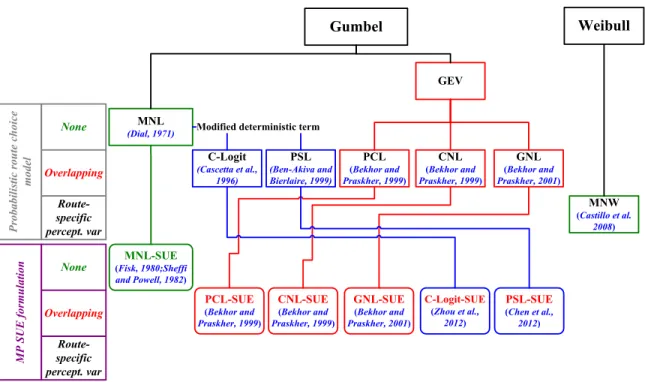
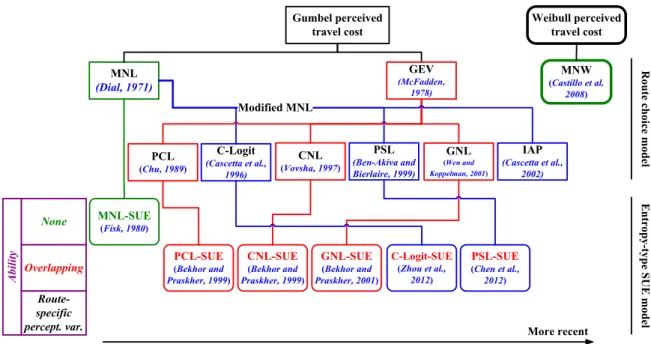
To address the shortcomings of the MNL model, several closed-form route-choice models have been developed. These models can be classified into two categories: the
extended logit models and weibit model, as shown in Fig. 3. The extended logit models relax the independently distributed assumption while retaining the Gumbel distributed random error terms. These models modify either the deterministic term or the random error term of the MNL random utility maximization (RUM) model. The models modifying the deterministic term include the C-logit (Cascetta et al., 1996), path-size logit (PSL)
(Ben-Akiva and Bierlaire, 1999), and implicit availability/perception (IAP) (Cascetta et al., 2002)
models. All three models add a correction term to the deterministic term of the disutility function to adjust the choice probability. However, the interpretation of each model is different. The C-logit model uses a commonality factor to penalize the coupling routes, while both the IAP and PSL models use a logarithmic correction term to modify the disutility (hence, the choice probability). The IAP model aims at capturing travelers’ imperfect knowledge of available routes. Equivalent MP formulations for these models were recently provided by Zhou et al. (2012) and Chen et al. (2012). The models modifying the random error term include the paired combinatorial logit (PCL) (Bekhor and Prashker, 1999), cross-nested logit (CNL) (Bekhor and Prashker, 1999), and generalized nested logit (GNL)
(Bekhor and Prashker, 2001) models. These models use the Generalized Extreme Value
(GEV) theory (McFadden, 1978) to incorporate route correlation, hence route overlapping. Equivalent MP formulations for these extended logit models were provided by Bekhor and Prashker (1999, 2001).
Fig. 3. Existing closed-form (probabilistic) route choice and MP SUE models
Even though all the extended models discussed above can successfully capture route overlapping, the identically distributed assumption (i.e. homogeneous perception variance) is still inherited; all routes are assumed to have the same and fixed perception variance according to the logit assumption of the Gumbel distribution. Hence, Chen et al.
(2012) suggested a practical approach to partially relax the assumption by scaling the
perception variance of an individual O-D pair. The individual O-D specific scaling factors allow the perception variance to increase or decrease according to the travel distance of each O-D pair. Specifically, the systematic disutility in the logit-based SUE models can be scaled appropriately to reflect different O-D trip lengths in a network by replacing a single dispersion parameter for all O-D pairs with individual O-D dispersion parameters for each O-D pair. However, it should be noted that it is not possible to scale individual routes of the same O-D pair since it would violate the logit-based SUE
Gumbel MNL (Dial, 1971) GEV M P S U E f or m u la ti on None Overlapping Route-specific percept. var C-Logit (Cascetta et al., 1996) PSL (Ben-Akiva and Bierlaire, 1999) PCL (Bekhor and Praskher, 1999) CNL (Bekhor and Praskher, 1999) GNL (Bekhor and Praskher, 2001)
Modified deterministic term
MNL-SUE (Fisk, 1980;Sheffi and Powell, 1982) PCL-SUE (Bekhor and Praskher, 1999) CNL-SUE (Bekhor and Praskher, 1999) GNL-SUE (Bekhor and Praskher, 2001) C-Logit-SUE (Zhou et al., 2012) PSL-SUE (Chen et al., 2012) P ro ba bi li st ic r ou te c h oi ce m od el None Overlapping Route-specific percept. var Weibull MNW (Castillo et al. 2008)
models’ assumption of an equal variance across the routes within the same O-D pair. For a more comprehensive review of the extended logit models used in the SUE problem, readers are directed to the reviews given by Prashker and Bekhor (2004) and Chen et al. (2012).
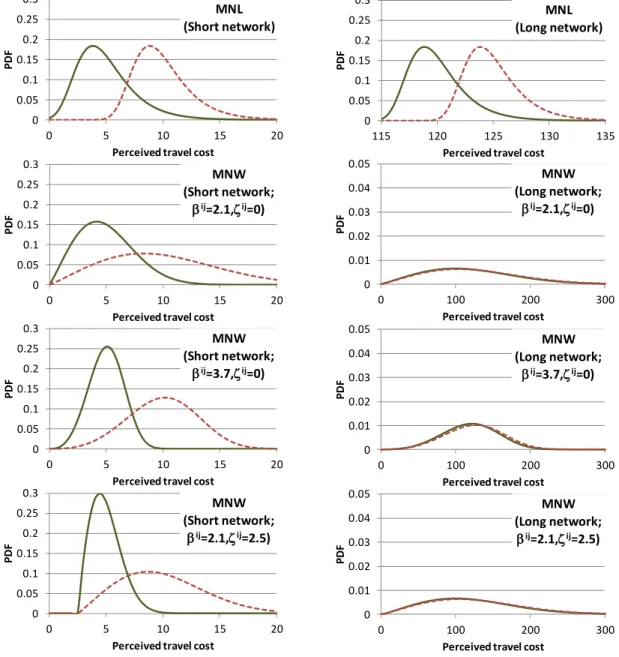
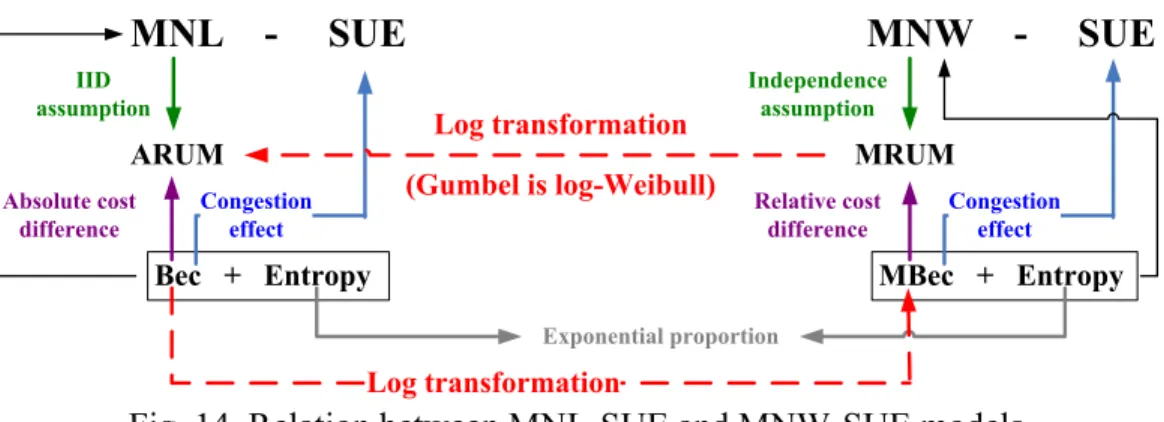
Recently, Castillo et al. (2008) proposed the multinomial weibit (MNW) model to relax the identically distributed assumption. Instead of the conventional Gumbel distribution, this route choice model adopts the Weibull distributed random error terms to handle the heterogeneous perception variance. Under the independence assumption, the MNW model has a simple analytical form with route-specific perception variance (i.e. non-identical perception variances with respect to trips of different lengths). However, no equivalent MP formulation has been proposed for the MNW-SUE model in the technical literature.
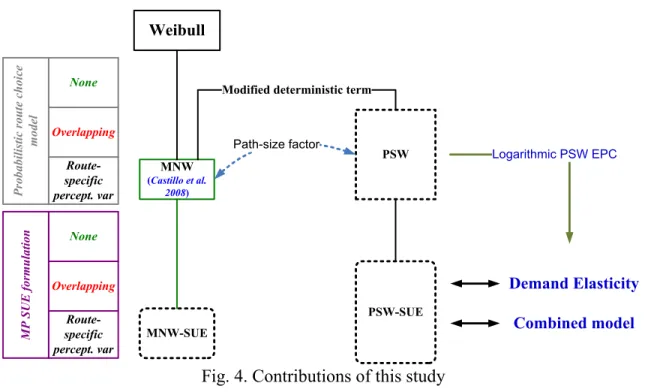
In this dissertation, an analytical closed-form route choice model and its MP SUE formulations are proposed to relax both independently and identically distributed assumptions. A path-size factor (Ben-Akiva and Bierlaire, 1999) is adopted to modify the MNW RUM model to create the path-size weibit (PSW) model, as shown in Fig. 4. Specifically, the route overlapping is captured through the path-size factor, and the route-specific perception variance is handled through the Weibull distributed random error terms. Then, both constrained entropy-type and unconstrained MP formulations for the PSW-SUE model are developed. In addition, model extensions to consider the demand elasticity and combined travel choice of the PSW-SUE model are provided. Unlike the logit-based model, these model extensions incorporate the logarithmic expected perceived travel cost (EPC) as the network level of service to determine the demand
elasticity and travel choice. Qualitative properties of these minimization programs are given to establish equivalency and uniqueness conditions, and algorithms to solve the proposed models are presented. Numerical examples show that the proposed models can produce a compatible traffic flow pattern compared to the MNP-SUE model under congestion, and these models can be implemented in a real-size network.
1.4 Objectives
The objectives of this study were to provide: OBJ1. the PSW route choice model,
OBJ2. an entropy-type MP formulation for the PSW-SUE model, OBJ3. a closed-form PSW EPC,
OBJ4. an unconstrained MP formulation for the PSW-SUE model,
OBJ5. an unconstrained MP formulation for the PSW-SUE model with elastic demand,
OBJ6. an entropy-type MP formulation for the PSW-SUE model with elastic demand, and
OBJ7. an entropy-type MP formulation for the combined travel choice of the PSW-SUE model with elastic demand.
The first goal was to provide the PSW route choice model to handle both route overlapping and route-specific-perception variance problems. Then, an entropy-type MP formulation for the PSW-SUE model with route flows as the decision variables was developed in OBJ2. Next, a closed-form PSW EPC was derived in OBJ3, which can be used to develop an unconstrained MP formulation for the PSW-SUE model with link
Fig. 4. Contributions of this study
The different decision variables play a significant role in the development of the solution algorithm. In addition, the PSW EPC would also be used to develop both unconstrained and entropy-type MP formulations for the PSW-SUE model with elastic demand and combined travel choice of the PSW-SUE model, where the network level of service is explicitly incorporated through the PSW EPC, in OBJ5, OBJ6, and OBJ7.
1.5 Organization
The organization of this dissertation is shown in Fig. 5. The next Chapter provides some background of the existing route choice models, MP SUE formulations, and solution algorithms. Chapters 3 through 5 are the main contributions of this dissertation, which consists of three technical papers. Chapter 3 provides the PSW route choice model, constrained entropy-type MP formulation for the PSW-SUE model, and a path-based solution algorithm for solving the entropy-type MP formulation. Chapter 4 derives the PSW EPC, develops an unconstrained MP formulation for the PSW-SUE model,
Weibull
MNW (Castillo et al.
2008)
PSW Modified deterministic term
MNW-SUE PSW-SUE M P S U E f or m u la ti on None Overlapping Route-specific percept. var P ro ba bi li st ic r ou te c h oi ce m od el None Overlapping Route-specific percept. var Path-size factor Demand Elasticity Combined model Logarithmic PSW EPC
Fig. 5. Dissertation organization
provides a link-based solution algorithm for solving the unconstrained MP formulation, and delivers the model extension to consider the demand elasticity. In Chapter 5, an entropy-type MP formulation for the PSW-SUE model with an elastic demand and the combined mode choice (or modal split) of the PSW-SUE model is presented, and it provides a path-based solution algorithm for solving the proposed model in a real-size network. Conclusions and remarks for future study are provided in Chapter 6.
References
Beckmann, M.J., McGuire, C.B., Winsten, C.B., 1956. Studies in Economics of Transportation. Yale University Press, New Haven, Conn.
Bekhor, S., Prashker, J.N., 1999. Formulations of extended logit stochastic user equilibrium assignments. Proceedings of the 14th International Symposium on Transportation and Traffic Theory, Jerusalem, Israel, 351-372.
Chapter 1: Introduction
Chapter 3: Path-size weibit SUE model
Chapter 4: Unconstrained weibit SUE model with extensions
Chapter 5: Elastic demand with weibit stochastic user equilibrium flows and application in a bimodal network
OBJ 1,2
Chapter 6: Conclusion Chapter 2: Literature review
Problem statement
Model, Formulation, and Solution Algorithm
OBJ 3,4,5 OBJ 6,7 PSW model PSW EPC PSW-SUE model (Entropy-type)
Bekhor, S., Prashker, J.N., 2001. A stochastic user equilibrium formulation for the generalized nested logit model. Transportation Research Record 1752, 84-90.
Bell, M.G.H., Shield, C.M., Busch, F., Kruse, G., 1997. A stochastic user equilibrium path flow estimator. Transportation Research Part C 5(3-4), 197-210.
Ben-Akiva, M., Bierlaire, M., 1999. Discrete choice methods and their applications to short term travel decisions. In: Hall, R. (Ed.), Handbook of Transportation Science. Kluwer, 5-34.
Cascetta, E., Nuzzolo, A., Russo, F., Vitetta, A., 1996. A modified logit route choice model overcoming path overlapping problems: specification and some calibration results for interurban networks. In: Proceedings of the 13th International Symposium on Transportation and Traffic Theory, Leon, France, 697-711.
Cascetta, E., Russo, F., Viola, F.A., Vitetta, A., 2002. A model of route perception in urban road networks. Transportation Research Part B 36(7), 577-592.
Castillo, E., Menéndez, J.M., Jiménez, P., Rivas, A., 2008. Closed form expression for choice probabilities in the Weibull case, Transportation Research Part B 42(4), 373-380.
Chen, A., Chootinan, P., Recker, W., 2005. Examining the quality of synthetic origin-destination trip table estimated by path flow estimator. Journal of Transportation Engineering 131(7), 506-513.
Chen, A., Pravinvongvuth, S., Xu, X., Ryu, S., Chootinan, P., 2012. Examining the scaling effect and overlapping problem in logit-based stochastic user equilibrium models. Transportation Research Part A 46(8), 1343-1358.
Chootinan, P., Chen, A., Recker, W., 2005. Improved path flow estimator for estimating origin-destination trip tables. Transportation Research Record 1923, 9-17.
Daganzo, C.F., Sheffi, Y., 1977. On stochastic models of traffic assignment. Transportation Science 11(3), 253-274.
Damberg, O., Lundgren, J.T., Patriksson, M., 1996. An algorithm for the stochastic user equilibrium problem. Transportation Research Part B 30(2), 115-131.
Dial, R., 1971. A probabilistic multipath traffic assignment model which obviates path enumeration. Transportation Research 5(2), 83-111.
Dial, R., 2006. A path-based user-equilibrium traffic assignment algorithm that obviates path storage and enumeration. Transportation Research Part B 40(10), 917-936.
Fisk, C., 1980. Some developments in equilibrium traffic assignment. Transportation Research Part B 14(3), 243-255.
Frank, M., Wolfe, P., 1956. An algorithm for quadratic programming. Naval Research Logistics Quarterly 3(1-2), 95-110.
Larsson, T., Patriksson, M., 1992. Simplicial decomposition with disaggregated representation for the traffic assignment problem. Transportation Science 26, 4-17. Leurent, F.M., 1997. Curbing the computational difficulty of the logit equilibrium
assignment model. Transportation Research Part B 31(4), 315-326.
Maher, M., 1998. Algorithms for logit-based stochastic user equilibrium assignment. Transportation Research Part B 32(8), 539-549.
Maher, M., 1992. SAM – A stochastic assignment model. In: Griffiths J.D. (Ed.), Mathematics in Transport Planning and Control, Oxford University Press, Oxford. McFadden, D., 1978. Modeling the choice of residential location. In: Karlquist, A. et al.
(Eds.), Special Interaction Theory and Residential Location. North-Holland, Amsterdam, 75–96.
Prashker, J.N., Bekhor, S., 2004. Route choice models used in the stochastic user equilibrium problem: a review. Transport Reviews 24(4), 437-463.
Rosa, A., Maher, M.J., 2002. Algorithms for solving the probit path-based stochastic user equilibrium traffic assignment problem with one or more user classes. Proceedings of the 15th International Symposium on Transportation and Traffic Theory, Australia, 371-392.
Sheffi, Y., 1985. Urban Transportation Networks: Equilibrium Analysis with Mathematical Programming Methods. Prentice-Hall, Englewood Cliffs, NJ.
Sheffi, Y., Powell, W.B., 1982. An algorithm for the equilibrium assignment problem with random link times. Networks 12(2), 191–207.
Wardrop, J.G., 1952. Some theoretical aspects of road traffic research. Proceedings, Institution of Civil Engineers II(1), 325-378.
Zhou, Z., Chen, A., Bekhor, S., 2012. C-logit stochastic user equilibrium model: formulations and solution algorithm. Transportmetrica 8(1), 17-41.
CHAPTER 2 LITERATURE REVIEW
A strongly connected network
N A,
is considered, where N and A denote the sets of nodes and links. Let IJ denote the subsets of N to represent a set of origin-destination (O-D) pairs ij. Let Rij be a set of routes (or paths) between O-D pair ij, which may consist of several links a A . In this section, we review the route choice models with a closed-form probability expression, their corresponding mathematical programming (MP) stochastic user equilibrium (SUE) formulations, and solution algorithms. The section begins with the route choice models, including the well-known multinomial logit (MNL) model and five extended logit models. Then, the MP SUE formulations for these logit models under congestion are provided, followed by the solution algorithms to solve these MP SUE formulations in a real-case study.2.1 Route choice models
2.1.1Multinomial logit model
The MNL model (Dial, 1971) assumes that the perceived route travel cost ij r G
follows the extreme value type I distribution or the Gumbel distribution. With this assumption, the cumulative distribution function (CDF) of ij
r
G , mean route travel cost
ij r
g , and route perception variance
ij 2 r can be expressed in Table 1. The mean travel cost ij
r
g is a function of the location parameter ij r
, the scale parameter ij r
, and the Euler constant . Note that the perception variance
ij 2r
is a function of ij r
Table 1: Gumbel distribution CDF ij
r G F t 1 exp
rijt rij
,
,
e t (1)Mean route travel cost ij r g rij ij r (2)
Route perception variance
ij 2 r 2 2 6 ij r (3)The MNL probability expression can be derived as follows:
Pr ; , , ij ij ij r r l ij P G G l r r R ij IJ , (4) which corresponds to
.., ,..
ij ij ij ij r r r r P H t dt
, (5) where ij rH is the partial derivative of the joint survival function w.r.t. ij r
t . Under the
independently distributed assumption, the joint survival function for the Gumbel distribution is:
exp exp . ij ij ij r r r ij ij ij ij r r r ij t r R t r R H e e
(6) Then, we have exp ijij ij ij ij ij r r r r k k ij t t ij ij r ij r k R r H H e e t
. (7)Substituting Eq. (7) into Eq. (5) gives
exp ijij ij ij ij ij r r r r k k ij t t ij ij ij r r r k R P e e dt
. (8)To obtain a closed-form probability expression, ij r
needs to be fixed for all routes as . With this, we have
exp exp . ij ij ij ij r r r k ij ij ij ij ij r r r k ij t t ij ij r r k R t t ij r k R P e e dt e e e dt
(9)By integrating Eq. (9), we have the MNL probability, i.e.,
exp exp ij ij r ij r ij k k R P
, r R ij IJij, . (10) According to Eq. (2), ij r is related to ij r g as follows: ij ij r gr . (11)Substituting Eq. (11) into Eq. (10) gives the MNL model, i.e.,
exp exp ij ij r ij r ij k k R g P g
, r R ij IJij, . (12)Note that is also known as the dispersion parameter (Dial, 1971).
The joint Gumbel distribution in Eq. (6) with the fixed further satisfies the
stability w.r.t. the minimum operation (Castillo et al., 2008). This important property states that joint survival extreme value function at minimum is the same family as the marginal survival extreme value function (Castillo et al., 2005). From the joint Gumbel distribution with the fixed , the Gumbel survival function at minimum is also the Gumbel distribution, i.e.,
,0 min exp ij ij k k Rij t G H t e , (13) where
,0 1ln exp ij ij ij k k R
. (14)With the stability property, travelers’ choice decisions are assumed to be based on their minimum perceived route travel cost, and the probabilistic route choice patterns can be determined by the multivariate extreme value distribution (Kotz and Nadarajah, 2000)
with the Gumbel marginal. Further, we can use the Gumbel distribution to determine the EPC. From the stability property, substituting ij,0 in Eq. (2) gives the MNL EPC:
1 ln exp ij ij ij k k R
. (15)Since the constant will not have an impact on the mathematical programming (MP) formulation considered later in this review, we can omit the term . From Eq. (11), the MNL EPC up to a constant can be expressed as a log-sum term as follows:
1ln exp ij ij ij k k R g
, ij IJ. (16)An important property of this EPC is that the partial derivative of the MNL EPC w.r.t. the route cost gives back the MNL probability (Daganzo, 1979; Sheffi, 1985), i.e.,
ln exp 1 exp . exp ij ij ij k k R ij ij ij r r ij r ij k k R g g g g g
(17)Moreover, the MNL model can also be interpreted as the Markovian process
(Akamatsu, 1996). Travelers are assumed to make a decision at each node (or state) until they reach the destination (or final state) according to the MNL choice probability. With this, we can use the link-based loading mechanism for the MNL loading (e.g., Dial, 1971;
Sheffi, 1985; Bell, 1995;Akamatsu, 1996).
The drawback of the MNL model stems from its underlying assumption of the
independently and identically distributed (IID) with Gumbel variate. The independently distributed assumption comes from the joint Gumbel distribution with independent variate in Eq. (6). The identically distributed assumption comes from the fixed θ to obtain a closed-form probability expression in Eq. (9), since the Gumbel
ij 2r
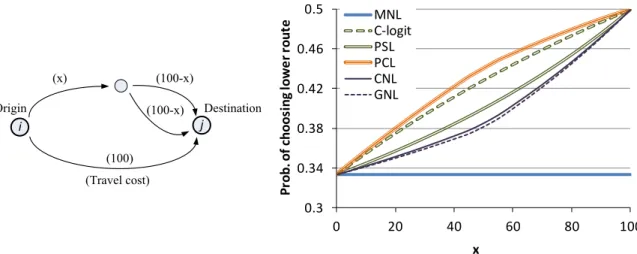
is a function of θ alone (see Eq. (3)). As a result, the MNL model has difficulty in handling the route overlapping problem (i.e., independence assumption) and the homogeneous perception variance w.r.t. different trip lengths (i.e., identical variance assumption). Consider the loop-hole network shown in Fig. 6. In this network, all three routes have equal travel cost of 100 units. The two upper routes overlap by a portion x, while the lower route is distinct from the two upper routes. According to the independently distributed assumption, the MNL model gives the same probability of 1/3 for each route, regardless of the overlapping portion.
1 2 3
exp 100 1
exp 100 exp 100 exp 100 3
ij ij ij P P P
Fig. 6. MNL probability on the loop-hole network
i j Destination Origin (100-x) (x) (100-x) (100) (Travel cost)
0.1 ;
0.5 0.5 1 0.5 1 0.62 1 ij l e P e e e
0.1 ;
12 12 12.5 0.5 1 0.62 1 ij l e P e e e a) Short network b) Long network Fig. 7. MNL probabilities on the two-route networks
a) Short network b) Long network Fig. 8. MNL perception variances of the two-route networks
On the other hand, consider a two-route network configuration as shown in Fig. 7. For both networks, the upper route travel cost is larger than the lower route travel cost by 5 units. However, the upper route travel cost is two times larger than the lower route travel cost in the short network, while it is only less than 5% larger in the long network. The MNL model produces the same flow patterns for both short and long networks. This is because each route has the same perception variance of
2 6
2 (see Eq. (3)) as shownin Fig. 8. As such, the MNL probability is solely based on the absolute cost difference irrespective of the overall trip lengths (Sheffi, 1985).
i j Origin Destination (10) (5) (Travel cost) i j Destination Origin (125) (120) (Travel cost) 0 5 10 15 20 P DF
Perceived travel cost
Short network Upper route Lower route 115 120 125 130 135 P DF
Perceived travel cost
Long network
Upper route Lower route
2.1.2Extended logit models
To relax the independently distributed assumption embedded in the MNL model, several closed-form extended logit models have been developed. These models can be classified in to two categories: 1) the models modifying the deterministic term of the MNL model, and 2) the models modifying the random error term of the MNL model. Recall that the MNL model can be written in the random utility maximization (RUM) model as (Sheffi, 1985) ij ij ij r r r U g , r R ij IJij, , (18) where ij r
is the IID Gumbel distributed random error term on route r between O-D pair ij
whose CDF is
1 exp
ij r t F t e , r R ij IJij, . (19)The models modifying the deterministic term introduce a correction factor to ij r g
to
adjust the probability of choosing the routes coupling with other routes, and hence the route overlapping. These models include the C-logit model (Cascetta et al., 1996) and path-size logit (PSL) model (Ben-Akiva and Bierlaire, 1999). The models modifying the random error term adopt the Generalized Extreme Value (GEV) theory (McFadden, 1978) to modify the random error term to allow the correlation, and hence the route overlapping. These models includes the cross nested logit (CNL) model (Bekhor and
Prashker, 1999), generalized nested logit (GNL) model (Bekhor and Prashker, 2001), and
paired combinatorial logit (PCL) model (Bekhor and Prashker, 1999). This subsection begins with the models modifying the deterministic term, followed by the models modifying the random error term (or GEV-based model).
2.1.2.1Models modifying the deterministic term
We start with the C-logit model followed by the PSL model. The C-logit model uses a commonality factor ij
r
CF to modify the deterministic term, i.e.,
ij ij ij ij r r r r U g CF , r R ij IJij, , (20) where ij r CF can be expressed as ln ij ij ij rl r ij ij l r r l l R L CF L L
, r R ij IJij, , (21) ij rlL is the length of overlapping section between routes r and l between O-D pair ij, ij r L is the length of route r between O-D pair ij, and and are the calibrated parameters. This
ij r
CF increases as the overlapping increases. As such, the routes coupling with other routes have a higher disutility. Note that there are several forms of ij
r
CF (see Cascetta et al., 1996,
for more information). From Eq. (20), the C-logit probability can be expressed as
exp exp ij ij ij r r ij r ij ij k k k R g CF P g CF
, r R ij IJij, . (22)Since the C-logit model modifies the deterministic term, its EPC can be expressed as
1 ln exp ij ij ij ij k k k R g CF
, ij IJ. (23)Similar to the C-logit model, the PSL model uses the path-size factor ij r
to modify the deterministic term as follows:
ln ij ij ij ij r r r r U g , r R ij IJij, , (24) where ij r can be expressed as
1 r ij ij a r ij ij a r ak k R l L
, r R ij IJij, , (25) al is the length of link a, ij r
L is the length of route r connecting O-D pair ij, and r is the set of all links in route r between O-D pair ij. This path-size factor ij
0,1
r
accounts for different route sizes determined by the length of links within a route and the relative lengths of routes that share a link. Note that several studies have provided alternative formulations for ij
r
(e.g., Ramming, 2001; Bovy et al., 2008; Prato, 2009). From Eq. (24), the PSL probability can be expressed as
exp exp ij ij ij r r ij r ij ij k k k R g P g
, r R ij IJij, . (26)Its EPC can be expressed as
1 ln exp ij ij ij ij k k k R g
, ij IJ. (27)2.1.2.2Models modifying the random error term
Let G y
1,..,yN
(or G( ) for short) be the GEV generating function, where yn 0.This GEV generating function satisfies the following properties (McFadden, 1978): 1) G( ) is non-negative.
2) G( ) is homogeneous of degree > 0; that is G
y1,..,yN
G y
1,..,yN
3) limynG y
1,..,yN
for all n.4) The lth partial derivative of G( ) w.r.t. any combination of l distinct yn’s, n = 1,..,N,
is non-negative if l is odd and non-positive if l is even.
1 1 ,.., ,.., ij ij ij Rij r ij ij Rij g g g ij r ij r g g e G e e P G e e , r R ij IJij, , (28) where 1,.., ij ij gRij g ij r G e e
is the partial derivative of
1,.., ij ij gRij g G e e w.r.t. to ij r g e .
Further, the EPC of the GEV-based model can be derived by
1 1 ln ,.., ij ij Rij g g ij G e e , ij IJ . (29)
We start this subsection with the CNL model followed by the GNL model and the PCL model.
The CNL GEV generating function can be expressed as
1ij ij ij ij ijar r a A r R G y
, ij IJ, (30)where ij
0,1
, and ijar
0,1 could be defined as (Bekhor and Prashker, 1999) ij a ijar ij ar r l L , a A r R ij IJ, ij, . (31)Both parameters represent the overlapping degree, where a larger (smaller) ijar (ij) indicates a higher overlapping degree. Using the principle in Eq. (28), the CNL probability can be expressed as
1 1 1 1 exp exp exp ij ij ij ij ij ij ij ij ij ijar r ijak k a A ij k R ij ij r ij ijbs s b A s R ij g g P g
, r R ij IJij, . (32)This CNL probability can be decomposed into two levels according to the two-level tree structure, i.e.,
| ij ij ij r a r a a A P P P
, r R ij IJij, , (33)
1 1 exp exp ij ij ij ij ij ij ij ijak k k R ij ij a ij ijbs s b A s R ij g P g
, r R ij IJij, , (34)
1 | 1 exp exp ij ij ij ij ijar r ij ij r a ij ijak k k R ij g P g
, r R ij IJij, . (35)The upper level is represented by the marginal probability ( ij a
P ) of selecting link a
between O-D pair ij, and the lower level is represented by the conditional probability ( ij|
r a
P ) of selecting route r between O-D pair ijpassing through link a. Then, using Eq. (29), the CNL EPC can be expressed as
1 1 ln exp ij ij ij ij ij ijbs s b A s R ij g
, ij IJ . (36)The GNL model is a generalized version of the CNL model. Its GEV generating function can be expressed as
1ija ija ij ij ijar r a A r R G y
, ij IJ, (37)where ija is specific to a link level. It could be defined as (Bekhor and Prashker, 2001)
1 1 ij ij ija ij ijak k R ar r R
, a A ij IJ, . (38)
1 1 1 1 exp exp exp ija ija ija ij ijb ijb ij ij ij ijar r ijak k a A ija k R ija ij r ij ijbs s b A s R ijb g g P g
, r R ij IJij, . (39)Similar to the CNL model, the GNL probability can be decomposed into the marginal and conditional probabilities as in Eq. (33). The GNL marginal probability (upper level) can be expressed as
1 1 exp exp ija ija ij ija ija ij ij ijak k k R ija ij a ij ijbs s b A s R ija g P g
, r R ij IJij, , (40)and the GNL conditional probability (lower level) can be expressed as
1 | 1 exp exp ija ija ij ij ijar r ija ij r a ij ijak k k R ija g P g
, r R ij IJij, . (41)By using Eq. (29), the GNL EPC can be expressed as
1 1 ln exp ijb ijb ij ij ij ijbs s b A s R ijb g
, ij IJ . (42)Unlike the CNL and GNL models, the PCL model uses the nest between route pairs to handle the route overlapping problem. Its GEV generating function can be expressed as
1 1 1 1 1 1 1 1 1 ijrl ij ij ijrl ijrl R R ij ij ijrl r l r l r G y y
, ij IJ, (43)where ijrl
0,1 represents the degree of overlapping between routes r and l, which could be defined as (Bekhor and Prashker, 1999)ij rl ijrl ij ij r k L L L , r R ij IJij, , (44)
and is a calibrated parameter. Following the same derivation as the CNL model, the PCL probability can be expressed as
11
1 1
exp 1 exp exp
1 1 1 1 exp exp 1 1 ijrl ijkm ij ij ij ij ij l r r ijrl
l r ijrl ijrl ijrl
ij r R R ij ij k m ijkm k m k ijkm ijkm g g g P g g
, r R ij IJij, . (45)It can be decomposed into marginal and conditional probabilities as follows:
| ij ij ij ij r rl r rl l r r R P P P
, r R ij IJij, , (46) where
1 1 1 1 1 1 exp exp 1 1 1 exp exp 1 1 ijrl ijkm ij ij ij ij l r ijrl ijrl ijrl ij rl R R ij ij k m ijkm k m k ijkm ijkm g g P g g
, l r R ij IJij, , (47) | exp 1 exp exp 1 1 ij r ijrl ij r l ij ij l r ijrl ijrl g P g g , l r R ij IJij, . (48)The PCL marginal probability (upper level) is a multinomial logit probability of selecting a route pair rl among the RijRij1 route pairs, and the PCL conditional probability (lower level) is simply a binary logit probability of selecting a ro