APPLICATION-AWARE NETWORK DESIGN USING SOFTWARE-DEFINED NETWORKING FOR APPLICATION PERFORMANCE OPTIMIZATION FOR BIG
DATA AND VIDEO STREAMING
A Dissertation IN
Telecommunications and Computer Networking and
Computer Science
Presented to the Faculty of the University of Missouri–Kansas City in partial fulfillment of
the requirements for the degree DOCTOR OF PHILOSOPHY
by SHUAI ZHAO
M.S., University of Missouri - Kansas City, USA, 2011 B.S., Heze University, Heze, ShanDong, China, 2008
Kansas City, Missouri 2017
c 2017 SHUAI ZHAO ALL RIGHTS RESERVED
APPLICATION-AWARE NETWORK DESIGN USING SOFTWARE-DEFINED NETWORKING FOR APPLICATION PERFORMANCE OPTIMIZATION FOR BIG
DATA AND VIDEO STREAMING
Shuai Zhao, Candidate for the Doctor of Philosophy Degree University of Missouri–Kansas City, 2017
ABSTRACT
This dissertation investigates improvement in application performance. For appli-cations, we consider two classes: Hadoop MapReduce and video streaming. The Hadoop MapReduce (M/R) framework has become the de facto standard for Big Data analytics. However, the lack of network-awareness of the default MapReduce resource manager in a traditional IP network can cause unbalanced job scheduling and network bottlenecks; such factors can eventually lead to an increase in the Hadoop MapReduce job completion time. Dynamic Video streaming over the HTTP (MPEG-DASH ) is becoming the de facto dominating transport for today’s video applications. It has been implemented in today’s major media carriers such as Youtube and Netflix. It enables new video applications to fully utilize the existing physical IP network infrastructure. For new 3D immersive
me-consumers and researchers in recent years. One of the biggest challenges in streaming such 3D media is the high bandwidth demands and video quality. A new Tile-based video is introduced in both video codec and streaming layer to reduce the transferred media size. In this dissertation, we propose a Software-Defined Network (SDN) approach in an Application-Aware Network (AAN) platform. We first present an architecture for our approach and then show how this architecture can be applied to two aforementioned appli-cation areas. Our approach provides both underlying network functions and appliappli-cation- application-level forwarding logics for Hadoop MapReduce and video streaming. By incorporating a comprehensive view of the network, the SDN controller can optimize MapReduce work-loads and DASH flows for videos by application-aware traffic reroute. We quantify the improvement for both Hadoop and MPEG-DASH in terms of job completion time and user’s quality of experience (QoE), respectively. Based on our experiments, we observed that our AAN platform for Hadoop MapReduce job optimization offer a significant im-provement compared to a static, traditional IP network environment by reducing job run time by 16% to 300% for various MapReduce benchmark jobs. As for MPEG-DASH based video streaming, we can increase user perceived video bitrate by 100%.
APPROVAL PAGE
The faculty listed below, appointed by the Dean of the School of Graduate Studies, have examined a dissertation titled “Application-Aware Network Design Using Software-Defined Networking for Application performance Optimization for Big Data and Video Streaming,” presented by Shuai Zhao, candidate for the Doctor of Philosophy degree, and certify that in their opinion it is worthy of acceptance.
Supervisory Committee
Deep Medhi, Ph.D., Committee Chair
Department of Computer Science & Electrical Engineering Appie Van De Liefvoort, Ph.D.
Department of Computer Science & Electrical Engineering Baek-Young Choi, Ph.D.
Department of Computer Science & Electrical Engineering Ken Mitchell, Ph.D.
Department of Computer Science & Electrical Engineering Praveen R. Rao, Ph.D.
Department of Computer Science & Electrical Engineering Zhu Li, Ph.D.
CONTENTS ABSTRACT . . . iii ILLUSTRATIONS . . . viii TABLES . . . xi ACKNOWLEDGEMENTS . . . xii Chapter 1 INTRODUCTION . . . 1 1.1 Application Background . . . 1
1.2 Application-aware Networks and Software-defined Networking . . . 4
1.3 Motivation and Scope . . . 5
1.4 Contribution . . . 7
1.5 Additional Research Contributions . . . 9
1.6 Organization . . . 21 2 RESEARCH SURVEY . . . 22 2.1 Related Work . . . 22 2.2 Research Scope . . . 26 2.3 Background Overview . . . 27 3 Proposed Architecture . . . 32
3.1 General AAN-SDN Architecture and Implementation . . . 32
4.1 HiBench: Bigdata Micro Benchmark Suite . . . 39
4.2 Data Collection Cases . . . 44
4.3 AAN-SDN Hadoop Architecture and Implementation . . . 52
4.4 MapReduce Traffic Optimization Using SDN . . . 53
4.5 Performance Evaluation . . . 54
5 Study of User QoE Improvement for Dynamic Adaptive Streaming over HTTP (MPEG-DASH) . . . 71
5.1 Composite Video Streaming QoE Metrics . . . 71
5.2 Proposed Dynamic Composite QoE Algorithm . . . 74
5.3 Implementation and Empirical Evaluation . . . 77
6 AAN-SDN For MPEG-DASH . . . 84
6.1 Regular MPEG-DASH Video Streaming QoE Improvement . . . 84
6.2 Immersive/360-degree MPEG-DASH Video Streaming QoE Improvement 90 7 Conclusion . . . 103
Appendix A Mininet Topology Source Code For DASH Setup . . . 106
B Hadoop Installation Source Code . . . 109
C Openvswitch Installation Source Code . . . 118
D HiBench Installation Guide . . . 120
REFERENCE LIST . . . 122
ILLUSTRATIONS
Figure Page
1 Video Content Size Comparison . . . 4
2 I-CaN-MaMa Framework . . . 10
3 Streaming Architecture . . . 11
4 Storm Topology . . . 12
5 BuDDI Middlebox Architecture. . . 13
6 SPArTaCuS: Architecture Framework . . . 14
7 Home Architecture . . . 15
8 DASH Over WebRTC . . . 17
9 WebRTC and WebSocket in NS3 Experiment Setup . . . 18
10 DASH SAND Architecture . . . 20
11 Research Scope . . . 27
12 Software-Defined Network Architecture . . . 28
13 MapReduce WorkFlow . . . 29
14 MPEG-DASH System Overview [51] . . . 30
15 General AAN-SDN Architecture . . . 32
16 Traffic Reroute Workflow Example . . . 36
17 HiBench Hadoop MapReduce Related Workload Summary . . . 40
19 Topology Type (a) TA, (b) TB-1, (c) TB-2, (d) TC, TD . . . 43
20 CPU Load Summary . . . 47
21 Memory Load Summary . . . 49
22 Job Completion time Summary . . . 51
23 SDN Hadoop Experimental Architecture . . . 52
24 Experimental Network Setup . . . 54
25 Loop Network Topology Setup . . . 55
26 Hadoop M/R runtime Comparison . . . 56
27 SDN Controller System Load . . . 57
28 Control Traffic . . . 57
29 (a) Network Topology, (b) Traffic Path Before Reroute, (c) Traffic Path After Reroute . . . 59
30 Hadoop MapReduce Intermediate Data Transfer . . . 63
31 ARP Broadcasting Packet Cause CPU Utilization High in a Loop Topology 64 32 Hadoop Job Runtime Comparison . . . 67
33 Network Profile for Testing Environment [21] . . . 77
34 A Sample Run of Network Traces Using Our Dynamic Algorithm . . . . 79
35 System Buffered Details: (a) Buffered Time and Queue Size (b) Buffered Bitrate Quality and Queue Number . . . 80
36 BenchMark Sample Run . . . 81
38 Comparison in Video Bitrate Switchover Frequence, Magnitude and Video Quality Between Proposed Dynamic and ExoPlayer Reference Algorithm 83
39 AAN-SDN DASH Experimental Architecture . . . 85
40 GENI Topology Setup . . . 87
41 SDN Adaptive Path Selection For DASH Traffic . . . 88
42 Multiple Clients Fetch Video Segment at The Same Time Using SDN and Non-SDN . . . 89
43 Tile-based Streaming Workflow [22] . . . 91
44 DASH SRD XML Example . . . 92
45 DASH SRD Coordinate Example (3×3tiles) . . . 93
46 Tile-based Video Playback Example . . . 94
47 SDN DASH Experimental Architecture . . . 95
48 Mininet SDN Topology Setup . . . 97
49 ROI Movement for A2X2Tile-based Video Segments . . . 98
50 Bitrate for Both Non-SDN and SDN deployment . . . 99
51 Buffered Size for Both Non-SDN and SDN deployment . . . 100
TABLES
Tables Page
1 Message types . . . 16
2 Monitored Port Number . . . 60
3 HiBench Workloads Traffic Reroute Using SDN . . . 66
4 Hibench Workload: Hardware Related Data Collection . . . 68
5 Mapreduce Workload Traffic Flow Data Summary . . . 69
6 Example of MapReducde Shuffle Traffic For Each Flow . . . 70
7 Composite QoE Metrics . . . 72
8 Test Video Bitrate Index . . . 78
9 MPEG-DASH Video Dataset Characteristics . . . 86
ACRONYMS AANApplication-Aware Networks
ABRAdaptive Bitrate
ARPAddress Resolution Protocol AVCAdvanced Video Codec
CSMACarrier-Sense Multiple Access
CMFDCommon Mode Failure and Common Dependencies DANEDash Aware Network Elements
FoVFielf of View
GENIGlobal Environment for Network Innovations HDFSHadoop File System
HEVCHigh Efficiency Video Coding HMDHead Mount Display
ICN/CCNInformation-Centric Networking/Content-Centric Networking IoTInternet of Things
JVMJava Virtual Machine M/RMapReduce
MPEG-DASHDynamic Adaptive Streaming Over HTTP MPDMedia Presentation Description
OVXOpenVirtex OTTOver-the-Top
OVSOpenvswitch
PSNRPeak Signal-to-noise Ratio QoEQuality of Experience RoIRegion of Interest
SANDServer and Network Assisted DASH FDHThe Full-Duplex HTTP based Protocols SDNSoftware-Defined Networking
STPSpanning Tree Protocols
SRDSpatial Relationship Descriptor SPSliding Percentile
TETraffic Engineering VMVirtual Machine VRVirtual Reality
ACKNOWLEDGEMENTS
I would like to express my sincere gratitude to my advisor Prof. Deep Medhi for the continuous support of my Ph.D. study and related research, for his patience, motiva-tion, and immense knowledge. His guidance helped me in all the time of research and writing of this thesis. I could not have imagined having a better advisor and mentor for my Ph.D. study.
Besides my advisor, I would like to thank the rest of my thesis committee: Dr. Appie Van De Liefvoort, Dr. Baek-Young Choi, Dr. Ken Mitchell, Dr. Praveen R. Rao, and Dr. Zhu Li, for not only their insightful comments and encouragement, but also for their hard questions, which incentives me to widen my research from various perspectives. I thank my fellow labmates for the stimulating discussions, for the sleepless nights we were working together before deadlines, and for all the fun we have had in the last four years.
I also want to thank all of my mentors during my Internship experience. Dr. Guo-Qiang(GQ) Wang and Dr. Ravishankar Ravindran from FutureWei Inc, gave me the first internship opportunity. They are great scientists and taught me much valuable knowl-edge. During my second internship at Raytheon BBN, Dr. Ali Sydney and Heidi Picher Dempsey were wonderful and generous friends and mentors. I am very grateful for every-thing they have taught me. Dr. Shan Liu was an awesome mentor when I was interning at Mediatek USA, Inc. She is very passionate and willing to mentor me with all of her efforts. My Ph.D. study experience could not be considered as complete without those
mentors’ support.
Special thanks to my family. Words cannot express how grateful I am to my mother-in law, father-in-law, my mother, and father for all of the sacrifices that you’ve made on my behalf. I would also like to thank all of my friends who supported me in writing and helped me to strive towards my goal. In the end, I would like to express appreciation to my beloved wife Jingxian Chen who spent sleepless nights with me and was always my support in the moments when there was no one to believe in me.
CHAPTER 1 INTRODUCTION
The rapid development of cloud services, mobility, Internet of Things (IoT) sen-sors, and video streaming services not only led to an explosion of network data but is also challenging the existing network management and monitoring system. Users pay the premium and also expect quality on-demand access to those applications, infrastructure, and other IT resources. Handling today’s mega datasets requires massive parallel process-ing that also puts a constant need for flexible capabilities from the underlyprocess-ing network. Network-based applications themselves are increasingly growing and require massively distributed computation.
1.1 Application Background
1.1.1 Hadoop MapReduce Big Data Processing Platform
To handle the ever-increasing data size, Hadoop [7] MapReduce (M/R) is a scal-able framework that allows dedicated and a seemingly unbound number of servers to participate in the analytics process. The response time of an analytics request is a major factor for time to gain data insights. Hadoop has been designed as a shared computing and storage platform and supports parallel computing of jobs for multiple users. While the computing and disk I/O requirements can be scaled with the number of servers, scal-ing the system leads to increased network traffic in the underlyscal-ing network. Arguably, the
communication-heavy phase of M/R contributes significantly to the overall response time. This problem is further aggravated, if communication patterns are heavily skewed, which is common in many MR workloads. Most of this caveat of the MapReduce program is because the default Hadoop resource manager does not take the network condition into consideration for job scheduling.
1.1.2 MPEG-DASH Video Streaming Status
In the video streaming filed, the report from Cisco system [13] demonstrates that video streaming over the Internet has become a major network traffic class, which could reach four-fifth of overall traffic by 2020. Many video providers such as YouTube and NetFlix are facing an ever-increasing challenge to keep a high QoE for their subscribers. Dynamic adaptive streaming over HTTP (MPEG-DASH) [66] was initially designed for efficient streaming of 2D flat videos. It has become one of the de facto effective adaptive streaming approaches that can fully utilize the existing physical IP network infrastruc-ture. However, the current IP network has the limitation of effective dynamic bandwidth allo cation, which can lead to suboptimal streaming experience for immersive content consumers. MPEG-DASH as one of the promising solutions, has caught significant atten-tions by both industrial and academic researchers. In DASH , the video files are encoded with different bitrates and divided into smaller sized segments. The clients can adapt the video bitrate by requesting the most suitable video segment by underlying network conditions. DASH video segments are stored under various bitrates with different play-back lengths. By delivering appropriate bitrate segments, user QoE can be guaranteed. A
high user-perceived QoE is a combination of many factors: available bandwidth, available video bitrates, and rebuffers. The key is to keep a balance among those factors.
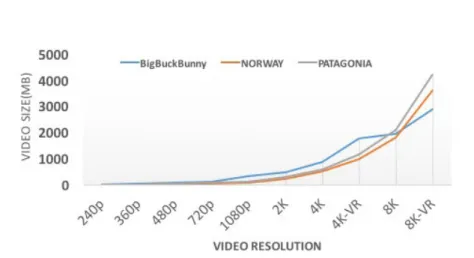
The public interest of immersive devices such as head-mounted displays (HMD) for Virtual Reality (VR), 360-degree video cameras for capturing immersive contents and 3D playback support from the commercial website such as YouTube are drawing great attentions from both consumers and researchers. Compare with regular 2D flat video con-tents, the 360 VR videos are extremely bandwidth intensive especially with the 4K/8K video resolution being widely accepted as a functional minimum resolution for current HMDs, while 8K or higher is desired. Therefore, a major challenge is how to efficiently transmit these bulky 360 VR videos to bandwidth-constrained wireless VR HMDs at ac-ceptable quality levels given their high bitrate requirements. Recommended VR/360-degree video display aspect ratio from YouTube is 2:1 for monoscopic or panoramic videos and 1:1 for stereoscopic videos with a ratio of 2:1 per eye for better user QoE. The file size is double w.r.t the original 2D videos. Nowadays, YouTube provides video contents with different resolutions. For illustration, we obtained video file sizes of three sample videos at different resolutions from YouTube, which is shown in Figure 1. This de-picts how video content size increases exponentially while the video resolution increases. A recently proposed tile-based approach is attempting to reduce the transfer size based on user’s region of interests (ROIs). In a typical scenario for streaming VR/360 videos, the user usually views only a portion of the video at a time, called field-of-view (FoV). As a result, there is a huge waste of bandwidth for streaming content to the client that is not visible to the user. By knowing the user ROIs, we can stream it with high
Figure 1: Video Content Size Comparison
quality while minimizing the quality of the rest of the video and thereby, saving the user bandwidth. In a video tiling scenario, the video is partitioned to multiple tiles and de-pending on the user’s viewable area, we stream the overlapping tiles. Tiling has proven useful in domains such as online video lectures and sports.
1.2 Application-aware Networks and Software-defined Networking
The emergence of Application-aware Networks (AAN) provides a new approach for managing Hadoop network traffic.The AAN provides the capability of an intelligent network to maintain current information about applications that connect to it and as a result, optimize their functioning as well as that of other applications or systems that they control. The information maintained includes the application state and resource re-quirements. The main benefits of our AAN approach are 1) It allows a controllable Hadoop cluster management system and a fine-granular application control platform using the SDN architecture 2) It provides an open programming interface for more intelligent
Hadoop resource allocations with consideration of global network traffic information. A software-based solution using software-defined networking (SDN) is a fine-grained way of controlling individual application and network devices. AAN benefits from SDN in two ways: first, by enabling dynamic control, configuration and giving the ability of AAN to allocate resources at any given moment; second, by running network controls on a separate server from the traffic forward device. The SDN is a relatively recent networking paradigm that has been conceived to address certain limiting of IP networking. With decoupled control and forwarding layers, SDN can dynamically op-timize network flows traffic based on global network traffic information. It also has a finer quality of service (QoS) control based on assigned flow priorities. Our work aims to investigate how the future immersive video streaming scheme can exploit SDN for bet-ter QoE. Specifically, we propose a SDN-based approach to design a tile-based VR/360 streaming platform using DASH. In our work, we focus on 1) Hadoop computation using an AAN framework through SDN when Hadoop nodes are spread out over a network 2) Video Streaming using MPEG-DASH with proposed AAN-SDN.
1.3 Motivation and Scope
In general, the goal of our research is to improve applications’ performance by proposed application-awareness networking framework. To prove its usability and effi-ciency, we tested our framework using two important applications in both big data and video streaming realm. We analyze the current issues and factors, which can affect the performance for those applications.
1.3.1 The Hadoop MapReduce Run Time Performance Optimization
A great deal of consideration must be put in place when managing a Hadoop cluster using resources for running MapReduce jobs in order to fully understand Hadoop traffic. The key elements are summarized as follows:
• The block size and split size: Hadoop uses blocks and split size to control how many blocks are being divided and used when running MapReduce jobs.
• Block replication factor: Hadoop uses this approach to prevent data loss because of common hardware failures.
• The physical configuration of hardware resources: This includes CPU, memory,
hard disk capacity, interconnection network link speed and the number of slave nodes.
• Java Virtual Machine(JVM): Hadoop uses JVM to complete jobs. The number of
resources, mainly CPU and memory, can be assigned to each created JVM. Because the process of creation and killing of such resources takes time, the rule of thumbs when using JVM is that the less mapper is better, which leads to less JVM creation and less killing time. However, this must be accomplished by being given sufficient resources to start with for the submitted jobs.
• Hadoop cluster topology: How slaves deploy across the Hadoop cluster can be
critical and depends on the assigned network bandwidth between master nodes and slave/data nodes.
• Other Hadoop performance tuning methods: Additional factors such as the num-ber of files, file size, JVM Reuse and combiners are also important for Hadoop performance tuning.
1.3.2 User QoE improvement for MPEG-DASH Based Video Streaming
As video gets popular, user requires higher quality-of-experience (QoE). With limited network bandwidth and architecture, network side video traffic optimization can play an important role. The key elements are summarized as follows:
• Video Streaming QoE Metrics: Design QoE metrics for regular 2D video streaming
is very important process to benchmark user perceived video qualities.
• Network Profiles for Video Streaming: Video quality changes based on networking
condition such as bandwidth and delays.
• Region of Interests (ROIs) Based Immersive/360-Degree Video Streaming:
Immer-sive video content streaming using various number of ROIs. 1.4 Contribution
In our research, we present AAN-SDN architecture for application performance optimization. We introduce tools and traffic reroute mechanisms for Hadoop and video streaming application optimization. We ran real-world MapReduce and MPEG-DASH streaming applications using our proposed AAN-SDN architecture to show improvement in both application use cases. Briefly, we make the following contributions:
1. w.r.t general AAN-SDN architecture design: • An application-aware framework with SDN
• A new ARP (address resolution protocol) flooding avoidance resolver algo-rithm for our framework.
2. w.r.t Hadoop MapReduce optimization:
• A data flow model to improve the data movement efficiency for MapReduce related workloads
• An adaptive traffic engineering mechanism for the AAN-SDN environment for Hadoop applications
3. w.r.t MPEG-DASH streaming QoE improvement:
• We present the difference in immersive content streaming between traditional-and SDN-based network.
• We introduce a SDN-based framework to assist tile-based immersive content streaming.
• We quantify the benefits brought by our SDN approach using network simu-lation. The results indicate that our scheme can increase of user’s quality of experience.
1.5 Additional Research Contributions
During my Ph.D. study, I have conducted collaborative research that resulted in published papers in various journal and conferences in the area of networking, multime-dia, and big data processing.
1.5.1 I-Can-MaMa: NetFlow Data Processing and Traffic Grouping
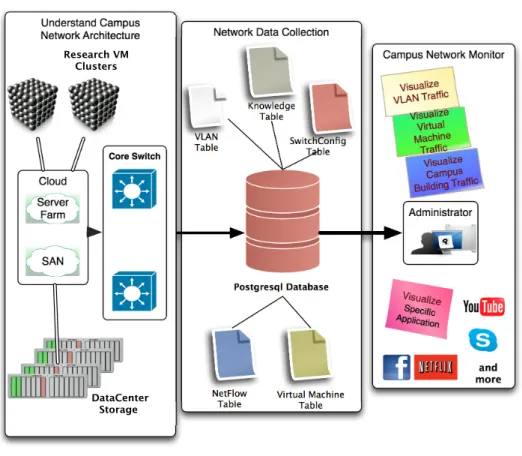
In I-Can-MaMa [80], the goal was to explore Cisco NetFlow Data from campus data center network and analyze traffic pattern and traffic grouping. In this paper, we focus on two important components that the CampusIS needs to address. The first is the campus physical network, and the second are the campus data centers that connect users to computing resources through the network. The goal of this project has been to take an integrated approach that gives the CampusIS system administrators (sysadmin, in short) the ability to understand the impact on the network. The impact may be due to different services using the data centers over the network, or due to users accessing external sites. The aim is to allow the CampusIS sysadmin to have a comprehensive view so that they can see how the network is being used by the data centers as well as external applications through a common framework. Because of virtual machines (VMs) provided at the data centers, it is also necessary to see how different traffic flows are incoming or outgoing from a specific VM. While the CampusIS sysadmin uses a number of commercial and public-domain tools, most of them are geared for a specific situation such as mrtgthat gives views on a link use. We proposed the I-Can-MaMa Framework (Fig 2) for large NetFlow data processing. Our data integration environment focuses on creating a few key
Network Data Collection VLAN Table Knowledge Table NetFlow Table Virtual Machine Table SwitchConfig Table Postgresql Database
Campus Network Monitor
Administrator Visualize VLAN Traffic Visualize Virtual Machine Traffic Visualize Campus Building Traffic Visualize Specific Application and more Understand Campus Network Architecture Core Switch Cloud SAN Server Farm DataCenter Storage Research VM Clusters
Figure 2: I-CaN-MaMa Framework
tables in thePostgreSQLdatabase to store a few key pieces of information on a periodic basis. We have created a number of tables. Collectively, we have built a KnowledgeBase through these tables.
1.5.2 Real-time Network Anomaly Detection System Using Machine Learning In [2], we presented the design and implementation of a real time network anomaly detection system for network-flow data in a campus network using Storm [69] real time data processing framework. The real network traffic of the campus network based using
Cisco NetFlow was collected at the campus data center at the University of Missouri– Kansas City (UMKC). Our proposed system is currently being developed using Apache Hadoop, Apache Storm, and Apache Kafka. Fig. 3 shows the architecture of our system. Apache’s Hadoop distributed file system (HDFS) is an open source system for reliable, scalable, distributed computing. Hadoop is comprised of two major components, HDFS and MapReduce. For our real time streaming purpose, the HDFS component serves as a flow data producer. Our Storm topology can be mapped to Kafka topics.
Apache Storm Processing
Storm Topology (T1, T2, …, Tn) T-1 Kafka Spout T-2 T-N …. …. Hadoop EcoSystem HDFS NetWork Data Result
Figure 3: Streaming Architecture
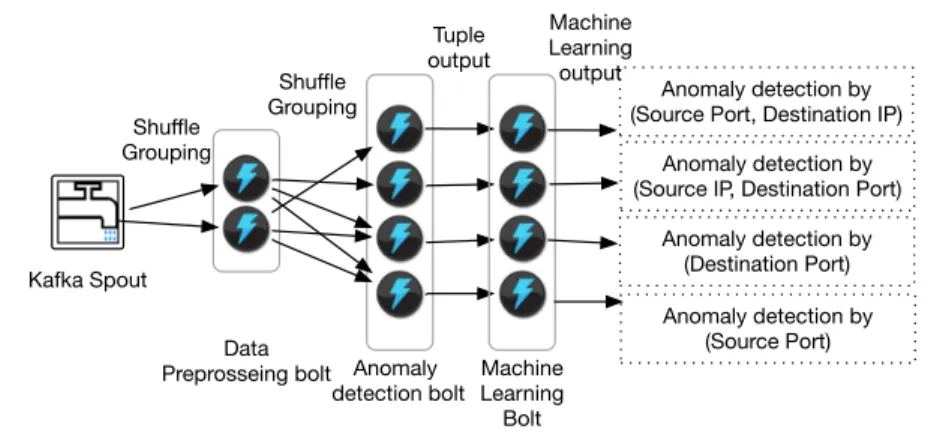
Fig. 4 shows a topology setup for the anomaly detection in one of the switches. The streaming process is divided into four components: Kafka Spout, Data Preprocess-ing Bolt, Anomaly Detection Bolt, and Machine LearnPreprocess-ing Bolt. The Machine LearnPreprocess-ing Bolt conducted advanced anomaly detection over the anomaly traffic data detected by the Anomaly Detection Bolt. The data were used as training data for the machine learning process. The Machine Learning Bolt was implemented using a Weka Machine Learning tool [27] to improve the accuracy of anomaly detection tasks. The output was automati-cally saved and stored in HDFS for future use.
Shuffle Grouping Shuffle Grouping Anomaly detection by (Destination Port) Anomaly detection by (Source Port) Data Preprosseing bolt Kafka Spout Anomaly detection bolt Anomaly detection by (Source IP, Destination Port)
Anomaly detection by (Source Port, Destination IP)
Machine Learning Bolt Tuple output Machine Learning output
Figure 4: Storm Topology
In this work, we presented a novel real-time system for network anomaly detec-tion by utilizing state-of-the-art approaches including Apache Storm, Apache Kafka and applying real-time analytics on streaming data for network monitoring and management. We obtained promising preliminary results for real-time network anomaly detection.
1.5.3 BuDDI: Bug Detection, Debugging, and Isolation Middlebox for Software-Defined Network Controllers
In BuDDI [2], we used SDN concepts and proposed an online software Bug De-tection, Debugging, and Isolation (BuDDI) middlebox architecture for SDN controllers. Software bugs cannot be resolved with them due to unexpected failure behavior. Fur-thermore, they are often bounded by common mode failure and common dependencies (CMFD). BuDDI consists of a shadow-controller based online debugging facility and a CMFD mitigation module in support of a seamless heterogeneous controller failover. For on-line bug detection and debugging, unlike a traditional N + 1redundancy cluster sys-tem, we propose an N + 2load balancing cluster system where components (N) have
at least two independent failover components (+2). BuDDI enables a shadow controller that mirrors the active controller functions and turns on a verbose debugging mode for a specific failure module. Eventually, the two failover components will converge into one active controller. If the shadow-controller cannot identify a software bug in a given pe-riod, it sends a preemption message to the active CMFD module to take over the active role. Otherwise, it will confirm an active role for the CMFD module.
Figure 5: BuDDI Middlebox Architecture.
The proposed architecture is shown in Figure 5. The middlebox is connected to the controllers via northbound OpenFlow, whereas with the physical network, via south-bound OpenFlow. Ryu, POX, FloodLight, Trema, and OpenDaylight are some of the most commonly used open source controllers. These controllers vary from each other in one way or another, which gives them diversity and supports our claim of using a heteroge-neous controller approach. We verified that BuDDI supports our claim of a heterogeheteroge-neous controller switchover without causing additional performance overhead.
1.5.4 SPArTaCuS: Service Priority Adaptiveness for Emergency Traffic in Smart Cities Using Software-defined Networking
In [1], we proposed SPArTaCuS (Service Priority Adaptiveness for Emergency Traffic in Smart Cities using Software-defined networking), a framework for smart cities on how to prioritize services for emergency needs in a stressed situation. Our approach is based on a promising new networking technology, known as software-defined network-ings (SDN). Our approach resorts to virtualizing networks for different service classes, and dynamic allocation of resources as the need be.
Figure 6: SPArTaCuS: Architecture Framework
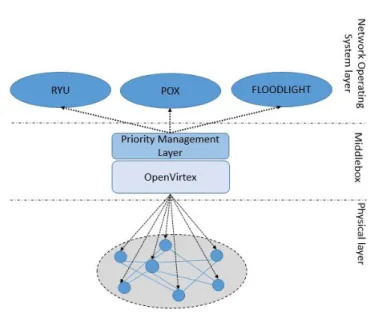
Our proposed approach SPArTaCuS uses SDN to accomplish service prioritiza-tion for emergency services in a stressed situaprioritiza-tion. In particular, SPArTaCuS uses the SDN framework with OpenVirtex (OVX) to create virtual SDN networks for different service classes that are mapped to the physical infrastructure. Fig. 6 presents a high-level
view of the SPArTaCuS framework. In our approach, the middlebox layer has a priority management layer on top of OVX; that is connected to multiple SDN controllers on the northbound interface. We argue to divide the traffic based on different organizations and prioritize them using the priority management layer in the middlebox. We illustrate two situations where SPArTaCuS can be helpful.
1.5.5 SeSAMe: Software Defined Smart Home Alert Management System for Smart Communities
In SeSAMe [3], we proposed an architectural vision for software defined smart community home alarm management based on software defined networks. We presented the protocol messages and systems components for the operation of SeSAMe. With our approach, should any alert/event such as a fire occur, an automated notification is sent to all the homes in the neighborhood and to the fire department and the police department about the fire. At the same time, alerts can also be forwarded to the police and the fire departments.
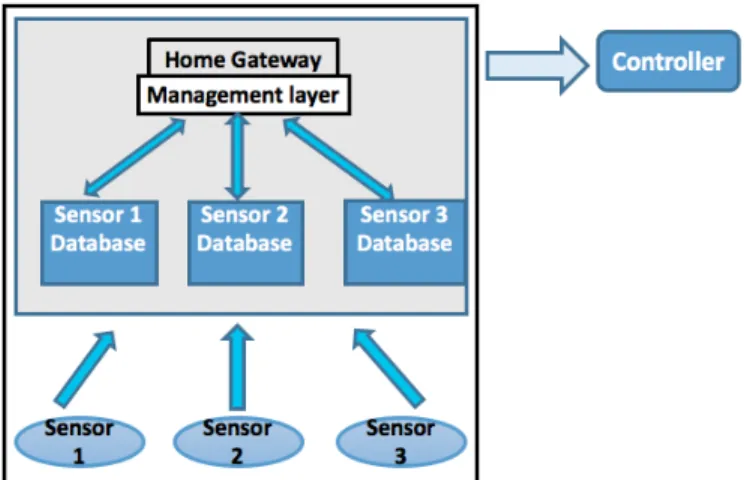
Fig. 7 shows the high level architecture of a smart home in SeSAMe. It can be categorized into two categories: home gateway and sensors. The sensors include different sensors that are part of the home, e.g., fire sensor, temperature sensor, light sensor, motion sensor, and so on. All sensors send their data to the home gateway. The controller creates a database of the readings from various sensors. As shown in the figure, there are three sensors in the home and the controller creates a database for each of the sensors. The home gateway consists of a database where the reading from different sensors is stored, at least temporarily.
Table 1: Message types
Message Type Sender-receiver Description
Update Home-to-Controller Sends updates to
the controller
Trigger Home-to-Controller Event triggered
message to notify the controller of any alert
Announce Home-to-Homes Notify the homes
of any alert
Keepalive Home-to-Controller Notify the
controller that the home is connected
In SeSAMe, we define four different types of messages as shown in Table 1. By varying the message size and frequency, we measure the efficiency of proposed system. The preliminary results show that using SDN approach alerts can be communicated very quickly. Moreover, they give the flexibility of programmable control functions, lower operating costs, and centralized management, to name a few.
1.5.6 Low Delay Video Streaming Using WebRTC for MPEG-DASH in Both Wired and Wireless Networks
In [81, 83], we studied MPEG-DASH streaming over the WebRTC data chan-nel. We explored the low delay WebRTC data channel as a transport vehicle for carrying DASH video sessions, and deploy our own sender side pacing solution for low delay DASH streaming. Simulation over a relay network using the NS-3 platform, demon-strates the significant improvement in end-to-end QoE delivery and reduction of start up and channel switching delays.
Figure 8: DASH Over WebRTC
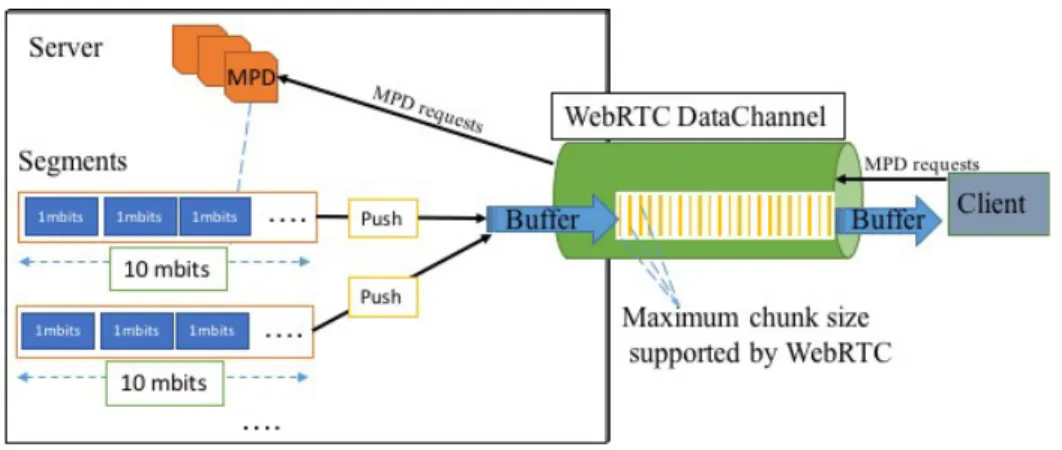
With WebRTC based solution, which is RTP based, we are not suffering from TCP under-utilization. However, this comes with a cost because the sender needs to take over the congestion avoidance logic and pacing the transmission. We use a sender self-timing transmission scheme, with underlying webRTC congestion signals exposed via WebRTC APIs to help avoid congestion. Fig. 8 shows our system architecture. A server serves DASH MPD files and segment data. A DASH client communicates with the server
through a WebRTCdatachannel.
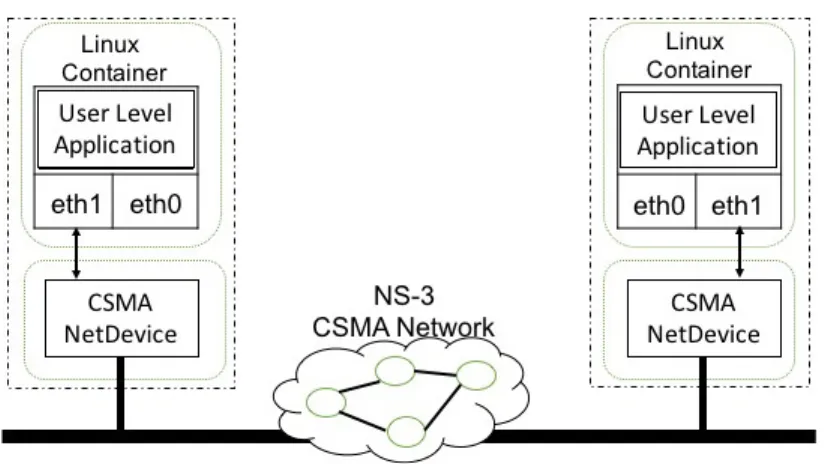
In this work, we conduct our experiments on both DASH and WebRTC using an NS-3 simulated network. In order to run the simulated network with an existing DASH .js player and WebRTC applications, we deploy two Linux containers using a Linux LXC library and Chrome as our test web browser. The DASH.js player and WebRTC are de-ployed as user level applications running on top of two different Linux containers that are connected by tap devices using an NS-3 simulated CSMA network. Figure 9 shows the topology setup using NS-3.
Figure 9: WebRTC and WebSocket in NS3 Experiment Setup
Initial simulation demonstrated very high link utilization and a low delay for DASH over WebRTC as compared with a typical DASH .js client over the HTTP link. In the future, we will further invest and expose the underlying WebRTC congestion model to support better QoS adaptation and introduce new sptaio-temporal QoE metrics to MPD to facilitate better end-to-end QoE optimization. Also, it will be interesting to introduce a thin middleware layer plug-in that enables WebRTC based peer-to-peer DASH streaming.
1.5.7 Wireless Video Traffic Bottleneck Coordination With A DASH SAND Framework
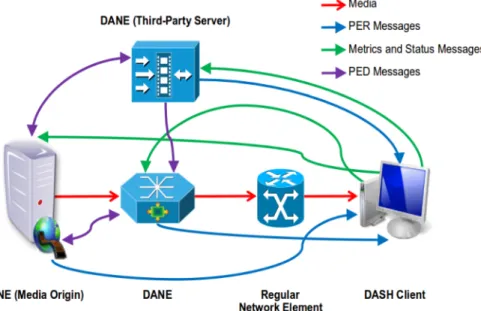
In [45], we introduced new Quality of Experience (QoE) metrics for DASH sub-representations, and proposed a marginal utility maximization-based resource pricing scheme to coordinate multiple video traffic sharing the bottleneck resource. The solution is based on the DASH SAND (Server And Network assisted DASH ) messaging frame-work. Simulation results demonstrated the QoE multiplexing gains from this solution, and the pricing control scheme is adopted in SAND messages. The growth of video data traffic is far out pacing the network capacity growth, and it dictated the reality that a large portion of mobile video sessions will be operating at a quality of service (QoS) deficit over a bottleneck. The bottleneck could happen over both the eNodeB wireless channels, over the home broadband gateway, and the links in the mobile core networks. The original DASH framework offers an effective rate adaptation scheme within a single streaming session, but lacks the coordination mechanisms among users sharing a common bottle-neck. In recent work, DASH SAND (MPEG-DASH Part 5) is addressing this problem by introducing new messaging and control schemes among DASH servers, clients and middle boxes (known as DANE: Dash Aware Network Elements). The overall SAND architecture is illustrated in Fig. 10 [61].
We also introduced a new temporal quality metric and DASH sub-representation packing solution, to offer finer granular streaming operating points in rates and grace-ful spatio-temporal quality degradation when streaming rates need to be reduced. For a
Figure 10: DASH SAND Architecture
pre-coded DASH segment at a certain PSNR quality level, we can further derive tem-poral quality operating points by packing the I, P, and B frames according to their if-loss distortion-induced characteristics. This is achieved by a frame significance function based frame loss distortion metric [44].
1.5.8 Multi-party Conference Over Virtual Service Edge Router (VSER) Platform In [8], we investigated Virtual Service Edge Router (VSER) platform a realized using OpenStack, which is an ICN edge service router with the capability of hosting arbi-trary realtime and non-realtime services as virtual machines (VM). The platform services are orchestrated through a programmable framework and takes advantage of scalable for-warding plane for content distribution.
1.6 Organization
The rest of this dissertation is organized as follows: Chapter 2 discuss our research scope and background knowledge on SDN, Hadoop MapReduce, and MPEG-DASH . We present our proposed the general AAN-SDN architecture for application performance optimization in chapter 3. We discuss how AAN can benefit Hadoop MapReduce jobs in chapter 4. We show our study of user QoE improvement for dynamic adaptive streaming over HTTP (MPEG-DASH) in chapter 5. We then discuss how AAN can benefit video streaming using MPEG-DASH in chapter 6. We conclude our work in chapter 7.
CHAPTER 2 RESEARCH SURVEY
In this chapter, we will discuss the state-of-art researches that have been done with regarding to improve the performance for both Hadoop MapReduce and MPEG-DASH streaming. We then discuss our research scope and related background review for Hadoop MapReduce, MPEG-DASH, and Software-defined networking.
2.1 Related Work
2.1.1 Hadoop MapReduce Related work
The Hadoop MapReduce [26, 41, 72] as a distributed processing framework has become the dominant approach for processing volumetric traffic in the big data era. Many researchers have studied several options to improve MapReduce’s performance. Recent work, using traditional IP networks, can be grouped into two categories within given hardware resources: (1) an advanced Hadoop resource scheduling algorithm design in [24, 25, 34, 68, 71, 73, 76, 78, 79] and (2) job optimization with optimized configuration parameters using specific hardware in [5, 43, 74].
The Existing Hadoop MapReduce resource scheduling algorithm manages to op-timize the Hadoop cluster resources such as slave nodes, CPUs, memories, networks, and disks. Those algorithms fall mainly into three categories: FIFO, capacity-based, and
fairness schedulers. There are also heuristic designs that focus on data locality with sim-ulations. BAR [34] proposed a heuristic task scheduling based on data locality by simula-tion, by initially finding an ideal data location for job processing in order to reduce the job running time. However, the assumption of initial job starting and completion time cannot stand in a real network. The proposed wait and random peeking approach in [68] and a fair scheduler [78] improves data locality. However, those methods can be further improved if integrated with network information and by using real-time data traces. SHadoop [23] takes an approach of modifying standard Hadoop’s map and reducing execution methods to avoid employing any particular hardware or supporting software. Other similar works, which use adaptive job performance scheduling under various cluster circumstances are in [25, 48].
Another aspect of improving MapReduce job completion time can be achieved using a hardware acceleration approach [6, 74]. Special software and hardware need to be deployed that may not be readily accessible for normal cluster setups. Job specific opti-mization for MapReduce works is presented in [43, 62]. However, it lacked generalized methods for the overall performance of MapReduce jobs.
By using the Hadoop cluster under the traditional IP network, MapReduce’s per-formance can be substantially degraded due to (1) the inherent characteristic of inten-sive data shuffle frameworks to transfer a large amount of intermediate data among slave nodes, and (2) default resources’ allocation methods that lack the global view of real-time network traffic information. TCP related optimization work for MapReduce workloads is invested in [9, 15, 77], but the overall operation still bears low-performance improvement.
New network frameworks have been studied to identify new approaches to achieve a better MapReduce performance, such as in MROrchestrator [63], Coflow [11] and Or-chestra [12] with much more sophisticated application integration designs. Pythia [52] has similarities with our approach but lacks a clear and comprehensive SDN system de-sign with respect to MapReduce and a related application-aware approach. A preliminary idea on our approach was presented in [87]. Our application-Aware network design on top of SDN provides a common API interface, which can provide a full range of capabilities for network management and monitoring for different applications. We also measure the SDN control latency cost in our test cases. Based on the test results, our AAN realization can be better utilized for applications such as Hadoop M/R, which does not rely on a low lantency requirement. Our recent work published [85] shows the benefits how such an AAN-SDN can improve the Hadoop’s run time efficiency.
2.1.2 MPEG-DASH MapReduce Related work
With modern capturing systems for 4K or Ultra High Definition (UHD) and 8K or ultra high definition television (UHDTV) video, new types of media experiences are possible where end users have the possibility to choose their viewing direction. Also with increased interest of immersive HMD devices for VR/360 content playback, user’s viewing experience suffers because of the present limitations in both of existing network framework and video delivery methods.
A great deal of work has been done on both video encoder and delivery methods to reduce transferred media size. Tiling, in the video codec level such as the H.265/HEVC [?,
14] refers to a spatial partitioning of a video where tiles correspond to independently de-codable video streams, which takes a divide-conquer approach to encoding and can reduce video content size by half. However, it is currently not widely adopted compared with the H.264/AVC encoding method.
With a 2D flat video, a tiled video can be obtained from a single video by par-titioning each frame into multiple frames of smaller resolution and by aggregating the smaller frames coming from the same partition/region of the input frame into a new video. Here, tiles are defined as a spatial segmentation of the video content into a regular grid of individual videos. Similar ideas are also being used for creating tile-based VR/360 contents [28, 29, 42, 47, 59, 67].
MPEG-DASH is one of de facto effective adaptive streaming approaches that can fully utilize the existing physical IP network infrastructure. To utilize the DASH approach for video streaming, various client sides’ ABR algorithm development have been proposed. Some of the representatives of the bandwidth-based approach such as PANDA [46], Elastic [16], Festive [33], SARA [35]. The performance of this approach can be affected by its bandwidth estimator’s accuracy. Bandwidth estimation and predic-tion are known to be tough tasks [60, 75]. The fundamental design of DASH architectures makes the DASH client play important roles for a smooth and quality playback by im-plementing the mechanism for selecting the bitrate and resolution is built into the player. Buffer-based algorithms (BBA) are also studied such as in BOLA [65]. Such BBA-based approach is adopted by NetFlix. We also studied the low delay MPEG DASH streaming over the WebRTC data channel related in [82, 83] and wireless streaming in [45].
DASH also supports the tiling scheme in the Media Presentation Description (MPD) file [54]. By specifying spatial relationship description (SRD) in the DASH MPD file, the client can fetch video segments based on current ROIs such as applications in [10,18,38].New streaming architectures is proposed in [58] to provide an efficient stream-ing experience. However, such experiments have been conducted usstream-ing the existstream-ing IP network architecture. Related research such as improving the quality of experience for streaming tile-based videos are also being investigated in [50, 59]. We studied the DASH QoE in [84] using the traditional IP network as our benchmark.
Our research is to exploit how SDN can be used in Hadoop and DASH including regular 2D and immersive streaming scenarios. One recent work in [86] shows our AAN-SDN architecture design for MPEG-DASH based streaming and Tile-based immersive streaming.
2.2 Research Scope
In our research, we focus on understanding and exploring the issues regarding the current network and application. Fig. 11 shows our research scope. We started with Hadoop as one experimental application to build an AAN-SDN based network architec-ture. We investigate the bottleneck point under traditional network architecarchitec-ture. We then propose our AAN-SDN architecture. We explain our architecture in details. With in-tensive real test cases, we show the performance gain under proposed architecture. We then extend our methodology to improve the video streaming performance using MPEG-DASH.
Figure 11: Research Scope 2.3 Background Overview
We first present a brief background on three important parts for our work: software-defined networking, MapReduce framework, HiBench benchmark suite and MPEG-DASH.
2.3.1 Software-defined Networking
Software-Defined Networking (SDN) [39, 57] provides a dynamic, manageable and cost-effective platform for making it an important platform for the high-bandwidth, dynamic nature of today’s network applications. Fig 3 shows the SDN architecture. It decouples the control and data forwarding layers and provides the programming interface for the underlying forwarding devices as well as upper application layer. The SouthBound and NorthBound APIs are provided as communication channels between the SDN layers. AAN can be realized using an SDN architecture that includes two main components: an SDN controller and a traffic forwarding protocol using the forwarding devices. An SDN controller is a software application that manages application flows to enable a dynamic
and controllable networking environment. The popular SouthBound communication pro-tocols between SDN controllers and forwarding devices are OpenFlow [39,49,57], which allows servers to instruct forwarding devices where to send packets.
Forwarding Layer SDN Control
Layer
Network control Applications
Application Control
Layer
Application Controller
SouthBound API (eg., OpenFlow) NorthBound API
Figure 12: Software-Defined Network Architecture
2.3.2 MapReduce Framework
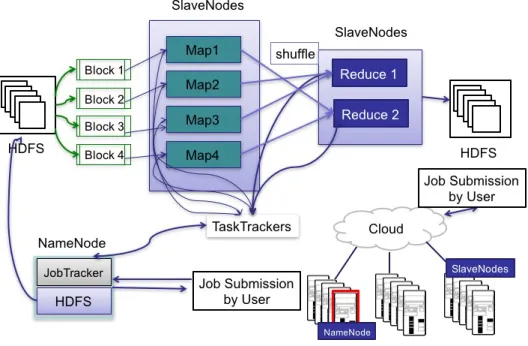
A Hadoop cluster includes one master node to manage the cluster’s metadata, such as the Hadoop File System (HDFS) and a resource manager such as YARN [70] that manages Job and task tracker for each submitted MapReduce job. Designated slave nodes run as computing powers. A Hadoop cluster is normally deployed in a closed and control environment such as in an Enterprise or a Campus datacenter (DC). Hadoop MapReduce [72] is a distributed and parallel computing framework that runs on top of the Hadoop File System (HDFS). A typical MapReduce program is composed of mixed operations among various numbers of mapper and reducer functions. Fig. 13 shows the
Figure 13: MapReduce WorkFlow
major MapReduce workflows and data movements. After the job submission, the input data split into blocks of data. The number of mapper and reducer functions plays a vital role to decide how MapReduce jobs are running on a Hadoop cluster. Based on the design of the MapReduce platform, there is a critical data movement phase when a job is running (called shuffle) that represents the output of a mapper function that is transferred to reduce functions for the final processing. How fast the shuffle phase is completed can affect the overall job completion time. We summarize the possible situations where various traffic patterns might occur in a Hadoop cluster:
• HDFS management such as a cluster health check
• File reads and writes from HDFS such as data replication, MapReduce input and output, and Cluster balancing
• Data shuffle among data nodes
• Interaction between TaskTracker such as data shuffles from mapper to reducer func-tions and data write back to HDFS as the final output.
2.3.3 MPEG-DASH
Figure 14: MPEG-DASH System Overview [51]
MPEG-DASH (ISO/IEC 23009-1) is a vendor-independent, international stan-dard. It bears the same video streaming approaches such as Apple HLS, Microsoft Smooth Streaming, and Adobe HDS. The goal of the DASH approach is to provide continued adaptation to the bandwidth situation of the client, reduce playback delay and increase the scalability and flexibility of client’s adaptive bitrate (ABR) schema. It utilizes the existing HTTP-based CDN and caches related techniques to bypass NATs and firewalls and ease the network packet traversal in the network. The fundamental idea of DASH is depicted in Fig 14 [51]. A Media Presentation Description (MPD) file stored on the server side depicts the metadata of video segments such as segment durations, video/au-dio codec, bitrate, video resolutions, and how segments are stored indicated by segment
reference schemes The client first fetches the MPD file to learn the URLs of all video segments. Thus, the video segments available from a video server. The ABR adaptation mechanism is conducted on the client side for each segment to determine which quality of a video segment is to be fetched. Bitrate switchover happens when network bandwidth or client buffer changes. By adaptively changing the downloaded bitrate, it provides a smooth playback experience for the user without much rebuffer situations.
CHAPTER 3
PROPOSED ARCHITECTURE
In this section, we discuss the status for our design approach of AAN-SDN archi-tecture and preliminary results w.r.t our two use cases: Hadoop and MPEG-DASH.
3.1 General AAN-SDN Architecture and Implementation
Forwarding Layer Traffic Monitor Flow ReRoute Shortest Path Topology Discover HDFS Controller MapReduce Controller
Transport Layer: TCP, UDP Network Layer: ARP, ICMP, IP Physical Layer: LLDP Packet Forwarding Module RESTAPI Engine WebServer Traffic Monitor Module
OpenFlow Compatible Devices
Core SDN Controller Layer Apps Layer Network control and Monitor Layer SSH Iperf
Application Specific Control Modules
Network Management and Monitoring Layer
Core SDN Controller Layer
In this section, we present our proposed AAN-SDN platform design and imple-mentation in general. We first introduced our layered SDN network architecture then conducted SDN-assisted MapReduce job completion time optimization. Starting from the bottom to the top layer, our proposed architecture (see Fig. 15) segregated our design into three main components:
• Core SDN Controller Layer
• Network control and monitor Layer • Application-specific Layer
3.1.1 Core SDN controller Layer
In the core SDN layer, we implemented two network modules, Packet Forward-ing, and Traffic Monitoring. In the packet forwarding module, we applied the network primary forwarding functions including the link layer discovery protocol (LLDP) in the physical network layer. The implementation was based on OpenFlow-compatible for-warding device. In the network layer, we implemented the forfor-warding function for the Internet Control Message Protocol (ICMP) messages, which is the key mechanism used to give feedback on network problems that could prevent packet delivery. Due to the flex-ibility provided by the SDN framework, we also addressed a new physical layer flooding avoidance mechanism such as for the address resolution protocol (ARP). In a traditional IP network, variations of spanning tree protocols (STP) are widely used to build a loop-free topology. The configuration of such an STP protocol can be cumbersome and complicated
based on the used forwarding devices. We designed and implemented an ARP resolver in Algorithm 1 that offers smooth ARP package flooding, instead of using a costly STP protocol as would be the case in a traditional IP network environment. It also takes care of ARP cache expiration issues by avoiding to send additional ICMP messages to get an updated ARP entry.
Above the network transport layer, we implemented TCP and UDP packet for-warding functions for application-aware networking. Based on the application layer’s port number and protocol type, it will forward packets accordingly. In the traffic moni-tor module, we implemented lightweight REST-API services to proactively fetch global network information such as port traffic for each forwarding device, flow installation/-modification, and traffic details in a managed time interval. The REST-APIs are designed to be lightweight without introducing extra overhead for the SDN controller. One Apache web server collects the pulled results from the REST-APIs and aggregates traffic details to provide any traffic alerts and Traffic Engineering (TE) recommendations.
3.1.2 Network Control and Monitor Layer, and Adaptive Traffic Engineering In the network control and monitoring layer, the global network topology was dis-covered where we took an adaptive traffic engineering approach by feeding into a shortest path algorithm module to calculate a path for each pair of network node/hosts on an on-demand basis. The traffic monitor component, using REST-APIs’ services, deployed at the core SDN controller layer proactively pulled network traffic information from the net-work. If there were any pre-defined traffic priority violations, a traffic reroute using a flow
Algorithm 1:ARP Resolver Algorithm Data: ARP FlowsARPr
Result: ARP Processing Decision (Forwarding/Blocking/NoAction) ARP cache initialization for each connect switch;
Read incoming ARP packets: ;
ifis ARP Broadcastthen
ifARP cache is emptythen
Add this entry to ARP Cache; Add expire timer to this entry; Flood this packet;
else
ifexiststhen
ifentry timer=< ARP T imerthen Renew entry timer;
Do not flood this packet; else
Renew entry timer; Flood this packet; end
else
ifis coming from a different port from existing entrythen Do not flood this packet;
else
Add this entry to ARP Cache; Add expire timer to this entry; Flood this packet;
end end end else
Forward ARP Request/Reply Packet; end
OVS1 ARP request Flow lookup () Host-A Ryu SDN Controller OVS2 Host-B ICMP echo
Flow Not Exists ARP Flooding ARP Flooding ARP Reply Install Flows Udpate: HostTracker() ARP Reply ARP Reply ShortestPath() ARP Reply Install Flows ICMP echo
Flow Exists, Ping will go through.
t1
t2
Cross Traffic (>= pre-set Link Bandwidth ThresholdPathOverLap()
Ping_Reroute() ShortestPath()
Install New Flows Install New Flows
ICMP Request ICMP echo Flow_clean() Delete Previous Flows Delete Previous Flows
t3
Udpate _ARP_ Cache Udpate_ARP _Cache Cross_traffic _threshold()reroute component might happen as explained in Fig. 16 that depicts the primary traffic reroute workflow. From the beginning, the ARP message for a network request such as Ping, SSH, or other applications. It first looks at the flow table and passes the traffic if there is an existing matching flow or checks if there are ARP broadcasting messages, oth-erwise. Flows are installed based on the path provided by the shortest path components. Flow rereoutes can happen when background traffic (at time t2) on the same route has over saturated some of the links along the path through adaptive traffic engineering. For this, the SDN controller recalculates a second shortest path in real time and installs new flows to reroute the application’s traffic.
3.1.3 Application Layer
In the Application layer, a port number based application recognition feature is implemented (such as port 22 is by default for the remote secure shell (SSH)). In our controlled network, the port number can be managed/changed via a separate configura-tion file that is read by our SDN controller. The modularizaconfigura-tion of various components provided by different SDN controllers helps the network administrator to control them individually in a manageable way. With regard to our specific use cases, we can resue our foundemental AAN-SDN design and add specific application layer modules:
Hadoop MapReduce AAN-SDNIt shows the application layer modules for Hadoop
MapReduce. It includes HDFS and MapReduce control components are implemented to instruct how to install flows regarding Hadoop file operations and job assignments, accordingly.
MPEG-DASH AAN-SDNIt shows the application layer modules for MPEG-DASH. With regards to DASH streaming applications, web server and DASH client control com-ponents are implemented to instruct how to install flows over forwarding devices. The modularization of various components provided by different SDN controllers helps the network administrator to control them individually in a manageable way. With regarding to recent Immersive video content such as VR/360 streaming over HTTP. MPEG-DASH has such support using Spatial Relationship Descriptor (SRD) in MPD file. The SRD parser module can parse the MPD file and extract the tile coordination based on user’s ROI change. Shortest path module can calculate in real-time for all shortest paths be-tween each pair of nodes based on existing network conditions and topology changes. In our test scenarios, higher priority tiles are rerouted using flow reroute module to the non-bottle-necked path to achieve better bandwidth utilization.
We discuss the specific application layer details for each of the mentioned appli-cations, which are the Hadoop MapReduce and MPEG-DASH , in Chapter 4 and 6.
CHAPTER 4
AAN-SDN FOR HADOOP
In this section, we first introduce HiBench, which is a Hadoop MapReduce bench-mark suite. We ran HiBench using real-world MapReduce applications to understand the depth of MapReduce traffic pattern with various Hadoop configurations such as hardware and network topology. We then discuss our AAN-SDN design for Hadoop MapReduce and evaluate how proposed architecture can improve the Hadoop runtime efficiency
4.1 HiBench: Bigdata Micro Benchmark Suite
In this section, we first introduce HiBench, which is a Hadoop MapReduce bench-mark suite. We ran HiBench using real-world MapReduce applications to understand the depth of MapReduce traffic pattern with various Hadoop configurations such as hardware and network topology. We then discuss our AAN-SDN design for Hadoop MapReduce and evaluate how proposed architecture can improve the Hadoop runtime efficiency
4.1.1 HiBench Summary
HiBench [30] is a big data benchmark suite that helps evaluate different big data frameworks in terms of speed, throughput, and system resource utilization. Hadoop MapReduce workloads in the HiBench benchmark suite include a number of applications such as Sort, WordCount, SQL, and PageRank. Due to our goal of understanding the
Figure 17: HiBench Hadoop MapReduce Related Workload Summary
resources’ usage and shuffle data traffic pattern and to later use this in our AAN-SDN en-vironment, we use the workloads’ categories depicted in Fig. 17 based on given hardware resources.
Figure 18: HiBench MapReduce Workloads Configuration Details
Before considering our AAN-SDN framework, we conducted a set of measure-ments on the Hadoop HiBench benchmark suite while keeping the topology simple and static to understand traffic patterns. We first discuss HiBench configurations used for this work.
The main considerations for running a MapReduce job include the job input size, the number of running slave nodes, the number of mappers and reducers, and the block size and location of the slaves. The Hadoop file block size was set to 32M B due to our limited hardware resources for the experimental platform and the replication factor is set to 2. Additional Hadoop related configurations are displayed in Fig 18. One of our goals in this work is to understand the shuffle traffic of Hadoop M/R. The selected configuration parameters are the key control points for our proposed AAN platform. For the rest, Hadoop default parameter values were used.
The small files problems [26] are avoided by limiting the total given file size. We setup a HiBench configuration based on a Hadoop MapReduce job type and the network topology locations for slave nodes as shown in Fig 18. Consider test configuration “B-1” as an example to explain our setup of HiBench: its input file size is48M B. The number of mappers and reducers set to one each. At this configuration setup, we compare the runtime difference with other “B-X” configurations as well as other test configurations using different HiBench settings. Slave locations are depicted in Fig. 19. For a TA type, only one slave is active for the submitted job. A TA case sets up a base comparison with other topology configuration types for the same MapReduce job with respect to job CPU, memory consumption and how long does it take to complete the job. We also ran a
(a) (b)
(c)
(d)
Figure 19: Topology Type (a) TA, (b) TB-1, (c) TB-2, (d) TC, TD
MapReduce job under different slave locations using a various number of slave nodes to understand if the location of the slave could affect the job completion time. For example in the TB-1 and TB-2 configuration setup, two slaves ran under the same topology location in TB-1 while they were in different locations for TB-2. A TE type uses eight slave nodes that are evenly distributed under four forwarding devices as shown in Fig. 29(a).
Some of the predefined MapReduce jobs in HiBench can be assigned a particular data size for input such as its micro workloads, WordCount and Sort, while others use
different input parameters such as for Join and Scan [56] from the SQL workload. For example, a Join workload using two parameters to set up the workloads, “number of Universities” and “pages”, instead of specifying the size of the input data. To ensure our input data size is the same, we conducted an initial experiment and derived the following relation based on empirical runs:
HiBench SQL workload: Join, Sort, Aggregation
Input Size(M B) = N umber of U niversities∗1.8
105 . (4.1)
HiBench WebSearch workload: PageRank
Input Size(M B) = N umber of U niversities∗2
6√2∗5000 . (4.2)
We determined that only the parameter, “number of Universities”, can change the input data size for workloads such as Join, Scan, and PageRank. By varying the predefined parameters, we keep our test configuration consistent with the same amount of input data size for different workloads.
4.2 Data Collection Cases
Hadoop MapReduce hardware resource data collection is conducted for a set of small static topology configurations. The goal is to understand the runtime resource con-sumption such as CPU, memory, and job completion time for each HiBench workload that is depicted in Fig 18.
Altogether, there were 330 tests. Because of the size of the test cases, was ran each test three times for each configuration to compute the average value; we also calculated the
Table 4 lists the detailed values for reference. Based on our observations that different HiBench jobs behave differently, we first examined the resource usage separately from each other for each HiBench configuration. We will then present a combined analysis.
4.2.1 Average CPU Usage Summary
Fig. 20 depicts the average CPU usage for various configurations. From the runs, we made the following observations:
• The single slave node uses CPUs most extensively, compared with other configura-tions. It has the highest CPU usage for a single slave node.
• When the number of mappers and reducers increases, the CPU usage increases slightly using the same input size, such as B-1 vs. B2 and B3 vs. B4. Even though for E-X configurations there is a slight drop for some jobs such as WordCount and Scan, the values are still within the95%CIrange. The reason for such behavior is due to over resource allocations since our testbed had limited hardware.
• When the number of slave nodes increases, the average CPU usage decreases in most our cases; for example, compare between D-1 and E-X.
• The location of a slave node in our setup does not play a significant role in affecting the overall CPU usage with consistent bandwidth allocation on each interconnected link.
configu-reason is due to the efficiency of the JVM resource allocation and release in the MapReduce platform at the runtime environment.
• PageRank has a higher CPU usage compared to other jobs, while others show sim-ilar CPU usage trends.
!"!!
#!"!!
$!"!!
%!"!!
&!"!!
'!"!!
(!"!!
)!"!!
*!"!!
+!"!!
#!!"!!
, -# . -# . -$ . -% . -& / -# / -$ 0 -# 1 -# 1 -$ 1 -% , -# . -# . -$ . -% . -& / -# / -$ 0 -# 1 -# 1 -$ 1 -% , -# . -# . -$ . -% . -& / -# / -$ 0 -# 1 -# 1 -$ 1 -% , -# . -# . -$ . -% . -& / -# / -$ 0 -# 1 -# 1 -$ 1 -% , -# . -# . -$ . -% . -& / -# / -$ 0 -# 1 -# 1 -$ 1 -% 2345 6347839:5 ;3<: 28=: >=?@A=:B , C @ 4 = ? @ D/ > E D E F = ? @ D> @ 4 8 @ : 5 = ? @ DG H IJ<.@:8KD634BL3=7F
Figure 20: CPU Load Summary4.2.2 Average Memory Usage Summary
Fig. 21 depicts the average memory usage for various HiBench configurations. From the runs, we observed the following:
• A single slave had the lowest memory usage even with the lowest input data size when comparing configuration A-1 with others.
• The average memory usage increases dramatically when the data size increase. For example, the average memory usage increased nearly 500%(≈ 2500/500) com-pared to six times in data growth(≈304/48).
• The memory usage was in direct proportion to the number of allocated mappers and reducers. However, in some cases, we noted opposing results, particularly in the C-2 and E-X cases. Even though they still fell into the calculated95%CI range, the reason for such behavior was due to over-resource allocations given our hardware’s limitations.
• The overall memory usage had less oscillation for the same set of test configurations compared to the CPU usage.
• All of the jobs had the same level of memory usage when compared to the same set of configuration runs.
!"!!
#!!"!!
$!!!"!!
$#!!"!!
%!!!"!!
%#!!"!!
&!!!"!!
&#!!"!!
'!!!"!!
( ) $ * ) $ * ) % * ) & * ) ' + ) $ + ) % , ) $ -) $ -) % -) & ( ) $ * ) $ * ) % * ) & * ) ' + ) $ + ) % , ) $ -) $ -) % -) & ( ) $ * ) $ * ) % * ) & * ) ' + ) $ + ) % , ) $ -) $ -) % -) & ( ) $ * ) $ * ) % * ) & * ) ' + ) $ + ) % , ) $ -) $ -) % -) & ( ) $ * ) $ * ) % * ) & * ) ' + ) $ + ) % , ) $ -) $ -) % -) & ./01 2/034/561 7/86 .496 :9;<=96> ( ? < 0 9 ; < @A < B / 0 C @ D E 9 ; < @F A * GH8*<64I@2/0>J/93E
Figure 21: Memory Load Summary4.2.3 Job Completion Time: Comparison
Fig. 22 depicts the average job completion time for various configuration setups. From the runs, we observ