Honors Research Projects The Dr. Gary B. and Pamela S. Williams Honors College
Spring 2016
The Relationship Between Nursing Students'
Perceptions of Staff Nurses' Attitudes Towards
Them and Self-Efficacy in Sophomore- and
Senior-Level Nursing Students
Sarah A. Mueller
University of Akron, [email protected]
Raechel M. Naragon
University of Akron, [email protected]
Rachael R. Smith
University of Akron, [email protected]
Please take a moment to share how this work helps youthrough this survey. Your feedback will be important as we plan further development of our repository.
Follow this and additional works at:http://ideaexchange.uakron.edu/honors_research_projects
Part of theCognition and Perception Commons,Educational Assessment, Evaluation, and Research Commons,Educational Leadership Commons, and theNursing Commons
This Honors Research Project is brought to you for free and open access by The Dr. Gary B. and Pamela S. Williams Honors College at IdeaExchange@UAkron, the institutional repository of The University of Akron in Akron, Ohio, USA. It has been accepted for inclusion in Honors Research Projects by an authorized administrator of
IdeaExchange@UAkron. For more information, please [email protected], [email protected]. Recommended Citation
Mueller, Sarah A.; Naragon, Raechel M.; and Smith, Rachael R., "The Relationship Between Nursing Students' Perceptions of Staff Nurses' Attitudes Towards Them and Self-Efficacy in Sophomore- and Senior- Level Nursing Students" (2016).Honors Research Projects. 202.
The Relationship Between Nursing Students' Perceptions of Staff Nurses' Attitudes Towards Them and Self-Efficacy in Sophomore- and Senior- Level Nursing Students
Sarah Mueller, Raechel Naragon, Rachael Smith The University of Akron
Abstract
Clinical teaching gives nursing students practical experience, allowing them to practice skills and to apply theories of nursing alongside a staff nurse. The purpose of this study was to examine the relationship between nursing students’ perceptions of staff nurses’ attitudes towards them and self-efficacy in sophomore- and senior-level nursing students. According to scientist Albert Bandura’s Social Cognitive Theory, self-efficacy is defined as a person’s belief in his or her own abilities. Using non-experimental comparative design, convenience sampling, and Likert scale questionnaires, sophomore- and senior- level baccalaureate nursing students were asked to complete the survey using the Nursing Clinical Self-Efficacy Scale and the Clinical Learning Environment Supervision and Nurse Teacher scale. Data was analyzed using SPSS 22 software analysis and t-tests. It was found that nursing students’ perception of staff nurses’ attitudes towards them is moderately related to self-efficacy in nursing students (r=0.428). There was no significant difference in this relationship between sophomore- and senior- level nursing students. This means that all students with a higher perception of the staff nurses’ attitudes about them tend to have a higher self-efficacy score of clinical skill performance. These findings suggest that staff nurses have the ability to make a significant impact on nursing students’ learning experience.
Clinical teaching is the means by which nursing students are given opportunities to apply the theory and science of nursing, and practice nursing skills that are essential to practice as a professional nurse. According to Gaberson and Oermann (1992) in Clinical Teaching Strategies in Nursing, clinical teaching is the best educational practice for which students can prepare for their career as a nurse. “Clinical practice requires critical thinking and problem-solving abilities, specialized psychomotor and technological skills, and a professional value system. Practice in clinical settings exposes students to realities of professional practice that cannot be conveyed by a textbook or a simulation” (Gaberson & Oermann, 1992, p. 5). It is through clinical teaching and experience that students are able to acquire the necessary clinical self-efficacy to become capable of supporting human lives through the practice of nursing. This self-efficacy entails confidence, knowledge, and skills in the field of nursing.
When essential learning opportunities in clinical teaching and experiences are missed or experienced negatively, nursing students may not be able to thrive in learning or become competent in the field before graduation and future employment. This is significant because deficiencies in nurses’ knowledge and experience may lead to patient safety issues. With increasing awareness and a changing healthcare system in the United States, health professions have been primarily focused on building a safer system. According to the American Association of Colleges of Nursing (2008), “Nursing has been identified as having the potential for making the biggest impact on a transformation of healthcare delivery to a safer, higher quality, and a more cost-effective system” (p. 5). However, newly graduated nurses are significantly more likely to make errors in patient care. It is estimated that less than 65% of RN graduates meet appropriate abilities for clinical judgment (Bueno, 2005), in part, because newly graduated nurses have less clinical experience and practice of critical thinking. Novice nurses lack the
ability to pick up on subtle changes and have trouble looking at the “big picture” when it comes to patient assessments. In fact, 50% of newly graduated nurses miss signs of life-threatening conditions (Bueno, 2005). New graduates are also aware of the need to gain more knowledge and practice, which may further increase anxiety, stress, and fatigue; each of which have been found to increase nursing errors, including medication errors (Spector, 2011).
One of the main factors that affects student learning is the hospital staff’s attitude toward the nursing students. A major problem that is seen in clinical practice for nursing students is that the students often perceive the staff nurses’ attitudes towards them as negative. This harmful relationship may have an effect on the student’s self-efficacy.
The aim of this study was to examine the relationship between nursing students’ perceptions of staff nurses’ attitudes towards them and self-efficacy in sophomore and senior nursing students. The research questions for this study were: What is the relationship between nursing students’ perceptions of staff nurses’ attitudes about them and student self-efficacy of clinical skill performance in sophomore- and senior-level baccalaureate nursing students? Is that relationship different in sophomore- and senior-level students?
Review of Literature
Many factors influence the nursing student’s clinical experience. One of the most influential factors affecting clinical experience is the student’s perception of staff nurse’s attitudes towards them. Researchers have found that nursing students may feel vulnerable and unsure in clinical settings as they are in new environments, learning new skills, and concerned about how the staff may view their actions (Chan, 2002). Buckenhan (1987) studied student reactions to nursing staff treatment. The researcher found that the staff nurses’ role as leaders were of greater importance and more influential to sophomore nursing students than to senior
nursing students. Senior nursing students reported more confidence in their clinical skills than their sophomore counterparts, suggesting higher levels of insecurity in sophomore nursing students. Burns, Chapman, Koontz, and Mallory (2010) studied the role of the mentor in nursing students, and found nursing students view nurse mentors as role models. Further, the use of preceptors in the clinical environment enhances the learning of nursing students. This suggests that having good relationships with preceptors may create positive learning environments for students. Mcalleer, Pemba, Pimparyon, Poonchai, and Roof (2000) found that students who perceived their learning environments in a positive light were more successful than those
students who perceived their learning environment to be negative. According to Gray and Smith (2000), the mentor relationship between nurses and students promotes support, guidance, and overall success. They also found that a good staff nurse is someone who is viewed as
understanding, approachable, confident, friendly, and enthusiastic. In conclusion, it has been found that staff nurses’ attitude and relationships with the nursing student are central to the students’ learning experience.
Researchers have found that some staff nurses are less willing to work with nursing students compared with others. This may lead to decreased confidence in abilities and barriers for communication and education for nursing students. Callister, Cox, Larsen, Matsumura, and Palmer (2004) looked at staff nurses’ perceptions of nursing students. They found that staff nurses often have mixed feelings about working with nursing students. One nurse stated, “Students are just dumped here and we are expected to teach them. They get in the way-they’re a ‘pain in the neck’ and where the heck are their instructors” (Callister et al., 2004, p. 300). Another nurse said, “…having a student is time consuming and generally ‘slows you down’ in patient care, because of the extra time spent in teaching and exploring things” (Callister et al.,
2004, p. 301). Chan (2002) discusses that students are simply interim members of the care team and have different levels of involvement than a staff nurse. The students are not always present, and are not completely included in the unit dynamic. Alberts, Mabuda, and Potgieter (2008) studied nurses and found that they did not professionally value or respect nursing students or the programs with which they were affiliated. Lambrinou, Leino-Kilpi, Papastacvou, Saarikoski Tsangari (2009) studied nursing students and concluded that, “feeling a part of a team and treated with respect as an individual is identified as a part of the socialization process that reduces anxiety, increases confidence, and promotes learning” (p. 180). Therefore, it is important for nursing students to develop confidence in the clinical setting because researchers have shown that students with more confidence can better communicate with patients and staff, resulting in a more positive experience (Casey, Murphy, Houghton, Shaw, 2012). An increase in confidence can facilitate learning for the student, and is a factor that may aid the supervisory relationship between students and staff (Kukulu, Korukcu, Ozdemir, Bezci, & Calik, 2013). Researchers have found that poor relationships between students and trained staff reduce the students’ confidence in their ability to learn and perform (Hyland, Millard & Parker, 1988). In general, researchers have found that the relationship between the nursing student and the staff nurses may be crucial in the clinical setting and is a factor strongly associated with student learning.
However, few researchers have examined how these relationships are associated with student clinical skills or clinical self-efficacy (See Appendix A for Review of Literature Table).
Theoretical Framework
Scientist Albert Bandura’s Social Cognitive Theory emphasizes that learning occurs in a social context and that much of what is learned is gained through observation. The idea of self-efficacy is central to this theory. Bandura defines self-self-efficacy as “people’s beliefs about their
capabilities to produce designated levels of performance that exercise influence over events that affect their lives” (Bandura, 1994, p. 1). In other words, self-efficacy is the belief in one’s ability to succeed. Bandura states that these beliefs determine how people think, feel, and act.
According to Bandura, there are four major sources of self-efficacy, which are as follows: mastery experiences, social modeling, social persuasion, and psychological responses (1994). See Appendix B for a model of the theory (Young, Plotnikoff, Collins, Callister, & Morgan, 2014).
Bandura’s theory pertains to this study since the intentions are to examine nursing students’ self-efficacy in the clinical setting. Specifically, the research will focus on examining the relationship between the nursing students’ perception of staff nurses’ attitudes about them and the nursing students’ self-efficacy. In terms of this research, self-efficacy can be considered the nursing student’s belief in his or her ability to perform clinical skills including education, assessments, and nursing actions. Similarly, perception can be defined as the nursing student’s opinions or beliefs about the staff nurses attitudes’ towards them.
Researchers have found that a nursing student’s mentor, in this case a staff nurse, plays an influential role in learning. Bandura’s theory states that self-efficacy is impacted by
environmental factors (see Appendix B). Therefore, the expected finding of this research is that the students’ perception of staff nurses’ attitudes towards them would have an impact on the students’ self-efficacy.
Methods Design
This non-experimental comparative descriptive study was set forth to look at and describe the relationship between nursing students’ perception of the staff nurses’ attitudes about them
and student self-efficacy in the clinical setting. The population consisted of sophomore and senior nursing students. A comparison was made between sophomore- and senior-level baccalaureate nursing students at a large-urban, public university in Midwest US. Recruitment and data collection commenced after study protocol was approved by the university’s
institutional review board. Setting and Sample
The setting was a school of nursing at a large, urban, public university in Midwest US. The total number of students at the university in the fall semester of 2014 was 25,177. The total number of undergraduate nursing students in the fall semester of 2015 was 567. The total number of students admitted into the school of nursing in the fall of 2015 was 179.
Sample inclusion criteria included: English speaking sophomore- or senior-level and traditional baccalaureate BSN nursing students at the study site. Further, the sophomore
students’ inclusion criteria included that subjects had passed the foundations of nursing I course and were currently enrolled in foundations of nursing II course, and completing their medical-surgical clinical rotation. The senior-level inclusion criterion was that subjects successfully completed all junior-level prerequisites and requirements. Subjects were excluded if they had not met this criterion, due to a lack clinical experience, which affects their ability to report attitudes of staff in clinical environments. Convenience sampling methods were used to recruit subjects for this study. No participants were excluded based on gender, ethnicity, or race. Sampling and Data Collection Procedures
Convenience sampling methods were used to recruit participants for this study. To avoid bias, demographic data was collected to determine the overall representation of the sample. Potential participants were identified and recruited with the assistance of the college’s Office of
Student Success, which was contacted by email with information about the study (see Appendix C) and how to participate, if interested. If interested, participants were redirected to a survey link, which included an informed consent form (see Appendix D) and the survey. All were loaded on the survey link on the university Qualtrics online survey system. Three recruitment emails were sent to the students who qualified for the study over a 15-day period, i.e., one every five days. Informed consent was indicated by submitted online surveys. Potential subjects were informed that responses to the Likert scale questionnaire were anonymous and confidential. Participants had the option to withdraw at any time, to ensure protection of human subjects.
Cross-sectional data was collected with an online survey, which would take approximately 5 to 10 minutes to complete. All data was automatically entered into a dataset with online survey submission. No identifiers were collected in the survey, and subjects were able to progress through the survey even if they chose not to respond to every survey item. However, data was omitted if the participant did not fully complete the survey. Data was imported into a data set for analysis, and the dataset was saved in password-protected computers with only co-investigators and project sponsors having access to the data.
The Instruments
Self-efficacy was measured with a 24-item Nursing Clinical Self-Efficacy Scale (NCSEC) and perceived staff attitudes were measured with a 34-item Clinical Learning Environment, Supervision and Nurse Teacher evaluation scale (CLES+T). With the CLES+T tool, the learning environment and the role of the staff nurse were measured on five sub-dimensions (See
Appendix E). Items were worded as statements regarding overall atmosphere and perceptions of the environment, including: academic atmosphere, leadership style of the ward manager,
teacher. The scale consisted of 23 questions with answer options ranging from strongly disagree to strongly agree. Each option was given a point value of one to five. The participant’s total perception score was the sum of the point values from all 23 questions. Scores had the potential to range from 23 to 115. For each statement, responders were asked to choose the option that best described their own experience on a 5-point Likert scale specified as, (1) disagree, (2) somewhat disagree, (3) neither agree nor disagree, (4) somewhat agree, and (5) agree. Dunn and Burnett (1995) tested validity of this instrument in a study by comparing it against the CLE scale and found a correlation of 0.93 (p<0.001), indicating high validity. They also found Cronbach’s alpha scores ranged from 0.73 to 0.95, indicating consistency and reliability (Henriksen et al, 2012).
The NCSES instrument (See Appendix F), created by Harvey and McMurray (1994), uses a
10-point Likert scale to measure self-reported self-efficacy with patient treatment, interpersonal clinical skills, hygiene skills, and technical skills. The scale consisted of 22 questions; with answer options ranging from one to ten. When added together, the participant’s total self-efficacy score was created. Scores had the potential to range from 22 to 220. The original tool was developed in Australia; therefore with few differences in terminology, only minor wording and spelling changes made by the investigators were made. The consistency for the NCSES scale was established with Cronbach’s alpha scores of 0.95 for pretest and 0.96 for posttest, therefore creating high internal consistency. Additionally, reliability was measured and found to be 0.62 (p<0.001), finding that there is strong reliability over time as well (Kuznar, 2009).
The following demographics were measured: gender, ethnicity, class, and grade point average.
Analysis Plan
All data was imported in the SPSS 22 software analysis plan. Descriptive statistical tests were used to describe the sample and variables of perceived attitudes and self-efficacy.
Percentages were used for nominal and categorical data, and means with standard deviations were used to describe integral and ratio-level data.
In order to determine the relationship between staff nurses’ attitudes and student self-efficacy, Pearson’s r-statistical method of analysis was used. Level of statistical significance was set at p-values less than or equal to 0.05. For the remainder of research, a t-test was used to determine if there was a statistical group difference in attitudes and self-efficacy, specifically in sophomore- and senior-level baccalaureate nursing students.
Results
The sample size included 44 nursing students. Of these 44 participants, 21 were
sophomore nursing students and 23 were senior nursing students. Eight of the participants were males and 36 were females. In terms of ethnicity, 39 participants identified as Caucasian, two participants identified as Hispanic/Latino, two participants identified as African American, and one participant identified as other. 65.9% of participants had a grade point average between 3.5 and 3.99, and 34.1% of participants had a grade point average between 3.0 and 3.49. Appendix G shows the specific demographic information. Participants were tested in two different areas including perceptions of staff nurses’ attitudes about them and student self-efficacy of clinical skill performance. See Appendices E and F for the specific survey questions regarding perception and self-efficacy.
The first research question was: what is the relationship between nursing students’ perceptions of staff nurses’ attitudes about them and student self-efficacy of clinical skill
performance in sophomore- and senior-level baccalaureate nursing students? Through Pearson’s r-statistical method of analysis, it was found that there is a 0.428 (r=0.428) correlation between nursing students’ perception of the staff nurses’ attitudes about them and student self-efficacy of clinical skill performance. Correlation was significant at the 0.01 (p=0.01) level (2- tailed). Figure 1 below shows the results of the correlation analysis.
Correlations Between Perception and Self-Efficacy of All Participants (Figure 1)
total_perception total_efficacy total_perception Pearson Correlation 1 .428** Sig. (2-tailed) .004
N 44 44
total_efficacy Pearson Correlation .428** 1 Sig. (2-tailed) .004
N 44 44
**. Correlation is significant at the 0.01 level (2-tailed).
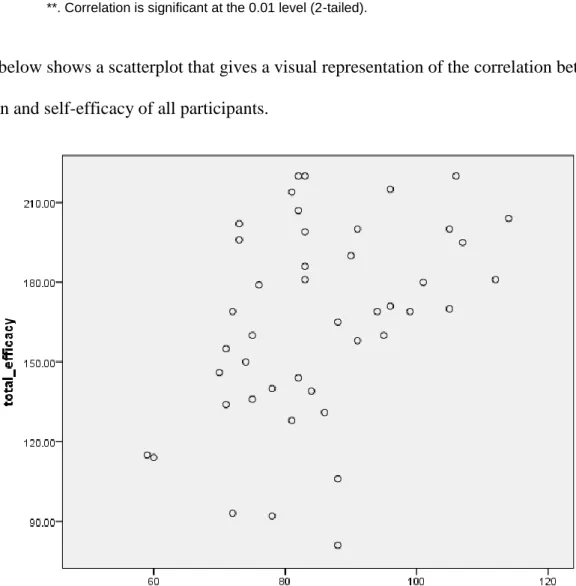
Figure 2 below shows a scatterplot that gives a visual representation of the correlation between perception and self-efficacy of all participants.
The second research question was: is the relationship between nursing students’ perceptions of staff nurses’ attitudes about them and student self-efficacy different in
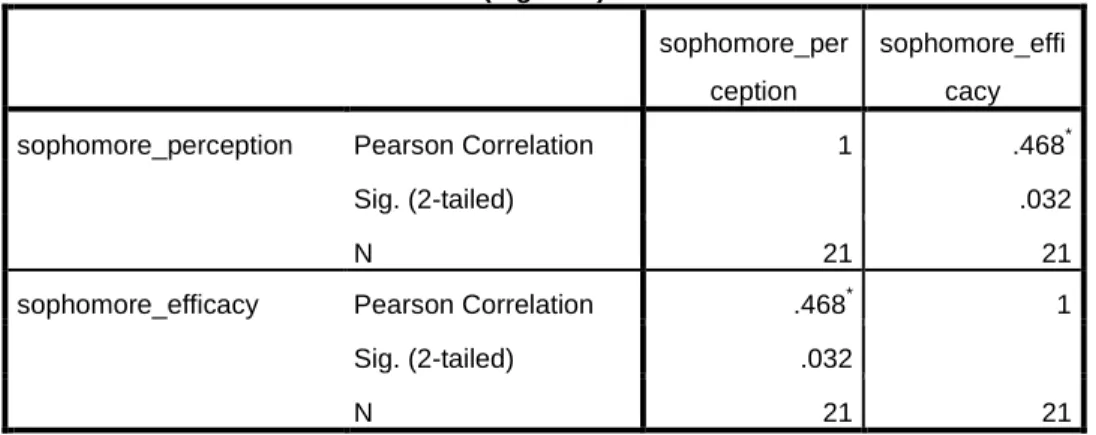
sophomore- and senior-level nursing students? Research found that there was not a significant difference between sophomore- and senior-level nursing students in the relationship between student perception and self-efficacy. Through Pearson’s r-statistical method of analysis, it was found that there is a 0.468 (r=0.468) correlation between sophomore nursing students’ perception of the staff nurses’ attitudes about them and sophomore student self-efficacy of clinical skill performance. Correlation was significant at the 0.05 (p=0.05) level (2- tailed). Figure 3 below shows the results of the correlation analysis.
Correlations Between Perception and Self-Efficacy of Sophomore Participants (Figure 3)
sophomore_per ception
sophomore_effi cacy sophomore_perception Pearson Correlation 1 .468*
Sig. (2-tailed) .032
N 21 21
sophomore_efficacy Pearson Correlation .468* 1 Sig. (2-tailed) .032
N 21 21
*. Correlation is significant at the 0.05 level (2-tailed).
Figure 4 below shows a scatterplot that gives a visual representation of the correlation between perception and self-efficacy of sophomore participants.
Figure 4
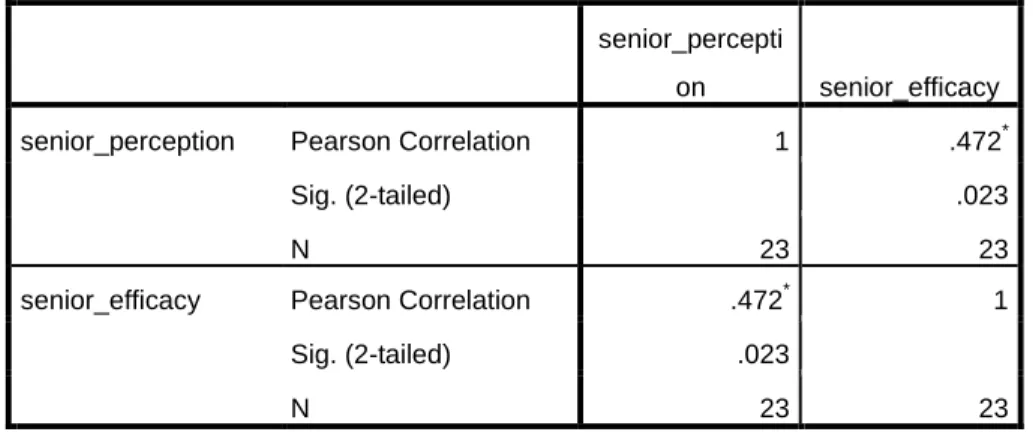
Through Pearson’s r-statistical method of analysis, it was found that there is a 0.472 (r=0.472) correlation between senior nursing students’ perception of the staff nurses’ attitudes about them and senior student self-efficacy of clinical skill performance. This correlation was significant at the 0.05 (p=0.05) level (2 tailed). Figure 5 below shows the results of the correlation analysis.
Figure 6 below shows a scatterplot that gives a visual representation of the correlation between perception and self-efficacy of senior participants.
Figure 6
Correlations Between Perception and Self-Efficacy of Sophomore Participants (Figure 5)
senior_percepti
on senior_efficacy senior_perception Pearson Correlation 1 .472* Sig. (2-tailed) .023
N 23 23
senior_efficacy Pearson Correlation .472* 1 Sig. (2-tailed) .023
N 23 23
An independent-sample t-test was conducted to compare the means of perception and self-efficacy based on grade level. The significance value of the total participant perception was 0.914. A significance value greater than 0.05 indicates that there was not a substantial statistical difference in perception scores between sophomore- and senior-level nursing students. This means that sophomore and senior students scored similarly on their perception of staff nurses. The significance value of the total participant self-efficacy was 0.011. Since this result is less than 0.05, this concludes that there was a substantial statistical difference in self-efficacy scores between sophomore- and senior-level nursing students. Data showed that seniors had a
significantly higher self-reported self-efficacy score than the sophomore students. The results are listed below in Figure 7.
Independent Samples T-Test of Perception and Self-Efficacy between Sophomore- and Senior-level Nursing Students (Figure 7)
Levene's Test for Equality of
Variances t-test for Equality of Means
F Sig. t df Sig. (2-tailed) Mean Difference Std. Error Difference 95% Confidence Interval of the Difference Lower Upper total_perception Equal variances assumed .089 .766 .109 42 .914 .437 4.009 -7.653 8.527 Equal variances not assumed .109 41.295 .914 .437 4.016 -7.671 8.545 total_efficacy Equal variances assumed .020 .888 -2.674 42 .011 -28.008 10.475 -49.147 -6.869 Equal variances not assumed -2.665 40.866 .011 -28.008 10.511 -49.237 -6.779
Nursing students’ perception of staff attitudes was measure with the Clinical Learning Environment, Supervision and Nurse Teacher evaluation scale. The scale consisted of 23 questions with answer options ranging from strongly disagree to strongly agree. Each option was given a point value of one to five. The participant’s total perception score was the sum of the point values from all 23 questions. Scores had the potential to range from 23 to 115. Figure 8 below shows a descriptive analysis of the reported perceptions for all participants, sophomore participants, and senior participants.
Perception Descriptive Statistics (Figure 8)
N Minimum Maximum Mean Std. Deviation total_perception 44 59 114 85.30 13.128 sophomore_perception 21 60 112 85.52 13.541 senior_perception 23 59 114 85.09 13.042 Valid N (listwise) 21
Efficacy was tested with the Nursing Clinical Self-Efficacy Scale. The scale consisted of 22 questions; with answer options ranging from one to ten. When added together, the
participant’s total self-efficacy score was created. Scores had the potential to range from 22 to 220. Figure 9 below shows a descriptive analysis of reported self-efficacy for all participants, sophomore participants, and senior participants.
Self-Efficacy Descriptive Statistics (Figure 9)
N Minimum Maximum Mean Std. Deviation total_efficacy 44 81 220 165.55 37.104 sophomore_efficacy 21 81 200 150.90 36.025 senior_efficacy 23 115 220 178.91 33.459 Valid N (listwise) 21
Aside from the research questions, individual responses to each survey item were broken down and analyzed. The CLES+T evaluation scale measured perceptions on a scale from
strongly disagree to strongly agree. In SPSS, strongly disagree is assigned the number one, disagree is assigned the number two, neither agree nor disagree is assigned the number three, agree is assigned the number four, and strongly agree is assigned the number five. The average perception score for each question for all participants was 3.70. A score of 3.70 means that the participants had an indifferent perception of the staff nurses’ attitudes towards them. Further, the average perception score for each question for sophomore participants was 3.71, while the
average perception score for each question for senior participants was 3.69. Therefore,
sophomore and senior nursing students’ perceptions of the staff nurses’ attitudes towards them were neither positive nor negative.
The NCSES measured items on a scale of one to ten, with one being least confident in skills and ten being most confident in skills. The average self-efficacy score for each question for all participants was 7.52. Further, the average self-efficacy score for each question for sophomore participants was 6.85, while the average self-efficacy score for each question for senior participants was 8.13. While sophomore and senior nursing students had very similar perception scores, sophomores reported lower self-efficacy scores.
Furthermore, perception of the staff nurses’ attitudes towards the participants and self-efficacy was influenced by GPA. Those with a lower reported GPA of 3.0-3.49 had lower overall scores for both perception and self-efficacy. The total average perception score for students with a lower GPA was 81.93 and the total average self-efficacy score for this subgroup was 154.60. These scores are below the scores of their counterparts who reported a GPA of 3.5-3.99. The total average perception score for students with a higher GPA was 87.03 and the total average self-efficacy score for this subgroup was 171.21. Students who reported a lower GPA had scores that were significantly lower than the average scores for all participants. By way of
contrast, students who reported a higher GPA had scores that were higher than the average scores for all participants. An independent t-test was conducted to compare the means of perception and self-efficacy based on student GPA. A significance value greater than 0.05 indicates that there was not a substantial statistical difference in perception and self-efficacy based on GPA. The results are listed below in Figure 10. Although a t-test shows that the difference was not significant, the descriptive statistics still indicate a difference in perception and self-efficacy between different GPAs.
Independent Samples T-Test of Perception and Self-Efficacy of GPA levels in Sophomore- and-Senior- level nursing students (Figure 10)
Levene's Test for Equality of
Variances t-test for Equality of Means
F Sig. t df Sig. (2-tailed) Mean Difference Std. Error Difference 95% Confidence Interval of the Difference Lower Upper total_perception Equal variances assumed .574 .453 1.229 42 .226 5.101 4.151 -3.275 13.478 Equal variances not assumed 1.132 22.918 .269 5.101 4.506 -4.221 14.424 total_efficacy Equal variances assumed 1.931 .172 1.424 42 .162 16.607 11.662 -6.928 40.141 Equal variances not assumed 1.319 23.225 .200 16.607 12.591 -9.427 42.640
Gender did not play a significant role in the clinical setting. Both males and females had similar results. The total average perception score for male students was 84.00 and the total
average self-efficacy score was 162.88. Similarly, the total average perception score for female students was 85.58 and the total average self-efficacy score was 166.14. Male nursing students only scored slightly lower than their female counterparts, showing no significant difference between gender and a student’s perception or self-efficacy. An independent t-test was conducted to compare the means of perception and self-efficacy between males and females. A
significance value greater than 0.05 indicates that there was no substantial statistical difference in perception and self-efficacy scores between males and females. The results are listed below in Figure 11.
Independent Samples T-Test of Perception and Self-Efficacy of Males and Females (Figure 11)
Levene's Test for Equality of
Variances t-test for Equality of Means
F Sig. t df Sig. (2-tailed) Mean Difference Std. Error Difference 95% Confidence Interval of the Difference Lower Upper total_perception Equal variances assumed 1.265 .267 -.305 42 .762 -1.583 5.186 -12.050 8.883 Equal variances not assumed -.263 9.074 .798 -1.583 6.012 -15.166 11.999 total_efficacy Equal variances assumed 3.475 .069 -.223 42 .825 -3.264 14.666 -32.860 26.332 Equal variances not assumed -.311 17.826 .759 -3.264 10.495 -25.328 18.801
Discussion
Including all of the students, the results of this study show that there was a moderate correlation (r=0.428 at the 0.01 significance level) between the nursing students’ perception of nurses’ attitudes toward them and self-reported self-efficacy. This indicates that a student who reports a more positive perception of the nurses’ attitude towards him or her, also tends to indicate a higher level of self-efficacy of clinical skill performance. These results suggest that nurses’ attitudes toward nursing students who are practicing in a clinical setting have the ability to positively or negatively impact the nursing student’s clinical self-efficacy. These findings are consistent with both Albert Bandura’s Social Cognitive Theory as well as past research.
According to the Social Cognitive theory, there are four major sources of self-efficacy: Mastery experiences, social modeling, social persuasion, and psychological responses (Bandura, 1994). In the Clinical setting, nursing students are continuously subjected to new and unfamiliar situations, and expected to gain a sense of self-efficacy. A nurse working as a mentor to a student has the potential to impact each of Bandura’s defined sources. According to Bandura, the mentor nurse should be able to impact the student’s self-efficacy. The results of this study are agreeable with Bandura’s theory, as it indicates a moderately positive correlation in the relationship between perceived nurses’ attitudes and self-efficacy in sophomore and senior level nursing students.
The results obtained from this research are also consistent with similar findings that have been discovered in the past. One study conducted in 2010 found that nursing mentors have the ability to enhance clinical environment and learning (Burns, Chapman, Koontz, & Mallory). Studies in the past have also shown that poor relationships between nurses and nursing students can lead to a lower level of confidence in students. This study and the studies preceding it
suggest that a positive relationship between nursing students and nurse mentors has the ability to improve the learning of nursing students. Also similar to this study, previous studies with graduate nurses as the participants have shown that many nurses do not professionally value or respect nursing students (Alberts, Mabuda, & Potgieter, 2008). The results of this study are unique, however, as it shows specifically how perceived nurses’ attitudes may impact
self-efficacy in clinical skill performance. This study also explores any differences in sophomore and senior level nursing students.
One expected finding from this study was that the senior level students would report a higher level of self-efficacy than the sophomore nursing students. According to Albert Bandura’s Social Cognitive Theory, self-efficacy is defined as the belief in one’s ability to succeed (Bandura, 1994). The questionnaire used for this study had students measure their self-efficacy by rating their confidence level in performing specific nursing tasks, including skills, assessments, and nursing knowledge. The senior-level students reported an average self-efficacy rating of 8.13 on each question on a scale ranging from one to ten. The sophomore-level nursing students reported lower levels of self-efficacy with an average of 6.85 on each question.
Specifically, sophomore-level students reported feeling much less confidence than senior-level students in matters of enemas, stitches, death, and teaching children. Interestingly, most students reported a low-self efficacy rating when it comes to being able to contact a physician
appropriately. However, even on this question, seniors reported feeling more confident than their sophomore counterparts. This is an anticipated finding, as senior-level students have spent more time learning in lectures, nursing labs, and in the clinical setting. The sophomore
was an expected finding that is not necessarily indicative of the nurses’ impact on the nursing students.
One unexpected finding of this study was that there was not a significant difference between sophomore- and senior-level students when comparing the relationship between nurses’ attitudes and self-reported self-efficacy. Both sophomore and senior student self-efficacy scores were impacted the same amount based on the perceived nurses’ attitudes. This differs from prior research, as it was found previously that the nurses’ role as a leader was more influential to sophomore nursing students than to senior nursing students. Sophomore nursing students have reported higher levels of insecurity in the clinical setting than their more confident and
experienced senior counterparts (Buckenhan, 1987). Expected findings were that the sophomore students would be more affected by perceived nurses’ attitudes than the senior students, resulting in a higher correlation value. This was not the case in this study. Instead, results indicated that the relationships of variables were nearly the same regardless of grade level. These results may be explained by the difference in time spent in the clinical setting with a nurse. At the
sophomore level, the students at the university where the study took place as well as students enrolled in similar programs have only spent one to two semesters practicing in a clinical setting. These clinicals take place once a week or biweekly for approximately eight hours. The students have not spent enough time by their sophomore year to gain the knowledge and experience they need to be confident in the clinical setting. Self-efficacy may be achieved at this level more through learning that takes place in the classroom and in nursing lab as opposed to the health care setting. By their senior year, nursing students at this university, as well as students enrolled in similar programs, have completed five to six semesters of practice in a clinical setting. These clinicals usually take place once or twice a week, for a total of twelve hours each week.
Although seniors are more experienced, confident and knowledgeable, senior-level nursing students spend significantly more time in the clinical setting and less time learning in the classroom. Since seniors spend more time than sophomore students working directly with the nurse mentor, nurses are able to make as much of an impact on senior-level nursing students that they do in sophomore-level nursing students in regards to self-efficacy.
Another unexpected finding was that the average perception scores were nearly the same in the sophomore- and senior-level nursing students. Overall, the students reported having a fair to good perception of the nurses’ attitudes toward them in the clinical setting. The total average perception score for both sophomores and seniors was 85, with scores that could range from 23 to 115. Research in the past has described nurses as having mixed feelings about working with nursing students. On one hand, nurses can relate to the stressful learning experience, as they once have endured it themselves. However, many nurses feel that they do not have the time to teach students while they are trying to care for patients themselves (Callister, et. al, 2004). Senior-level students are more educated and experienced and do not require as much supervision or time spent teaching by the nurse. Regardless, this research has shown that both sophomore- and senior-level nursing students have roughly the same experience with nursing mentors while practicing in the clinical setting. One possible explanation may be the nurses’ lack of awareness or disinterest in the skill level of the nursing student. If nurses do not understand the experience level of the nursing students, the nurses’ actions and attitudes would not change based on the grade level of the student.
Although students on average rated the nurses’ attitudes towards them as being fair to good, many noteworthy statistics can be seen once the results are broken down. Only 25% of all the students reported that they felt they were treated as colleagues. Of the senior-level students,
56.5% reported that they did not feel like they were treated as colleagues, while most of the sophomore-level students felt indifferent about this matter. The more experienced seniors class which is nearing graduation is able to see what it means to be treated as a colleague and
oftentimes yearns to be treated as so. Only 43.1% of all students reported the nurse learning the student’s name and calling the student by name, and only 43.2% of all students reported that they felt the staff was generally interested in supervision of the students. For both of these statistics, the senior students were more likely to report staff disinterest in supervision and learning names than the sophomore students. One possible explanation is that the nurses may feel the seniors are more capable of performing patient care and do not need to intervene as much as they would for sophomore students. Regardless, both sophomore- and senior-level nursing student require guidance and supervision, as they have not perfected nursing assessments and skills. Also, too much confidence in a senior student’s abilities by the nurse may lead to the student feeling neglected and reporting staff disinterest, creating a barrier in communication. Failure in communication can lead to missed learning opportunities by the nursing students, and delayed care for the patients.
One last interesting finding was that students with a higher grade point average (GPA) scored higher on both the self-efficacy and perception test. Although a t-test showed that there was not a significant statistical difference, a difference in scores still indicates that there could be clinical significance. It was expected that students with a higher GPA would receive a higher self-efficacy score. A higher GPA generally indicates an increased amount of materials learned and retained, which would have an impact on students’ confidence and abilities. It was less expected, however, that students with a higher grade point average would also score higher on the perception test. This means that students with a higher grade point average are more likely to
indicate a positive perception of the nurses’ attitudes towards them. One possible explanation is that students with more confidence and knowledge in their skills are more likely to perform better in the clinical setting. Nurses working with these students might notice this and respond better than they would to students who are less confident or capable of performing nursing assessments and skills. Furthermore, students who are less capable of performing skills require more supervision and more teaching time from the nurse. Staff nurses have reported that students can be a burden, as the nurses do not have time other patients and do not have much time to spend teaching students (Alberts, Mabuda, & Potgieter, 2008). If the nurse is busy, a less knowledgeable student who needs more help may be more likely to perceive the nurse as being less receptive to his or her needs.
Conclusion
The results of this study signify that all students with a higher perception of staff nurses’ attitudes towards them tend to also score higher in self-efficacy of clinical skill performance. This indicates that nurses’ attitudes towards students may have a significant impact on the
learning of students. There was no major difference in this relationship between sophomore- and senior-level students. As expected, senior students scored higher than sophomore students in self-reported self-efficacy. The sophomore- and senior-level students scored similarly in how they perceived the staff. On average, the students scored the staff nurses’ attitudes as fair to good. However, once the results of the perception test were broken down many disruptive statistics about staff treatment of the nursing students were revealed. Many students feel that it is difficult to communicate with the nurses and that nurses do not take their role as a supervisor seriously. In some cases, the nurses do not bother to learn the names of students who are taking care of their patients all day. Lastly, results showed that students with a higher grade point
average reported a significantly higher self-efficacy as well as a significantly higher perception of staff attitudes towards them.
One limitation of this study is that subjects were obtained from a convenience sampling of a limited population from one nursing school. The results of the study cannot be applied to the general population, only suggested. In terms of this study, the nursing students would have only had interactions with nurses from two or three local hospitals. The sampling population did not represent the demographics of the general population. 88.9% of all participants were
Caucasian, 4.4% were Hispanic, 4.4% were African American, and 2.2% identified as other. Secondly, the data was measured subjectively by the participants. The self-efficacy scale represents how the participant perceives his or her own skills. It is not an objective tool to measure self-efficacy. Therefore, each participant’s determination of his or her rankings were individualized. Lastly, the study does not prove causation. The design of the study does not allow for the ability to draw causal relationships due to extraneous variables that could be
affecting the student’s level of self-efficacy, such as outside tutoring, peer involvement, GPA, or personal issues.
Future studies would be recommended to further explore this topic. Research shows that nurses impact the nursing students. This study in particular shows that nurses have the potential to play a very important role in the development of the efficacy in nursing students across grade levels. More studies could be done to include a more diverse population, and to further explore what nurses can do specifically in order to improve the perception of the nursing students. A study about what nursing students are looking for in the staff nurses would be helpful for both the students and the nurses.
This study reveals that staff nurses have the ability to make an impact on the education of nursing students. The implication is that nurses can use these findings as a motivation to be good mentors. The students’ perception of the nurses’ attitudes can affect how the student thrives in the unfamiliar and oftentimes stressful learning environment of a clinical setting. When students have a positive perception of the nurses, students are more likely to succeed in understanding necessary nursing skills. Nurses are key members in the community, who work directly with patients every day. Studies have shown that novice nurses are more likely to make mistakes related to patient care (Bueno, 2005). The education of nurses should be a priority and not an inconvenience. Staff nurses should be more accepting of students practicing in the clinical setting, and more perceptive of student needs. Students at every level require some degree of supervision and nurses should also take this role seriously as it directly pertains to the safety of their patients. Students can make a change as well. Nursing students can learn to better communicate with staff about what skills they are able to perform independently, and in what areas they need help. Nurses and nursing students alike should try to form relationships with one another that foster communication in order to achieve the best student learning experience and the best patient care possible. This study has the ability to make nurses more aware of their impact on nursing students and their role as a leader.
References
Bandura, A. (1994). Self-efficacy. In V.S. Ramachaudran (Ed.), Encyclopedia of Human Behavior (Vol. 4, pp. 71-81). Retrieved from www.esludwig.com
Buckenham, M. (1987). Student nurse perceptions of staff nurse role. Journal of Advanced Nursing, 662-670.
Bueno, D. (2005). A crisis in critical thinking. Nursing Education Perspectives, 5, 278-282. Retrieved from
http://web.a.ebscohost.com.lib.ezproxy.uakron.edu:2048/ehost/pdfviewer/pdfviewer?sid= 15ef1c21-4e5c-4db5-beb8-88b5d8a6df55%40sessionmgr4001&vid=31&hid=4209 Chan, D. (2002). Development of the clinical learning environment inventory: Using the
theoretical framework of learning environment studies to assess nursing students' perceptions of the hospital as a learning environment. Journal of Nursing Education, 41(2), 69-75.
Gaberson K. B., Oermann M. H. (1992). Clinical teaching strategies in nursing. New York, NY: Springer Publishing Company Inc. Retrieved from
http://books.google.com/books?id=Q5oPqcM4eHcC&pg=PA38&lpg=PA38&dq=clinical +teaching+in+nursing+education+reilly+and+oermann+1992+national+league+for+nursi ng&source=bl&ots=lyBTulEi-1&sig=- 5Jbdo5kx7SboBx4cOLeBm8QqaE&hl=en&sa=X&ei=7iJRVMvWAs-1oQShzICQBg&ved=0CC4Q6AEwBQ#v=onepage&q=clinical%20teaching%20in%20n ursing%20education%20reilly%20and%20oermann%201992%20national%20league%20 for%20nursing&f=false.
Gray, M. A., & Smith, L. N. (2000). The qualities of an effective mentor from the student nurse’s perspective: findings from a longitudinal qualitative study. Journal Of Advanced Nursing, 32(6), 1542-1549.
Harvey, V. & McMurray, N. (1994). Self-efficacy: A means of identifying problems in nursing education and career progress. International Journal of Nursing, 31(5), 471-485.
Henriksen, N., Norman, H., & Skaalvik, M. (2012). Development and testing of the new version of the clinical learning environment, supervison and nurse teacher (CLES T) evaluation scale. International Journal of Nursing Education Scholarship,9(1).
Houghton, C. E., Casey, D., Shaw, D., & Murphy, K. (2013). Students' experiences of
implementing clinical skills in the real world of practice. Journal Of Clinical Nursing, 22(13/14), 1961-1969. doi:10.1111/jocn.12014
Hyland, M., Millard, J., & Parker, S. (1988). How hospital ward members treat learner nurses: An investigation of learners’ perceptions in a British hospital. Journal of Advanced Nursing, 13(4), 472-477. doi:10.1111/j.1365-2648.1988.tb02852.x
Koontz, A. M., Mallory, J. L., Burns, J. A., & Chapman, S. (2010). Staff nurses and students: The good, the bad, and the ugly. MEDSURG Nursing, 19(4), 240-245.
Kukulu, K., Korukcu, O., Ozdemir, W., Bezci, A, & Calik, C. (2013). Self- confidence, gender and academic achievement of undergraduate nursing students. Journal of Psychiatric & Mental Health Nursing, 20(4), 330-335. Doi:10.1111/j.1365-2850.2012.01924.x
Kuznar, K. (2009). Effects of high-fidelity human patient simulation experience on self- efficacy, motivation and learning of first semester associate degree nursing students. Retrieved from the University of Minnesota Digital Conservancy,
Mabuda, B., Potgieter, E., &Alberts, U. (2008). Student nurses’ experiences during clinical practice in the Limpopo Province. Curationis, 31(1), 19-27.
Matsumura, G., Callister, L. C., Palmer, S., Cox, A. H., & Larsen, L. (2004). Staff nurse perceptions of the contributions of students to clinical agencies. Nursing Education Perspectives, 25(6), 297-303
Papastavrou, E., Lambrinou, E., Tsangari, H., & Saarikoski, M. (2010). Student nurses
experience of learning in the clinical environment. Nurse Education in Practice, 10, 176-182.
Pimparyon, P. P., Caleer, S., Pemba, S.S., & Roff, S.S. (2000). Educational environment, student approaches to learning and academic achievement in a Thai nursing school. Medical Teacher, 22(4), 359-364.doi:10.1080/014215900409456
Spector, N. (2011). Are we pushing graduate nurses too fast. Retrieved from http://www.webmm.ahrq.gov/case.aspx?caseID=238
The essentials of baccalaureate education for professional nursing practice (2008). American Association of Colleges of Nursing. Retrieved from http://www.aacn.nche.edu/education-resources/BaccEssentials08.pdf
Young, M. D., Potnikoff, R. C., Collins, C. E., Callister, R., & Morgan, P. J. (2014). Social cognitive theory and physical activity: A systematic review and meta-analysis. Obesity Reviews, 15(12), 983-995.
Appendix A Review of Literature APA formatted reference1 Problem. Research Purpose &/or Research Question Theoretical Framework Design of study, Site, Population, Sampling Method. Sample Size. Variables and measures/tools. Reliability and validity of measures/tools Findings Conclusions Implications Limitations of findings2 1 Mabuda, B., Potgieter, E., &Alberts, U. (2008). Student nurses’ experiences during clinical practice in the Limpopo Province. Curationis, 31(1), 19-27. Problem: “Many nurse researchers repeatedly report negative experiences of student nurses in the clinical setting” (p20). Purpose statement: “The purpose of this study was to explore how student nurses experience clinical practice during their training” (p20). Research question: “How do Theoretical Framework: The authors looked at several articles that discussed different situations that lead to negative clinical learning experiences in terms of the hospital staff. The authors used this information to understand how the nursing students feel about their clinical learning experiences Design: Qualitative, exploratory, descriptive, and contextual study Site: Limpopo Province college of nursing Population: 4th year nursing students Sampling method: Purposive sampling method based on students’ Tool: Tool was phenomenologi cal interviews. There were no independent or dependent variables. All participants were asked the same main questions and some participants were reinterviewed to ascertain that the data was truthful. All responses were recorded and analyzed. Findings Conclusion: “The findings indicate that there are aspects which impact negatively on student nurses clinical learning experiences, such as lack of teaching and learning support, lack of opportunities for learning, poor theory-practice integration, and poor interpersonal Implications: “There should be cooperation between college tutors, preceptors, ward sisters, unit managers, and students in the selection of learning opportunities and formulation of clinical learning outcomes” (p25). Limitations:
The study was only focused on one of the three nursing campuses and clinical facilities in Limpopo so the findings were not generalized to all campuses Data was only collected from student nurses in their 4th year
student nurses experience clinical practice during their training?” (p20). knowledge Sample size: 11 relationships between the students, college tutors, and ward staff” (p 19). 2 Hyland, M., Millard, J., & Parker, S. (1988). How hospital ward members treat learner nurses: An investigation of learners’ perceptions in a British Hospital. Journal of Advanced Nursing, 13(4), 472-477. doi:10.1111/j.1 365-2648.1988.tb02 852.x Problem: “Just under 50% of learners’ responses indicated that the ward sister-charge nurse was rude and did not make them feel ‘at home’” (p472).
Purpose
Statement:
“This study examines to what extent the sister, other trained staff, and other learners affect the learner’s preference for a ward” (p473). Research Question: To what extent does the sister, other trained staff, and other learners affect the learner’s Theoretical Framework: The authors looked at several studies that discussed the importance between a good ward atmosphere in regards to staff and student. The authors used this information to develop a more specific study investigating learner’s perceptions. Design: Descriptive study
Site: Within the Plymouth Group of hospitals
Population:
Student nurses who had just completed their first circuit on wards and community Sampling Method: Questionnaire distributed to students who had just completed their first circuit on wards and community. Sample Size: 25 Tool: The researchers developed their own questionnaire. The questionnaire was divided into two sections, the experience in the first ward and the experience in the second ward. Questions were asked about the rudeness, how welcoming the ward nurses were, and how the students were treated in general. Responses were based on a 7 point scale ranging from “not at all” to “all the time” The questionnaire Findings Conclusions: “Ward atmosphere is an important aspect of the learner nurses’ experience on a ward” (p476). Implications: “Given the important role played by sisters/charge nurses in setting the atmosphere of a ward, and given our findings of the poor performance of many sisters/charge nurses in relation to the experience of learners, it seems essential that training in leadership and educational skills should be a prerequisite for upgrading to sister/charge nurse” (p476). Limitations: The researchers developed their own questionnaire. Only one hospital was used for the research so the findings cannot be generalized to all hospitals.
preference for a ward?
was not peer reviewed. 3 Pimparyon, P. P., Caleer, S., Pemba, S.S., & Roff, S.S. (2000). Educational environment, student approaches to learning and academic achievement in a Thai nursing school. Medical Teacher, 22(4), 359-364.doi:10.108 0/01421590040 9456 Problem: Teachers need to be able to identify the learning environment and understand how students learn to facilitate learning and plan a curriculum to achieve the learning outcomes Purpose Statement: The aim was to examine the relationship among students’ approaches to learning, their perceptions of educational environment, and their academic achievement” (p 359). Research Question: Theoretical Framework: The authors looked at several studies that stated that learning is complex. The authors understand that everyone learns differently and they want to see how environment affects learning. Design: Descriptive study Site: Bangkok Population: Female Thai nursing students at the Metropolitan nursing college in Bangkok. Sampling Method: Random selection from the students at College of Nursing in Bangkok Sample Size: 238 Thai nursing students Tool: A shortened version of Approaches to studying questionnaire (s-ASQ) and Medical Education Environment Measure (MEEM) were the two tools used. The s-ASQ contains 32 questions. Satisfactory level of test-retest reliability and satisfactory level of internal consistency. However, a subscale of the s-ASQ was found to have low results, which casts doubt on the reliability and validity of this factor. MEEM contains 58 questions. Items are scored from 0(strongly Findings Conclusions: “Students who perceive their learning environment more positively are more likely to be successful than those who perceive it less positively” (p364).
Implications:
“The need for creation of a supportive environment as well as designing and implementing interventions to remedy unsatisfactory elements of the environment if effective and successful learning is to be realized” (p364). Limitations: Only females from one school were studied. Some students did not finish the
questionnaire. The s-ASQ has questionable reliability and validity.
“How does educational environment affect student approaches to learning and their academic achievement?” (p359). disagree) to 4 (strongly agree). Both were translated into Thai. 4 Houghton, C. E., Casey, D., Shaw, D., & Murphy, K. (2013). Students' experiences of implementing clinical skills in the real world of practice. Journal Of Clinical Nursing, 22(13/14), 1961-1969. doi:10.1111/joc n.12014 Problem: “Implementing clinical skills into the reality of practice can be challenging for students” (p. 1961). Purpose Statement:
“The aim of the study was to describe students’ experiences of the real world of practice with regard to the learning and implementation of clinical skills” (p. 1962). Research Question: How
does the clinical setting affect the student’s ability to Theoretical Framework: Socialisation theory is the main theory used in this article. The authors state “Socialisation theory is used in this paper to support the discussion of students’ adaptation to clinical practice in the same way that ‘new- comers’ adapt to a new working environment” (p. 1962). A supportative staff helps the students learn and implement clinical skills. The anxiety of real world practice can Design: Multiple case study design Site: 5 different case study sites in Ireland
Population:
Students (junior and senior) and clinical staff (clinical nurse manager, clinical placement coordinator, staff nurse in a preceptorship role, and newly qualified nurse) were interviewed. Sampling Method: Samplesize: 43 Tool: Semi-structured interview and non-participant observations were used. Students and staff were observed/intervi ewed at different times of the day and the students were of different educational levels. Dependability and credibility were achieved through provision of an audit trail and reflexivity.
Findings Conclusions:
“This study found that the reality of practice could cause anxiety for students and hinder their implementation of skills in practice. For this reason, continuous practice in the CSL is needed prior to clinical placement to ensure that students are familiar with the clinical skills that they will encounter in practice. g the transition from the CSL to the real world of practice. The findings in this Implications: “This study made recommendatio ns for a ‘clinical tutor’ role, an individual directly responsible for student learning who can also maintain a synergistic relationship between the CSL and the clinical area.” (p. 1966). Staff needs to understand how students adapt to their environment. Development of Parallel student communities needs to be prevented. This can be achieved by decreasing the number of Limitations: “This research was limited in that it did not assess specific aspects of students’ skills proficiency in practice” (p. 1966).
practice skills in the real world? hinder the student’s ability to adapt and learn.
study also high- lighted that students encountered inconsistencies when they were taught to do a skill differently in clinical practice to the skill procedure taught in the CSL. Lack of time on the ward and staff being under stress with their workload resulted in missed learning opportunities, which hindered the students’ learning experiences in practice” (p. 1966). It can be concluded that a balance between having other students to provide peer support but not too many as to hinder exposure to learning opportunities must be achieved (p. 1967). students on the floor at a given time
5 Papastavrou, E., Lambrinou, E, Tsangari, H., & Saarikoski, M. (2010). Student nurses experience of learning in the clinical environment. Nurse Education in Practice, 10, 1961-1969. Problem: Nursing student do not have the competencies required to meet the complex demands of care and to apply theory and practice Purpose Statement: “The aim of this study was to explore the student’s experiences of the clinical environment and supervision of the hospital-based system of education in Cyprus, and forms the basis for future replication when nursing has totally moved to the “university system (p 178)”. Research Question: What factors contribute to Theoretical Framework: “The theoretical framework of this study is based “the duyatic nature of the clinical environment: One is the learning environment including the ward atmosphere, the culture and the complexities of care, and the other is the supervisory relationships between students, clinical and school staff”” (p 177). Design: Quantitative descriptive study Site: Cyprus (Ministry of Health) public school of nursing Population: Nursing students from Cyprus Sampling Method: Convenience sampling Sample Size: 645 Tool: Clinical Learning Environment and Supervision Scale. High variance percentage (67%). Reliability with cronbach alpha score was 0.95, which is very satisfactory. Sub dimension alpha ranged from 0.79 to 0.95, which is very satisfactory. This indicates strong validity and reliability. Findings Conclusions:
“It was found that a significant percentage of students experienced failed supervisory relationships and team supervision that comes in contrast with the philosophy and principles of individualizatio n” (p 181). Implications: “ The implications of the findings and the challenge for nurse educators is to find new innovative ways for the re-organization of nursing curricula and nursing practice so as to match the theoretical and academic element with the practical component of nursing education. There are also opportunities for both educators and students to work within a more creative environment that will promote and add to the professional knowledge base” (p 181). Limitations: Convenience sampling
nursing student’s learning experience in the clinical setting? 6. Matsumura, G., Callister, L. C., Palmer, S., Cox, A. H., & Larsen, L. (2004). STAFF NURSE PERCEPTION S of the Contributions of Students to Clinical Agencies. Nursing Education Perspectives, 25(6), 297-303 Problem: Due to nursing shortage and high nurse-to-patient ratios, it is becoming increasingly difficult to place nursing students in acute care settings. Purpose Statement: “A primary goal was to gather information that will serve as an impetus for collaboration between nursing service and education in the development of workforce mentoring evionrments” (p 297). Research Question: Theoretical Framework: No theoretical framework was presented in this article Design: Qualitative study using surveys and interviews Site: Agencies that hosted the Canadian nursing students Population: Staff nurses at Canadian hospitals hosting the study Sampling Method: Purposive sampling Sample Size: 165 Tool: A 54-item survey, Nursing Students’ Contributions to Clinical Agencies (NSCCA). Crombach’s alpha on NSCCA was 0.95, which is very satisfactory. This indicates strong validity and reliability. Findings Conclusions: This study indicates that staff nurses have ambivalent feelings about working with nursing students. Nurses report professional insecurity when confronted with challenging situations with students. Nurses report frustration with problem students Implications: Strageties to increase collaboration between nursing education and servies are to increase student participation, share critical thinking strageties, and nursing care techqniues, encourage faculty to provide feedback to staff nurses and students and provide education for staff nurses on effective mentoring, for example. Limitation: “Most of the agencies participating in this survey have a variety of students on their clinical unit, including unlicensed assistive personnel, emergency medical technicians, licensed practical nurses, associate degree nursing students, and baccalaureate nursing students. It is unclear whether or not responses were reflections of specific experiences with baccalaureate nursing students. Another limitation is
“What are the perceived benefits and challenges to staff nurses of working in clinical agencies with nursing students” (p 297). that experiences with nursing students vary” (p 301-302). 7. Buckenham, M. (n.d.). Student nurse perceptions of staff nurse role.
Journal of Advanced Nursing, 662-670. Problem: “Experience of working with student nurses has led this writer to the opinion that whilst the perception they hold of the staff nurse role does change over the period of training, it does not develop into a clear understanding of what this role entails” (p 662). Purpose Statement: “The object of this research was to identify the development of the perceptions Theoretical Framework: “… suggests that three phases can be identified in the socialization of lay persons to the professional role. These phases being: (a) shifting of attention from the broad goals of society related to the profession, to the proficiency in specific tasks; (b) significant others (peers, ward sister, tutor) in the work situation become the reference group; and (c) internalization Design: Quantitative comparative study between groups Site: Two different health districts Population: Staff nurses, sisters, and student nurses Sample Method: Systematic stratified sample Sample Size: 190 Tool: Performance of role questionnaire. Part A discussed importance of role function, Part B discussed questions related to role function, and Part C was demographics. Reliability and validity was not discussed. Findings Conclusions: “Student nurses held different views to staff nurses whilst in the first year, but the same views as staff nurses from the second year, except in management. Students have reasonable expectation of the importance of these function of the role of staff nurse” (p 670). Implications: Greater emphasis should be placed on staff nurses working with the junior learners Limitation: The authors made the questionnaire so the questionnaire is not valid or reliable.