Introduction
After the collapse of the former social, economic and market system the structure of Hungarian pig production changed considerably. The share of co-operative farms declined drastically while there was a rapid increase in the number of private agricultural enterprises. During this time the effi ciency of production sharply declined, but after the years of transition, the smallest producers quitted produc-tion. As a consequence of adverse socio-economic condi-tions in the pig sector (a decrease in domestic pork meat consumption, a drop in export quantity and prices, and dis-parity between the input and output prices of swine farms) the number of pigs in Hungary sharply decreased. There is also a trend towards equalisation of the pig prices between Hungary and other European Union (EU) Member States (MS). This represents a new threat for the Hungarian pig production sector because the opportunity for increasing prices without decreasing the market share is rather limited. The competitiveness of Hungarian pig breeding compared to other countries with important pig sectors can be considered as extremely poor (Rasmussen, 2006; Hoste, 2011).
In such countries, where the laws of the market economy have been dominant during the last half century, the methodi-cal analysis for pig breeding technology and veterinary med-icine has strong traditions. For example, in England there are extensive databases for the assessment of benchmarking (comparative analysis) of different farms from the point of view of different technological and veterinary indices (Robertson et al., 1991; Ridgeon, 1993; Enting et al., 2000). There are numerous analyses dealing with the effect of ele-ments of technology or veterinary practice on performance of farms but a review of the literature did not fi nd models which analyse the interdependence of factors infl uencing the performance of pig breeding units. In the EU New MS, which have undergone a fundamental paradigm change, the
economic quantifi cation of effects of different technological and veterinary factors is even more diffi cult due to the lack of reliable statistical data and long term time series.
In these countries (e.g. in Hungary) the new owners of pig breeding farms often lack professional knowledge, expe-rience and fi nance (Balogh et al. 2009). As a consequence, they try to decrease their production costs by minimising the cost of pharmaceutical preparations and in some cases do not recognise the role of veterinary medicine in improving performance in pig breeding enterprises. A good example for this short-sighted approach is that while in Hungary the pro-duction cost is practically the same, the proportion of animal health costs is only one third or half of that in other MS (e.g. Lara et al., 2002; Béládi and Kertész, 2006).
The aim of this article is to determine the basic interde-pendences between farm management strategy, technology, veterinary practice and performance of swine herds. The concept of ‘strategy’ has many references in international management science. Porter (1985) showed that the fi rms can compete with each other by three strategies: minimis-ing costs (cost-leadership), differentiation, or focusminimis-ing on a well-defi ned market segment. As Török (1994) has dem-onstrated, this grouping is only partially applicable in a post-transition economy because the ‘drifting’ of managers and fi rms is also a general trend. In the case of agricultural enterprises the same trend has been illustrated by Kapron-czai et al. (2005). From the point of view of the long term development of pig producing enterprises the commitment of management to quality oriented development plays a key role, but under the pressure of current fi nancial and organi-sational problems, or due to a lack of qualifi cations, as well as the short-sightedness of managers, this approach is often pushed into the background.
The importance of defi ning the concept of performance is widely recognised but its treatment in research fi ndings is perhaps one of the thorniest issues confronting strategy researchers today. Most earlier studies on strategy have ÓZSVÁRI László*, BÍRÓ Oszkár* and LAKNER Zoltán**
Role of veterinary management in increasing pig breeding
ef
fi
ciency: a methodological approach
The aim of this research was to determine the effects of different factors of production (farm management strategy, veterinary management, physical farm conditions, and breeding technology) on the performance of Hungarian pig breeding farms. Per-formance is defi ned in a broad sense, refl ecting the complexity of pig breeding, taking into consideration technological and economic indices. According to our hypothesis a direct, quantifi able stochastic relation can be shown between management strategy, veterinary practice management, construction and building engineering characteristics of plants, breeding technol-ogy and the performance of farms. The data for the analysis were acquired by a direct question survey of more than 130 Hungarian pig breeding farms. Utilising these data, different indices were created for each farm with the purpose of informa-tion compression. Based on these indicators, a series of linear regression equainforma-tions was set up to describe the relainforma-tionship between independent (exogenous) variables, such as management strategy, intervening causal variables (such as the piglet rearing technology and veterinary practice management) and the performance, as the dependent variable. This simultaneous equation model was tested using Mplus® software. The results serve as quantitative, statistical evidence for the effect of
man-agement practice in general, and veterinary manman-agement in particular, on the performance of pig breeding farms. This can be considered as clear proof of the economic importance of veterinary management.
Keywords: performance, swine, veterinary management, structural equation systems
* Szent István Egyetem, Gödöllő, Hungary
described performance in terms of profi tability, either alone or together with other performance indices (Venkatramand and Ramanujan, 1986). Since profi tability is infl uenced by the external economic and social environment, as well as many previous time frames, it is unlikely to be a complete refl ection of current advantage. Under these conditions, given that performance is not a unitary concept, consider-ing only profi tability as a measure of performance is inad-equate. In this study the performance was analysed in a mul-tidimensional matrix consisting of technological indices, net profi tability in the last seven years and the rate of change in turnover.
Methodology
The form of our questionnaire, which aimed to show the position and strategy of Hungarian pig producers, was determined on the basis of three focus groups with experts working in pig farm management. In the second phase, a pilot study was conducted to test the questionnaire. For practical reasons the original questionnaire was divided into three parts: the general, comprehensive questionnaire inquiring after the main strategic directions of the farms, which was sent to the farm managers together with another questionnaire analysing the breeding technology, environ-mental management and the housing problems of the units. A questionnaire specifi cally concerning the animal health management and animal welfare status of the farm was sent to the veterinary specialist. The survey of veterinary practice management, physical condition of buildings, breeding tech-nology and animal health status was based on the principles and suggestions of the literature (Kovács, 1990; Rafai, 1996; Deen et al., 2001).
After some improvements based on the results of the pilot study, the questionnaire was posted to more than 400 farms representing approximately 90% of the large-scale pig farms in Hungary in 2004. Twelve per cent of the question-naires were returned, and this was increased to 22.3% by a second call. In this way 93 questionnaires were acquired. An additional 47 questionnaires were obtained by personal farm visits by the authors.
In the second phase of the study a scale of scores was attached to different, directly measured variables. Generally, the higher scores indicated a better performance or condi-tion. After the data processing, the results of the survey were analysed by mathematical-statistical methods. The statisti-cal evaluation of questionnaires was carried out using the integrated statistical program package SPSS 11.5 (SPSS Inc, 1999). Based on the survey, a matrix was produced which contained the values for each farm according to different score values. In order to make these different values esti-mated on different scales comparable, the data were trans-formed into a normal distribution having 0 expected value and 1 standard deviation. This is the so-called z-transforma-tion (Norusis, 1986).
Regression analysis models the relationship between one or more dependent variables and the independent variables. If there is more than one independent variable, it will be a multivariate regression. Path analysis is an extension of the
multivariate regression model, when a series of regression equations is tested simultaneously. A path model is a dia-gram relating to independent, intermediary and dependent variables; arrows indicate causation between the variables (Hoyle, 1995). Exogenous variables in a path model are those with no explicit causes. In our case these were for example management strategy and stall construction. Endogenous variables include intervening causal variables and depend-ents. Intervening endogenous variables have both incoming and outgoing causal arrows (e.g. veterinary practice and pig-let management practice) in the path diagram. The depend-ent variables have only incoming arrows. The estimated signifi cant regression coeffi cients have been indicated by the arrows mentioned above. The standard errors of estimations are given in parentheses. The path model was determined by Mplus® software (Muthén and Muthén, 2004). The fi tness of the model was tested by chi-square and Root Mean Square Error of Approximation (RMSEA) statistics (Marcoulides and Schumaker, 1996).
Results
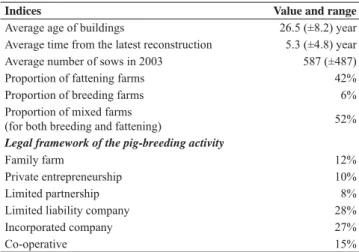
The basic technical and technological indices of swine farms are summarised in Table 1 and the basic characteristics of breeding and animal health technology in farms investi-gated are summarised in Table 2. The mortality of animals in different phases of technology are as follows: 8.9% for the suckling piglets, 4.3% for the weaned pigs and 2.5% for the fi nishing pigs.The epidemiological status of pig farms was estimated by scoring the different disease statuses. A 0 score value was given to farms infected with a given disease, 1 to those ones with no clinical manifestations, 2 to farms having defence with vaccination and 3 to those ones being free from disease.
The basic technical and housing features of the pig farms are summarisedin Table 3. The farms were scored according to the different technical and housing indices. As a scoring system the variables are measured on a metric scale as fol-lows: below average with more than 20% is equal to 0, aver-age ± 20% to 1, above averaver-age with more than 20% to 2. In dichotomy questions: ‘yes’ equals 1, 0 means ‘no’.
Table 1: Basic indices of the pig farms participating in the study,
with standard deviations given in parentheses where applicable.
Indices Value and range
Average age of buildings 26.5 (±8.2) year Average time from the latest reconstruction 5.3 (±4.8) year Average number of sows in 2003 587 (±487) Proportion of fattening farms 42%
Proportion of breeding farms 6%
Proportion of mixed farms
(for both breeding and fattening) 52% Legal framework of the pig-breeding activity
Family farm 12%
Private entrepreneurship 10%
Limited partnership 8%
Limited liability company 28%
Incorporated company 27%
The commitment of managers to a quality oriented devel-opment strategy was measured by self-reported acceptance of different statements, refl ecting different strategic develop-ment possibilities of the farms. Respondents were asked to express the level of acceptance of different statements on a 1-5 scale (5: very important; 1: absolutely unimportant). The results of this survey are summarised in Table 4.
The most important indices of veterinary practice man-agement in the farms were then evaluated according to the following aspects: the number of work hours spent on obser-vation in the herd, frequency of using different advisory services, authority level of veterinary specialist in fi eld prob-lems, his/her indirect and/or direct infl uence on animal health conditions, frequency of serological profi le analysis by out-side institutions and the cost of medications/100 swine.Table 5 shows the basic indices of veterinary practice management. Table 2. The characteristics of technology and veterinary practice
management for (a) breeding sows and suckling piglets; (b) pig rearing and (c) pig fattening.
Characteristics
Positive answers (%)
a b c
Application of “all in all out” principle 82 65 40 At least one week service period of rooms 29 53 40 Preventive anticoccidial treatment of piglets before
weaning 30
Vaccination of piglets before weaning against
Mycoplasma hyopneumoniae 19
Grouping of weaned piglets according to age and sex 33 Separate grouping of weak weaned piglets 21 At least one of compound feeds contains acidifying
agent 42
Preventive vaccination before housing against
Mycoplasma hyopneumoniae 11
Preventive vaccination before housing against
Actinobacillus pleuropneumoniae 8
Preventive vaccination before housing against
Pasteurella multocida 4
Separate rooms for groups of animals having more
than two weeks difference in age 37 Separate grouping of weak fattening pigs 35 Regular antiparasitic treatment 43 At least one of compound feeds contains acidifying
agent 20
Vaccination of fattening pigs against
Mycoplasma hyopneumoniae 15
Vaccination of fattening pigs against
Actinobacillus pleuropneumoniae 5
Table 3: The basic technical and housing parameters of the
investigated farms. Average values with standard deviations given in parentheses where applicable.
Variable Value
Space allotment for pregnant pigs in the sow house (m2) 3.5 (1.6) Space allotment for starter pigs (m2) 0.3 (0.2) Air-space for starter pigs (m3) 1.1 (0.4) Space allotment for grower pigs (m2) 1.5 (0.8) Air-space for grower pigs (m3) 9.2 (1.0) Space allotment for fi nishing pigs (m2) 1.8 (0.5) Air-space for fi nishing pigs (m3) 3.0 (1.1)
Ventilation % (Yes/All) 18
Paddock (outrun) % (Yes/All) 32 Separate penning of virgin gilts % (Yes/All) 28
Table 4. Importance of different ways of development according
to farm managers. 5: very important; 1: absolutely unimportant. Standard deviations are shown in parentheses.
Way of development Average
score Increasing the professional knowledge of the blue-collar
workers of the farm 3.5 (1.2)
Improvement of the quality of feeds 4.4 (1.1) Increasing the professional knowledge of the white-collar
workers of the farm 2.6 (1.5)
Higher utilisation of the benchmarking for the evaluation of
the farm 3.5 (0.9)
Improvement of the effi ciency of veterinary attendance 4.2 (1.0) Increasing the use of preventive programmes 4.0 (1.1) Improvement of the technology 3.7 (1.2) Improvement of the feed conversion ratio 4.5 (1.3) Improvement of category distribution of pig meat produced
by the farm 3.7 (1.2)
Improvement of the information and traceability system of
the farm 3.8 (1.0)
Table 5: Indices of veterinary practice management.
Indices Score Distribution of
responses (%) 1. Number of work hours spent on observation in the herd
(work hours per/100 sows)
More than 4 work hours per 100 sows 4 31 4 work hours per 100 sows 3 40 3 work hours per 100 sows 2 23 Less than 3 work hours per 100 sows 1 6 2. Frequency of using different advisory services
Regular utilisation of independent scientifi c
advisory services 4 12
Regular utilisation of advisory service of
pharmaceutical – or feed producers 3 34 Occasional utilisation of advisory service of
pharmaceutical – or feed producers 2 38
Not at all 1 16
3. Authority level of veterinary specialist in fi eld problems, infl uencing indirectly and directly the animal health conditions (or status) Decision rights in problems, infl uencing
directly or indirectly the animal health condi-tions of the stock (e.g. feeding)
3 11
Decision rights in problems, infl uencing directly the animal health conditions of the stock (e.g. planning of vaccination programs, medication programmes)
2 65
Decision rights in problems relating to the observance of rules and to the prevention of infectious diseases
1 24
4. Frequency of serological profi le analysis by outsider institution
Regularly 3 16
Occasionally 2 75
Practically never 1 19
5. Frequency of diagnostic analyses beyond the compulsory surveys
Monthly 5 5
Quarterly 4 13
Half-yearly 3 45
Yearly 2 37
Less than once per year 1 7
6. Cost of medications /100 swine
Below 2 € 5 28
2-4 € 4 48
4-6 € 3 17
6-7 € 2 4
above 6 € 1 3
Allowance of pig breeding for workers
Yes 0 77
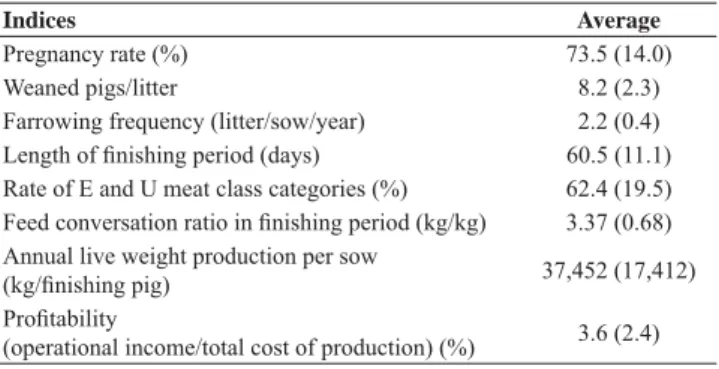
Finally, the most important indices of effi ciency and prof-itability in the farms were evaluated (Table 6).
Based on the data above, structural equation modelling was elaborated to determine the infl uence of different factors on the effi ciency of a swine farm. Contrary to our expec-tations, in order to get the fi tness of the acceptable model nearly fi fty attempts were needed, because it was not possi-ble to fi nd any statistically signifi cant relationships between each different factor theoretically infl uencing the perfor-mance of pig breeding units. The chi-square test showed that the null hypothesis, according to which the model fi ts the data, cannot be rejected. This fi nding was corroborated by the RMSEA statistics. According to Hu and Bentler (1999) the recommended cut-off value is 0.06. The RMSEA estima-tion was 0.04, that is, the model fi ts well. The results of the analysis are summarised in Figure 1.
Discussion
Analysing the features of technology for breeding sows and suckling piglets as well as of veterinary practice man-agement, the relative backwardness of current practice compared to ‘optimal’ or ‘quasi-optimal’ practice can be detected. It is very important to decrease pathogens in the environment, so in this sense the application of ‘all in all out’ principle is essential which is applied in more than three quarters of farms (Table 1).
The data in Table 2show that 65% of farms use the ‘all in all out’ principle in the growing phase of production. Slightly fewer, around half of them, applied at least one week long service period of rooms.It is a positive sign that many farms use feed additives. The feed acidifi ers are used alone on just a few farms but in spite of that, because of the stringent con-trol of antibiotic treatments and the prohibition of Zn sup-plementation, this prophylactic method might come to the fore. Vaccination has a far smaller role in the fi nishing units. Regarding the veterinary practice management in the case of weanlings it is a positive sign that nearly two thirds of respondents apply the simultaneous housing/simultaneous vacating system. An at least one week long period between vacating and housing is a common practice in the case of more than half of respondents. The observance of this guide-line is rather simple, as a consequence of the low utilisation of pig breeding capacities.
In the fi nishing phase of pig production only few farms can put into practice the ‘all in all out’ principle and a one week long service period of rooms. In most farms animals with more than two weeks difference in age can be found in the same room. The reason for that is the fl uctuation in demand, the inadequate technology and the volatile herd rotation. In more than 40% of the herds regular antiparasitic treatment is applied. The use of acidifi ers and vaccines is quite rare during fattening. Intensive use of mineral addi-tives can be explained by intensive advisory activity of feed producers, because they try to increase their market share in the shrinking Hungarian market. The relatively low rate of application of separation can be explained by relative obso-lescent building construction.
Analysing the causes of mortality, it can be stated that crushing piglets and E. coli diarrhoea are the most common problems. In the pig rearing phase the mortality rates in most farms are high, almost 4.5%. The causes could be the inad-equate housing and feeding as well as sometimes no proper treatment. In the fattening phase the average mortality rate is 2 to 4%, in the survey the mean was 2.5%. The different respiratory diseases, swine dysentery, Post-weaning Multi-systemic Wasting Syndrome (PMWS) and Porcine Dermati-tis and Nephropathy Syndrome (PDNS) are the outstanding agents. The comparative analysis of the Hungarian epidemi-Table 6: Indices of effi ciency of farms being investigated. Standard
deviations are shown in parentheses.
Indices Average
Pregnancy rate (%) 73.5 (14.0)
Weaned pigs/litter 8.2 (2.3)
Farrowing frequency (litter/sow/year) 2.2 (0.4) Length of fi nishing period (days) 60.5 (11.1) Rate of E and U meat class categories (%) 62.4 (19.5) Feed conversation ratio in fi nishing period (kg/kg) 3.37 (0.68) Annual live weight production per sow
(kg/fi nishing pig) 37,452 (17,412) Profi tability
(operational income/total cost of production) (%) 3.6 (2.4)
epidemiological situation stall construction veterinary practice management strategy
piglet rearing technology and veterinary practice management
finishing technology and veterinary practice management
weaners technology and veterinary practice management
finishing pig mortality piglet mortality weaner mortality performance 0.24 (0.09) 0.12 (0.04) 0.67 (0.25) 0.14 (0.05) -0.78 (0.28) -0.31 (0.13) -0.24 (0.11) -0.33 (0.018) 0.24 (0.13) -0.16 (0.05) -0.10 (0.03) 0.28 (0.10) -0.28 (0.10) 0.15 (0.07)
Figure 1: A model of factors infl uencing the performance of pig breeding units. The signifi cant regression coeffi cients of structural equations are shown above the arrows and their standard errors in parentheses.
ological and herd health situation with that of the ‘so-called’ developed states could be a topic of further investigation.
The results of the basic technical and technological indi-ces of swine farms are partly similar or equal to the fi ndings of the survey done at the request of the Hungarian Ministry of Agriculture and Rural Development in 2001 (Ráki, 2003). The basic architectural-technical features in the majority of the cases in our study satisfy the minimal requirements, often as a consequence of the decreasing number of pigs as well as the lower average weight of pigs.
The majority of respondents are committed to improve the quality and effi ciency of production. In line with our expectations the improvement of feed conversion ratio and that of quality of feeds has primary importance. Accepting the importance of improvement of veterinary health care can be assessed as a sign of quality-oriented development. At the same time, the human resource development and the acceptance of a benchmarking approach is relatively low. Improving the quality distribution of pork meat produced by the farm, under the current economic circumstances, in itself is not a decisive factor for farm profi tability. Setting up an informational background for improvement of effi ciency, profi tability and quality of production as well as building up traceability systems is not yet an integral part of the develop-ment strategies of Hungarian swine farms.
The results of structural equation modelling highlight the effects of different factors on the performance of a swine farm. Analysing the relationships between different indica-tors, it is clear that there is a signifi cant relationship between the strategy of the management and the veterinary practice. The signifi cant coeffi cient of variable called ‘management strategy’ on veterinary practice and performance of the farm objectively proves our preliminary, intuitive expecta-tion about the importance of commitment of management to upgrade the animal health status of the farm. This fact highlights the importance of efforts for enhancement of vet-erinary and stock farming technology knowledge of farm-owners and managers. That is why the postgraduate training courses and further education for pig farm owners could be important tools for improving the competitiveness of pig breeding.
The relationships between veterinary practice, stall con-struction and epidemiological situation were also signifi cant. These relationships are well documented in the literature. Previously, Maes et al. (2002) and Mouricout (2004) have shown the infl uence of stall construction on epidemiological status. Thrusfi eld (2005), in his monumental work, demon-strated the decisive infl uence of veterinary strategy on epide-miological status of pig breeding units. The impact of techni-cal, housing conditions of breeding on the epidemiological status of herds highlights the importance of modernisation of production facilities as well as the need for application of veterinary considerations in the planning, building and reconstruction phases.
In line with our previous expectations, there was a direct relationship between technology and respective mortality. This is a further proof of the need for better co-operation between the veterinarians and technological specialists. On the other hand, the impact of mortality on performance of swine farms emphasises the economic importance of the
vet-erinary activity.
The results of our research are preliminary, because by increasing the number of farms participating in the survey, conducting a more detailed analysis of veterinary status, and examining the activities of swine farms under more stable economic conditions could reveal even more characteris-tic relationships, giving the possibility for a sophischaracteris-ticated, benchmark-type analysis of the pig units. However, it is clear that the structural equation modelling can be used effi ciently in determining the interrelationships of factors which infl u-ence the performance of pig breeding farms. These results could contribute to (1) the development of decision support systems, (2) advisory services, and (3) curricula in graduate as well as postgraduate education.
References
Balogh, P., Ertsey, I.; and Szűcs, I. (2009): Answer to the challenges of the 21stcentury in the Hungarian pig sector, Poster presenta-tion at the Internapresenta-tional Associapresenta-tion of Agricultural Economists Conference, Beijing, China, 16-22 August 2009.
Béládi K. and Kertész A. (2006): A főbb mezőgazdasági ágazatok költség- és jövedelemhelyzete 2005-ben a tesztüzemek adatai alapján [The main agricultural sectors, cost and income situa-tion in 2005 based on FADN data], Budapest: AKI.
Deen, J., Dee, S., Morrison, R.B. and Radostits, O.M. (2001): Health and Production Management in Swine Herds. Herd Health Food Animal Production Medicine (3rd edition). Phila-delphia, PA: W.B. Saunders.
Enting, J., Huirne, R.B.M., Dijkhuizen, A.A. and Tielen, M.J.M. (2000): Zovex, a knowledge-integrated computer system to support health management on pig farms. Computers and Elec-tronics in Agriculture 26, 13-35.
Hoste, R. (2011): Productiekosten van varkens [Costs of pig pro-duction]. Resultaten van InterPIG over 2009. Wageningen LEI WUR.
Hoyle, R. (1995): Structural equation modelling: concepts, issues and applications. Thousand Oaks, CA: Sage.
Hu, E. and Bentler, D. (1999): Multivariate statistics. New York: McGraw-Hill.
Kapronczai, I., Korondiné Dobai E., Kovács H., Kürti, A., Varga, E. and Vágó, Sz. (2005): A mezőgazdasági termelők alkalmaz-kodóképességének jellemzői [The adapting capacity of Hun-garian agricultural producers]. Budapest: AKI.
Kovács, F. (1990): Állathigiénia [Animal Hygiene]. Budapest: Mezőgazdasági Kiadó.
Lara, A., Kelly, P. W. and Lynch B. (2002): The international cost competitiveness of the Irish pig industry. Rural Economic Re-search Series No. 8, Dublin: Teagasc.
Maes, D. G., Chiers, K. F., Haesebrouck, H., Verdonck, L. M. and de Kruif, A. (2002): Seroprevalence of Actinobacillus
pleuro-pneumoniae serovars 2, 3 and 9 in slaughter pigs from Belgian
fattening farms. The Veterinary Record 151, 206-210.
Marcoulides, G.A. and Schumaker, R.E. (1996): Advanced Struc-tural Equation Modelling: Issues and Techniques. Denton, Tx: University of North Texas.
Mouricout, M. (2004): Swine and cattle enterotoxigenic
Escheri-chia coli-mediated diarrhea. Development of therapies based
on inhibition of bacteria-host interactions. European Journal of Epidemiology, 7:588-604.
Muthén, L.K. and Muthén, B.O. (2004): MPlus User’s Guide (3rd edition). Los Angeles, CA: Muthén & Muthén.
Norusis, N. (1986): SPSS for Windows. Chicago, IL: SPSS Inc. Porter, M. (1985): Competitive strategies. New York: Free Press.
Rafai, P. (1996): Ellenőrző listák a termelési környezetkockázati tényezőinek feltárására. [Checklist for analysis of environmen-tal risk-factors of production] in: Sertés Állomány-egészségtan [Veterinary medicine of pig-production]. Budapest: ÁOTE, 45-77.
Ráki, Z. (2003): Sertéstelepeink műszaki állapota és állatvédelmi helyzete [Technical condition of pig breeding plants]. A Sertés
8, 48-55.
Rasmussen, J. (2006): Costs in international pig production. Danish Pig Production. DMA. Report no. 29.
Ridgeon, B. (1993): The economics of pig production. London: Farming Press.
Robertson, I.D., Hampson, D.J. and Mhoma, J.R. (1991): The adoption of management and husbandry procedures by Western Australian pig farmers. Australian Veterinary Journal 68, 291-293.
Thrusfi eld M. (2005): Veterinary epidemiology. London: Blackwell. SPSS Inc. (1999): User’s manual for SPSS® for Windows™.
Chi-cago, IL. SPSS Inc.
Török, A. (1994): Firms afl oat and fi rms drift. Budapest: Academy Publishing House.
Venkatraman, N. and Ramanujan, V. (1986): Measurements of Business Performance in Strategy Research: A comparison of approaches. Academy of Management Review 11, 124-135.