Rony Lindell
Helsinki November 24, 2016 M.D. Thesis
Instructors: Prof. Sampsa Hautaniemi and PhD Rainer Lehtonen (Hautaniemi Lab) UNIVERSITY OF HELSINKI
Medicum, Genome-Scale Biology research program [email protected]
Faculty of Medicine Medicum, Genome-Scale Biology research program Rony Lindell
Next-generation sequencing using the Anduril framework. Medicine
M.D. Thesis November 24, 2016 32 pages
Anduril, next-generation sequencing, parallelization, cloud computing, variant analysis, cancer Next-generation sequencing has evolved during the past 10 years to become the go-to method for genome-wide analysis projects. Based on parallelizable PCR methods adopted from the traditional Sanger sequencing, NGS platforms can produce massive amounts of genetic information in a single run and read an entire DNA molecule within a day. The immense amount of nucleotide sequence data produced by a single sample has brought us to an era of algorithmic optimization for analysis and guring out parallelization schema. For cohort projects generally cloud based systems are used due to vast computing power requirements.
Anduril is an integration and parallelization framework well suited for NGS analysis, as is shown in this study. After a brief review of the golden standard methods of NGS analysis, we describe the incorporation of the main tools into the new sequencing bundle for Anduril. Tools for align-ment (BWA, Bowtie), recalibration (GATK, Picard-tools) and variant calling (GATK, Samtools, VarScan) are in main focus. The Best Practice of Broad Institute, creators of The Genome Analysis Toolkit (GATK), has been a big inspiration in the creation of our sequencing pipeline.
The evolution of sequencing bundle tools into a pipeline is discussed through three separate project examples. First, a small group of 8 chronic myeloid leukemia patient samples were analysed after implementation of the main tools of the pipeline. The results were consistent with previous results, but no novel relevant mutations were found. Second, exome sequencing data from 180 breast cancers with controls available in TCGA (The Cancer Genome Atlas) were processed for use in various projects in our lab. The example showed the power of Anduril in gross cohort analysis projects, enabling automatic parallelization and intelligent workow management system. Third, we analysed exome data from 330 TCGA ovarian cancers with controls and created a prototypical set of database components for creation of a database of annotated variants for use in analytical queries.
Compared to other integration frameworks (e.g. GATK, Crossbow and Hadoop), Anduril is a robust contender for the programming oriented scientist. As cloud computing is becoming at an increasing rate a requirement in large genome-wide analysis projects, Anduril provides an eective generalizable framework for adding tools, creating pipelines and executing entire workows on multi-nodal computing servers. As technology advances and available computational resources grow, fast multi-processor analysis can be incorporated into health care more and more for detection of disease causing genes, medication kinetics altering polymorphisms and cancer driving mutations in an everyday setting.
Tekijä Författare Author
Työn nimi Arbetets titel Title
Oppiaine Läroämne Subject
Työn laji Arbetets art Level Aika Datum Month and year Sivumäärä Sidoantal Number of pages
Tiivistelmä Referat Abstract
Avainsanat Nyckelord Keywords
Säilytyspaikka Förvaringsställe Where deposited
Acknowledgments
Special thanks goes to the following individuals. Firstly, thanks goes to my main supervisor and chief Prof. Sampsa Hautaniemi for his repeated encouragements and unlimited patience, which enabled my continuing work and upheld my motivation. Our senior scientist and my second supervisor PhD Rainer Lehtonen gave excellent advice for my thesis and revealed with great enthusiasm the complexities of genetic variant analysis, together with invaluable input from PhD Riku Louhimo and PhD Sirkku Karinen, who also were experts in this area.
PhD Kristian Ovaska, main creator of Anduril together with PhD Marku Laakso, has been irreplaceable for his unending work on Anduril and for, together with PhD Javier Núñez-Fontarnau, adapting the engine to new hardware settings and pipeline requirements. PhD Ville Rantanen was my go-to guy for programming tips and as a linux/bash script wizard always seemed to have an answer for making my life easier. MSc Alejandra Cervera was in parallel creating the RNA sequencing pipeline for expression analysis and provided great insights and a synergistic collaboration was evident.
PhD Vladimir Rogojin did an excellent job on the TCGA database tools and helped with sample downloads, as well as proved to be a great friend always with a good spirit and humour at work. As Insa Lietz did a great job on the prototypical database components, I could concentrate on rest of the pipeline by simply giving hints on design and feature requirements. I also want to thank Tiia Pelkonen for keeping me included in various lab events and for maintaining order in an otherwise chaotic environment. Lastly, but most importantly, I want to thank my family of wife and daughter for their endless support and love.
Denitions
Alignment = A list of reads arranged according to the sequence of the reference genome.
Alignment quality = Generally estimated using the average depth and overall cov-erage.
Base space = The only possible real values in a DNA sequence of nucleotide bases are {A, T, G, C}.
Base quality = A PHRED quality score given to each nucleotide base during se-quencing as an estimate of the probability that it is the correct base.
BAM = Compressed Binary SAM (Sequence Alignment Map) le that allows ef-cient calculations in reduced le size and is used in alignment processing steps.
Call = One (SNV/SNP) base or a sequence of numerous (SV/indel) bases in the alignment that is evaluated to dier from that in the reference in the same locus (i.e. is a variant).
Cloud computing = Shared service of processing resources providing computing power for users on demand.
Coverage = The percentage of the reference genome that is covered by the se-quences in a read or alignment le. The term is often, a bit confusingly, used as a short version for depth of coverage, which means the average depth of sequencing. For example, a coverage of >100x means that on average, each genomic location is covered by at least 100 reads.
CSV = The (comma-separated value) table le format that the Anduril engine uses as standard for manipulations and most components handle inherently for inputs and outputs.
dbSNP = The consensus database of single nucleotide polymorphisms (SNPs). Depth = Number of reads in an alignment that cover a specic area. For an entire
alignment le, it is dened as the mean depth and can be used as a quality metric.
FASTQ = The standard (FASTA with Qualities) le format for raw reads with base quality estimates created by sequencer platforms.
GATK = The Genome Analysis Toolkit, created and maintained by Broad In-stitute, which is the golden standard software package used in sequencing projects.
Germline = Inherited (or de-novo changes around conception) genetic variations are called germline mutations. Germline mutations are analyzed in studies of genetic diseases other than cancer.
Haplotype = Multiple denitions exists. Primarily, a haplotype is a group of genes that are inherited together from a single parent. By a second denition, a haplotype is a set of SNPs in a chromosome that statistically always seem to occur together. Lastly, haplotype can refer to a collection of specic mutations in a genetic segment.
Illumina = A sequencer platform technology that creates short-reads of around 100 bases in length.
Indel = Common term for genetic insertions and deletions, which are short oligo-nucleotide changes in the amount of bases in a genes and generally occur through errors made by DNA polymerase or DNA repair enzymes.
Locus = A genomic position with respect the chromosomal coordinates of the reference genome.
Mapping = The ordering of sequenced reads according to the coordinates of the reference genome. The alternative to mapping is de-novo assembly.
Next-generation sequencing platform = An automated sequencing machinery that parallelizes the same principle used in Sanger sequencing. Entire DNA molecules can be analyzed in a single run within a day.
Paired-end sequencing = A method were the two ends of a DNA fragment of a certain length are sequenced. The distance of the coupled mates is assumed constant, which aids in analysis of structural information.
Picard-tools = A set of command line tools, that allow numerous sequencing le ma-nipulations such as sorting, merging, splitting, duplicate marking and quality-metric calculations.
Read = The fragment unit of a specic (usually constant) length of nucleotide bases that is read by a NGS platform and written into the list of millions of reads compiled during a single run.
Roche-454 = A sequencing platform that (using pyrosequencing) produces long reads of around 500 bases in length.
Sanger sequencing = The in vitro method developed by F. Sanger in 1977, in which chain terminating (dideoxy)nucleotides and DNA polymerase enzymes are used with uorescent dyes to read DNA sequences of up to several hundreds of bases. The method is still widely used for small-scale analysis and for validation of NGS results.
Sequencing = The process of determining the exact order of nucleotides within a DNA molecule.
Sequencing bundle = A set of components for Anduril created for use in NGS analysis pipelines.
SNP = Variations in the human population of one base length that are known to occur with a certain (ethnicity dependant) mean frequency.
SOLiD = A (Sequencing by Oligonucleotide Ligation and Detection) NGS platform that produces short reads of about 100 bases in length in colorspace.
Somatic = Uninherited mutations in cells of the body that happen during a life-time that, when disturb cell stability and growth, can cause cancer. Somatic mutations are analyzed in cancer studies.
Synthetic lethality = Creates cell death when two or more gene products are defect, however not when only one is decient. As somatic cancer mutations create countless silent random genetic defects, those that aect synthetic lethality partner genes can hypothetically be exploited as therapeutical targets for achieving specic cell death of cancer cells, while leaving normal host cells intact.
Variant calling = The algorithmic step that calculates the calls, generally by build-ing a (Bayesian or other) probabilistic model usbuild-ing prior information, such as normal genetic mutation frequency depending on molecular context.
Contents
1 Introduction 1 2 Background 2 2.1 Sequencing . . . 3 2.2 NGS frameworks . . . 5 2.3 Anduril . . . 7 3 Methods 8 3.1 Sequencing data . . . 8 3.2 Alignment . . . 9 3.3 Recalibration . . . 10 3.3.1 Duplicate marking . . . 10 3.3.2 Realignment . . . 113.3.3 Base quality score recalibration . . . 11
3.4 Variant calling . . . 12 3.5 Variant analysis . . . 13 3.5.1 Variant recalibration . . . 13 3.5.2 Annotation . . . 14 3.5.3 Filtering . . . 15 3.6 Parallelization . . . 15 4 Results 17 4.1 Dierence in drug response in CML patients . . . 17
4.2 Massive parallel processing of TCGA BRCA exomes . . . 19
4.3 Database creation for TCGA OVAC exomes . . . 20
5 Discussion 23
Appendices
1 Introduction
Modern cancer research and clinical genotyping relies heavily on vast computational power and ecient algorithms. Capillary methods and panel micro-arrays are still used when locations of interest are known and are for this purpose the golden stan-dard. For genome wide analysis however, the traditional methods are too time consuming. The Human Genome Project was concluded during an era where DNA shotgun methods were combined with Sanger sequencing [San75], which required analysis of small pieces of DNA in parallel resulting in a huge assembly problem to be solved [Ven01, Lan01].
Now, when the complete consensus genome sequences are known for all frequently studied species, they can be used as templates for rapid recreation of the entire genomic sequences of individuals. Next-generation sequencing (NGS) methods still split the genome into pieces that need to be assembled, however the sequencing of an entire genome is usually done on a single machine and assembly on a single computer unit using the known consensus genomic sequence of the species as reference [Mar13]. Further processing of the mapped genome, the so called alignment [Li09b], relies on numerous computational steps based on mathematical improvement of the reads for achieving optimal variational analysis [Liu12]. Each base is compared to the reference for detection of alternate alleles. Multiple bases are compared as a unit for identication of insertions, deletions and structural variations [Yoo09, Abe13, Gho14, Alk15]. Reliable calls are inferred through utilization of known variation in the population and appropriate ltering steps.
A complete DNA sample can today be analyzed on a single modern computer within a day. Multi-sample analysis however, increases sensitivity and specity, but has a much larger computational requirement for which cloud-based systems are used [Lan09a, McK10]. To make analysis pipelines stable and reusable numerous eorts have been made by separate groups. In this thesis we will show how the robust parallelizable sequencing pipeline for the Anduril framework [Ova10] was created and tested.
The history of sequencing and progression to NGS will be reviewed in the background section, in which we will also discuss the current golden-standard methods of NGS algorithms and software. The incorporation of the most relevant NGS procedures into our pipeline and their usage will be examined in the methods section. The nal sequencing pipeline shown in gures 2 and 3 is a result of months of work
and further months of testing in three separate projects, spanned over a few years. The experimental projects are discussed in detail the results section. The nal result is a powerful sequencing pipeline incorporated into a downloadable bundle of components in Anduril [Ova16].
Cancer biology and genetics is out of scope for this study and only the most rel-evant terminology will be explained. The Hallmarks of Cancer [Han00, Han11], however, provides an ultimate theoretical basis for the exploration of cancer driver genes [You11] and therapeutical targets, which is the main motivation for this work. Synthetic lethal genes provide especially interesting targets for treatment [Kot08, Wan16a]. With technological advances we could fathom a future where, hypothetically, cancer could be treated as (multi-cellular) parasites and eradicated using a vast set of antibiotics, each with dierent synthetic lethal partner products as targets. The treatment problem would then be reduced to that of nding the can-cer mutation targets dynamically, e.g. through monitoring of circulating mestatatic cells from blood samples, and fast, as the cancer cells are continuosly changing the tumor landscape.
2 Background
Next-generation sequencing (NGS) has evolved from Sanger sequencing [San75], developed in 1977, during a span of roughly 40 years. Primary Sanger methods are still used for small-scale projects and for validation purposes of NGS results. More comprehensive validations are commonly done using microarray analysis, in which uorescent hybridization is used on matrix plates containing known probes of complementary sequences. Microarrays are extremely reliable and still functions as more of a parallel method than a stepping stone compared to NGS [Iri07].
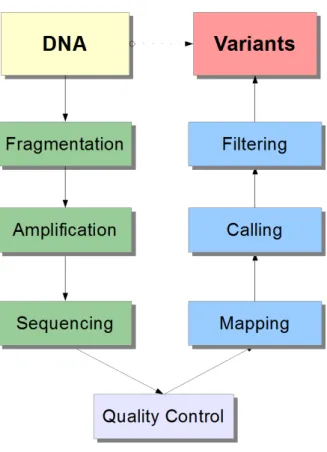
Even though microarrays have obvious structural design bias limiting ubiquitous genome-wide investigation, they still provided the rst methods in expression, chro-matin structure, SNP genotyping and methylation analysis. NGS methods have however grown to take over most of these previously golden-standard techniques by providing unbiased and extended information. Due to the low cost and speed of microarray analysis they are still the mainstream of clinical screening, where the locations of interest are obvious, along with direct loci PCR of specic genes. The basic concept of NGS analysis is depicted in gure 1. In short, an individual sample of DNA is processed in a series of steps until variation from the reference
genome can be inferred, from which mutations of interest (e.g. disease causing) are mined among millions of candidates. In this chapter we will briey discuss the evolu-tion of NGS, the common methods of analysis and introduce the Anduril framework. This provides a ground basis for the sequencing pipeline that was created, which will be described in the subsequent section. The nomenclature for variational studies is well established [den01] and the relevant terminology (words in cursive throughout the text) is summarized in the Denitions section.
2.1 Sequencing
By denition sequencing means analysis of parts or the complete sequence of nu-cleotides in a DNA molecule. Unless de-novo building of the sequence is otherwise required, normally the order of nucleotides is derived by comparing and mapping the separate parts to a reference genome [Tra09]. A suitable reference is achieved through pooling of well spaced candidates of a species and calculating the average nucleotide at each locus. After the sequence is mapped, the corresponding variation from the reference can be inferred and studied [Dal10, Ng10]. Inherited (germline) variations cause all phenotypical dierences in a species and the relative or absolute risks for diseases. The uninherited (somatic) variational changes however is the area of study of cancer genesis and treatment targets.
The complete consensus 2.9 Gb sequence of bases of the human genome was solved in The Human Genome Project, which was concluded in 2001, using the whole-genome shotgun sequencing method [Ven01, Lan01]. The International HapMap project further identied 3.1 million common SNPs in the human population and a website of tools for accessing the respective haplotypes was created [The03, Tho05, The07]. The consensus human genome is now universally used as a reference sequence in human next-generation sequencing projects. HapMap together with other gathered resources, such as Ensembl [Cur04], RefSeq [Pru07] and UCSC [Hsu06] gene portals, are regularly utilized in the consequent analysis for adding information about the data.
The golden standard capillary Sanger method of sequencing naturally evolved start-ing from 2005 through automation and parallelization into next-generation sequenc-ing (NGS). NGS is an automated process incorporated into a ssequenc-ingle machine that can read an entire (human) genome within a day. Using a NGS platform, e.g. Il-lumina (IlIl-lumina Inc., Ca, USA), Roche-454 (454 Life Sciences/Roche, CT, USA) or SOLiD (ABI Solid Sequencing/Life Technologies, CA, USA), the DNA-molecules
Figure 1: The basic concept of next-generation sequencing. DNA molecules are rst fragmented and the pieces amplied and sequenced, all done in a automated sequenc-ing machine. Quality control procedures are commonly required for raw reads after sequencing, such as low-quality end trimming and platform-specic lters. Next, the reads containing nucleotide sequences are mapped to a reference genome and the variants called using genotyping algorithms. Finally, the calls are ltered using annotation information and computational methods. The acquired variants are now ready for genetic interpretation. The coloring demarcates the transition between pipelines and separates data from results. The blue (purely computational) pipeline is the main topic of this study.
of an individual are rst fragmented and the pieces of nucleotides amplied using parallel PCR. The clones of fragments are read using incorporated uorescent dye scanning methods into base space (A, T, C and G). [Ben08, Mar13]
The acquired reads, consisting of a varying amount of partly overlapping sequences (depending on the coverage used) of parts of the original DNA sequence, are ready to be assembled into the complete original sequence in base space. The variational analysis that follows requires a NGS framework of ecient software (the pipeline) and robust hardware of processors, memory and storage space, which for big cohort projects usually means a cloud computing system [Lan09a].
2.2 NGS frameworks
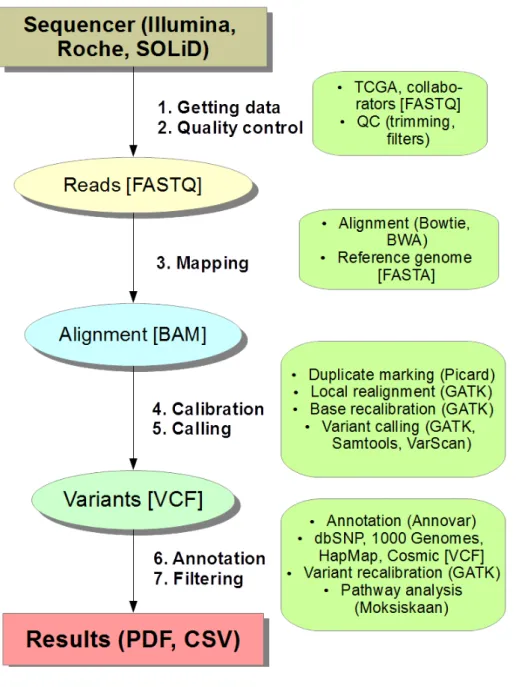
For a sequencing project to succeed an eective setup both software- and hardware-wise is required. Numerous software using various algorithms exist for each step of the process, most of which started to arise quickly after the development of the rst sequencing platforms [Abe13, Gho14, Dal10, Nev15]. Choosing the correct tools can be dicult and connecting them together with the right amount of resources even harder. Multiple ready-to-use workows have been made to help out the newcomer. A sequencing project usually follows the workow of 1. alignment, 2. recalibration, 3. variant calling and 4. ltering and annotation, depicted in more detail in gure 2.
Next-generation sequencing frameworks have been well rened over the past 6 years. More often than not, the tool creators have tackled a specic part of the process, such as (germline and/or somatic) variant calling (VarScan [Kob09, Kob12]), indel specic calling (Pindel [Ye09, Gho14]) or alignment (Burrow-Wheeler Aligner or BWA [Li09a, Li10] and Bowtie [Lan09b, Lan12]). Others have tried to create a more comprehensive package that include tools for both alignment and variant level data, e.g. The Genome Analysis Toolkit (GATK) [McK10, DeP11, dAA13], Samtools [Li09b], Crossbow [Lan09a]) and Hadoop [Agg15].
Any of these can be, and many have been, incorporated as components into the integration framework of Anduril [Ova10]. Anduril enables a powerful creation of an entire NGS pipeline using a common programming language and powerful engine for running the analysis with automatic parallelization on practically any system.
Figure 2: The basic workow of the computational part in next-generations se-quencing. The FASTQ (FASTA with Qualities) reads from a sequencer or database (e.g. The Cancer Genome Atlas, TCGA) are after quality control (QC) procedures mapped to the reference genome using an aligner software. The alignment in Binary SAM format (BAM) is next recalibrated and realigned using the Genome Analysis Toolkit (GATK) and marked for PCR duplicates using Picard-tools. The variants are next genotyped using a caller software. The calls in Variant Call Format (VCF) are nally ltered preferably using machine learning if enough data is available (GATK) and annotated using various databases (Annovar, Moksiskaan). The nal result is often presented in a PDF or tabular CSV (comma-separated value) le. The oval steps are parts of the sequencing pipeline, with colors emphasizing changes in data types. The green boxes summarize software, method and data information that is used in the pipeline.
2.3 Anduril
Anduril is a simple yet powerful programming framework created for large-scale data analysis. The Anduril engine handles the execution of the pipeline and the ow of information in the form of reading and writing les. The engine keeps track of le changes (the information ow) and re-executes only the parts of the pipeline that have changed in each run. The pipeline is written in Scala (previously in AndurilScript) in a workow le, which denes the pipeline components using logical connections.
The scripting language (Scala/AndurilScript) itself is easy to learn for any scientist and is used for connecting components together into a pipeline, handling of workow parameters, looping for multi-threading and result creation e.g. in the form of a PDF or website. The engine automatically uses all available processors in a multi-threaded fashion and allocates necessary memory, by launching separable executions in their own threads. The engine will keep track of the threads and wait at merging points when required by following the logic of the pipeline. The processes run in succession and in parallel until the entire pipeline execution is nished. Since the engine remembers its state of execution, if errors occur or the workow is stopped and changed in mid-process, only those steps that are changed or have yet to be run are executed on the next run.
The Anduril framework is especially well suited for next-generation sequencing projects. As we can see in gure 2, a NGS pipeline contains numerous compu-tational steps that need to be linked together. Parameters often need to be adjusted according to the data at hand and possibly re-iterated during searching of the op-timal setup. For sample cohorts containing hundreds of samples, a multi-threaded approach with fully parallelizable executions is superior to non-parallelizable frame-works.
New components with documentation are created and shared on a regular basis. Anduril is available under an open source license and is actively maintained with new versions released regularly. A graphical interface for easy pipeline creation and running that implements Scala/AndurilScript intrinsically has been available since 2014. New components can be created using various programming languages, for instance R, Java, MATLAB, Python and Perl or simply as Scala/AndurilScript functions that run already existing software.
currently incorporates a complete set of functions that run separate golden standard NGS tools and are easy to include into any sequencing pipeline.
3 Methods
In this chapter we will explore the design of the next-generation sequencing pipeline incorporated into the Anduril framework, by looking at each pipeline step separately. For more detailed component descriptions, please see the Anduril documentation [Ova16], as only the main points will be reviewed here. The pipeline follows the principles of the current golden standard workow established by Broad Institute [Bro16]. The component development for Anduril NGS studies began 2011 and is still ongoing as the eld is ever changing. Finished and ready-to-use components are incorporated in a separate sequencing bundle. The components have already been used in various projects (see section 4) and are regularly updated for keeping up with new software versions of the tools used. The overall pipeline can be seen in gure 2.
3.1 Sequencing data
A standard raw NGS data le uses either the FASTQ or unaligned BAM format, which typically contain millions of reads created by a NGS platform. The raw reads are fed into the NGS analysis pipeline for processing. Unless a NGS platform is available through collaborators, data les can be downloaded from public databases such as The Cancer Genome Atlas (TCGA) with license (see gure 2 step 1) [Chi08]. A typical le size spans from 1 to 300 Gb depending on genome size and sequencing depth and coverage. A typical human exome data sample is roughly 30 Gb in le size, while a corresponding whole genome le is around 10 times as big, due to 100 times larger genomic coverage, but 10 times lower depth. The burden on data storage architecture and management in cohort projects is evident. Exome sequencing, covering only around 1 % of the genome, has been a compromise in order to achieve excellent read depth (around 50-200x), with much less demand on computer and NGS platform resources. [Hod07, Ng10, Zha14]
FASTQ les contain (millions of) lines with read name and platform ID paired with the sequence of bases read and corresponding base qualities evaluated during the platform run [Coc10]. The number of bases in each read is typically constant and
dependent on the platform architecture used. Illumina creates around 100 bases per read, while the long reads of Roche-454 generally contain roughly 500 bases. The BAM (Binary Sequence Alignment Format, i.e. binary SAM [Li09b]) les are tabular and contain multiple elds of additional information. During alignment of an unaligned BAM le, only the information contained in an equivalent FASTQ le is used.
In order to retain structural information paired-end sequencing is now most com-monly used. Paired-end data is stored in two FASTQ or BAM les with equal amount of lines, where each read in the rst le has a corresponding mate read in the other le. The pairs are created by reading each end of a longer sequence usually with a constant genetic distance in between. When the mate distance varies compared to the assumed reference distance structural information can be inferred. [Ful09]
3.2 Alignment
The raw reads in a FASTQ or BAM le are aligned to a reference genome as the rst step of analysis (see gure 2 step 3). Numerous pre-processing qualiy-control steps are often used after sequencing before mapping (step 2 in gure 2), but are not proven to be unequivocally eective, the most popular being read trimming of low-quality ends [Liu12]. Quality control is not covered further in this work, however various QC components are available in Anduril, with most developed for RNA sequencing. The alternative to alignment is de-novo assembly of the genome, which introduces a dierent set of problems that are continuously addressed by new enhanced algorithms [Cha15]. De-novo assembly is not covered by this study, as it is still quite experimental and not widely used in practical medical applications due to higher error rates.
For alignment the Align component for Anduril was made. Align takes as input the reference genome to which the reads will be mapped (e.g. The Genome Reference Consortium Human genome build 38 [Lan01]) and the reads in either one single-end le or two paired-end data les. The most common aligners BWA, Bowtie(2) and TopHat(2) (for RNA-sequencing) are supported [Tra09]. By setting parameters the appropriate aligner can be chosen, as well as additional information such as sample name, sequencing platform ID, trimming value and seed length.
Naming the samples helps when using merging and splitting procedures later on and when doing multi-sample analysis e.g. with GATK. The platform ID is re-quired when using GATK, which parametric assumptions depend on the sequencing technology used. Trimming from both ends can be applied by aligners dynamically using base length (Bowtie) or base quality (BWA) criteria. Seeding enables the us-age of only a specic number of bases from the high-quality end when determining the alignment, which speeds up the process signicantly.
The resulting BAM alignment le contains the aligned reads ordered by location according to the chromosomal coordinates of the reference genome. Depending on the aligner used the sorting is done innately or separately automatically using Picard-tools using default settings with modiable memory-allocation. The aligned and sorted BAM les is now ready for recalibration.
3.3 Recalibration
The aligners use a crude, memory ecient and fast algorithmic approach in order to nd the rst best genomic match(es) of each read to the reference. The raw alignment will contain systematic biases that can be corrected in the recalibration step. First, duplicate reads created in the PCR reaction during preparation for sequencing will be aligned by a crude algorithm along with all other reads. This will make interpretation of depth for variation analysis problematic unless separately accounted for. Second, misalignments occur due to problematic regions, such as indel, structural variant, and repetetive regions.
Lastly, the original base qualities calculated by sequencers are good estimates of the process accuracy itself, but are generally poor for transforming into variation quality after calling due to various biases, such as the position in the read (position bias) and known background variation in the population (polymorphism bias). These three problems are taken into account in the stepwise recalibration process (step 4 in gure 2), which is recommended for most sequencing studies. [Liu12, Pir14]
3.3.1 Duplicate marking
The duplicate marking algorithm of the Picard toolkit was incorporated in the Du-plicateMarker component, which takes the sorted alignment BAM le created in the alignment process and the reference genome as input les. The output will be a du-plicate marked le, where either the dudu-plicate reads have a eld added for dynamic
ltering, or optionally the duplicate reads are removed altogether. A metrics le is also output containing statistics such as the count of duplicates found, which can be useful to incorporate in the nal project report.
3.3.2 Realignment
The realignment procedure uses the two-step process of GATK and is included in the Realigner component. The component takes as input the reference genome and the (sorted and duplicate marked) alignment BAM le. The output is a realigned BAM le and a list of the regions that were targeted for manipulation. For case-control analysis paired tumor and normal samples are preferably input together for combined realignment in order to keep both alignments positionally coherent, which helps in comparison analysis later on. Data les of known indel regions (e.g. from 1000 Genomes Project [Alt15]) and known SNP variation (from dbSNP [She99]), which are available through the Broad Institute server, should be used to aid the algorithm [Bro16].
3.3.3 Base quality score recalibration
The most comprehensive recalibraton step is the correction of base qualities. For-tunately GATK includes an advanced algorithm based on machine learning for ad-justing the original qualites, which takes into account numerous biasing covariates. Using before-and-after covariate plot comparisons, a clear improvement of qualities through the adjustment according to a proper error model can be shown. For re-calibration the BaseRecalibrator component was made, which takes as input the (sorted, duplicate marked and realigned) alignment BAM and the reference genome les.
Masking les containing known variational regions are essential to include, otherwise the error model will be quite useless. For human genomic sequencing a dbSNP le and preferably also a reliable 1000 Genomes indels le should be used, as in the realignment procedure. In exome analysis, an interval list of known exome regions should additionally be included, in order that only captured sites are included in the model creation.
The assumptions made by the model that relies on priors and the covariate modeling accuracy is greatly improved when the mentioned les are incorporated. The output is a base score recalibrated BAM le and optionally model plots. For
before-and-after comparison two runs need to be made for covariate table creation and input into the AnalyzeCovariates tool of GATK, which can easily be done using Anduril using a custom function when needed.
3.4 Variant calling
The main question in sequencing projects is generally answered using the variant information found. Variant calling is the critical step, in which the actual dierences in the alignment le compared to the reference genome are derived (step 5 in gure 2, see also gure 5). The modern calling algorithms rely on probabilistic Bayesian error model creation, which uses prior information about inherent genetic background mutations frequencies and information found from known mutation sites such as dbSNP.
Naturally, the reliability of each base being correctly sequenced and positioned must be dynamically assessed. The improvements from the previous recalibration step thus greatly enhance the accuracy of the variant calling step. Each variant is given a probabilistic scoring value as an estimation of the reliability according to the model of being a true variant.
The amount of variants called is dependent on the probabilistic threshold for in-clusion, which can be changed to be suitable for the project at hand. When great accuracy is needed the default or even more stringent threshold should be used. For multi-sample data mining projects it might be reasonable to keep most if not even all possible variants intact for ltering or summarizing using dierent criteria later on.
The VariantCaller component for Anduril was created for calling purposes. It sup-ports the standard high quality callers Samtools, VarScan and GATK. Samtools is the most simple one, VarScan is especially used for copy number variations and normal-tumor comparison analysis, while GATK is overall the most robust and fea-tures dynamic multi-sample analysis capabilities and can use parallelized multi-core processing for enhanced speed. The preferred caller is chosen using a parameter. The newest GATK callers MuTect (for somatic data) and HaplotypeCaller are still untested and not available in the current public sequencing bundle version.
The standard method takes as input one BAM alignment le and the reference genome le and outputs a VCF (Variant Calling Format) variant table le containing a list of SNPs and indels with probabilistic quality estimates and allele zygosity
evaluations based on calculated allele frequencies at the loci. For normal-tumor VarScan analysis the corresponding pairs of BAM les are input. For multi-sample analysis a list of BAM les is provided as input (or a single multi-sample BAM le) and the output will be a multi-sample VCF le that can be split by sample if needed. GATK again relies heavily on prior information for its advanced probablistic model and providing a dbSNP le as input is highly recommended. A metric le with information such as the number of variants called will also be output, which can be useful to include in the nal project report.
3.5 Variant analysis
The method of nal analysis of the variants heavily depends on the questions asked and level of detail required. A traditional and natural way is visualization of the variants e.g. at specic regions of interest using tools such as the Integrative Ge-nomics Viewer (IGV), also distributed by the Broad Institute [Rob11, Tho13], or Rikurator [Kat13, Kat16a], which will soon be known as BasePlayer [Kat16b]). When the data is abundant, however, some ltering needs to be done beforehand. Annotating the variant list using known genomic information helps searching accord-ing to specic context and lteraccord-ing out unwanted regions (steps 6 and 7 in gure 2). Various ltering methods are commonly applied, sometimes multiple times in succession, in order to reduce the number of variants until only high quality and relevant ones are left. Next we will describe the most common methods used in Anduril sequencing projects.
3.5.1 Variant recalibration
The golden standard for handling large amount of data is currently recalibration of variants using machine learning techniques. This is one of the most comprehen-sive and advanced features of GATK and is implemented in the Anduril component VariantRecalibrator. The idea revolves around using as much background informa-tion as possible, such as 1000 Genomes, known indels, HapMap, dbSNP and a huge amount of samples simultaneously in a single run for dynamic processing of each variant for evaluation of its signicance.
The process will considerably aect the ratio of false positives to true negatives and make decision-making easier and more accurate. The crude variant score estimates from the calling algorithms contain multiple biases that will be taken into account in
this procedure. The calibration will result in new quality score values, that will be useful for ranking and ltering and as exact estimates of truth values (comparable to p-values) they can help in decision making.
The component takes as input a multi-sample VCF and the reference genome les and outputs a recalibrated VCF le. Instead of a multi-sample VCF le a list of single samples can be input. For the algorithm to work a sucient number of samples needs to be included. The required amount depends on the data type. Exome data requires tens of samples, while whole genome data might work with under ten. Dummy-samples can be included if the sample size is inadequate, e.g. from a dierent project of comparable data or from other available sources.
The algorithm additionally requires background data as described above, which can be downloaded from the GATK server. Filter annotations for indels and SNPs can be changed from the defaults using parameters and the truth threshold chosen according to preference. The result is a recalibrated multi-sample VCF le that can be further annotated and nally ltered for results.
3.5.2 Annotation
There are numerous available tools in Anduril for annotating les containing ge-netic data after conversion to common table format (CSV). One of the most robust annotator softwares publicly available that have been implemented in Anduril is Annovar [Wan10] and is included in a component bearing the same name. Other implementations have also been created for various dierent uses of the software. The Annovar component will take as input the variant le in either CSV or VCF format and output in the same format. Annovar has multiple methods for adding information, namely region, gene and lter based annotation.
The research question asked denes which method(s) should be used. Gene infor-mation is critical when specic genes are of interest, such as the breast and ovarian cancer related gene BRCA (see section 4). Region based annotation is used when more detail is required, such as codon or SNP information. Filter based annotation includes information from various databases, such as 1000 Genomes (populational), dbSNP (SNP/indel) or COSMIC (oncological) [For15]. The annotation method is chosen using a parameter. The databases used need to be downloaded in advance from the Annovar server.
easily be implemented for use in Anduril. When CSV format annotation is used the possibilities using Anduril are quite limitless. The annotated le is nally ready for ltering.
3.5.3 Filtering
Crude ltering is often appropriate and sucient when the question asked is clear and amount of data small. For this the VariantSelector was created that uses GATK for selection of variants according to applied criteria. Any information in the VCF le can be used during selection. Dynamic logical manipulations and inclusion and exclusion criteria can be employed by using the JEXL (Java Expression Language) format.
The component takes as input the (recalibrated and annotated) variant VCF and the reference genome les and outputs the selected variants in a new VCF le. A comprehensively annotated variant le makes selections easier and more detailed. Using a threshold value for the (recalibrated) probability based variant quality score is also recommended for minimizing the amount of false positives in the results. As in the annotation step, it might be better to switch to the CSV format at this point. There are numerous components available for Anduril that manipulate CSV table les. Additional information can easily be added as new columns and matrix calculations are possible e.g. through R components. The main issue at this point is the amount of data to be handled and some pre-ltering is often needed to reduce le sizes. One example is VariantFilter that uses the variant data in CSV format and can annotate, compute allele counts and lter based on allele frequencies. The nal variants are ready for manual analysis and interpretation. The nal form is commonly a list of aected genes and actual mutational changes and/or a graphical representation e.g. as an integrated pathway plot using Moksiskaan [Laa10].
3.6 Parallelization
The two great advantages of Anduril is integration and parallelization. The integra-tive approach enables any publicly available tool to be implemented for use in an Anduril pipeline. Data from dierent sources can be included and run in parallel using multi-core systems, where each separate process will be distributed eciently and automatically in the (cloud) system until execution is completed.
The pipeline method allows logical coupling of processes, which tells the Anduril engine in what order to run the processes, when to wait for a process and how to combine results from dierent runs into a new process. Everything is distributed automatically in an optimal way as long as the pipeline logic is correct. When changes and iterations are made only parts of the pipeline that have been changed will be run.
The parallelization is automatic for each separable independent process in the An-duril pipeline code. For large sequencing projects, or simply when managing large data les, intelligent pipeline coding can improve running times to that which is only limited by the amount of processor cores (and memory) available. Most, if not all, steps in sequencing can be split into smaller parts such as samples, chromosomes or even smaller genomic chunks. Even a sizeable NGS sample can be analyzed from the beginning to end in (minutes to) hours when split processing is used [Agg15]. Some parts of the pipeline rely on dynamic use of big amounts of data in a sin-gle evaluation process for model creation, such variant score recalibration, which however allows intrinsic multi-threading in GATK. Splitting of these kind of steps needs to be done with care and with regard to the algorithmic requirements and assumptions. Parallel processing can also be especially useful in the last analysis stage, when a big amount of data requires iterations in dierent ways.
Generally, chromosomes can be analyzed in parallel on separate cores in practically any step on the analysis and results combined in the end. This methodology has yet to be tested in real projects with Anduril, as sample-level parallelization has been sucient. However, an analogical approach to the implementation in the paral-lelization pipeline Hadoop [Agg15], is easy to achieve in Anduril simply by genomic splitting and looping through an array of split les. As mentioned before, as long as the processes are independent and separable, the Anduril engine will take care of parallelization automatically.
Splitting already on FASTQ level will allow practically any level of parallelization. Merging and splitting of BAM les is simple using SAM format management tools, such as Samtools or Picard-tools, which have been included into sequencing bundle (e.g. BamCombiner). Anduril remote connection allows multi-node runs (as in Hadoop), which means practically limitless use of cloud resources in a single run.
4 Results
In this chapter we will discuss how the Anduril sequencing pipeline was tested in various projects in our lab. Dierent setups were used in searching for an optimal setting for handling large amount of data with a limited computational multi-core system and limited amount of storage space. As our data storage capacities progres-sively increased and multi-core systems became cloud based, more and more could be handled in parallel.
The rst example for testing the system was a small exome analysis of chronic myeloid leukemia (CML) patients provided by the Haematology Clinic of Helsinki University Hospital. In the second example, we processed a vast exome TCGA cohort of 180 breast cancer patients for further analysis done in our lab. In the last and third example, we processed an exome TCGA cohort of 330 ovarian cancer patients and queried the results through creation of a database of calibrated and annotated variants.
4.1 Dierence in drug response in CML patients
Paired normal and tumor whole exome sequencing samples were provided from 8 CML high-risk patients with the same clinical prognosis, of which 4 had responded well to the treatment (group 1) and 4 had hardly responded at all (group 2). The Haemotology Clinic had for a while tried to gure out how predict drug response in otherwise seemingly equal high-risk patients and nd out why a marked propor-tion failed to respond to therapy. Rapropor-tionally, genetic comparison analysis of high responders versus low responders was planned and analysed using acquired samples at FIMM (Institute of Molecular Medicine Finland).
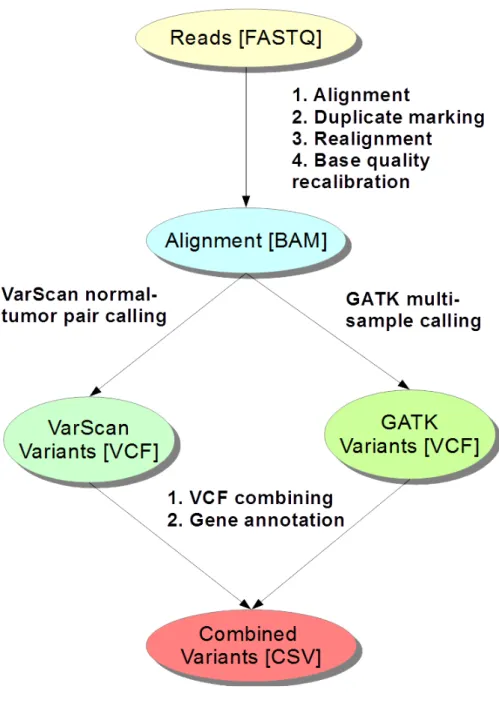
At that point our lab was using the FIMM cloud-based computational cluster for many of our analysis and we were asked by the Haematology Clinic to re-analyze the data. The preliminary results by FIMM had not resulted in any clinically relevant mutational dierences. Their pipeline did not dier in any relevant manner to ours (see gure 3) as most of the algorithms and softwares used were the same, but still provided a good start for testing of the Anduril sequencing pipeline.
For alignment we used BWA using the standard settings for dynamic trimming and mismatch-counts. Sorting and indexing was done using Samtools. Duplicates were marked using Picard-tools. Local realignment and base score recalibration was
Figure 3: The general workow of the CML analysis. The raw FASTQ (FASTA with Qualities) reads were aligned using the Align component. With DuplicateMarker the BAM (Binary Sequence Alignment Map) alignment was marked for duplicates and then realigned and recalibrated through BamRecalibrator. Calls were next cal-culated using the VariantCaller component. The VCF (Variant Calling Format) variants were lastly converted to CSV format with VCF2CSV component and an-notated using various Anduril methods (e.g. NextGene component). The coloring simply emphasizes the hierarchical change in representation of the data.
then applied in succession using GATK according to the Best Practice at the time [dAA13]. For variant calling we tried two separate methods. Firstly VarScan, as the go-to method for normal-tumor paired somatic calling, was used to fetch the most specic set of calls. Secondly, we wanted to try out the UniedGenotyper of GATK and did multi-sample variant calling separately for the normal and tumor samples. Calling with GATK achieved roughly 10 times more variants. However, after ltering out the variants from the normal set there were somewhat more left in the VarScan set of variants. VarScan separates somatic and germline variants automatically as well as variants with loss-of-heterozygosity (LOH) according to statistical analysis done dynamically during the calling. By combining the results, after annotating using components available in Anduril for Ensembl gene information, we concluded in concordance with the results from FIMM, that our analysis did not nd any common variants in the samples in either group that would explain the dierence in treatment response.
4.2 Massive parallel processing of TCGA BRCA exomes
Next we wanted to test our pipeline and hardware system on a huge amounts of exome data that could later be used and analyzed in a query-like manner in projects. We had acquired massive processing power from CSC cloud consisting of 8 nodes each with 24 modern processors and four times the amount in Gb of memory. We integrated the Anduril framework to the virtual machines in each node that could be logged into and used. Work could also be remotely sent as jobs by which multiple nodes could be integrated and used in parallel. This allowed the full power of Anduril in which each process is according to the workow setup automatically sent to the next available processor and the required memory reserved.
We used the same principle for analysis as in the previous section depicted in gure 3 on approximately 180 TCGA exome breast cancer normal-tumor pairs (i.e. 360 les) [The12]. For downloading and handling TCGA data in a local database manner, we had created separate tools for Anduril gathered in the TCGA component bundle. Downloading and creation of the TCGA database is time consuming and complicated and is outside the scope of this study [Wan16b].
We found that each sample could eectively run on one node using one processor and 4 Gb of allocated memory. Naturally, there would be no gain in using multiple processing threads (and more memory) per sample, as with this many samples to
analyze there would be no processors left to allocate. In previous settings (e.g. the CML project in section 4.1), we had concluded that a proportion of 4 Gb of memory for each processor was quite optimal in the current climate of algorithms and software especially in exome analysis. If more memory per sample was needed, as might be the case in whole genome projects, we could allocate more threads and memory for each sample using the same proportion. Some downtime for processors is however inevitable in this setup, as every algorithm does not allow intrinsic multithreading (e.g. Picard sorting and VarScan calling).
It became apparent that the amount of input-output (IO) operations on the hard-drives was problematic and slowed down the usage of the virtual machines and sometimes crashes occurred. Also the amount of space required was massive. For this project arguably 30 Gb (mean size of an exome sample) x 180 normal-tumor pairs, i.e. (30 x 360) Gb = 10,8 Tb of storage space, was required at minimum. We could minimize space requirements by using the inherent ability of Anduril engine to dynamically remove les that have according to the workow setup become obsolete. This obviously created somewhat of a mess when crashes occurred, since some runs needed to start from the beginning. However, with a working setup and obvious hardware and storage limitations, this is of a huge advantage.
We additionally implemented the then new feature of space reduction of BAM les in GATK into the component BamReducer, which could compress BAM les up to 100 times less size. The eect on VarScan analysis was however unclear, so this was mainly used as the last step for storing processed BAMs for possible later usage. Finally, we acquired a lengthy list of VarScan analyzed normal-tumor variant VCF les as well as multi-sample GATK analyzed variant VCF les (normal and tumor), both with calls that could be annotated and queried for various projects. The downloading, nal setup, testing, error corrections and iterative analysis due to occurred problems required months to nish.
4.3 Database creation for TCGA OVAC exomes
Lastly, we wanted to add robust database querying of nalized variants for usage in various projects into our sequencing methods. When a huge amount of variants is available, the sheer amount of information provides complexity in choice of analysis and required processing power. Our main focus was on creating readily annotated and coordinate based genetic mutation information easily accessible either with or
without cloud-based computing power. Conceptually, once the database has been created, iterative querying, gathering and manipulation of information can when necessary be split into e.g. chromosomal parallel processes that are integrated in the end (see section 3.6). This allows the full power of a cloud based processing system with the automated parallelization of Anduril to be used.
Since we and our collaborators were already interested in nding leading mutations in ovarian cancer (OVAC) [Che15] using various methods, we downloaded and pro-cessed the OVAC exome cohort available in TCGA to aid in this purpose [Bel11]. Approximately 330 normal-tumor pairs i.e. 660 samples all-in-all in raw sequencing data was downloaded using the TCGA bundle components in the same manner as in the BRCA project.
The same principal pipeline analysis was run through, this time with less errors and more ow due to multiple renements. A massive amount of storage space in tens of Tb was required and lists of variants from both VarScan and GATK multi-sample analysis were stored. Reduced (compressed) BAMs were stored for visualization and possible analytical purposes.
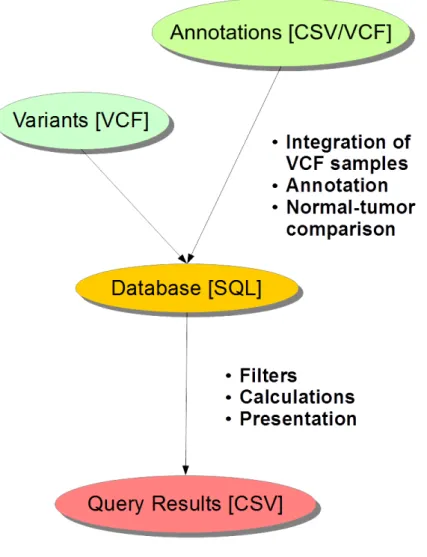
The prototypical database components created enabled building of SQL tables from variant (VCF) and annotation (CSV/VCF) information (see gure 4). If normal and tumor samples were included into the same database an allele based subtraction method was used to create a comparison database. The list of samples containing a certain allele was conserved and allele counts were calculated into separate columns. User-based dynamic manipulations were allowed in database creation for adding new columns of information.
Querying was done using a separate component, which allowed robust calculations and integrations to be made. Creation of an entire cohort database required a huge amount of information and was shown to be quite processor-time and memory consuming. Sub-genomic database creation of areas of interest provided to be fast and practical. For creation of an entire database parallelization by chromosomes was possible and allowed the utilization of the cloud based processing system to reduce creation time linearly.
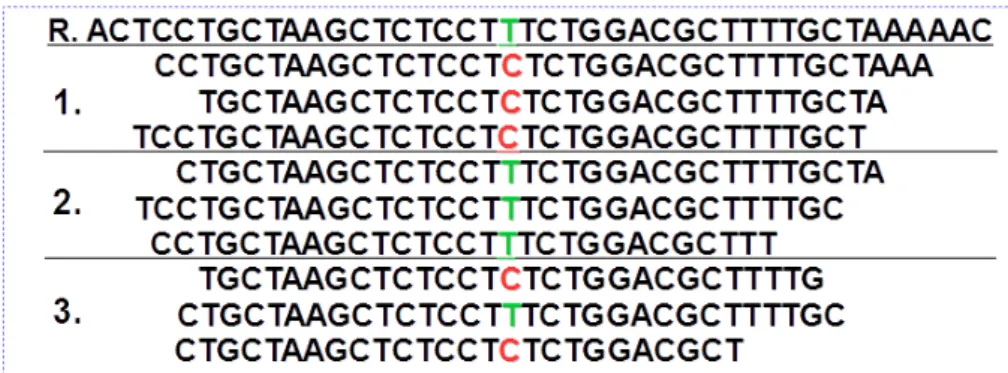
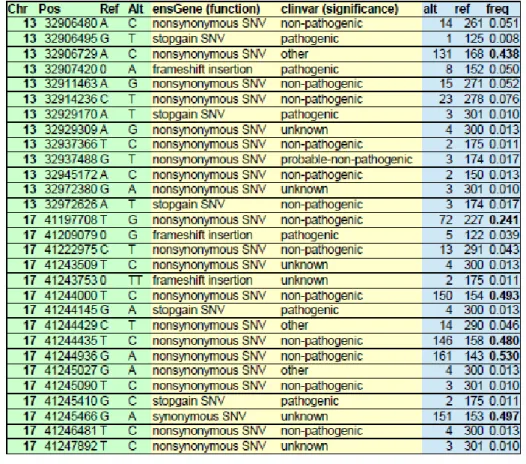
We tested the database by querying the BRCA1 and BRCA2 regions and compared the results to those from another OVAC project in our lab [Che15]. The mutational allele status was coherent with the TCGA analysis made, but failed to provide anything novel (see appendix 1). An example that illustrates how the variants are called from the data and how the subsequent variant analysis follows is shown in
Figure 4: The principle of the prototypic database we created for sequencing variant analysis. Multiple variant VCF (Variant Quality Format) samples are integrated with CSV/VCF annotation information. If normal-tumor pairs are used subtraction results are included. The database is created in SQL (Structured Query Language). When querying various methods can be used, such as complex ltering, dynamic calculations and the information to be presented can be selected. For large databases multi-threading can utilized by splitting the processing into separate parallelizable genomic parts (e.g. chromosomes). The coloring simply emphasizes the change in representation of the data.
gure 5. The database framework and implementation proved however to be quite complex, cumbersome to maintain and dicult to optimize. To date no stable implementation is available in Anduril for public use, however it is still an ongoing project.
5 Discussion
Next-generation sequencing (NGS) has evolved to the to-go method for genetic anal-ysis since its emergence around 2005, when the rst sequencers were created. To date, clinical genetic tests still rely on simple one- or multiple-gene methods either by direct PCR-probing or micro-arrays. Following the current progress, it is quite inevitable that future genetic tests will be based upon a once taken whole genome sample, from which any variant of interest can be inferred. The genetic prole of an individual can subsequently be updated every few years to keep the information up to date with advancements in technology.
In health care, a common phenotype-inducing variant can be of importance regard-less of its prevalence through elevated risk for certain diseases or by changing the kinetics of medicaments. The scope of utilities in this regard is quite limitless and mostly bounded by imagination and law.
In this work we reviewed the current golden-standard methods for next-generation sequence analysis. There are quite a few algorithms and software available for each step along the pipeline, some faster than others, most however rather equally reliable result-wise. The Best Practice for The Genome Analysis Toolkit (GATK), created and distributed by Broad Institute in MIT/Harvard, has been used as a guideline from the beginning in our work for both pipeline setup and choice of tools.
The most relevant GATK tools have been incorporated into the Anduril sequencing bundle, such as tools for recalibration of alignments or variants and variant calling. The common alignment tool BWA as well as the main duplicate marker from Picard-tools have been recently incorporated into GATK, which has henceforth become more or less a complete kit for analysis of NGS data.
We did not create any new core algorithms for NGS data processing. We included some of the best available methods into the sequencing bundle for usage in Anduril. The strength of Anduril comes from automatic parallelizaton of each run, which can be a sample or genetic region such as chromosome. Further advantage comes
Figure 5: In this example we have a hypothetical set of 3 samples each containing 3 reads of dierent lengths aligned to the reference genome. The locus (human GRCh37/hg19 assembly) is one of the SNP positions in BRCA1 that we found in the OVAC TCGA data set. Hypothetically, the sample 1 variant is of high-quality (3/3 alternates), while the sample 3 variant is of low-quality (only 2/3 alternates), according to probabilistic signicance estimates. Using database annotations for our data, we nd that the variant is not a signicant ovarian cancer tumor causing mutation, does provide enhanced risk for breast cancer [Cox11] and in the population occurs in 18-45 % as wild-type depending on ethnicity, which leaves our calculated frequency of 49 % (see appendix 1) in tumor samples rather insignicant. This variant thus oers a bad candidate in the search of a disease causing mutation. The (arbitrarily) colored boxes encompass annotation databases used and the dash-lined boxes the overall process.
from the ability to include essentially any tool available into the pipeline by easy wrapping into an Anduril component.
The only restriction for incorporation into Anduril is le-based ow of information. This integrative approach enables us to use the core utilities of GATK, as well as the nesses of other tools such as Annovar for annotations or pathway analysis tools such as Moksiskaan, all in the same pipeline. We have also created numerous analysis tools for answering specic questions often using R libraries and for accessing various databases using SQL, that can be highly useful in certain projects [Laa10, Kar11, Ova13, Lou13, Che15].
The core of the sequencing pipeline in Anduril was outlined in the methods sec-tion in appropriate detail. The pipeline can be individualized through component parameters. Disk space can be automatically minimized in Anduril using dynamic scrapping of obsolete les during processing, which is highly useful in NGS projects due to huge le sizes. When cloud based multi-processor systems are used the au-tomatic parallelization of Anduril comes into full power. By intelligent splitting (e.g. by chromosomes) most steps of whole genome data analysis can be done ex-tremely fast, time only restricted by hardware, and as was mentioned in section 4.2 sometimes the frequency of IO-operations that the system can handle.
Through three examples in the results section the evolution of the sequencing pipeline was narrated. The core was created in the rst example where a small group of chronic myeloid leukemia exomes were re-analyzed. We were asked to mine the samples once more for any shared variants that could explain dierences in response to treatment between the groups of High- versus Low-responders. Even though no likely causal variants could be found in this small experiment, the analysis proved Anduril could be eectively used in NGS analysis and enabled us to experiment with parallelization.
Our upgraded cloud-based system (8 nodes x 24 processors with 4 Gb memory each) was put to test in the second example, in which we processed a huge cohort of 180 normal-tumor paired breast cancer (BRCA) exomes from the TCGA database. We rened the pipeline, created more tools and experimented with large-scale process-ing. After months of trial and errors we completed the analysis in full and lists of VarScan and GATK (variant recalibrated) variants were available for use in our projects for reference.
A database approach for analysis of variants has been an ongoing project in our lab. In the third example, we processed roughly 330 normal-tumor pairs of ovarian
cancer (OVAC) exomes from the TCGA database using roughly the same pipeline as in the BRCA analysis. This time we experimented with post-processing the data with our prototypic database component. Variant and annotation information could be combined and various manipulation be made through complex querying of information from the database.
The database was tested for estimation of BRCA1 and BRCA2 mutation frequen-cies in OVAC prognostic groups (see appendix 1), by which the ndings were con-sistent with those otherwise achieved [Che15]. The database however proved to be cumbersome to maintain and make ecient. More work is still required before post-prototypical component can be made publicly available. As a principle, paral-lelization through parts in database creation and search can make iterative analysis very fast and convenient even for huge amounts of data when cloud-system based hardware is available.
Compared to other comprehensive NGS pipeline tools, we believe Anduril can of great use to the programming oriented scientist. For multi-processor (cloud) sys-tems, the automatic distribution of parts in a workow, while maintaining the hi-erarchical order by waiting for connected parts to nish, makes Anduril a powerful tool in large-scale analysis. Favorite software can easily be wrapped into the pipeline and current tools are fully available to be used in any project.
Maintenance of components in the ever-changing climate of tools and updates re-mains a great challenge. Even without a fully working database component for post-analysis, the sequencing bundle now serves as a complete kit for NGS analysis for use in ecient search of cancer driving genes and therapeutic targets.
References
Abe13 Abel, H., Detection of structural DNA variation from next generation sequencing data: A review of informatic approaches. Cancer Genetics, 206,12(2013), pages 432440.
Agg15 Aggour, K. S., A highly parallel next-generation DNA sequencing data analysis pipeline in Hadoop. Bioinformatics and Biomedicine (BIBM), 2015 IEEE International Conference on, pages 756763.
Alk15 Alkodski, A., Comparative analysis of methods for identifying somatic copy number alterations from deep sequencing data. Briengs in Bioin-formatics, 16,2(2015), pages 242254.
Alt15 Altshuler, D. M., A global reference for human genetic variation, The 1000 Genomes Project Consortium. Nature, 526,7571(2015), pages 68 +.
Bel11 Bell, D., Integrated genomic analyses of ovarian carcinoma. Nature, 474,7353(2011), pages 609615.
Ben08 Bentley, D. R., Accurate whole human genome sequencing using re-versible terminator chemistry. Nature, 456,7218(2008), pages 539. Bro16 Broad Institute, Genome analysis toolkit: Best practices, 2016. URL
https://www.broadinstitute.org/gatk/guide/best-practices. Cha15 Chaisson, M. J., Genetic variation and the de novo assembly of human
genomes. Nature Reviews Genetics, 16,11(2015), pages 62740.
Che15 Chen, P., Identication of prognostic groups in high-grade i serous ovarian cancer treated with platinum-taxane chemotherapy. Cancer research, 75,15(2015), pages 29872998.
Chi08 Chin, L., Comprehensive genomic characterization denes human glioblastoma genes and core pathways. Nature, 455,7216(2008), pages 10611068.
Coc10 Cock, P. J. A., The Sanger FASTQ le format for sequences with qual-ity scores, and the Solexa/Illumina FASTQ variants. Nucleic acids research, 38,6(2010), pages 17671771.
Cox11 Cox, D., Common variants of the BRCA1 wild-type allele modify the risk of breast cancer in BRCA1 mutation carriers. Human molecular genetics, 20,23(2011), pages 47324747.
Cur04 Curwen, V., The Ensembl automatic gene annotation system. Genome research, 14,5(2004), pages 942950.
dAA13 der Auwera A., G. V., From FastQ data to high condence variant calls: the Genome Analysis Toolkit best practices pipeline. Curr Protoc Bioinformatics, 11,1110(2013), page 11.10.1.
Dal10 Dalca, A. V., Genome variation discovery with high-throughput se-quencing data. Briengs In Bioinformatics, 11,1(2010), pages 314. den01 den Dunnen, J. T., Nomenclature for the description of human sequence
variations. Human genetics, 109,1(2001), pages 121124.
DeP11 DePristo, M. A., A framework for variation discovery and genotyping using next-generation DNA sequencing data. Nat Genet, 43,5(2011), page 491.
Erg15 Erguner, B., Performance comparison of next generation sequencing platforms. Engineering in Medicine and Biology Society (EMBC), 2015 37th Annual International Conference of the IEEE, pages 64536456. For15 Forbes, S. A., COSMIC: exploring the world's knowledge of somatic
mutations in human cancer. Nucleic acids research, 43, pages D805 D811.
Ful09 Fullwood, M. J., Next-generation DNA sequencing of paired-end tags (PET) for transcriptome and genome analyses. Genome research, 19,4(2009), pages 11.
Gam10 Gamazon, E. R., SCAN: SNP and copy number annotation. Bioinfor-matics (Oxford, England), 26,2(2010), pages 259262.
Gho14 Ghoneim, D. H., Comparison of insertion/deletion calling algorithms on human next-generation sequencing data. BMC Research Notes, page 864. URL http://dx.doi.org/10.1186/1756-0500-7-864.
Han11 Hanahan, D., Hallmarks of cancer: The next generation. Cell, 144,5(2011), pages 646674.
Hod07 Hodges, E., Genome-wide in situ exon capture for selective resequenc-ing. Nat Genet, 39,12(2007), page 1522.
Hsu06 Hsu, F., The UCSC Known Genes. Bioinformatics, 22,9(2006), pages 10361046.
Iri07 Irizarry, R. A., Exploration, normalization, and genotype calls of high-density oligonucleotide SNP array data. Biostatistics, 8,2(2007), pages 485499.
Kar09 Karchin, R., Next generation tools for the annotation of human SNPs. Briengs In Bioinformatics, 10,1(2009), pages 3552.
Kar11 Karinen, S., Data integration workow for search of disease driving genes and genetic variants. PLoS ONE, 6,4(2011), pages 18.
Kat13 Katainen, R., Detection of pathogenic mutations from exome sequenc-ing data, 2013.
Kat16a Katainen, R., Abstract 5281: Fast and scalable software for compar-ative variant analysis and visualization of massive next-generation se-quencing data. Cancer research, 76,14(2016), pages 52815281.
Kat16b Katainen, R., BasePlayer: Versatile analysis software for large-scale genomic variant discovery. submitted.
Kob09 Koboldt, D. C., VarScan: variant detection in massively paral-lel sequencing of individual and pooled samples. Bioinformatics, 25,17(2009), page 2283.
Kob12 Koboldt, D. C., VarScan 2: somatic mutation and copy number al-teration discovery in cancer by exome sequencing. Genome Res, 22,3(2012), page 568.
Kot08 Kotani, H., Integrated genomic and pharmacological approaches to identify synthetic lethal genes as cancer therapeutic targets. Current Molecular Medicine, 8,8(2008), pages 774783(10).
Laa10 Laakso, M., Integrative platform to translate gene sets to networks. Bioinformatics, 26,14(2010), pages 18021803.
Lan01 Lander, E. S., Initial sequencing and analysis of the human genome. Nature, 409,6822(2001), page 860.
Lan09a Langmead, B., Searching for SNPs with cloud computing. Genome biology, 10,11(2009).
Lan09b Langmead, B., Ultrafast and memory-ecient alignment of short DNA sequences to the human genome. Genome Biol, 10,3(2009), page R25. Lan12 Langmead, B., Fast gapped-read alignment with Bowtie 2. Nat
Meth-ods, 9,4(2012), page 357.
Li09a Li, H., Fast and accurate short read alignment with Burrows-Wheeler transform. Bioinformatics, 25,14(2009), page 1754.
Li09b Li, H., The Sequence Alignment/Map format and SAMtools. Bioinfor-matics, 25,16(2009), page 2078.
Li10 Li, H., Fast and accurate long-read alignment with Burrows-Wheeler transform. Bioinformatics, 26,5(2010), page 589.
Liu12 Liu, Q., Steps to ensure accuracy in genotype and SNP calling from illumina sequencing data. BMC Genomics, 13, page S8.
Lou13 Louhimo, R., Identication of genetic markers with synergistic survival eect in cancer. BMC Systems Biology, 7, pages 19.
Mar13 Mardis, E. R., Next-generation sequencing platforms. Annu Rev Anal Chem (Palo Alto Calif), 6, page 287.
McK10 McKenna, A., The Genome Analysis Toolkit: a MapReduce frame-work for analyzing next-generation DNA sequencing data. Genome Res, 20,9(2010), page 1297.
Nev15 Nevado, B., Pipeliner: software to evaluate the performance of bioin-formatics pipelines for next-generation resequencing. MOLECULAR ECOLOGY RESOURCES, 15,1(2015), pages 99106.
Ng09 Ng, S. B., Targeted capture and massively parallel sequencing of 12 human exomes. Nature, 461,7261(2009), page 272.
Ng10 Ng, S. B., Exome sequencing identies the cause of a mendelian disor-der. Nature genetics, 42,1(2010), pages 3035.
Ova10 Ovaska, K., Large-scale data integration framework provides a compre-hensive view on glioblastoma multiforme. Genome Medicine, 2,9(2010), pages 112.
Ova13 Ovaska, K., Integrative analysis of deep sequencing data identies estro-gen receptor early response estro-genes and links ATAD3B to poor survival in breast cancer. PLoS Computational Biology, 9,6(2013), pages 113. Ova16 Ovaska, K., Anduril component documentation, 2016. URL http://
www.anduril.org/anduril/bundles/all/doc/.
Pir14 Pirooznia, M., Validation and assessment of variant calling pipelines for next-generation sequencing. Human Genomics, page 14.
Pru07 Pruitt, K. D., NCBI reference sequences (RefSeq): A curated non-redundant sequence database of genomes, transcripts and proteins. Nu-cleic acids research, 35,1(2007), pages D61D65.
Rob11 Robinson, J. T., Integrative genomics viewer. Nature biotechnology, 29,1(2011), page 24.
San75 Sanger, F., A rapid method for determining sequences in DNA by primed synthesis with DNA polymerase. Journal of Molecular Biol-ogy, 94,3(1975), page 441.
She99 Sherry, S. T., dbSNP - database for single nucleotide polymorphisms and other classes of minor genetic variation. Genome research, 9,8(1999), pages 677679.
The03 The International HapMap Consortium, The International HapMap Project. Nature, 426,6968(2003), page 789.
The07 The International HapMap Consortium, A second generation human haplotype map of over 3.1 million SNPs. Nature, 449,7164(2007), page 851.
The12 The Cancer Genome Atlas Network, Comprehensive molecular portraits of human breast tumors. Nature, 490,7418(2012), pages 6170.