Evidence-based Clinical Statement
Physiotherapy management of ankle
injuries in sport
Authors: Dr Gaylene McKay and Dr Jill Cook
The APA wishes to acknowledge Sports Physiotherapy Australia, who provided funding to produce this evidence-based clinical statement.
First published 2006
© Copyright Australian Physiotherapy Association 2006
This work is copyright. Apart from any use permitted under the Copyright Act 1968, no part may be reproduced by any process without prior written permission from the APA. Australian Physiotherapy Association
PO Box 6465, St Kilda Rd Central Victoria 8008
Phone +61 3 9534 9400 Fax +61 3 9534 9199
APA Evidence- based
Clinical Statement
May 2006
Physiotherapy Management of Ankle Injuries in Sport
Introduction
The purpose of this evidence-based clinical statement is to review the scientific evidence for the efficacy of physiotherapy in the management of the uncomplicated ankle sprain. It focuses on the treatment of acute ankle sprains and the prevention of ankle sprains. Both of these are necessary to an appropriate ankle sprain treatment program.
The evidence-based clinical statement provides a set of recommendations for clinical practice based on this evidence. Physiotherapists can use this evidence to facilitate their role in the management of ankle sprains.
Ankle injuries are prevalent in weight bearing sports and activities (Garrick 1977, McKay et al 2001). Ankle injuries account for 10–30% of all sports injuries (Mascaro & Swanson 1994) and 20–25% of time lost due to injury in running and jumping sports (Mack 1982). It is estimated that 85% of ankle injuries are ankle sprains (Garrick 1977). Ankle sprains can range from an uncomplicated sprain of the anterior talofibular ligament to an injury that involves bony and joint structures.
Even the uncomplicated ankle sprain can have residual problems such as pain, tenderness, swelling, mechanical instability, functional instability, and recurrent sprains (Mann et al 2002b). Follow-up of ankle injuries after 6–18 months have shown that residual ankle complaints occur in 40–50% of cases (Anandacoomarasamy & Barnsley 2005, Brand et al 1977, Gerber et al 1998, Itay et al 1982, Lentell et al 1990). Seven years post-injury, 32% continue to report residual ankle symptoms (Konradsen et al 2002). Ankle sprains can result in considerable morbidity and financial cost (Ogilvie-Harris & Gilbart 1995). There is a clear need for evidence-based treatment to improve outcomes for ankle sprain.
Treatment of ankle sprains is in the domain of all sports medicine practitioners, and the physiotherapist has a critical role in the management of the acute injury and the restoration of full function to the ankle in both the short and long term.
Methods
Systematic searches of the PEDro, CINAHL, Medline, Embase and Cochrane Databases were conducted from 1966 to Feb 2006. Simple search terms ‘ankle’ and ‘sprain’ were combined with terms to extract systematic reviews and relevant trials. Papers not in English were excluded. All retrieved papers were reviewed by title and abstract. Papers that were not applicable to a primary clinical perspective were excluded. No quality criteria were used; all remaining papers were reviewed in full text. The Australian National Health and Medical Research Council (NHMRC) have issued guidelines on how to evaluate the effectiveness of treatment interventions (NHMRC 1999). The NHMRC have suggested that the strongest evidence for treatment efficacy is obtained from a systematic review of all relevant randomised controlled trials (RCTs)
APA Evidence- based
Clinical Statement
(Level I evidence). Level II evidence is defined as 'evidence obtained from at least one properly designed randomised controlled trial'. Level III evidence is defined as evidence obtained from comparative (non-randomised and observational) studies. The evidence in this position statement is predominately from Level I and Level II evidence, with a few Level III studies included where appropriate.This evidence-based clinical statement consists of two documents. First, there is a summary of the specific recommendations for each intervention and second, a more detailed technical report. The technical report details the evidence base for management of the uncomplicated ankle sprain and presents a collation of available evidence.
Results
Findings indicate that there are evidence-based interventions for the treatment and management of ankle sprains.
Physiotherapy management of acute ankle sprains
Recommended treatments
Recommended treatments are those for which there is clear Level I or II evidence for their effect.
Diagnosis
The Ottawa Ankle Rules should be applied when deciding whether to X-ray acute ankle sprains in adults. These rules do not apply in children. The clinical version of the anterior drawer test should be used to assess the integrity of the ATFL only in a delayed physical examination. The test should be used in 10–200 of plantar flexion.
Early mobilisation
Early mobilisation, rather than immobilisation, is recommended in the management of acute ankle injuries. There is evidence that the use of lace-up and semi-rigid braces in conjunction with early mobilisation decreases swelling.
Pharmacological treatments
Current evidence suggests that the use of oral and topical non-steroidal anti-inflammatory medication following ankle sprain results in faster recovery and less pain.
Outcome and impairment measures
Until ankle-specific outcome measures have been developed, physiotherapists should measure treatment effectiveness by using the Lower Extremity Functional Scale and/or the Patient Specific Functional Scale. Limited evidence supports the use of impairment measures. The weight bearing lunge test is a valid test for measuring ankle dorsiflexion range of movement.
Recommended under certain circumstances
APA Evidence- based
Clinical Statement
outcomes from the treatment in the literature, b) a limited number of trials or number of subjects in the trials, or c) poor quality of the trials on the treatment.Ice
There is marginal evidence to suggest that ice in addition to exercise is effective following ankle sprain. There is limited evidence to suggest that ‘melting iced water’ applied through a wet towel for repeated periods of 10 minutes is the most effective method of ice therapy.
Joint mobilisation
Limited evidence is available to support the use of passive mobilisations in the treatment of acute ankle sprains. The use of passive mobilisations in sub-acute ankle injuries can increase the range of ankle dorsiflexion.
Surgery
There is evidence that surgical management of acute ankle sprains is no better than conservative management. Treatment decisions should be made on an individual basis.
Laser
There is limited evidence supporting the use of low-level laser in the treatment of acute ankle sprains.
Ankle braces
There is evidence that lace-up and semi-rigid ankle braces in conjunction with early mobilisation decrease swelling.
Not recommended
Treatments that are not recommended are those for which there is Level I or II evidence of no effect of the treatment.
Ultrasound
Current evidence does not support the use of ultrasound in the treatment of ankle sprains.
Compression
Current evidence does not support the use of compression in the treatment of acute ankle sprains.
Hyperbaric oxygen therapy
There is no evidence that the addition of hyperbaric oxygen therapy improves outcomes over that provided by standard care.
APA Evidence- based
Clinical Statement
Physiotherapy management for the prevention of recurrent ankle
sprains
Recommended treatments
Recommended treatments are those for which there is clear Level I or II evidence for their effect.
Clinical performance tests
The single leg stance test is valid for detecting activity limitations following ankle sprain.
Ankle braces
The use of ankle braces for preventing ankle injury/ies is recommended. The reduction in the number of ankle sprains with the use of ankle braces is greatest in those with a history of ankle sprain. On current evidence, no one ankle brace is better than another in reducing the incidence of ankle sprains.
Rehabilitation
A functional rehabilitation program should be undertaken as an effective injury prevention strategy. The minimum content and optimal duration of the functional rehabilitation program for ankle injuries remains unclear.
Screening for ankle injury
Two tests can be used for screening purposes (predict ankle injury). The single leg stance test using force plates provides objective measures of postural sway. Clinically, the flamingo single leg balance test can also predict risk of ankle injury.
Recommended under certain circumstances
Treatments recommended under certain circumstances are those for which there is some question regarding their efficacy. Questions arise because of: a) both positive and negative outcomes from the treatment in the literature, b) a limited number of trials or number of subjects in the trials, or c) poor quality of the trials on the treatment.
Referral for reconstruction in the management of Grade III ankle Injuries
There is evidence to support the use of operative (reconstructive) treatment in patients with chronic mechanical instability. Guidelines for when to refer for operative treatment remain based on clinical experience, which suggests referral should occur when chronic mechanical instability coexists with chronic functional instability, despite quality functional rehabilitation programs.
Ankle taping
There is insufficient evidence to assess the efficacy of ankle taping in reducing the incidence of ankle injuries
Shoes
Current evidence does not support the protective effect of high-cut shoes for ankle injuries. There is limited evidence that air cells in the heels of basketball shoes increase the risk of ankle injury. There is limited evidence that cushioning and standard insoles do not have a protective effect for ankle injuries.
APA Evidence- based
Clinical Statement
Stretching
The protective effect of stretching for ankle injuries is inconclusive.
Clinical performance tests
There is some evidence that the maximal wide hopping test, the lower extremity functional test and time to stabilise from a sub-maximal single leg landing test are also valid for detecting activity limitations following ankle injury.
Physical conditioning
There is some evidence that poor physical conditioning is a risk factor for ankle injury. Conditioning programs may be considered by the physiotherapist in an ankle injury prevention program.
No evidence found
This comprises treatments for which there is no Level I or II evidence available. Therefore no evidence-based comments can be made on the use of these interventions.
Prevention of new (first time) ankle sprains
There is no evidence that any physiotherapeutic intervention is appropriate for the prevention of new ankle injuries.
Conclusion
The evidence-based clinical statement on ankle sprains recommends that after assessing the need for X-ray based on the Ottawa ankle rules, acute ankle sprains should be managed with early functional mobilisation with an ankle brace and non-steroidal medication. Ice, laser, and passive joint mobilisation may be used as adjuncts.
For the prevention of ankle sprains, rehabilitation should include a functional rehabilitation program and the use of ankle braces. Ankle taping, stretching, and appropriate shoe selection may also be advantageous in preventing ankle injuries.
APA Evidence- based
Clinical Statement
Technical report
The following report details the evidence that currently exists for the efficacy of physiotherapy treatments for ankle sprains.
Definition of an ankle sprain
Ankle sprain is an injury of the lateral ligament complex of the ankle joint (Struijs & Kerkhoffs 2003). It is known that the anterior talofibular ligament (ATFL) is the first or only ligament to sustain injury in 97% of cases (Brostrom 1966). The usual mechanism of injury is inversion and supination of the plantar flexed foot (Struijs & Kerkhoffs 2003). In this position, the bony structure provides only minimal stability and the ATFL, which is the weakest component of the lateral ligament complex, is taut and exposed to injury (Mann et al 2002a). Brostrom (1966) found that combined ruptures of the anterior talofibular ligament and the calcaneofibular ligament (CFL) occurred in 20% of cases and that isolated rupture of the calcaneofibular ligament occurred in only 3% of cases. The posterior talofibular ligament is usually uninjured unless there is frank dislocation of the ankle.
Grading of ankle injuries
Traditionally, lateral ankle injuries are graded I to III. Definitions used for this grading system can vary, describing anatomical damage and/or symptoms at clinical presentation (Mann et al 2002b). The following definitions reported by Kaikkonen et al (1994) combine the severity of the ligament damage and clinical symptoms:
Grade I (mild sprain): stretch of the ligaments without macroscopic tearing, little swelling or tenderness, slight or no functional loss, and no mechanical instability of the joint.
Grade II (moderate sprain): partial macroscopic tear of the ligaments with moderate pain, swelling, and tenderness, with some loss of motion and mild to moderate instability.
Grade III (severe sprain): complete rupture of the ligaments with severe swelling, haemorrhage, and tenderness, with loss of motion and considerable abnormal motion and instability.
Practically, this graduation may be considered as purely theoretical, because it has no therapeutic prognostic consequences (de Bie et al 1998).
Physiotherapy management of acute ankle sprains
The evidence for accurate diagnosis, the RICE (rest, ice, compression, elevation) regime, and the efficacy of electrotherapy, mobilisations and surgery in acute ankle sprains are critical parts of the early and effective management of ankle sprains. Diagnosis
In acute ankle injuries, the diagnosis of ankle sprain is made both clinically and with imaging to exclude the presence of bony injury (Brukner & Khan 2001). X-rays are the primary investigation when imaging for ankle sprain.
APA Evidence- based
Clinical Statement
When to refer for X-ray?
The Ottawa ankle rules are guidelines for the use of X-ray in ankle injury to reduce the number and cost of radiographic procedures (Stiell et al 1992). These rules state that an ankle X-ray series is only required if there is any pain in the malleolar zone and any of these findings:
• Bone tenderness at “A”. Where “A” represents the posterior edge of distal 6 cm of the lateral malleolus or the tip of the lateral malleolus.
• Bone tenderness at “B”. Where “B” represents the posterior edge of distal 6 cm of the medial malleolus or the tip of the medial malleolus.
• Inability to bear weight both immediately and in emergency department.
Figure 1: Ottawa Ankle Rules. Reprinted from Annals of Emergency Medicine, 21(4) I. G. Steill et al, A study to develop clinical decision rules for the use of radiography in acute ankle injuries, p385 1992, with permission from American College of Emergency Physicians
A systematic review that examined the accuracy of the Ottawa ankle rules included 27 studies reporting 15 581 patients (Bachmann et al 2003). They concluded the rules are an accurate instrument for excluding fractures of the ankle and mid-foot in adults. The instrument has a sensitivity of almost 100% (sensitivity measures a negative result given when a fracture exists). Of the 15 581 patients, 47 patients (0.3%) had a false negative result. The specificity (an indicator of the number of unnecessary radiographs that may be avoided using the rules) was modest and variable, ranging between 10% and 79%. Bachmann and colleagues (2003) suggest the specificity variation may be
APA Evidence- based
Clinical Statement
due to factors such as clinical skills and experience as well as cultural interpretations of pain.The accuracy of the Ottawa ankle rules for children was investigated in a trial that included 195 children with 40 fractures (Clark & Tanner 2003). The sensitivity was 83%, the positive predictive value was 28%, and the negative predictive value was 93%. They concluded the Ottawa ankle rules cannot be applied to children with the same sensitivity as adults.
Clinical tests
Anterior Drawer Test
The anterior drawer test is the most common clinical test used to examine the integrity of the ATFL (Tohyama et al 2003). Shortly after ankle sprain, the talar tilt and anterior drawer tests are almost always positive, and therefore the relevance of short-term results is questionable (Kerkhoffs et al 2002a). Furthermore, the test results can be invalidated by protective muscle contractions that can prevent ankle joint movement (Tohyama et al 2003). The tests best indicate instability in a delayed physical examination, four to seven days after trauma (Klenerman 1998).
The anterior drawer test is reported to be a valid test for ATFL integrity (Glasgow et al 1980, Johnson & Markolf 1983, Lindstrand & Mortensson 1977, Rasmussen & Tovborg-Jensen 1981, Taga et al 1992), however other studies have questioned the validity of the test (Fujii et al 2000, Lahde et al 1988). Assessing the integrity of the ATFL in 10–200 of plantar flexion results in the largest increase in neutral zone laxity in the ATFL deficient ankle compared to the normal ankle (Tohyama et al 1995). A large amount of anterior force is not necessary during the anterior drawer test to diagnose disruption of the ATFL (Tohyama et al 1995, Tohyama et al 2003). Excessive force should not be applied to overcome the patient’s protective response of muscular contraction (Tohyama et al 2003).
Excellent reliability of the anterior drawer test has been shown when using a custom-designed ankle laxity testing device (Kerkhoffs et al 2002a, Tohyama et al 2003). Reliability studies for the clinical version of this test appear to be absent. Mann et al (2002a) suggest that as the accuracy of the clinical test is dependent on the examiner’s personal skill the results should be accepted with caution.
Talar Tilt Test
There is a lack of evidence about the use of the talar tilt in physical examination. The talar tilt test is proposed to examine the integrity of both the CFL and the deltoid ligament (Brukner & Khan 2001). As this test aims to assess different ligaments to the anterior drawer test, it is not surprising that Kanbe and colleagues (2002) found there was no correlation between the talar tilt test and the anterior drawer test using stress radiography.
RICE
The regime of rest, ice, compression and elevation (RICE) is the traditional early management of acute ankle injuries (Brukner & Khan 2001, Renstrom & Lynch 2002).
APA Evidence- based
Clinical Statement
Rest
No studies were located that directly investigate the role of rest. There are a group of studies that examine the role of rest by immobilisation (plaster cast or special boot) compared to functional treatment (incorporating early mobilisation).
Immobilisation
Four systematic reviews concur that functional treatment, which incorporates early mobilisation, results in less short-term disability. Better outcomes such as earlier return to sport and work, less swelling, less objective instability, and greater patient satisfaction were reported for functional treatment compared to immobilisation using plaster casts or special boots (Kerkhoffs et al 2002c, Ogilvie-Harris & Gilbart 1995, Pijnenburg et al 2000, Shrier 1995).
Early mobilisation as part of a functional treatment is preferred to cast immobilisation for the treatment of acute ankle injuries. Kerkhoffs et al (2002c) conducted meta-analysis (21 trials involving 2184 participants) and reported that there were statistically significant differences in favour of functional treatment when compared to immobilisation for seven outcome measures: more patients returned to sport in the long term (Relative risk (RR) 1.86, 95%CI 1.22 to 2.86); the time taken to return to sport was shorter (weighted dichotomous outcome (WMD) 4.88 days, 95%CI 1.50 to 8.25); more patients had returned to work at the short term follow-up (RR 5.75, 95%CI 1.01 to 32.7); the time taken to return to work was shorter (WMD 8.23 days, 95%CI 6.31 to 10.16); fewer patients suffered from persistent swelling at short term follow-up (RR 1.74, 95%CI 1.17 to 2.59); fewer patients suffered from objective instability as tested by stress X-ray (WMD 2.60 95%CI 1.24 to 3.96); and patients treated functionally were more satisfied with their treatment (RR 1.83, 95%CI 1.09 to 3.07). However, Kerkhoffs et al (2002c) suggest that these results should be interpreted with caution, as most of the differences are not significant after the exclusion of low quality trials.
Ice
One systematic review used meta-analysis to investigate the use of ice in the treatment of acute soft tissue injuries (Bleakley et al 2004). Although this review is not specific to the ankle, the analysis and results appear relevant. The study included 22 RCTs using 1469 subjects. The following are some pertinent conclusions:
• Ice plus exercise is the most effective following ankle sprain. Adequate cooling can reduce pain spasm and neural inhibition, thereby allowing for earlier and more aggressive exercises.
• Single applications of combined ice and compression seem to be as effective as no treatment after acute sprain.
• The addition of ice to compression is no more effective than compression alone. • Barriers such as dressings and bandages have the potential to mitigate the cooling
effect of a cold compress.
• A number of case studies have reported the occurrence of skin burns and nerve damage after as little as 20–30 minutes of cooling.
Two critical reviews evaluated the role of ice therapy for acute ankle injuries (MacAuley 2001, Ogilvie-Harris & Gilbart 1995). These reviews found there was no evidence in the literature regarding optimal frequency or duration of ice application. MacAuley (2001) reported that ‘melting iced water’ applied through a wet towel for repeated periods of 10 minutes was most effective at cooling injured animal tissue and healthy human tissue. This method allows for reduced muscle temperature without compromising the skin and
APA Evidence- based
Clinical Statement
allows the superficial skin temperature to return to normal while deeper muscle temperature remains low. However, Bleakley et al (2004) cautioned that this protocol had not yet been tested in injured humans.Compression
Two reviews were located that examined the role of compression in ankle sprains (Kerkhoffs et al 2002c, Wilson & Cooke 1998). Kerkhoffs et al (2002c) reported that elastic bandages are less effective than functional treatment where lace-up or semi-rigid ankle braces were used. Persistent swelling at short term follow-up was less with the two types of braces compared to the elastic bandage and the semi-rigid ankle support resulted in a shorter time to return to work compared to the elastic bandage. This review is supported by a later RCT comparing semi-rigid brace to elastic bandage that demonstrated a similar outcome (Boyce et al 2005).
Wilson and Cooke’s critical (1998) review cited 12 trials that studied compression in the treatment of acute ankle sprains. They concluded that early movement provided the best results and that the current literature did not support the widespread use of elasticised cylindrical bandages to treat ankle sprains. Furthermore, they questioned whether cylindrical bandages produced an anterior compression band as the ankle has a 90° curve.
Electrotherapy modalities in acute ankle injuries
Ultrasound
A systematic review of ultrasound therapy for acute ankle sprain that included five trials involving 572 patients was conducted by Windt and co-workers (2002). They concluded that the extent and quality of the available evidence for the effects of ultrasound therapy for acute ankle sprain is limited. In the four placebo-controlled trials in this review the use of ultrasound in the treatment of ankle sprains was not supported. Windt et al (2002) state that no optimal and adequate dosage schedule for ultrasound therapy is known. Whether such a schedule would improve the reported effectiveness of ultrasound for ankle sprains is unknown.
Heat
Heat may be defined as the warming of body tissues using electromagnetic radiation, electric current, or ultrasonic waves for the reduction of an inflammatory response, oedema, and pain (Struijs & Kerkhoffs 2003). One critical review reported five prospective studies comparing heat to placebo for the treatment of acute ankle sprains (Ogilvie-Harris & Gilbart 1995). Three studies showed significantly shorter recovery period with less pain and oedema in the heat group, whilst two studies concluded there was no significant difference between heat and placebo (Ogilvie-Harris & Gilbart 1995).
Laser
One RCT investigated the role of low-level laser (820-nm GaA1As diode, 40 mW at 16Hz) therapy in the treatment of grade II ankle sprains. Subjects were randomised to three groups: (i) RICE treatment, (ii) RICE plus placebo laser, and (iii) RICE and laser. Treatment with RICE and laser resulted in a statistically significant reduction in the volume of oedema (Stergioulas 2004).
APA Evidence- based
Clinical Statement
Mobilisation in acute ankle sprains
Two RCTs provide evidence for the use of passive mobilisations in the management of acute ankle sprains. One RCT investigated the use of passive anteroposterior glide of the talus in addition to the usual RICE regime in the physiotherapy management of acute ankle sprains (Green et al 2001). The intervention group required fewer treatments to achieve full pain-free dorsiflexion, and had greater increases in stride speed in the first and third treatment sessions.
An RCT investigated one session of osteopathic manipulation where both intervention and control groups received standard care (Eisenhart et al 2003). The intervention group had statistically significant improvements in oedema and pain and a trend towards increased range of motion.
Mobilisation in sub-acute ankle sprains
One RCT investigated the use of a Mulligan’s mobilisation with movement (MWM) technique in sub-acute ankle injuries (Collins et al 2004). The MWM combines relative posteroanterior glide of the tibia on the talus with active dorsiflexion movements. The trial compared an intervention group with a placebo mobilisation group and a control group. Significant improvement in the range of ankle dorsiflexion movement was recorded for the intervention group (Collins et al 2004).
In another RCT, the intervention group had a chiropractic mortise separation adjustment (8 treatments over 4 weeks) and the control group received “sham” ultrasound (Pellow & Brantingham 2001). The intervention group had significantly greater pain reduction, increased ankle dorsiflexion, and improved ankle function. Surgery for acute ankle sprains
A systematic review examining the role of surgery in acute ankle sprains included 17 studies, involving 1950 mostly active adult males, where surgical treatment was compared to conservative treatment (Kerkhoffs et al 2002b). There were no significant differences between the treatment groups for all the primary outcomes (return to pre-injury level of activity, re-pre-injury, persistent pain, and subjective instability). Furthermore, similar numbers of patients in both groups considered that they had a poor result (RR 0.81, 95%CI 0.36 to 1.83). There is some evidence indicating that surgery may provide benefit over conservative treatment in some secondary outcomes. The incidence of a positive talar tilt on stress radiographs (RR 0.40, 95%CI 0.25 to 0.65) or a positive anterior drawer sign (RR 0.52, 95%CI 0.36 to 0.76) was significantly higher in the conservative group and there was a lower incidence of long-term ankle swelling in treated patients (RR 0.74, 95%CI 0.55 to 0.98). However, more surgically-treated patients from two trials complained of ankle stiffness (RR 1.94, 95%CI 1.21 to 3.10).
Kerkhoffs et al (2002b) concluded there was insufficient evidence available from RCTs to determine the relative effectiveness of surgical and conservative treatment for acute injuries of the ankle in adults. They further suggested that treatment decisions must be made on an individual basis, carefully weighing the relative benefits and risks of each option. Given the risk of operative complications and higher costs associated with surgery, conservative treatment appears the best option for acute sprains.
APA Evidence- based
Clinical Statement
Pharmacological agents
One critical review of 19 pharmacological studies concluded that reasonable evidence was available to show that patient recovery following ankle sprain is faster and with less pain when treated with oral non-steroidal anti-inflammatory medication (NSAID). No particular drug was shown to be superior to others (Ogilvie-Harris & Gilbart 1995). Topical application of NSAID was systematically reviewed and demonstrated a significant effect in acute soft tissue injuries (Moore et al 1998). This is supported by a later RCT that demonstrated better outcomes with a topical application of NSAID (Mazieres et al 2005). There appears to be no difference in using either COX-1 or COX -2 anti-inflammatory medication (Petrella et al 2004).
Hyperbaric oxygen therapy
A systematic review conducted by Bennett and co-workers (2005) examined the effects of hyperbaric oxygen therapy (HBOT) on soft tissue injury, including delayed onset muscle soreness. The review comprised nine small trials involving a total of 219 participants. Two trials evaluated HBOT for the treatment of acute soft tissue injury (acute ankle sprains and medial collateral ligament injury respectively). The remainder of the trials examined the effect of HBOT on delayed onset muscle soreness. The authors concluded that there was insufficient evidence to establish the effects of HBOT on the recovery from ankle sprains (or following an acute knee ligament injury).
Outcome and impairment measures
Outcome measures
Evaluation of treatment effectiveness should be made with one or more measurement tools that are valid, reliable, and sensitive to change. The measures should be functional in nature to reflect outcomes. Ankle-specific functional tests, such as the single leg stance test and the maximal wide hop test, have been shown to be valid and reliable for measuring activity limitations following ankle injury (see prevention section). However, it is not known whether these tests are sensitive to change.
There have been many ankle scoring scales developed. Haywood et al (2004) investigated ankle-specific scoring scales in a critical review. All measures lacked evidence of test-retest reliability or internal consistency, had limited evidence of construct validity, and had no formal assessment of sensitivity to change. Until such evidence exists for ankle specific scales, physiotherapists should use the more generalised scales such as the Lower Extremity Functional Scale (Stratford et al 1995) or the Patient-Specific Functional Scale (Binkley et al 1999).
Impairment measures
Impairment measurements such as range of motion may be used to monitor changes within a treatment session and as part of the clinical reasoning process. There is one validated test for measuring ankle dorsiflexion but no valid tests that examine ankle plantar flexion, inversion or eversion range. The weight bearing lunge test has been reported to have excellent inter-tester and intra-tester reliability (Bennell et al 1998). This test was found to be more sensitive in detecting treatment effects than an angular weight-bearing measure and a non-weight-bearing measure (Vicenzino et al 2001).
APA Evidence- based
Clinical Statement
Physiotherapy management for the prevention of recurrent ankle
sprains
Recurrent ankle sprains are common in athletes (DuRant et al 1992, Ekstrand & Tropp 1990, Garrick & Requa 1973, McKay et al 2001, Milgrom et al 1991, Yeung et al 1994). Physiotherapy management of ankle injuries must include strategies to minimise the recurrence of ankle injuries.
The World Health Organisation’s International Classification of Functioning and Disability (ICF) is used here as the framework for investigating the evidence for preventing ankle injury (World Health Organisation 2001). The ICF includes:
• Impairments of body functions and structures • Activity limitations
• Contextual Factors, incorporating: — Personal Factors
— Environmental Factors
Impairments of body functions and structures
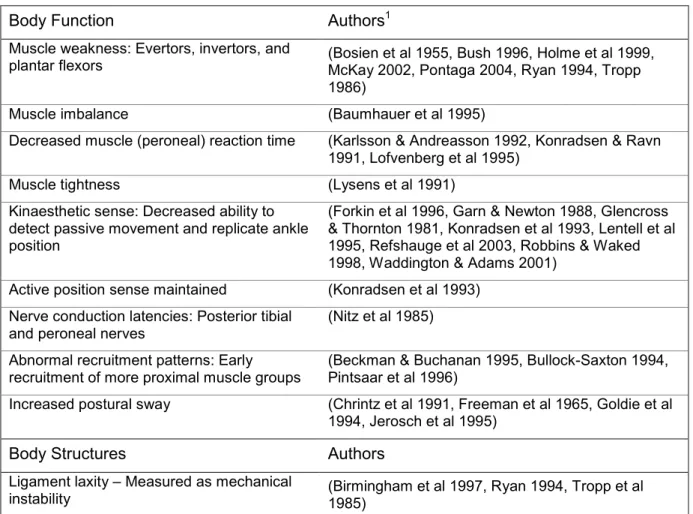
Body functions and structures relate to the physiological functions of body systems and anatomical parts of the body (World Health Organisation 2001). Physiotherapists must identify impairments of body functions and structures that arise after ankle sprain (Table 1). Physiotherapy management of ankle injuries should aim to improve impairments to minimise the impact of ankle injury on the body’s functions and structures.
APA Evidence- based
Clinical Statement
Table 1. Impairments of body function and structure demonstrated following ankle sprain.
Body Function Authors1
Muscle weakness: Evertors, invertors, and
plantar flexors (Bosien et al 1955, Bush 1996, Holme et al 1999, McKay 2002, Pontaga 2004, Ryan 1994, Tropp
1986)
Muscle imbalance (Baumhauer et al 1995)
Decreased muscle (peroneal) reaction time (Karlsson & Andreasson 1992, Konradsen & Ravn
1991, Lofvenberg et al 1995)
Muscle tightness (Lysens et al 1991)
Kinaesthetic sense: Decreased ability to detect passive movement and replicate ankle position
(Forkin et al 1996, Garn & Newton 1988, Glencross & Thornton 1981, Konradsen et al 1993, Lentell et al 1995, Refshauge et al 2003, Robbins & Waked 1998, Waddington & Adams 2001)
Active position sense maintained (Konradsen et al 1993)
Nerve conduction latencies: Posterior tibial and peroneal nerves
(Nitz et al 1985) Abnormal recruitment patterns: Early
recruitment of more proximal muscle groups
(Beckman & Buchanan 1995, Bullock-Saxton 1994, Pintsaar et al 1996)
Increased postural sway (Chrintz et al 1991, Freeman et al 1965, Goldie et al
1994, Jerosch et al 1995)
Body Structures Authors
Ligament laxity – Measured as mechanical
instability (Birmingham et al 1997, Ryan 1994, Tropp et al 1985)
1
This list of authors may not include every study that has shown impairments to body functions and structures, but should provide sufficient evidence to verify their existence.
Muscle impairments
The relationships between different muscle impairments are complex. Konradsen and Ravn (1991) showed that decreased peroneal reaction time was highly correlated to postural sway (Spearman’s rho = 0.92). Postural sway has a low correlation with muscular strength (Tropp 1986) and with tests of dynamic and static balance (Nakagawa & Hoffman 2004). Fatigue of the ankle plantar-flexors and dorsi-flexors significantly increased postural sway (Lundin et al 1993). Willems et al (2005) reported that men with decreased reaction time in the tibialis anterior muscle and the gastrocnemius muscle were more likely to sprain their ankle. The interaction between muscle impairments and ankle sprain requires further investigation.
Ankle range of movement
There is some disparity regarding ankle range of movement and the risk of ankle sprain. Willems et al (2005) showed that men with decreased dorsiflexion range of movement with a straight knee were at greater risk of ankle sprain. This contrasts with
APA Evidence- based
Clinical Statement
Baumhauer et al (1995) conducted pre-season screening and found those who injured their ankle during the season had significantly greater subtalar inversion range of movement (20.3 ± 4.10) than the non-injured group (19.0 ± 3.40). Two other studiesreport that general ankle joint laxity is not associated with increased risk of ankle sprains (Baumhauer et al 1995, Wiesler et al 1996).
Joint position sense
Disparity exists about the relationship between joint position sense and the risk of ankle sprain. In basketball players, Payne et al (1997) showed that joint position sense was a risk factor for ankle sprain. In contrast a recent study reported no association between joint sense and ankle injury (Willems et al 2005).
Instability
There appears to be poor correlation between clinical instability and functional instability (Mann et al 2002b, Rechtime et al 1982). Furthermore, clinical instability is often absent in athletes with recurrent ankle injuries (Birmingham et al 1997, Ryan 1994, Tropp et al 1985).
Activity limitations
Activity limitations are difficulties that an individual may have in executing a task or action (World Health Organisation 2001). There appears to be a growing body of evidence of bilateral activity limitations following ankle injury (Beckman & Buchanan 1995, Bullock-Saxton 1994, Friden et al 1989, Konradsen et al 1991, McKay 2002, Pintsaar et al 1996). Whether bilateral performance deficits preceded the ankle injury (Friden et al 1989, Holme et al 1999, McGuine et al 2000, Tropp et al 1984) or are consequent to ankle injury (Beckman & Buchanan 1995, Bullock-Saxton et al 1994, Pintsaar et al 1996) is unknown.
Diagnosis of activity limitations
Activity limitations are examined with functional or performance tests, and can be used to evaluate the progression of rehabilitation programs (Davies & Matheson 2002). The performance test most commonly used in physiotherapy practice is the single leg stance test. During this test, visual judgements of postural steadiness and the number of touchdowns of the non-weight-bearing leg are made. Evidence shows that the test can distinguish the difference between injured and uninjured ankles (Chrintz et al 1991, Freeman et al 1965, Goldie et al 1994, Jerosch et al 1995).
The single leg stance test examines the body’s ability to remain steady over a small base of support (static balance). This type of balance differs from the more dynamic balance required in the sporting arena (McKay 2002). Tests of dynamic balance have been developed. The maximal wide hopping test is a valid and reliable test for examining activity limitations following ankle injury (McKay 2002). The lower extremity functional test described by Davies and Matheson (Davies & Matheson 2002) has been shown to be valid and reliable for final stage functional testing. The time to stabilise from a single leg landing test (50–55% of maximum vertical jump height) is also valid in detecting functional instability of the ankle (Ross & Guskiewicz 2004).
Other functional performance tests have been shown not to be valid in detecting activity limitations following ankle sprain. These tests include agility hops (Demeritt et al 2002), the triple-crossover hop for distance (Munn et al 2002) and the shuttle run (Demeritt et al 2002, Munn et al 2002).
APA Evidence- based
Clinical Statement
Other performance tests such as the ankle functional testing algorithm, the static and dynamic fastex tests, the functional standing long jump, and hop tests appear to be based on clinical experience rather than on evidence (Davies & Matheson 2002). Contextual factors
Contextual factors represent the complete background of an individual’s life and living. They include personal and environmental factors that may have an impact on the individual with the health condition such as ankle sprain (World Health Organisation 2001).
Personal factors
Many of the personal factors that may increase the risk of recurrent ankle injury are outside of the control of the physiotherapist. These risk factors investigated in prospective studies or associations evident in cross-sectional studies include a history of ankle injury, height and weight, limb dominance, anatomic foot type, gender, age and level of competition (see Appendix). Although the history of ankle injury as a risk factor is also beyond a physiotherapist’s control, physiotherapists can implement preventive strategies to minimise recurrent ankle injuries.
Some other personal factors may be somewhat in the control of the physiotherapist. A prospective study has shown that male subjects with a slower running speed (on the shuttle run) and decreased respiratory fitness were at increased risk of ankle injury. Furthermore, men with decreased concentric contraction measured isokinetically at 300/sec were at greater risk of ankle sprain (Willems et al 2005). Poor physical condition has also been shown to be a risk factor for injury (Lysens et al 1991) Potentially, physiotherapists may educate and plan a program to improve the physical condition of those at high risk of ankle injury.
Environmental factors
Environmental factors associated with managing an ankle injury prevention program include the use of external ankle support (ankle braces and tape), shoe selection, functional rehabilitation, and stretching.
External ankle support
External ankle support includes ankle braces and ankle tape. These are used extensively in the sporting arena for their perceived ability to prevent ankle sprain.
Ankle braces
Four systematic reviews analysing between five and 14 RCTs have concluded that ankle braces decrease the incidence of ankle injuries (Handoll et al 2001, Quinn et al 2000, Thacker et al 1999, Verhagen et al 2000).
Handoll et al (2001) conducted meta-analysis using 14 RCTs (8279 participants). They reported a reduction in the number of ankle sprains with the use of external ankle braces (RR 0.53, 95%CI 0.40 to 0.69). This reduction was greatest in those with a history of ankle sprain (RR 0.33, 95%CI 0.20 to 0.53). A non-significant result was reported for those who did not have a history of ankle sprain (RR 0.73, 95%CI 0.52 to 1.03). They concluded that there is good evidence that ankle braces provide protection for athletes involved in sporting activities considered to be at high risk for ankle injuries.
APA Evidence- based
Clinical Statement
The duration an ankle brace needs to be worn to prevent an ankle injury has been investigated in a systematic review (Olmsted et al 2004). Olmsted et al (2004) calculated the numbers-needed-to-treat statistic from the data from Sitler et al (1994) and concluded that for one ankle sprain to be prevented in a single basketball season in athletes with a history of sprain, 18 ankles would need to be braced. In athletes without a history of sprain, to prevent a single ankle sprain, 39 basketball players would need to wear a brace. Olmsted et al (2004) also used the data from Surve et al (1994) and concluded that for one ankle sprain to be prevented in a single soccer season in athletes with a history of sprain, five players would need to be braced. For those without a prior injury, to prevent a single ankle sprain 57 soccer players would need to be braced.
Olmsted et al (2004) also conducted cost-benefit analysis for ankle braces and tape. They concluded that ankle taping would be 3.05 times more expensive as bracing over the course of a competitive season. For example, using the results of Surve et al (1994), taping five athletes with a history of sprain was estimated to cost US$453, whereas bracing these athletes would cost US$175. To tape 57 athletes with no history of ankle sprain would cost US$6091, whereas bracing would cost US$1995.
There appears to be no gradient of protection for more severe injuries (Handoll et al 2001). This study demonstrated that the protective effect of ankle braces was similar for both mild (grade I) sprains (RR 0.37, 95%CI 0.21 to 0.66) and more severe (grade II/III) sprains (RR 0.57, 95%CI 0.41 to 0.80). The homogeneity of the results suggests that which external ankle brace is used is less important than whether it is used at all (Handoll et al 2001).
A systematic review investigated the effects of external ankle support (adhesive tape, lace-up brace, and semi-rigid style) on lower extremity functional performance measures (Cordova et al 2000). Seventeen RCTs were included in the analysis. The greatest effect of ankle support on performance was a negative effect of the lace-up style brace on sprint speed (effect size –0.22, 90%CI –0.47 to 0.03), equivalent to approximately 1% impairment of speed. The other effects of external ankle support on performance were insubstantial. Cordova et al (2000) concluded that the benefit in preventing injury outweighed the possibility of a small impairment of performance when using external ankle support.
Ankle tape
Handoll et al (2001) noted there was insufficient information on the role of ankle tape in reducing the incidence of ankle injury. No studies were located in the literature where the sole aim of the study was to assess the effectiveness of ankle tape in preventing ankle injury. This is despite ankle tape being commonly used by sports people. Studies reporting the effectiveness of ankle tape have used other preventive measures in their intervention program, such as balance-board training (Hawkins 1982, Tropp et al 1985), rehabilitation (Ekstrand et al 1983), and varying cuts of shoes (Garrick & Requa 1973, Rovere et al 1988).
APA Evidence- based
Clinical Statement
Shoes
High-cut shoes
In a systematic review, Handoll et al (2001) concluded that the protective effect of high-cut shoes has not been established. In basketball, high-high-cut shoes were advocated following a study that reported the lowest rate of ankle injury in players wearing the combination of high-cut shoes and ankle tape (Garrick & Requa 1973). However, the specific roles of the shoe and the ankle tape are unclear. More recent evidence suggests that the cut of shoe worn does not affect the incidence of ankle injuries (Barrett & Bilisko 1995).
Air Cells in heels of basketball shoes
One study using a multivariate analysis reported that basketball players wearing the most expensive shoes which had air cells in the heel were 4.8 times more likely to injure their ankle than those wearing the least expensive shoes (McKay et al 2001). This may be due to impaired ankle movement discrimination when subjects wear shoes compared to bare feet (Robbins & Waked 1998).
Insoles for shoes
Waddington and Adams (2003) reported that when textured insoles replaced the smooth insoles in the shoes of female soccer players the ankle discrimination was restored back to the barefoot levels. However insoles did not improve injury rates, Bensel (1986) compared cushioning insoles with standard insoles and a control group, and there were no statistically significant differences in injury rates between the three groups (RR 0.74, 95%CI 0.37 to 1.48).
Functional rehabilitation
Three systematic reviews show that rehabilitation following ankle injury is effective in reducing the incidence of ankle sprains (Handoll et al 2001, Thacker et al 1999, Verhagen et al 2000). Verhagen et al (2000) reported that proprioceptive training decreased the incidence of ankle sprains in athletes with recurrent sprains, to the same level as those without a history of ankle sprains. Thacker et al (1999) concluded that ankle-injured athletes should undergo a supervised rehabilitation program before returning to practice or competition. In addition, one systematic review investigated if supervised rehabilitation gave better outcomes than conventional treatment (van Os A G et al 2005). This review concluded that supervised exercises resulted in greater reduction of swelling and faster return to work.
The minimum content of a rehabilitation program that would result in the prevention of an ankle injury remains unclear. Thacker et al (1999) stated “whether general or targeted training will reduce ankle injury rates awaits better research”. In a systematic review, Handoll et al (2001) concluded that although ankle disc training alone produced a reduction in the number of recurrent ankle injuries, the reduction did not reach statistical significance (6/24 versus 13/24; RR 0.46, 95%CI 0.21 to 1.01). Ankle disc training in those with a history of ankle injury was compared with a control group in one study (Tropp et al 1985), and there was a significant reduction in the number of ankle sprains in the intervention group (RR 0.28, 95%CI 0.13 to 0.62) (Handoll et al 2001). Handoll et al (2001) also reported that functional activities resulted in significantly fewer ankle sprains compared to a control group in the Wedderkopp et al (1999) study (RR
APA Evidence- based
Clinical Statement
0.30, 95%CI0.13 to 0.70) and in the Holme et al (1999) study (2/29 vs 11/38; RR 0.24, 95%CI 0.06 to 0.99).The optimal duration of a rehabilitation program also remains unclear. Studies that have shown a reduced incidence of ankle injuries have implemented rehabilitation programs varying from 10 weeks (Hawkins 1982, Tropp et al 1985) to 10 months (Wedderkopp et al 1999).
Verhagen and colleagues (2005b) evaluated the cost effectiveness of a proprioceptive balance board training program for the prevention of ankle sprains in volleyball. The authors found that the total costs (direct and indirect) per player were significantly higher in the intervention group. However, further analysis suggested that using a balance program in those with a previous history of ankle sprains could be cost effective over the longer term.
There are a number of studies that have investigated the effect of balance training or functional rehabilitation on measures of muscle timing of postural sway. These have not been reviewed as the effect of these changes on injury incidence is not known (Clark & Burden 2005, Verhagen et al 2005a).
Stretching as part of warm-up
One systematic review investigated the role of stretching in reducing the incidence of ankle injuries (Handoll et al 2001). They analysed two RCTs using calf stretching (Pope et al 1998) and complex (six leg muscles including the calf muscles) stretching (Pope et al 2000) during warm-up compared with control groups. There was no statistically significant difference between the stretching and control groups in the number of ankle sprains sustained (calf stretching 11/549 vs 16/544; RR 0.68, 95%CI 0.32 to 1.45; complex stretching 19/735 vs 27/803; RR 0.77, 95%CI 0.43 to 1.37).
One study has reported on the benefits of stretching in ankle injury prevention. McKay et al (2001) documented that basketball players who did not stretch were 2.7 times more likely to injure their ankle than players who performed stretches.
Predictive validity of tests used for screening purposes
Until recently, the only test that has been shown to be valid and reliable for predicting ankle injury is the single leg stance test using force plates to quantify postural sway (McGuine et al 2000, Tropp et al 1984). Using this laboratory-based test, basketball players with poor single leg balance (high postural sway scores) had nearly seven times as many ankle sprains as players with good balance (low postural sway scores) (McGuine et al 2000). Similarly, soccer players with abnormal postural sway recordings had a 42% risk of ankle injury in the following season compared to 11% for those with normal postural sway recordings (Tropp et al 1984). This test was predictive of ankle injury regardless of whether there was a presence or absence of previous ankle sprain. The flamingo balance test is a clinic-based version of the single leg stance test (on a beam) that has recently been reported to predict ankle sprains (Willems et al 2005). The score on the flamingo test for the injured group (9.40 ± 4.95) was higher than the uninjured group (7.57 ± 3.64). The score reflects a higher number of attempts to keep balance on the beam for one minute.
APA Evidence- based
Clinical Statement
Physiotherapy management in the prevention of new ankle injuries The majority of the literature addressing the prevention of ankle injuries investigated ankle injuries regardless of whether the injury is recurrent or a new (first time) injury. Only one systematic review noted results for previously uninjured athletes (Handoll et al 2001). The use of an ankle brace did not significantly reduce the risk of ankle injury in those who did not have a history of ankle sprain (RR 0.73, 95%CI 0.52 to 1.03). The screening test described by Tropp et al (1984) and McGuine et al (2000) (see above section) found that the relationship between poor single leg balance (high postural sway scores) and ankle injury occurred regardless of the presence or absence of previous ankle sprain.
Referral for reconstruction in the management of grade III ankle injuries As reported earlier, for acute ankle injuries there is no evidence to suggest that surgical treatment is better than conservative treatment (Kerkhoffs et al 2002b). For sub-acute or chronic ankle injuries, no systematic reviews or RCTs were located that investigate guidelines on when to refer a grade III ankle sprain for surgical reconstruction. Therefore, current guidelines appear to be based on clinical experience rather than on evidence. These guidelines suggest that when chronic mechanical instability coexists with chronic functional instability, despite quality functional rehabilitation programs, then surgical intervention should be considered (Nyska & Mann 2002).
One RCT was located that compared surgical and functional treatment of 370 patients with chronic mechanical instability (median of 8 years). The surgically treated group reported less giving way (RR 0.62, 95% CI 0.42 to 0.92), fewer recurrent sprains (RR 0.66, 95% CI 0.45 to 0.94) and fewer positive results of the anterior drawer test (RR 0.54, 95% CI 0.41 to 0.72) (Pijnenburg et al 2003).
APA Evidence- based
Clinical Statement
Appendix
Factors associated with an increased risk of ankle injury that are outside of physiotherapeutic management include both intrinsic and extrinsic factors.
Intrinsic factors
History of ankle injuryThe most frequently documented risk factor for ankle injury is the history of ankle injury (DuRant et al 1992, Ekstrand & Tropp 1990, Garrick & Requa 1973, Milgrom et al 1991). Athletes with a history of ankle injury were almost five times more likely to sustain an ankle injury compared to their previously uninjured counterparts (McKay et al 2001).
Height and weight
Three studies report that height and weight are not independent risk factors for ankle sprain (Beynnon et al 2001, McKay et al 2001, Sitler et al 1994). This contrasts the findings of Watson (1999) who noted that taller soccer players were at increased risk of ankle injury. Milgrom et al (1991) reports that taller and heavier army recruits were at greater risk of ankle injury compared to their shorter and lighter counterparts.
Limb dominance
Two studies report that limb dominance is not an independent risk factor for ankle injury (Beynnon et al 2001, Surve et al 1994). Two studies report significantly more ankle injuries to the dominant leg (Ekstrand et al 1983, Yeung et al 1994). Ekstrand et al (1983) noted that 92% of soccer players injure their dominant ankle. Yeung et al (1994) found that injuries to the dominant ankle occurred at a rate 2.4 times higher than to the non-dominant ankle. Baumhauer et al (Baumhauer et al 1995) found that athletes whose left leg was dominant were more likely to injure their ankle.
Anatomic foot type
Three studies report that anatomic foot type (pronated, supinated, or neutral) is not an independent risk factor for ankle injury (Barrett et al 1993, Beynnon et al 2001, Dahle et al 1991). However, the classification systems used by these studies may not be adequate, and further investigations should use specific and sensitive measurements of foot-contact mechanics (Beynnon et al 2001).
Verni et al (2002) reported a high correlation between anterior cavo-varus foot structure and the occurrence of re-injury. The rigid cavo-varus foot structure showed significant low compliance to ankle braces (Verni et al 2002) which may partly account for the ankle re-injuring.
Sex
Two studies report an increased risk for female athletes (DuRant et al 1992, Hosea et al 2000). However, Hosea et al (2000) found this increased risk only among the less serious grade I ankle injuries. DuRant et al (1992) did not report the gender-specific data or the results of their analysis. Three studies report a non-significant association between ankle injuries and gender (Beynnon et al 2005, Beynnon et al 2001, Payne et al 1997). Small samples of ankle injuries in these studies may mean differences in injury rates for gender may have been missed. The relationship between gender and the incidence of ankle injuries requires further clarification.
APA Evidence- based
Clinical Statement
Age
Age has been documented as a risk factor for ankle injury, with younger athletes being at greater risk (Leanderson et al 1993). A non-significant relationship between age and ankle injuries was reported by McKay et al (2001).
Extrinsic factors
Level of competitionThree studies report that the standard of competition played is not an independent risk factor for ankle injury (Beynnon et al 2005, McKay et al 2001, Yeung et al 1994). One study reported that the relative risk of ankle sprain for both males and females doubled as the level of competition increased from high school to college level (Harrer et al 1998 in Beynnon et al 2001).
Match play
The incidence of ankle injuries is reported to be higher in match play than in practices for volleyball (Bahr et al 1994, Yde & Nielsen 1990) and soccer (Surve et al 1994). This factor is beyond physiotherapeutic control.
Playing surface
Playing field surface has been suggested as a risk factor for ankle injury (Ekstrand & Nigg 1989, Levy et al 1990, Orchard & Powell 2003). Artificial turf has been suggested to increase the risk of ankle injury (Ekstrand & Nigg 1989, Orchard & Powell 2003). Orchard & Powell (2003) report that in American Football there is a reduced risk of ankle injury in natural grass stadiums compared to domes (indoor stadiums using Astro Turf) (RR 0.69 95%CI 0.66 to 0.91). For outdoor Astro Turf stadiums there was a reduced risk of ankle injury in cold weather compared to hot weather (RR 0.68 95%CI 0.51 to 0.91) in the same stadiums (Orchard & Powell 2003). This is most likely to be due to reduced shoe-surface traction (Orchard & Powell 2003).
Sport
Basketball was reported to increase the risk of ankle sprain in women and not men compared to lacrosse and soccer (Beynnon et al 2005).
Acknowledgement
We would like to thank Mr Tony Ward and Dr Andrew Garnham for their comments in the preparation of this evidence-based clinical statement.
APA Evidence- based
Clinical Statement
References
Anandacoomarasamy A and Barnsley L (2005): Long term outcomes of inversion ankle sprains. British Journal of Sports Medicine 39: e14.
Bachmann L M, Kolb E, Koller M T et al (2003): Accuracy of Ottawa ankle rules to exclude fractures of the ankle and mid-foot: Systematic review. BMJ 327: 417– 419.
Bahr R, Karlsen R, Lian O et al (1994): Incidence and mechanisms of acute ankle inversion injuries in volleyball. A retrospective cohort study. American Journal of Sports Medicine 22: 595–600.
Barrett J and Bilisko T (1995): The role of shoes in the prevention of ankle sprains.
Sports Medicine 20: 277–280.
Barrett J R, Tanji J L, Drake C et al (1993): High- versus low-top shoes for the prevention of ankle sprains in basketball players. A prospective randomized study. American Journal of Sports Medicine 21: 582–585.
Baumhauer J F, Alosa D M, Renstrom A F et al (1995): A prospective study of ankle injury risk factors. American Journal of Sports Medicine 23: 564–570.
Beckman S M, Buchanan T S (1995): Ankle inversion injury and hypermobility: Effect on hip and ankle muscle electromyography onset latency. Archives of Physical Medicine & Rehabilitation 76:1138–1143.
Bennell K L, Talbot R, Wajswelner H et al (1998): Intra-rater and inter-rater reliability of a weight-bearing lunge measure for ankle dorsiflexion. Australian Journal of Physiotherapy 44:175–180.
Bennett M, Best T M, Babul S et al (2005): Hyperbaric oxygen therapy for delayed onset muscle soreness and closed soft tissue injury. Cochrane Database of Systematic Reviews (Online) 4 (Art no. CD004713.pub2).
Bensel C, Kaplan D and Natrick M (1986): Wear test of boot inserts: Memorandum for the record. Natick, Massachusetts. United States Army Natick Research and Development Laboratories.
Beynnon B, Vacek P, Murphy D et al (2005): First time inversion ankle ligament trauma: The effect if sex, level of competition, and sport in the incidence of injury. American Journal of Sports Medicine 33: 1485–1491.
Beynnon B D, Renstrom P A, Alosa D M et al (2001): Ankle ligament injury risk factors: a prospective study of college athletes. Journal of Orthopaedic Research 19: 213–220.
de Bie R, Hendriks H, Lenssen A et al (1998): Guidelines for acute ankle sprains.
Nederlands Tijdschrift voor Fysiotherapie 108: 2–23.
Binkley J, Stratford P, Lott S et al (1999): The lower extremity functional scale (LEFS): Scale development, measurement properties and clinical application. Physical Therapy 79: 371–383.
Birmingham T B, Chesworth B M, Hartsell H D et al (1997): Peak passive resistive torque at maximum inversion range of motion in subjects with recurrent ankle inversions sprains. Journal of Orthopaedic & Sports Physical Therapy 25: 342– 348.
Bleakley C, McDonough S and MacAuley D (2004): The use of ice in the treatment of acute soft-tissue injury. A systematic review of randomised controlled trials.
American Journal of Sports Medicine 32: 251–261.
Bosien W R, Staples O S and Russell S W (1955): Residual disability following acute ankle sprains. Journal of Bone & Joint Surgery–American Volume 37-A: 1237– 1243.
Boyce S H, Quigley M A and Campbell S (2005): Management of ankle sprains: A randomised controlled trial of the treatment of inversion injuries using an elastic
APA Evidence- based
Clinical Statement
support bandage or an Aircast ankle brace. British Journal of Sports Medicine39: 91–96.
Brand R L, Black H M and Cox J S (1977). The natural history of inadequately treated ankle sprain. American Journal of Sports Medicine 5: 248–249.
Brostrom L (1966): Sprained ankles V. Treatment and prognosis in recent ligament ruptures. Acta Chirurgica Scandinavica 132: 537–550.
Brukner P and Khan K (2001): Clinical Sports Medicine (2nd ed.). Sydney: McGraw-Hill. Bullock-Saxton JE (1994): Local sensation changes and altered hip muscle function
following severe ankle sprain. Physical Therapy 74: 17–28; discussion 28–31. Bullock-Saxton JE, Janda V and Bullock MI (1994): The influence of ankle sprain injury
on muscle activation during hip extension. International Journal of Sports Medicine 15: 330–334.
Bush KW (1996): Predicting ankle sprain. Journal of Manual & Manipulative Therapy 4: 54–58.
Chrintz H, Falster O and Roed J (1991): Single-leg postural equilibrium test.
Scandinavian Journal of Medicine & Science in Sports 1: 244–246.
Clark KD and Tanner S (2003): Evaluation of the Ottawa ankle rules in children.
Pediatric Emergency Care 19: 73–78.
Clark V and Burden A (2005): A 4-week wobble board exercise programme improved muscle onset latency and perceived stability in individuals with a functionally unstable ankle. Physical Therapy in Sport 6: 181–187.
Collins N, Teys P and Vicenzino B (2004): The initial effects of a Mulligan's mobilisation with movement technique on dorsiflexion and pain in subacute ankle sprains.
Manual Therapy 9: 77–82.
Cordova ML, Ingersoll CD and LeBlanc MJ (2000): Influence of ankle support on joint range of motion before and after exercise: A meta-analysis. Journal of Orthopaedic & Sports Physical Therapy 30: 170–182.
Dahle LK, Mueller MJ, Delitto A et al (1991): Visual assessment of foot type and relationship of foot type to lower extremity injury. Journal of Orthopaedic & Sports Physical Therapy 14: 70–74.
Davies GJ and Matheson JW (2002): Functional testing as the basis for ankle rehabilitation progression. In Nyska G and Mann M (Eds): The Unstable Ankle
Champaign: Human Kinetics, pp 205–218.
Demeritt KM, Shultzt SJ and Docherty CL (2002): Chronic ankle instability does not affect lower extremity functional performance. Journal of Athletic Training 37: 406–412.
DuRant RH, Pendergrast RA, Seymore C et al (1992): Findings from the preparticipation athletic examination and athletic injuries. American Journal of Diseases of Children 146: 85–91.
Eisenhart AW, Gaeta TJ and Yens DP (2003): Osteopathic manipulative treatment in the emergency department for patients with acute ankle injuries. Journal of American Osteopathic Association 103: 417–421.
Ekstrand J, Gillquist J and Liljedahl SO (1983): Prevention of soccer injuries. Supervision by doctor and physiotherapist. American Journal of Sports Medicine 11: 116–120.
Ekstrand J and Nigg BM (1989): Surface-related injuries in soccer. Sports Medicine 8: 56–62.
Ekstrand J, Tropp H (1990): The incidence of ankle sprains in soccer. Foot & Ankle 11: 41–44.