Evidence-based Clinical Guidelines for stuttering
Leonoor Oonk1, Bert Bast2,3,4, Joeri van Ormondt2, Mark Pertijs1,5
1
University of Applied Sciences Utrecht, the Netherlands, 2 Dutch Stuttering Association, Demosthenes, 3 Dutch Stuttering Federation (NFS),4 International Stuttering Association (ISA), 5 European Clinical Specialization Fluency Disorders
What is an evidence based guideline?
Guidelines have become essential in clinical practice, be it for broken legs or psychosis. Such guidelines embody shared knowledge on a specific problem. Guidelines in speech and language therapy are not very common. Treatment may differ from therapist to therapist, be it based on differences in vocational training, clinical experience or preferences, or
otherwise. For example: Imagine a three year old child who starts to stutter. The parents consult a Speech and Language Therapist (SLT) and are advised to start therapy immediately. Reason: you should start young to get the best results. Suppose the parents, after having received this advice, move to another area and consult another SLT. This SLT advises to wait and see. In many young children, recovery from stuttering will occur naturally. Both SLTs may be correct in general terms, but the parents are confused.
Guidelines are valuable tools for speech therapists, fluency specialists, educational institutions and health care providers who work with people who stutter and for people who stutter and their families. They can help to improve the quality of care and minimize undesirable differences in treatment and management of PWS.
An Evidence-based clinical guideline is a document with recommendations. An example of one of our recommendations:
“The treatment of children who begin to stutter before the age of four, should start before they become five years of age.”
Such recommendations are based on a systematic review of scientific research, as well as a critical appraisal of the evidence available and an assessment of the benefits and harms of alternative care options (Graham R, Mancher M, Wolman DM, Greenfield S, Steinberg E, editor(s). Clinical practice guidelines we can trust. Washington (DC), http://www.iom.edu/Reports/2011/Clinical-Practice-Guidelines-We-Can-Trust/Standards.aspx.
In the Netherlands, we have recently developed an evidence-based guideline for stuttering. Development of the Dutch evidence-based clinical guideline for stuttering
Participants
The Dutch guideline for the treatment and management of developmental stuttering has been created by a working group of ten participants, consisting of SLTs (1), SLTs specialized in fluency disorders (5) and PWS (2), in cooperation with experts(2) of the CBO, an independent Dutch institute
for healthcare improvement which is specialized in the methodology and techniques underlying the development of guidelines (www.CBO.nl ).
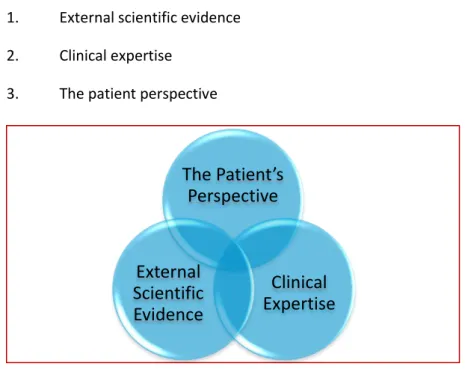
We have been working with representatives from various backgrounds to guarantee that the three elements of evidence-based practice were properly represented.
These three elements are
1. External scientific evidence 2. Clinical expertise
3. The patient perspective
Figure 1: The three elements of evidence-based practice
All three elements are important in the decision making process in clinical practice. Therefore they are relevant in making decisions about recommendations of the care concerning stuttering. The patient perspective is an important factor to be taken into account when the benefits and harms of different care options are being assessed.
To increase public support for the guideline, two additional groups were involved:
1. The advisory group (n=7). This group consisted of professional associations involved with PWS such as general practitioners, specialists, teachers and psychologists. They played an important role during the problem analysis and during the external review stage.
2. The focus group (n=11); a group of PWS and parents of Children Who Stutter (CWS). They also played an important role during the problem analysis and gave in depth information about the way they experience stuttering health care.
Questions
A survey was held amongst SLTs, stuttering specialists and PWS and their parents, to find out more about the existing problems in the care for PWS. Also the advisory group was consulted and a focus
The Patient’s
Perspective
Clinical
Expertise
External
Scientific
Evidence
group meeting was organized. The results of the survey and the focus group meeting have led to the following questions, to be answered in the guideline:
1. When should therapy begin for young children who start to stutter?
2. What are the validity and the reliability of the diagnostic instruments for stuttering? 3. What is the effect of stuttering therapy in preschool children?
4. What is the effect of stuttering therapy in school-aged children? 5. What is the effect of stuttering therapy in adolescents and adults?
6. When should an SLT consider referral of the patient to another specialist? 7. How to organize maintenance/follow-up therapy?
Grading the scientific evidence
When starting the Dutch Clinical Guideline (Pertijs et al, 2014) we decided not just to update pre-existing ones (as these from USA, GB and Canada) because all were over seven years old. Instead, we started over again, which enabled us to introduce the recent technique Grading of
Recommendations Assessment Development and Evaluation (GRADE) Working Group approach (Guyatt et al., 2008). This method enables to utilize different sources of knowledge according to their intrinsic scientific strength. GRADE classifies the quality of evidence as high, moderate, low or very low. The quality of evidence reflects the extent of our confidence that the estimates of the effect of therapy are correct. If the evidence is evaluated “high” then we are very confident that the true effect lies close to that of the estimate of the effect. If the evidence is evaluated ‘low” our confidence in the effect estimate is limited: The true effect may be substantially different from the estimate of the effect. Various sources (publications, commonly adopted best clinical practice etc.) will be awarded with a specific level (ranging from very low to high). GRADE however allows the quality of evidence to be upgraded or downgraded, depending on the details of the design and execution of the studies. For example, consideration is given to the magnitude of the effect, the risk of bias, study limitations and consistency of the results. Based on that, the quality of the evidence can be upgraded or downgraded in its ultimate ranking1.
From Evidence to recommendation
Besides the quality of the evidence other aspects are also taken into account. E.g.: concerning diagnostic instruments, we examined the validity and reliability of the instruments. But we also discussed issues like: What are the benefits of working with this instrument, what are the
disadvantages, what are the costs, what is the impact on the PWS? The working group weighed all such issues and the conclusion is reflected in the strength of the recommendation.
1
For more information about search strategy , inclusion and exclusion criteria e.g. , see original guideline document p142-144 on http://nvlf.logopedie.nl/site/inhoudelijke_richtlijnen, or www.nedverstottertherapie.nl
An example of a weak recommendation is the recommendation on therapy in school-aged children. The research on the effect of stuttering therapy in school-aged children is limited and the quality of the evidence was rated as low. Our recommendation therefore is weak and not very specific:
“The treatment of stuttering children between the ages of 6 and 13 years should preferably be based on a treatment plan that contains all elements of the International Classification of Functioning Disability and Health (ICF) model. Therapy should focus on stuttering behaviours, emotions and/or cognitions, and should depend upon assessment findings. The parents and the child who stutters should consent to the treatment plan.”
When a recommendation is weak, clinicians and clients need to devote more time to the process of shared decision-making by which they ensure that the informed choice reflects individual values and preferences.
An example of a stronger recommendation is the recommendation on therapy to children under 6 years of age. Here we recommend to either use the Lidcombe Program (Onslow, Packman & Harrison, 2003) or treatment based on the Demands and Capacities Model (DCM) (Starkweather & Gottwald, 1990). The effect of the Lidcombe Program is found to be large and the quality of the evidence was rated as moderate. The effect of treatment based on the DCM model has shown similar results.
“Discuss with the parents of children who stutter up to six years of age the benefits of stuttering treatment versus no treatment option (reduction of percentage stuttered syllables and stuttering severity). Explain the differences between the 'Lidcombe program' and treatment based on the 'Demands and Capacities Model’. Come to a shared decision with the parents which of the two approaches is preferred.”
The importance of the evidence based guideline for SLTs
The current guideline has been written to ensure broad acceptance within the field, and in the Dutch implementation, clinicians should know how to use these guidelines. Therefore basic education about how to interpret and use the guideline will be increased. In this sense, basic education of SLTs will also be increased, enabling easier cooperation within the profession and easier communication with society at large. Guidelines don’t represent a rule box, but rather a tool box. SLTs should learn to take decisions based upon the recommendations from this guideline. SLTs may deviate from any recommendation based on their own clinical experience and responsibility, but they must discuss that with the client (shared decision making) and they must document such a possible different choice in their case reports.
The importance of the evidence based guideline for PWS
Clients are using clinical guidelines increasingly to understand and to make decisions regarding their health (Loudon et al., 2014). Clients do need information that fits their needs to make more informed health choices. Productive interactions between the (informed) patient and the health care
professional have been shown as a key component of good care. Clinical guidelines that increase self-management will help the client to become better at his problem-solving skills, to become less dependent of a healthcare professional, to participate more in society, getting a higher quality of life.
Furthermore, the informed client will be more motivated in following therapy, more satisfied, loyal and the interaction is more productive (Légare et al., 2011).
The above mentioned evidence-based clinical guideline for stuttering has been rewritten in a second version especially for PWS. A specific study one of us performed to that end showed that this client’s version could stimulate the understanding of PWS, which resulted in an increase in self-management and an improved quality of life (Ormondt, 2015).
International Cooperation
Within the Netherlands we have experienced a burst of new activities and better understanding in and within various groups partaking in the process of guideline development and implementation. As mentioned above, the Dutch guideline is the most recent one and the only one based on generally acceptable GRADE criteria. We, therefore, have been asked to make this guideline available in English, and that process is almost finished. Of course specific (national) factors have to be taken into account, such as organization of health care and basic financial means, which do differ between various countries in the world. Still, by aiming for, writing and implementing such guidelines, well informed clinical practice will reach more and more clients for the common good.
We propose that to be a worldwide action, supervised by the IFA, and followed carefully by the ISA. References
Guyatt, G.H., Oxman, A.D., Gunn, E.V., Kunz, R., Falck-Ytter, Y. & Schünemann, H.J.(2008). GRADE: what is “quality of evidence” and why is it important to clinicians? British Medical Journal, 336, 995-998.
Légaré, A.B., Weijden, T. van der, Pakenham, C., Burgers, J., Légaré, J., St-Jacques, S., Gagnon, S. (2011). Patient and public involvement in clinical practice guidelines: A knowledge synthesis of existing programs. Medical Decision Making, 31, E45-E74.
Loudon, K., Santesso, N., Callaghan, M., Thornton, J., Harbour, J., Graham, K., Harbour, R., Kunnama, I., Liira, H., McFarlane, E., Ritchie, K., Treweek, S. (2014). Patient and public attitudes to and
awareness of clinical practice guidelines: a systematic review with thematic and narrative syntheses. BMC Health Services Research, 14, 321-334.
Onslow, M. Packman, A. Harrisson, E. (2003). The Lidcombe Program of Early Stuttering Intervention: A Clinicians’s Guide. Austin. Texaz: Pro-ed.
Ormondt, J van. (2015). Zelf-management bij stotteren door patiënteninformatie, Bachelor thesis, Hanze University for Applied Sciences, Groningen.
Pertijs, M.A.J., Oonk, L.C., Beer, de J.J.A., Bunschoten, E.M., Bast, E.J.E.G., Ormondt, van J., Rosenbrand, C.J.G.M., Bezemer, M., Wijngaarden, van L.J., Kalter, E.J., Veenendaal, van H. (2014).
Evidence-based Richtlijn Stotteren bij kinderen, adolescenten en volwassenen. Nederlandse Vereniging voor Logopedie en Foniatrie, Woerden.
Starkweather, C.W., Gottwald S.R. (1990). The demands and capacities model II: Clinical applications.