Human Action Recognition Using
Deep Probabilistic Graphical
Models
Di Wu
Department of Electronic and Electrical Engineering
The University of Sheffield
A thesis submitted for the degree of
Doctor of Philosophy
Declaration
Parts of this report have been included in the following papers:
D. Wu, L. Shao, ”Deep Dynamic Neural Networks for Gesture Segmentation and Recognition”. In ECCV ChaLearn workshop 2014, Zurich (accepted).
D. Wu, L. Shao, ”Multimodal Dynamic Networks for Gesture Recognition”. In ACM Multimedia (MM) 2014, Orlando, USA (accepted).
D. Wu, L. Shao, ”Leveraging Hierarchical Parametric Network for Skeletal Joints Action Segmentation and Recognition”. In CVPR 2014, Columbus, USA.
L. Shao, D. Wu and X. Li, Learning Deep and Wide: A Spectral Method for Learning Deep Networks, In IEEE Transactions on Neural Networks and Learning Systems, 2014, doi: 10.1109/TNNLS.2014.2308519.
D. Wu, L. Shao, ”Multi-Max-Margin Support Vector Machine for Multi-Source Human Action Recognition”. Neurocomputing, vol. 127, pp. 98-103, Mar. 2014.
D. Wu, L. Shao,H. Zhang, ”One Shot Learning Gesture Recognition with Kinect Sensor”. ACM International Conference on Multimedia (MM), Nara, Japan, 2012.
D. Wu, F. Zhu, and L. Shao. ”One shot learning gesture recognition from RGBD images”. In IEEE Conference on CVPR 2012 workshop on gesture recognition (oral), Rhode Island.
D. Wu and L.Shao, Silhouette Analysis Based Action Recognition via Exploiting Human Poses, IEEE Transactions on Circuits and Systems for Video Technology, vol. 23, no. 2, pp. 236-243, Feb. 2013.
L. Shao, D. Wu and X. Chen, Action Recognition Using Correlogram of Body Poses and Spectral Regression, IEEE International Conference on Image Processing (ICIP), Brussels, Belgium, September 2011.
Acknowledgements
First I would like to thank my advisor Ling Shao for his dedications towards work, professionalism, and allowing me to freely pursue and explore the field of computer vision and machine learning. I am indebted to Chris Mower for his proofreading of this thesis. His dedication far surpasses my expectation and makes the revision process fun and enjoyable.
My thanks also go to my lab mates. It was very enlightening and entertaining working with Simon Jones whom I am constantly in awe of his programming skill sets and his broad interests in the field of machine learning. I would also like to express my thanks to Li Liu for all the refreshing conversations, Fan Zhu for the fun project in the year of 2012, Ruomei Yan for her witty insights and Bo Dong for his kind assistance.
My research life highlight should be the 3 months spent in Mi-crosoft Research Cambridge where I was fortunate to meet some of the most talented minds and make acquaintance with some incred-ible friends. I am very grateful for my mentors Ben Glocker and Antonio Criminisi for their hugely positive and enriching work-ing environment. Durwork-ing the development of the project, I ben-efited a lot working with Ben from the pair-coding, model visu-alization and slides presentation. I also thank Jakov Vogel, Joeri de Ruiter, Katja Hofmann, Matteo Venanzi, Martin Kiefel, Bhaskar Mitra, who, apart from being amazing intellectuals, make daily re-search a very fun job.
At last, I would like to thank my parents for their unfailing support, mutual respection and unconditional love.
Abstract
Building intelligent systems that are capable of representing or ex-tracting high-level representations from high-dimensional sensory data lies at the core of solving many A.I. related tasks. Human ac-tion recogniac-tion is an important topic in computer vision that lies in high-dimensional space. Its applications include robotics, video surveillance, human-computer interaction, user interface design, and multi-media video retrieval amongst others.
A number of approaches have been proposed to extract represen-tative features from high-dimensional temporal data, most com-monly hard wired geometric or bio-inspired shape context features. This thesis first demonstrates somead-hochand-crafted rules for ef-fectively encoding motion features, and later elicits a more generic approach for incorporating structured feature learning and reason-ing,i.e.deep probabilistic graphical models.
The hierarchial dynamic framework first extracts high level fea-tures and then uses the learned representation for estimating emis-sion probability to infer action sequences. We show that better action recognition can be achieved by replacing gaussian mixture models by Deep Neural Networks that contain many layers of fea-tures to predict probability distributions over states of Markov Mod-els. The framework can be easily extended to include an ergodic state to segment and recognise actions simultaneously.
The first part of the thesis focuses on analysis and applications of hand-crafted features for human action representation and classifi-cation. We show that the “hard coded” concept of correlogram can incorporate correlations between time domain sequences and we
further investigate multi-modal inputs,e.g.depth sensor input and its unique traits for action recognition.
The second part of this thesis focuses on marrying probabilistic graphical models with Deep Neural Networks (both Deep Belief Networks and Deep 3D Convolutional Neural Networks) for struc-tured sequence prediction. The proposed Deep Dynamic Neural Network exhibits its general framework for structured 2D data rep-resentation and classification. This inspires us to further investigate for applying various graphical models for time-variant video se-quences.
Contents
Contents v
1 Introduction 1
2 Hand-crafted Features 6
2.1 Introduction and Related Works . . . 6
2.2 From Local to Global . . . 7
2.2.1 Bag-of-Correlated-Poses(BoCP). . . 9
2.2.1.1 Codebook Creation . . . 10
2.2.1.2 Soft Assignment Scheme . . . 11
2.2.1.3 Correlogram Of Poses . . . 12
2.2.1.4 Dimensionality Reduction . . . 13
2.2.2 Extended-MHI . . . 14
2.2.3 Experimental Results . . . 16
2.2.3.1 Parameter Sensitivity Test . . . 18
2.2.3.2 Visual Word Ambiguity Effect . . . 18
2.3 RGBD Images and One-Shot-Learning . . . 21
2.3.1 Experimental Results . . . 24
2.3.1.1 Preprocessing: Background Separation and Noise Reduction for Depth Images . . . 24
2.3.1.2 Temporal Segmentation . . . 25
2.3.1.3 Motion Descriptors and Scheme for Classifier . 26 2.3.1.4 Multiview Spectral Embedding (MSE) for Data Fusion . . . 30
CONTENTS
2.4 Discussion . . . 33
3 Deep Belief Dynamic Networks 35 3.1 Introduction . . . 35
3.2 Boltzmann machines . . . 36
3.2.1 Energy-Based Model . . . 36
3.2.1.1 EBMs with Hidden Units . . . 36
3.3 Restricted Boltzmann machines . . . 38
3.3.1 Gaussian Bernoulli Restricted Boltzmann machines . . . 39
3.4 Deep Belief Networks . . . 41
3.5 Deep Belief Dynamic Networks . . . 44
3.5.1 Methodology . . . 45
3.5.1.1 Problem formation . . . 46
3.5.2 Graphical Models . . . 48
3.5.3 ES-HMM: Simultaneous Segmentation and Recognition 50 3.6 Related Works . . . 53
3.7 Experimental Results . . . 54
3.7.1 ChaLearn Italian Gesture Recognition-Kaggle track . . . 57
3.7.2 MSR Action3D . . . 58
3.7.3 MSRC12 dataset . . . 59
3.8 Discussion . . . 60
4 Deep 3D Convolutional Dynamic Networks 62 4.1 Introduction . . . 62
4.2 Probabilistic Graphical Model Unification . . . 64
4.2.1 3D convolutional neural networks . . . 64
4.2.2 3DCNN Markov Field . . . 66
4.2.3 Inference . . . 70
4.2.3.1 Inference Library: libDAI . . . 71
4.3 Related Works . . . 72
4.4 Experimental Results . . . 73
4.4.1 Lipreading task . . . 73
CONTENTS
4.4.1.2 Transfer learning: . . . 75
4.4.1.3 Anchor point discovery: . . . 76
4.4.2 Depth sequence gesture recognition . . . 76
4.4.3 Looking into the filtered maps . . . 78
4.4.4 Computational complexity . . . 78
4.5 Discussion . . . 79
5 Multimodal Deep Dynamic Networks 80 5.1 Introduction . . . 80
5.2 Architecture . . . 82
5.3 Related Works . . . 83
5.4 Experiments . . . 84
5.4.1 Skeleton-Audio pair module . . . 84
5.4.1.1 Audio Features . . . 84
5.4.1.2 Skeleton Features . . . 85
5.4.1.3 Dynamic Networks Setup . . . 86
5.4.1.4 Results & Computational Complexity Analysis 87 5.4.2 Skeleton-Depth pair module . . . 88
5.4.2.1 Deep Learning Library: Theano & cuda-convnet 88 5.4.2.2 Skeleton Module . . . 89
5.4.2.3 Depth 3D Module . . . 91
5.4.2.4 Score Fusion . . . 94
5.5 Discussion . . . 95
6 Conclusion and Future Directions 101 Bibliography 105 Notation 118 Appendix 120 6.1 Details of the Dataset . . . 120
6.1.1 ChaLearn Italian Gesture Recognition . . . 120
CONTENTS
6.1.1.2 ChaLearn Looking At People (LAP) track 3 . . 120
6.1.2 ChaLearn Gesture One-shot-learning Recognition . . . . 121
6.1.3 MSR Action3D . . . 122
6.1.4 MSRC12 . . . 122
6.1.5 MSRGesture3D . . . 123
6.1.6 AVLetter Lipreading . . . 124
6.1.7 Weizmann . . . 124
6.1.8 Inria Xmas Motion Acquisition Sequences (IXMAS) . . . 124
6.2 Details of the Code . . . 126
6.2.1 Deep Belief Dynamic Networks . . . 126
6.2.2 Deep 3D Convolutional Dynamic Networks . . . 126
6.2.3 CBP and Extended-MHI . . . 126
6.2.4 One-Shot-Learning from RGBD Images . . . 126
Chapter 1
Introduction
In recent years, human action recognition has drawn increasing attention of re-searchers, primarily due to its growing potential in areas such as video surveil-lance, robotics, human-computer interaction, user interface design, and multi-media video retrieval.
Previous works on video-based motion recognition focused on adapting handcrafted features and low-level hand-designed features have been heav-ily employed with much success. These methods usually have two stages: an optional feature detection stage followed by a feature description stage. Well-known feature detection methods (“interest point detectors”) are Har-ris3D [1], Cuboids [2] and Hessian3D [3]. For descriptors, popular methods are Cuboids [4], HOG/HOF [1], HOG3D [5] and Extended SURF [3]. In a re-cent work of Wanget al.[6], dense trajectories with improved motion-based de-scriptors epitomized the pinnacle of handcrafted features and achieved state-of-the-art results on a variety of “in the wild” datasets. Given the current trends, challenges and interests in action recognition, this list would probably continue to spread out extensively.
In the evaluation paper of Wang et al. [7], one interesting finding is that there is no universally best hand-engineered feature for all datasets, suggest-ing that learnsuggest-ing features directly from the dataset itself may be more advan-tageous. Albeit hand-crafted features are still the dominant approaches for visual recognition tasks, the approaches that derive from the learning perspec-tives [8,9,10] are gaining more and more momentums.
With the recent resurgence of neural networks invoked by Hinton and oth-ers [11], deep neural architectures have been proposed as an effective solu-tion for extracting high level features from data. Deep artificial neural net-works (including the family of recurrent neural netnet-works) have won numer-ous contest in pattern recognition and representation learning. Schmidhu-ber [12] compiled a historical survey compactly summarising relevant works with more than 850 entries of credited works. Such models have been suc-cessfully applied to a plethora of different domains: the GPU-based cuda-convnet [13] classifies 1.2 million high-resolution images into 1000 different classes; multi-column Deep Neural Networks [14] achieve near-human perfor-mance on the handwritten digits and traffic signs recognition benchmarks; 3D Convolutional Neural Networks [15, 16] recognize human actions in surveil-lance videos; Deep Belief Networks combining with Hidden Markov Mod-els [17, 18] for acoustic and skeletal joints modeling outperform the decade-dominating paradigm of GMM+HMM. In these fields, deep architectures have shown great capacity to discover and extract higher level relevant features.
However, direct and unconstrained learning of complex problems is dif-ficult, since (1) the amount of required training data increases steeply with the complexity of the prediction model and (2) training highly complex mod-els with very general learning algorithms is extremely difficult. It is therefore common practice to restrain the complexity of the model and this is gener-ally done by operating on small patches to reduce the input dimension and diversity [10], or by training the model in an unsupervised manner [9], or by forcing the model parameters to be identical for different input locations (as in convolutional neural networks [13,14,15]).
Uncertainty is unavoidable in real-world applications, “as far as the laws of mathematics refer to reality, they are not certain, as far as they are certain, they do not refer to reality”(Albert Eistein, 1921). The Probabilistic Graphical Mod-els, which generally incorporate models from Bayesian Networks(directed graphs) and Markov Random Fields(undirected graphs), derive the ideas from discrete data structure from the computer science to effectively encode, decode, trans-fer uncertainties in high-dimensional variables. Graphical Representation is both intuitive and compact for a data structure, it induces efficient reasoning
using general-purpose algorithms. Furthermore, by introducing conditional reason, sparse parameterisations of the model can be achieved via feasible elic-itation or learning from data.
In this thesis, Deep Learning is represented by Probabilities Graphical Mod-els framework as a building block for modeling time series data. This thesis has two main parts. In the first part, some novel hand crafted features for hu-man action recognition are described. The second part of the thesis focuses on data driven analysis of acyclic video sequence labeling problems,i.e.video sequences are non-repetitive as opposed to longer repetitive activities,e.g. jog-ging, walking and running. With the immense popularity of Kinect [19], there has been renewed interest in developing methods for human gesture and ac-tion recogniac-tion from 3D skeletal data and depth images. A number of new datasets [20, 21, 22, 23] have provided researchers with the opportunity to design novel representations and algorithms and test them on a much larger number of sequences. The tasks of action recognition using 3D skeletal joints, at the first sight, seems trivial. However, due to the high dimensional space that 3D skeletal joints reside in and the amount of variation in human motion, the learning for the skeletal model requires latent states to empower the ex-pressiveness of the model. This thesis also discussed the tasks of continuous action recognition, which are the real world’s scenario and have been mostly ignored by researches. This thesis proposed a novel framework by introducing an ergodic states to achieve continuous action/gesture recognition.
Summary of Remaining Chapters
Chapter 2: Hand-crafted Features. This chapter describes hand crafted fea-tures for describing human actions in video sequences. A Bag-of-Correlated-Poses with soft-assignment scheme is proposed to encode the correlation within an action sequence. Later, the Motion History Images represen-tation is extended as a holistic descriptor to compensate the semi-local Bag-of-Correlated-Poses scheme. The one-shot-learning scenario for ges-ture recognition is also studied. The Multi-view Spectral Embedding is proposed to fuse the information from RGB and depth images. With
the appearance-based HOG temporal segmentation and extended-MHI as feature representation, the proposed system is able to recognize ges-ture token in an unsegmented video sequence.
Chapter 3: Deep Belief Dynamic Networks. This chapter starts solving the ac-tion recogniac-tion problem from a machine learning perspective. It be-gins with a brief technical overview of Restricted Boltzmann Machines (RBMs) from an energy-based model aspect. The Gaussian Bernoulli vis-ible layer for modeling real valued data is provided as the building block for Deep Belief Networks. The pre-training procedure for better initial-ization of the Deep Neural Networks and the learning hyper-parameters are also discussed. Then, a hierarchical dynamical framework that first extracts high level skeletal joints features is introduced for estimating the emission probability for the Hidden Markov Models in the place of Gaus-sian Mixture Models. The framework can also be easily extended to in-clude an ergodic state to segment and recognize actions simultaneously. It’s worth pointing out that the model has been designed with human ac-tion recogniac-tion using skeletal joints as input in mind, but it should also lend itself well to other high-dimensional time series.
Chapter 4: Deep 3D Convolutional Dynamic Networks. This chapter is built upon the powerful framework of Deep Convolutional Neural Network which achieves the state-of-the-art result in large scale image classifica-tion tasks. A Probabilistic Graphical Model unifies the Deep Neural Nets and Markov Field in a factor graph representation. A generalized hier-archical dynamic framework that first extracts high level features from contextual frames is proposed as the spatio-temporal learning represen-tation. The 3D Deep Convolutional Neural Network is driven directly by the objective function, negates the time and energy consuming human ef-fort in designing problem specific, sometimes suboptimal, hand crafted features. Experiments across various sensory input,i.e. RGB and depth, shows the Deep 3D Convolutional Dynamic Networks consistently per-form on par with a wide variety of handcrafted features and other learn-ing based methods.
Chapter 5: Multimodal Deep Dynamic Networks. This chapter unifies multi-modal dynamic networks from various sensory inputs. Two fusion pipelines,
i.e.early fusion and late fusion scheme are experimented and both exhibit the evidence that the multi-modal dynamic networks enables share rep-resentation learning, outperforming individual modalities. The 3D Con-vNet is also studied in more detail in this section and the visualization of the 3D ConvNet filters and the convolved spatio-temporal cuboids show that both shape pattern and motion pattern have been learnt by the 3D Deep ConvNet, reinforcing the conjecture that problem specific features could be learnt automatically.
Chapter 6: Conclusion and Future Directions. This chapter briefly summarises the contributions and discusses possible future research directions.
Chapter 2
Hand-crafted Features
2.1
Introduction and Related Works
This chapter describes the contributions for improving human action recog-nition by introducing frame-based correlation and multiview spectral embed-ding. The special case of one-shot-learning is also discussed.
Recent research has been local-feature focused. In their pioneering work, Dollar et al.[2] introduced an efficient approach for detecting spatio-temporal interest points (STIPs) using a temporal Gabor filter and a spatial Gaussian filter. Later, a number of other STIP detectors and descriptors have been pro-posed. The mainstream STIP detectors include Harris3D by Laptev et al.[24], Cuboid by Dollaret al.[2], 3D-Hessian by Willemset al.[25], Dense Sampling by Fei-Fei and Perona [26], Spatio-Temporal Regularity Based Feature (STRF) by Goodhartet al.[27]. And the mainstream STIP feature descriptors are HOG/HOF[24], HOG3D[28], Extended SURF[25] and MoSIFT[29]. The differences of various feature detectors and descriptors can be found in the survey paper [30]. Spatio-temporal features [2,24] have shown success for many recognition tasks when pre-processing methods such as foreground segmentation and tracking are not possible, e.g. in the Hollywood dataset [31] or the UCF sports dataset [32]. However, their computational complexity hinders their applicability in real-time applications. Wang et al. [7] showed that the average time for spatio-temporal feature extraction varies from 0.9 FPS to 4.6 FPS, which makes the
spatio-temporal interest points (STIPs) features too time-consuming in compu-tation. Another major limitation of the local feature based methods is that the sparse representation such as bag-of-visual-words (BoVW) discards geometric relationship of the features and hence is less discriminative. Hard-assignment quantization during the codebook construction for BoVW, which is usually realized by the k-means clustering algorithm, also makes the sparse represen-tation less informative.
A human action can be viewed as a set of sequential silhouettes over time. Each silhouette records a pose of this action at a particular instant. Davis and Bobick [33] found that a human action can be recognized even when it is pro-jected onto a single frame by incorporating partial time element. Gorelick et al. [34] treated human actions via silhouettes as three-dimensional shapes and the Poisson equation properties is adopted to obtain to space-time key features. Wang and Leckie [35] fused the global body shapes and local temporal motions from silhouettes and encoded human actions using the quantized dictionary from space-time windows. Shao and Chen [36] employed body poses sampled from silhouettes which are fed into a bag-of-features model. Similarly, Quet al.
[37] calculated the differences between frames and used them as intermediate features. Incorporating the local and holistic features, Sunet al. [38] unified the local 3D-SIFT descriptors and holistic Zernike motion energy image features.
2.2
From Local to Global
This section describes the contributions for improving human action recogni-tion by introducing frame-based correlarecogni-tion from local to global as follows:
1. Correlogram of human poses in an action sequence is introduced to en-code temporal structural information. We first extend the bag-of-features model to treat the silhouette in each frame as a feature. In the original bag-of-features representation, features are assigned to their closest clus-ter cenclus-ters, also called visual words, and an entire video sequence is rep-resented as an occurrence histogram of visual words. The traditional bag-of-features representation disregards structural information among the
visual words. To encode the structural information, Leibeet al. [39] pro-posed an implicit shape model using general Hough forest as a statistical method. We propose an explicit model to encode its temporal-structural information by constructing a correlogram which is a structurally more informative version of the histogram. The undesirable increase of di-mension is suppressed by two stages of didi-mensionality reduction, i.e., unsupervised principal component analysis (PCA) and supervised lin-ear discriminant analysis (LDA).
2. Soft-assignment scheme/kernel codebook is extended for circumventing the quantization error penalty. Traditional bag-of-features model desig-nates a feature by the cluster number it belongs to. And this hard as-signment scheme may incur penalty for its quantization error. Gemert
et al. [40] experimented four types of soft-assignment schemes for visual words encoding and demonstrated that explicitly modeling visual word assignment ambiguity improves classification performance compared to the hard-assignment of the traditional codebook model. Boureau et al.
[41] investigated the relative significance of mid-level features in every single step of the system pipeline through extensive experimentation and evaluation of different types of encoding schemes for object and scene recognition. The adoption of Mahalanobis distanceachieved the state-of-the-art performance for scene classification [42]. We extend their idea in our approach to maximize the preservation of information after the k-means clustering by assigning a feature proportionally according to its Mahalanobis distance to different cluster centers, so that a feature is no longer a discrete addition to the histogram bin but a continuous voting to multiple bins.
3. A holistic representation extension is proposed as a complimentary de-scriptor for local representation. As found by Sun et al. [38], local de-scriptors and global features emphasize distinctive aspects of actions and share complimentary properties. Motivated by their finding, we fuse the
Figure 2.1: Flowchart of theBoCPmodel. Note the two phases of dimensionality reduction and their corresponding methods.
above temporally local descriptor with an extension of the holistic de-scriptor: motion history image (MHI) by adding gait energy informa-tion (GEI) and inversed recording (INV). These two additional holistic descriptors serve as the compensation for the loss of information due to sequentially overlapping frames that is discarded in the original motion history image(MHI)representation. Then, a unified frame work is pro-posed to combine two distinct descriptors by early fusion (feature vector concatenation) and achieve further improvement over the separate meth-ods.
2.2.1
Bag-of-Correlated-Poses
(BoCP)
Fig.2.1shows the flowchart of the construction process for the bag-of-correlated-poses(BoCP)representation. An action sequence is a series of pictorial frames. Most current approaches [2, 24, 28, 34] bundle action frames together as a monocular 3D volume representation. Unlike traditional 3D volume repre-sentation, we treat each frame individually as an atomic input. The notion of body poses in our approach is represented by the silhouettes as in Fig.2.2. A bounding box, i.e. the smallest rectangle containing the human figure, is applied to each frame of the silhouette sequence and then is normalized to a fixed size. The prepossessing steps reduce the original dimension and remove global scale and translation variations. The interpolation during the normal-ization process suppresses the noise as the morphological transformations (di-lation and erosion) can isolate individual elements and join disparate elements in an image. The rectangular region of interest (ROI) mask serves as image uni-fication in each action frame, making recognition invariant to body size as well as scale and translation variations resulting from perspective changes.
Figure 2.2:Left: Illustration of the “cross arms” action; Right: A normalized silhouette.
2.2.1.1 Codebook Creation
The extracted normalized silhouettes are used as input features for the BoCP
model. The traditional BoVW model [2], [24] in action recognition is based on the detection and description of STIPs as input whilst our approach is based on holistic silhouettes. Due to the usage of pose silhouettes, the local feature de-tection and description steps in a traditional BoVW method are not required. In the interest point based action recognition method, each feature vector is a 3D descriptor calculated around a detected interest point in an action se-quence. In our method, each feature vector is converted from the 2D silhou-ette mask to a 1D vector by scanning the mask from top-left to bottom-right pixel by pixel. Therefore, each frame at the timetin an action sequence is rep-resented as a vector of binary elements Ft, the length of which is L=m×n,
where m and n are dimensions of the normalized pose silhouette. Suppose the ith action sequence consists of Si frames, then an action sequence can be
represented as a matrixX ∈Rm×n. Each row of the matrix stands for a single
frame. Therefore, for a training set withnaction sequences, the whole training dataset can be represented as:
X = X1 X2 . . . Xn (2.1)
The total number of rows, which is also the total frame number in the training dataset, is S = S1+S2+. . .+Sn . Because features are in high-dimensional
space, we first use PCA for dimensionality reduction. Hence, each frameFt is
projected into a lower dimensionFet.Then visual vocabulary can be constructed
k-means algorithm. The center of each cluster is defined as a codeword, and the size of the visual vocabulary is the number of clustersk.
2.2.1.2 Soft Assignment Scheme
In the traditional BoVW model [2], [24] each feature vector can be assigned to its closet codeword based on the Euclidean distance. The visual word vo-cabulary in the code-book framework can be composted in various methods,
e.g. GMM, spectral clustering, etc. One typical way of constructing a code book is k-means clustering. However, the crucial presumption is that the fea-ture (from an image, or a video sequence) could be well represented as a dis-crete visual word. The k-means algorithm minimizes the variance between the data and the clusters. Hence, the most frequent appearing features will be assigned as the clusters. Nevertheless, the most frequent features are not nec-essarily the most discriminative [40] and visual appearance, instead of being discrete, is naturally continuous and the discretizing the representative visual word would be problematic. Assigning a feature to its single cluster gives rise to loss of information due to quantization errors, especially for features resid-ing on boundaries of neighborresid-ing clusters. Thus, in our approach, we model our visual words by a kernel codebook to integrate the visual word ambigu-ity. Kernel density estimation is an alternative to the discrete histogramming which is inherently more robust for estimating a probability density function. In the case of the soft-assignment scheme, the most common Gaussian kernel
Kσ = exp(−12x
2
σ2) assumes that normal distribution between a visual feature
and a codeword with a smoothing parameter σ. Therefore, we adopt this
sta-tistically viable kernel function and a visual word Wi,t can be described as:
Wi,t =exp(− Fet−Ci 2 2σ2 ) i=1,2,. . . ,k; (2.2)
where Fet is the projected low dimension frame vector at time t, Ci is the ith
cluster center, kis the number of clusters and the smoothing parameterσ
de-termines the degree of similarity between data samples. Note that this degree of affinity is dataset dependent with respect to dimensionality of the features,
and the range of the feature values. The goal is to find the kernel size that dis-criminates best between classes. This pesky hyper-parameter is generally set by cross-validation.
2.2.1.3 Correlogram Of Poses
As the current BoVW model discards all geometric information and based on the 2D picture correlogram[43], we extend the original BoVW model toBoCP
which takes advantage of the temporally local features whilst maintaining the holistic geometric information. The concept of correlogram was first intro-duced by Huang et al.[44], where they used colour correlogram for image in-dexing. A colour correlogram is a three-dimensional matrix where each ele-ment indicates the co-occurrence of two colours which are at a certain distance from each other. Therefore a correlogram encodes more structural informa-tion than a flat histogram. Similarly, for acinforma-tion representainforma-tion, each element in
BoCP denotes the probabilistic co-occurrence of two body poses taking place at a certain time difference from each other. Note that we use the word “prob-abilistic” here because our visual word is not a discrete codebook number but a probabilistic distribution of multiple poses. Fig. 2.3aillustrates the construc-tion of a correlogram at a single temporal distance in our BoCPmodel. Since the poses are divided into k clusters, the dimensionality of the correlogram matrix at a fixed time offset ∆t is k×k , where k represents the codeword number of the constructed codebook. Each entry in the BoCP matrix can be defined as: E(i,j;δt) = ST−δt
∑
t=1 Wi,t∗Wi,t+δt; (2.3)whereδtspecifies the time offset,Wi,tis the frameFet’s visual word probability
to clusteriin Eq.(2.2),STis the number of frames in the action sequence. Note
that the correlogram matrix in Eq.(2.3) can be obtained by assigning a num-ber of different time offsets δt. Multiple time offsets scheme will accordingly
enhance distinctiveness of correlogram representation but at the cost of the in-crease of dimensionality of the feature descriptor and the computational time. In our implementation, four time offsets of 2, 4, 6 and 8 are employed. Fig.2.3b
(a) Illustration of the correlogram in the BoCP. W correspond the visual words defined in Eq.(2.2). Inputs are a series of silhouettes. For every pair of two frames with time interval δt,
each entry in the correlogram is the multiplication of two weights corre-sponding to these two poses.
(b) Left: Correlogram matrices of different ac-tions, i.e. “check watch, cross arms, scratch head, sit down, get up, turn around, walk, wave punch, kick, pick up”, performed by the same person. Top Right: two rows of two actions: “walk” and
“cross arms” performed by different people; Bot-tom Right: correlogram matrices with different time offsets.
Figure 2.3
depicts examples of correlogram matrices. On the left side are correlogram matrices of different actions performed by the same subject. It is even visu-ally possible to distinguish the difference in texture between different actions’ correlograms. On the top right, row 1 and row 2 are correlogram matrices of 2 actions performed by different people. We can observe that the correlogram matrices of the same action look much more similar than those of different actions, which makes correlogram a discriminative representation for human actions.
2.2.1.4 Dimensionality Reduction
Both the original binary silhouette features and the final correlogram represen-tations are in very high dimensionality. Due to the “curse of dimensionality”, it is impractical to use the original long feature vectors for classification. There-fore, the use of a dimensionality reduction method is necessary. There are two stages where dimensionality reduction is needed in our algorithm. The first stage is before feeding silhouette feature vectors into the k-means clustering process and the second stage is for the reduction of the final correlogram
rep-resentations. We adopt the unsupervised principal component analysis (PCA) at the first stage and the combination of PCA and supervised linear discrimi-nant analysis (LDA) at the second stage. PCA seeks projection directions that maximize the variance of the data and LDA maps the features to make them more discriminative. Our argument for adopting different dimensionality re-duction methods is as follows: at the first stage, a certain silhouette pose may appear in different action classes and the class label information is not very relevant. Therefore, an unsupervised method,i.e., PCA, is used. At the second stage, each correlogram matrix is at a high dimension (in a scale of 103D), we first project the correlogram matrix into a lower dimension of 100D using PCA and because each individual correlogram matrix belongs to one unique action class, we further reduce the dimension to the number of action class -1 using LDA.
2.2.2
Extended-MHI
As found by Sun et al. [38], local features and holistic descriptors emphasize different facets and share complimentary properties. Motivated by their find-ing, we fuse the above temporally local descriptor BoCPwith an extension of the holistic descriptor: MHIby adding Gait Energy Information (GEI) and In-verse Coding (INV). These two additional holistic descriptors serve as the com-pensation for the loss of information due to sequentially overlapping frames lost in the originalMHIrepresentation. We deduce our approach by first intro-ducing motion templates:
Motion Templates: motion energy images (MEI) and motion history images (MHI) proposed by Davis and Bobick [33] are used to represent the motions of an object in video. All frames in a video sequence are projected onto one image (MHI/MEI) across the temporal axis. As to where and how motion happens are recorded in the images,MHIcaptures the temporal information of the mo-tion in a sequence. Assume I(x,y,t)is an image sequence and letB(x,y,t)be a binary image sequence indicating regions of motion, which can be obtained from image differencing. The binaryMEI Eτ(x,y,t) with the temporal extent
of durationτ is defined as:
Eτ =∪τ
−1
i=1B(x,y,t−1) (2.4)
TheMHI Hτ(x,y,t) is used to represent how the motion image is moving,
and is obtained with a simple replacement and decay operator:
Hτ(x,y,t) =
(
τ if B(x,y,t) =1,
max(0,Hτ(x,y,t−1)−1) otherwise.
(2.5)
It is stated in [38] that “empirical experimentations demonstrate that the cycle of a single action in two benchmark datasets: the KTH [45] and the Weiz-mann [34] datasets can be as short as 5 frames”. Hence, in their experiments the duration of a single action is set to 5 frames. However, for non-repetitive actions, such as those in the IXMAS [46] dataset, choosing aτ is impractical.
Notwithstanding, we observe that the larger τ, the more information is
en-coded. Therefore, we setτas the duration of the whole actionT, and generally
it’s up to 100 frames in most action sequences. The re-defined version of MHI is: e H(x,y,t) = ( T if B(x,y,t) = 1, e H(x,y,t−1)−1 otherwise. (2.6) Note that there is no maximum operator in front of Hfτ cf. Eq. (2.11) because
settingτas the sequence duration will lead to non-negativity ofHfτ.
We further extend motion templates that include two more elements: GEI
andINV.
GEIis to compensate for the non-moving regions and the multiple-motion-instants regions of the action. The summation of all binary silhouette images and normalization of the pixel value defineGEI:
G(x,y) = 1 τ τ
∑
t=1 B(x,y,t) (2.7)settingτas the whole action duration and is defined as follows: e Iτ(x,y,t) = ( τ if B(x,y,t) =1, e Iτ(x,y,t+1)−1 otherwise. (2.8)
Note that its subtle difference to Eq. (2.12) is the time variable becomes
t+1 instead oft−1 from which we get the nameInversed Recording.
We reason thatMHIis poor at representing repetitive actions from Fig.2.4a
and Fig. 2.4b: the confusion matrix of the originalMHIon the IXMAS dataset withτas the whole action duration shows that “wave” and “scratch head” are
the two most difficult actions to be distinguished, because they have similar motion patterns, i.e., repetition of hand movement at similar spatial locations.
INV provides complementary information by emphasizing (assigning larger value) at initial motion frames instead of the last motion frames as inMHI. Fig.
2.4b illustrates the similarities and differences betweenMHI, INV andGEI of these two action sequences. The first columns are theMHIprojections, second are theINVprojections and the last are theGEIprojections. The top row corre-sponds to the “wave” action and the bottom “scratch head”. Again, the projec-tion graphs show that MHIemphasizes recent motion (ending frames) whilst
INV displays the opposite. Hence the combination of the two is complemen-tary. Furthermore, GEI encodes the supplementary information in repetitive actions where both MHIand INV are poor at representing. The experimental results in Section Roman4 prove the viability of our conjecture.
2.2.3
Experimental Results
Datasets and Experimental Setup
We evaluate our approach on two public action recognition datasets: Weiz-mann [34] and Inria Xmas Motion Acquisition Sequences (IXMAS) [46]. De-tails of the two datasets can be found at6.1.7and6.1.8. For the IXMAS dataset, we only use single camera’s data for training/testing and follow the widely adopted leave-one-actor-out testing strategy. For the Weizmann dataset, we adopt the leave-one-sequence-out testing strategy. We choose the following
(a) Settingτas the whole action duration inMHI,
the confusion matrix of the IXMAS dataset (Cam-era 3). Actions “wave” and “scratch head” are diffi-cult to distinguish because they have similar motion patterns,i.e.repetition of hand movement at similar spatial location.
(b) Illustration of theMHI,INV and
GEI– top: “scrath head”; bottom: “wave”. The projection graphs show that MHI emphasizes recent motion (ending frames) whilst INV the op-posite. GEIencodes the average gait information and is supplementary in repetitive actions where both MHI
andINVare poor at representing.
Figure 2.4
parameter settings: the bounding box of silhouettes is 30×20 pixels; and fea-ture vectors are reduced to the dimension of 30 using PCA. During visual vo-cabulary construction,k =30 is used for the k-means clustering, which results in 30 codewords. Four different time offsets for δt =2, 4, 6, 8 frames, are used
for the construction of correlogram; hence the dimensionality of aBoCP repre-sentation is 30×30×4 = 3600D. EachBoCP representation is then reduced to the dimension of the number of actionclass-1using the combination of PCA (100D) and LDA. Then a unified framework is proposed to combine the two distinctive descriptors: BoCP and Extended-MHI by early fusion based on a very intuitive notion: local descriptor(BoCP)and holistic descriptor (Extended-MHI) are complementary to each other. For final classification, the Gaussian kernel SVM classifier is adopted.
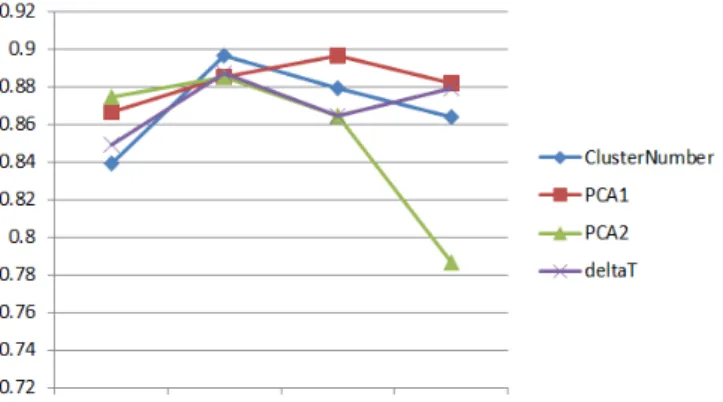
Figure 2.5: Parameters sensitivity test ofBoCP. The choices of four parameters (from left to right): cluster number: 10,20,30,40; PCA (stage 1) dimension: 10,20,30,40; PCA (stage 2) dimension:50,100,200,400; δt (frames): 2,2-4,2-4-6,2-4-6-8. It can be seen that the proposed
model is insensitive to various hyperparameters.
2.2.3.1 Parameter Sensitivity Test
There are a few parameters in the construction process of ourBoCPmodel and we demonstrate that ourBoCPmodel is insensitive to the choice of parameters in Fig. 2.5using the IXMAS dataset. Four main parameters are tested: time off-setδtin Eq. (2.3); cluster numberkduring the k-means clustering; the reduced
dimension after applying PCA at the first stage; the reduced dimension after applying PCA at the second stage. It can be seen that theBoCPmodel is rather robust to the choice of different parameters as the overall accuracy varies in the range of 2%-7%. The most error-prone parameter is the second stage dimen-sion of PCA: excessively large dimendimen-sion may lead to worsen performance.
2.2.3.2 Visual Word Ambiguity Effect
Through Fig.2.5 we are also able to examine the effect of the soft assignment strategy. Note that the cross-validation-optimal number of clusters in our model is quite small: 30 comparing with the traditional BoVW model [2, 7, 24,25,28,
31], which usually surges up to 1000 and more. The graph also shows that a surprisingly small cluster number, i.e. a cluster number of 10, still achieves comparable result but a larger cluster number does not improve the overall
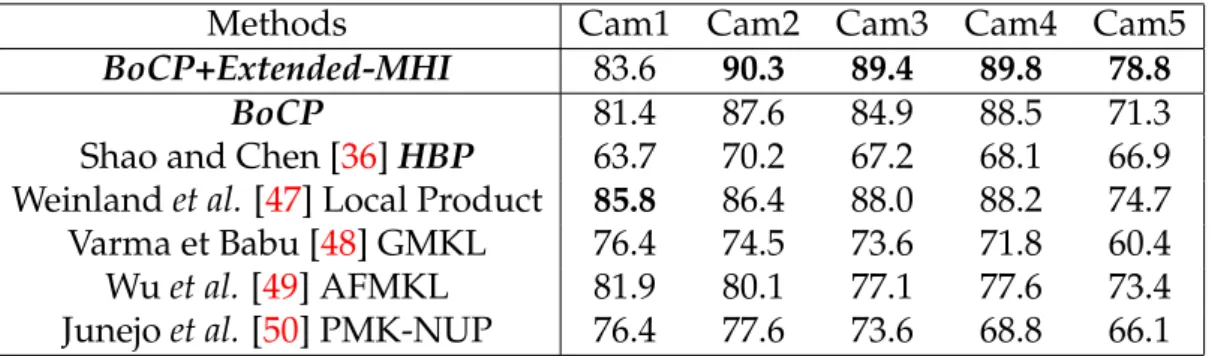
Methods Cam1 Cam2 Cam3 Cam4 Cam5
BoCP+Extended-MHI 83.6 90.3 89.4 89.8 78.8
BoCP 81.4 87.6 84.9 88.5 71.3 Shao and Chen [36]HBP 63.7 70.2 67.2 68.1 66.9 Weinlandet al. [47] Local Product 85.8 86.4 88.0 88.2 74.7 Varma et Babu [48] GMKL 76.4 74.5 73.6 71.8 60.4 Wuet al.[49] AFMKL 81.9 80.1 77.1 77.6 73.4 Junejoet al.[50] PMK-NUP 76.4 77.6 73.6 68.8 66.1 Table 2.1: Performance comparison of different methods in five cameras on the IXMAS dataset.
Figure 2.6: Algorithms for comparison. The first three columns of two datasets correspond to three values of τ in Eq.(2.11): 5 frames, half duration of the action, and the whole
du-ration of the action. The following three columns correspond to MHI only,MHI+INV and
MHI+INV+GEI. The last two columns evaluateBoCPand the effect of combining two descrip-tors:BoCPandExtended-MHI(“All” stands for the combination of the two desecriptors).
recognition accuracy. The reason behind the scene is that in our BoCPmodel, a visual word is described by a vector whose elements are related to the dis-tances to the cluster center, i.e. Eq.(2.2), instead of the quantized class mem-bership. Moreover, we further utilize this probabilistic visual word descrip-tor for the entries in Eq. (2.3) so that a frame spans over all the columns in the correlogram matrix. Observe that our BoCPmodel is a matrix of dimen-sion k×k where kis the number of clusters. Again, a larger cluster number increases the computational complexity during k-means clustering O(k) and
BoCP correlogram constructionO(k2) exponentially. By adopting the soft as-signment scheme, we tactically circumvent the situation wherekcan be easily up to 1000, making theBoCPdimension up to what is simply impractical com-putationally and unnecessary for action representation. Thus, we gracefully achieve an action descriptor with a dimension in the scale of thousands while
encoding temporal structural information.
Algorithms for Comparison
We first make a quantitative comparison between our correlogram based method
(BoCP)and the histogram based method(HBP)[36] in Table 2.2 and it can be seen that our proposed method BoCPconsistently outperforms the histogram based method. We then verify our choice of time duration in Eq. (2.12) over Eq. (2.11) through Fig.2.6. The first three columns of two datasets correspond to three values of τin Eq. (2.11): 5 frames (suggested by [38]), half duration of
the action and the whole duration of the action. Setting τ as the whole action
duration achieves the best results among the three schemes. The following three columns summarize the efficacy of concatenating different versions of motion templates described in Section Roman3. The consistent improvement of accuracy validates that both GEIand INV are complementary to the origi-nalMHI. Then, by early fusion (direct concatenation) of two descriptors:BoCP
and Extended-MHI, we show in the last two columns that the combination of temporal-local and holistic descriptors further improve the overall accuracy by 1% for the Weizmann dataset (because the improvement for the Weizmann dataset’s accuracy is close to saturation: 97.78%, 88/90) and 3.6% for the IX-MAS dataset. Again, this explains the complementary characteristics between the BoCP model and the Extended-MHI representation: BoCP is good at rep-resenting temporal pose correlations and the Extended-MHI excels at holistic motion representation. In addition, BoCPcompensates for MHI’s ineffective-ness in representing repetitive movements. Table 2.2 shows the comparison to the state-of-the-art methods on the IXMAS dataset using a single camera view. Our algorithm outperforms the state-of-the-art methods on the chal-lenging free viewpoint IXMAS dataset and this demonstrates that our model is robust to large variations of viewpoint, position and orientation. The ex-periments were done on an Intel 2-core 3GHz CPU and 4GB memory PC in a single thread running MATLAB. The speed of our method is approximately 25 FPS (excluding the silhouette extraction process).
2.3
RGBD Images and One-Shot-Learning
In this section, the one shot learning scenario is studied with respect to depth images’ special idiosyncrasies.
With the revolutionizing affordable Kinect sensor and the graceful core al-gorithm of , a single input depth image can be segmented into a dense prob-abilistic body part labeling whilst simultaneously achieving two goals: com-putational efficiency and robustness. One key component of their success lies in the huge and highly varied training data: both from realistic and synthetic depth images, a total number of 1 million images were used to train the deep randomized decision forest classifier in order to avoid overfitting. However, even the best existing depth image-based systems still exhibit limitations: in the system of [19], an effective depth sensor distance is required from 1.2m to 3.5m. Outside the effective range, meaningful skeletal joints are unlikely to be generated. Various applications spawned after the inception of this consumer priced 3D camera: scene flow estimation using a particle filter was formulated in [51]; human activity detection from RGBD images based on a hierarchical MEMM was studied in [52]; CHALEARN Gesture Challenge in [53],etc.
We focus on the CHALEARN Gesture Challenge [53]. There are some unique distinctions in this dataset from other action/gesture recognition datasets [45,54]. We reinstate the major easy/difficult aspects of the dataset and present our analysis and reasoning to solve/circumvent the problems as follows:
1.Availability of depth camera: depth cameras significantly reduce the huge colour and texture variability induced by clothing, hair and skin. However, some imperfection/noise of various sources still exists [55] in current depth sensors: e.g.reflectance and mismatched patterns. cf to Figure 2.7, strong ex-istence of “salt and pepper” noise is detected as real motion information. A spatial filtering and a morphological preprocessing step are required for noise reduction.
2.Multiple gestures in testing set: temporally unsegmented action sequences are real-world scenario. However, present action/gesture recognition datasets almost universally dodge this difficulty by providing training/testing sequences in a manually segmented manner. In the dataset of [53], however, the number
Figure 2.7:Noise in depth image.
of gestures contained in a testing video sequence varies from 1 to 5. There-fore, temporal segmentation is a precondition for gesture recognition. Note that current action localization methods [56,57] also provide solutions for ef-fectively retrieving action sequence from video sequences. We argue, how-ever, that because of the unique property of this dataset, i.e.hands return to a resting position between each pair of neighboring gestures, the temporal seg-mentation as a preprocessing step is more effective than the action localization approach. Weinland et al. [58] presents a semi-supervised action recognition system that breaks down action sequences into primitive actions based on a motion history volume descriptor and automatically discovers the action tax-onomies. Similarly, as suggested by [53], since the assistants hands return to a resting position between each pair of neighboring gestures, segmentation points occur near the peaks of hand motions in the lower part of an image. In our system, instead of using motion information for action segmentation, we adopt the appearance-based approach and achieve 5% error in the metrics of Levenshtein distancefor the verification of segmentation. Also note that the accuracy for our whole gesture recognition system is upper bounded by this temporal segmentation performance.
3.One-shot-learning: only one training example of each class is considered as the unique trait of this challenge whilst using more examples per sign typi-cally improves accuracy (see, e.g. [59, 60]). The standard tools of statistical machine learning,e.g.classification and regression, have a chance to be equally matched to modeling purposeful behavior in a poor manner; an agent’s goals often succinctly, but implicitly, encode a strategy that would require tremen-dous amounts of data to learn. We discuss our experimental result on two
classes of machine learning models: generative algorithms, and discrimina-tive algorithms and conclude that discriminadiscrimina-tive classifiers are more suitable for solving this one batch one lexicon one learning token dataset due to lack of training data. More specifically and surprisingly, the simplest correlation coefficient discriminating method, which defines the statistical independence, works best among other popular classifiers, e.g.nearest neighbor, SVM, Ran-dom Forest,etc.
4.Depth & RGB camera decision fusion: how to effectively utilize multiple inputs to generate an informed decision is sometimes under-appreciated. Cur-rently, the most commonly adopted approach when encountering different types/spectra of features is to concatenate multiple features into a long vec-tor before the classification stage and feed this long feature vecvec-tor into a classi-fier [7,38,61]. In [31], a handcrafted weights was adopted for merging the clas-sification score. Mostly, for the sake of simplification, different view features are treated independently and have been ignored by their intrinsic relation-ships [47, 62, 63]. We argue that the interleaving relationship between differ-ent feature vectors is lost during this brute-concatenation process, and the in-terdependent relationship between different feature decisions could be better incorporated in an ensemble system. Moreover, the benefit of multi-spectrum video fusion always comes with a certain cost and complexity in the analysis process due to the fact that the involved modalities have different characteris-tics. On one hand, the more pronounced the independence between difference modalities, the more complementary information can be gleaned from each of them. On the other hand, there need to be a sufficient amount of correlations in order to be able to link features in one modality. We study the Multiview Spec-tral Embedding (MSE) in [64] and its derivative of spectral clustering. Then we present our discovery of the intrinsic property during the embedding pro-cess. With the brief theoretical analysis, we demonstrate the effectiveness of the proposed approach by embedding information acquired from both depth and RGB cameras to further improve the recognition rate.
2.3.1
Experimental Results
In this section we detail our approach towards solving the general four issues aforementioned and present both quantitative results and qualitative evalua-tions of our method on the CHALEARN dataset [53]. The details of the dataset can be found at6.1.2.
Error Metrics. We quantify our recognition rate by computing theLevenshtein distancebetween the list of predicted labelsRand the corresponding list of true labels T, that is the minimum number of edit operations (substitution, inser-tion or deleinser-tion) that one has to perform to go fromRtoT(or vice versa). This error metrics measurement is also in accordance with the Leaderboard in [53] and we refer this error metrics asLDfrom now on.
2.3.1.1 Preprocessing: Background Separation and Noise Reduction for Depth Images
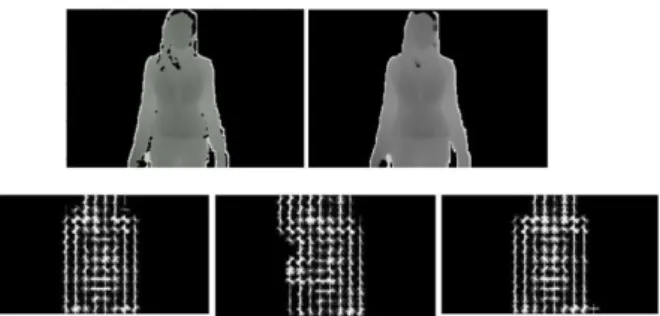
We take advantage of the depth sensor unique property from which human silhouettes can be easily segmented. Firstly we segment human from the back-ground using Otsu’s method of global image threshold [65] as shown in Fig-ure 2.8 (top left). The resulting noise pattern in depth images resembles salt and pepper noise. We then use a spatial filtering and a morphological pro-cess for noise reduction. A median filter provides excellent “salt and pepper” noise reduction with considerably less blurring. As in [55], we adopt a 5×5 aperture median filter. Then, morphological process is used for further noise reduction. Specifically, we use opening operation which consists of erosion followed by dilation to smooth the outers, split the narrow region and remove the thin perimeter. Thus, the opening operation removes randomly generated noise and smooths the original image. The resulting depth image is shown in Fig.2.8(top right). When the noise reduction method is applied to the motion image generated from the depth sensor, the resulting motion description is less prone to faulty defects from the depth sensor. These operations are highly ef-fective for the depth image noise reduction especially if the action descriptor is motion-based as in our system. Experimental result shows that the noise reduction method can improve the performance in terms ofLDup to 9%.
Figure 2.8: Top left: background segmentation; top right: depth image after noising; Bot-tom row: HOG descriptor for temporal segmentation. As it can be seen that the starting frame(bottom left) and the ending frame(bottom right) are quite similar to each other whereas in the midst of action (bottom middle), there is a substantially spatial difference.
2.3.1.2 Temporal Segmentation
For temporal segmentation, we adopt theappearance based approach. Because hands return to a resting position between each pair of neighboring gestures, we aspire to find the frames that are similar to the beginning and ending frame in the unsegmented testing video sequence and define them as the interval frames between two gestures in a video sequence. A simple but effective op-tion to retrieve similar frames is to divide a single frame into an N×Nlattice and use the histogram of oriented gradients (HOG) [66] as the cell descrip-tor with B number of bins. Hence, a single frame can be represented as a feature vector of N×N×B dimension. Then we use the k nearest neighbor approach to search for frames that are similar to the beginning and ending frame. Some implementation details worth mentioning: first how many simi-lar frames should we search in this unsegmented video? Our solution is to first store the training example’s average frame number Land when there is a test sequence, we make a rough estimation of gesture number as the quotient Qof test frame number Fand the average training tokens’ frame numberL. Then, the estimated frame number to retrieve is 8×Q. The reason we choose 8 here is rather arbitrary as it makes little influence to the final performance. After the similar frames being retrieved, a max pooling approach [67] is used to ag-gregate interval frames. We then merge minimal segmented sequences if the total action tokens segmented exceed the number of 5, which is the maximum gesture number for one test sequence in this dataset. Generally, the more
lat-tices that one frame picture is divided into, the more accurate it is to segment action sequence. However, through our experiments, the varying of HOG grid size has little impact on temporal segmentation performance. Consequently, taking the computational cost into consideration, there is no significant point to set the size of the HOG grid into small values. In our experiment, bin num-ber Bis 9 and two lattice types were tested, i.e.8×8 and 16×16. In the case of 8×8,LDis 6.764% and for 16×16 is 5.235%. Note that as we mentioned in Section 2, accuracy for our whole gesture recognition system is upper bounded by this temporal segmentation performance.
2.3.1.3 Motion Descriptors and Scheme for Classifier
We experiment extensively on different motion descriptors and classifiers and via comparison we discuss our methodological insights. Our final adopted ap-proach is Extended-MHIfor action descriptor andMaximum Correlation Coeffi-cientfor classifier. The results are reported on the first 20 development batches unless otherwise we explicitly state on the validation dataset.
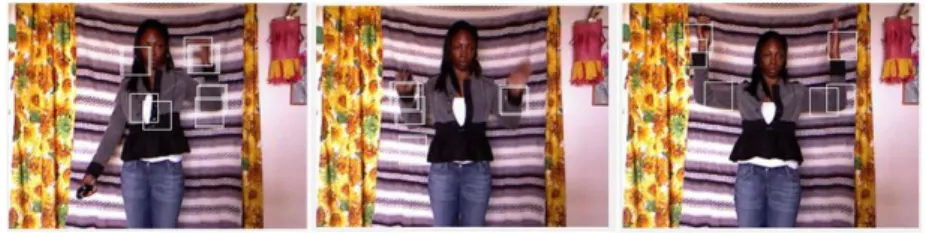
Cons for local method: Spatio-temporal features [2, 24] have shown success for many recognition tasks where preprocessing methods such as foreground segmentation and tracking are not possible. However, their computational complexity hinders their applicability in real-time applications. Wang et al.[7] showed that the average time for spatio-temporal feature extraction varies from 0.9 FPS to 4.6 FPS, which makes the STIP features too time-consuming in computation. Another major limitation of the local feature based methods is that the sparse representation such asBoVWdiscards geometric relationship of the features and hence is less discriminative. We experiment on depth im-age using Dollar’s method [2] for STIP detection, HOG3D [28] for cuboid de-scriptor, kernel codebook [40] for encoding and SVM [68] for classifying BoVW model. The result shows that theLDis merely 0.7232 and is even worse than the baseline of 0.5998. We argue that the reasons behind local BoVW method’s ineffectiveness in gesture recognition lie in the following two aspects: 1) low interclass variation between different gestures make local methods and their corresponding descriptors less discriminative. cf Figure2.9, although motion
Figure 2.9: Spatial temporal interest points in white bounding box of three different gesture tokens.
interest points have been successfully detected around arms and hands area, similarity of interest points around bending elbows could hinder the discrim-inative power of local patch; 2) one-shot-learning renders it difficult to distin-guish the most informative local patch in a BoVW model, especially temporal sequence has been discarded through the construction process of histograms. Insufficient training examples would be very likely to lead to the failure in this histogram based approach.
Cons for generative methods: Under the one-shot-learning configuration, for some discriminative models, one-shot-learning also restrains their discrimina-tive power: e.g.for SVM, a single training example can not effectively define its hyperplane for discriminating multi-class; for Adaboost, certain quantity of positive and negative examples are needed to train the weak classifiers; the de-cision trees methods, e.g.Random Forest [69], require hundreds of thousands of training samples to avoids overfitting [19]. Comparatively, nonparamet-ric methods, e.g.nearest neighbor, maximum correlation coefficient, etc work surprisingly well for one-shot-learning because they are intrinsically template matching metrics and will not suffer from overfitting problems.
Our approach:Extended-MHIand Maximum Correlation Coefficient
Motion Templates:MEIandMHIproposed by Davis and Bobick [70] are used to represent the motions of an object in video. All frames in a video sequence are projected onto one image across the temporal axis. As where and how motion happens are recorded in the images, MHI captures the temporal infor-mation of the motion in a sequence. Assume It = (I1,I2, . . . ,InFrames) ∈ <3 is a gray scale image sequence and let Bt = (B1,B2, . . . ,BnFrames−1) ∈ <3 be
a binary image sequence indicating regions of motion, which can be obtained from image differencing and thresholding:
Bt =
(
1 if (It+1−It) >Threshold,
0 otherwise. (2.9)
where threshold is defined as:
Threshold = v u u t nFrames
∑
t σt/(h×w×nFrames) (2.10)where σt is the second moment (variance) of a single frame It; h,w,nFrames are the height, width and frame number of that video sequence.
TheMHI H(t;τ)is used to represent how the motion image is moving, and
is obtained with a simple replacement and a decay operator:
H(t;τ) =
(
τ if Bt =1,
max(0,H((t−1);τ)−1) otherwise. (2.11)
We observe that the largerτ, the more information is encoded. Therefore,
we setτ as the duration of the whole action Tto preserve the whole sequence
motion trail. The re-defined version of MHI is:
e H(t) = ( T if Bt =1, e H(t−1)−1 otherwise. (2.12) Note that there is no maximum operator in front of Hfτ cf Eq. (2.11) because
settingτas the sequence duration will lead to non-negativity ofHe(t;τ).
We further extend motion templates that include two more elements: GEI
andINV:
GEI is to compensate for the non-moving regions and the multiple-motion-instants regions of the action. The summation of all image pixels and
normal-Figure 2.10: Illustration of theMHI,INVandGEIin two tokens (top row and bottom row). The projection images show that MHIemphasizes recent motion, i.e. ending frames whilst
INVthe beginning frames.GEIencodes the average gait information and is supplementary in repetitive actions where bothMHIandINVare poor at representing.
ization of the pixel value defineGEI:
G = 1 τ τ
∑
t=1 It (2.13)INV is used to recover the loss of initial frames’ action information when set-ting τas the whole action duration and is defined as follows:
e I(t;τ) = ( τ if Bt =1, e I(t+1;τ)−1 otherwise. (2.14)
Note that its subtle difference to Eq. (2.12) is the time variable becomes t+1 instead oft−1 from which we get the nameInversed Recording.
We reason the complementary property of our proposed extended-MHIas
MHI is poor at representing repetitive actions andINV provides complemen-tary information by emphasizing (assigning larger value) at initial motion frames instead of the last motion frames. Figure2.10illustrates the similarities and dif-ferences betweenMHI,GEI andINV of two gesture tokens. The first columns are theMHIprojections, second are theINVprojections and the last are theGEI
projections. Again, the projection graphs show that MHI emphasizes recent motion, i.e.ending frames whilstINVthe opposite. Hence the combination of the two is complementary. Furthermore, GEI encodes the supplementary
in-Methods GEI MHI INV Extended-MHI LD 0.2761 0.3010 0.3022 0.2600
Table 2.2: Performance comparison of three elements inExtended-MHI.
formation in repetitive actions where bothMHIandINVare poor for the repre-sentation. Then, we reduce the dimensionality of each projection by dividing the projection into a 16×16 lattice using HOG as the feature descriptor and concatenate three vectors into a long feature vector. Supervised linear discrim-inant analysis (LDA) is adopted for the final stage of dimensionality reduction. The experimental results in Table2.2prove the viability of our conjecture. Note that in order to have a fairer comparison between different algorithms, we use the action boundaries provided by [53] for development batch instead of us-ing the temporal segmentation results in Section 3.2 and MSEin Section 3.4 is also used for RGB and depth camera fusion so that irrelevant influences can be reduced to a minimum.
For the matching metric, nonparametric methods is more advantageous by avoiding the issue of overfitting. In our experiment, Maximum Correlation Coefficient works best. The correlation coefficient is defined as:
ρ= σxy
σxσy (2.15)
where σxy is the covariance of two feature vectors x and y, and σx,σy are the respective variances.
2.3.1.4 Multiview Spectral Embedding (MSE) for Data Fusion
To effectively and efficiently learn the complementary nature of different views, we adopt the spectral methods in [64] to search for a low dimensional repre-sentation and sufficiently smooth embedding over all views simultaneously. Luxburg [71] elegantly presents the intuition behind why spectral clustering works. We briefly state the core algorithm inMSEand further cast light on the unaddressed dimensionality problem in [64] by Graph Cut point of view. For notational details, please refer to the paper [64]. Firstly, we construct the graph
Laplacian Li for each viewi. The normalized graph Laplacians we choose for the system is Lsys as the matrix is symmetric. Then we introduce a weight αi to encode the significance for each viewi. We try to find the low-dimensional embedding by solving: argmin | {z } Y,α m
∑
i=1 αritr(YLiYT) (2.16) s.t. YYt = I; m∑
i αi =1, αi≥0. (2.17) where Y is the multiview fused embedding feature vector in a dimension ofd, exponent r is the coefficient for controlling the interdependency between different modalities/views and should satisfy r ≥ 1. Pronounced indepen-dence between difference modalities prefers smallerr while rich complemen-tary prefers larger r. In our system, the valuerhas trivial influence over low dimensional embedding and is set to be 1.5. In our system, we only fuse RGB and depth camera, hence the number of viewsmis 2.
Eq. (2.17) is a nonlinearly constrained nonconvex optimization problem and an expectation-maximization (EM) like iterative algorithm can be used to obtain a local optimal solution. The alternating optimization iteratively up-dates Y and α in an alternating fashion. By introducing Lagrange multiplier λ to take the constraint ∑mi αi = 1 into consideration, we get the Lagrange function L(α,λ) = m
∑
i=1 αritr(YLiYT)−λ( m∑
i αi−1) (2.18) By setting the derivative ofL(α,λ)with respect toαiandλto zero, we haveαi =
(1/tr(YLiYT))1/(r−1) (∑mi=1αitr(YLiYT))1/(r−1)
(2.19) Here, we cast light on the choice of lower embedding dimensiondand the interpretation of weights αi dispatched to different views where the original paper [64] fails to accomplish. In the paper of [64], the value of dis acquired by cross-validation. However, we argue that the low dimension d should be
fixed to be the number of gestureclass-1. According to the Graph Cut theorem, the multiplicity k1 of the eigenvalue 0 of Graph Laplacian L equals the num-ber of connected components in the graph. Similarly, MSE finds d smallest eigenvalues in the spectrum of Lwhich corresponds to the smallest variation of the cluster. The smallest eigenvalue ofLis always 0 [71] and the correspond-ing eigenvector is the constant one vector 1. Therefore, the veritable number of d should be the number of cluster/gesture class-1. And the experiments in [64] are in agreement with our reasoning. Secondly, we explicitly express the physical meaning of the weightsαias a measurement of the “closeness” of intra-class distance from each individual view. From Eq. (2.19), we can see that
αi is proportional to the inverse trace ofYLiYT, and
tr(YLiYT) =
∑
λi (2.20) where λiare the eigenvalues of the Graph Laplacian Li. Hence,αi ∝1/(∑λi). In Spectral clustering [71], small eigenvalues (closer to 0) represent the the “closeness” of intra-class distance from each individual view. A well clustered view, i.e. , easier to be classified, is more significant than other views. So a largerαi assigns larger significance to that view.We then use the low dimensional multiview fused representationYas the feature vector for Correlation Coefficient comparison. Note that this approach unsupervisedly clusters the test set, however it does not violate the compe-tition rule that allows using unlabeled examples for training the system. We compare the performance between our approach against the approach which directly concatenates the RGB and depth camera feature vector and there is a consistently 4% improvement inLD.
2.3.1.5 Performance Evaluation
The performance of our system on validation data batch is0.29685and among the top entries on the public leader board in [53] with LDless than 0.3. Fig-ure2.11shows our system’s performance on the first 20 development batches. It can be observed that our system performs well when there is large amount of
1multiplicities: the number of eigenvectors belonging toλ
Figure 2.11:Performance on the 20 development data batches.
motion presents in a gesture token, e.g.batch 01, 05, 08, 09 whereas the perfor-mance suffers if the gestures are rather static, e.g.batch 03, 10. We reason that our gesture descriptor is motion based so that little motion and subtle appear-ance differences in gesture tokens will degenerate our system’s discriminative power.
The experiments were done on a Intel 2-core 3.0GHz, 4GBmemory desktop in a single thread running MATLAB and the average training and testing time for a single batch is around 220 seconds (approximately 20 fps) which is faster than real time requirement.
2.4
Discussion
In this chapter, two new representations, namelyBoCPand theExtended-MHI
for action recognition were presented. BoCP is a temporally local feature de-scriptor and the Extended-MHI is a holistic motion descriptor. In the BoCP
model, the unique way of considering temporal-structural correlations between consecutive human poses encodes more information than the traditional bag-of-features model. Also a soft-assignment strategy was utilized to preserve the visual word ambiguity which is usually disregarded during the quantization process after k