UNIVERSITY OF GONDAR
COLLEGE OF BUSINESS AND ECONOMICS
DEPARTMENT OF ACCOUNTING AND FINANCE
Factor Affecting the Role of Performance Audit In fighting Corruption:
(Evidences from Amhara National Regional State)
Principal Advisor:- GARDACHEW WORKU(PhD.)Ass.Pro.of Acct. & Fin.
Co-Advisor: - ABEY ZEWGE (MSc)
BY DILNESSA DEMISSIE
A Thesis submitted in partial fulfillment of the requirements for the
Degree of Master of Science (Accounting and Finance)
December, 2014
DECLARATION
I, the undersigned, declare that the thesis encompasses my own work. In compliance with internationally accepted practices, I have appropriately acknowledged and referenced all materials used in this work. I understand that non-adherence to the principles of academic honesty and integrity, misrepresentation of any idea/data/fact/source will constitute sufficient ground for disciplinary action by the University and can also bring to mind penal action from the sources which have not been properly cited or acknowledged.
Name of candidate:- Dilnessa Demissie Fenta
Signature ………
CERTIFICATE
I certify that this thesis work entitled Determinants of Performance Audit in fighting Corruption in the case of Amhara National Regional State has been undertaken independently by Dilnessa Demissie Fenta under my guidance and supervision and that it has not previously formed the basis for the award of any degree, fellowship or associate ship.
Name and designation of Advisor: Gardachew Worku (PhD) Asst.Pro.of Accounting and Finance
Signature of Advisor _____________________________
Date of Submission ______________________________
APPROVAL
The thesis entitled “Determinants of Performance Audit in Fighting Corruption in the case of
Amhara National Regional State’’ by Mr.Dilnessa Demissie Fenta is approved for the degree of
“Master of Science in Accounting and Finance (MSc)” at University of Gondar.
As member of the Board of Examiners of the MSc Thesis Open Defense Examination, We certify that we have read, evaluated the thesis prepared by Dilnessa Demissie Fenta and examined the candidate. We recommended that the thesis be accepted as fulfilling the thesis requirement for the Degree of Master of Science in Accounting and Finance.
Approved by Board of Examiners
Name, Signature and Date
_______________________________________ _______________
Advisor Signature Date
_______________________________________ ________________ Internal Examiner Signature Date
________________________________________ ________________
Table of Contents
Tittle Page
DECLARATION... I CERTIFICATE... II APPROVAL... III List of abbreviations...VIII Acknowledgements... IX Abstract... X List of Tables... XICHAPTER ONE... 1
INTRODUCTION... 1
1.1. BACKGROUND OF THE STUDY... 1
1.1.1. A brief overview of performance audit... 1
1.1.2. Overview of corruption and anticorruption struggle in Ethiopia... 2
1.2. Statement of the problem... 3
1.3. Objectives of the study... 4
1.4. Research Question and Research Hypothesis of the study... 5
1.4.1. Research Question of the Study... 5
1.4.2. Hypothesis of the research... 5
1.5. Significance of the study... 6
1.6. Scope or Delimitations of the study... 7
1.7. Limitation of the study... 7
1.8. Organization of the Study... 7
CHAPTER TWO... 8
LITERATURE REVIEW... 8
2.1.1. Development of performance audit... 8
2.1.2. The basis of performance auditing... 8
2.1.3. Objectives of performance audit... 9
2.2. Theoretical overview of corruption... 9
2.2.1. Concept and type of corruption... 9
2.2.2. Methods of combating corruption... 10
2.2.3. Major players in anti-corruption struggle... 11
2.2.4. Model of corruption and struggle against roots of corruption... 12
2.3. Empirical studies on determinants of performance audit and its role in combating corruption... 14
2.3.1. Determinant factors affecting performance audit... 14
2.3.2. Corruption reduction role of performance audit in advanced countries and in Sub-Saharan Africa 15 2.4. Empirical conclusion and knowledge gap... 19
2.4.1. Organizational Independence... 20 2.4.2. Mandate... 20 2.4.3. Access to information... 21 2.4.4. Funding... 21 2.4.5. Leader... 21 2.4.6. Staff... 21 2.4.7. Support... 22 2.4.8. Compliance... 22 2.4.9. Communication... 22 2.4.10. Using as a tool... 23
2.4.11. Performance Audits Role of Fighting Corruption... 23
CHAPTER THREE... 24
RESEARCH METHODOLOGY AND DATA COLLECTION... 24
3.1. Introduction... 24
3.3. Population and Sample size... 24
3.4. Data type and Sources... 24
3.5. Definition of Variables and Model Specification... 25
3.5.1. Operational Definition of Performance Audit... 25
3.5.2. Operational Definition of Corruption... 26
3.5.3. Dependent Variable... 26
3.5.4. Independent variables... 26
3.6. Data Processing, Analysis and Presentation... 30
CHAPTER FOUR... 31
DATA ANALYSIS AND PRESENTATION... 31
4.1. Introduction... 31
4.2. Personal Profile of Respondents... 31
4.2.1. Personal Information of respondents... 31
4.3. Descriptive Statistics... 34
4.4. Correlation Analysis... 39
4.4.1. Relationship between Independenceand performance audit’s role of fighting corruption... 40
4.4.2. Relationship between mandate and performance audit’s role of fighting corruption... 40
4.4.3. Relationship between access to information and performance audits role in fighting corruption.... 40
4.4.4. Relationship between funding and performance audits role in fighting corruption... 40
4.4.5. Relationship between leadership and performance audits role in fighting corruption... 41
4.4.6. Relationship between staff and performance audits role in fighting corruption... 41
4.4.7. Relationship between support and performance audits role in fighting corruption... 41
4.4.8. Relationship between compliance and performance audits role in fighting corruption... 41
4.4.9. Relationship between communication and performance audits role in fighting corruption... 41
4.4.10. Relationship between using performance audit results as a tool and performance audits role in fighting corruption... 41
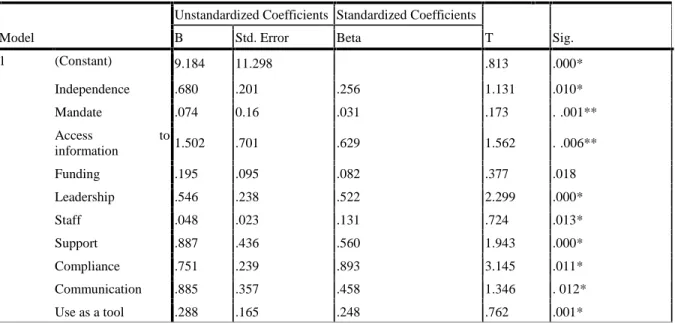
4.6. Regression Analysis... 42
Chapter 5... 51
Conclusions and recommendation... 51
5.1. Conclusions... 51
5.2. Recommendation... 52
5.3. Areas for Further Research... 54
References... 55
Appendix A-Existing performance auditors’ survey... 61
Appendix B: Interview question to head of performance audit division of OAG... 72
Appendix C:- Table 11 Independence of the OAG... 74
Appendix D:- Table 12 Mandate to carryout performance audit... 74
Appendix E:- Table 13 Unrestricted access to information for OAG... 74
Appendix F:- Table 14 Funding of performance audit... 74
Appendix G:- Table 15 Leadership of Performance audit... 74
Appendix H:- Table 16 Staff of Performance audit... 75
Appendix I:- Table 17 Support of Performance audit... 75
Appendix J:- Table 18 Compliance of Performance audit... 76
Appendix K: -Table 19 Communication of Performance audit Results... 76
Appendix L:- Table 20 Using Performance audit results as a Tool... 77
List of abbreviations
3Es Efficiency, Effectiveness and Economy
ADB Asian Development Bank
AEACC Amhara Ethics and Anticorruption Commission
AFROSAI-E African Organization of English- Speaking Supreme Audit Institutions
AG Auditor General
ANAO Australian National Audit Office
ANRSEACC Amhara National Regional State Ethics and Anticorruption Commission
ANRSOAG Amhara National Regional State Office of Auditor General
B.C Before Christ
BoF Bureau of Finance
EACC Ethics and Anticorruption Commission
EGAS Ethiopian Government Auditing Standards
ERA Economic Responsibility Audit
EU European Union
FACT Financial Accountability & Anti-Corruption
FEACC Federal Ethics and Anti-Corruption Commission
INCOSAI International Congress of Supreme Audit Institutions
INTOSAI International Organization of Supreme Audit Institutions
IMF International Monetary Fund
ISA International Standards on Auditing
NAO National Audit Office
OAG Office of Auditor General
OECD Organization for Economic Co-operation and Development
OFAG Office of the Federal Auditor General
PA Parliamentary Auditors
PAASC Public Accounts Affairs Standing Committee
RMB China Yuan
SAIs Supreme Audit Institutions
SNAO Swedish National Audit Office
SSA Sub-Saharan Africa
UK United Kingdom
ULS Uganda Law Society
US United States
VFM Value-for-money
Acknowledgements
Above all, my deepest thank goes to the source of everything and the kindhearted God, without him I wouldn’t have come up this result.
Besides, I want to address my sincere thanks for the respected principal advisor Gardachew Worku (PhD) and co-advisor Ato Abey Zewge for their kind, unreserved help and genuine comment & advice and persistent guidance throughout the development of this paper. This small piece of appreciation cannot fully convey my heartfelt gratitude towards them. Subsequently, my sincere thanks go to performance auditors and head of performance audit department of ANRS. Last but not least I also give due consideration to my family whom they encourage me to undertake this study.
Abstract
This study assessed factor affecting the role of performance audit in fighting public sector corruption taking evidences from Amhara National Regional State. Data collection was achieved through questionnaires and interview. The primary data were supplied to 20 respondents focusing purposively on all existing performance auditors and 5 turn out performance auditors, which have a known destination and are accessible. The interview was conducted with head of performance audit department and ANRSEACC head of corruption prevention and prosecution. The test of hypotheses and other analysis of data were done using SPSS, version 20. The tests revealed that independent variables, independence, mandate, access to information, funding, leadership, staff, support, compliance, communication and use as a tool are the significant factors affecting performance audit’s role of fighting corruption in Amhara National Regional State. That means they are the principal factors hindering the performance audit’s role of fighting corruption. The study recommends efforts should be made to improve independence, mandate access to information, funding, leadership, and staff of ANRSOAG, support to performance audit department, and communication of performance audit results develop awareness on performance audit’s role in fighting corruption. Also, ANRSEACC and other watch dog agencies should exercise legal measure based on performance audit results.
Key Words: Independence,Support, Communication, Use as a tool, Performance auditor, auditee and corruption.
List of Tables
Table 1: Response Rate by Target Group---27
Table 2: Sex of respondents---28
Table 3: Age of Respondents in Years---28
Table 4: Educational Level Of Respondents---28
Table 5: Respondents Field of Study---29
Table 6: Respondents Experience on Performance Audit ---29
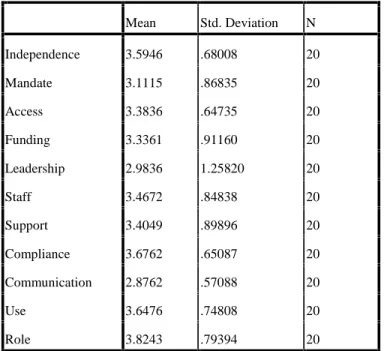
Table 7: Descriptive Statistics of variables ---30
Table 8: Pearson’s Correlation Matrixes---35
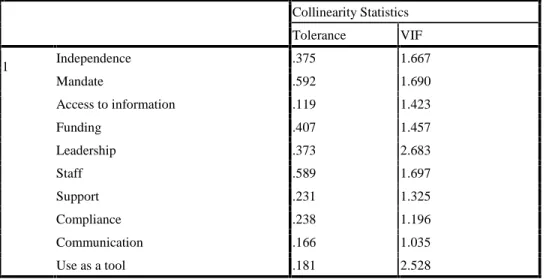
Table 9:- Multicolinearity between Independent Variables ---37
CHAPTER ONE
INTRODUCTION
1.1.
BACKGROUND OF THE STUDY1.1.1. A brief overview of performance audit
The development of auditing traces to early ancient civilization of Egypt, Greece and Romans (Boyd, 1905 cited in Flesher et al., 2003). Historical evidence shows that from 500-300B.C. auditing originated in city of Greece, Athens, by state Board of Auditor in municipal administration (Wallace 1980). Then, in medieval period English manorial auditing began. This become the foundation of the statutory audit in the 19th century and later spread throughout
Europe. Also, the 19th century industrial revolution and stock market crash debacle in 1930
accentuated the need for verification and fraud detection (Kinfu and Bayou, 2009).
In Ethiopia government auditing in modernized way has been established by proclamation No. 69/1944. Accordingly the Revised Constitution of Ethiopia 1955 (1948 E.C.) expresses the
Auditor General’s responsibility to report for the Emperor and the Parliament on the financial
operations of the government and was given access to all books and records of government accounts (OFAG 2011a). Subsequently, the functions of the Auditor General were amended by decree No. 32 of 1958, which was later renumbered as proclamation No. 179/1961. After the 1974 Ethiopian Revolution, proclamation No. 164 of 1979 was enacted to redefine the powers and duties of the Auditor General giving him additional responsibility of auditing mass organizations, development projects as well as conducting performance auditing. Later on, the National Shengo provided proclamation No.13/1987 to establish the Office of the Auditor General of the people’s Democratic Republic of Ethiopia. This proclamation was in effect until the country introduced the new Federal Government structure in 1994. Thus one can understand that up to 1994 Office of Federal Auditor General (OFAG) was the only government audit institution in Ethiopia. However, proclamation No. 7/1992 of the transition period has already laid down the basis for the establishment of National/Regional State-Governments. Article 8(e) of this proclamation states "every National/Regional self-government shall have an audit and
control Office". Article 15(h) of the proclamation has also given each National/Regional council the power to establish the Audit and Control Office.
Even though the issue of performance audit stated in proclamation No. 164 of 1979, it was not conducted in Ethiopia until beginning of 1990s. In 1991 development of performance audit started in new sprit as a result of UN expert financial auditing project recommendation. Then, manual of performance audit prepared in 1992 and short term training provided. Later on in the middle of 1990s performance audit reports issued and started to present for parliament incorporating it with financial audit.
Amhara National regional state office of Auditor General (ANRSOAG) has been established through proclamation number 6/1993 and in 2002 Amhara National Regional State Office of Auditor General takes its duty of conducting performance audit after training program provided to 5 auditors in Addis Ababa city Administration Office of Auditor General hall by OFAG
(Amhara National Regional State Office of Auditor General 2002 Annual report).
Performance audit is conducted with legal basis according to proclamation number 98/2004,. Accordingly Amhara National Regional State Office of Auditor General (ANRSOAG) has a mandate of conducting four types of performance audit: efficiency audit, program effectiveness, economic audit and environment audit. Since 2002 around 46 performance audit reports issued within 12 years by ANRSOAG.
1.1.2. Overview of corruption and anticorruption struggle in Ethiopia
Corruption is common problem affecting all countries including Ethiopia. In order to tackle corruption and impropriety, Ethics and Anti- corruption commission (EACC) established in May 2001 at Ethiopian Federal government level. Since its inception, the FEACC launched a three-pronged attack on corruption- prevention, investigation and prosecution (FEACC, 2011).
The Amhara Ethics and Anti-corruption commission(AEACC) was established in 2003 by proclamation number 93/2003 with the main objective of having society that shall not condone, but rather be prepared to effectively combat corruption and impropriety and thereby promote as well as sustain the development and democratic process in the region. The commission has officially launched its activities in 2005 (EACCO, 2008).
Many developing and developed counties in the world are using performance audit as a tool in
fighting corruption(Khan 2006). Identifying the determinant factors of performance audit’s role
and make better-off these factors has a valuable effect to maximize its role of fighting corruption. This research has an intention to identify the determinant factors of performance audits role of fighting corruption.
1.2. Statement of the problem
Performance audit have numerous importance in improving performance (John 1996), in assisting public expenditure management (Dadi 2009), in supporting modern public management (Michael 2002) and in fighting corruption (Khan 2006). Especially in many countries performance audit is used as a tool against corruption (Dye and Stapenhurst 1998; Borge 1999; Pope and Jeremy 2000; ADB-OECD 2005; Blume and Voigt 2007; Dye 2007; Waring and Morgan 2007; Gong 2009; Mukasa 2010; Sundgren 2011; and Matechak nd).
To the contrary, information released by Transparency International Index of AFROSAI-E expressed the rank of member countries against corruption in its web address. Hence, Ethiopia
scored 2.7 and ranked 14thamong 23 of AFROSAI-E member and 120th among 180 assessed
countries (Sundgren 2011).
However, in Ethiopia the strong struggle against corruption is mitigating the assumed prevailing corruption level (FEACC 2011). Detecting and eradicating this problem requires stretched time, vast resources and organized national integrity system such as using performance audit and regular audit finding of office of the auditor general (OAG) (FEACC 2011).
In Ethiopia the issue of performance audit has aged more than two decades and its coverage in federal government level is low and as a result of insufficient performance audit reports accessibility to the public or parliament is limited (OFAG, 2008). Also, corresponding negligence is observed at regional level OAG. For instance, in Amhara national regional state more than 1760 government organizations are potential areas of it; however, limited entities get the chance to be audited. Not only coverage problem, but also the gap between office of Auditor Generals and anti-corruption affects the role of performance audit as a device of struggle against corruption in the region needs further investigation.
The least coverage of performance audit, the deterioration of performance audit quality, insufficiency of performance audit reports, the inaccessibility of performance audit reports, absence of communication performance audit results between OAG and watchdog agencies, and the absence of any research about this issue in the region attract the researcher for extensive research on performance audit and its determinants in combating corruption in Amhara National Regional State. This research initiates every belonged individual or body of the state to
reconsider the determinant factors ofperformance audit’s role of fighting corruption and to take
appropriate corrective action on the determinant factors to maximize performance audit’srole in
the struggle of corruption prevention and detection.
1.3. Objectives of the study General objective of the study
The overall purpose of this study is to identify the determinant factors of performance audit or value-for-money audit in fighting public corruption at Amhara national regional state.
Specific objectives of the study
The specific objectives of this study are:
Assessing the effect of lack of independence on performance audit’s role of fighting
corruption.
To examine the effect of absence of mandate on performance audit’s role of fighting
corruption.
To assess the effect of access information on performance audit’s role of fighting corruption..
To identify the effect of shortage of funding on performance audit’s role of fighting
corruption.
To examine the effect of leadership on performance audit’s role of fighting corruption.
To examine the effect of staffingon performance audit’s role of fighting corruption.
To examine the effect of lack of supporton performance audit’s role of fighting corruption.
To examine the effect of compliance onperformance audit’s role of fighting corruption.
To examine the effect of absence of communicationon performance audit’s role of fighting corruption.
To examine the effect of using performance audit reports as a tool to detect and prevent corruptionon performance audit’s role of fighting corruption.
1.4. Research Question and Research Hypothesis of the study
1.4.1. Research Question of the Study
Basically Performance audit is carried out in three phases: planning, fieldwork, and reporting. Problems faced in each phases vary widely among auditing organizations around the world. Common and unexpected challenges costume not only in pre conduct and during conduct of performance audit but also it may face in post follow-up and when using its findings for combating corruption. Thus, the Central research questions
are:- Does independence of OAG affect performance audits role of fighting corruption?
Does mandate of OAG determine performance audits role of fighting corruption?
Does access to information for performance auditors a determinant factor for its role of fighting corruption?
Does funding determine performance audits role of fighting corruption?
Does leadership affect performance audits role of fighting corruption?
Does the competence of the performance auditorsdetermine performance audit’s role of fighting corruption?
Does the degree of support affect performance audit’s role of fighting corruption?
Does performance audit’s role of fighting corruption determined by the degree of implementation of standards and manuals?
Does degree of communication affect performance audit’s role of fighting corruption?
Does performance audit’s role of fighting corruption determined by the use of its results as a tool? To achieve the above objectives of the study, a series of research questions are developed. Some of these research questions are stated in the form of hypothesis while others take the form of “what”, “which” and “How” question type expression. In this context, the study focus on research objectives and on testing research hypothesis.
1.4.2. Hypothesis of the research
Based on the above theory in attempt to examine the determinant factors of performance audit’s role in fighting corruption, the following hypothesis have been formulated and tested:
H1: The absence of independence has no significant effect on performance audit’s role of fighting
corruption.
H3: Lack of access to information has no significant effect on performance audit’s role of fighting
corruption.
H4: Shortage of fund has no significant effect onperformance audit’s role of fighting corruption.
H5: Leadership has no significant effect onperformance audit’s role of fighting corruption.
H6: The competency of the staff has no significant effect on performance audit’s role of fighting
corruption.
H7: Absence of support has nosignificant effect on performance audit’s role of fighting corruption.
H8: Compliance while conducting performance audit has no significant effect on it’s role of fighting
corruption.
H9: Communication has nosignificant effect on performance audit’s role of fighting corruption.
H10: Using performance audit results as a tool has no significant effect on its role of fighting corruption. Therefore to overcome the absence of using performance audit results as corruption prevention and detection purpose, the researcher tested the reality of these factors (causes) and mitigates
their impact onperformance audit’s role of fighting corruption.
1.5. Significance of the study
Since performance audit become the important and burning issue in Ethiopia. This study is expected to have importance to many parties. First the Amhara National regional State Ethics and Anti-corruption commission can incarcerate from outcomes of the study how to prevent and reduce corruption via performance and result based audit. Secondly, ANRSOAG can use for strategic formulation. Thirdly, House of representative council especially Public Accounts Affairs Standing Committee (PAASC) can use the outcome of the study for various decisions. Fourthly, the foreign fund provider (if any) use as a basis of evaluating the project of developing performance audit and anti-corruption struggle in developing countries mainly in Amhara National regional state.
Also, it creates public awareness about performance audit. Moreover, the study disclosed those problems faced Performance auditors and the state government can use it as a base for
adjustment. Finally, the study may used as reference for future researcher(s) and it may call the attention of the potential researcher on the area.
1.6. Scope or Delimitations of the study
The study would have been more bearable if its scope were able to cover all office of the auditor general and EACC in the country, but due to capacity and availability of facilities, the study is limited to the Amhara National regional State Office of Auditor General. The time period covers in the study ranges from 2002G.C to half of 2014, which is the entire life of performance audit in the region.
1.7. Limitation of the study
The project paper has the following limitations. Firstly, lack of knowledge by the researcher on previous empirical studies conducted. Secondly, the researcher can’t get all turnout performance auditors to incorporate their response.
Moreover, factors and challenges those affecting developments of performance audit that are not incorporated in this paper will affect the conclusion of the study
1.8. Organization of the Study
The research paper is organized in the following way. Chapter 1: Introduction–Which describes
the problem of the study, objective of the study, the research questions and hypothesis, significance, scope and limitation of the study are presented respectively. Chapter 2: Literature
Review – Which gives the detail explanation about Performance audit. Chapter 3: Data
presentation and analysis Chapter 4: Discussion – Findings of the study are combined together
and the research questions are answered and hypothesis tested Chapter 5: Conclusions and recommendations – Encloses the major findings, effect of the findings to the audit offices and stakeholders, the weakness of the study and areas where further research may be fruitful.
CHAPTER TWO
LITERATURE REVIEW
In this chapter the theoretical and empirical works on the area of performance audit and its determinant factors in fighting corruption are reviewed. This review of the literature establishes the framework for the study and which, in turn, help in clearly identifying the gap in the literature and formulating the research hypothesis for the study.
The review has four parts. Part one presents a review of the conceptual overview of performance audit. This is pursued by a review on theoretical overview of corruption in part two The experience of some advanced and Sub-Saharan Africa countries, on role of performance audit in combating corruption are reviewed as empirical study in part three As a final point, conclusions on the literature review and knowledge gaps are presented in part four.
2.1. Concept and development of performance auditing: theory
In this theory part performance audit’s development, basis and objectives are explained as follow.
2.1.1. Development of performance audit
The responses to the question ‘when and where did performance audit first commenced?’ is controversial issues in historical development of VFM audit. In general, when writing for a performance audit growth, it is good practice to analyze the early important work.
In short most studies indicate, despite the ancient recognition about the concept of performance audit is essentially a twentieth century phenomenon (Flesher et al., 2002) and is a very new development in the history of auditing. It is by-product of the modern public management and these audits are complex by nature (Gronlund et al., 2011). Currently become part of government audit, in all member countries of the International Organization of Supreme Audit Institutions (INTOSAI). In Ethiopia at federal government level, also, performance audit is developed and aged more than two decades.
2.1.2.The basis of performance auditing
The guide line of performance audit implementation issued with joint effort of 29 SAI member countries and INTOSAI (2004) state that public accountability is the root of performance audit. Public accountability means that those in charge of a government program or ministry are held
responsible for the efficient and effective running of such. Accountability presupposes public insight into the activities of the program or ministry. Performance auditing is a way for
taxpayers, financiers, legislatures, executives, ordinary citizens and the media to ‘execute
control’ and to obtain insight into the running and outcome of different government activities (INTOSAI 2004).
2.1.3. Objectives of performance audit
Cowater (2006) states the following seven prime objectives of performance audit: to maintain and enhance public accountability; to improve accountability by strengthening the relevant supervising authority's reporting to the legislature on the performance of government departments, agencies, projects and programs; to act as a force for beneficial change in the management of resources and the achievement of value for money; to encourage improved value for money in government departments, agencies etc. where improvements are found to be necessary and cost effective; to identify well performing government organizations as possible lessons to be emulated by others; to enable to provide independent information, advice and assurance about the 3Es in the major fields of revenue, expenditure and management of other resources; and to induce and assist audited entities to take action where improvements are shown to be necessary and cost effective.
2.2. Theoretical overview of corruption
In this second subpart the basic concept and types of corruption; the efforts of anticorruption players in national pillars; and methods and model of combating corruption are reviewed.
2.2.1. Concept and type of corruption
Anxiety about corruption is as old as the history of government audit (Shah, 2007). The term ‘corruption’ come from Latin word called ‘corruptio’ and it mean that bribe and destroy (Hornby, 2010). Ongoing time the forms and levels of corruption are mounted. As a result, various definitions for the term ‘‘corruption’’, have been given in the academic research and policy-relevant literature on corruption.
For instance, in their joint work Shah and Schacter (2004) defined Corruption as the exercise of official powers against public interest or the abuse of public office for private gains (Shah, 2007). Public sector corruption is a symptom of failed governance. Governance is defined as the norms, traditions, and institutions by which power and authority in a country are exercised.
Khan (2006) stated a highly complex phenomenon of corruption. The parties involved leave very little telltale in the form of irrefutable hard evidence. Most of the corruption takes place in an informal manner and under the dark cover of isolated contacts. At times it does not even require a spoken word. Mere eye contact can establish a relationship of corruption.
Vazquez et al. (2007) in their work concluded that there are countless types of corruption and many distinctions can be made based on the dynamics of the act (i.e., unilateral, multiparty), the agents involved (i.e., high-level officials, low-level officials, private agents), the size of the corrupt act (grand corruption or petty corruption), the budgetary functions affected (i.e., expenditures, revenues), the nature of the determinant involved (i.e., structure of incentives, institutional opportunities), and so on.
Auditors do not deal with some corruption types, such as political, social, or cultural corruption. Most of the time auditors can deal with corruption in government offices and in large public and
private organizations that fall under the purview of theauditors’ routine work (Khan 2006). The
current study deals with corruption in public sector taking evidence from Amhara National Regional State.
2.2.2. Methods of combating corruption
There is a range of approaches from different point of views in order to get rid-off the vicious circle of corruption. To begin with, “penal-administrative approach” offers tostrengthen national law and administrative structure in order for unveiling leakages from the system, betterment of institutional tools and firm punishment of those cases by strict laws and regulations. Secondly,
“economy-based approach” of IMF and World Bank suggests pursuing all economic reforms
needed in a determined manner (Ploskonka, 2004). Lastly, “national integrity system” a well -known concept suggested by Ibrahim Seushi, who is President of Transparency International-Tanzania in 1998 refers to eight institutions which pursue the war against corruption in an interdependent manner and lack or weakness of any of these would increase the burden of the
other pillars of integrity. These institutions are political will,administrative reforms, “watchdog”
agencies (anti-corruption commissions, supreme, SAIs, ombudsman office) parliaments, public awareness/involvement, the judiciary, the media and the private sector (Dye and Stapenhurst, 1998).
According to systemic approach, there is an initial need for a comprehensive anticorruption strategy that is strongly backed with political will determined to bear all its consequences. That strategy should be composed of institutional and administrative reforms on public-financial management and control system and should also ensure the involvement of civil society and citizens. Furthermore, since international cooperation would create fruitful circumstances to gain knowledge of successful and/or bitter experiences of other countries; to develop a mutual understanding of corruption and to take necessary measures in international law, contributions of international society should be taken into account at each and every step of the strategy. Consequently, systemic approach implies that lack of any level would lead to a loopholes causing to corruption (Kayrak, 2008).
2.2.3. Major players in anti-corruption struggle
Over the entire world anti-corruption struggle involve the following 8 major players called “pillars”: public sector anti-corruption strategies; “watchdog” agencies; public participation in democratic process; public awareness of the role of civil society; accountability of the judicial process; the media; the private sector and international business & International co-operation. Each pillar is interdependent. If one pillar weakens, an increased load is thrown on to the others. If several weaken, their load will tilt, so that the round ball of sustainable development rolls off. Establishing a national integrity system requires identifying gaps and opportunities for utilizing each of these pillars, as well as catalyzing the work of the government, civil society and donors into a coherent framework of institutional strengthening.
Anti-corruption agencies, the office of the ombudsman, and supreme audit institutions are former of central pillar known as “watchdog agencies”. U.S. and international legal, business, and accounting associations and Nongovernmental organizations such as the American Bar Association, the U.S. Chamber of International Chamber of Commerce, Ethics Officer
Association, Committee of Sponsoring Organizations, and Transparency International —have
played key advisory roles in the development of various anti-corruption initiatives (Olsen 2010). In order to trim down corruption strengthening the prevention and control capacity of key anti-corruption players such as Independent Anti-Corruption body, Supreme Audit Institutions, Ombudsmen and Inspectorates of Government, Public Accounts Committees, Parliament and Parliamentary Committees, Investigation, Police, Local government, Public complaints
mechanisms, Whistle blowing, Judiciary, and Prosecution, discipline, and sanctions is underlying operation.
2.2.4. Model of corruption and struggle against roots of corruption
Both corruption and anti-corruption struggle are the function of various variables. While underlying causes of corruptions are variables that arise the level of corruption and the consequences of combatant efforts in a national integrity are considered as variables that reduce the level of corruption.
In the following two corruption model-Klitgaard model and Sundgren model, variables of opportunity for corruption and outcome of anti-corruption efforts such as Supreme Audit institution are explained. For instance, Klitgaard develop simple corruption model in which the amount of monopoly and discretionary power have direct relationship with the amount of corruption and Accountability has indirect relationship. Eliminating the monopoly and discretionary power might reduce amount of corruption but not eliminate it. Thus, elimination of corruption was not usually an economic objective of development reforms (Vazquez et al. 2007). Klitgaard model
Simply defined, corruption is the abuse of public power for personal gain or for the benefit of a group to which one owes allegiance. It occurs at the intersection of public and private sectors, when public office is abused by an official accepting, soliciting, or extorting a bribe. Klitgaard (1996) has developed a simple model to explain the dynamics of corruption:
C (Corruption) = M (Monopoly Power) + D (Discretion)–A (Accountability)
In other words, the extent of corruption depends on the amount of monopoly power and discretionary power that an official exercises. Monopoly power can be large in highly regulated economies; discretionary power is often large in developing countries and transition economies where administrative rules and regulations are often poorly defined. And finally, accountability may also be weak, either as a result of poorly defined ethical standards of public service, weak administrative and financial systems and ineffective watchdog agencies (Dye and Stapenhurst, 1998).
In the above equation accountability is included as a function of transparency since transparency
so that other agencies and the general public can assess whether the relevant procedures are
followed, consonant with the givenmandate”(ARC, 2007).
The end objective of public financial accountability varies between countries and is influenced by the culture of public-sector governance. It has beneficial consequences in reducing levels of financial corruption and in the deterrent effect on public officials (Hedger and Blick, 2008). Audits are fundamental to accountability can contributes to public information about violations of accepted standards of ethics and deviations from principles of legality, accounting, economy, efficiency and effectiveness (Dye and Stapenhurst, 1998). This, in turn, upholds level of transparency and accountability in public-financial management system. This preventive function is considered as the most prominent contribution of SAIs to struggle against corruption (Kayrak M., 2008). SAIs should have their functional, legal/constitutional, financial and managerial independence to fully satisfy requirements of fostering transparency and accountability in public sector (INTOSAI, 2001).
Sundgren Model
The other model is developed by Bengt Sundgren, Performance Audit Manager of AFROSAI-E. The model is straight forward; corruption can be seen as a function and the degree of corruption depends on the relationship between different factors:
Also, Sundgren(2009 and 2011) elaborated how the model is used with fighting against corruption as follow:
“The risk for corruption is a function of the amount of control and the degree of consequences if the corrupt civil servant is caught. It is also a function of the complication in the decision making process and the amount of time to get the service without a bribe. From the model it is evident that the more complicated decision processes and the longer
waiting times the larger risk for corruption. The lesser control and risk to be caught and if, even when caught, there is no or only minor consequences the larger is the risk for corruption. As mentioned above corruption deforms the public sector. There are no incentives for a “civil servants” who wants a bribe to improve his work or the function of the organization, on the contrary the more dysfunctional an organization is the more bribes can be collected.”
2.3. Empirical studies on determinants of performance audit and its role in combating corruption
Factors affecting performance audit or Value-for-money audit, role of performance audit in combating corruption in developed nations and SSA presented in this empirical part.
2.3.1. Determinant factors affecting performance audit
Many of the factors that lead SAIs successful claimed in various papers. For example, Financial Accountability & Anti-Corruption Team(FACT) of UK identify eight factors that affects audit conducted by SAI(Crown, 2005): legal framework of Independence, audit remit, access rights, reporting; leadership and strategy; governance of the SAI; adequacy of staff resources (the number and skills of staff available to the SAI); the adequacy of other key resources available to the SAI (finance, Office Space, corporate knowledge base(library), Utilities and IT and non-IT equipment); audit methodology used to deliver audit work such as National standards, INTOSAI standards and International Standards on Auditing (ISAs); relations with external stakeholder including Public Accounts Affairs Standing Committee, audited bodies, Ministry of Finance, the media, civil society and the general public; and the actual outcomes (timeliness, monitoring and follow Up) achieved by the SAI.
Numerous factors that determine the success of SAI also specifically affect the value for money audit conducted. Of these, Dye and Stapenhurst (1998) stated that having a clear mandate, independence, adequate funding and staff, and the sharing of knowledge and experience are essential for SAI success.
White and Hollingsworth (1999) and Waring and others (2006) in their joint work mentions several key requirements to an effective audit function. These include organizational independence, a legal mandate, unrestricted access to information, sufficient funding, competent leadership, competent staff, stakeholder support, and professional audit standards. A few of these
elements are present in some countries in Sub-Saharan Africa. Even the most advanced countries around the world will not have all of them fully in place (Waring and Morgan, 2007).
2.3.2. Corruption reduction role of performance audit in advanced countries and in Sub-Saharan Africa Numerous researchers forwarded multitask of performance audit. For instance, Abdullah (1993)
claim that performance audit can improve trust in government’s institutions and organizations
and strengthen the relationship between the governments and their citizens; Premchand (1993) and Jones and Pendlebury (2000) argue that performance audit promote more efficient and effective public management, supporting initiatives aimed for producing clear objectives, means to assess them, and measurements of outputs or performance in relation to those objectives, so as to achieve the best use of resources and value for money; Al Athmay (2008) assert that the increasing growth of government expenditure makes performance audit understandable and necessary;
Other researchers and well experienced Auditors argue that in many countries performance audit is used as a tool against corruption. For instance, Dye and Stapenhurst (1998), Borge(1999), Pope and Jeremy (2000) work indicated that performance audit play a central role in preventing and detecting corruption; ADBOECD (2005) assert that in Maldives a mix of internal, external and performance audits conducted to deter and detect possible corruption; Blume and Voigt (2007) verify that performance or value-for-money auditing checks whether the citizens have received value for their money in less perceived levels of corruption; and, Mukasa (2010) claim that in Uganda Law Society (ULS) new anti-corruption project as tool of combating corruption value for money audit is in use.
Late 1990s in China(also including Hong Kong) an ‘economic responsibility audit’ (ERA) and performance audit play a significant development in china and used as a tool against corruption(Gong, 2009). For instance, by the end of 2005, auditors had performed such audits on over 240,000 leading officials. More than RMB500 billion of irregular financial expenses were uncovered, among which at least 34 billion had been incurred due to the failure of leading cadres to fulfill their official duties. The auditing results led to the demotion and dismissal of more than 16,000 officials, of whom more than 4800 cases transferred to judicial agencies for further action (Gong 2009).
Also, Dye (2007) in his individual work state that Performance audits are designed to compare operational performance against norms and predetermined criteria. They can therefore be designed to include some references to laws and regulations and to assist in identifying fraud and corruption. Because performance audits focus on operational issues, especially in high-risk areas, it is not uncommon for auditors to notice some activities that are not in accordance with rules and regulations. Thus, although performance audits are not designed to identify fraud and corruption, these issues sometimes surface.
In many countries procurement reformers and anti-corruption advocates the need of audit oversight to protect the integrity of the procurement process (Matechak,nd). For example in UK, If the goods or services purchased clearly show good value for money there can have been little financial loss from any form of corruption, whatever forms that corruption might take. If the value for money audit shows a poor result, that indicates a misuse of public funds whether from corruption or incompetence. From 1997 the NAO was given greater freedom to criticize Government policies as well as policy implantation and management if these did not secure good value for money. Also, about 38 percent of NAO resources are dedicated to performance auditing to produce over 50 reports annually (Osborne, 2007).
The Office of Auditor General of Zambia (2007), disclosed that in Zambia performance audit is used to improve service delivery in the public sector, maximize value for money the use of public resources, safeguard public assets and act as deterrence to fraud and corruption. As a result, due to audit and other factors level of corruption reduced in Zambia.
Sundgren (2009 and 2011) served as performance auditor for long period described that Performance audit can be seen as a tool in the fight against corruption.
Finally, considering its significance that performance audit has in combating corruption international institutes such as INTOSAI and World Bank (Dye, 2007) make it their strategic issue and area of focus. For example, the current 5 years strategic plan of INTOSAI from 2011 to 2016 provides guidance for using performance audits for the purpose of promoting good governance and fighting corruption.
A properly planned and executed performance audit would highlight areas of diseconomy, inefficiency and failure to achieve results and impact. The argument is that if a project or
program has been planned properly, it should be possible to implement it with due regard for economy and efficiency and it should achieve its results. If it exceeds its planned costs significantly or takes much longer than envisaged or does not achieve what was intended, then there is a possibility that the people involved in its management may have indulged in corruption. Although the above argument is plausible, yet the existence of diseconomy, inefficiency or ineffectiveness is not a conclusive proof of corruption. There could be genuine reasons of human failings, or complex and difficult environmental factors which inhibited the achievement of objectives. There could, simply, be a case of unintentional human negligence, not taking into account all the risks and costs. Thus performance auditing carried out in a routine manner may not indicate a concrete evidence of corruption (Khan 2006).
In European Union member countries the wider scope of a public sector audit include some aspects of performance auditing or a comprehensive assessment of the arrangements for ensuring legality and preventing and detecting fraud and corruption (SAI EU 2004).
As Wynne (2010) stated, in many countries in Sub-Saharan Africa, valuable performance audits are conducted, at the local, regional, or national level. Regulatory enforcement effectiveness, effectiveness of procurement processes, effectiveness of revenue collection processes; reliability of reported performance data; asset management; validity of performance measures; cost of services ,such as cost per patient visit in health clinics, cost per household for sanitation and solid waste pickup, and cost per thousand; service timeliness, access, equity, and availability, staffing ratios compared with benchmarks and utilization rates are the common areas where performance audit conducted in countries in Sub-Saharan Africa (Waring and Morgan, 2007).
Challenges constrain the introduction and effective functioning of a performance audit function in the public sector includes corruption, poverty, poor governance, poor infrastructure, and a continuous brain drain. Some, such as poverty and infrastructure problems, can be incorporated into the performance audit plan. The tractability of other challenges—primarily corruption and
poor governance—depends on the level at which they occur. If the highest levels of government
are corrupt or incompetent, it will probably not be possible for the performance auditor to be effective. However, if the audit function enjoys unwavering support at the highest levels of government, it can serve as a powerful tool in rooting out corruption and identifying needed improvements in management practices. This is especially true if the performance auditors
combine forces with fraud investigators, forensic accountants, and law enforcement officials (Waring and Morgan, 2007).
Vazquez et al. (2007), argue that the region of sub-Saharan Africa (SSA) known with where worst cases of pervasive corruption take place. Based on Corruption Perceptions Index 2009 in AFROSAI-E member countries, consequential decrease in corruption took place in Botswana, Mauritius, Seychelles, South Africa, Namibia and Ghana. However, Angola, Zimbabwe, Sierra Leone, Kenya, Uganda, Nigeria and Mozambique are the AFROSAI-E member countries with most corruption (the lowest scores) in 2009.
The other challenges faced in SSA with conducting performance audit the existence of a few key requirement elements to an effective audit function. These include organizational independence, a legal mandate, unrestricted access to information, sufficient funding, competent leadership, competent staff, stakeholder support, and professional audit standards. A few of these elements are present in some countries in Sub-Saharan Africa. Even the most advanced countries around the world will not have all of them fully in place (Waring and Morgan, 2007).
Public sector audit is complex and not as independent of the executive as it should be in many Sub-Saharan African countries (Wynne, 2010). This lack of adequate independence for Supreme Audit Institutions is, of course, not limited to Sub-Saharan Africa. An INTOSAI survey undertaken in 2000 found that of 113 Supreme Audit Institutions around 70 had their primary accountability to parliament whilst in nearly 40 cases it was to the head of state. Similarly AFROSAI-E (the regional body for Anglophone Supreme Audit Institutions) found, in 2001, that only 5% of their members considered that they had adequate independence (Wynne, 2010). Countries with well outstanding audit function such as Botswana, Mauritius and Ghana have low level of corruption. Fikeremarkos (2009) argue that Botswana is presenting the lowest corruption prevalence rate in Africa due to political commitment, equitable distribution of resources, stable social and economic environment, integration of the fight against corruption with good governance and ensuring transparency, accountability, and competence in the executive, legislative, judiciary, audit, police and electoral commission systems(FEACC,2009). Also, both Botswana and Ghana are best performing performance audit among AFROSAI-E member
countries. As a result, AFROSAI-E in cooperation with the Swedish National Audit Office (SNAO), award the SNAO Prize for them.
Dadi (2009) conducted the study on performance audit in Ethiopia and indicated four
contribution of value-for money audit in expenditure management viaenforcing the executive’s
accountability toward the legislature and citizens, combating corruption, facilitating good governance, and aiding financial management. It also assist in making different policy instruments such as subsidies, grants, levies, loans and public information campaigns.
Indicators of corruption highlighted by performance auditing
Khan (2006) stated Performance auditing can, however, provide some clue to corruption if it exists. For this purpose, the performance auditors need to go a step deeper into the issues identified during the audit planning stage.
Generally, if the finding of the performance audit shows a suspicion that corruption had taken place in these projects or programs would be quite high.
2.4. Empirical conclusion and knowledge gap
The late 20th century public sector reform (Holmes, 1992; Hood, 1991) performance audit
emerged in more than 140 INTOSAI member countries (Kellner 2000). Primarily it used to maintain accountability and improve value for money in government units (Cowater 2005). Also, in developed and under developed nations it used as a tool against fighting corruption. For example, Dye and Stapenhurst (1998), Borge(1999), Pope and Jeremy (2000) work indicated that performance audit play a central role in preventing and detecting corruption; ADB-OECD (2005) assert that in Maldives a mix of internal, external and performance audits conducted to deter and detect possible corruption; Blume and Voigt (2007) verify that performance or value-for-money auditing checks whether the citizens have received value for their money in less perceived levels of corruption; and, Mukasa (2010) claim that in Uganda Law Society (ULS) new anti- corruption project as tool of combating corruption value for money audit is in use.
However, harmonized approach of using such audit is not clearly stated by researchers and
detecting fraud and corruption discussed, studies conducted by INTOSAI and regional SAIs are too low (Kellner 2000; Khan 2006; Kayrak 2008 and Sundgren 2011).
Since 1992 performance audit practice emerged in Ethiopia. However, due to probable problems faced, it is not developed as other countries like Botswana. Botswana is African country with less corruption but Ethiopia with serious (Sundgren 2011). Audit played role to combat corruption in Botswana (Fikremarkos 2009).
On the other hand, studies conducted in SSA on how to use performance audit finding as a tool against corruption were minimum (Sundgren 2011). Especially, in Ethiopia while the issue of performance audit and corruption currently become a burning issue. As a result, the current researcher is very interested to conduct the study on this area.
The conceptual framework of this research is to identify the determinant factors of performance audit to use as a tool for preventing and detecting public sector corruption in Amhara National Regional State.
Lastly, both corruption and performance audit are global hot issues, the research method and the findings used in this study may have application to other regions and countries. The next chapter provides details of the research method in respect of the identified research problem.
2.4.1. Organizational Independence
The Ethiopia government auditing standard (EGAS 2006) states that in all matters related to their audit work, the audit offices and their individual auditors must have independence from the legislature, executive and the management of the audited entities.
2.4.2. Mandate
The mandate of performance auditing should be defined in the legislation, and special regulations are often needed that specify the conditions for performance auditing. The mandate should cover the whole state budget, including all relevant government undertaking and all relevant public services. The mandate should allow for audits of both individual government institutions and large state-owned enterprises of public interest as well as government-wide programs from different perspectives. The performance auditor must be given the freedom to select audit areas within the performance audit mandate. (http://www.intosai.org)
2.4.3. Access to information
Special regulations are often needed that specify the conditions for performance auditing, for example, access to information from sources other than the auditees, the ability to give recommendations, the mandate to scrutinize government undertakings and programs, and the effectiveness of legislation. Audits should be conducted with complete and unrestricted access to employees, property and records.(http://www.intosai.org)
2.4.4. Funding
The audit function must have sufficient funding relative to the size of its audit responsibilities. This important element should not be left under the control of the organization under audit because the budget affects the audit function’s capacity to carry out its duties.
(http://www.intosai.org)
2.4.5. Leader
The Ethiopia government auditing standard (EGAS 2006) states that the work of the audit staff at each level and audit stage should be properly supervised during the audit, and documented work should be reviewed by a senior member of the audit staff.
Supervision involves directing audit staff and external consultants who are involved in the audit and monitoring their work to ensure that the audit objectives are met and the quality of audit work is maintained. Proper supervision is necessary regardless of the competence of individual auditors.
Supervision is an essential and continuous process and should be done throughout the audit
process by senior auditors, division heads and department heads to ensure that.
2.4.6. Staff
The Ethiopia government auditing standard (EGAS 2006) states that the audit team must collectively possess the required competence.
Each audit office needs to command the range of skills and experience necessary for effective discharge of the audit mandate. Thus, the audit offices should equip themselves with the full range of up-to-date audit methodologies including systems-based techniques to audit automated information systems.
The audit offices should adopt policies and procedures to recruit personnel with suitable qualifications for performance audit such as accounting, statistics, law, engineering, architect, automated data processing, public administration, economics or other related social sciences. 2.4.7. Support
The Ethiopia government auditing standard (EGAS 2006) states, performance audits are complex exercises requiring a wide range of skills, expertise and experience to be completed cost-effectively. Considerable judgment is required at all stages of the audit. The audit team should consult with knowledgeable staff and advisory groups within the Office, subject matter specialists, and others as appropriate, including entity management, to obtain advice and guidance before finalizing the audit plan.
The audit office may acquire external and internal experts throughout the audit as consultants and adviser if the successful carrying out of an audit so requires in order that the audit findings, conclusions and recommendations are perceptive and soundly based and reflected.
The audit team should use the services of an advisory committee. Members of the advisory committee could be both from inside and outside the audit office and should be selected on the basis of their skills, insight, relevant knowledge (e.g. subject matter specialist) and experience. 2.4.8. Compliance
The Ethiopia government auditing standard (EGAS 2006) states that the audit offices adopt policies and procedures to prepare manuals and other written guidance and instructions concerning the conduct of the performance audits.
The audit offices should communicate to their staff by means of circulars containing guidance, and the maintenance of an up-to-date audit manual setting out their policies, standards and practices so as to maintain the quality of audits.
The audit offices should attempt to update their performance audit manuals with latest methodologies and practices on a pre-determined regular period. The audit offices should revise and update their manual and guidance in the light of new Federal and Regional Government policies.
2.4.9. Communication
To get a required performance improvement and to take appropriate action based on the result of
performance audit, Audit reports should be submitted to the legislature, the audited entity and to other the appropriate organizations.
The report should be submitted to the legislature, the auditee, officials designated by law or regulation to receive such reports, those responsible for acting on the findings and recommendations, those who have legal oversight authority, those who have provided assistance to the audited entity, including external funding organizations. (EGAS 2006)
2.4.10. Using as a tool
In many countries performance audit is used as a tool against corruption (Dye and Stapenhurst 1998; Borge 1999; Pope and Jeremy 2000; ADB-OECD 2005; Blume and Voigt 2007; Dye 2007; Waring and Morgan 2007; Gong 2009; Mukasa 2010; Sundgren 2011; and Matechak nd). Amhara national Regional State should start using performance audit results in corruption prevention struggle.
2.4.11. Performance Audits Role of Fighting Corruption
Countries with well outstanding audit function such as Botswana, Mauritius and Ghana have low level of corruption. Fikeremarkos (2009) argue that Botswana is presenting the lowest corruption prevalence rate in Africa due to political commitment, equitable distribution of resources, stable social and economic environment, integration of the fight against corruption with good governance and ensuring transparency, accountability, and competence in the executive, legislative, judiciary, audit, police and electoral commission systems(FEACC,2009). Also, both Botswana and Ghana are best performing performance audit among AFROSAI-E member countries. As a result, AFROSAI-E in cooperation with the Swedish National Audit Office (SNAO), award the SNAO Prize for them. Ethiopia should strength its audit function and start to use audit results in its corruption prevention struggle.
The determinant factors of performance audit’s role in fighting corruption are identified as independence, mandate, access to information, funding, leadership, staff, support, Compliance, communication of results and using as a tool and their degree of influence are measured by using evidence from Amhara National Regional State.
CHAPTER THREE
RESEARCH METHODOLOGY AND DATA COLLECTION
3.1. Introduction
This section discusses the method and procedure that was employed in carrying out the research and it also discuss the research design, study population, sample size, sampling design, and data analysis.
3.2. Research Design
The research design that was employed in this study has both quantitative and qualitative nature of the survey type and it attempts to examine the various determinant factors (independent variables) that can affect the role of performance audit in fighting corruption (dependent variable) in Amhara National Regional State. The Correlation and Regression approaches are used to investigate the relationships between the variables of the study in a causal system by avoiding bias, summarization of large information and testability of the hypothesis. This is because the objective is to examine the cause and effect of the determinant factors (organizational independence, mandate, and unrestricted access to information, funding, leadership, staff, support, compliance, communication and using as a tool) on performance audit’s role of fighting corruption.
3.3. Population and Sample size
The number of performance auditors currently engaged in ANRSOAG are 15 (target population). All of them are selected for the data collection purpose of this research (100%). The questioner has been sent to each auditor and each performance auditor was invited to respond for the research.
In addition 12 performance auditors are turn out from performance audit department and 5(41.67%) of them are selected to respond for the research. The cause for limiting the sample size is the inaccessibility of these auditors.
3.4. Data type and Sources
Primary Data
This relevant data is collected from the performance auditors through questionnaires and performance audit department head through interview.
Secondary Data
This data is collected through review of reports, text books and company documents.
3.5. Definition of Variables and Model Specification
3.5.1. Operational Definition of Performance Audit
Performance auditing is an audit of economy, efficiency and effectiveness with which a government organization, a program, a project, an activity or a function uses its resources in carrying out its responsibilities. It embraces:
(a) Audit of the economy of administrative activities in accordance with sound administrative principles and practices, and management policies;
(b) Audit of the efficiency of utilization of human, financial and other resources, including examination of information systems, performance measures and monitoring arrangements, and procedures followed by audited entities for remedying identified deficiencies; and (c) Audit of the effectiveness of performance in relation to the achievement of the objectives of
the audited entity, and audit of the actual impact of activities compared with the intended impact.
Performance audit is intended to be a broad, constructive examination and diagnosis of policies, organization and operations of a government entity. It calls for appraisals of an organization to compare accomplishments with plan, results with standards, and practice with policy. The objective is to arrive at a dispassionate and verifiable basis for comparing what is being done (and how well it is being done) with the plans, policies and standards and, most importantly to understand the reasons for positive or negative variance from those plans, policies and standards. Performance audits are necessary for a more complete picture of what is taking place inside the organizations. Financial audits alone do not give this completeness, which is desirable for effective control and accountability of any organization (Performance Audit Manual 2004).