Module
External quality assurance:
options for higher education managers
1
Making basic choices
for external quality
assurance systems
International Institute for Educational Planning (UNESCO) 7-9 rue Eugène-Delacroix
75116 Paris
Tel.:+33 1 45 03 77 00 Fax: +33 1 40 72 83 66 E-mail: [email protected]
Web site: www.unesco.org/iiep
These modules were typeset using IIEP’s computer facilities and printed in IIEP’s printshop.
The designations employed and the presentation of materials throughout the publication do not imply the expression of any opinion whatsoever on the part of UNESCO concerning the legal status of any country, territory, city or area of its
External quality assurance: options for higher
education managers
These modules were prepared by IIEP staff and consultants to be used in training workshops or by individuals as self-study materials. IIEP is also using this material for its distance education courses.
The set of modules is available at www.unesco.org/iiep
Also available on IIEP’s web site:
Quantitative research methods in educational planning Reforming school supervision
HIV/AIDS and education
Using indicators in planning Education For All Other sets will be available soon.
• • • •
Module 1
MAKING BASIC CHOICES FOR EXTERNAL QUALITY ASSURANCE SYSTEMS
Objectives of the module 4
Questions for reflection 4
Introduction 5
The role of EQA in quality assurance systems 6
1. Trends in higher education systems 6 2. Alternative policy instruments for regulating academic quality 11 3. Role of EQA in the overall quality assurance system 13 4. Quality: a complex and multi-dimensional concept 15 5. Definitions: quality assurance, quality control, quality assessment/evaluation,
quality audit and accreditation 16 6. Users and purposes of accreditation systems 19
Major organizational and methodological choices in EQA
systems 21
1. Overall purposes of EQA 21
2. General approaches to EQA 23
3. Scope of EQA systems 32
4. Conclusions 38
Lessons learnt 39 References and further reading 41
List of abbreviations
AACSB Association to Advance Collegiate Schools of Business (US) ACSCU-AA Association of Christian Schools, Colleges and Universities
Accrediting Agency (US)
CEPES European Centre for Higher Education (Romania) CESU National Council for Higher Education (Colombia) CHEA Council for Higher Education Accreditation (US) CNA National Council for Accreditation (Colombia)
CNE National Higher Education Evaluation Committee (France) CONEAU National Evaluation and Accreditation Council (Argentina) ENQA European Network for Quality Assurance
EQA External quality assurance
FAAP Federation of Accrediting Agencies in the Philippines GATS General Agreement on Trade in Services
HEI Higher education institution MERCOSUR Common Market of South America MOE Ministry of education
NAAC National Assessment and Accreditation Council (India) NAC National Accreditation Committee (Hungary)
NCA North Central Association (USA)
NQAAA National Quality Assurance and Accreditation Agency (Egypt) NWA Northwest Association (USA)
PAASCU Philippine Accrediting Association of Schools, Colleges and Universities
PACU-COA Philippine Association of Colleges and Universities – Commission on Accreditation and the Association of Christian Schools, Colleges and Universities
RIACES Iberoamerican Network for Quality and Accreditation of Higher Education
TNAC Temporary National Accreditation Committee (Hungary) UGC University Grants Commission
WASC Western Association of Schools and Colleges (USA) WTO World Trade Organization
List of boxes
Illustrations from the quality assurance practices of the following countries:
Box 1 Regional integration processes and quality assurance...9
Box 2 The international value of US accreditation – CHEA database reveals range of non-US universities with US accreditation... 10
Box 4 Compulsory accreditation in Hungary ... 24
Box 5 Standard-based approach used by the regional accreditation agencies in the USA... 25
Box 6 Livre des références of France’s Comité national d’évaluation... 27
Box 7 Accreditation of high quality in Colombia ... 28
Box 8 Quality audit established in Norway... 30
Box 9 Policy commitment to quality control of private providers in South Africa ... 33
Box 10 Flexibility in the US accrediting system... 34
Box 11 Request for compulsory accreditation of state-approved programmes in Argentina ... 37
List of tables Table 1 Alternative policy instruments for regulating academic quality by locus of influence ... 13
Table 2 Matrix of quality assurance functions in a higher education system ... 14
Table 3 Uses of accreditation systems for different stakeholders... 20
Objectives of the module
This module will:
• present international trends driving countries to establish systems of external quality assurance (EQA);
• explain how EQA mechanisms fit in overall quality assurance systems;
• problematize the notion of ‘quality’ and define basic concepts related to EQA;
• discuss overall purposes of EQA systems; and
• relate those overall purposes to basic organizational and methodological options.
On completion of this module, you are expected to be able to:
• understand contextual factors and policy rationales for setting up EQA systems;
• define different concepts related to EQA such as assessment, audit and accreditation;
• understand the role that EQA plays in the quality assurance function performed by governments; and
• identify major organizational choices in setting up an EQA mechanism.
Questions for reflection
What are the prevailing structures for quality assurance in the higher education system of my country?
What functions of quality assurance at the national level are currently weak and need to be developed?
What role does or could an EQA mechanism play in this respect?
What organizational options within an EQA system would be most appropriate in my country?
Module 1
MAKING BASIC CHOICES FOR EXTERNAL QUALITY ASSURANCE SYSTEMS
Introduction
Policy-making and management of higher education have traditionally been concerned with maintaining and enhancing academic standards and processes. To do so, they use different instruments according to the administrative set-up of each system. Higher education systems located in centralized countries emphasize bureaucratic input steering, while decentralized countries leave much of the authority to higher education institutions (HEIs) to establish their own quality assurance system. External quality assurance (EQA) mechanisms can address the shortcomings of traditional mechanisms for quality assurance found in both administrative realities. Indeed, national authorities are often far away and not able to judge fairly the quality of academic programmes and institutions. At the same time, it is difficult to compare standards when academic institutions are both providers and judges of their own services. In addition, globalization is widely affecting higher education and creating new challenges for its regulation and steering. While the provision of higher education is becoming ever more diversified, globalization also creates the need for more standardization so that qualifications can be more easily assessed. This is why there is demand for EQA in many administrative cultures and traditions.
This module is the introductory module to a series of five on EQA systems. Chapter 1 places EQA within the broader system of quality assurance at the national level. EQA adds a new function to quality assurance, which is understood here as a national function to be performed by higher education authorities. Chapter 1 also defines some basic concepts with the aim of developing a common understanding and enhancing conceptual clarity. Chapter 2 then presents the now commonly-accepted three-stage model of EQA as well as a number of basic choices that must be made when designing an EQA system. These basic choices depend very much on the overall purpose of the EQA system, which itself is a function of the added role it plays in the overall national quality assurance system.
The role of EQA in quality assurance systems
1.
Trends in higher education systems
Higher education systems worldwide are heavily affected by a number of common and frequently interrelated trends. These trends require ongoing change and adaptation both at the national and institutional levels.
Growing social demand and expansion of systems
Social demand for higher education has been growing over the past decades, in particular in developing countries. Systems are therefore expanding, while the financial capacity to respond to this demand is often inadequate. Across the world, enrolments increased from 69.4 million in 1998/1999 to 120.4 million in 2002/2003. If we exclude North America and Western Europe, enrolment in the rest of the world more than doubled, with an increase from 41.1 million to 88.2 million in just four years. China alone increased its share from 6.4 million in 1998/1999 to 15.2 million in 2002/2003 (UNESCO, 2006, Table 9A).1 In order to
enrol greater numbers of students, systems have become more diversified. Thus, a non-university, post-secondary sector has developed and increasingly courses are taught through distance education. As a result, national authorities have found it more difficult and more complex to assure quality through traditional mechanisms.
Privatization of higher education
Many countries that in the past were committed to public-only systems of education now no longer have the financial capacity to respond to demand for it. They have therefore adopted legislation that allows for the development of a private higher education sector. This has led to tremendous growth in the private provision of higher education over the last decade, particularly in developing countries. Public higher education institutions (HEIs) have also undergone major privatization processes through growing reliance on cost-sharing arrangements and income generation measures. In many countries, privatization processes have made the provision of higher education more unequal in terms of quality.
Higher education increasingly perceived as a private good
There is increasing recognition of the private component of higher education. This is particularly true for professional degrees, which undeniably lead to greater benefits for the individual. In particular, higher education for working adults
1. According to the Statistical bulletin of national education development in 2004 prepared by the State Statistics Bureau of China (2004), the total enrolment of various HEIs exceeded 20 million in 2004. This made China top the list in higher education enrolment.
(lifelong learning) has been targeted by both public and private HEIs as both a national and international market. Consequently, specific segments of higher education (professional higher education for adults) are considered in many countries as a market good. Certain governments actively encourage their public HEIs to become active players in this field. With the blossoming provision of professional higher education, much of it being organized by private providers, the traditional quality assurance role of governments is also being questioned as well as the methods governments use for carrying out this role.
Deregulation and governments’ demand for value for money
In many countries, governments have been reorganized according to the New Public Management model. This has led them to redefine their roles as public authorities. One of the emerging trends under this model is greater reliance on deregulation and decentralization of power from government, or government agencies, to institutions. In many countries, deregulation is part of a broader reform of public organizations. Where this is the case, the predominant tools are the decentralization of decision-making incentives for units and individual staff, negotiation of objectives and targets, output control and a funding system based on measures of output. These tools relate to notions such as self-regulation and autonomy. Within this context, governments tend to stress the need for enhanced mechanisms that can provide quality control at a distance, with a focus on accountability.
Where higher education is steered ‘indirectly’, authorities limit their role to setting guidelines and providing resources and incentives. At the same time, institutions and the state negotiate more detailed objectives in terms of activities and outputs. Demand for accountability and trust is thus raised on political agendas, along with HEIs being given greater freedom to make their own decisions. However, politicians, government, parliament and citizens need to be assured that HEIs offer an adequate provision of services to society.
More than ever, governments expect institutions to guarantee and demonstrate ‘value for money’ and be accountable to their customers and the public at large. Consequently, institutions in many countries worldwide have been urged to provide information on their results as well as on their expenditure.
A shift to the market and consumer demand for market transparency
New forms of government steering are frequently linked to a greater reliance on market mechanisms. Some countries have a strong tradition in this area, while others have adopted them more recently. In highly diversified and market-oriented systems, such as in the United States of America (USA), the provision of information to consumers and the public at large through accreditation is a longstanding practice. Requests by students and parents for information on institutions’ performance have also become apparent in other regions that tend to be increasingly steered by market forces. Even in highly centralized higher education systems, there is a shift towards greater institutional autonomy. However, in these cases EQA schemes must adjust to the culture and usually emphasize the control of inputs rather than results.
Globalization
Higher education systems are also increasingly affected by globalization. Recent advances in regional integration processes and trade agreements, as well as information and communication technology (ICT), have led to growing potential for the international movement of goods, capital and persons. This has had a significant effect on the structure, content and delivery of higher education system worldwide. Indeed, trade agreements have led to an unprecedented level of mobility in certain professions. The globalization of some professions and increased professional mobility create stronger pressure on countries and institutions to obtain qualifications recognized by the international labour market. Furthermore, there is growing concern with the comparability of educational standards.
GATS and borderless markets for higher education
A direct manifestation of globalization in higher education is the continuous growth of ‘transnational higher education’. This includes study programmes, sets of courses of study or educational services (including distance education) in which learners come from a country different from that in which the awarding institution is based. Transnational education is often conducted with a commercial aim and referred to as ‘international trade in educational services’. It should be underlined that both transnational education and its commercial application are not an entirely new phenomenon. However, the speed of its evolution is quite recent and expected to grow. Indeed, the World Trade Organization (WTO) is considering including ‘educational services’ within the framework of the General Agreement on Trade in Services (GATS). This has raised awareness of the fact that higher education has become a global market good for which there are currently no regulatory forces at the international level. Particular issues related to transnational higher education will be dealt with in Module 5.
International market for quality assurance services
The movement towards the globalization of educational services also includes quality assurance and accreditation services. Indeed, many of the private accreditation agencies operating at the national level, in particular those in professional areas of study such as management or engineering, offer their services to organizations located in other countries. For this reason, there have been attempts to build new organizations (for instance the Global Alliance for Transnational Education) that offer their services at an international level. Some of the US-based regional and professional accreditation agencies have accredited programmes in as many as 40 different countries. However, international providers of quality assurance services frequently impose their own values and standards, which are not always in line with national perspectives. This puts additional pressure on national governments to establish their own structures, which can be more easily geared to the preservation of national values and interests.
HEIs worldwide are thus faced with a new set of trends at both the national and international levels, which affect their higher education systems directly. Box 1
(Common Market of South America) initiative on accreditation. Both examples illustrate how regional integration processes based on international trade agreements affect educational developments and provide an impetus for the development of quality assurance systems at the regional level. Box 2 provides information on the international role of US accreditation agencies.
Box 1. Regional integration processes and quality assurance Example A: The Bologna Process
The European Bologna Process was established in 1999 and currently has 45 member states among the European countries. The idea behind the Bologna Process is that by improving education, especially higher education and life-long learning, the economic development of the area will improve as well.
The Bologna Process is not a legal entity, but has more to do with virtual power and even by acting. It has therefore gained strong influence on the development of higher education in the European countries. In total, the Bologna Process has six goals. One of these is quality assurance. This goal aims at facilitating the mobility of students and scientific staff and at improving the competitivity of the European higher education sector.
A remarkable step in quality assurance within the Bologna Process took place in 2003, when the member states of the Bologna Process invited the European Network for Quality Assurance in Higher Education (ENQA) to develop a set of standards, procedures and guidelines on quality assurance. It was also invited to explore ways of ensuring an adequate peer review system for quality assurance or accreditation agencies. With the help of other agencies, ENQUA has finished this work. At the moment, similar standards and guidelines have been accepted by the Bologna Ministerial Conference (the decisive committee), but the European register for quality assurance agencies has not yet been set up.
For detailed information about the Bologna Process, please see www.dfes.gov.uk/bologna/
Source: Hendriks, 2005.
Example B: Accreditation in the MERCOSUR
MERCOSUR, the Common Market of the South, has Argentina, Brazil, Paraguay, Uruguay and Venezuela as full members. Bolivia, Chile and most recently Colombia, Ecuador, Peru have become associate members. These countries were invited to develop a scheme for making degrees comparable among them, without interfering with national sovereignty or institutional autonomy. Interestingly, when work began, only three of these countries had quality assurance schemes in place. The work focused on the design of a common experimental accreditation mechanism. Professional experts from the six countries were brought together in three Consultative Committees, one for each of the chosen degree programmes (agronomy, engineering and medicine). These committees developed common standards to be applied throughout the region. They also determined the conditions of operation to enable each institution to achieve the desired outcomes.
After agreeing on common standards, a common definition of quality was reached. This definition consists of two elements: external and internal consistency. External consistency means the adjustment of the work of each programme to the definitions agreed on by the corresponding disciplinary and professional reference group. Internal consistency is the ability of the programme to respond to the principles and priorities that emerge from the HEI’s mission or stated purposes. The next stage was to determine common quality assurance procedures. These must be followed by the national quality assurance agencies. They include bringing in external evaluators from countries within the region, other than the country where the programme is based. These evaluators must go through a special Mercosur training stage, and use the manuals and materials provided. As a result, each country is able to trust the decisions made by the national QA agencies in the other countries. In this way, they can provide recognition of the accredited degrees. The MERCOSUR Accreditation Scheme is still at the experimental stage, having finished the accreditation of the agronomy programme and continuing with the other two programmes. The process was made possible by many factors, i.e. national governments’ support, equal participation from all countries, and the stability and continuity of the work. It has created a trust among the participating countries and agencies which in turn helps the long term integration of the countries in the region.
At the same time, the Latin American countries and Spain have created the Iberoamerican Network for Quality and Accreditation of Higher Education (RIACES). This network was created in order to provide needed support to other countries just beginning to develop quality assurance programmes.
Source: Lemaître, 2005.
Box 2. The international value of US accreditation – CHEA database reveals range of non-US universities with US accreditation
The US Council for Higher Education Accreditation (CHEA), the co-ordinating body for higher education accreditation in the United States, has released an updated database of all institutions/programmes accredited by its members. As previously reported by the Observatory, as universities increasingly seek international reputation, there is a trend of resort to non-national accreditation or other recognition. The most obvious examples are non-US business schools that have obtained accreditation from the US Association to Advance Collegiate Schools of Business (AACSB), and business schools from a range of countries that have sought accreditation under the EQUIS scheme in Europe or from the Association of MBAs in the UK. The CHEA database reveals examples of US accreditation obtained by higher education institutions in 31 countries/territories outside of the United States – including Australia, Canada, Germany, New Zealand, Singapore and the United Kingdom.
Activity 1
List national and international trends in your country that create pressure to establish a system for external quality assurance.
Are a regional trade agreement or other international agreements part of those trends?
Has your government recently introduced changes in the steering of higher education, such as more autonomy for higher education institutions in exchange for greater accountability and quality assurance?
2. Alternative
policy
instruments for regulating academic quality
The above trends have led to an ever-growing concern with the issue of ‘quality’ of higher education and subsequently ‘how to assure it’. Quality assurance of higher education by state authorities, collective HEI bodies or HEIs themselves is by no means a new practice or request. Nor is the concern for quality. Traditionally, most systems of higher education control academic activities through various mechanisms. The nature and extent of these mechanisms vary widely according to the different higher education systems.
Systems of higher education that are strongly influenced by state control and intervention (such as continental European higher education systems as opposed to institutions in the United Kingdom) have traditionally operated through controlling what goes in to the system (‘inputs’). This can be done, for example, by enforcing yearly ‘item-line’ budgets, giving academic staff civil servant status and setting minimum qualifications, and running state-regulated admission systems. Educational processes have been controlled in the same way. Thus, the curriculum of new study programmes may require approval, with the state setting standards for their work load and minimum contents, as well as the types of examinations to be conducted.
At the institutional level, evaluations of the academic performance of individual scholars – in particular their research performance – has generally been conducted by heads of departments or departmental committees, or by disciplinary committees at the national level. Performance has been measured taking into
account the number and quality of publications. This type of staff appraisal has been conducted in relation to decisions on either promotion or recruitment. The assessment of research outcomes within the community of scholars, most often informally by peer assessment, has become a rather well-established practice in higher education systems.
The newly emerging concern and pressure for EQA, requested in particular by governments and international funding agencies, bring with them three types of innovation:
• first, they refer to areas of academic life in which governments or funding agencies interfered only marginally in the past. In particular, a special interest in the quality of teaching/learning has emerged in countries where governments either create mechanisms to investigate the teaching or learning conditions or encourage institutions to set up their own mechanisms for assuring that established standards are met;
• second, national authorities or institutions request assessment to be conducted on a regular basis (and no longer on an irregular basis for certain types of decisions); and
• third, the current movement of quality assurance is concerned more with outcomes (in particular student learning and graduation) than with inputs and throughputs. In some Latin American countries, such as Brazil,2
Colombia and Mexico, public mechanisms have been created to test the knowledge and competencies of university graduates in selected study areas. This measure has been introduced to create more transparency as to the real performance of the many public and private higher education institutions.
Governments have a broad range of policy approaches for influencing academic standards. Clark (1983) sets out three co-ordinating powers in higher education: the academic oligarchy; the state; and the market. These encompass, broadly speaking, three different types of instruments that can be used for quality assurance, depending on which power is the strongest:
• direct monitoring by the state of the quality of institutions and programmes;
• providing incentives to professional organizations for their self-regulation; and
• relying on market mechanisms for improvements to academic quality.
2. The Brazilian mechanism for assessing the knowledge of graduates in a number of study programmes, the National Course Examination (ENC-Provão) was established in 1996 and abolished in 2003.
Table 1. Alternative policy instruments for regulating academic quality by locus of influence
Focus Professional
self-regulation State (direct) regulation Market regulation Research Professional peer judgment Research assessment Competitive
allocation of research funds by the State Teaching/
learning Professional disciplines/organizations Professional certification/licensing External examination systems Voluntary accreditation Assessment ‘regulation’ Academic audits Subject assessment State certification/licensure State conducted accreditation Performance indicators National examinations Student-based funding and tuition fees Information provision Source: Dill, 2003.
As can be seen in Table 1, the set of instruments chosen for the regulation of academic quality depends on the relative forces played in a higher education system by the state, the academic oligarchy and the professions, and the market. They are usually chosen by a government authority, so that they are in harmony with a prevailing philosophy for the steering of higher education. The change from one type of instrument to the other is often indicative of a system intending to strengthen one force, usually to the detriment of the other.
3.
Role of EQA in the overall quality assurance system
Quality assurance systems consist of a variety of mechanisms that build on each other. As a result, they evolve as a system. A change in any one of the functions naturally has repercussions on the others.
Quality assurance systems relate to institutions and programmes (both undergraduate and graduate). They address different functions that can include:
• assessments related to the initial opening of programmes and institutions (commonly called ‘licensing’ and leading to the status of a publicly-recognized entity);
• supervision of the current functioning (commonly relating to minimum standards, also including the supervision of administration and finance);
• accreditation (frequently of advanced levels of quality);
• professional certification of graduates in chosen professional fields; and
• the provision of information on the recognition and accreditation status of both institutions and programmes.
These functions are not necessarily present in all systems. However, if they are not, the quality assurance function will not be completely fulfilled.
Different entities (government or non-government) may be responsible for these different functions. The main actors are typically the Ministry of Education (with the main responsibility for quality assurance), bodies with delegated authority such as an inspectorate (less frequent in higher education than in other levels of education), more recently parastatal or private entities such as quality assurance agencies, and finally professional bodies, when a system requires professional certification. The issue of institutional affiliation will be discussed in more detail in
Module 3.
As shown in Table 2, the quality assurance continuum can often be presented in a matrix with the following distribution of responsibilities:
Table 2. Matrix of quality assurance functions in a higher education system
Unit of
assessment/function Institutions Programmes (undergraduate) Programmes (graduate) Students Opening- Initial assessment (licensing) MOE Specialized public agency MOE or
licensed HEI MOE or licensed HEI Admission test
Supervision Inspectorate HEI HEI HEI
Accreditation Buffer organization or QA agency Buffer or agency Professional organization Buffer or agency Professional organization Outcome Assessment among graduates Professional
certification Professional organizations Professional organizations Peer review
Professional organizations Public information MOE and/or
agency MOE and/or agency MOE and/or agency
Source: World Bank, 2003.
Activity 2
Prepare a matrix of existing quality assurance mechanisms in your country using the types of regulation discussed above. What conclusions can you draw from this matrix?
Prepare a matrix of quality assurance functions for your higher education system and state what national body is responsible for them. Does any quality assurance function remain unfilled?
What are the strengths and weaknesses of the existing system of quality assurance in your country?
4.
Quality: a complex and multi-dimensional concept
As a part of the quality debate in higher education, the concept of quality is highly disputed. Moreover, it is often used by stakeholders in order to legitimize their specific vision or interests. There are two reasons for the difficulties that the notion of quality encounters with regard to higher education:
1. There is no consensus on the exact objectives of higher education. The following objectives can be distinguished, among others:
• higher education as the production of qualified manpower;
• higher education as training for a research career;
• higher education as the efficient management of teaching provision; and
• higher education as a matter of extending life chances.
2. Higher education, like any education, is a multi-dimensional and complex process based on the interrelationship of both teachers and learners. It is difficult to grasp the interaction of inputs and throughputs, and what exactly determines the outputs.
3. As higher education becomes more inclusive and the student population more heterogeneous, demands on HEIs and on the provision of courses grow increasingly more diverse. What might seem an adequate definition of quality for one type of course or institution may therefore be quite inadequate for others. Green (1994) singles out five approaches in considering quality:
• quality as exceptional (highest standards);
• quality as conforming to standards;
• quality as fitness for purpose;
• quality as effectiveness in achieving institutional goals; and
• quality as meeting customers’ stated or implied needs.
These approaches to quality will be further discussed in Module 4. Indeed, they are fundamental to the way in which ‘quality’ will be put into practice by the quality assurance agency.
Who defines quality and in what interest?
The meaning given to quality is not only a matter of its underlying conception. It is also very much a matter of who defines it and in what interest. Is it the academics themselves, students, government and its agencies, professional bodies or employers? Academics will define quality in higher education by emphasizing the quality of research work done by a colleague or an institution. Undergraduate students will focus on the quality of the teaching, their learning experience and the environment. Meanwhile, professional bodies tend to focus on professional standards and skills related to the professions that students are trained for. This
means that any methodology for EQA must balance the different interests of stakeholders so that consensus on the meaning of educational quality can be achieved.
One of the main tasks of a quality assurance agency (QAA) is precisely to determine the main approach it will take to the definition of quality. It must consider the stakeholders it will consult, the way in which it will take into account international standards and definitions, and how it will legitimize and make this definition acceptable throughout the system.
5. Definitions: quality assurance, quality control, quality
assessment/evaluation, quality audit and accreditation
The way in which the term ‘quality’ is defined and put into practice has obvious effects on attempts to manage or assure it. However, it is also important to understand the different terms used in the discussion and practice of EQA. These terms are frequently used very loosely. It is therefore important to consider the following terms commonly used in quality assurance language:
• quality assurance (internal and external);
• quality assessment/evaluation;
• quality audit; and
• accreditation.
There is no general consensus on the exact meaning of each of these. Some of them are generic for the whole field, such as quality assurance (internal and external) and quality assessment, while others relate to more specific approaches (quality audit and accreditation). They also relate also to the responsibility of different actors in the system and to different areas of attention.3
Quality assurance (QA) is a generic term used as shorthand for all forms of external quality monitoring, evaluation or review. It may be defined as a process of establishing stakeholder confidence that provision (input, process and outcomes) fulfils expectations or measures up to minimum requirements.
At the institutional level, QA is generally defined as the part of the overall management function that determines and implements the quality policy (intentions and directions of the organization). Procedures might be imposed on institutions by the government or funding agencies (e.g. for purposes of accountability and conformity). The institutional or departmental management might also set them up internally. They may be part of a traditional process (i.e. of institutional accreditation or programme validation/review) or relate to new practices such as the use of student ratings of the teaching staff. They may be geared towards: 1) research activities; 2) courses; 3) academic staff; or 4) support functions (e.g. administrative audit). These procedures may also analyze these functions in an aggregated manner, in either departments or in an entire institution.
3. It is interesting to note that the INQAAHE has been working on a glossary, which can be consulted at http://www.qualityresearchinternational.com/glossary/
Internal quality assurance refers to each institution’s or programme’s policies and mechanisms for ensuring that it is fulfilling its own purposes as well as the standards that apply to higher education in general or to the profession or discipline in particular.
External quality assurance (EQA) refers to the actions of an external body, which may be a QAA or another body different from the institution, which assesses its operation or that of its programmes in order to determine whether it is meeting the standards that have been agreed on.
Quality assurance and accreditation: a glossary of basic terms and definitions (Vlãsceanu, Grünberg, and Pârlea, 2004), published by UNESCO/CEPES, defines quality assurance as follows:
“Quality assurance relates to a continuous process of evaluating (assessing,
monitoring, guaranteeing, maintaining, and improving) the quality of a higher education system, institutions or programmes. As a regulatory mechanism, quality assurance focuses on both accountability and improvement, providing information and judgment (not ranking) through an agreed and consistent process and well-established criteria. Many systems make a distinction between internal quality assurance (i.e. intra-institutional practices in view of monitoring and improving the quality of higher education) and external quality assurance (i.e. inter- or supra-institutional schemes of assuring the quality of higher education institutions and programmes). Quality assurance activities depend on the existence of the necessary institutional mechanisms preferably sustained by a solid quality culture. The scope of quality assurance is determined by the shape and the size of the higher education system. Quality assurance varies from accreditation, in the sense that the former is only a prerequisite for the latter. Quality assurance is often considered as a part of the quality management of higher education, while sometimes the two terms are used synonymously.”
A related, equally broad concept, is quality assessment. Often, this is a synonym of ‘evaluation’ or ‘review’. Many countries have started by establishing quality assessment mechanisms that do not produce any type of grading or ranking of institutions, but rather a set of recommendations on how to improve the quality of a given institution or programme.
“Quality assessment (often called also quality review or evaluation) indicates the
actual process of external evaluation (reviewing, measuring, judging) of the quality of higher education institutions and programmes. It consists of those techniques, mechanisms and activities that are carried out by an external body in order to evaluate the quality of the higher education processes, practices, programmes and services. Some aspects are important when defining and operating with the concept of quality assessment: 1) the context (national, institutional); 2) the methods (self-assessment, assessment by peer review, site visits); 3) the levels (system, institution, department, individual); 4) the mechanisms (rewards, policies, structures, cultures); 5) certain quality values attached to quality assessment, such as academic values (focusing upon the subject filed), managerial values (focusing on staff and their teaching skills and classroom practice), employment values
(emphasizing graduate output characteristics and e-learning outcomes).” (Vlãsceanu, Grünberg, and Pârlea, 2004).
A rather particular approach to quality assurance is quality audit. This does not assess quality or performance as such, but rather the quality of existing quality assurance mechanisms. It can be used to evaluate the strengths and weaknesses of the quality assurance mechanisms adopted by an institution. This can help to monitor and improve the activities and services of a subject, a programme or the whole institution.
“Quality audit is the process of quality assessment by which an external body
ensures that: 1) the institution or programme quality assurance procedures; or 2) that the overall (internal and external) quality assurance procedures of the system are adequate and are actually being carried out. Quality audit looks to the system for achieving good quality and not at the quality itself. A quality audit can be realized only by persons (i.e. quality auditors) who are not directly involved in the areas being audited. Quality audits can be undertaken to meet internal goals (internal audit) or external goals (external audit). The result of the audit must be documented through an audit report.”
(Vlãsceanu, Grünberg, and Pârlea, 2004)
Accreditation is the most widely used method of EQA and has recently been introduced in many higher education systems. It can represent either a transformation of other existing methods of EQA, or an entirely new method. Based on assessment and evaluation, it makes an explicit judgment as to whether a programme or institution meets particular quality standards. These standards may be either a set of minimum standards, standards of high quality or excellence, or the institution’s own purposes. Accreditation therefore always involves some kind of benchmarking and a set of existing quality criteria. It is thus the only method within the quality assurance spectrum that makes an explicit judgment about the degree to which an institution or programme actually meets pre-determined standards.
Accreditation against minimum (also called ‘threshold’) standards provides assurance of acceptable programmes or institutions. When it is also linked to the authorization to operate, it is usually called licensing. Some systems also apply high quality standards. This makes it possible to differentiate between those programmes or institutions that meet threshold standards (and are thus acceptable) and those that are excellent. Some systems also accredit institutions or programmes solely against their own purposes. However, these are becoming rare, unless they can also show that their purposes meet the basic standards for the profession or for higher education in general.
“Accreditation is the process by which a government or private body evaluates the
quality of a higher education institution as a whole or a specific educational programme in order to formally recognize it as having met certain predetermined minimal criteria or standards. The result of this process is usually the awarding of a status (a yes/no decision), of recognition, and sometimes of a license to operate
within a time-limited validity. The process can imply initial and periodic self-study and evaluation by external peers. The accreditation process generally involves three steps with specific activities: 1) a self-evaluation process conducted by the faculty, the administrators, and the staff of the institution or academic programme, resulting in a report that takes as its reference the set of standards and criteria of the accrediting body; 2) a study visit conducted by a team of peers selected by the accrediting organization, which reviews the evidence, visits the premises, and interviews the academic and administrative staff, resulting in an assessment report, including a recommendation to the commission of the accrediting body; 3) examination by the commission of the evidence and recommendation on the basis of the given set of criteria concerning quality and resulting in a final judgment and the communication of the formal decision to the institution and other constituencies, if appropriate.”
(Vlãsceanu, Grünberg, and Pârlea, 2004)
This discussion on some key concepts shows the difficulties in defining and categorizing processes and procedures. It is particularly difficult when international experiences are being considered. This is because existing country realities show a variety of practices that use concepts in a necessarily untidy manner. There is therefore no point in attempting to be conceptually pure. However, there is a definite need to establish a common language for pedagogical reasons.4
Activity 3
Consult the INQAAHE glossary on basic terms in quality assurance under http://www.qualityresearchinternational.com/glossary/. Review the discussion of the concept of accreditation. How do the definitions in the INQAAHE glossary compare with the UNESCO/CEPES definitions?
6.
Users and purposes of accreditation systems
EQA and accreditation provide information on the quality of programmes and institutions. This information may be used by a variety of stakeholders, including:
• government;
• students;
4. A more complete discussion of concepts, including an analysis of conceptual variations, can be found in a glossary prepared under an INQAAHE project on the following web site:
• employers;
• funding organizations; and
• institutions of higher education.
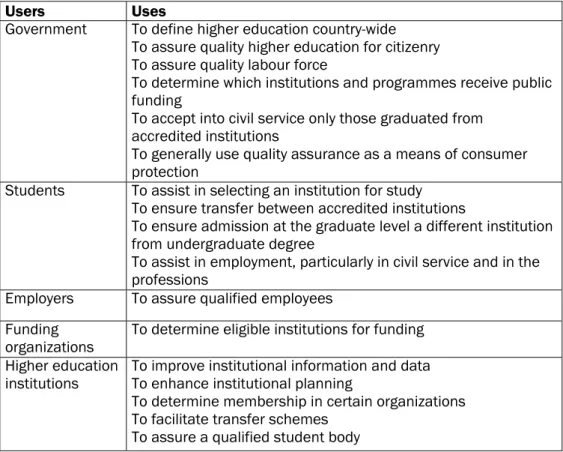
Lenn distinguishes the following uses of EQA systems applying in particular to accreditation systems (see Table 3; Peace Lenn, 2004):
Table 3. Uses of accreditation systems for different stakeholders Users Uses
Government To define higher education country-wide To assure quality higher education for citizenry To assure quality labour force
To determine which institutions and programmes receive public funding
To accept into civil service only those graduated from accredited institutions
To generally use quality assurance as a means of consumer protection
Students To assist in selecting an institution for study To ensure transfer between accredited institutions
To ensure admission at the graduate level a different institution from undergraduate degree
To assist in employment, particularly in civil service and in the professions
Employers To assure qualified employees Funding
organizations To determine eligible institutions for funding Higher education
institutions To improve institutional information and data To enhance institutional planning To determine membership in certain organizations To facilitate transfer schemes
To assure a qualified student body
Source: Peace Lenn, 2004.
Activity 4
Who are/would be the main recipients of information related to EQA in your country?
Should information on the recognition or accreditation and/or QA of institutions and programmes be made publicly available in your country? If so, by whom and how?
Major organizational and methodological
choices in EQA systems
The definitions of EQA concepts may give the impression that the methodology and organizational options in EQA are homogeneous. Although the purposes of EQA may seem similar, many important differences become evident when we compare methodological options. This shows us that while some basic elements in the process are common, EQA systems vary both in their underlying objectives and approaches.
It is agreed that EQA should ideally be based on internal self-assessment by the professionals located in the basic unit level (department, faculty or institution) responsible for decisions concerning education or research. Self-assessment is commonly guided or helped by a list of areas of attention to be addressed. This provides a framework conducting the process. However, self-assessment needs external validation of both the procedures and criteria used. A team of external experts that examines the self-study report and visits the unit is best placed to give such validation. This team will then prepare a report on the basis of which EQA decisions are taken. The basic structure for accreditation processes therefore comprises the following three elements:
• self-assessment;
• peer review; and
• decision-making and public reporting.
These commonly accepted process elements will be discussed fully in Module 2.
1.
Overall purposes of EQA
EQA in higher education refers to a wide range of purposes and related methodological frameworks. Some of these reflect government interest and demand, while others address the internal needs of institutions more directly. As a result, the purposes of EQA are tightly linked to the use that will be made of information outcomes.
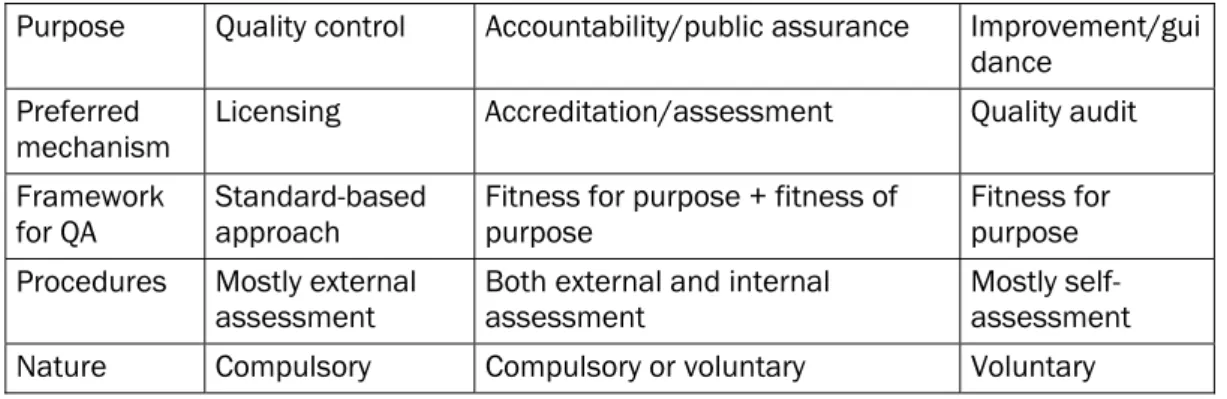
EQA systems have three main broad purposes:
• quality control;
• accountability/guidance; and
• improvement purposes.
Quality control relates to the traditional role of governments in ensuring that
higher education provision is in line with minimum requirements of quality. Where higher education systems are mostly public, this function used to be less prominent as it was assumed that sufficient input steering would produce acceptable levels of quality. This is now brought into question. In addition, ongoing privatization and growth in the numbers of private national and international providers have enhanced the need for national governments to check quality, if
only to protect national consumers and ensure that higher education provision relates to national development objectives.
Second, although EQA is mainly geared towards accountability, it is often also
commissioned by public authorities as part of their higher education policy agenda. It is frequently linked to concerns over ‘value for money’ and creation of transparency and public assurance. To make higher education accountable and have it conform to standards set, the public must be kept informed and judgments made about institutions’ fitness for purpose, soundness or public satisfaction with them. EQA is often conducted mainly to enforce accountability in order to reassure external stakeholders about levels of ‘quality’, acceptable or high standards, and the ‘international comparability’ of both public and private providers (Harvey, 2001).
EQA models can also be used by government to make HEIs conform more to
general policy and reform initiatives. They can do so through the quality model and by setting criteria and standards to be measured. Indeed, quality assurance standards provide detailed information on how institutions will be judged. Together with legal frameworks and funding methodologies, accreditation thus becomes a strong instrument for steering academia. In particular, reporting systems between institutions and government authorities can be highly enriched through regular provision of data and reports.
Third, EQA may also be geared explicitly towards improving existing practices. To
achieve this, it must rely largely on the individual or collective involvement of academic staff. EQA will naturally lead to improvement, partially through the compliance objective, and partially through the setting of high or good practice standards that provide targets towards which institutions and their departments will strive. But the main reason why EQA brings about improvement is the formal and systematic self assessment procedures it helps establish within HEIs. Indeed, ‘transformative’ quality improvement happens more easily when academics start self-assessment by reflecting on their own teaching reality. Otherwise, an EQA system may simply produce a ‘compliance culture’.
Ensuring minimum quality standards is important in higher education systems that have become highly diversified and heterogeneous, or where public trust in HEIs is eroding. In these cases, it is essential to provide a basic assurance that HEIs operating within the system comply with minimum or threshold standards. Threshold standards are normally linked to some degree of sanctions. This means that institutions or programmes that do not meet these standards are forced out of the system, their degrees are not officially recognized, or some similar measure is applied.
Accountability or compliance with standards, including the institution’s own purposes, is used when public information about the quality of a given institution or programme is important. In some cases, this is also linked to sanctions or incentives. At the very least, however, the information provided enables market forces to act. This helps stakeholders make decisions on the basis of quality.5
5. It must be recognized that not all stakeholders consider quality their main concern. There are other important criteria for decision-making. At the very least, quality assurance empowers those willing to make quality their main consideration.
Quality assurance focusing on improvement is normally possible only in more mature systems, where threshold standards have already been met and institutions have developed a basic understanding of self-regulation. This does not mean that the other approaches cannot promote quality. However, making quality improvement the main concern imposes certain requirements on HEIs and on the EQA scheme.
There has been lengthy discussion on whether control, accountability and improvement objectives are compatible or mutually exclusive. While it is certainly true that EQA systems address them all in one way or another, the particular shape an EQA system takes is usually more geared to one than to the others.
2. General
approaches to EQA
Compulsory vs. voluntary EQAOne of the most important questions in setting up an EQA system is deciding whether it will be of a compulsory or voluntary nature. A compulsory system requires all institutions or programmes that fall under EQA mechanisms to periodically undergo the QA process. Generally, however, a compulsory EQA system is not just concerned with checking that minimum standards are met. Compulsory systems are frequently set up because there is no licensing system or it is deficient. They may also apply to types of programmes where the State has a special responsibility, such as teacher training or programmes preparing for professions vital for national development and security, such as medicine, architecture and civil engineering.
Most EQA systems are, however, of a voluntary nature. This means that institutions and departments may apply to undergo EQA. Their motivation to do so may be the chance to acquire a special status through accreditation, which would give them an advantage in a competitive environment in finding students and funding. Or they may be motivated by access to specific funding (such as student funding or special incentive schemes). When EQA systems are voluntary, however, there is an expectation that the advantages related to EQA will create a movement through which all or, at least the majority, of institutions will be pulled into the system. Voluntary EQA systems are often more directly related to the improvement policy agenda. This is because institutions and departments can decide themselves whether they wish or not to join the process, depending on whether they wish to adhere to the proposed quality model. Voluntary EQA systems are also more easily acceptable to the higher education community
Box 4. Compulsory accreditation in Hungary
Hungary developed its procedure and organization of accreditation during the 1990s and has made it official through government bills that were modified on three different occasions: the Temporary National Accreditation Committee (TNAC) 1993-1994, the National Accreditation Committee (NAC) 1994-1996 and the Hungarian Accreditation Committee 1997. HAC is an organization for ‘remote control’ and is responsible for both content and quality, both of which are implemented by way of accreditation of programmes and institutions.
HAC is responsible for different functions. It performs institutional accreditation of universities and colleges every eight years (with special regulations for church- and privately-run institutions applying for State recognition), whereby, in addition to the management and infrastructure of the institution, all degree programmes are assessed (through self-evaluation, the peer visit, and subsequently the published report). The HAC is also in charge of assessing new degree programmes and doctoral schools, specialized postgraduate programmes, and 2-year post-secondary vocational programmes at HEIs. It licenses new universities, colleges and foreign higher education institutions. In addition to these functions that are directly related to quality management, it issues statements on national qualification requirements and on credit system regulations, and it evaluates drafts of international agreements on diploma recognition and equivalence. More recently, accreditation of trans-national higher education and evaluation of academia have been added to its portfolio of functions.
One of the particularities of the Hungarian accreditation system is that institutional accreditation is based on both programme assessment and on the fact that it is already offering a minimal number of programmes that have been accredited with the grade of either exceptional or strong.
In order to fulfil these above-mentioned functions, HAC issues recommendations (or decisions) at three different levels. The first of these levels consists of disciplinary programme committees, the second (medium) concerns college, institutional and interdisciplinary committees and the third level is the plenum of HAC. Final decisions are considered to be corporate actions that concern programmes, faculties and institutions. Thus HAC recommends that the Ministry of Education pronounce a decision for accreditation for undergraduate programmes and different faculties and institutions. It is the responsibility of HAC, however, to advise accreditation of postgraduate programmes.
The objectives of the Hungarian accreditation system were initially geared to the principle assurance of minimum quality standards, in particular at the programme level where disciplinary committees have established minimum requirements for the accreditation of programmes. Consequently, accreditation is compulsory in Hungary. Institutional accreditation possesses, however, a component that aims in particular the improvement of quality. Faculties and institutions are to prepare a self-study report, which is followed up by a visiting team that examines the whole institution, as well as the self-evaluation studies conducted at other specific levels. There is apparent tension due to performing both objectives simultaneously, and critics of the system believe that the quality improvement function should have precedence. The current intention is to help institutions develop and assess their own quality management procedures as part of the accreditation process.
Fitness for purpose vs. standard-based approach
The related dichotomy between the objectives of EQA systems and their fundamental nature (whether compulsory or voluntary) is also directly related to the approach used to assess quality. This can either be the ‘fitness-for-purpose’ or the ‘standard-based’ approach. The ‘fitness-for–purpose’ approach begins by analyzing the stated purpose of an HEI or programme (mission statement). It may also consider whether this purpose is acceptable in higher education or not (fitness of purpose). This approach has been heavily supported. Indeed, institutions and programmes cannot all be judged against the same standards, since they may serve specific types of clients and service groups in a diversified system of higher education. For instance, a traditional university located in a major city and that places strong emphasis on the excellence of its research may not be judged against the same set of standards as a teaching-only institution that emphasizes recruitment of non-traditional student groups. It has, however, also been argued that certain standards (in particular minimum norms) must be required of all HEIs. This way of thinking is becoming increasingly established, in particular within the context of a growing desire for international comparability. More and more systems of quality assurance are therefore moving towards a standard-based approach to accreditation. The ‘fitness for purpose’ approach is usually understood as the more appropriate approach for quality improvement, whereas the standard-based approach is more easily associated with accountability and conformity.
When the aim of EQA is to judge whether an institution or a programme can be accredited or not, it is necessary to use a standard-based approach. This is the case of the regional accreditation agencies in the USA.
Box 5. Standard-based approach used by the regional accreditation agencies in the USA
Accrediting agencies have a long history of requiring institutions to provide evidence about what they do. When USA accrediting agencies got underway early in the twentieth century, they required very specific information on the college’s structure and programmes. Standards were limited in number, generally relied on available information, and were usually quantitative. During the 1920s, for example, typical requirements asked for information on the number and capacity of classroom buildings, the number of volumes in the library, the number and credentials of academic staff, and the size of the annual budget. The purpose, generally speaking, was to ensure that academic institutions had adequate organizational resources or sources of stability that could support a quality education. Notably, the focus was on the institution, and not on students nor on learning and instruction.
This approach was criticized on several grounds. First, it was said to give too much attention to fragmented information that, while ‘countable’, was not necessarily meaningful. Second, it did not allow for differences in institutional mission and type. Third, these measures gave too much emphasis to ‘inputs’ or ‘resources’ rather than to what use was made of them. Adding to these arguments, undoubtedly, was the fact that, as experience accumulated with accreditation, and with lists of accredited institutions offering programmes of good quality and
deserving to be accredited, even if they failed to meet certain prescriptive requirements, the requirements themselves were increasingly seen as not meaningful.
By the 1930s, with the North Central Association taking the lead, the idea of a single set of standards was dropped. The NCA instead decided to focus on the ‘total pattern’ of an institution’s activity and to take into account the purposes that the institution itself had chosen. A small, religiously affiliated college may have very different purposes than one of the Mid-West’s large state universities, it was recognized, and should be judged according to its own purposes.
To implement this new approach, the NCA revised its approach to accreditation review. Evidence gathered about an institution was to be assessed in terms of overall pattern the evidence presented, instead of the previous emphasis on meeting each specific standard. Standards were from then on known as ‘criteria’ to reflect their change in purpose. Under this ‘holistic’ approach, an institution could be deficient in one area but have offsetting strengths in other areas.
This attention to a university’s overall pattern of activity was adopted by the NCA and used throughout the 1930s and 1940s (NCA, 1997, p.4). Other regional accrediting agencies took similar actions during this period. Notably, although they took steps to offer greater flexibility in how their standards were interpreted, they did not change their wording from ‘standards’ to ‘criteria’. Numerical information continued to be used but it was given less importance. Qualitative judgement became more important. Still, the focus was on the institution, its organizational strengths, and distinctive educational offerings and mission.
In retrospect, it can be said that this ‘holistic’ emphasis may have slowed but did not stop a gradual process of increased detail in accrediting requirements. The wording changed, the guidance became more flexible, but the number of standards grew. Most accrediting agencies today work with quite detailed standards, intended to reflect both the general responsibilities that all institutions or programmes should meet, and the criteria by which to judge whether those standards are met. The Northwest Association (NWA), for example, currently has nine standards, with a total of 45 subparts (Northwest Association, 1999).
Source: El-Khawas, 2001: 60-62
The French system of evaluation has been based for almost 20 years on a rather open system of quality assessment. The aim of this system is to assess the particular strengths and weaknesses of an HEI, in order to provide information to improve the internal processes at a given institution. More recently, a set of standards for evaluators and the internal management of HEIs was adopted (see
Box 6. Livre des références of France’s Comité national d’évaluation
At the same time, we saw that the work of the CNE had to become more professional to establish its reputation. We sought to strengthen our methodology and explain it more clearly in the international arena. The most successful achievement in this field came in 2003 with the publication of the Livre des références (Book of standards), which is now the framework for internal evaluation. The reasoning of this document is based on demonstration, leaving the university to choose which lessons it should draw. It addresses three areas: educational policy, research policy and the extent to which the university's management serves its objectives. The book is divided into ten reference frameworks, each of which defines a major area of university life on which the expectations of users and partners are based; 63 references constituting an implementation system; and a non-exhaustive list of 302 criteria, each of which formalizes a mechanism that contributes to achievement of the objective. The Livre des références has not only been used in all CNE evaluations since its publications, but has also proved to be an effective communication tool.
Source: Levasseur, 2005.
Module 4 will further discuss and deepen the ‘fitness-for-purpose’ and standard-based approaches to EQA, which are fundamental system choices.
Minimum standards vs. high level (or good practice) standards in accreditation
EQA systems may use either minimum or high level (or good practice) standards.
They more commonly use minimum standards. When they do so, they tend to be conceptually close to a licensing scheme for institutions or programmes and thus act as a periodic licensing mechanism. Such minimum standards frequently address input factors relating to students, staff, buildings, facilities and finances. They also include process elements such as governance and management systems, as well as the basic research activities perceived to be necessary for higher education to be meaningful. Overall, an EQA system based on minimum standards aims to enforce conformity with standards as well as accountability. EQA based on high standards assumes that either the minimum standards are already checked through a different mechanism or that quality in the system is relatively even. This is the case, for instance, in Western Europe, where the state has long assumed the major responsibility for funding a largely public system. Assurance of high or good practice standards is also predominant in countries where universities traditionally have a high level of autonomy and where compliance with minimum standards, particularly at the programme level, seems contrary to the local understanding of autonomy. EQA based on high level or good practice standards seems to be the mechanism for quality improvement as it provides a set of references towards which institutions should strive. Again, it is easier to implement as it is frequently of a voluntary nature and may be driven by the better-quality institutions. The problem with this mechanism is that it is not very effective in weeding out unacceptable levels of quality. It is thus not an effective mechanism to deal with uneven and sometimes unacceptable programmes offered by a multitude of (commercial) providers.
Box 7 presents the Colombian approach to accreditation which is a standard based system but whose aim is not to provide assurance of minimum quality standards, but which certifies high quality standards and is thus organized on a voluntary basis.
Box 7. Accreditation of high quality in Colombia
Higher education in Columbia is complex and heterogeneous. It consists of a multi-layer system of universities, colleges, technological institutions as well as intermediate technical-professional institutions. Social demand for higher education from an increasing number of secondary school leavers has grown tremendously over the past two decades. However, due to funding constraints public provision could only satisfy part of this demand, which has led to a proliferation of multiple private programmes and institutions that offer higher education with different levels of both quality and relevance.
As part of a reform of the higher education system in Colombia proposed in 1992 (Law 30), the system of accreditation of Colombian higher education institutions was created under the auspices of the National Council for Accreditation (CNA), which had been precisely perpetrated by this Law. CNA functions under the National Council for Higher Education (CESU), which is the main body for policy-making in Colombian higher education. CNA consists of a group of highly respected Colombian academics and of a secretariat that is in charge of co-ordinating ongoing accreditation processes.
CNA is in change of voluntary accreditation for high levels of quality. “Accreditation of high quality” is both a voluntary and temporary process and its methodology stresses quality enhancement rather than quality control. In consequence, “Accreditation of high quality” adopted a system whereby ideal characteristics of quality are compared to reality, thus creating strong incentives for quality improvement.
The methodology for the Accreditation of high quality of academic programmes and institutions is founded on a process consisting of basically four stages. Once an institution has requested accreditation of its programmes, the first phase concerned with checking the eligibility of criteria may begin. Following this stage, the academic undergraduate programme of the institution undergoing accreditation conducts a self-evaluation based on a pre-established methodology and set of criteria and quality characteristics. An external peer visit of the institution then follows, which leads to the preparation of a report on which the institutional management may comment. The concluding report of the peers is submitted to CNA that thus proceeds to the final evaluation or synthesis and issues a recommendation to the Ministry of Education to accredit the programme for a given duration ranging from three to ten years.
CNA has prepared a model for the Accreditation of high quality, which is based on the following seven factors:
• institutional project;
• students and teachers;
• academic processes;
• organization, administration and management;
• graduate students and impact on the environment;
• physical and financial resources.
The factors are described and organized into a total number of 66 characteristics. Each characteristic includes indicators that allow measuring the degree of compliance with an ideal value.