Towards an Access Control System for Mobile
Peer-to-Peer Collaborative Environments
Pascal Fenkam, Schahram Dustdar, Engin Kirda, Gerald Reif, and Harald Gall
Technical University of Vienna, Distributed Systems Group
Argentinierstrasse 8/184-1, A-1040 Vienna, Austria
P.Fenkam, S.Dustdar, E.Kirda, G.Reif, H.Gall
@infosys.tuwien.ac.at
Abstract
Access control is one of the key requirements in en-terprise security. A number of approaches in distributed systems have been designed that support various (new) paradigms such as peer-to-peer, nomadic working, and teamworking. Few of them, however, explicitly take into ac-count the possible superposition of these concepts. Such a superposition often results in conflicting and additional re-quirements. We present ongoing work in developing an ac-cess control system for Peer-to-Peer mobile teamwork en-vironments. This system is developed as part of the MO-TION project. The goal of this project is to develop a ser-vice architecture for mobile teamwork, providing support for various devices and taking into account diverse connec-tivity modes. We present the requirements for an access con-trol system that simultaneously supports mobility, collabo-ration, and peer-to-peer, illustrate our solution, and discuss how it meets the requirements.
Keywords: Access Control, Security, Mobile Team-working, XML meta-data and XQL, Mobile Computing, MOTION, Peer-to-Peer.
1
Introduction
In this paper we propose an access control mechanism for mobile Peer-to-Peer (P2P) teamwork environments. A number of research papers as well as product implemen-tations exist that propose solutions for authorization when P2P and mobile teamwork paradigms are considered as sep-arate requirements.
This project is supported by the European Commission in the Frame-work of the IST Program, Key Action II on New Methods of Work and eCommerce. Project number: IST-1999-11400 MOTION (MObile Team-work Infrastructure for Organizations NetTeam-working)
In the CoolTown [14] project for instance, an autho-rization infrastructure is designed for nomadic computing. Shen and Dewan [11] propose an access control system for collaborative environments (also called teamworking envi-ronments). Kim et al. [7] give an example of authorization infrastructure for P2P environments. Though these three concepts draw growing interest in the software engineering community we are not aware, to the best of our knowledge, of an authorization mechanism that takes all these paradigm specific requirements into consideration. Considered sep-arately, none of the models designed for mobile comput-ing, peer-to-peer systems or collaborative environments can meet the requirements for access control in mobile peer-to-peer collaborative environments.
In this paper, we first provide an overview of require-ments for access control in mobile P2P teamworking sys-tems. We proceed by superposing the requirements result-ing from each paradigm. Conflicts are solved by givresult-ing priority to the functional requirements. The paper further presents our initial results and briefly discusses how it meets the requirements.
The remainder of the paper is organized as follows. Sec-tion 2 investigates the requirements for authorizaSec-tion in mo-bile, P2P, and collaborative systems. Section 3 gives an overview of the MOTION [8, 10] platform, a platform for mobile P2P teamworking, and presents its access control mechanism. Section 4 discusses the evaluation of the MO-TION access control system regarding advocated require-ments. Section 5 concludes the paper.
2
Requirements for Access Control in Mobile
P2P Collaborative Systems
The requirements for an access control system in mo-bile P2P teamworking systems are ineluctably derived from requirements for access control in mobile systems, access
control in P2P systems and access control in collaborative environments.
Authorization for nomadic users is guided by place spe-cific services. Users continuously encounter services while on the move. Exploiting them, however doesn’t work with-out problems; poor connections and insufficient resources are often obstacles to mobility. Therefore, the access con-trol mechanism must take into accountworking offline from any central point of administration or control. Though weak connection is the most advocated reason for taking offline working into consideration, there are many other ex-amples showing that many peers indeed work offline, be it intentionally or not (tactical battlefield equipments, mobile computing in area without infrastructure, ad hoc network-ing, law enforcement, disaster recovery, administration and control of large events, etc. [1]). The second most important requirement for access control systems in mobile comput-ing environments is thesupport for various mobile devices.
They often lack resources for running conventional security mechanisms themselves. These problems are exacerbated when the number of services is large and services are mo-bile themselves.
Peer-to-Peer computing on the other hand, principally
rejects the concept of central authorization controlwhich is not excluded in mobile computing. The CoolTown [14] authorization system for nomadic workers is, for instance, based on a central authorization control. The reason for re-jecting this concept is that many peers are often responsible for the resources they provide. Besides this,scalability is often an issue in P2P networks.The access control mecha-nism must therefore suitably face the problem of large num-ber of peers. The access control mechanism should not be a handicap for P2P specific scenarios such as ad hoc com-munication and must not be handicapped by these specific scenarios (e.g. independent lifetime of peers).
Most existing P2P platforms, whether intended or not, are designed exclusively for sharing only some few types of resources [7]. Security for personal P2P systems is not as critical as for enterprises, which require high security levels for P2P collaboration within their organization as well as on the Internet. As a consequence, personal P2P systems do
not address security to the extent that is required by en-terprises:a great variety of resources need to be protected, the notion of role is increasingly required [6]. Other re-quirements for access control in collaborative rere-quirements are listed in [11]: multiple and dynamic user roles (inher-itance of access rights (AR) from many roles), tion rights (additional access rights that match collabora-tive requirements), flexibility (support for fine-grained sub-jects, obsub-jects, and access rights). To be beneficial for enter-prises, collaborative applications must provide integration facilities for third party applications (e.g. databases). This implies that their authorization mechanisms must be
suffi-ciently generic and be able of matching many access control mechanisms and a wide range of access rights [11].
These requirements present an overview of the chal-lenges faced when designing access control mechanisms for mobile, P2P, and collaborative applications separately. The superposition of these requirements leads to conflicting re-quirements. We enumerate two examples of such conflicts:
Central vs. non central authorization control. Zhang and Kindberg [14] have designed an authorization mechanism for nomadic computing. The system is based on a central authorization control. A reason for this design decision is the difficulty in maintaining dis-tributed security policies. However, for Peer-to-Peer, a centralized authorization mechanism seems to be in contradiction with the goals of this architectural style such as redundancy-induced dependability, availabil-ity through replication, etc. Peer-to-Peer securavailabil-ity de-signers believe that it is natural to assume each peer as being responsible for resources it provides.
Access rights revocation. E-Speak [7] is a P2P “e-service infrastructure that allows “e-services to advertise, discover, and interoperate with each other in a dy-namic secure way.” The access control mechanism of E-Speak is built on top of the Public Key Infrastructure (PKI). It allows services to maintain certificate revoca-tion lists (CRL). Capabilities may be revoked through CRLs, which might be a bottleneck for a set of sce-narios in mobile computing: ad hoc networking and weak network connectivity, to name a few. In fact, a service working offline will not be able to work appro-priately since it cannot verify that the certificate was not revoked.
3
The MOTION Access Control System
In this section, we give an overview of the MOTION ar-chitecture, and describe our authorization model.
3.1 Overview of the MOTION Architecture The MOTION [8, 10] (MObile Teamwork Infrastructure for Organizations Networking) service architecture that we have developed supports mobile teamwork and relies on a P2P middleware. The MOTION system has a layered ar-chitecture consisting of three layers (as depicted in Figure 1). The bottom layer is the communication middleware of-fering basic services such as publish/subscribe mechanisms (i.e. event-based system support), peer-to-peer file sharing functionality and distributed search propagation. We refer to every computing device that is connected to the MOTION system as apeer. Some peers in the system host services and some only act as clients. Any computing device that is
TWS API
Team Work Services
Business Specific Services Presentation Layer Communication Middleware Distributed Search Publish/ Subscribe Artifact Management
Peer−to−Peer File Sharing TWS
Layer AccessControl User Management Management
Community
Repository Messaging DUMAS
Event based System
Figure 1. Overview of the MOTION Architec-ture
able to run the MOTION libraries can act as both, service host and client. A typical MOTION configuration, thus, consists of desktop computers, notebooks, and PDAs that can host services and also act as clients. Clients such as Web browsers or WAP enabled phones do not host services, but access them remotely. Each peer that has the technical capability hosts a repository. Artifacts (i.e. files) that the user wishes to share with others in communities are stored in this repository along with the corresponding XML meta-data (i.e.profilein the MOTION terminology).
The repositories hosted on peers also store community and user profile information that are replicated across some peers and are synchronized using events. From the user perspective, profiles are used to support queries based on descriptions ofresources(e.g. communities, users, and ar-tifacts). From the system point of view, the profiles are also used to store system-relevant information such as user names and last modification timestamps.
The middle layer in the architecture, the Teamwork Ser-vices (TWS) layer, is built on top of the communication middleware. It is responsible for the integration of the main components of the system such as the repository, access control, community management, and user management component. Furthermore, it provides an Application Pro-gramming Interface (API) to the following generic services: 1) Storing and retrieving artifacts in the local repository and from remote repositories on other peers. 2) Managing re-sources (e.g. artifacts, users, and communities) and their profile information. 3) Creating and managing communi-ties. 4) Sharing of artifacts with other users within com-munities 5) Subscribing to specific events in the MOTION system (e.g. artifact insertion, artifact deletion, user joining a community, etc.). 6) Sending and receiving messages to and from other users. 7) Receiving system messages and notifications. 8) Distributed searching for artifacts, users, and communities based on their profiles.
3.2 Access Control in MOTION
3.2.1 Conceptual Overview
The access control facility is provided in the MOTION sys-tem by DUMAS (Dynamic User Management and Access Control System. See Figure 1). This component provides three main functionalities: access control, user manage-ment, and community management.
A community represents a set of users sharing some re-sources. Operations on communities include creating them, deleting them, making them subcommunities of other com-munities and removing them from other comcom-munities. We identify the notion of community as a teamworking view of the concept of roles discussed in the access control arena. Thus, the community management facility of DUMAS is in fact a role management facility.
User management consists of registering new users in the MOTION environment, assigning them to and removing them from roles, and deleting them. Obviously, users inherit access rights from the different roles they are members of.
The access control facility is composed of primitives for assigning access rights to users and roles, removing access rights from them, defining new access rights and assigning semantics (such as methods) to them. Through the capabil-ity of defining new access rights, MOTION supports differ-ent business specific requiremdiffer-ents, and integration of third party products. This paradigm is further discussed in [2].
The architecture of DUMAS is inspired by the under-lying P2P file sharing middleware and the requirement for mobility support. Two categories of peers are distinguished. L1 peers (Peers of Level 1), and L2 peers.
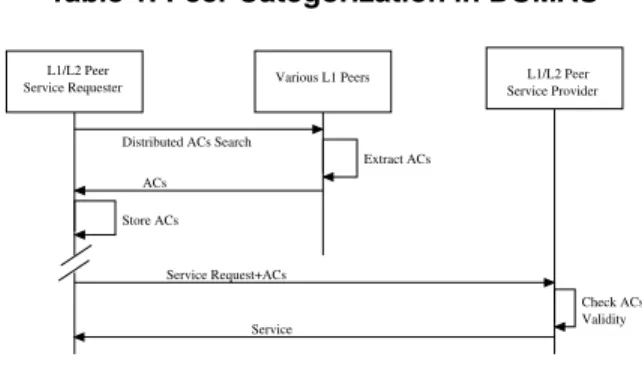
A summary of this categorization is shown in Table 1. A primitive such as adding a user to a community consists of three steps: validating the set of authorization certificates presented by the user (labeled V in the table), executing the real function (E), and publishing the event (P). Peers per-form all or a subset of these tasks depending on their levels. L1 peers are peers that have the capacity of maintain-ing a regular security infrastructure. This includes the com-plete intelligence for assigning permissions, removing per-missions, validating and storing access control lists (ACLs). An important characteristic of an L1 peer is that it is re-sponsible for protecting some resources (whether provided by itself or other peers). The responsibility of protecting a service includes storing ACLs related to this service and de-livering authorization certificates. To use a service, a user must present his capabilities to the service provider (See Figure 2). These capabilities are authorization certificates (ACs), delivered by L1 peers based on the hosted ACLs. Each peer disposes a public/private key pair.
L2 peers are devices lacking the resources for instantiat-ing the full DUMAS engine. They rely on a special imple-mentation of DUMAS, which functionalities consist of:
Category Function AR Storage AC Delivery
L1 V, E, P ACLs Yes
L2 V, P ACs No
Table 1. Peer Categorization in DUMAS
Various L1 Peers
Service Provider L1/L2 Peer Service Requester
L1/L2 Peer
Distributed ACs Search
Extract ACs ACs Service Request+ACs Check ACs Validity Service Store ACs
Figure 2. Authorization Process
verification of authorization certificates. Some devices (mobile or not, online or not), though disposing weak resources, might provide services to users and there-fore need to protect them. In this case ACLs are stored on some L1 peers . The L2 peer needs the intelligence to verify authorization certificates related to the service it provides.
storing of a subset of authorization certificates. For ex-ample, an L2 peer might belong to some nomadic
user who needs to interact with another L2 peer
later on. The communication might happen in a sce-nario where both L2 peers are offline. For this, the no-madic user stores his authorization certificates related to services provided by on .
storing of public keys of peers responsible of protect-ing the provided resource.
Generally, to use a service, a user must present his au-thorization certificates to service providers (see Figure 2). While he is online, the user performs a distributed search specifying the kind of authorization certificates he is look-ing for. Some L1 peers can reply by sendlook-ing some rization certificates for a short validity period. These autho-rization certificates are small enough (up to 300 bytes) so that they can be stored on L2 peers and presented to ser-vice providers in exchange of serser-vices. An authorization certificate has the form (access right, user ID, object ID, expiration date, peer signature). The signature is that of the L1 peer delivering the AC. This peer must be registered as one of the peers responsible for managing ACLs for the service for which it delivers the authorization certificates.
Any action performed in the MOTION environment is accompanied with a set of authorization certificates. Op-erations for assigning access rights to and removing them
from users and communities are sent asynchronously to re-sponsible L1 peers. The communication between peers is event based. This implies in fact that any peer can inter-cept the published event and later on distribute authorization certificates in a non authorized manner. However, these au-thorization certificates will not be accepted by the service provider since such authorization certificates are not deliv-ered by registdeliv-ered L1 peers.
3.2.2 Implementation
The actual implementation of our access control system is done using the Java programming language. The communi-cation facility between peers is provided by PeerWare [9], a middleware whose functionalities include peer-to-peer file sharing, mobile code deployment, distributed search prop-agation, and event subscription and publishing. Authoriza-tion certificates and ACLs are represented using the eXten-sible Markup Language (XML [12]). Search for authoriza-tion certificates is performed by using XQL [13], a query language for XML.
Users might search for their authorization certificates on the MOTION network using various criteria: access right name, service keywords, name of the peers possibly deliv-ering the authorization certificates, etc. An example of such a query is given below:
AuthorizationCertificate[
Target/ID $startswith$ ’+43699’
$and$ Target/Type $contains$ ’Telephone’ $and$ @peer $startswith$ ’motion’
$and$ @Owner=’fsigmund’]
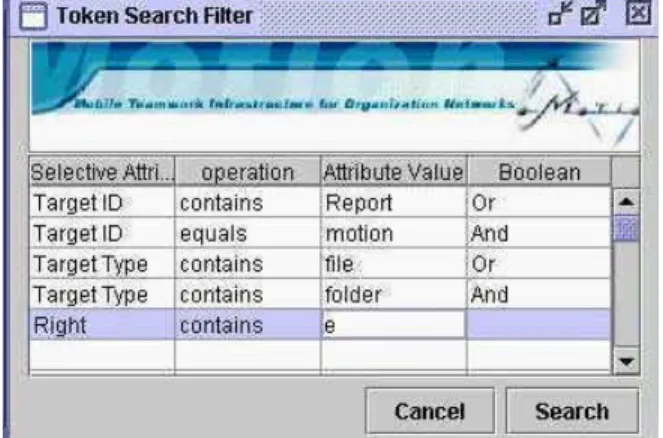
The purpose of this query is to search for any authoriza-tion certificate that the userfsigmundhas on the numbers starting with+43699. The search must be performed only on L1 peers whose name start withmotion. This query is distributed to appropriate peers. These peers locally apply the XQL query to their ACLs (using the GMD XQL engine [4]), extract the set of matching resources, include an expi-ration date, sign the information and return the result. These queries might seem complicated for end users, therefore we have designed an appropriate graphical user interfaces that, we believe, allows end users to formulate such queries (See Figure 3).
An example of a authorization certificate returned by an L1 peer is shown below.
<AuthorizationCertificate Signature=’R24fd64he64hg7448’> <ExpirationDate Date=21.03.2002 Time=’15:34’/> <Owner ID=’fsigmund’/> <Target Type=’Telephone’ ID=’+43699111’/>
Figure 3. Formulating AC Search Queries
<Right Name=’dial’/>
</AuthorizationCertificate>
The current efforts in the realization of our access control system are deployed 1) for the public key infrastructure, and 2) for the verification of the whole protocol. A part of the access control system was already formally specified using the formal specification language VDM-SL [3]. This formal specification was used for deriving test cases for our Java implementation. However, VDM-SL is not very well suited for specifying protocols. We are now translating the formal specification to Alloy [5], a formal specification language for micro-model of software. Its analyzer allows complete and automatic verification of various properties.
4
Discussion
We briefly discuss the fulfillment of the requirements mentioned in section 2 through our authorization infrastruc-ture.
1. Decentralization of control: access rights information can indeed be stored on every L1 peer, provided this peer is known by the peer providing the service. Repli-cation of information can thus be achieved among var-ious peers.
2. Offline working: A peer can in fact be offline and still be in the MOTION network, providing its services to nomadic users. These users need to search their autho-rization certificates from online peers. The offline peer needs to be informed each time a new peer is added to the list of peers allowed to deliver authorization certifi-cates.
3. Support for various access control systems: DUMAS allows syntactic and semantic definition of access
rights at runtime. This implies that access rights avail-able in other applications can easily be defined and therefore the MOTION’s access control system made compatible with these applications. Further, DUMAS supports assigning access rights both to users and to roles. In this sense, application can be integrated that have either role base access control (RBAC) or user oriented access control.
4. Support for mobile devices: authorization certificates delivered by MOTION peers are small enough such that a PDA can store up to 1000 of them without prob-lems.
5. Access rights revocation: two types of access con-trol data are distinguished. On one side, there are ARs stored on L1 peers. These ARs can be re-voked by simply removing the corresponding entry from the XML repository (DUMAS provides primi-tives for this). Other L1 peers are informed by means of the publish/subscribe mechanism and can update their knowledge. The other kind of data are authoriza-tion certificates. Authorizaauthoriza-tion certificates have such a short lifetime that they are revoked automatically when they expire.
6. Collaboration: DUMAS maps the notion of commu-nity to roles. However, when a user searches for his authorization certificates, he will receive a authoriza-tion certificate if he is either in a community having the access right he is looking for or he was explicitly assigned this permission. All the requirements listed in [11] are satisfied by our authorization systems. Users may be member of many roles and inherit access rights from these roles. DUMAS supports any finite number of access rights. Our model is sufficiently fine grained: permissions can be assigned to users and roles. 7. RBAC: Jaeger and Prakash [6] have identified the
en-hancement of Role Based Access Control through dis-cretionary access control (DAC) as an important re-quirement for collaborative systems. This rere-quirement allows decentralization of the administration. A com-munity leader can be defined for each comcom-munity and given the right to further assign this right to members of the community. Access rights in DUMAS are ob-jects on which users or communities might have per-missions. These permissions include the permission to delegate this access right or not, thus the support for discretionary access control.
8. Administration: we have developed a graphical user interface for easy administration of the access control system for L1 peers. Future work includes evaluation of the usability of this user interface.
9. Scalability is an issue that we are now investigating: how to restrict the search scope of queries. This is not a problem if a user specifies the peers from which authorization certificates must be collected. We can-not assume, however, that users will always do so. We have, therefore, to find solutions for automatically narrowing down this scope. Another issue is that we strongly depend on the scalability of the underlying event based system. We assume that an event pub-lished by a peer will be delivered in time to subscribed recipients. Without this assumption, it is difficult to ar-gue for instance that an access right removed from a user is indeed removed from that user. In small exper-imental settings, we have been satisfied.
5
Conclusion
The goal of this paper has been to present our ongo-ing work in developongo-ing an enterprise-wide access control system for mobile peer-to-peer collaborative environments. Current access control systems relevant for the investigated research area are build for either personal usage of peer-to-peer systems or for mobile environments and do not con-sider highly distributed enterprise scenarios. However dif-ferent usage scenarios lead to superposition of requirements and as a consequence to conflicts. The access control sys-tem presented in this paper takes the different requirements advocated for these paradigms into consideration and solves conflicts by giving priority to functional requirements. The contributions of this paper are manifold: The presented ac-cess control system is generic and supports any finite num-ber of access rights. It supports discretionary access control as well as RBAC. Distributed search are performed using XQL. Furthermore it is implemented for highly decentral-ized architectures. We showed how Access Control Lists (ACL) may be hosted on any peer in a P2P system and not only on the peer providing the actual service or on a single central peer. This enables our solution to be highly avail-able. We have discussed the fulfillments and implementa-tion issues of access control requirements realized in our infrastructure. As we hope that our infrastructure will be a reference in the area, correctness of is an issue that we are investigating in our future work.
References
[1] S. Basagni, I. Chlamtac, and A. Farago. A generalized clus-tering algorithm for peer-to-peer networks. InWorkshop on Algorithmic Aspects of Communication, satellite workshop of ICALP’97, invited paper, Bologna, Italy, July 1997. [2] P. Fenkam, H. Gall, G. Reif, and E. Kirda. A Dynamic and
Customizable Access control System for Distributed Appli-cations. Technical report, Distributed System Group, Tech-nical University of Vienna, December 2001.
[3] P. C. Fenkam. Dynamic user management system for web sites. Master’s thesis, Graz University of Technology and Vienna University of Technology, September 2000. Avail-able from http//www.ist.tu-graz.ac.at/publications.
[4] GMD. Xql ipsi, http://xml.darmstadt.gmd.de/xql/, 2002. [5] D. Jackson, I. Shlyakhter, and M. Sridharan. A
micromod-ularity mechanism. InProc. ACM SIGSOFT Conf. Founda-tions of Software Engineering/European Software Engineer-ing Conference (FSE/ESEC ’01), Vienna, September 2001. [6] T. Jaeger and A. Prakash. Requirements of role-based
ac-cess control for collaborative systems. InProc. of the 1st ACM Workshop on Role-based Access Control; Gaithers-burg, MD, November 1995.
[7] W. Kim, S. Graupner, and A. Sahai. A secure platform for peer-to-peer computing in the internet. InThirty-Fifth An-nual Hawaii International Conference on System Sciences, January 2002.
[8] E. Kirda, H. Gall, G. Reif, C. Kerer, and P. Fenkam. TWS-API: A generic teamwork services application programming interface. InIEEE Proceedings of the Internation Workshop on Mobile Teamwork 2002, To Appear.
[9] G. P. Picco and G. Cugola. PeerWare: Core Middleware Support for Peer-To-Peer and Mobile Systems. Technical report, Dipartimento di Electronica e Informazione, Politec-nico di Milano, 2001.
[10] G. Reif, E. Kirda, H. Gall, G. P. Picco, G. Cugola, and P. Fenkam. A web-based peer-to-peer architecture for col-laborative nomadic working. In10th IEEE Workshops on Enabling Technologies: Infrastructures for Collaborative Enterprises (WETICE), Boston, MA, USA. IEEE Computer Society Press, June 2001.
[11] H. Shen and P. Dewan. Access control for collaborative environments. In J. Turner and R. Kraut, editors, Proc ACM Conf. Computer-Supported Cooperative Work, CSCW, pages 51–58. ACM Press, 31 –4 1992.
[12] World Wide Web Consortium. eXtensible Markup Lan-guage. Technical report, W3C, May 2000. Available from http://www.w3.org/XML/.
[13] World Wide Web Consortium. XQL Query Requirements. Technical report, W3C, January 2000. Available from http://www.w3.org/TR/2000/WD-xmlquery-req200031. [14] K. Zhang and T. Kindberg. An authorization
infrastruc-ture for nomadic computing. In Proceedings of the 7th ACM Symposium on Access Control Models and Technolo-gies (SACMAT), To Appear.