1
On Islamic Economic Development
Mehmet Bulut
Department of Economics, Istanbul Sabahattin Zaim University
Cem Korkut
Department of Economics, Ankara Yıldırım Beyazıt University
On Islamic Economic Development
Abstract
Muslim countries witnessed outstanding intellectual and socio-economic prosperity up to the 18th century when they fell into a period of regression following the Ottoman’s global decline. Currently, economically Muslim societies lags behind the modern western world. Scholars hold different views, including the radical notion that Islam is inherently anti-development and thus resists progress. This study discusses the Islamic philosophy and principles of development in the context of institutional economics. The basic principles of Islamic economic development drawn from the Islamic sources and historical experiences will be explored for a better understanding of Muslims’ current condition. This study addresses questions including whether basic religious precepts caused Muslims’ economic underdevelopment, while examining the development process according to Muslim perspectives. The institutions, the organizations, rules, and applications will also be explored in addition to the impact of those institutions on development. The context of development will also be evaluated according to Western value perspective. A model of Islamic economic development will be discussed in addition to the discussions of institutions that contributed to the early development of the Islamic world.
Keywords:Islamic Development; Economic development; Waqf
INTRODUCTION
What did the West do right or what did Muslims do wrong in the last two centuries? Discussionon comparative economic development between the western and Muslim worlds depend largely on this very question. Ergener (2010:1) refers to the theories of underdevelopment in Muslim, especially in the Middle East. The main theories can be summarized as follow; (1) extinction of rational thinking according to Weber in 1965; (2) devastating effects of western imperialism according to Rodinson in 1978; (3) the relationship between Islamic law and property rights and the absence of institutions of liberty in Islam according to Facchini in 2007 and 2010; (4) the negative effects of Islamic law on the accumulation of capital and waqf system on economic flexibility according to studies of the Qur’an in 2004. There are also other approaches that relate underdevelopment the institutions and bad governance (Acemoglu & Robinson, 2012).
to consume more. However, classical theories accept the relationship between consumption and development level (Hasan, 1995: 85-87). The Western definition of development depends on the Scottish Enlightenment and the views of Adam Smith (Mirakhor and Askari, 2010:53). Having said that, there are many views about development pointing to the need of approaching economic development according to the perspective of communities’ native and indigenous value systems.
Today, Western economic system accepts the level of development with a view of the quality of credit and borrowing channel, free competition, freedom of choice and enterprise, attitude of profit maximization, market mechanism and private ownership. This however oversights many other critical factors such as universal values, welfare in Hereafter, and religious-based trust. Such scenario only points to the deficiency of the western concept and approach to development. The Eastern model of development appears to be predominantly totalitarian. The state acts as the sole arbiter, and rules all production, planning, and distribution. Such a system also not connate of human-being (El-Ghazali, 1994:31-33). Classical western economic approach measures development according to the quality of air, water and energy resources, environmental biodiversity, assets of produced, R&D and finance, human capital, investment in human and depreciation human as a human capital aspect, in addition to consumption, education, employment, health and income distribution (Stevens, 2005:3).
According to World Health Organization statistics, 27% of adults in Iceland, Norway and Switzerland have faced at least one mental disorder such as depression, anxiety, or others. This at least points to the weakness of the measures of development used in Western economic thought and their failure to capture the holistic concept of human prosperity or happiness. This is perhaps because economics in the West largely tends to focus on material satisfaction as source for comfort and peace. However, the phenomenon of remembrance of Allah is the only action that provides moral satisfaction in Islamic thoughti.
Theories of development theories, self-interest or state-interest also hardly consider the concept of altruism. They do not discuss the issues that motivate people to help each other. Institutional economists have begun to debate other factors underlying development, such as culture, religion, tradition, human behavior, etc. Those debates however are still unable to fully understanding Muslims, Homo Islamicus. For example, Qur’an (1986) reduces the role of Homo Islamicus in social responsibility and altruistic behavior. The reason being that investigations are carried out only on the current situation of Muslim countries with no recommendation for the successful application of Islamic civilizations in history.
This study examines the development process according to the Muslim perspective. The institutions, the organizations, rules, applications will also be explored in addition to impact of those institutions on development. Can those very institutions be the cause of underdevelopment in Muslim societies or is the Muslims perspective on the mundane life different from the modern homo economicus person the very reason of underdevelopment? The context of development context will also be evaluated in a material perspective as a Western value.
I. ISLAMIC PERSPECTIVE ON ECONOMIC DEVELOPMENT
be limited strictly to maximizing of material comfort and output only, it should rather include pursuit of peace, justice and correct behavior. The spiritual needs require moral development while the satisfaction of the physical and material needs also requires the material, and humans need sufficient level and balanced distribution of income and wealth (Chapra, 1993:6-7). In this context, economic development must be fair causing no damage to the lives of humans, the caliph of God in the universe. The understanding of Islam of development needs to be evaluated according to this metaphysical perspective. This, the activities and transactions that may conform other economic conventional systems of economic development may not necessarily be in lime the basic principles and philosophy of Islam, as is the case with prohibition of interest (riba), excess consumption, and others.
The impact of religious beliefs, cultural values, traditions, customs, on economic development has for long drawn the attention of academics, researchers and policy makers. Unwritten rules, norms and tendencies that govern the relations of societies in themselves and towards one another also affect the shape of their economic activities. Similarly, elements such as common expectations and societal value judgments are also intertwined with economic development and growth actors. The mainstream economic theories accept individuals rational. However, it is not necessary to be rational when one especially believes in the divine religions having faith in afterlifeii. All societies have in fact pursued the happiness and prosperity of their people. Muslims today are querying the current situation for they enjoyed glorious days in the history. This situation may be because of resurrection for Muslim societies (Sadeq, 1987:35). Rationally, individuals may not wish to maximize their material benefits, however, Muslim societies and Islamic countries can aim to provide human welfare.
For any revival to take place in Muslim societies, it is essential to understand the development and growth policies which Islam either commands or recommends. This will be discussed when light shed on the Muslim era reaching peak economic prosperity highest development levels. Scholars limit the Islamic Golden age to the period extending between 7th-13th century (Chaney, 2015). However, this period can be extended further to the Ottoman’s brightest period and later (Sezgin, 2007). Even, there are critiques on basic Islamic institutions, such as inheritance system, waqfs etc., they have shape much of modern institutions for modern world.
compare inheritance systems, especially in medieval and pre-modern era, Islamic societies defended women’s right to inheritance, but this right was easily violated in European societies (Shatzmiller, 2006:26-27).
The other critiques on development of Muslim countries is the lack of ability to catch the age because of Islamic law. Some explain underdevelopment of Muslim societies no to give importance to secular and empirical knowledge. They argue that the acceptance of the closing of the gate of ijtihad is major reasons of underdevelopment. The decline in academic, economic and public management caused the backwardness of in Islamic societies. Those views also explain the underdevelopment according to endogenous reasons, especially with regards to religion. There are theories that rather look at exogenous factors including the view of the rise of the West and the decline of the rest. According to those views, the main factor for underdevelopment of Muslim societies and other undeveloped countries is the imperial and colonial policies of West (Mehmet, 1990:35-36). However, the pretext of underdevelopment is both endogenous and exogenous.
One of the fundamental interests of Islam is human welfare. The Quran (2: 201) and Sunnah clearly intend human happiness and prosperity in both worlds. (1987:35-36). Islam provide highly positive philosophy and legislation for development. Two fundamental Islamic pillars, zakativ and hajjv, related to the condition of wealth. Sadeq (1987) divides human life in two periods; the first is temporary and starts with birth until the death while other is permanent and starts after death. Islam wants prosperity for these two periods. Sadeq formulates the two-period welfare situation as follows;
Total Welfare (W) = f1(Wt, Wp) Wt = f2(Xt, D) Wp = f3(Xp, D) f1, f2, f3 > 0 where W is total human welfare,
Wt is welfare in the temporary period of life Wp is welfare in the permanent period of life D is for economic development
Xt and Xp are variables that do not have relation with development but affect the welfare of humans.
The variables, Xt and Xp, are crucial because Xt is defined as the happiness from actions in this world and Xp is defined as the actions (like worship) that help enter heaven in the Hereafter. The economic development affects welfare in both the temporary and permanent periods of life (1987:36). The temporary and permanent periods of life are inseparable. This is because Islam opposes the convent life for individualsvi. Chapter (2: 201) of the Qur’an shows that Islam seeks balance between the two worlds. We can formulate this situation as follow;
W = f(Xbα, Xgβ, D) Ut= X(α+β)
Uh= X(β-α) α+β=1
If αX > βX: There is only gain in this world if βX > αX There is gain in both worldviiwhere W is again total welfare
Xb (αX) is defined as evil or haram behaviors
Xg (βX) is defined as good behaviors (such as worship) Ut is the utility in this world.
D is general economic development
Thus, an individual makes choices between Xb and Xg. His preferences affect his own welfare and that of other in this world and Hereafter. This means that development may affect the total welfare in two lines. Not all economic development models may protect the welfare of next life (Quran, 2: 216). So, the sign of 𝜕𝑊/𝜕𝐷 could either be positive or negative. Now, we will focus on development that affect W in a positive way. Terms of α, β are important as they determine the welfare in the life to come and relate to the level of sins and reward. The Qur’an and hadith both identify sins bigger in harm than others12viii, which means that using a scale, the coefficients (α, β) will determine the abode in the Hereafter, heaven or hell.
It is not difficult to draw comparison between the perspectives of Western economic and Islam on the concept of development. If the process of reconstruction (i’mar)and wisdom with lore (‘irfan) represent two aspects of the function of macroeconomic development, the Western thought places more importance on first (imar) than the second (‘irfan). However, the existence of ‘irfan gives value to i’mar, and can be formulated as follows;
Western Economic Thought: λ=Φ + Ψ View of Islamic economics: λ=Φ*Ψ
0 ≤ Φ ≤ θ -∞ < Ψ < +∞
where λ is the real macro-economic development Φ is imar/construction
Ψ is irfan
θ is the maximum potential development level restricted with natural and technological resources.
Thus, if Ψ=0, the real development will be equal to the only Φ in Western thought. Thus, there is no meaning for Ψ to be without Φ in Islamic perspective and if Ψ=0, the real development will be equal to zero (because of Φ*Ψ) in Islamic thought. Moreover, the situation of Ψ approaching -∞ means to get away from the path of piety and righteousness and drawing near to disbelief. Thus, a negative coefficient for ‘irfan also causes partial negative impact in Western thought. This means that a real destruction of society in Islamic perspective. Alternatively, a positive coefficient causes partial improvement in Western economic thought and has great positive effect on development in Islamic economic view. This implies that Islam introduces a development that is based on moderation, balance and evolution.
The Islamic economic perspective also depends on compliance of interest, instead of conflict of interest. Thus, Islam motivates harmony on interest between society and individuals (1995:97). Islamic institutions such as those of zakat and sadaqah stand as indication of interest compliance. Benefactors increase their utility for the Hereafter. On the other hand, people who accept those donations also increases their benefits in this world. Thus, one may argue that the concept of Islamic development embraces three essential dimensions, namely, individual’s self-development, world’s general development, and both sided developments. The latter is critical because it allows individuals to socialize. In this way, people would give priority to the benefits of the community (Askari, Iqbal, Krichene & Mirakhor 2014:8).
There are basic indicators that speak of societies’ development levels. The economic growth and justice in income distribution of a country, and a good social environment are important values for development in Islamic perspective (1987: 37). The quality of economic growth provides economic development. The view of Islamic economy supports production-based growth. The financial growth, i.e., interest-based growth is not recommended. The agricultural and industrial production, trade is lawful (halal) as they provide growth in the economy. In particular, the concept of labor is one of the main factors in Islamic economics, and in fact may be considered the only production factor. All lands belong to God with people acting as trustees of it. People are forbidden to take the rent of capital known as riba/interest (Qur’an, 2: 216; Tabakoğlu, 2013).
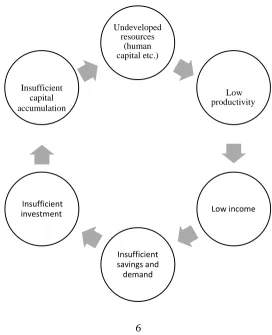
According to the above, human capital plays vital role in Islamic economics. However, underdeveloped countries generally produce labor-intensive products. This situation leads poor countries to remain poor as they essentially lack adequate resources that help them stand alone and grow. This situation in fact causes the vicious circle of poverty. One solution to break this vicious circle is to have competent and qualified workforce. This is understandable in view of the technological developments, infrastructure investments, and others which need cash capital or debt with interest. Besides, education does not need huge resources. The description of the area before the advent of Islam as the era of ignorance highlights the position and significance of education according to the Islamic perspective of development and civilization. For example, prior to their marriage, Prophet Muhammad and his wife Khadija had a trade contract (mudarabahix) according to which the Prophet ran the Khadija’s capital through trade (Koehler, 2014). This example also shows that the Prophet did not interact with interest-bearing transactions even before Islam.
Figure 1. The vicious circle of poverty (Bauer, 1965)
Undeveloped resources
(human capital etc.)
Insufficient capital accumulation
ion
Low productivity
Insufficient
investment Low income
Justice is another fundamental term in income distribution. Equality does not mean justice because humans are not equal with regards to their natural predisposition. They can be strong, weak, healthy, mutilated, etc. (Kayaoğlu, 1985:203). Islam looks to establish an innate economic system whereby people take the provisions of their rights from work (Qur’an, 53: 39). However, the effects of alms and zakat should be evaluated differently because zakat is a religious obligation (fard). As evidence of social justice of Islam, in the institution of zakat, money does not belong to the benefactors, rather to the poor and needy (Qur’an 9: 60).
II. ROLE OF ISLAMIC INSTITUTIONS IN DEVELOPMENT
Greif (1994) drew attention to the organization of society. The economic development of a country depends on its economic, legal, moral, political and social institutions. Those institutions also affect the distribution of wealth. The organization of Muslim societies is important to understanding the economic growth and development in Muslim countries. Interpersonal behavioral interactions are very important in Islam. This is because those behaviors affect this very mundane world and the next life. One may argue that cultural beliefs, traditions and customs of society also draw an economic progress and path in time. The behaviors of individuals shape this progress and path in history. Different societies have different development patterns because of their particular cultural and moral beliefs. (1994:915-916). Muslim societies also have different development worldview and model of progress and patterns.
The divine law and rules describe the worships and organize the socio-economic relationships in society. That is perhaps the reason why Islam is described as a rule-based system. The rules revealed in the Qur’an were explained and illustrated through the practice of the Prophet. The public compliance to those practice determines the rewards and punishments in both worlds (2014:3). The first Islamic state played critical role in creating institutions of Muslims societies, especially when the practices of the Prophet were current, with the Qur’anic provisions applied for all applications in the fullest and most genuine sense. Such period of institutionalization, known as the age of felicity (asr-ı saadet), should be adopted as pioneering model.
Although the political institutions manage the economic restrictions and property rights, the primary factor that set the economic rules of the game and sustained the economic growth is an evolution of both economic and political institutions (North, 1991:98). Koehler (2014) attributes the especially political developments in the early periods of Islam to economic factors. The institutions are used to explain the difference of countries’ development levels. Here, it is important to note that the development level should be considered as the material growth of countries. Olson (1996) believes that the question of the wide gap between countries cannot be answered by the opportunities of accessing productive knowledge and capital markets, the different levels of the proportion of the population per land and other natural resources, differences of the working culture of people and quality of the human capital. The main factor underlying the huge gap pertains be the quality of institutions and countries’ economic policies. That explains the detection of Islamic institutions which existed and functioned in the but currently not is crucial.
institution used to increase the welfare for the afterlife world. The patterns of behaviors, codes of conduct, moral values are enlisted as basic elements of such institution. The other is formal institutions. These kinds of institutions have their rules, regulations, and laws such as the (Islamic) participation banks, laws of corporate and trade, property rights, and so on. Both of these institutions form the behaviors of people and organize the relationship among corporations, governments, and people as economic agents (Kahf, 2003: 40-41).
When those institutions operate well, the transactions costs of the economic system are set to decline. The effective functioning of those Islamic institutions results in good Islamic economic order. That is because they reduce the uncertainties and business manipulations (gharar) (Quran, 2: 188). Gharar increases the transaction cost of trade and causes increase of the borrowing rate. Islamic institutions seek to reducing all intolerable gharar in the business and trades while achieving utility maximization in both worlds instead of pure material profit for this world only. Therefore, when the seller was not to maximize the benefits for the Hereafter, he should them provide his customers with more information. Generally, in the market economy, the seller is not favor of providing information about his goods. In such a case, the government intervention may be needed (Oğuz, 2005:263). Therefore, it is necessary that the Muslım Muslim seller has an understanding of both, not increase the regulation costs of state and the proper functioning of the market.
Muslim countries use institutions to render effective all of their resources. The Islamic economic system, which is not interested to create idle resources, encouraged inclusion of pillowed money in the system. For example, zakat is not supposed to be taken from the cash processed in investment. Similarly, the soil system is shaped in the direction of the aim of using every source in the most efficient way. For instance, the Ottoman’s timar system does not allow the planting for three years in a row. When the plantation is not done, the soil owned by one person is taken and given to another. Also, uninhabited lands were allocated to those who planted and harvested their agricultural products. So, it can safely be said that the Islamic economic system foresees no idle resources.
II.1. Institutions and importance of behaviors
The Revelation, the Qur’an and the Sunnah, particularly the Islamic belief in the Day of Judgment, fundamentally shape the core of human actions and further reinforces certain human behavior. In the modern world, the rule of law, legislations, regulations, all contribute to shaping and monitoring the activity of man and society. These are not inborn but rather imposed rules. Thus, those institutions and rules play actives role in the production, growth, and development (2014:12). The state of Medina is critical to understanding the model state that ruled through provisions of the Qur’an and provides us the opportunity to analyze the Prophet practices, governance and model of development. Prophet Muhammad established a new market for Muslim merchants and traders even when there was already one in the city. He set out moral institutions for market behavior to further minimize the risks of traders and contracts that are composed under the divine rules and laws.
muhtasib who like the inspector who supervises the markets and bazaars and checks the trade’s compliance with Islamic rules. It can be said that the first muhtasib ever was the Prophet (Saleh, 2009) who forbade the purchase the goods by certain traders before the goods reach the market and found their real prices. He also prevented the restriction of goods transferability by some merchants. Cheung (1974:57) also claims that the value of goods decreases when it becomes difficult to transfer or when restriction is placed of its most valuable using. As far as the prices issue is concerned, the hisbah has become active only in cases of selling essential goods at high prices. It focused on quality of goods and accuracy of sellers’ information. In this way, it can be said that hisbah organization sought to provide full competitive market conditions. It solved the problems of the imperfect market such as asymmetric information, moral hazard, adverse selection, and others (Kallek, 1998).
Business contracts were always important before the advent of Islam and in the early period of Islam. They helped shape the behaviors of societies. One of those contracts was ilaf which gave people the right to free movement while encouraging trade safely. Merchants made Mecca an active trade center (Quran: 106). Contracts played a crucial role in the development of the tribe of Quraysh in Makkah (Hamidullah, 1957). Islam also places great importance to honesty in speech, keeping one’s words and promises, and acting with trusted. The trust provided by contracts s uch as t he ilaf ensured a decline in transaction costs. The level of trade and traders would be less without contracts which means reduced long-term investments, less productivity, decrease in economic growth and worse development level for early Islamic society. This predictability led people to invest in trade and to make long-term contracts with one another. The results of this predictability also brought economic development and growth to the Muslim community (2014:22-23). In this regard, the concept of Islamic economic development concept on rules that are defined according to the four basic Islamic sources used for legal reasoning, establishment of institutions for economic development, and improving the human welfare in both temporary and eternal worlds.
The institutions of zakat and sadaqah are used as motivation for the welfare in the permanent world while helping to equalize the income and wealth distribution in the world. The motivation for permanent life is certainly lacking in secular modern economic systems. Thus, the capital constantly grows and is collected as single source. In Islam, Muslims are required to give in certain fixed amount of their accumulated unused capital, which serves as motivation for engaging in new investments in this worldly life but also an opportunity to increase one’s welfare in the world to come.
II.2. Cooperation and Solidarity as Term of Development
The institutions of waqf (endowment) support and sustain human cooperation and solidarity. They emerge as important channels for better socio-economic life and social solidarity in Muslim communities. One of the most important features of waqf is that they make institutionalize support and solidarity. In history, there were ample examples waqfs active role as witnessed during the Ottoman period. The economic size of waqfs in the whole economy of the Ottoman State reached 20% in the 16th century (Tabakoğlu, 2012:308). The following hadith serves as key motivation for founding waqfs. Prophet Muhammad is reported to have said: “When the human being dies, his deeds come to an end except for three: ongoing charity, beneficial knowledge, or a righteous child who prays for him” (Sahih Muslim, 1631). Some scholars maintain that wealthy Muslims use waqfs to protect their assets. Waqf keep their wealth from states’ confiscation (Kuran, 2012:1090).
The number of waqfs founded for wealth protection is very limitedx. When a person says: “I devoted”, he then should have no right or connections with the endowed property or goods endowed following his deeds of dedication (Furat, 2012). There prime motivation for establishing waqf foundation is held for the sake of God. Such behavior increases the welfare in the permanent life. However, the size of family waqf considered as protecting of wealth was not the majority of waqfs in the Ottoman period. The rate of family waqfs was in the range of 15% in the 18th and 19th centuries (Çizakça, 1998:52). Thus, establishing of waqfs for the protection of wealth was not common as it is thought to be.
When for some reasons, a waqf based village school turns useless causing dispersal of villagers, the school’s assets then get transferred to the needs of other nearest schools having less assets, with the view of the judge. If the assets of the school that do not work are moved by a non-school village and a school is built in this village, the assets of the old school are then transferred to this new village school. Thus, the heirs of the waqf are not allowed to claim any right of the waqf assets because the school is closed (Berki, 1968:17). This helps us understand how waqf goods used to be protected more than private properties and further explain the weakness of the claim stating that founding of waqfs was made for private property protection.
The historical literature of waqf shows funding of infrastructure services like bridges, roads, inns, caravanserais, fountains, sidewalks, waterway, religious services including mosques, masjids, dervish lodges, and zawiyas, and educational services like schools and madrasas. Waqfs led to those works reach today by funding and supporting them. They represented crucial functions for regional development. Waqfs produced solutions for regional problems because the founding was made based on regional needs. Thanks to waqfs, the educational institutions found the chance to standing independent and alone. So, contrary to Kuran (2012:1091-1092), waqfs become important centers for production of free and original knowledge. They contributed to the realization of the state’s functions and covered projects pertaining to infrastructure, education, religion.
One of criticism leveled at waqf institutions is that they lacked flexibility, which because of legal rigidity, missing the potential to adapt themselves to new developments, thus causing resources waste (2004:80-81). It should be noted that waqfs were originally founded as response to the local problems of the regions, and hence, there was no context for adaptation to new developments. Waqfs were initially made as response to those very changing developments. In fact, the Ottomans were known for their flexibility and pragmatic solutions to current problems (Pamuk, 2004 and Joseph, 2012).
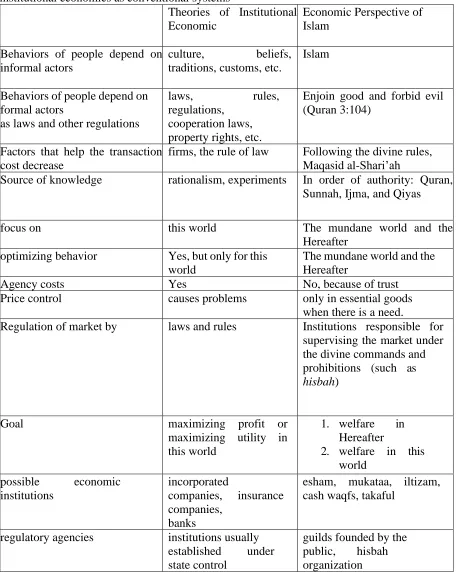
Table 1. Differences and similarities between development perspective of Islam and institutional economics as conventional systems
Theories of Institutional Economic
Economic Perspective of Islam
Behaviors of people depend on informal actors
culture, beliefs,
traditions, customs, etc.
Islam
Behaviors of people depend on formal actors
as laws and other regulations
laws, rules,
regulations, cooperation laws, property rights, etc.
Enjoin good and forbid evil (Quran 3:104)
Factors that help the transaction cost decrease
firms, the rule of law Following the divine rules, Maqasid al-Shari’ah
Source of knowledge rationalism, experiments In order of authority: Quran, Sunnah, Ijma, and Qiyas
focus on this world The mundane world and the
Hereafter optimizing behavior Yes, but only for this
world
The mundane world and the Hereafter
Agency costs Yes No, because of trust
Price control causes problems only in essential goods
when there is a need.
Regulation of market by laws and rules Institutions responsible for supervising the market under the divine commands and prohibitions (such as hisbah)
Goal maximizing profit or
maximizing utility in this world
1. welfare in Hereafter
2. welfare in this world
possible economic
institutions
incorporated
companies, insurance companies,
banks
esham, mukataa, iltizam, cash waqfs, takaful
regulatory agencies institutions usually established under state control
guilds founded by the public, hisbah organization
II.3. Comparison between the Islamic and Western Views on the Minimum Living
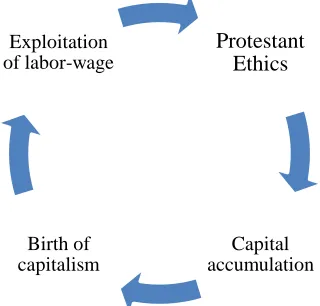
increasingly prosperous. This situation was criticized by thinkers like Marx. Religion plays critical role on uncontrolled enrichment. This is because of its directs people’s attitudes and behaviors, not the poor, but the material ideas and interests of the target (Weber, 1949:76). Profits making and money earning is greatly rewarded according to Protestant ethics. When one has wealth fortune, he was then considered to be a very good man on the side of God. This idea caused the overcome of the moral limits to prosper. Prosperity did not spread to all layers of society. In fact, capital owners turned wealthier while workers and sub-class (other paid employers) retain constant income and faced the financial problems.
Figure 3. Economic Thought of Weber and path of exploitation of labor-wage
Understanding the economic view of the Ottomans is crucial to comparative studies. The Ottoman economic worldview was set to improve the situation of the God’s servants, citizens in the social and economic aspects (ibadullâhın terfi-i ahvâli). The radical changes and transformations affecting Europe could not be seen in the Ottomans. However, their mutual interaction carried consequences on both sides. But one can safely say that there was never a complete analogy. This is ordinary because of the different thoughts, culture and value judgments of both the Ottoman and Western societies (Bulut, 2012:73). While the Ottomans addressed the needs of large segments of society and, in particular, focused on the quality of production in the industrial arena, the accumulation-based model geared to maximization of profit, utility and efficiency acted as the main drivers for Western European nations.
CONCLUSION
Development according to the Islamic perspective should be approached to increase the welfare in this world and the Hereafter in economic perspective of Islam. Muslim need to have descent income to fulfill their basic worships. Besides, Muslim need to maintain balance between permanent and temporary life. The Islamic economic system embraces four basic elements for both this world and the Hereafter, namely, faith (iman), worship (ibadah), morality (akhlaq) and good deeds defined as transactions. Those ingredients were used to build Islamic economic models and systems. The latter are based on the Qur’an and Sunnah, and was dynamic, efficient, flexible and open-minded. In this regard, the underdevelopment of Islamic countries may be interpreted with respect to breaking away with Muslim intrinsic values.
It is possible to formulate the position of Islamic economic development perspective according to both prerequisites and channels. Maqasid al-Shari‘ah, economic and social justice, spirit of solidarity, mutuality and cooperation, environmental and inter-generational sustainability, dignity and opportunity for all are institutional framework of prerequisites. Governance includes capable and trustworthy systems and leadership with strong accountability and
Protestant Ethics
Capital accumulation Birth of
stakeholders-oriented governance and management of trust and social capital. Channels consists of distribution and redistribution mechanisms. The first depend on risk sharing and entrepreneurship with basic Islamic bans like avoiding interest and gharar while the second is closely related to Islamic institutions of solidarity such as zakat, qard al-hasan, waqf, sadaqah and others.
References
Acemoglu, D., & Robinson, J. (2012). Why Nations Fail: The Origins of Power, Prosperity,
and Poverty. Crown Business.
Askari, H., Iqbal, Z., Krichene, N., & Mirakhor, A. (2014). Understanding Development in an Islamic Framework. Islamic Economic Studies, 22(1), 1-36.
Auda, J. (2008). Maqasid al-Shariah as philosophy of Islamic law: a systems approach. The International Institute of Islamic Thought. UK.
Bauer, P. T. (1965). The vicious circle of poverty. Weltwirtschaftliches Archiv, 4-20.
Berki, A. H. (1968). Müstağnen Vakıflar. Vakıflar Dergisi, 7, Istanbul. pp:17-18.
Bulut, M. (2012). “Osmanlı Ekonomi Politiği’ne Yeniden Bir Bakış” Bilig Journal of Social Sciences 62: 63-96.
(2015), “İktisat ve Ahlak” Adam Academy- Journal of Social Sciences,5/2: 109- 127.
Chaney, E. (2015). Religion and the Rise and Fall of Islamic Science. Draft. Harvard University.
http://scholar.harvard.edu/files/chaney/files/science_12_10_2015.pdf?m=145236655 5
Chapra, M. U. (1993). Islam and Economic Development: A Strategy for Development with
Justice and Stability. The International Institute of Islamic Thought and Islamic Research
Institute. Islamization of Knowledge – 14. Pakista
Chapra, M. U. (2008). The Islamic vision of development in the light of maqasid al- Shariah. The International Institute of Islamic Thought. Occasional Paper Series – 15. London. UK.
Cheung, S. N. S. (1974). A Theory of Price Control. Journal of Law and Economics 17(1). 53-71
Çizakça, M. (1998). Awqaf in history and its implications for modern Islamic economies. Islamic Economic Studies, 6(1), 43-70.
El-Ghazali, A. H. (1994). Man is the Basis of the Islamic Strategy for Economic Development. Islamic Economics Translation Series – 1. Islamic Research and Training Institute. Islamic Development Bank. Jeddah. Saudi Arabia.
Ergener, R. (2010). Absence of Monaticism as One of the Causes of the Economic Underdevelopment of Moslem Countries. ASREC (Association for the Study of
Religion, Economics, and Culture) Conference. June 29 – July 3, 2010. Portland.
Facchini, F. (2007). Islam and Private Property. Workshop of the European Network on the
Economics of Religion (ENER). November 16-17, 2007. Granada.
Facchini, F. (2010). Religion, law and development: Islam and Christianity—Why is it in Occident and not in the Orient that man invented the institutions of freedom?.
Furat, A. H. (2012). İslam Hukukunda Vakıf Akdinin Bağlayıcılığı. Journal of Faculty of Theology of Istanbul University/Istanbul Üniversitesi Ilahiyat Fakültesi Dergisi, 27.
Greif, A. (1994). Cultural beliefs and the organization of society: A historical and theoretical reflection on collectivist and individualist societies. Journal of political economy, 912-950.
Haleem, M. A. (2013). The Religious and Social Importance of Hajj. The Hajj: Collected Essays (Eds. Porter, V.; Saif, L.). The British Museum Press.
Hamidullah, M. (1957). Al-ilaf, ou les rapports économico-diplomatiques de la Mecque pré-islamique. Institut Français de Damas.
Hasan, Z. (1995). Economic development in Islamic perspective: Concept, objectives, and some issues. Journal of Islamic Economics, 1(6), 80-111.
Iqbal, Z. (2015). Islamic Finance Perspective on Shared-Prosperity. 10th Global Forum on Islamic Finance. 40th Annual Meeting of the IDB Group. 9 June 2015. Mozambique.
Iqbal, Z. (2016). Islamic Finance: Perspective on Economic Development. Opening Ceremony of International Islamic Economics and Finance Research and Practice Center. 28 October 2016. Istanbul Sabahattin Zaim University.
Joseph, S. (2012). Islamic Law on Peasant Usufruct in Ottoman Syria: 17th to Early 19th Century. Brill.
Kahf, M. (2003). Sustainable Development in the Muslim Countries. Islamic Development Bank. Islamic Research and Training Institute. Jeddah.
Kallek, C. (1998). Hisbe. Türkiye Diyanet Vakfı İslam Ansiklopedisi, 18, 133-143.
Kayaoğlu, İ. (1985). İslam’da Adalet Mefhumu. Ankara Üniversitesi İlahiyat Fakültesi Dergisi, (27). 201-206.
Koehler, B. (2014). Early Islam and the Birth of Capitalism. Lexington Books.
Qur’an, T. (1986). The economic system in contemporary Islamic thought:
Qur’an, T. (2004). Why the Middle East is economically underdeveloped: historical mechanisms of institutional stagnation. The Journal of Economic Perspectives, 18(3), 71-90.
Qur’an, T. (2012). The Economic Roots of Political Underdevelopment in the Middle East: A Historical Perspective. Southern Economic Journal. 78(4). 1086-1095.
Mehmet, O. (2002). Islamic identity and development: Studies of the Islamic periphery. Routledge.
Mirakhor, A., & Askari, H. (2010). Islam and the path to human and economic
development. Palgrave Macmillan.
North, D. C. (1991). Institutions. The Journal of Economic Perspectives. 5(1). 97-112.
Oğuz, F. (2005). Bilgi, Regülasyon ve Rekabet: Bir Piyasa Süreci Yaklaşımı. Doğuş Üniversitesi Dergisi 6(2). 253-267.
Olson, M. (1996). Distinguished lecture on economics in government: big bills left on the sidewalk: why some nations are rich, and others poor. The Journal of economic perspectives, 10(2), 3-24.
Pamuk, Ş. (2004). Institutional change and the longevity of the Ottoman Empire, 1500– 1800. Journal of Interdisciplinary History, 35(2), 225-247.
Rodinson, M. (1978). Islam and capitalism. University of Texas Press.
Sadeq, A. H. M. (1987). Economic development in Islam. International Journal of
Economics, Management and Accounting, 1(1).
Saleh, F. (2009). The Institution of Hisbah: Its Roles in Nurturing Fair and Just Economic System in Islam. Seminar Ekonomi Islam Peringkat Kebangsaan
(SEIPK’09). Malaysia.
Sardar, Z. (1996). Beyond development: an Islamic perspective. The European Journal of development research, 8(2), 36-55.
Shatzmiller, M. (2006). Women’s Property Rights in Islamic Law and the Debate over Islamic Economic Performance. XIV International Economic History Congress. 21-25 August 2006. Helsinki Finland.
Sezgin, F., Aliy, A., Kaplan, H., & Neubauer, E. (2007). İslam'da bilim ve teknik. Kültür ve Turizm Bakanlığı.
Stevens, C. (2005). Measuring Sustainable Development. Statistics Brief, 10. OECD.
Tabakoğlu, A. (2012). Türkiye İktisat Tarihi. Dergah Yayınları.
Weber, M. (1949). Objectivity in social science and social policy. The methodology of the social sciences, 78, 50-112.
Weber, M. (1965). The sociology of religion. Revue Française de Sociologie, 6(1), 111.
i Surah Ar-Ra’d (The Thunder) 13:28 - Those who have believed and whose hearts are assured by the remembrance of Allah. Unquestionably, by the remembrance of Allah hearts are assured.
ii Surah Al-Ankabut (The Spider) 29:64 - What is the life of this world but amusement and play? But
verily the Home in the Hereafter, - that is life indeed, if they but knew.
iii The Archive of T.R. Prime Ministry Directorate General of Foundations, Waqf of Hadji Ahmet Effendi b. Hüseyin and His Companions, Register: 987, Pages: 101-102, Serial: 35-1.
iv Zakat or Zakat al-Mal is obligatory alms that depend on wealth. It is the third pillar of Islam. v Hajj is a worship that Muslims make a journey to the heart of Islam, the Ka’ba (Haleem, 2013:1). vi Hadith, Camiu’s-Sagir, No:1201: Work for your worldly life as if you are living forever, and work for your Hereafter as if you are dying tomorrow
vii Surah Al-A’raf (The Heights) 2:8-9: And the weighing [of deeds] that Day will be the truth. So those whose scales are heavy - it is they who will be the successful. And those whose scales are light - they are the ones who will lose themselves for what injustice they were doing toward Our verses.
viii Surah Al-Nisa (The Women) 2:31- If you avoid the major sins which you are forbidden, We will remove from you your lesser sins and admit you to a noble entrance [into Paradise].
ix Mudarabah is a type of contract. One puts his capital and other puts his efforts/labour. The profit will be shared as they determine at first.