Ferris State University
HIT and HIM Programs Page 1
FERRIS STATE UNIVERSITY
Academic Program Review
Health Information Technology (HIT)(AAS)
Health Information Management (HIM)(BS)
Ferris State University
HIT and HIM Programs Page 2
TABLE OF CONTENTS
Page
SECTION 1: Overview of the Program
3-13
SECTION 2: Collections of Perceptions
14-27
SECTION 3: Program Profile
28-51
SECTION 4: Facilities and Equipment
52-54
SECTION 5: Conclusions
55-57
APPENDIX A: Tenure and Tenure Track Faculty Curricula Vitae 58- 92
APPENDIX B: Curricula Check Sheets
93-100
APPENDIX C: Sample Course Syllabi
101-358
APPENDIX D: Survey Instruments
360-432
APPENDIX E: Standards for Health Information Programs 433-434
APPENDIX F: Curricula Mapping, Curricula Outcomes (TracDat) 435-443
APPENDIX G: APR Plan, Timeline, Budget 444-446
APPENDIX H: Department Head Response for HIT HIM 447-449
Academic Program Review
Ferris State University
HIT and HIM Programs Page 3
Section 1. Overview of the Health Information Programs
The health information programs are designed to provide flexibility for students by allowing them to enter and exit at various degree levels to fit their needs. The student could start his/her educational career by completing Health Information Technology (HIT) program and earn an associate degree and ladder into the 4-year Health Information Management (HIM)
baccalaureate degree without loss of credit. For a graduate of an accredited HIT program, all of the professional HIM courses are offered online.
The HIT program is one of seven accredited health information technology programs in
Michigan. Its curriculum has been designed to meet the accreditation standards published by the American Health Information Management Association (AHIMA) and CAHIIM (Commission on the Accreditation of Health Information and Informatics Management). Graduation from an accredited program allows the graduate to apply to write the national certification examination of the AHIMA to qualify to use the title Registered Health Information Technician (RHIT).
The HIM program is a 4-year program which culminates in the BS degree. It too, has been designed to meet the accreditation standards published by AHIMA. There are only two accredited HIM programs in Michigan. Graduates of the HIM program are eligible to apply to write the national certification examination of the American Health Information Management Association to qualify to use the title Registered Health Information Administrator (RHIA). Since their inception in the late 1970‟s, both programs have been continuously accredited by the American Health Information Management Association (AHIMA) in conjunction with the Commission on Accreditation for Health Informatics and Information Management Education (CAHIIM).
Please note: Throughout this document, the Health Information Technology (HIT) and Health Information Management (HIM) programs will be referred to as the Medical Record Information Science (MRIS) programs where the responses are identical for both programs. Elsewhere, they will be referred to individually. “MRIS” (Medical Record Information Sciences) is the prefix used for most of our health information programs‟ professional courses.
A. PROGRAM GOALS
1) The primary goal of the MRIS programs is to prepare students through education and experience for entry level employment in a variety of health care settings.
At the conclusion of the student‟s program, they should be able to: a. Demonstrate interpersonal skills necessary to:
1. work with others in a group
2. ask questions to gain information necessary to perform assigned tasks. 3. deal with conflict.
4. show respect for diverse opinions and ideas. b. Demonstrate oral communication skills necessary to:
1. make professional presentations. 2. support a conclusion.
Ferris State University
HIT and HIM Programs Page 4
c. Demonstrate the ability to use the computer to: 1. construct a basic spread sheet.
2. manipulate data. 3. access information.
4. use word processing skills.
5. access, navigate, and retrieve patient information in the electronic health record. d. Demonstrate critical thinking skills to apply previously learned knowledge to solving a new problem.
e. Demonstrate analytical skills necessary to interpret data. f. Demonstrate written communication skills to:
1. support proposals.
2. report the results of investigations. 3. convey ideas to appropriate audiences. g. Demonstrate professional conduct.
h. Speak the language of the health care professions.
i. Demonstrate understanding of the laws that pertain to health care.
j. Demonstrate understanding of the structure of health care in the United States. k. Demonstrate appropriate work ethics:
1. responsibility for individual‟s actions 2. punctuality
3. honesty 4. integrity
5. understanding of personal value systems
6. understanding of expectations of health care work place
l. Demonstrate an understanding of the pervasive nature of quality assurance throughout the health care professions.
m. Demonstrate specific knowledge and skills defined by their curriculum. In addition to the above, our health information management graduates are skilled in the collection, interpretation, and analysis of patient data from paper health records. They receive the necessary training necessary to assume supervisory and managerial positions related to the health record functions.
2) These goals were developed by the faculty of the MRIS programs and approved by the MRIS programs‟ advisory committee. They are reviewed annually and remain appropriate for the programs.
3) The goals reflect program graduate needs for technical, professional and general
education. Graduates of these programs are employed in various health care settings including hospitals, nursing homes, physician offices, long term care facilities, ambulatory care clinics, hospices, and insurance companies.
4) The programs‟ goals have not changed since the last APR. They continue to reflect the goals of the program. The MRIS Advisory Committee and the program faculty review the program goals on a regular basis and have not recommended changes.
Ferris State University
HIT and HIM Programs Page 5
5) The MRIS programs fit well into the overall mission of Ferris State University and the College of Health Professions.
Mission of Ferris State University: Ferris State University prepares students for
successful careers, responsible citizenship, and lifelong learning. Through its many partnerships and its career-oriented, broad-based education, Ferris serves our rapidly changing global
economy and society.
Mission of College of Health Professions: Building upon the mission, vision and values of Ferris State University, the College of Health Professions‟ mission is to prepare students for successful careers in the programs contained therein, to foster responsible citizenship and to promote lifelong learning. The college will partner with healthcare providers and facilities to prepare students for rapidly changing careers.
Vision of the College of Health Professions: The college‟s vision is to be a recognized leader in the provision of career-oriented programming in the allied health and nursing fields. It will become the preferred choice for students who pursue a career in one of the disciplines offered by the college through its alignment of programs with the evolving needs of the agencies which it serves.
Mission of the MRIS programs: Building upon the mission, vision and values of Ferris State University and the College of Health Professions, the Health Information programs‟ mission is to provide leadership in the education of health information professionals to meet the current and emerging needs of the state and region.
The programs are consistent with the university‟s mission statement. While the
Programs are not prominent nationally, they do provide opportunities for innovative teaching and learning in career-oriented, technological and professional education. Graduates of the programs are employed in numerous states of the United States as well as Saudi Arabia, Israel, and
Botswana. Most of the courses within the curricula require application skills of the Microsoft Office software. Many of the courses are web-enhanced, mixed delivery, or totally online to provide students with the most current information in the field. The programs‟ courses are offered during the week, on weekends, and in the evenings. Weekday/early evening courses are offered on the Big Rapids campus, evening and day classes are offered in Grand Rapids for the associate degree programs. Two of the courses are offered on the weekend. All of the HIM professional courses at the 300 and 400 levels (MRIS, HCSA, CAHS, and CCHS) are offered totally online. Most of these HIM professional courses are also offered in seat for those students that prefer this format of learning.
All of our graduates are able to:
Work as a member of the health care team
Identify opportunities for professional advancement Integrate theory and practice effectively
Accurately code inpatient and outpatient health records
Ferris State University
HIT and HIM Programs Page 6
Perform professionally by respecting the confidentiality of patient data;
maintaining neatness in personal habits, work areas; performing to the best of their abilities; following established employment policies; and assuming responsibility for their conduct and their work.
In addition to the above, our baccalaureate graduates should:
Be capable of professional advancement and study, in health information management and education positions
Understand, promote, and participate in total quality management and continuous quality improvement programs
Manage and supervise other health information professionals
Be aware of, comply with, and monitor external regulatory requirements
B. Program Visibility and Distinctiveness
1) The MRIS programs at Ferris State University are unique in many ways: a. Well-equipped laboratory with state of the art hardware and software.
b. Students use the same equipment and software that they will use in health care facilities. Students are provided the opportunity to be proficient before they go on their internship.
c. Internships are available in various types of health care settings.
Because of the increasing number of students entering the MRIS programs and competition with other health information programs, it is becoming increasingly difficult to find sites, especially in summer semester when the majority of the students are ready for internship. It is preferred that our HIT internship (6 weeks) is done in a hospital setting. When this has not been possible, we have used long term care and outpatient settings. For exposure to tasks that are primarily seen in a hospital setting, most of these students are able to schedule a few days in the hospital setting. Students are also able to complete their internship in other states or countries.
d. Experienced faculty. The program‟s faculty members have more than 100 years of teaching MRIS students as well as working experience in the health care industry. e. Courses are offered at times and places convenient for students. The HIT program is
offered in Big Rapids in the daytime and on weekends; and Grand Rapids in the daytime, evenings, and on weekends. Some of the program courses are also offered online or mixed delivery. Many of the HIM courses are offered at both campuses. All of the professional HIM completion program courses are offered online. Most of the courses could be taken in seat if that is the student‟s preference. Most of the courses are offered at least two semesters each academic year, if not all three semesters.
Ferris State University
HIT and HIM Programs Page 7
f. Continuously updated curricula in response to the needs of the health care industry and the requirements of the MRIS programs‟ accrediting agency. Both programs have gone through major changes within the last few years and both continue to be revised as the implementation of ICD-10 coding for diagnoses and procedures becomes a requirement in October, 2014. Increased emphasis on pathophysiology has led to changes in course content and the allocation of credit hours for courses with this content. The health information programs were last updated in Spring 2012 for implementation in Fall 2012.
g. Faculty who lend their expertise to the CAHS core courses.
h. High labor demand for graduates. Employment in the field is expected to grow 20% faster than the average for all occupations through 2020 according to the Bureau of Labor Statistics.
2) We attract quality students by:
a. Recruiting in high schools and career technical schools. The admission counselors have been crucial in helping us disburse program information to prospective students at schools, job fairs, and career fairs.
b. The CAHS advisors for pre-professional students talk to students who are waiting to get into CAHS clinical programs. If these students have completed all of their general education courses, they are able to complete the HIT program in four semesters. Very often, the student only needs to take one MRIS course in the first semester. This introductory course is a pre-requisite to most of the other MRIS courses. Some of these students then continue on with their clinical program of choice. Others seek employment in the health information field or continue their education in HIM.
c. Recruiting Ferris pre-pharmacy and pre-optometry students who are not accepted into their respective programs.
d. Attending the annual Michigan Health Information Management
Association meeting where we have an exhibitor‟s booth to provides us with the opportunity to provide program literature to attendees.
e. Offering a career ladder (HIT to HIM) that meets the needs of graduates of an accredited HIT program.
f. Offering the HIT program at the Grand Rapids campus to attract individuals who may not be able to attend the main campus to take classes.
3) The institutions that offer the main competition to our HIT program: - Baker College –Flint, Jackson, Allen Park, Clinton Township - Davenport University-Livonia
Ferris State University
HIT and HIM Programs Page 8
- Macomb Community College – Clinton Township - Southwestern Michigan College – Dowagiac - Mid-Michigan Community College – Harrison
The institutions that offer the main competition to our HIM program: - Davenport University – Grand Rapids, Livonia
a. These HIT and HIM programs are different than ours because their internships are done one or two days a week throughout a semester. Most of our students complete their 240 or 400 hour internship by working 40 hours per week at the internship site until they have met the total number of hours. Another major difference is that our students have several projects that they must complete while on internship. The other programs leave it up to the healthcare organization to provide work activities for the interns. Many healthcare facilities have complimented us on the quality of our internship project manual. The programs are similar to ours because we all must meet the same accrediting agency requirements for content in the programs. The faculty works closely with west Michigan hospital health information directors and the MRIS programs‟ advisory committee to assure that course content is reflective of the current workplace environment. Baker College, Schoolcraft College, Davenport, and Macomb Community College are located in southeast Michigan. Graduates of these CAHIIM accredited associate degree programs are able to ladder into the FSU HIM completion program. Because all of the professional courses in the online HIM completion program have been offered online since Fall 2010, the number of HIT graduates from other accredited colleges who have enrolled in our HIM completion program has increased. HIT and HIM students are combined in the 100 and 200 level courses with a MRIS prefix. Combining students in both levels helps to improve efficiency in the classroom.
b. Some schools require that a prospective student visit a health information
department prior to enrolling in a MRIS program. Baker College and Davenport University‟s programs were developed after our programs. Thus, they are very similar. We have the same accrediting agency, CAHIIM, with defined program requirements. Most of the full-time faculty at the other institutions are Ferris graduates.
C. Program Relevance
1. Labor Market Relevance – Health Information Profession
Department of Labor
Bureau of Labor Statistics (Modified March 2010)
Employment of medical records and health information technicians is expected to increase by 21 percent from 2010 to 2020, faster than the average for all
occupations.
Ferris State University
HIT and HIM Programs Page 9
39% of jobs were in hospitals, the remainder were in offices of physicians, nursing care facilities, home healthcare services, public health departments and insurance firms that deal in health matters
Most employers hire Registered Health Information Technicians (RHIT) or Registered Health Information Administrators (RHIA), who must pass a written examination offered by the American Health Information Management
Association. Examinations are offered to graduates from the two year associate degree program and four year baccalaureate degree program accredited by the Commission on Accreditation of Health Information and Informatics
Management.
The mandatory implementation of ICD-10 coding of diagnoses and procedures in the United States was to be effective October 2013. However, in March 2012, the government stated that implementation will be delayed until October 2014. ICD-10 coding is more detailed than ICD-9 and will require more coders than the current number required. It is also projected that many of the current coders will retire rather than learn this new coding system. At the recommendations of AHIMA, it is the intentions of the MRIS faculty to go forward with
implementation of an ICD-10 coding class (MRIS 205) in Summer 2013. We will continue teaching ICD-9 Coding (MRIS 204) until Fall 2013. At that time, we will only teach ICD-10 coding in MRIS 204 and MRIS 205.
(Bureau of Labor Statistics, Occupational Outlook Handbook, 2010) Earnings:
o Median annual earnings were $32,350 in 2010 o Lowest 10% earned less than $21,240 in 2010 o Highest 10% earned more than $53,430 in 2010
AHIMA
There were 64,000 members of AHIMA in May 2008. A salary survey was conducted of these AHIMA members and 11,000 responded. Some of the results are:
53% of the members work in the hospital setting
AHIMA membership data shows the median salary range for HIM professionals with a master‟s degree or higher across all job categories as between $50,000-89,999 (AHIMA, 2008).
A director of HIM with an associate degree earns on average $59,849; that number grows to $68,213 for those with a baccalaureate degree, and to $81,879 for those with a master‟s degree.
Regression analysis reveals that the primary work setting is a key contributor to the variation in salaries of HIM professionals. Job opportunities are expected to be excellent because the number of job openings is expected to increase by more than 20% in the next decade. Many openings will result from the need to replace workers who retire or stop working for some reason. The implementation of ICD-10 will result in the need for qualified coders.
Ferris State University
HIT and HIM Programs Page 10
The MRIS faculty receives phone calls and emails on a regular basis from hospitals and other healthcare organizations with job opportunities and inquiries about our recent graduates. In March of this year, one large hospital employer called because they were looking for 17 credentialed coders. Entry level coders were eligible for these jobs as long as they had their RHIT credentials.
2. Program responds to emerging issues in the discipline, changes in the labor force, changes in employer needs, changes in student needs in the following manner:
a. Curriculum redesign due to technological advances using an electronic health record. The MRIS program has used AHIMA‟s virtual electronic health record lab, Spring Management electronic health records, and other free demos in the classroom. Academic Affairs has recently purchased Cerner‟s electronic health record system for the College of Health Professions. This product will be installed in our laboratory as well as the College of Health Professions computer lab. Cerner is the electronic record system that is currently used in most hospitals in the United States.
b. MRIS coding classes are updated each year with new textbooks and supplemented with CPT and DRG coding updates. The MRIS programs have two different coding software systems that are updated each quarter. All of the courses are reviewed and revised as necessary (when regulatory agency requirements change, reflect industry changes). The MRIS programs have recently been revised and ready for
implementation in Fall, 2012.
c. Computers and software are continuously upgraded to meet the demands of the health care industry. In many cases, we have different types of software for the same
function. We are able to expose the student to a variety of software programs that they will see in the workplace.
d. In the HIT program, most of the professional (MRIS) courses are offered in- seat or mixed delivery. Based on graduate and employer surveys, it is felt that students do better in face to face setting for the professional courses in the HIT program. Some of our HIT courses can be effectively taught online (CCHS 101, CCHS 102).
e. The professional courses in the HIM completion program are all offered online. The HIM students have completed all of the HIT courses and take the online HIM courses without difficulty. All but three of the upper level (300 and 400 level) courses are offered face to face, mixed delivery, or online which allows the student to take the class in the format that best meets their style of learning.
f. Review of the graduate surveys and student program evaluations allow us to make appropriate changes to individual courses in the programs.
g. Faculty is active in professional organizations such as the American Health Information Association, Michigan Health Information Association, local health information associations as well as specialty associations. Attendance at these
Ferris State University
HIT and HIM Programs Page 11
meetings and conferences allows the faculty to stay abreast of any changes made in the health information profession.
h. Internship site instructors often comment about the high caliber students from our health information programs. Our students and graduates are hired by our internship affiliates. Quite often, jobs are created for students that these facilities have had on internship and do not want to lose. See Appendix D (p. 360-432) for Site Coordinator Evaluations of HIT and HIM Internship students.
3. According to informal surveys conducted in MRIS 101 Introduction to Health Information Systems, the students listed the following as reasons for enrolling in a MRIS program.
Laboratory experience using software currently used in the healthcare Industry
Read about profession and the number of jobs Relative is a coder
Reputation of the program and faculty
a. Graduate survey responses reflect that the MRIS programs meet their expectations. We are continually revising our curriculum and updating computer software to reflect industry changes/updates. For more information, refer to the graduate survey results in Appendix D, Survey Instruments (p.360-432).
b. Student sentiment is measured using the Student Assessment of Instruction
(SAI)/IDEA for two courses per tenured instructor each semester. Students meet with their academic advisors at least once per semester to discuss concerns and have their questions answered. They must meet with their advisor each semester to have their advising holds lifted. Faculty use evaluations that they have personally created to identify strengths and weaknesses of their specific courses. These are then used to make modifications to the specific courses.
D. PROGRAM VALUE:
1. To the university: The MRIS programs benefit the university because we are one of
only two HIM bachelor degree programs in Michigan. The associate degree program is only taught at six other Michigan colleges/universities, all in southern Michigan, except one in Grand Rapids. Our well-equipped computer lab has 23 stations with state of the art hardware and software. All program faculty has working experience in the health care industry that allows them to bring real-world experiences into the classroom. The faculty survey results show that they feel that the library has the resources available to meet the needs of our students.
2. To students: The students learn in state of the art equipped labs in both of the sites where the program is offered. Although the faculty survey shows that we have a well-equipped laboratory, there are times when students must use their personal laptops in the lab
Ferris State University
HIT and HIM Programs Page 12
because there are not enough computers to accommodate all students in the class. The
programs‟ courses are offered at various times (day, evening, weekend formats) and locations to meet the needs of the students. It is common for Big Rapids students to take evening classes in Grand Rapids or Grand Rapids students to take classes at the Big Rapids campus. The faculty is available to the students via email, telephone, or face to face meetings. The HIT program benefits both the university and the students by providing an associate degree program that can be completed in four semesters if all of the general education
requirements have been completed. This allows students to complete a program while waiting to begin a clinical program that has more applications that available spots. Understanding the coding and billing process is an added benefit for any of our clinical programs and it also provides another career option.
3. Assessment by program personnel: MRIS faculty believe that the value of our
HIT/HIM programs starts with many employers desiring credentialed employees as part of their staff. Our programs allow HIT/HIM professionals to understand the structure and format of a legal health record (electronic & paper), coding and reimbursement, quality monitoring and information technology. Employers also recognize that Ferris HIT/HIM programs are CAHIIM accredited.
Our program/students are ready to become leaders in translating data into useful information about diseases for a variety of customers (TJC, CMMS, NCQA, healthcare providers,
research facilities, etc.) Students completing the HIT/HIM programs require less workplace training and are able to competently perform all HIT/HIM functions. Our graduates are ready to be involved in the ever changing roles in healthcare in information technology, fraud & abuse, quality, privacy, security, data management and others.
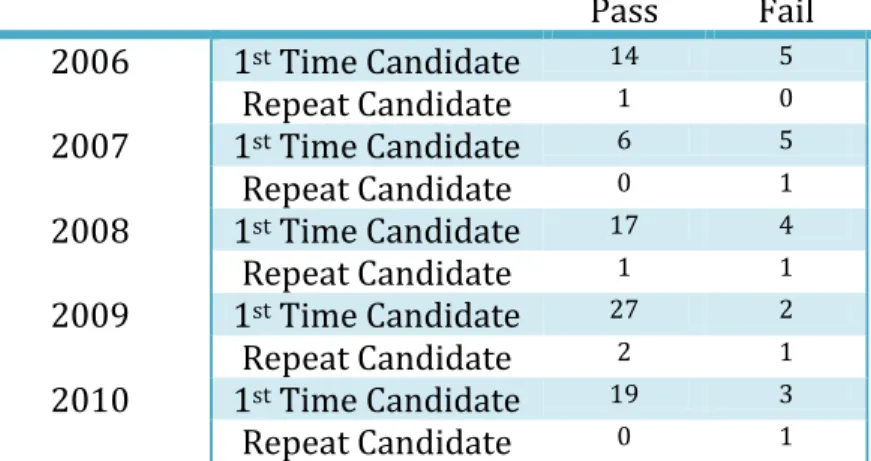
The value of the Ferris HIT/HIM programs is evidenced by many employers selecting FSU interns and graduates over other programs offered in the state. While on internship, some Ferris interns are providing training to student interns from other HIT programs in various HIM functions. Ferris students pass the national certification exam at a rate higher than the national average. Ferris graduates/students have a high rate of employability in HIT/HIM. For years 2006-2010, both HIT and HIM graduates scored above the national average each year except 2007. For example, in 2009, the RHIT national average pass rate was 82% and Ferris pass rate was 91%. Employer responses from the annual surveys show that Ferris does a “good job preparing students for meeting challenges”. They also state that our graduates have very good computer skills, often commenting on their Excel skills. See Appendix D, Survey Instruments (p.360-432).
Many employers with open positions contact Ferris instructors requesting graduate/student referrals as possible candidates. Also, some employers in the community have contacted Ferris to assist them in the training and education required for implementation of ICD-10 coding classification system anticipated in 2014.
Ferris State University
HIT and HIM Programs Page 13
Faculty explains the role of health information professionals to technical center and high school students at Open Lab Days that have been hosted by the College of Allied Health Sciences. Program faculty has visited career fairs and job fairs as a means to attract students to our profession. The program coordinator has visited other accredited HIT programs in the state to encourage students to enroll in the online HIM completion program. The MRIS programs at Ferris prepare a large number of the health information practitioners in Michigan. All of the faculty have presented continuing education activities and/or reviewed textbook chapters, and/or served as officers in local and state health information associations. Faculty has worked with the Michigan Health Information Management Association to co- sponsor ICD-9 and CPT Coding update workshops at the Grand Rapids campus. Health care recruiters contact us when they have health information job openings. Employers who hire our
graduates state that they would hire a Ferris grad again. This is reflected on employer surveys and via conversations directly with faculty at professional meetings. Although most of our graduates are employed by hospitals, we have graduates working for software vendors, long term care facilities, outpatient clinics, home health agencies, hospices, and insurance
companies.
5. Services for extra-University general public groups: The faculty participates in local, state, and national continuing education activities. Faculty have presented continuing education activities, reviewed textbook chapters, and served as officers in local and state health information associations. Faculty has worked with the Michigan Health Information Management Association to co- sponsor ICD-9 and CPT Coding update workshops at the Grand Rapids campus. A faculty member serves on the advisory committee for the Mecosta-Osceola Career Center. See Appendix A – Faculty Curricula Vitae (p. 58-92).
Groups outside the university: Program faculty and students have provided services to groups outside the university. Students have gone to their high schools and tech centers to talk about the value of a health information profession. The registered student organization, Health Care Management Association (HCMA), of which many MRIS students are members of, have participated in several service projects each year including Relay for Life, The Big Event, Big Brothers, Big Sisters, Toys for Tots, Adopt a Family at Thanksgiving and Christmas,
Halloween party for community children, and participating with the American Red Cross blood drives. They also host social events for association members and/or the community.
Faculty explains the role of health information professionals to tech center and high school students at Open Lab Days that have been hosted by the College of Health Professions. Program faculty has visited career fairs and job fairs as a means to attract students to our profession. The program coordinator has visited other accredited HIT programs in the state to encourage students to enroll in the online HIM completion program.
Ferris State University
HIT and HIM Programs Page 14
Section 2: Collection of Perceptions A. Graduate Follow-up Survey
The programs, as a part of their ongoing outcomes assessment, undergo a two-part graduate evaluation. The first part, conducted as the students prepare to leave campus consists of a survey of graduating students. The second part consists of a graduate survey mailed to all graduates one year following their graduation.
The survey that is conducted just prior to the student‟s graduation is designed to assess their perceived readiness to enter professional practice. Students are asked to evaluate their perceived value of the courses, their internship and various other aspects of the program.
The purpose of the graduate survey is to determine the graduate‟s employment and salary status and to determine whether they perceive that they were prepared for professional practice. Additional questions are designed to elicit information regarding areas where the curriculum may need to be revised to remain current with practice in the field. Results have been extensively used in recent curriculum revisions. A lot of the content on the graduate survey is required by CAHIIM.
There is an ongoing problem getting the graduates to return the survey documents. A total of 232 surveys were sent out to HIT and HIM graduates from 2007-2011. Until 2010, surveys were sent only by United States mail. Beginning in 2010, the surveys were sent electronically. The return rate was higher when surveys were sent electronically. Of the 137 graduates surveys sent out between 2007 and 2009, only 33 surveys or 24% of the surveys were returned. Of the 95 graduate surveys sent by email, 32 surveys or 34% of the surveys were returned.
. The Alumni office and CHP dean‟s office staff are helpful with providing addresses of program graduates. When sent by mail, many surveys are returned as “undeliverable”. The majority of our graduates are females which complicates things when they marry and change their name. The College of Health Professions Dean‟s Office supplied us with email addresses of graduating students. We are considering the use of social media such as Facebook or LinkedIn to contact our graduates. We have a Facebook group for HIT/HIM graduates.
.
Faculty have discussed offering each graduate the opportunity to win a gift card if he/she completes the graduate survey. We think that offering this type of incentive will continue to improve the return rate of the graduate surveys.
Surveys were created based on the accreditation requirements of CAHIIM and recommendations from Institutional Testing and Research.
Ferris State University
HIT and HIM Programs Page 15
HIT/HIM Program Graduate Survey Results 2007-2010
2007 2008 2009 2010 Surveys Sent 42 59 36 35 Surveys Completed/Returned 4 18 11 12 Employed FT 3 14 8 8 Employed PT 1 0 2 0 Continuing education 0 2 0 1
Other (Relief, Pool) 0 2 0 3
Not working 0 0 1 0
Evaluation of the above data suggests that students readily find employment in the field within one year of graduation. Employment opportunities are available in a variety of settings, but graduates find employment mainly in the acute care setting.
The graduate survey from 2007 - 2010 graduates has continued to identify the strengths to be the faculty, internships, and relevancy of coursework. Graduates repeatedly and continuously identify the weaknesses to be the amount of general classes (too many), the need for additional coding classes, and the need for an electronic health record software package (Cerner EMR is currently being installed in the CHP for use by all of the health and hospital-related programs).
With implementation of ICD-10 in 2014, many current health information professionals have expressed their intentions to retire rather than learning this new classification system for diagnoses and procedures. This will provide additional job opportunities for our graduates who will have had ICD-10 training.
HIT/HIM Graduate Survey Results 2007 – 2010* Based on scale of 1 (Strongly Disagree) to 5 (Strongly Agree)
2007 2008 2009 2010
The program helped me acquire knowledge needed for job. 4.3 4.5 4.7 4.0 Program prepared me to use sound judgment in job 4.3 4.5 4.8 4.0 Program prepared me to be able to recommend appropriate procedures for job.
4.7 4.0 4.5 4.0
Program enabled me to think critically, solve problems and develop action steps.
Ferris State University
HIT and HIM Programs Page 16
Program prepared me with skills for HI professional. 4.0 4.5 4.5 3.9 Professional practice was valuable in reinforcing HI skills. 4.3 4.5 4.5 4.3 Program prepared me to effectively communicate in job 4.3 4.0 4.5 4.5 Program prepared me to conduct myself in ethical and professional manner. 4.5 4.0 4.5 4.6 Program taught me to manage my time efficiently 4.7 4.0 4.3 4.3 Program prepared me to work effectively as team member 4.5 4.0 4.5 4.9 Overall quality of preparation as HI professional 4.3 4.0 4.5 4.8
*2011 surveys were changed to 4 point scale as recommended by CAHIIM.
Average responses were calculated by dividing the average number of responses to an item by the number of individuals who responded to each item. In many cases, all of the alumni who responded to the survey failed to respond to some of the individual items. As noted in the above table, the overall quality of preparation for the health information profession is very high.
HIT/HIM Graduate Surveys can be found in Appendix D Survey Instruments (p. 360- 432).
B. Employer Follow-up Survey:
HIT/HIM Employer Survey Results 2007-2010*
Results based on a scale of: 1 (Strongly Disagree) to 5 (Strongly Agree)
2007 2008 2009 2010
Graduate has knowledge to function in job.
5 4 5 4.8
Grad uses sound judgment while functioning in job 5 4 5 4.8 Grad is able to recommend appropriate HIM procedures 5 3 4.5 4.8
Grad able to think
Ferris State University
HIT and HIM Programs Page 17
problems, and develop appropriate action steps. Grad possesses technical skills to perform job. 5 4 5 4.7 Grad communicates effectively 5 4 4.5 4.7
Grad conducts self in ethical and
professional manner
5 4 5 4.9
Grad manages time
efficiently 5 5 4 4.8 Grad functions effectively as team member. 5 4 5 4.8 Overall quality of grads of program 5 4 4.5 4.8
*2011 MRIS programs changed to 4 point scale as recommended by CAHIIM.
Employer surveys are sent at the same time that graduate surveys are sent. For years 2007, 2008, and 2009, the surveys were sent to the graduates. The graduates were asked to give their employer a survey to complete and return in the enclosed self-addressed stamped envelope. For years 2010 and 2011, the surveys were sent to healthcare facilities that we knew had hired Ferris MRIS graduates. The return rate was higher when we sent the surveys to the specific employers.
There were 172 employer surveys sent out between 2007-2010. Forty-five surveys (22%) were completed and sent back. The scores ranged from 4(Generally Agree) to 5 (Strongly Agree) for overall quality of the graduates of the MRIS programs. As shown in the above table, employers are very satisfied with HIT/HIM graduates.
Surveys can be found in Appendix D-Survey Instruments (p. 360-432).
C. Graduating Student Exit Survey:
Graduating students were surveyed after Fall 2011 to attain their perspectives related to the quality of instruction, relevance of courses, and satisfaction with program outcomes based on their expectations. Program faculty utilizes the comments/recommendations as a tool to evaluate the effectiveness of the specific course.
The surveys were given to students at the end of their last class prior to going out on internship. Eleven of the twelve HIT/HIM graduating students felt that they were
adequately prepared for an entry level position in the health information profession. Ten of the twelve graduating students who returned their survey felt that they were well-prepared for an entry level position in the health information profession. One student did not know if he/she was prepared for an entry level position. Eleven of the twelve
graduating students would recommend the HIT/HIM program at Ferris State University. Comments made by these students included: “I feel I was prepared for 90% of my
Ferris State University
HIT and HIM Programs Page 18
assignments”; “Instructors were willing to help me when I didn‟t feel prepared”; and “I can‟t believe everything I have learned”.
A separate survey is given to students at the end of their internship experience. One of the questions asked of the students is if their classroom instruction adequately prepared them for their internship. The majority of these students felt that they were prepared for the internship.
MRIS 293 Professional Practice I Student Evaluations Fall 2006 – Su 2011 287 Student Respondents
Yes No Student Comments
Received tour and
orientation to department 280 7 Received orientation to hospital 280 7 Received adequate orientation to each procedure performed 282 5 Performance in each
function was monitored 279 8 Completed tasks were double-checked; Given instructions and discussed outcomes; Checked on regularly and asked if there were questions
Felt comfortable asking for assistance from
supervisor/other employees
279 8
Received help when
questions were asked 285 2
Felt accepted by healthcare organization and
department personnel
285 2
Granted permission to spend time in areas other than ones scheduled by site coordinator
270 17
Classroom instruction
adequate for internship 278 9 Utilization Review. Felt unprepared in Although discussed in class,
not prepared; difficult to code from patient record; doing both CPT and ICD coding on same patient chart
Internship manual provided sufficient information for internship preparation
278 9 Facilities should know how university wants reports to look like; better explanation of how to do projects; revise manual for EMR as opposed to paper records; manual
projects for nonacute settings; some of projects weren‟t worded quite right;
Ferris State University
HIT and HIM Programs Page 19
MRIS 293 Professional Practice I student comments identified the strongest aspects of the internshipexperience to be: “Handling actual records of real patients; being trusted and treated as an actual employee; great cooperation from the staff; working with outpatient coders; going to meetings; experience and knowledge gained; being able to work with minimal supervision; opportunity to network; and exposure to many different department functions.”
MRIS 293 Professional Practice I students commented that the weakest points were: “Completing tasks that were irrelevant to internship; putting together reports; spending time in transcription; days were long; not staying busy; too short; project deadlines; site coordinator didn‟t provide a lot of guidance; site meetings often rescheduled; felt like I was bothering people and in the way.”
In most cases, students complete their first internship (240 hours) in a hospital setting. The hospital can be in any state or country. Most students secure a Michigan internship site. In some cases, non-traditional settings such as nursing homes and clinics have served as a student‟s internship site. The reason could be that this is the place of employment for the intern or they could not secure an acute care setting in the area that he/she wanted to complete the internship.
MRIS 493 Professional Practice II Student Evaluations Fall 2006 – Su 2011 27 Student Respondents
Yes No Student Comments
Received tour and
orientation to department 27 0
Received orientation to
hospital 26 1 Already worked there, received orientation when
hired at hospital Received adequate orientation to each procedure performed 25 2 Performance in each
function was monitored 24 3 Worked independently, but was monitored; could only observe some areas
Felt comfortable asking for assistance from
supervisor/other employees
27 0
Received help when
questions were asked 27 0
Felt accepted by healthcare organization and
department personnel
27 0
Granted permission to spend time in areas other than ones scheduled by site coordinator
25 2
Classroom instruction
adequate for internship 27 0 Well-prepared, good preparation
Internship manual provided sufficient information for internship
25 2 Need a few clarifications; no problems, I felt lucky because interns from other
Ferris State University
HIT and HIM Programs Page 20
preparation schools didn‟t have a
manual
MRIS 493 Professional Practice II student stated that the strongest aspects of this internship included: “Exposure to so many departments, helpful people who answered questions; able to pull classroom learning together with real world; networking; working with real data.”
MRIS 493 Professional Practice II student stated that the weakest aspects of this internship included: “Having to reschedule appointments for projects; site person didn‟t always have time for me; wasn‟t able to attend all meetings; didn‟t have my own desk; supervisor was gone a lot.”
The student recommendations were to ask a lot of questions because “no question is stupid”, create a schedule with site coordinator, and to visit as many departments as possible.
MRIS 493 Professional Practice II is a 400 hour experience in a health related organization such as hospital, nursing home, ambulatory care setting, home health agency, clinics, or physician practice.
Surveys can be found in Appendix D-Survey Instruments (p.360-432).
MRIS 293 Professional Practice I Site Coordinator’s Final Assessment of Intern’s Performance 2007-2011
4=Above Average 3=Average 2=Below Average 1=Poor
The Intern: Above
Average (4) Average (3) Average (2) Below Poor (1) Demonstrated appropriate
interpersonal skills 203 11 1 0
Asked questions to gain information needed to complete tasks
203 12 0 0
Dealt appropriately with conflict 200 10 5 0
Showed respect for diverse
opinions and ideas 202 10 3 0
Showed respond for site coordinator and allowed time when submitting projects for review
200 12 3 0
Presented material
professionally 198 12 4 1
Explained his/her point of view 201 12 2 0
Constructed basic spreadsheet 200 12 3 0
Manipulated data 191 20 4 0
Accessed information within
facility’s system 200 13 2 0
Used word processing skills to
complete projects 214 1 0 0
Ferris State University
HIT and HIM Programs Page 21
campus to the healthcare setting Accurately interpreted
information 210 5 0 0
Used acceptable grammar and punctuation when completing tasks
208 5 2 0
Completed all assigned work 210 5 0 0
Presented work that was neatly done and had professional appearance
208 7 0 0
Arrived on time for scheduled
days 209 3 2 1
Arrived on time for scheduled
meetings 209 6 0 0
Was in attendance for number of
hours scheduled each day 212 3 0 0
Was neat and clean 213 2 0 0
Was appropriately attired for
work situation 213 2 0 0
Could speak language of
healthcare 189 26 0 0
Demonstrated understanding of
laws that pertain to healthcare 177 38 0 0
Demonstrated understanding of
structure of healthcare in U.S. 194 21 0 0
Demonstrated an understanding of pervasive nature of quality improvement throughout healthcare
187 28 0 0
The site coordinator at the internship site completes a final assessment of the intern‟s performance. As noted in table above, site coordinators are very happy with the quality of our students.
Some positive comments included: “Student was professional and well spoken, liked to stay busy and ask appropriate questions; very detailed and conscientious about the quality for her work; this is the type of ethic we like to see in health information; always
presented professional and pleasant personality; exemplary employee who is very knowledgeable in her profession; attention to detail, and good professional demeanor; self- motivated and professional demeanor; knowledgeable and confident; thorough and eager to learn, helpful; professional in appearance and had great computer skills; not afraid to ask questions, she sees the “big picture” and is able to work well in a structured environment; punctual, plans ahead, friendly and cooperative; team player,
self-motivated; learns systems quickly.”
Some areas for improvement included as noted by Site Coordinators included: “N/A(62); passionate about wanting a quality, complete record that I think it frustrates her to deal with a record from imperfect providers and staff; continued exposure to HIM profession; become more confident-this well come with time; should feel free to ask questions; trust self; more experience in coding; keep up with lifelong learning;-collating thoughts and expressing what is learned in written format; and validate assumptions”.
Ferris State University
HIT and HIM Programs Page 22
MRIS 493 Professional Practice II Site Coordinator’s Final Assessment of Intern’s Performance
2007-2011
4=Above Average 3=Average 2=Below Average 1=Poor
The Intern: Above
Average (4) Average (3) Average (2) Below Poor (1) Demonstrated appropriate
interpersonal skills 26 0 1 0
Asked questions to gain information needed to complete tasks
25 2 0 0
Dealt appropriately with conflict 22 3 1 0
Showed respect for diverse
opinions and ideas 25 1 1 0
Showed respond for site coordinator and allowed time when submitting projects for review
25 1 1 0
Presented material
professionally 25 2 0 0
Explained his/her point of view 24 3 0 0
Constructed basic spreadsheet 26 1 0 0
Manipulated data 25 2 0 0
Accessed information within
facility’s system 26 1 0 0
Used word processing skills to
complete projects 27 0 0 0
Applied knowledge learned
on-campus to the healthcare setting 26 1 0 0
Accurately interpreted
information 26 1 0 0
Used acceptable grammar and punctuation when completing tasks
24 2 1 0
Completed all assigned work 26 1 0 0
Presented work that was neatly done and had professional appearance
26 1 0 0
Arrived on time for scheduled
days 26 0 0 1
Arrived on time for scheduled
meetings 26 0 1 0
Was in attendance for number of
hours scheduled each day 26 1 0 0
Was neat and clean 27 0 0 0
Was appropriately attired for
work situation 27 0 0 0
Could speak language of
healthcare 23 4 0 0
Demonstrated understanding of
laws that pertain to healthcare 24 3 0 0
Demonstrated understanding of
structure of healthcare in U.S. 24 3 0 0
Demonstrated an understanding of pervasive nature of quality improvement throughout
Ferris State University
HIT and HIM Programs Page 23
healthcare
The site coordinator at the internship site completes a final assessment of the intern‟s performance. As noted in table above, site coordinators are very happy with the quality of our students.
Some positive comments from the Site Coordinators included: “Intern got along well with employees and willing to help wherever needed; not easily distracted from task; friendly and outgoing; professional; asked good questions; good oral communication skills; intern made many valid and quality suggestions; always thinking; eagerness to learn; accepted new challenges; completed high quality projects; did not much direction; projects accurate; dressed appropriately; prompt and present as scheduled; positive outlook on healthcare; understands impact and relationship of concepts and processes to overall job functions; good understanding of U.S. healthcare; detail-oriented; organized; works well with diverse staff; good communicator; learns systems quickly.”
Some areas for improvement as noted by the Site Coordinator include:
“Inappropriate comments to associates; lack of “grateful” attitude for allowing student learning; sometime too blunt; needs to improve written communication skills; validate assumptions.”
Faculty reviews these evaluations each semester. The negative comments are discussed and faculty determine the best way to make improvements. Most often, the “weak areas” are already covered in class in great detail. However, faculty continues to emphasize the importance of these topic areas.
D. Student Program Evaluation:
HIT/HIM Student Perceptions of Programs 2011 Respondents: 35 HIM Students, 50 HIT Students
A= Excellent B = Good C=Acceptable D=Below Expectations E=Poor
Excellent Good Acceptable Below
Expectations Poor
Courses available at
convenient times 25% 40% 26% 7% 2%
Pre-requisites for courses are
realistic 43% 39% 16% 2% 0
Know how assignments will be
graded (rubrics) 53% 35% 9% 2% 1%
There are enough supplies and/or equipment to use during classroom/lab sessions (2 didnot respond)
60% 27% 6% 1% 4%
Required general education courses for degree are current and meaningful (1 did not respond)
24% 49% 22% 2% 1%
Ferris State University
HIT and HIM Programs Page 24
information (8 did not respond)
Advisor is available when needed (2 did not respond)
43% 28% 18% 6% 2%
Provided with useful
information by advisor 49% 33% 14% 2% 1%
Instruction in program courses
is_________________ 39% 48% 7% 4% 1%
Online courses designed to meet student needs. (3 did not respond)
39% 40% 14% 1% 2%
Current students (BR, GR) are surveyed to obtain information regarding quality of instruction, relevance of courses, and satisfaction with program outcomes based on their own expectations. This survey was given to students at the end of Fall semester, 2011. Thirty-five HIM students responded to the survey and fifty HIT students responded. Of the 35 HIM students surveyed, 13 were on campus students and 22 were off campus. Of the 50 HIT students surveyed, 16 were on campus students and 33 were off campus students. The surveys showed that the students were satisfied with the quality of education received in the health information programs. Students felt that courses are available at times convenient for them. They felt that they were provided with useful information when meeting with their advisor. 87% of the students rated their classroom instruction as “Excellent” or “Good”.
Sixty-five percent (55/85) of the students felt that courses were available at convenient times. Some students would like to be on campus only two to three times a week because of family and work obligations. We try to schedule classes to accommodate this. In Grand Rapids, classes are offered one time a week, in the evening and if a second section is needed, it would be offered in the afternoon. If there are Grand Rapids seats available, Big Rapids campus students can enroll in these classes.
Seventy two percent (60/83) of the students felt that their academic advisor is available to them at the times they are needed. Students must meet with their advisor before
registering for classes. Most faculty are on campus at least four days a week for at least 8 hours each of these days. Each faculty has at least four hours of scheduled office hours each week and also are available to “walk-in” requests/concerns.
Ferris State University
HIT and HIM Programs Page 25
E. Faculty Perceptions:
MRIS Faculty Perceptions of Program 2011
Rating Scale: 5=Excellent B=Good C=Acceptable D=Below Expectations E=Poor Results based on 3 Tenure Track Faculty in Big Rapids and 2 Full Time Faculty in Grand
Rapids
Excellent Good Acceptable Below
Expectations Poor
Administrators involved in developing/revising program plan seek and respond to faculty input
5 0 0 0 0
Written goals for program state realistic outcomes 5 0 0 0 0 Curricula designed to meet needs of graduates 4 1 0 0 0 Curricula designed to meet needs of employers 4 1 0 0 0 Curricula designed to meet requirements of accrediting body 4 1 0 0 0 Involved in program evaluation 5 0 0 0 0 Administrative support for program 4 1 0 0 0
Lab space for
program 2 3 0 0 0
Lab equipment for
program 2 3 0 0 0
Library support for
program 3 2 0 0 0 Adequate support for professional development 0 0 5 0 0 Advisory committee for programs 4 1 0 0 0 Provision for students with disabilities 2 3 0 0 0 Secretarial support for programs 3 1 1 0 0 Instructional support staff 1 3 1 0 0 Number of faculty assigned to program 0 2 3 0 0 Quality of faculty assigned to 5 0 0 0 0
Ferris State University
HIT and HIM Programs Page 26
program
These surveys were given to the five full-time health information faculty (three in Big Rapids and two in Grand Rapids) to assess their perceptions of the program curricula, resources, admissions standards, commitment by administration, processes and procedures used, and their overall feelings.
The surveys showed that the faculty is satisfied with the program. Areas where faculty is most satisfied are program goals with realistic outcomes, faculty involvement in
evaluation progress, and department head support. Area where faculty is least satisfied is loss of full time tenure track faculty line after the death of a faculty member. Current MRIS faculty is on overload each semester. We have an adjunct faculty member who is also on overload each semester. Prior to 2011-12 academic year, CHP funding for professional development activities had not been available for the preceding three years. This made it more difficult for faculty to attend educational sessions in their area of expertise.
Surveys can be found in Appendix D-Survey Instruments (p.360-432).
F. Advisory Committee Perceptions:
HIT/HIM Advisory Committee Survey Results 2011 9 of 10 Advisory Committee Members responded
Excellent Good Acceptable Below
Expectations Poor Courses available at convenient times 44% 44% 11% 0% 0% Program meets needs of health information community 44% 33% 22% 0% 0% Faculty in the program are qualified 78% 22% 0% 0% 0%
Lab facilities for program are adequate (1 did not
respond) 67% 11% 11% 0% 0% Graduates are in high demand 67% 22% 11% 0% 0% Curricula reflective of current health information practice 67% 22% 11% 0% 0%
Ferris State University
HIT and HIM Programs Page 27
The purpose of this survey is to obtain information from the members of our advisory committee regarding the curriculum, outcomes, facilities, equipment, graduates, and trends affecting job placement.
We surveyed the ten members of our advisory committee and nine completed surveys were returned. Overall satisfaction with the programs, faculty, and graduates is apparent by the above survey results. To better meet the needs of the health information
community, the faculty are exposing the students to records from non-acute care settings such as clinics and long term care facilities.
Ferris State University
HIT and HIM Programs Page 28
Section 3: Program Profile
A. Profile of Students
1 a-f) Student Demographic Profile: Health Information Technology (HIT) and Health Information Management (HIM) programs
2007 2007 2008 2008 2009 2009 2010 2010 2011 2011 HIT HIM HIT HIM HIT HIM HIT HIM HIT HIM
Sex Male 5 2 3 3 10 5 8 4 8 3 Female 85 29 73 31 95 26 117 36 87 49 Race Unknown 5 1 4 1 10 0 7 1 5 2 Black 9 2 9 0 12 1 8 6 4 5 Hispanic 3 1 2 1 3 1 6 1 2 2 Native 1 0 1 2 0 1 2 2 1 1 Asian 4 0 3 0 4 1 3 2 1 1 White 68 27 54 30 76 27 98 28 82 40 Hawaiian 0 0 0 0 0 0 0 0 0 0 Multi 0 0 0 0 0 0 1 0 0 1 Foreign 0 0 0 0 0 0 0 0 0 0
Age Avg. Age 33 30 31 32 32 31 33 29 35 28
Residence In-state 84 30 73 33 104 31 124 40 93 52 Out-of-State 0 0 0 0 0 0 1 0 0 0 Enrolled Status Full-Time 24 15 23 14 47 11 53 15 36 26 Part-Time 66 16 50 20 58 20 72 25 59 26 Attend Classes Day 30 26 28 17 52 14 58 16 40 26 Evening 60 5 45 17 53 15 67 20 55 22 Weekends* Enrolled On-Campus 38 18 51 19 63 23 40 30 Off-Campus 42 18 59 14 63 17 55 22 SCH’s On-Campus 593 227 769 269 464 381 Off-Campus 384 76 413 105 396 185 Delivery Method 100% On-line 0 0 0 0 0 2 0 4 0 4
*One HIT course is only offered mixed delivery with in-seat portion on a Saturday. g. With the increase in number of students enrolled in the HIT programs at the Big Rapids campus, each professional course is offered in at least two different
semesters each academic year. Many of our HIT students at the Grand Rapids campus are attending classes on a part-time basis because they are currently working full-time in health care. We have seen an increase in the number of Grand Rapids HIT graduates laddering into the HIM completion program because all of the professional courses are offered in an online format. Although we have several students in the online completion HIM degree, many
Ferris State University
HIT and HIM Programs Page 29
of these students are still taking some of their course work on campus. As we continue to enroll HIT graduates from other colleges, we will continue to see an increase in the number of students completing the professional courses in HIM totally online.
MRIS 101, the introductory health information course, is typically taught in Big Rapids only in the fall semester. Beginning Summer 2010, we began to also offer this course in summer semester. This allowed students who were
waiting to begin a clinical program the opportunity to complete our HIT program in four semesters. After completing their general education requirements and pre-requisite courses for their clinical program, most students have to wait at least a year before they are accepted into their clinical program. The HIT program works well for these students because they complete their HIT internship the following summer after taking MRIS 101. They are then ready to start their clinical program in fall semester after completing the HIT program. Having an understanding of the coding and billing process is valuable for any healthcare profession. After completing the HIT program, some of these students who had intended to enter a clinical program decide to continue into HIM or find a job in health information.
The number of HIT students increased from 105 in 2009 to 125 in 2010 because we began offering MRIS 101, the first health information course during summer semester in Big Rapids. This course is usually only offered in fall semester in Big Rapids. Thus, for the past three years, we have offered MRIS 101 in both fall and summer semesters. Many of the students who begin the program in summer semester have all of their general education requirements completed and complete the HIT program in four semesters. Although the number of HIT students decreased from 125 to 95 between 2010 and 2011, eight of these HIT students did a curriculum change into the HIM program. We have seen the numbers in our HIM program increase because all of the HIM professional courses are now offered online. We have also experienced a decrease in the number of HIT students on our Grand Rapids campus. For the last five years, we had a large number of displaced employees in the Michigan Works programs enroll in the HIT program. The HIT program does not have a wait list and can be completed in within the timeframe established by Michigan Works. However, 2.) Quality of Students
2007 2007 2008 2008 2009 2009 2010 2010 2011 2011
HIT HIM HIT HIM HIT HIM HIT HIM HIT HIM
a.Currently
EnrolledGPA Range 1.68 - 4. 2.58 -3.98 1.51 - 4. 2.5 - 4. 1.75 - 4. 2.65 -4. 1.6 - 4. 1.51 - 4. 2.07 - 4. 2.17 - 4.
Average 3.31 3.18 3.13 3.27 3.28 3.31 3.29 3.22 3.3 3.18
Currently
EnrolledACT Range 13 - 29 15 - 28 10 - 23 15 -28 13 - 28 14 - 30 14 - 27 14 - 30 13 - 30 14 -27
Average 18.53 19.76 17.56 20.06 19.08 21 19.44 19.55 19.83 19.63
b. Graduating
StudentsGPA Range 2.32 - 4. 2.49 - 2.49 2.85 - 4. 2.82- 3.76 2.51 - 4. 2.8 - 3.6 2.51 - 4. 2.77 - 3.66
Ferris State University
HIT and HIM Programs Page 30
Graduating
StudentsACT Range 15 -25 15 - 27 16 - 28 13 - 20 18 -22 15 - 26 17 - 26
Average 19.83 17.83 19.43 17.06 20 20.29 21
Source: Ferris Fact Book
a. ACT and GPA, students must earn a “C” or better in all MRIS and HCSA courses. It is noted that the GPA of students currently enrolled in HIT or HM often falls below 2.5. Students must have a 2.5 GPA to be admitted into the HIT or HIM program and a 2.0 to graduate. Beginning Fall 2012, students must have a 2.25 GPA to graduate. The GPA of students currently in the HIT or HIM program will be closely monitored. According to the statistics above, the low end of the ACT scores range from 10-15. Prior to Fall 2010, students with GPA below 2.5 would be identified as a pre-HIT or pre-HIM. We no longer have a pre- program. Once a student‟s GPA is 2.5 or above, the student can request a program change to be completed. We do find that students sometimes try to enroll in MRIS 101 and do not have a 2.5 GPA.
b. We will continue to monitor ACT scores and GPA of graduating students. This is especially important that we monitor GPA as we have raised the GPA of graduating students to 2.25. In the past, a graduating student needed a 2.0.
c. No other methods are currently used to assess the quality of students entering the program. The clinical programs in the CHP require successful completion of
pre-requisite courses prior to applying. They usually require a “B” or better in these courses. Because of the increasing number of students interested in the HIT/HIM programs, faculty will consider stricter entrance requirements.
d. Students in the MRIS programs are members of the American Health
Information Management Association, the national professional organization; members of Michigan Health Information Management Association; and Health Care Management Association, the student association on campus. These students perform fundraising activities for various charitable organizations in Big Rapids, mentor students in the program, and sponsor social activities for the members.
Each year, Michigan Health Information Management Association, our state organization offers the opportunity for health information program students to apply for scholarships ($500 – $750) based on GPA, student involvement at school and in the community, and honors/awards received. The number of scholarships vary by year (usually 3 – 7). Since the last program review, 15 of our students have earned these scholarships. They also offer graduating students the opportunity to apply for an award that would pay for first year national association dues and a state conference registration and lodging. Two of our graduates have received this award since the last program review. We have had six of our students apply and receive scholarships from our national association, American Health Information Management Association. Marcy Parry received the “Outstanding Academic Advisor” award in 2010.