Web Applications
XIAOWEI LI
Vanderbilt University YUAN XUE
Vanderbilt University
Web applications are one of the most prevalent platforms for information and service delivery over the Internet today. As they are increasingly used for critical services, web applications have become a popular and valuable target for security attacks. Although a large body of techniques have been developed to fortify web applications and mitigate attacks launched against web applications, there has been little effort devoted to drawing connections among these techniques and building the big picture of web application security research.
This paper surveys the area of securing web applications from the server side, with the aim of systematizing the existing techniques into a big picture that promotes future research. We first present the unique aspects of the web application development which cause inherent challenges in building secure web applications. We then discuss three commonly seen security vulnerabilities within web applications:input validation vulnerabilities,session management vulnerabilities and application logic vulnerabilities, along with attacks that exploit these vulnerabilities. We organize the existing techniques along two dimensions: (1) the security vulnerabilities and attacks that they address; (2) the design objective and the phases of a web application during which they can be carried out. These phases aresecure construction of new web applications, security analy-sis/testing of legacy web applications andruntime protection of legacy web applications. Finally, we summarize the lessons learnt and discuss future research opportunities in this area.
Categories and Subject Descriptors: K.6.5 [Management of Computing and Information Systems]: Security and Protection
General Terms: Security
Additional Key Words and Phrases: Web Application Security, Input Validation Vulnerability, Session Management Vulnerability, Application Logic Vulnerability
1. INTRODUCTION
The World Wide Web has evolved from a system that delivers static pages to a platform that supports distributed applications, known as web applications, and has become one of the most prevalent technologies for information and service delivery. The increasing popu-Author’s address: X. Li, Department of Electrical Engineering and Computer Science, Vanderbilt University, 400 24th Ave. South, Nashville , TN 37203; Y. Xue, Department of Electrical Engineering and Computer Science, Vanderbilt University, 400 24th Ave. South, Nashville , TN 37203. This work was supported by NSF TRUST (The Team for Research in Ubiquitous Secure Technology) Science and Technology Center (CCF-0424422). Permission to make digital/hard copy of all or part of this material without fee for personal or classroom use provided that the copies are not made or distributed for profit or commercial advantage, the ACM copyright/server notice, the title of the publication, and its date appear, and notice is given that copying is by permission of the ACM, Inc. To copy otherwise, to republish, to post on servers, or to redistribute to lists requires prior specific permission and/or a fee.
c
larity of web application can be attributed to several factors, including remote accessibility, cross-platform compatibility, fast development, etc. The AJAX (Asynchronous JavaScript and XML) technology also enhances the user experience of web applications with better interactiveness and responsiveness.
As web applications are increasingly used to deliver critical services, they become a valuable target for security attacks. Many web applications interact with back-end database systems, which may store sensitive information (e.g., financial, health). A compromised web application could result in an enormous information breach, severe financial losses, and ethical and legal consequences. A breach report from Verizon [Verizon 2010 ] shows that web applications are at the top in both the number of breaches and the amount of data compromised.
The Web platform is a complex ecosystem composed of a large number of components and technologies, including the HTTP protocol, web server and server-side application development technologies (e.g., CGI, PHP and ASP), and web browser and client-side technologies (e.g., JavaScript and Flash). Web applications built and hosted upon such a complex infrastructure enjoy a rapid and wide user adoption, thanks to the rich features of these components. However, the inconsistencies among different technologies migrate the challenge of ensuring security to web application development. Meanwhile, current web application development and testing frameworks offer limited security support. As a result, web application development is an error-prone process, and implementation of se-curity measures requires substantial efforts. These efforts could be unrealistic under time-to-market pressure, especially for people with insufficient security skills or awareness. As a result, a high percentage of web applications deployed on the Internet are exposed to security vulnerabilities. According to a report by the Web Application Security Consor-tium, 49% of the web applications reviewed contain vulnerabilities considered high risk and more than 13% of the websites can be compromised completely [WASS 2007 ]. A recent report [WhiteHat 2010 ] revealed that over 80% of the websites on the Internet have had at least one serious vulnerability.
Motivated by the urgent need to secure web applications, a substantial amount of re-search efforts have been devoted to this problem, developing a large number of techniques for hardening web applications and mitigating attacks. Many of these techniques make assumptions about the web technologies used in the application development and only ad-dress one particular type of security flaw. Additionally, the prototypes are usually imple-mented and evaluated on limited platforms. Practitioners often face a dilemma in selecting suitable techniques that meet their development needs – whether a technique can be di-rectly applied; and if not, whether several techniques can be extended and/or combined. Thus, there is an urgent need to provide a systematic framework for uncovering the con-nection between the existing techniques. This survey marks an initial attempt towards such a framework.
In this paper, we survey the state of the art in securing web applications, with a focus on approaches that are deployed on the server side. In particular, this survey covers the tech-niques which consider the following threat model: 1)the web application itself is benign (i.e., not hosted or owned for malicious purposes) and hosted on a trusted and hardened infrastructure (i.e., a trusted computing base, including OS, web server, interpreter, etc.); 2)the attacker is able to manipulate either the contents or the sequence of web requests sent to the web application, but cannot directly compromise the infrastructure or the
appli-cation code. While this survey focuses on server-side techniques for securing web applica-tions, it also covers techniques requiring collaboration between client and server. We note here that although browser security ([Wang et al. 2009; Tang et al. 2010], etc.) is also an essential component in end-to-end web application security, research works on this topic usually have a different threat model, where web applications are considered as potentially malicious. This survey does not include the research works on browser security so that it can focus on the problem of building secure web applications and protecting vulnerable ones.
Although there are several existing surveys in the web application security area, they either focus on one particular type of attack (e.g., XSS [Garc´ıa-Alfaro and Navarro-Arribas 2009], SQL injection [Halfond et al. 2006]) or summarize one class of techniques that can be applied (e.g., vulnerability analysis [Cova et al. 2007], detection [Garcia-Alfaro and Navarro-Arribas 2008]). To the best of our knowledge, this is the first comprehensive survey covering a wide range of attacks – from input validation attacks to application logic attacks – and three categories of server-side defense techniques, including secure construction, vulnerability analysis and testing, and runtime protection.
The structure of this survey is as follows. Section 2 describes how a web application works and the unique characteristics of web application development. Section 3 describes three types of commonly seen security vulnerabilities within web applications, as well as the attack vectors that exploit these vulnerabilities. Section 4 classifies existing research works into three categories:secure construction of new applications,security analysis and testing of legacy applicationsandruntime protection of legacy applications, and present the state-of-the-art systematically. Finally, Section 5 summarizes this paper by identifying several evolving trends in the area of web application security and the new challenges that are expected ahead.
2. UNDERSTANDING UNIQUE CHARACTERISTICS OF WEB APPLICATIONS
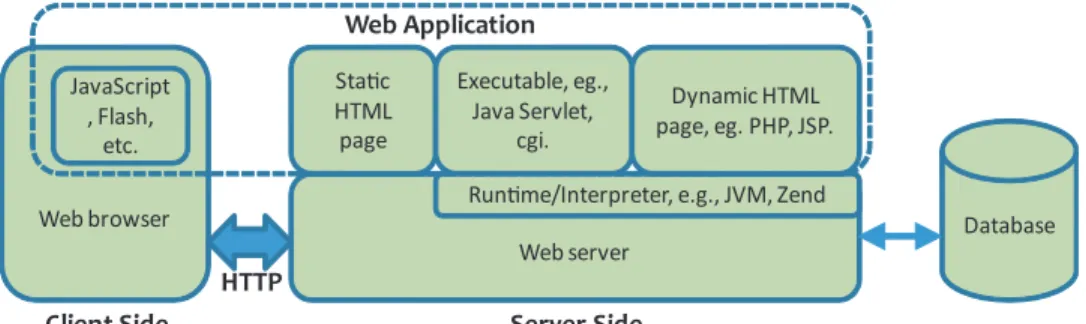
Web application is a client-server application that is executed over the Web platform. It is an integral part of today’s Web ecosystem that enables dynamic information and service delivery. As shown in Fig.1, a web application consists of code on both the server side and the client side. On the server side, a web application receives user inputs via HTTP requests from the client (i.e., browser), and interacts with local file systems, back-end databases or other components for data access and information retrieval. Its outputs (i.e., HTML pages) are sent to the client through HTTP responses. On the client side, HTML pages are rendered and the client-side code (i.e., JavaScript) embedded in the HTTP re-sponses is executed by the web browser. The client-side code can also communicate with the server-side code asynchronously without interfering with the display of the existing HTML page via AJAX (Asynchronous JavaScript and XML) and dynamically update the page. Nowadays, some programming libraries and frameworks (e.g., Rails and Django) are developed to facilitate rapid application development. For example, most web devel-opment frameworks provide session management functions, which developers can directly leverage to manage the web sessions.
The execution model of web applications is radically different from traditional applica-tions. The development of web applications also faces challenges that are not ordinarily encountered in the development of traditional applications. First, in the open web envi-ronment, user inputs are potentially dangerous and can never be trusted. Input validation
is an important part of a web application to identify and sanitize untrusted user inputs. Although input validation is an essential function required by all types of applications, its implementation in web applications is much more challenging due to the unique features of web development technologies. Second, the communication between the client and the web application is carried out through the stateless HTTP protocol. As a result, multiple inputs from the same user will appear to be independent users to the web application. The web application has to employsession managementin order to correlate the web requests from the same user into a web session. Finally, a web application is usually implemented as a number of modules with URLs as their entry points. This allows a user to directly access the application modules in an arbitrary order. Recently AJAX applications provide users with a richer and more responsive experience by moving part of the computation to the client side, which avoids unnecessary network round trips. Since the computing results from the client side can never be trusted, additional validation of these results is required on the server side. These unique features significantly complicate thelogic implementation of a web application, which needs to enforce the application’s control flow between the client and the server and across different modules. These three aspects of web application development are described in the following sections.
Web server Sta!c HTML page Executable, eg., Java Servlet, cgi.
Run!me/Interpreter, e.g., JVM, Zend Dynamic HTML page, eg. PHP, JSP. Web Application Database Web browser JavaScript , Flash, etc.
Client Side Server Side
HTTP
Fig. 1. Overview of Web Application
2.1 Input Validation
User inputs can never be trusted and need to be validated or sanitized before they can be utilized by web applications. Usually, web developers employ sanitization routines (i.e., sanitizers) to transform user inputs into trusted data by filtering or escaping suspicious characters or constructs. Web applications allow developers to blend several types of con-structs in one file for runtime interpretation. For instance, a PHP file may contain both static HTML tags and PHP statements and an HTML page may embed executable JavaScript code. The representation of application data and code via an unstructured sequence of bytes is a unique feature of web application. While enhancing the development efficiency, this unique feature complicates the input validation of web applications, since developers have to anticipate the contexts where and how user inputs are utilized that pose different sanitization requirements (i.e., context-sensitive sanitization). For instance, applying the default HTML escaping sanitizer is recommended for sanitizing the values inside HTML tags; however, this sanitizer is insufficient for sanitizing values within URL attributes (such
as src or href), since the URI attribute of the script tag can embed malicious code [Samuel et al. 2011].
2.2 Session Management
Web applications adopt an abstraction of a web session to identify and correlate a series of web requests from the same user during a certain period of time. A set of session variables (or session data) is associated with a web session, and can be used by the application to record the conditions from the historical web requests that affect the future execution of the web application (i.e., application session state). The session variables can be maintained either at the client side (via a cookie, a hidden form or URL rewriting) or at the server side (in a file or using a database). In the latter case, a unique identifier (session ID) is defined to index the explicit session variables stored at the server side and issued to the client. Most web programming languages (e.g., PHP and JSP) and frameworks offer developers a collection of functions for managing the web session. For example, in PHP,session start() can be called to initialize a web session and a pre-defined global array$ SESSIONcan be employed to contain the session variables. In either case, the client plays a vital role in maintaining the session information.
2.3 Logic Implementation
A web application’s logic is usually implemented through enforcing the control flow of the application and protecting sensitive information and operations, which can be achieved explicitly through security checks in the source code or implicitly through the navigation paths presented to users (i.e., interface hiding). Explicit security checks examine the appli-cation state, which is maintained by session variables and persistent objects in the database, before sensitive information and operations can be accessed. However, interface hiding only allows accessible resources and operations to be presented as web links exposed to users. Many web applications share common components in their business logic. For in-stance, authentication and authorization are the most common part of the control flow in many web applications through which a web application restricts its sensitive information and privileged operations from unauthorized users. A common practice is for developers to place authorization checks on certain security critical variables before all sensitive infor-mation and operations. These variables can include client-side cookies, session variables and persistent objects in the database. In AJAX applications, the application functionality needs to be split in such a way that all required security checks are performed on the server.
3. UNDERSTANDING WEB APPLICATION VULNERABILITIES AND ATTACKS
In general, there are three types of security vulnerabilities within web applications at dif-ferent levels: input validation vulnerability at the single request level, session management vulnerability at the session level, and application logic vulnerability at the level of the whole application. In what follows, we describe the above three types of vulnerabilities and the common attacks that exploit these vulnerabilities.
3.1 Input Validation Vulnerabilities
A common security practice is input data validation, since user input data cannot be trusted. Data validation is the process of ensuring that a program operates on clean, correct and useful input data. When inputs are not sufficiently or correctly validated, attackers are
able to craft malformed inputs, which can alter program executions and gain unauthorized access to resources. Input validation vulnerability is a long-lived problem in software security. Incorrect or insufficient input validation could invite a variety of attacks, such as buffer overflow attacks and code injection attacks.
Web applications may contain a wide range of input validation vulnerabilities. Since the entire web request, including request headers and payload data, is under the complete control of users, a web application has to ensure that user inputs are processed and utilized in a secure way during the execution. Web applications with input validation vulnerabilities are susceptible to a class of attacks usually referred to as script injections, data-flow attacks or input validation attacks. This type of attack usually embeds malicious scripts within web requests with the goal of injecting them into trusted web contents composed by the web application. As a result, the structural integrity of the web application output is violated. Thus, input validation attacks can manifest as both malformed input and output of the application.
These attacks can be generally categorized by the locations where malicious scripts get executed. For example, directory traversal attacks aim to access unauthorized directories within the local file system by embedding “../” (dot dot slash) characters. OS/command injections happen when the operating system executes malicious shell commands injected through web requests. Nowadays, input validation attacks are seen as the most dangerous and popular attacks against web application security, which manifest as the top two security risks (i.e., injections, cross-site scripting) from OWASP top ten security risks [OWASP Top 10 2013].
In what follows, we review two most popular injection attacks, namely SQL injection and cross-site scripting (XSS). Most defense techniques against input validation attacks focus on these two attacks.
3.1.1 SQL Injection. A web application is vulnerable to SQL injection attacks when malicious content can flow into SQL queries without being fully sanitized, which allows the attacker to trigger malicious SQL operations by injecting SQL keywords or opera-tors. For example, the attacker can append a separate SQL query to the existing query, causing the application to drop the entire table or manipulate the return result. Malicious SQL statements can be introduced into a vulnerable application using many different input mechanisms [Halfond et al. 2006] including user inputs, cookies and server variables. A special case of SQL injection is second-order SQL injection, where the attacker stores the malicious content into the database and triggers its execution at a later time. Second-order SQL injection is much more difficult to identify and can bypass insufficient sanitization functions. SQL injections can lead to authentication bypass, information disclosure, and other problems. More details can be found in the survey entirely dedicated to SQL injec-tions [Halfond et al. 2006].
3.1.2 Cross-Site Scripting (XSS). A web application is vulnerable to XSS attacks when malicious contents can flow into web responses without being fully sanitized, which al-lows the attacker to execute malicious scripts in victims’ browsers, since the web browser trusts the contents returned by the web application under the same-origin policy. Com-mon consequences of XSS attacks include disclosure of users’ sensitive information, such as cookie details and credit card information. XSS also frequently serves as the first step that enables more sophisticated attacks (e.g., the notorious MySpace Samy worm [2005
MySpace Samy Worm ]). There are several variants of XSS attacks based on how the malicious scripts are injected. Reflected XSS is launched when the victim clicks a crafted web link, which echoes back the XSS payload through the web application and enables its execution. Persistent (second-order) XSS happens when the malicious scripts are sent to the application back-end database as, for example, forum posts, comments, etc, and stored for a period of time. The malicious scripts are triggered by the victim later when he visits a web page which contains the scripts. DOM-based XSS occurs when the malicious scripts are injected into the client-side JavaScript code for execution, even without sending to the server side. It is worth noting that DOM-based XSS is extremely difficult to handle using only server-side defenses. This does not cover all types of XSS, as there are others left unmentioned (such as content-sniffing XSS [Barth et al. 2009], CSS-based XSS, etc). 3.2 Session Management Vulnerabilities
Session management is essential for a web application to keep track of user inputs and maintain application states. Within the OWASP top-ten security risks [OWASP Top 10 2013], three are related to session management vulnerabilities: (1) Broken Authentication and Session Management, (2) Cross-Site Request Forgery and (3) Insufficient Transport Layer Protection.
In web application development, session management is accomplished through the col-laboration between the client and the server. A common approach is that the server sends the client a unique identifier (i.e., a session ID) upon successful user authentication, through which the server recognizes the client on subsequent requests and indexes his session vari-ables stored at the server side. Since session ID is the only proof of the client’s identity, its confidentiality, integrity and authenticity need to be ensured to avoid session hijacking. First, the session ID should be random for each client’s visit and expire after a short period of inactivity. Weak session identifier generation allows attackers to hijack the victim’s web sessions by predicting his session ID. Second, transmission of the session ID should always be protected by a secure transport layer protocol (i.e., over SSL). Otherwise, attackers are able to sniff the session ID and hijack the session. Third, the client needs to make sure that his session ID is provided by the server and is unique. Adopting a session ID from an external source opens up a vulnerability to session fixation, where attackers can set the session ID to a value that is known to them.
Securing the session ID alone is not sufficient for secure session management. Session hijacking can also be achieved through malicious web requests that are associated with a valid session ID. Cross-site request forgery (CSRF) is a popular attack of this type, where attackers trick the victim into sending crafted web requests on their behalf. The vulnerable web application cannot differentiate if the incoming web requests are malicious, since they are associated with valid session information. For example, attackers may forge a web request that instructs a vulnerable banking website to transfer the victim’s money to his account. Login CSRF [Gmail CSRF Security Flaw 2007], on the other hand, tricks the victim into logging in to a target website using the attacker’s credential through a forged request. This attack allows the attacker to harvest the information about the victim’s activities under the attacker’s account.
3.3 Application Logic Vulnerabilities
The decentralized structure of web applications poses significant challenges to the imple-mentation of business logic. First, since web application modules can be accessed directly
through their URLs,interface hidingmechanism has been commonly used as a measure for access control in web applications. However, this mechanism alone, which follows the principle of “security by obscurity”, is not sufficient to enforce the control flow of a web application. Attackers can easily exploit hidden links to access unauthorized information or operations. Second, explicit security checks have to be placed by developers manually before all sensitive operations. Since it is difficult to anticipate all possible execution paths leading to sensitive operations, which are dispersed throughout the web application, it is very likely that security checks are missing on certain paths, allowing attackers to access sensitive operations. Third, developers usually send redirection headers to users when se-curity checks fail. However, under certain circumstances, redirection headers do not stop the application execution, which allows the attacker to trigger sensitive operations even though the check fails. This vulnerability is also referred to as Execution After Redirection (EAR) [Doup´e et al. 2011]. In AJAX applications, the application functionality is split between the client and the server. Since the computation results at the client side can be manipulated by malicious users, security checks need to be replicated at the server side to validate the results from the client side. Inconsistent or missing validation at the server side may allow attackers to tamper with the application business logic.
Application logic vulnerabilities are highly dependent on the intended functionality of a web application. For example, a vulnerable e-commerce website may have a specific logic vulnerability that allows attackers to apply the same coupon multiple times to re-duce prices. Despite the heterogeneous application functionalities, there are several types of logic flaws that correspond to common business logic patterns in many applications. One common type is access control vulnerability, which allows attackers to access unau-thorized sensitive information or operations. Another type is workflow violation, which allows attackers to violate the intended steps within business workflows. For example, a vulnerable e-commerce website may allow attackers to bypass the tax calculation step during the checkout procedure.
The class of attacks that target application logic vulnerabilities are generally referred to as logic attacks or state violation attacks. Depending on how attacks are launched, they can be given several other terms. Forceful browsing [Sun et al. 2011] is one attack vector, where attackers directly point to hidden but predictable web links to access sensitive information. Parameter tampering [Bisht et al. 2010] is launched by manipulating certain values in web requests to exploit application logic.
Since logic attacks are idiosyncratic to their specific targets and manifest as syntactically valid web requests, it is desirable to understand the application logic in order to identify the malicious intentions behind those requests, which makes them extremely challenging to be detected and mitigated. Three of the top-ten security risks for web applications [OWASP Top 10 2013] can be attributed to application logic vulnerabilities (i.e., Missing Func-tional Access Control, Insecure Direct Object Reference and Unvalidated Redirects and Forwards).
4. CATEGORIZING EXISTING TECHNIQUES
A large number of techniques have been proposed to secure web applications. These tech-niques can be carried out during different phases of a web application’s lifecycle from development, review and auditing to deployment. They usually have different design ob-jectives depending on the phase of defense. Based on these obob-jectives, we categorize these
techniques into the following three classes.
(1)Secure Construction of New Web Applications: this class of techniques aim to construct secure web applications, ensuring that no potential vulnerabilities are introduced during the web application development. These techniques are usually carried out through the design of new web programming languages or frameworks that are built with security mechanisms, which root out certain types of vulnerabilities. While applicable to the de-velopment of new web applications, these techniques are not suitable for fixing vulnerable legacy applications due to the huge amount of redevelopment effort that is required.
(2)Security Analysis/Testing of Legacy Web Applications: this class of techniques aim to identify vulnerabilities within web applications through program analysis (usually referred to as vulnerability analysis1) and testing techniques. Additional efforts have to be devoted to fix the identified vulnerabilities and retrofit the applications, either manually or automatically. They are usually designed to handle a specific programming language or framework, and therefore can not be easily extended to another. A key challenge for this class of techniques is the trade-off between completeness and correctness of vulnerabil-ity discovery. Static analysis, which examines application source code without execution, tends to be more complete in vulnerability discovery than dynamic analysis (including test-ing), which observes the application behavior through execution. On the other hand, static analysis is also more likely to introduce more false alerts, while dynamic analysis typi-cally can guarantee the correctness of the identified vulnerabilities through its capability of generating concrete attack vectors.
(3)Runtime Protection of Legacy Web Applications: this class of techniques aim to harden and protect potentially vulnerable web applications against external exploits by building a runtime environment that supports its secure execution. They usually either (1) place safeguards (e.g., HTTP proxy) that separate the web application from other compo-nents (e.g., the browser, the database) in the Web ecosystem or (2) instrument the infras-tructure components (e.g., language runtime, web browser) to monitor its runtime behavior and identify/quarantine potential exploits. These techniques are usually scalable to handle a large number of web applications, even with different languages or platforms, with a cost of performance overhead due to instrumentation.
In the following sections, we survey a number of techniques that have been proposed recent years. We organize these techniques along two dimensions. The first dimension is the security vulnerabilities that they address and the attacks they aim to defeat; the second dimension is the design objectives they bear and the phases during which they can be carried out. For each technique, we briefly review its design and comment on its unique strengths and limitations. We also discuss open issues that remain under-addressed in each area. Fig. 3 shows a summary of techniques covered in this survey.
4.1 Addressing Input Validation Vulnerabilities
The root cause for input validation vulnerabilities is that untrusted user inputs flow into trusted web contents without being sufficiently and correctly sanitized, resulting in an in-stance of insecure information flow. Theinformation flow specificationcan be applied to address input validation vulnerabilities. This specification is instantiated for web applica-tions as follows. First, all user inputs are marked as tainted at entry points (i.e., sources) of a web application. Then, the tainted inputs are propagated throughout the application 1A previous survey [Cova et al. 2007b] specifically focuses on vulnerability analysis.
Input Validation Vulnerabilities Session Management Vulnerabilities Application Logic Vulnerabilities Secure Construction of New Web Applications [Fisk 2004]
[McClure and Kruger 2005] [Chong et al. 2007a, 2007b] [Robertson and Vigna 2009] [Samuel et al. 2011] [Hooimeijer et al. 2011] [Johnston 2004] [Jovanovic et al. 2006a] [Barth et al.2008] [Sheridan 2008] [Palmer 2008]
[Chong et al. 2007a, 2007b] [Corcoran et al. 2009] [Yip et al. 2009] [Krishnamurthy et al. 2010] Security Analysis/Testing of Legacy Web Applications Taint analysis [Huang et al. 2004] [Minamide 2005] [Livshits and Lam 2005] [Xie and Aiken 2006] [Jovanovic et al. 2006b; 2006c] [Wassermann and Su 2007; 2008] [Balzarotti et al. 2008] [Lam et al. 2008] [Balzarotti et al. 2007] [Chaudhuri and Foster 2010] [Chlipala 2010] [Felmetsger et al. 2010] [Sun et al. 2011] [Son et al. 2011] [Doup´e et al. 2011] [Bisht et al. 2010a] [Bisht et al. 2011] Testing [Huang et al. 2003]
[Mcallister et al. 2008] [Martin and Lam 2008] [Kiezun et al. 2009] [Saxena et al. 2010a, 2010b] [Doup´e et al. 2012] Runtime Protection of Legacy Web Applications Taint-based protection
[Boyd and Keromytis 2004] [Haldar et al. 2005] [Nguyen-tuong et al. 2005] [Pietraszek et al. 2005] [Su and Wassermann 2006] [Halfond et al. 2006b] [Jim et al. 2007] [Chin and Wagner 2009] Sekar [2009]
[Gundy and Chen 2009] [Nadji et al. 2009]
[Ter Louw and Venkatakrishnan 2009]
[Stamm et al. 2010] [Saxena et al. 2011]
[Cova et al. 2007a] [Dalton et al. 2009] [Parno et al. 2009] [Guha et al. 2009] [Vikram et al. 2009] [Li and Xue 2011] [Li et al. 2012]
Taint-free protection
[Scott and Sharp 2002] [Kruegel and Vigna 2003; 2005] [Valeur et al. 2005]
[Halfond and Orso 2005] [Bandhakavi et al. 2007] [Ingham et al. 2007] [Johns et al. 2008]
[Bisht and Venkatakrishnan 2008] [Song et al. 2009]
[Scholte et al. 2012]
[Li and Xue 2013]
through program statements (e.g., assignment) or functions (i.e., propagators). Before the tainted inputs can reach security-sensitive operation points (i.e, sinks), where they are uti-lized by the application (e.g., for composing SQL queries or web responses), they have to be sanitized correctly to become untainted and safe for use.
Two techniques have to be carried out to enforce information flow specification: (1) un-trusted data separation, in which unun-trusted user inputs have to be reliably separated and identified from the trusted web contents before they can be utilized by the web application. In practice, this can be achieved through a number of techniques, such as security-typed languages, strong typing and taint tracking. (2)untrusted data handling, in which un-trusted user inputs have to be handled and processed by the web application in a secure way, ensuring that the structural integrity of the web contents is preserved. In practice, there are two general approaches to handling user inputs. One is to apply sanitization rou-tines (i.e.,sanitizers) over user inputs, so that they can be trusted and utilized by the web application. Some techniques regard sanitizers as a black-box and focus on data separa-tion and tracking, while others specifically look into the sanitizasepara-tion funcsepara-tions and focus on the design of context-sensitive sanitization. The other approach is to quarantine or di-rectly drop suspicious user inputs based on certain security policies. This approach is free of sanitization, and therefore circumvents all the complexities and challenges imposed by context-sensitive sanitization.
4.1.1 Secure Construction of New Web Applications. Security-typed language anno-tates information flows with specific labels and enforces security policies associated with different flows at both compile time (i.e., static checking) and runtime (i.e., dynamic check-ing). SIF (Servlet Information Flow) [Chong et al. 2007a] is a web application framework based on the security-typed language Jif [Myers et al. ], which extends Java with informa-tion flow control and access control. SIF is able to label user input, track the informainforma-tion flow and enforce the annotated security policies on user inputs at both compile time and runtime. While SIF is applicable to web applications whose functionality is mainly im-plemented as server-side code, its parallel work Swift [Chong et al. 2007b] considers web applications with client-side code. Swift framework automatically and securely partitions Jif source code into server-side and client-side code and enforces end-to-end information flow policies over code at both sides. SIF and Swift can be used for building secure web applications that are free of input validation vulnerabilities, as long as the security policies associated with the information flow of untrusted user inputs are specified correctly. These two frameworks can also be used to enforce other security policies that are relevant with application logic (e.g., authorization), which is covered in Sec. 4.3.1.
Robertson and Vigna [2009] propose a strongly-typed web development framework to build robust web applications against XSS and SQL injections. Developers specify the intended web document and SQL structure in a strongly typed language Haskell, in order to reliably separate untrusted user inputs from trusted static web contents. User inputs are passed through specific sanitization routines, depending on their types/contexts (e.g., a html tag or an attribute), to ensure the structure integrity of the web documents and SQL queries. As a purely server-side approach, this framework cannot handle client-side DOM-based XSS.
Besides newly developed frameworks, existing frameworks are appended with addi-tional security mechanisms to assist developers in building secure web applications. To defend against SQL injections, Prepared Statement [Fisk 2004] (or Parameterized Queries)
and SQL DOM [McClure and Kr¨uger 2005] are recommended for writing SQL query state-ments, where untrusted user inputs are filled into the place holders within the explicitly specified structure of SQL queries, so that their structural integrity is enforced by inter-preters.
Similarly, to eliminate XSS opportunities, HTML template systems (e.g., Google CTem-plate) and some development frameworks (e.g., Django) force developers to separate user data from HTML structure explicitly, and apply sanitization functions automatically when user inputs are embedded into web responses. These greatly facilitate the secure devel-opment of web applications by freeing developers from writing complex and error-prone sanitizers on their own.
All of the above techniques aim at identifying and separating untrusted user inputs, so that sanitization routines can be applied. In order to root out input validation vulnerabili-ties, developers also need to ensure the correctness of each individual sanitization routine and apply them in a context-sensitive manner. Nowadays, the adoption of web development frameworks, which provide automatic context-sensitive sanitization functions, greatly re-duces this challenging and error-prone task. However, they are not perfect, as a recent study [Weinberger et al. 2011] shows that input validation vulnerabilities can still arise even after those auto-sanitization functions are utilized. The reason for this is that there exists a large gap between the sanitization requirements for web application development and the actual capabilities provided by those frameworks. For example, web application frameworks have limited expressiveness of contexts, and therefore cannot provide accurate context-sensitive sanitization. To address this challenge, Samuel et al. [2011] build a re-liable context-sensitive auto-sanitization engine into web template systems based on type qualifiers. Hooimeijer et al. [2011] presents BEK, a new language that enables the devel-opment of sanitizer functions for web applications and more importantly, precise reasoning about the correctness of sanitizers.
4.1.2 Security Analysis/Testing of Legacy Web Applications. Since legacy web appli-cations require developers to identify user inputs and write sanitization functions manually, two types of defects can be introduced: (1) missing sanitization and (2) faulty sanitization. Both taint analysis and testing can be employed to identify input validation vulnerabilities resulting from the above error-prone procedure.
Taint analysisaims to identify insecure information flows where user inputs are prop-agated and flow into sinks within web applications. To perform taint analysis, the set of sources, propagators, sinks and sanitizers have to be manually specified and modeled, requiring human expertise. In order to identify missing sanitization, sanitizers are usu-ally modeled as a black-box function, which takes the untrusted user inputs and outputs the trusted data. As a result, this technique is inadequate for examining faulty sanitization. Taint analysis usually involves complex and language-specific program analysis techniques to reliably taint and track user inputs. The analysis accuracy is greatly impacted by their capability of handling specific language features, especially when it comes to dynamic scripting languages.
Static taint analysisexamines the application source code without execution and is usu-ally employed for identifying missing sanitization. Several program analysis techniques, such as dataflow analysis, pointer analysis, string analysis, can be applied. Static taint analysis can conservatively identify all possible insecure information flow, but has limited capability of modeling the dynamic features of scripting languages (e.g., code inclusion,
object-oriented code). Complex alias analysis has to be employed, causing static taint analysis to be inherently inaccurate, and possibly introducing false positives.
Huang et al. [2004] propose a tool WebSSARI which applies static analysis into iden-tifying vulnerabilities within web applications. The tool employs flow-sensitive, intra-procedural analysis based on a lattice model. They extend the PHP language with two type-states, namely tainted and untainted, and track each variable’s type-state. In addition, runtime sanitization functions are inserted into the locations where the tainted data reaches the sinks to automatically harden the vulnerable web application. WebSSARI does not support a number of language features, such as recursive functions and array elements.
Xie and Aiken [2006] perform a bottom-up analysis of basic blocks, procedures and the whole program to find SQL injection vulnerabilities. Their technique employs symbolic execution to automatically derive the set of variables that need to be sanitized before uti-lized by functions. Their static analysis is also limited to a certain set of language features. Pixy [Jovanovic et al. 2006b; 2006c] is an open source tool that performs inter-procedural flow-sensitive data flow analysis over PHP web applications. Pixy first constructs a control-flow graph for each function. Then, it performs precise alias and literal analysis on the intermediate nodes. Pixy is the first to apply alias analysis to scripting languages, which greatly improves the analysis precision.
Wassermann and Su [2007; 2008] propose string-taint analysis, which enhances Mi-namide’s string analysis [Minamide 2005] with taint support. Their technique labels and tracks untrusted substrings from user inputs, ensuring that no untrusted scripts can be in-cluded in SQL queries and generated HTML pages. Their technique not only addresses missing sanitization but also faulty sanitization performed over user inputs.
Instead of analyzing PHP web applications, Livshits and Lam [2005] apply precise context-sensitive (but flow-insensitive) points-to analysis into analyzing the bytecode of Java web applications based on binary decision diagrams. In particular, they use a high-level declarative language Program Query Language (PQL) for specifying the information flow policy and automating the information flow analysis. This is different from traditional techniques based on type declaration or program assertions.
Dynamic taint analysistracks the information flow of user inputs during runtime ex-ecution through instrumentation and can be used for identifying both missing and faulty sanitization. Compared to static taint analysis, dynamic taint analysis does not require complex code analysis and can better handle dynamic features of scripting languages, thus improving the analysis precision (i.e., less false positives). However, it inherits the limita-tion of dynamic analysis, which cannot guarantee the completeness of the analysis. Subtle vulnerabilities might be missed when the application execution space is not fully explored. Since dynamic tainting is usually employed for runtime monitoring, we will review the existing works using this technique in Sec. 4.1.3.
Hybrid taint analysiscombines the strengths of static and dynamic analysis to improve the analysis precision. Saner [Balzarotti et al. 2008] first analyzes the correctness of both built-in and custom sanitization routines in PHP web applications and demonstrates that faulty sanitization can introduce numerous subtle flaws. Saner applies conservative static string analysis to model how user inputs are sanitized, then feeds a large set of malicious inputs into suspicious sanitization routines to identify weak or incorrect sanitization func-tions.
model checking, dynamic taint tracking and runtime detection. In particular, they devel-oped a model checker QED (Query-based Event Director) for J2EE web applications to improve the accuracy of static taint analysis by systematically exploring the application space and verifying the information flow specification. QED can also generate concrete attack vectors to prove the correctness of analysis without false positives and facilitate the correction of application flaws.
Testingtries to construct input vectors that expose input validation vulnerabilities within web applications. Usually both benign and malformed user inputs are fed into web appli-cations to check whether the structure of the outputs can be successfully tampered by the intentionally malicious inputs. Since testing is a dynamic analysis technique, it is challeng-ing to generate test inputs that can completely explore the application space and discover all potential vulnerabilities. Some subtle vulnerabilities, such as faulty sanitization, are extremely difficult to uncover without the knowledge of application internal design details (e.g., how the user input is encoded).
Black-box testing/scanning tools, including both open-source (e.g., Spike, Burp) and commercial (e.g., IBM AppScan) products, are particularly attractive and useful when the application source code is unavailable. These tools usually first crawl the web application under test to identify all the possible entry points for injection, then feed the application with test inputs that are randomly generated from a library of known attack patterns, and at last evaluate web responses to determine whether vulnerabilities exist. WAVES [Huang et al. 2003] is among the earliest testing frameworks to assess the security of a web appli-cation by injecting XSS and SQL injection attack vectors. Mcallister et al. [2008] utilize recorded user sessions to demonstrate that guided and stateful fuzzing can improve the scanner’s performance.
Two recent surveys [Doup´e et al. 2010; Bau et al. 2010] on black-box scanners demon-strate that black-box scanners are struggling with the issue of deep crawling, which is the practice of exploring the web application completely to reach more vulnerability injection points for fuzzing. Deep crawling is very important for the discovery of certain subtle flaws, such as second-order input validation vulnerabilities.
To improve the performance of current black-box scanners, Doup´e et al. [2012] propose to incrementally build an internal state machine during crawling. This inferred state ma-chine is utilized to drive and fuzz the web application. Their technique takes into account the application state changes, and is therefore able to discover more subtle vulnerabilities that are hidden behind specific application states.
Traditional fuzzing can be enhanced with program analysis techniques to achieve better coverage and efficiency. For example, Martin and Lam [2008] apply model checking to explore the web application and generating attack vectors. Static analysis is used to prune infeasible execution paths, in order to avoid state explosion and enhance input generation efficiency.
ARDILLA [Kiezun et al. 2009] improves input generation efficiency by symbolically tracking sample inputs through execution and only mutating those whose parameters flow into sensitive sinks. In particular, it is capable of tracking tainted data through a database, allowing it to precisely identify second-order XSS vulnerabilities.
FLAX [Saxena et al. 2010a] is a taint-enhanced black-box fuzzing technique that targets at client-side input validation vulnerabilities within JavaScript code and DOM-based XSS attacks. In particular, it applies dynamic taint analysis to extract knowledge about the
sinks within JavaScript code, and then uses it to prune the input mutation space and direct effective fuzzing.
Kudzu [Saxena et al. 2010b] is another automated vulnerability analysis/testing tool for discovering client-side input validation vulnerabilities. Different from FLAX, which relies on an external manually developed test harness to explore the path space, Kudzu auto-matically generates a test suite that explores the execution space. Specifically, Kudzu uses dynamic symbolic execution of JavaScript to explore the value space of a program and em-ploys automatic GUI (Graphical User Interface) exploration to cover its event space. The symbolic execution engine used in Kudzu is based on a newly defined constraint language and its constraint solver in order to provide rich support for reasoning about the operations of JavaScript applications.
4.1.3 Runtime Protection of Legacy Web Applications. In general, there are two ap-proaches to protecting vulnerable web applications from input validation attacks at run-time. One approach requires examining the internals of a web application by tracking and processing (e.g., sanitizing or quarantining) untrusted user inputs, which we refer to as taint-based protection. The other approach observes the external behavior of a web ap-plication by evaluating incoming web requests and outgoing web responses, to detect and stop input validation attacks, which we refer to astaint-free protection.
Taint-based protectionusually requires instrumentation of either the application source code or the infrastructure components (e.g., interpreter, system library). As a result, this approach may negatively affect an application’s runtime performance and stability. Taint mode is first introduced into Perl by extending its interpreter to support dynamic taint tracking and ensure that no external data can be used by critical functions.Nguyen-tuong et al. [2005] modify the PHP interpreter to precisely taint and track user inputs at the gran-ularity of characters. At runtime, untrusted user inputs are sanitized by explicitly calling a new function instrumented into the application. Haldar et al. [2005] instrument the Java system class bytecode to extend Java with taint tracking support. Chin and Wagner [2009] implement efficient character-level tainting via instrumentation of Java library classes and Java Servlet.
Taint tracking can also be achieved without the instrumentation of language runtime or libraries. SQLRand [Boyd and Keromytis 2004] follows the idea of instruction-set random-ization [Kc et al. 2003] and separates untrusted user inputs from the SQL static structure by randomizing SQL keywords with secret keys. In this way, attackers cannot inject SQL key-words to tamper the SQL query structure. This method requires an additional SQL proxy to manage the randomization keys, translate “encrypted” SQL queries and drop malformed ones at runtime.
CSSE [Pietraszek et al. 2005] assigns metadata to user inputs and modifies original operations and functions to preserve the metadata while processing user inputs. CSSE performs context-aware string evaluation to ensure no tainted user inputs can be injected into static web contents, including literals, SQL keywords and operators.
SQLCheck [Su and Wassermann 2006] taints untrusted user inputs with surrounding special brackets (e.g., “[” and “]”) and propagates bracketed user inputs throughout the application. SQL queries are dropped if any bracketed user data spans an SQL keyword, indicating a SQL injection attack.
Halfond et al. [2006b] propose “positive tainting”, which taints and tracks trusted strings generated by the application, instead of untrusted user inputs (i.e., negative tainting).
Pos-itive tainting is more conservative and accurate, since the size of the trusted data set tends to be much smaller than that of untrusted data.
ScriptGuard [Saxena et al. 2011] also employs positive taint tracking for context-sensitive sanitization. It does this through instrumenting the contexts into the web application and tracking the trusted web contents. ScriptGuard detects and repairs the incorrect placement of sanitizers, which are linked to two instances of input validation flaws for ASP.NET ap-plications: (1) context-mismatched sanitization and (2) inconsistent multiple sanitization. It also leverages a training phase for inferring the correct sanitizer of different contexts at runtime and automatically repairs those broken sanitization functions. One feature of ScriptGard is that it requires no changes to web browsers or to server-side source code. Instead, it uses binary rewriting of server code to embed a browser model that determines the appropriate browser parsing context when HTML is output by the web application. ScriptGard can serve both as a testing aid to developers as well as a runtime mitigation technique.
Sekar [2009] proposes a black-box taint inference technique to avoid the overhead intro-duced by deep instrumentation. First, events that traverse across different components/libraries are intercepted, from which data flows are identified via approximate string matching. Then, data flows that contain untrusted user data are evaluated over a set of syntax-aware and taint-aware policies. This technique faces challenges when complex operations are performed over user input, in which case data flows may not be identifiable.
To defend against XSS attacks, pure server-side protection is not adequate. First, the malicious scripts are executed in the browser and the runtime behavior of the application in the browser cannot be fully anticipated from the server side. Second, subtle differences exist between browsers, which can be exploited to evade server-side defense. Finally, in the client-side XSS, such as DOM-based XSS, the malicious scripts are never sent to the server side, making the server-side approach inapplicable. Therefore, the collaboration between the server and the client is desirable to effectively mitigate XSS. The server side has the complete knowledge of what contents are legitimate and allowed and can help the client identify untrusted data more accurately. The untrusted data can then be handled within the browser. This collaborative approach usually requires changes to the web infrastructure, especially modification of the browser, hindering its adoption.
BEEP [Jim et al. 2007] embeds a whitelist of known-safe scripts into each web page and instructs the instrumented web browser to filter the suspicious scripts. The whitelist approach is similar to positive tainting where untrusted data can be easily identified. BEEP also protects the whitelist from tampering using script key [Markham 2006]. Obviously, the effectiveness of the static whitelist is limited, especially for handling dynamically con-structed scripts. BEEP can not handle client-side XSS.
NonceSpace [Gundy and Chen 2009] associates elements and attributes of HTML doc-uments with different permissions through a modified web template engine. The permis-sions are specified in a policy file and protected by different randomized namespaces. HTML documents are verified against the policy file at a proxy to determine whether they should be forwarded to browsers or get dropped. Noncespace encodes the structure of web documents at a much finer granularity than BEEP [Jim et al. 2007]. Similar to BEEP, NonceSpace can not handle client-side XSS.
DSI [Nadji et al. 2009] enforces the structure integrity of web documents through parser-level isolation of untrusted data in the browser based on a server-specified policy.
Specifi-cally, at the server side, web pages are instrumented so that all sections that may potentially contain user inputs are surrounded with randomized delimiters. At the client side, the static document structure can be robustly interpreted by the modified browser, where suspicious user data is tracked and monitored during execution. This technique can handle client-side XSS effectively.
BLUEPRINT [Ter Louw and Venkatakrishnan 2009] is designed to address the problem of browser inconsistencies in parsing web contents, which can be exploited to launch XSS attacks. At the server side, context representations of user inputs are embedded within web pages. At the client side, web pages are parsed by an external script library, which strips the parsing functionality from the browser and moves it to the server side.
Content Security Policy (CSP) [Stamm et al. 2010] requires developers to specify a special HTTP header (X-Content-Security-Policy) within web responses, which instructs the browser only to load and execute scripts from a whitelist of sources. To date, CSP has been adopted by a number of websites (e.g., Twitter) and mainstream browsers (e.g., Chrome, Firefox) for mitigating injection attacks. There are two major reasons behind its wide adoption. First, CSP provides fine-granularity control over the web contents, so that a variety of attacks, including DOM-based XSS and JSON-based XSS, can be defeated. Second, CSP is backward compatible and enables easy and smooth transition in the infrastructure level.
Taint-free protectionexamines either incoming web requests or outgoing web responses to detect injection attacks. Two types of security models, negative and positive, can be employed. A negative security model encodes attack patterns as signatures and is usually employed by web application firewalls (e.g., ModSecurity, Imperva), which monitor HTTP traffic between web applications and users, identifying known attacks. This model is ac-curate and efficient within its detection range, but cannot handle zero-day attacks. It also requires expertise to develop and update attack signatures constantly.
On the other hand, a positive model characterizes patterns of normal behaviors for a web application, including web requests, responses and SQL queries, identifying the deviations from normal patterns as potential attacks. This model can handle unknown attacks. Its detection performance closely depends on the accuracy of normal patterns.
Positive security policy can be manually specified by experts. For example, Scott and Sharp [2002] propose a security gateway which examines HTTP requests in terms of fea-tures such as parameter length and special characters, based upon a developer-specified security policy. Their system can be viewed as an additional layer of input validation.
Normal patterns can also be extracted from the application source code. AMNESIA [Halfond and Orso 2005] extracts the structure of legitimate SQL queries from PHP code, based on a non-deterministic finite automata (NDFA) model. However, the model accuracy is bounded by the flow-insensitive static analysis. It might miss certain attacks when the tampered SQL queries match a legitimate query on a different path.
CANDID [Bandhakavi et al. 2007] employs dynamic analysis to extract an accurate structure of SQL queries by feeding benign candidate inputs into the application. The ap-plication is instrumented at each query generation point with a shadow query, which cap-tures the legitimate structure and is compared with the runtime generated ones. Dynamic analysis can monitor the execution paths, allowing for more complete and accurate model-ing. Vulnerable query generation statements can also be retrofitted by prepared statements automatically [Bisht et al. 2010b].
Using similar techniques in CANDID, XSS-Guard [Bisht and Venkatakrishnan 2008] generates a shadow page to capture a web application’s intent for each web response, containing only the authorized and expected scripts. Any differences between the real constructed page and the shadow page indicate potential script injections.
Normal patterns can be automatically inferred by observing HTTP traffic during a train-ing phase. This technique is usually referred to as anomaly detection. The assumption for anomaly detection is that the resulting behaviors of attacks would deviate from the web application’s normal attack-free behaviors sufficiently. The key challenge is how to estab-lish accurate and sensitive normal models so that false positives and false negatives can be minimized.
Kruegel and Vigna [2003; 2005] are among the first that apply anomaly detection into detecting web-based attacks. They derive multiple statistical models to characterize dif-ferent features of normal web requests, such as attribute length, character distribution and attribute order. In the detection phase, a decision is made by taking into account all of the features of incoming web requests based on the statistical models. To further reduce false positives, anomalies are grouped into attack categories [Robertson et al. 2006]. Further research [Maggi et al. 2009] addressed the concept drift phenomenon in real world appli-cations. Valeur et al. [2005] extract a similar set of features from normal SQL queries for detecting SQL injections.
Several other works characterize normal web requests by transforming them into a set of tokens and extracting features of web requests at the token level. Ingham et al. [2007] em-ploy deterministic finite automata, while Song et al. [2009] use a mixture of Markov chains based on n-gram transitions. A comparative study [Ingham and Inoue 2007] shows that token-based algorithms tend to be more accurate than character-based algorithms, since they are able to capture higher-level structure of web requests than individual characters.
XSSDS [Johns et al. 2008] proposes two techniques for detecting two types of XSS attacks. Reflected XSS attacks can be detected by matching incoming data with outgoing scripts within web responses. Stored XSS attacks can be detected by establishing a set of legitimate scripts during the training phase and identifying unobserved suspicious outgoing scripts.
Scholte et al. [2012] add an additional layer of external validation over HTTP requests to stop XSS and SQL injection attacks. They combine machine learning and static analy-sis to deduce the type (e.g., URL, integer, token) of HTTP request parameters and apply type-specific validators to identify potential attacks. The performance of their technique is largely limited by the expressiveness of their types.
We note here there are also a number of pure client-side defenses against XSS attacks, including IE8 XSS filter [Ross 2008], Firefox NoScript plugin [NoScript ], Noxes [Kirda et al. 2006], BrowserShield [Reis et al. 2006], CoreScript [Yu et al. 2007], NoMoXSS [Nentwich et al. 2007], etc. These focus on client-side approaches, and are therefore be-yond the scope of this survey.
4.1.4 Summary. Though a substantial amount of efforts have been devoted to address-ing input validation vulnerabilities and attacks, several open issues are still not sufficiently addressed, while XSS remains the most popular web attack nowadays. First, web appli-cation development frameworks have been increasingly adopted for developing new ap-plications. These often provide auto-sanitization features and force developers to follow certain defensive programming practices (e.g., using Prepared Statements), eliminating a
large portion of potential vulnerabilities and escalating the bar for attackers. However, as a recent study [Weinberger et al. 2011] shows, they still cannot meet all of the requirements posed by modern web applications. Designing and reasoning context-sensitive sanitization routines still require substantial work.
Second, the identification of input validation vulnerabilities from legacy web applica-tions is still challenging. Although taint-based techniques have been demonstrated to be very effective, they cannot be directly applied to a large number of newly developed web applications. In particular, they cannot handle the dynamic and complex features of script-ing languages (e.g., object-oriented code) very well and tend to result in false positives. Also, web applications usually involve several technologies, languages or components, which makes it even harder to track user information flow and identify subtle second-order attacks.
Black-box testing is a promising alternative, since it is independent of application lan-guages and platforms. However, recent studies [Doup´e et al. 2010; Bau et al. 2010] show that most current black-box scanners are still far from perfection. They have limited ca-pabilities in several areas, such as detecting second-order vulnerabilities, handling active contents (e.g., flash, Java Applet) and deep crawling of the application for high coverage.
To address the above issues, one single technique tends to be insufficient. We have seen an increasing number of works that combine two or more techniques to achieve bet-ter performance, such as hybrid taint analysis [Balzarotti et al. 2008], string-taint analysis [Wassermann and Su 2007; 2008] and taint-enhanced fuzzing [Kiezun et al. 2009]. An-other alternative is to apply one technique in a novel way, such as positive tainting [Halfond et al. 2006b] or black-box inference [Sekar 2009]. The question of how to combine ex-isting techniques in a creative way to address the limitations of single techniques is an interesting research direction.
4.2 Addressing Session Management Vulnerabilities
Compared to input validation vulnerabilities and application logic vulnerabilities, which are very challenging to tackle and remain a subject of active research, the techniques that address session management vulnerabilities are relatively mature. Many defense mech-anisms for session management vulnerabilities have been successfully adopted by web application frameworks for constructing applications. Here we briefly review some key techniques and tools.
4.2.1 Secure Construction of New Web Applications. To ensure the confidentiality, in-tegrity and authenticity of session ID and thus avoid session hijacking, several program-ming practices are recommended [Johnston 2004; Palmer 2008]. First, a cryptographically strong random number generation algorithm needs to be used to generate a unique session ID for an authenticated user, in order to keep the session ID random and unpredictable. Second, an automatic logout should be forced after a reasonably short period of inactiv-ity. Third, transmission of the session ID should always be protected by a secure transport layer protocol to avoid traffic sniffing and information disclosure. When cookies are used to carry the session ID, their SECURE attribute should be set, as a defensive practice to avoid accidental transmission of sensitive information over non-SSL protocols. Note that cookies may also be stolen through XSS, which is originated from the input validation vulnerabilities within the web application. The security measures against XSS have been extensively discussed in Sec.4.1. To foil session fixation attacks, a web application should
never trust the value of a session ID that is provided by a client. Instead, it should al-ways create a unique session ID after a user is successfully authenticated and overwrite the session ID presented by the client with its own. Many web application development frameworks (e.g., Django, Rails 2) provide security features for session management. For example, Rails provides several functions to defend against session fixation attacks, in-cluding strong session ID generation function, session ID auto expiration and reissuance for each visit. It also supports convenient configuration of the SSL connection [Rail ].
To defend against CSRF attacks, a secret validation token is commonly used (e.g., [Jo-vanovic et al. 2006a]). Each HTTP request contains a “secret validation token” for the server to determine whether the request comes from an authorized user. This secret valida-tion token should only be known to the server and the client, and hard to guess by attackers. If the validation token is missing from a request or it does not match the expected value, the server should reject the request. There are multiple methods for generating this token. For instance, the server can generate a random nonce for the user upon its first visit. For every subsequent request, the server validates the token. This nonce can be either independent of the session ID or bound to the session ID [Sheridan 2008] [Jovanovic et al. 2006a]. This binding can be maintained either through a server-side state table or using the HMAC of the session identifier as a CSRF token, as implemented in the Ruby on Rails framework. Using secret validation tokens to protect against login CSRF [Gmail CSRF Security Flaw 2007], a “pre-session” is first created to bind the secret token before user login. Then, it transitions to a real session after successful user authentication. Other CSRF defense techniques include the usage of HTTP Referrer header, which can be used to differentiate the requests coming from the same-site from cross-site requests. For AJAX applications, setting and validating custom HTTP headers using XMLHttpRequest can be applied to defend against CSRF. To address the privacy concerns that are associated with the usage of Referrer header, Barth et al. [2008] propose to include an “Origin” header with POST requests, which carries the domain value of the URL of the requests. By checking this value, the application ensures that the received requests are not forged by attackers. This technique requires the modification of browsers, which may limit its adoption. There are also several client-side defenses against CSRF, such as RequestRodeo [Johons and Winter 2006] and BEAP [Mao et al. 2009], which are beyond the scope of this survey.
4.2.2 Summary. Session management is fundamental to the authentication and access control of a web application, as it identifies the same user across multiple web requests. Although the techniques to address session management vulnerabilities are relatively ma-ture compared with other vulnerabilities, such vulnerabilities are still prevalent and remain one of the top security threats [OWASP Top 10 2013], largely due to the wide existence of legacy systems and the integration with those systems. Even for the construction of new secure web applications, it still requires consistent efforts from developers to follow secure coding practices to build robust session management mechanisms.
4.3 Addressing Logic Vulnerabilities
As opposed to input validation vulnerabilities that originate from insecure information flow, logic vulnerabilities are multi-faceted without a single root cause. Existing works that address logic vulnerabilities have followed two directions: (1) targeting special types of vulnerabilities that are associated with common application functionalities, such as au-thentication or access control; (2) aiming at general logic vulnerabilities that can be
de-pendent on the functionalities of each application (referred to as application-specific logic vulnerabilities hereinafter). In this case, the application’s intended functionality (i.e., spec-ification) is required to tackle the logic vulnerabilities. Such a specification can be ex-plicitly specified by developers during software development. In the absence of such a specification, which is commonly seen in practice, it must be inferred from the applica-tion implementaapplica-tion. Applicaapplica-tion specificaapplica-tion inference is challenging, since a general method must be able to handle a number of heterogeneous web applications and platforms to minimize manual effort involved.
4.3.1 Secure Construction of New Web Applications. To enforce authorization poli-cies in web applications, existing works have adopted information flow model to prohibit sensitive information from flowing to unauthorized principals. Consider how the informa-tion flow model has been applied to prevent untrusted user inputs from flowing into trusted web contents to address input validation vulnerabilities. SIF [Chong et al. 2007a] and Swift [Chong et al. 2007b], which use security-typed language Jif to track the information flow, provide a unified framework, which can enforce both input validation policies and authorization policies.
SELinks [Corcoran et al. 2009] is a programming framework extending the LINKS web programming language with FABLE [Swamy et al. 2008], a type system for defining and enforcing custom, label-based security policies. Similar to Jif, each type of sensitive data in Fable is annotated with a security label. However, unlike Jif, the semantics of this label are user-defined, and programmers can define the interpretation of labels in special enforcement functions that are separated from the rest of the program. FABLE can be used to define and enforce a wide range of policies including access control, data provenance and information flow policies, while Jif only supports information flow policy.
RESIN [Yip et al. 2009] is a system that allows programmers to specify application-level data flow assertions using policy objects and define data flow boundaries using filter objects. RESIN operates within a language runtime (e.g, Python or PHP interpreter). It tracks application data as it flows through the application, checks data flow assertions on every executed path and invokes filter objects when data crosses a data flow boundary, such as writing to a network or a file. A variety of vulnerabilities can be mitigated using RESIN, including script injections or missing access control checks. Compared to SIF [Chong et al. 2007a] and SELinks [Corcoran et al. 2009], RESIN allows programmers to reuse the application’s existing code and thus avoids the large amount of annotations and instrumentations required by security-typed languages. However, RESIN cannot track implicit data flow, such as program control flow or data structure layout, which is the capability available through security-typed languages.
In addition to information flow models, the principle of least privilege and privilege sep-aration have also been applied to facilitate constructions of web applications that minimize the side effects of an attack. Capsules [Krishnamurthy et al. 2010] is a web develop-ment framework based on an object-capability language Joe-E [Mettler et al. 2010] for enforcing isolation and facilitating the practice of the principle of least privilege. A web application is partitioned into isolated components, each of which is given a limited set of explicitly-specified privileges. This technique minimizes the damages caused by vul-nerable components, especially from third-party programs, and facilitates security reviews and verification. However, it cannot guarantee that each application component is free of vulnerabilities.