(IJSBAR)
ISSN 2307-4531
(Print & Online)
http://gssrr.org/index.php?journal=JournalOfBasicAndApplied
---
234
Application of Problem Based Learning to Increase
Students’ Problem Solving Ability on Geometry in Class X
SMA Negeri 1 Pagaran
Sandro J. Simamora
a*, Rustam E. Simamora
b, Bornok Sinaga
ca,b,cState University of Medan,Jln. Willem Iskandar Pasar V, Medan 20222, Indonesia a Email: [email protected] b Email: [email protected] c Email: [email protected] Abstract
The purpose of this research are: (1) To know the improvement of problem solving ability of students, (2) To know the improvement of problem solving ability of mathematics students by applying Problem Based Learning Model on geometry topic. The approach of this research is a classroom action research. Subjects in this study were students of class X-6 of SMA (Tenth Year Senior High School) Negeri 1 Pagaran totaling 30 students. The result of data analysis after giving of action in cycle 1, it was obtained 70% classical completeness; medium problem solving ability category. In the second cycle obtained 90% classical completeness. The category of problem solving ability is very high. Based on the results of data analysis, it can be concluded that the problem-based learning model can improve mathematics problem solving ability.
Keywords: problem based learning; problem solving ability.
1. Introduction
Mathematics which is studied in every level of formal education, is very important knowledge to support human life [1], especially in the modern era.
--- * Corresponding author.
235
Without mathematics, science, commerce, industry, information and communication technology, the entire economic infrastructure will be problematic [2]. Mathematics is fundament of all science and technology whose applications penetrate areas of human activity [3]. According to Soedjadi, mathematics education should pay attention to two purposes, namely (1) formal goal, namely to improving the reasoning and the personal character of students, and (2) material goal, namely the application of mathematics and mathematic thinking skills [4]. Through learning mathematics, students are expected to increase the ability to think mathematically and skillfully applying the mathematics in solving various problems that encountered in real life.
Although mathematics is a very important subject, the achievement of Indonesian mathematics education is still not encouraging. The similar results, author found in SMA Negeri 1 Pagaran. Interviews with math teachers at the school stated that mathematics was not a interesting subject to most of students. The results of observation through the provision of diagnostic tests to students X-6 Class SMA Negeri 1 Pagaran, test with subjective form to describe students' ability in solving mathematical problems, obtained similar information; the problem solving ability is very low.
Mathematics teacing-learning design should really be thought to overcome the problems like above. Teaching-learning model will be very influential in reaching math skills, especially high-level Higher Order Thinking Skills (HOTS), like problem solving ability. Armanto stated that mathematics education should be aimed at the development of critical, practical, logical, and honest mindset oriented by applying mathematics in solving problems [5]. The learning process, preferably, emphasizes the center of learning activities by students optimally. One of the learning model with constructivist understanding whose emphasis enables students to solve problems is a Problem Based Learning (PBL) model..
1.1.Problem Based Learning
Problem Based Learning Learning Model (PBL) is a series of learning activities that emphasize the process of problem solving [6]. Trough the problem solving experience in this model of teaching learning, the students are directed to develop their ability to build new knowledge, solving problems and solving problems [7].
Reference [8] states that problem-based learning seeks to establish students. Repeated teacher demands will prompt and direct students to ask questions and find their own solutions to real problems. Students will complete tasks with freedom of thought and with open inquiry drive. In learning the students are required to find a concept or principle, but all learning activities have been carefully planned by the teacher [4].
Arends argues that there are five main features of problem-based learning: problem-solving or questioning, interrelationship with other disciplines, authentic investigation, producing and exhibiting work, and collaboration [8].
Based on the syntax of PBL, it is clear that this teaching learning model requires students to be more active in problem solving. Problem-based learning involving students in their own inquiry, enables students to interpret and explain real-world phenomena and build on their understanding of the phenomenon. This learning is classified into top-down learning means that learning begins with the giving of complex problems, then in
236
solving the problem obtained more specific problems with the intent to find a solution of the problem .
Table 1: Syntax of Problem Based Learning Learning (PBL)[6]
Phases Teacher Actvities
Phase 1
Orientate student to the problem
− Explain the purpose of learning − Describes the required logistics
− Motivate students to be actively involved in solving the selected problem
Phase 2
Organize students
− Help students define and organize learning tasks related to the problem
Phase 3
Individual and group research guide
− Encourage students to gather appropriate information
− Encourage students to carry out experiments for explanations and problem solving
Phase 4
Develop and present the work
− Assist students in planning and preparing suitable works such as reports, models and sharing assignments with friends
Phase 5
Analyze and evaluate the problem-solving process
− Evaluate learning outcomes about the material that has been studied / ask group presentation of the work.
1.2.Problem Solving Ability
Problem-solving ability is a very important skill. That is why NCTM [9] stated solving problems is not only a goal of learning mathematics but also a major means of doing so. In everyday life and in the workplace, being a good problem solver can lead to great advantages. Problem solving is an integral part of all mathematics learning. With problem-solving skills, students will be able to arrange real-life situations in mathematical models [10]. Every peeople in his life will always be faced with a problem that requires a skill and ability to solve it.
The importance of teaching problem solving was put forward by Hudojo. Teaching students to solve problems allows students to become more analytical in making decisions in life [11]. So when students are trained to solve problems then they will be able to make decisions because they already have skills how to gather relevant information, analyze information and realize how much research needs to be re-examined. Therefore, in learning
237
based on the problem students play an active role to find solutions to the problems it faces.
To solve problem used the strategy or steps formulated by Polya [12,13], there are four steps that must be done, namely:
(1) Understanding the problem
Activities that can be done in this step are:
• Write down what is known in the matter • Write down what is asked in the question (2) Planning for problem solving
Activities that can be done in this step are:
• Illustrates problems in pictures or schemes • Selecting a variable
• Make problems in mathematical models (3) Performing the plan
Activities that can be done in this step are:
• Linking, organizing and applying the concepts and principles learned to solve problems based on mathematical models
• Performing the counting operation correctly • Determine the completion result
(4) Re-checking all steps performed.
Activities that can be done in this step is, the students analyze and evaluate whether the procedure is applied and the results obtained are the best.
1.3. Research Limitation
Limitations in this study are:
• Research approach in this study is classroom action research that takes just one class, amounting to 30 students, class X-6 of SMA (Tenth Year Senior High School), as a subject.
• Research is conducted on only one topic, namely Geometry, consisting of four meetings.
• Problem solving skills that focus in this study are students' ability in implementing Polya's steps in solving tasks, namely:
238
(1) Understanding the problem. Shown with the ability of students to write what is known and what is asked in the problems.
(2) Make plan. Shown with student ability to illustrates problems in pictures or schemes, make problems in mathematical models, or selecting formula
(3) Implement the plan. Shown with student ability to linking, organizing and applying the concepts and principles learned to solve problems based on mathematical models; performing the counting operation correctly; determine the completion result
(4) Recheck problem solving process again. Shown with student ability to analyze and evaluate whether the procedure is applied and the results obtained are the best.
2. Method
Prior to conducting the research, researchers conducted preliminary research by doing diagnostic tests unto students and interviews with teachers and obtained that the problem solving ability of students was very low. In accordance with this type of research, Classroom Action Research, this study has a stage or cycle consisting of: (problem), planning, action implementation, observation, and reflection [14,15,16].
2.1. Cycle 1
The problem in this research is the low of mathematical problem solving ability of student Class X-6 SMA Negeri 1 Pagaran (Tenth Year Senior High School). The action planning step 1 is performed after the initial test is given. The results of these tests then used as reference in dividing students into several small groups.
At observation step, after implementation step, mathematics teacher SMA Negeri 1 Pagaran observes the researcher who acts as a teacher with the aim to know whether the condition of teaching and learning has been done in accordance with the teaching program that has been prepared. The data obtained from the students' mathematical problem solving test were analyzed in the form of tables after which the calculation was done to obtain the result of the students problem solving test.In reflection stage, the researchers test whether the student learning outcomes have been completed or not. If it is still incomplete then proceed cycle 2 of which the implementation stage is the same as the implementation of the stages in cycle 1.
2.2.Cycle 2
In the second cycle, the problem that will be discussed are problems that found in the phase reflection cycle 1. If the problem is still exist, problem solving ability of students has not completed yet, we have to make improvements with stages of action such like cycle 1. Competencies that have not completed in cycle 1 will be repeated back in cycle 2 before going into the next competency. Repetition of this material is intended to remind students of the previous material and be done at the first meeting in the second cycle. After that just continue to the next material.
239
2.3.Success Criteria of Study
Reasearch said successful if:
• Students’ Problem ability: at least 80% students are with medium category (score 65). • Teacher’s activity: at least good category.
• There is improvement between cycle. 3. Result
Action in this research is implementation of learning model based on problem. Before the implementation of the problem-based learning model is done, first given diagnostic tests to students, and then carried out the model of learning based on the problem. Implementation of learning done in 2 cycles. The exposure of research results is done based on sequence of cycle implementation. Each cycle presents a description of planning, action, observation, and reflection. Results of each cycle:
3.1.Issue 1
Determination of the problem is based on the results of preliminary observations conducted in SMA Negeri 1 Pagaran thorugh diagnostic tests. Subjects in this diagnostic test are X-6 class SMA Negeri 1 Pagaran totaling 30 people. The result of the test realized that students have a low level of problem solving math problems. Students tend to be passive in teaching and learning activities and teacher use model does not motivate students' activities to solve problems, so that students are not so motivated to study. From the results of the diagnostic test researh designed the learning model, the problem-based learning model, to improve the problem-solving ability.
3.2.Planning 1
In this step, researcher do this :
• Create learning scenarios, Lesson Plan (RPP), with problem-based learning models. • Prepare Student Worksheet (LKS) according to geometry topic.
• Make cycle 1 test to measure student's problem solving ability level. • Establish guidance on assessment of student problem solving skills.
• Prepare an observation sheet to observe the situation and conditions of the learning activity and observation sheet of student activities.
3.3.Action 1
Reseaarch, as a teacher, conduct teaching and learning accoding to the plans that have been prepared.. Learning is done by applying the problem-based learning model. The teaching and learning activities conducted at meetings 1, and 2 meetings held at this stage are:
240
• Teachers inform the purpose of learning
• Teacher directs students to problems through LKS that are distributed to each student. • From the distributed LKS, the teacher encourages every student to openly propose ideas. Phase-2 (organizing student learning)
• Recommend that students have more than one book of learning resources
• Teachers divide students into 7 groups where each group consists of 4 people. Group sharing is done heterogeneously regardless of race, race, or gender.
• Encourage students to solve problems in several ways, from different perspectives, and solve problems by being able to find new ideas.
Phase-3 (guiding individual and group investigations)
• Teachers observe the course of group discussions and come to groups that have difficulty in solving problems in LKS 01 and 02.
• Guiding students to facilitate the work of solving problems, such as helping students understand the problems in LKS 01 and LKS 02 so that students are able to figure out how to solve them.
• Directing students in groups to good cooperation, where each member of the group must be part of solving the problem.
• Encourage each group member to ask each other a friend who is more understanding and understand will solve the problem so that all group members understand in solving every problem in LKS.
Phase-4 (developing and presenting the work)
• Guiding students to put together their group work in front of the class, and directing each group member to take part in the percentage.
• Motivate groups outside the renderers to respond to the work of their peers and ask if there are things that are not understood by the percentage of the presenter group and motivate the renderer group to respond to suggestions and questions from other groups.
Phase-5 (analyzing and evaluating problem-solving process)
• Appoint a non-presentation group to respond to the work of the presenter group or to question the presenter group.
• At the end of cycle 1, students are given a problem solving ability test 1 of the discussed material that is worked on individually that aims to determine the students 'mathematical problem solving abilities as well as find out the location of the students' difficulties in completing the test.
3.4.Data Analyze 1
241
ability to solve the problem as follows:
Tabel 2: Level of Student Mathematics Problem Solving Ability in Cycle 1
Degree of Problem Solving Ability Category of Problem Solving Ability Number of students Percentage 90 -100 Very High 1 3,33 % 80 -89 High 7 23,33 % 65 -79 Medium 13 43,33 % 55 -64 Low 3 10 % 0 - 54 Very Low 6 20 % Sum 30 100 %
According the problem solving ability test 1 that given to 30 students, found 21 students or 70% have reached the learning mastery level, while 9 students 30% have not reached the level of mastery learning.
According teacher performance observation, the ability of teachers to manage learning at meeting 1 is 50% with average for twelve aspects is 2. The ability of teachers to manage the class in action 1 is still classified Low, this is because only the beginning of learning and still in the stage of introduction problem-based learning model. While at the second meeting obtained the ability of teachers in managing learning by 68.75% with an average for the twelve aspects 2.75. From the results of this observation can be seen that the management of learning by teachers is still medium (average of meeting 1st and 2nd is 2.37). From management learning is increasing from meeting 1st to meeting 2nd, but not yet quite good. So it is necessary to improve the learning process for the next cycle.
3.5.Reflection 1
3.5.1. Student Problem Solving Ability
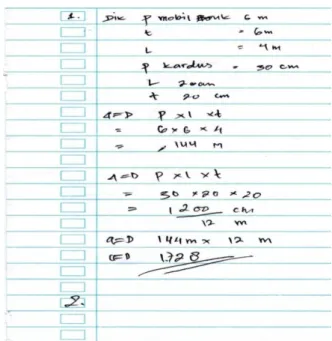
The results of action research on cycle 1 indicate the students' lack of ability to solve the problem. The result of problem-solving test given in cycle 1 is 21 out of 30 students (70%) have been able to solve the problem while 9 other students (30%) have not been able to solve the problem well. Nine students who have not been able to solve the problem, found the pattern of weakness or obstacles experienced by students while doing the test problem solving abilities cycle 1. The following figure shows an example of errors that occurred during the test problem solving abilities in cycle 1. Errors that occur are presented on Figure 1 below:
From the student's answer pattern, it appears that the student does not write down the problem-solving steps. As a result students have difficulty in solving problems step by step. From the figure it is also seen an error in determining the problem solving strategy, while the number 2 blank question is not answered. Of the 9 students who have not been able, there are three students whose answers show the same error. Errors that occur are
242
presented in the following Figure 2.
Figure 1: The First Pattern of Student Error
Figure 2: The Second Pattern of Student Error Answers
3.5.2. Management of Learning
Management of learning by dividing the students into groups of learning 4 people groups with LKS as a medium of learning provides a more meaningful learning experience to students. Most students actively answer the mathematical problem as a problem-solving process that is the first step toward better understanding of problem solving.
The weaknesses of teacher to apply problem based learning model above are: first, grouping 4 students in one group invites the non-involvement of all students in the discussion. Second, many students pay less attention when each group representative reports in writing or orally the results of his work in front of the class. Third, the
243
real problems that are compiled and set forth in the LKS are still too difficult and lack of understanding of the problem-solving steps that for new students are first given. The alternative of improving the action in the next cycle for the management of learning is to make the grouping of the students smaller; improving the way of reporting the work of the group by not asking all group representatives to report the results of their group work up front, but by taking two representative groups that answer LKS the most correct and most not true. Fourth, the ability of teachers to manage the class is still lacking, so the teacher must improve the learning process for the next cycle.
The learning activities of meeting 1 in cycle 1 found that the two groups were able to carry out the problem-solving steps contained in the LKS and represent them in the concept of problem problem-solving as the correct answer. While the other four groups were unable to get it right, but after the teacher helped explain the problem and the solution step in the LKS the groups were able to get it right. Students are still less able to become independent learners because students are less able to push themselves to ask questions, seeking solutions to real problems by themselves.
At the end cycle 1, generally the group was able to answer the LKS better but with a level of accuracy that has not been optimal. Only one group can not answer correctly and correctly. Group learning process in cycle 1 shows the interaction among students is good enough, students have cooperated with each other to develop social skills and thinking skills among students, although at the beginning of the group discussion action has not been seen.
3.6. Issue 2
As a result of not complete learning and still there are many difficulties experienced by students in solving the problem solving abilities test 1, it is necessary in cycle 2 to overcome the problems that occur, so it is expected to cycle 2 later students more master geometry.
The problem with cycles is that students are less able to implement problem-solving steps, especially in planning problem solving, in this case finding patterns that match the problem and implement problem solving.
3.7.Planning 2
The action plan that will be done in cycle 2 is as follows:
• The teacher presents the material using a problem-based learning model, in which several phases of improvement are made. As in phase-1 the teacher should be able to convey the purpose of the empowerment to be implemented, the teacher-2 phase should be able to convey the problem with the language more easily understood by the students, in phase-3 the teacher should pay more attention to the student discussion activities and pay attention to the group experiencing difficulties, phase-4 students are better guided in compiling the results of the discussion and in the presentation, as well as the 5-phase students should be more motivated in providing ideas and responses to the results of the discussed discussion so that when the evaluation students really understand the problem solving.
244
• Teachers are more motivating students to build concepts on themselves so that they are easier to solve problems given.
• Teachers change group members, where group sharing in the first cycle does not take into account the academic ability of the students but in cycle 2 it is divided by taking into account the students academic abilities seen from the students' problem solving skills tests. The number of members of each group is reduced to 3 per group This is expected so that students who are better able to teach a less understood class in a group.
• The teacher tells the students that there will be additional value either individually or in groups to increase student interest. In addition, it will be divided into major groups who are obliged to provide opinions, suggestions to the publisher groups.
• Teachers provide exercises to do at home in order to improve math problem solving skills.
• The teacher rearranges the problem-solving test 2, the time for the problem-solving test problem 2 plus from the previous one.
• Prepare an observation sheet to observe the situation and conditions of the learning activity and observation sheet of student activities.
3.8.Action 2
Phase-1 (orientating student unto the issue)
• Teachers inform the purpose of learning
• Teacher directs students to problems through LKS that are distributed to each student. • From the distributed LKS, the teacher encourages every student to openly propose ideas. Phase-2 (organizing student learning)
• Recommend that students have more than one book of learning resources
• Teachers divide students into 10 groups where each group consists of 3 people. The division of groups is based on students' academic ability by distributing students who are capable of each group.
• Encourage students to solve problems in several ways, from different perspectives, and solve problems by being able to find new ideas.
Phase-3 (guiding individual and group investigations)
• Teachers observe the course of group discussions and come to groups that have difficulty in solving problems in LKS 03 and LKS 04.
• Guiding students to provide guidance in problem-solving work, such as helping students understand the problems in LKS 03 and LKS 04 so that students are able to figure out how to solve them.
• Directing students in the group to good cooperation; students who are more understanding and able to solve problems should teach a group of less-understood friends, so that every member of the group must be able to solve every problem.
245
• The teacher tells the students that there will be additional value either individually or in groups to increase student interest. In addition, it will be divided into major groups who are obliged to provide opinions, suggestions to the publisher groups.
• Teachers walk around to dialogue with group members so that students who are still confused can understand.
Phase-4 (developing and presenting the work)
• Guiding students to present their group work in front of the class, and directing each group member to take part in the percentage.
• Motivate groups outside the renderers to be more active in responding to their peers' work and to inquire if things are not understood by the percentage of the renderers and motivate the renderers to respond to suggestions and questions from other groups.
Phase-5 (analyzing and evaluating problem-solving process)
• Appoint a non-presentation group to respond to the work of the presenter group or to question the presenter group.
• Appoint some students to give conclusions from the material that has been discussed or to appoint another student to respond to the conclusions given by his friend.
• Teachers provide exercises to do at home in order to improve math problem solving skills. At the end of cycle 2, students are given a problem solving ability test 2
3.9.Data Analyze 2
Based on the data of test result problem solving abilities 2, can be seen the ability of students in solving the problem as follows:
Tabel 2: Level of Student Mathematics Problem Solving Ability in Cycle 2
Degree of Problem Solving Ability Category of Problem Solving Ability Number of students Percentage 90 -100 Very High 15 50 % 80 -89 High 9 30 % 65 -79 Medium 2 6,67 % 55 -64 Low 4 13,33 % 0 - 54 Very Low 0 0 % Sum 30 100 %
246
According to the problem solving ability test 1 that given to 30 students, 26 students or 86,67% have reached the learning mastery level, while 4 students or 13,33% have not reached the level of mastery learning.
Based on result of observation of cycle 2, from observation of teacher performance in managing learning at meeting 3 obtained ability of teacher in managing learning equal to 85,5% with mean for twelfth aspect 3,42. from the observation results can be seen that the management of learning by teachers has been classified as good. Management of learning is increasing from cycle 1 to cycle 2, this can be seen from the value provided by the better observer.
3.10.Reflection 2
On the student activity, the cohesiveness among the group members has improved from cycle 1. This can be seen from the students enthusiasm to do the Student Worksheet (LKS) is better, the students' ability in solving the problem increases, this can be seen from the increasing number of students who are able to understand troubleshooting steps. Enthusiastic of students to ask is getting better and more focused. The questions and answers presented during the discussions and presentations have been satisfactory, the students have also dared to express their opinions or ideas during the discussions and presentations.
3.10.1. Student Problem Solving Ability
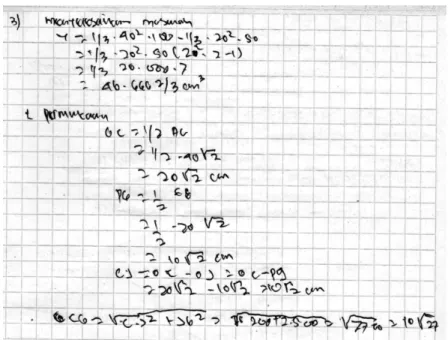
After the activity of learning cycle 2 is done, the students are tested to measure students ability in problem solving. The result of the students' mathematic problem solving ability showed that 27 out of 30 people (90%) were able to solve the problem well (value ≥ 65) while the other 3 students (10%) have not been able to solve the problem. Of the 3 students who have not been able to solve the problem, the level of error experienced by students has been reduced from cycle 1. Of the 3 students who have not been able to solve the problem there are 2 people who make the same mistakes. Student response patterns are presented in Figure 3 below.
247
From the picture above shows in question number 3 students only write one of four troubleshooting steps, that is only give answer without write the plan. Students didn’t consider to understand the problem first and make a planning for problem solving. After the tes, the students are interviewed, they stated that they were forgotten about problem-solving steps and time required is not enough.
3.10.2. Management of Learning
The success of improving students mathematics problem solving ability, can not be separated from the ability of teachers to manage learning that is getting better. Enthusiasm of students in implementing the process of learning model based on the problem is also getting better. This can be seen from the observation of the ability of teachers to manage learning, obtained an average score of 3.42, the results of student observations to learn obtained a score of 3.19 of the maximum score is 4. Based on the ability category, this indicates the average ability of teachers managing learning and students' learning ability reaches the "good" category. In this cycle, we can conclude that research is successful.
Table 3: StudentsActivities in Cycle 1 and Cycle 2
No Aspects Cycle 1 Cycle 2
Meeting 1 Meeting 2 Meeting 3 Meeting 4 1. Problems at the beginning of learning
• Understand the problem, in this case write down what is known and what is asked.
• Plan for problem solving, in this case find a pattern that matches the problem. • Implement problem solving, in this case linking, compiling and defining concepts learned to solve problems.
• Re-examine the results obtained.
2 2 2 2 3 2 2 3 3 3 3 3 3 3 3 3 2. Sociocultural • Enthusiasm of students in
conveying ideas, opinions and arguments.
• The cohesiveness of group
members.
• Participation of group members.
• Enthusiasm working group
2 2 2 1 2 2 2 2 3 3 3 3 3 4 4 4 3. Overcoming Difficulty • Enthusiasm in overcoming
difficulties by asking the teacher.
• Help in accordance with the
difficulties encountered.
• Gaining encouragement, warning
or guidance in solving problems.
2 3 3 2 3 3 2 3 3 3 4 4 4. Presentation / Presentation of work
• Present work in front of the class
• The other group responds to the
work presented in front of the class
2 3 2 3 3 3 3 4 Average 2,15 2,38 2,38 3,46 Total Average 2,27 3,19
248
Table 4: Results of Teachers Observation in Conducting Teaching Learning in Cycle 1 and Cycle 2
No Indicator Cycle 1 Cycle 2
Meeting 1 Meeting 2 Meeting 3 Meeting 4
1 Motivating / communicating learning
competency
2 3 4 4
2 Designing the problems 2 3 3 3 3 Orientiating students to the problems 2 3 3 4 4 Organizing students to solve the problems 1 2 3 3 5 Guiding students to solve the problem 1 2 3 4
6 Presenting 2 3 3 4
7 Directing students to draw conclusions of a
procedure / concept
2 3 3 4
8 Analyzing and evaluating 3 3 3 4
9 Managing of time 3 3 3 4
10 Conduciving class atmosphere 2 3 3 3 11 Motivating students to investigate the problems 1 2 3 3
12 Teacher enthuasism 3 3 4 4
Average 2 2,75 3,17 3,67
Total Average 2,37 3,42
4. Discussion
In Problem Based Learning (PBL), as one of the models that corresponding to constructivist theory, students are confronted with a real problem that has a meaning to them [17, 18]. That problem launches students inquiry as they collaborate to find solutions. The series of activities to solve problems in the syntax Problem Based learning train students a very important thing, namely think how to think [12]. In constructivist classrooms, as in this teaching learning model, students are actively involved, the environment is democratic, and interaction becomes crucial in learning [19]. In PBL model, students are the main body of learning activity and they construct knowledge on their own initiatives; teachers are the helpers and the drivers for students constructing knowledge [20]. The constructivist learning model, like PBL, the teaching of mathematics has a great impact in the acquisition of concepts. The result showed that there were statistically significant differences between the mean scores of students of experimental and control groups in the post application to test the statistical concepts for the benefit of students of the experimental group [21]. These constructivist theories are consistent with the results of the research discussed in this article.
The results of this study are in accordance with the results found by Angkotasan [22]. Research conducted by Angkotasan used quasi experimental research and at grade XII IPA and reported that students' mathematical problem solving ability was achieved by using PBL model. In an experimental study conducted by Argaw [23],
249
PBL was used as a model in physics subject and found out that there were significant differences in students' mathematical problem-solving abilities taught by PBL and with those taught by traditional learning models. In addition to improving problem-solving skills, research on the implementation of PBL also provides results that self-efficacy students in junior high. Sahyar [24] research by combining PBL with adversity quotient. The results showed that: Students 'problem solving skills using problem-based learning models were better than conventional learning, students' problem-solving abilities that had high-yield intelligence outcomes were higher than students with low-average difficulty scores, and there was an interaction between models problem-based learning and conventional learning with adversity quotient to improve students problem solving skills
In addition to the above researchs, Saragih's experimental research, finds that PBL can also enhance students' creativity [25].
5. Conclusion
Based on the findings and the results of data analysis research, it can be concluded that the application Problem Based Learning (PBL) on geometry topic in class X - 6 SMA Negeri 1 Pagaran can improve students' problem solving ability.
6. Recommendation
The suggestions in this study are:
• Problem-based learning model is recommended to improve student problem solving abilities.
• Research findings, data analysis results, learning tools, and instruments produced in this study can be used as a reference in an effort to improve the problem solving skills of students at different levels or subjects that are different from this research.
• Teachers should design real issues that are interesting and challenging for students to be completed. Acknowledgements
The authors would like to especially extend their gratitude to SMA Negeri 1 Pagaran for their corporation, and Lecturers and students of Post Graduation Program State University of Medan for help, support and their attention.
Reference
[1] J. Suratno. “The Development of Students Worksheet Using GeoGebra Assisted Problem-Based Learning and Its Effect on Ability of Mathematical Discovery of Junior High Students”. Proceeding of 3rd International Conference on Research, Implementation and Education of Mathematics and Science Yogyakarta, Indonesia, 16 – 17 May 2016 (accessed Pebruary 15, 2017)
[2] M. A. Akanmu & M. O. Fajemidagba. (2013). “Guided-discovery Learning Strategy and Senior School Students Performance in Mathematics in Ejigbo, Nigeria”. Journal of Education and Practice. Vol.4,
250
No.12, 20
[3] Australian College of Educators. (2010). “Why teach mathematics?”. Professional Educator , Vol. 9, No. 2 (accessed April 7, 2017)
[4] R. Soedjadi. Kiat Pendidikan Matamatika di Indonesia. Jakarta: Direktorat Jendral Pendidikan Tinggi Departemen Pendidikan Nasional, 2000
[5] Armanto, Dian. “Aspek Perubahan Pendidikan Dasar Matematika Melalui Pendidikan Matematika Realistik (PMR)”. Presented at Penerapan Pendidikan Matematika Realistik pada Sekolah dan Madrasah, Medan, Indonesia, 2001.
[6] R. E. Simamora, D. Sidabutar & E. Surya. (2017). “Improving Learning Activity and Students’ Problem Solving Skill through Problem Based Learning (PBL) in Junior High School”. International Journal of Sciences: Basic and Applied Research (IJSBAR),
[7] Pearson Learning Group. (2009). “Problem-S olving Experiences: Making Sense of Mathematics”. Pearson Learning Group. Available:
http://www.cimm.ucr.ac.cr/resoluciondeproblemas/PDFs/Pearson.pdf. [Oct. 4, 2016]
[8] R. I. Arends. Exploring Teaching: An Introduction to Education. New. York: Mc Graw-Hill Companies, 2001
[9] NCTM. Principles and Standards for school mathematics. Reston, VA: National Council of Teachers of Mathematics, 2000
[10] K. Pintér. “On Teaching Mathematical Problem-Solving and Problem Posing”. PhD Thesis, University of Szeged, Szeged, 2012
[11] H. Hudojo. Mengajar Belajar Matematika. Jakarta: Depdikbud, 2003
[12] G. Polya. How To Solve It, by George Polya, 2nd ed. Princeton: Princeton University Press, 1957
[13] Tim MKPBM. Strategi Pembelajaran Matematika Kontemporer. Bandung: Jurusan Pendidikan Matematika, FMIPA UPI, 2001
[14] R. Wiriaatmaja. Metode Penelitian Tindakan Kelas. Bandung: Remaja Rosdakarya, 2008
[15] S. Arikunto. Penelitian Tindakan Kelas. Jakarta: Bumi Aksara, 2008
251
[17] T. Kalpana. (2014). “A Constructivist Perspective on Teaching and Learning: A Conceptual Framework”. International Research Journal of Social Sciences, Vol. 3(1), 27-29
[18] C. H. Liu & R. Matthews. (2005). “Vygotsky’s philosophy: Constructivism and itscriticisms examined”. International Education Journal, Vol 6(3), 386-399.
[19] R. J. Amineh & H. D. Asl. (2015). “Review of Constructivism and Social Constructivism”. Journal of Social Sciences, Literature and Languages, Vol. 1(1), pp. 9-16
[20] Q. Jia. (2010). “A Brief Study on the Implication of Constructivism Teaching Theory on Classroom Teaching Reform in Basic Education”. International Education Studies, Vol. 3, No. 2
[21] H. A. Laz & K. E. Shafei. (2014). “The Effectiveness of Constructivist Learning Model in the Teaching of Mathematics”. Journal of Applied and Industrial Sciences
[22] N. Angkotasan. (2014). “Keefektifan Model Problem-Based Learning Ditinjau dari Kemampuan Pemecahan Masalah Matematis”. Delta-Pi: Jurnal Matematika dan Pendidikan Matematika, Vol. 3, No. 1
[23] A. S. Argaw, B. B. Haile, B. T. Ayalew & S. G. Kuma. (2017). “The Effect of Problem Based Learning (PBL) Instruction on Students’ Motivation and Problem Solving Skills of Physics”. Eurasia Journal of Mathematics Science and Technology Education, 13(3): 857-871
[24] Sahyar, & R. Y. Fitri. (2017). “The Effect of Problem-Based Learning Model (PBL) and Adversity Quotient (AQ) on Problem-Solving Ability”. American Journal of Educational Research, Vol. 5, No. 2, 179-183
[25] S. Saragih, & W. L. Habeahan. (2014). “The Improving of Problem Solving Ability and Students’ Creativity Mathematical by Using Problem Based Learning in SMP Negeri 2 Siantar”. Journal of Education and Practice. Vol.5, No.35
![Table 1: Syntax of Problem Based Learning Learning (PBL)[6]](https://thumb-us.123doks.com/thumbv2/123dok_us/1225915.2665166/3.892.96.796.217.764/table-syntax-problem-based-learning-learning-pbl.webp)