This manuscript has been reproduced from the microfilm master. UMI films the text directly from the original or copy submitted. Thus, some thesis and dissertation copies are in typewriter face, while others may be from any type o f computer printer.
T he quality o f th is reproduction is dependent upon th e quality o f the
copy subm itted. Broken o r indistinct print, colored or poor quality
illustrations and photographs, print bleedthrough, substandard margins, and improper alignment can adversely affect reproduction.
In the unlikely event that the author did not send UMI a complete manuscript and there are missing pages, these will be noted. Also, if unauthorized copyright material had to be rem oved, a note will indicate the deletion.
Oversize m aterials (e.g., maps, drawings, charts) are reproduced by sectioning th e original, beginning at the upper left-hand com er and continuing from left to right in equal sections with small overlaps. Each original is also photographed in one exposure and is included in reduced form at the b ack o f the book.
Photographs included in the original manuscript have been reproduced xerographically in this copy. Higher quality 6” x 9” black and white photographic prints are available for any photographs or illustrations appearing in this copy for an additional charge. C ontact UMI directly to order.
A
THESIS
Presented to the Faculty
of the University of Alaska Fairbanks
in Partial Fulfillment of the Requirements
for the Degree of
DOCTOR OF PHILOSOPHY
By
John Paul Benoit, B.S.
Fairbanks, Alaska
Copyright 1998 by Benoit, John Paul
All rights reserved.
UMI Microform 9838831
Copyright 1998, by UMI Company. All rights reserved. This microform edition is protected against unauthorized
copying under Title 17, United States Code.
UMI
300 North Zeeb Road Ann Arbor, MI 48103
RECOMMENDED:
APPROVED:
By
John Paul B enoit
. _ s L " 's'
Prcif. Max Wyss.
-ProLJohn Eicfaelbereer /
j c I- / 4 c? > ^ ^
-l5r. Roger Hansen, State Seismologist
Research Prof. Stephen McNutt. Advisory Comfnltfee Chair
\
i i / /
Associate Prof. Paul Layer. Department Head
Prof. Paul Reichardt,
Dean, College of Natural Science. Engineering, and Mathematics
Prof. Joseph Kan.
Dean of the Graduate School
The patterns of occurrence and the underlying processes of two important seismological phenomena at volcanoes, earthquake swarms and volcanic tremor, were investigated. A global database of volcanic earthquake swann parameters was compiled and was used to evaluate the March 10-14,19% seismo-volcanic crisis at Akutan Volcano, Alaska. Earthquake swarm durations and magnitudes were compared with eruptive activity using this database. Trends identified using the database suggest that the Akutan swarm was not precursory and, no
eruption occurred. We postulate that a deep intrusion with a large opening component occurred under the flanks of Akutan. The global swarm database has provided an important baseline and has proved to be useful in preparing eruption scenarios for public information releases.
The duraiion-amplitude distribution or ffequency-size scaling of volcanic tremor was also examined. The hypothesis tested was that the duraiion-amplitude distribution may be approximated by an exponential function. The exponential model, implying a scale-bound source process, is found to be a better fit to data then a power-law (scale invariant) model. The exponential model gives a satisfactory description o f tremor associated with a wide range of volcanic activity. We propose that exponential scaling of tremor amplitude is due to fixed source geometry driven by a variable excess pressures. This implies that the characteristic amplitude of the duration-amplitude distribution is proportional to a geometric dimension o f the source.
Broadband seismic data recorded at Arenal volcano, Costa Rica, provide new constraints on tremor source processes. Arenal's tremor contains as many as seven harmonics, whose frequencies vary temporally. This source is inferred to be a shallow, 200-660 m-long resonator, radiating seismic energy from displacement antinodes. We infer that the resonator is gas- charged magma with variable bubble concentration within the conduit and also changes as a function o f time, thereby changing the acoustic velocity and the boundary conditions. Polarization analyses for the fundamental mode show particle motion azimuths abruptly rotating, which may be explained by a decrease in incidence angle near the recording site. We suggest that energy for this mode is radiated predominantly from a displacement antinode that is changing position with time.
Table of Contents
Abstract “* Table of Contents *v List of Figures “ List of Tables » i AcknowledgementsChapter 1
Thesis Introduction
1.0 General Introduction I1.1 An overview of the chapters 3
1.2 References 6
Chapter 2
Use of a global database of volcanic earthquake swarms during the 1996
seismo-volcanic crisis at Akutan volcano, Alaska
2.0 Abstract 7
2.1 Introduction . 8
2 3 Global Volcanic Earthquake Swarm Database (GVESD) 10
2_3 Results from the GVESD 11
2.3.1 Swann duration 12
2.3.2 Swann duration and eruption explosivity 15
2.3.3 Event type and swarm duration 17
2.3.5 Mmax and the explosivity of the following eruption 21 2.4 A case study: Using the GVESD during the 1996 Akutan crisis 23
2.4.1 Description of the Akutan swarms 23
2.5 Discussion 28
2.6 Conclusions 39
2.7 Acknowledgements 42
2.8 References 42
Appendix 2A
Development and Description of the Global Volcanic Earthquake Swarm
Database
2A.1 Introduction 47
2A.2 Database Structure and Description 49
2AJ2.1 Volcano Table 50
2A.22 Earthquake Swarm Table 50
2A.23 Eruption Table 50
2A3 VOLCAT Organization and Parameter Description 51
2A.3.1 Morphology. Tectonic Framework. Elevation, and Edifice Relief 53
2A.32 Range of Erupted Products 55
2A.4 SWARMCAT Organization and Parameter Description 56
2A.4.1 Swarm Dates. Durations and Uncertainties 57
2A.4.2 Definition of a Swarm and Swarm Duration 57
2A.43 Swarm Type 58
2A.4.4 Event Types 60
2A.43 Quality Grades 61
2A.4.6 Maximum Magnitude. Intensity, and Depth 62
2A.4.7 Cumulative Energy. Energy Release Rate, and Repose 63
2A.4.8 Earthquake Counts and Magnitude Detection Threshold 63
2A.4.9 Seismograph Information 63
2A.4.10 Previous Swarms and Other Reported Information 64
2A.4.11 References, Comment and Key Phrase fields 65
2A3 ERUPTCAT Organization and Parameter Description 65
2A.5.1 Data Sources 69
2A.5 2 Erupted Volume. Plume Height. Silica Content, and the VE2 70
2A.6 Improvements and Future Work 71
2A.7 Acknowledgements 71
2A.8 References 72
Chapter 3
The Duration-Amplitude Distribution of Volcanic Tremor
3.0 Abstract 74
3.1 Introduction 75
3 2 Frequency-size distributions 77
3 3 Methodology 78
3.4 Case studies 86
3.4.1 Crater Peak. Mt. Spurr. Alaska 86
3.4.2 Kilauea. Hawaii 90
3.4.3 Karkar and Ulawun, Papua New Guinea 93
3.4.4 Pavlof. Alaska 96
3.43 Fuego. Guatemala and Arenal. Costa Rica 97
3.4.6 Old Faithful Geyser. Yellowstone National Park. Wyoming 99
3.4.7 Redoubt. Alaska 101
3 3 Is volcanic tremor a series of law-fireqnency events closely spaced in time? 102
3 3 Acknowledgements 112
3.9 References 113
Appendix 3A
3A.1 Definition of reduced displacement 119
3AJ2 Calculation of reduced displacement from RSAM data 119
Appendix 3B
3B.1 Overestimation of RMS ground displacement using helicorders or RSAM data 122
Appendix 3C
3C.1 The duration-amplitnde waling of acoustic signals at Arenal volcano 125
3G 2 Data 125
3C_3 Duration-amplitude measurements 125
Chapter 4
New Constraints on Source Processes of Volcanic Tremor at Arena!
Volcano. Costa Rica, Using Broadband Seismic Data
4.0 Abstract 128
4.1 Introduction 129
42 Analyses and Results 133
43 Discussion and Conclusions 142
4.4 Other Observations and Future Work 149
45 Acknowledgements 150
4.6 References 150
Appendix 4A
4A.1 Calculation of theoretical dispersion curves of Love waves 154
4A3 Source code 155
Chapter 5
Thesis Condusion
5.0 General Conclusions 159
5.1 Volcanic Earthquake Swarms 159
5 2 Volcanic Tremor 161
53.1 The amplitude scaling of volcanic tremor 161
5.23 The tremor source: A case study 163
List of Figures
Chapter 2
2.1 Earthquake swarms durations and their association with eruptions 14 2 2 Bax plots of precursory swarm durations and the size of the eruption 16
2 3 Histograms of swarm durations based on events type 19
2.4 Histograms of maximum magnitude (M ) 20
2.5 Box plots of precursory swarm Mu and the size to the following eruption 22 2.6 Location map of Akutan Island and the near permanent seismic stations 25 2.7 Histogram of the number of earthquakes per hour recorded at station DTN for
March 11*14,1996 Akutan swarm 26
2.8 Sketch map of ground cracks on Akutan Island 38
2.9 Photograph of a ground crack, believed to have formed during the March 1996
earthquake swarms 41
2A.1 Number of events per time versus time shown for the 3 types of earthquake
sequences 47
2 A 2 Example record from the Global Volcanic Earthquake Swarm Database 49 2A J Schematic diagram of the temporal relation between volcanic earthquake swarms
and eruptive activity 60
2A.4 The mean depth of volcanic earthquake swarms 62
3.1 Measurement of the frequency-size or duration-amplitude distribution for volcanic tremor 81
33. Comparison between an exponential and a power-law scaling model for the duration-amplitude distribution of volcanic tremor
33 Tremor duratiou-amplitnde distribution for M t Spurr
3.4 Duration-amplitude distribution for shallow and deep tremor at Kilanea volcano 3.5 Duration-amplitnde duration for tremor associated with the phreatic explosions a Karkar in 1978-79 and the m agm atie eruption at Ulawun in 1978
3.6 Duration-amplitnde distribution for Pavlof 1973-86, Pavlof. December 1996. Fuego, and Arenal volcanoes
3.7 Duration-amplitnde distribution for seismic noise recorded in 1972 near Old Faithful Geyser, Yellowstone National Park and the December 13-14*, 1989 low-frequency swarm at Redoubt
3.8 Typical synthetic tremor created by summing a series of low-frequency events closely spaced in time
3B.1 Amplitude measurements for synthetic tremor
3C.1 Comparison of the exponential and power-iaw models for the duration-amplitnde distributions for acoustic recording at Arenal volcano
Chapter 4
4.1 Map of Arenal Volcano, Costa Rica4 2 An example seismogram of a small eruption followed by rhythmic degassing 43 Velocity seismogram and spectrogram, showing three small eruptions
4.4 Example displacement seismogram of a small explosion recorded on the broadband instrument
Chapter 3
83 89 92 95 98 100 104 124 127 131 132 135 1364 3 Dispersion carve for tbe large amplitude transverse waves shown in Figure 4.4 137 4.6 An example window in time and frequency used in polarization analysis 139 4.7 Polarization analysis showing a dramatic rotation in the tremor particle motions 140 4.8 Observed and theoretical particle motions in the horizontal plane 141
4.9 Frequency-amplitude dependence for tremor 144
4.10 Schematic model of the fundamental displacement mode of a standing wave in a
bubbly magma column 146
4.11 Numerical model of magma bubble content and resonator boundary conditions
within the volcanic conduit 147
4A.1 Solutions to 4A.1, tbe dispersion relation for Love waves, for several frequencies 156
List of Tables
Chapter 2
2.1 Swarm duration statistics by the size of the following eruption 15
2 2 statistics by the size of the following eruption 21
2 3 Locations and magnitudes for the largest earthquakes of the Akutan swarms 27
2.4 Swarms with greater than 500 felt earthquakes 31
2.5 Precursory swarms with M greater than or equal to M4.5 34
2.6 Non-precursory swarms with greater than or equal to M4.5 35
2A.1 Regional organization 51
2A.2 List of volcanoes in the GVESD 52
2 A J Volcano morphology 54
2A.4 Tectonic framework 55
2A.5 Erupted products 56
2A.6 Reporting uncertainties 57
2A.7 Event types 61
2A.8 Other reported observations 65
3.1 Goodness-of-fit as measured by tbe correlation coefficient and the chi-squared statistic for the power-law and the exponential models
3 2 Slope of the duration-amplitnde distribution curve and the characteristic or mean amplitude
This thesis would not be possible without a great deal of support and encouragement from many people. I sincerely thank my primary advisor and committee chairman. Or. Stephen McNutt, for his sound scientific guidance, unending encouragement, and most of all. for his
friendship. I also thank him for my introduction to the wonders of flying red rocks, a moment that I will never forget.
I extend my sincere gratitude to my advisory committee Drs. Max Wyss. John Eichelberger, Roger Hansen, and Juergen Kienle, whom have contributed in many ways to this body o f work and to my experience in Alaska. I thank Drs. David Stone, Douglas Christensen, and Paul Layer for the many discussions at the lunch table and on Friday afternoons, which has taught me many things, including, not all science is done behind a computer.
My special thank?; go to my friends and cohorts of the third floor o f the Geophysical Institute. In particular Stefan Wiemer, Zhong Lu, Hilary Fletcher, Arthur Jolly, Kent Lindquist, Guy Tytgat, Vicki McConnell, John Power, Milton Garces, and Mitch Robinson deserve special mention for helping me. in their own ways, complete this body of work.
To my family whom has continually supported me in all of my endeavors, I extend my sincere appreciation. I am especially indebted to Rubai Xie, whom enabled me to finish this thesis before the turn of the millennium Finally, I thank my dear Katherine, without her support and encouragement none of this could be possible.
I acknowledge the Alaska Volcano Observatory for my continuous support throughout my thesis work.
Thesis Introduction
1.0 General Introduction
A primary goal o f Volcanology is to provide an assessment of the hazards posed by the world’s volcanoes, and of particular societal importance is the question of forecasting the time, type, and magnitude of volcanic eruptions. To accomplish this objective, a basic understanding of the physical processes involved in the ascent of magma to the surface is required. The science of Volcanology is still relativity young and a theoretical framework of the physical processes has been sketched out in only the most general terms. At this young stage, much remains to be gained through observational studies and exploratory analyses of the data collected at the world's
volcanoes.
Geological studies can provide important constraints on the size, types of eruptive activity, and eruption mechanisms. However, these studies are of lim ited use for the short-term forecasting of an eruption. Geophysical monitoring of active volcanoes can provide the data necessary to forecast these events. Experience gained at well-monitored volcanoes clearly indicate that most, perhaps all, eruptions are preceded and accompanied by measurable
geophysical changes in the state of the volcano [Tilling, 1989]. Several monitoring strategies have been employed to detect these changes, including: seismology, ground deformation,
geochemistry, thermal, and potential fields methods. Seismological monitoring has the longest and most successful history of detecting precursory changes before eruptions. Beginning with the pioneering work by Omori [1914] in Japan and Wood [1915] in Hawaii, significant changes in
Chapter 1
seismicity were shown to occur before eruptions. Since these early works, seismology has
emerged as the primary tool for volcano monitoring. Today, about one oat of three volcanoes that has erupted in historical time is monitored by some type o f seismic instrumentation [McNutt,
1996],
Seismic monitoring is most effective when it can be continuously carried out through entire eruptive cycles, including periods of quiescence, precursors, and eruptions [Swanson et al„
1983; 1985]. Unfortunately, very few volcanoes have been monitored over an entire eruptive cycle with a full array of seismic instrumentation. This situation presents a common scenario; unrest begins at a long-inactive and unmonitored volcano and the lack o f background data renders results difficult to interpret, even after monitoring has begun. The interpretation of the data is further hindered by the lack of adequate theoretical models of the physical processes associated with the ascent o f magma. The most successful prognoses for monitoring are based on
recognition of patterns seen earlier [Swanson et al., 1983; 1985], and given that many
characteristics are common to many volcanoes, a compilation and analysis of case histories of unrest may reveal these patterns. An understanding of these patterns can then be used to construct models of the physical processes involved. Finally, these models can be tested against forecasts of future activity. Tbe results of these tests can then be analyzed and used to improve the models.
This thesis will explore in detail the patterns of occurrence of two commonly recorded seismological phenomena at volcanoes, earthquake swarms and volcanic tremor. The presence and characteristics of both swarms and tremor have been shown to be useful towards the goal of forecasting of the time, type, and magnitude of an eruption [e.g. McNutt, 1996], in addition to being scientifically interesting in their own right. Earthquake swarms are defined as series of earthquakes occurring closely in space and time without a single outstanding main shock [Mogi,
indicator of an im pending eruption, yet they have rarely been studied systematically. Volcanic tremor is a continuous seismic signal that accompanies virtually all eruptions. The source processes of volcanic tremor is related to pressure fluctuations associated with transport and degassing of magm a Tremor is therefore a prime target to gain understanding of the processes associated with the ascent of m agma and refine forecasts of both the types and magnitudes of eruptions.
1.1 An overview of the chapters
This thesis is divided into five chapters: this general introduction, three journal article
manuscripts, and general conclusions. Each o f the journal article m anuscripts is preceded by an introduction and followed with conclusions specific to that chapter. The progression of chapters is intended to move from a very broad global study to a very specific topical study and does not reflect the order in which the work was completed.
The first manuscript (Chapter 2) explores the relationships between volcanic earthquake swarms and volcanic activity. Global data from 1979 to 1989 pertaining to volcanic earthquake swarms have been compiled into a relational database. This database is composed o f three parts: a section containing general information on volcanoes, a section containing earthquake swarm data (such as dates of swarm occurrence and durations), and a section containing eruption information. The primary objective o f this study is to generate a global baseline for comparison with future seismic activity, to quantify the duration of volcanic earthquake swarms, and to expose general relationships between volcanic swarms and eruptions. These relationships are then tested during a seismo-volcanic crisis that occurred on Akutan Island in March 1996. This chapter was submitted (December 1997) to the Journal o f Volcanology and Geothermal Research.
Part of this project is exploratory in nature, a hypothesis-generating project- Through the act of compiling such a data set several patterns have emerged. New hypotheses can be defined and subsequently tested with the collection of new data. For example, the repose period between eruptions appears to be related to the duration of the preceding swarm [Benoit and McNutt,
1996a]. For a subset of swarms, the longer the repose period between eruptions, the longer the duration of the preceding swarm. A second example is the Generic Volcanic Earthquake Swarm Model [McNutt and Benoit, 1995], which outlines a series o f processes and their associated seismicity throughout an eruption cycle. This model emerged from the examination of hundreds of swarms and will provide a framework with which to more fully evaluate seismic unrest.
Due to the large size of the swarm database, over 350 pages, I chose not to include the entire database within this thesis. However, two parts of the database are included in Appendix 2A for reference. The appendix is excerpted from a US Geological Survey Open-file Report [Benoit and McNutt, 1996b], and describes in detail, the structure of the database and how the swarm data were complied. The third section of the database, the eruption table, is also included. The data contained in tbe eruption table compares eruptive activity with parameters measured for earthquake swarms.
In the next chapter, (Chapter 3) we investigate the patterns of occurrence of volcanic tremor. This chapter focuses on modelling a fundamental property of tremor, tbe relationship between its frequency o f occurrence and size. This frequency-size distribution is tested against two statistical models: a power-law and an exponential model. The exponential model, implying a scale-bound source process, is compared with a power-law (scale invariant) model. The models are tested at several volcanoes for tremor associated with a range of volcanic activity, including tremor associated with magma tic and phreahc eruptions, shallow and deep source regions, and
tremor is composed of a series of low-frequency events spaced closely in time. Finally, we suggest that these scaling parameters may prove to be useful to distinguish eruptive from non- eruptive tremor.
Three appendices follow chapter 3. Tbe first appendix defines the normalized metric (reduced displacement) used in this study and how it is estimated from other amplitude measures. The second appendix outlines a technique to measure tremor amplitudes mere accurately, and the third appendix shows duration amplitude measurements for acoustic data recorded at Arenal volcano. This chapter, less the appendices, will be submitted to the Journal o f Geophysical Research.
Chapter 4 is a topical study that examines the spectral and polarization characteristics of tremor recorded at Arenal volcano, Costa Rica. From this analysis we developed a new model for the generation of tremor at Arenal This model provides constraints on shallow degassing
processes within the shallow conduit. Spectral and polarisation analyses are performed on broadband seismic recordings made by us at Arenal volcano in the spring o f 1994. Analyses of the tremor associated with small explosive eruptions clearly show patterns in the spectra and particle motion polarizations. Tbe proposed model suggests that these patterns are the resonance modes of a gas-charged magma-filled conduit and the rapid changes are due to degassing of the magma at shallow depths within the conduit.
The main body of Chapter 4 is published in Geophysical Research Letters [Benoit and McNutt, 1997]. This manuscript was expanded to include forward modeling o f surface waves. Appendix 4A outlines the method and source code used to calculate the Love-wave dispersion curves.
Tbe final chapter (Chapter 5) presents the general conclusions of this thesis, along with an outline for future research directions.
1.2 References
Benoit, J. P. and S. R. McNutt, New constraints on source processes of volcanic tremor at Arenal volcano, Costa Rica, using broadband seismic data, Geophys. Res. Lett., 24,449-452,
1997.
McNutt, S. R. and J. P. Benoit, Generic Earthquake Swann Model, (extended abs.), Periodico di Mineralogia, 64, 229-230, 1995.
McNutt, S. R., Seismic monitoring and eruption forecasting of volcanoes: A review o f the state- of-the-art and case histories, in: Monitoring and mitigation o f volcano hazards, R. Scarpa and R. L Tilling eds.. Springer-Verlag, Berlin, 99-146, 1996.
Omori, F., The Sakura-jima eruptions and earthquakes. Bull. Imp. Earthquake Invest. Comm., 8, No. 1-6, 525 p., 1914.
Swanson, D. A., T. J. Casadevall, D. Dzurisin, S. D. Malone, C. G. Newhall, and C. S. Weaver, Predicting eruptions at Mount St. Helens, June 1980 through December 1982, Science, 221, 1369-1376,1983.
Swanson, D. A., T. J. Casadevall, D. Dzurisin, R. T. Holcomb, C. G. Newhall, S. D. Malone, and C. S. Weaver, Forecasts and prediction eruptive activity at Mount St. Helens, U.S.A.:
1975-1984, J. Geodynamics, 3,397-423, 1985.
Tilling, R. L, Volcanic hazards. Tilling, R. I., ed., American Geophysical Union, Washington D.C., 123 p., 1989.
Wood, H. O., The seismic prelude to the 1914 eruption of Mauna Loa, BulL SeismoL Soc. Am., 5 39-50, 1915.
Use of a global database of volcanic earthquake swarms during the
1996 seismo-volcanic crisis at Akutan volcano, Alaska1
2.0 Abstract
W e compiled a global database of volcanic earthquake swarm parameters to study the relationship between swarms and eruptions. W e used the database to evaluate the March 10-14
1996 seismo-volcanic crisis at Akutan Volcano, (54N08', 165W58'). Alaska. In particular, we compared volcanic earthquake swarm durations and magnitudes o f the largest earthquakes with eruptive activity using the swarm database. W e also used the database as a tool to develop and constrain eruptive scenarios during the Akutan crisis. For precursory earthquake swarms, durations and magnitudes were compared to the Volcanic Explosivity Index (VEI) of the
associated eruption. We tested the hypothesis that longer, more energetic swarms precede larger, more explosive eruptions. W e find that swarms preceding eruptions last longer than those not associated with eruptions. The median swarm durations are 9 and 3.7 days respectively. The distributions of the magnitudes of the largest earthquakes within precursory swarms show no
significant difference with non-precursory swarms. We examined the distributions of both
durations and magnitudes within each VEI category. For less explosive eruptions (VEI 0-3), there appears to be no clear relationship between the swarm duration and the VEI. However, when larger, mare explosive eruptions are considered (VEI 3-6). the mean of swarm durations increases as the explosivity of the eruptions increases. A similar positive correlation is apparent when the magnitude of the largest earthquake within a swarm (M ) is compared to the VEI. For eruptions of VEI 2 or greater, the mean magnitude of the largest precursory earthquake shows an increase with increasing explosivity. The largest shock and the duration of a precursory swarm are parameters reflecting the total seismic energy released. For more explosive eruptions (VEI 3-6) the above results support the hypothesis that more energetic earthquake swarms precede more explosive eruptions.
1 Benoit, J. P. and S. R. McNutt, submitted to Journal of Volcanology and Geothermal Research. December 1997.
Chapter 2
A strong earthquake swarm consisting of two pulses occurred at Akutan on March 10-11 and 13-14,1996. No eruption followed these swarms. The strength of the Akutan swarms was much larger than global observations of volcanic swarms. Within 4 days local residents felt over 3000 earthquakes. The largest events were a mb = 4.7 (ML = 5.1), and a m, = 4.6 (Mj. = 5.3), and the swarms contained at least 18 events with m*, > 4.0. To assess the character of these swarms, we compared the Alniran swarm with the global database. The comparison yielded only 3 out of 700 cases with sim ilar numbers of felt events and only 21 cases with shocks of equal or larger magnitudes. The M of these swarms are not a reliable indicator of the likelihood of occurrence of an im pending eruption. However, the database shows that flank eruptions are more often preceded by large shocks. Assu m in g that an eruption was imminent at Akutan, from these trends we would forecast a large flank eruption. The durations of the Akutan swarms (24 and 18 hrs. of intense activity and 3.5 days in total duration) are relativity short when compared to global data. The database durations thus suggest that the Akutan swarm was not precursory. We postulate that a deep intrusion with a large opening component occurred under the flanks of Akutan. The global swarm database has provided an important baseline and has proved to be very useful in preparing eruption scenarios for public information releases. This is especially true for volcanoes, such as Akutan, which had little or no monitoring hist cry at the time of the March 1996 swarm
2.1 Introduction
Earthquake swarms are pervasive at volcanoes, but have seldom been studied systematically. Most swarms that are described in the literature are those that occurred in
association with eruptions; indeed, earthquake swarms are the most reliable method of forecasting eruptions. Because swarms are such a common and important phenomenon, we undertook a systematic and comprehensive study of swarms at volcanoes. An eleven-year period (1979-1989) was chosen, and summary parameters from over 700 swarms were compiled. We term the result the Global Volcanic Earthquake Swarm Database (GVESD). The database and a detailed description of parameters are given in Benoit and McNutt, [1996a; 1996b].
One of the primary goals of the swarm database is to provide a basic monitoring tool for volcanoes with little or no seismological monitoring history. A t such a volcano, the evaluation of a swarm can prove to be problematic. Is the swarm unusual? How does this swarm compare to other swarms at similar volcanoes? Did eruptions follow the similar swarms? If an eruption did follow the swarm, what type of eruption and how big? The GVESD can provide constraints or a range of possible outcomes to these types o f questions. A query of the database quickly gives a list of case histories that share some attribute with the swarm in question. These queries can be complex involving many relationships across the database. For example, we can query the database far precursory swarms rhar occurred at a stratovolcano, lasted longer than 3 days, and contained a M5 earthquake. Such a set of case histories from a global data set can be valuable during a crisis response because they can be used as a basis for constructing eruptive scenarios. These data are not only useful to form a probabilistic judgement during a crisis but also provide constraints for more detailed studies of the underlying processes.
On March 11. 1996 a vigorous swarm o f felt earthquakes began at Akutan volcano (54N08', 165W58') in Alaska’s Aleutian Islands. A crisis quickly developed as more than 3000 earthquakes were felt by the residents of Akutan village 13 km east of the summit- No local instrumental seismic monitoring of the volcano existed at the onset of the crisis, so there was no baseline of data for comparison. Instead, this crisis provided a field test of the utility o f the swarm database. As the crisis developed, the database was repeatedly queried and the results were compared to the observations at Akutan. These results and previous work with the database became an im portant component in evaluating the crisis and building possible eruptive scenarios for the residents of Akutan village and the emergency response community.
In this paper we review the data included within the GVESD and how they were compiled. We next examine several relationships between swarm parameters and eruptive activity, and
finally, we show bow the GVESD was used during the March 19% seismo-volcanic crisis at Akutan volcano, Alaska.
2.2 Global Volcanic Earthquake Swarm Database (GVESD)
The GVESD is compiled from 11 years (1979-1989) of data as reported in the Bulletin of Volcanic Eruptions (BVE) of the Volcanological Society of Japan. We chose BVE as our primary data source for several reasons. First, it contains data on many swarms that were never reported in the reviewed literature. This is because most papers report eruptions, and swarms are included only if they were associated with eruptions. In other words, the reviewed literature is biased in favor of swarms followed by eruptions, whereas BVE more fully reports a variety of activities during times o f no eruptions. Second, BVE is prepared once per year, which gives investigators the opportunity to summarize data on a broad time scale. Monthly reports, such as the
Smithsonian Institution Global Volcanism Network Bulletin often focus more narrowly on the necessarily short (one month) time scale. Third, the BVE includes a section devoted to
miscellaneous information. The miscellaneous information section includes many reports o f seismic activity at volcanoes that were not in eruption that year. Finally, BVE includes a supplement, which is used to provide additional information on previous years’ activity. This systematic updating provides an additional element of quality control, which is not found in most standard reports.
The time period, 1979 to 1989, was chosen to include several well-studied swarms that occurred at M l S l Helens, Etna, Kilauea, Augustine, Redoubt, O-Shima, and Izu-Tobu. A cogent effort was made not only to focus on the well-studied swarms, but also to include sm aller, less well known swarms and swarms not associated with eruptions. Since very large eruptions occur
relatively infrequently, swarms associated with very large eruptions were poorly represented in the database. This gap was filled by adding selected swarms and associated eruptions (e.g., Sakurajima 1914 and 1955, Paricutin 1943, Bezymianny 1955, Sheveluch 1964, and Pinatubo
1990) which occurred outside the 1979-89 time window.
The GVESD is composed of three main tables. The first table contains general information on volcanoes that were active during the study period. This table includes the location, elevation, morphology, and the range of eruptive products. The second table contains earthquake swarm data The parameters included are: dates of swarm occurrence, swarm duration, numbers of events (felt and unfelt), event type, magnitu d e of the largest event, maximum felt intensity, energy (rate released and cumulative), average b-values, and basic instrumental information (e.g.
detection threshold) as well as errors associated with some o f these parameters. A third parallel table contains inform ation pertaining to eruptive activity, including dates of activity, eruption intensity, and the character of the eruption.
It was our initial intention to perform a full multi-parametric study of the database.
However, it quickly became apparent that durations and the magnitudes of the largest earthquake ( M J were the most widely reported parameters, whereas many other parameters were poorly reported (e.g., energy, cumulative seismic energy release, detection threshold, b-value). Thus we have focused our initial efforts on understanding the distributions of swarm durations and Mon, and their relation to eruptive activity.
2.3 Results from the GVESD
Out of a total of 700 swarms, tbe database lists 385 cases which include swarm duration and 180 cases which include the Hon. These large samples give robust estimates of the mean.
median, and standard deviation of the duration and M distributions. These parameters then were sub-divided according to their relationships to eruptions.
2 3 .1 Sw arm duration
Earthquake swarms are generally defined as a sequence of events closely clustered in time and space without a single outstanding shock [Mogi, 1963]. Our working definition follows Mogi’s general outline and also requires a significant increase in the rate of local volcanic
earthquakes above the background rate. We take volcanic earthquakes to be of any type, for
exam ple A, B, [M inakam i, I960], high frequency, low frequency, short period, long period, [Koyanagi et al., 1987], volcano tectonic, [Latter, 1981], explosion evenis, etc., but they must occur within an arbitrary near distance to the volcano (typically < 15 km). We do not identify a significant increase over the background rate in a strict statistical sense, but accept the experience and point of view o f each reporter. In other words, if the reporter feels that an increase in
seismicity is significant enough to report, then we include that report as a swarm record along with a quality modifier. We also do not consider seismic crises (peak seismicity rates within a swarm), obvious mainshock-aftershock sequences, or tremor episodes as swarms.
This working definition was developed through the systematic examination of over 700 swarms. One single fixed definition or algorithm is preferable, but is not feasible due to the widely varying qualities and formats of the data. Future studies would greatly benefit from standardized reporting and the stria application of an algorithm to distinguish the starts, ends and durations of swarms [e.g., Evison and Rhoades, 1993].
Swarm duration varies from very short, intense swarms lasting less than an hour, such as those reported at Piton de la Fournaise and Kilauea, to swarms lasting several years, such as those
database). The median duration of 385 swarms was found to be one week [Benoit and McNutt, 1996b].
Swarm durations were then separated based on their relationship to eruptive activity: those that preceded eruptions (precursory) and those not associated with eruptions (non-precursory). Occasionally, eruptions begin some time after a swarm ends. For example, the 1989 Izu-Tobu eruption commenced ~2 days after the end of a 6 day long volcano-tectonic swarm.
Approximately one quarter of all precursory swarms in the database display a seismicity rate decrease or quiescence before the onset of an eruption. To account for these cases, we consider swarms precursory when an eruption begins within three months after a swarm ends. The three month cut-off was determined by examining the interval between the end of swarms and the beginning of eruptions. In two-thirds of swarms showing quiescence, an eruption occurred within
10 days, and 80% occurred within 3 months. Tbe three months cut-off interval is also used in the Volcanoes o f the World, a global catalog of volcanoes and eruptions, [Simkin and Seibert, 1994] to distinguish eruptive episodes from eruptions.
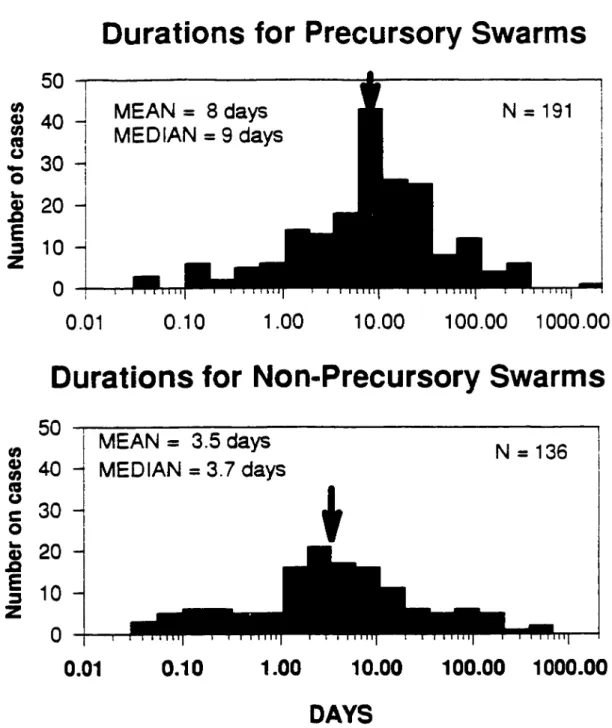
The durations o f the precursory swarms tend to be longer than non-precursory swarms (Figure 2.1). Tbe median duration of precursory swarms was found be more than twice that of non-precursory swarms, 9 and 3.7 days respectively. The distributions mean durations are 8 and 3.5 days, with a standard deviations of 0.79 and 0.91 log-days, and 95% confidence limits of 0.11 and 0.15 log-days for precursory and non-precursory swarms, respectively. The mean of these distributions were found to be significantly different from one another (at tbe 95% confidence level using a t-test), in other words the durations of each swarm type are drawn from different parent populations [.Benoit and McNutt, 1996b].
Durations for Precursory Swarms
(A® 40
(0 (Q" 30
0«
20
a1 10
50
MEAN = 8 days
MEDIAN = 9 days
0.01
0.10
1.00
N = 191
10.00
100.00
1000.00
Durations for Non-Precursory Swarms
0.01
0.10
1.00
10.00
100.00
1000.00
DAYS
Figure 2.1 Earthquake swarm durations and their association with eruptions. Comparison of the distribution of 191 swarm durations that precede eruptive activity (precursory) and
136 durations that are not associated with eruptive activity (non-precursory). The geometric mranc are 8 and 3.5 days (marked with bold arrows), and the medians 9 and 3.7 days f a 1 precursory and non-precursory swarms, respectively.
2.3.2 Sw arm duration and eruption exp losivity
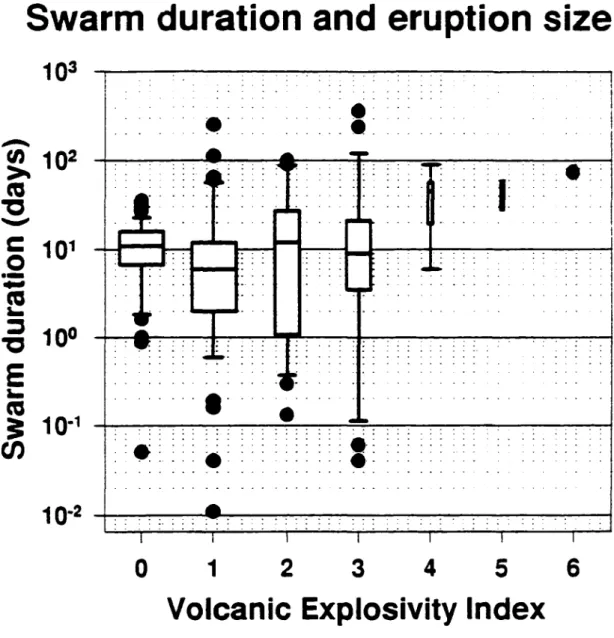
The durations of precursory swarms were then compared to the explosivities of the following eruptions. W e wish to know whether swarm durations vary significantly with eruption size. The Volcanic Explosivity Index (VEI) [Newhall and Self, 1982] is used to parameterize the explosivity (size) of the eruptions which followed swarms; note that each increase of one unit in VEI corresponds to one order of m agnitude in tepbra volume. Figure 2.2 gives the number of cases, and the m ean, median, and quartiles for each distribution. Additional descriptive statistics are given in Table 2.1. The distribution of swarms preceding VEI 0 eruptions is the most compact as measured by the 95% confidence limits This distribution is primarily composed of cases from Kilauea volcano and therefore mainly represents effusive basaltic eruptions at Kilauea. The VEI 1 and 2 classes span Strombolian eruptions. Slightly longer swarms precede the larger Strombolian eruptions, however the distributions are sim ilar VEI 3 and larger eruptions are basically all sub- Plinian to Plinian eruptions involving larger volumes of erupted material For swarms preceding VEI 3 and larger eruptions, the mean durations show a positively correlated trend with the VEI. Unfortunately, the trend is not statistically significant due to the small number of cases for the largest eruptions. More data are needed on VEI 5 and greater eruptions to establish formal significance of the correlation.
Table 2.1 Sw arm duration statistics by the size of the following eruption.
VEI number of cases median (davs) mean (davs) std. dev. Ooadavs) 95% conf. interval (loo davs) 0 45 11 7.9 0.54 0.16 1 50 6 4.8 0.86 0.27 2 30 12 6.1 0.88 0.37 3 26 9 6.7 1.02 0.44 4 5 45 30 0.44 0.55 5 2 41 41 - -6 1 - - -
S
w
ar
m
d
u
ra
ti
o
n
(da
y
s)
Swarm duration and eruption size
1 0 3 1 0 2101
1 0 ° 1 0 - 1 1 0 * 20
1
2
3
4
5
6
Volcanic Explosivity Index
Figure 2.2 Box plots of precursory swarm durations and the size of eruptions. These data suggest that for larger eruptions (VEI > 3) the median duration of swarms is longer than those for smaller eruptions. Tbe median for each distribution is shown as line drawn through the box. The lower and upper fences of the box plot mark the 10th and 90th percentiles of each distribution, respectively. The lower and upper hinges show the 1st and 3rd quartiles of each distribution, respectively. The values outlying the upper and lower fences are plotted individually.
I
m
• ± _
2.3.3 E vent ty p e and swarm duration
Volcanoes produce a wide variety of seismic signals. Many swarms are composed of two or more distinct types of earthquakes. For example, a common sequence is a swarm of high- frequency events followed by low-frequency events, tremor, explosion events, and finally deep earthquakes [McNutt and Benoit, 1995]. To further describe the nature of the seismicity that makes up a swarm w e added an event type(s) field to the database. The event type field attempts to reflea this complexity by listing (in the order of occurrence, if reported) all the event types that occurred during the swarm. Some swarms are defined and reported by event type. At Kilauea, for example, swarms are reported by location and event type. W e separated swarms reported at this level o f detail into individual swarm records. Most reports do not provide this level of detail, therefore, most swarm records contain more than one event type.
To examine th e dependence of swarm duration on event type we divided swarms into two broad groups: high- and low-frequency events. Worldwide terminology varies substantially in describing seismicity at volcanoes. Thus, these terms may have specific meanings and uses at each observatory. Nevertheless we grouped together swarm durations with A-type, high
frequency, and volcano-tectonic events for this comparison. Within this paper these swarms are referred to as “high-frequency swarms.” Similarly, B-type, low frequency, long period, and tomillo events are also grouped together and referred to as “low-frequency swarms.”
Figure 2.3 shows histograms comparing the durations for these two groups. The median duration of high-frequency swarms (11 days) is more than twice as long as the duration o f low- frequency swarms (5 days). Tbe significant difference in the mean durations is not totally
unexpected because the underlying processes are probably different High-frequency swarms are generally thought to be the brittle failure of the country rocks in response to a concentrated source
of stress, such as the intrusion magma or other fluid. In contrast, low-frequency swarms reflect
m any processes including- the exsolution o f magma Hr. volatiles, the interaction of magma with groundwater, fluid pressurization, transport, resonance, and other superficial processes (all occurring at relatively shallow depths, generally less than 4 km).
2 .3 .4 T he largest shock w ithin a volcanic earthquake swarm (M m J
The database contains over 180 records in which the magnitude of the largest shock (M ,„) within the swarm is recorded. The M values range from 0.5 to 6.2. The largest events in the database, M,6.2 at Miyake-jima in 1983 and M6.0 at Oshitna in 1986, occurred in association with large fissure eruptions. The M,6.2 event at Miyake-jima and a M5.6 event at Soputan in
1985 are the largest events preceding an eruption included in the database. The largest events without a following eruption within 3 months are: a Mjma5.7 at Unzen in 1984 (an eruption
occurred in 1990); and a M6.2 at Long Valley Caldera in 1980 (no eruption as of this writing).
Many magnitude scales are used in reporting these events. ML, Mjua> and Me are roughly equivalent to M (moment magnitu d e ) in the range o f 4 to 6.5 [Bakun, 1984; Boore and Joyner, 1982; Katsumata, 1983; Jackson, 1994]. The Russian energy class measurements were converted for comparison. The Russian energy scale K, was converted to M using: M = (K, - 4.6) / 1.5 [Gorelchik, 1989].
Figure 2.4 shows a comparison of the M for precursory and non-precursory swarms. Tbe mean of the M ^ distribution for precursory swarms is not significantly different from the mean o f non-precursory swarms. The mean M—- is 3.4 for precursory swarms and 3.2 for non-
precursory swarms. The precursory distribution shows a slightly larger spread than the non- precursory distribution. Tbe standard deviations of the distributions are 1.3 and 1.1 magnitude
CO Q CO CB O 0) n
E
3Swarm Durations
A-type, HF, SP, and VT events
CO o CO CB O 0) AE
30.01
0.10
1.00
10.00
100.00
1000.00
B-type, LF, and LP events
30
20
10
-0.01
0.10
1.00
10.00
100.00
1000.00
DAYS
Figure 2.3 Histograms of swarm durations based on event type. The top histogram shows 104 swarms that contain A-type, high-frequency, short-period or volcano-tectonic events, and the bottom histogram shows 96 swarms that contain B-type, low-frequency, or long- period events. The geometric means are 9.3 and 5.5 days, and the medians 11 and 5 days for high-frequency and low-frequency swarms respectively.
N
u
m
b
e
r
of
s
w
a
rm
s
50
40
30
20
10
040
30
20
10
0Figure 2.4 Histograms of maid m um magnitude Comparison of the distributions of magnitude, of the largest shock within 64 precursory swarms and 95 non-precursory swarms. Tbe means o f the distributions are M3.4 and M3.2 for precursory and non- precursory swarms, respectively. The largest shock of the Akutan swarms is marked on both histograms. For precursory swarms the open bars are events that preceded central vent eruptions, while the striped bars are from swarms that preceded flank or radial fissure eruptions.
PRECURSORY SWARMS
N = 64
MEAN = 3.4
Akutan ML 5.3
t
1NON-PRECURSORY SWARMS
N = 95
MEAN = 3.2
Akutan ML 5.3
t
Mmax
The eruption location is then used to further subdivide the precursory swarms. Two broad groups were constructed, “central vent” and “flank or radial fissure” eruptions. The open bars on the top histogram of Figure 2.4 show events that preceded central vent eruptions, while the striped bars are from swarms that preceded flank or radial fissure eruptions. With one exception (Nyamuragira 1981), eccentric and radial fissure eruptions are preceded by larger shocks than central vent eruptions.
2 .3.5 Manx and th e explosivity of the follow ing eruption
Values of Mm,* from precursory swarms are compared to the size of the following eruptive activity. Figure 2.5 shows a box plot of precursory swarm versus the VEI of the following eruption. Descriptive statistics for each distribution are given in Table 2.2. Similar to the
duration-VEI plot (Figure 2.2), the M for VEI 0 represents effusive basaltic Hawaiian eruptions. Only two precursory values are recorded in the database for this VEI class and are therefore not representative. The mean Maas values are similar for VEI 1-2 or Strombolian eruptions. For VEI greater than or equal to 3, the VEI is positively correlated with the mean However, this correlation is not significant due to the lack of the number of cases in the largest eruption classes. Once a g a in , more data are needed on VEI 5 and greater eruptions to establish the formal significance of this correlation.
Table 2.2 M— statistics by the size of the following eruption.
VEI number o f cases median mean std. dev. 95% conf. interval 0 2 - - - -1 10 2.4 2.7 1.4 1.0 2 12 2.6 2.9 1.2 0.7 3 18 3.0 3.2 1.4 0.7 4 8 3.9 3.8 1.2 1.0 5 3 4.4 4.5 0.5 1.2 6 1 - - -
Mmax ^nd eruption size
7
6
5
x 4
2§ 3
2
1
0Figure 2.5 Box plots of precursory swarm Mn*t and tbe size of following eruptions. These riara suggest rhflt for larger eruptions (VEI > 3) the median M— o f swarms is longer than those for smaller eruptions. The median for each distribution is shown as line drawn through the box. See Figure 2.2 for description of the box plot hinges and fences.
a
T
f
I
0
1
2
3
4
5
6
2.4 A case study: Using the GVESD during the 1996 Akutan
crisis
2.4.1 D escription o f the A kutan swarm s
The onset of the seismic crisis at Akutan Island (Figure 2.6) was marked by a vigorous, 24 hour long swarm starting March 10, 1996 at about 7:30 PM AST (GMT - 09:00). The largest event in this swarm occurred at 9:10 PM AST and had a magnitude of 4.7 mb (National F-arthqnalcp. Information Center, NEIC) 5.1 Ml (Alaska Tsunami Warning Center, ATWC) and
was felt as far as Dutch Harbor about 60 km to the southwest Eight other events with magnitudes o f 4.0-4.3 nib were located by the NEIC within 20 km o f the summit of Akutan volcano (Table 2.3). The rate of activity peaked about 6 hours after the onset, when more than 40 events/hour (Figure 2.7) were recorded at seismic station DTN, located 250 km to the northeast (Figure 2.6). Residents of Akutan described the effects of this activity as nearly continuous, low intensity motion punctuated by large individual shocks.
A second swarm of 18 hours duration began on March 13,1996 at about 4:45 PM AST. The largest event of this swarm occurred at 8:43 PM AST and had a magnitude of nib = 4.6 (NEIC) Ml = 5 3 (ATWC). This event was also felt in Dutch Harbor at an intensity of MMffl.
Tbe second swarm included 9 events with magnitudes in the range 4.0-4.6 mb (NEIC) (Table 2.3). Tbe rate of earthquakes observed at station DTN built up quickly and remained relatively
constant throughout the second swarm (Figure 2.7). Starting one hour after tbe swarm began; rates of 15-30 events per hour were recorded at station DTN f a - 13 hours. The residents of Akutan village (13 km from the volcano’s summit) felt an estimated 3000 events during these two swarms (R. Rozier, written comm., 19%). A list of all the events located by the NEIC within 25 km of Akutan volcano is given in Table 2.3. Local magnitudes were contributed by the ATWC.
Note, on average the local magnitudes (Ml) are 0.6 units greater than the body-wave magnitudes (nib). During the first days of the swarm the closest station to Akutan available in real-time was SND at 370 km and only a few additional stations were available within a 600 km radius for which local magnitud e is defined. Tbe lack of data is probably the largest contributing factor to the discrepancy between the magnitude scales.
On March 12th the first seismometer was installed on Akutan Island, and by March 18th a four-station temporary network was installed and earthquakes were being routinely located. All of the events were high frequency or volcano-tectonic events, and no long-period events or volcanic tremor were recorded. After the temporary network was established the level of seismicity continually declined. Within 3 months the seismicity rate had dropped to 3-7 locatable events per week [Power et al„ 1996]. The total seismic moment released by the two swarms is estimated at 2.7 x 10¹⁸ Nm using coda duration magnitudes at station DTN (J. Power, writ, comm 1997). A second estimate of the total moment release of 5.5 x 10¹⁶ Nm was calculated using the nit, given in Table 2.3 and relations between nib and M, [Abe and Kanamori, 1980] and M, and M a
[Kanamori, 1977]. The moment calculated from the body-wave magnitudes is almost two orders of magnitude less than the value estimated from coda-duration magnitudes. This discrepancy is caused partly by the systematic difference in nib and M L. The two estimates are used as upper and lower bounds. For comparison, the moment released at Akutan (1016-1018 Nm) is similar to the moment released during the 1980 eruption at Mount St. Helens (1.1 x 10¹⁷ Nm) [Weaver et al.,
Figure 2.6 Location map of Akutan Island and the nearest permanent seismic stations (DTN and SND).
n
u
m
b
e
r
of
ev
en
ts
p
er
h
o
u
r
AKUTAN SEISMICITY
RECORDED AT STATION DTN
March 11 to 15, 1996
0 6 12 18 0 6 12 18 0 6 12 18 0 6 12 18 0Mar 11
Mar 12
Mar 13
Mar 14
Mar 15
time is UT
Figure 2.7 Histogram of the number of earthquakes per hour recorded at station DTN (250 km to the northeast) for the March 11-14,1996 Akutan swarm. The occurrences of events greater than or equal to M 5 are marked with arrows.
Table 2.3 Locations and magnitudes for the largest earthquakes of the Akutan swarms.
date origin time ITT lat Ion mb Ml intensity
3/11/96 05:41:51.59 54.133 -166.043 4.1 4.4 IV 06:10:18.08 54.231 -166.087 4.7 5.1 IV 07:09:55.53 54.269 -166.077 4.4 4.7 IV 07:14:14.60 54.238 -166.092 4.2 4.4 IV 08:17:16.42 54.282 -166.219 4.3 4.4 IV 08:30:48.35 54.180 -165.995 4.0 4.5 IV 08:52:44.58 54.204 -166.107 4.2 4.6 IV 3/12/96 00:32:17.95 53.991 -166.170 3.4 4.3 IV 02:0622.25 54.184 -165.967 4.0 4.8 IV 3/13/96 03:38:38.27 54.071 -166.207 3.9 4.7 IV 3/14/96 03:55:36.17 54.220 -166.003 4.0 4.8 IV 05:43:53.65 54.204 -166.001 4.6 5.3 V* 07:19:11.83 54.236 -165.765 3.9 4.7 IV 0728:44.28 54.313 -166.101 3.9 4.6 IV 09:07:51.81 54.197 -165.894 3.8 4.6 IV 09:18:1020 54.076 -165.917 3.8 4.5 IV 10:00:18.21 54.230 -165.963 4.2 4.7 IV 10:31:43.41 54.260 -165.965 3.5 4.4 IV 10:51:15.38 54.209 -165.984 4.2 4.6 IV 112120.85 54.129 -165.878 3.7 3.5 IV 11:56:13.90 54.125 -165.826 4.3 5.0 IV 12:35:07.13 54.229 -165.795 3.8 4.4 IV 13:1328.09 54.114 -165.990 4.3 4.9 IV 13:17:57.68 54.177 -166.139 4.0 4.4 IV 14:58:16.91 54.047 -165.881 3.9 4.3 IV 152121.32 54.156 -165.906 4.3 5.0 V 16:09:45.01 54.035 -165.929 4.4 IV 16:13:51.60 54.134 -165.844 4.6 5.2 V 1720:08.38 54.181 -165.997 3.9 4.6 IV 1729:59.36 54.245 -165.982 3.4 4.4 IV 182320.23 54.136 -165.993 3.7 4.5 IV 1927:57.85 54.117 -166.123 4.2 5.0 IV
Felt intensities are from Akutan *Fett (III) on Unalaska.
2.5 Discussion
As the crisis at Akutan progressed, the duration and the of the swarms were
repeatedly compared to the previously prepared histograms and box plots (Figure 2.1 and Figure
2.5). Specific queries were constructed and the resulting case histories and the comparisons with the global distributions were assessed. This information was quickly synthesized with the available geological information (Le. 200 years of recorded eruptive history) [e.g. Simikin and Seibert, 1994; Finch, 1935] to build a broad range of eruptive scenarios. On March 14th at 2:00
PM. the Alaska Volcano Observatory released an information update stating three possibilities:
Based on tbe frequency, number and locations of recorded earthquakes, the following scenarios are considered possible at this time:
(1) Earthquake activity diminishes and no eruption occurs
(2) Eruption of a lava flow from a vent on the flank- or within the summit caldera, accompanied by ash plumes and explosions
(3) Significant, explosive eruption producing ash plumes to altitudes of 30,000' ASL or higher.
These very broad statements encompassed just about anything that could happen at a volcano. These types o f statements nonetheless are helpful for the emergency response
community and are needed as soon as possible. A more detailed analysis followed in the weeks after the swarm. An attempt was made to assign some likelihood or probability to each of the above scenarios. The remainder o f this discussion details how these data were assessed and their physical implications. Each of the swarm parameters discussed in general above are now directly compared to the Akutan case.
The durations of the Akutan swarms were 18 and 24 hours. The combined duration of the sequence was about 3.5 days, the same as the mean of non-precursory swarms. Considering the duration parameter alone, the relatively short Akutan swarms would be considered non-
precursory. In other words, shorter lasting swarms are less likely to precede eruptions. However, if the activity re-intensified or continued for several more days these swarms would have a higher likelihood of being precursory.
The observation that precursory swarms are about twice as long as non-precursory swarms may be simply explained as the greater ascent of magma to the surface by longer lasting swarms, while intrusions or failed eruptions (less ascent) are m anifested by shorter swarms [Benoit and McNutt, 1996b]. Factors such as the rate at which magma can enter the swarm volume, and the rate and extent o f magma transfer between adjacent dikes, may also control the duration of a swarm [Hill, 1977]. The extent of the magma transfer between dikes is necessarily greater for
magma that reaches the surface than for an intrusion, which stops short. Several other factors, not directly related to the movement of magma, may also control the duration of shorter swarms. Volcanic and geothermal areas have been shown to be sensitive to small strains such as; earth and tidal stresses [McNutt and Beavan, 1981; Rydelek et al., 1988], surface waves from regional or teleseismic earthquakes [Hill et al., 1993], seasonal ocean-loading [McNutt and Beavan, 1987] or changes in barometric pressure [Rinehart, 1980]. The periods of such strains, which can be forcing functions, may partly control swarm durations.
The Akutan swarms were almost exclusively composed of high-frequency events. Only one low-frequency event was detected on March 15,1996 during the crisis. Nine other low- frequency events were located in the next three months. Pom1 quality locations put tbe events several kilometers to the southeast of the island. Due to their locations the events were not
considered to be associated with the volcano, but may be related to superficial processes such as
small submarine landslides No volcanic tremor was detected at Akutan.
A commonly observed sequence of event types during a precursory swarms is as follows; high-frequency events, low-frequency events, tremor, explosion events, and finally deep
earthquakes [McNutt and Benoit, 1995]. Over 40 cases in the database show all of these event types in the above relative order. Many other precursory swarms show two or more components, again in the same relative order. The Aleman swarms possessed only the first component of this generic sequence. Using this generic precursory swarm sequence as a guide, the lack of both low- frequency events and tremor suggests that the Akutan swarms were not yet leading to an eruption. If an eruption were to occur, we would expect to detea at least one other event type, eg. low- frequency events or tremor, before an eruption would begin. Low-frequency events and tremor generally represent processes occurring at relatively shallow depths (< 4km) within the crust. If a magmatic intrusion was driving the Akutan swarms, the lack of low-frequency events and tremor provides some evidence that the intrusion had not yet risen to very shallow depths.
When the descriptive statistics of all o f the generic sequences’ component distributions are well determined (eg. the data presented in Figures 2.1-2.5 and Tables 2.1-2.2) a probabilistic eruption forecasting scheme could be developed. This scheme a algorithm could compare durations of an ongoing earthquake sequence with the generic sequence and give probabilistic assessments of possible outcomes. This task has not yet been done and is beyond the scope o f the present paper.
The largest events in the Akutan swarms were mb = 4.7 (ML = 5.1) and mb = 4.6 (ML = 5.3). There is not a significant difference between the distributions of Mon f a precursory and non-precursory swarms (Figure 2.4). Therefore, the size of the alone does not give a clear
indication that a swarm is likely to lead to an eruption. Many o f the events o f the Akutan swarms were felt. The database was searched using the question: “Are there any comparable swarms with over 3000 felt earthquakes within a period of a few days?” Out of 700 swarms, the answer was no. The number was lowered to > 500 felt events and the database returned only 3 cases (Table 2.4). Two of these swarms occurred before and during eruptions and the third occurred 5 years before an eruption. Usu volcano, with 2145 felt events, came the closest to the Akutan swarms. The felt events at Usu occurred over several years, not in only a few days as in the Akutan case. This small data set does not indicate whether or not the swarm is precursory, but with respect to the numbers of felt events, the Akutan swarms are quite extraordinary.
Table 2.4 Swarms w ith greater than 500 felt earthquakes.
volcano swarm
start date
number felt
number
detected activity references
Akutan 11-Mar-96 >3000 777 no eruption this paper
Usu 6-Aug-79 2145 11526 during eruption BVE no 17, p 49-53;
BVE no 23, p 61
Tacana 7-May-86 1000 4000 before eruption BVE no 25, p 65;
BVE no 26, p 64-65
Unzen 15-May-84 519 10544 no eruption BVE no 24, p 65
If w e assume the Akutan swarms were precursory we can compare the M with the VEI of the following eruption (Figure 2.5). Using mb=4.7 as the M for the Akutan swarms the most likely VEI categories are VEI 4 and 5. In other wards, if the Akutan swarms were precursory, the large earthquakes suggest that a flank eruption or a large explosive eruption through the central vent were probable.
In general, volume changes within the crust produce shear stresses, which are released by
earthquakes McGarr [1976] proposed a direct relation between total seismic moment release and volume changes within m ines. Abe [1992] applied this relation to a volcanic setting. Abe
compared the volume of the Karmai caldera and the total moment released in association with the formation and found it to be in good agreement with McGarr’s relatioa This general relationship is also supported by the dam shown in Figure 2.5; larger more explosive eruptions tend to be preceded by larger earthquakes. Using this scaling relationship the change in volume was estimated for the Akutan swarms. Following Abe [1992], the moment can be interpreted in terms of a model of shear faulting or a volume source. For the volume source the swarm occurs in response to shear stresses induced by change in a volume of material [McGarr, 1976], The moment is written as
M 0 = fiV, (2.1)
where M 0 is the total moment, fi is the rigidity, and V is approximated by total volume of material added to the region. T aking p = 3 x 10¹⁰ N/m2, we obtain V = 1.6 x 10⁶ m3 from the body-wave derived total moment and V = 9.0 x 10⁷ m3 from the coda-duration derived total moment. This volume of material would correspond to a VEI 2-3 eruption. These volume estimates are probably both lower bounds since the formulation assumes the volume c hange, is accommodated entirely within the seismogenic crust. Magma at such depths would contain few vesicles, in contrast to tepbras whose volumes are measured to determine VEI.
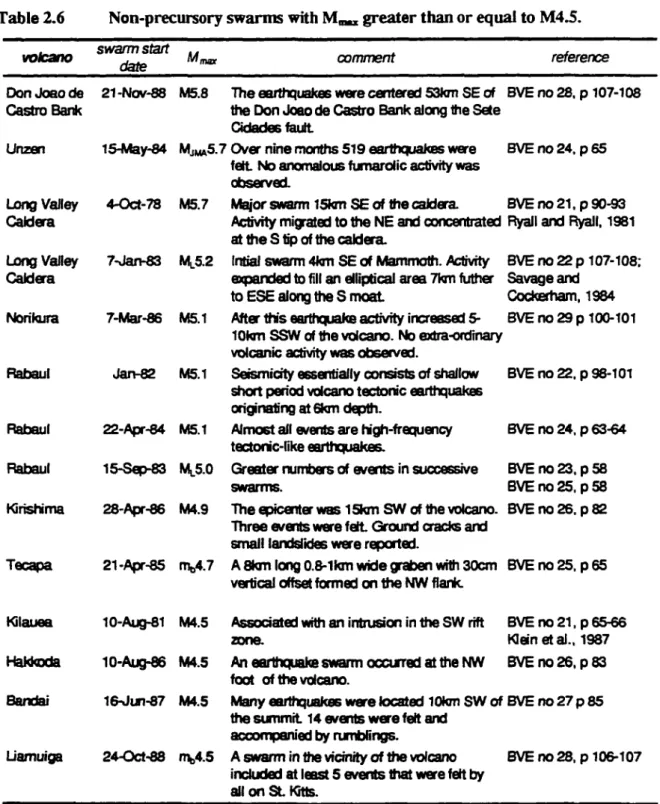
The database was queried for specific swarm case histories with magnitude 4.5 or greater shocks. The query returned a list of 26 swarms with Mon > 4.5, out of 188 swarms where the Mnnx was recorded in the database. Twelve of the swarms preceded eruptions (Table 2.5), while