i
Master Program in Business Studies
MASTER THESIS
Determinants and consequences of perceived intrusiveness in
pre-roll video online advertising
Author:
Marcelo J. Cabrera Herrera
Student Number:
6258603
Supervisor:
Dr.
R. Pruppers
ii
I decided to write my master thesis about pre-roll video advertising because it has become a very important medium for companies when locating their marketing campaigns and conveying brand messages. Streaming video websites are becoming more and more popular occupying a high percentage of activity within the online tasks of consumers. Nowadays, marketers are aware of the opportunities coming from the online environment, however they should also be considered from a consumer behavior perspective. This is why I decided to focus on the determinants and consequences of one recognized effect of advertising named intrusiveness. From the consumer point of view better conditions could be provided to reduce negative feelings and a more effective approach could be achieved considering the managerial perspective.
ACKNOWLEDGEMENTS
This master thesis could not be completed without the help and support of many people. First, I would like to thank my supervisor Drs. Roger Pruppers. Thanks to his expertise in marketing research, he has done an amazing job by providing very valuable insights to every chapter of this research. Roger, it was a pleasure working with you and I was amazed by your enthusiasm and constant motivation.
I also want to thank god and my family which from the distance knew how to provide strength. In addition, to my friends for their support and all the people that participated in the research and that made possible complete the experiment. To my girlfriend Lot, thank you so much for your love, ideas, criticism and constant motivation. Last but not least, to Mariëtte, Paul and Tim thank you for your support and incentive in everyway during this whole experience.
Marcelo Cabrera Amsterdam 2011
iii
ABSTRACT
The emerging advertising format of pre-roll advertising has positioned itself very strongly in the video streaming environment. However it has received relatively little academic attention concerning its negative perceptions coming from potential consumers. The present research addresses this important issue by focusing on the determinants and consequences of one very important driver of negative outcomes in advertising known as perceived intrusiveness. In order to find which confounding factors and consequences are involved in pre-roll ads, an experiment with 214 participants was conducted involving a 2x2x2 factorial design between subjects and putting to test five hypotheses. From the analysis it was found that the main drivers are ad location (beginning vs. middle) and video length of where the ad is embedded (short vs. long). Considering ad length it was found that once an ad is embedded in an online streaming video, its perception regarding its duration becomes altered due to a change in attention however its effects on intrusiveness were rejected. Moreover, a theoretical model is constructed with respect to the dependent variable (intention of avoidance) and suggests that irritation plays a mediating role for intrusiveness. Besides intrusiveness, the variables of attitude towards advertising in general, attitude towards the ad and attitude towards pre-roll ads were also found as predictors of irritation yet intrusiveness was the stronger one. The overall outcome is discussed along with the implications for theory and practice and finally it is proposed future research directions in the field of pre-roll advertising taking in consideration the contributions of the present study.
iv
1 INTRODUCTION_______________________________________________1
1.1 GENERAL INTRODUCTION TO PRE-ROLL ADVERTISING 11.2 PRE-ROLL ADS, NOTION OF INTRUSIVENESS AND RESEARCH GAP 2
1.3 PROBLEM DEFINITION 3 1.4 DELIMITATIONS OF THE STUDY 3
1.5 CONTRIBUTION 3
1.5.1 THEORETICAL 3
1.5.2 MANAGERIAL 4
1.6 STRUCTURE/OUTLINE OF THE RESEARCH 5
2 ONLINE ADVERTISING__________________________________________6
2.1 CONSUMER PERCEPTIONS IN AN ONLINE ENVIRONMENT 6
2.2 DESCRIPTION 7
2.3 EVOLUTION 8
2.4 CURRENT TYPES OF ONLINE ADS 9
2.5 COMPARISON WITH TRADITIONAL ADVERTISING 10
2.6 PRE-ROLL ADVERTISING 14
3 ADVERTISING PROCESSING PERCEPTIONS________________________17
3.1 NEGATIVE PERCEPTIONS IN TRADITIONAL ADVERTISING 17
3.2 NEGATIVE PERCEPTION IN ONLINE ADVERTISING 19
3.3 REVIEW OF INTRUSIVENESS 22
4 HYPOTHESES________________________________________________26
4.1 INTRODUCTION 26 4.2 CONFOUNDING FACTORS 27 4.3 CONSEQUENCES 315 RESEARCH METHODOLOGY ___________________________________33
5.1 OVERVIEW 33 5.2 RESEARCH DESIGN 345.3 INDEPENDENT AND DEPENDENT VARIABLES 34
5.4 MEASUREMENTS 35 5.4.1 AD LENGTH 35 5.4.2 VIDEO LENGTH 35 5.4.3 PERCEIVED INTRUSIVENESS 35 5.4.4 INTENTION OF AVOIDANCE 36 5.4.5 IRRITATION 36 5.5 STIMULI DEVELOPMENT 36 5.5.1 THE VIDEO 36 5.5.2 THE COMMERCIAL 38 5.5.3 PRE-TEST 39
5.5.3.1 PARTICIPANTS AND PROCEDURE 39
5.5.3.2 RESULTS OF PRE-TEST 40
5.5.3.2.1 CHOICE OF AD LENGTH 42
v
5.6.1 BRAND FAMILIARITY 56
5.6.2 ATTITUDE TOWARDS THE PRODUCT 56
5.6.3 ATTITUDE TOWARDS THE VIDEO 56
5.6.4 ATTITUDE TOWARDS THE AD 56
5.6.5 ATTITUDE TOWARDS PRE-ROLL ADS 56
5.6.6 ATTITUDE TOWARDS THE STREAMING MEDIA 57
5.6.7 AMOUNT OF STREAMING WEBSITE USAGE 57
5.6.8 DEMOGRAPHICS 57
5.7 PARTICIPANTS AND PROCEDURE 57
5.7.1 PARTICIPANTS 57 5.7.2 PROCEDURE 58
6 RESULTS____________________________________________________59
6.1 RESPONDENTS 59 6.2 DATA PREPARATION 59 6.3 MANIPULATION CHECKS 60 6.3.1 BRAND FAMILIARITY 61 6.3.2 VIDEO UNDERSTANDING 616.3.3 ATTITUDE TOWARDS THE VIDEO 61
6.3.4 ATTITUDE TOWARDS THE AD 61
6.3.5 VIDEO LENGTH 62 6.3.6 AD LENGTH 66 6.4 HYPOTHESIS TESTING 71 6.4.1 HYPOTHESIS 1 73 6.4.2 HYPOTHESIS 2 73 6.4.3 HYPOTHESIS 3 74 6.4.4 HYPOTHESIS 4 74 6.4.5 HYPOTHESIS 5 78
7 DISCUSSION________________________________________________88
7.1 INTERPRETATION OF RESULTS 88 7.1.1 AD LENGTH 88 7.1.2 AD LOCATION 89 7.1.3 VIDEO LENGTH 897.1.4 INTERACTION EFFECTS AND OVERALL ANALYSIS 90
7.1.5 CONSEQUENCES 91
7.2 IMPLICATIONS 92
7.2.1 THEORETICAL 92
7.2.2 MANAGERIAL 94
8 CONCLUSION_______________________________________________97
8.1 CONCLUSION OF THE STUDY 97
8.2 LIMITATIONS AND FUTURE RESEARCH 98
REFERENCE LIST______________________________________________100
APPENDIXES_________________________________________________106
1
INTRODUCTION
1.1 GENERAL INTRODUCTION TO PRE-ROLL ADVERTISING
The increasing usage of internet and different activities of online presented opportunities for advertising campaigns and new ways to approach consumers. For instance, according to the Pew Internet and American Life Project (2010), by May 2010 79% of American adults are online in the U.S. in contrast to the 68% found in 2006 and 59% in 2001. Moreover watching a video on video-sharing sites like YouTube or Google Video are represented by the 23% of users in an average day. Whether users browse for information, play games, seek for social interactions or other forms of entertainment they are in an aware state with a goal by being online, which implies being exposed to advertising (Ko, et al., 2005). Thus, this phenomena is aimed to be leveraged by companies through online advertising across different ad formats for example pop-ups, pop-unders, in-line (banners) which are embedded in different activities such as search platforms, game websites, social media, blogging and content communities (McCoy, et al., 2007).
The objective of the latter is sharing media content between users ranging from text, photos (e.g., Flickr), PowerPoint presentations (e.g., Slideshare) and videos like in Youtube (Kaplan & Haenlein, 2010). Video sharing and streaming is currently one of the most popular activities online, statistics of January 2009 show that every minute, ten hours of content was uploaded to Youtube and over 100 million videos per day were served (Kaplan & Haenlein, 2010). Thus, content communities of video became a very attractive contact channel for many firms. According to the Pew Internet and American Life Project (2010), 69% of internet users watch or download video online, 14% post videos and the 18-29 year-olds are the heaviest consumers of online video.
Additionally since 2007 the amount of viewers in the U.S. has increased drastically. For example adult users in humorous videos risen viewership from 31% to 50%, educational videos 22% to 38% (videos shown as teaching material in class), movies or TV show videos from 16% to 32% and political videos 15% to 30%. This increase is also explained also by the growing social networking in the same timeframe where status updates in Facebook or Twitter for example involve sharing popular or favourite videos from Youtube. Nowadays watching videos online can be found in any place and form that allows usage of internet going from households and offices and from PC‘s to devices like the Apple Ipod and smartphones. Technology of the latter contributed in a very important way to this increase, for example with the idea of why wait until you return home to watch the new YouTube video if you can do it very easily on your iPhone? (Pew Internet and American Life Project 2010; Kaplan & Haenlein, 2010).
Inevitably companies aware of this are locating advertising on streaming websites and its videos, in forms ranging from pop-ups and pop-unders in the beginning or after five seconds that the video has started. The latest trend is pre-roll video advertising, which is a format similar to a television commercial, but integrated in the videos, lasting from 15 to 30 seconds and normally shown before the video is displayed however it can also be located at the end or the middle. (PricewaterhouseCoopers, 2010, p. 16 and MacMillan, 2009).
1.2 PRE-ROLL ADS, NOTION OF INTRUSIVENESS AND RESEARCH GAP
Pre-roll ads emerged as an alternative for reaching older and younger viewers who are increasingly difficult reaching through TV ads. According to research conducted in the Netherlands by Microsoft Advertising (2008) 74% of pre roll ads are viewed from beginning to end and higher spontaneous recall of the ad is experienced in pre-roll than in banners and ads shown during commercial breaks. In the online environment companies in the Netherlands like T-Mobile and ASN Bank are examples currently maintaining a campaign using this type of ads on Youtube.
Yume (2010) a video advertising technology company, indicates that the category spending the most in pre-roll ads are consumer packaged goods, completion rates in average are 70% but female audience presents higher with 74% versus 67% of males. In contrast, Tubemogul (2010) a company analyzing video advertising, reported that in pre-roll ads 15.89% of viewers clicked away from a video rather than staying with the ad. Clearly there is an avoidance behavior encountered also in other advertising formats where people tend to avoid commercials for example in TV by switching channels, putting on silence, etc. (Speck and Elliott, 1997). Comparing pre-roll ads with TV, the last format have small ads generally encountered as pre-roll before a program or live show. It is understood that consumers may have negative perceptions such as interruption leading to avoid the ads (Wang, et al., 2002), the intrusive feeling phenomena is precisely the focus of this research in the pre-roll ad context.
Interruption-feeling levels could vary across different formats, for instance it is not the same being interrupted while watching television than when intending to look a video on internet. Factors like purpose and higher motivation to process that video can mark that difference. That deviated attention can cause a forced-feeling and perceived intrusiveness leading to avoid the ads and making them less effective. Intrusiveness was already studied in formats such as pop-ups or banners (Li, Edwards and Lee 2002), however it continues being a research gap in the pre-roll video advertising context, along with its confounding factors and consequences of being that intrusive in comparison to other more traditional ads.
1.3 PROBLEM DEFINITION
The overall and general question of this research is: What determines the level of perceived intrusiveness in Pre-roll advertising and what are its consequences? In other words: What factors come together in explaining the feeling of perceived intrusiveness for pre-roll ads and what consequences come with it?
1.4 DELIMITATIONS OF THE STUDY
The research focuses on the confounding factors which are expected to explain perceived intrusiveness in the mindset of viewers regarding pre-roll advertising. These may be congruence, duration, position, intensity of task and attitude towards advertising in general. In order to achieve this, the research focuses on a comparison of intrusiveness from another advertising formats such as television, print ads in magazines, pop-ups, etc. Moreover it deals only with the interaction of these factors for assessing the construction of intrusiveness leading to avoidance of the ad and ultimately a change of the streaming website. It becomes clear that the goal is to understand the consumer intrusive perception in pre-roll ads.
The study will not include product class relevance or product involvement. At the same time brand familiarity or attachment is excluded for analyzing if it has a certain influence on intrusiveness. Utility of the ad in terms whether is informative or entertaining is also excluded because the analysis focuses on the response towards the interruption factor rather than in the content of the ad itself and its message. Thus it focuses on the drivers of intrusive feelings rather than possible moderators of after exposition. Finally we are not concerned in advertising processing as such and the positive impact that can have on factors like brand perceptions, rather we focus on the downsides of advertising, in other words the study of the factors making the video pre-roll ads ineffective.
1.5 CONTRIBUTION
1.5.1
THEORETICAL
The research aims extending theory of intrusiveness which is encountered mainly in traditional advertising formats but continues as a research gap in pre-roll video advertising, moreover extending understanding of the downsides of pre-roll advertising in terms of consumer perceptions. The relations of the proposed confounding factors are expected to explain the formation of intrusiveness in the consumer mindset when watching videos. Thus, the contribution is to provide more understanding of the relation between different purposes of watching the videos when they are interrupted. For example, users could be mindlessly surfing videos in Youtube (low intensity of task) in contrast to users surfing for specific purposes as
investigation or entertaining (high intensity of task). This relationship could be significant the moment of choosing videos where to allocate the ads that may lead to less perceived intrusiveness. Thus it becomes important to study the mindset watching online videos and the determinants of perceived intrusiveness. Finally is expected that the investigation yield a reasonable conclusion of what is the proper combination of the confounding factors that may lead to less intrusiveness.
By making a simple comparison with television, ads can be perceived as intrusive but it is known that a set of several commercials is coming, therefore the audience can leave the room or do other activity. In contrast, pre-roll ads are displayed as one every certain time, therefore the user would not be expected to leave the room or change immediately of activity because is known that is just one commercial, and may choose to watch it but at the same time the feeling of being interrupted or forced can be perceived as not worth to watch a 30 seconds ad, especially in cases when the video intended to watch was of the same or even less duration. Thus, it is interesting to explore the mindset when watching videos and the factors coming together for the feeling of perceived intrusiveness. For example what is known about intrusiveness from other formats is the irritation feelings that lead to avoidance but this is only taken in formats such as pop-ups and banners (Li, et al., 2002) where the mindset is quite different. Furthermore in pre-roll can be considered that the confounding factors for this intrusiveness is for instance congruence between the ad and the content of the video, duration, location, and even the type of video being watched at the time. Different videos at that moment could also yield higher or lower value of the time for instance whether they are entertainment, news, or looking for information where situations of higher goal pursue can be encountered. Interestingly enough previous literature has not studied these factors along with intrusiveness in the pre-roll context in a proper manner.
1.5.2 MANAGERIAL
The expected contribution is to improve the practice of advertising strategies in an online environment; specifically marketers could use the expected empirical evidence to reduce perceived intrusiveness in campaigns involving pre-roll ads. The importance of the study is justified due to the increasing audience of video streaming and the growing trend of advertising itself. Reports from ComScore, a company that evaluates the internet rate‘s usage, indicated that online video ads reached almost half of users in the U.S. and estimates that a total of 4.37 billion video ads were served to U.S. users in September 2010, (Marshal, 2010). Moreover video advertising spending is expected to grow around 60 percent for 2011 (Kaye, 2010),
however the intrusiveness feeling may cause annoyance and ways to ignore advertising, thus a practical relevance is encountered given that the findings may help reducing this factor that influences overall advertising effectiveness. The findings may create potential advantages for better conditions to position the ads that can contribute to better attitudes towards brands or products in an increasing competitive online advertising environment. Managerial implications can exist for companies that want to leverage better pre-roll ads and influence effectively the user environment in order to reduce avoidance.
Finally, companies that manage streaming videos can use this information to locate in different way the ads, and gain competitive advantage in contrast to companies that stay in the current way, which is maintaining a similar level of perceived intrusiveness as it is known. Thus consumers would switch to the platform web that gives less annoyance and intrusiveness in terms of pre-roll advertising. Arguably the amount of videos existing per platform can establish a strong reason for not moving to other one despite of having less intrusive advertising.
1.6 STRUCTURE/OUTLINE OF THE RESEARCH
The chapter that follows introduces the knowledge pre-roll advertising and how is encountered in terms of consumer perceptions. Online Advertising is described for understanding better the context in contrast to traditional advertising. The chapter three discusses Intrusiveness and starts by providing a comprehensive overview of advertising processing perceptions. The fourth chapter presents the hypotheses and predictions of the study. The next chapter explains the research methodology, continued by the chapter where empirical results are given from the hypotheses testing. The last chapter deals with the analysis of the results, interpretation and implications. Finally conclusions, limitations and directions for future research will be discussed.
2
ONLINE ADVERTISING
Given that this investigation deals with one of the formats that correspond to online advertising. It is necessary to describe and give an overview of online advertising, also in terms of its evolution and types, including a comparison with traditional advertising and the way consumers perceive it. Finally Pre-roll advertising format is introduced and thoroughly explained with current research and general knowledge. A deeper explanation of advertising perceptions, specifically negative ones are described in the chapter three.
2.1 CONSUMER PERCEPTIONS IN AN ONLINE ENVIRONMENT
Internet is seen as a convergent medium for other media, in the way of an hybrid of TV, radio, newspapers, billboards and magazines where people can watch and listen to programs, read newspapers, e-mail ads, banner ads, etc (Cho and Cheon, 2004). Furthermore the Internet can be used like traditional media for purposes like seeking information or entertainment but there are more specific purposes which influence them. According to Wang, et al. (2002) advertising in general is easily ignored, but the factors identified that contribute to consumer perceptions of ads are entertainment, irritation, informativeness, credibility, demographic and interactivity.
In addition the study of consumer perceptions and its implication in online advertising has been already discussed in previous research, for example Rodgers and Thorson (2000) mention in their internet advertising model (IAM), motives for internet use which are consumer-controlled functions of research, shop, entertain, communicate, socialize. These motives interact with the mode, which is defined as the extent to which Internet activities are goal-directed ranging from playful to serious. The outcome of this interaction develops a mindset on the cognitive information processes (attention, memory and attitude) which then go through the advertised-controlled structures which are the ad type, format and features of the ad. The outcomes are included in terms of several consumer responses where a negative one is ignoring or avoiding the ad. The figure 1 shows the discussed model.
Figure 1
Source: Rodgers and and Thorson, 2000. The Interactive advertising model.
2.2 DESCRIPTION
Internet, web or online advertising was introduced in 1994 in the form of banner ads (Robinson, Wysocka and Hand, 2007). From this point internet marketing industry continued growing and expansion of advertising communication through the web became generally known due to the potential of global reach, interactivity and ultimately more effective one-to-one targeting ability (Dreze & Hussherr, 2003 and Yaveroglu & Donthu, 2008). Ha (2008) defined it ―as messages placed on third-party websites including search engines and directories available through internet access‖. There are several features that are characteristics of this format, for example data collection mechanisms are used to target specific individuals and elicit in a more automatic way the buying and selling behaviour, in this way it relies in economic and statistical methods for its successful positioning on the web (Evans, 2008).
Furthermore, web advertising makes possible to users to act as soon as they are exposed to the ad and whatever is their reaction, they are not acting only as an audience but as users having a goal when they are online (Ha & McCann 2008). This behaviour and the importance of advertising online, lead to more research to help understanding its impact. For instance, even though that part of the benefits are a mass reach and targeted messages providing better information, Dreze and Hussherr (2003) addressed advertising effectiveness online and found that the reason for low clicking-through rates are that people avoid looking at banner ads during the activities they are engaged. Moreover internet advertising allow marketers and advertisers to
have control regarding the features that the ad will present, in other words consumers have no control to what type of ads they may be exposed (Rodgers & Thorson 2000) and the interactivity that the ads will include (Ha, 2008). The following section will provide an explanation of the evolution of online advertising including the evolution of its characteristics.
2.3 EVOLUTION
After its apparition in 1994 with banner ads, the business of online advertising basically consisted in buying and selling advertising space which is accessed by web users. According to Evans, (2008) by 2006 it was already identified in the industry categories in which web advertisement evolved, such as search advertising (in search-result pages), display advertising (in non-search web pages), classified listings appearing on websites and e-mail based advertisements. Search advertising is displayed after doing a search query in search engines like Google and a list of ―paid search results‖ are displayed related to the results according to the keywords provided by the user. The display advertising depends on the provision of web publishers which create advertising inventory by designing their web sites, written to accept graphical, text, or video ads in various portions of the page. Classified listings can or not be related to the content of the website and are similar to search advertising. Finally e-mail based advertising can appear in an informative and promotional way including banners, buttons, etc (Evans, 2008). The different types of ads that can be encountered will be explained in the further subsection.
Another way to explain this evolution is that it became harder to connect with consumers given that more tools were developed, for example pop-up blockers allowed to avoid ads and with users having control upon the media experience (IBM Global Services 2009), it required to develop more interactive and measurable formats that can increase consumer attention. According to previous research, interactivity can be functional according to interactive elements present according to the interactive perception that relates to previous ad messages, in a way that when clicking in an ad, this leads to further pop-up ads as consequence (Shyam and Jinhee, 2005). It becomes important then to understand that even if having more interactive ads this will lead to a desired response and not irritation or avoidance, because interactivity may not erase levels of interruption or irritation given by interactive ads that are totally irrelevant, negative reactions are discussed further in depth in chapter three.
Furthermore even tough that more effective strategies are considered in terms of how the ads are developed, according to the IAB Internet Advertising Revenue Report (2009) search engines accounts for the 47% of the revenues, and the increasing usage of internet became proportionally related to online advertising, pointing out that not only Pc computers or laptops are used, different electronic devices before stated that allows getting online permits establish advertising campaigns, moreover the arrival of Social Media marked a whole new territory for online advertising. At the same time the evolution of technology developed different formats for online ads which have different characteristics such as animation, audio, video and allow interacting with the user; this is better described in the following point.
2.4 CURRENT TYPES OF ONLINE ADS
In this point it is described the current types of online advertising existing. According to Robinson, et al., (2007) the growth spending on web advertising shows the excitement marketers have about campaings in an online environment and executives regarding the spending involved and which formats are the best decision given that attitude towards a partuicular online advertising format influences attitute towards the ad (Burns and Lutz 2006).
Apart from the categories of Evans (2008), Faber et al. (2004) made already a distinction in web advertising that we can still find in the current environment, it starts with images displayed on a web page used as an ad (banner advertisings), websites with advertising content that pop up or appear in front of the original website that the online consumer aimed to visit (Interstitials) and finally the ones comparable to banners, but appearing in a different window in front of the original website that the user aimed to see (Pop-ups).
Furthermore according to Rosenkrans (2009) the concept of rich media advertising includes several interactive methods displaying motion, sensory traits and multimedia elements like video, audio or animation (including content that moves when the user clicks). The author within this context found that interactive ads, lead to more clicks than non-interactive ads, and provide a description of different online rich media ads that include, floating ads, wallpaper ads, fold-over ads, video ads, expandable banner ads, ghost ads, and advergames (Rosenkrans, 2009). Moreover regarding the current ad platforms, projections for interactive ad revenues (2009-2014) indicate a compound annual growth rate of 34% ads in social media, 27% in mobile marketing, 17% in display advertising, 15% in search marketing and 11% in email marketing (Kirchhoff, 2009). Online ads can also be located in Podcasts. According to (Goga,
2005) podcasting is is the creation of digital audio files that may be easily downloaded from the Web to any portable MP3 player and listened to at the user‘s convenience. Thus podvertising is part of the content which is downloaded to portable MP3-players with formats such as sponsorship, ad-spots and infomercials (Ridåker et al., 2006). Besides the types discussed in the literature, the annual internet advertising revenue report conducted by PricewaterhouseCoopers on behalf of the Interactive Advertising Bureau (IAB) gives an important overview of the current online advertising types in the market. The formats already explained are: Display Advertising (Banner Ads), E-mail banner ads, links or advertiser sponsorships that appear in e-mail newsletters, and Rich Media which may appear in ad formats such as banners, buttons and interstitials. Search continues as the most important format regarding amount, its subcategories include: (1) Paid listings, appearing at the top or side of search results based on keywords. (2) Contextual search, appearing in an article based on the context of the content, instead of a user-submitted keyword. (3) Paid inclusion, which guarantees that a marketer‘s URL is indexed by a search engine and (4) Site optimization, that modifies a site to make it easier for search engines to automatically index the site and hopefully result in better placement in results (PricewaterhouseCoopers, 2010).
In addition Sponsorship is custom content created for an advertiser which may or may not include ad elements such as display advertising, brand logos, advertorial or pre-roll video and Classifieds and auctions are fees advertisers pay Internet companies to list specific products or services (e.g., online job boards and employment listings, real estate listings, automotive listings, auction-based listings, yellow pages). Finally, Digital Video Commercials are TV-like advertisements appearing as in-page video commercials in a player environment or streaming content (PricewaterhouseCoopers, 2010). This is also known as pre-roll advertising which is the focus of this study within online advertising and it will be thoroughly reviewed after the next section which addresses a comparison between traditional and online advertising.
2.5 COMPARISON WITH TRADITIONAL ADVERTISING
At a general level traditional and online advertisement have the same purpose. In the way that content is used by publishers to attract an audience and publishers sell access to advertisers to convey information related to their marketing campaigns (Evans 2008). Formats like radio and video television commercials are part of traditional advertising, newspapers and magazines address text ads like classifieds which can contain graphics (Evans, 2008). A point of distinction for instance in print ads, is whereas the space on paper is sold to the company,
internet web revenues from ads like banners are mostly generated by number of clicks in the ad (Burns, 2010).
Technology and Interactivity.- The most logical difference between traditional and online formats is technology. Given that web ads can target particular consumers in real time considering language, content and can be more content specific. Google AdSense for instance looks at the content of individual web pages and serves ads relevant to that content (Evans, 2008). Thus, online ads serve advertisement for the viewer of the web page based on knowledge of the viewer‘s socioeconomic characteristics or even what sorts of products the viewer is considering to purchase for example with click-through behaviour (Evans, 2008).
Web advertising then, is more interactive and the consumer actively crosses through the pieces of information depending whether he wants to go further or not (Bezjian-Avery, et al., 1998). In this way Internet provides two-way communication between sources and consumers while most traditional advertising provide only one-way communication. In other words with internet, users can interactively enjoy choosing what they want and when they need (Wang, et al., 2002). This interactivity, allow consumers to have more control over the order in which they are exposed to information (Bezjian-Avery, et al., 1998).
According Wang, et al. (2002) interactivity is one of the factors that contributes to consumer perceptions of ads, moreover the importance and relevance of the ad regarding the consumers‘ information needs, would determine how becomes involved and how it values the ad (Wang, et al., 2002). It is important to make the distinction of interactivity with traditional formats because consumers‘ perceptions upon exposure in an online environment can elicit more action than in traditional advertising. For example when a relevant ad is found on the web, due to the interactivity present it can elicit a response of looking for more information, visiting the website and ultimately purchasing due to the constant stimuli and payment facilities online. In this way the consumer can chose to click or not, and even choose ads personalized according to particular interests expressed by the consumer, this has not been encountered either with broadcast or print genres as part of traditional advertising (Rodgers and Thorson, 2000).
Viewer Experience.- in traditional and online advertising the viewer experience could be explained by certain advertising feature variables. Rodgers and Thorson, (2000) give a
comparative overview of these variables, in this study fits to mention that online format gives more objective ad features which are advertiser-controlled, in terms of interactivity, telepresence, vividness, realism and number of choices. This marks a difference regarding subjective ad features which are consumer-controlled, given that in traditional formats like print and broadcast the experience is for example in terms of interesting, boring and attitude towards the ad. The online format can be experienced as ―friendly‖ navigation, current information, attitude towards the ad and the website (Rodgers and Thorson, 2000). Even tough it could be a slight similarity with television for example, where different channels give more or less advertising and consumers develop a certain attitude depending on the amount of advertising that they are being exposed (Ofcom, 2008); this similarity with traditional and online advertising is mentioned because in the case of pre-roll could be that this attitude is now expressed to the streaming video website that is locating more or less pre-roll ads.
Consumer’s Perceptions.- The comparison in this study has to do also with how consumers perceive ads across the two formats and what are the responses occurring, for example in traditional formats such as print and broadcast media if we consider radio listeners of a talk-show and/or music they are suddenly interrupted by a set of commercials which are the station sponsors, in print magazines while reading articles of interest it encounters different types of ads. From the viewer experience perspective consumers can react in several ways for example by easily changing the radio station and switching back when they think the commercial is over, in magazines it can be easily skipped or ignored and in Television, where a more visual and animated environment is experienced by the audience, then different behaviours such as changing channels among the most familiar, putting on silence, leaving the room or changing activity are encountered (Speck and Elliott, 1997). Thus, across traditional formats there are different ways of experiences and reactions towards advertising. In contrast, with the arrival of internet a different way of experience was born and the difference is mostly explained by the activities the web provides, unlike traditional limited formats, internet includes different elements but also motives and goals from the consumer perspective, for example Rodgers and Thorson, (2000) proposed that given that consumers are actively in internet to fulfil several goals, the functions of internet was included as part of the internet advertising model (IAM) include consumer controlled functions which are primarily internet motives such as research, shop, entertain, communicate, socialize, and the mode which can range from playful to serious in selecting and constantly comparing information that includes videos, music, and others as well as interacting with different websites. During all this different experiences the
audience is influenced by design, events, emotions and an atmosphere that includes the influence of advertising that comes as opportunity to provide persuasive messages during this interaction on the Web (Constantinides, 2004).
Different Activities and Targeting.- In this way because consumers are engaged in different activities, different types of ads were developed to target across those activities ranging from e-mail communication where for example in the Hotmail platform a free account is created but by being exposed to different advertising in forms of banners, others uses such as information searching in Google present different formats that were already mentioned. However from the start of online ads in 1994 users became used to advertising in the web, and it was easy to avoid ads which were irrelevant but at the same time they were mainly perceived as annoying (Dreze and Hussherr, 2003). This avoidance may develop more aggressive formats such as when a clicking in order to visit a website is made, one or two pop-ups came before you could display the intended website. At the same time tools such as pop-up blockers became more popular to avoid ads more effectively, and due to this strategies ads with animation or interactivity, became more successful in get easier attention of potential customers, in this way it was experienced a different approach than in print and broadcast media, giving a whole new experience of exposure towards ads.
Later on, relevance in targeting ads according location, language and content, represented a new experience to the customer for example if the user was in a game page, or a blog with certain topic he will be targeted with pop-ups that may be interested in congruence with the site content and task performed (McCoy et. al, 2007). In traditional formats this can also be encountered for example in a sports radio, with ads that target sport accessories and so on, the same concept applies for print magazines and television but the difference lies that it is in real time and constantly evolving as the interest of the user changes during surfing the website. Thus, because of the different mindset in comparison with traditional media, more and more ads were located on internet and of course ads could easily be ignored, however consumers felt also flooded due to some strategies which where experienced as more aggressive in comparison with traditional means (Ha and McCann, 2008).
Implications of time usage.- Furthermore, in traditional media there is a limited amount of time that the average audience is engaged in, whether is listening to radio, watching TV or reading a magazine. In the web in contrast, new activities came along in appealing higher
internet usage. This represented new ways of locating advertising (Xian-Sheng, Tao & Shipeng, 2008). Social Networks is a clear example of big influence where advertisers could make use of clicking behaviour in websites like Facebook in order to address different ad messages and extract information from target markets (Story and Stone, 2007). As it was mentioned before, video content communities as part of social networking represent an important amount of time that users invest on internet. Whether is watching previous shows, sharing videos or songs, or looking for information implicated new ways to locate ads (Catone, 2007). From the start the amount of videos uploaded with different campaigns in Youtube was remarkable, and the user experienced it as free, easy and practical, at the same time advertising started here with pop-ups and popunders, due to the potential and increasing usage. A normal discontent or annoyance came along even though these ads can be closed or ignored (Schiffman, 2008). In contrast, TV is the traditional format with most similarity towards online video communities, however in TV there is fixed programming that users are used to, as the same as radio programming and spaces in magazines. The difference with watching videos online is that the user goes and has a more free feeling of what he or she is choosing to watch and as in other formats being able to avoid advertising when is exposed to it in ways of pop-ups or banners. In this context time usage of online videos evolved given that more time was invested and likewise technology improved locating now pre-roll ads posted in the videos, but what happens when the consumer may not feel free to skip ad information but rather forced to watch it. The next point explain in more detail Pre-roll ads and the subsequent chapter the negative reactions linked to advertising.
2.6 PRE-ROLL ADVERTISING
The arrival of this type of advertising came as a new way to approach consumers which are engaged in video streaming websites like Youtube, Dailymotion, etc. YouTube became one of the world‘s most popular web sites in 2006 and at the age of 18 months, it was acquired by Google for $1.65 billion (Boone et. al, 2007). The amount of time consumed in video streaming yielded opportunities already before, with formats like pop-unders and text Google ads that were most of the times related to the name that contains the video (MacMillan, 2009). However, this type of ads could easily be ignored or avoided and pre-roll became an alternative also by putting commercials that already were avoided in television (Microsoft 2008).
This, however does not imply that the pre-roll ads will not be avoided, in fact by being so intrusive, heavy users in internet have posted ways to try to avoid them, for example by clicking ¨F5¨ (Website: Crisfinke.com) which is intended to refresh the video, it will re-start the
video without the ad, although sometimes it has to be refreshed several times before the video comes without the ad or the page has to be closed and reopened. The issue dealing here may be also the value of time, given that or either you let the ad role, in which you can look into another direction, take the time to refresh the web site or even closing it and opening again.
Similar behaviours have been found in a format that is related to pre-roll, in television commercials for example, ads can be located before, after and in the middle of the show, thus users show an avoiding behaviour when they are interrupted with advertising content (Cronin and Menelly, 1992). Previous research focus on different aspects in understanding commercials such as content, relevance, frequency and the effects in recall and recognition (Terry, 2005), however among the scarce research approaching location of ads in television, Bollapragada and Garbiras (2004) found that in commercial breaks the audience ratings tend to be higher at the beginning and end than in the middle of the break., thus advertisers prefer these positions in a commercial segment, to those in the middle. Other than this (rating measures), there is no pre-roll ad research in television, that aims getting a deeper insight from the consumer behavior perspective which is the focus of our study. In comparison to pre-roll video, this could be different and tedious for example for heavy users who watch videos as aim of entertaining, where they were used to watch playlist of videos coming together to an hour or more for completing a show, documentary or even a movie without having to watch ads from time to time. In that period several commercials are shown now and according to Gold (2011) one pre-roll ad will be shown at least maintaining 7 minutes between the next pre-pre-roll ad. There is no available academic research approaching pre-roll ads and its implications from a consumer perspective.
Pre-roll ads are also known as in-stream ads ranging to its location from before, in the middle or at the end of the content of the video, in average most of them are of 15 seconds of length (Boone et. al, 2007). In the report of 2010 published by the PricewaterhouseCoopers, pre-roll is defined as a:
“TV-like advertisements that may appear as in-page video commercials or before, during, and/or after a variety of content in a player environment including but not limited to, streaming video, animation, gaming, and music video content. This definition includes digital video commercials that appear in live, archived and downloadable streaming content”. PricewaterhouseCoopers (2010: 16)
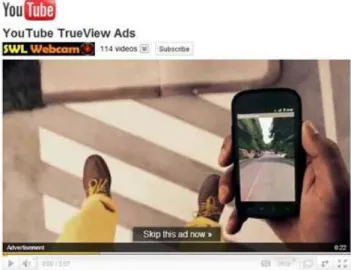
The following picture shows how a pre-roll ad looks like before streaming a video on the website.
Figure 2: Pre-roll Ad format in Youtube
It is clear that this type of advertising represents a good opportunity for many companies maintaining commercials on television and that want to locate their message in video streaming platforms. At the same time it becomes important for them to understand if it is wise to do so, given that the intrusive tactic that represents may generate negative perceptions that could transfer to the brand, product, company and even the website provider of the videos. Previous research shows that users perceive online ads as more intrusive that in other media (Zhu, et al. 2009), thus there is no guarantee that by posting the ad before a video in Youtube it will not be ignored or the user will not feel irritated.
Pre-roll advertising is clearly positionated and needs to be further examined, there is no basic research addressing pre-roll, rather the most information is encountered in companies dedicated to analyze the new formats in the market but not from a consumer behaviour perspective. Even though that pre-roll is a new context it can also be compared with television commercials and small ads shown before regular programming, and as it was mentioned before it was only reviewed in terms of rating but not in depth with behavior and possible determinants and consequences of their perceptions (Bollapragada and Garbiras, 2004). In the scientific literature there is nothing to find regarding pre-roll online video ads and its consumer experience has not yet been scientifically researched. The present study can give a contribution by extending to a new context which is pre-roll advertising as a hybrid experience for the viewer with online video and a TV format commercial. For this reason the following chapter focuses in negative processing perceptions in advertising, before understanding perceived intrusiveness in the pre-roll consumer mindset and draw up hypotheses regarding the factors coming together for its formation and its consequences.
3
NEGATIVE ADVERTISING PERCEPTIONS
Advertising has been successfully used to influence consumer behaviour and/or attitude. Proving to be a marketing tool capable of deliver messages regarding certain product, brand or company information in order to persuade consumers´ attitude, believe and awareness which ultimately is intended to have effect on consumption (Wright-Isak, et al. 1997). The different strategies used across different advertising formats (e.g. cognitive, affective, conative) and appeals (e.g. humor, sex, rationality, etc) have been supporting in creating awareness, associations, attachment and attitude towards brands and its ads (Clow and Baack, 2007; Keller, 2001). However, consumer perceptions and outcomes are not only positive in advertising. The present chapter gives an overview of the side effects of advertising starting from traditional to online formats in order to understand the negative side of ads while addressing factors that explain these perceptions. A review of current knowledge regarding perceived intrusiveness is given before establishing the hypotheses of the study in the chapter four.
3.1 NEGATIVE PERCEPTIONS IN TRADITIONAL ADVERTISING
As starting point in traditional advertising, behaviours like avoidance or perceptions of irritation from users have been identified in intended campaigns. Irritation has been known as the most common factor of negative perceptions among advertising. The study of Aaker and Bruzzone (1985) provides an overview of the causes of irritation in traditional formats such as commercials in broadcast media. These causes have to with the product class and content; however our understanding focuses more on the mindset of the consumer, given that in previous research, it was found that some commercials are not even evaluated or are simply ignored regardless of the content.
Several studies have addressed the way consumers act towards certain type of advertising. In television commercials for example, it has been found that a high percentage of commercials were zipped. Benedicta (1989) mention ―zipping‖ as the electronic avoidance of commercials by fast-forwarding through them while viewing pre-recorded video-taped programs. Cronin and Menelly (1992) found that 9 out of 10 commercials that were zipped, were made in an avoidance mode, the authors suggest that is not the content of the commercial causing avoidance but that the commercials do not have even the opportunity to have viewers‘ attention. It is important to consider these findings because in pre-roll advertising, television commercial formats are used, and a similar behaviour could be founded on them; however it
was also suggested that the level of clutter relates to higher zipping because some viewers differ in tolerance for clutter (Ha, 1996 and Rotfeld, 2006).
Irritation from repetition and forced exposure.- Teachings from previous findings regarding negative perceptions in traditional media stems for instance by exposing to an audience seeing a single ad too frequently (Aaker and Bruzzone, 1985), this can make television users get irritated and therefore avoid the ads (Li, et al 2002). In pre-roll video ads, even though that there is a period between the ads they can come across as extremely annoying if the same ad is shown when a viewer is watching a set of videos from a playlist, the question lies in what happens if every seven minutes is exposed to the exact same commercial. We could relate this phenomena to the feeling of reactance, considering that if reactions of consumers are defensive, it may not be an effective strategy to force them view ads, thus according to the reactance theory, forced exposure will result in negative consequences, however if it could be minimized, it would not represent a threat to viewers‘ perceptions of freedom (Li, et al. 2002).
Furthermore, causes of irritation are broadly classified into ad content (e.g. exaggerated, confusing), execution (too loud, long or large) and placement referring to too many or repeatedly shown (Li et al, 2002a). Moreover, this irritation leads to avoidance behaviour for example in television commercials by changing channels, focusing on something else or leaving the room are the most common (Cronin and Menelly, 1992). In addition cognitive, behavioral and mechanical avoidance was found in print and broadcast media where cognitive relates to shifting focus, behavioral leaving the room, and mechanical use remote to change station (Speck and Elliott, 1997).
Avoidance.- Another negative implication in advertising has to do with avoidance. In traditional formats Speck, et.al (1997) studied the predictors of avoidance in print and broadcast media, specifically in magazines, newspapers, radio and television where it was discovered that different ad perceptions were the stronger predictors for avoidance. Demographic characteristics (age and income), breadth of media use, and communication problems (hindrance) were altogether considered the predictors for avoidance in these formats. Across Magazines, search hindrance and the perception that ads are not interesting are the strongest predictors, the same way in Newspapers plus considering them excessive, however the audience gets self-directed to classified ads in newspapers, moreover in radio format, commercials are considered annoying, hindering search for programming and seem disruptive. Finally, on television an avoiding behaviour in commercials is found depending on whether they watch
many channels, consider them unbelievable, commercials seem disruptive, perceive a waste of time in progress of programming or perceive them as annoying are the strongest ones (Speck, et.al 1997).
Another perspective of avoidance in broadcast media is given by Rojas-Mendez and Davies (2005) where according to time allocation theory; users perceive ads depending on their time orientation (i.e. past, present or future). The authors suggest that this, influences attitude towards advertising and avoidance in the way that past-oriented users see ads as important, but promoting consumption and tend to avoid them more than present people, which see ads as complimenting concerns from daily live, finally future-oriented people see ads as important in planning purchases and are less likely to avoid them. This mindset characteristic could represent a description for consumers when watching pre-roll ads, inferring if there is a relation that makes them feel less interrupted in an online environment and pre-roll advertising.
These negative feelings may also be related to perceptions of a delay in searching for programming content, blocking access to programming, interruption causing distractions and disrupt interaction with the desired content, in that way consumers can perceive them as intrusive. (Li et al. 2002a). Intrusiveness is mentioned here in a general way as part of negative perceptions in traditional advertising. Ha (1996) defined it as the interruption of editorial content and by definition, advertising seek to interrupt editorial content by interfering with their goals and limiting actions that consumers take to attain fully their goals, in traditional formats this may involve the effort implied in changing channels, skip ads in magazines and a perception of waist of time involved with this intrusiveness. A deeper overview of Intrusiveness is discussed in the 3.3 paragraph.
3.2 NEGATIVE PERCEPTIONS IN ONLINE ADVERTISING
In 1999 a research survey showed that 69% of users considered pop-ups annoying, and 23% said they would not return to the site simply because of the ads (McCoy et. al, 2007). This concerning can also be related to consumers being exposed to a high amount of ads leading to an ad clutter. The ad clutter was examined by Ha & McCann (2008) suggesting that the amount of advertising may play only a small role in creating negative advertising effects, however they identified characteristics like visibility and time delay affecting perceived advertising clutter level. Additionally the task which the consumer is focused on while using internet, may determine negative responses, for instance when searching for specific information in a limited amount of
time there can be different reasons to avoid the ads such as time pressure, irrelevant or nontargeted ads, etc., than those who use the Internet to pass time or for pure entertainment purposes (Cho and Cheon, 2004).
Avoidance.- in an online environment, several perceptions towards advertising can cause effects such as avoidance. Cho and Cheon (2004) found that perceived goal impediment, perceived ad clutter and prior negative experience explains why people cognitively, affectively, and behaviourally avoid the ads. Perceived goal impediment was the most significant antecedent explaining advertising avoidance on the web and its antecedents are search hindrance, disruption and distraction. Moreover perceived ad clutter is constructed by excessiveness, exclusiveness and irritation. The antecedents of prior negative experiences are dissatisfaction, perceived lack of utility and perceived lack of incentive (Cho and Cheon, 2004). In this way they suggest that the unexpected appearance of ads on Internet disrupts user tasks or goals and causes avoidance, this consequence could be applied for pre-roll advertising given that at the moment of video streaming an ad is not expected. A further reason may be that because it is a video format, a certain content of audio and video intended to see, so there is a motivation to process video and not advertising instead.
Irritation and placement.- Besides avoidance, other authors studied different effects in other ad formats, for example Ritther and Cho (2009) analyzed responses to advertising in podcasts. Specifically, they addressed the placement of the ad in contribution to the perception of irritation or annoyance. It was demonstrated that participants perceived less irritation from ads located at the start of the podcast than in the middle. Irritation it is an emotional response, which is a transitory affective experience that describes a feeling of annoyance, impatience or anger as a result of a certain experience (Ritther and Cho, 2009). This finding could be further applied for pre-roll ads given that is not standardized and some ads are located at the beginning, middle or the end. Moreover, frequency at which the ads are exposed was found to be a cause for irritation in pop-up ads and irritation is mentioned as precursor for ad avoidance (Li et. al, 2002).
Negative attitudes.- In the online environment, regardless that consumers find some information useful or entertaining in ads, reports present that consumers develop negative attitudes towards ads in internet and avoid them as much as possible, in contrast to traditional advertising; this attitude in a Web context means avoidance to the site (McCoy et al., 2007). In
other words more negative perceptions could be developed from a site that delivers more advertisement, in the pre-roll context for example, this distinction could be made from web pages that deliver more ads such as Youtube in contrast to a broadcast page of a TV station or other streaming websites Dailymotion. In addition of the reviewed negative perceptions in traditional and online advertising, it may be interesting to test the attitude towards advertising in general, advertising online and towards television commercial formats (Shavitt, et al. 2004), given that some negative attitudes already established in the mind of consumers could influence the perception of intrusiveness, irritation and avoidance in pre-roll advertising, due to its characteristics by being a mixture of television commercial format in an online environment.
Perceived goal impediment.- Additionally, within negative perceptions online, the format can represent a varying perception according to the format for example in pop-ups, banners, or others that yield a different perceived goal impediment (Li et.al, 2002). In banner ads for instance, Newman et al. (2004) state that consistency is expected by consumers, with product class associated with the banner and the web page in balance, to ensure positive brand associations and reduce negative effects (Li et al, 2002). Part of these negative effects can have impact on the long term regarding advertising exposure, this may relate to psychological reactance which was mentioned before. In other words, even though that currently it exist tools to avoid ads more effectively such as popblockers, important implications could be further examined for certain websites that manage advertising that threatens consumers´ freedom, sense of control and goal attainment through its exposition to ads (Truong and Simmons, 2010).
Irritation and irrelevant advertisement.- other reactions have been studied in formats not so conventional such as mobile phones. In this format consumers hold a very personalized relationship with their mobiles in the way of companion and connection with their community, thus they could be more easily irritated when receiving intrusive pushed advertising (Truong and Simmons, 2010). Intrusive tactics also have been taken in consideration for its analysis and users have made a distinction between ‗helpful‘ and ‗misleading‘ internet advertisements, the latter like erroneous benefit information, products and services located on banner advertisements with prices to capture attention, which led to unavailable stock of products or services. Thus trust reveals a determinant of perceptions relating to online advertising and users seem to have negative perceptions of internet as conveyor of impersonal and irrelevant advertising, however the web environment is appreciated as a medium of having
control over what is searched and is wanted to view (Truong and Simmons, 2010). At a general level this idea can be applied to the video streaming platform, where users approach to the content but may be exposed to pre-roll ads that can manifest impersonal or irrelevant, this can keep those negative perceptions as in other formats and cause avoidance or irritation, considering as well that consumers nowadays use mobile phones to watch videos on Youtube contributing to a possible perception of ad clutter besides the current advertising existing for mobile phones.
As it was described, there is a high similarity between the negative perceptions of traditional media and the online environment, given that the latter is a hybrid form that allows to access to different type of information at once, ranging from text, pictures, videos and others. In this way irritation and avoidance are encountered in both even considering the important difference with the web which lies regarding the motives behind its usage such as communication or building online communities. In the same way, an important phenomenon named as intrusiveness may be the core driver for the negative perceptions, for instance in online advertising is found as antecedent of irritation and avoidance (Li et al. 2002b) and needs to be further described in other to assess its relevance, relation and consequences regarding its effect in pre-roll advertising.
3.3 REVIEW OF INTRUSIVENESS
Li, Edwards and Lee (2002) defined intrusiveness as a cause of annoyance and irritation that affects the way consumer processes ads tending to form negative attitudes. Their studies are limited to pop-ups, magazine printed ads and television commercials. But still it has not been researched on the pre-roll ad context. It is clear that intrusive tactics for getting consumer‘s attention in an online context may create intrusiveness (Wang Zhang, Choi & D`Eredita, 2002). However, in pre-roll ads there are different factors versus other advertising formats that make intrusiveness a very important issue that needs to be better understood from the perspective of consumer behavior and the impact in advertising effectiveness. By being a format that suddenly pops-up in the screen before streaming a video, consumers are prepared to mentally process that video and rather are forced to watch an ad. In this type of advertising it has not been addressed yet which are the confounding factors for perceived intrusiveness.
Definition.- Part of the definition of Li et al (2002) deals intrusiveness as a psychological reaction to ads that interfere with a consumer's ongoing cognitive processes, they state this interference as broader than interruption given that includes aspects of an ad itself
(volume, length, or size) and the media schedule (frequency and clutter) that could add to feelings of this intrusiveness. This definition applies logically to the context of pre-roll advertising and the authors identified specific constituents for it in the terms of distracting; disturbing, forced, interfering, intrusive, and obtrusive.
As it was stated before a distinction needs to be made across online ads because several formats have different characteristics that influence perceived intrusiveness, for example a pre-roll ad may yield different perceived goal impediment in comparison to a pop-up or banner which is ignored more easily than pre-roll ads. In formats such as banners or pop-ups, users are interrupted in their task and have to scroll ads and close pop-up windows. According to McCoy, et al., 2007 the more important or urgent this task is, the more intrusive the interruption is likely to be perceived. Moreover (Ritter and Cho, 2009) studied intrusiveness in podcast advertising and found that they are easily found intrusive because the goal is to download a particular file and listen to that content and not to advertising, this effect can lead to avoidance as it was proven by other studies for example in pop-ups where intrusiveness is antecedent of avoidance (Lee, et al, 2002) The implication of this studies and the similarity with pre-roll is that the audience made an effort to look for a video and intends to direct the attention to look at certain video and not to advertising.
Location.- Another contribution of Ritter and Cho (2009) has to do with the placement of the ad in the podcasts, where perceived less intrusiveness came from ads located at the start of the podcast than in the middle. However they also found that when ads were placed in the middle, sponsorships resulted in noticeably less intrusiveness than traditional ads. This insight could be applied for the pre-roll context where commercials with a higher length could be located only at the start and very short commercials in the middle, in this way because of its short length it could be perceived as less intrusive and reduce avoidance or irritation.
Performed task.- Perceived intrusiveness is explained by interruptions caused from a certain task. The negative reaction comes from the need to expend additional effort to process information coming in the interruption, leading to ad avoidance and irritation (McCoy, et al. 2007 and Li et al. 2002). Regarding the comparison of intrusiveness in several formats it was found that pop-ups were 24% more intrusive than in-line ads and pop-unders were 33.1% more intrusive than in-line ads (McCoy et al. 2007). The reason why one format is considered more intrusive than other is that apparently users prefer not deviating their attention and take additional steps to close pop-up windows. In the case of pre-roll even tough some ads may
contain an option to close it after 5 or 10 seconds it still implies having to do an action which was not expected and interrupted the intended goal. The authors also measured behavioural intentions to return to the site, but even considering one or other format, the tendency was negative regarding decisions of returning, this assumption could be applicable for pre-roll advertising given that from the start when advertising was not located and when pop-ups and popunders appeared, they were not as intrusive, as to getting to the point of suspending the rolling of the video and locate an ad instead, which can present higher perceived intrusiveness, considering that some ads equals the length of the video intended to watch. Thus the intentions of remaining in that website can be questionable if competing companies do not locate ad in such formats or manage to locate them in such a way which is not that intrusive or annoying.
Region of interest and deviated attention.- Liu, Qiu, Huang, Jiang and Xu (2009) studied intrusiveness and attention of the audience in in-image advertising and discovered that two aspects of attention affect intrusiveness, being first if the inserted ad covers the Region of Interest (ROI), then it is very intrusive and second if distracts attention from the original attending points. Based on these findings pre-roll advertising may be considered as highly intrusive given that involves all the region of interest, however the original attending points remain the same, rather what is intended to see is changed.
Antecedents and consequences from previous studies.- The antecedents of the model of intrusiveness of Li et al. (2002) are cognitive intensity, editorial-ad congruence, Ad entertainment and Ad informativeness, the evidence they provide regarding the consequences of intrusiveness is that, when ads are perceived as intrusive, feelings of irritation are elicited and advertisements are avoided. Ad entertainment and informativeness moderate perceived intrusiveness. The level of cognitive intensity is related to the intensity the viewers pursue their goals, thus when they are focused, perceive interruptions as more severe. Based on this pre-roll ads may have a higher level of perceived intrusiveness given that cognitively viewers are motivated to process certain content and are more sensitive to such interruption although this could vary among the purpose of watching the videos whether involve a task with more value of time or more serious purposes rather than entertainment or surfing. Li et al. (2002) provides a scale for measuring perceived intrusiveness and proposes variables to limit perceptions of intrusiveness, which are, first targeting viewers when their cognitive effort is low for example locating at breaks, second increasing the relevancy of the advertising, and finally providing value to viewers in the way of information or entertainment.
Furthermore, Wehmeyer (2007) studie