TimeGraph: GPU Scheduling for Real-Time Multi-Tasking Environments
Shinpei Kato
† ‡, Karthik Lakshmanan
†, and Ragunathan (Raj) Rajkumar
†, Yutaka Ishikawa
‡†
Department of Electrical and Computer Engineering, Carnegie Mellon University
‡
Department of Computer Science, The University of Tokyo
Abstract
The Graphics Processing Unit (GPU) is now commonly used for graphics and data-parallel computing. As more and more applications tend to accelerate on the GPU in multi-tasking environments where multiple tasks access the GPU concurrently, operating systems must provide prioritization and isolation capabilities in GPU resource management, particularly in real-time setups.
We present TimeGraph, a real-time GPU scheduler at the device-driver level for protecting important GPU workloads from performance interference. TimeGraph adopts a new event-driven model that synchronizes the GPU with the CPU to monitor GPU commands issued from the user space and control GPU resource usage in a responsive manner. TimeGraph supports two priority-based scheduling policies in order to address the trade-off between response times and throughput introduced by the asynchronous and non-preemptive nature of GPU processing. Resource reservation mechanisms are also employed to account and enforce GPU resource usage, which prevent misbehaving tasks from exhausting GPU resources. Prediction of GPU command execution costs is further provided to enhance isolation.
Our experiments using OpenGL graphics benchmarks demonstrate that TimeGraph maintains the frame-rates of primary GPU tasks at the desired level even in the face of extreme GPU workloads, whereas these tasks be-come nearly unresponsive without TimeGraph support. Our findings also include that the performance overhead imposed on TimeGraph can be limited to 4-10%, and its event-driven scheduler improves throughput by about 30 times over the existing tick-driven scheduler.
1
Introduction
The Graphics Processing Unit (GPU) is the burgeoning platform to support high-performance graphics and data-parallel computing, as its peak performance is exceeding 1000GFLOPS, which is nearly equivalent of 10times that of traditional microprocessors. User-end windowing systems, for instance, use GPUs to present a more lively interface that improves the user experience significantly through 3-D windows, high-quality graphics, and smooth
transition. Especially recent trends on 3-D browser and desktop applications, such as SpaceTime, Web3D, 3D-Desktop, Compiz Fusion, BumpTop, Cooliris, and Win-dows Aero, are all intriguing possibilities for future user interfaces. GPUs are also leveraged in various domains of general-purpose GPU (GPGPU) processing to facili-tate data-parallel compute-intensive applications.
Real-time multi-tasking support is a key requirement for such emerging GPU applications. For example, users could launch multiple GPU applications concurrently in their desktop computers, including games, video play-ers, web browsplay-ers, and live messengplay-ers, sharing the same GPU. In such a case, quality-aware soft real-time ap-plications like games and video players should be pri-oritized over live messengers and any other applications accessing the GPU in the background. Other examples include GPGPU-based cloud computing services, such as Amazon EC2, where virtual machines sharing GPUs must be prioritized and isolated from each other. More in general, important applications must be well-isolated from others for quality and security issues on GPUs, as on-line and user-space programs can create any arbi-trary set of GPU commands, and access the GPU directly through generic I/O system calls, meaning that malicious and buggy programs can easily cause the GPU to be over-loaded. Thus, GPU resource management consolidating prioritization and isolation capabilities plays a vital role in real-time multi-tasking environments.
GPU resource management is usually supported at the operating-system level, while GPU program code itself including GPU commands is generated through libraries, compilers, and runtime frameworks. Particularly, it is a device driver that transfers GPU commands from the CPU to the GPU, regardless of whether they produce graphics or GPGPU workloads. Hence, the development of a robust GPU device driver is of significant impact for many GPU applications. Unfortunately, existing GPU device drivers [1, 5, 7, 19, 25] are not tailored to support real-time multi-tasking environments, but accelerate one particular high-performance application in the system or provide fairness among applications.
We have conducted a preliminary evaluation to see the performance of existing GPU drivers, (i) the NVIDIA proprietary driver [19] and (ii) the Nouveau open-source
0 0.2 0.4 0.6 0.8 1
NVIDIA Nouveau NVIDIA Nouveau
Relative frame rate to standalone
w/ Engine w/ Clearspd
Graphics drivers / Graphics cards GeForce 9800 GT GeForce GTX 285
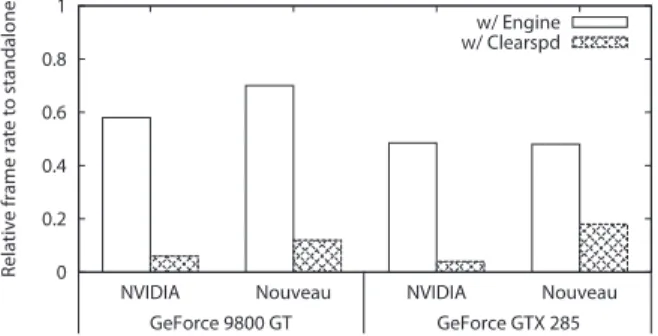
Figure 1: Decrease in performance of the OpenArena ap-plication competing with different GPU apap-plications.
driver [7], in multi-tasking environments, using two dif-ferent NVIDIA graphics cards, (i) GeForce 9800 GT and (ii) GeForce GTX 285, where the Linux 2.6.35 kernel is used as the underlying operating system. It should be noted that this NVIDIA driver evaluated on Linux is also expected to closely match the performance of the Win-dows driver (WDDM [25]), as they share about90%of code [23]. Figure 1 shows the relative decrease in per-formance (frame-rate) of an OpenGL game (OpenArena) competing with two GPU-accelerated programs (Engine and Clearspd [15]) respectively. The Engine program represents a regularly-behaved GPU workload, while the Clearspd program produces a GPU command bomb causing the GPU to be overloaded, which represents a malicious or buggy program. To achieve the best possi-ble performance, this preliminary evaluation assigns the highest CPU (nice) priority to the OpenArena applica-tion as an important applicaapplica-tion. As observed in Fig-ure 1, the performance of the important OpenArena ap-plication drops significantly due to the existence of com-peting GPU applications. It highlights the fact that GPU resource management in the current state of the art is woefully inadequate, lacking prioritization and isolation capabilities for multiple GPU applications.
Contributions: We propose, design, and implement
TimeGraph, a GPU scheduler to provide prioritization
and isolation capabilities for GPU applications in soft real-time multi-tasking environments. We address a core challenge for GPU resource management posed due to the asynchronous and non-preemptive nature of GPU processing. Specifically, TimeGraph adopts an
event-driven scheduler model that synchronizes the GPU with
the CPU in a responsive manner, using GPU-to-CPU interrupts, to schedule non-preemptive GPU commands for the asynchronously-operating GPU. Under this event-driven model, TimeGraph supports two scheduling poli-cies to prioritize tasks on the GPU, which address the trade-off between response times and throughput. Time-Graph also employs two resource reservation policies to
isolate tasks on the GPU, which provide different levels
of quality of service (QoS) at the expense of different lev-els of overhead. To the best of our knowledge, this is the first work that enables GPU applications to be prioritized and isolated in real-time multi-tasking environments.
Organization: The rest of this paper is organized as follows. Section 2 introduces our system model, in-cluding the scope and limitations of TimeGraph. Sec-tion 3 provides the system architecture of TimeGraph. Section 4 and Section 5 describe the design and imple-mentation of TimeGraph GPU scheduling and reserva-tion mechanisms respectively. In Secreserva-tion 6, the perfor-mance of TimeGraph is evaluated, and its capabilities are demonstrated. Related work is discussed in Section 7. Our concluding remarks are provided in Section 8.
2
System Model
Scope and Limitations: We assume a system composed of a generic multi-core CPU and an on-board GPU. We do not manipulate any GPU-internal units, and hence GPU commands are not preempted once they are submit-ted to the GPU. TimeGraph is independent of libraries, compilers, and runtime engines. The principles of Time-Graph are therefore applicable for different GPU archi-tectures (e.g., NVIDIA Fermi/Tesla and ATI Stream) and programming frameworks (e.g., OpenGL, OpenCL, CUDA, and HMPP). Currently, TimeGraph is designed and implemented for Nouveau [7] available in the Gal-lium3D [15] OpenGL software stack, which is also planned to support OpenCL. Moreover, TimeGraph has been ported to the PSCNV open-source driver [22] pack-aged in the PathScale ENZO suite [21], which supports CUDA and HMPP. This paper is, however, focused on OpenGL workloads, given the currently-available set of open-source solutions: Nouveau and Gallium3D.
Driver Model: TimeGraph is part of the device driver, which is an interface for user-space programs to submit GPU commands to the GPU. We assume that the device driver is designed based on the Direct Rendering
Infras-tructure (DRI) [14] model that is adopted in most
UNIX-like operating systems, as part of the X Window System. Under the DRI model, user-space programs are allowed to access the GPU directly to render frames without us-ing windowus-ing protocols, while they still use the win-dowing server to blit the rendered frames to the screen. GPGPU frameworks require no such windowing proce-dures, and hence their model is more simplified.
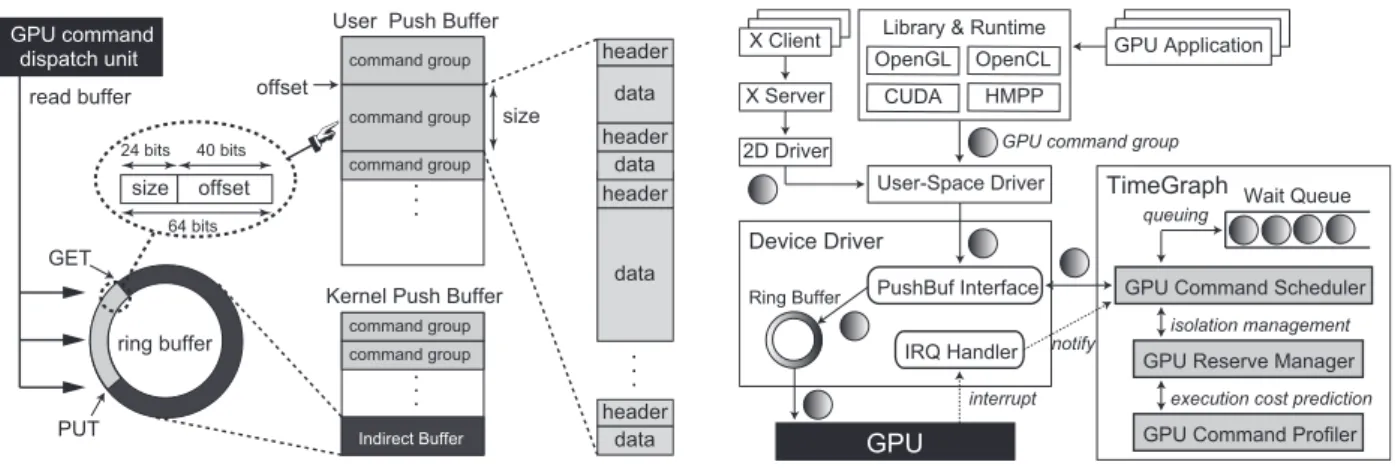
In order to submit GPU commands to the GPU, user-space programs must be allocated GPU channels, which conceptually represent separate address spaces on the GPU. For instance, the NVIDIA Fermi and Tesla archi-tectures support128channels. Our GPU command sub-mission model for each channel is shown in Figure 2.
GET PUT size offset 64 bits 24 bits 40 bits offset size User Push Buffer
Kernel Push Buffer
header data header header . . . header data data data Indirect Buffer command group command group command group command group command group . . . . . . ring buffer GPU command dispatch unit read buffer
Figure 2: GPU command submission model.
Each channel uses two types of kernel-space buffers:
User Push Buffer and Kernel Push Buffer. The User Push
Buffer is mapped on to the address space of the corre-sponding task, where GPU commands are pushed from the user space. GPU commands are usually grouped as non-preemptive regions to match user-space atomic-ity assumptions. The Kernel Push Buffer, meanwhile, is used for kernel primitives, such as host-device synchro-nization, GPU initialization, and GPU mode setting.
While user-space programs push GPU commands into the User Push Buffer, they also write packets, each of which is a (size and address) tuple to locate a certain GPU command group, into a specific ring buffer part of the Kernel Push Buffer, called Indirect Buffer. The driver configures the command dispatch unit on the GPU to read the buffer for command submission. This ring buffer is controlled byGETandPUTpointers. The point-ers start from the same place. Every time packets are written to the buffer, the driver moves thePUTpointer to the tail of the packets, and sends a signal to the GPU command dispatch unit to download the GPU command groups located by the packets between theGETandPUT pointers. TheGETpointer is then automatically updated to the same place as thePUTpointer. Once these GPU command groups are submitted to the GPU, the driver does not manage them any longer, and continues to sub-mit the next set of GPU command groups, if any. Thus, this Indirect Buffer plays a role of a command queue.
Each GPU command group may include multiple GPU commands. Each GPU command is composed of the header and data. The header contains methods and the data size, while the data contains the values being passed to the methods. Methods represent GPU instruc-tions, some of which are shared between compute and graphics, and others are specific for each. We assume that the device driver does not preempt on-the-fly GPU command groups, once they are offloaded on to the GPU. GPU command execution is out-of-order within the same
Ring Buffer
Wait Queue
GPU
GPU Command Scheduler
GPU Reserve Manager
GPU Command Profiler PushBuf Interface IRQ Handler interrupt notify queuing isolation management
execution cost prediction TimeGraph
Device Driver
GPU command group
X Server
User-Space Driver OpenGL
Library & Runtime OpenCL CUDA HMPP
X Client GPU Application
2D Driver
Figure 3: TimeGraph system architecture.
GPU channel. The GPU channels are switched automat-ically by the GPU engines.
Our driver model described above is based on Direct
Rendering Manager (DRM) [6], and especially target the
NVIDIA Fermi and Tesla architectures, but can also be used for other architectures with minor modification.
3
TimeGraph System Architecture
The architecture of TimeGraph and its interaction with the rest of the software stack is illustrated in Figure 3. No modification is required for user-space programs, and GPU command groups can be generated through exist-ing software frameworks. However, TimeGraph needs to communicate with a specific interface, called PushBuf, in the device driver space. The PushBuf interface enables the user space to submit GPU command groups stored in the User Push Buffer. TimeGraph uses this PushBuf in-terface to queue GPU command groups. It also uses the IRQ handler prepared for GPU-to-CPU interrupts to dis-patch the next available GPU command groups.
TimeGraph is composed of GPU command scheduler,
GPU reserve manager, and GPU command profiler. The
GPU command scheduler queues and dispatches GPU command groups based on task priorities. It also coordi-nates with the GPU reserve manager to account and en-force GPU execution times of tasks. The GPU command profiler supports prediction of GPU command execution costs to avoid overruns out of reservation. There are two scheduling policies supported to address the trade-off be-tween response times and throughput:
• Predictable-Response-Time (PRT): This policy minimizes priority inversion on the GPU to provide predictable response times based on priorities.
• High-Throughput (HT): This policy increases total throughput, allowing additional priority inversion.
Get Buffer Object
Lock Mutex
Activate Buffer
Reservation Requested?
Submit Command Group
Start Accounting Setup Interrupt Deactivate Buffer Unlock Mutex Sleep <Scheduling Policy> Run or Wait? <Reservation Policy> Run or Wait? Stop Accounting Enter PushBuf Interface
Leave PushBuf Interface Sleep Run No Wait Deactivate Buffer Unlock Mutex Yes Wait Run GPU Idle?
Wake Up Next Task
Leave IRQ Handler Enter IRQ Handler
Yes
No
Figure 4: Diagram of the PushBuf interface and the IRQ handler with the TimeGraph scheme.
It also supports two GPU reservation policies that ad-dress the trade-off between isolation and throughput:
• Posterior Enforcement (PE): This policy enforces GPU resource usage after GPU command groups are completed without sacrificing throughput.
• Apriori Enforcement (AE): This policy enforces GPU resource usage before GPU command groups are submitted using prediction of GPU execution costs at the expense of additional overhead. In order to unify multiple tasks into a single reserve, the TimeGraph reservation mechanism provides theShared
reservation mode. Particularly, TimeGraph creates a spe-cialSharedreserve instance with the PEpolicy when loaded, called Background, which serves all GPU-accelerated tasks that do not belong to any specific re-serves. The detailed design and implementation for GPU scheduling and GPU reservation will be described in Section 4 and Section 5 respectively.
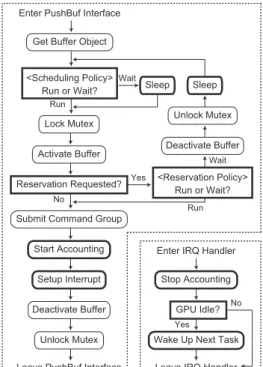
Figure 4 shows a high-level diagram of the PushBuf interface and the IRQ handler, where modifications in-troduced by TimeGraph are highlighted by bold frames. This diagram is based on the Nouveau implementation, but most GPU drivers should have similar control flows. The PushBuf interface first acquires the buffer object associated with the incoming GPU command group. It then applies the scheduling policy to determine whether this GPU command group can execute on the GPU. If it
should not be dispatched immediately, the corresponding task goes to sleep. Else, the User Push Buffer object is activated for command submission with the mutex lock to ensure the GPU command group to be located in the place accessible from the GPU, though the necessity of this procedure depends on driver implementation. Time-Graph next checks if GPU reservation is requested for this task. If so, it applies the reservation policy to ver-ify the GPU resource usage of this task. If it overruns, TimeGraph winds up buffer activation, and suspends this task until its resource budget becomes available. This task will be rescheduled later when it is waken up, since some higher-priority tasks may arrive by then. Finally, if the GPU command group is qualified by the scheduling and reservation policies, it is submitted to the GPU. As the reservation policies need to track GPU resource us-age, TimeGraph starts accounting for the GPU execution time of this task. It then configures the GPU command group to generate an interrupt to the CPU upon comple-tion so that TimeGraph can dispatch the next GPU com-mand group. After deactivating the buffer and unlocking the mutex, the PushBuf interface returns.
The IRQ handler receives an interrupt notifying the completion of the current GPU command group, where TimeGraph stops accounting for the GPU execution time, and wakes up the next task to execute on the GPU based on the scheduling policy, if the GPU is idle.
Specification: System designers may use a
specifica-tion primitive to activate the TimeGraph funcspecifica-tionality,
which is inspired by the Redline system [31]. For each application, system designers can specify the scheduling parameters as: <name:sched:resv:prio:C:T>, where name is the application name, sched is its scheduling policy,resvis its reservation policy,prio is its priority, and a set ofC andT represents that the application task is allowed to execute on the GPU forC microseconds everyTmicroseconds. The specification is a text file (/etc/timegraph.spec), and TimeGraph reads it every time a new GPU channel is allocated to a task. If there is a matching entry based on the applica-tion name associated with the task, the specificaapplica-tion is applied to the task. Otherwise, the task is assigned the lowest GPU priority and theBackgroundreserve.
Priority Assignment: While system designers may assign static GPU priorities in their specification, Time-Graph also supports automatic GPU priority assignment (AGPA), which is enabled by using a wild-card “*” entry in thepriofield. TimeGraph provides a user-space dae-mon executing periodically to identify the task with the foreground window through a window programming in-terface, such as the_NET_ACTIVE_WINDOWand the
_NET_WM_PID properties in the X Window System.
TimeGraph receives the foreground task information via a system call, and assigns the highest priority to this
task among those running under the AGPA mechanism. These tasks execute at the default static GPU priority level. Hence, different tasks can be prioritized over them by assigning higher static GPU priorities. AGPA is, how-ever, not available if the above window programming in-terface is not supported. TimeGraph instead provides another user-space tool for system designers to assign priorities. For instance, designers can provide an opti-mal priority assignment based on reserve periods [13], as widely adopted in real-time systems.
Admission Control: In order to achieve predictable services in overloaded situations, TimeGraph provides an admission control scheme that forces the new re-serve to be a background rere-serve so that currently ac-tive reserves continue to execute in a predictable manner. TimeGraph provides a simple interface where designers specify the limit of total GPU resource usage by 0-100% in a text file (/etc/timegraph.ac). The amount of limit is computed by a traditional resource-reservation model based onCandT of each reserve [26].
4
TimeGraph GPU Scheduling
The goal of the GPU command scheduler is to queue and
dispatch non-preemptive GPU command groups in
ac-cordance with task priorities. To this end, TimeGraph contains a wait queue to stall tasks. It also manages a
GPU-online list, a list of pointers to the GPU command
groups currently executing on the GPU.
The GPU-online list is used to check if there are currently-executing GPU command groups, when a GPU command group enters into the PushBuf interface. If the list is empty, the corresponding task is inserted into it, and the GPU command group is submitted to the GPU. Else, the task is inserted into the wait queue to be sched-uled. The scheduling policies supported by TimeGraph will be presented in Section 4.1.
Management of the GPU-online list requires the in-formation about when GPU command groups complete. TimeGraph adopts an event-driven model that uses GPU-to-CPU interrupts to notify the completion of each GPU command group, rather than a tick-driven model adopted in the previous work [1, 5]. Upon every interrupt, the cor-responding GPU command group is removed from the GPU-online list. Our GPU-to-CPU interrupt setting and handling mechanisms will be described in Section 4.2.
4.1
Scheduling Policies
TimeGraph supports two GPU scheduling policies. The
Predictable-Response-Time (PRT)policy encourages such tasks that should behave on a timely basis without affecting important tasks. This policy is predictable in a sense that GPU command groups are scheduled based
CPU
GPU
HP task MP task LP task TimeGraph
command
submission interrupt
time
time
wait queue task arrival
(a)PRTscheduling.
CPU
GPU
HP task MP task LP task TimeGraph
command
submission interrupt
time
time
wait queue task arrival
(b)HTscheduling.
Figure 5: Example of GPU scheduling in TimeGraph.
on task priorities to make high-priority tasks responsive on the GPU. TheHigh-Throughput (HT)policy, on the other hand, is suitable for such tasks that should execute as fast as possible. There is a trade-off that the PRT
policy prevents tasks from interference at the expense of throughput, while theHTpolicy achieves high through-put for one task but may block others. For instance, desktop-widget, browser-plugin, and video-player tasks are desired to use thePRTpolicy, while 3-D game and interactive 3-D interfacing tasks can use theHTpolicy.
PRT Scheduling: The PRT policy forces any GPU command groups to wait for the completion of the pre-ceding GPU command group, if any. Specifically, a new GPU command group arriving at the device driver can be submitted to the GPU immediately, if the GPU-online list is empty. Else, the corresponding task must sleep in the wait queue. The highest-priority task in the wait queue, if any, is waken up upon every interrupt from the GPU.
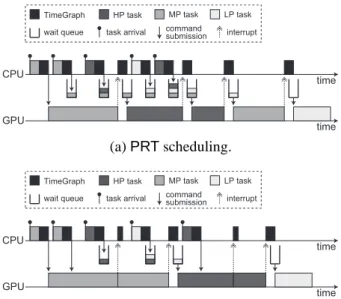
Figure 5 (a) indicates how three tasks with different priorities, high-priority, medium-priority (MP), and low-priority (LP), are scheduled on the GPU under thePRT
policy. When the MP task arrives, its GPU command group can execute on the GPU, since no GPU command groups are executing. Given that the GPU and CPU op-erate asynchronously, the MP task can arrive again while its previous GPU command group is executing. How-ever, the MP task is queued this time, because the GPU is not idle, according to thePRTpolicy. Even the next HP task is also queued due to the same reason, since fur-ther higher-priority tasks may arrive soon. The specific set of GPU commands appended at the end of every GPU command group by TimeGraph generates an interrupt to the CPU, and the TimeGraph scheduler is invoked
ac-cordingly to wake up the highest-priority task in the wait queue. Hence, the HP task is next chosen to execute on the GPU rather than the MP task. In this manner, the next instance of the LP task and the second instance of the HP task are scheduled in accordance with their priorities.
Given that the arrival times of GPU command groups are not known a priori, and each GPU command group is non-preemptive, we believe that thePRTpolicy is the best possible approach to provide predictable response times. However, it inevitably incurs overhead to make a scheduling decision at every GPU command group boundary, as shown in Figure 5 (a).
HT Scheduling: TheHTpolicy reduces this schedul-ing overhead, compromisschedul-ing predictable response times a bit. It allows GPU command groups to be submitted to the GPU immediately, if (i) the currently-executing GPU command group was submitted by the same task, and (ii) no higher-priority tasks are ready in the wait queue. Otherwise, they must suspend in the same manner as the
PRTpolicy. Upon an interrupt, the highest-priority task in the wait queue is waken up, only when the GPU-online list is empty (the GPU is idle).
Figure 5 (b) depicts how the same set of GPU com-mand groups used in Figure 5 (a) is scheduled under the
HTpolicy. Unlike thePRTpolicy, the second instance of the MP task can submit its GPU command group imme-diately, because the currently-executing GPU command group was issued by itself. These two GPU command groups of the MP task can execute successively without producing the idle time. The same is true for the two GPU command groups of the HP task. Thus, theHT pol-icy is more for throughput-oriented tasks, but the HP task is blocked by the MP task for a longer internal. This is a trade-off, and if priority inversion is critical, the PRT policy is more appropriate.
4.2
Interrupt Setting and Handling
In order to provide an event-driven model, TimeGraph configures the GPU to generate an interrupt to the CPU upon the completion of each GPU command group. The scheduling point is thus made at every GPU command group boundary. We now describe how the interrupt is generated. For simplicity of description, we here focus on the NVIDIA GPU architecture.
Completion Notifier: The NVIDIA GPU provides
theNOTIFYcommand to generate an interrupt from the
GPU to the CPU. TimeGraph puts this command at the end of each GPU command group. However, the in-terrupt is not launched immediately when theNOTIFY command is operated but when the next command is dis-patched. TimeGraph therefore adds theNOPcommand after theNOTIFYcommand, as a dummy command. We also need to consider that GPU commands execute out
of order on the GPU. If theNOTIFYcommand is oper-ated before all commands in the original GPU command group are operated, the generated interrupt is not timely at all. TimeGraph hence adds the SERIALIZE com-mand right before theNOTIFYcommand, which forces the GPU to stall until all on-the-fly commands complete. There is no need to add another piece of theSERIALIZE command after theNOTIFYcommand, since we know that no tasks other than the current task can use the GPU until TimeGraph is invoked upon the interrupt.
Interrupt Association: All interrupts from the GPU caught in the IRQ handler are relayed to TimeGraph. When TimeGraph receives an interrupt, it first references the head of the GPU-online list to obtain the task in-formation associated with the corresponding GPU com-mand group. TimeGraph next needs to verify whether this interrupt is truly generated by the commands that TimeGraph inserted into at the end of the GPU command group, given that user-space programs may also use the
NOTIFYcommand. In order to recognize the right
inter-rupt, TimeGraph further adds theSET_REFcommand before theSERIALIZEcommand, which instructs the GPU to write a specified sequence number to a particular GPU register. This number is identical for each task, and is simply incremented by TimeGraph. TimeGraph reads this GPU register when an interrupt is received. If the register value is less than the expected sequence num-ber associated with the corresponding GPU command group, this interrupt should be ignored, since it must have been caused by someone else before theSET_REF com-mand. Another piece of theSERIALIZEcommand also needs to be added before theSET_REFcommand to en-sure in-order command execution. As a consequence, TimeGraph inserts the following commands at the end of each GPU command group:SERIALIZE,SET_REF,
SERIALIZE,NOTIFY,NOP.
Task Wake-Up: Once the interrupt is verified, Time-Graph removes the GPU command group at the head of the GPU-online list. If the corresponding task is sched-uled under the PRT policy, TimeGraph wakes up the highest-priority task in the wait queue, and inserts its GPU command group into the GPU-online list. If the task is assigned theHTpolicy, meanwhile, TimeGraph wakes up the highest-priority task in the same manner as thePRTpolicy, only when the GPU-online list is empty.
5
TimeGraph GPU Reservation
TimeGraph provides GPU reservation mechanisms to regulate GPU resource usage for tasks scheduled under thePRTpolicy. Each task is assigned a reserve that is represented by capacityCand periodT. Budgeteis the amount of time that a task is entitled for execution. Time-Graph uses a popular rule for budget consumption and
GPU time budgetC
0
arrival arrival arrival arrival other commands T T T (a)PEreservation. GPU time budgetC 0
arrival arrival arrival arrival
other commands
T T T
predicted cost
(b)AEreservation.
Figure 6: Example of GPU reservation in TimeGraph.
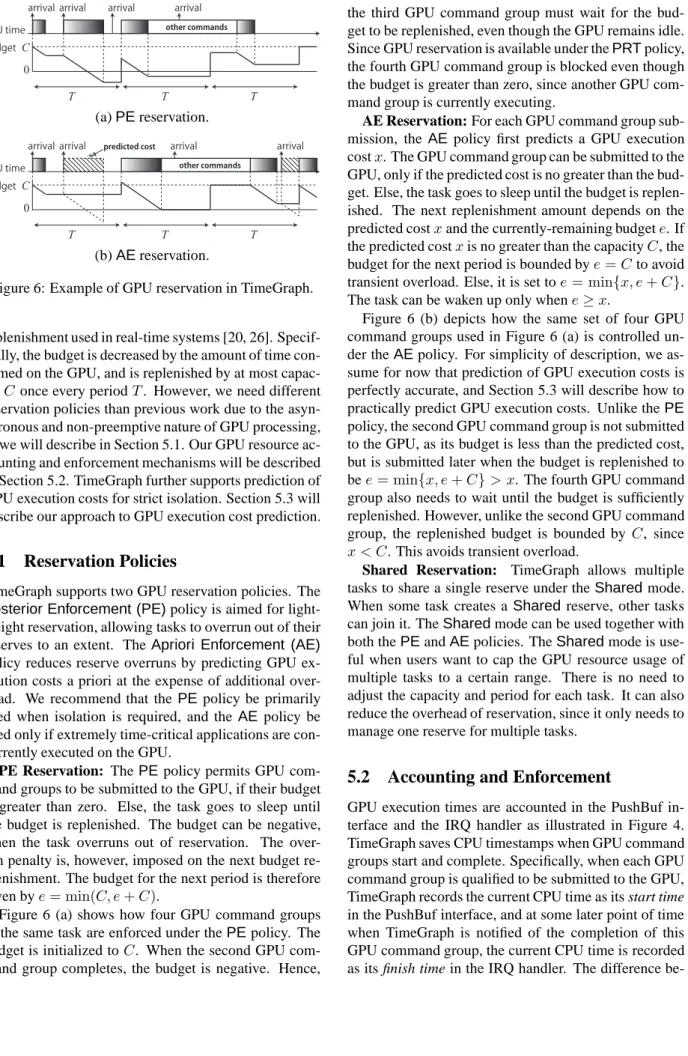
replenishment used in real-time systems [20, 26]. Specif-ically, the budget is decreased by the amount of time con-sumed on the GPU, and is replenished by at most capac-ityC once every periodT. However, we need different reservation policies than previous work due to the asyn-chronous and non-preemptive nature of GPU processing, as we will describe in Section 5.1. Our GPU resource ac-counting and enforcement mechanisms will be described in Section 5.2. TimeGraph further supports prediction of GPU execution costs for strict isolation. Section 5.3 will describe our approach to GPU execution cost prediction.
5.1
Reservation Policies
TimeGraph supports two GPU reservation policies. The
Posterior Enforcement (PE)policy is aimed for light-weight reservation, allowing tasks to overrun out of their reserves to an extent. TheApriori Enforcement (AE)
policy reduces reserve overruns by predicting GPU ex-ecution costs a priori at the expense of additional over-head. We recommend that thePE policy be primarily used when isolation is required, and the AE policy be used only if extremely time-critical applications are con-currently executed on the GPU.
PE Reservation: ThePEpolicy permits GPU com-mand groups to be submitted to the GPU, if their budget is greater than zero. Else, the task goes to sleep until the budget is replenished. The budget can be negative, when the task overruns out of reservation. The over-run penalty is, however, imposed on the next budget re-plenishment. The budget for the next period is therefore given bye= min(C, e+C).
Figure 6 (a) shows how four GPU command groups of the same task are enforced under thePEpolicy. The budget is initialized toC. When the second GPU com-mand group completes, the budget is negative. Hence,
the third GPU command group must wait for the bud-get to be replenished, even though the GPU remains idle. Since GPU reservation is available under thePRTpolicy, the fourth GPU command group is blocked even though the budget is greater than zero, since another GPU com-mand group is currently executing.
AE Reservation: For each GPU command group sub-mission, theAE policy first predicts a GPU execution costx. The GPU command group can be submitted to the GPU, only if the predicted cost is no greater than the bud-get. Else, the task goes to sleep until the budget is replen-ished. The next replenishment amount depends on the predicted costxand the currently-remaining budgete. If the predicted costxis no greater than the capacityC, the budget for the next period is bounded bye=Cto avoid transient overload. Else, it is set toe= min{x, e+C}. The task can be waken up only whene≥x.
Figure 6 (b) depicts how the same set of four GPU command groups used in Figure 6 (a) is controlled un-der theAEpolicy. For simplicity of description, we as-sume for now that prediction of GPU execution costs is perfectly accurate, and Section 5.3 will describe how to practically predict GPU execution costs. Unlike thePE
policy, the second GPU command group is not submitted to the GPU, as its budget is less than the predicted cost, but is submitted later when the budget is replenished to bee= min{x, e+C}> x. The fourth GPU command group also needs to wait until the budget is sufficiently replenished. However, unlike the second GPU command group, the replenished budget is bounded byC, since
x < C. This avoids transient overload.
Shared Reservation: TimeGraph allows multiple tasks to share a single reserve under theSharedmode. When some task creates aShared reserve, other tasks can join it. TheSharedmode can be used together with both thePEandAEpolicies. TheSharedmode is use-ful when users want to cap the GPU resource usage of multiple tasks to a certain range. There is no need to adjust the capacity and period for each task. It can also reduce the overhead of reservation, since it only needs to manage one reserve for multiple tasks.
5.2
Accounting and Enforcement
GPU execution times are accounted in the PushBuf in-terface and the IRQ handler as illustrated in Figure 4. TimeGraph saves CPU timestamps when GPU command groups start and complete. Specifically, when each GPU command group is qualified to be submitted to the GPU, TimeGraph records the current CPU time as its start time in the PushBuf interface, and at some later point of time when TimeGraph is notified of the completion of this GPU command group, the current CPU time is recorded as its finish time in the IRQ handler. The difference
be-tween the start time and the finish time is accounted for as the execution time of this GPU command group, and is subtracted from the budget.
Enforcement works differently for thePEand theAE
policies. In the PushBuf interface, theAEpolicy predicts the execution costxof each GPU command group based on the idea presented in Section 5.3, while thePE pol-icy always assumesx= 0. Then, both policies compare the budgeteand the costx. Only ife > xis satisfied, the GPU command group can be submitted to the GPU. Otherwise, the corresponding task is suspended until the budget is replenished. It should be noted that this en-forcement mechanism is very different from traditional CPU reservation mechanisms [20, 26] that use timers or ticks to suspend tasks, since GPU command groups are non-preemptive, and hence we need to perform enforce-ment at GPU command group boundary. TimeGraph however still uses timers to replenish the budget period-ically. Every time the budget is replenished, it compares eandxagain. Ife > xis satisfied, the task is waken up, but it needs to be rescheduled, as illustrated in Figure 4.
5.3
Command Profiling
TimeGraph contains the GPU command profiler to pre-dict GPU execution costs forAEreservation. Each GPU command is composed of the header and data, as shown in Figure 2. We hence parse the methods and the data sizes from the headers.
We now explain how to predict GPU execution costs from these pieces of information. GPU applications tend to repeatedly create GPU command groups with the same methods and data sizes, since they use the same set of API functions, e.g., OpenGL, and each function likely generates the same sequence of GPU commands in terms of methods and data sizes, while data values are quite variant. Given that GPU execution costs depend highly on methods and data sizes, but not on data values, we propose a history-based prediction approach.
TimeGraph manages a history table to record the GPU command group information. Each record consists of a
GPU command group matrix and the average GPU
ex-ecution cost associated to this matrix. The row and the column of the matrix contain the methods and their data sizes respectively. TimeGraph also attaches a flag to each GPU command group, indicating if it hits some record. When the methods and the data sizes of the GPU com-mand group are obtained from the remapped User Push Buffer, TimeGraph looks at the history table. If there exists a record that contains exactly the same GPU com-mand group matrix, i.e., the same set of methods and data sizes, it uses the average GPU execution cost stored in this record, and the flag is set. Otherwise, the flag is cleared, and TimeGraph uses the worst-case GPU
ex-ecution cost among all the records. Upon the comple-tion of the GPU command group, TimeGraph references the flag attached to the corresponding task. If the flag is set, it updates the average GPU execution cost of the record with the actual execution time of this GPU com-mand group. Otherwise, it inserts a new record where the matrix has the methods and the data size of this GPU command group, and the average GPU execution time is initialized with its actual execution time. The size of the history table is configurable by designers. If the total number of the records exceeds the table size, the least-recently-used (LRU) record is removed.
Preemption Impact: Even the same GPU command group may consume very different GPU execution times. For example, if reusable texture data is cached, graph-ics operation is much faster. We realize that when the GPU contexts (channels) are switched, GPU execution times can vary. Hence, TimeGraph verifies GPU con-text switches at every scheduling point. If the concon-text is switched, TimeGraph will not update the average GPU execution cost, since the context switch may have af-fected the actual GPU execution time. Instead, it saves the difference between the actual GPU execution time and the average GPU execution cost as the preemption
impact. TimeGraph keeps updating the average
preemp-tion impact. A single preemppreemp-tion cost is measured be-forehand when TimeGraph is loaded. The preemption impact is then added to the predicted cost.
6
Evaluation
We now provide a detailed quantitative evaluation of TimeGraph on the NVIDIA GeForce 9800 GT graphics card with the default frequency and 1 GB of video mem-ory. Our underlying platform is the Linux 2.6.35 kernel running on the Intel Xeon E5504 CPU and 4 GB of main memory. While our evaluation and discussion are fo-cused on this graphics card, Similar performance benefits from TimeGraph have also been observed with different graphics cards viz, GeForce GTX 285 and GTX 480.
As primary 3-D graphics benchmarks, we use the Phoronix Test Suite [24] that executes the OpenGL 3-D games, OpenArena, World of Padman, Urban Terror, and Unreal Tournament 2004 (UT2004), in the demo mode based on the test profile, producing various GPU-intensive workloads. We also use MPlayer as a pe-riodic workload. In addition, the Gallium3D Engine demo program is used as a regularly-behaved workload, and the Gallium3D Clearspd demo program that ex-ploits a GPU command bomb is used as a misbehaving workload. Furthermore, we use SPECviewperf 11 [28] to evaluate the throughput of different GPU scheduling models. The screen resolution is set to 1280×1024. The scheduling parameters are loaded from the
pre-configured TimeGraph specification file. The maximum number of records in the history table for GPU execution cost prediction is set to100.
6.1
Prioritization and Isolation
We first evaluate the prioritization and isolation proper-ties achieved by TimeGraph. As described in Section 3, TimeGraph automatically assigns priorities. CPUnice priorities are always effective, while GPU priorities are effective only when TimeGraph is activated. The priority level is aligned between the GPU and CPU. We use the
PRTpolicy for the X server to prevent it from affecting primary applications, but it is scheduled by the highest GPU/CPU priority, since it should still be responsive to blit the rendered frames to the screen.
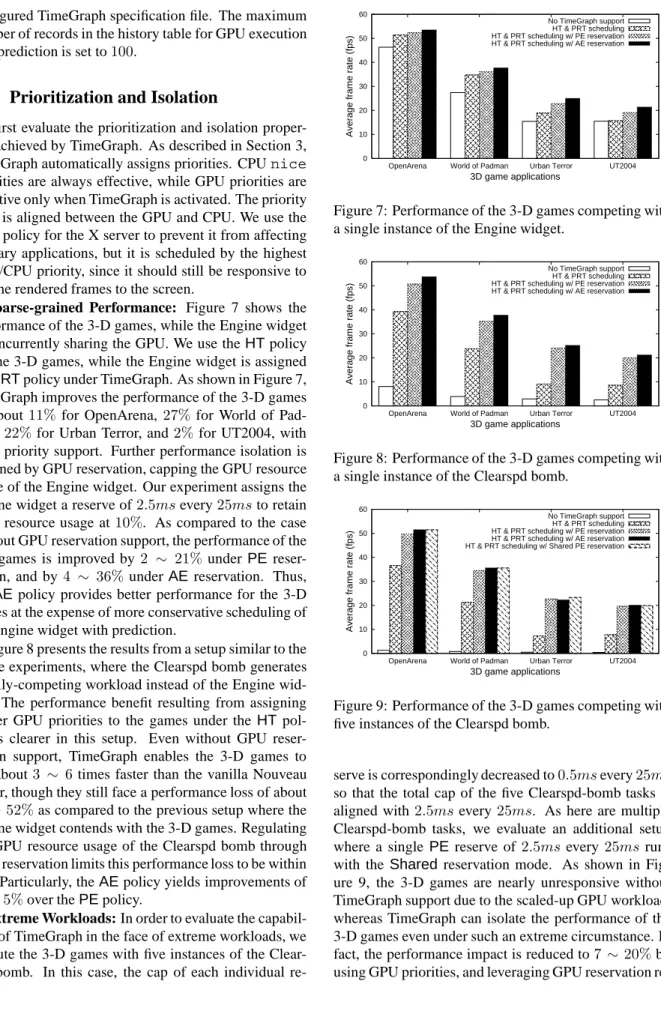
Coarse-grained Performance: Figure 7 shows the performance of the 3-D games, while the Engine widget is concurrently sharing the GPU. We use theHTpolicy for the 3-D games, while the Engine widget is assigned thePRTpolicy under TimeGraph. As shown in Figure 7, TimeGraph improves the performance of the 3-D games by about11%for OpenArena, 27%for World of Pad-man,22%for Urban Terror, and2% for UT2004, with GPU priority support. Further performance isolation is obtained by GPU reservation, capping the GPU resource usage of the Engine widget. Our experiment assigns the Engine widget a reserve of2.5msevery25msto retain GPU resource usage at10%. As compared to the case without GPU reservation support, the performance of the 3-D games is improved by2 ∼ 21%underPE reser-vation, and by 4 ∼ 36%underAE reservation. Thus, the AEpolicy provides better performance for the 3-D games at the expense of more conservative scheduling of the Engine widget with prediction.
Figure 8 presents the results from a setup similar to the above experiments, where the Clearspd bomb generates heavily-competing workload instead of the Engine wid-get. The performance benefit resulting from assigning higher GPU priorities to the games under the HT pol-icy is clearer in this setup. Even without GPU reser-vation support, TimeGraph enables the 3-D games to run about3 ∼ 6 times faster than the vanilla Nouveau driver, though they still face a performance loss of about 24∼52%as compared to the previous setup where the Engine widget contends with the 3-D games. Regulating the GPU resource usage of the Clearspd bomb through GPU reservation limits this performance loss to be within 3%. Particularly, theAEpolicy yields improvements of up to5%over thePEpolicy.
Extreme Workloads: In order to evaluate the capabil-ities of TimeGraph in the face of extreme workloads, we execute the 3-D games with five instances of the Clear-spd bomb. In this case, the cap of each individual
0 10 20 30 40 50 60
OpenArena World of Padman Urban Terror UT2004
Average frame rate (fps)
3D game applications
No TimeGraph support HT & PRT scheduling HT & PRT scheduling w/ PE reservation HT & PRT scheduling w/ AE reservation
Figure 7: Performance of the 3-D games competing with a single instance of the Engine widget.
0 10 20 30 40 50 60
OpenArena World of Padman Urban Terror UT2004
Average frame rate (fps)
3D game applications
No TimeGraph support HT & PRT scheduling HT & PRT scheduling w/ PE reservation HT & PRT scheduling w/ AE reservation
Figure 8: Performance of the 3-D games competing with a single instance of the Clearspd bomb.
0 10 20 30 40 50 60
OpenArena World of Padman Urban Terror UT2004
Average frame rate (fps)
3D game applications
No TimeGraph support HT & PRT scheduling HT & PRT scheduling w/ PE reservation HT & PRT scheduling w/ AE reservation HT & PRT scheduling w/ Shared PE reservation
Figure 9: Performance of the 3-D games competing with five instances of the Clearspd bomb.
serve is correspondingly decreased to0.5msevery25ms so that the total cap of the five Clearspd-bomb tasks is aligned with2.5msevery25ms. As here are multiple Clearspd-bomb tasks, we evaluate an additional setup where a single PE reserve of2.5msevery 25msruns with the Sharedreservation mode. As shown in Fig-ure 9, the 3-D games are nearly unresponsive without TimeGraph support due to the scaled-up GPU workload, whereas TimeGraph can isolate the performance of the 3-D games even under such an extreme circumstance. In fact, the performance impact is reduced to7 ∼20%by using GPU priorities, and leveraging GPU reservation
0 50 100 150 200 250 10 20 30 40 50 60 70 Frame rate (fps)
Reserve size of the Engine widget (%)
Engine against Openarena
Engine (AE reservation) against Openarena Openarena against Engine
Openarena against Engine (AE reservation)
Figure 10: Performance regulation by GPU reservation for the 3-D game and the 3-D widget.
0 40 80 120 160 200 240 280 320 0 10 20 30 40 50 60 70 80 90 100 110 120 Frame rate (fps)
Elapsed time (second)
No TimeGraph support PRT scheduling
PRT scheduling w/ PE reservation PRT scheduling w/ AE reservation PRT scheduling w/ Shard PE reservation
Figure 11: Performance of the Engine widget competing with five instances of the Clearspd bomb.
sults in nearly no performance loss, similar to results in Figure 8. TheShared reservation mode also provides slightly better performance withPEreserves.
Performance Regulation: We next demonstrate the effectiveness of TimeGraph in regulating the frame-rate for each task by changing the size of GPU reserve. Fig-ure 10 shows the performance of the OpenArena game and the Engine widget contending with each other. The solid lines indicate a setup where thePE policy is as-signed for both the applications, while the dotted lines indicate a setup where theAEpolicy is assigned for the Engine widget instead. GPU reservation is configured so that the total GPU resource usage of the two applica-tions is capped at90%, and the remaining10%is avail-able for the X server. Assigning theAEpolicy for the Engine widget slightly improves the performance of the OpenArena game, while it brings a performance penalty for the Engine widget itself due to the overhead for pre-diction of GPU execution costs. In either case, however, TimeGraph successfully regulates the frame-rate in ac-cordance with the size of GPU reserve. In this exper-iment, we conclude that it is desirable to assign a GPU reserve for the OpenArena game withC/T= 60∼80% and that for the Engine widget withC/T = 10∼30%, given that this configuration provides both the applica-tions with an acceptable frame-rate over25fps.
0 40 80 120 160 200 0 10 20 30 40 50 60 70 80 90 100 110 120 Frame rate (fps)
Elapsed time (second)
Engine #1 Engine #2 Engine #3
(a) No TimeGraph support.
0 40 80 120 160 200 0 10 20 30 40 50 60 70 80 90 100 110 120 Frame rate (fps)
Elapsed time (second)
Engine #1 Engine #2 Engine #3 (b)PRTscheduling. 0 40 80 120 160 200 0 10 20 30 40 50 60 70 80 90 100 110 120 Frame rate (fps)
Elapsed time (second)
Engine #1 Engine #2 Engine #3
(c)PRTscheduling andPEreservation.
Figure 12: Interference among three widget instances.
Fine-grained Performance: The 3-D games demon-strate highly variable frame-rate workloads, while 3-D widgets often exhibit nearly constant frame-rates. In or-der to study the behavior of TimeGraph on both these two categories of applications, we look at the variabil-ity of frame-rate with time for the Engine widget con-tending with five instances of the Clearspd bomb, as shown in Figure 11. The total GPU resource usage of the Clearspd-bomb tasks is capped at2.5msevery25ms through GPU reservation, and a higher priority is given to the Engine widget. These results show that GPU reser-vation can provide stable frame-rates on a time for the Engine widget. Since the Engine widget is not as GPU-intensive as the 3-D games, it is affected more by the Clearspd bomb making the GPU overloaded, when GPU reservation is not applied. The benefits of GPU reserva-tion are therefore more clearly observed.
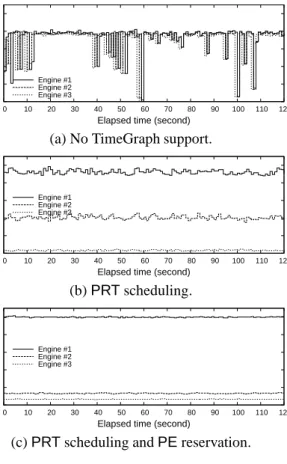
Interference Issues: We now evaluate the interfer-ence among regularly-behaved concurrent 3-D widgets. Figure 12 (a) shows a chaotic behavior arising from exe-cuting three instances of the Engine widget concurrently, with different CPU priorities but without TimeGraph support. Although the Engine widget by itself is a very regular workload, when competing with more instances of itself, the GPU resource usage exhibits high
0 5 10 15 20 25 0 20 40 60 80 100 120 140 160 180 200 Frame rate (fps)
Elapsed time (second)
No TimeGraph support PRT scheduling w/ PE reservation
Figure 13: Performance of MPlayer competing with five instances of the Clearspd bomb.
ity and unpredictability. Figure 12 (b) illustrates the im-proved behavior under TimeGraph using the PRT pol-icy, where we assign the high, the medium, and the low GPU priorities for Engine #1, Engine #2, and Engine #3 respectively, using the user-space tool presented in Sec-tion 3. TimeGraph successfully provides predictable re-sponse times for the three tasks according based on their priorities. Further performance isolation can be achieved by GPU reservation, exploiting different sizes of GPU reserves: (i)15msevery25msto Engine #1, (ii)5ms every50msto Engine #2, and (iii)5msevery100msto
Engine #3, as shown in Figure 12 (c). ThePEpolicy is used here. Since the Engine widget has a non-trivial de-pendence on the CPU, the absolute performance is lower than expected for smaller reserves.
Periodic Behavior: For evaluating the impact on ap-plications with periodic activity, we execute MPlayer in the foreground when five instances of the Clearspd bomb contend for the GPU. We use an H264-compressed video, with a frame size of 1920×800 and a frame rate of24fps, which uses x-video acceleration on the GPU. As shown in Figure 13, the video playback experience is significantly disturbed without TimeGraph support. When TimeGraph assigns aPEreserve of 10msevery 40msfor MPlayer, and aPEreserve of5msevery40ms for the Clearspd bomb tasks in theSharedreservation mode, the playback experience is significantly improved. It closely follows the ideal frame-rate of24fps for video playback. This illustrates the benefits of TimeGraph for interactivity, where performance isolation plays a vital role in determining user experience.
6.2
GPU Execution Cost Prediction
We now evaluate the history-based prediction of GPU ex-ecution costs for realizing GPU reservation with theAE
policy. The effectiveness ofAEreservation relies highly on GPU execution cost prediction. Hence, it is impor-tant to identify the types of applications for which we
0 200 400 600 800
Actual GPU cost (us)
-400 -200 0 200 400 5000 6000 7000 8000 9000 10000
Prediction error (us)
GPU command group counts
(a) Engine widget.
0 500 1000 1500 2000
Actual GPU cost (us)
-1000 -500 0 500 1000 5000 6000 7000 8000 9000 10000
Prediction error (us)
GPU command group counts
(b) Clearspd bomb. 0 1000 2000 3000 4000 5000
Actual GPU cost (us)
-3000 -2000 -1000 0 1000 2000 5000 6000 7000 8000 9000 10000
Prediction error (us)
GPU command group counts
(c) OpenArena game.
Figure 14: Errors for GPU execution cost prediction.
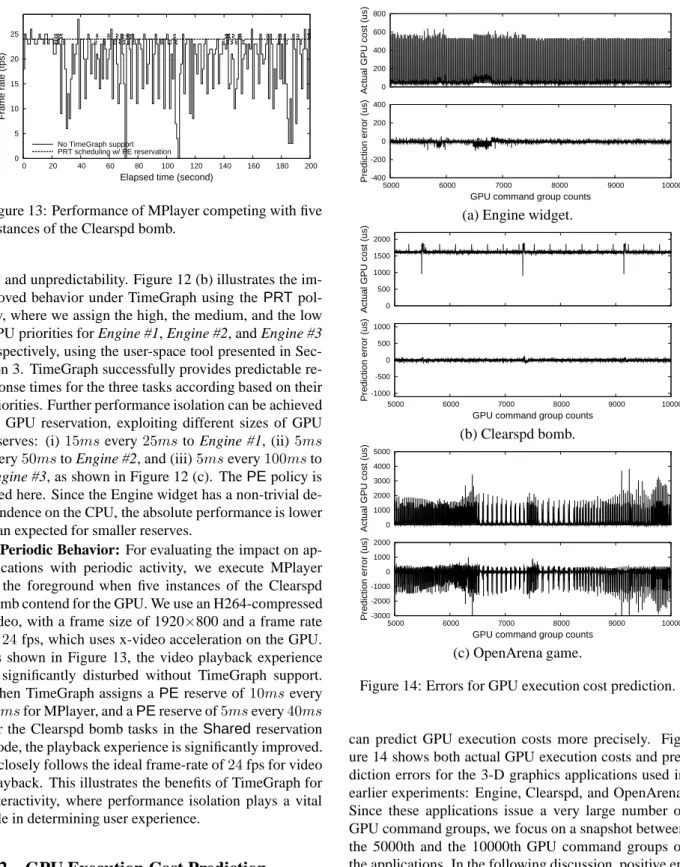
can predict GPU execution costs more precisely. Fig-ure 14 shows both actual GPU execution costs and pre-diction errors for the 3-D graphics applications used in earlier experiments: Engine, Clearspd, and OpenArena. Since these applications issue a very large number of GPU command groups, we focus on a snapshot between the 5000th and the 10000th GPU command groups of the applications. In the following discussion, positive er-rors denote pessimistic predictions. Figure 14 (a) shows that the history-based prediction approach employed by TimeGraph performs within a15%error margin on the Engine widget that uses a reasonable number of meth-ods. For the Clearspd bomb that issues a very limited set of methods, while producing extreme workloads,
Time-Graph can predict GPU execution costs within a7% er-ror margin as shown in Figure 14 (b). On the other hand, the results of GPU execution cost prediction un-der OpenArena, provided in Figure 14 (c), show that only about65%of the observed GPU command groups have the predicted GPU execution costs within a 20% error margin. Such unpredictability arises from the in-herently dynamic nature of complex computer graphics like abrupt scene changes. The actual penalty of mis-prediction is, however, suffered only once per reserve period, and is hence not expected to be significant for reserves with long periods.
In addition to the presented method, we have also ex-plored static approaches using pre-configured values for predicted costs. Our experiments show that such static approaches perform worse than the presented dynamic approach, largely due to the dynamically changing and non-stationary nature of application workloads.
GPU execution cost prediction plays a vital role in real-time setups, where it is unacceptable for low-priority tasks to even cause the slightest interference to high-priority tasks. As the above experimental results show that our prediction approach tends to fail for complex interactive applications like OpenArena. However, we expect the structure of real-time applications to be less dynamic and more regular like the Engine and Clearspd tasks. GPU reservation with theAEpolicy for complex applications like OpenArena would require support from the application program itself, since their behavior is not easily predictable from historic execution results. Other-wise, thePEpolicy is desired for low overhead.
6.3
Overhead and Throughput
In order to quantify the performance overhead imposed by TimeGraph, we measure the standalone performance of the 3-D game benchmarks. Figure 15 shows that as-signing the HT policy for both the games and the X server incurs about 4% performance overhead for the games. This small overhead is attributed to the fact that TimeGraph is still invoked upon every arrival and com-pletion of GPU command group. It is interesting to see that assigning thePRTpolicy for the X server increases the overhead for the games up to about10%, even though the games use theHTpolicy. As the X server is used to blit the rendered frames to the screen, it can lower the frame-rate of the game, if it is blocked by the game itself. On the other hand, assigning the PRT policy for both the X server and the game adds a non-trivial overhead of about17∼28%largely due to queuing and dispatching all GPU command groups. This overhead is introduced by queuing delays and scheduling overheads, as Time-Graph needs to be invoked for submission of each GPU command group. We however conjecture that such
0 10 20 30 40 50 60 70
OpenArena World of Padman Urban Terror UT2004
Average frame rate (fps)
3D game applications
No timing support HT scheduling (both game and Xorg) HT scheduling PRT scheduling PRT scheduling w/ AE reservation PRT scheduling w/ AE reservation
Figure 15: Performance overheads of TimeGraph.
0 0.5 1 1.5 2 2.5 3 3.5 4 handShaded
handShaded HQ hand wireframe
squid shaded
squid shaded HQ toy store shaded
toy store wireframe
wolf fur select
wolf fur select HQ
wolf shaded
wolf shaded HQ
Frame rate (fps)
SPECViewperf11 Maya benchmarks No TimeGraph support
Event-driven model Tick-driven model
Figure 16: Throughput of event-driven and tick-driven schedulers in TimeGraph.
head cost is inevitable for GPU scheduling at the device-driver level to shield important GPU applications from performance interference. If there is no TimeGraph sup-port, the performance of high-priority GPU applications could significantly decrease in the presence of competing GPU workloads (as shown in Figure 1), which affects the system performance more than the maximum scheduling overhead of28%introduced by TimeGraph. As a con-sequence, TimeGraph is evidently beneficial in real-time multi-tasking environments.
Finally, we compare the throughput of two conceiv-able GPU scheduling models: (i) the event-driven sched-uler adopted in TimeGraph, and (ii) the tick-driven scheduler that was presented in the previous work, called GERM [1, 5]. The TimeGraph event-driven scheduler is invoked only when GPU command groups arrive and complete, while the GERM tick-driven scheduler is in-voked at every tick, configured to be1ms(Linux jiffies). Figure 16 shows the results of SPECviewperf bench-marking with the Maya viewset created for 3-D computer graphics, where thePRTpolicy is used for GPU schedul-ing. Surprisingly, the TimeGraph event-driven scheduler obtains about15∼30times better scores than the tick-driven scheduler for most test cases. According to our analysis, this difference arises from the fact that many
GPU command groups can arrive in a very short interval. The GERM tick-driven scheduler reads a particular GPU register every tick to verify if the current GPU command group has completed. Suppose that there are 30 GPU command groups with a total execution time of less than 1ms. The tick-driven scheduler takes at least30msto compete these GPU command groups because the GPU register must be read 10times, while the event-driven scheduler could complete them in1msas GPU-to-CPU interrupts are used. Hence, non-trivial overheads are im-posed on the tick-driven scheduler.
7
Related Work
GPU Scheduling: The Graphics Engine Resource Man-ager (GERM) [1, 5] aims for GPU multi-tasking support similar to TimeGraph. The resource management con-cepts of TimeGraph and GERM are, however, fundamen-tally different. TimeGraph focuses on prioritization and isolation among competing GPU applications, while fair-ness is a primary concern for GERM. Since fair resource allocation cannot shield particular important tasks from interference in the face of extreme workloads, as reported in [31], TimeGraph addresses this problem for GPU ap-plications through priority and reservation support. Ap-proaches to synchronize the GPU with the CPU are also different between TimeGraph and GERM. TimeGraph is based on an event-driven model that uses GPU-to-CPU interrupts, whereas GERM adopts a tick-driven model that polls a particular GPU register. As demonstrated in Section 6.3, the tick-driven model can become unre-sponsive when many GPU commands arrive in a short interval, which could likely happen for graphics and compute-intensive workloads, while TimeGraph is re-sponsive even in such cases. Hence, TimeGraph is more suitable for real-time applications. In addition, Time-Graph can predict GPU execution costs a priori, taking into account both methods and data sizes, while GERM
estimates them posteriorly, using only data sizes. Since
GPU execution costs are very dependent not only on data sizes but also on methods, we claim that TimeGraph computes GPU execution costs more precisely. How-ever, additional computation overheads are required for prediction. TimeGraph therefore provides light-weight reservation with thePEpolicy without prediction to ad-dress this trade-off. Furthermore, TimeGraph falls inside the device driver, while GERM is spread across the de-vice driver and user-space library. Hence, GERM could require major modifications for different runtime frame-works, e.g., OpenGL, OpenCL, CUDA, and HMPP.
The Windows Display Driver Model (WDDM) [25] is a GPU driver architecture for the Microsoft Windows. While it is proprietary, GPU priorities seem to be sup-ported in our experience, but are not explicitly exposed to
the user space as a first-class primitive. Apparently, there is no GPU reservation support. In fact, since NVIDIA shares more than90%of code between Linux and Win-dows [23]. Therefore, it eventually suffers from the per-formance interference as demonstrated in Figure 1.
VMGL [11] supports virtualization in the OpenGL APIs for graphics applications running inside a Vir-tual Machine (VM). It passes graphics requests from guest OSes to a VMM host, but GPU resource man-agement is left to the underlying device driver. The GPU-accelerated Virtual Machine (GViM) [8] virtual-izes the GPU at the level of abstraction for GPGPU ap-plications, such as the CUDA APIs. However, since the solution is ’above’ the device driver layer, GPU resource management is coarse-grained and functionally limited. VMware’s Virtual GPU [3] enables GPU virtualization at the I/O level. Hence, it operates faster and its usage is not limited to GPGPU applications. However, multi-tasking support with prioritization, isolation, or fairness is not supported. TimeGraph could coordinate with these GPU virtualization systems to provide predictable re-sponse times and isolation.
CPU Scheduling: TimeGraph shares the concept of priority and reservation, which has been well-studied by the real-time systems community [13, 26], but there is a fundamental difference from these traditional studies in that TimeGraph is designed to address an arbitrarily-arriving non-preemptive GPU execution model, whereas the real-time systems community has often considered a periodic preemptive CPU execution model. Several bandwidth-preserving approaches [12, 29, 30] for an arbitrarily-arriving model exist, but a non-preemptive model has not been much studied yet. The concept of priority and reservation has also been considered in the operating systems literature [4, 9, 10, 17, 20, 31]. Specifically, batch scheduling has a similar constraint to GPU scheduling in that non-preemptive regions disturb predictable responsiveness [27]. These previous work are, however, mainly focused on synchronous on-chip CPU architectures, whereas TimeGraph addresses those scheduling problems for asynchronous on-board GPU ar-chitectures where explicit synchronization between the GPU and CPU is required.
Disk Scheduling: Disk devices have similarity to GPUs in that they operate with non-preemptive regions off the chip. Disk scheduling for real-time and interactive systems [2, 16] therefore considered priority and reserva-tion support for non-preemptive operareserva-tion. However, the GPU is typically a coprocessor independent of the CPU, which has its own set of execution contexts, registers, and memory devices, while the disk is more dedicated to I/O. Hence, TimeGraph uses completely different mech-anisms to realize prioritization and isolation than these previous work. In addition, TimeGraph needs to
ad-dress the trade-off between predictable response times and throughput since synchronizing the GPU and CPU incurs overhead, while disk I/O is originally synchronous with read and write operation.
8
Conclusions
This paper has presented TimeGraph, a GPU scheduler to support real-time multi-tasking environments. We de-veloped the event-driven model to schedule GPU com-mands in a responsive manner. This model allowed us to propose two GPU scheduling policies, Predictable Response Time (PRT) andHigh Throughput (HT), which address the trade-off between response times and throughput. We also proposed two GPU reservation policies,Posterior Enforcement (PE)and theApriori Enforcement (AE), which present an essential design knob for choosing the level of isolation and through-put. Our detailed evaluation demonstrated that Time-Graph can protect important GPU applications even in the face of extreme GPU workloads, while provid-ing high-throughput, in real-time multi-taskprovid-ing environ-ments. TimeGraph is open-source software, and may be downloaded from our website athttp://rtml.ece. cmu.edu/projects/timegraph/.
In future work, we will elaborate coordination of GPU and CPU resource management schemes to fur-ther consolidate prioritization and isolation capabilities for the entire system. We are also interested in coordina-tion of video memory and system memory management schemes. Exploration of other models for GPU schedul-ing is another interestschedul-ing direction of future work. For instance, modifying the current API to introduce non-blocking interfaces could improve throughput at the ex-pense of modifications to legacy applications. Schedul-ing overhead and blockSchedul-ing time may also be reduced by implementing an real-time satellite kernel [18] on mi-crocontrollers present in modern GPUs. Finally, we will tackle the problem of mapping application-level specifi-cations, such as frame-rates, into priority and reservation properties at the operating-system level.
References
[1] BAUTIN, M., DWARAKINATH, A.,ANDCHIUEH, T. Graphics Engine Resource Management. In Proc. MMCN (2008). [2] DIMITRIJEVIC, Z., RANGAWAMI, R.,ANDCHANG, E. Design
and Implementation of Semi-preemptible IO. In Proc. USENIX FAST (2003).
[3] DOWTY, M., AND SUGEMAN, J. GPU Virtualization on VMware’s Hosted I/O Architecture. ACM SIGOPS Operating Systems Review 43, 3 (2009), 73–82.
[4] DUDA, K.,ANDCHERITON, D. Borrowed-Virtual-Time (BVT) Scheduling: Supporting Latency-Sensitive Threads in a General-Purpose Scheduler. In Proc. ACM SOSP (1999), pp. 261–276. [5] DWARAKINATH, A. A Fair-Share Scheduler for the Graphics
Processing Unit. Master’s thesis, Stony Brook University, 2008.
[6] FAITH, R. The Direct Rendering Manager: Kernel Support for the Direct Rendering Infrastructure. Precision Insight, Inc., 1999. [7] FREEDESKTOP. Nouveau Open-Source Driver. http://
nouveau.freedesktop.org/.
[8] GUPTA, V., GAVRILOVSKA, A., TOLIA, N.,AND TALWAR, V. GViM: GPU-accelerated Virtual Machines. In Proc. ACM HPCVirt (2009), pp. 17–24.
[9] JONES, M., ROSU, D.,ANDROSU, M.-C. CPU Reservations and Time Constraints: Efficient, Predictable Scheduling of Inde-pendent Activities. In Proc. ACM SOSP (1997), pp. 198–211. [10] KRASIC, C., SAUBHASIK, M.,ANDGOEL, A. Fair and Timely
Scheduling via Cooperative Polling. In Proc. ACM EuroSys (2009), pp. 103–116.
[11] LAGAR-CAVILLA, H., TOLIA, N., SATYANARAYANAN, M., AND DELARA, E. VMM-Independent Graphics Acceleration. In Proc. ACM VEE (2007), pp. 33–43.
[12] LEHOCZKY, J., SHA, L.,ANDSTROSNIDER, J. Enhanced Ape-riodic Responsiveness in Hard Real-Time Environments. In Proc. IEEE RTSS (1987), pp. 261–270.
[13] LIU, C.,ANDLAYLAND, J. Scheduling Algorithms for Multi-programming in a Hard Real-Time Environment. Journal of the ACM 20 (1973), 46–61.
[14] MARTIN, K., FAITH, R., OWEN, J.,ANDAKIN, A. Direct Ren-dering Infrastructure, Low-Level Design Document. Precision Insight, Inc., 1999.
[15] MESA3D. Gallium3D.http://www.mesa3d.org/. [16] MOLANO, A., JUWA, K., AND RAJKUMAR, R. Real-Time
Filesystems. Guaranteeing Timing Constraints for Disk Accesses in RT-Mach. In Proc. IEEE RTSS (1997), pp. 155–165. [17] NIEH, J.,ANDLAM, M. SMART: A Processor Scheduler for
Multimedia Applications. In Proc. ACM SOSP (1995). [18] NIGHTINGALE, E., HODSON, O., MCLLORY, R., HAW
-BLITZEL, C.,ANDHUNT, G. Helios: Heterogeneous Multipro-cessing with Satellite Kernels. In Proc. ACM SOSP (2009). [19] NVIDIA CORPORATION. Proprietary Driver. http://www.
nvidia.com/page/drivers.html.
[20] OIKAWA, S.,ANDRAJKUMAR, R. Portable RT: A Portable Re-source Kernel for Guaranteed and Enforced Timing Behavior. In Proc. IEEE RTAS (1999), pp. 111–120.
[21] PATHSCALEINC. ENZO.http://www.pathscale.com/. [22] PATHSCALE INC. PSCNV. https://github.com/
pathscale/pscnv.
[23] PHORONIX. NVIDIA Developer Talks Openly About Linux Sup-port. http://www.phoronix.com/scan.php?page= article&item=nvidia qa linux&num=2.
[24] PHORONIX. Phoronix Test Suite. http://www. phoronix-test-suite.com/.
[25] PRONOVOST, S., MORETON, H.,ANDKELLEY, T. Windows Display Driver Model (WDDM v2) And Beyond. In Windows Hardware Engineering Conference (2006).
[26] RAJKUMAR, R., LEE, C., LEHOCZKY, J., ANDSIEWIOREK, D. A Resource Allocation Model for QoS Management. In Proc. IEEE RTSS (1997), pp. 298–307.
[27] ROUSSOS, K., BITAR, N., ANDENGLISH, R. Deterministic Batch Scheduling Without Static Partitioning. In Proc. JSSPP (1999), pp. 220–235.
[28] SPEC. SPECviewperf. http://www.spec.org/gwpg/ gpc.static/vp11info.html.
[29] SPRUNT, B., LEHOCZKY, J.,ANDSHA, L. Exploiting Unused Periodic Time for Aperiodic Service using the Extended Priority Exchange Algorithm. In Proc. IEEE RTSS (1988), pp. 251–258. [30] SPURI, M.,ANDBUTTAZO, G. Efficient Aperiodic Service
un-der Earliest Deadline Scheduling. In Proc. IEEE RTSS (1994), pp. 2–11.
[31] YANG, T., LIU, T., BERGER, E., KAPLAN, S.,ANDMOSS, J.-B. Redline: First Class Support for Interactivity in Commodity Operating Systems. In Proc. USENIX OSDI (2008), pp. 73–86.