A machine learning approach to taking EEG-based brain-computer interfaces out of the lab
Dissertation
zur Erlangung des Grades eines Doktors der Naturwissenschaften
der Mathematisch-Naturwissenschaftlichen Fakultät und
der Medizinischen Fakultät der Eberhard-Karls-Universität Tübingen
vorgelegt von
Vinay Jayaram
aus Farmington Hills, United States of America
Tag der mündlichen Prüfung: 15.11.2018
Dekan der Math.-Nat. Fakultät: Prof. Dr. W. Rosenstiel Dekan der Medizinischen Fakultät: Prof. Dr. I. B. Autenrieth
1. Berichterstatter: Prof. Dr. Moritz Grosse-Wentrup 2. Berichterstatter: Prof. Dr. Martin Giese
Prüfungskommission: Prof. Dr. M. Grosse-Wentrup
Prof. Dr. M. Giese
Erklärung / Declaration:
Ich erkläre, dass ich die zur Promotion eingereichte Arbeit mit dem Titel:
„A machine learning approach to taking EEG-based brain-computer interfaces out of the lab“
selbständig verfasst, nur die angegebenen Quellen und Hilfsmittel benutzt und wörtlich oder inhaltlich übernommene Stellen als solche gekennzeichnet habe. Ich versichere an Eides statt, dass diese Angaben wahr sind und dass ich nichts verschwiegen habe. Mir ist bekannt, dass die falsche Abgabe einer Versicherung an Eides statt mit Freiheitsstrafe bis zu drei Jahren oder mit Geldstrafe bestraft wird.
I hereby declare that I have produced the work entitled “……”, submitted for the award of a doctorate, on my own (without external help), have used only the sources and aids indicated and have marked passages included from other works, whether verbatim or in content, as such. I swear upon oath that these statements are true and that I have not concealed anything. I am aware that making a false declaration under oath is punishable by a term of imprisonment of up to three years or by a fine.
Tübingen, den ... ... Datum / Date Unterschrift /Signature
Contents
Abstract 5
Acknowledgements 6
1 Synopsis 7
1.1 Introduction . . . 7
1.2 Transfer learning: leveraging many, small datasets . . . 9
1.2.1 Multi-session approaches . . . 10
1.2.2 Multi-task learning . . . 11
1.3 Frequency modulation: more information from less electrodes . 14 1.3.1 Alpha peak shift . . . 15
1.3.2 Frequency shifts in BCIs . . . 16
1.4 How to validate? Principled use of open-access data . . . 17
1.5 Conclusion: Moving forwards . . . 19
1.5.1 Transfer Learning . . . 20
1.5.2 Frequency Modulation . . . 21
1.5.3 Outlook . . . 22
2 Collected works 31 2.1 Contributions . . . 31
2.2 Paper 1: Transfer Learning in Brain-Computer Interfaces . . . 33
2.3 Paper 2: Task-induced frequency modulation features for brain-computer interfacing . . . 54
2.4 Paper 3: MOABB: Trustworthy algorithm benchmarking for BCIs . . . 68
2.5 Paper 4: Multi-Task Logistic Regression for Brain-Computer Interfaces . . . 78
Abstract
Despite being a subject of study for almost three decades, non-invasive brain-computer interfaces (BCIs) are still trapped in the laboratory. In order to move into more common use, it is necessary to have systems that can be reliably used over time with a minimum of retraining. My research focuses on machine learning methods to minimize necessary retraining, as well as a data science approach to validate processing pipelines more robustly. Via a probabilistic transfer learning method that scales well to large amounts of data in high dimensions it is possible to reduce the amount of calibration data needed for optimal performance. However, a good model still requires reliable features that are resistant to recording artifacts. To this end we have also investigated a novel feature of the electroencephalogram which is predictive of multiple types of brain-related activity. As cognitive neuro-science literature suggests, shifts in the peak frequency of a neural oscillation – hereafter referred to as frequency modulation – can be predictive of activ-ity in standard BCI tasks, which we validate for the first time in multiple paradigms. Finally, in order to test the robustness of our techniques, we have built a codebase for reliable comparison of pipelines across over fifteen open access EEG datasets.
Acknowledgements
It is terrifying, as it no doubt is for all doctoral students, to be writing the acknowledgements section. I thought to do it first, since it seemed easier than writing about everything I’ve learned in the last four years, but then I realized that trying to comprehend how far you’ve come, and who all has helped you to get there, is much worse.
My foremost gratitude goes to Moritz, who saw the potential in a biology major to enter this highly mathematical field, and who has guided me in this journey. Without his advice on how to think about my projects, and his feedback on my ideas, I may well have gained the quantitative skills I have now, but I would have never gotten this view of science and how it can be done. Looking forwards I believe it is the latter which will have the greater impact on my future. I am also very grateful to Bernhard for supporting me over the course of my PhD and always being available for guidance if I asked. Next I must thank my labmates – Matthias, Tatiana, Atalanti, and Se-bastian – for their input, both professional and personal, over the last years. I can’t imagine having been with another set of colleagues, and I don’t want to.
Lastly, but certainly not least, I would like to thank my family, who stood by me even as I announced my decision to disappear for years into the depths of Germany to study a field none of them had ever heard of. I could not have done so much of what I have done, if not for you, and your support will continue to be behind anything else I might publish or create, even if I don’t get another chance to say it publicly.
Chapter 1
Synopsis
1.1
Introduction
One of the most surprising things about the field of brain-computer inter-facing (BCI) is that it has been around for almost thirty years now, even though few outside academia realize it is any more than science fiction. In some labs, it even manages to work impressively well, once it is set up and calibrated. The mystery is why it is still almost exclusive to academia. As researchers, we explain it away by pointing out how difficult a problem it is. An outsider to the field, however, might see it somewhat differently. If you’re telling me that we had a system in 1994 to control a cursor on a computer screen with only your mind, they might ask, then why isn’t it in my iPhone yet? And they have a point. Many fields we’ve known about for decades now – brain-based control, muscle-based control – have surfaced once or twice in the popular imagination but invariably slunk back into the lab, while at the same time other fields – facial recognition, voice generation – are being de-ployed in an array of applications. Deep learning was the innovation that brought image and audio machine learning into widespread use; the question my doctorate explores is, how can we move towards those advances in BCIs? It is hard, with two working thumbs and an iPhone, to appreciate the urgency of this gap in application, but physically abled people are not the target population for a BCI. A keyboard and mouse may not be the ideal means of communicating with a computer, but for someone with two func-tioning hands they serve quite well– the problems begin for those without. For people with paralysis, as well as for people with various neurological con-ditions, communicating with the world is not something to be simply taken for granted. For these people, even a good deal of inconvenience would be acceptable if it granted them a way of reliably communicating with a
min-imum of movement. Here, at least, there has been progress: eye-tracking technology, muscle-based systems, and smart typing systems are used by hundreds of individuals with severe movement disabilities to communicate with loved ones and caregivers (and, in some cases, to write famous French novels or publish famous English theoretical physics papers). Even so, there remain patients for whom none of this is good enough. At the end stage of Amyotrophic Lateral Sclerosis (ALS), patients enter the so-called completely locked-in state, in which every form of muscle activity is extinguished [1]. The only way to ensure that everyone who is not incapable of thought is still capable of expressing themselves is to have a BCI available. Yet true, reliable brain-based communication remains out of reach, even for individuals willing to undergo inconvenience.
For a device to be usable in daily life, it must have the following proper-ties: It must fulfill a need, it must be reliable, and it must be simple to setup and use. Even in patient populations, state-of-the-art brain-computer inter-faces only fulfill the first of these three properties. For people without muscle control, it is by definition the only way to communicate. However, the relia-bility and the simplicity represent a difficult tradeoff. For a BCI to translate thoughts into actions, it must have a model which converts the raw elec-troencephalogram (EEG) signal into estimates of brain activity. Any model requires data to be properly fitted to the intended application, and an ideal model performs reliably under real-life conditions. Unfortunately, no such ideal model exists, and the best current models for BCI applications require significant amounts of data from every recording session to perform opti-mally. Further, transient changes in environmental factors can also strongly affect the predictive accuracy of current models. What this leads to is a situation in which models fitted with good data and applied in the lab can be very effective, but reducing the signal quality or training data size can often lead to reductions in performance.
In order to overcome these limitations we may consider how image recog-nition overcame its own problems: better models with bigger data. The field of BCI does not have models that scale well to large offline datasets, and so my work has focused on building and validating models which allow the field to effectively use big data. For this to happen, there are two important hurdles to be overcome: Models must be able to deal with data from many (possibly short) recording sessions, and they must be robust to variable data quality and few recording channels. To explore my contribution to the lit-erature, the rest of this thesis is structured as follows: First there is a brief overview of the specific contributions in transfer learning, feature generation, and offline validation, followed by a section to explore the potential of these contributions in combination and to look to future experiments.
1.2
Transfer learning: leveraging many, small
datasets
While effective in lab settings, machine learning in BCIs quickly runs into the problem of signal non-stationarity. Between two different recording sessions, the properties of the signal can vary significantly, causing the commonly used variance features to have different distributions [2], [3]. These factors are both random, such as the electrical noise in the room and the impedences of the electrodes, and based on the mental and physical state of the user. While it can be relatively simple to learn a model to predict certain brain responses within a single recording session, this model very rarely generalizes perfectly to new recordings. Because of this, the majority of machine learning within the realm of BCIs focused on the problem of within-recording-session machine learning and simply assumed that users would be willing to record a small calibration dataset at the beginning of each recording session. In the lab setting this is a reasonable assumption, but for more practical application the requirement quickly becomes onerous. Having to teach a computer over and over again what seems – to a human – to be the same thing is a very frustrating experience. Further, this approach is, from a machine learning point of view, incredibly wasteful. Ignoring large amounts of data that were gathered earlier and only using session-specific data forces any model to use only a small subset of the full possible samples, which necessitates simple models to avoid overfitting. Furthermore, it makes session usefulness entirely dependent on the user: If the training data is bad for any reason, even if the user is normally proficient in the system, then the rest of the session will not work.
Over the last 20 years of machine learning research there has been a great deal of progress on suitable models for single-session BCIs. In particular spatial filtering via common spatial patterns (CSP) showed that the number of discriminative brain regions during a BCI task is usually much smaller than the number of recording channels, and that recovering the signals from exactly these regions is far more robust than using features generated from the channels themselves [4], [5]. However, this approach suffers greatly from overfitting to the training data: spatial filters trained on one session are not likely to transfer to other recording sessions (for a review of the need for regularization see Lotte et al [5]).
Since BCIs are interactive systems, the difficulty of calibration-free or plug-and-play BCIs has also been tackled via adaptive fitting. This is an approach in which an initially poor model is trained through use of the system online, instead of first requiring a calibration dataset that is recorded without
feedback to the user. These approaches use sequential supervised samples to iteratively update the parameters of a linear classifier [6], [7]. Although this is an effective way of eliminating a calibration session, it still requires many labelled samples, and a small number of features, for the classifier to stabilize.
1.2.1
Multi-session approaches
Standard classification or regression models assume a single training and test set; transfer learning assumes there are also multiple datasets that were previously recorded. These could either correspond to different subjects or the same subject at previous points in time, or both. The goal of these methods is to leverage the previous recordings – with or without data from the current recording session – to fit a classification model for the current recording. This has mostly been considered in the multi-subject case, as over time the assumption was that a single subject would learn to generate data that corresponds to the initially trained model.
The early approach to the problem was to try pooling all the data and using a more complicated classification model. As this method was incapable of taking the statistics of a new recording into account, it was not particularly
successful. These early models were attempted on channel-level features
however, and so many people considered how to use CSP in a multi-subject context in order to get more stationary and robust features. Since a group of people doing motor imagery are activating the same area of cortex, albeit with slightly differing individual anatomies, it is reasonable to expect that the optimal spatial filters for all of them will be close to each other in some sense. Starting with Devlaminck et al. [8] and continuing on until the present day [9] many groups have invented ways of combining offline data when fitting CSP to a new subject. This has had some success, but also two major drawbacks: First, it is incapable of selecting features that are not based on variance. Second, it cannot be done in an adaptive manner, but rather requires a fixed amount of data from both classes be recorded in each new subject.
New approaches based on the geometry of the covariance matrix manifold have shown themselves to be more predictable and robust than spatial filter-ing [10], [11]. This is done by usfilter-ing all the variance information in the EEG, regardless of whether the underlying source is neural data or a correlated noise source, leading to better performance at the cost of model introspec-tion. Particularly in the case of BCIs, however, the ability to determine what features of the recorded signal are predictive of the desired brain activity is very important. Invariant features solve the classification problem, but with-out knowing what part of the signal is predictive there is the danger that
the learned features do not actually correspond to neural data, but rather correlated noise sources such as muscles. Though this is mostly harmless in cases when the system is optimizing for accuracy in healthy subjects, it can be problematic in patient populations where certain types of features are lost over disease progression.
In order to get both a cross-subject transfer learning approach and to re-cover a representation of the variation over individuals, generative modelling has been used. Generative approaches are approaches that attempt to model the underlying recorded signals or features, instead of simply attempting to find a function that reliably predicts class membership. The most typical way this is done is via covariate shift adaptation [12], in which the most relevant data points are chosen from the offline pool for each new task based on their overlap with the data of the new recording. While effective, this ap-proach has the downside that it requires a reasonably large pool of unlabeled data from each new task in order to do density fitting. It is also difficult to faithfully model data distributions in high dimensions, forcing this approach to limit the number of features the classifier can use. Further approaches via hierarchial Bayesian modelling of the recorded time-series have also been done [13]–[15]. These have the advantage of being able to encapsulate the information from the pool of offline subjects in hyper-priors that can be used to efficiently find parameters for new tasks. By modelling the projections of the sources directly, they allow for easy introspection to confirm that sources are neural in origin. However, the optimization strategy for this approach requires many independence assumptions in order to be tractable via more efficient methods such as variational inference. Further, incremental addi-tions of data, such as those used in the adaptive calibration techniques, is not possible.
1.2.2
Multi-task learning
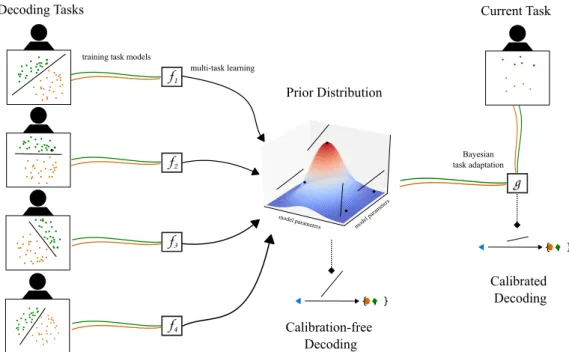
Instead of generative Bayesian modelling, our approach was to attempt a Bayesian treatment of the problem in the discriminative sense, in order to both efficiently recover a classification function for new subjects and a rep-resentation of the subject-invariant knowledge. Rather than attempting to model hidden sources that generated the observed data, we modeled the classification hyperplane in order to bias the recovered classifier towards the classifiers that are optimal for previous recordings [16]. The idea behind this method is reasonably simple: Instead of using a generic regularization method, such as ridge regression in the case of a linear classifier, with multi-ple datasets it is possible to determine data-driven regularization parameters. By modelling a regression vector as a random variable, as seen in Figure 1.1,
f1 f2 f3 f4 g Calibrated Decoding Decoding Tasks model paramet
ers model paramet ers
Prior Distribution
Current Task
Calibration-free Decoding training task models
multi-task learning
Bayesian task adaptation
{ , }
{ , }
Figure 1.1: Schematic for modelling regression vectors in multi-task learning, reprinted from Jayaram et al. [17]
it is possible to estimate the parameters of the distribution over regression vectors and use them to bias the solution in future tasks.
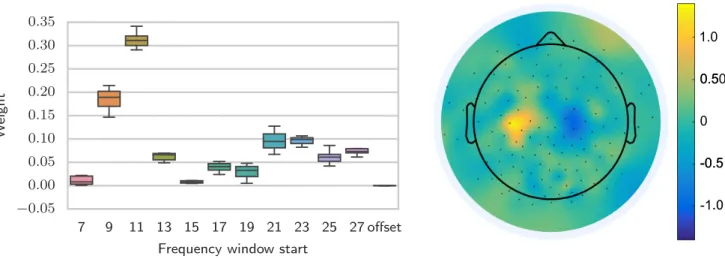
The signals that are recovered by classification models in BCIs are usu-ally projecting from one or few parts of the brain to the electrodes. Because of this, it makes little sense to take features computed on all the channels and simply stack them into one large feature vector. Instead, we determined that we could treat channels and features-per-channel differently via a bi-linear model, in which two independent regression vectors are derived and combined to form the classifier: one which learns a weighting over channels and one which learns a weighting over features. In this way it is possible to consider many channels and many features per channel without a multi-plicative increase in the number of parameters to be fit. This approach is a marked improvement over standard spatial filtering because it is capable of taking multiple frequency bands, as well as non-amplitude-based features, into account easily. It is also possible to visualize the prior distributions over the features and channels, which can lead to insight on which features are most important, as seen in Figure 1.2.
One major benefit of our proposed method is its scalability. Most ap-proaches in BCI decoding are poorly suited to very large datasets, for ex-ample datasets with more than 100 subjects or recordings. Approaches that
(a) 0.5 0 -0.5 -1 1.0 0.5 -0.5 .0 .0 (b) 7 9 11 13 15 17 19 21 23 25 27 offset Frequency window start
−0.05 0.00 0.05 0.10 0.15 0.20 0.25 0.30 0.35 W eight
Figure 1.2: Figure, reprinted from [18], which shows the learned spatial and spectral prior means for a trained multi-task model on motor imagery data. The spatial weights are largest around the two motor cortices (a) and the spectral weights are higher around the frequencies corresponding to the
anatomical α and β bands(b)
pool or that use covariate shift compensation require iterating through the entire offline pool in order to calibrate a classifier for a new subject, which causes the computation time to increase for the new recording proportion-ally to the number of recordings in the current pool. In contrast, multi-task learning requires an optimization to learn the parameters of the priors, but once those are fixed the update for a single subject is simply the solution to a set of linear equations. Further, while other optimizations require all the data to be loaded into memory at once, this approach is easily parallelized as each recording is dealt with independently in the maximization step of the algorithm.
A second consideration with big datasets is the possibility of negative transfer in the case that some subjects either have poor data or do the task very differently. This is a problem for most transfer learning techniques as they have no capacity to tell whether a particular task is good or bad. How-ever in the context of a probabilistic model, negative transfer can be viewed as outliers in the samples that are used to build the prior distribution. Because of this they can be taken care of via standard outlier rejection techniques, or dealt with in the expectation step of the algorithm directly via the choice of a prior distribution with a larger tail. This results in the multi-task learning procedure’s stability as the number of input datasets increases, under the mild assumption that there are comparatively few bad datasets.
One final benefit to this model, in comparison with generative approaches, is its compatibility with adaptive training. Since this approach corresponds
to a linear model with a fixed regularization term, it is possible to use se-quential labeled data points to adapt both the linear and bilinear models in real time. This allows it to be used seamlessly in adaptive BCIs such as those described in Vidaurre et al [7] and Faller et al. [6].
1.3
Frequency modulation: more information
from less electrodes
The vast majority of all data recorded for BCIs was recorded in the confines of a laboratory, using technicians to set up the equipment. As a result, most of it is of an appropriately high quality, with low electrode impedences and a minimum of noise from movement and other artifactual sources. This does not, however, describe a reasonable use case. Even for locked-in patients, it is infeasible to spend a half hour setting up electrodes; in the case of consumer electronics, this becomes even more ridiculous. Home use of BCI systems requires something that can be used in daily life, and that often means a minimum in setup time as well as number of electrodes.
Unfortunately, most established methods perform significantly worse with lower-quality signals and fewer electrodes. An illustrative example of this is the ongoing debate between dry and wet electrodes. Wet electrodes have historically been considered a gold standard for EEG signal quality [19], but must be manually optimized to achieve acceptable signals. In contrast, dry electrodes do not require gel application, as the name suggests, and therefore are both faster to apply and can withstand longer recordings, in exchange for a loss in signal quality and possibly comfort. The unreliability of standard methods in the face of a lower signal-to-noise ratio is such that making BCI paradigms work on non-wet systems is sufficiently novel to be published time and time again [20]–[22].
Another important hurdle in moving BCIs out of the laboratory is the physical environment. Labs can be set up to minimize possible sources of electrical noise, and participants are instructed to keep still and blink as little as possible. Moving into the real world, however, neither of these is easy to get, especially if one considers a medical environment like a hospital. As reviewed in Minguillon et al. [23], EEG recorded outside of the lab setting face many artifacts, and unless one wants to engineer a pipeline of complicated artifact-removal techniques, it is necessary to look for features that are less affected by them.
The first section of this thesis detailed a framework for transfer learning which allows for the effective leveraging of large amounts of offline data.
However, in order for that framework to be effective, it requires a large amount of data – which is difficult to attain when one must spend a large amount of time on ensuring that electrodes and recording conditions are perfect. In order to obtain enough data to fit robust classifiers, compromises in signal quality are unavoidable. Therefore, it is important to find features that can be computed which are more stable to signal quality differences. Via the bilinear approach detailed in Section 1.2, it is possible to easily add new channel-wise features to the classification model.
1.3.1
Alpha peak shift
In order to study what new features may be usable in BCI paradigms, one may begin by looking into the neuroscientific literature on brain rhythms. In non-invasive recordings, task-related differences in amplitude are best char-acterized, but invasive neuroscience has long known of many other properties of neural oscillations that are modulated by activity. One of these properties is the specific frequency at which a circuit oscillates. Bragin et al. [24] showed via invasive recordings of the rat hippocampus that while the amplitude of
γ oscillations was tied to the phase of θ oscillations, both of these oscilla-tions varied significantly in frequency throughout the recording period. This was further verified in humans in which it was shown that peak frequency changes could reliably predict working memory loads where amplitude-based measures were not predictive [25].
Most human studies of frequency shift are centered around the α peak.
In the literature, this has been considered in both a static and dynamic
manner. Studies of the average location of the α peak among individuals
has showed a great deal of variance in frequency, due to both genetic [26], [27] and environmental factors [28]. These individual differences have been correlated with measures of intelligence [29], [30]. However, Aurlien et al [31] showed that the peak location can vary by up to 1Hz within a single recording session. Looking into the dynamics of this oscillation as recorded via EEG, it was determined that theαpeak location is related to cognitive readiness on a shorter timescale, and that it can be modulated in a task-dependent manner in addition to the aforementioned static correlations [32]. More recent work has also confirmed that the frequency is modulated consciously in the case of cued and uncued stimulus perception[33]. In addition to these results on
healthy, awake subjects, α peak frequency has been researched in sleep as
well as epilepsy research, which has led to many algorithms to reliably extract it from the brain [34], [35].
The α peak is also well-known in the BCI literature, though it has only been viewed through phase or amplitude measures. The spectral power in
the alpha range is predictive of some mental activities, and this is sufficiently robust on a single-trial basis to be used within BCI paradigms [36]. More importantly, however, spectral power was shown to be predictive in ALS patients across a range of disease severities [37], which offers hope that it may be predictive into the completely locked-in state as well.
1.3.2
Frequency shifts in BCIs
While extensive, the work on characteristic features of the oscillations in invasive recordings is rarely used in the non-invasive sphere. Since muscle activity projects strongly to frequencies above 20Hz, the isolation of gamma rhythms from the non-invasive EEG is very difficult in practice, causing phase-amplitude coupling to be difficult to detect. As phase-amplitude cou-pling is much more well-researched than frequency shifts, it is not surprising that both are mostly ignored in the EEG literature. Instead, there is a large amount of work on phase-related measures, both in order to generate features based on pairwise coupling [38] and in order to refine estimates of spatial filters [39].
In the space of BCIs, the frequency drift of the EEG signal has been ex-plored via adaptive filtering, which has been employed in order to improve the
fidelity of amplitude-based measures. The location of the true α frequency
in relation to the passband of the spectral filter is crucial to determining the signal-to-noise ratio of the power of the bandpassed signal. Therefore, methods that can resize and shift the passband based on the location of the central frequency can more reliably estimate the power over time.
While not yet in common use, there are many possible benefits to fre-quency shift features. The influence of artifacts on the power spectrum is well-known and, in setups with few channels, very difficult to get rid of. Transient, high-amplitude artifacts in particular are problematic since they have a disproportionate effect on the variance of a signal. It may be, however, that the frequency shift is less affected by this issue. We proposed to look at the change in peak frequency of the EEG as a feature for a classifier, both in motor imagery and in a cognitive paradigm [40]. This idea only showed up once before, and was validated on a small motor imagery dataset [41], but we were interested in seeing if this is a valid approach across multiple paradigms.
In order to isolate the peak frequency on a per-trial basis, we elected to use the analytic signal. The analytic signal is computed via the Hilbert transform and leads to a representation of the signal that includes both amplitude and phase information. By extracting the phase and taking the difference between every pair of neighboring timepoints, it is possible to
extract an instantaneous frequency for a given time series at every time point. Since this estimate of the instantaneous frequency is noisy due both to edge artifacts and discretization issues, we chose the median of the instantaneous frequencies within each trial as the estimate of the peak frequency [40]. A similar approach was used in Cohen et al [42] to show the perceptual relevance of instantaneous frequency in EEG and artifical network models.
Our results showed that the location of the frequency peak as computed via the median instantaneous frequency for each trial is a noisy but helpful predictor in both motor imagery and cognitive paradigms. In particular in the case of low-channel settings, we show that adding the median instan-taneous frequency can reliably help classification in a variety of frequency bands [43]. In reference to the signal processing literature, we refer to this feature as the FM feature.
While the success in cognitive tasks can be explained by the literature on alpha peak location, the results on motor imagery are a new finding. Our results with CSP suggest that neural populations that show event-related desynchronization also have a shift downwards in their peak alpha frequency[40], which has not yet been described even in invasive studies. While work exists in monkeys that shows how waves of activity at different frequencies propagate across the primary motor cortex [44], there is as of yet no description of how the frequency of these waves is modulated. It is further quite interesting to ask why the frequency and power are correlated, as this may have implications for the circuit properties underlying the α rhythm.
1.4
How to validate? Principled use of
open-access data
It is rarely clear, when developing methods for BCIs, how well these methods transfer to other labs or hardware. Since there is so much variance in every-thing from sampling rate to electrode number to dry versus wet electrodes, positive results on one platform don’t necessarily imply positive results on another. In extreme cases, results that work on the vast majority of datasets can still fail for one particular lab, as seen in Figure 1.3. Unfortunately, this particular question is very difficult to phrase within the field of BCIs. Most labs have their own preferred setup, developed over generations of doctoral students, and their own pipeline for processing and saving that data. Trying to compare across many labs can be quite difficult given these methodological differences. This has resulted in the condition that there is little incentive for newly proposed algorithms to be taken up by the community, as even after
2 1 0 1 2
Standardized Mean Difference
Meta-effect001-2014 001-2015 002-2014 004-2014 004-2015 AlexandreCho2017 Grosse-WentrupPhysionet Shin2017A Weibo 2014Zhou 2016
< AM + optSVM better
CSP + LDA better >
3.91e-03 4.88e-04 1.50e-03 2.15e-02 3.12e-02 2.32e-05 1.92e-08 1.65e-04 9.77e-04 6.41e-21 p-valueFigure 1.3: Figure, taken from Jayaram et al. [45]. This shows a comparison of log-variances per channel combined with an SVM versus CSP and LDA as a method for classifying motor imagery across 13 open-access datasets. Even though CSP performs significantly better in most datasets, there are still some–such as Grosse-Wentrup et al. 2009[46] –which go against the trend. This highlights the need for validation over many hardware types to convince labs that a new algorithm truly will work better.
the work of implementing them for a lab’s specific setup there is a reasonable chance that they will not improve performance.
The closest previous attempt to standardize how BCI algorithms are com-pared is the BCI competitions datasets [47]–[50], which are as of now over 10 years old. Thousands of papers have been written using only these datasets, which makes it very likely that the results by now are heavily overfitted to that specific combination of electrodes, paradigm, and sensor number. Over this same period, however, thousands of hours of BCI data have been recorded all over the world, and hundreds of those hours are available freely online – the issue is simply that nobody has spent the time to gather them and run analyses over all of them. This is the goal of Jayaram et al. [45], in which we introduce the MOABB, an open-source codebase that allows for replicable result generation, combined with a statistical procedure in order to reliably rank compared algorithms. Given the results shown in Figure 1.3, we hope that offering this codebase to the community will allow for future
algorithic advances to be better received.
The first analysis with this method is centered around single-recording classification performance, as that is the field in which the majority of pre-vious work has been done. By verifying this procedure with well-known pipelines from the field, done in such a way that anyone can reproduce the results, we hope to convince the community that the rankings that come out of our analysis are trustworthy. With trust comes two things: The ability to conduct further studies, and hopefully also an increase in publically avail-able data. If our results in a more well-studied subfield of EEG classification pass peer review, we can continue on to test transfer learning and novel fea-ture spaces safe in the knowledge that the results thereof are reliable. Ifthe community is not satisfied with our processing or our statistical analysis, then there is no point in running more experiments with the same analy-sis. Further, and more optimistically, we hope that providing a platform for labs around the world to easily use open-access data makes experimental labs more willing to share their data, since they will know that groups can work on it. With more data we could expand beyond questions of algorithm and ask more interesting questions about how hardware, paradigm, and even personal characteristics affect the EEG across hundreds of subjects.
1.5
Conclusion: Moving forwards
When looking at how machine learning could help EEG-based BCIs step out of the lab, two key areas stood out: developing methods for using pools of offline data, and searching for new features that are robust to less ideal recording conditions. In order to validate the results of these explorations, we took advantage of the large amount of open-access data and built a validation framework for comparing different pipelines. However, although the methods introduced in this thesis have many interesting properties, comparing them directly against modern variants of CSP, or modern amplitude estimation methods, is very likely to show that their performance is worse. This may be because the ideas they suggest are less effective, but it is equally likely that it is because so much more work has been expended on the other directions. Because of this, the remainder of this section will first detail, for the transfer learning and frequency modulation, technical possibilities for improving these methods, such that this latter possibility can be dealt with. Finally, a more unified future outlook will be presented.
1.5.1
Transfer Learning
Both the bilinear regression model and the choice of a Gaussian distribu-tion for the probabilities are simplificadistribu-tions that allow for easy inference and interpretation. As such, these can both be extended into more powerful approaches, often losing little in terms of simplicity.
A bilinear model as described in Jayaram et al. [18] can equivalently be thought of as a linear model in the feature space where the regression matrix is constrained to be of rank 1. As fixed-rank manifolds are not convex, this means that optimization over them is also non-convex, which is the reason that a nested iterative approach is described in [18]. Relaxing this constraint
has two major benefits. First, it allows for multiple spatial and feature
weightings. It was determined that in CSP, the optimal number of spatial filters is six [51], and it is therefore likely that one is not the optimal number of spatial weightings in this model. By using a rank-based penalty instead of a rank constraint as used in Farquhar et al. [52], a flexible number of spatial and feature weightings can be estimated. In order to visualize the individual pairs as was done in Figure 1.2, a matrix decomposition can be used.
Next, we might consider the Gaussianity assumption on both the task-specific noise and the prior over the weight vectors. Two ways of extending this approach are the use of hyper priors and the use of other distributional forms. One simple example of a hyper prior would be one that assumes the mean vector comes from a zero-mean, isotropic Gaussian. A downside of the approach described in Jayaram et al. [18] is that the regularization penalizes deviation from a mean vector, but the norm of this mean vector is not penalized. Via a zero-mean prior over the computed mean, this could be remedied. In addition, the current approach penalizes the Mahalanobis distance between task weight vectors and the prior; instead of this, we may want to choose to penalize a difference distance between tasks and the mean, in order to promote properties such as sparsity in our solution. There is already work by Argyriou et al. [53] in which a convex multi-task approach with sparsity is derived, and this can be very easily substituted into the current algorithm.
Using different distributional assumptions can also be easily done. As-suming a logistic model, in which a squared loss function is traded for a cross-entropy loss, has been shown to lead to increases in performance when compared to a fully linear model [54]. It may also be possible to derive a solu-tion when the loss funcsolu-tion is assumed to be the hinge loss, effectively turning each task-specific problem into a maximum-margin optimization. Another approach would be to use different assumptions about the prior, such as a Laplace distribution, in order to more robustly compute the mean and
co-variance within each iteration.
A larger concern in relation to this method is that it requires pre-computed features per channel. As work with ICA and CSP shows, linear filters applied to the electrodes in the time domain can lead to very predictive features. In-deed, while we showed that using multi-task learning it was possible to find an optimal classifier in a fixed feature space with very little data, post-hoc comparisons with subject-specific CSP showed that a linear model over the channel-wise features is not ideal for within-session classification. If instead of pre-computing the features, we were to extend this model to automatically determine relevant features from the time domain, it would be significantly more powerful. However, it is not entirely clear how this could be done. One possibility would be to extend the model from Farquhar et al. [52] with the probabilistic multi-task approach.
When comparing so many different possible models, the possibility of overfitting to a single dataset becomes more and more dangerous. Via the MOABB codebase, comparisons of all these methods can be done with a minimal risk of overfitting [45].
1.5.2
Frequency Modulation
We validated the idea that neural oscillations change their oscillatory fre-quency in response to both cognitive tasks and motor ones, and more cru-cially that this difference is recognizable via the instantaneous frequency per channel. Ideally, this finding reflects a property of the underlying neural sig-nals. However, the Hilbert transform of a mixed signal is not well-defined, in the sense that it is unclear which of the underlying components is being reflected in the estimated instantaneous phase. If the recovered frequency and amplitude were independent then this would not be a problem, but our results showed that they correlate. Therefore, more robust model-based methods of estimating the instantaneous frequency need to be tested as well, in order to determine if this is simply an artifact of neural amplitude change or if the underlying signal is also frequency modulated. Cognitive psychology has good evidence of this shift in cognitive tasks, but frequency shift has yet to be described in vivo for motor imagery.
One important goal of the work with frequency modulation is to see if it is more robust to differences in signal quality than amplitude modulation. Unfortunately, the current study was done on data recorded under laboratory conditions with wet electrodes, and so another comparison with a noisier dataset is required. Re-running the analysis from Jayaram et al. [40] with the framework provided by the MOABB codebase is a first step in this direction. Further, while there were no conclusive findings in the analysis of ALS patient
data, a larger sample size may help account for the confounding effect of disease progression.
The fact that frequency and amplitude information are correlated in both of the tested paradigms leads to another interesting question, of whether this can be used as a way of characterizing neural data. There are few reliable ways to characterize data that is neural in origin from just a time-series or spectrum – a problem that has been heavily investigated in the field of ICA for EEG [55]. If there are reliable amplitude-frequency couplings in neural signals, and if these are different from muscle or noise signals, this could be exploited to realize new signal decomposition approaches.
Lastly, it has been shown that feedback on the power in the upperαband can decrease cognitive impairments in some cases [56]. Giving feedback on
the power in only the upper part of the α band may be equivalent to giving
feedback that pushes the α frequency higher, and it may be that using the
frequency location instead of the half-width bandpower is a more reliable signal.
1.5.3
Outlook
One of the major problems causing BCIs to remain in the laboratory is their inconsistency and the frustration of trying to use them habitually. Transfer learning represents a path towards optimal use of past data, such that ma-chine learning models perform more stably. In addition, new features may also be less susceptible to the major sources of noise within the signal. And, finally, it is very expensive to test new models in a closed-loop BCI in terms of the manpower involved. Better validation via precollected data allows one to conduct online experiments with provably robust machine learning, allowing users and developers to concentrate on the other areas of the system.
Looking out from the work of my doctorate, there are both methodological and experimental directions to be followed. The model for transfer learning can be extended in many ways, and with a robust procedure for validating these ways it is possible to determine the optimal way of using this scheme to aid in BCI decoding. On the other side, the implications of frequency modulation in task-based experiments have not yet been explored, and there is therefore a great deal of room to see what the benefits of using these features over traditional amplitude features are. In addition to both of these improvements done independently, however, there is also an obvious question of what happens when both the transfer learning and frequency modulation are combined. While a simple idea in theory, in practice this requires a large pool of subjects doing recordings, ideally longitudinally, and that is still a difficult proposition in brain-computer interfacing. No low-cost hardware
has been optimized to the point where such a study is feasible outside a doctoral project, but the future is bright in this regard. There has already been some work showing how commercial, low-cost EEG may be suitable for BCI applications [57], [58]. In combination with some of the innovations presented here, it may be soon that BCIs finally leave the lab after all.
Bibliography
[1] A. R. Murguialday, J. Hill, M. Bensch, et al., “Transition from the
locked in to the completely locked-in state: A physiological analysis,” Clinical Neurophysiology, vol. 122, no. 5, pp. 925–933, 2011,issn:
1388-2457. doi: http://dx.doi.org/10.1016/j.clinph.2010.08.019.
[2] P. Shenoy, M. Krauledat, B. Blankertz,et al., “Towards adaptive clas-sification for BCI,” Journal of Neural Engineering, vol. 3, no. 1, R13–
R23, Mar. 2006, issn: 1741-2560.doi: 10.1088/1741-2560/3/1/R02.
[3] J. Millan, “On the need for on-line learning in brain-computer
inter-faces,” in 2004 IEEE International Joint Conference on Neural
Net-works, vol. 4, IEEE, pp. 2877–2882,isbn: 0-7803-8359-1.doi:10.1109/ IJCNN.2004.1381116.
[4] Z. J. Koles, M. S. Lazar, and S. Z. Zhou, “Spatial patterns underlying population differences in the background EEG,”Brain Topography, vol. 2, no. 4, pp. 275–284, 1990.
[5] F. Lotte and C. Guan, “Regularizing common spatial patterns to
im-prove BCI designs: Unified theory and new algorithms,” IEEE
Trans-actions on Biomedical Engineering, vol. 58, no. 2, pp. 355–362, 2011. [6] J. Faller, C. Vidaurre, T. Solis-Escalante, et al., “Autocalibration and
recurrent adaptation: Towards a plug and play online ERD-BCI,”IEEE
Transactions on Neural Systems and Rehabilitation Engineering, vol. 20, no. 3, pp. 313–319, May 2012, issn: 1534-4320. doi: 10 . 1109 / TNSRE.2012.2189584.
[7] C. Vidaurre, C. Sannelli, K.-R. M¨uller,et al., “Machine-learning-based
coadaptive calibration for brain-computer interfaces,” Neural
Compu-tation, vol. 23, no. 3, pp. 791–816, Mar. 2011, issn: 0899-7667. doi: 10.1162/NECO_a_00089.
[8] D. Devlaminck, B. Wyns, M. Grosse-Wentrup, et al., “Multisubject
learning for common spatial patterns in motor-imagery BCI,”
[9] M. Cheng, Z. Lu, and H. Wang, “Regularized common spatial patterns with subject-to-subject transfer of EEG signals.,” Cognitive neurody-namics, vol. 11, no. 2, pp. 173–181, Apr. 2017, issn: 1871-4080. doi: 10.1007/s11571-016-9417-x.
[10] A. Barachant, S. Bonnet, M. Congedo,et al., “Classification of covari-ance matrices using a Riemannian-based kernel for BCI applications,” Neurocomputing, vol. 112, pp. 172–178, Jul. 2013,issn: 0925-2312.doi: 10.1016/J.NEUCOM.2012.12.039.
[11] ——, “Common spatial pattern revisited by Riemannian geometry,” in
2010 IEEE International Workshop on Multimedia Signal Processing, IEEE, Oct. 2010, pp. 472–476,isbn: 978-1-4244-8110-1.doi:10.1109/ MMSP.2010.5662067.
[12] M. Sugiyama, M. Krauledat, and K.-R. M¨uller, “Covariate shift adapta-tion by importance weighted cross validaadapta-tion,”The Journal of Machine Learning Research, vol. 8, pp. 985–1005, 2007.
[13] H. Kang and S. Choi, “Bayesian common spatial patterns for
multi-subject EEG classification,” Neural Networks, vol. 57, pp. 39–50, 2014.
[14] ——, “Bayesian common spatial patterns with Dirichlet process priors
for multi-subject EEG classification,” in The 2012 International Joint Conference on Neural Networks (IJCNN), IEEE, 2012, pp. 1–6.
[15] ——, “Bayesian multi-task learning for Common Spatial Patterns,” in
2011 International Workshop on Pattern Recognition in NeuroImaging,
IEEE, May 2011, pp. 61–64, isbn: 978-1-4577-0111-5. doi: 10.1109/
PRNI.2011.8.
[16] M. Alamgir, M. Grosse-Wentrup, and Y. Altun, “Multitask learning for
brain-computer interfaces,” in Proceedings of the Thirteenth Interna-tional Conference on Artificial Intelligence and Statistics (AISTATS), 2010, pp. 17–24.
[17] V. Jayaram, K.-H. Fiebig, J. Peters,et al., “Transfer learning for BCIs,” Brain–Computer Interfaces Handbook: Technological and Theoretical Advances, p. 425, 2018.
[18] V. Jayaram, M. Alamgir, Y. Altun, et al., “Transfer learning in brain-computer interfaces,” IEEE Computational Intelligence Magazine, vol. 11, no. 1, pp. 20–31, 2016.
[19] M. A. Lopez-Gordo, D. Sanchez-Morillo, and F. P. Valle, “Dry EEG
electrodes,” Sensors, vol. 14, no. 7, pp. 12 847–12 870, Jul. 2014, issn:
[20] M. Sp¨uler, “A high-speed brain-computer interface (BCI) using dry
EEG electrodes,” PLOS ONE, vol. 12, no. 2, D. Zhang, Ed., e0172400,
Feb. 2017, issn: 1932-6203. doi:10.1371/journal.pone.0172400.
[21] A. Pinegger, S. C. Wriessnegger, J. Faller, et al., “Evaluation of differ-ent EEG acquisition systems concerning their suitability for building a braincomputer interface: Case studies,” Frontiers in Neuroscience, vol.
10, p. 441, Sep. 2016, issn: 1662-453X. doi: 10.3389/fnins.2016.
00441.
[22] F. Popescu, S. Fazli, Y. Badower, et al., “Single trial classification of
motor imagination using 6 dry EEG electrodes,” PLOS ONE, vol. 2,
no. 7, C. Miall, Ed., e637, Jul. 2007, issn: 1932-6203. doi: 10.1371/ journal.pone.0000637.
[23] J. Minguillon, M. A. Lopez-Gordo, and F. Pelayo, “Trends in EEG-BCI
for daily-life: Requirements for artifact removal,” Biomedical Signal Processing and Control, vol. 31, pp. 407–418, Jan. 2017, issn:
1746-8094. doi: 10.1016/J.BSPC.2016.09.005.
[24] A. Bragin, G. Jand´o, Z. N´adasdy, et al., “Gamma (40-100 Hz)
oscilla-tion in the hippocampus of the behaving rat.,” The Journal of
Neuro-science, vol. 15, no. 1 Pt 1, pp. 47–60, Jan. 1995,issn: 0270-6474.doi: 10.1523/JNEUROSCI.15-01-00047.1995.
[25] N. Axmacher, M. M. Henseler, O. Jensen,et al., “Cross-frequency cou-pling supports multi-item working memory in the human
hippocam-pus.,” Proceedings of the National Academy of Sciences of the United
States of America, vol. 107, no. 7, pp. 3228–33, Feb. 2010, issn:
1091-6490. doi: 10.1073/pnas.0911531107.
[26] D. J. A. Smit, D Posthuma, D. I. Boomsma, et al., “Heritability of
background EEG across the power spectrum,” Psychophysiology, vol.
42, no. 6, pp. 691–697, 2005.
[27] S. Bodenmann, T. Rusterholz, R. D¨urr,et al., “The functional Val158Met
polymorphism of COMT predicts interindividual differences in brainα
oscillations in young men,” The Journal of Neuroscience, vol. 29, no. 35, pp. 10 855–10 862, 2009.
[28] S. Haegens, H. Cousijn, G. Wallis, et al., “Inter-and intra-individual variability in alpha peak frequency,” Neuroimage, vol. 92, pp. 46–55, 2014.
[29] E. Angelakis, J. F. Lubar, and S. Stathopoulou,
“Electroencephalo-graphic peak alpha frequency correlates of cognitive traits,”
Neuro-science Letters, vol. 371, no. 1, pp. 60–63, Nov. 2004, issn: 0304-3940. doi: 10.1016/J.NEULET.2004.08.041.
[30] T. H. Grandy, M. Werkle-Bergner, C. Chicherio, et al., “Individual
alpha peak frequency is related to latent factors of general cognitive abilities,” Neuroimage, vol. 79, pp. 10–18, Oct. 2013, issn: 1053-8119. doi: 10.1016/J.NEUROIMAGE.2013.04.059.
[31] H Aurlien, I. O. Gjerde, J. H. Aarseth,et al., “EEG background activity described by a large computerized database,”Clinical Neurophysiology, vol. 115, no. 3, pp. 665–673, 2004.
[32] E. Angelakis, J. F. Lubar, S. Stathopoulou, et al., “Peak alpha
fre-quency: An electroencephalographic measure of cognitive prepared-ness.,” Clinical neurophysiology : Official journal of the International Federation of Clinical Neurophysiology, vol. 115, no. 4, pp. 887–97, Apr.
2004, issn: 1388-2457.doi: 10.1016/j.clinph.2003.11.034.
[33] R. Sol´ıs-Vivanco, O. Jensen, and M. Bonnefond, “Top-down control of
alpha phase adjustment in anticipation of temporally predictable visual stimuli,” Journal of Cognitive Neuroscience, vol. 30, no. 8, pp. 1157–
1169, Aug. 2018, issn: 0898-929X. doi: 10.1162/jocn_a_01280.
[34] D. P. Nguyen, M. A. Wilson, E. N. Brown, et al., “Measuring
instan-taneous frequency of local field potential oscillations using the Kalman smoother,” Journal of Neuroscience Methods, vol. 184, no. 2, pp. 365– 374, 2009.
[35] M. J. Prerau, P. L. Purdon, and U. T. Eden, “Tracking non-stationary
spectral peak structure in EEG data,” in 2013 35th Annual
Interna-tional Conference of the IEEE Engineering in Medicine and Biology So-ciety (EMBC), IEEE, Jul. 2013, pp. 417–420,isbn: 978-1-4577-0216-7. doi: 10.1109/EMBC.2013.6609525.
[36] R. Scherer, J. Faller, E. V. C. Friedrich, et al., “Individually adapted imagery improves brain-computer interface performance in end-users with disability,” PLOS ONE, vol. 10, no. 5, L. Bianchi, Ed., e0123727,
May 2015, issn: 1932-6203. doi: 10.1371/journal.pone.0123727.
[37] M. Hohmann, T. Fomina, V. Jayaram, et al., “A cognitive
braincom-puter interface for patients with amyotrophic lateral sclerosis,”Progress in Brain Research, vol. 228, pp. 221–239, Jan. 2016, issn: 0079-6123. doi: 10.1016/BS.PBR.2016.04.022.
[38] B. Hamner, R. Leeb, M. Tavella, et al., “Phase-based features for
mo-tor imagery brain-computer interfaces,” in 2011 Annual International
Conference of the IEEE Engineering in Medicine and Biology Society, IEEE, 2011, pp. 2578–2581.
[39] O. Falzon, K. P. Camilleri, and J. Muscat, “The analytic common
spatial patterns method for EEG-based BCI data,” Journal of neural
engineering, vol. 9, no. 4, p. 45 009, 2012.
[40] V. Jayaram, M. Hohmann, J. Just, et al., “Task-induced frequency
modulation features for brain-computer interfacing,”Journal of Neural Engineering, vol. 14, no. 5, p. 056 015, Oct. 2017,issn: 1741-2560.doi: 10.1088/1741-2552/aa7778.
[41] A. M´edl, D. Flotzinger, and G. Pfurtscheller, “Hilbert-transform based
predictions of hand movements from EEG measurements,” in
Engineer-ing in Medicine and Biology Society, 1992 14th Annual International Conference of the IEEE, IEEE, vol. 6, 1992, pp. 2539–2540.
[42] M. X. Cohen, “Fluctuations in oscillation frequency control spike
tim-ing and coordinate neural networks.,” The Journal of Neuroscience,
vol. 34, no. 27, pp. 8988–98, Jul. 2014,issn: 1529-2401.doi:10.1523/ JNEUROSCI.0261-14.2014.
[43] V. Jayaram, B. Sch¨olkopf, and M. Grosse-Wentrup, “Frequency peak
features for low-channel classification in motor imagery paradigms,” in Proceedings of the 8th IEEE EMBS Conference on Neural Engineering, 2017.
[44] D. Rubino, K. A. Robbins, and N. G. Hatsopoulos, “Propagating waves
mediate information transfer in the motor cortex,”Nature Neuroscience, vol. 9, no. 12, pp. 1549–1557, Dec. 2006,issn: 1097-6256.doi:10.1038/ nn1802.
[45] V. Jayaram and A. Barachant, “MOABB: trustworthy algorithm
bench-marking for BCIs,” May 2018. arXiv: 1805.06427.
[46] M. Grosse-Wentrup, C. Liefhold, K. Gramann, et al.,
“Beamform-ing in non-invasive brain-computer interfaces,” IEEE Transactions on
Biomedical Engineering, vol. 56, no. 4, pp. 1209–1219, Apr. 2008,issn:
0018-9294. doi: 10.1109/TBME.2008.2009768.
[47] M. Tangermann, K.-R. M¨uller, A. Aertsen, et al., “Review of the BCI competition IV,” Frontiers in Neuroscience, vol. 6, p. 55, Jul. 2012,
[48] B Blankertz, K. R. M¨uller, D Krusienski, et al., “The BCI competition
III: Validating alternative approaches to actual BCI problems,” IEEE
Transactions on Neural Systems and Rehabilitation Engineering, vol. 14, no. 2, pp. 153–159, 2006.
[49] A Schloegl, “Results of the BCI competition 2005 for data set IIIa and IIIb,” Institute for Human-Computer Interfaces - BCI Lab, University of Technology Graz, Austria, Tech. Rep., 2005.
[50] G Blanchard and B Blankertz, “BCI competition 2003 - data set IIa:
Spatial patterns of self-controlled brain rythm modulations,” IEEE
Transactions on Biomedical Engineering, vol. 51, no. 6, pp. 1062–1066, 2004.
[51] B. Blankertz, R. Tomioka, S. Lemm, et al., “Optimizing spatial filters
for robust EEG single-trial analysis,” IEEE Signal Processing
Maga-zine, vol. 25, no. 1, pp. 41–56, 2008, issn: 1053-5888. doi: 10.1109/ MSP.2008.4408441.
[52] J. Farquhar, “A linear feature space for simultaneous learning of spatio-spectral filters in BCI,”Neural Networks, vol. 22, no. 9, pp. 1278–1285,
Nov. 2009, issn: 0893-6080. doi: 10.1016/J.NEUNET.2009.06.035.
[53] A. Argyriou, T. Evgeniou, and M. Pontil, “Convex multi-task feature
learning,” Machine Learning, vol. 73, no. 3, pp. 243–272, Dec. 2008,
issn: 0885-6125. doi:10.1007/s10994-007-5040-8.
[54] K.-H. Fiebig, V. Jayaram, J. Peters, et al., “Multi-task logistic
regres-sion in brain-computer interfaces,” in Proceedings of the 2016 IEEE
International Conference on Systems, Man, and Cybernetics, 2016.
[55] B. W. McMenamin, A. J. Shackman, J. S. Maxwell,et al., “Validation
of ICA-based myogenic artifact correction for scalp and source-localized
EEG,” Neuroimage, vol. 49, no. 3, pp. 2416–2432, 2010, issn:
1053-8119. doi: http://dx.doi.org/10.1016/j.neuroimage.2009.10.
010.
[56] C. Escolano, M. Aguilar, and J. Minguez, “EEG-based upper alpha
neurofeedback training improves working memory performance,” in 2011 Annual International Conference of the IEEE Engineering in Medicine and Biology Society, IEEE, Aug. 2011, pp. 2327–2330, isbn:
978-1-4577-1589-1. doi: 10.1109/IEMBS.2011.6090651.
[57] S. Debener, F. Minow, R. Emkes,et al., “How about taking a low-cost,
small, and wireless EEG for a walk?” Psychophysiology, vol. 49, no.
11, pp. 1617–1621, Nov. 2012, issn: 00485772.doi:
[58] M. Duvinage, T. Castermans, M. Petieau, et al., “Performance of the
Emotiv Epoc headset for P300-based applications,” BioMedical
Engi-neering OnLine, vol. 12, no. 1, p. 56, Jun. 2013. doi: 10.1186/1475-925X-12-56.
Chapter 2
Collected works
2.1
Contributions
1. Vinay Jayaram, Morteza Alamgir, Yasemin Altun, Bernhard Sch¨olkopf, and Moritz Grosse-Wentrup. Transfer learning in bracomputer in-terfaces. IEEE Computational Intelligence Magazine 11, no. 1 (2016):
20-31. ©2016 IEEE, reprinted with permission.
The idea of a hierarchial Gaussian model was introduced by Morteza Alamgir, Yasemin Altun, and Prof. Grosse-Wentrup and published at a conference in 2010 [16]. I added a task-specific bilinear model and derived the optimization strategy for this approach. I participated in one of the recordings for the ALS patient data and did not participate in the recording of the motor imagery data. All coding and analysis was performed by me, in addition to the writing of the manuscript in the lab of Prof. Sch¨olkopf
2. Vinay Jayaram, Matthias Hohmann, Jennifer Just, Bernhard Sch¨olkopf, and Moritz Grosse-Wentrup. Task-induced frequency modulation fea-tures for brain-computer interfacing. Journal of Neural Engineering 14, no. 5 (2017): 056015.
For this manuscript the original idea for investigating the frequency shift came from qualitative analysis of ALS patient data in conjunction with Prof. Grosse-Wentrup. All code and analysis was done by me, in addition to the decision to test this feature on healthy subject data in
both cognitive and motor paradigms. Matthias recorded the data used in the cognitive task analysis and Jennifer, Matthias, and I assisted with the recordings with ALS patients. All work was done with the support of Prof. Sch¨olkopf
3. Vinay Jayaram, Alexandre Barachant. MOABB: Trustworthy
algo-rithm benchmarking for BCIs. arXiv preprint (2018). Submitted to
the Journal of Neural Engineering in May 2018.
The initial idea came from Dr. Alexandre Barachant, but the codebase as it is available was a fully joint project between the two of us. The idea for this manuscript, and the specific analysis we did within it, was initiated by me and done in collaboration with Dr. Barachant. For the statistical analysis we consulted with Dr. Marco Congedo.
4. Fiebig, Karl-Heinz, Vinay Jayaram, Jan Peters, and Moritz
Grosse-Wentrup. Multi-task logistic regression in brain-computer interfaces. In Systems, Man, and Cybernetics (SMC), 2016 IEEE International
Con-ference on, pp. 002307-002312. IEEE, 2016. ©2016 IEEE, reprinted
with permission.
The initial idea was proposed in a joint session between myself, Prof. Grosse-Wentrup, and Karl-Heinz. Karl-Heinz did the derivations and wrote the analysis and manuscript, while I supervised and reviewed all three. Karl-Heinz was also supervised by Prof. Peters.
2.2
Paper 1: Transfer Learning in Brain-Computer
Interfaces
1
Transfer Learning in Brain-Computer Interfaces
Vinay JayaramIMPRS for Cognitive and Systems Neuroscience, University of T ¨ubingen, T ¨ubingen, Germany Department of Empirical Inference, Max Planck Institute for Intelligent Systems, T ¨ubingen, Germany
Morteza Alamgir
Department of Computer Science, University of Hamburg, Hamburg, Germany Yasemin Altun
Bernhard Sch¨olkopf Moritz Grosse-Wentrup
Department of Empirical Inference, Max Planck Institute for Intelligent Systems, T ¨ubingen, Germany
F
Abstract
The performance of brain-computer interfaces (BCIs) improves with the amount of available training data; the statistical distribution of this data, however, varies across subjects as well as across sessions within individual subjects, limiting the transferability of training data or trained models between them. In this article, we review current transfer learning techniques in BCIs that exploit shared structure between training data of multiple subjects and/or sessions to increase performance. We then present a framework for transfer learning in the context of BCIs that can be applied to any arbitrary feature space, as well as a novel regression estimation method that is specifically designed for the structure of a system based on the electroencephalogram (EEG). We demonstrate the utility of our framework and method on subject-to-subject transfer in a motor-imagery paradigm as well as on session-to-session transfer in one patient diagnosed with amyotrophic lateral sclerosis (ALS), showing that it is able to outperform other comparable methods on an identical dataset.
1 INTRODUCTION
It is often a problem in various fields that one runs into a series of tasks that appear - to a human - to be highly related to each other, yet applying the optimal machine learning solution of one problem to another results in poor performance. Specifically in the field of brain-computer interfaces (BCIs), it has long been known that a subject with good classification of some brain signal today could come into the experimental setup tomorrow and perform terribly using the exact same classification function. One initial approach to get over this problem was to fix the classification rule beforehand and train the patient to force brain activity to conform to this rule. For example, Wolpaw et al. in the early 90’s chose weights for theα andµrhythms and trained participants to modulate the bandpower in these frequency bands in order to control
2 a cursor [1], [2]. Similarly, Birbaumer et al. trained a patient to create large depolarizations of the electroencephalogram (EEG) over the course of several seconds, using a simple threshold on the bandpassed raw signal [3]. In their time, both approaches were successful, but took training time on the order of months to master. To overcome this limitation, several groups introduced machine learning techniques for adapting BCIs to their users [4]–[10]. They successfully managed to learn decoding rules with high acccuracy using only a fraction of the training trials required by the earlier approaches, allowing subjects to communicate consistently with a computer in a single session. Unfortunately, a training period had to be repeated at the beginning of each usage session as the learned discrimination rules were not immediately stable. A naive solution to this limitation was to pool training data from multiple recordings; however, the statistical distributions of these data varies across subjects as well as across sessions within individual subjects, giving this approach varying effectiveness. In recent years, several groups have started explicitly modelling such variations to exploit structure that is shared between data recorded from multiple subjects and/or sessions. In this article, we provide an overview of previous work on the topic and present a unifying approach to transfer learning in the field of BCIs. We demonstrate the utility of our framework on subject-to-subject transfer in a motor-imagery paradigm as well as on session-to-session transfer in one patient diagnosed with amyotrophic lateral sclerosis (ALS).
1.1 Previous work
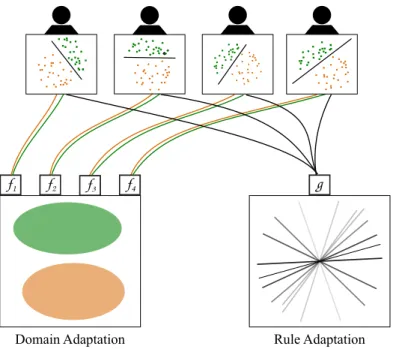
Transfer learningdescribes the procedure of using data recorded in one task to boost performance in another, related task (for a more exhausive review of the machine learning literature, see [11]). That is to say, we assumea priorithat there is some structure shared by these tasks; the goal, then, is to learn some representation of this structure so further tasks can be solved more easily. In the context of BCIs, transfer learning is of critical importance - it has long been known that the EEG signal is not stationary, and so in its strictest sense one can consider every trial a slightly new task. As such, long sessions of BCI usage present unique problems in terms of consistent classification [12]. The question is how to transfer some sort of knowledge between them: a question that can be answered in one of two general ways. Either we can attempt to find some structure in the data that is invariant across datasets or we can find some structure in how the decision rules differ between different subjects or sessions. We denote these asdomain adaptationandrule adaptationrespectively (Figure 1).
Looking at the literature, BCI has been almost exclusively dominated by domain adaptation approaches. One popular feature space in the field is the trial covariance matrices used both in Common Spatial Patterns (CSP) [4], [13] and other more modern methods [14]. Many transfer learning techniques have been attempted with CSP, mostly relying on an assumption that there exists a set of linear filters that is invariant across either sessions or subjects. An early example of session-to-session transfer of spatial filters is the work by Krauledat et al. [15], in which a clustering procedure is employed to select prototypical spatial filters and classifiers, which are in turn applied to newly recorded data. Using this approach, the authors demonstrate that calibration time can be greatly reduced with only a slight loss in classification accuracy. The problem of subject-to-subject transfer of spatial filters is addressed by Fazli et al. [16]: also building upon CSP for spatial filtering, the authors utilize a large database of pairs of spatial filters and classifiers from 45 subjects to learn a sparse subset of these pairs that are predictive across subjects. Using a leave-one-subject-out cross-validation procedure, the authors then demonstrate that this sparse subset of spatial filters and classifiers can be applied to new subjects with
3 learning amounts to determining invariant spaces on which to project the data and learning classifiers in these spaces. This line of work has been further extended by Kang et al. [17], [18], Lotte and Guan [19], and Devlaminck et al. [20]. In these contributions, the authors demonstrate successful subject-to-subject transfer by regularizing spatial filters derived by CSP with data from other subjects, which amounts to attempting to find an invariant subspace on which to project the data of new subjects. Recently, a method of distance measures between trial covariance matrices has also been used to great effect in both motor imagery [21] and event-related potential paradigms [22] as a domain adaptation tool. Related to the spirit of the regularized CSP methods described above, they work by trying to find the best projection plane for the trial covariance matrices, invariant to subjects and sessions, and then run a classification algorithm. Other domain adaptation approaches include that by Morioka et al. [23], in which an invariant sparse representation of the data is learned using many subjects and then the transformation into that space is applied to new subjects, and the technique of stationary subspace analysis [24], [25], which attempts to find a stationary subspace of the data from multiple subjects and/or sessions.
A very related technique to domain adaptation iscovariate shift, which has also found use in BCIs. Sugiyama et al. have used covariate shift adaptation to combine labeled training data with unlabeled test data [26]. Here, it is assumed that the marginal distribution of the data changes between the subjects and/or sessions, but the decision rule with respect to this marginal distribution remains constant. This assumption leads to a re-weighting of training data from other subjects and/or previous sessions based on unlabeled data from the current test set that corrects for covariate shifts–in essence, correcting for the difference in marginal distributions in the different subjects and/or sessions. In addition to their results, several other authors have also reported improvements in BCI decoding performance by using similar techniques for covariate shift adaptation [27]–[29]. Other techniques such as boosting [30] have also used re-labelling of offline data to increase performance [31].
The covariate shift and other methods presented in the previous paragraph represent a very different assumption about the tasks than the methods that attempt to find an invariant space to project the data. Instead of assuming that there exists some space where the data already lives that is invariant for all individuals or across all time, it attempts to model the variation between individuals and efficiently discover a transformation for new individuals to the known space (in comparison, an invariant subspace could be seen as applying an identical transform to all individuals). This approach of attempting to learn a representation of the variability is most naturally attempted in the space of possible rules, since it often offers a ready-made parametrization of the approximating function. One possibility for such modelling is to treat the parameters of a decoding model as random variables that are, for each subject and/or session, drawn from the same distribution. The prior distribution of the model parameters can then be used to link tr
![Figure 1.2: Figure, reprinted from [18], which shows the learned spatial and spectral prior means for a trained multi-task model on motor imagery data](https://thumb-us.123doks.com/thumbv2/123dok_us/392008.2543577/13.892.218.704.186.408/figure-figure-reprinted-learned-spatial-spectral-trained-imagery.webp)
![Figure 1.3: Figure, taken from Jayaram et al. [45]. This shows a comparison of log-variances per channel combined with an SVM versus CSP and LDA as a method for classifying motor imagery across 13 open-access datasets](https://thumb-us.123doks.com/thumbv2/123dok_us/392008.2543577/18.892.227.660.205.530/figure-figure-jayaram-comparison-variances-combined-classifying-datasets.webp)