ISSN 1403-0586
WORKING PAPER SERIES WORKING PAPER NO 2, 2005
ESI
After outsourcing – the outsourced unit:
Dependence, capabilities and strategy
by
Leif Sanner
http://www.oru.se/esi/wps
SE-701 82 Örebro SWEDEN
Strategy for outsourced units
After outsourcing – the outsourced unit: Dependence, capabilities and strategy.
Leif Sanner, assistant professor, Business Studies, Örebro University, SE-701 82 Örebro, Sweden1
ABSTRACT
Outsourcing is in this study defined as the transfer of responsibility and activities, including relevant assets and resources, from a user to a legally separate party, that becomes a vendor to the user. An outsourcer transfers activities to an outsourced unit. The situation of the
outsourced unit becomes problematic in its provision of goods or services to both the
outsourcer and other buyers. Specifically, the outsourced unit after outsourcing has ample and tight bonds to the outsourcer and there is a need to strike a balance between dependence and independence towards the outsourcer. The investigated problem reported in this article is:
How can the outsourced unit strategically handle its situation after the outsourcing? Issues at stake for the outsourced unit are: How to hand le dependence on the outsourcer. How to use and develop competitive advantages, capabilities and resources. How to develop and implement business strategy.
Dependence can reside in asset specificity: Relationships with the outsourcer and business partners, need for the exchange partner’s competence, joint governance systems, the relative volume of goods/services provided and/or specialization of goods/services towards the exchange partner. The structure of the market may make it more or less possible to substitute one exchange partner for another.
For sustainable competitive advantage, the possession of or access to strategic capabilities and resources is needed, which the outsourced unit accumulates and deploys. The firm must meet the demand with a supply based on its capabilities and resources. The outsourced unit
obviously starts with resources collected and capabilities developed by the out sourcer. It is its management’s task to identify and muster the resources and strategic capabilities of the firm. Inherited capabilities and resources may thus need to be developed into capabilities that are important for the outsourcer’s new role and position.
In two in-depth cases outsourced units are studied with focus on dependence on the
outsourcer, the units’ guiding competitive advantages, their capabilities and resources. Two distinct strategies are identified. A strategy of conjunction with the outsourcer is to make use of competitive advantages, align capabilities and resources towards the outsourcer’s needs and to build on dependence by holding specific assets of interest for the outsourcer. A strategy of disjunction implies reducing dependence on the outsourcer by seeking new alliances and markets outside the outsourcer-outsourced relation. Disharmony with either of the strategies is discussed as a reason for strategic change.
1
1 Outsourcing
For more than a decade large firms have been going through extensive structural changes. Increased national and international competition, extended chains of decision making, inadequate responsiveness to customers, quality deficiency and high costs are needs behind structural changes (Reilly and Tamkin, 1996; Momme, 2002). Solutions leading to higher efficiency are partly found within the firm, but often there has been a need to realign the firm itself. Services, administration, manufacturing, logistics and distribution are functions in the firm that are often found in new or different structures (Greco, 1997). Management
philosophy has developed as well: A move from tight and centralized control in large organisations to more decentralised and loose governance, which includes transferring work to parties outside the firm.
Outsourcing is one of the solutions in the attempt to increase efficiency. The firm may by outsourcing concentrate on a set of “core competencies” where it can achieve pre-eminence and create value for its customers. It may also outsource activities for which it has neither strategic needs nor special capabilities (Pralahad and Hamel, 1990; Quinn and Hilmer, 1994). The notion of outsourcing is used with some variations in the literature. Transfer of activities and responsibility for the activit ies is a common denominator: An outsourcer transfers services, administration, manufacturing, logistics, distribution or some other activity which has been integral to the outsourcing firm to a unit outside the firm (Quinn and Hilmer, 1994; Greco, 1997; Zhu et al., 2001). The unit outside is then an existing firm, which is considered to provide the outsourced tasks more efficient ly, either better or cheaper.
A second requisite for outsourcing is brought forward by some writers: Transfer of assets and resources used for the activities provided (Takac, 1993; Lonsdale, 2001). Employees,
machinery, equipment etc. is also transferred to the outsourced unit to continue to be used for the activities. The unit outside may be an existing firm or it may be a new firm with former employees coming from the outsourcing firm.
Transfer of activities and responsibility for the activities without transfer of corresponding resources is traditional contracting out: making an agreement with another firm, which has to provide manpower, equipment etc. Transfer of assets and resources makes the agreement more encompassing, complicated and demanding for the parties involved. In this article we use the term outsourcing for covering both forms of transfer and we discuss outsourcing as:
The transfer of responsibility and activities, including relevant assets and resources, from a user to a legally separate party, which becomes a vendor to the user or a user to the vendor.
Assessing the needs for outsourcing, managing the outsourcing decision and the outsourcer’s relations to the outsourced units are issues treated in the literature (Takac, 1993; Quinn and Hilmer, 1994; Jennings, 1997; Baden-Fuller et al., 2000; McDermott and Handfield, 2000; Lonsdale, 2001; Zhu et al., 2001; Heikkilä and Cordon, 2002; Momme, 2002). The interest for the outsourcer’s problems as well as taking on the outsourcer’s perspectives is quite natural, given the situations of large firms. But the situation of the outsourced unit also becomes problematic in its provision of goods or services to both the outsourcer and other buyers. Specifically, the outsourced unit has ample and tight bonds to the outsourcer and there is a need to strike a balance between dependence and independence towards the outsourcer. The balance is based on the outsourced unit’s capabilities and strategies concerning products, markets and alliances.
The investigated problem reported in this article is: How can the outsourced unit strategically handle its situation after the outsourcing? Issues at stake are: How to handle dependence on the outsourcer. How to use and develop resources and capabilities. How to develop and implement business strategy.
The problems and situation of the outsourced unit after its outsourcing seems not to have been noticed in research. Our literature survey of several databases concerning the matter gave a meagre result: We found no articles taking the outsourced unit’s perspective and covering the issues above as a main theme, and only one article (Brandes et al., 1997) that partly took an interest in the situa tion for outsourced units.
2 The outsourced unit
By the transfer from the outsourcer, the outsourced unit takes over resources, competence, experience, governance systems with practices and routines, all built up in the outsourcer’s organisation. The outsourced unit is oriented towards the outsourcer in many respects. This orientation may persist for a long or short time (Nelson and Winter, 1982). It facilitates continued business with the outsourcer. A similar or joint governance system and the on-going relationships between the parties and a common network may be a competitive advantage for continued business with the outsourcer (Collis, 1991).
But if the purpose for the outsourced unit is to create new business with new customers, new products or new alliances, the traditional mental and practical bonds with the outsourcer may be an obstacle to change. A new firm may need to build new relationships, acquire new
resources and competence. If the outsourced unit is amalgamated with another existing firm, it will need to adjust itself to the new organization with its governance systems etc.
The outsourced unit may by habit be associated with the outsourcer also in the future. At least, it may take time to become known in its own right just like the situation for any new business (Stinchcombe, 1965).
Finally, if the outsourced unit hires new staff to work together with the people from the outsourcer, it may encounter problems due to the different frames of reference and experiences of people with different backgrounds.
There are two key factors for success for the outsourced unit to handle. One is dependence on the outsourcer. The other may be a need to align resources and capabilities with selected strategies for its continued business.
3 Dependence
The outsourced unit is linked to the outsourcer by dependence. Business may continue and the outsourced unit – at least in the short run – will be dependent on business with the outsourcer. But the outsourcer is also dependent on the outsourced unit in continued business due to relationships, familiarity with the outsourcer’s products, specialized skills and may be also linked by governance systems.
Social relations between actors, where an actor can be either a person or a group, commonly entail ties of mutual dependence between the parties (Emerson, 1962). A is dependent upon B if he aspires to goals or gratifications whose achievement is facilitated by appropriate actions on B’s part. Actors experience their dependence situatio ns as contingent on motivation and alternative means for goal achievements (Pfeffer and Salancik, 1978). Interdependence or mutual dependence means that two persons or organisations are dependent on one another (Thompson, 1967; McCann and Galbraith, 1981; Ring and van de Ven, 1992). Organisations may not only be dependent but also influence each other’s actions. The outsourcer and the outsourced unit are often interdependent.
Interdependence does not necessarily mean that both parties are dependent on one another for the same reason or to the same extent. Asymmetry is a common theme in the literature
(Williamson, 1985; Heide and John, 1988; Buchanan, 1992; Gundlach and Cadotte, 1994; Kumar et al., 1995; Joshi, 1998). Dependence can be balanced or unbalanced (Emerson, 1962; Jacobs, 1974; Pfeffer and Salancik, 1978). In the latter situation one party dominates the relation. The literature often contends that the firm should avoid depending on trade partners, but there are also studies indicating that dependence can bring the firm benefits (Lusch and Brown, 1996). The relationships between the outsourcer and the outsourced unit may be asymmetric and unbalanced and still be considered beneficial by both parties. But if one party regards the unbalanced situation as being detrimental, it is an indication of problems.
What constitutes dependence? A firm can be dependent on a specific other firm due to
investments in specific assets geared to that firm. When a firm makes a specialized investment in its partner, transaction-specific assets will exist (Williamson, 1985). It will be dependent on another firm through assets specifically geared towards the exchange partner, assets which can not at all or only by incurring large switching costs be used for other exchange partners. We can identify five types of specific assets: Personal relations, competence, integration of governance systems, dedicated volume of goods/services, and product/process specialization. Another reason for dependence is the structure of the market, which may lack alternative providers of similar products. Then it becomes impossible or difficult due to large switching costs to substitute one firm for another for the provision of good/services.
Asset specificity
Relational exchange means that each transaction must be viewed in terms of its history and anticipated future (Ring and van de Ven, 1992). In relational exchange the participants can be expected to engage more in social exchange. Norms are based on the expectation of mutuality of interest, essentially prescribing stewardship behaviour, and they are designed to enhance the well-being of the relationship as a whole (Macneil, 1980). The actors invest more in joint activities and resources and in long-term commitment (Johanson and Mattson, 1987). The duration of a relationship is likely to affect the parties’ expectations that the relationship will continue (Ganesan, 1994; Berger et al., 1995). The parties adapt to one another in order to support and possibly expand current business. Adaption has an impact on dependence (Dwyer et al., 1987; Hallén et al., 1991). Relational flexibility, information exchange and solidarity between the parties affect dependence (Joshi and Stump, 1999). This is the relationship background in outsourcing. The effects of the built- up relations before the outsourcing may persist for a long time and are a specific asset in that the relationships facilitate business. Need for the exchange partner’s competence may create dependence of one firm on another (Håkansson, 1989; Robinson, 1989; Lamming, 1993; Gadde and Håkanssson, 2001). Quite
often the outsourcer at least in the short run will be dependent on the outsourced unit, even if the outsourcer did not outsource its core competence. For the outsourced unit, its competence may create dependence on the outsourcer, if it is specifically directed to the outsourcer’s needs. Competence can be a specific asset between the parties.
Efficiency in the flow of goods/services between suppliers and customers may entail
integration in systems for order, delivery and payment (Robinson, 1989). By using IT-systems such as Just-in-Time and Electronic Data Interchange (EDI), as well as specific logistics solutions, parties adjust their administration to each other forming interdependent governance systems (Ragatz et al., 1997; Gadde and Håkanssson, 2001). Business with one party becomes facilitated more in a relative sense as compared to parties where no joint governance system is applied (Raffa, 1992; Lilliecreutz, 1998). A high degree of governance system integration between outsourcer and outsourced is normally based on the outsourcer’s system. For the outsourced unit working in that system will constitute a specific asset. This will increase dependence (Heide and John, 1990).
If a high relative volume of goods/services provided by a firm is dedicated to one party there is resource dependence (Pfeffer and Salancik, 1978; Buvik and Grönhaug, 2000). In the start the outsourced unit normally sells a large volume – maybe even all – to the outsourcer. The former internal ordering system has by the outsourcing merely become external. The same logic that relative volume makes relative dependence applies to both selling ands buying (Gadde and Håkanssson, 1993). The outsourcer may buy a large part or all of its needs of a specific goods or service from the outsourced unit.
Apart from dedicated volume, a focal firm can also be linked to another party by
specialization of its goods/services (Raffa, 1992; Lyons and Bailey, 1993), i.e. there are, due to specialization, fewer alternative buyer/sellers available for that product. The outsourced unit has a history of investment in specialized production and processes geared to the needs of the outsourcer. It is a specific asset which may create dependence also in the future.
Specialization entails dependence when the specialized product would bring large switching costs to sell to or buy from another party (Williamson, 1985; Anderson and Weitz, 1992).
Substitutability
Dependence is increased when the market has fewer or no potential alternative sources of supplier or customer (El Ansary and Stern, 1972; Pfeffer and Salancik, 1978; Heide and John, 1988). The structure of the market may be such as to make it impossible to substitute one exchange partner for another (Jacobs, 1974). If the outsourcer can not find an alternative source for a needed goods/service it will be dependent on the outsourced unit. Likewise, if the outsourced unit does not find another buyer on the market it will be dependent on the
outsourcer. Any of these situations may be difficult to change in the short run. In the longer run markets change and adjust to demand and supply, which may alter these situations of monopsony and monopoly.
4 Capabilities and resources
The outsourced unit’s market position is – just like any business - based on competitive advantage (Hunt, 1997). Typical endeavours for attaining sustainable competitive advantage are outperforming competitors in costs, creating a niche on the market, enhancing quality and
timeliness of delivery. Firms have a sustainable competitive advantage when they consistently produce products and delivery systems corresponding to the buying criteria for key customers in their targeted market, for the advantage to be perceived in the eyes of the customer (Hall, 1993). For sustainable competitive advantage the possession of or access to strategic
capabilities and resources is needed, which the outsourced unit accumulates and deploys (Wernerfelt, 1984; Day, 1994; Lorenzoni and Lipparini, 1999). The firm uses its strategic capabilities and resources to perform in accordance with key success factors of the industry (Porter, 1980; Grant, 1991) and the core customer it wants to address (Pralahad and Hamel, 1990; Rangone, 1999). A study by Hall (1993) showed that managers considered quality, availability, image and price to be the most important attributes to competitive advantage. The outsourced unit may need sustainable competitive advantage both towards the outsourcer and other customers.
The resource-based view sees the firm as a combiner of heterogenous, imperfectly mobile resources (Penrose, 1959; Nelson and Winter, 1982; Wernerfelt, 1984; Grant, 1991; Barney, 2001). The general economic view is that the firm needs to take the opportunities on the product market it confronts, the demand side of the market. The resource-based view specifically contends that the firm must also meet the demand with a supply based on its capabilities and resources. Without these, no business is acquired. Business is done not only on the product market, it depends on a supply based on a functioning factor market as well (Collis, 1991; Teece et al., 1997).
Firms differ with respect to their resources and capabilities. In the short run they are often stuck with what they possess (Nelson and Winter, 1982; Teece et al., 1997). In the longer run, by accumulation and deployment of resources and strategic capabilities, firms may increase or re-align their relative competitive advantage. The outsourced unit obviously starts with
resources collected and capabilities developed by the outsourcer.
Resources are tangible or intangible assets which are more or less permanently tied to the firm. Examples are: brand names, licences and other property rights, reputation, know-how, people’s abilities, attitudes concerning quality and timeliness, machinery, production
processes, data bases and computer hardware/software, commercial and other relationships in networks (Wernerfelt, 1984; Hall, 1993). Resources can be human or material. By integration, reconfiguration, gaining or releasing, bundles of resources are matched to desired capabilities. With a bundle of resources needed for a strategic capability, the firm may create competitive advantage. It is the management’s task to identify and muster the resources and strategic capabilities of the firm.
Capability refers to the firm’s ability to integrate, build and reconfigure internal or externally available resources to address the environment.Strategiccapability denotes processes
intended to safeguard competitive advantage or to achieve new and innovative forms of competitive advantage (Eisenhardt and Martin, 2000). We identify four basic types of capabilities: Innovation capability (develop new products, processes and technology), production capability (produce and deliver), marketing capability (market and sell), and management capability (run the firm). The outsourced unit may need to reassess its heritage from the outsourcer in the light of the competitive advantages it identifies and strategies it embarks upon. Inherited capabilities may thus need to be developed into strategic capabilities that are important for the outsourcer’s new role and position.
The difference between the notions of resource and capability can be stated thus: a resource is an asset that the firm possesses (it is owned, borrowed, hired etc), whereas capability denotes something the firm can do: i.e. act upon resources available for a purpose. If this purpose is competitive advantage, the capability is strategic. Resources can be held passively, idle or be superfluous by not being used. Capability denotes the active use of resources; resources are activated.
Competence is a complex notion handled in different ways by different writers representing the resource-based view. The notion of competence tends to become a “catch-all”, meaning everything and thereby becoming difficult to define and use in a clarifying way. In our terminology and in this article competence resides in resources, such as for example engineering competence. Competence as a human resource becomes a capability when it is used for a purpose such as product development.
Identification of strategic capabilities is an important ingredient of the firm’s strategy work. The task of the outsourced unit’s management is to assess whether the unit’s strategic capabilities are those needed for desired competitive advantage. If not, it must discern paths of strategiccapability development and see to it that a repertoire of resources is at hand for this development. That is to say, needed specific assets are assembled for this purpose, spanning individuals and groups into paths of activities building strategically important capabilities (Teece et al., 1997). Paths are formed by experience, they are learning
mechanisms concerning patterns of capability building and resource provision (Nelson and Winter, 1982; Grant, 1991).
Existing resources are continuously used forming the same capabilities, as long as competitive advantages give adequate performance, market share and key customers and desired
profitability. The same strategy is followed. Paths have been developed by experience and are stable. But depressed profitability, lowered market share and loss of key customers signal lowered competitive advantage, less-than-adequate performance. A mismatch occurs between resources and capabilities on one hand, and needed competitive advantage on the other. A strategic reorientation is necessary. There is a need for new or revised capabilities to match a new situation with changed competitive advantage. New resources are acquired to form the needed new/revised capabilities. Acquisition and rebundling of resources goes on until
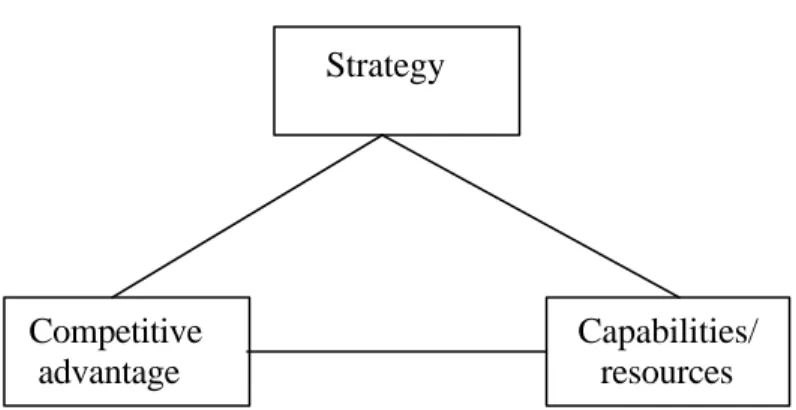
strategic capabilities match desired competitive advantage. This is the essence of the resource-based view and it can be depicted as a model in Figure 1.
Figure 1. Resources/capabilities, competitive advantage and strategy Capabilities/
resources Competitive
advantage
We will now investigate how dependence links to the model above: if dependence is important in the outsourcing unit’s strategy- making and could be a reason for match and mismatch in the unit’s situation. This study is performed by carrying out in-depth case studies including two outsourced units.
5 The cases
5.1 Laxå Special Vehicles
Laxå Special Vehicles (LSV) is specialised in customer adapted solutions as a complement to the product range of Scania, the Swedish manufacturer of trucks and buses, operating world-wide. Extended crew cabs and other special cabs are mounted on Scania chassis, special cabs such as fire tenders and other specialised vehicles are modifications based on standardised chassi configurations, engines, and gearing systems of Scania. For customer adapted orders LSV is a part of the production flow. Scania is then a supplier of standardised parts of the car and LSV supplies Scania with the modified vehicle. LSV is situated in Laxå, Sweden, a small town 300 km from the cab supplying plant (Oxelösund) and 200 km from the main assembly site of Scania (Södertälje). The building of special vehicles for Scania in Laxå has a history of more than 20 years, first as a firm of its own, which was purchased by Scania in 1992. It operated as a production unit until 1999, when Scania decided to outsource the unit to the local management. LSV was established.
In accordance with the management in Scania the new owners saw the advantages in increased production flexibility based on different principles than a large standardised assembly line, and also some other adjustments possible in a smaller firm. Still the basic business idea was the same as before. Turnover increased from 66 Sw. Mkr in1999 to 125 Sw. Mkr in 2003. The number of employees increased from 65 to 95. Expansion has been
combined with profit each year ranging between 4-6 % of turnover. The scope of operation expanded by LSV taking over more of the cab mounting, most important welding together the front and rear cab halves. LSV has also built facilities for painting, which used to be
outsourced before. All production is still geared to Scania, which is LSV’s sole customer. Construction, production and logistics are integrated with Scania. Quality and environmental standards and documentation are adjusted to the norms of Scania. LSV takes part in Scania’s product development and sometimes makes design prototypes. The marketing of special vehicles is done by Scania’s marketing departments worldwide. LSV has no marketing function of its own, instead it backs up Scania’s sales by giving sales people and customers technical information when needed. Agreements with end customers are always signed by Scania. Scania and LSV make their own agreements accordingly on volumes, prices and deliveries.
5.1.1 Dependence between LSV and Scania
Long-standing relationships and tight networks are prominent between the companies. Key staff at LSV have earlier been employed by Scania. Both take the other party’s needs into special consideration. “We think Scania and we work Scania”, as one of the managers of LSV expressed it. A representative for Scania expressed it in this way:
“It is in the interest of Scania to share its future plans, to give LSV a fair chance to comply with the needs and a representative for LSV: “we feel that Scania trusts us, the way we handle our business together”
The need for the other party’s competence. The challenges for a supplier’s competence development is to live up to the customer’s expectations. For LSV it is vital to live up to these expectations. But Scania also needs LSV’s competence in its product development due to its experience of special vehicles. Even so, 80 % of Scania’s production is independent of the specialised production of LSV. The possibilility to offer special vehicles is an important competitive advantage for Svania, though. Its fire engines e.g. are well-known worldwide. Sales of special vehicles increase more than for standard trucks. It would take a long time to establish an alternative provider of special vehicles. LSV and Scania are in this way mutually dependent on one another.
Participation in the same governance systems. LSV is totally integrated into Scania’s production system. Orders from Scania govern LSV’s operations. Volumes: 100 % of LSV production is geared to Scania. Scania, on the other hand, needs special adjustments from LSV in only 20 % of the trucks it produces. The degree of LSV specialisation towards Scania is 100 %.
LSV would have extensive problems in shifting over to any other car manufacturer or other business. One of the managers:
“We cannot start working for Mercedes or Volvo. We would lose confidence with Scania. Could be very hazardous for us. If we tried to run this complex production for several customers, we would lose competence. And it would take too much money, time and effort to start building machines for farming, road construction and similar possible products.”
. There is in the short run no alternative customer for LSV, no substitutability.
To sum up, asymmetric dependence exists between the companies. LSV has to comply with Scania due to the integration in Scania’s production system. Futhermore, LSV is both a customer and a supplier within the same production line. Still, this is not considered to be a problem by the companies. Interdependence, even if it is asymmetric can be seen as positive by both parties, if they feel it benefits their business.
5.1.2 Competitive advantages, capabilities and resources
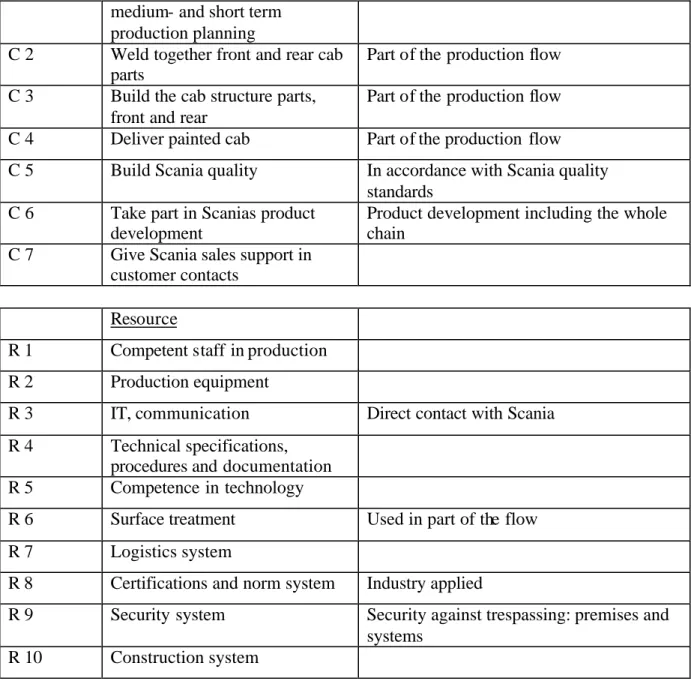
In table 1 is summarised LSV’s views of the company’s competitive advantages, its most important capabilities and resources.
Competitive advantage LSV CA 1 Best Scania vehicle for the
customer’s needs
Provide best special vehicle on the market for the customer’s needs based on Scania’s product range
CA 2 Best supplier of special vehicles to Scania
Supply according to Scania’s specifications special vehicle of the right quality and in time
Capability
medium- and short term production planning
C 2 Weld together front and rear cab parts
Part of the production flow C 3 Build the cab structure parts,
front and rear
Part of the production flow
C 4 Deliver painted cab Part of the production flow
C 5 Build Scania quality In accordance with Scania quality
standards C 6 Take part in Scanias product
development
Product development including the whole chain
C 7 Give Scania sales support in customer contacts
Resource
R 1 Competent staff in production
R 2 Production equipment
R 3 IT, communication Direct contact with Scania
R 4 Technical specifications, procedures and documentation
R 5 Competence in technology
R 6 Surface treatment Used in part of the flow
R 7 Logistics system
R 8 Certifications and norm system Industry applied
R 9 Security system Security against trespassing: premises and
systems R 10 Construction system
Table 1. Laxå Special vehicles – competitive advantages, capabilities and resources
In Table 1 can be discerned how competitive advantages are supported by capabilities and resources. For the competitive advantage Best Scania vehicle for the customer’s needs (CA 1) it is vital to have capabilities to cooperate with Scania in medium- and short-term planning (C1) and to take part in in Scania’s product development (C 6). Important resources are Competence in technology (R 5), Construction system (R 10), Technical specifications, procedures and documentation, Certifications and norm system (R 8), Security system (R 9) and Communication facilities (R 3). These capabilities and resources give LSV its position as preferred supplier.
To be the best supplier of special vehicles to Scania (CA 2) the important competitive advantage to maintain is to build Scania quality (C 5) and give Scania sales support in customer contacts (C 7). Vital resources are all 10 resources stated above.
It is notable how closely LSV links itself with Scania by its perception of competitive advantages, capabilities and resources.
5.2 Lyckes Produk tion Inc.
Lyckes Produk tion Inc. (LP) is a company in metal cutting situated in Karlskoga, an industrial city in Sweden. LP normally works on its cus tomers’ material in subcontracted production. For a long time a large manufacturing company in the defence industry, Bofors Inc. in
Karlskoga, outsourced metal cutting to Lyckes, which had 80-90 % of its orders from Bofors. In 1992 Lyckes was bought by an employee. The new owner of Lyckes wanted to reduce dependence on one customer and started marketing the company to new potential customers. He also started to exchange the old and very traditional machinery for modern NC equipment. Aided by a boom in the middle of the 1990’s turnover doubled within four years facilitating more re- investment. Bo fors had some tough years with restructuring its business and ceased ordering from Lyckes.
Lyckes’ owner acquired a company in 1993, now called Cylinder Tube Inc. in Kristinehamn, an industrial city some 100 km away. Its business, roller burnished cylinder tubes, can be characterised as an enlargement of Lyckes’ niche. Turnover was 6 Sw. Mkr the first year and 400 Sw. Mkr four years later. Then Lyckes’ owner in 1998 bought a company at a
neighbouring site close to Cylinder Tube. Its operation is aluminium casting and welding. The firm is now called Aluminiumproduk tion Inc. This acquisition gave Lyckes a more prominent position on the market of aluminium component s and also gave Lyckes a wider scope of the production flow from material to end product or a larger share of a composed system. A third enlargement occurred when Rolls- Royce Marine Inc., with a production for shipping and boating, outsourced its mechanical workshop, which Lyckes purchased.
In recent years Lyckes has found itself to be an outsourced unit for the second time when Rolls-Royce gave orders for nearly 100 % of the Lyckes group capacity. Once again Lyckes ended up in total dependence on one large customer. Also this time the owner made a counter move in his specific way: He bought a mechanical workshop, Scana Komponenter Inc. in Karlskoga, which actually provided Bofors (now called SAAB Bofors Dynamics Inc.) with metal cutting as Lyckes did 10 years ago. The acquisition also gave Lyckes additional machine capacity for a larger market, including large industrial buyers such as SAAB, ABB and Volvo.
Some restructuring and reorganisation ensued. Casting and welding is now concentrated to Kristinehamn and metal cutting to Karlskoga to enable specialisation and for cost efficiency. Daily transports knit the units together.
Lyckes’ expansion can be summed up in figures. Turnover has increased from 25 Sw. Mkr. in 1992 to 190 Sw. Mkr. in 2003 for the Lyckes group. The number of employees in Lyckes was 18 in 1992. The whole Lyckes group now employs 125 people. The profit for the last four years has ranged between 15-20 % of turnover.
5.2.1 Dependence between LP and two outsourcers
Lyckes has shown a clear aim to avoid being totally dependent on one large customer. The means for that is expansion by acquisition and alliances, giving more customers and
broadening the market. There is also an emerging pattern in its acquisitions: Lyckes seeks a form of partnership: It wants to take over operations in Lyckes specific niche from other companies and make them dependent on Lyckes. It looks for outsourcers. Such a strategy requires Lyckes to be more qualified and/or cost effective in the niche than the outsourcer, otherwise outsourcing would not make sense.
With Bofors there has been long-standing relationships and tight networks for six decades. The firms are located in the same city with its specific industrial milieu. A number of employees at Lyckes were trained at Bofors Vocational School or have worked in Bofors. Business was at a low level during a decade. LP did not hesitate to buy Scana, since they relied on their relations with Bofors. And this part of the firm operates in- house, in Bofors’ workshop. In the second city the picture is similar: Together with the acquisitions came also many personal links with Rolls-Royce.
Is LP dependent on the outsourcers’ competence? LP has by acquisitions obtained the desired competence from the outsourcers in order to have the competence in its own organisation - and maybe increase the outsourcer’s dependence on Lyckes. But the role of the outsourcers as demanding customers is important: Learning resides in the customers’orders.
Concerning the connection to the outsourcers’ governance systems, LP has a philosophy: “We have the same MPS-system in all our companies. The same programming system. We can communicate easily. Also move staff between our companies. Researcher: Do you have the same MPS as your largest customers?
Lyckes: No. But we have EDI for ordering and payment”
It is thus more important to have a joint governance system within the group than with the outsourcers.
Share of volume of LP production has varied considerably. The volume of 80-90% from Bofors went down to almost zero, then up again (by acquisition) to 30 %. An order volume of zero went up to 100% coming from Rolls-Royce, which has now decreased in relative share to 50 %. LP wants to change shares of volume by expansion of business, while retaining the volume of the dominant customers in absolute figures. The owner of LP sees the ideal
composition to be a number of customers with 15-20 % each, in order not to be too dependent and vulnerable.
Dependence by specialization towards a specific customer is not typical in the business of cutting metal. Technology, equipment and competence are normally easy to use for different orders and customers. The outsourcers do not favor too much specialization either. Lyckes:
“In our commitment towards Bofors we are allowed other customers. Also Bofors’ competitors. Rolls-Royce does not want us as single supplier. They want us to be stable and competent in the future.”
Could Bofors and Rolls-Royce be easily substituted? Lyckes:
“ It would be tough for us to lose them. It takes a long time to get a new customer. I have made statistics on that. It took us two years. Price, delivery time, quality were key factors. And they do not gladly swap suppliers. So we need a good reputation to succeed.”
5.2.2 Competitive advantages, capabilities and resources
In table 2 is summarised LP’s views of the company’s competitive advantages, its most important capabilities and resources.
Competitive advantage LP
CA 1 Assortment Capacity to offer the customer a
broad range of details
CA 2 Semi- heavy and heavy products Handle metal cutting and welding for components up to 80 tons
CA 3 Partnership Offer competence and cost
effectiveness in accordance with customer needs in agreed phases of production
Capability
C 1 Plan and prepare for production Programming, use CAD/CAM,
MPS etc.
C 2 Work on different materials and
dimensions of details
Iron, stainless steel, aluminium etc.
C 3 Configure Machine preparation, flow, staff
disposition
C 4 Compose system Components and details composed
according to customer order
C 5 Control subsuppliers Tier n+1, where n=Lyckes
C 6 Plan and perform together with the customer
C 7 Logistics, transport
Resources
R 1 Machinery NC-control, etc.
R2 Staff Operators, planners, admnistrators,
etc.
R 3 Competence and system for
production
Access to technology,
programming, MPS, CAD/CAM, NC etc.
R 4 Marketing competence
R 5 Competence and equipment for
management and procedures
R 6 Logistics system and equipment
R 7 Premises and equipment E.g. special adaptation fo r heavy
Table 2. Lyckes Produktion Inc. – competitive advantages, capabilities and resources
In Table 2 can be discerned how competitive advantages are supported by capabilities and resources. Competitive advantage Assortment (CA 1) concerns what is essential in the metal cutting line of business: To meet the cuctomer’s needs for different kinds of work on the customer’s material. Capabilities will be a broad range of Plan and prepare for production (C 1), towork on different materials and dimensions of details (C 2), to configure the machine setting (C 3), Compose components and details according to customer order (C 4) and to Plan and perform together with the customer (C 6). Machinery, staff, competence and system for production, management and marketing are important resources ( R1-5).
The acquisitions from Roll- Royce have given LP machinery and equipment to work with heavy components, a distinctive niche on the market. For the competitive advantage Semi-heavy and Semi-heavy products (CA 2), all capabilities and resources stated in the table above are important.
Partnership is LP’s own concept for its endeavour to take over all operations in a part of the production flow, thus enabling its customer to outsource this part altogether with staff, machinery, shopfloor area etc. To become an outsourced unit in this way is thus by LP considered to be a competitive advantage (CA 3). Capability demands on LP are then, apart from the production in itself, to Compose components and details according to customer order, to Control LP’s own subsuppliers, to Plan and perform together with the customer and handle Logistics (C 4-7) and to mobilize all resources indicated in the table.
6 Conclusions : conjunction and disjunction strategies
As can be seen above, the outsourced unit LSV pursues a main strategy of binding itself to the outsourcer. We label this a strategy of conjunction with the outsourcer. LSV identifies
competitive advantages in having close business ties with the outsourcer, it regards dependence on the outsourcer as an asset and it develops and maintains capabilities and resources to support this strategy. The outsourced unit LP, on the other hand, seeks liberation,
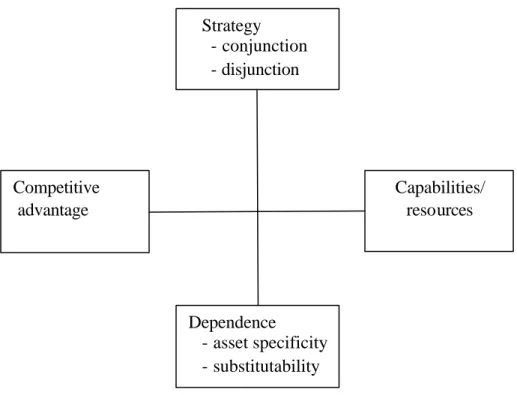
a strategy of disjunction from the outsourcers whe n the firm twice took action for what it considered to be over-dependence. It responded by seeking new alliances and markets in order to use its competitive advantages for the customers and to obtain new competitive advantages. The acquisitions display a clear wish to muster new capabilities and resources. We have also seen in the cases that dependence plays a vital role for the outsourced units’ view of competitive advantage and their assets in forms of capabilities and resources. We therefore revise the model in Figure 1 above to bring in the study’s concepts into a model presented in Figure 2 below.
Figure 2. Dependence, resources/capabilities, competitive advantage and strategy
There may be a reinforcing circle between asset specificity, competitive advantage and capabilities/resources. Existing asset specificity at the time of outsourcing may lead to identification of competitive advantages towards the outsourcer. These competitive advantages will favour maintaining and developing certain capabilities and resources. The existence of these capabilities and resources may in its turn reinforce asset specificity , and so on. If there is a tendency for outsourced units to apply conjunction with outsourcers as a strategy, deliberate or emergent (Mintzberg and Waters, 1985), this reinforcing circle could be an explanation. An outsourced unit may have ambitions of more liberation from the
outsourcer than they actually achieve. The problem deserves further studies.
We have also seen examples of harmony and disharmony in the cases. A situation of harmony
exists when there is a match between strategy pursued, perceived competitive advantage, the dependence situation and capabilities/resources at hand. The outsourced unit has no reason – for as long as harmony is believed to prevail – to change any of these components relating to its business partners (outsourcer and others). But there may be a situation of disharmony when there is a mismatch between pursued strategy, perceived competitive advantage, the
dependence situation and capabilities/resources at hand. The mismatch is characterised by e.g. an unrealistic view of competitive advantages, inadequately developed capabilities, lack of important resources or too much or too few specific assets geared towards the business partner. Disharmony shows itself through disturbances in the relationship between the outsourced unit and its business partners which may lead to lost sales, low profitability, contracts not renewed, etc.
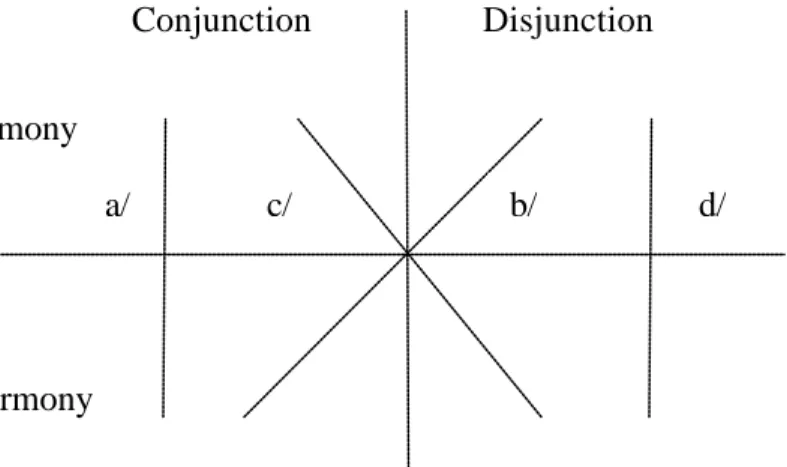
The strategies of conjunction and disjunction can be combined with a state of harmony or disharmony for any specific outsourced unit. In Figure 3 the four combinations possible are
Capabilities/ resources Competitive advantage Strategy - conjunction - disjunction Dependence - asset specificity - substitutability
Conjunction Disjunction
Harmony
Disharmony
a/ c/ b/ d/
depicted. In a state of harmony the outsourced unit just needs to stick to competitive advantages, capabilities and resources and keep specific assets. Of cour se markets,
competition and technology change over time, which makes it necessary for the outsourced unit to assess its situation now and then. This is the situation of the case LSV. Experiencing disharmony, the firm would strive to reach a state of harmony, which could be either in a strategy of conjunction or disjunction (the case LP represents the latter). There are thus four ways of strategic change, indicated by the arrows in the model in Figure 3.
Figure 3. Harmony/disharmony and strategy
a/ Disharmony with a strategy of conjunction may make the outsourced unit reach a more harmonious relation to the outsourcer, i.e retaining conjunction by aligning its competitive advantages, capabilities and resources to the needs of the outsourcer. In terms of dependence the outsourced unit may strengthen one or several specific assets: close relationships in the outsourcer’s organization, adherence to the outsourcer’s governance systems, high volume of delivery and continued specialization towards the business of the outsourcer. To the
outsourcer, specific assets can imply efficiency and flexibility: Required qualities, timeliness, smooth processes such as ordering, fast delivery, simple logistics, security, facilitated error handling etc. The outsourced unit would respond to the outsourcer’s needs in these respects. Even though the LSV situation was not characterised by disharmony, its desire to maintain to the strategy of conjunction made the firm act in ways indicated here in order to prevent disharmony.
b/ Disharmony with a strategy of conjunction may also make a firm attempt to reach harmony by a strategy of disjunction, i.e. widen its market. A revision of competitive advantages, capabilities and resources is then needed when facing new business partners. To exploit possible competitive advantages that are not relevant for the outsourcer can be the very reason for outsourcing and to embark upon a development towards disjunction. New competitive advantages can also appear as markets change. Of course a competitive advantage important for the outsourcer may also be important to other – old or new – customers of the outsourced unit. Backing up competitive advantage towards other customers than the outsourcer may trigger development of new paths of capability (see section 4 above) and requisite resources.
LP’s two shifts from being dominated elicited work with visions, markets and products for competitive edges, and resulted in new resources and capabilities for new production.
There are a number of ways to shift dependence over from the outsourcer to other customers (new or existing). Marketing, product development, alliances with other firms bringing in new products and/or markets and competition based on cost efficiency are some ways. LP, for example, used acquisition of other firms as a way to expand markets and settle in a niche. c/ Disharmony with a strategy of disjunction may make the outsourced unit re-orient itself back to the outsourcer by a strategy of conjunction. This is a situation where the strategy of disjunction showed itself to be inappropriate or less rewarding and the outsourced unit re-evaluates the relations with the outsourcer to bring harmony. Aligning competitive advantages, capabilities and resources is then needed for orientation to the outsourcer. In terms of dependence, the outsourced unit may need to strengthen one or several specific assets of interest for the outsourcer: close relationships in the outsourcer’s organization, adherence to the outsourcer’s governance systems, high volume of delivery and continued specialization towards the business of the outsourcer.
d/ Disharmony with a strategy of disjunction could also attain harmony by acquiring other, new customers or extending business with customers that have been less important so far. The strategy of disjunction is in itself considered to be appropriate, i.e. a liberation from the outsourcer. A revision of competitive advantages, capabilities and resources is then needed when facing a changed set of business partners. There are a number of ways to shift
dependence over to other customers (new or existing). Marketing, product development, alliances with other firms bringing in new products and/or markets and competition based on cost efficiency are some ways. Asset specificity may not be as prominent in a disjunction strategy if the outsourced unit seeks conjunction with many different customers. Specific assets may reside in personal relationships, adjustments to customers’ procedures, need for a customer’s competence, or specialization of certain products towards one or more of the firm’s customers.
The notions of strategic conjunction and disjunction are prototypes for analytical clarity. In reality a firm may very well adhere to both strategies, but towards different customers. Elements of conjunction and disjunction at the same time in the firm’s strategy can be seen in LP. Basically its owner wanted to keep outsourcers as customers (conjunctive element) and expand to become more independent (disjunctive element) at the same time. Situations like that – with mixed and in some respects opposing requirements – are worthy of further studies, both because the situation may put extra strain on management and because these situations are probably common for outsourced units.
Likewise, for clarity in the discussion, the notio ns of harmony and disharmony have been used above in an absolute sense. In reality it is a matter of degree. A firm may experience increasing disharmony with its situation over time. At some point increasing disharmony may elicit action with possible strategic re-orientation. Harmony and disharmony - whether or not there is a match between strategy pursued, perceived competitive advantage, the dependence situation and capabilities/resources – may thus provide explanation as to why and when firms embark upon strategic change. Harmony/disharmony may be fruitful notions for further studies of what determines processes of strategic change.
BIBLIOGRAPHY
Anderson, E. & Weitz, B., (1992), "The use of pledges to build and sustain commitment in distribution channels." Journal of Marketing Research, Vol. 29, February, pp. 18-34. Baden-Fuller, C., Targett, D. & Hunt, B., (2000), "Outsourcing to Outmanoeuvre: Outsourcing Re-defines Competitive Satrategy and Structure." European Management Journal, Vol. 18, No. 3, pp. 285-295.
Barney, J. B., (2001), "Resource-based theories of competitive advantage: A ten-year retrospect on the resource-based view." Journal of Management, Vol. 27, pp. 643-650. Berger, H., Noorderhaven, N. G. & Nooteboom, B., (1995), Determinants of supplier dependence: an empirical study, Sjöstrand, S.-E., On economic institutions. Theory and application, Bodmin, Edward Elgar Publ., 195-212.
Brandes, H., Lilliecreutz, J. & Brege, S., (1997), "Outsourcing - success or failure?"
European Journal of Purchasing & Supply Management, Vol. 3, No. 2, pp 63-75.
Buchanan, L., (1992), "Vertical trade relationships: The role of dependence and symmetry in attaining organizational goals." Journal of Marketing Research, Vol. 29, February, pp. 65-72. Buvik, A. & Grönhaug, K., (2000), "Inter- firm dependence, environmental uncertainty and vertical co-ordination in industrial buyer-seller relationships." Omega. The International Journal of management Science, Vol. 28, pp 445 - 454.
Collis, D. J., (1991), "A resource-based analysis of global competition: The case of the bearings industry." Strategic Management Journal, Vol. 12, pp. 49-68.
Day, G. S., (1994), "The Capabilities of Market-Driven Organizations." Journal of Marketing,
Vol 58, No. 4, pp. 37-52.
Dwyer, F. R., Schurr, P. H. & Oh, S., (1987), "Developing Buyer-Seller Relationships."
Journal of Marketing, Vol. 54, April, pp 11-27.
Eisenhardt, K. M. & Martin, J. A., (2000), "Dynamic capabilities: What are they?" Strategic Management Journal, Vol. 21, pp. 1105-1121.
El Ansary, A. I. & Stern, L. W., (1972), "Power measurement in the distribution channel."
Journal of Marketing Research, Vol. 9, February, pp. 47 - 52.
Emerson, R. M., (1962), " Power-Dependence Relations." American Sociological Review, Vol 27, No. 1, pp. 31-41.
Gadde, L.-E. & Håkanssson, H., (1993), Professional Purchasing, London, Routledge. Gadde, L.-E. & Håkanssson, H., (2001), Supply network strategies, Chichester, Wiley & Sons.
Ganesan, S., (1994), "Determinants of long-term orientation in buyer-seller relationships."
Journal of Marketing, Vol. 58, April, pp. 1-19.
Grant, R. M., (1991), "The Resource-Based Theory of Competitive Advantage: Implications for Strategy Formulatio n." California Management Review, Spring, pp. 114-135.
Greco, J., (1997), "Outsourcing: the new partnership." Journal of Business Strategy, Vol. 18, No. 4, pp. 48-54.
Gundlach, G. T. & Cadotte, E. R., (1994), "Exchange interdependence and interfirm
interaction: Research in a simulated channel setting." Journal of Marketing Research, Vol. 31, November, pp. 516-532.
Hall, R., (1993), "A framework linking intangible resources and capabilities to sustainable competitive advantage." Strategic Management Journal, Vol. 144, pp. 607-618.
Hallén, L., Johanson, J. & Seyed-Mohammed, N., (1991), "Interfirm Adaption in Business Relationships." Journal of Marketing, Vol. 55, April, pp 29-37.
Heide, J. B. & John, G., (1988), "The Role of Dependence Balancing in Safeguarding Transaction-Specific Assets in Conventional Channels." Journal of Marketing, Vol 52, Jan., 20-35.
Heide, J. B. & John, G., (1990), "Alliances in industrial purchasing: The determinants of joint action in buyer-supplier relationships." Journal of Marketing Research, vol. 27, February, pp. 24-36.
Heikkilä, J. & Cordon, C., (2002), "Outsourcing: a core or non-core strategic management decision?" Strategic Change, Vol. 11, Jun-Jul, pp. 183-193.
Hunt, S. D., (1997), "Resource-Advantage Theory: An Evolutionary Theory of Competitive Firm Behavior." Journal of Economic Issues, Vol. XXXI, No. 1, pp. 59-77.
Håkansson, H., (1989), Corporate technological behaviour: co-operation and networks, London, Routledge.
Jacobs, D., (1974), "Dependency and Vulnerability: An Exchange Approach to the Control of Organizations." Administrative Science Quarterly, Vol 19, pp 45-59.
Jennings, D., (1997), "Strategic guidelines for outsourcing decisions." Strategic Change, Vol. 6, pp. 85-96.
Johanson, J. & Mattson, L.-G., (1987), "Interorganizational relations in industrial systems: A network approach compared with the transaction-cost approach." International Studies of
management and Organization, XVII, No. 1, 34-48.
Joshi, A. W., (1998), "How and why do relatively dependent manufacturers resist supplier power?" Journal of Marketing Theory and Practice, Vol. 6, No. 4, 61 - 77.
Joshi, A. W. & Stump, R. L., (1999), "Determinants of Commitment and Opportunism: Integrating and Extending Insights from Transaction Cost Analysis and Relational Exchange Theory." Canadian Journal of Administrative Sciences, Vol. 16, No. 4, 334 - 352.
Kumar, N., Scheer, L. K. & Steenkamp, J.-B. E. M., (1995), "The effects of percieved interdependence on dealer attitudes." Journal of Marketing Research, Vol. 32, August, 348 - 356.
Lamming, R., (1993), Beyond partnership - strategies for innovation and lean supply, Hemel Hempstead, Prentice Hall.
Lilliecreutz, J., (1998), "Orchestrating resource base, role, and position: a supplier's strategy in buyer-dominated relationships." European Journal of Purchasing & Supply Management,
Vol. 4, pp. 73 - 85.
Lonsdale, C., (2001), "Locked-In to Supplier Dominance: On the Dangers of Asset Specificity for the Outsourcing Decision." The Journal of Supply Chain Management, Spring, pp. 22-27. Lorenzoni, G. & Lipparini, A., (1999), "The leveraging of interfirm relationships as a
distinctive organizational capability: A longitudinal study." Strategic Management Journal,
Vol. 20, pp. 317-338.
Lusch, R. F. & Brown, J. R., (1996), "Interdependency, Contracting, and Relational Behavior in Marketing Channels." Journal of Marketing, Vol. 60, 19 - 38.
Lyons, B. R. & Bailey, S., (1993), "Small Subcontractors in UK Engineering:
Competitiveness, Dependence and Problems." Small Business Economics, Vol. 5, pp. 101-109.
Macneil, I. R., (1980), The New Social Contract. An inquiry into modern contractual relations, Birminghamton N Y, Yale University Press.
McCann, J. & Galbraith, J. R., (1981), Interdepartmental relations, Nystrom, P. C. S., W. H. (ed), Handbook of Organisational Design, New York, Oxford University Press, Vol. 2, 60-81. McDermott, C. & Handfield, R. B., (2000), "Concurrent development and strategic
outsourcing: Do the rules change in breakthrough innovation?" The Journal of High Technology Management Research, Vol. 11, No. 1, pp. 35-57.
Mintzberg, H. & Waters, J. A., (1985), "Of Strategies, Deliberate and Emergent." Strategic Management Journal, Vol. 6, pp. 257-272.
Momme, J., (2002), "Framework for outsourcing ma nufacturing: strategic and operational implications." Computers in Industry, Vol. 49, pp. 59-72.
Nelson, R. R. & Winter, S. G., (1982), An evolutionary theory of economic change, Cambridge, Mass., The Belknap Press of Harvard Univesity Press.
Pfeffer, J. & Salancik, G. R., (1978), The External Control of Organizations. A Resource Dependence Perspective, New York, Harper & Row Publ.
Porter, M. E., (1980), Competitive Strategy, New York, The Free Press.
Pralahad, C. & Hamel, G., (1990), "The Core Competence of the Corporation." Harvard Business Review, May-June, pp. 79-91.
Quinn, J. B. & Hilmer, F. G., (1994), "Strategic Outsourcing." Sloan Management Review,
Vol. 35, No. 4, pp. 43-55.
Raffa, M., (1992), A relationships typology in firms networks, 8th IMP Conference, Lyon, IMP Conference.
Ragatz, G. L., Handfield, R. B. & Scannell, T. V., (1997), "Success Factors for Integrating Suppliers into New Product Development." Journal of Product Innovation Management, Vol. 14, 190 - 202.
Rangone, A., (1999), "A Resource-Based Approach to Strategic Analysis in Small-Medium Sized Enterprises." Small Business Economics, Vol. 12, pp. 233-248.
Reilly, P. & Tamkin, P., (1996), Outsourcing: A flexible option for the future?, Brighton, The Institute for employment studies (IES).
Ring, P. S. & van de Ven, A. H., (1992), "Structuring cooperative relationships between organizations." Strategic Management Journal, Vol. 13, pp. 483-498.
Robinson, T., (1989), Partners in Providing the Goods: The Changing Relationship Between Large Companies and their Small Suppliers, London, 3i's.
Stinchcombe, A. L., (1965), Social Structure and Organizations, March, J. a. G., Handbook of Organizations, Chicago, Rand McNally & Company, pp. 142-193.
Takac, P. F., (1993), "Outsourcing Technology." Management Decision, Vol. 31, No. 1, pp. 26-37.
Teece, D. J., Pisano, G. & Shuen, A., (1997), "Dynamic capabilities and strategic management." Strategic Management Journal, Vol. 18, No. 7, pp. 509-533. Thompson, J. D., (1967), Organizations in Action, Mc Graw-Hill.
Wernerfelt, B., (1984), "The resource-based view of the firm:." Strategic Management Journal, Vol. 5, pp. 171-180.
Williamson, O. E., (1985), Market and Hierarchies: Analysis and antitrust implications, New York, The Free Press.
Zhu, Z., Hsu, K. & Lillie, J., (2001), "Outsourcing - a strategic move: the process and ingredients for success." Management Decision, May, pp. 373-378.