Enriching Interlinear Text using Automatically Constructed Annotators
Ryan Georgi
University of Washington Seattle, WA 98195, USA
Fei Xia
University of Washington Seattle, WA 98195, USA
William D. Lewis
Microsoft Research Redmond, WA 98052, USA [email protected]
Abstract
In this paper, we will demonstrate a sys-tem that shows great promise for creating Part-of-Speech taggers for languages with little to no curated resources available, and which needs no expert involvement. In-terlinear Glossed Text (IGT) is a resource which is available for over 1,000 lan-guages as part of the Online Database of INterlinear text (ODIN) (Lewis and Xia, 2010). Using nothing more than IGT from this database and a classification-based projection approach tailored for IGT, we will show that it is feasible to train reason-ably performing annotators of interlinear text using projected annotations for poten-tially hundreds of world’s languages. Do-ing so can facilitate automatic enrichment of interlinear resources to aid the field of linguistics.
1 Introduction
In this paper we discuss the process by which a highly multilingual linguistic resource (greater than 1,200 languages) can be built and then sub-sequently automatically enriched. Although we touch upon tools for building and maintaining such a resource, our focus in this paper is not so much on the process by which we curate the data, but the process by which automatically enrich the data with additional layers of linguistic analysis. Crucially, we show that the linguistic knowledge encapsulated in all of the data, irrespective of the language, can improve the accuracy of NLP tools that are developed for any specific language. This is particularly true for languages that are otherwise highly under-resourced, and where the develop-ment of automated NLP tools, such as taggers, are
either not possible or very expensive to develop using traditional methods.
We will focus on the development of Part-of-Speech (POS) taggers. POS tagging is generally thought of as a solved task for many languages, with per-token accuracies reaching 97% (Brants, 2000; Toutanova et al., 2003). While these high accuracies can certainly be achieved for languages with substantial annotated resources, many low-resource languages have little to no annotated data available, making such traditional supervised ap-proaches impossible. Given the cost in developing such resources, many languages with insufficient economic or strategic interest may never see ded-icated tools. If annotated resources are not avail-able, what methods can be used?
Several approaches have been proposed to solve the problems posed by the shortage of labeled training data. The first are purely unsuper-vised techniques. POS induction techniques, such as class-based n-grams (Brown et al., 1992) or feature-based HMM (Berg-Kirkpatrick et al., 2010) induce parts-of-speech without the need for labeled data by finding the ways in which words appear to pattern similarly in clusters. However, as Christodoulopoulos et al. (2010) noted, the way to map the induced clusters to meaningful tags is not straightforward.
Other work has looked at solving the issue of a lack of data by using two or more closely related languages where one of the languages is resource-rich. Hana et al. (2004) used Czech resources to tag Russian. This, however, requires the lan-guages to be closely related, and not all resource-poor languages have closely-related resource-rich languages.
Another path of inquiry has been to use one un-related resource-rich language and alignment
nnisaau daxalna makaatibahunna
the-women(3.PL.F.)-NOM entered-3.PL.F office(PL.)-ACC-their(F.) their offices.”
“The women have entered LANG
GLOSS TRANS
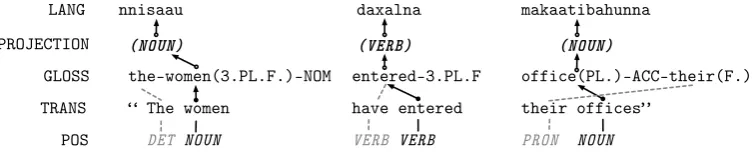
Figure 1: An example of Interlinear Glossed Text (IGT) in Arabic from (Nasu, 2001), with an En-glish translation.
niques to “project” information from the resource-rich language to the resource-poor one. Yarowsky and Ngai (2001); Das and Petrov (2011) both in-vestigated training POS taggers by projecting la-bels from one language to another, while Hwa et al. (2004) looked at projecting dependency parsers.
In this paper, we focus on using a resource known as Interlinear Glossed Text (IGT) as a pos-sible source of linguistic knowledge for the POS tagging task on resource-poor languages, and ap-ply it to the enrichment of a linguistic resource composed of IGT data. An example of IGT is shown in Fig. 1. IGT is a format used by lin-guists for giving examples of linguistic phenom-ena, and since linguists study a large number of languages, IGT instances can be found for hun-dreds of languages. We will explain the precise structure of the data in depth later, but IGT as a re-source is appealing not only for its broad coverage, but also the linguistic knowledge it contains. Al-though it does not typically contain POS tags ex-plicitly, these examples often contain enough data to make inferences which can be used to enrich the data, whether with POS tags or with other syntac-tic information (Lewis and Xia, 2010).
We present a system which takes advantage of the structure of IGT instances in order to perform automatic part-of-speech tagging of the target lan-guage, regardless of the language. While the tag-ging performance is not necessarily competitive with state-of-the-art supervised systems, it shows great promise for languages with which such su-pervised systems are not currently possible, and can increase the value of the entire resource to the linguistic and computational linguistic communi-ties.
POS taggers are intrinsically valuable to com-putational linguists, since they are building blocks for a number of other NLP tools. Theoretical and descriptive linguists might question their value to them; however, they only represent a class of possible annotators. The projection
methodol-ogy, especially the fact that projection accuracy is boosted by relying on an entire corpus, can be applied to other forms of annotation, such as tags or analyses that may be of benefit for subsequent analyses. Although such taggers will not be as accurate as human annotators, they could reduce workload by doing first pass analyses automati-cally.
2 The IGT Data Type
As shown in Fig. 1, IGT instances typically con-tain one line in the target language, then a word-for-word gloss in the language of the paper from which the example is drawn (typically English) and finally a translation. The gloss line is of par-ticular interest for our purposes because of tokens such as the(3.PL.F)-NOMoften found in IGT, as shown in Fig. 1. This token is intended to sig-nify that the Arabic tokennnisaauis third per-son, plural, feminine, and in the nominative case. Each portion of the token, 3, PL, F, and NOM
are grammatical annotations, orgramsfor short1. While these grams by themselves do not guaran-tee that the token is necessarily a noun, they are a strong indicator. We will show how this informa-tion may be used in Secinforma-tion 4.
Also of note is that while the gloss line aligns one-to-one with the language line, with three words mapping to three gloss tokens, the transla-tion line has six words. Aligning these tokens is made easy by the words in the gloss line matching words in the translation line. This allows for pro-jection to be performed more precisely than might otherwise be possible using statistical alignment methods.
Previous work on projecting syntactic informa-tion between languages differs from our approach in two significant ways. First, projection in previ-ous work has relied on bitexts, which do not ben-efit from the additional information the gloss line of IGT provides. Therefore, these past methods have relied upon statistical alignment between lan-guages. Obtaining alignments of sufficient qual-ity would likely not be possible for resource-poor languages, since statistical alignment methods re-quire large amounts of parallel text. Using IGT, however, alignment can be obtained more pre-cisely with smaller amounts of data.
1While the “gram” moniker is typically used to refer to
Second, while many-to-one are a source of problems for past approaches, IGT offers a pos-sible solution for disambiguating tag-word align-ments by examining the grams directly. For in-stance, the gloss tokenboys.ran.3.PRESmay align to both NOUN and VERB tags, but the 3
andPRESgrams provide evidence that the token is most likely a verb showing agreement. In this paper, we will explore how both of these solutions may help us over traditional approaches to projec-tion.
2.1 Previous Uses of IGT
A number of studies have shown the linguistic knowledge contained in IGT data to be useful. The Online Database of INterlinear text (ODIN) (Lewis and Xia, 2010) contains over 190,000 IGT instances for over 1,000 languages. While still short of the approximately 6,900 languages that exist in the world (Lewis, 2009), this covers an enormous range of languages for which few other resources exist. Using ODIN as a resource, Lewis and Xia (2008) demonstrated via projection us-ing IGT alignments that basic word order of a language could be determined with 99% accuracy if the language contained at least 40 instances of IGT. Georgi et al. (2014) used IGT instances to produce sets of dependency trees which were then corrected and used to learn automatic correction rules.
2.2 INTENT: a Package for Creating Enriched IGT
In the previous sections, we described the forms of useful information that IGT contains. The next step is to programmatically harness that in-formation in order to construct automatic annota-tors. This is what our system, the INterlinear Text ENrichment Toolkit (INTENT), was designed for. INTENT takes IGT instances as input and produce automatically enriched IGT instances as output. A more in-depth discussion of the system can be found in Xia et al. (2015).
Word alignment is the first crucial phase of IN-TENT’s enrichment strategy. Due to IGT’s struc-ture providing a one-to-one gloss and language word alignment, and a gloss line containing many English-language words that co-occur in the trans-lation line, the gloss line can be used as a pivot to align the English language with the target lan-guage. INTENT does this either by matching the words from the gloss and translation lines, on a
string and morphological heuristics, or by using GIZA++ as a statistical alignment approach.
INTENT’s second primary purpose in this paper is to provide part-of-speech tags, which are pro-duced in one of two ways. Either INTENT uses one of the word alignment methods to project the English POS tags onto the gloss, and subsequently the target language word, or it takes advantage of the extra grammatical markers such as -Nom
(nominative case) or-Dec(declarative marker) as features for a classifier to recognize the part-of-speech tag that a gloss word is most likely to be an-notating in the target language, without ever need-ing to look at the target language directly. This means that INTENT can theoretically provide tags for any language for which interlinear text is avail-able.
2.3 Use of INTENT for Linguists
In the Spring of 2015 at the University of Wash-ington, our colleague Prof. Emily Bender used the INTENT system as part of a course, Computa-tional Methods in Language Documentation2. The INTENT system was used to enrich IGT instances from the Language CoLLAGE project (Bender, 2014). The students then worked on methods by which typological phenomenon might be deter-mined from the automatically enriched data, fol-lowing Bender et al. (2013, 2014). This type of in-quiry shows the large-scale enrichment of a wide variety of languages that INTENT is intended for, and how this can be used to answer interesting lin-guistic questions.
Other such uses might be enriching collected IGT instances automatically, to create an anno-tated corpus from IGT data while being able to greatly reduce the amount of human annotators needed for the task.
For these goals to be effective, INTENT must be able to generate sufficiently reliable POS tags on resource-poor languages. Whether or not that is the case is the question we seek to answer in this paper.
3 Projecting Annotation in IGT
Projection-based approaches work by finding an alignment between two lines, where one has anno-tation and one does not, and “projecting” the an-notations from one to the other. Figure 2 shows 2Course website available at: http://faculty.
nnisaau daxalna makaatibahunna
the-women(3.PL.F.)-NOM office(PL.)-ACC-their(F.) their offices”
“ The women have entered LANG
GLOSS TRANS
DET NOUN VERB VERB PRON NOUN
(NOUN) (VERB) (NOUN)
POS PROJECTION
[image:4.595.111.488.63.140.2]entered-3.PL.F
Figure 2: An illustration of how the gloss line from the IGT in Fig. 1 can be used for projection.
an illustration of how this projection occurs, using the sentence from Fig. 1.
Left unspecified is how the alignments between sentences are obtained. Previous papers gener-ated alignments using statistical alignment. For instance, Yarowsky and Ngai (2001) showed 76% POS tag accuracy for projecting directly between English and French, using GIZA++ to automat-ically align the words and evaluating with a re-duced tagset similar to the one used in this pa-per. Such an approach, however, required a set of parallel data consisting of roughly 2 million words per language, something which would not be available for resource-poor languages.
3.1 Using IGT to Bootstrap Alignment While ODIN contains many IGT instances, it has nowhere approaching the 2 million sentences used in previous projection approaches, such as Yarowsky and Ngai (2001). Thankfully, IGT con-tains more information than simply the source and target language data—IGT also has gloss lines. The gloss line is a transliteration of the language line, containing many of the same words that are used in the translation, although in a different or-der. We can use the gloss line as a “pivot” to boot-strap our alignment, as shown in Fig. 2, and fol-lowing Lewis and Xia (2008, 2010).
There are five steps to our process of projecting POS tags using the gloss line of IGT:
1. POS tag the translation line
2. Align the translation line with the gloss line 3. Disambiguate multiply-aligned gloss tokens 4. Attempt to resolve unaligned tokens in the
gloss line
5. Project POS tags from gloss line to language line
1 – First, an English-language POS tagger is used to provide the POS tag sequence for the trans-lation line. For our tests, we used the Stanford Tagger (Toutanova et al., 2003) trained on all sec-tions of English Penn Treebank (Marcus et al.,
1993) with the POS tags remapped from 45 down to the 12 tags in the universal tagset proposed by Petrov et al. (2011).
2 – Next, the words in the translation line and gloss line are aligned; this can be done by one of two ways: heuristically, or using statistical align-ment. In the heuristic approach, words are aligned by exact string matches; then stemmed matches, and finally a series of gram mappings, such asI
aligning to1SG. For this paper, we use the heuris-tic approach.
3 – After step 2, multiple translation words with differing POS tags may be aligned to the same gloss tokens. In Fig. 2, the translation to-kensThe women align to a single complex token
the-women(3.PL.F.)-NOM. In an effort to use a language-independent way of resolving mul-tiple tags on a single token, we specify an order of precedence by which a tag is selected, prioritizing content words over function words.3
4 – On gloss tokens that failed to receive an alignment, we attempt to retrieve a tag for the to-ken based on a dictionary lookup of the individ-ual subtokens. The dictionary is built using the part-of-speech tags from the English Penn Tree-bank (Marcus et al., 1993), and remapped to 12 universal POS tags following (Petrov et al., 2011). If one or more portions of the token are found in the dictionary, we use the most frequent tag for each of those words to label the token. Multiple tags are resolved the same as if the tags were pro-jected.
5 – Finally, the tags projected to the gloss line are transferred to the language line assum-ing a one-to-one, monotonic alignment. Since the glosses of IGT are intended to be paired word-for-word with the target language, this is a reasonable assumption. Due to noise in the IGT text files4,
3This order of precedence is: VERB > NOUN > ADV > ADJ > PRON > DET > ADP > CONJ > PRT
> NUM > PUNC > X.
4Further discussion of the noise in these files is found in
however, there is not always a one-to-one align-ment between the language line and gloss, and in these cases, we skip processing the IGT instance. In addition to alignment failures, noise is found in the form of a bias toward English, since all projec-tions originate in English, as well as a bias toward unusual phenomena that the author of the paper from which the instance is extracted is focusing upon. These issues are discussed further in Lewis and Xia (2008), where they are referred to as the
English biasandIGT bias, respectively.
3.2 Drawbacks of Projection
While Xia and Lewis (2007) show that the heuris-tic alignment approach can achieve 98% precision, and the recall is between 74% and 85% with fairly clean data. However, in our data, we found that upwards of 60% of tokens were unaligned (see Section 7.1). Tokens that are unaligned are left without a tag, and thus never labeled correctly. In order to address this issue, we next take a look at how the gloss line itself can be used as a means to obtain POS tags.
4 Building a Gloss-Line Classifier
There are three main areas in which the projec-tion method discussed above shows weaknesses: gloss tokens with multiple POS tags aligned to them, gloss tokens that fail to be aligned or found in a dictionary, and the assumption that foreign-language words will share the same POS as the English words in the translation line5. For in-stance, a gloss tokenrun.NOMmight be labeled as VERB, due to aligning with the intransitive verb form of the word in the English line. How-ever, the gram NOM is a strong indicator that the word is nominalized and should be tagged as
NOUN.
It is not the case that the tokens in question lack information on which to base a decision, but rather that such information is perhaps not well-suited
5This is an occurrence of theEnglish biasnoted by Lewis
and Xia (2008)
for a deterministic approach. Therefore, we pro-pose building a gloss-line classifier that uses the individual subtokens of a gloss-line word as fea-tures to make a decision for the label of the to-ken as a whole. Figure 3 illustrates how these sub-token level features might be used in this scenario. In addition to helping resolve the possible ambigu-ity of multiply-aligned tokens, our approach also avoids the indirection of finding the correct align-ment for a gloss token and working on the gloss token directly.
By using the very precise, albeit low recall, heuristic alignment method, we can automatically generate training instances for the gloss-line tag-ger. Using these automatically-annotated gloss to-kens, we then train a classifier using the MALLET package (McCallum, 2002) and its Maximum En-tropy implementation. We experimented with dif-ferent features, but the following set resulted in the highest performance on our development set for classifying a tokeni:
• Grams contained in tokeni
• Grams contained in tokeni−1,i+ 1 • Best dictionary tags for grams
Finally, this gloss line classifier can be used on IGT instances for the target language. After the gloss-line is labeled, the tags are transferred via one-to-one alignment with the language line.
4.1 Context-Sensitive Features
One of the things worth noting about this approach is that, while the IGT instances cover multiple dif-ferent languages, we can opt to use the gloss lines from all the languages in our annotated data to train the classifier (as we do in Section 6.2). Al-though the gloss lines may annotate different lan-guages, the tokens in the gloss line are all English words and grammatical markers. This results in a pseudo-language of sorts where the meaning of the tokens is largely consistent between languages.
Although it is convenient to think of the gloss-line as this pseudo-language for the purposes of POS tagging it, we also keep in mind that the word order of this pseudo-language is dependent upon
nnisaau daxalna makaatibahunna
the-women(3.PL.F.)-NOM entered-3.PL.F office(PL.)-ACC-their(F.)
LANG
GLOSS
NOUN VERB NOUN
[image:5.595.110.486.683.733.2]ANNOTATION
the language it is annotating, and thus context-sensitive features might not generalize well.
5 The Data
For our experiments, we used IGT instances from the Documentation of Endangered Languages (DOBES) project by Bickel et al. (2011) on the Chintang language of Nepal6, an endangered lan-guage with intricate morphology. This corpus in-cluded not only thousands of instances, but also gold-standard POS tags for the language line. This high-quality enriched resource is one that allows us to evaluate our method on a truly low-resource language.
5.1 Splitting the Data
From the data above, we split the corpus 80-10-10 for training, development, and testing. Since this work is still in the early stages, only the re-sults on the development set are given here. The breakdown of this data can be seen in Table 1. 5.2 Chintang Tagset
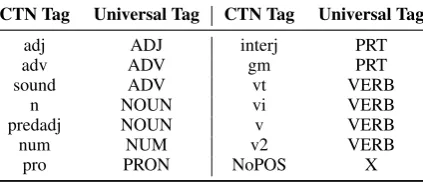
Although tags are manually provided, they are not the same tags as the universal tagset that INTENT uses, so we must map one or the other to evaluate correctly. Table 2 shows our mapping from tags used in the Chintang (CTN) tagset to those in the universal tagset.
Ideally, this mapping should be many-to-1; that is, each Chintang tag maps to a single tag in the
6http://dobes.mpi.nl/projects/
chintang/
Training Set Dev Set
Instances 7,120 876
Tokens in lang/gloss lines 31,116 3,884
[image:6.595.75.287.635.726.2]Tokens in trans lines 39,396 4,872
Table 1: Corpus statistics for Chintang IGT data (Bickel et al., 2011).
CTN Tag Universal Tag CTN Tag Universal Tag
adj ADJ interj PRT
adv ADV gm PRT
sound ADV vt VERB
n NOUN vi VERB
predadj NOUN v VERB
num NUM v2 VERB
[image:6.595.323.513.645.726.2]pro PRON NoPOS X
Table 2: Tagset mapping from CTN tags to Uni-versal tagset tags.
universal tagset. However, some Chintang tags can map to multiple tags in the universal tagset.
For instance, for words with tag “gm” in Chin-tang, some are grammatical markers that do not have counterparts in English (e.g., a TOPIC marker) and therefore is mapped toPRT(for par-ticle); others are listed as the English words and,
or, orbut, and should likely be labeled as conjunc-tions and mapped to CONJ. Other “gm” tagged words have variations of DEM (for demonstra-tive), and are likely pronoun-like, requiring the
PRONtag. Table 3 shows the top 12 gloss tokens labeled “gm” in the data.
We experiment with two mappings: the first mapping, Basic Mapping, is many-to-1, and all
gmwords are mapped toPRT; in the second map-ping,Extended Mapping, thegmtokens are split betweenCONJ, PRT, and PRON, with a simple, 14-token wordlist, consisting of the dozen tokens in Table 3, plusorandDEM and their associated tags. For the projection-only POS tagger, this ex-tended mapping occurs as post-processing remap-ping step on the projected tags. For classification, the gloss words are added to the existing dictio-nary, creating an expanded dictionary with CTN-specific (gloss-token, tag) pairs. This dictionary is then used to provide the best-guess tag feature to the classifier at training and test time.
6 Experiments
For this work, we wanted to test three overall sce-narios: using projection alone (§6.1), using the classifier trained on ODIN data (§6.2), and then using the classifier trained on Chintang data (§6.3). All three scenarios will be evaluated on the dev set of the Chintang corpus.
6.1 Projection Only
For the first scenario, since the projection method is deterministic and does not require training, only instances from the Chintang dev set are used. The
Gloss Word # Tokens Tag # Tokens
FOC 1049 CIT 360
TOP 1027 REP 243
SEQ 855 and 237
ADD 621 SURP 236
EMPH 504 SPEC.TOP 223
BUT 365 COND 207
projection method described in Section 3 is used, tagging the English translation line, finding ments on the gloss line, and then using 1:1 align-ment from gloss and language to assign tags to the language line. We then evaluate by compar-ing the projected tags with the manually assigned tags, while also keeping track of the unaligned to-kens.
6.2 Classifier Trained with ODIN Data For the first of the two classification-based set-tings, we follow the approach described in Sec-tion 4, by using our full set of ODIN instances to automatically label the gloss line via projection. We then again use the 1:1 alignments between gloss and language to project to the language and evaluate with those tags.
6.3 Classifier Trained with Unlabeled CTN Data
Finally, for the second classification based ap-proach, we train the classifier with the training portion of the Chintang coprus, ignoring the gold-standard POS labels, to see what effect using in-stances specific to Chintang might have. In partic-ular, since all the instances used to train the classi-fier were coming from the same language, we used this experimental setting to test whether adding context features to the classifier would help, in the case that there was enough single-language data.
7 Results
The results are presented in the order given in Section 6, with the projection-only approach first (§7.1), followed by the different classification ap-proaches (§7.2).
7.1 Projection
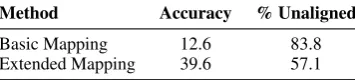
The results of using projection alone on the Chin-tang dev set can be seen in Table 4, which shows the POS tagging accuracy in the first column, as well as the unaligned tokens (tokens assigned UN-ALIGNED) in the data.
With only the most basic mapping, we see that the projection-only approaches achieves a mere
Method Accuracy % Unaligned
Basic Mapping 12.6 83.8 Extended Mapping 39.6 57.1
Table 4: Results of projection-only approach.
hun-ko-i tis-u-m pache
DEM-NMLZ-LOC put.into-3P-1/2nsA SEQ
(pro) (vt) (gm)
after putting dal or arum
Figure 4: An instance from the Chintang dev set, showing the lack of alignment between gloss line and translation line, as well as the gold standard POS tags.
12.6% accuracy, with an 83.8% of all tokens in the gloss line unaligned. Figure 4 shows a Chin-tang instance that illustrates part of the reason for this high amount of unaligned tokens. While many of the instances in the ODIN database frequently contain words that match (if only in their stemmed forms) between translation and gloss line, many of the instances in the Chintang corpus glossed the words only in terms of grammatical markers, such as “SEQ” or “DEM-NMLZ-LOC” as shown in this example.
The second row of Table 4 shows the result of adding Extended Mapping, which would correctly identify the gloss containing “DEM” as aPRON
and the “SEQ” gloss as the mappedPRT.
7.2 Classification
Table 5 shows the results of the classification-based experiments outlined above, trained on ei-ther the ODIN instances or the Chintang (CTN) instances on their own, or combining the two. Shown for comparison also is the result of using the remapped gold standard tags from the Chin-tang training data to train the classifier, and
evalu-Training Data DictionaryExpanded FeaturesContext Accuracy
ODIN X 43.153.0
CTN
75.0
X 74.9
X 74.8
X X 74.9
CTN+ODIN X 61.670.7
X X 72.6
Supervised (with Labeled CTN)
89.6
X 90.6
[image:7.595.92.270.699.739.2]X X 90.1
Table 5: Classification results showing different sets of training data and classifier features.
ating on the dev set.
7.2.1 ODIN-Only Training Data
As mentioned in Section 7.1, the IGT instances in the Chintang data look different from many of the instances in the ODIN data, and the accuracy re-sults of 43.1% and 53.0% would seem to confirm the dissimilarities between the data sets. Though the expanded dictionary with CTN-specific gloss tokens seems to help somewhat, the ODIN data suffers because there are simply too many tags as-signed by the classifier that do not occur in the CTN data, such as DET (fordeterminer) or ADP (foradposition). Even though the results are low, given that these are results for a system which has never been provided with a single instance of Chintang data, they are somewhat promising. 7.2.2 CTN Training Data
The classifier trained on CTN IGT instances fares much better, achieving 75% accuracy. It should be noted that when CTN instances were used to train the classifier, the automatically labeled train-ing data is produced by the projection algorithm which uses the Extended Mapping described in Section 5.2, and thus the expanded dictionary is of little use above the training data that the classifier has already seen.
Finally, combining CTN training instances with ODIN IGT instances achieves only 61.6% without additional features, but when the expanded dictio-nary is added, as well as the CTN-specific con-textual features, we see a result of 72.6%, getting closer to the result seen by the CTN data on its own.
While none of these methods come close to the 90% accuracies seen by the supervised system, our automated system shows promise given that it uses a far more impoverished set of information to train it. To compare these systems in a more real-world setting, we also looked at how the systems per-formed if the amount of data used to train each was scaled back from the approximately 32,000 tokens in the full training set.
7.2.3 Varying Amounts of Data
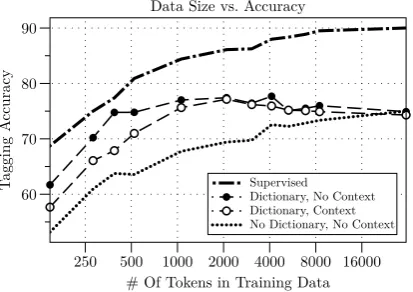
The graph in Fig. 5 shows the result of varying the amount of training data used for the different clas-sification approaches. While all the clasclas-sification- classification-based approaches ultimately converge around 75% accuracy, we can see that when only 500 or fewer tokens are available, a setting which is much
Supervised
Dictionary, No Context Dictionary, Context No Dictionary, No Context
Tagging A
ccuracy
60 70 80 90
# Of Tokens in Training Data 250 500 1000 2000 4000 8000 16000
[image:8.595.312.519.67.213.2]Data Size vs. Accuracy
Figure 5: Graph showing how performance varies with respect to the number of training tokens avail-able to the system.
more realistic for low-resource languages, these approaches actually do not do poorly by compari-son. We also see that the dictionaries help the most when the amount of training data is small.
8 Conclusion and Future Work
In this paper, we have demonstrated a proof-of-concept for a system that can potentially pro-duce POS taggers for up to a thousand languages, many of which have little to no annotated linguis-tic resources available. While the performance is lower than state-of-the-art supervised systems for resource-rich languages, our approach demon-strates a method that can be applied to resource-poor languages, as shown by the Chintang results. For subsequent work, our goal is to apply this technique to additional resource-poor lan-guages, with different typological characteristics from Chintang, as well as take an additional step toward training monolingual parsers from the tagged language lines.
Acknowledgments
This work is supported by the National Science Foundation Grant BCS-0748919. We would also like to thank Balthasar Bickel and his team for al-lowing us to use the Chintang data set in our ex-periments, and our three anonymous reviewers for the helpful feedback.
References
Declerck, T., Loftsson, H., Maegaard, B., Mari-ani, J., Moreno, A., Odijk, J., and Piperidis, S., editors,Proceedings of the Ninth International Conference on Language Resources and Evalu-ation (LREC’14), pages 2447–2451, Reykjavik, Iceland. European Language Resources Associ-ation (ELRA). ACL Anthology Identifier: L14-1508.
Bender, E. M., Crowgey, J., Goodman, M. W., and Xia, F. (2014). Learning Grammar Specifica-tions from IGT: A Case Study of Chintang . In
Workshop on the Use of Computational Meth-ods in the Study of Endangered Languages, Bal-timore, MD.
Bender, E. M., Goodman, M. W., Crowgey, J., and Xia, F. (2013). Towards Creating Preci-sion Grammars from Interlinear Glossed Text:
Inferring Large-Scale Typological Propertie. In
Proceedings of the ACL workshop on Language Technology for Cultural Heritage, Social Sci-ences and Humanities.
Berg-Kirkpatrick, T., Bouchard-Cˆot´e, A., DeNero, J., and Klein, D. (2010). Painless unsupervised learning with features. Association for Compu-tational Linguistics.
Bickel, B., Stoll, S., Gaenszle, M., Rai, N., Lieven, E., Banjade, G., Bhatta, T., Paudyal, N., Petti-grew, J., Rai, I., and Rai, M. (2011). Audiovi-sual corpus of the Chintang language, includ-ing a longitudinal corpus of language acquisi-tion by six children, paradigm sets, grammar sketches, ethnographic descriptions, and pho-tographs. DOBES Archive.
Brants, T. (2000). TnT — A Statistical Part-of-Speech Tagger. In the sixth conference, pages 224–231, Morristown, NJ, USA. Association for Computational Linguistics.
Brown, P. F., deSouza, P. V., Mercer, R. L., Pietra, V. J. D., and Lai, J. C. (1992). Class-based n -gram models of natural language. Computa-tional Linguistics, 18(4):467–479.
Christodoulopoulos, C., Goldwater, S., and Steed-man, M. (2010). Two decades of unsupervised POS induction: how far have we come? pages 575–584.
Das, D. and Petrov, S. (2011). Unsupervised part-of-speech tagging with bilingual graph-based projections. In Proceedings of the 49th An-nual Meeting of the Association for
Computa-tional Linguistics: Human Language Technolo-gies (ACL HLT 2011), pages 600–609, Portland, OR, USA.
Georgi, R., Xia, F., and Lewis, W. D. (2014). Cap-turing divergence in dependency trees to im-prove syntactic projection.Language Resources and Evaluation, 48(4):709–739.
Hana, J., Feldman, A., and Brew, C. (2004). A Resource-Light Approach to Russian Morphol-ogy: Tagging Russian using Czech Resources. In Proceedings of the Conference on Empiri-cal Methods in Natural Language Processing, pages 222–229. Rodopi Bv Editions.
Hwa, R., Resnik, P., Weinberg, A., Cabezas, C., and Kolak, O. (2004). Bootstrapping parsers via syntactic projection across parallel texts. Natu-ral Language Engineering, 1(1):1–15.
Lewis, M. P., editor (2009). Ethnologue: Lan-guages of the World. SIL International, Dallas, TX, USA, sixteenth edition.
Lewis, W. D. and Xia, F. (2008). Automatically identifying computationally relevant typologi-cal features. InProceedings of the Third Inter-national Joint Conference on Natural Language Processing.
Lewis, W. D. and Xia, F. (2010). Developing ODIN: A Multilingual Repository of Annotated Language Data for Hundreds of the World’s Languages.
Marcus, M. P., Santorini, B., and Marcinkiewicz, M. A. (1993). Building a large annotated cor-pus of english: The penn treebank. COMPU-TATIONAL LINGUISTICS, 19(2):313–330. McCallum, A. K. (2002). Mallet: A
ma-chine learning for language toolkit. http://mallet.cs.umass.edu.
Nasu, N. (2001). Towards a theory of non-cyclic A-movement. In Essex Graduate Student Pa-pers in Language and Linguistics, volume 3, pages 133–160.
Petrov, S., Das, D., and McDonald, R. (2011). A universal part-of-speech tagset. arXiv preprint arXiv:1104.2086.
Xia, F., Goodman, M. W., Georgi, R., Slayden, G., and Lewis, W. D. (2015). Enriching, Edit-ing, and Representing Interlinear Glossed Text. In16th International Conference on Intelligent Text Processing and Computational Linguistics, pages 1–16.
Xia, F., Lewis, W., Goodman, M. W., Crowgey, J., and Bender, E. M. (2014). Enriching odin. In Chair), N. C. C., Choukri, K., Declerck, T., Loftsson, H., Maegaard, B., Mariani, J., Moreno, A., Odijk, J., and Piperidis, S., editors,
Proceedings of the Ninth International Confer-ence on Language Resources and Evaluation (LREC’14), Reykjavik, Iceland. European Lan-guage Resources Association (ELRA).
Xia, F. and Lewis, W. D. (2007). Multilingual Structural Projection across Interlinear Text. pages 452–459.
Yarowsky, D. and Ngai, G. (2001). Inducing mul-tilingual POS taggers and NP bracketers via robust projection across aligned corpora. In