Extracting and Aggregating False Information from Microblogs
Naoaki Okazaki†‡ Keita Nabeshima† Kento Watanabe†
Junta Mizuno§ Kentaro Inui†
{okazaki, nabeshima, kento.w, junta-m, inui}@ecei.tohoku.ac.jp †Graduate School of Information Sciences, Tohoku University
6-3-09 Aramakiaza-Aoba, Aoba-ku, Sendai, 980-8579 Japan
‡Precursory Research for Embryonic Science and Technology (PREST), Japan Science and Technology Agency (JST) §National Institute of Information and Communications Technology (NICT)
Abstract
During the 2011 East Japan Earthquake and Tsunami Disaster, we had found a number of false information spread on Twitter, e.g., “The Cosmo Oil explosion causes toxic rain.” This paper extracts pieces of false information exhaustively from all the tweets within one week after the earthquake. Designing a set of linguis-tic patterns that correct false information, this paper proposes a method for detecting false information. More specifically, the method extracts text passages that match to the correction patterns, clusters the pas-sages into topics of false information, and selects, for each topic, a passage explain-ing the false information the most suitably. In the experiment, we report the perfor-mance of the proposed method on the data set extracted manually from Web sites that are specialized in collecting false informa-tion.
1 Introduction
In the aftermath of the Tohoku Earthquake (also known as the Great East Japan Earthquake) in March 2011, social media, such as the Twitter so-cial networking and microblogging service, served as highly active and beneficial sources of informa-tion. Among Internet users, 18.3% referred to so-cial media as information sources, 18.6% referred to Internet newspapers, and 23.1% referred to na-tional and regional government websites (Nomura Research Institute, 2011). This indicates that so-cial media rivaled the other two in influence. It has also been noted that the Internet and social media has accelerated the dissemination of disin-formation and other types of misindisin-formation, e.g., “Toxic rain will follow the explosion at the Cosmo Oil petrochemical complex”.
Misinformation such as this regarding safety and danger spread quickly in the aftermath of the Tohoku Earthquake and the related accident at the Fukushima Dai-Ichi Nuclear Power Plant, which threatened the lives and welfare of numer-ous people. Other themes of the misinformation included the admonition, “Drink Isodine (povi-done iodine) to protect your thyroid from radia-tion”. One tweet consolidation site dedicated to collecting/correcting information on the Tohoku Earthquake1 found that during the month of Jan-uary 2012, even ten months after the event, more than ten pieces of misinformation related to the earthquake were posted. This indicates a strong need for misinformation alerts in normal times as well as in times of disaster.
In this study, we aim at automatic collection of misinformation disseminated on Twitter. More concretely, we focus on corrective patterns (CPs), such as It is incorrect that ..., which are com-monly used to correct or refute misinformation, and propose a method incorporating such CPs into a system for automatic collection of misinforma-tion. We then describe the experimental applica-tion of this method to tweets posted during the week following the Tohoku Earthquake. The re-sults of this experiment showed that our method could detect approximately half of the 60 formative tweets identified by the existing misin-formation consolidation sites, as well as 22 other misinformative tweets that had not been recorded on those sites.
2 Related work
Twitter has been the subject of a number of stud-ies. Here, we review those relating to the truth or credibility of information posted on Twitter.
Qazvinian et al. (2011) proposed a method for classifying a group of tweets related to
misinfor-1https://twitter.com/#!/jishin_dema
mation (such as a group of tweets containing the terms “Barack Obama” and “Muslim”) into those including explicit expression of misinformation (e.g., “Barack Obama is a Muslim”), and those that do not (e.g., “Barack Obama met with Muslim leaders”), then further classifying the latter into those that support the misinformation and those that oppose it. Unlike the present study, it assumed that mining misinformation from large volumes of tweet and obtaining a group of misinformation-related tweets was outside its scope.
In Japan, numerous studies have been per-formed on misinformation dissemination via Twit-ter, prompted by a strong awareness of this prob-lem following the Tohoku Earthquake. For exam-ple, Fujikawa et al. (2012) proposed a method for assessing the truth or falsehood of information by classifying user reactions based on the number of specific responses, such as those expressing doubt or presenting well-grounded arguments that the topic is misinformative. Toriumi et al. (2012) pro-posed a method of investigating the co-occurrence of words and terms such as disinformation, lie, and
false report in arguments related to tweet content
in order to determine whether the content com-prises misinformation.
To analyze the trends in misinformation dis-semination and correction on Twitter following the Tohoku Earthquake, Umejima et al. (2011) tested hypotheses such as “the probability of tweet text containing a URL being misinformation is low”, “many information tweets contain content that urges action, is negative, or fans unrest”, and “a tweet containing any of these three features is apt to be retweeted”. In subsequent studies (Ume-jima et al., 2012; Miyabe et al., 2012), their group showed that words and terms that clearly indicate an intention to correct, such as disinformation and
mistaken, provide a useful feature for recognizing
corrective tweets during the construction of a mis-information database. They collected tweets con-taining such terms and built a binary classifier to assess whether the tweets were correcting specific information.
In all of these studies, each tweet text is taken as a unit with the focus on determining whether it contains misinformation or corrects by providing specific information2, without precisely
identify-2For example, the tweet “Be careful! All kinds of misin-formation are circulating on Twitter” contains the expression “misinformation” but does not correct any specific informa-tion.
ing the region of the misinformation in the tweet
text. Therefore, to our knowledge, the present
study represents the first investigation of a com-prehensive collection of misinformation extracted from large volumes of tweet data.
3 Proposed method
In this study, we assume that misinformation disseminated on Twitter is corrected or refuted by other users. For example, we found tweets correct-ing information (corrective tweets hereafter) for the misinformation, “Toxic rain is falling because of the Cosmo Oil explosion.”
• It is counterfactual that toxic rain will fall due to the Cosmo Oil explosion.
• Be aware of the false rumors that rain con-taminated by the toxic substances produced by the Cosmo Oil explosion will fall.
A corrective tweet consists of a corrective pression (e.g., the underlined parts in the above ex-amples) and misinformation where the corrective expression corrects or refutes. Thus, we can locate misinformation by finding corrective expressions in tweets. The goal of the proposed method pre-sented in this section is to collect phrases of mis-information by using corrective patterns (CPs) and aggregate them into a small number of descrip-tions of misinformation.
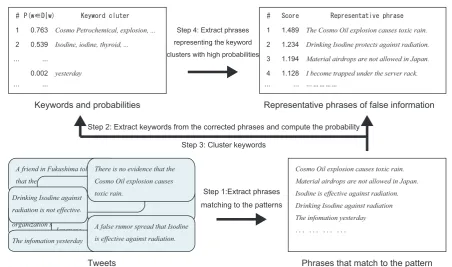
Figure 1 shows the flow of the proposed method, which is essentially comprised of the four steps. In Step 1, the proposed method searches for occurrences of CPs in tweets and extracts their targets of correction (corrected phrases hereafter). Step 2 chooses keywords that appear frequently in the corrected phrases. In order to merge keywords referring to the same misinformation, we cluster keywords (Step 3). Finally in Step 4, the proposed method chooses the small number of phrases that describe misinformation the most suitably. We will explain the detail of these steps in the sub-sequent subsections.
3.1 Step 1: Extraction of corrected phrases
Here, we search for tweets with corrected
phrases. In corrective tweets, the search
determines the presence of the misinforma-tion that is being corrected or refuted via terms such as misinformation or mistaken, as
in the statement, “It is disinformation that
Do not donate here. This
organization states that Japanese A friend in Fukushima told me
that the most
The infomation yesterday
A false rumor spread that Isodine
is effective against radiation. There is no evidence that the
Cosmo Oil explosion causes
toxic rain. Drinking Isodine against
radiation is not effective.
Cosmo Oil explosion causes toxic rain.
Material airdrops are not allowed in Japan.
Isodine is effective against radiation.
Drinking Isodine against radiation
The infomation yesterday
Tweets Phrases that match to the pattern
㸦Corrected phrases㸧
Step 1:Extract phrases matching to the patterns
Step 4: Extract phrases
representing the keyword
clusters with high probabilities
Step 2: Extract keywords from the corrected phrases and compute the probability
Step 3: Cluster keywords
Representative phrases of false information Keywords and probabilities
3ZѮ'_Z .H\ZRUGFOXWHU
1
2
...
...
0.763 Cosmo Petrochemical, explosion, ...
Isodine, iodine, thyroid, ...
yesterday
0.539
0.002 ...
...
6FRUH 5HSUHVHQWDWLYHSKUDVH
1
2
3
4 ...
1.489 The Cosmo Oil explosion causes toxic rain.
Drinking Isodine protects against radiation.
Material airdrops are not allowed in Japan.
I become trapped under the server rack.
1.234
1.128 1.194
[image:3.595.71.524.56.323.2]... ... ... ... ... ...
Figure 1: Overview of the proposed method
which the underlined portion is the misinformative phrase being corrected. A Japanese translation of this sentence is, “Isojin ha hibaku wo fusegeru to iu no wa dema da”.
In the Japanese sentence that corrects or re-futes misinformation, the corrected phrase (e.g., in transliteration, the underlined portion of the sen-tence “Isojin ha hibaku wo fusegeru”, which cor-responds to the underlined portion of the above English example) is followed by a functional at-tributive particle expression, such as the above “to iu no wa” or some other functionally similar term such as “no yo na”, and the corrective expression (“wa dema da” in the above example).
We manually formulated 368 CPs to recognize the corrected phrases. We obtained these CPs by examining tweets containing keywords that corre-spond to 15 kinds of well-known misinformation. If a region of a tweet text matches any of these CPs, the corrected phrase is deemed to comprise the portion of the Japanese sentence ranging from the first word in the sentence to just before the CP. We applied this process to the whole of the tweets under investigation, and the set of corrected phrases extracted in this way is denoted asD.
3.2 Step 2: Keyword extraction
Some of the corrected phrases extracted in this way simply refer to the misinformation rather than stating it, as in “kino no are” (literally “That thing yesterday”) in a sentence such as “kino no are wa dema da” (“That thing yesterday was misinforma-tion”). Such phrases cannot be considered misin-formative and must therefore be excluded. This is done by determining whether the words in the cor-rected phrase co-occur prominently with the CPs. For this purpose, the conditional probability that a wordwused in the tweet is among those in the corrected phrase setDis computed as,
P(w∈D|w) =# tweets wherewco-occurs with CPs # tweets containingw .
(1) We extract the top-500 words yielding the highest probability as misinformation keywords.
3.3 Step 3: Keyword clustering
Misinformative phrases pertaining to the same in-formation may differ considerably in wording and information quantity, as in “Rain containing haz-ardous substances from the Cosmo Oil fire will occur” and “The Cosmo Oil explosion is toxic”, which must be consolidated to avoid redundancy
rea-son, we perform clustering of the keywords
ex-tracted in Step 2. As the inter-keyword
dis-tance (i.e., similarity), we use the cosine similarity on context vectors whose elements correspond to co-occurrence counts between the keywords and the content words (nouns, verbs, and adjectives) in sentences. For the feature value of the con-text vector, we use the pointwise mutual informa-tion (PMI), which provides a measure of the co-occurrence of the keywords and the content words. Performing the complete-link clustering method (furthest neighbor method), we choose the cluster keywords as those yielding high conditional prob-abilities in Step 2.
3.4 Step 4: Representative phrase selection
For each cluster obtained in Step 3, we select rep-resentative phrases from among those containing the keywords, and output them as identified misin-formation. To select corrected phrases of suitable length that can provide a sufficient description of the misinformation, we compute the score,
Scorep(s, t) = histt(lens) ∑
w∈Cs
PMI(t,w), (2)
where s denotes the corrected phrase, t denotes the representative keyword of the misinformation cluster, Cs indicates the set of content words in
s, and lens is the number of words in s. The
term histt(lens) represents the ratio (relative
fre-quency) of occurrences of sentences consisting of
lens words with the keyword t. PMI(t, w)
rep-resents the pointwise mutual information of the cooccurrencetandw.
Equation 2 is designed to yield a high score for corrected phrases that contain numerous con-tent words that co-occur frequently with the key-words and are of a standard length. In essence,
histt(lens) is a compensatory term that yields a
high score for phrases of typical length among those containing the keyword t. For each cluster obtained in Step 3, we choose the phrasesˆ yield-ing the highest score as the representative descrip-tion for the keywordt.
4 Experiment 1 — CP evaluation
For misinformation acquisition by the proposed method, it is essential to identify CPs that can ef-fectively represent the misinformation. Our first experiment was to evaluate the performance of our CPs.
Table 1: Precision and recall of correction patterns
Precision Recall
0.79 (118/150) 0.83 (50/60)
4.1 Experimental setting
The corpus that was used as the source of in-formation for the misinin-formation extraction eval-uation comprised 179,286,297 tweets posted be-tween 9:00 JST on March 11 and 9:00 on March 18, 2011, which were provided by Twitter Japan at the Great East Japan Earthquake Big Data Work-shop3. To create a reference data set, we col-lected all the instances of misinformation from four misinformation consolidation websites4 and chose from them 60 instances of misinformation that were determined to have been posted dur-ing the week followdur-ing the Tohoku Earthquake. During the CP performance evaluation, these 60 misinformation instances were compared with ap-proximately 20,000 corrected phrases that were automatically extracted by our CPs. In this eval-uation, these 60 instances were denoted as “valid (or gold) instances”.
The CPs were evaluated for precision and recall. For precision evaluation, we took 150 samples se-lected at random from the approximately 20,000 instances of corrected phrases. Precision was de-fined as the proportion of those samples that were recognized by the CPs as instances of information correction or refutation made by their posters. Re-call was defined as the proportion of the 60 valid instances that were recognized from the set of ap-proximately 20,000 instances of corrected phrases.
4.2 Results and analysis
As shown by the values found for the CP pre-cision and recall values in Table 1, the prepre-cision and recall values of the misinformation extrac-tion were both approximately 80%. The corrected phrases that were extracted were found to be of four types, as shown in Table 2.
Those in types (a) and (b) were identified as
3https://sites.google.com/site/prj311/ 4
The following four websites:
http://www.kotono8.com/2011/04/08dema. html
http://d.hatena.ne.jp/seijotcp/20110312/ p1
Table 2: Types of corrected phrases extracted
Phrase type #
(a) Having sufficient content for recog-nition as phrases with corrected infor-mation
76
(b) Lacking sufficient content for recognition as phrases with corrected information
42
(c) Phrases erroneously extracted that represent instances of ambiguous pat-terns
24
(d) Phrases erroneously extracted that represent instances of unclear author intent
8
Total 150
Table 3: Causes of failure to extract misinforma-tion
Cause #
(e) New correction pattern 3
(f) Evidence present in corrective tweet 4
(g) No corrective tweet 3
Total 10
valid in the evaluation that yielded the results shown in Table 1. Type (b) is of special interest because it comprises phrasing instances in which the misinformation is either not explicitly stated
(e.g. “昨日のあれ(That thing yesterday)” in “昨
日のあれ ってデマ だったのか (That thing
yes-terday was a piece of disinformation)”, where the CP underlined) or insufficiently expressed (e.g. “that Isodine affair” in “I heard that Isodine af-fair was a case of disinformation”). Presumably, corrected phrases of type (b) can be eliminated by the conditional probability ranking and represen-tative phrase selection performed by Steps 2 and 4, respectively.
Those of types (c) and (d) were both mistakenly extracted in the evaluation. Type (c) comprises in-stances of phrasing in which the corrected phrase was extracted by erroneous CP application (e.g.,
“こういう災害のとき (In times of disaster such
as this)” in “こういう災害のとき ってデマ がよ
く流れる (In times of disaster such as this,
dis-information flows freely)”). Type (d) comprises phrases in which the attitude of the writer toward the CP (in regards to the correction) is ambiguous
or vague (e.g., “募金するとモテるってデマを流
Table 4: Accuracy and recall of extracted misin-formation
N Acc (4-sites) Acc (manual) Recall 25 0.44(11/25) 0.64(16/25) 0.18(11/60) 50 0.34(17/50) 0.58(29/50) 0.28(17/60) 75 0.33(25/75) 0.56(42/75) 0.42(25/60) 100 0.30(30/100) 0.52(52/100) 0.50(30/60)
せばいいのに(Fundraising will make you popular
- spreading that rumor will have an effect)”). We also examined the 10 instances of failure to extract misinformation and, as shown in Table 6, found the following three types.
Type (e) involved corrective phrasing that was not covered by the existing CPs, such as the
underlined portion of the statement, “天皇が24
時間御祈祷に入ってる ってのはソースがない (No information source is given to show that the Emperor actually performed 24 hours of prayer)”. Extraction of this type will be possible with the addition of new CPs. Type (f) comprises types of misinformation correction or refutation that are outside the scope of the CP forms considered in this study. One instance of this is the following corrective tweet, which opposes the
disinforma-tion stating that, “日本に韓国が借金の申し出。
しかも管は快諾(South Korea requests loan from
Japan. And (P.M.) Kan readily agrees.)”
“これデマなんじゃ? ソースないし。
RT @xxx RTこんな非常事態の日本に
韓国が借金の申し出。しかも管は快諾!
(This looks like a fabrication. No source given. RT@xxx. RT. In the present state of emergency, South Korea asks Japan for a loan. And Kan readily agrees!)”.
Several tweets intended to correct misinformation were found to take the form of commentary on an original tweet, as in this example.
Type (g) comprises several instances in which tweets purveying misinformation were present among the tweet collection used in this study, but related corrective tweets were not. Extraction of such misinformative tweets by the proposed method would be difficult at best, as our method assumes the occurrence of correction tweets, but such instances were small in number.
Table 5: Types of errors that lowered accuracy
Error type # %
(a) Errors in topic extraction 12 25.0
(b) Errors in clustering 1 20 41.7
(c) Information of uncertain content 5 10.4 (d) Extraction of correct information 1 2.1 (e) Prediction of future events 5 10.4
(f) Validity unclear 5 10.4
[image:6.595.90.272.193.261.2]Total 48 100.0
Table 6: Types of errors that lowered recall
Error type # %
(g) Errors in clustering 2 2 10.0
(h) Low ranking 18 90.0
Total 20 100.0
We next evaluated Steps 2 to 4 of Section 3. This evaluation essentially consisted of determin-ing whether these two steps, when applied to the corrected phrases extracted in Section 4, effec-tively excluded the type (b) corrected phrases from the extracted phrase set (lacking a statement of the specific information) and whether the selected rep-resentative phrases contained appropriate descrip-tions of misinformation.
5.1 Experimental setting
We assessed the misinformation extracted by the proposed method by manually examining each in-stance to determine whether it was equivalent in content to any of the 60 gold instances from the four consolidation websites. For some of the mis-information extracted by the proposed method, no similar instances were found in the gold set. In those cases, we manually investigated the in-formation with Web search engines to determine whether it actually was a case of misinformation. Additionally, as the objective in the present study is a comprehensive extraction of misinformation, in cases where the content two or more instances of extracted misinformation were deemed to be es-sentially the same, we counted them as one correct instance of extraction. Ultimately, the accuracy and recall in this investigation were determined using various values of N, which is the predeter-mined number of information instances output in order of decreasing score, in the proposed method.
5.2 Experimental results and analysis
Table 4 shows the results of the evaluation. With N as 100, approximately 30% of the information
instances extracted by the proposed method were found to be present in the gold set. In addition, ap-proximately 20% of the extracted instances were found to be actual instances of information, and thus correct, even though they were not present in the gold set. Therefore, it can be said that the proposed method extracted misinformation with a precision of approximately 50%. Among the in-correct answers, approximately half involved re-dundant expressions of essentially the same mis-information phrased differently. In summary, ap-proximately 70% of the misinformation extracted by the proposed method represented a correct an-swer.
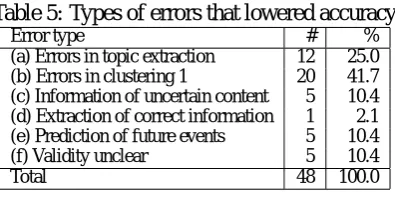
Investigation of the causes of the inaccuracy in output represented by the 48 incorrect answers present among the top 100 extracted misinforma-tion instances showed that they could be classified into six types. These are listed in Table 5, together with the number of incorrect answers attributable to each type. Types (a) to (d) involve instances that were easily judged as errors, but types (e) and (f) involve instances that would be difficult for hu-mans to characterize as either true information or misinformation. The six cause types, and potential means of avoiding them, are as follows:
(a) Errors in keyword extraction In some
in-stances, unsuitable keywords such as “なんち
ゃら (watchamacallit)”, “どさくさ (mess)”,
and “○○” (a symbol used to mean “a
cer-tain”, as in “a certain person”) were extracted as misinformation keywords. It may be pos-sible to eliminate this source of error in Step 2 by excluding extraction terms that are writ-ten entirely in hiragana (the Japanese cursive syllabary) and/or terms composed in large de-gree of symbols, such as “○○” above.
(b) Errors in clustering Among the top 100
stances of information extraction, some in-volved redundancies in the form of different phrases that have essentially the same con-tent, as in the following examples, in which the terms in parentheses were theme terms used in the selection process.
市原市のコスモ石油千葉製油所
LPGタンクの爆発により、千葉
県、近隣圏に在住の方に有害な雨 などと一緒に飛散する(コスモ石 油千葉製油所)
Oil Chiba Refinery LPG tank in Ichihara City, residents of Chiba Prefecture and its neighboring re-gions will be subjected to toxic rain. (Cosmo Oil Chiba Refinery) 千葉県の石油コンビナート爆発 で、空気中に人体に悪影響な物質 が空気中に舞い雨が降ると酸性雨 になる(石油コンビナート爆発) Due to the Chiba Prefecture petro-chemical complex explosion, the substances adversely affecting hu-man health will mix in the air and fall as acidic rain. (petrochemical complex explosion)
Because these two instances of misinforma-tion were not assigned to the same cluster in Step 3, they gave rise to apparent redundancy. While the current method takes words that co-occur in corrected phrases as their fea-tures, it may be possible to reduce this type of redundancy by adding surface information of the keywords themselves to the feature set.
(c) Information of uncertain content This
involves instances in which the selected rep-resentative phrase states the misinformation inadequately, as in the following example:
餓死者や凍死者が出た。
Death by starvation and freezing has occurred.
The gold set included the sentence “いわき
市で餓死者や凍死者が出た(In Iwaki City,
death by starvation and freezing have oc-curred)”, but the above representative state-ment is less specific and was therefore con-sidered to be uncertain in content. Tweets containing such phrases were small in num-ber, and may therefore be excluded by setting a threshold number for this purpose.
(d) Erroneous extraction of true information
The following was extracted as misinforma-tion, but when checked against reality was found to be true:
東京タワーの先端が曲がった The tip of Tokyo Tower has been bent.
When people saw this, many also consid-ered this to be misinformation, as its content
seems wildly implausible. However, in the present evaluation, it was the only instance of this type detected among 100 instances of ex-tracted information, and is therefore not con-sidered to be a substantial problem.
(e) Prediction of future events In some in-stances, expressions comprising the predic-tion of a future event were extracted, such as the following:
福島で核爆発が起こる
A nuclear explosion will occur in Fukushima.
(f) Unclear validity We found some instances in
which a search of several websites yielded no indication of whether they involved misinfor-mation, as in the following example:
サントリーが自販機無料開放 Suntory opens vending machines to dispense products free of charge.
Among the 60 gold instances of misinforma-tion, 20 were included in the corrected phrase set but were not extracted as misinformative. Our in-vestigation into the causes showed that they were of the following two types, which are listed in Ta-ble 6 together with the number that occurred in each type.
(g) Errors in clustering In some instances, the
candidates were extracted by the CPs but were mistakenly merged with other misinfor-mation instances during the clustering pro-cess. However, they apparently do not pose a substantial problem because their number was small in comparison with the total quan-tity of extracted misinformation.
(h) Unduly low ranking In some instances,
can-didates were extracted by the CPs but were not extracted as keywords because of their
low conditional probability. One example
of this is in the misinformation, “東京電力
を装った男が現れた(A man pretending to
phrases themselves, rather than for indepen-dent keywords, is necessary to eliminate this problem.
6 Conclusion
In this study, we focused on expressions that cor-rect or refute misinformation, and proposed a method for automatic collection of misinforma-tion. The method was evaluated in an experiment during which entries extracted from misinforma-tion consolidamisinforma-tion websites that had been man-ually classified as misinformation were taken as gold instances and used as a basis for compar-ison with information extracted by the proposed method as misinformation. Some of this extracted misinformation was not listed as misinformation in the consolidation websites, which, together with the other results, showed that the proposed method could be useful for automatic collection of misin-formation or, at least, for helping people create and update a comprehensive list of misinformation.
In our future studies, we intend to work to ex-pand the set of CPs used in this method and to improve the corrected phrase scoring, thereby en-hancing its performance in misinformation extrac-tion, together with the development of a complete system for real-time misinformation acquisition.
Acknowledgments
This study was partly supported by Japan Society for the Promotion of Science (JSPS) KAKENHI Grants No. 23240018 and 23700159 and by the Precursory Research for Embryonic Science and Technology (PREST), Japan Science and Tech-nology Agency (JST). We are grateful to Twitter Japan for its provision of invaluable data. Finally, we wish to thank the workshop organizers, who gave the opportunity to present and discuss im-portant applications of natural language process-ing that help people in disaster situations.
References
Tomohide Fujikawa, Nobuhiro Kaji, Naoki Yoshinaga, and Masaru Kitsuregawa. 2012. Classsification of users’ attitudes toward rumors on microblogs. In
Technical Report of the Institute of Electronics, In-formation and Communication Engineers.
Mai Miyabe, Ayana Umejima, Akiyo Nadamoto, and Eiji Aramaki. 2012. Ryugenjoho cloud: Collect-ing false rumors by extractCollect-ing correction informa-tion from humans. In Proceedings of the 18th
An-nual Meeting of the Association for Natural Lan-guage Processing, pages 891–894.
Ltd. Nomura Research Institute. 2011.
Sur-vey on “trends in people’s use and views of media in the wake of the tohoku - pacific
ocean earthquake”. http://www.nri.co.jp/
english/news/2011/110329.html.
Vahed Qazvinian, Emily Rosengren, Dragomir R. Radev, and Qiaozhu Mei. 2011. Rumor has it: identifying misinformation in microblogs. In
Pro-ceedings of the Conference on Empirical Methods in Natural Language Processing, EMNLP ’11, pages
1589–1599, Stroudsburg, PA, USA. Association for Computational Linguistics.
Fujio Toriumi, Kosuke Shinoda, and Genta Kaneyama. 2012. Evaluating a system that judges false ru-mors in social media. Journal of Digital Practice, 3(3):201–208.
Ayana Umejima, Mai Miyabe, Akiyo Nadamoto, and Eiji Aramaki. 2011. Tendency of rumor and correc-tion re-tweet on the twitter during disasters. In IPSJ
SIG Technical Report, volume 2011, pages 1–6.
Ayana Umejima, Mai Miyabe, Akiyo Nadamoto, and Eiji Aramaki. 2012. Analysis for extracting rumor markers in microblogs. In Proceedings of DEIM