University of Warwick institutional repository: http://go.warwick.ac.uk/wrap
This paper is made available online in accordance with publisher policies. Please scroll down to view the document itself. Please refer to the repository record for this item and our policy information available from the repository home page for further information.
To see the final version of this paper please visit the publisher’s website. Access to the published version may require a subscription.
Author(s): J.V. Hanna and M.E. Smith
Article Title: Recent technique developments and applications of solid state NMR in characterising inorganic materials
Year of publication: 2010 Link to published article:
http://dx.doi.org/10.1016/j.ssnmr.2010.05.004
Publisher statement: “NOTICE: this is the author’s version of a work that was accepted for publication in Solid State Nuclear Magnetic Resonance. Changes resulting from the publishing process, such as peer review, editing, corrections, structural formatting, and other quality control mechanisms may not be reflected in this document. Changes may have been made to this work since it was submitted for
Characterising Inorganic Materials
J. V. Hanna and M. E. Smith*
Department of Physics, University of Warwick, Coventry, UK, CV4 7AL
Abstract
A broad overview is given of some key recent developments in solid state NMR techniques that have driven enhanced applications to inorganic materials science. Reference is made to advances in hardware, pulse sequences and associated computational methods (e.g. first principles calculations, spectral simulation), along with their combination to provide more information about solid phases. The resulting methodology has allowed more nuclei to be observed and more structural information to be extracted. Cross referencing between experimental parameters and their calculation from the structure has seen an added dimension to NMR as a characterisation probe of materials. Emphasis is placed on the progress made in the last decade especially from those nuclei that were little studied previously. The general points about technique development and the increased range of nuclei observed are illustrated through a range of specific exemplars from inorganic materials science.
* Author for correspondence: M.E. Smith, Department of Physics, University of Warwick, Coventry, UK, CV4 7AL
1. Introduction
2. Development of Techniques Applicable to Solid State NMR of Inorganic Materials 2.1 Hardware
In any NMR experiment two of the key factors are the magnetic field and the probe chosen. The availability in the mid-1990s of wide bore (89 mm) 14.1 T instruments made a huge difference to the quality of spectra from a number of key nuclei such as 23Na and 27Al, as second-order quadrupolar effects were better suppressed because of their inverse applied magnetic field (Bo) dependence [3, 5, 6]. Higher magnetic fields also increased sensitivity, such that NMR studies of inorganic materials using insensitive nuclei, such as 17O became more popular [7]. These advantages increased still further as persistent fields of 20 T became more widely available, with currently the state of the art corresponding to wide bore 20 T commercial instruments, with a few higher field facilities for solids equipped with 21.1 and 23.5 T instruments, but with standard bore (57 mm) magnets. The other point about the wider availability of particularly high field magnets and appropriate MAS probes is the variable field approach to determining quadrupolar interaction parameters [3, 8] becoming more widely used. The differing field dependencies of the second-order quadrupolar interaction ( Bo 1, in Hz) and chemical shift interaction ( Bo, in Hz) means that measurements at two fields, with three or more preferred, much better constrain the NMR interactions determined. If the CSA, which is averaged by MAS, also needs to be determined then a combination of static and MAS measurements at differing magnetic fields is necessary. Two practical examples are shown in Fig. 1. 25Mg MAS at three magnetic fields (11.7, 14.1 and 18.8 T) is used to constrain and determine the isotropic chemical shift ( iso), the quadrupolar coupling constant ( Q,) and quadrupolar asymmetry parameter ( Q, see refs 3, 5 for definition of these parameters) in MgSO4.6H2O [9]. Despite the strong overlap between these two sites the NMR parameters are well constrained by this approach. An example where CSA is also present is the 93Nb NMR spectra of YNbO4 where although there is clearly a large second-order quadrupole interaction, there is also significant CSA. Again data collected at multiple fields (here four) strongly constrains the interactions [10]. Work on constraining the NMR interaction parameters has also been pushed forward even for much studied nuclei such as 23
Na and 27Al. MQ MAS techniques are now well established for resolving overlapping lineshapes from such nuclei. The retention of second-order quadrupolar and isotropic information in the different dimensions of the 2D data sets can also help separate the different NMR interaction parameters. This approach can also be used in combination with multiple field 1D data sets, including iteratively, to constrain a quantitative fit of the 1D MAS lineshape (see section 2.5.1).
in diameters of the rotors available, with key steps being 5 kHz (7/7.5 mm), 15 kHz (4 mm), 25 kHz (3.2 mm) and 35 kHz (2.5 mm) by the mid-1990s. Increasing rotor speed has meant fewer spinning sidebands (although the anisotropic information conveyed by can be important) producing cleaner spectra and better S/N for the same amount of sample, as well as larger ranges of interactions, especially dipolar and quadrupolar are able to be averaged to give the best possible resolution. Faster MAS has also meant that paramagnetic systems become more tractable to high resolution techniques (Sec 4.3). The major change in the last decade has been to even smaller diameter rotors of 2, 1.5 and now even 1 mm. Currently the smallest diameter rotors commercially available are 1.3 mm which provide upper spinning speeds of ~70 kHz. Some non-commercial prototypes have reported maximum spinning speeds of 90 kHz. Smaller rotors provide better mass-sensitivity such that samples with limited availability become more tractable, which although not often a limitation for many inorganic materials problems, for some cases with isotopic enrichment can be useful. As spinning speeds in excess of 50 kHz have been reached many of the typical spin interactions were exceeded. High resolution proton spectroscopy from solids has been a long-standing problem as the strong dipolar interacting spins make the linewidth homogeneous, which cannot be refocused periodically. Nevertheless, fast MAS brings a considerable improvement in resolution. While experimental results show that proton linewidths decrease only linearly with the rotor speed, the effect is more pronounced in 2D spectra where the 2 [11]. Fast MAS increasing the utility of proton NMR is more relevant to organic materials since in inorganic materials the proton density is usually low enough that even modest MAS rates (e.g. 25 kHz) can be sufficient. Another key point is that in complex pulse sequences that combine spatial reorientation with spin manipulation (e.g. decoupling, coherent spin motion, etc.) via rf pulses it has always been assumed that the MAS rate is the slow motion. With such high MAS rates this is no longer necessarily true. This opens up new possibilities for the manipulation of the spins.
solenoid probe would be very difficult to record because of the limited rf available relative to the linewidth. With a 300 m coil and 850 W of power, an rf field of 3 MHz can be produced. These conditions allow spectra extending over 1 MHz to be recorded [13]. The stripline solution produces spatially localised rf fields such that NMR of thin films can be realised, which could find several potentially important applications in inorganic materials science, such as for surface layers. An alternative strategy using inductive coupling enabling wireless transmission of the rf pulses and detection of the signal from the sample under fast MAS also holds a lot of promise [14]. Although still not widely available the specific advantages offered by such microcoils should see more application in the area of inorganic materials in the future.
DOR was introduced as a technique in around 1988 [15] as a direct 1D approach to provide high resolution spectra from second-order quadrupolar broadened nuclei. The DOR solution used the mechanical sophistication of a ‘rotor within a rotor’ system such that the sample is simultaneously spun around the magic angles for both the second-order (54.74º) and fourth-order Legendre polynomials (30.56º and 70.15º, with the smaller angle chosen for practical reasons). The concept is very neat, but did not catch on because of the relatively low spinning speed of the outer rotor (~ 1 kHz, which produced many spinning sidebands), the lack of long term spinning stability and the need for a specialised probe. It remains the only technique that gives high resolution spectra from quadrupole nuclei in real time in a directly analogous way to MAS. There has recently been renewed interest in the application of DOR NMR, which has been catalysed by developments of DOR probe heads, with smaller outer rotors allowing faster spinning (up to ~ 2 kHz) and probably most importantly the long term stability offered by computer controlled air pressures. This new generation of probes then allows concepts beyond just simply distinguishing sites on the basis of improved resolution to be introduced, providing additional structural information via the quantitative determination of anisotropic interactions. Examples of such experiments have been to use the sideband pattern intensity to detect dipolar coupling and CSA, as well as their relative orientations [16]. As an example the 17O NMR spectrum of L-alanine (Fig. 3) shows that the sideband intensity cannot be reproduced by simply including the quadrupolar interaction, but has to include CSA as well, which can then be accurately determined. Hence DOR should be seriously considered in the specialised solid state NMR armoury for characterising materials.
2.2 New High Resolution Methods for Quadrupolar Nuclei
being such an example [17, 18]. MQDOR spectra can be transformed via shear and scaling transformations to give a 2D representation in which the F1 and F2 frequencies correspond to the isotropic second-order quadrupolar shift and chemical shift, respectively, with the protocol for such a transformation having been presented for all spins and differing MQ coherence order [18]. In measuring RbNO3 using this approach very narrow resonances were obtained with the linewidths solely being determined by homogeneous effects to produce values for 87Rb of ~0.1 and 0.2 ppm in the quadrupolar and chemical shift dimensions, enabling the highly accurate determination of the isotropic chemical shift and the combined quadrupolar product, PQ. For
amorphous materials the use of MQDOR to remove line broadening interactions allows the chemical shift and EFG distributions to be directly determined which is difficult from other approaches such as multiple field analysis of MAS and/or MQ data since the interactions are convoluted in a single parameter. After shearing and scaling the two projections, isotropic chemical shift and quadrupolar interaction distributions which are completely independent of each other are obtained which has been applied to vitreous B2O3 [18]. An interesting comparison of 1D MAS, DOR, 3Q and 5Q MAS was made for 27Al by taking data from two much studied compounds AlPO4-14 and andalusite, a polymorph of Al2SiO5. The need for strong rf excitation to provide the best sensitivity for 5Q experiments was clear. The 1D techniques were much more sensitive in terms of the S/N produced in a fixed time [19], and DOR has good sensitivity despite the relatively poor filling factor.
broadened spectra. For I = 3/2 nuclei Wimperis introduced an experiment [24] for acquiring isotropic NMR spectra in real time, termed STARTMAS. This experiment requires very accurate timing of a series of rotor-synchronised pulses to interconvert ST and DQ transitions throughout acquisition, with the ratio of evolution times chosen such that the quadrupolar broadening is refocused. Another method based on the standard STMAS approach initiated the experiment via a series of selective pulses applied at different frequency offsets that create a series of echoes in the conventional acquisition, from which a 2D spectrum can be formed [25]. Both these experiments are highly innovative and effectively allow acquisition of both 2D and isotropic spectra using a single scan. The question of the impact these will have on the study of inorganic materials, especially compared to DOR will be interesting to follow in the next few years.
2.3 Methods for Improving Sensitivity and Wideline Observation from Quadrupolar Nuclei With quadrupolar nuclei making up such a large fraction (~ 75%) of the NMR-active nuclei of the Periodic Table considerable effort has been undertaken to allow more efficient collection of undistorted spectra from broad lines and to enhance the signal of the observed transitions. To allow unambiguous simulation especially when multiple interactions are present, although distortions can be taken in account, collecting undistorted experimental spectra pays dividends. Using frequency offset techniques, such as VOCS, allow such spectra to be collected [26].
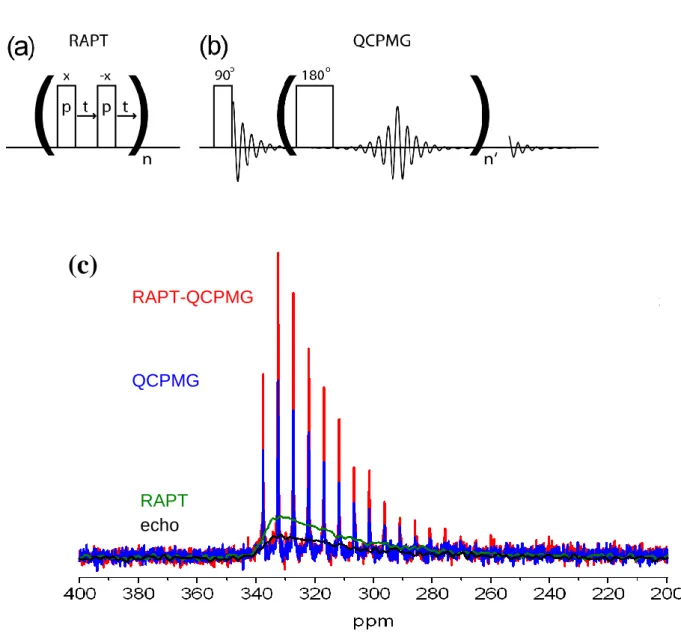
PT experiments involve the use of pulse sequences applied prior to the acquisition period which can enhance the NMR signal arising from the CT (which is the transition generally observed) of a half-integer spin quadrupolar nucleus by transferring polarisation from the ST. The NMR signal that arises from the CT is proportional to the population difference across the ½ levels. If the STs can be saturated while the CT is left unaffected, this population difference can be increased by a factor of I + ½ for any half-integer spin quadrupolar nucleus of spin I. Such saturation of the STs can be achieved using the RAPT pulse sequence [29], a train of pulses with constant amplitude and alternating in phase (Fig. 4(a)), leading to a constant modulation frequency νRAPT = (2p+2t)−1. Maximum signal enhancement has been shown to occur when the RAPT loop duration is equal to one MAS rotor period and when νRAPT ≈ χQ/4 where χQ is the quadrupolar coupling constant [29]. Even greater enhancement of the population difference across the CT can be obtained if the STs are inverted, rather than saturated, producing a factor 2I. One way in which the STs can be inverted without affecting the CT is by applying adiabatic inversion pulses [30] to the STs. In CT signal enhancement experiments, adiabatic pulses are applied at an offset far from the CT frequency so as to only invert the STs. The enhanced CT signal can then be observed in the usual way using a CT-selective 90 pulse or a Hahn-echo sequence with CT-selective 90 and 180 pulses. Recently it has been shown that applying an adiabatic inversion to a single ST spinning sideband is enough to invert the entire ST manifold. Other adiabatic pulse shapes have also been proposed, including WURST [31] and DFS where the latter employs a constant-amplitude pulse whose frequency is swept adiabatically [32]. Since QCPMG only involves manipulation of the spins during the acquisition, it is also possible to apply PT sequences prior to the QCPMG pulse train to provide further signal enhancement [33]. A comparison for some of these sequences is shown for 33S in Fig. 4(c). RAPT creates a significant signal enhancement from the direct echo and the further advantage of QCPMG is readily observed, which can in turn also get a signal boost from RAPT.
2.4 Correlation Experiments
most cases means there needs to be spectral resolution. For this reason correlation experiments tend to be better developed for spin-½ nuclei. Experiments such as CP have long been used for example in silicates to distinguish differently protonated Qn species [3]. The refocused INADEQUATE experiment (Figure 5(a)) exploits the internuclear J-coupling interaction to identify nuclear spins that are linked via chemical bonds. The refocused version uses an additional π-pulse to obtain in-phase correlations, making it applicable to the solid state, where linewidths tend to be much broader than in solution. 2D correlation sequences are well established for 31P, utilising the high sensitivity of this nucleus, and can be used to identify which phosphorus sites are linked via bridging oxygens. In favourable cases it can also be used to measure phosphate chain lengths and identify the chemical shifts of each site in the chain in the correct sequence [34, 35]. In many cases precise values of distances are not required, as semi-quantitative estimates provide the necessary information. DQF homonuclear correlation spectra are suitable for detection of inter and intramolecular contacts. DQ coherence is excited by relatively simple sequences of orthogonal 90o pulses at the beginning and end of every half rotor period. Reconversion of the homonuclear DQ coherence to a SQ coherence generates a spectrum that represents only the closest dipolar coupled spins. The 2D DQF spectrum can be used to correlate spin pairs and the packing environment for each spin can be elucidated. A practical materials example is shown in Fig. 5(b) where the 31P DQ refocused INADEQUATE of a crystallised Na2O-CaO-P2O5 glass is shown with 12 different 31P peaks, some barely resolved due to their overlap and low intensity. X-ray diffraction identifies two crystalline products -Ca(PO3)2 and NaCa(PO3)3 which can be assigned to the relevant 31P resonances. However six lower intensity peaks remain unassigned and these are revealed to be part of a single chain. This is a good example of the complementarity of different physical probe techniques and how advanced NMR methods can provide new information. Such correlation methods (particularly homonuclear variants) are much less common for quadrupolar nuclei because of the usually poorer resolution from such nuclei, although if resolution can be regained then many of the same sequences can be applied. In heteronuclear correlation experiments if one of the nuclei involved is spin-½ this can be the detected nucleus.
applications examined below. Homonuclear dipolar recoupling has allowed DQ correlations to be observed in amorphous solids. A practical consideration in these systems is to increase the robustness of the sequences to spreads of frequency, as found in amorphous materials. In a lanthanum aluminate glass (La0.18Al0.82O1.5) such correlation experiments have been applied to map the 27Al-27Al correlations. The structure has the expected AlO4, AlO5 and AlO6, but these units are not all randomly mixed, with the dominant structural motifs the AlO4 connected with AlO4, AlO5 and AlO6, and no connections between the other units (e.g. AlO5-AlO6, etc.) [39].
2.5 Software and Computational Methods
The ability to analyse the data from NMR experiments and to calculate the expected NMR interactions parameters on the basis of structure has improved greatly over the last decade. This section is broken up into looking at packages for analysing the experimental data and then first principles calculations of NMR parameters.
2.5.1 Lineshape Analysis and Simulation of Experiments
Several computer programs currently exist for fitting solid state NMR spectra, and for taking into account the effects of the pulse sequences on lineshapes. In our own laboratory or in collaboration with others, a range of packages are used that include SIMPSON, WSolids, DMFit and recommend them all for different specific problems. We recently compared these programmes and added a spectral simulation programme of our own QuadFit [40]. QuadFit is tailored towards fitting of NMR spectra from amorphous materials, but is also equally applicable to spectra from crystalline materials (http://go.warwick.ac.uk/quadfit). DMFit is a program written by Massiot [41] which has basic processing capabilities and extensive fitting abilities for both 1D and 2D data. SIMPSON [42] has been developed to produce very accurate simulations of NMR spectra given a set of spins, their interactions and a pulse sequence using density matrix theory. WSolids [43] is a simulation program for NMR spectra rather than a fitting program.
observed [44]. Then as this sample is ball milled defects are introduced which cause a much larger spread of interaction parameters. The spectra were simulated with the same average quadrupolar interaction Q = 8.34 MHz. However in the crystalline sample only a small spread of values Q = 0.40 0.05 MHz was needed, whereas this has risen considerably in the ball-milled sample to Q = 2.20 0.15 MHz. There have also been recent advances in the understanding of the distributions in the quadrupolar parameters from disordered solids. The Czjzek model for the distribution of the EFG tensor in disordered solids, results from the statistical rotational invariance of a disordered solid and from the applicability of a central limit theorem to the EFG tensor [45, 46]. The basic Czjzek model has recently been extended that effectively argues that starting from a well defined local environment (as would be the case for the -Ga2O3 given above) with values of the asymmetry parameter and of the principal component Vzz of the EFG tensor, perturbed by the disorder caused by effects further from the local atoms. The effect of disorder is simulated by Gaussian ‘noise’ about these values [46], with the essence to provide a means to extract information about the local environment and hence the disorder present in the material. The combination of the 1D spectra (especially if constrained at several magnetic fields) and the 2D contours of MQ data can really constrain the interactions and their distribution. This has really brought about an advance in analysing disordered inorganic materials in recent years.
2.5.2 First Principles Calculations of NMR Parameters
relatively simple oxides and gallates. The agreement between the calculations and experiment for the most part was good, sufficient to encourage the use of this combined approach to provide real insight into the oxygen site coordination in doped systems that are candidates for intermediate solid oxide fuel cell electrolytes. It is noted that one of the sources of error is that the calculations rely on the motionally and spatially averaged structure determined by diffraction and not the local structure experienced on the NMR timescale. Approaches to incorporate such effects in calculations beyond pure DFT are challenging, but are a possible interesting future direction [50]. Other examples of how these methods can be used to help understand the structural implications of the measured NMR interaction parameters will be given below in some specific materials systems.
3. Progress in Observation of Less Studied Nuclei
In the past decade the bulk of solid state NMR studies have involved the well established nuclei. For inorganic materials key nuclei that fall into this category are 11B, 23Na, 27Al, 29Si and 31
P. Specific examples of extensions of applications of these nuclei to important materials science and technology problems are given in Section 4. The last decade has seen a significant increase in the range of nuclei observed (i.e. the approach has become more multinuclear). This section briefly looks at (i) examples of interesting new applications of less studied nuclei in inorganic materials, and (ii) draws attention to extensive new studies of such nuclei.
3.1 Spin-½ Nuclei 89
shift range of 109Ag is large, approaching 1000 ppm for inorganic salts, with a large range of skews and spans observed. Hence the chemical shift interaction parameters are very sensitive to the local environment.
3.2 Half-integer Spin High- Quadrupolar Nuclei
There are a range of quadrupolar nuclei with relatively large magnetic moments (e.g. 45Sc, 69,71
Ga, 63,65Cu, 93Nb, 113,115In, 139La) where the effective quadrupolar broadening factor (taking into account both (i) the ‘raw’ second-order quadrupolar broadening factor, determined by the magnetic and quadrupolar moments along with the spin, and (ii) the local electron density ‘magnification’ of the external EFG as estimated by the Sternheimer antishielding factor. The effective quadrupole broadening factor is then estimated by multiplying factors (i) and (ii) (defined in Table 2 of [5])) for these nuclei is in the range ~25-250 and compares to 0.6 for 11B and 3.6 for 27Al. Hence the significantly higher broadening requires either some of the wideline techniques or make use of the much faster spinning and higher magnetic fields available. 71Ga NMR is now being increasingly used to distinguish GaO4 and GaO6 on the basis of their differing chemical shifts [44, 50]. The ability to distinguish and quantify these sites in materials is at approximately the same state of development as 27Al was 15 years ago.
45
Sc static and MAS NMR spectra were reported at two applied magnetic fields from a range of simple scandium compounds including Sc(NO3)3.5H2O and ScCl3.6H2O. Q was found to be in the range 3.9 to 13.1 MHz, with a good correlation to the local geometry of the scandium environment. Static data revealed that all the compounds had a significant CSA, with spans in the range 60 to 200 ppm, indicating that CSA should probably be taken into account in all scandium compounds [55]. A further study using MAS at three magnetic fields on a different range of model inorganic compounds found Q in the range 1.6-23.4 MHz. In looking at the isotropic chemical shift range it appears that the chemical shift in these compounds was dominated by the local coordination number, with ScO6 and ScO8 showing a shift difference of ~200 ppm [56]. Applying 45
Sc MAS NMR to the solid solution Sc2(WO4)3-Sc2(MoO4)3 suggested a small average Q of 3.6 MHz, with spectra changing in a way consistent with random mixing of the tungsten and molybdenum over tetrahedral sites [57]. Oxygen vacancy hopping is important in scandium-doped CeO2, a solid state electrolyte. To examine the dynamics, 45Sc NMR data from 80 oC up to 600 o
well as the activation energy, determined by NMR for this process are in agreement with values deduced from electrochemical impedance spectroscopy [58].
93
Nb is potentially an important probe nucleus of inorganic materials problems that could include contributing to understanding the activity, stability and selectivity of functional materials such as catalysts, catalytic supports, as well as microporous and mesoporous ion-exchangers. Solid state niobate chemistry also plays a crucial role in several very important piezoelectric phases, as well as several other technological applications such as optical materials and nuclear waste immobilisation. Although 93Nb is 100% naturally abundant and has a moderately large magnetic moment there is still only a limited number of solid state NMR studies as its relatively large quadrupolar moment introduces a large second-order quadrupolar broadening. In addition, 93Nb appears to exhibit a large chemical shift range (typically ~4000 ppm) with significant structural distortion producing large CSAs and significant chemical shift dispersion broadening of spectra for disordered systems. In the last decade there have been a number of studies of effectively model systems, but there is a question mark over many of the early values of the NMR interaction parameters determined because of single field analysis, imperfections in the lineshapes because of their width and the neglect of any CSA contribution to the line shapes. Hence some of the suggested shift ranges attributed to different coordinations may need to be revisited. A recent study combined data at four magnetic fields (e.g. Fig. 1b) and DFT calculations [10]. This study emphasised that a variable Bo approach unambiguously detects the presence of both quadrupolar and CSA contributions from 93Nb broadline data. These data reveal that the 93Nb EFG tensor is a particularly sensitive measure of the immediate and extended environments of the Nb(V) positions, with Q values 0 to >80 MHz, iso covering a range of ~250 ppm and CSA spans of 0 to ~800 ppm, with the latter being of particular note compared to several previous studies. The three method approach that uses crystal structure, NMR measurement and DFT calculation exhibits a good level of accuracy and the excellent correlations found indicated that 93Nb is a good probe of local structure.
3.3 Half-integer Spin Low- Quadrupolar Nuclei
The study of low- quadrupolar nuclei, although still limited, has seen a large increase since the area was reviewed in 2001 [51]. Nuclei in this group include 25Mg, 33S, 35,37Cl, 43Ca, 47,49
Ti, 73Ge, 91Zr, 95,97Mo and 135,137Ba. Examples of developments of all these nuclei can be found in the literature in the last decade, but a few illustrative cases will be given here. 95Mo is potentially a very significant nucleus to probe some important catalysis problems. The (MoO4)2 environment is quite symmetric. Recent studies [60, 61] have shown that in such coordinations Q tends to be < ~3 MHz which makes NMR observation relatively straightforward. Static spectra reveal that there can be significant CSA interaction (Fig. 7). Multiple sites can be distinguished, with -ZnMoO4 having three crystallographically distinct molybdenum sites which are readily resolved (Fig. 7(d)), with two having clear second-order quadrupolar lineshapes and one much narrower. DFT calculations allow ready identification of the resonances with crystallographic sites on the basis of both the quadrupolar interaction and isotropic chemical shift. On moving to real catalytic materials the quadrupolar interaction in other local environments can be much larger, such that spectra have to be interpreted carefully even at high magnetic field [61]. An example of a nucleus which is now observable really for the first time because of the better availability of high magnetic field is 73Ge. From the two forms of crystalline GeO2, GeO4 units had a much smaller Q than GeO6 and a shift difference of ~200 ppm [62].
33
As with other low- nuclei examined here 25Mg has also remained little exploited, with the odd study showing one or two spectra especially from samples with small Q. This situation has very recently moved forward significantly with two studies reporting extensive sets of 25Mg NMR interactions from relatively simple inorganic magnesium-containing compounds, comparing the results with DFT calculations [9, 66]. The experimental and calculated parameters show excellent correlation, generally indicating that 25Mg NMR can indeed be used to probe structure. MgSO4·6H2O has two distinct magnesium sites, with the two contributions to the lineshape readily distinguished (Fig. 1(a)) despite the structural differences determined by XRD between them being very small. The average Mg-O bond lengths are 2.080 Å and 2.083 Å, and average O-Mg-O bond angles are 90.04° and 87.39° for sites 1 and 2 respectively, with the corresponding Q of 1.65 and 2.4 MHz respectively, assigned on the basis of DFT calculations. The spectra of magnesium sulphates are very sensitive to the hydration state [9]. In diamagnetic compounds the isotropic chemical shift range is ~200 ppm, but with many shifts concentrated from 15 to 25 ppm. On the basis of the collected data so far the chemical shift could probably distinguish MgO4 and MgO6 in materials where magnesium’s coordination was unknown.
Despite calcium making a major elemental contribution to matter on the Earth, for example being the fifth most abundant element in igneous rocks, present in most soils and sedimentary beds, the main cation in mineralised bone tissue and shells, and a component in many man-made products, such as crucially important cements, there have been very few solid state NMR studies of 43Ca until the last five years. 43Ca is yet another low- , quadrupolar nucleus with a very low natural abundance (0.14%). Despite the unpromising intrinsic NMR parameters when a natural abundance study of a wide range of calcium compounds was undertaken relatively narrow resonances were observed [67]. This meant that only modest MAS rates were necessary (4-5 kHz) so that large volume rotors could be used (typically 9.5 mm diameter). With an increasing range of observations of 43Ca [68] it is clear that iso, which is the most readily determined parameter from MAS NMR spectra, could provide information not only on the average Ca---O bond distances, but also about the nature of the next nearest neighbours around the calcium, as noted for borates and aluminosilicates [69].
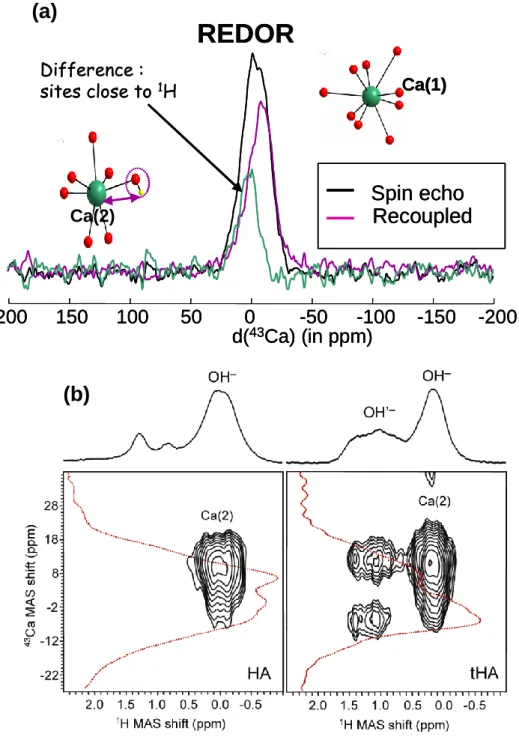
the two sites in the structure which is 3:2 [70]. The assignment was confirmed since the Ca(2) is much closer to the proton, allowing site discrimination on the basis of the different dipolar coupling [71]. A 1H-43Ca REDOR experiment relies on the increased dephasing of the calcium closer to the proton. Hence the left hand side of the line (Fig. 8(a)) more strongly dephases, confirming its assignment as the Ca(2) site. More sophisticated experiments that have been developed for more abundant nuclei with larger signals can equally be applied to low- nuclei. As an example R3-HMQC was applied to HA and the structurally more poorly defined oxyhydroxide t-HA [72]. The R3-HMQC spectrum from HA shows the expected correlation between the Ca(2) site and the OH. Then in t-HA there are vacancies, which means there is a much increased range of local environments, showing up as more distinct hydroxyl environments and effectively three inequivalent calcium environments close to the hydroxyls. This means amongst the local structures are some regions that are the same as HA, but then others are associated with defects. Examining three calcium silicate glasses which contain aluminium and/or sodium showed that the 43
Ca NMR parameters are highly sensitive to variations in its chemical environment. In such glasses calcium changes its role from charge compensating the (AlO4) to acting as a network modifier being associated with non-bridging oxygens. The change of iso and Q gave clear discrimination of the different sites, allowing such changes in a series of glasses to be followed [73].
3.4 Integer spins
1 nuclei such as 14N with signal enhancement techniques emerging. The techniques developed are close to the WURST approach and was demonstrated for KNO3 and was termed DEISM [76] Given the importance of nitrogen in some materials this development could allow much more frequent observation of 14N as a probe of materials.
4. Exemplar Recent Applications of Solid State NMR to Inorganic Materials
Applications of solid state NMR to inorganic materials have become increasingly widespread which is a measure of the success of the technique. Many reports involved well established nuclei applied to materials that have been long studied by NMR techniques e.g. zeolites. However a very elegant use of 29Si was to examine the effect of radiation damage in zircon containing -emitters as a model nuclear waste storage medium. 29Si MAS NMR of pristine zircon has a single sharp resonance from Q0 species. The -particle and the nuclear recoil displace atoms from their lattice sites which causes disorder. This could be readily quantified by 29
Si MAS NMR, and could be correlated to the radiation dose [77].
4.1 Geopolymers 29
Si and 27Al MAS NMR of aluminosilicates was one of the early major successes of the technique in studying inorganic materials since NMR provided new insight into the local ordering which was very difficult using scattering techniques because these two elements are light and have very similar X-ray scattering factors. A relatively new area of aluminosilicate materials chemistry is that of geopolymers which are structurally disordered, but are not glasses. They are being developed as more environmentally friendly alternatives to cements. 1H and 23Na have also been applied and changes in compressive strength have been related to network connectivity [78]. In a range of aluminosilicate geopolymer gels detailed 29Si MAS NMR studies were carried out such that the Q4(mAl) environments could be quantified by Gaussian deconvolution. For Na-, NaK-, and K-geopolymers the Si/Al distribution showed no significant difference for materials where the Si/Al ratio was >1.65. However, for K-geopolymers at lower Si/Al ratios the concentrations of Q4(4Al) and Q4(3Al) were different compared to the other cation-containing geopolymers, implying the structural ordering was different with differing alkali type. Hence the potassium samples were suggested to be more disordered such that some Al-O-Al linkages are present [79]. 29
within the structure. 23Na data interestingly suggests that although there are several different environments none of these are directly attributable to terminating the geopolymer network which could be a cause of structural weakening.
To further illustrate the importance of a multinuclear approach, to include even less studied
nuclei when possible, a series of aluminosilicate geopolymers have been examined containing up
to 50 wt% of added calcium compounds [81]. The level of calcium added was high to allow
natural abundance 43Ca MAS NMR spectra to be acquired. The change of the 43Ca MAS NMR
spectrum from that of the initial compound as the reaction proceeds suggest that the calcium enters
the network when the calcium starts as a calium silicate phase (e.g. gel) or Ca(OH)2. However
geopolymers initially containing CaCO3 and Ca3(PO4)2 show 43Ca MAS NMR spectra that are
virtually unchanged from those of the initial calcium compound. In this case the implication is that
the calcium phase is acting as a filler and does not enter the geopolymer network.
4.2 Biomaterials
Biomaterials science has undoubtedly become much more important in the last decade with very many more research programmes looking at tissue replacement and implanted drug release systems. Such materials can be complex multiphase, poorly ordered mixtures. For example to provide materials with significant strength, flexibility and ability to stimulate cell growth can be very demanding. Often these can be only delivered by hybrid materials and the local structure and the bonding between the components can be important. Bioglasses are a very important class of biomaterials and sol-gel processed samples often show better cellular response than a similar glass formed by conventional melt-quench techniques. One of the factors that imparts the superior properties is the higher surface proton content of the sol-gel produced glass. Proton quantification via 1H NMR on weighed samples is a very straightforward method to determine the proton content of sol-gel produced materials [82].
principles calculations can help in the assignment of the peaks, but this is not possible for the PO4 units designated P1 and P3 and a 2D MAS-J-INADEQUATE sequence was necessary to elucidate the connectivity and hence the identity of the sites (Fig. 10) [83]. In octacalcium phosphate the phosphorus sites were assigned from 31P DQ and 31P-1H HETCOR measurements and it was shown that a substantial fraction of the phosphate groups had been converted to hydrogen phosphates [84]. Another example of the use of a combined methodology was a study on some mesoporous CaO-SiO2-P2O5 glasses that combined 1D 1H, 29Si and 31P MAS NMR with CP, DQ 1
H-1H experiments and heteronuclear correlation experiments. The combination allowed the spatial distribution of the different elements to be understood and a biphasic model of the structure to be proposed [85]. The pore wall is mainly SiO2 with a nanoscale amorphous calcium orthophosphate phase that is distributed heterogeneously on the inner surface. This distribution of elements means that the calcium and phosphorus are readily exchangeable with fluids in contact with the surface.
The ‘classic’ natural biomaterials are bone and related materials such as tooth enamel and dentin, which are effectively composite materials consisting of an organic matrix (primarily collagen type I) deposited on nanocrystals of a mineral inorganic phase commonly based on hydroxyapatite (HA). Nanocrystalline HA was shown by 1H and 31P NMR to correspond to calcium-deficient HA as a core with a surface layer dominated by hydrogen phosphate groups and structural water [86]. The structural complexity HA is that it can accommodate a whole range of ionic substitutions such as CO32–, F
–
, Na+ and Mg2+. CO32– is a very important substitution and although substitution levels of other ions can be very low they can have a strong influence on the functional properties. Although solid state NMR is an obvious probe of the atomic scale substitutions in apatite-based natural materials and although some studies were performed some time ago it is only recently that NMR has emerged as a key analytical tool for these materials [87]. Borate substitution with the HA structure formed at high temperature shows that the bulk of the borate units are incorporated in a disordered calcium phosphate phase as a surface layer that [88]. The interface between the HA core and the amorphous phosphate surface layer was probed by a combination of triple resonance 1H-31P-11B CP and 31P{1H} REDOR [88]. In mineralised cartilage the inorganic surface species that interact with the organic surroundings have been probed by 1D 1
NMR between diseased and healthy inorganic components which suggest that the disease may be more related to the organic component matrix or its interaction with the mineral [90].
In formation of biological HA, octacalcium phosphate (OCP) is a supposed precursor phase. NMR, as a component technique, has probed the molecular mechanism of the transformation of OCP to HA, where 31P DQ has proved to be particularly informative with eight sets of auto- and cross-correlation peaks assigned to the OCP phase [91, 92]. The DQ signals can be monitored as a function of mixing time and the time variation can be modelled. The key point is that the modelled variation can be compared to the expected variation in the phosphorus separations as the structure transforms to HA, with the data suggesting that OCP crystals transform to HAp topotaxially. Water interaction is also important and CP suggests that water enters the hydration layers of an hydrolysis reaction [92]. Natural abundance 43Ca MAS NMR of a cow tooth and horse bone revealed broader spectral lines than from synthetic HA, with chemical shift dispersion dominating the linewidths revealing greater atomic disorder. Sodium substitution examined via 23Na MAS NMR at different magnetic fields, in combination with 3Q-MAS, 23
Na{31P} REDOR and 1H{23Na} R3-HMQC clearly showed that sodium is located inside the apatite phase [93]. 31P NMR has been used to examine rat dentins of various ages and a picture is presented of apatite crystallites embedded in an amorphous matrix, with ~19% of the apatite crystallites containing hydroxyls [94].
4.3 Paramagnetic Systems
sites from the expected hyperfine fields [95]. The site preferences and how these varied with concentration could be readily followed.
The availability of increasingly fast MAS has seen an increase in the number of studies of paramagnetic materials. For example in pyrope [Mg,Fe]3Al2Si3O12 for 27Al and 29Si a pseudocontact interaction was observed as Fe2+ was added. The effects observed were an increase in sideband intensities and new peaks as Fe2+ substituted as a second nearest neighbours. The study pointed out that some peaks, those too close to the iron, are lost from the spectrum and hence careful absolute intensity comparisons are sometimes necessary [96]. Energy-related materials such as lithium batteries are now intensively investigated. In rechargeable batteries LiCoO2 is an important cathode material, but there has been an attempt to reduce the cobalt content because of the cost of cobalt has seen its replacement to varying extents by nickel and manganese which broaden the lithium lines in such materials. Although 6Li has a much smaller magnetic moment than 7Li its much smaller quadrupolar moment means that different sites can be more readily distinguished and cation motion can be examined via changes in the spectra with temperature. 30 kHz MAS at 4.7 T [97] showed three different local lithium environments in Li[Ni0.33Mn0.33Co0.33]O2 which were attributed to different Ni/Mn/Co next nearest neighbour environments. Other really interesting lithium-based cathode materials are LiFePO4 [98] and Li3V2(PO4)3 [99]. In these materials the advantage of really fast MAS is well demonstrated. At low MAS the resonances only partially break up, such that only at 40 kHz do the three 31P centrebands stand out from the spinning sidebands [99] (Fig. 11). The resonances shifted to such high frequency result from the hyperfine transfer of electron density from the V3+ and can be assigned on the basis of the anticipated different Fermi contact interactions.
4.4 Energy Materials – Lithium Ion Batteries, Fuel Cells and Hydrogen Storage
an atomic scale probe, such as NMR can play a central role in understanding and optimising such materials. These materials can often be complex, nanocrystalline phase mixtures containing metallic and insulating components which means that wide shift ranges should be investigated. NaAlH4 is a potential hydrogen storage material and 27Al NMR revealed that there was an surface alumina layer, with various proton sites revealed by 1H MAS NMR [100]. In NaAlH4 nanocomposites with carbon the confinement in nanopores causes the 23Na and 27Al spectra to be broadened from increased disorder. As dehydrogenation is followed a single release peak was observed and at maximum dehydrogenation a peak from metallic sodium occurs. Rehydrogenation restored the solid state NMR spectra indicating that process is reversible for a NaAlH4/C composite [101].
Much of our mobile technology depends on the availability of suitable power sources and lithium ion batteries play a crucial role in this. Detailed understanding of the role played by the electrolyte and the electrode materials in such systems is necessary. Layered lithium compounds such as LixMO2 materials play the central role as the positive electrode, with replacements for simple compounds, such as the widely used LiCoO2, being sought because of higher lithium capacity. Many of the contenders are more complex solid solutions, with transition metal ion layers which can accommodate additional lithium. Fast MAS (up to 38 kHz) on a lithium nickel manganese compound revealed several peaks corresponding to differing numbers of Mn/Ni neighbours [102]. Extending this to a more complex compound also containing significant cobalt content the 6Li MAS NMR was dominated by all cobalt in both the first and second neighbour shells. The distribution of Mn/Ni in these shells could be followed by a range of additional peaks spread over > 500 ppm and the changes with lithium content were readily followed [103]. 6Li has been used to detect the different lithium sites, separated by differing disposition relative to the paramagnetic centre. 2D exchange spectra revealed the activation energy of lithium hopping between different sites and has been applied to novel potential electrode materials such as Li5V(PO4)F2 [104] and Li3Fe2(PO4)3 [105]. One of the most elegant studies on lithium-related battery problems was to combine 7Li MAS and in situ static work. The observation was made that
Materials used as electrolytes in fuel cell applications have been widely studied and oxygen ion conductors are important in this role. Apatite-structured oxygen ion conductors have generated much interest in this role with materials based around La9.33(SiO4)6O2 which has cation vacancies and La9.67(SiO4)O2.5 which has oxygen excess sites in addition to the vacancies. The conductivity was very much better in the oxygen excess sample. 29Si NMR was able to detect the oxygen excess with the appearance of a second peak in the MAS NMR spectrum attributed to Q0 species adjacent to an interstitial oxygen. At other compositions peaks associated with condensation to form Q1 species can also be seen [107]. Oxygen motion itself needs to be understood and in a material such as ZrW2O8 a ratcheting mechanism between the WO4 units explained the variable temperature 17O data [108]. 17O NMR data was collected over an extended temperature range ( 238 to 1000 oC) on the anionic conductor Bi26Mo10O69. This material contains isolated (MoO4)2 and bismuth oxygen columns with two clear 17O resonances observed attributable to these two species at low temperature which employed a cryoMAS probe. Variable temperature analysis showed that at lower temperatures the molybdate units were in rapid rotation whereas the bismuth-related sites were static. At higher temperatures all oxygen sites become involved in the oxygen motion [109]. The higher temperature mechanism is such that it allows long-range oxygen conduction without the need for multiple coordinated breaking of Mo-O bonds. Hence the ability of NMR to probe local structure and dynamics can be important to understand such materials.
4.5 Connectivity and Ordering in Glasses
with changes in the 31P SQ and DQ chemical shifts. These variations in 2JP;P constitute a potentially rich new source of information for the characterisation of variations in bond angle and bond length. The REINE experiment unambiguously reveals differences in the J-couplings between a P1 and a P2 unit (2JP1;P2) and those between two P1 units (2JP1;P1) or two P2 units (2JP2;P2). These spectra have been shown to be sensitive to the PO4 chain lengths. The observed spectral features, especially the distributions of parameters can be compared to first principle calculations of J-couplings [110].
In the phosphate glasses (NaPO3)1 x(B2O3) (0 x 0.3) a combination of NMR sequences was used to examine changes in linkages as the composition was varied. From 1D spectra it looks as though BO4 units are connected to P2 and P3 units. At compositions with x 0.2 all the boron is present as (BO4) and hence the charge balance means that the non-bridging bonds on the phosphate network decrease and the connectivity of the network increases, reflected directly in the increase in the glass transition temperature. The REDOR curves modelled on the basis of the dipolar coupling allows the spatial distribution of the atoms to be examined, and suggest P-O-B linkages tend to cluster with the P3 unit attracting two BO4 neighbours [111]. For aluminophosphate glasses the 100% natural abundance of both 27Al and 31P allowed a combination of 1D MAS, MQMAS and 31P-{27Al} HETCOR to provide detailed speciation information. The interconnection to the aluminophosphate groups to form the network was elucidated via 31P{27Al} HMQC, REAPDOR and HETCOR, as well as 27Al{31P} REDOR. The P-O-P connectivity was probed by 2D J-resolved experiments. The whole range of Pn units was present and their connectivity to AlOx (x = 4, 5, 6) species were identified and quantified so that a real model of the intermediate order could be advanced [112]. In mixed cation alkali borate glasses again a combination of NMR methods including 11B{23Na} REDOR and the alkali-alkali interactions elucidated via SEDOR experiments showed that cations were randomly mixed in the structure. These observations help explain the mixed alkali effect as a site mismatch phenomenon [113].
neighbours (in a 100% 29Si labelled system) by sequentially increasing the mixing time and this information can be used to constrain the fits of the 1D spectrum [115]. {17O}27Al HMQC experiments readily separate the Ca-O-Al and (Si,Al)-O-(Si,Al) linkages. In a magnesium aluminoborate glass the 27Al DQ MAS NMR data clearly showed that there was preferential proximity between the AlO4 and AlO5, with no connection to the AlO6 present, suggesting that the AlO6 are connected together in separated clusters (Fig. 12(e)) [116].
With ab initio calculations playing an increasing role in providing more detailed structural interpretation of the NMR interaction parameters, extension to amorphous materials is being developed. The DFT methods rely on the spatial periodicity of the structure. This is mimicked in disordered material by taking a supercell. This approach was applied to a sodium silicate tetrasilicate glass with the parameters compared to some closely related crystalline sodium silicate phases. The glassy structure generated from molecular parameters provided the basis of the sueprcell to calculate the NMR parameters and gave really good agreement to the experimentally determined values. The relationships deduced between the NMR parameters and structure increases the certainty of the implications for structure of the distributions of NMR parameters determined [117]. To illustrate this, a very detailed analysis was carried out on the archetypal inorganic glass, vitreous silica. GIPAW calculations were combined with hybrid Monte Carlo/molecular dynamics simulations to understand the connection between the various 17O and 29
Si NMR parameters and their distribution to the local structure in terms of Si-O bond lengths and Si-O-Si bond angles. This allowed a new analytical model to be proposed for the reconstruction of the Si-O-Si bond angle. This looks highly promising given its ability to reproduce both the mean bond angle and its distribution using the 17O and 29Si experimental data on the same samples [118]. Comparison of calculated parameters to experimental values in disordered materials offers exciting new opportunities for better understanding of the structure of disordered materials.
5. Summary and Outlook
Even though high resolution solid state NMR has been applied to inorganic materials for more than 30 years the capability of the technique still continues to increase very rapidly. For example, rather than just a few common nuclei (e.g. 23Na, 27Al, 29Si, 31P) an increasingly multinuclear approach is now possible opening up some exciting possibilities and this will only continue. Some of the main developments within the last decade have been:
2. The availability of high resolution techniques for half-integer quadrupolar nuclei such as MQMAS, STMAS and DOR.
3. Increased observation of nuclei with small magnetic moments encouraged by 1 above, and by signal enhancement via manipulation of satellite transition populations.
4. The increasing translation and development of correlation sequences to solids providing connectivity information and hence new insight into medium-range order in materials, including those showing disorder.
5. The role of first principles calculations of the NMR interactions which are closely integrated with their experimental determination giving new structural insight.
The enhanced NMR capability can be applied to many areas of materials science and technology. Examples that are exciting a lot of interest currently such as biomaterials and geopolymers are likely to be the subjects of many more solid state NMR studies.
Acknowledgements
The NMR infrastructure at Warwick is funded through a variety of sources including EPSRC, the HEFCE and the University of Warwick, as well as through the Science City Advanced Materials project supported by Advantage West Midlands (AWM) and part funded by the European Regional Development Fund (ERDF) for which the authors are grateful. Copyright holders who gave permission for the use of figures from their publications are thanked.
Summary of NMR abbreviations used
1D – One dimensional 2D – Two dimensional
CASTEP – Cambridge serial total energy package CP – Cross polarisation
CSA – Chemical shift anisotropy CT – Central transition
DEISM – Direct enhancement of integer spin magnetisation DFS – Double frequency sweeps
DFT – Density functional theory DOR – Double angle rotation DQ – Double quantum DQF – Double quantum filter EFG – Electric field gradient
GIPAW – gauge-including projector augmented wave HETCOR – Heteronuclear correlation
HMQC – Heteronuclear multiple quantum correlation HSQC – Heteronuclear single quantum correlation HS – Hyperbolic secant
INEPT – Insensitive nuclear enhancement by polarisation MAS – Magic angle spinning
MQ – Multiple quantum PT – Polarisation transfer
QCPMG – Quadrupole Carr Purcell Meiboom Gill RAPT – Rotor assisted population transfer
REAPDOR – Rotational echo adiabatic passage double resonance REDOR – Rotational echo double resonance
REINE – Refocused INADEQUATE spin-echo SEDOR – Spin-echo double resonance
S/N – Signal to noise ST – Satellite transition
STARTMAS – Satellite transitions acquired in real time MAS WURST – Wideband uniform rate and smooth truncation VOCS – Variable offset cumulative spectroscopy
References
[1] E. Lippmaa, M. Magi, A. Samoson, G. Engelhardt, A.R. Grimmer, J. Am. Chem. Soc. 102 (1980) 4889.
[2] G. Engelhardt, D. Michel, High Resolution Solid State NMR of Silicates and Zeolites, 1987, Wiley, Chichester.
[3] K.J.D. MacKenzie, M.E. Smith, Multinuclear Solid State NMR of Inorganic Materials, 2002, Pergamon Press, Oxford
[4] A. Medek, J.S. Harwood, L. Frydman, J. Am. Chem. Soc., 117 (1995) 12779. [5] E.R.H. van Eck, M.E. Smith, Prog. Nucl. Magn. Reson. Spectrosc. 34 (1999) 159. [6] S.E. Ashbrook, Phys. Chem. Chem. Phys. 11 (2009) 6892.
[7] S.E. Ashbrook, M.E. Smith, Chem. Soc. Rev. 35 (2006) 718.
A review of 17O NMR that provides background to the NMR interactions and techniques that are relevant to its study in the solid state and a range of applications examined.
[8] S.C. Kohn, M.E. Smith, P.J. Dirken, E.R.H. Van Eck, A.P.M. Kentgens, R. Dupree, Geochim. Cosmochim. Acta 62 (1998) 79.
[9] L.S. Cahill, J.V. Hanna, A. Wong, J.C.C. Freitas, J.R. Yates, R.K. Harris, M.E. Smith, Chem. Eur. J. 15 (2009) 9785.
[10] J.V. Hanna, K.J. Pike, T. Charpentier, T.F. Kemp, M.E. Smith, B.E.G. Lucier, R.W. Schurko, L.S. Cahill, Chem. Eur. J. 16 (2010) 3222.
An extensive state of the art NMR study of 93Nb in the solid state that combines static and MAS measurements at multiple magnetic fields with DFT calculations. This work questions the accuracy of some of the parameters determined previously in the literature.
[11] A. Samoson, T. Tuherm, J. Past, A. Reinhold, T. Anupold, I. Heinmaa, Topics in Current Chemistry 246 (2005) 15.
[12] A.P.M. Kentgens, J. Bart, P.J.M. van Bentum, A. Brinkman, E.R.H. van Eck, J.G.E. Gardeniers, J.W.G. Janssen, P. Knijn, S. Vasa, M.H.W. Verkuijlen, J. Chem. Phys. 128 (2008) 052202.
The theoretical background and practical implementation of microcoil design are examined.
[13] K. Yamauchi, J.W.G. Janssen, A.P.M. Kentgens, J. Magn. Reson. 167 (2004) 87. [14] D. Sakellariou, G. Le Goff, J.F. Jacquinot, Nature 447 (2007) 694.
[15] A. Samoson, E. Lippmaa, A. Pines, Molec. Phys. 65 (1988) 1013.
[17] A.P.M. Kentgens, E.R.H. van Eck, T.G. Aiithkumar, T. Anupold, J. Past, A. Reinhold, A. Samoson, J. Magn. Reson. 178 (2006) 221.
[18] I. Hung, A. Wong, A.P. Howes, T. Anupold, J. Past, A. Samoson, M.E. Smith, D. Holland, S.P. Brown, R. Dupree, J. Magn. Reson. 197 (2009) 229.
[19] J. Kanellopoulos, D. Freude, A. Kentgens, Solid State Nucl. Magn. Reson. 32 (2007) 99. [20] Z.H. Gan, J. Am. Chem. Soc. 122 (2000) 3242.
[21] S.E. Ashbrook, S. Wimperis, J. Magn. Reson. 156 (2002) 269.
[22] S.E. Ashbrook, S. Wimperis, Prog. Nucl. Magn. Reson. Spectrosc. 45 (2004) 53.
The definitive review of STMAS, extensively developing the theoretical background along with the practical implementation and illustrated via a series of examples.
[23] S.E. Ashbrook, A.J. Berry, W.O. Hibberson, S. Steuernagel, S. Wimperis, Amer. Mineral. 90 (2005) 1861.
[24] M.J. Thrippleton, T.J. Ball, S. Steuernagel, S. Steuernagel, S.E. Ashbrook, S. Wimperis, Chem. Phys. Lett., 431 (2006) 390.
[25] R. Bhattacharya, L. Frydman, J. Am. Chem. Soc., 128 (2006) 16014.
[26] D. Massiot, I. Farnan, N. Gautier, D. Trumeau, A. Trokiner, J.P. Coutures, Solid State Nucl. Magn. Reson. 4 (1995) 241.
[27] R. Siegel, T.T. Nakashima, R.E. Wasylishen, Concepts Magn. Reson. 26A (2005) 47. [28] R. Siegel, T.T. Nakashima, R.E. Wasylishen, Concepts Magn. Reson. 26A (2005) 61.
[29] Z. Yao, K.T. Kwak, D. Sakellariou, L. Emsley, P.J. Grandinetti, Chem. Phys. Lett. 327 (2000) 85.
The first instance of the RAPT concept being applied to non-integer spin quadrupolar nuclei to provide signal enhancement an approach that is now widely used with a number of variants.
[30] J. Haase, M.S. Conradi, Chem. Phys. Lett. 209 (1993) 287. [31] E. Kupce, R. Freeman, J. Magn. Reson. 115 (1995) 273. [32] D. Iuga, A.P.M. Kentgens, J. Magn. Reson. 158 (2002) 65.
[33] L.A. O’Dell, K. Klimm, J.C.C. Freitas, S.C. Kohn, M.E. Smith, Appl. Magn. Reson. 35 (2008) 247.
[34] M. Feike, R. Graf, I. Schnell, C. Jager, H.W. Spiess, J. Am. Chem. Soc. 118 (1996) 9631. [35] L.A. O’Dell, P. Guerry, A. Wong, E.A. Abou Neel, T.N. Pham, J.C. Knowles, S.P. Brown, M.E. Smith, Chem. Phys. Lett. 455 (2008) 178.
[36] D. Iuga, C. Morais, Z.H. Gan, D.R. Neuville, L. Cormier, D. Massiot, J. Am. Chem. Soc. 127 (2008) 11540.
[37] M. Edén, Solid State Nucl. Magn. Reson. 36 (2009) 1.
[38] J.P. Amoureux, J. Trébosc, L. Delevoye, O. Lafon, B. Hu, Q. Wang, Solid State Nucl. Magn. Reson. 35 (2009) 12.
[39] A.Y.H. Lo, M. Edén, Phys. Chem. Chem. Phys. 10 (2008) 6635.
[40] T.F. Kemp, M.E. Smith, Solid State Nucl. Magn. Reson. 35 (2009) 243.
[41] D. Massiot, F. Fayon, M. Capron, I. King, S. LeCalve, B. Alonso, J.-O. Durand, B. Bujoli, Z. Gan, G. Hoatson, Magn. Reson. Chem. 40 (2002) 70.
The paper that introduces the Dmfit program that is widely used to simulate and fit NMR spectra from solids.
[42] M. Bak, T. Rasmussen, N.C. Nielsen, J. Magn. Reson. 147 (2000) 296.
[43] K. Eichele, R.E. Wasylishen, WSolids NMR Simulation Package URL http://ramsey.chem.ualberta.ca/software/software.html
[44] L.A. O’Dell, S.L.P. Savin, A.V. Chadwick, M.E. Smith, Appl. Magn. Reson. 32 (2007) 527. [45] J.B.D. Lecaillerie, C. Fretigny, D. Massiot. J. Magn. Reson. 192 (2008) 244.
[48] M.D. Segall, P.J.D. Lindan, M.J. Probert, C.J. Pickard, P.J. Hasnip, S.J. Clark, M.C. Payne, J. Phys. Condens. Matter, 14 (2002) 2717.
[49] C.J. Pickard, F. Mauri, Phys. Rev. B 63 (2001) 245101.
[50] D.S. Middlemiss, F. Blanc, C.J. Pickard, C.P. Grey, J. Magn. Reson. 204 (2010) 1. [51] M.E. Smith, Ann. Rep. Nucl. Magn. Reson. Spectrosc. 43 (2001) 121.
[52] S.E. Ashbrook, K.R. Whittle, G.R. Lumpkin, I. Farnan, J. Phys. Chem. B 110 (2006) 10358. [53] S.W. Reader, M.R. Mitchell, K.E. Johnston, C.J. Pickard, K.R. Whittle, S.E. Ashbrook, J. Phys. Chem. C 113 (2009) 18874.
[54] G.H. Penner, W. Li, Inorg. Chem. 43 (2004) 5588.
[55] A.J. Rossini, R.W. Schurko, J. Am. Chem. Soc. 128 (2006) 12638. [56] N. Kim, C.H. Hsieh, J.F. Stebbins, Chem. Mater. 18 (2006) 3855. [57] N. Kim, J.F. Stebbins, Chem. Mater. 21 (2009) 309.
[58] H.J. Avila-Paredes, P.Jain, S. Sen, S. Kim, Chem. Mater. 22 (2010) 893.
[59] K.J. Ooms, K.W. Feindel, M.J. Willans, R.E. Wasylishen, J.V. Hanna, K.J. Pike, M.E. Smith, Solid State Nucl. Magn. Reson. 28 (2005) 125.
[60] A.M. Forgeron, R.E. Wasylishen, Phys. Chem. Chem. Phys. 10 (2008) 574. [61] J.B.D. Lecaillerie, Z. Gan, Appl. Magn. Reson. 32 (2007) 499.
[62] V.K. Michaelis, P.M. Aguiar, V.V. Terskikh, S. Kroeker, Chem. Comm. 2009 4660.
[63] S. Couch, A.P. Howes, S.C. Kohn, M.E. Smith, Solid State Nucl. Magn. Reson. 26 (2009) 203.
[64] J.B.D. Lecaillerie, F. Barberon, B. Besson, P. Fonollosa, H. Zanni, V.E. Fedorov, N.G. Naumov, Z. Gan, Cem. Concr. Res. 36 (2006) 1781.
[65] I. Moudrakovskii, S. Lang, J. Ripmeester, J. Phys. Chem. A 114 (2010) 309.
[66] P.J. Pallister, I.L. Moudrakovski, J.A. Ripmeester, Phys. Chem. Chem. Phys. 11 (2009) 11487.
[67] Z. Lin, M.E. Smith, F.E. Sowrey, R.J. Newport, Phys. Rev. B 69 (2004) 224107. [68] D.L. Bryce, E.B. Bultz, D. Aebi, J. Am. Chem. Soc. 130 (2008) 9282.
[69] C. Gervais, D. Laurencin, A. Wong, F. Pourpoint, J. Labram, B. Woodward, A.P. Howes, K.J. Pike, R. Dupree, F. Mauri, C. Bonhomme, M.E. Smith, Chem. Phys. Lett. 464 (2008) 42.
An example of the application of 43Ca MAS NMR applied to phosphates, with issues concerning chemical shift referencing for 43Ca discussed in detail.
[70] D. Laurencin, A. Wong, R. Dupree, M.E. Smith, Magn. Reson. Chem. 46 (2008) 347.
[71] D. Laurencin, A. Wong, J.V. Hanna, R. Dupree, M.E. Smith, J. Am. Chem. Soc. 130 (2008) 2412.
[72] A. Wong, D. Laurencin, R. Dupree, M.E. Smith, Solid State Nucl. Magn. Reson. 35 (2009) 32.
[73] F. Angeli, M. Gaillard, P. Jollivet, T. Charpentier, Chem. Phys. Lett. 440 (2007) 324.
[74] D. Holland, S.A. Feller, T.F. Kemp, M.E. Smith, A.P. Howes, D. Winslow, M. Kodama, Phys. Chem. Glasses 48 (2007) 1.
[75] J. Berkowitz, M.R. McConnell, K. Tholen, S. Feller, M. Affaigato, S.W. Martin, D. Holland, M.E. Smith, T.F. Kemp, Phys. Chem. Glasses 50 (2009) 372.
[76] L.A. O’Dell, R.W. Schurko, J. Am. Chem. Soc. 131 (2009) 6658. [77] I. Farnan, H. Cho, W.J. Weber, Nature 445 (2007) 190.
[78] P. Duxson, J.L. Provis, G.C. Lukey, S.W. Mallicoat, W.M. Kriven, J.S.J. van Deventer, Coll. Surf. A. 269 (2005) 47.
[79] P. Duxson, J.L. Provis, G.C. Lukey, F. Separovic, J.S.J. van Deventer, Langmuir, 21 (2005) 3028.
29
Si NMR is shown to be a sensitive probe of the Si,Al ordering within geopolymers and that differing cations can affect this ordering.
[81] K.J.D. MacKenzie, N. Rahner, M.E. Smith, A. Wong, J. Mater. Sci. 45 (2010) 999. [82] S. Lin, C. Ionescu, K.J. Pike, M.E. Smith, J.R. Jones, J. Mater. Chem. 25 (2009) 1276.
[83] F. Pourpoint, C. Gervais, I. Bonhomme-Coury, T. Azaïs, C. Coelho, F. Mauri, B. Alonso, F. Babonneau, C. Bonhomme, Appl. Magn. Reson. 32 (2007) 435.
A nice example of combining fast 1H MAS, 31P DQ and first principles calculations to provide a detailed assignment of some phosphates important in biomaterials chemistry.
[84] Y.H. Tseng, J.H. Zhan, K.S.K. Lin, C.Y. Mou, J.C.C. Chan, Solid State Nucl. Magn. Reson. 26 (2004) 99.
[85] E. Leonova, I. Izquierado-Barba, D. Arcos, A. López-Noriega, H. Hedin, M. Vallet-Regi, M. Edén, J. Phys. Chem. C 112 (2008) 5552.
[86] C. Jager, T. Welzel, W. Meyer-Zaika, M. Epple, Magn. Reson. Chem. 44 (2006) 573. [87] W. Kolodziejski, Topics Curr. Chem. 246 (2005) 235.
[88] S. Barheine, S. Hayakawa, A. Osaka, C. Jaeger, Chem. Mater. 21 (2009) 3102.
[89] M.J. Duer, T. Friscic, R.C. Murray, D.G. Ried, E.R. Wise, Biophys. J. 96 (2009) 3372. [90] S. Maltsev, M.J. Duer, R.C. Murray, C. Jaeger, J. Mater. Sci. 42 (2007) 8804.
[91] J.H. Zhan, Y.H. Tseng, J.C.C. Chan, C.Y. Mou, Ad. Func. Mater. 15 (2005) 2005. [92] Y.-H. Tseng, C.Y. Mou, J.C.C. Chan, J. Am. Chem. Soc. 128 (2006) 6909.
[93] D. Laurencin, A. Wong, W. Chrzanowski, J.C. Knowles, D. Qiu, D.M. Pickup, R.J. Newport, Z. Gan, M.J. Duer, M.E. Smith, Phys. Chem. Chem. Phys. 12 (2010) 1081.
[94] Y.H. Tseng, Y.L. Tsai, T.W.T. Tsai, J.C.H. Chao, C.P. Lin, S.H. Huang, C.Y. Mou, J.C.C. Chan, Chem. Mater. 19 (2007) 6088.
[95] N. Dajda, J.M. Dixon, M.E. Smith, N. Carthey, P.T. Bishop, Phys. Rev. B 67 (2003) 024201. [96] J.F. Stebbins, K.E. Kelsey, Phys. Chem. Chem. Phys. 11 (2009) 6906.
[97] L.S. Cahill, S.-C. Yin, A. Samoson, I. Heinmaa, L.F. Nazar, G.R. Goward, Chem. Mater. 17 (2005) 6560.
[98] J. Cabana, J. Shirakawa, G. Chen, T.J. Richardson, C.P. Grey, Chem. Mater. 22 (2010) 1249. [99] L.S. Cahill, C.W. Kirby, G.R. Goward, J. Phys. Chem. C 112 (2008) 2215.
[100] J.L. Herberg, R.S. Maxwell, E.H. Majzoub, J. Alloys Comp. 417 (2006) 39.
[101] M.H.W. Verkuijlen, P.J.M. van Bentum, E.R.H. van Eck, W. Lohstroh, M. Fichtner, A.P.M. Kentgens, J. Phys. Chem. C 113 (2009) 15467.
[102] M. Jiang, B. Key, Y.S. Meng, C.P. Grey, Chem. Mater. 21 (2009) 2733. [103] D. Zeng, J. Cabana, W.-S. Yoon, C.P. Grey, Chem. Mater. 22 (2010) 1209.
[104] Y. Makimura, L.S. Cahill, Y. Iriyama, G.R Goward, L.F. Nazar, Chem. Mater. 20 (2008) 4240.
[105] L.J.M. Davis, I. Heinmaa, G.R. Goward, Chem. Mater. 22 (2010) 769.
[106] B. Key, R. Bhattacharyya, M. Morcrette, V. Seznéc, J.-M. Tarascon, C.P. Grey, J. Am. Chem. Soc. 131 (2009) 9239.
An elegant study that demonstrates that in situ work is essential to really understand lithium incorporation in silicon battery electrodes.
[107] J.E.H. Sansom, J.R. Tolchard, M.S. Islam, D. Apperley, P.R. Slater, J. Mater. Chem. 16 (2006) 1410.
[108] A. Soleilhavoup, M.R. Hampson, S.J. Clark, J.S.O. Evans, P. Hodgkinson, Mag. Res. Chem. 45 (2007) S144.
[109] L. Holmes, L. Peng, I. Heinmaa, L.A. O’Dell, M.E. Smith, R.-N. Vannier, C.P. Grey, Chem. Mater. 20 (2008) 3638.
[110] P. Guerry, M.E. Smith, S.P. Brown, J. Am. Chem. Soc. 131 (2009) 11861. [111] D. Raskar, M.T. Rinke, H. Eckert, J. Chem. Phys. C 112 (2008), 12530.
[112] L. van Wüllen, G. Tricot, S. Wegner, Solid State Nucl. Magn. Reson. 32 (2007) 44. [113] E. Ratai, J.C.C. Chan, H. Eckert, Phys. Chem. Chem. Phys. 4 (2002) 3198.