A Graph-Based Approach to Skill Extraction from Text
∗Ilkka Kivim¨aki1, Alexander Panchenko4,2, Adrien Dessy1,2, Dries Verdegem3, Pascal Francq1, C´edrick Fairon2, Hugues Bersini3 and Marco Saerens1
1ICTEAM,2CENTAL, Universit´e catholique de Louvain, Belgium
3IRIDIA, Universit´e libre de Bruxelles, Belgium
4 Digital Society Laboratory LLC, Russia
Abstract
This paper presents a system that performs skill extraction from text documents. It out-puts a list of professional skills that are rele-vant to a given input text. We argue that the system can be practical for hiring and man-agement of personnel in an organization. We make use of the texts and the hyperlink graph of Wikipedia, as well as a list of professional skills obtained from the LinkedIn social net-work. The system is based on first computing similarities between an input document and the texts of Wikipedia pages and then using a biased, hub-avoiding version of the Spreading Activation algorithm on the Wikipedia graph in order to associate the input document with skills.
1 Introduction
One of the most difficult tasks of an employer can be the recruitment of a new employee out of a long list of applicants. Another challenge of the employer is to keep track of the skills and know-how of their employees in order to direct the right people to work on things they know. In the scientific community, editors of journals and committees of conferences always face the task of assigning suitable reviewers for a tall pile of submitted papers. The tasks de-scribed above are example problems ofexpertise re-trieval (Balog et al., 2012). It is a subfield of in-formation retrieval that focuses on inferring asso-ciations between people, expertise and information content, such as text documents.
∗
Part of this work has been funded by projects with the “R´egion wallonne”. We thank this institution for giving us the opportunity to conduct both fundamental and applied research. In addition, we thank Laurent Genard and St´ephane Dessy for their contributions for the work.
In this paper, we propose a method that makes a step towards a solution of these problems. We de-scribe an approach for the extraction of professional skills associated with a text or its author. The goal of our system is to automatically extract a set of skills from an input text, such as a set of articles written by a person. Such technology can be potentially useful in various contexts, such as the ones men-tioned above, along with expertise management in a company, analysis of professional blogs, automatic meta-data extraction, etc.
For succeeding in our goal, we exploit Wikipedia, a list of skills obtained from the LinkedIn social net-work and the mapping between them. Our method consists of two phases. First, we analyze a query document with a vector space model or a topic model in order to associate it with Wikipedia arti-cles. Then, using these initial pages, we use the Spreading Activation algorithm on the hyperlink graph of Wikipedia in order to find articles that cor-respond to LinkedIn skills and are related or central to the initial pages.
One difficulty with this approach is that it of-ten results in some skills, which can be identified as hubs of the Wikipedia graph, constantly being retrieved, regardless of what the input is. In or-der to avoid this pitfall, we bias the activation to avoid spreading to general, or popular nodes. We try different measures of node popularity to redirect the spreading and perform evaluative experiments which show that this biasing in fact improves re-trieval results.
We have built a web service that enables anyone to test our skill extraction system. The name of the system isElisit, an abbreviation from “Expertise Localization from Informal Sources and Information
Technologies” and conveying the idea of trying to elicit, i.e. draw forth latent information about exper-tise in a target text. According to the best of our knowledge, we are the first to propose such a system and describe openly the method behind it.
2 Related work
The recent review of Balog et al. (2012) gives a thorough presentation of the problems of expertise retrieval and of the methodology used for solving them. They classify these problems in subcategories ofexpert retrievalandexpert profiling. The former means the task of providing a name of a person who is an expert in a field that is presented as a query, while the latter means assigning expertise to a per-son, or some other entity based on information that is available of that entity. Recent expertise retrieval research has focused on the TREC enterprise track, which uses the TREC W3C and CERC corpora (Ba-log et al., 2008). These datasets contain annotated crawls of websites. The task in the TREC enterprise challenge is to build a model that performs expert retrieval and document retrieval based on a set of query topics, which correspond to expertise areas.
Our approach is quite different from the one used in the TREC challenge, as we focus on a fixed list of skills gathered from the LinkedIn website. Thus, we were not able to directly compare our sys-tem to the syssys-tems participating in the TREC enter-prise track. Our problem shares some resemblance with the INEX entity-ranking track (Demartini et al., 2010), where the goal was to rank Wikipedia pages related to queries about a given topic. Our skill re-trieval task can also be seen as an entity ranking task, where the entities are Wikipedia pages that corre-spond to skills.
LinkedIn has developed methods for defining skills and for finding relations between them (Sko-moroch et al., 2012). These techniques are used in their service, for example, for recommending job opportunities to the users. The key difference of our technology is that it allows a user to search for skills by submitting an arbitrary text, instead of only searching for skills related to a certain skill. Although expertise retrieval has been an active re-search topic for some time, there have not been many methods for explicitly assigning particular
skills to text content or people producing text con-tent.
Our method consists of two steps. First, we ap-ply a text similarity method to detect the relevant Wikipedia pages. Second, we enrich the results with graph mining techniques using the hyperlink graph of Wikipedia. We have not found a simi-lar combination being applied for skill extraction before, although both parts have been well studied in similar contexts before. For instance, Steyvers et al. (2004) proposed the Author-Topic Model, a graphical model based on LDA (Blei et al., 2003), that associates authors of texts with topics detected from those texts.
Wikipedia has been already used in NLP research both as a corpus and as a semantic network. Its hy-perlink graph is a collaboratively constructed net-work, as opposed to manually crafted networks such as WordNet (Miller, 1995). Gabrilovich and Markovitch (2007) introduced Explicit Semantic Analysis (ESA), where the words of a document are represented as mixtures of concepts, i.e. Wikipedia pages, according to their occurence in the body texts of the pages. The experimental results show that this strategy works very well and outranks, for exam-ple, LSA (Landauer and Dumais, 1997) in the task of measuring document similarity. ESA was later extended by taking into account the graph structure provided by the links in Wikipedia (Yeh et al., 2009). The authors of this work used a PageRank-based al-gorithm on the graph for measuring word and doc-ument similarity. This approach was coined Wiki-Walk.
Associating the elements of a text document un-der analysis with Wikipedia pages involves itself al-ready many problems often encountered in NLP. The process where certain words and multiword expres-sions are associated with a certain Wikipedia page has been calledWikification(Mihalcea and Csomai, 2007). In our work, we take a more general ap-proach, and try to associate the full input text to a set of Wikipedia pages according to different vec-tor space models. The models and the details of this strategy are explained in section 3.3.
a cognitive associative memory (Anderson, 1983), and the Wikipedia hyperlink network can be under-stood as an associative network. The simulation works by finding associations in a network of cepts by spreading pulses of activation from con-cepts into their neighbours. In the context of NLP, the Spreading Activation algorithm has been tradi-tionally used for word sense disambiguation (Hirst, 1988) and information retrieval (Crestani, 1997). Gouws et al. (2010) have shown that this algorithm, applied to the Wikipedia graph, can also be used to measure conceptual and document similarity.
3 Methodology
In this section, we will explain how the Elisit skill extraction system works. We will first ex-plain how the system uses data from Wikipedia and LinkedIn. Then, we will describe the two main components of the system, thetext2wiki mod-ule, which associates a query document with related Wikipedia pages, and the wiki2skill module, which aims to associate the Wikipedia pages found by thetext2wiki module with Wikipedia pages that correspond to skills.
3.1 Wikipedia texts and links
Each page in Wikipedia contains a text that may in-clude hyperlinks to other pages. We make the as-sumption that there is a meaningful semantic rela-tionship between the pages that are linked with each other and that the Wikipedia hyperlink graph can be exploited as an associative network. The properties of the hyperlink structure of Wikipedia and the na-ture of the information contained in the links have been investigated by Koolen (2011).
In addition to the encyclopedia pages, Wikipedia also contains, among others, category, discussion and help pages. In our system, we are only interested in the encyclopedia pages and the hyperlinks be-tween them. We are using data downloaded1on May 2nd 2012. This dump encompasses 3,983,338 pages with 247,560,469 links, after removal of the redi-rect pages. The Wikipedia graph consists of a giant Strongly Connected Component (SCC) of 3,744,419 nodes, 4130 SCC’s of sizes from 61 to 2 nodes and 228,881 nodes that form their own SCC’s.
1http://dumps.wikimedia.org/
3.2 LinkedIn skills
We gathered a list of skills from the LinkedIn social network2. The list includes skills which the users can assign to their profiles. This enables the site to recommend new contacts or open job opportu-nities to each user. The skills in the list have been generated by an automated process developed by LinkedIn (Skomoroch et al., 2012). The process de-cides, whether a word or a phrase or a skill suggested by a user is actually a skill through an analysis of the text contained in the user profile pages.
Each LinkedIn skill has its own webpage that con-tains information about the skill. One piece of infor-mation contained in most of these pages is a link to a Wikipedia article. According to Skomoroch et al. (2012), LinkedIn automatically builds this map-ping. However, some links are manually verified through crowdsourcing. Not all skill pages contain a link to Wikipedia, but these skills are often ei-ther very specific or ambiguous. Thus, we decided to remove these skills from our final list. The list of skills used in the system was extracted from the LinkedIn site in September 2012. After removal of the skills without a link to Wikipedia, the list con-tained 27,153 skills.
3.3 text2wikimodule
The goal of thetext2wiki module is to retrieve Wikipedia articles that are relevant to an input text.
The output of the module is a vector of sim-ilarities between the input document and all arti-cles of the English Wikipedia that contain at least 300 characters. There are approximately 3.3 mil-lion such pages. We only retrieve the 200 Wikipedia pages that are most similar to the input document. Thus, each input text is represented as a sparse vec-tor a(0), which has 200 non-zero elements out of 3,983,338 dimensions corresponding to the full list of Wikipedia pages. Each non-zero valueai(0)of this vector is a semantic similarity of the query with thei-th Wikipedia article. This approach stems from ESA, mentioned above. The vectora(0)is given as input to the second modulewiki2skill.
Thetext2wiki module relies on theGensim library ( ˇReh˚uˇrek and Sojka, 2010)3. In particular,
2
we have used four different text similarity func-tions, based respectively on the classical Vector Space Models (VSM’s) (Berry et al., 1994), LSA and LDA:
(a) TF-IDF (300,000 dimensions) (b) LogEntropy (300,000 dimensions) (c) LogEntropy + LSA (200 dimensions) (d) LogEntropy + LDA (200 topics)
First, each text is represented as a vector x in a space of the 300,000 most frequent terms in the corpus, each appearing at least in 10% of the docu-ments (excluding stopwords). We limited the num-ber of dimensions to 300,000 to reduce computa-tional complexity. The models (a) and (b) directly use this representation, while for (c) and (d) this ini-tial representation is transformed to a vectorx0 in a reduced space of 200 dimensions/topics. For LSA and LDA, the number of dimensions is often empir-ically selected from the range [100− 500] (Foltz, 1996; Bast and Majumdar, 2005). We followed this practice. From the vector representations (xorx0), the similarity between the input document and each Wikipedia article is computed using the cosine sim-ilarity.
Pairwise comparison of a vector of 300,000 di-mensions against 3.3 million vectors of the same size has a prohibitive computational cost. To make our application practical, we use an inverted index of Gensimto efficiently retrieve articles semantically related to an input document.
3.4 wiki2skillmodule
The wiki2skill module performs the Spread-ing Activation algorithm usSpread-ing the initial activations provided by thetext2wikimodule and returns a vector of final activations of all the nodes of the net-work and a vector containing the activations of only the nodes corresponding to skills.
The basic idea of Spreading Activation is to ini-tially activate a set of nodes in a network and then iteratively spread the activation into the neighbour-ing nodes. This can actually be interpreted in many ways opening up a wide space of algorithms that can lead to different results. One attempt for an exact definition of the Spreading Activation algorithm can be found in the work of Shrager et al. (1987). Their formulation states that ifa(0)is a vector containing
the initial activations of each node of the network, then after each iteration, or time step, or pulset, the vector of activations is
a(t) =γa(t−1) +λWTa(t−1) +c(t), (1)
whereγ ∈[0,1]is adecay factorwhich controls the conservation of activation during time,λ∈[0,1]is afriction factor, which controls the amount of acti-vation that nodes can spread to their neighbors,c(t)
is anactivation source vectorandWis a weighted adjacency matrix, where the weights control the amount of activation that flows through each link in the network. In some cases, iterating eq. (1) leads to a converged activation state, but often, especially when dealing with large networks, it is more prac-tical to set the number of pulses,T, to some fixed, low number.
As already stated, this formulation of Spread-ing Activation spans a wide space of different al-gorithms. In particular, this space contains many random walk based algorithms. By considering the case where γ = 0, λ = 1,c(t) = 0 and where the matrixW is row-stochastic, the Spreading Ac-tivation model boils down to a random walk model with a transition probability matrixW, where a(t)
contains the proportion of random walkers at each node when the initial proportions are given bya(0). When the situation is changed by choosingc(t) = (1− λ)a(0), we obtain a bounded Random Walk with Restart model (Pan et al., 2004; Mantrach et al., 2011).
Early experiments with the first versions of the al-gorithm revealed an activation bias towards nodes that correspond to very general Wikipedia pages (e.g. the page “ISBN”, which is often linked to in the References section of Wikipedia pages). These nodes have a high input degree, but are often not rel-evant for the given query. This problem is often en-countered when analysing large graphs with random walk based measures. It is known that they can be dominated by the stationary distribution of the cor-responding Markov Chain (Brand, 2005).
networks (Fronczak and Fronczak, 2009). These weights are given by
w∗ij = π
α j P k:(i,k)∈E
παk, (2)
where πj is a popularity index andα is a biasing parameter, which controls the amount of activation that flows from nodeito nodej based on the pop-ularity of nodej. For the popularity index, we con-sidered three options. First, we tried simply the in-put degree of a node. As a second option, we used the PageRank score of the node (Page et al., 1999) which corresponds to the node’s weight in the sta-tionary distribution of a random surfer that surfs Wikipedia by clicking on hyperlinks randomly. As a third popularity index, we used a score based on the HITS algorithm (Kleinberg, 1999), which is simi-lar to PageRank, but instead assigns two scores, an authority score and a hub score. In short, a page has a high authority score, if it is linked to by many hub pages, and vice versa. In the case of HITS, the popularity index was defined as the product of the authority and hub scores of the node. Whenα = 0, wij is equal for all links leaving from node i, but whenα <0, activation will flow more to less popu-lar nodes and less to popupopu-lar nodes. We included the selection of a suitable value forαas a parameter to be tuned along with the rest of the spreading strat-egy in quantitative experiments that are presented in section 5.2. These experiments show that biasing the activation to avoid spreading to popular nodes indeed improves retrieval results.
We also decided to investigate whether giving more weight to links that exist in both directions would improve results. The Wikipedia hyperlink graph is directed, but in some cases two pages may contain a link to each other. We thus adjust the link weightswij so that wij = δwij∗ if (j, i) ∈ E and wij =wij∗ otherwise, whereδ ≥1is abidirectional link weight. With large values ofδ, more activation will flow through bidirectional links than links that exist only in one direction. After this weighting, the final link weight matrixW is obtained by nor-malizing each element with its corresponding row sum to make the matrix row-stochastic. This makes the model easier to interpret by considering random walks. However, in a traditional Spreading
Activa-tion model the matrixW is not required to be row-stochastic. We plan to investigate in the future, how much the normalization affects the results.
The large size of the Wikipedia graph challenges the use of Spreading Activation. In order to pro-vide a usable web service, we would need the system to provide results fast, preferably within fractions of seconds. So far, we have dealt with this issue within thewiki2skillmodule by respresenting the link weight matrixWof the whole Wikipedia graph us-ing the sparse matrix library SciPy4. Each itera-tion of the Spreading Activaitera-tion is then achieved by simple matrix arithmetic according to eq. (1). As a result, the matrixW must be precomputed from the adjacency matrix for a given value of the bias-ing parameterαand the bidirectional link weightδ when the system is launched. Thus, they cannot be selected separately for each query from the system. Currently, the system can perform one iteration of spreading activation within less than one second, de-pending on the sparsity of the activation vector. Our experiments indicate that the results are quite stable after five spreading iterations, meaning that we nor-mally get results with thewiki2skillmodule in about one to three seconds.
4 TheElisitskill extraction system
The Elisit system integrates the text2wiki and the wiki2skill modules. We have built a web application5which lets everyone try our method and use it from third-party applications. Due to this web service, the Elisit technology can be eas-ily integrated into systems performing skill search, email or document analysis, HR automatization, analysis of professional blogs, automatic meta-data extraction, etc. The web interface presents the user the result of the skill extraction (a list of skills) as well as the result of thetext2wikimodule (a list of Wikipedia pages). Each retrieved skill also con-tains a link to the corresponding Wikipedia page.
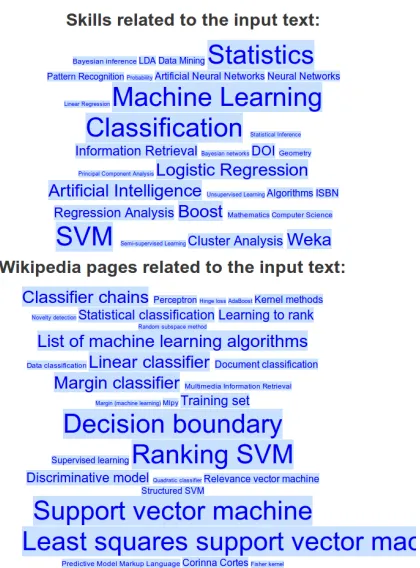
Figure 1 presents an example of results provided by the Elisit system. It lists skills extracted from the abstract of the chapterSupport vector ma-chines and machine learning on documents from
4http://www.scipy.org/
5GUI: http://elisit.cental.be/; RESTful web
Figure 1: Skills extracted from a text about text document categorization.
Introduction to Information Retrieval by Manning et al. (2008). As one can observe, the Wikipedia pages found by thetext2wiki module represent many low-level topics, such as “Desicion bound-ary”, “Ranking SVM” or “Least square SVM”. On the other hand, the skills retrieved after using the wiki2skillmodule provide high-level topics rel-evant to the input text, such as “SVM”, “Machine Learning” or “Classification”. These general topics are more useful, since a user, such as an HR man-ager, may be confused by too low-level skills.
5 Experiments & results
5.1 Evaluation of thetext2wikimodule
In order to compare the four text similarity func-tions, we collectedp = 200,000pairs of semanti-cally related documents from the “See also” sections of Wikipedia articles. A good model is supposed to assign a high similarity to these pairs. However, since the distribution of similarity scores depends on the model, one cannot simply compare the mean similaritys¯over the set of pairs. Thus, we used a
Model z-score
TF-IDF 8459 LogEntropy 4370 LogEntropy + LDA 2317 LogEntropy + LSA 2143
Table 1: Comparison of different text similarity functions on the Wikipedia “See also” dataset.
z-score as evaluation metric. Thez-scores are com-puted as
z= ps¯−µˆ
ˆ
σ2/p (3)
where µˆ and σˆ are sample estimates of mean and standard deviation of similarity scores for a given model. These sample estimates have been calculated from a set of 1,000,000 randomly selected pairs of articles. Table 1 presents the results of this experi-ment. It appears that more complex models (LSA, LDA) are outperformed on this task by the simpler vector space models (TF-IDF, LogEntropy). This can be just a special case with this experimental setting and perhaps another choice of the number of topics could give better results. Thus, further meta-parameter optimization of LSA and LDA is one approach for improving the performance of the text2wikimodule.
5.2 Evaluation of thewiki2skillmodule
In order to find the optimal strategy of applying Spreading Activation, we designed an evaluation protocol relying on related skills listed on each LinkedIn skill page. These are automatically se-lected by computing similarities between skills from user profiles (Skomoroch et al., 2012). Each skill page contains at most 20 related skills.
[image:6.612.367.479.58.117.2]re-lated skills.
There are many LinkedIn skills that are not well represented in the Wikipedia graph, because of am-biguity issues, for instance. To prevent these anoma-lies from causing misguiding results, we selected a fixed set of 16 representative skills for the evalua-tion. These skills were “Statistics”, “Hidden Markov Models”, “Telecommunications”, “MeeGo”, “Digi-tal Printing”, “OCR”, “Linguistics”, “Speech Syn-thesis”, “Classical”, “Impressionist”, “Education”, “Secondary Education”, “Cinematography”, “Exec-utive producer”, “Social Sciences”, “Political Soci-ology”.
Developing a completely automatic optimisation scheme for this model selection task would be diffi-cult because of the number of different parameters, the size of the Wikipedia graph and the heuristic na-ture of the whole methodology. Thus, we decided to rely on a manual evaluation of the results.
Exploring the whole space of algorithms spanned by eq. (1) would be too demanding as well. That is why we have so far tested only a few models. In the preliminary experiments that we conducted with the system, we observed that using a friction factorλ smaller than one had little effect on the results, and thus we decided to always useλ = 1. Otherwise, we experimented with three models, which we will simply refer to as models 1, 2 and 3 and which we define as follows
• model 1:γ = 0andc(t) =0;
• model 2:γ = 1andc(t) =0;
• model 3:γ = 0andc(t) =a(0).
In model 1, activation is not conserved in a node but only depends on the activation it has received from its neighbors after each pulse. In contrast, the activation that a node receives is completely con-served in model 2. Model 3 corresponds to the Ran-dom Walk with Restart model, where the initial ac-tivation is fed to the system at each pulse. Models 1 and 2 eventually converge to a stationary distribu-tion that is independent of the initial activadistribu-tion vec-tor. This can be beneficial in situations where some of the initially activated nodes are noisy, or irrele-vant, because it allows the initial activation to die out, or at least become lower than the activation of other, possibly more relevant nodes. With Model 3,
the initially activated nodes remain always among the most activated nodes, which is not necessarily a robust choice.
The outcomes of the experiments demonstrated that model 2 and model 3 perform equally well. In-deed, these models are very similar, and apparently their small differences do not affect the results much. However, model 1 provided constantly worse results than the two other models. Thus, we decided to use model 3, corresponding to the Random Walk with Restart model, in the system and in selecting the rest of the spreading strategy.
We also evaluated different settings for the link weighting scheme. Here, we faced a startling result, namely that increasing the bidirectional link weight δall the way up to the valueδ= 15kept improving the results according to almost all evaluation mea-sures. This would indicate that links that exist in only one direction do not convey a lot of semantic relatedness. However, we assume that this is a phe-nomenon caused by the nature of the experiment and the small subset of skills used in it, and not necessar-ily a general phenomenon for the whole Wikipedia graph. In our experiments, the improvement was more drastic in the rangeδ ∈ [1,5]after which a damping effect can be observed. For this reason, we decided to set the bidirectional link weight in the Elisitsystem toδ= 5.
We observed a similar phenomenon for the num-ber of pulsesT. Increasing its value up toT = 8 im-proved constantly the results. However, again, there was no substantial change in the results in the range T ∈[5,8]. In the web service, the number of pulses of the spreading activation can be determined by the user.
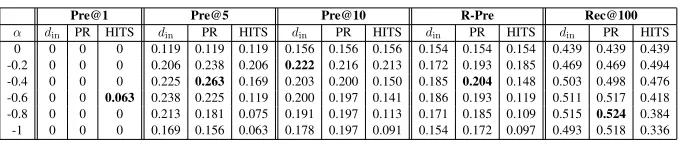
Pre@1 Pre@5 Pre@10 R-Pre Rec@100 α din PR HITS din PR HITS din PR HITS din PR HITS din PR HITS 0 0 0 0 0.119 0.119 0.119 0.156 0.156 0.156 0.154 0.154 0.154 0.439 0.439 0.439 -0.2 0 0 0 0.206 0.238 0.206 0.222 0.216 0.213 0.172 0.193 0.185 0.469 0.469 0.494 -0.4 0 0 0 0.225 0.263 0.169 0.203 0.200 0.150 0.185 0.204 0.148 0.503 0.498 0.476 -0.6 0 0 0.063 0.238 0.225 0.119 0.200 0.197 0.141 0.186 0.193 0.119 0.511 0.517 0.418 -0.8 0 0 0 0.213 0.181 0.075 0.191 0.197 0.113 0.171 0.185 0.109 0.515 0.524 0.384 -1 0 0 0 0.169 0.156 0.063 0.178 0.197 0.091 0.154 0.172 0.097 0.493 0.518 0.336
Table 2: The effect of the biasing parameterαand the choice of popularity index on the results in the evaluation of the
wiki2skillmodule.
that using Pagerank as the popularity index provided overall better results than using the input degree, which again yielded better results than using HITS. Thus, biasing according to the input connections of nodes seems more preferable than biasing accord-ing to co-citation or co-reference connections. The low scores with Precision@1 are understandable, because of the low number of positives (at most 20 related skills) in comparison to the total number of skills (over 27,000). In theElisitsystem, we use the Pagerank score as the popularity index and set the value of the biasing parameter toα =−0.4.
5.3 Evaluation of the wholeElisitsystem
We adapted the evaluation procedure used for the wiki2skill module, described in the previous section, in order to test the whole Elisit sys-tem. This time, instead of activating the node of a given skill, we activated the nodes found by the text2wikimodule when fed with the Wikipedia article corresponding to the skill. We run the Spread-ing Activation algorithm with the setup presented in the previous section. To make the evaluation more realistic, the initial activation of the target skill node is set to zero (instead of 1, i.e. the cosine of a vector with itself).
The system allows its user to set the number of initially activated nodes. We investigated the ef-fect of this choice by measuring Precision and Re-call according to the related skills, and by looking at the average rank of the target skill on the list of final activations. However, there was no clear trend in the results when testing with 1-200 initially ac-tivated nodes. Nevertheless, we have noticed that using more than 20 initially activated nodes rarely improves the results. We must also emphasize that the choice of the number of initially activated nodes depends on the query, especially its length.
We also wanted to compare the different VSM’s
VSM Pre@1 Pre@5 Pre@10 R-Pre Rec@100
TF-IDF 0.042 0.231 0.214 0.190 0.516 LogEntropy 0.068 0.216 0.212 0.193 0.525
LogEnt + LSA 0.042 0.180 0.181 0.163 0.491 LogEnt + LDA 0.089 0.193 0.174 0.159 0.470
Table 3: Comparison of the different models of the
text2wikimodule in the performance of the whole
Elisitsystem.
of thetext2wiki module when using the whole Elisit system. We did this by comparing Pcision and Recall at different ranks w.r.t. the re-lated skills of the target skill found on LinkedIn. Thus, this experiment combines the experiments in-troduced in sections 5.1, where the evaluation was based on the “See also” pages, and 5.2, where we used a set of 16 target skills and their related skills. Table 3 reports the Precision and Recall values ob-tained with the different VSM’s. These values result from an average over 12 different numbers of ini-tially activated nodes. They confirm the conclusion drawn from the experiment in section 5.1, namely that the LogEntropy and TF-IDF models outperform LSA and LDA models for this task.
6 Conclusion and future work
[image:8.612.329.519.174.222.2]nodes of the graph improves retrieval results. This work is still in progress, and we have many goals for improvement. One plan is to compute link weights based on the contents of linked pages using their vector space representation in thetext2wiki module. The method and system proposed in the paper could also be extended to other languages. Fi-nally, our methodology can potentially be used to different problems than skill extraction by substitut-ing the LinkedIn skills with a list of Wikipedia pages from another domain.
References
John R Anderson. 1983. A spreading activation theory of memory. Journal Of Verbal Learning And Verbal Behavior, 22(3):261–295.
Krisztian Balog, Paul Thomas, Nick Craswell, Ian Soboroff, Pe-ter Bailey, and Arjen P De Vries. 2008. Overview of the trec 2008 enterprise track. Technical report, DTIC Document. Krisztian Balog, Yi Fang, Maarten de Rijke, Pavel Serdyukov,
and Luo Si. 2012. Expertise retrieval. Foundations and Trends in Information Retrieval, 6(2-3):127–256.
Holger Bast and Debapriyo Majumdar. 2005. Why spectral retrieval works. InProceedings of the 28th annual interna-tional ACM SIGIR conference on Research and development in information retrieval, pages 11–18. ACM.
Michael W. Berry, Susan T. Dumais, and Gavin W. O’Brien. 1994. Using linear algebra for intelligent information re-trieval. Technical Report UT-CS-94-270.
David M. Blei, Andrew Y. Ng, and Michael I. Jordan. 2003. Latent dirichlet allocation.Journal of Machine Learning Re-search, 3:993–1022, March.
Matthew Brand. 2005. A random walks perspective on max-imizing satisfaction and profit. Proceedings of the 2005 SIAM International Conference on Data Mining.
Fabio Crestani. 1997. Application of spreading activation tech-niques in information retrieval. Artificial Intelligence Re-view, 11(6):453–482.
Gianluca Demartini, Tereza Iofciu, and Arjen P De Vries. 2010. Overview of the inex 2009 entity ranking track. InFocused Retrieval and Evaluation, pages 254–264. Springer. Peter W Foltz. 1996. Latent semantic analysis for text-based
research.Behavior Research Methods, Instruments, & Com-puters, 28(2):197–202.
Agata Fronczak and Piotr Fronczak. 2009. Biased random walks in complex networks: The role of local navigation rules.Physical Review E, 80(1):016107.
Evgeniy Gabrilovich and Shaul Markovitch. 2007. Comput-ing semantic relatedness usComput-ing wikipedia-based explicit se-mantic analysis. InIJCAI’07: Proceedings of the 20th in-ternational joint conference on Artifical intelligence, pages 1606–1611, San Francisco, CA, USA. Morgan Kaufmann Publishers Inc.
Stephan Gouws, G-J van Rooyen, and Herman A. Engelbrecht. 2010. Measuring conceptual similarity by spreading acti-vation over wikipedia’s hyperlink structure. InProceedings
of the 2nd Workshop on The People’s Web Meets NLP: Col-laboratively Constructed Semantic Resources, pages 46–54, Beijing, China, August. Coling 2010 Organizing Committee. Graeme Hirst. 1988. Semantic interpretation and ambiguity.
Artificial Intelligence, 34(2):131–177.
Jon M. Kleinberg. 1999. Authoritative sources in a hyperlinked environment.Journal of the ACM, 46(5):604–632.
Marijn Koolen. 2011. The Meaning Of Structure: the Value of Link Evidence for Information Retrieval. Ph.D. thesis, University of Amsterdam, The Netherlands.
Thomas K. Landauer and Susan T. Dumais. 1997. A solu-tion to plato’s problem: The latent semantic analysis theory of acquisition, induction, and representation of knowledge.
Psych. review, 104(2):211.
Christopher D Manning, Prabhakar Raghavan, and Hinrich Sch¨utze. 2008. Introduction to information retrieval, vol-ume 1. Cambridge University Press Cambridge.
Amin Mantrach, Nicolas van Zeebroeck, Pascal Francq, Masashi Shimbo, Hugues Bersini, and Marco Saerens. 2011. Semi-supervised classification and betweenness com-putation on large, sparse, directed graphs. Pattern Recogni-tion, 44(6):1212–1224.
Rada Mihalcea and Andras Csomai. 2007. Wikify!: link-ing documents to encyclopedic knowledge. In M´ario J. Silva, Alberto H. F. Laender, Ricardo A. Baeza-Yates, Debo-rah L. McGuinness, Bjørn Olstad, Øystein Haug Olsen, and Andr´e O. Falc˜ao, editors,CIKM, pages 233–242. ACM. George A Miller. 1995. Wordnet: a lexical database for english.
Communications of the ACM, 38(11):39–41.
Lawrence Page, Sergey Brin, Rajeev Motwani, and Terry Wino-grad. 1999. The pagerank citation ranking: Bringing order to the web. Technical Report 1999-0120, Computer Science Department, Stanford University.
Jia-Yu Pan, Hyung-Jeong Yang, Christos Faloutsos, and Pinar Duygulu. 2004. Automatic multimedia cross-modal corre-lation discovery. InProceedings of the tenth ACM SIGKDD international conference on Knowledge discovery and data mining, pages 653–658. ACM.
Radim ˇReh˚uˇrek and Petr Sojka. 2010. Software Framework for Topic Modelling with Large Corpora. InProceedings of the LREC 2010 Workshop on New Challenges for NLP Frameworks, pages 45–50, Valletta, Malta, May. ELRA. Jeff Shrager, Tad Hogg, and Bernardo A Huberman. 1987.
Observation of phase transitions in spreading activation net-works.Science, 236(4805):1092–1094.
Peter N Skomoroch, Matthew T Hayes, Abhishek Gupta, and Dhanurjay AS Patil. 2012. Skill customization system, Jan-uary 24. US Patent App. 13/357,360.
Mark Steyvers, Padhraic Smyth, Michal Rosen-Zvi, and Thomas Griffiths. 2004. Probabilistic author-topic models for information discovery. InProceedings of the 10th ACM International Conference on Knowledge Discovery and Data Mining. ACM Press.