Modified Wilcoxon Signed-Rank Test
Ikewelugo Cyprian Anaene Oyeka, Godday Uwawunkonye Ebuh*
Department of Statistics, Faculty of Physical Sciences, Nnamdi Azikiwe University, Awka, Nigeria Email: *[email protected]
Received January 6, 2012; revised February 10, 2012; accepted February 19, 2012
ABSTRACT
This paper briefly reviews the Wilcoxon signed rank sum test and proposes a modification. Unlike the Wilcoxon method, the proposed approach does not require that the populations being studied be continuous. Also unlike the Wil-coxon signed rank test the proposed method, does not require the absence of zero differences or tied absolute values of differences. Rather the proposed method structurally makes provisions for these possibilities. The proposed test statistic also enables the estimation of the probabilities of positive, zero or tied and negative differences within the data. This was illustrated with an example and the proposed method was generally more efficient and hence more powerful than the Wilcoxon test statistic with the power increasing as the number of tied observations or zero differences increases.
Keywords: Proposed Method; Probabilities; Positive; Zero; Tied; Negative; Frequencies
1. Introduction
Wilcoxon signed rank test is a rank based alternative to the parametric t test that assumes only that the distribu-tion of differences within pairs be symmetric without requiring normality [1]. Let Xi be the ith observation,
in a random sample of size n drawn from population X with unknown median M; or let (Xi, Yi) be
the ith pair in a paired random sample of size n drawn from population X and Y with unknown M1
and M2 respectively. For the moment, we assume that X
and Y are continuous. In the one sample case, interest may be in testing that the unknown population median M is equal to some specified value, M0. In the paired sample
case interest may be in testing that the unknown popula-tion medians are equal that is M1 = M2 or that one
popu-lation median is equal to at least some multiple of other population median, that is M1= c·M2 + k say, where c (c
> 0) and k are real numbers versus appropriate two-sided or one sided alternative hypotheses. If the assumption of parametric test are satisfied, the first hypothesis may be tested using the one sample t-test while the second hy-pothesis may be tested using the paired sample t test. The third hypothesis may however be readily tested using the parametric method because of problems of non-homo- geneity. If the necessary assumptions of the parametric t-test cannot be reasonably made, use of a non-parametric method that often readily suggests itself in these situa-tions is the Wilcoxon signed rank sum test [2].
1, 2, ,
i n
1, 2, ,
i n
1, 2, ,
i n
In this paper, we briefly discuss the Wilcoxon method and then proceed to present a modified version of the
method that may be appropriate for testing the above hypotheses.
2. The Wilcoxon Signed Rank Sum Test
According to [3,4], the Wilcoxon signed rank test is used to test the null hypothesis that the median of a distribu-tion is equal to some value and can be used in place of a one sample t-test, a paired t-test or for ordered categori-cal data where a numericategori-cal scategori-cale is inappropriate but where it is possible to rank the observations.
To use the Wilcoxon signed rank sum test, we first find the difference between the observation and the hy-pothesized median in the one sample problem or the dif-ference between the paired observations in the paired sample problems. That is, in the one sample case, we find di = xi or in the two sample case (di = xi – cyi – k) for
. We then take the absolute values of these differences and rank them either from the smallest to the largest or from the largest to the smallest, always taking note of the ranks of the absolute values with positive differences and those with negative differences. The re-quirement that the populations from which the samples are drawn are continuous makes it possible to state at least theoretically that the probability of obtaining zero differences or tied absolute values of the differences is zero. Now, let r d
i be the rank assigned to dii
d i 1, 2, ,n , the absolute value of the ith difference ; for
1, if 0; 0, if 0.
i i
i
d Z
d
.
Let
(1)
i 1
P Z (2) Let
1
n
i i i
T Z r d
(3)
That is T is the sum of the ranks of the absolute values with positive differences. Now for simplicity but without loss of generality, we let r d
i i1
n
i i T i Z
[2]. Then,
(4)
Now
Zi and Var
Zi
1
(5)Hence
1 1
E
n n
i i
i i
T i Z i Z
That is
T n n
2 1
ˆ
(6)
Note that an estimate of θ namely may be obtained from the expression
1 ˆ
2
n n
T
2 Var
i i Zi
(7)
1 1
Var Var n n
i i
T i Z
Cov Z Z, 0 i j Since i j , for That is
1 2
1
Var 1
6
n n n
T (8)
The null hypothesis that is usually tested in the Wil-
coxon signed rank sum approach is [2]. 0 0
2 1
:
H
versus either a two sided or an appropriate one sided al-ternative hypothesis. For the paired sample case, this null
hypothesis is equivalent to 0 1 2
1 2
M M
:
H P .
Similarly for the one sample case this null hypothesis is equivalent to H0:M M0. A large sample test statistic
for any hypothesized value of 0, θ0 say (0 < θ < 1) is
given by
0
0 0
1 2 1
1
1 2 6
n n T Z
n n n
(9)
This has approximately a standard normal distribution under the desired null hypothesis. But under the null hy-pothesis usually tested using the Wilcoxon signed rank
test, that is,
0 0
1 :
2
H , then Equation (6) becomes
0
1 4 n n T
H
(10)
and
0
1 2 1 Var
24
n n n
T H
(11)
Hence the test statistics of Equation (9) becomes
1 4 1 2 1
24 n n T Z
n n n
(12)
which under H0 has a standard normal distribution for
fairly large sample size n and may be used to test the null hypothesis of equal population medians. When all non zero values are of the same sign, the Wilcoxon signed rank test reduces to the sign test and the two tailed P-
value is
1
1 2
n
1, 2, ,
i n
, where n is the number of non zero val-
ues [5].
3. The Proposed Modified Method
We here drop the requirement that the populations from which the samples are drawn are continuous. We now only require that the populations be quantitative data measured on at most the ordinal scale. The populations could be continuous or discrete. The requirements of no zero differences or tied absolute values are also no longer necessary; since these problems are taken care of struc-turally by following model specifications. We here con-tinue to use di to represent the difference between xi and
the hypothesized population median M0, in the one-sam-
ple case and the differences xi – yi (or xi – yi – k) in the
paired sample case for . We also continue to use again without loss of generality r d
i i to rep-resent the rank assigned to the absolute value of the ith difference, di.1, if 0; 0, if 0; and 1, if 0 for 1, 2, ,
i i
i
i
d d
Z
d i n
(13)
Also let
π P Zi1 , π0P Z
i0
, π P Z
i 1
0
π π π 1
(14)
where
1
n
i i
T i Z
(15)
Finally define
That is, T is the difference between the sum of ranks assigned to absolute values with positive differences and the sum of the ranks assigned to absolute values with negative differences.
π0
1 π
π π
1 π 0
i
Z
That is
i
Z
2π π
Z
(17)
and
2 22 2 0 0
Var
1 π 1 π 1
i i i
Z Z Z
π
ππ
2That is
Var Zi π π
(18)
Furthermore
1 1
n n
i i
i i
T i Z i
That is
1
ππ
ππ πˆ πˆ
2 n n
T
(19)
Note that may be estimated as
from
πˆ 1πˆ
2 Var
i i Zi
v
2 n n
T (20)
Also
1 1
Var Var n n
i i
T i Z
Since Co
Z Zi, j
0, for i j Therefore
1 2
1
2
Var π π π π
6
n n n
T (21)
Note that in the case of one sample π, π0 and π
are respectively on the average the probabilities that the population median is greater than, equal to, or less than the hypothesized median Mo while in the paired sample case, they are on the average the probabilities that one population median is greater than, equal to or less than the other population median. They are estimated respec-tively as the relative frequencies of occurrence of 1, 0 and –1 in the frequency distribution of the n elements of
i
Z .
That is ˆπ f
n
; πˆ0 f0 n
; ˆπ f
n
(22)
where f, f0 and f
i
are respectively the frequen-cies of occurrence of 1, 0 and –1 in the frequency
distri-bution of Z . Often the null hypothesis required to be tested is
0 0 1 0
0
:π π versus :π π , say, 1 1
H H
(23)
or versus a two tailed or an appropriate one tailed alter-native hypothesis. For the paired sample case, this null hypothesis is equivalent to
0: 1 2 1 2 0 H P M M P M M
0 0
which for is the same as
1 2
H0:M1M2 or M cM k
For the one sample case, the null hypothesis is equiva-lent to
0: 0 0 0
H P M M P M M
0 H
which for 0 implies 0:M M0
The test statistic
0
2
1 2 1 2 1
π π π π
6
n n T Z
n n n
(24)
which under H0 has a standard normal distribution for
fairly large n. In practical application π and π of
Equation (24) are usually replaced with their sample es-timates of Equation (22). Note that as defined by Wilcoxon is the sum of the ranks of the absolute values of positive differences and that θ is the probability of the occurrence of only positive differences. Thus the speci-fication of Wilcoxon’s statistic does not explicitly pro-vide for the possible occurrence of negative differences. So the
T
π in our proposed modification in Equation (14) is automatically set equal to zero in the Wilcoxon’s ap-proach and under H0 the probability of the occurrence
of positive differences is hypothesized as
0 0
1 :
2
H . Hence if we automatically set
π0 and under the null hypothesis we set
0 0 0
1
π π
2
in Equation (24), then the pro-
posed test statistic is seen to coincide with Wilcoxon signed rank test statistic could be rewritten as
2
4 1
2 1 2 1
π π π π
3
T n n Z
n n n
(25)
while the test statistic for the proposed method could be rewritten as
0
2
2 1
2 1 2 1
π π π π
3
T n n Z
n n n
The hypothesis tested under the Wilcoxon’s approach
0: 0
2 1
is 0 π π 0 0
e proposed method.
tistics are able hypothesis or reject a false null hypo be obtained by com
uation (25) with the va
H equivalent to H :
tested under th
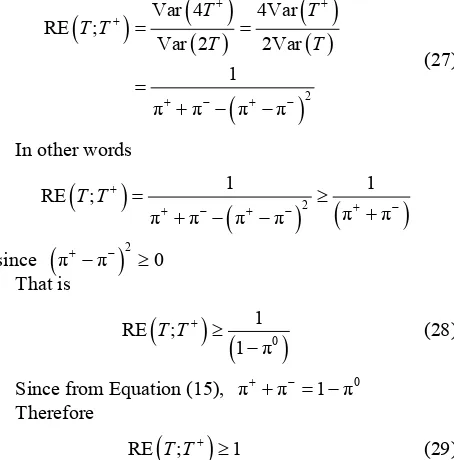
Therefore the relative rate at which these two test sta-to accept a true null
thesis can therefore -paring the variance of 4T+ of Eq
riance of 2T of Equation (26) that is in terms of the relative efficiency of T compared with T+ that is
2Var 4 4Var RE ;
Var 2 2Var 1
T T
T T
T T
(27)
ππ ππ
In other words
2
1 1
RE ;
π π
π π π π
T T
sin That is
ce
ππ
2 0
01
1π (28)
om Therefore
1 (29)fo increases.
roposed modified (T) is more efficient than the Wilco ethod
RE T T;
Since fr Equation (15), ππ 1 π0
RE T T;
r π00, increasing as π0
Hence, the p
xon’s m
T whenever π0 is notere are zero differences or equal to 0, that ver th
serv ta. fficiency of T c
0,
eth re
te the actual and the ideal number have. The results are
pre-olute differences are assigned their mean ranks. The results are presented in Table 2.
Ta
is whene
tied ob ations in the da The relative e
ompared with T increases as π0 increases. The two
methods are equally efficient when π0 that is
when there are no ties in the data whatsoever.
Thus unless there are no ties whatsoever in the data, the proposed m od yields a mo powerful test crite-rion than the Wilcoxon signed rank sum test statistic for the same sample size.
only
4. Illustrative Example
A random sample of twelve married women were se-lected and asked to sta
of children they would like to sented in Table 1.
[image:4.595.308.539.110.300.2]To apply the Wilcoxon signed rank test, we take and rank the differences between the actual and ideal number of children by the sample of married women shown in
Table 1. Tied abs
ble 1. Actual and ideal number of children by a sample of married women.
Woman Actual Ideal
1 4 5
2 1 5
3 6 5
4 1 6
5 7 5
6 1 9
7 4 4
8 2 6
9 8 8
10 5 5
11 4 4
12 4 5
Table 2. Ranks of absolute differences r d
i , of e dif-ferences di tween actual and ideal number of c dren inTable 1.
No. of Wo 1 2 3 4 6 7 8 9 11 12
th hil be
men 5 10
Ideal 5 5 5 6 5 9 4 6 8 5 4 5
Actual 4 1 6 1 7 1 4 2 8 5 4 4
di(Ideal-Actual) 1 4 –1 5 –2 8 0 4 0 0 0 1
i
d 1 4 1 5 2 8 0 4 0 0 0 1
Rank of di 6 9.5 6 11 8 12 2.5 9.5 2.5 2.5 2.5 6
Sign of di + + – + – + 0 + 0 0 0 +
we ha h h e ran s abso te differe p i i
.5 1 5 6 5
From Table 2 ve t at t
tive e sum sig
of t s
h k of lu nces with os ns
6 9 1 12 9. 4
T
The null hypothesis to be tested with the Wilcoxon si
0.5 . Hence under
gned rank test is usually that the two populations of interest have equal medians
H0: 0
H0 we obtain from Equation (6) and (8) that
12 13
39 4 T and
12 13 25
Var 162.5
24
T
0: 0 0.5 H
The resulting test statist ation (12)) under the Wilcoxon approach is
ic (Equ
54 39 15 177 1.18 12.748
162.50
Z
significant at the 5 percent level. We now apply the modified Wilcoxon signed r k test to the data of Table 1 for comparative purposes. Now
from Table 2 and Equation (16) we have that
1.
(P-value = 0.1190) which is not statistically
[image:4.595.59.286.216.446.2]
6 8
40 and from 54T T T Equation (22) 6
ˆ
π 0.50
12
; πˆ0 0.33
12
4 ; πˆ 2 0.17
12
from Equations (19) and (21), we have that
0.17
25.74 and12 13 0.50 2
T
2
Var 0.50 0.17 0.50 0.17
6 364.715
T
test the null hypothesis of equal population medi-ng the modified approach we have from Equation
0
12 13 25
To ans usi
(24), with 0
40 40 2.094
Z
e two populations have equal medians. Note that th
hypothesis was accepted using the Wilcoxon signed rank test statistic unmo resence of ties in
19.098 364.715
(P-value = 0.0183)
which is statistical significant at 5 percent level. ly Hence we now reject the null hypothesis that th
is same null
dified for possible p the data.
Also note from Equation (28) that the relative effi-ciency of the modified test statistic T to the Wilcoxon test statistic T is estimated as
1π0
1 0.33
0.67Thus for the data being analysed, the proposed test sta-tistic is at least 1.49 times more e
1 1 1
RE T T; 1.49
fficient and hence more powerful than the Wilcoxon signed rank test statistic
T.
Thi paper briefly reviews the Wilcoxon signed rank sum a modification. Unlike the Wilcoxon sed approach does not require that the
[1] R. De-W. Derryberry, S. B. Schou and W. J. Conover, “Teaching Ra izing Structural Similarities to ric Tests,” Journal
earning Support Centre, 2004, pp. 1-
/.../NonParametrics.
5. Conclusion
s
test and proposes method, the propo
populations being studied be continuous. Also unlike the Wilcoxon signed rank test the proposed method, does not require the absence of zero differences or tied absolute values of differences. Rather the proposed method struc-turally makes provisions for these possibilities. The pro-posed test statistic also enables the estimation of the probabilities of positive, zero or tied and negative differ-ences within the data. The proposed method shown to be generally more efficient and hence more powerful than the Wilcoxon test statistic with the power increasing as the number of tied observations or zero differences in-creases.
REFERENCES
nk-Based Tests by Emphas Corresponding Paramet
of Statistics Education, Vol. 18, No. 1, 2010, pp. 1-19. www.amstat.org/publications/jse/v18n1/derryberry.pdf [2] D. Gibbon, “Non Parametric Statistics,” McGraw Hill,
New York, 1971.
onlinelibrary.wiley.com/doi/10.1111/j.2044-8317 [3] R. Shier, “Statistics,” The Wilcoxon Signed Rank Sum
Test, Mathematics L
3. mlsc.lboro.ac.uk/resources/statistics/signtest.pdf [4] I. C. A. Oyeka, “An Introduction to Applied Statistical
Methods,” 8th Edition, Nobern Avocation Publishing Company, Enugu, 2009, pp. 496-533.
[5]
B. H. Robbins, “Non Parametric Tests,” Scholars Series, 2010, pp.1-30.