Solution Building for Arbitrary System of Linear
Inequalities in an Explicit Form
Demetrius V. Shapot*, Alexander M. Lukatskii
Energy Research Institute, Russian Academy of Sciences, Moscow, Russia Email: *[email protected]
Received November 25,2011; revised January 16, 2012; accepted January 28, 2012
ABSTRACT
The known Fourier-Chernikov algorithm of linear inequality system convolution is complemented with an original procedure of all dependent (redundant) inequalities deletion. The concept of “almost dependent” inequalities is defined and an algorithm for further reducing the system by deletion of these is considered. The concluding algorithm makes it possible to hold actual-time convolution of a general inequality system containing up to 50 variables with the rigorous method of dependent inequalities deletion and up to 100 variables with the approximate method of one. The main ap-plication of such an approach consists in solving linear inequality system in an explicit form. These results are illus-trated with a series of computer experiments.
Keywords: Linear Inequalities; Convolution; Variable Elimination; Orthogonal Projection Method; Fourier Algorithm;
Chernikov Rules; Dependent Inequalities; Redundant Inequalities; Almost Dependent Inequalities; Matrix Cleanup; Coarsening
1. Introduction
Polyhedron orthogonal projection (POP) was devised by Fourier [1] as early as in the 20s of the XIX century. Some properties of an arbitrary convex set orthogonal
projection are considered by Shapot [2]. However, the
closed algorithm of generating orthogonal projections to
any subspaces is known only for linearpolyhedral sets.
For a long time the POP didn’t find obvious practical use as with every elimination of variables it initiated a large number of dependent (redundant) inequalities. It resulted in a rapid increase in their total number and as a rule didn’t make it possible to solve the problem within an acceptable timeframe. In the middle of the XX-th century Chernikov [3] devised methods of dependent inequality determination, making substantial progress towards re-solving this problem. With their help it became possible to increase the dimension of the problem, solved with POP within acceptable time, from 5 - 8 to 8 - 15, how-ever, a further increase of dimensions resulted in the former problems of expansion. Methods of dependent inequalities in large linear systems determination began to develop in the 80s (ref., for example, Bushenkov and Lotov [4], Lotov [5], Eremin and Makhnev [6]). A new constructive approach to the implementation of the
Fou-rier-Chernikov algorithm (FCA), which makes it
possi-ble to control inequality number expansion during the
process of variable elimination, was devised by Shapot and Lukatskii [7]. From this point on we shall refer it to
as the constructive algorithm of convolution—CAC.
Here we give a preliminary formulation of the main
algorithm. Let the 0 system be given, enclosing k of
linear equations and m of linear inequalities, defining
non-empty set in real space . Let us suppose that the
0 investigation aim is to find its nonbasic variable
population and to write each of them in an explicit form. Such a notation can be represented in two ways: 1) in the form of this variable equality to a number or to a linear function of numerically defined variables; 2) in the form of value bounds restricted by either numbers or by linear functions, which depend on previously numerically de-fined variables. Previously dede-fined variable numerical values” should be considered only within the framework of a procedure containing the following two stages:
S
n
R
S
Elimination of all equations from S0 by means of
“Step of Jordan Elimination” (JE) series. Then r k
of variables will be assumed to be set equal to the
linear functions, which depend on the rest p n r
variables, where rrank of the equation subsystem
(r k , if all equations are mutually independent).
These variables will gain numerical values after
solu-tion of the remaining system of inequalities S1 to
p
R . Let us suppose that every inequality defines
non-negativity of the corresponding basic variable.
S1 “inequality system solution” is generated by an
investigator in the form of an arbitrary sequence of p
variables, in which the first variable has one or two numerical boundaries and each of the consequent variables is limited by linear functions, which depend on previously considered variables. Such a pyramidal (S2) representation of inequality system S1 is similar to limit defining in multiple integrals. With such a representation it is quite convenient to select a working point in S1, being guided by some conceptual criteria.
Let us consider an algorithm of 2 sequence
genera-tion. Let us compare 1 inequality system with the
ma-trix
S S
p
M , which defines p-dimensional convex
polyhe-dron. Let us decrease its dimension to , i.e. let us
pass to the matrix
1
p
1
p
M , eliminating an arbitrary variable j
x
from the coordinate set. This can be done in two ways: either by assigning a numerical value to xj,i.e. bymak-ing 1, section or by constructing the union of all sections along
S
j
x , i.e. the 1 orthogonal projectionon subspace not containing
S
j
x . We will use the second way of
eliminating variables. Let us generate
p t
1 M matrix
sequence with Mp1, ,Mpt, ,
S M
polyhedra
de-creasing dimensions. Precisely this sequence will make it
possible to easily generate 2. Really the
1
M matrix
contains only two columns, the first with the coefficients
uj corresponds to
a xj variable and the other one with
the coefficients b —j to free members.
Denote by q11minu
bu auj |auj0
and
12 maxu u uj uj 0
q b a a .
Then it is not too difficult to see that q12 xj q11,
where 11 and 12 are numbers. In the same way it is
possible to represent the bounds for r
q q
x variable using the
2
M matrix with the xr and xjvariables, q22 xr q21,
where 21 and 22 are linear functions, which depend
on
q q
j
x . If you select xj “attractive” value within the
specified range, the xr acceptable range will be a
nu-merical one. This method of boundary function
Mp t
matrix construction and the selection of variable“attrac-tive” values can be prolonged to the Mp
parent matrix. From this point on we shall refer the considered approach to as POP.
Fourier algorithm is described in Section 2. Different methods of redundant inequality cleanup are considered and a formal description of POP is given in Section 3. The stability and complexity of POP algorithms are estimated in Section 4. The results of numerical experiments are discussed in Section 5.
2. Orthogonal Projection Fourier Algorithm
Let n be a real n-dimensional space. The set
R
,
: ,
:
y Q :
k
n n k
k n k k
n k n
n
x Q u x Q
v y v Q
R R u P Q Q
is referred to as the n set projection on the
n Q R
n k
R subspace.
Let us consider the n non-empty bounded set,
de-fined by the linear system of inequalities
Q
1
0, 1, 2,
n
n ji i j i
Q a x b j m
J
.Suppose we want to build 1, where
1
n n
Q R Rn1
doesn’t depend on an xr variable. According to the
algo-rithm of linear inequality systems free convolution devised by Fourier [1] let us divide J index set into three groups:
(1) (2)
(3)
1, , ; 1, , ;
1, ,
Q s Q s
Q p m
pso, that for them avr0;ar0;ar0.
Solving each of two first groups of inequalities with respect to xr we obtain
1 1 i i i r r r i i r r
l a x b
a
x l a x b
a i
(1)1, , ;s s 1, ,p
Eliminating xr from these relations, i.e. combining
each inequality of the first group with each inequality of the second group we obtain PQ1 nQn1, generated by
s p s inequalities, which have the form
0
1, , ; 1, ,
i i
i
i r r r r r
a a b b
x
a a
a a
s s p
(2)and m p inequalities of the third group. As a matter of fact, x Qn1:
1, 1, max min s k sx l x l x x
and then xr
x , x :
x x, r
Qn .On the other hand, if x doesn’t comply with the
0, 0
-th inequality of (2), then any xr, complyingwith the 0 inequality of (1), contradicts the 0-th inequality and vice versa.
If the first or the second group of inequalities is empty,
i.e. j J a: jr0
ajr0
, then for any x, comply-ing with inequalities of the third group, and
for any
3
xQ
, r
n.r r
x x x
(3) 1 n n
P Q Q x x x
Q Therefore,
in this case .
With the help of the considered algorithm it is possible to eliminate any subset of variables and to construct the
n k k n
Since all computations are performed in the form of a
matrix notation, the Qn set is defined by the matrix,
which we shall denote as M0. Then the k n,
projec-tion generated as a result of eliminating k variables, is
defined by the k
P Q
M matrix. If k n 1, then the Mk
contains only xn column and the column of constant
term. The (1) formula, which corresponds to it, has the form: xnxnxn, where xnmax
b b1, 2, , bs
,
1 2,
n s s s p Such a notation makes it
possible to select any value of
min ,
x b b ,b .
0
n n n, n
x x x x variable
of the Qn projection on the xn axis, i.e. a permissible
value. The same situation will occur, if in the Mn2
matrix you multiple the xn column by
0
n
x . And in general,
during “the descent from the sequence of Ms matrices”
after selection of the s s
0: 1, 2, ,
x x s n n n k
variables arbitrary permissible values and multiplying the
k
M matrix corresponding columns by them we shall
obtain the acceptable range for the n k 1.variable value selection. Therefore, it is possible to say, that the
k matrix sequence allows us to
obtain in explicit form the solution of the inequality
sys-tem defined by .
x
: 1,n
Q
2, ,1
M k n
n
The considered Fourier algorithm, in spite of its seeming simplicity, is usable only for the simplest sys-tems of inequalities. The necessity of all
-th pairs combining while eliminating each variable causes a rapid expansion of inequality number with elimination ofvariables. In particular, if after variable
elimina-tion a system of k1 inequalities is obtained, then after
k-th variable elimination we shall obtain 1
k r
21 r 2
1
k k
r r k1 . The lower boundary is
im-plemented in the case if k and
r
pm s1, or p s 1,
and the upper boundary if p m and s r k2 2. Here a large percentage consists of generated inequalities are
dependent. So, if , then the accessible upper
bound for is 0 of inequalities.
10
13 0
r r5 2 1
Thus, intensive expansion of inequality number with elimination of variables is the main obstacle for POP use in problems of practical importance. To overcome this obstacle it is first of all necessary to have effective algo-rithms for determination of dependent inequalities gener-ated while using the Fourier algorithm. From this point on we shall refer to them as “matrix cleanup” algorithms.
3. Methods of Eliminating Dependent
Inequalities
3.1. Fourier-Chernikov Algorithm (FCA)
Motzkin et al. [8] and Chernikov [3] offered a serious
improvement to the Fourier algorithm related to the abandonment of generating some dependent inequalities. By endowing each inequality of parent system with a primary subscript (number) and by joining (disjuncting) the subscripts while combining inequalities in pairs Cher-
nikov complemented the Fourier algorithm with the fol-lowing two rules:
(ChR1) With eliminating the -th in succession
ine-quality only those inequalities which generate the
sub-script containing not more than of primary
sub-scripts are to be combined (Chernikov’s first rule);
h
h1
(ChR2) The pairs containing some other inequality
to-tal subscript shouldn’t be combined in pairs (Chernikov’s second rule).
In FCA (ChR1) is verified during the process of Fourier
inequalities combining and the (ChR2) is verified after all
combinations not contradicting (ChR1) have been
gener-ated. With the help of Chernikov’s rules all dependent inequalities are determined in the total polyhedra
assem-bly, i.e. for all systems of homogeneous inequalities.
However, for the inequalities with fixed constant terms these rules do not by any means determine all dependent inequalities.
The validity of this statement is readily illustrated by simple numerical examples. To generate them and to conduct consequent computational experiments we used general linear programming (LP) generator of inequality system:
1
0, 1
N
j ji i j i
y a x b j
N,where
0.5
1 3
0.5
( 1)
1
1 3 1 , mod 3
3 0 1
1
3 , , 1, , ,
1
max, , 1, , .
j i ji
j j
i N
i i i i
i i j
a j i
b i j N
j
сx c i N
i
0;
(3)
The bounds of nonbasic variable are: 0.5 xi 2,
1, 2, ,
i N.
In the first example for the case where N7 and
using the Fourier algorithm without applying Cherni- kov’s rules 587115 inequalities were generated with the elimination of the 7-th variable. In the case where N = 8 the use of the Fourier algorithm led to the memory
over-flow. In the second example where , application
of Chernikov’s rules, but without determination of all redundant inequalities, generated the results given in
Table 1. But if you use the algorithm of dependent
[image:3.595.308.538.371.544.2]ine-quality complete cleanup in this example, convolution results will appear to be quite different. They are given in
Table 2.
10
N
Table 1. No determination of all redundant inequalities.
Iter. No. 1 2 3 4 5 6 7 8 9
Fourier 26 50 115 298 1466 8023 30,777 125,149 403,925
Chernikov 26 34 46 106 212 393 749 1335 2369
Table 2. With determination of all redundant inequalities.
Iter. No. 1 2 3 4 5 6 7 8 9
Fourier 19 25 16 11 10 7 8 10 3
Chernikov 19 18 13 11 10 7 8 8 3
Complete Cleanup 16 13 11 9 7 6 6 3 3
algorithms substantially depend on the possibility of de-termination of dependent inequalities generated in the framework of FCA. It should be pointed out, that Chernikov [3] also considered the method of all redun-dant inequalities with fixed constant terms complete cleanup. It is based on a computation of cone generator fundamental system associated with the system of linear inequalities. According to Preparata and Shamos [9], Shevchenko and Gruzdev [10] the corresponding algo-rithm has an operation number polynomial estimator on linear inequality system cardinality with a fixed
dimen-sion. In particular, if is the inequality number
(car-dinality), n is the variable number (dimension), then the operation number in this algorithm has the estimate
m
1 2
n
O m
. As the number of inequalities can increase
rapidly during the convolution process, such algorithm use does not seem to be of practical importance.
3.2. A Formalized Description of POP
Step 0. Clear the counter of variable eliminations I0.
Read an initial matrix Mp of the linear inequality
system, where p—the number of variables.
Endow each linear inequality a primary
sub-script .
0
l
ind l
Step 1. Choose a column , which has t A positive
and B negative elements, and multiplication A B
being minimal. If such a column is absent, then proce-dure is complete, otherwise I I 1.
Note, that under parallelepiped restrictions on all variables a premature end is possible only for an incom-patible system, as otherwise there would be a non bounded variable, in the contrary system.
Step 2. Exclude the variable xt by (1), (2) formula
from the inequality system. As each new inequality is
generated, let us form its subscript by uniting the
subscripts of the corresponding pair. We do not include the inequalities being redundant with the 1-st Chernikov
rule, i.e. number of primary indexes (ChR1)
(ind)
(length(ind) I 1) don’t include in the system.
Step 3. Carry out a control of subscript pairs on (ChR2)
(indind ind
), then delete the inequality with subscript
from the system as a redundant one.
Step 4. Carry out after the full cleanup in the inequal-ity system.
Step 5. Save Mp I matrix I -th iteration of
inequal-ity system and the number t of excluding
vari-able. If
p I
1
I p , then return to Step 1, otherwise the
end.
3.3. The Algorithm of Building of an Inequality System Solutions in Explicit Form
Here we give a formal description of the algorithm in 1.
This procedure means that all steps of variable
elimination have been implemented. Then the matrix 1
1
p
p
M contains the single variable with number and
the matrix
(1)
t
p j
M contains variables with numbers j
1 ,,
jt t . M0 is the initial matrix of linear problem
with p variables.
For j1, , p do
Step j. If j1, then go to 2, otherwise:
1. In the matrix Mp j we fix the values of variables, which were changed in the preceding steps
0 0
(1) (1), , ( 1) ( 1),
t t t j t j
x x x x
as a result the matrix Mp j contains the single variable ( )
t j
x
.2. Using the matrix Mp j , the solution of an inequal-ity system with this single variable is formed as the range of its acceptable values: Ajxt j( )Bj . We choose a
desired value 0
( )
t j
x from this range. If j p 1, then
1
j j and return to 1, otherwise the end.
3.4. Constructive Approach to Determination of Dependent Inequalities in Polyhedral Sets
The problem of dependent inequalities determination is rather relevant for various applications. It was considered by many authors both in the context of projections method Bushenkov and Lotov [4], Lotov [5], Eremin and Makhnev [6] and independently Efremov, Kamenev and Lotov [11], Golikov and Evtushenko [12], Gutman and Ioslovich [13], Paulraj and Sumathi [14]. Before we de-veloped and programmatically implemented several ap-proaches to the determination of dependent inequalities in linear systems Shapot and Lukatskii [7,15]. We de-scribe and substantiate the algorithm of Shapot and Lu-katskii [7] further in this text.
[image:4.595.58.286.179.250.2]spe-cific procedure. To ensure investigated polyhedron bou- ndedness we require that the upper and lower boundaries are defined for all free variables. These boundaries shall define the survey coverage of models in the form of a rec-tangular parallelepiped, of interest for the investigator. However, in the case when any of parallelepiped restric-tions appears to be dependent it should be eliminated from the corresponding matrix like any other dependent in- equality. Here we remind the dependent inequality concept.
Definition 3.1. The inequality is dependent
(redundant) on a set , if it is satisfied in each point of this set and is incompatible with , if it is satisfied in no point .
0l x
Q Q
x Q
The analysis of inequality dependence or
incompatibility conditions with respect to the set can
be founded on any of the following equivalent and obvi-ous criteria.
0l x
Q
(Crit1) In order for the l x
0 inequality could be: a) dependent on Q, orb) incompatible with Q,
It is necessary and sufficient to meet the conditions:
a) minx Q l x
0,
min l x 0 r
b) x Q .
(Crit2) The inequality is dependent on
l x
0
j 0Q l x j
0
if and only if
It is representable as j j , j 0,
j
l u l a u a
Chernikov [3].
(Crit3) a) Elimination of any independent inequality from the system of inequalities causes region of feasibil-ity expansion, i.e. Q Q and Q Q ;
b) Elimination of any dependent inequality from the system of inequalities doesn’t cause region of feasibility expansion, i.e. Q Q .
In the general case, when the inequality
dependence on the j
0l x
1
, 1, , ,
0, 1, , ; ,
j i i i n
i i i
Q x x x i n
l x a x b m j
set is investigated it is sufficient to use (Crit1) and to
solve the corresponding problem of linear programming (LP). However, we are interested in the complete cleanup of matrix in the framework of orthogonal projecting pro-cedure (OPP), when inequalities number rapid expansion is possible with variables elimination. Suppose, that at the OPP next step after FCA implementation the
gener-ated system of m inequalities can contain noticeable
amounts of dependent inequalities. In this situation the approach based on (Crit1) direct use for m inequalities
testing assumes LP problems solving. It is obvious
that such an approach is not attractive. Let us consider a
fundamentally different way of slump in amount of cor-responding computation while verifying inequalities in-dependence.
m
Suppose that a basic solution is found for the linear inequality system defining -dimensional compact poly- hedral set
n
i i i, 1, , , s 0, 1, 2,
Q x x x i n l x s m (4)
obtained after the OPP next step and containing no pair-wise equivalent inequalities. As a reminder, some solu-tion of (4) is referred to as a basic one if it satisfies all
constraints and transforms at least n inequalities into
equalities. Relying on the conditions considered below we can verify dependence of all inequalities correspond-ing to the basic solution matrix (BSM). We shall first make some terms more precise.
By using variable shift we may reduce our problem to the case xi0. We also transform xixi to the form
0
i i
x x
and add it to the constrain set
ls . Belowwe shall refer to the x j variablesin the formula (4) as
nonbasic (free) ones and the ls variables—as basic
(constrained) ones. Moreover, in respect of any
sim-plex-matrix we shall speak of column and row variables.
Any of these variables is associated with its non-nega- tivity condition. Therefore, each inequality corresponds to one of the variables.
From this point onwards we shall refer to the
differ-ence between the dependdiffer-ence in respect of the set
and the
Q
0j
l x dependent inequality:
Definition 3.2. The l is the first kindj , if
: j 0
x Q l x
.
Definition 3.3. The lj is the second kind, if
: j 0
x Q l x
and x Q l x: j
0.The analysis of inequality dependence, defining the polyhedral bounded set, can be based on the condi-tions given below.
Q
1) For row variables. If after the appropriate JE step in the course of the BSM construction or investigation the xs-th with all non-negative coefficients constant term
inclusive is discovered, then in accordance with the (Crit2) the xs0 inequality is dependent and the xs-th row can
be eliminated from the matrix.
2) For column variables. If all constant terms in the BSM are positive, then independent inequalities corre-spond to all column variables non-negativity condition.
As a matter of fact, if an xs column variable is given
0,
s
x
negative increment, the constant terms of each
-th row
j bj will have the value b j bj ajs xs . If
0
js
a , then b j bj, if ajs0 , then b j bj, if
and 0
js
a xs minjb aj js, then This
means, that there’s the interval s
0.
j
b
0,
x x
where the
only s inequality is violated, i.e. the reference set
without this constraint will be an extended one. There-0.
fore, in accordance with (Crit3) this inequality is
inde-pendent.
From this point onwards we shall assume, that the homogeneous inequalities containing zero constant terms correspond to the first rows of the BSM. In this case
all column variables correspond to the
inequali-ties, which on the basis of the (Crit1) are not the first kind
dependent, but represent the tangent hyperplanes. Here two cases are possible:
p
0
s
x
a) The half-space contains the face, which
has dimension , where . Then is
an independent inequality. 0
s
x n
Q Q
1
ndim xs0
b) The hyperplane contains the edge, rather
than the Q face, generated by faces intersection,
which has dimension . Then is a
dependent inequality of the second kind. 0
s
x Q
k k n
, 2
n k xs0
The following is valid.
3) The column inequality is independent,
when and only when there exists a point of the
0
s
x
0
s
x hyperplane, in which all row homogeneous inequalities are satisfied with positive change of all other column variables.
As a matter of fact, if the inequality is
inde-pendent, there is
0
s
x
0 ,s j
0: 0 0 0,
x x l j
0,
x
s for all
inequalities homogeneous ones inclusive. But if
Q
0: 0 0, 0
s j
x x x
0 n1
x R
Q
j s
x
for all column variables, then
. Therefore, the s hyperplane contains the
space, i.e. it is an independent inequality. 0
In order to check a column inequality independence with regard to (2), it is sufficient to check fulfillment of (3) only for homogeneous inequalities. While checking
the column inequality independence let us
con-sider such a small shift from the basic solution point
simultaneously in all column variables but 0
s
x
d
s
x , with
which none of homogeneous row inequalities is violated.
Let us assume s i i where
is a small positive number, for example, 0, s x: u d q,
q
1,
ui
0.0001
x i
q .
Herewith, 0 xi d. Let us write down the row homo-
geneous inequality system ji i ji i 0
i s i s
a x d a u
0.0001
i i v u
or
. Making a change of , we
obtain 0
ji i i s
a u
0.0001 0, 1, , , 0 0.9999.
ji i ji i
i s i s
a v a j p v
(5)According to (3) the inequality is independent
when and only when the system (5) is compatible, i.e. it
is possible to find a basic solution for it. Let us check this possibility by solving the corresponding linear problem.
0
s
x
With the help of (3) it is possible to determine all de-pendent column inequalities and to eliminate each of
them from by first performing the appropriate JE
step. But if we take into account that any row inequality in the BSM can become a column one with the help of
one or several JE steps, the following concluding propo-sition is true:
Q
Proposition 3.1. With the help of (1), (2), (3) all
de-pendent inequalities can be determined in the BSM.
Returning to the orthogonal projection procedure let us note that the computation amount in the course of matrix complete cleanup can be reduced with regard for the fol-lowing important point. If with elimination of a next xr
variable the Mr matrix contains -th rows, for which j
0
jr
a , and the corresponding -th inequality
depend-ence was determined in the course of matrix cleanup during the preceding iterations, their independence re-peated check is meaningless. Legitimacy of such an ap-proach follows from the following obvious proposition.
j
Proposition 3.2. If l x
s1, , xn
0 is the inequality independent on the n set, then it is the inequalityin-dependent on
Q
n s
Q set and vice versa.
Therefore, under the FCA framework with each new inequality subscript building it is reasonable to comple-ment it with “its independence temporary non-identifi- cation” criterion.
3.5. Algorithm of Full Cleanup of Redundant Inequalities (Step 4 of 3.2)
Step 1. Reduce the matrix of linear inequalities system to the BSM form, in which all free members are nonnega-tive.
Step 2. If there are inequalities having all coefficients nonnegative in BSM, we mark them as redundant.
If all free members in BSM are positive, then we mark all column variables as independent and go to Step 4, otherwise to Step 3.
Step 3. Mark subset of rows with null free members. In the cycle by column variables xs form linear problem
(5). Solving it, we obtain the answer about the inde-pendence of variable xs.
Step 4. If all variables are identified by independence mark, then we complete the process, otherwise go to Step 5.
Step 5. Exchange BSM by means of JE in order for some row variables that were not tagged with the sign of independence to move to column ones. Return to Step 2.
3.6. Methods of Matrix Additional Cleanup
Appropriate polyhedron boundaries moderately small alteration, resulting in transforming some independent inequalities into dependent ones, is associated with matrix additional cleanup.
poly-hedral set comparison special measure Lotov [5], Efremov, Kamenev and Lotov [11].
Essentially boundaries alteration can be made with a sacrifice in both expansion (inequalities part elimination) and contraction (variable range restriction) of inequality system feasibility region. From this point onwards we shall consider only the first way.
Surface fine-cellular structure is typical for linear polyhedra if they are defined by a large number of in- equalities. Therefore, its minor “coarsening” in applica-tion studies is admissible with a sacrifice in neglecting of some side defined as “almost dependent (redundant)” inequalities. To implement such an approach it is first of all necessary to introduce a measure of any inequality dependence on a corresponding set. It is obvious that such measure selection is heuristic.
Assume
i i 0 is one of inequalitiesi
l x
a x bdefining set, and the Q is the same set, but in the
absence of this inequality. It appears that it is convenient to characterize this inequality measure of dependence on the set with a value proportional to
Q
Q dminx Q l
.
0l x x
As a matter of fact, we are dealing with BSM therefore,
the system constant term vector doesn’t contain
negative constant terms. If , then is a
dependent inequality. But if , its elimination from
definition is equivalent to the b constant term
in-crease by the value
Q
0
d
0
d Q
d . This value is proportional to the
distance between the hyperplane and the vertex
of (in half-space l ), the least distant from it, and
therefore, it makes it possible to infer the Q extension
degree. In particular, for projection of Q on xiaxis its
extension is equal , where is the angle
be-tween the l x hyperplane normal and i
0 0
u d l x
cos
Q
u
0 x axis.Therefore, the value itself can be used for the upper estimate of such an extension. It is obvious, that each
inequality in the dependence degree estimates should
be comparable to each other. It follows, that they should be represented in “relative units”, in particular, in
frac-tions of corresponding constant terms, i.e. by the value
d
Q
e d b
, under the condition, that . Therefore, with
the assumption of a rate value e0, we shall consider the
j non-homogeneous inequality to be “almost
dependent” on Q, if the
0
b
0
l x
l x e b0 j 0
j inequality is
dependent on the Q set, i.e. if minx Q j 0 j.
Let us consider a simple algorithm to estimate de-pendence degree of some non-homogeneous inequalities in the BSM containing only independent inequalities. Let us compute and put in order of increasing the
l x e b
sj j js
d b a values for all for each column
variable
: js
j a 0
s
x . Assume the first place in this list is occupied by the row (several rows) corresponding to the xu,
vari-able and the second—to the xv variable. (In the case,
when , we proceed to the next column variable). If
we make the JE with the resolvent element, we will
find that the
0
u
b
vs
a
u u v us vs
b b b a a b
constant term is negative.
With bu increase by the u value the inequality
would be found out dependent of the second kind. It fol-lows that
0
u
x
u u
b d .
Proposition 3.3. If 0 u and no negative
coef-ficients are found out among the u-th row coefcoef-ficients, this inequality can be considered to be “almost dependent”
and it can be eliminated from the BSM. Similar computa-tion cycles should be repeated, the pattern of column variables should be changed every time.
,
e b
u
d
0.1
e qe
3.7. Inequalities Number Expansion Process Control with Variables Elimination by CAC
While using matrix additional cleanup it is possible to find a simple trade-off between two contradictory stimuli: the desire to prevent too rapid number expansion of the inequalities defining projections and the desire to prevent polyhedron surface excessive alteration. To implement such a trade-off let us assume two parameters.
The first one is represented as the inequalities
coarsening maximum admissible rate in the course of matrix additional cleanup and therewith associated the
“working value” 0
e0 of this rate, where the
controlled variable can take the discrete values 0,1,2,···,9,10. For practical use it is reasonable to assume the value to be within the range of 0.05 - 0.10.
q
0
The second parameter is the maximum admissible
multiplicity of row number in the matrix increase
with elimination of variables in respect of the parent ma-trix. Thus inequalities number admissible threshold
valueв is 0
e
( )h
PRG r h . The rational value depends on the available “computation resources” and can vary within 3 - 10.
h
Let us assume that after the elimination of the next
variable xk the working value , and the number
of inequalities in the matrix is k . Assume that
after the elimination of the variable xk+1 with the help of FCA algorithm and the complete cleanup of matrix the inequalities number therein exceeds the preset threshold. In this case let us additionally clean the matrix with the ek
rate. If it doesn’t provide the rk+1 value decrease needed,
let us assume 1
0
RG
k
q r P
1
k k
q q
PRG
, then let us again additionally clean the matrix, but now in an “intense mode”, i.e. with the ek+1 rate. Let us repeat this procedure until one of the two conditions is fulfilled:
1) rk1 and qk110, or PRG qk 10
2) k1 and 1 .
In the first case it will be possible to further intensify matrix cleanup restricting inequalities number in newly generated matrices during the following iterations if nec-essary. In the second case the process of variable elimi-nation with complete and additional cleanup of generated
matrices will be continued, however, the possibility of matrix additional cleanup intensification will be lost.
If in the course of variable elimination it is necessary to resort to matrix additional cleanup, then not only the corresponding matrix is compared to each -th iteration,
but also the ek coarsening rate value, which was used
during its generation. It makes it possible to avoid inad-missible solutions occurring as a result of the polyhedron “improper” extension during “descent of matrix pyra-mid”. Precisely, in the formally computable range of the
k
k
x -th variable
x xk, k
it is permissible to chose xkval-ues only in the range
xk k,xk k
, where
0.5 k .
k e xk k x
4. Stability of the Polyhedron Orthogonal
Projection and Complexity of Its
Algorithm
4.1. Stability of the POP Algorithm
Let us give an inequality system (4). It gives us a
com-pact polyhedron . Here two cases are possible:
is solid or singular. In the first case it is valid.
n QR
Q
Proposition 4.1. If the polyhedron is solid, then
POP is stable.
Q
Proof. Using (4), we introduce M = maxi max
xi 1, xi 1
. Denote by lj such a perturbation ofinequality lj, in which all coefficients ji and free
member
a
j
b have an increment in absolute value not
exceeding a given 0. Denote by Q the
polyhe-dron obtained if in (4) inequalities ljreplaced by lj .
Suppose that j is the face in Q and j—in Q
asked by the conditions j and j , respectively.
For an inequality
0
l l 0
j
l we introduce the rate
2j ji
i
N l
a . Suppose that all inequalities havenonzero rates. Define
1maxj
j
N
N l
. We fix 0
and take
2N Mn 1
. Then we have
,
1
: j j n j i i j
i
x Q l x l x a x b Mn
It follows that :
2
j j
x Q l x l x
N
. We now
take xj. Then we have l xj
0. Hence
2
j j j
l x l x l x
N
. Note that
, j
j
j
l x x
N l
. Immediately it is verified that there
exists 00 such that with condition 0 for any
it is valid:
1
2. 2
j j
N l N l
It follows that
j
: ,
j j
x x
. Here
x,j
is the distancefrom the point to the space.
Similarly, it is easy to see that x j:
x, j
.Denote by
Q —neighborhood of . Then wehave
Q
,
Q Q Q Q . (6)
Denote by the orthogonal projection on a
sub-space. Since the distance between the points cannot in-crease in the projection, from (6) it follows that
P
,
P Q P Q P Q P Q
(7)From (7) it follows that a sufficiently small perturba-tion of coefficients and free members of inequalities leads to a small perturbation of polyhedron projection. This completes the proof.
In the case of singular polyhedron an arbitrary small perturbation can lead to a significant change in projection as follows
Example 4.1. Let be the polyhedron defined by
the inequalities:
Q
1 2 0, 1 2 0, 0 1 1, 0 2 1
x x x x x x .
Denote by P1 the orthogonal projection on the axis
1
x . We introduce a perturbation Q of .Q
1 1 2 0, 1 1 2 0, 0 1 1, 0
x x x x x x2 1. Then we have P Q1
0,1 and for any 0 it holds P Q1
0 .4.2. The Complexity of the POP Algorithm
The complexity of POP algorithm is defined by two fac-tors:
1) the growth of inequality number in the system by iterations;
2) the complexity of the algorithm of redundant ine-quality cleanup for a single iteration.
Let us consider 1). Let be a compact
polyhe-dron defined by the inequality system (4) and be the
orthogonal projection onto a subspace . Note
that single iteration of the orthogonal projection proce-dure is accompanied by a full cleanup of redundant ine-qualities. Therefore, an inequality
n QR
k
P n n k
R R
0
ll in the system
of projection corresponds to hyperplane
0
con-taining a face of P Q
πk . Similar to [16,17] this
hy-perplane can be represented as projection of the
in-tersection of k1 hyperplanes j k 1)
of the original inequality system. Hence, we obtain an
estimation of the number k of inequalities for this
projection by the binomial coefficients:
lj(1)l ( 0
1 2
k
k m
N C
n
. (8)
Here is the number of inequalities (lj) in (4) and
correspond to parallelepiped restrictions.
m
2n
At 2) we estimate the cause of complexity of redun-dant inequality cleanup. It is determined by the number of appeals to the solution of linear problems (5). Typi-cally this problem has a low dimension and is solved by means of the simplex-algorithm. As it is well known the simplex-algorithm has an exponential complexity [18]. Note that in the linear problem (5) the threshold of accuracy of its solution is introduced. This allows the use of the polynomial algorithms of linear problem solution. Here Khachiyan [19] and Karmarkar [20] algorithms are known. The Karmarkar algorithm [20] is more efficient and has the complexity
q
3.5 2ln ln lnk
Compl O n L L L .
Here is the number of free variables of linear pro-
blem and is the number of bits of input to the
algo-rithm. It is suggested that a linear problem is solved for
each inequality. Then for complexity k of
the redundant inequality cleanup of the iteration , we have the majorant
n L
ComplConv k
k k k
ComplConv N Compl . (9)
5. Computational Experiment Results
In accordance with the considered algorithm we have
developed a demonstration version of the program
im-plementing the orthogonal projecting procedure (OPP)
by using the language VISUAL BASIC 6th version with a
32-bit compiler. During computational experiments the
following computer resources were used:PC Intel-Core2
with clock speed of 2.67 GHz, capacity of internal mem-ory of 3.25 Gb and the operating system Microsoft Win-dows XP Professional 2003. The computational experi-ments aimed to analyse FCA improvement proposed measures effectiveness. The matrices of form (3) were investigated. The LP problem was used for computation accuracy strict check with OPP implementation. In par-ticular, first the projection of the entire feasibility region is constructed on the objective function axis. Then, the optimal resolution vector is determined with the previ-ously computed matrices sequence “descent”. This esti-mation of solution accuracy is made by its comparison with the same problem solving by means of sim-plex-method. Herewith material inconsistency is admis-sible only in the case, if the problems pair being consid-ered has an ambiguous solution.
When the procedure is used in practice, the following parameters are rather essential beyond computational accuracy: 1) expansion maximum degree of the number of inequalities with the elimination of variables; 2)
com-puting time needed for the elimination of a given set of variables. This time depends on available computation resources, the specific nature of the parent matrix, the number of eliminated variables and after all on the algo-rithm being used. Therefore, all experiments were held on the same computer, with the same structure matrices (3), with the same requirement of all nonbasic variables elimination. The matrices being considered had only
various
N dimensions of polyhedra. Herewith theparent matrix contains rows, since rows are
supplemented by the requirements . Matrices
in-admissible expansion with the use of FCA only is clearly
illustrated in Table 1 with . At the next stage
algorithm performance capabilities were investigated with complete cleanup of matrices, but without addi-tional cleanup, in particular, without their expansion control. At the final stage the algorithm with additional cleanup, i.e. with “coarsening” was considered.
2N N
2
i
x
10
[image:9.595.310.536.585.728.2]N
Table 3 gives the consolidated results of numerical
experiments for various dimensions of the parent matri-ces. The Table 3 contains
N—parent matrix dimensions,
M—inequalities in the matrix number maximum
ex-pansion after its complete cleanup,
T—time (sec) of all variables elimination,
Relative deviations from the simplex solution of the LP appropriate problem:
D1—deviation of the optimal value of the objective
function;
D2—maximum deviation of the optimal solution
vari-ables;
D3—average deviation of the optimal solution
vari-ables.
All Table 3 rows (excluding the last two rows)
repro-duce results of convolution with the use of matrix com-plete cleanup, but without coarsening. With matrices cleanup in LP problems, which are represented in the last two rows, a coarsening with threshold 3 and maximum
rate 0.1 for N50 and 0.12 for was used.
The Table 3 analysis shows, that the rate-determining
100
N
Table 3. Combined results of experiments.
N M T D1 D2 D3
10 20 1 <E–14 <E–14 <E–14 20 40 6 <E–14 <E–14 <E–14 30 66 26 3.25E–10 3.37E–9 2.82E–10 40 402 1176 3.61E–10 4.50E–9 4.35E–10 50 602 4564 9.72E–10 2.05E–8 1.19E–9
50 (coarsening) 343 454 4.00E–3 3.87E–2 1.87E–3
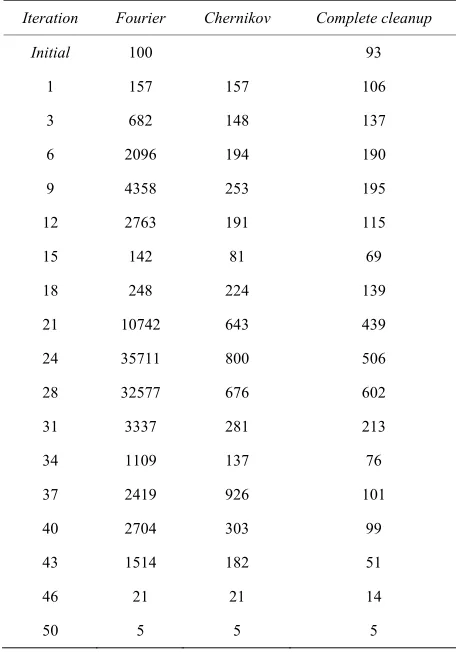
factor with convolution of the high-dimensional inequal-ity systems is not so much expansion thereof, as compu-tation time. In the above mentioned conditions the ad-missible computation amount (76 min 4 sec) was
ob-tained with with the use of only matrix
com-plete cleanup. The fragments of corresponding automati-cally generated protocol, giving the idea about inequality system convolution history, are represented in Table 4.
50
[image:10.595.57.285.412.738.2]N
Table 4 illustrates the fact that the generated matrix
cardinality dependence on the next iteration index is am-biguous. It is determined by the variables elimination order and by the distribution of positive and negative coefficients in the eliminated column.
[image:10.595.140.531.446.740.2]Comparison of the data represented in the two rows of
Table 3 for problem with dramatizes matrix
additional cleanup algorithm (coarsening algorithm) per-formance capabilities. In the discussed example its use made it possible to reduce inequality system maximum expansion by 1.76 times, computation time—by 10.05 times, however, it is accompanied by objective function optimal value computation accuracy loss up to the level of 0.004. In those cases, when such loss is admissible, the use of the coarsening algorithm can be considered to be rather effective. Below the algorithm of choosing the of attractive admissible point 3.3 is illustrated in example
50
N
Table 4. Convolution history for N = 50.
Iteration Fourier Chernikov Complete cleanup
Initial 100 93
1 157 157 106
3 682 148 137
6 2096 194 190
9 4358 253 195
12 2763 191 115
15 142 81 69
18 248 224 139 21 10742 643 439 24 35711 800 506 28 32577 676 602 31 3337 281 213 34 1109 137 76 37 2419 926 101 40 2704 303 99 43 1514 182 51
46 21 21 14
50 5 5 5
(3) with N10. The course of building of system (3)
solution in the explicit form is given in Table 5. Note
that the value of variable 1 is calculated, i.e. it is not given in the dialog.
6. Conclusions
The computer experiments performed enable us to esta- blish the following:
The algorithms of matrix complete cleanup make it
possible to obtain quite a high accuracy of computa-tion.
A rapid increase in computation time span with
prob-lem dimensions increase is the main disadvantage of the demonstration version of the program used.
The use of matrix additional cleanup is effective in
cases, where the initial information is in error of sev-eral percents.
We can hope that estimations (8), (9) of the
complex-ity of POP are overvalued and can be improved sig-nificantly.
It is useful to mention the following trends of OPP use in applied research:
[image:10.595.308.536.464.700.2]In defining linear model of an object whose variables are not relevant for the investigator, though they cannot be neglected, the corresponding set projection to subspace, not containing those variables, will make it possible to retain all the features of the model being investigated. Such an application of the convolution method is known
Table 5. Dialog interface for the building of an inequality system solution.
Name of variable
Iteration of convolution
Low variable
bound
High variable
bound
Field of input of variable
value
Objective
function 10 0.00000 3.84323 3.80000
Variable 8 9 3.42561 4.00000 3.50000
Variable 9 8 1.00000 1.02042 1.01000
Variable 10 7 3.94127 4.00000 3.98000
Variable 2 6 1.00000 1.00636 1.00300
Variable 5 5 3.52671 3.53210 3.53000
Variable 6 4 3.99698 4.00000 3.99800
Variable 3 3 2.64854 2.64920 2.64900
Variable 7 2 2.46478 2.46693 2.46500
Variable 4 1 1.00000 1.00013 1.00010
The substitution of the original system of constrains is over. There are no errors
Option with the objective function. The objective
function 3.80000
in biophysics (Nikolaev, Burgard and Maranas [21]). In parametric programming problems, in which it is useful to find the dependence of LP problem optimal solution on such linear model parameters as absolute terms of constrains and (or) boundaries of variables (Keerthi and Sridharan [22]).
In the problems of process-admissible deviations from any products rated values, for which operability scope
thereof is defined by a linear model. The use of OPP
will make it possible use much more fully with a
transfer from universally accepted mutually independent tolerances to a system of dependent tolerances, because it allows us to replace a parallelepiped inscribed in with a polyhedron.
Q
Q
Q
In various problems on agreeing solutions in search of a compromise between partners (Shapot and Lukatskii [7]).
In problems of a multi-objective choice while project-ing region of feasibility on subspace of criteria (Kar-bovsky, Lukatskii and Shapot [23]).
7. Acknowledgements
The authors are grateful to the referees for their useful comments.
REFERENCES
[1] J. B. Fourier, “Solution d’une Question Particulière du Calcul des Inégalités,” Nouvean Bulletin des Sciences par la Société Philomatique de Paris, 1826, p. 99.
[2] D. V. Shapot, “On the Construction of Orthogonal Pro-jections of Point Sets Defined by a System of Inequali-ties,” Journal Computational Mathematics and Mathe-matical Physics, Vol. 11, 1971, pp. 1113-1126.
[3] S. N. Chernikov, “Linear Inequalities,” Nauka, Мoscow, 1968.
[4] V. A. Bushenkov and A. V. Lotov, “An Algorithm for Analysis of Inequality Dependences in a Linear System,”
Journal Computational Mathematics and Mathematical Physics, Vol. 20, 1980, pp. 562-572.
[5] A. V. Lotov, “On the Estimate of Stability and the Condi-tion Number of the SoluCondi-tion Set of a System of Linear Inequalities,” Journal Computational Mathematics and Mathematical Physics, Vol. 24, 1984, pp. 1763-1774. [6] I. I. Eremin and A. A. Makhnev, “International Workshop
on Algebra and Linear Optimization Dedicated to the 90th Anniversary of the Birth of S. N. Chernikov,” Ural State University Bulletin, Vol. 30, 2004, pp. 183-184. [7] D. V. Shapot and A. M. Lukatskii, “A Constructive
Algo-rithm for Foldind Large-Scale Systems of Linear In- equalities,” Computational Mathematics and Mathemati-cal Physics, Vol. 48, No. 7, 2008, pp. 1100-1112.
doi:10.1134/S0965542508070038
[8] T. S. Motzkin, H. Raiffa, G. L. Thompson and R. M. Trall, “The Double Description Method,” Contributions
to the Theory of Games, Vol. 2, 1953, pp. 51-73. [9] F. P. Preparata and M. I. Shamos, “Computational
Ge-ometry. An Introduction,” Springer-Verlag, Berlin, Hei-delberg, New York, Tokyo, 1985.
[10] V. N. Shevchenko and D. V. Gruzdev, “Modifications of Fourier-Motskin Algorithm for Triangulation Construc-tion,” Discrete Analysis and Investigation of Operations, Series 2, Vol. 10, 2003, pp. 53-64.
[11] R. V. Efremov, G. K. Kamenev and A. V. Lotov, “Con-structing an Economical Description of a Polytop Using the Duality Theory of Convex Sets,” Doklady Mathemat-ics, Vol. 70, 2004, pp. 934-936.
[12] A. I. Golikov and Y. G. Evtushenko, “A New Method for Solving Systems of Linear Equalities and Inequalities,”
Doklady Mathematics, Vol. 64, 2001, pp. 370-373. [13] P. O. Gutman and I. Ioslovich, “On the Generalized Wolf
Problem: Preliminary Analysis of Nonnegativity of Large Linear Programs Subject to Group Constrains,” Automa-tion Telemech, No. 8, 2007, pp. 116-125.
[14] S. Paulraj and P. Sumathi, “A Comparative Study of Re-dundant Constrains Identification Methods in Linear Pro-gramming Problems,” Mathematical Problems in Engi-neering, Vol. 2010, 2010, pp. 1-16.
doi:10.1155/2010/723402
[15] D. V. Shapot and A. M. Lukatskii, “A Constructive Algo-rithm for Building Orthogonal Projections of Polyhedral Sets,” Optimization, Control, Intelligence, Sibirian En-ergy Institute, Irkutsk, 1995, pp. 77-91.
[16] D. Hilbert and S. Cohn-Fossen, “Anshauliche Geometrie,” Verlag J. Springer, Berlin, 1932.
[17] A. D. Alexandrov, “Convex Polyhedra,” Springer-Verlag, Berlin, 2005.
[18] V. Klee and G. Minty, “How Good Is the Simplex-Alg- orithm,” Proceedings of the Third Symposium on Ine-qualities,Los Angeles, 1972, pp. 159-175.
[19] L. Khachiyan, “A Polynomial Algorithm in Linear Pro-gramming,” Soviet Mathematics—Doklady, Vol. 20, 1979, pp. 191-194.
[20] N. Karmarkar, “A New Polinomial Time Algorithm for Linear Programming,” Combinatorics, Vol. 4, No. 4, 1984, pp. 373-395. doi:10.1007/BF02579150
[21] E. V. Nikolaev, A. P. Burgard and C. D. Maranas, “Edu-cation and Structural Analysis of Concerved Pools for Genom-Scale Metabolic Reconstruction,” Biophysical Jour- nal, Vol. 88, No. 1, 2005, pp. 37-49.
doi:10.1529/biophysj.104.043489
[22] S. S. Keerthi and K. Sridharan, “Solution of Parametrized Linear Inequalities by Fourier Elimination and Its Appli-cations,” Journal of Optimization Theory and Applica-tions, Vol. 65, 1990, pp. 161-169.
[23] I. N. Karbovsky, A. M. Lukatskii and D. V. Shapot, “Use of Orthogonal Projection Method by the Example of An- alysis of Industries Possible Price Response to Natural Monopolies Products Price Shocks,” Proceeding of the Second International Conference MLSD 2008, Institute of Control Sciences, Moscow, 2008, pp. 117-126.