Distributed Sensor Network Based on RFID System
for Localization of Multiple Mobile Agents*
Byoung-Suk Choi1, Joon-Woo Lee1, Ju-Jang Lee1, Kyoung-Taik Park2
1
Department of Electrical Engineering, KAIST, Daejeon, Korea (South)
2
Korea Institute of Machinery and Materials (KIMM), Daejeon, Korea (South) E-mail:[email protected], [email protected], [email protected], [email protected]
Received December 10, 2010; revised December 29, 2010; accepted January 13, 2011
Abstract
This paper presents a distributed wireless sensor network for multiple mobile agents localization. Localiza-tion of mobile agents, such as mobile robots, humans, and moving objects, in an indoor space is essential for robot-robot interaction (RRI) and human-robot interaction (HRI). The standard localization system, which is based on sensors installed in the robot body, is not suitable for multiple agents. Therefore, the concept of sensor network, which uses wireless sensors distributed in a specified space, is used in this study. By ana-lyzing related studies, two solutions are proposed for the localization of mobile agents including humans: a new hardware system and a new software algorithm. The first solution focuses on the architectural design of the wireless sensor network for multiple agent localization. A passive RFID system is used, and then the ar-chitecture of the sensor network is adapted to suit the target system. The second solution centers on a locali-zation algorithm based on the sensor network. The proposed localilocali-zation algorithm improves the accuracy in the multiple agent localization system. The algorithm uses the displacement conditions of the mobile agents and the recognition changes between the RFID tags and RFID reader. Through experiments using a real platform, the usefulness of the proposed system is verified.
Keywords: Multiple Robot Localization, Distributed Sensor Network, RFID System
1. Introduction
Recently, ubiquitous computing [1,2], where networks can be accessed anywhere and anytime, has garnered increasing attention. The infrastructure to build a sensor network has been developed rapidly as a result of advances in semiconductors, MicroElectroMechanical Systems (MEMS), and communications technologies [3,4]. Sensor networks are a basic element of ubiquitous computing environments and have features such as low power, efficiency, low cost, robustness, flexibility, and distribution. Sensor networks with these features have been applied to several areas such as intruder surveill- ance, position tracking, and motion monitoring in indoor spaces [5-8].
In the near future, multiple mobile agents are expected to co-exist and interact with each other in indoor spaces. The mobile agents include humans and objects, as well as robots. The following two examples are considered to
be the types of interactions with mobile agents that will increase: robots will interact with other robots and perform cooperative functions; robots will offer services to humans and track objects. To facilitate smooth and safe interactions, more accurate and robust localization methods for these mobile agents are needed. That is, the states of all mobile agents within a specified space should be detectable.
Classic localization algorithms use sensors installed in mobile agents, and the positions of the mobile agents are estimated by analyzing the data obtained from these sensors, such as cameras, encoders, and ultrasonic sensors [9]. If multiple mobile agents are located closely in the same space, however, interference between the sensors data obtained is generated. Therefore, accurate data for localization cannot be obtained from these sensors. Also, the use of sensors is limited according to the features of the mobile agents. For example, human agents do not have general sensors such encoders or cameras for localization. Thus, the classic localization system is not suitable for multiple mobile agent localization that
includes human agents. Recently, studies on mobile agent localization have been undertaken using wireless sensor networks: the sensors distributed in a specified space are used in the wireless sensor network system. Therefore, the problems found in the classic localization system are examined with reference to wireless sensor networks as a possible solution.
In this paper, a distributed wireless sensor network is used to effectively estimate the position of multiple mobile agents. The sensor network is organized using passive Radio Frequency IDentification (RFID) technology in order to improve efficiency and solve interference problems in the multiple agent localization process. However, there are some unknown factors in the locali- zation process; therefore, the purpose of this study is to reduce uncertainty and to improve accuracy in the multiple agent localization system.
The remainder of the paper is organized as follows. Section 2 states the related works on the localization system using sensor network and research objectives. Section 3 presents the architecture of the sensor network. Section 4 presents the proposed algorithm for effective localization in a sensor network environment. The ex- periment results are presented in Section 5. Finally, con- clusions are drawn in Section 6.
2. Related Works
Many researchers have attempted to improve the accuracy of localization systems based on sensor net- works.
Zhang et al. [10] proposed a distributed sensor
network using infrared sensors: the infrared sensors were suspended from the ceiling and human agents wore infrared transmitters. The transmitters spread the signal with unique data for identification, and the positions of the human agents were detected. Lee and Kim [11,12] proposed an active beacon system to fuse the RF signals and ultrasonic sensors. Their system calculated the dis- tance between the mobile agents and the node using the time of arrival (TOA) of the transmitted signal. Villa- dangos et al. [13] proposed a sensor network composed
of ultrasonic sensors. The positions of the robot agents were estimated using a combination of the distance data obtained from the ultrasonic sensors. Han et al. [14]
proposed a localization system for mobile agents using passive RFID tags that were arranged on the floor of an indoor space.
Mehta et al. [15] used a wireless camera sensor
network platform. Data was obtained using grayscale images from the camera sensor nodes over a wireless channel: they proposed simple arithmetic calculations, and implemented and evaluated the physical camera
sensor network platform. Shenoy et al. [16] addressed
the localization algorithm for wireless sensors in a hybrid sensor network. The hybrid sensor network consisted of a large number of static sensors and GPS signals. The static sensors were able to estimate the robots’ positions based on the messages received. Their proposed algorithm worked simultaneously for both the sensor node locali- zation and mobile robot navigation. Sheng et al. [17]
proposed a new sensor network architecture consisting of an active sensor network. A potential-based robot area partition algorithm and a distributed localization algo- rithm were also developed.
The previous works are limited by issues of mobile robot localization in indoor spaces. For accurate locali- zation, therefore, the existing research might fuse sensor networks and general sensors such as ultrasonic sensors or cameras installed on the robot body. In Section 1, HRI and RRI have been mentioned. The localization for the human agents and moving objects should also be addressed. As shown in the previous studies, robots can have extra sensors for localization on their body, except in sensor network systems. However, sensors such as encoders, ultrasonic sensors, and cameras cannot be installed in human agents and objects for localization. The position of the human agents should be estimated using a distributed sensor network. Therefore, a locali- zation system based on sensor network for the several types of mobile agents (robots, humans, and objects) must be addressed. To date, previous studies have not considered these issues.
In this paper, the problems shown in existing studies are considered and possible solutions are proposed. The sensor network using an RFID system is organized for effective localization of multiple and different types of mobile agents. Even If they coexist, localization can be processed irrespective of this. The architecture of the sensor network is presented in Section 3. Furthermore, an algorithm to improve accuracy in the localization process is proposed based on the designed sensor network. Because the algorithm does not require extra sensors, it can be applied to human agents, moving objects, and robots alike. The algorithm is explained in Section 4.
3. Architectural Design of Sensor Network
A distributed sensor network system has an architecture where several sensor agents are connected and net-worked with each other, as shown in Figure 1. In a
sen-sor network system, the data obtained from each sensen-sor is transferred through a wired or wireless network. In this paper, a distributed wireless sensor network is applied to the mobile agent localization as shown in Figure 2. The
Figure 1. General concept and architecture of sensor network system that consists of several small sensors agents.
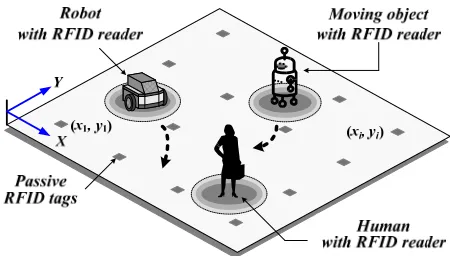
Figure 2. Application of sensor network for the localization of multiple mobile agents including humans, robots, and moving objects.
and the main network. The position of multiple mobile agents is estimated by the nodes, which consist of small sensors arranged in the specified space. One node covers a local assignment space and nodes are placed so that they overlap slightly; thus, the total coverage by the nodes is equates with the overall global space. The mo-bile agents are all human agents, objects, or momo-bile ro-bots that exist in the specified space. When a mobile agent exists in a certain local space, the position of the agent is estimated by the node that covers that local space. If several agents are located near the same node, the positions of the agents are obtained independently using their own IDs. The main network with network servers stores and manages the IDs and states of every agent. All agents have knowledge of the position of each agent in the network.
The distributed wireless sensor network is organized using RFID technology. An RFID system has several features and functions that depend on the frequency band, nature of the power source, tags, etc [18]. A passive RFID system with an operation frequency of 13.56 MHz is used to obtain the following practical features [19,20]. Passive RFID tags use induction power through RF waves from RFID readers. Because an external power source is not
[image:3.595.312.537.549.677.2]used, semi-permanent use without power replacements is possible after the initial installation. The passive RFID system recognizes passive RFID tags without contact. Damage or incorrect readings caused by obstacles do not occur. Because the ID and position data are stored in the RFID tags, the positions of several agents can be ad-dressed simultaneously without confusion.
Figure 3 shows the concept of the sensor network
based on the RFID system for localization of multiple mobile agents. Passive RFID tags are arranged with a constant gap on the floor and a pre-stored coordinated value. That is, the sensor network node is a passive RFID tag in this study. The mobile agents have independent RFID readers and antennas to communicate with the RFID tags. Mobile robots have antennas installed on the bottom of their body and human agents install the antennas on the bottom of their shoes. The antenna, which is connected to a reader, radiates electromagnetic waves with a finite range in the direction of the floor. RFID tags are activated using electromagnetic waves and can then transmit their coordinate values to the RFID reader. The packet with the obtained position data and ID of the mobile robots is uploaded to the main network. Because passive RFID tags do not use a separate external power source, the position data yielded by the RFID system is indirectly uploaded through the RFID reader installed in the robot agent. As shown in Figure 4, the mobile agents
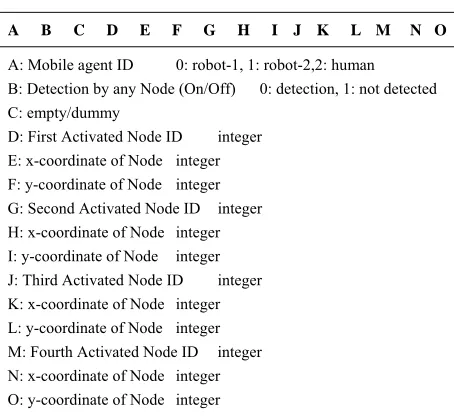
have RFID readers and antennas, and the data obtained from the RFID tags is transferred to the main network. The protocol used in the network communication is organized as shown in Table 1. Through this network,
each robot agent and user knows the position of every robot agent at any time.
4. Algorithm for Localization Based on
Sensor Network
As mentioned in the previous section, the RFID reader is
Figure 4. Localization of mobile agents using the RFID system.
Table 1. Communication protocols between the RFID reader and network server.
A B C D E F G H I J K L M N O
A: Mobile agent ID 0: robot-1, 1: robot-2,2: human B: Detection by any Node (On/Off) 0: detection, 1: not detected C: empty/dummy
D: First Activated Node ID integer E: x-coordinate of Node integer F: y-coordinate of Node integer G: Second Activated Node ID integer H: x-coordinate of Node integer I: y-coordinate of Node integer J: Third Activated Node ID integer K: x-coordinate of Node integer L: y-coordinate of Node integer M: Fourth Activated Node ID integer N: x-coordinate of Node integer O: y-coordinate of Node integer
installed in mobile agents and passive RFID tags are arranged on the floor. When a mobile agent approaches a specified tag, the coordinated value stored in the tag is read by the RFID reader in the mobile agent. That is, the mobile agent is located around a coordinate value stored in the tag. However, an accurate position value of the mobile agent cannot be obtained. The distance between the node (i.e. RFID tag) and the mobile agent is
unknown due to the technical limitations of passive RFID systems. Only limited position information can be obtained: that is, the mobile agent is located near a certain node. Previous works have used other sensor systems with a sensor network to improve the accuracy
of localization. While the sensors such as encoders and cameras can be installed on the robot body, human agents do not have these sensors for localization. Thus, for successful localization of the mobile agents including human agents, a scheme that uses only the distributed sensor network must be considered.
Therefore, a localization algorithm that uses the motion of the mobile agents and recognizes changes in the RFID tags under a sensor network environment is proposed. The approach using the motion of the mobile agents is as follows. If the mobile agents move in the space, displacement for a constant time is generated according to the agents’ velocity. If the velocity of agents is controlled, the displacement will be within a constant range. Therefore, the range of the next position from the initial position of the agents can be predicted and estimated. The approach using the recognition change is as follows. In the RFID system, communication and recognition between the RFID reader and tags are always conducted. However, the maximum distance for communication and recognition is fixed. If the mobile agent equipped with the RFID reader moves, the distance between the RFID reader and tag varies continuously. Therefore, two cases-case I where the RFID reader recognizes the tags and case II where the RFID reader does not recognize the tags- occur repetitively. Using the recognition change in the RFID system, the position of mobile agents can be estimated.
It is assumed that mobile agents move with a limited velocity in a specified indoor space. As shown in Figure 5, the RFID tags are arranged regularly and defined as
the node1, node2, and node3. The coordinate values stored
in each node are CN.1, CN.2 and CN.3., respectively.
. ( . , . ), 1, 2, 3
N k N k N k
C x y k (1)
The nodes cover a constant territory. If a mobile agent exists in the recognition territory (RT), the position of the
mobile agent is estimated using the corresponding node. The territory recognized by nodek is represented as RTk.
For example, RT1 is approximated as a circle with
constant radius, γ, and the center is node1 [21].
[image:4.595.313.535.587.694.2]2 2 2
.1 .1
(xxN ) (yyN ) (2)
Note that a mobile agent is always recognized by
node1 within the RT1; however, the recognition rate for a
mobile agent is low near the boundary of RT1. That is, the
reader communicates with tags in the recognition territory, and the communication is unstable at the boundary of the recognition territory. Eventually, the communication is prevented due to the mobile agent moving out of the recognition territory. However, two RFID tags simultaneously communicate with the RFID reader in the overlap region of RT1 and RT2. A localization
algorithm is proposed using the communication state between the tags and the reader. The algorithm is explained below for the mobile agent movement from
RT1 to RT2, as shown in Figure 5.
Step 1.
Assume that the mobile agent is detected by node1. It
can be considered that the mobile agent is located within RT1. However, the exact position within the RT1 cannot
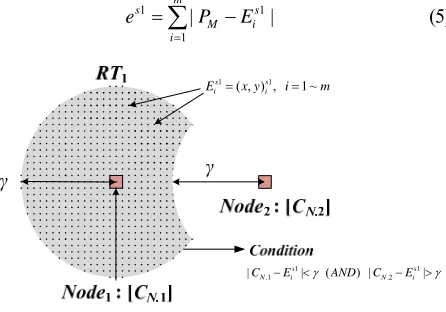
be known. Therefore, it is assumed that there are some points that can be expected to contain the current position of mobile agent in RT1. As shown in Figure 6,
m points are scattered in this area. Each point has an x-y
coordinate value in a 2D plane. The points are represented as follows:
1 ( , ) ,1 1 ~
s s
i i
E x y i m (3)
The number of points, m, is subject to the resolution of
the localization and the dimension of RT1. The point,
1
s i
E , satisfies the following condition in Step 1.
1 1
.1 .2
| s | | s |
N i N i
C E AND C E (4)
The probability that each s1
i
E is the real position of a
mobile agent is the same. If the real position of the mobile agent is PM, the sum of the position estimation
errors for s1
i
E is represented as follows:
1 1 1 | | m s s M i i
e P E
(5)1 ( , ) ,1 1 ~
s s
i i
E x y i m
1
ˆ ( ) ( s) 1~
M i
P k Avg E for i m
1 1
.1 .2
| s| ( ) | s|
N i N i
[image:5.595.309.536.499.690.2]C E AND C E
Figure 6. Shape of the recognition territory of node1 in Step 1.
Because the weight of s1
i
E for the real position of the
agent is the same, the average of s1
i
E minimizes the
error. The estimated position of the mobile agent,
ˆ ( )M
P k , at time k is determined by the average value.
1 1
1 1
ˆ ( )
ˆ ( ) / /
ˆ ( )
T
m m
M s s
M i i
i i
M
x k
P k x m y m
y k
(6)Step 2.
The mobile agent moves toward node2 within RT1. The
mobile agent is continuously detected by node1. The
recognition change, where node2 detects the mobile
agent, is generated. In this step, it can be considered that the mobile agent can be located at the boundary of RT2 as
shown in Figure 7. An arbitrary region along the
boundary of recognition territory is set; at some points along this boundary, s2
i
E , it can be expected as that the
position of the mobile agent is selected within an arbitrary region using the same method as explained in Step 1. The points, s2
i
E , satisfy the following conditions
in Step 2.
2
.2 1
( ) | s | ( ),
i N
E C within RT
(7) The probability that s2
i
E is the real position of
mobile agent is the same as in Step 1.
The estimated position of the mobile agent at time k is
determined by the average of s2
i
E .
2 2
1 1
ˆ ( )
ˆ ( ) / /
ˆ ( )
T
m m
M s s
M i i
i i
M
x k
P k x m y m
y k
(8)The mobile agent has a limited maximum velocity. Therefore, the maximum displacement of the mobile agent is calculated during the movement time from Step 1 to Step 2.
|step2 step1| max ( s2 s1) M max
d v T T for v v (9)
2 ( , ) ,2 1 ~
s s
i i
E x y i m
2 .2
( ) | s | ( )
i N
E C
2
ˆ ( ) ( s) 1 ~
M i
P k Avg E for i m
1 2 1
| 2 1|
1 1
: , | |
( ) ( ) , 1 ~
s s s
i i i step step
s s
M i i
E removed if E E d
P k Avg E for remaining E i m r
[image:5.595.62.285.526.682.2]The distances from s1
i
E to Eis2 are calculated; then,
the s1
i
E values that are not satisfied with the maximum
displacement are removed.
1 2 1
| 2 1|
: , | |
s s s
i i i step step
E removed unless E E d (10)
The position of the mobile agent is estimated again using the remaining s1
i
E .
1 1
ˆ ( ) ( s ) s , 1, ,
M i i
P k Avg E for remaining E i mr
(11)
Step 3.
If a mobile agent is stably recognized by node1 and
node2, it is considered that the mobile agent is located in
the RT1 and RT2 overlap region as shown in Figure 8.
Next, the points, s3
i
E , where the position of the mobile
agent can be expected are determined. Point s3
i
E
satisfies the following conditions in Step 3.
3 3
.1 .2
| s | , | s |
i N i N
E C and E C (12)
The estimated position of the mobile agent at time k is
determined by the average of s3
i
E . The distance from
2
s i
E to s3
i
E is calculated, and the s2 i
E values that are
not satisfied with the maximum displacement are then removed.
2 3 2
| 3 2|
: , | |
s s s
i i i step step
E removed unless E E d (13)
The position of the mobile agent is estimated again using the remaining s2
i
E .
2 2
ˆ ( ) ( s ) s , 1, ,
M i i
P k Avg E for remaining E i m r
(14)
Step 4.
As this step is the same as that of Step 2 albeit with RT2
and RT3, the recognition change by node1 within RT2 is
3
ˆ ( ) ( s) 1 ~
M i
P k Avg E for i m
2 3 2
| 3 2|
2 2
: , | |
( ) ( ) , 1 ~
s s s
i i i step step
s s
M i i
E removed if E E d
P k Avg E for remaining E i m r
3 ( , ) ,3 1 ~
s s
i i
E x y i m
3 3
.1 .2
| s | | s |
i N i N
E C AND E C
Figure 8. Shape of the recognition territory by the node1 and node2 in Step 3.
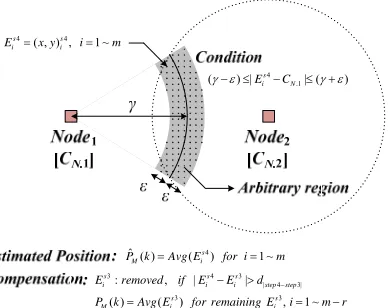
generated. Instead, the mobile agent is continuously de-tected by node2. As shown in Figure 9, it can be
as-sumed the mobile agent is located in the boundary of RT1.
An arbitrary region is set and some points, s4
i
E , are
se-lected as in the previous step. Point s4
i
E satisfies the
following conditions in Step 4.
4
.1 2
| s | ,
i N
E C within RT
(15) The estimated position of the mobile agent is calculated as in Step1 to Step 3.
3 3
ˆ ( ) ( s ) s , 1, ,
M i i
P k Avg E for remaining E i mr
(16) According to the movement of the mobile robot, the recognition change of the mobile agent by the node is generated. The position of the mobile agent is continuously estimated using the aforementioned steps.
5. Experiment and Result
[image:6.595.82.281.518.656.2]The proposed sensor network for localization is applied in a real system. The positions of the multiple mobile agents are obtained using the sensor network including the algorithm introduced in Section 4.
Figure 10 shows the RFID system and mobile robots
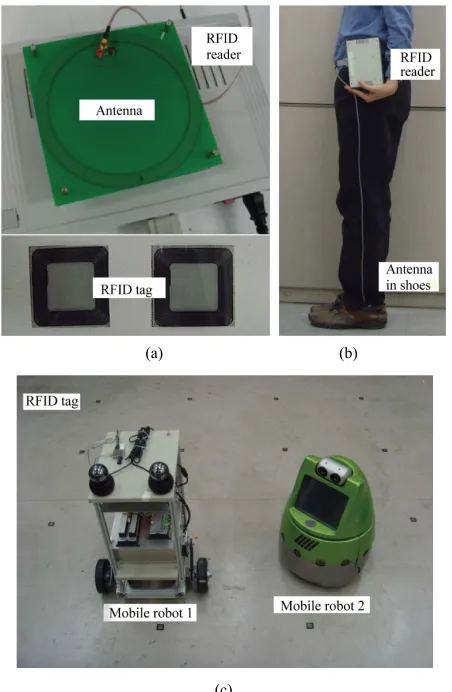
used in this experiment. The RFID system, KISR300H, used for the sensor network is a passive RFID system and it operates at a frequency of 13.56 MHz. As shown in Figure 10(a), the passive RFID tags fabricated from
epoxy have dimensions of 0.03 m × 0.03 m. The RFID reader and antenna are installed in the mobile robots and human, as shown in Figures 10(b) and 10(c). The size of
the robots’ antennas is 0.15 m × 0.15 m and the size of human agent’s antenna is 0.07 m × 0.07 m. The commu-nication between the RFID reader and network server is conducted using a wireless LAN. Figure 10(c) shows the
mobile agents: mobile robot 1 and mobile robot 2. Both robots have two-wheel differential drive and RFID read-
4 ( , ) ,4 1 ~
s s
i i
E x y i m
4 .1
( ) | s | ( )
i N
E C
4
ˆ ( ) ( s) 1 ~
M i
P k Avg E for i m
3 4 3
| 4 3|
3 3
: , | |
( ) ( ) , 1 ~
s s s
i i i step step
s s
M i i
E removed if E E d
P k Avg E for remaining E i m r
[image:6.595.331.527.542.696.2](a) (b)
[image:7.595.319.528.74.452.2](c)
Figure 10. Experimental environment: (a) RFID reader, antenna and tags; (b) human agent with RFID reader and antenna; (c) two mobile robots in the wireless sensor network using RFID tags.
ers. The antennas (connected to the RFID reader) are installed on the bottom of body. The human agent has also a small portable RFID reader and antenna as shown in Figure 10(b).
The mobile agents are driven as follows. The RFID tags are arranged on the floor and the gap between the tags is 0.5 m, as shown in Figure 10(c). Figure 11(a)
shows the driving path of the mobile agents in the speci-fied indoor space. In order to prevent the mobile agents colliding, the driving paths were predefined. The linear velocity of each agent during the movement along the path is represented in Figure 11(b). The maximum
ve-locity of the mobile robots is limited to 25 cm/s. The human agent moves with the maximum instantaneous velocity, 8 cm/s, and steps forward one step at a time. The sensor network estimates the position of the moving mobile agents using the RFID system. The position of the mobile agents is estimated during approximately 60 s, and the sampling period of the position measurement is 0.25 s.
(a)
(b)
Figure 11. The predefined path and linear velocity of the mobile agents: (a) the path of all agents; (b) the linear velocity of mobile robot 1, mobile robot 2, and the human agent.
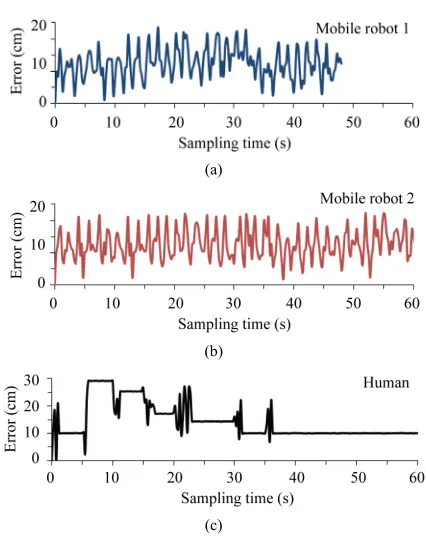
The error between the real position value and the measured value of the mobile agents is defined as the performance index. Figure 12 represents the position
error of the mobile agents measured using the proposed algorithm for the driving time from the starting point to the finishing point. Figures 12(a) and 12(b) are the
position errors of mobile robot 1 and mobile robot 2, respectively. The average value of the position error during driving was 12.06 cm and 12.62 cm for mobile robot 1 and mobile robot 2, respectively. Figure 12(c)
shows the position error for the human agent’s motion. Because the human agent repeats a stopping and starting/ moving motion, the human agent’s error pattern is different to that of the mobile robots. The average value of error is 14.24 cm for the human agent.
[image:7.595.60.286.76.422.2](a)
(b)
[image:8.595.65.278.70.339.2](c)
[image:8.595.57.288.422.495.2]Figure 12. Error generated in the localization process based on the proposed sensor network using the proposed algorithm: (a) error for mobile robot 1; (b) error for mobile 2; (c) error for the human agent.
Table 2. Comparison for experimental result between proposed algorithm and previous algorithm.
Average value of error
(proposed algorithm) (previous algorithm in [14]) Average value of error Mobile
robot 1 12.06 cm Mobile robot 1 23.16 cm Mobile
robot 2 12.62 cm Mobile robot 2 25.81 cm Human 14.24 cm
algorithm proposed in this study. The results were then compared for each algorithm. In the RFID-based sensor network, the distribution of RFID tags affects the accuracy of localization. If the number of RFID tags is large, the accuracy generally rises.
The previous method proposed in [14] only depends on the data of the node (i.e. RFID tag) that is close to
mobile agents. If a mobile agent is near the node, the position of the mobile agent is estimated using a coordinated value stored in the node. If the mobile agent is not located near the node, however, it is difficult to obtain a coordinated value from the node. When a small number of RFID tags is used, the accuracy of the previous algorithm [14] is drastically reduced.
The method proposed in this study uses the displacement of the mobile agent and recognition of the change between the RFID reader and tags, and can reduce uncertainty in localization systems based on a sensor
network. That is, the proposed system is less affected by the distribution of RFID tags than the previous algorithm. The position of the mobile agents is estimated using factors obtained by their movement. If the mobile agents are not located near the node, the position of the mobile agents is indirectly calculated using other factors. Even when a small number of RFID tags is used, a reasonable level of accuracy can be maintained.
For the same density distribution of RFID tags, the performance of the previous algorithm and the proposed algorithm is compared. The gap between RFID tags is uniformly 0.4 m. The experiments were conducted with two mobile robots. The results from the experiments in this study are listed in Table 2. Through the experiments,
it was verified that the performance of the proposed sensor network using the proposed algorithm exceeds that of previous research.
6. Conclusion
This work studied the localization of multiple mobile agents using a distributed sensor network. The distri- buted sensor network that has been used for the locali- zation of mobile agents in previous studies had limited functions. This paper presented a sensor network and localization algorithm that can be applied to multiple mobile agents and the distributed wireless sensor net- work was organized using RFID technology. This con- cept addressed issues such as sensor interference and position estimation confusion among multiple agents. Furthermore, an algorithm that estimates more accurate position of agents was proposed using the recognition change between the RFID tag and RFID reader. This algorithm can be applied to many types of agents includ- ing humans.
In the future, the system will be organized for interac-tion and mointerac-tion planning among agents using the pro-posed localization scheme based on a sensor network.
7. References
[1] D. Crasto, A. Kale and C. Jaynes, “The Smart Bookshelf: A Study of Camera Projector Scene Augmentation of an Everyday Environment,” Proceedings of the 7th IEEE Workshop on Application of Computer Vision, Colorado,
January 2005, pp. 218-225.
[2] O. Lazaro, A. Gonzalez, L. Aginako, T. Hof, F. Filali, R. Atkinson, S. Maza, P. Vaquero, B. Molina, J. O. Flaherty, and R. Mazza, “Multinet: Enabler for Next Generation Pervasive Wireless Services,” Proceedings of the 16th IST Mobile and Wireless Communication Summit,
Budapest, Hungary, July 2007, pp. 1-5.
ing,” Wireless Sensor Network, Vol. 2, No. 9, 2010, pp.
655-660. doi:10.4236/wsn.2010.29078
[4] X. Zhao, K. Mao, S. Cai and Q. Chen, “Data-Centric Routing Mechanism Using Hash-Value in Wireless Sen- sor Network,” Wireless Sensor Network, Vol. 2, No. 9,
2010, pp. 703-709. doi:10.4236/wsn.2010.29086
[5] A. Boukerche and S. Samarah, “In-Network Data Reduc- tion and Coverage-Based Mechanisms for Gene- rating Association Rules in Wireless Sensor Networks,” IEEE Transactions on Vehicular Technology, Vol. 58, No. 8,
October 2009, pp. 4426-4438. doi:10.1109/TVT.2009. 2020802
[6] S. Yao, J. Tan and H. Pan, “A Sensing and Robot Navi- gation of Hybrid Sensor Network,” Wireless Sensor Network, Vol. 2, No. 4, 2010, pp. 267-273. doi:10.4236/
wsn.2010.24037
[7] Z. Liang and S. Zhu, “Cooperative Distributed Sensors for Mobile Robot Localization,” Wireless Sensor Network,
Vol. 2, No. 5, 2010, pp. 347-357. doi:10.4236/wsn.2010. 24046
[8] B.-S. Choi, J.-W. Lee and J.-J. Lee, “Target-following Scheme for Mobile Robots Based on the Virtual Sub-Goal Points,” Information — An International Inter- disciplinary Journal, Vol. 13, No. 6, November 2010, pp.
1929-1938.
[9] B.-S. Choi and J.-J. Lee, “Localization of a Mobile Robot Based on an Ultrasonic Sensor Using Dynamic Obstacles,”
International Journal of Artificial Life and Robotics, Vol.
12, No. 1-2, March 2008, pp. 280-283. doi:10.1007/s100 15-007-0482-4
[10] Z. Zhang, X. Gao, J. Biswas and J. K. Wu, “Moving Targets Detection and Localization in Passive Infrared Sensor Networks,” Proceedings of the 10th International Conference on Information Fusion, Quebec, July 2007,
pp. 1-6. doi:10.1109/ICIF.2007.4408178
[11] T. Lee, J. Shirr and D. D. Cho, “Position Estimation for Mobile Robot Using In-Plane 3-Axis IMU and Active Beacon,” Proceedings of IEEE International Symposium on Industrial Electronics, Seoul, July 2009, pp. 1956-
1961.
[12] B. Kim and J.-S Choi, “Active Beacon System with the Fast Processing Architecture for Indoor Localization,”
Proceedings of IEEE Conference on Emerging Technolo- gies and Factory Automation, Patras, September 2007, pp.
892-895.
[13] J. M. Villadangos, J. Urena, M. Mazo, A. Hernandez, F. Alvarez, J. J. Garcia, C. D. Marziani and D. Alonso, “Improvement of Ultrasonic Beacon-based Local Position System Using Multi-Access Techniques,” Proceedings of IEEE International Workshop on Intelligent Signal Pro- cessing, Faro, September 2005, pp. 352-357.
[14] S. Han, H. Lim and J. Lee, “An Efficient Localization Scheme for a Differential-Driving Mobile Robot Based on RFID System,” IEEE Transaction on Industrial Electronics, Vol. 6, 2007, pp. 3362-3369. doi:10.1109/
TIE.2007.906134
[15] V. Mehta, W. Sheng, T. Chen and Q. Shi, “Development and Calibration of a Low Cost Wireless Camera Sensor Network,” Proceedings of IEEE/RSJ International Con- ference on Intelligent Robots and Systems, St. Louis, October 2009, pp. 110-115.
[16] S. Shenoy and J. Tan, “Simultaneous Localization and Mobile Robot Navigation in a Hybrid Sensor Network,”
Proceedings of IEEE/RSJ International Conference on Intelligent Robots and Systems, Alberta, Canada, August
2005, pp. 1636-1641. doi:10.1109/IROS.2005.1545194 [17] W. Sheng, G. Tewolde and S. Ci, “Micro Mobile Robots
in Active Sensor Networks: Closing the Loop,” Proceed- ings of IEEE/RSJ International Conference on Intelligent Robots and Systems, Beijing, October 2006, pp. 1440-
1445. doi:10.1109/IROS.2006.281968
[18] K. Finkenzeller, “RFID Handbook: Fundamentals and Applications in Contactless Smart Cards and Identifi- cation,” Wiley, New York, 2003.
[19] B.-S. Choi and J.-J. Lee, “Mobile Robot Localization Scheme Based on RFID and Sonar Fusion System,”
Proceedings of IEEE International Symposium on Indus- trial Electronics, Seoul, July 2009, pp. 1035-1040.
[20] B.-S. Choi and J.-J. Lee, “Sensor Network Based Localization Algorithm using Fusion Sensor-Agent for Indoor Service Robot,” IEEE Transaction on Consumer Electronics, Vol. 56, No. 3, August 2010, pp. 1457-1465. doi:10.1109/TCE.2010.5606283