and Limited Penalties
By Tymofiy Mylovanov and Andriy Zapechelnyuk∗
Several agents with privately known social values compete for a prize. The prize is allocated based on the claims of the agents, and the winner is subject to a limited penalty if he makes a false claim. If the number of agents is large, the optimal mechanism places all agents above a threshold onto a shortlist along with a fraction of agents below the threshold, and then allocates the prize to a random agent on the shortlist. When the number of agents is small, the optimal mechanism allocates the prize to the agent who makes the highest claim, but restricts the range of claims above and below.
A principal has an indivisible prize to give to one of several ex-ante identical agents. The principal’s value from giving the prize to agentiis privately known by this agent. The principal asks the agents to report these values and allocates the prize based on the reports. Ex post, the principal learns the true value from allocating the prize and can penalize the winner by destroying a certain fraction of his surplus. The principal can commit to an allocation rule that determines how the prize is allocated as a function of the agents’ reports and under what circumstances the prize recipient is penalized. Apart from the penalty, there are no utility transfers.
There are multiple environments that correspond to our model. For example, a development agency announces a grant competition among potential partners to deliver aid to a disaster area. Each partner organization privately knows the social value it will produce. Ex post, the agency can conduct a review of the competition winner and decide whether to debar this organization from future grant applications (or whether to try to recover some of the funds allocated to the organization).1 For another example, a college administration has to allocate
∗ Mylovanov: University of Pittsburgh, Department of Economics, 4925 Posvar Hall, 230 South
Bou-quet Street, Pittsburgh, PA 15260, USA, Kyiv School of Economics, Ukraine, and Council of the National Bank of Ukraine. Email: [email protected]. Zapechelnyuk: School of Economics and Finance, University of St Andrews, Castlecliffe, the Scores, St Andrews KY16 9AR, UK. E-mail: [email protected].
The authors would like to thank four anonymous referees for comments that led to a significant im-provement of the paper. The authors are also grateful to Simon Board, Daniele Condorelli, Rahul Deb, Hanming Fang, Drew Fudenberg, Manolis Gallenianos, Sidartha Gordon, Daniel Kr¨ahmer, Stephan Lauermann, Michael Ostrovsky, Mallesh Pai, Rakesh Vohra, and audiences at numerous seminars and conferences. The authors are grateful to the Study Center Gerzensee for its hospitality. The authors declare that they have no relevant or material financial interests that relate to the research described in this paper.
1Consider, for example, the U.S. Agency for International Development. A typical report to the
an academic scholarship or a slot in a program to one of the applicants. The students have private information about their abilities or their fit to the program. The college will be able to withdraw the remainder of the scholarship from the students with subpar performance. The last example is a firm that would like to fill a position with a fixed salary. Applicants have private information about their qualifications. The firm will eventually learn the qualification of the new hire and can choose to let him or her go.
In all these examples, the principal can punish the agent for lying about her private information by destroying a part of the prize. This penalty is limited because the agent enjoys a share of the payoff until the prize is taken away, or with some probability, the principal may fail to take the prize away because of legal or political reasons (e.g., a court might side with the worker), or imperfect monitoring. The agent has limited liability and cannot be punished beyond taking the prize away.
We characterize allocation rules that maximize the expected payoff of the prin-cipal. To understand the forces at play on the intuitive level, consider a naive rule that allocates the prize to the agent with the highest reported value. In the unique equilibrium, everyone reports the upper-bound value, and the rule de facto allocates the prize at random. This is so even if the lies are penalized ex post. An agent with a low value (values are continuously distributed) has only a slight chance of winning by truthfully reporting his value, since it is nearly certain that another agent has a higher value. Inflating the report to the upper-bound value substantially increases the probability of winning the prize, albeit at the cost of loosing a fraction of the surplus. The argument then unravels: once agents with low values inflate their reports, then agents with medium and, in turn, high values respond by inflating their reports as well.
The principal can do better than allocating the prize at random. Consider a restricted-bid procedure that allows the agents to submit reports within some interval between two thresholds and selects the agent with the highest report (ties are broken randomly). Ex post, the winner is penalized whenever his report is “inflated,” i.e., when it is above the lower threshold and exceeds the true value. An agent’s benefit from an inflated report is bounded by the increment in the probability of selection between submitting the upper threshold and the lower threshold reports. When this probability increment is small enough and does not compensate for the loss of the surplus caused by the penalty, reporting the value closest to the true value within the permitted interval is optimal. This allocation rule is superior to random allocation, as it only bunches types at the top, above the upper threshold, and at the bottom, below the lower threshold, while fully
separating types in the middle. We show that, for a small number of agents, the optimal rule has the described two-threshold structure.
The optimal allocation rule is different when the number of agents is large. It can be described as ashortlisting procedure. Agents report whether their values are above or below a single threshold. The former are shortlisted with certainty, while the latter are shortlisted with a probability of less than one. A winner is chosen randomly from the shortlist. If the shortlist is empty, then a winner is drawn at random from the full set. Ex post, the penalty is imposed if the winner has an above-threshold report and a below-threshold value. Note that there is no discontinuity between the restricted-bid and shortlisting procedures. As the number of agents,n, increases, the optimal thresholds of the restricted-bid procedure converge to a single threshold.
Of course, our model is a just a simplification intended to capture a relevant tradeoff in settings with ex-post verification and limited penalties. The incentive constraint bounds the ratio in probabilities of the selection of the highest and lowest types. If the low types are not promised to be selected with a sufficiently high probability, they will mimic the high types, so the principal may as well select an agent at random. The cap on the highest probability means bunching the types at the top, while the floor on the lowest probability means bunching the types at the bottom. Keeping the difference in these probabilities fixed, the principal faces the tradeoff between making the rule more competitive by selecting higher types with higher probability and reducing rents that have to be given to the low types.
In applications, bunching can take the form of categorization, quotas, or the use of irrelevant and ad hoc criteria to rule out applicants. A grant agency can sort applicants into, for example, three categories: “highly competitive,” “competitive,” and “non-competitive”. After that, it can allot certain amounts of funding for each category and randomly allocate the appropriated funding within the categories.2 An academic program can assign a quota for scholarships that are need-based and automatically enter every applicant who did not qualify for merit-based funding into a lottery for need-based scholarships. It can also invoke irrelevant or vague qualifying criteria such as seniority, prior allocation of scholarships, or some specific performance measure to disqualify applicants from obtaining the scholarship. As long as the application of these criteria is random and independent of merit from the perspective of the students, its effect on the incentives of the students will be equivalent to bunching.
Our analysis shows that adding agents beyond some number does not benefit the principal and that, for a large number of agents, the optimal allocation rule is a binary shortlisting procedure. There is an alternative implementation of the optimal rule for a large number of agents: The principal randomly excludes some
2Our model assumes a single indivisible good. This is for clarity of exposition. Extension to multiple
agents, and categorizes the remaining agents as above or below the bar. If there are agents above the bar, one of them is chosen at random. Otherwise, an agent is randomly chosen among all agents. We see similar mechanisms in practice. Job search forums are full of anecdotes of HR departments discarding every fifth application or arbitrarily dividing applications into two piles and throwing away an “unlucky” pile. If candidates apply over time, a company might keep the search open for a fixed period of time or until a certain number of candidates have applied. If the quality of the candidates does not correlate with their arrival time, the optimal rule for the company is to hire the first candidate above the bar and to hire at random from the pool of applicants if all candidates are below the bar and the search is closed.
In our model, ex-post verification coupled with limited penalty is the only in-centive tool available to the principal. Ben-Porath, Dekel, and Lipman (2014) (henceforth, BDL) study a similar model. They differ in the verification tech-nology of agents’ information: verification is costly and can be done prior to the allocation decision. Thus, the principal faces a tradeoff between reducing the cost of verification and improving incentives for the agents to report their information truthfully. The optimal rule is a one-threshold mechanism. If all agents report values below the threshold, their values are not verified and the good is allocated to a “favored” agent. Otherwise, the highest report is verified. Thus, similar to the optimal rules in our paper, there is distortion and bunching at the bottom. The reason for this distortion is different: the expected value from allocating the good to the highest-value agent if all agents have low valuations does not justify paying the verification cost. In BDL, there is no distortion at the top because the agents who report high values will be verified and denied the good if they lie. The difference in the timing of verification between our models is not essential: if in our model, the principal could recover the entire good with certainty and there were verification costs, the model would become equivalent to BDL.
In our model, there are no transfers at the interim (allocation) stage and there are restricted penalties at the ex-post stage. Optimal contracts with transfers that can depend on ex-post information have been studied in, e.g., Mezzetti (2004), DeMarzo, Kremer and Skrzypacz (2005), Eraslan, Mylovanov and Yimaz (2014), Dang, Gorton and Holmstr¨om (2015), Deb and Mishra (2014), and Ekmekci, Kos and Vohra (2016). This literature is surveyed in Skrzypacz (2013).3 Burguet, Ganuza and Hauk (2012) and Decarolis (2014) study allocation problems with transfers in which the principal has a lack of commitment and can renege on transfers ex post (e.g., because of bankruptcy). In these problems, similarly to our model, agents with low values are given rents to stop them from bidding too aggressively to win the contract.4 For mechanism design with evidence at the interim stage see Green and Laffont (1986); Bull and Watson (2007);
De-3See also Glazer and Rubinstein (2004, 2006).
4Similar forces are at play in Mookherjee and Png (1989), who solve for the optimal penalty schedule
neckere and Severinov (2008); Ben-Porath and Lipman (2012); Kartik and Ter-cieux (2012); Sher and Vohra (2015), and Koessler and Perez-Richet (2013). Fi-nally, for the literature with costly state verification, monetary transfers, and one agent, see Townsend (1979), Gale and Hellwig (1985), Border and Sobel (1987), and Mookherjee and Png (1989).
There is a body of literature on mechanism design with partial transfers in which the agents’ information is non-verifiable. In Chakravarty and Kaplan (2013) and Condorelli (2012), a benevolent principal would like to allocate an object to the agent with the highest valuation, and the agents signal their private types by exerting socially wasteful effort. Condorelli (2012) studies a general model with heterogeneous objects and agents and characterizes optimal allocation rules where a socially wasteful cost is a part of mechanism design. Chakravarty and Kaplan (2013) restrict their attention to homogeneous objects and agents, and consider environments in which a socially wasteful cost has two components: an exoge-nously given type and a component controlled by the principal. In particular, they demonstrate conditions under which, surprisingly, the uniform lottery is op-timal.5 Che, Gale and Kim (2013) consider the problem of efficient allocation of a resource to budget-constrained agents. They show that a random allocation with resale can outperform competitive market allocation. In an allocation problem in which the private and the social values of the agents’ are private information, Condorelli (2013) characterizes the conditions under which the optimal mecha-nism is stochastic and does not employ payments. Bar and Gordon (2014) study an allocation problem with non-negative interim transfers (subsidies), in which the allocation might be inefficient because of incentives to save on the subsidies paid to the agents.
I. Model
A. Preliminaries
A principal allocates a single indivisible prize (e.g., a job, scholarship, or office space) to one of n≥2 agents. The principal’s payoff from retaining the prize is normalized to 0, while her payoff from choosing an agentiisxi ∈[a, b], wherexi is private information of agenti. We assume thatb >0 and we do not restricta. In particular,acan be negative. The values ofxi’s are i.i.d. random draws, with continuously differentiable c.d.f.F, whose densityf is positive almost everywhere on [a, b].
The value of the prize for every agent is v(xi)>0. Each agentimakes a state-ment yi ∈ [a, b] about his type xi, and the principal allocates the prize to some agent, or to none of them, according to a specified rule. After an allocation has been made, the principal observes type xi of the selected agent and, contingent
5See also McAfee and McMillan (1992), Hartline and Roughgarden (2008), and Yoon (2011) for
on this observation, can destroy a fractionc∈(0,1) of the agent’s payoff.6 This assumption has multiple interpretations. For example, in the case a grant com-petition, the winner organization can be debarred from further grant applications after the post-implementation review. Alternatively, the grant agency can try to recover the funds in court and be successful with some probability. Finally,ccan capture the expected penalty if the agency discovers the winner’s true type with probability less than one.
Parameters a, b, c, and n, and functions F and v are common knowledge. In addition, we assume thatFn−1(0)≤1−c, so that the mass of negative agents is not too large.7
The principal has full commitment power and can choose any stochastic allo-cation rule conditional on the reports and any penalty rule conditional on the reports and the ex-post verified type of the selected agent. By the revelation principle, it is sufficient to consider allocation rules in which truthful reporting constitutes a Bayesian Nash equilibrium.
We assume that allocating the prize to agent iyields payoffxi to the principal if the agent is not penalized and at most xi if the agent is penalized. In other words, the penalty is never beneficial for the principal and therefore can only be used as an incentive tool.8 The optimal penalty rule is thus trivial. Since typexi of the selected agent is verifiable, it is optimal to penalize the agent whenever he lies,yi 6=xi, and not to penalize him otherwise.
An allocation rule p associates with every profile of statements ¯y = (y1, ..., yn) a probability distributionp(¯y) over {0,1,2, . . . , n}. We writepi(¯y) for the prob-ability of selection ofi∈ {1, ..., n} and p0(¯y) for the probability that the prize is not allocated conditional on report profile ¯y.
Denote by ¯F the product c.d.f. of allnagents and by ¯F−i the product c.d.f. of all agents excepti. Also denote by ¯x= (x1, ..., xn) the profile of truthful reports and by (yi,x−¯ i) the same profile, except that xi is replaced by yi. Let gi(yi) be the expected probability that agentiwith reportyi is selected, assuming that all other agents make truthful reports,
gi(yi) =
Z
¯
x−i∈[a,b]n−1
pi(yi,x−¯ i)d ¯F−i(¯x−i).
The principal would like to design an allocation rule that maximizes her expected
6In the Appendix, we consider an extension of this model where the penaltycis type-dependent. 7This assumption is useful for elegance of the exposition. We analyse a more general model in the
Appendix without relying on this assumption.
8If the principal can benefit from penalizing agents, then she might prefer to ex-post penalize the
payoff,
max
p E
hXn
i=1pi(¯x)xi
i ,
(P0)
subject to the incentive constraint that truthful reporting is optimal (by the revelation principle),
vi(xi)gi(xi)≥ max yi∈[a,b]
vi(xi)(1−c)gi(yi) ∀xi∈[a, b], ∀i∈ {1, ..., n}, (IC0)
and the feasibility constraint that the probabilities are nonnegative and add up to one, (pi(¯x))i∈{0,...,n} ≥0 andPni=0pi(¯x) = 1 for all ¯x∈[a, b]n.
B. Problem in reduced form
We will approach problem (P0) by formulating and solving its reduced form. Recall that allnagents are ex-ante identical, with types distributed according to
F. This assumption is important for the reduced-form approach to be applicable. Define the reduced-form allocation g: [a, b]→R+ by
(1) g(x) =
n
X
i=1
gi(x), x∈[a, b].
We will now formulate the principal’s problem in terms of g:
(P) max
g
Z b
a
xg(x)dF(x)
subject to the incentive constraint
(IC) v(x)g(x)≥v(x)(1−c) sup y∈[a,b]
g(y) for allx∈[a, b],
and a generalization of the Matthews-Border feasibility criterion (Matthews 1984, Border 1991, Mierendorff 2011, Hart and Reny 2015) that guarantees the existence of an allocation rulepthat induces a giveng (see Lemma 1 below):
(F)
Z
{x:g(x)≥t}
g(x)dF(x)≤1−F({x:g(x)< t})n for all t∈R.
Variable g can be interpreted in two ways. First, g(x)n is the probability of an agent being chosen conditional on reporting x under a symmetric allocation rule whose reduced form is g. Second, g(x)f(x) is the (improper) probability density of selection of type x from the principal’s perspective. The reason for defining variable g as in (1) (rather than, for instance, g(x) = n1Pn
convenience: the principal’s objective function (P) and the incentive constraint (IC) are independent ofn.
Proposition 1 A reduced-form allocation g is a solution of problem (P) if and only if there exists a solution p of problem (P0) whose reduced form is g.
Asp is reducible tog by definition, the only nontrivial part of the result is the “only if” part. The feasibility condition (F) is the criterion for the existence of a (symmetric) p that implements g. This condition is due to the lemma below, which is a generalization of the Matthews-Border feasibility criterion (e.g., Border 1991, Proposition 3.1) for asymmetric mechanisms. In addition, for a symmetric
p, the incentive constraints (IC0) and (IC) are identical, even though (IC0) is a stronger condition for a generalp.
Let (X,X, µ) be a measure space with measureµ. LetQnbe the set of measur-able functionsq :Xn→[0,1]n such that Pn
i=1qi ≤1. We say that Q:X →R+ is a reduced form of q ∈ Qn if Q(y) = Pni=1
R
Xn−1qi(y,x−¯ i)dµn−1(¯x−i) for all
y∈X.
Lemma 1 Q:X →R+ is the reduced form of some q∈ Qn if and only if
(2)
Z
{x:Q(x)≥t}
Q(x)dµ(x)≤1−µ({x:Q(x)< t})n for all t∈R+.
Proof. Sufficiency is due to Proposition 3.1 in Border (1991), which implies that, ifQ satisfies (2), then there exists a symmetric q whose reduced form is Q. To prove necessity, considerq∈ Qn and letQbe its reduced form. For everyt∈R+
denoteEt={x∈X:Q(x)≥t}. Then
Z
y∈Et
Q(y)dµ(y) =
Z
y∈X
" n X
i=1
Z
x−i∈Xn−1
qi(y, x−i)dµn−1(¯x−i)
#
1{y∈Et}dµ(y)
= n X i=1 " Z
(xi,¯x−i)∈Xn
qi(xi,x−¯ i)1{xi∈Et}dµ
n(x i,x−¯ i)
# ≤ n X i=1 " Z
(xi,¯x−i)∈Xn
qi(xi,x−¯ i)1∪j{xj∈Et}dµ
n(x i,x−¯ i)
#
=
Z
x∈Xn
n
X
i=1
qi(x)
!
1∪j{xj∈Et}dµ
n(x)≤
Z
x∈Xn
1∪j{xj∈Et}dµ
n(x)
= 1−
Z
x∈Xn
1∩j{xj∈X\Et}dµ
n(x) = 1− µ(X\E t)
n .
form of every solution of (P0) is admissible for (P), and that for every solutiong of (P) there is an admissible allocationp for (P0) whose reduced form is g.
Let p be a solution of (P0). Then its reduced form satisfies the feasibility constraint (F) by Lemma 1. The incentive constraint (IC) is satisfied as well, since (IC0) applies separately for each i and thus, in general, is stronger than (IC).
Conversely, let g be a solution of (P). Since g satisfies (F), by Proposition 3.1 in Border (1991) there exists a symmetricpwhose reduced form is g. Thispwill satisfy incentive constraint (IC0), since, for symmetric mechanisms, (IC) implies (IC0).
II. Optimal allocation rules
Problem (P) is interesting because of its constraints. First, the incentive con-straints (IC) are global rather than local, as is often the case in mechanism design. Second, the feasibility constraint (F) is substantive and will bind at the optimum if and only if the incentive constraint (IC) slacks, which is not the case in the classical mechanism design for allocation problems. Let us now discuss the im-plications of these constraints on the design of optimal rules.
A. Incentive compatibility.
There is tension between the ability of the principal to infer the agents’ in-formation and the ability to use this inin-formation to the principal’s benefit by selecting agents with higher types. Suppose that the principal selects an agent with the highest positive report and selects no one if all reports are negative. In the unique equilibrium under this rule, everybody reports the highest possible type, b.9 Thus, communication is uninformative and the outcome of this mech-anism is identical to the one where the principal disregards the agents’ reports and picks an agent at random, providedE[x]≥0, so that allocating the prize to
a random agent is better than not allocating it at all.
The following lemma shows that without loss of generality we can consider only monotonic reduced-form allocation rules.
Lemma 2 An optimal reduced-form allocation g(x) is nondecreasing.
Intuitively, the optimality for the principal implies the monotonicity of g, as the principal would like to select higher types with higher probability. If an allocationgis nonmonotonic, by sortingg(F−1) in ascending order, we construct a monotonic ˜gthat preserves the incentive and feasibility constraints but increases the principal’s payoff. The proof of Lemma 2 is in the online appendix.
9This follows from the observation that, for low enough values ofx, bidding truthfully is dominated
Consider a nondecreasing reduced-form allocation rule g. By the assumption thatv(x)>0, the incentive constraint (IC) can be simplified as
(3) g(x)≥(1−c)g(b),
The right-hand side is the maximal payoff that agenti can obtain by lying. It is equal to the probability of selection that agentican obtain by lying, g(b), times the fraction of the retained surplus after the lie is found out, 1−c. Unlike in the standard mechanism design problems, where typically the only binding incentive constraints are local, constraint (4) is global.
By Lemma 2 and the assumption that v(x)>0, the incentive constraint (IC) becomes
(4) g(x)≥(1−c)g(b), for all x∈[a, b].
The incentive constraint (4) induces two properties of an optimal allocation rule:
1. Give a chance to low types. The right-hand side of (4) provides a uniform lower bound on g. That is, an optimal rule must select any type x, whether positive or negative, whether low or high, with a probability of at least (1−c)g(b). In particular, the monotonicity of g in an optimal rule then implies bunching at the bottom: all agents with low enough types will be selected with the same probability.
2. Cap the odds of the best. The incentive constraint (4) tightens as the probabil-ity of selecting the highest type increases. Thus, a smaller value of g at the top decreases the probability of selecting types bunched at the bottom. An optimal rule capsgat some value below 1, leading to bunching at the top: all agents with high enough types will be selected with the same probability.
The incentive constraint (4) dictates a different structure of an optimal allo-cation than in Elchanan Ben-Porath, Eddie Dekel and Barton L. Lipman (2014) (BDL). The feature of bunching the types at the bottom is similar, but the rea-son behind it is not the same. In our model, the incentive constraint prevents separation at the bottom, whereas in BDL, the separation of low-valued agents is feasible but does not justify the verification cost. Unlike our model, in BDL, there is no bunching at the top because, at the optimum, the agents who report high values are verified with certainty.
B. Feasibility
By Lemma 2, optimality for the principal implies the monotonicity ofg. Hence, the feasibility constraint (F) can be simplified as follows.
equiv-alent to
(5)
Z b
y
g(x)dF(x)≤1−Fn(y), for ally ∈[a, b].
Proof. Since g is weakly increasing, for every t ∈ R+, sets {x :g(x) < t} and
{x:g(x)≥t}are intervals [a, y) and [y, b], respectively, wherey = inf{x:g(x)≥
t}. It is then immediate that (F) is identical to (5).
The feasibility constraint (5) has a clear interpretation. Dividing both sides by 1−Fn(y), we obtain
1 1−Fn(y)
Z b
y
g(x)dF(x)≤1.
The left-hand side is a conditional probability expression. This is the probability of choosing an agent with at least typey, conditional on the highest type among all agents being at leasty. Naturally, it cannot exceed 1.
There are two properties of an optimal rule that follow from (5).
3. Separation in the middle. On any interval (x0, x00) where the feasibility con-straint is binding, the density of the selected type, g(x)f(x), must be equal to the density of the highest type, nFn−1(x)f(x). This implies strictly increasing
g(x) =nFn−1(x) on (x0, x00), and thus full type separation on that interval. An-other implication is that, if the highest value, max{x1, . . . , xn}, is in that interval, the agent with that value must be chosen with certainty.
4. Diminishing role of the feasibility constraint for large pools of agents. As the number of agents n increases, the set of feasible reduced-form allocations satisfying (5) expands, eventually permitting all allocations asn→ ∞. However, the incentive constraint (IC) is independent ofn, so, as we will prove later, there exists a finite ¯n such that, for n > n¯, the incentive constraint determines the optimal allocation, while the feasibility constraint is not binding. Intuitively, as n rises, the probability of a given low-type agent being chosen shrinks. To preserve the incentives for truthtelling, the probability of the highest type of being chosen must shrink at the same rate. Thus, a larger n does not allow for better differentiation between types. As a consequence, increasing the pool of agents over some finite size ¯n does not confer any benefit to the principal. This contrasts to standard auction environments with independent values and monetary transfers, where the auctioneer can always benefit from more bidders, albeit at a diminishing rate.
C. Optimal allocations
We now describe optimal allocation rules. Assume that
(6) ifa <0, then
Z 0
a
(1−c)xdF(x) +
Z b
0
Since we allow for negative types, it might be optimal for the principal to select no agent. Assumption (6) is a necessary and sufficient condition for the principal to prefer the selection of some agent over no agent. Intuitively, the least that the principal can do is to differentiate between values above and below zero. Specifically, consider an allocation rule which asks each agent to report whether his value is positive or negative, and then assigns probability n1(1−c) to each agent whose report is negative and probability 1n to each agent whose report is positive. This rule is feasible and incentive compatible, and it yields a positive payoff if (6) holds. The converse argument is more involved and requires to show that, if (6) does not hold, the upper bound on what the principal can attain is nonpositive. The argument uses the upper bound result of Section III.A and thus is deferred to Section III.F.
When the number of agents is small, the optimal rule bunches the types at the top and at the bottom and separates them in the middle. It can be implemented by arestricted-bid auction.
Restricted-bid auction. The principal asks each agent to make a statement yi in an interval [x, x]⊂[a, b] and then selects an agent with the highest statement (ties are broken uniformly at random). Ex post, the chosen agent is penalized if his statementyi is “inflated”: yi > xandyi > xi.
Informally, a restricted-bid auction categorizes the agents into three groups: “high” with types above ¯x, “middle” with types between x and ¯x, and “low” with types belowx. The principal then randomly chooses a candidate from the high group (bunching at the top). If there are no candidates in that group, the highest type among the middle group is chosen (separation at the middle). If there are neither high nor middle candidates, a candidate is randomly selected from the low group (bunching at the bottom). Provided that n is not too large, one can always find x and x that guarantees the incentive compatibility of the restricted-bid auction: the greaterx and the lowerxare, the less benefit there is for a low-type agent to pretend to be a high type.
However, as we noted in Section II.B, for a large enough number of agents, the feasibility constraint is nowhere binding, so optimality only requires bunching at the top and at the bottom, with the empty middle interval. This is implemented by a different mechanism called abinary shortlisting procedure.
Binary shortlisting procedure. The principal asks each agent to make a statement indicating whether his type is above or below some threshold ¯x. Every agent who reports xi ≥ x¯ is shortlisted with certainty, while every agent who reportsxi <x¯ is shortlisted with a specified probabilityq, which is independent of the reports. Then, an agent is chosen from the shortlist uniformly at random. In the event that the shortlist is empty, a uniformly random agent is chosen from the full list. Ex post, the chosen agent is penalized if his statement has been inflated: a typexi<x¯has reported being above ¯x.
thresholdx and probability parameter q = 0.
We say that two allocation rules p and p0 areequivalent if their reduced forms
gand g0 are identical up to a measure zero.
Theorem 1 There exists a number of agents n¯ such that an allocation rule is optimal if and only if it is equivalent to a restricted-bid auction when n <n¯ and to a binary shortlisting procedure when n≥n¯.
We prove the theorem and solve for the parameters of the optimal allocation rule in the next section.
III. Proof of Theorem 1
We proceed with the proof of Theorem 1 as follows. First, we solve the reduced-form problem without imposing the feasibility constraint (5). The obtained so-lution gives an upper bound on the principal’s optimal payoff, and it is optimal whenever it satisfies (5). We identify the minimum number of agents ¯n above which (5) is not binding for this upper-bound solution, and show that this solu-tion is a binary shortlisting procedure.
Then, we solve the problem for n < n¯, where the feasibility constraint (5) is binding and the upper bound is unattainable. We show that the solution is a restricted-bid auction with suitably defined bounds x and x. This is the most technically interesting and novel part of the analysis, where we deal with interaction of two non-standard constraints: global incentive compatibility and the Matthews-Border feasibility constraint.
A. Upper bound on the principal’s payoff
To derive the upper bound on the principal’s payoff, we solve (P) subject to the incentive constraint (4) while relaxing the feasibility constraint (5).
First, we simplify the incentive constraint.
Lemma 4 Reduced-form allocationg satisfies the incentive constraint (4)if and only if there exists r∈R+ such that
(7) (1−c)r≤g(x)≤r for all x∈[a, b].
Proof. If (4) holds, then (7) also holds with r = supy∈[a,b]g(y). Conversely, if (7) holds with somer ∈R, then it also holds withr0 = supy∈[a,b]g(y)≤r, which implies (4).
Proposition 2 Let (z∗, r∗) be the unique solution of
Z z∗
a
(1−c)(z∗−x)dF(x) =
Z b
z∗
(x−z∗)dF(x),
(8)
Z z∗
a
(1−c)r∗dF(x) +
Z b
z∗
r∗dF(x) = 1.
(9)
For any allocation rule, the principal’s payoff is at most z∗. Moreover, if an allocation rule attains the payoff of z∗ for the principal, then its reduced form must be almost everywhere equal to
(10) g∗(x) =
(
(1−c)r∗, x < z∗, r∗, x≥z∗.
One could interpret the allocation (10) as a mechanism that gives lottery tickets to the agents. Everyone with a statement abovez∗ gets r∗ tickets, and everyone with a statement belowz∗ gets (1−c)r∗ tickets. The probability of winning the lottery is proportional to the quantity of tickets held. Now, consider loweringz∗
a little. Then, the marginal agent has a higher chance of winning. This lowers the chance of winning of all the people abovez∗ (weighed by 1) and all the people below (weighed by 1−c). The first effect is good for the principal, while the second effect is bad. Since these effects are both monotone in z∗, there is a unique internal optimum given by (8). Equation (9) just says that the combined value of all lottery tickets must add up to 1.
Proof. We solve max g
Rb
axg(x)dF(x) subject to the incentive constraint (7) and the relaxed feasibility constraint that requires the total probability of allocation not exceed the unity,Rabg(x)dF(x)≤1. The Lagrangian of this problem is
max g minz
Z b
a
xg(x)dF(x) +z
1−
Z b
a
g(x)dF(x)
, or
max g minz
z+
Z b
a
(x−z)g(x)dF(x)
,
subject to (7), wherez≥0 is a Lagrange multiplier.
Observe that the incentive constraint (7) must be everywhere binding, since the objective function is linear in g. The solution is a step function that, for some constantr ≥0, chooses the minimum incentive compatible value (1−c)r below
zand the maximum incentive compatible value r abovez,
g(x) =
(
Now substitute the obtainedg(x) into the objective function and optimize overz
andr,
(11) max r≥0 minz≥0
z+
Z z
a
(x−z)(1−c)rdF(x) +
Z b
z
(x−z)rdF(x)
.
To rule out boundary solutions, observe that, under assumption (6), this objective function is linear and strictly increasing in r at z = 0. Hence, z > 0 at the optimum. Furthermore, ifr= 0, then the objective function is strictly increasing in z and achieves the minimum at z = 0, which cannot be optimal, as noted above. Hence,r >0 at the optimum.
Consequently, if a solution exists, it must satisfy the first-order conditions
Z z
a
(1−c)(x−z)dF(x) +
Z b
z
(x−z)dF(x) = 0,
(12)
1−
Z z
a
(1−c)rdF(x)−
Z b
z
rdF(x) = 0.
(13)
Notice that these conditions are equivalent to (8) and (9).
The left-hand side of (12) is strictly decreasing inz, nonpositive atz=b, and, under assumption (6), positive at z = 0, thus admitting a unique solution z∗. Moreover,z∗ ∈(0, b]. In addition, for a givenz∈(0, b], the left-hand side of (13) is linearly decreasing inr and positive atr = 0, thus admitting a unique solution
r∗ >0.
B. Attainment of the upper bound.
The reduced-form solutiong∗ might not be feasible when the number of agents is small. We now derive a condition on the number of agents that ensures the feasibility ofg∗.
By Lemma 3, g∗ is feasible if and only if Rb
z∗g∗(x)dF(x) ≤1−Fn(z∗), which
after substitutingg∗ from (10) becomes:
(14) (1−F(z∗))r∗ ≤1−Fn(z∗).
Note that this is a condition on the primitives, asz∗ andr∗ are determined by F
andc and independent ofn.
Denote by ¯n the smallest number of agents that satisfies (14). It follows that:
Corollary 1 There exists an allocation rule that attains the upper-bound payoff of z∗ if and only if n≥n¯.
Corollary 2 There exists an allocation rule that attains the upper-bound payoff of z∗ if c≤ n−n1.
In other words, the principal’s upper-bound payoff can be achieved when the penalty is not too large, leaving at leastn1-th of the value of the prize to the agent.
Proof. Using (9), rewrite (14) as (1−c)F1(z−∗F)+1(z∗−)F(z∗) ≤ 1−Fn(z∗). Solving for
1−cyields
Fn−1(z∗)
1 +F(z∗) +F2(z∗) +. . .+Fn−1(z∗) ≤1−c.
This inequality holds whenc≤ n−1
n , because:
Fn−1(z∗)
1 +F(z∗) +. . .+Fn−1(z∗) =
1
F1−n(z∗) +F2−n(z∗) +. . .+ 1≤
1
n ≤1−c.
C. Shortlisting procedure.
An allocation rule that implementsg∗ with bunching of types above and below the threshold is a binary shortlisting procedure. The threshold type is z∗, while the probabilityq of shortlisting low-type agents has to be calculated to give the desired probabilities,g∗(x) = (1−c)r∗ forx < z∗ and g∗(x) =r∗ forx≥z∗.
Corollary 3 Letn≥n¯. Then the binary shortlisting procedure with the threshold ¯
x=z∗ and the probability parameter
(15) q= 1−c
s
attains the upper boundz∗, where sis the unique solution of equation10
(16) (1−s)sn−1 = 1
r∗
1− 1
r∗ n−1
, s∈n−1
n ,1
.
The proof is in the online appendix.
D. Small number of agents
When the number of agents is small, n < n¯, attainment of the upper-bound payoffz∗ is prevented by the feasibility constraint. The problem becomes more difficult, as we need to handle the interaction of the feasibility and incentive constraints.
10Equation (16) has two solutions on [0,1]. One of them,s= 1− 1
r∗, is outside the domain [n−n1,1],
Our approach is to fix a numberr, find the maximal principal’s payoff on the set of reduced-form allocationsgwith supremumr, and show that this is implemented by a restricted-bid auction. Then the optimal allocation can be determined by taking the maximum with respect tor.11
For r ∈ R+ denote by Gr the set of reduced-form allocations that are weakly increasing and satisfy the incentive constraint (7) forr. Note thatGr contains an optimal allocation only if12
r ∈R≡[1,min{n,1/(1−c)}].
Fix r ∈ R. We would like to maximize the principal’s payoff on Gr subject to the feasibility constraint (5),
max g
Z b
a
xg(x)dF(x) (Pr)
s.t. (1−c)r≤g(x)≤r, x∈[a, b],
(17)
Z b
x
g(y)dF(y)≤1−Fn(x), x∈[a, b].
(18)
One can interpret g(x)f(x) as an improper probability density that has to satisfy Rabg(x)f(x)dx ≤ 1 and treat (Pr) as the problem of allocation of the probability mass among the types on [a, b].
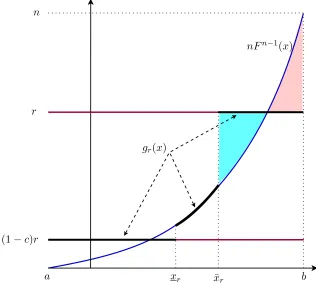
To solve problem (Pr), we allocate the probability mass among the types, start-ing from the highest typeband proceeding to lower types, by setting the maximum density permitted by the constraints (illustrated by Fig. 1). Formally, we solve
max g
Z b
a
Z b
x
g(t)dF(t)
dx s.t. (17) and (18).
This problem is identical to (Pr), by integration by parts of the objective function. The solution of this problem is a pointwise maximal function that respects the constraints,gr(x) =rfor allx≥x¯r, andgr(x) =nFn−1(x) forx <x¯r. The latter is derived from the constraint (18) satisfied as equality,Rxbg(y)f(y)dy= 1−Fn(x). The threshold ¯xr is the point where these constraints meet (the colored areas on
11This approach is analogous to Elchanan Ben-Porath, Eddie Dekel and Barton L. Lipman (2014),
who show that, without loss of optimality, one can restrict attention to favored-agent mechanisms parametrized by agentiand thresholdv∗, and then find an optimal mechanism within this subclass.
12Ifr >1/(1−c), then every allocation inG
rmust satisfyg(x)≥(1−c)r >1, so it violates feasibility,
Rb
ag(x)dF(x)>1. Ifr > n, then every allocation inGr is also inGn, sinceg(x)≤nby feasibility, and
reducingrweakens the left-hand side of (7). Finally, ifr <1, then every allocation inGr is inferior to
the uniformly random allocation,Rb
axg(x)dF(x)≤
Rb
n
r
nFn−1 (x)
gr(x)
(1−c)r
xr x¯r
[image:18.612.142.458.102.390.2]a b
Fig. 1. A solution with a given supremumr.
Fig. 1 have equal size): Rx¯b
rrdF(x) = 1−F
n(¯xr), or simply13
(19) r(1−F(¯xr)) = 1−Fn(¯xr).
To sum up, we allocategr(x) =r on the interval [¯xr, b] andgr(x) =nFn−1(x) on the interval [xr,x¯r). All the types below the lower threshold xr are assigned the minimum density permitted by the incentive constraint, (1−c)r. The threshold
xris the smallest number that satisfies two constraints,xr≥0 and the total mass not exceeding unity:
Z xr
a
(1−c)rdF(x) +
Z ¯xr
xr
nFn−1(x)dF(x) +
Z b
¯ xr
rdF(x)≤1.
The latter constraint can be simplified. Using (19) and integrating out the con-stant parts yields (1−c)rF(xr) + (Fn(xr)−Fn(xr)) + (1−Fn(xr)) ≤ 1, or,
13Note that there is a unique solution of (19), as 1−Fn(x)
1−F(x) = 1 +F(x) +...+F
n−1(x)∈[1, n] is strictly
equivalently,
Fn−1(xr)≥(1−c)r.
It is apparent that eitherxr solves the above as an equality orxr= 0, whichever is greater. Note thatxr ≥0, since r ≥1 and, by assumption, Fn−1(0)≤1−c. Thusxr is the solution of14
(20) Fn−1(xr) = (1−c)r.
The solution of problem (Pr) is thus
(21) gr(x) =
(1−c)r, x < xr, nFn−1(x), xr≤x <x¯r,
r, x≥x¯r,
where ¯xr and xr are given by (19) and (20).
We have shown thatgrmaximizes the principal’s payoff,
Rb
axg(x)dF(x), on the set of functionsGr for a givenr ∈R. The next proposition summarizes this result and characterizes the optimal value ofr.
Proposition 3 Let n <n¯. Then, a reduced-form allocation g is optimal if and only ifg=gr, where r is the solution of
(22) (1−c)
Z xr
a
(xr−x)dF(x) =
Z b
xr
(x−xr)dF(x)
andxr and xr are defined by (19) and (20).
The optimal value of r maximizes Rb
axgr(x)dF(x). Equation (22) is the first-order condition for this maximization problem, which turns out to have a unique solution. As in (8), the optimal thresholds equate the principal’s marginal utility distortions at the top and at the bottom. The complete proof is in the online appendix.
E. Restricted-bid auction.
The reduced-form allocation gr bunches the types above xr and below xr and fully separates types in the interval [xr,x¯r]. This reduced-form allocation can be implemented by the restricted-bid auction with the bid interval [xr,x¯r]. In equilibrium, an agent bids his type truthfully if it belongs to the interval [xr,x¯r], bids xr if his type is above xr, and bids xr otherwise. If one or more agents have types abovexr, the restricted bid auction selects one of these agents with
14Note that there is a uniquex
r defined by (20), asr∈R⊂[1,1/(1−c)], so (1−c)r∈[0,1], and
equal probability (bunching above xr). If the highest type belongs to [xr,x¯r], it is selected with probability one (separation). Otherwise, all bids are equal to
xr and the restricted bid auction selects one of the agents at random (bunching belowxr).
By the construction of xr, as given in (19), an agent with type above xr is selected with the probability of r/n. By (20), an agent with type below xr is selected with the probability of at least (1−c)r/n, and thus has no incentive to inflate his report.
Corollary 4 Let n < ¯n. Then, the restricted-bid auction with the bid inter-val [xr,x¯r] attains the optimal payoff for the principal, where xr and x¯r are the thresholds in the optimal reduced-form allocation gr in Proposition 3.
Proof. The payoff of the principal from the restricted-bid auction with bid interval [xr,x¯r] is equal to
V∗=Fn(xr)E[x|x < xr] +
Z x¯r
xr
xdFn(x) + (1−Fn(¯xr))E[x|x≥x¯r]
= F n(x
r)
F(xr)
Z xr
a
xdF(x) +
Z x¯r
xr
xnFn−1(x)dF(x) +1−F n(¯xr)
1−F(¯xr)
Z b
¯ xr
xdF(x)
=
Z xr
a
(1−c)rxdF(x) +
Z ¯xr
xr
xnFn−1(x)dF(x) +
Z b
¯ xr
rxdF(x) =
Z b
a
gr(x)dF(x),
where in the last line we used (19), (20), and (21).
F. No allocation
Let us now prove that assumption (6) is necessary and sufficient for the principal to select an agent with a positive probability and to receive a positive payoff.
Proposition 4 The optimal allocation rule chooses no agent and attains zero payoff if and only if
(23)
Z 0
a
(1−c)xdF(x) +
Z b
0
xdF(x)≤0.
Proof. By Proposition 2, the principal’s payoff cannot exceed z∗ given by the first-order condition (8). Since (8) has a unique solution, the upper-bound payoff
z∗ is nonpositive if
Z z
a
(1−c)(z−x)dF(x)≥
Z b
z
which is identical to (23). Conversely, if (23) does not hold, then the rule
g(x) =
(
(1−c)r, x <0, r, x≥0.
is incentive compatible, is feasible for a small enoughr >0, and yields the payoff
r Z 0
a
(1−c)xdF(x) +
Z b
0
xdF(x)
>0.
IV. Discussion and comparative statics
There are two notable features of optimal allocation when the principal must rely on reported information, which is in sharp contrast to the case of observable agent types.
First, no matter how many agents participate, low types must be chosen with a positive probability. Even agents with negative types, no matter how bad they are for the principal, must be treated the same way since the principal cannot distinguish between good and bad types and has to provide incentives for telling the truth to everyone. Moreover, the probability of choosing the very top types has to be capped to reduce the benefit of lying.
Second, in an environment with observable types, the probability of choosing a type above any given threshold is strictly increasing in the number of agents. This is not true in our model. In fact, in the restricted-bid auction, asngoes up, there is more pooling at the top: the upper threshold x decreases. Eventually, whenn≥¯n, the optimal reduced-form allocation is a binary categorization that assigns only two values, high and low, to types above and below some threshold, respectively.
We now present comparative statics results with respect to (a) the payoff of the principal;
(b) the size of the pooling interval of high types;
(c) the size of the separating interval in the middle for the case of a small number of agents,n <n¯.
We denote the threshold of the high pooling interval byxand the lower thresh-old of the separating interval byx.15 The high pooling interval, [x, b], consists of all types above the upper quality bar x that are treated identically in the allo-cation mechanism. The larger the interval is, the less discriminatory the optimal mechanism will be for high types. The separating interval, [x, x], has a positive length whenn <n¯. The size of this interval is indicative of the allocation rule’s ability to discriminate the types in the middle.
15Forn <n,¯ x=x
r andx=xr as defined by (19) and (20) at the optimalr. Forn≥n,¯ x=z∗as
The amount of ex-post penalty affects the agents’ incentives and is crucial for the structure of the optimal mechanism. As the penaltycdecreases, the principal is less able to discriminate between high and low types. Ascapproaches zero, the gap between the probabilities assigned to high and low types vanishes, leading to the uniformly random allocation.
Proposition 5a Suppose that the penaltycmarginally increases. Then the prin-cipal is better off. The size of the high pooling interval,[x, b], decreases. Suppose in addition that n <n¯ and that Ff(x)(x) is decreasing.16 Then, the size of the sepa-rating interval,[x, x], increases.
An increase in the number of applicants, n, has a non-obvious effect that we have already discussed. A larger n relaxes the feasibility constraint (F) while having no effect on the incentive constraint (IC) and the objective function (P). The principal can thus implement the allocation closer to the upper bound.
Proposition 5b Let n <n¯. Then, as n goes up, the principal is better off. The size of the high pooling interval, [x, b], increases, and the size of the separating interval, [x, x], decreases. Any increase of nabove ¯nhas no effect.
While keeping the allocation ratio between high and low types fixed to ensure incentive compatibility, the principal has leeway in choosing the size of the pooling intervals for high and low types. There is a trade-off: a better differentiation of high types (smaller interval [¯x, b]) entails worse differentiation of low types (larger interval [a, x]). This tradeoff depends on the distribution of types. An f.o.s.d. improvement of the distribution increases the single optimal threshold when n ≥ n¯, and it has an ambiguous effect on the structure of the optimal mechanism whenn <n¯: both optimal thresholds can either increase or decrease.
Proposition 5c Suppose that F is replaced by F˜, where F˜ f.o.s.d.F. Then the principal is better off. Ifn≥¯nunderF, then the size of the high pooling interval, [x, b], decreases.
The effects of a mean-preserving spread or a rotation of the distribution (Johnson and Myatt 2006) are ambiguous. When both low and high types are less numer-ous, whether the principal benefits from it and whether more discrimination or more pooling of high types is optimal depends on the exact change of the distri-bution of types.
The proof of Propositions 5a, 5b, and 5c is in the online appendix.
V. Conclusion
In this paper, we have analyzed the problem of allocating a prize to one of several agents, where the social value of giving the prize to an agent is privately
known by this agent. The allocation rule chooses the winner of the prize based on the agents’ reports about these values. After the prize is allocated, the social value of giving the prize to the winner becomes commonly known, and the agent can be penalized for lies about the value. We have shown that, if the number of agents is low, the optimal allocation rule takes the form of a restricted-bid pro-cedure; otherwise, it takes the form of a shortlisting procedure. In this problem, the principal faces the tradeoff between making the choice more competitive by selecting higher types with a higher probability and mainting the incentives for truthtelling by selecting low types with a positive probability. There are multiple applications that correspond to our model: a grant agency selecting an organiza-tion to fund, a college administrator awarding a scholarship, or a firm recruiting for a fixed-salary position.
REFERENCES
Ambrus, Attila, and Georgy Egorov. 2017. “Delegation and Nonmonetary Incentives.”Journal of Economic Theory, forthcoming.
Bar, Talia, and Sidartha Gordon.2014. “Optimal Project Selection Mecha-nisms.”American Economic Journal: Microeconomics, 6: 227–255.
Ben-Porath, Elchanan, and Barton L. Lipman.2012. “Implementation with Partial Provability.”Journal of Economic Theory, 147: 1689–1724.
Ben-Porath, Elchanan, Eddie Dekel, and Barton L. Lipman. 2014. “Optimal Allocation with Costly Verification.” American Economic Review, 104: 3779–3813.
Border, Kim C. 1991. “Implementation of Reduced Form Auctions: A Geo-metric Approach.”Econometrica, 59: 1175–1187.
Border, Kim C, and Joel Sobel. 1987. “Samurai Accountant: A Theory of Auditing and Plunder.”Review of Economic Studies, 54: 525–40.
Bull, Jesse, and Joel Watson.2007. “Hard Evidence and Mechanism Design.” Games and Economic Behavior, 58: 75–93.
Burguet, Roberto, Juan-Jos´e Ganuza, and Esther Hauk. 2012. “Lim-ited Liability and Mechanism Design in Procurement.” Games and Economic Behavior, 76: 15–25.
Chakravarty, Surajeet, and Todd R. Kaplan. 2013. “Optimal Allocation Without Transfer Payments.”Games and Economic Behavior, 77: 1–20.
Che, Yeon-Koo, Ian Gale, and Jinwoo Kim.2013. “Assigning Resources to Budget-Constrained Agents.”The Review of Economic Studies, 80: 73–107.
Condorelli, Daniele. 2012. “What Money Can’t Buy: Efficient Mechanism Design with Costly Signals.”Games and Economic Behavior, 75: 613–624.
Dang, Tri Vi, Gary Gorton, and Bengt Holmstr¨om.2015. “The Informa-tion Sensitivity of a Security.” Mimeo.
Deb, Rahul, and Debasis Mishra. 2014. “Implementation with Contingent Contracts.” Econometrica, 82: 2371–2393.
Decarolis, Francesco.2014. “Awarding Price, Contract Performance, and Bids Screening: Evidence from Procurement Auctions.”American Economic Journal: Applied Economics, 6: 108–132.
DeMarzo, Peter M, Ilan Kremer, and Andrzej Skrzypacz.2005. “Bidding with Securities: Auctions and Security Design.” American Economic Eeview, 95: 936–959.
Deneckere, Raymond, and Sergei Severinov.2008. “Mechanism Design with Partial State Verifiability.”Games and Economic Behavior, 64: 487–513.
Ekmekci, Mehmet, Nenad Kos, and Rakesh Vohra. 2016. “Just Enough or All: Selling a Firm.” American Economic Journal: Microeconomics, forth-coming.
Eraslan, H¨ulya K. K., Tymofiy Mylovanov, and Bilge Yimaz. 2014. “Deliberation and Security Design in Bankruptcy.” Mimeo.
Gale, Douglas, and Martin Hellwig.1985. “Incentive-Compatible Debt Con-tracts: The One-Period Problem.”Review of Economic Studies, 52(4): 647–63.
Glazer, Jacob, and Ariel Rubinstein. 2004. “On Optimal Rules of Persua-sion.”Econometrica, 72: 1715–1736.
Glazer, Jacob, and Ariel Rubinstein.2006. “A Study in the Pragmatics of Persuasion: A Game Theoretical Approach.”Theoretical Economics, 1: 395–410.
Green, Jerry R, and Jean-Jacques Laffont. 1986. “Partially Verifiable In-formation and Mechanism Design.”Review of Economic Studies, 53(3): 447–56.
Hartline, Jason D., and Tim Roughgarden. 2008. “Optimal Mechanism Design and Money Burning.”Proceedings of the 40th Annual ACM Symposium on Theory of Computing, 75–84.
Hart, Sergiu, and Philip J Reny. 2015. “Implementation of Reduced Form Mechanisms: A Simple Approach and a New Characterization.”Economic The-ory Bulletin, 3: 1–8.
Johnson, Justin P., and David P. Myatt.2006. “On the Simple Economics of Advertising, Marketing, and Product Design.” American Economic Review, 96(3): 756–784.
Kartik, Navin, and Olivier Tercieux.2012. “Implementation with evidence.” Theoretical Economics, 7(2).
Matthews, Steven A.1984. “On the Implementability of Reduced Form Auc-tions.” Econometrica, 52(6): 1519–1522.
Mezzetti, Claudio.2004. “Mechanism Design with Interdependent Valuations: Efficiency.”Econometrica, 72(5): 1617–1626.
Mierendorff, Konrad.2011. “Asymmetric reduced form Auctions.”Economics Letters, 110(1): 41–44.
Mookherjee, Dilip, and Ivan Png.1989. “Optimal Auditing, Insurance, and Redistribution.”The Quarterly Journal of Economics, 104(2): 399–415.
Sher, Itai, and Rakesh Vohra.2015. “Price Discrimination Through Commu-nication.”Theoretical Economics, 10: 597–648.
Skrzypacz, Andrzej. 2013. “Auctions with Contingent Payments—An Overview.”International Journal of Industrial Organization, 31: 666–675.
Yoon, Kiho. 2011. “Optimal Mechanism Design When Both Allocative Inef-ficiency and Expenditure InefInef-ficiency Matter.” Journal of Mathematical Eco-nomics, 47: 670–676.
Appendix: Type-dependent penalties
Here, we consider a more general model where the penalty c depends on the agent’s type. Formally, we assume that, ex post, the principal observes the se-lected agent’s true typexiand can impose a penaltyc(xi)≥0, which is subtracted from the agent’s valuev(xi). Our primary interpretation ofcis the upper bound on the expected penalty that can be imposed on the agent after his type has been verified.17 Functions v and care bounded and almost everywhere continuous on
X≡[a, b].
As before, we formulate the principal’s problem in terms of the reduced-form allocation:
(P) max
g
Z
x∈X
xg(x)dF(x),
subject to the incentive constraint,
(IC) v(x)g(x)≥(v(x)−c(x)) sup y∈X
g(y) for allx∈X,
and the feasibility constraint,
(F)
Z
{x:g(x)≥t}
g(x)dF(x)≤1−F({x:g(x)< t})
n
for all t∈[0, n].
The idea of the solution is the same as in Section III.D. We fix a supremum value ofg, denoted byr, interpretg(x)f(x) as a probability density, and allocate the maximum density to high types, starting from the top, b, and proceeding
17The assumption thatx
iis verified with certainty can be relaxed; ifα(xi) is the probability thatxi
down, subject to the constraints. However, two issues that arise because of a type-dependent incentive constraint.
The first issue is that the feasibility constraint (F) is not tractable without mak-ing more assumptions about the structure of admissible allocationsg. To restore tractability, we assume that the share of the after-penalty surplus is monotonic:
Assumption 1 (Monotonicity)
v(x)−c(x)
v(x) is weakly increasing.
That is, agents with higher types stand to lose less from lying to the principal. This is a natural assumption for the applications we consider: agents who have better values for the principal are likely to have better outside options.
Under the above assumption, using the same argument as in Lemma 2, without loss, we can consider weakly increasing allocations. By Lemma 3, for monotonic allocations the feasibility constraint (F) is equivalent to
(Fmax)
Z b
x
g(y)dF(y)≤1−Fn(x), for all x∈X.
The second issue is that, even after simplifying the feasibility constraint, we must still handle a non-trivial interaction between feasibility and type-dependent incentive compatibility. To address this complexity, we separate the global in-centive constraint (IC) into two simpler constraints. Letr= supy∈Xg(y). Then, (IC) can be expressed as (c.f. Lemma 4)
g(x)≤r, x∈X,
(ICmax)
g(x)≥h(x)r, x∈X,
(ICmin)
whereh(x) denotes the share of the after-penalty surplus truncated at zero:
h(x) = max
v(x)−c(x)
v(x) ,0
, x∈X.
For every r ∈ R+, derivation of a solution of (Fmax) subject to (ICmax) and (ICmin), denoted bygr, follows four steps.
Step 1. Existence. We identify the interval of r that ensures the existence of a feasible and incentive compatible allocation that respects supg=r. Let ¯r be the greatest value ofr that satisfies
Z b
x
rh(y)dF(y)≤1−Fn(x) for allx∈X.
for all r ∈ [0,r¯]. Moreover, since this is the minimal allocation that satisfies (ICmin) for every givenr, every incentive compatible allocation is infeasible when
r >r¯.
Step 2. Solution for negative types. The principal prefers to minimize the density assigned to the negative types. Denote by a0 the greatest point in [a,0] that satisfies
(A1)
Z a0
a
rh(y)dF(y)≥Fn(a0).
There are two possibilities. First,a0 = 0 and
R0
a rh(y)dF(y) > Fn(a0). That is, the only binding constraint for below-zero types is (ICmin), so these types can be assigned the minimal incentive compatible density, gr(x) = h(x)r for all x < 0. Moreover, the principal prefers to allocate all available probability mass to the positive types. Thus, the total mass to types in [0, b] must be fully allocated at the optimum,R0bgr(y)dF(y) = 1−Fn(0).
The second possibility is a0 ≤ 0 and
R0
a rh(y)dF(y) = F n(a
0). That is, the assignment of the minimal incentive compatible densitygr(x) =h(x)r is feasible only for types in [0, a0]. Incentive and feasibility constraints meet at a0, and for type a0, the feasibility constraint is binding,
Rb
a0gr(y)dF(y) = 1−F
n(a
0). The feasibility constraint (Fmax) then implies Rab
0gr(y)dF(y) = 1−F
n(a0).
To sum up, in either case, we setgr(x) =h(x)rfor allx < a0, and the feasibility constraint must be binding ata0,
(A2)
Z b
a0
gr(y)dF(y) = 1−Fn(a0),
so the total mass to types in [a0, b] must be fully allocated at the optimum. This constraint means that an agent should be selected unless all agents have types belowa0. Conditions (Fmax) and (A2) imply the following constraint:
(Fmin)
Z x
a0
g(y)dF(y)≥Fn(x)−Fn(a0) for allx∈[0, b].
In what follows, we disregard the types belowa0 and solve the problem on [a0, b] subject to constraint (A2).
Let ¯G(x) :=Rb
xg(t)dF(t) and consider the following problem:
max g
Z b
a0
¯
G(x)dx s.t. (ICmax) and (Fmax). (Pmax)
Similarly, letG(x) :=Rax
0g(y)dF(y) and consider the following problem:
min g
Z b
a0
G(x)dx s.t. (ICmin) and (Fmin). (Pmin)
Problems (Pmax) and (Pmin) are the same as (P), but with relaxed incentive compatibility, subject to only (ICmax) and (ICmin), respectively. Indeed, notice that the objective functions are the same up to a constant (by integration by parts). In addition, with a constant mass to be allocated, (A2), constraint (Fmin) is equivalent to (Fmax), but is expressed in terms of the complement sets. Thus, for any given r, (Pmax) is the problem where the original incentive constraint (IC) is replaced by the constraint in which the probability of allocation to all types is capped byr. Similarly, (Pmin) is the problem where the original incentive constraint (IC) is replaced by the constraint in which the probability of allocation to each typex is at least rh(x).
A concatenation is an allocationgr that satisfies for some z∈(a0, b]:
(A3) gr(x) =
rh(x), x∈[a, a0),
g
r(x), x∈[a0, z),
gr(x), x∈[z, b],
where gr(x) and gr(x) denote the solutions of (Pmin) and (Pmax). We say that
gr is an incentive-feasible concatenation if it satisfies (ICmax), (ICmin), (F), and (A2).
Theorem 2 A reduced-form allocation rule g∗ is a solution of (P)if and only if
g∗ is an incentive-feasible concatenationgr, where r solves max
r∈[0,¯r]
Z
X
xgr(x)dF(x).
Before proving the theorem, let us discuss what the solutions of the auxiliary problems (Pmax) and (Pmin) look like. The solutiongr of (Pmax) is the pointwise maximal function subject to the constraints, as the following lemma shows.
Lemma 5 For every r∈[0,¯r], the solution of (Pmax) is equal to
gr(x) =
(
nFn−1(x), x∈[a0,x¯r),
n
b r
nFn−1 (x)
¯
xr ¯
gr(x)
a b
rh(x)
nFn−1 (x)
gr(x)
[image:29.612.114.545.86.376.2]a rh(x)
Fig. A1. Examples of solutions of Pmax(left) and Pmin(right).
where x¯r< b is implicitly defined by
(A4)
Z b
¯ xr
rdF(x) = 1−Fn(¯xr).
Proof. As r ≤ r < nF¯ n−1(b) = n, there exists ¯xr such that the feasibility constraint (Fmax) does not bind, while the incentive constraint (ICmax) binds for
x≥x¯r, and the opposite is true for x <x¯r. Consequently,gr(x) =r forx≥x¯r, while gr(x) = nFn−1(x) for x < x¯r. The value of ¯xr is the unique solution of (A4). i.e., the feasibility constraint binds at allx ≤x¯r and slacks at allx > x¯r.
The solution gris illustrated by Fig. A1 (left). The blue curve isnFn−1(x) and the red curve isr; the black curve depictsgr(x). Starting from the right (x=b), the black line followsr so long as constraint (Fmax) slacks. Down from point ¯xr constraint (Fmax) is binding, and the highest ¯gr(x) that satisfies this constraint is exactlynFn−1(x) for x <x¯r.
sub-ject to the constraints. It is more complex, as it involves function h(x) in the constraints. Fig. A1 (right) depicts an example ofg
r. The blue curve isnF n−1(x) and the red curve is rh(x); the black curve depictsg
r(x). Starting from the left (x=a), the black line followsrh(x) up to the point where the blue area is equal to the red area (so the feasibility constraint starts binding), and then jumps to
nFn−1(x). Then, the black curve followsnFn−1(x) so long as it is above rh(x). After the crossing point, the incentive constraint is binding again, and the black curve again followsrh(x).
A more specific result can be obtained if we make an assumption of “single-crossing” of incentive and feasibility conditions. Recall that the feasibility con-straint means that the probability of choosing a type above a certain level, x, cannot exceed the probability that such a type realizes, 1−Fn(x), for a given distribution F and a given number of agents n. When the incentive constraint is absent, h = 0, all that matters is the feasibility constraint. As we increase
h uniformly for all x (constant h), in (Pmin) (where the constraint g(x) ≤ r is ignored), the incentive constraint g(x) ≥ rh(x) will be binding for all types below some threshold, but the feasibility constraint is still binding for all types above the threshold. The “single-crossing” assumption is a sufficient condition that yields this structure for type-dependenth. It precludes multiple alternating intervals where one of the constraints, incentive or feasibility, binds and the other slacks. Formally, for every r, there exists a threshold xr such that, for function
g(x) = rh(x), the feasibility constraint (Fmin) is satisfied (possibly, with slack) on interval [a0, x] for any x below the threshold and is violated for any x above the threshold.
Assumption 2 (Single-crossing property) For every r ∈ R+, there exists
xr∈[0, b]such that
(A5)
Z x
a0
rh(y)dF(y)≥Fn(x)−Fn(a0) if and only if x≤xr.
Assumption 2 is clearly satisfied under constanth. The concavity ofh(F−1(·)) is also sufficient.
Lemma 6 Assumption 2 holds if h(F−1(t))is weakly concave.
Proof. By the concavity of h(F−1(t)), for every n ≥ 1, h(F−1(t))−ntn−1 is concave. Hence, by the monotonicity ofF, for all r≥0,
rh(y)−nFn−1(y) is quasiconcave.
It is immediate that the subset of (a0, b] where expression
Rx
a0(rh(y)−nF
An example that satisfies Assumption 2 is a linear value of the prize, v(x) =
αx+β, and constant penalty, c(x) = c, β ≥ c ≥ 0, provided that Fn−1(x) is weakly convex.
Lemma 7 Let Assumption 2 hold. Then, for every r ∈ [0,¯r], the solution of problem (Pmin) is equal to
(A6) g
r(x) =
(
rh(x), x∈[a0, xr],
nFn−1(x), x∈(xr, b].
Proof. By Assumption 2, we have (ICmin) binding on [a0, xr] and (Fmin) binding on (xr, b]. Consequently, gr(x) = rh(x) on [a0, xr], while gr(x) = nFn−1(x) on (xr, b].
Proof of Theorem 2. Because of the condition (A2), we can interpret1g(x)f−Fn(a(x)
0)
as the probability density on [a0, b]. A necessary condition for allocationg to be optimal is that
G(x) := 1 1−Fn(a
0)
Z x
a0
g(y)dF(y)
is maximal w.r.t. the first-order stochastic dominance order (f.o.s.d.) on the set of c.d.f.s that satisfy (IC) and (F). We will prove that the set of f.o.s.d. maximal functions is the set of incentive-feasible concatenations{gr}r∈[0,¯r]. Optimization on the set of these functions yields the solutions of (P).
Indeed, consider an arbitrary ˜g that satisfies (IC), (F), and(A2), where r = supXg˜(x). Let us compare
˜
G(x) = 1 1−Fn(a
0)
Z x
a0
˜
g(y)dF(y) and Gr(x) = 1 1−Fn(a
0)
Z x
a0
˜
gr(y)dF(y),
where gr is an incentive-feasible concatenation (A3), where gr and gr are con-catenated at somez. Because gr is the solution of (Pmin), we have for allx≤z
Gr(x) = 1 1−Fn(a0)
Z x
a0 g
r(y)dF(y)≤ 1 1−Fn(a
0)
Z x
a0
˜
g(y)dF y) = ˜G(x).
Furthermore, becausegr is the solution for (Pmax), for allx > z, we have
1−Gr(x) = 1 1−Fn(a
0)
Z b
x
gr(t)dF(t)≥ 1
1−Fn(a 0)
Z b
x ˜
g(t)dF(t) = 1−G˜(x).
Hence,Gr f.o.s.d. ˜G.