Int. J. Communications, Network and System Sciences, 2011, 4, 197-204
doi:10.4236/ijcns.2011.44024 Published Online April 2011 (http://www.SciRP.org/journal/ijcns)
Cubic Root Extractors of Gaussian Integers and Their
Application in Fast Encryption for Time-Constrained
Secure Communication
Boris Verkhovsky
Computer Science Department, New Jersey Institute of Technology, Newark, USA E-mail: verb73@gmail.com
Received March 2, 2011; revised April 12, 2011; accepted April 15, 2011
Abstract
There are settings where encryption must be performed by a sender under a time constraint. This paper de-scribes an encryption/decryption algorithm based on modular arithmetic of complex integers called Gaus-sians. It is shown how cubic extractors operate and how to find all cubic roots of the Gaussian. All valida-tions (proofs) are provided in the Appendix. Detailed numeric illustravalida-tions explain how to use the method of digital isotopes to avoid ambiguity in recovery of the original plaintext by the receiver.
Keywords: Cryptographic Protocol, Secure Communication, Time-Constrained Encryption, Cubic Root Extractor, Gaussian Integers, Modular Arithmetic, Prefix/Suffix Positioning, Digital Isotope, Quadratic Residue, Jacoby Symbol
1. Introduction
This paper describes a cryptographic algorithm based on the extraction of cubic roots from complex numbers a + bi with integer components a and b. Such complex integers are called Gaussian integers (Gaussians, for short) [1]. Let’s denote and , where N is called a norm of (a, b). In modular arithmetic based on Gaussians, if p is a prime and , then for every integer a and b holds an equivalent of the Fermat identity [2]:
a b, :
a bi N:a2bmod 0
N p
2
1
21
, p mod 1,0
a b p . (1) This means that the cycles in Gaussian modular arith-metic have order , while the cycles in modular arithmetic based on real integers have order
2
p
p . Ap-plication of Gaussians for ElGamal cryptosystem is con-sidered in [3]; and the RSA digital signature is described in [4]. Public key cryptography based on cubic roots of real integers is provided in [5] and in [6].
Definition1: A Gaussian integer (x, y) is called the
cu-bic root of (a, b) modulo integer n, and defined as
3 a b, modn,if
3, , mod
x y a b n. (2)
Proposition1: If p is a prime, pmod12 1 and
1 3
: , p mod 1,0
V a b p 1, (3) then there exists a cubic root of (a, b) modulo p.
Proposition2: If , then for every integer
a and b there exists an unique cubic root of (a, b) modulo p.
mod12 5
p
Proposition3: If p2mod 9 1 and
1: p mod 1, 0
W V p 1, (4) then there exists a cubic root of (a, b) modulo prime p.
Remark1: Here are examples, where p2mod 9 1 : p
= 17, 19, 53, 71, 89, 107, 109, 179, 197, 199, 269, 271. The following two algorithms are constructive proofs of these propositions.
2. Algorithm-1
Step 1.1: Compute
21 3: , p mod
W a b p; (5)
Step 2.1:if W
1,0 , then cubic root of (a, b)mod-ulo p does not exist;
Step 3.1: Compute
: mod 9
Step 4.1: if s 1, then : 4
m s , (7) otherwise apply Algorithm-2;
Step 5.1: Compute
2
: 1 3
p
E m p 9, (8) {where m = 1 or 2, see Table 1};
Step 6.1: Compute
x y, : a b, Epmodp
4
. (9)
Example 1: Let p = 23;
a b, 19, ; 1762
(23 1)/3
: (19, 4) (19, 4) mod 23 (1,0);
W
: 59
p
E
hence (19,4) is a cubic residue. ;
3
59
, : 19, 4 19, 4 mod 23 16,16 .
x y
Indeed,
3
16,16 mod 23 19, 4 . It is easy to verify that (5, 2) and (2, 5) are also cubic roots of (19, 4). Hence, algo-rithm (5)-(9) computes only one of three cubic roots of (a, b). How to compute the two other cubic roots is dis-cussed in sections 5 and A3.
3. Algorithm-2
If q mod 12 = 5, then a cubic root exists for every (a, b); and each Gaussian has a unique cubic root. The follow-ing algorithm computes such a cubic root (1).
Step 1.2: Compute cubic extractor
: 2 1 3
q
E q ;
Step 2.2: Compute R:
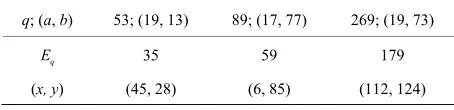
a b, Eqmodq (10) Step 3.2: Output (x, y):=R.Three examples are provided in Table 2.
4. Multiplicity of Cubic Roots
[image:2.595.306.540.83.265.2]Proposition 4: Suppose C C1, 2 and C3 are three cubic Table 1.Cubic extractors E and m. p
p 7 11 13 23
p
E ; m 5; 2 27; 2 19; 1 59; 1
p 29 31 41 43
p
[image:2.595.59.286.565.636.2]E ; m 187; 2 107; 1 187; 1 411; 2
Table 2. Illustrations of cubic root extraction; q mod 12 = 5.
q; (a, b) 53; (19, 13) 89; (17, 77) 269; (19, 73)
q
E 35 59 179
(x, y) (45, 28) (6, 85) (112, 124)
roots of L:= (a, b) modulo p, each satisfying the equation
C3L
modp0; (11)then for every i = 1, 2, 3 the following identities hold:
3 mod
i
C L p. (12)
1 2 3
1 2 3mod 0;
mod [7];
C C C p
C C C p L
C C1 2C C1 3C C2 3
modp0. (13)
2
mod 0i j k
C C C p , (14) where {i, j, k} is every permutation of {1, 2, 3}.
2mod 0.
i j i j
C C C C p
(15)
5. Cubic Roots of (1, 0) and Gaussians
In order to find two other roots of (a, b), consider cubic roots of unity:
u w,
:3
1,0 modn. (16)If (x, y) is a cubic root of (a, b), then
u w x y,
, and
2, , mod
u w x y p are also its cubic roots modulo n.
Proposition 5: If p is a Blum prime, then either
3 or 3 modulo p exists, but not both; if 3 mod p exists, then
1 2 mod ;
and 1 3 2 mod .
u p p
w p
p (17) If 3 modp exists, then
1 3 mod
u p. (18) Proof is provided in the Appendix.
6. Existence of
3 mod
p
or
3 mod
p
Jacoby symbols [8,9] analyze whether a specified integer is quadratic residue(QR). If p is a Blum prime, then
3 1 /823 mod 3 1
1
3 3
2
or 1 1 .
3 p p
(19)
Therefore, if p mod 12 = 11, then 3 is QR. Seven ex-amples are listed in Table 3.
Table 3. 3 mod p if p mod 12 = 11.
p 11 23 47 59 71 83 107
[image:2.595.57.284.668.723.2]B. VERKHOVSKY 199
, ;mod ;
p
Yet, if p mod 12 = 7, then –3 is QR. (20)
7. Properties of Gaussian Cubes
Consider
t v, : u w,
3
u u
23w2
,w u3 2w2
modp(21) Property 1:
u w,
3
u u
23w2
,w u3 2w2
t v
(22)
Property 2:
w u,
3
w w
23u2
,u w3 2u2
( , )v t p(23)
Property 3: If u + w = p, then
u,w
3 w u,
3u3
1,1 mod . (24)8. Cryptographic Protocol
System design (each user’s actions):
Step 1.3: Selects two large distinct primes p and q,
where p mod 12 = 11; p2mod 9 1 ; and q mod 12 = 5;
Step 2.3: Computes n = pq; {n is user’s public key; p
and q are his private keys};
Step 3.3: Finds cubic root (u, w) of (1, 0) modulo p:
1 2 mod
;
3 mod .u p p w u p
Step 4.3: Pre-computes
1
1
: mod ; : mod mod ;
P q q p Q p p q n
Protocol implementation: Suppose a sender (Sam)
wants to securely transmit a plaintext G to receiver (Re-gina);
Sam divides G into an array of blocks
g h1, 1 ; g h2, 2 ; ; gk, hk ;
and
k k
in such a way that every g n h n;
Encryption {Sam’s actions}:
Step 5.3: He gets Regina’s public key n; computes
ciphertext
3, : , mod a b g h n; and sends (a, b) to her;
Decryption {Regina’s actions}:
Step 6.3: She, using her private keys p and q, extracts
cubic roots
3 3
1: , mod ; and : , mod ;
M a b p R a b q
Step 7.3: Shecomputes
2: 1 , mod ; and :3 2 , mod ;
M M u w p M M u w p
Step 8.3: {Using Chinese Remainder Theorem [10], Re-
gina computes all 3 roots of (a, b) D:3
a b, modn}:for k = 1,2,3 Dk:
M P RQk
modn;Step 9.3: {The original plaintext is recovered via
dig-ital isotopes-see sections 10 and 11}:D = G.
9. Efficient Encryption of Gaussians
Squaring of a Gaussian requires two multiplications of real integers (MoRI); and multiplication of two Gaus-sians requires three MoRI [11]. Therefore, the cubic power of Gaussian requires five MoRI. Yet, encryption
a b, : g h,
3
g33gh2,3g h h2 3
modpin Step 5.3 requires only four MoRI:
2 2
1 2
1 2 3 2 4 1
3 3 4 4
: mod ; : mod ;
: ; : 2 ; : 2
: mod ; : mod ;
P g p P h p
S P P A S P A S P
P gA p P hA p
;
{there are no A1 and A2}; where the doublings
are achieved by binary shifting; then 1
2 and P
2
2P
a b, : P P3, 4
.10. Asymmetric Tagging of Digital Isotopes
In cryptographic algorithms based on extraction of square roots of real integers [12] or Gaussians [6]there are four pairs of solutions, and only one of them is the original plaintext. To distinguish the original solution from the other three, the authors use methods of tails, which is an analogue of using isotopes to tag various chemical com-ponents.
If the digital isotopes repeat r rightmost digits in each component of plaintext (g, h), then the probability of erroneous recovery of the “plaintext” is of order
1 102r
. For instance, if the length of isotope r = 3, then the probability of error is one in one million.
As shown below, a more elaborate strategy must be used to avoid ambiguity in the recovery of the original plaintext.
Definition 2: If there exist Gaussians with distinct
components x and y such that
3 3, , mod
x y y x p , (25) then such cubic roots are called Gaussian twins (or CT, for short).
Proposition 6: If the square root of 3 modulo prime p
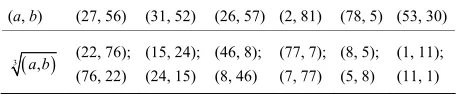
[image:3.595.309.537.675.722.2]exists, then there exists the CT; {see Table4 for examples}. Table 4. Examples of cubic roots twins (CT) for p = 83.
(a, b) (27, 56) (31, 52) (26, 57) (2, 81) (78, 5) (53, 30)
3 a b, (22, 76); (76, 22)
(15, 24); (24, 15)
(46, 8); (8, 46)
(77, 7); (7, 77)
(8, 5); (5, 8)
0
Proof: since , then (25) implies the following relationships:
mod 0
x y p
2 22 2 2 2 2 2
2
2
1, 1 , , , , 0;
, 2 0, , 2
0, 2 mod 0;
. ., 2 mod 0.
x y x y x y y x y x
x y xy x y y x xy
xy x y p
i e x y xy p
(26)
Let y := Txmodp, then i.e., which implies that
2
2 1 2 mod
x T T p ,
0;
T24T1 mod
p2 3 mod T p.
For instance, if p = 83, then 3 70 , i.e., .
2 70 mod83 11 or 68
T
If x = 1, then y = {11 or 68}; hence ; and .
3
3
1,68 68,1 mod 83 73,10
3
3
1,11 11,1 mod83 53,30
It means that 3
53,30 mod83
equals either
1,11
or . Yet, if in both components the rightmost digit is “1”, it is not clear whether the original plaintext is (0, 1) or (1, 0). For every p mod 12 = 11 there exist
CTs that satisfy (25) {examples are provided in Table 4).
11,1
4 p1
11. Numeric Illustration
Algorithm in a nutshell
System design: Let Regina’s p = 227 and q = 1109,
where , p mod 12 = 11; and q mod 12 = 5; she computes n = pq = 251,743; P and Q:
2mod 9 4 1
p
1 1
1 1
: mod =1109 1109 mod 227 1109 96 106464;
:= mod 227 227 mod1109 227 640 145280;
P q q p
Q p p q
and a cubic root (u w) of (1,0) modulo p:
227 1 2 mod
113u p ;
57
3 113 3 mod 227 25;
w u
Remark 2:
u w,
2 u p w,
modp ;
3
, 25 mod 227 1,0
{indeed, 113 ;
2
and 113, 25 mod 227 113, 202 };
: 227 mod 9 2
s ; m: 4 2 2; and Gaussian cubic extractor{Step 5.1}
2
: 2 227 1 3 9 11451
p
E ; finally, Regina pre-computes another cubic extractor
: 2 1 3 739 q
E q .
Encryption: Suppose the sender (Sam) wants to
se-curely transmit message G = (1941, 2487) to Regina with two-digit isotopes:
Z := 100G + Gmod100 = (194141, 248787).
In this case the probability of erroneous recovery of the original message will not exceed 1/10,000, i.e., it equals 0.01%.
Sam computes ciphertext
a b, :Z3mod 251743
227258,195067
Decryption: Regina computes
11451 1
11451
: 227258,195067 mod 227 31,74 mod 227 74,78 M
and two other cubic roots:
2: 1 , 74,78 113, 25 56, 222 ;
M M u w
3: 2 , 56, 222 113, 25 97,154 ;
M M u w
and then unique cubic root R modulo q
739 : , mod 227258,195067 66,371 mod1109 .
q E
R a b q
Using the Chinese Remainder Theorem [10], Regina computes (28):
System design:Select p, q;
Compute n, P, Q, u, w, s, m, p, q
Encryption: Create plaintext Z with isotopes;
com-pute ciphertext (a, b);
E E ;
Decryption: R;RQ; 1; 2;
1
1
, 1109 1109 mod 227
227 227 mod1109 mod 251743
106464 145280 mod 251743; k
k
k
x y M
R M R 3
M M M .
until she detects isotopes
1 1
, 106464 145280 66,371
106464 74, 78 22246, 25878 mod 96549, 274294 ; where 251743
x y M
n n
2 2, 106464 22246, 25878 mod 106464 56, 222 22246, 25878 mod 19 41, 24 87 .
x y M n
n
41 87
Therefore, Regina recovers the original Gaussian block of information; and it is not necessary to compute
x y, 3.12. Optimized Recovery of Information
B. VERKHOVSKY 201
then xk M P R Q yk1 1 ; k M P R Qk2 2 .
1 11, 12
M M M
is computed by cubic root extraction; if the isotopes in Z are detected, then the original infor-mation is recovered; otherwise Regina needs to compute four components of two other cubic roots of (a, b):
2 11 12
11 12 11 12
, ( , ) ,
M M M u w
M u M w M w M u
; (27)
3 11 12
11 12 11 12
, , ,
M M M u w
M u M w M w M u
. (28)
Yet, to minimize computational burden, instead of computing M2 and M3, she finds
1: 12
N M wP; (29) and then computes
2 11 11 1
x M uP R Q N . (30) If the isotopes are detected, then she computes , otherwise Regina computes 2
y
11 311 2 121
32
and .
x x N
M uP R Q M wP y
(31)
13. Elimination of Ambiguity in Recovery of
Original Information
The probability of erroneous recovery can be decreased if, instead of repeating r rightmost digits of g and h, the following procedure is applied:
1) Consider r leftmost digits (prefix Pr) of the first
component g in plaintext (g, h) and repeat it as its digital isotope;
2) Consider rrightmost digits (suffix Sr) of the
sec-ond component h of plaintext (g, h) and repeat it as its digital isotope.
Example 2: if (g, h) = (31415926, 27182845) and r = 2,
then (3131415926, 2718284545).
NB: if n is t-digits long and the number of digits in g
is smaller than t, then the prefix . To avoid ambiguity, the sender must attach both digital isotopes
r and r as suffixes. Below is a simple
mne-monic/schematic rule for constructing the digital isotopes:
00 0
r
P
P S
priority, cocktail
rity , cock .
prio tail
prio tail
Remark 3: Therefore, there can be two types of cubic
roots with isotopes:
(PUP, VSS) and (USS, PVP). Only the former one is
authentic. Hence, a receiver (Regina) searches for the cubic root with isotopes in format (PUP, VSS), where P
and S are prefix and suffix respectively. In this case (PU,
VS) is acceptable as the genuine plaintext.
Example 3: if t = 8; r = 2;
and (g, h) = (00415926, 07182845), then
6 8
2 2 2
( mod10 ) 10 , :
( mod10 ) 10 mod10 ) 00415926 ,07182845
g g g
Z
h h h
00 45
14. Second Numeric Illustration
System design: Let p = 227; q = 1109, n = pq = 251,743;
P = 106464; Q = 145280; (u, w) = (113,25); s2;
2
m ; Ep11451; 739Eq .
Encryption: Plaintext G = (1756, 2011); plaintext with
isotopes
Z := (175617, 201111);
and ciphertext (a,b) = (57971, 209989);
Decryption: R = (395, 382); M := (202, 137); 1mod 239939;
QR n
1: 12 115336
N M wP
196
x M uP QR N
;
2 11 1 1 688;
since there is no isotope in x2, then
x y3, 3
is theoriginal Gaussian.
Indeed, x3x22N1175617.
15. Algorithm Analysis
The cryptographic algorithm described above is neither a generalization nor a special case of the RSA protocol [13].
First of all, the following identity holds:
21 1
, p q mod 1,0a b n 1. (32) In the RSA algorithm, if z is the length of group cycle [13], then each user selects a public key e that is co-prime with z. In the proposed algorithm the length of cycle c is equal
2
: 1
c p q1
. (33) Therefore in the RSA extension it would have been necessary to compute a multiplicative inverse d of e modulo c. Yet, in the algorithm described above the en-cryption key e = 3. Hence, the decryption key d cannot be computed as a modular multiplicative inverse, since
gcd 3,z 3, which implies that such an inverse does not exist [14].
16. Communication Speed-Up
plain-text, where the size of each block must not exceed six-teen digits; in addition, suppose that we want to ensure that the probability of erroneous recovery does not ex-ceed one in one million. There are two options:
Option 1 is to select the size of each block equal to ten digits and the size of each tail equal to six digits; Option 2 is to select the size of each block equal to thirteen dig-its and the size of each tail equal to three digits.
In the 1st option we will treat each block individually
as a real integer; which implies that we need to transmit H/10 real integers. In the 2nd option we will treat a pair of
blocks as a Gaussian; which implies that we need to transmit H/26 Gaussians, i.e., H/13 real integers. There-fore, the first option requires 13/10 = 1.3 times more bandwidth, than the second option. In other words, the bandwidth can be reduced by 30% if Gaussian integers are considered.
17. Possible Applications and Conclusions
The proposed cryptosystem has significant specifics: the encryption is substantially faster than the decryption. There are certain settings where the sender has limited time to transmit the message: visual images or video, and receiver does not have such restriction. For instance, the sender is a system that urgently needs to transmit infor-mation prior to either collision with a target or before it is destroyed by a hostile action [15]. Another example is if the sender (say, an interplanetary or interstellar space station) detects an impending collision with an asteroid and is programmed to report about such collision and transmit visual and other details about the asteroid.
In this case it is paramount to ensure the reliability of message delivery [15,16]. Yet another example is of a security camera that has detected an imminent explosion and is pre-designed to report the situation (audio, pic-tures and/or video) [17] prior to its own destruction from the explosion.
18. Acknowledgements
I express my appreciation to J. Jones, and R. Rubino for corrections, and to E. A. Verkhovsky as well as anony-mous reviewers for several suggestions that improved this paper.
19. References
[1] C. F. Gauss, “Disquisitiones Arithmeticae,” English translation, Yale University Press, New Haven, 1986. [2] J. T. Cross, “The Euler’s φ-Function in the Gaussian
In-tegers,” American Mathematics, Vol. 55, 1983, pp. 518-528. doi:10.2307/2322785
[3] A. N. El-Kassar, M. Rizk, N. Mirza and Y. Wada, “El-Gamal Public Key Cryptosystem in the Domain of Gaus-sian Integers,” International Journal of Applied
Mathe-matics, Vol. 7, No. 4, 2001, pp. 405-412.
[4] H. Elkamchouchi, K. Elshenawy and H. Shaban, “Ex-tended RSA Cryptosystem and Digital Signature Schemes in the Domain of Gaussian Integers,” The 8th
Interna-tional Conference on Communication Systems,
Washing-ton, 25-28 November 2002, pp. 91-95.
[5] S. Kak, “The Cubic Public-Key Transformation,”
Cir-cuits Systems Signal Processing, Vol. 26, No. 3, 2007, pp.
353-359. doi:10.1007/s00034-006-0309-x
[6] B. Verkhovsky, “Accelerated Cybersecure Communica-tion Based on Reduced EncrypCommunica-tion/DecrypCommunica-tion and In-formation Assurance Protocols,” Journal of
Telecommu-nication Managements, Vol. 2, No. 3, 2009, pp. 284-293.
[7] R. W. Hadden, “On the Shoulders of Merchants: Exchange and the Mathematical Conception of Nature in Early Modern Europe,” State University of New York Press, New York, 1994.
[8] R. Crandall and C. Pomerance, “Prime Numbers: A Computational Perspective,” Springer, New York, 2001. [9] A. Menezes, P. van Oorschot and S. Vanstone,
“Hand-book of Applied Cryptography,” CRC Press, Boca Raton, 1997.
[10] D. Knuth, “The Art of Computer Programming, Vol. 1: Fundamental Algorithms,” 3rd Edition, Addison-Wesley, Upper Saddle River, 1998.
[11] A. Karatsuba and Y. Ofman, “Multiplication of Many- Digital Numbers by Automatic Computers,” Doklady Ak-
ademii Nauk SSSR, Vol. 14, No. 145, 1962, pp. 293-294.
[12] M. Rabin, “Digitized Signatures and Public-Key Func-tions as Intractable as Factorization,” Technical Report, MIT/LCS/TR-212, January 1979.
[13] R. Rivest, A. Shamir and L. Adleman, “A Method of Ob- taining Digital Signature and Public-Key Cryptosys-tems,” Communication of ACM, Vol. 21, No. 2, 1978, pp. 120-126. doi:10.1145/359340.359342
[14] B. Verkhovsky, “Enhanced Euclid Algorithm for Modu-lar Multiplicative Inverse and Its Complexity,” Advances
in Computer Cybernetics, Vol. 6, 1999, pp. 51-57.
[15] B. Verkhovsky, “Selection of Entanglements in Informa-tion Assurance Protocols and Optimal Retrieval of Original Blocks,” Journal of Telecommunications
Man-agement, Vol. 2, No. 2, 2009, pp. 186-194.
[16] B. Verkhovsky, “Information Assurance Protocols: Effi-ciency Analysis and Implementation for Secure Commu-nication,” Journal of Information Assurance and Security, Vol. 5, No. 3, 2008, pp. 263-269.
[17] Z. Xu and J. Sun, “Video Encryption Technology and Application,” English translation, Nova Science Publishers Inc., New York, 2010, pp. 1-99.
B. VERKHOVSKY 203
Appendix
A1. Validation of Algorithm-1
If condition (5) holds; then
2
2
1 3 1
1 3
3 3
, ,
m , , od ,
p m p
m p
E
x y a b
p a b
a b a b
(A1)
If
a b,
p21 3modp
1,0
, then by Definition (2) (x, y) is a cubic root of (a, b) modulo prime p. Hence, if
p21 9
is not an integer, then there exists an integerm such that Ep is an integer, i.e., there exists an integer solution of equation
2 1
3 mod 9 0m p
. (A2)
Indeed, observe that
1) Every integer greater than 3 can be expressed ei-ther as p=6k+1 or as p = 6k–1;
2)
p21 3
is an integer for every prime greaterthan 3;
3) If
p21 9
is not an integer, then k mod 3 = 0;and
p21 3
is not co-prime with 3.Therefore, (A2) can be rewritten as
2 1 3mod 3 2
m p . (A3) If there is no integer solution of Equation (A3); then Algorithm-1 is not applicable for these cases. In other terms, if either
p1 9
or
p1 9
is an integer, then Ep is not an integer.A2. Validation of Algorithm-2
Let
1 2
3 , q , m
R a b a b odq. (A4) Since q mod 12 = 5, then
q1 2
is even, hence by Euler criterion of quadratic residuosity, i.e.,
1 /2 1 q modq 1
: 1 mod
i p q (A5) is a real integer; and hence (a, b)mod q is also a real in-teger. Therefore, by the Fermat identity
. Q. E. D.
3mod ,
R q a b
A3. More on Identities for Cubic Roots
By the Vieta theorem [7], equation
C3L
modp 0; (A6)implies that
C C 1
C C 2
C C 3
modp0. (A7)Hence, (A6) and (A7) imply
C1C2C3
modp0; modC C C1 2 3 p L ; (A8)and for every permutation {i, j, k} of
1, 2, 3
2
mod 0i j k
C C C p . (A9) On the other hand, (A9) implies
2mod 0.
i j i j
C C C C p
(A10)
Yet, neither (A9) nor (A10) are instrumental in recov-ery of all cubic roots.
A4. Proof of Proposition 5
Algebraic approach:
u w,
3
u33uw2,3u w w2 3
modp
1, 0 (A11)Therefore from (A6) we deduce two equations with unknown u and w:
2 3 2
modu u w p1; (A12) and
3 2 2
modw u w p0. (A13) Since in (A13) wmodp0, then
2 2
3u w modp
. (A14) Hence, (A12) and (A14) imply that
3
2
8 1 0 mod ; or 2 1 4 2 1 mod 0
u p
u u u p
.
(A15)
Equation (A15) holds if either
1 2 mod
u p p ; (A16) or
4u22u1 mod
p0. (A17)Thus in (A16) case, if there exists square root of 3 modulo p, then from (A14)
3 1
w u p 3 2. (A18) Otherwise, Equation (A17) implies that
1 3 mod
u p; (A19) and finally from (A12) we deduce w.
Trigonometric approach: Consider
3 3
, 1,0 cosπ i sinπ
(cosπ3 i sinπ3) 1, 3 2 mod u w
p
.
Proposition7: If (x, y) is a cubic root of
(a, b) modulo p, then
u w x y,
, modp and
2, , mod
u w x y p are also cubic roots of (a, b).
Proof: From Definition1 (2) for k = 1, 2
3
, k , , mod
u w x y a b p