Collective Tweet Wikification based on Semi-supervised Graph
Regularization
Hongzhao Huang1, Yunbo Cao2, Xiaojiang Huang2, Heng Ji1, Chin-Yew Lin2
1Computer Science Department, Rensselaer Polytechnic Institute, Troy, NY 12180, USA 2Microsoft Research Asia, Beijing 100080, P.R.China
{huangh9,jih}@rpi.edu1,
{yunbo.cao,xiaojih,cyl}@microsoft.com2
Abstract
Wikification for tweets aims to automat-ically identify each concept mention in a tweet and link it to a concept referent in a knowledge base (e.g., Wikipedia). Due to the shortness of a tweet, a collective inference model incorporating global ev-idence from multiple mentions and con-cepts is more appropriate than a non-collecitve approach which links each men-tion at a time. In addimen-tion, it is chal-lenging to generate sufficient high quality labeled data for supervised models with low cost. To tackle these challenges, we propose a novel semi-supervised graph regularization model to incorporate both local and global evidence from multi-ple tweets through three fine-grained re-lations. In order to identify semantically-related mentions for collective inference, we detect meta path-based semantic rela-tions through social networks. Compared to the state-of-the-art supervised model trained from 100% labeled data, our pro-posed approach achieves comparable per-formance with 31% labeled data and ob-tains 5% absolute F1 gain with 50% la-beled data.
1 Introduction
With millions of tweets posted daily, Twitter en-ables both individuals and organizations to dis-seminate information, from current affairs to breaking news in a timely fashion. In this work, we study the wikification (Disambiguation to Wikipedia) task (Mihalcea and Csomai, 2007) for tweets, which aims to automatically identify each concept mentionin a tweet, and link it to a
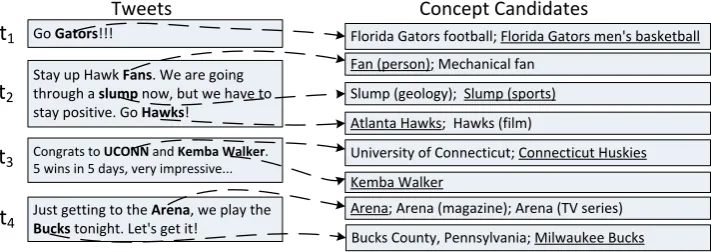
concept referent in a knowledge base (KB) (e.g., Wikipedia). For example, as shown in Figure 1,
Hawksis an identified mention, and its correct ref-erent concept in Wikipedia isAtlanta Hawks. An end-to-end wikification system needs to solve two sub-problems: (i) concept mention detection, (ii) concept mention disambiguation.
Wikification is a particularly useful task for short messages such as tweets because it allows a reader to easily grasp the related topics and en-riched information from the KB. From a system-to-system perspective, wikification has demon-strated its usefulness in a variety of applica-tions, including coreference resolution (Ratinov and Roth, 2012) and classification (Vitale et al., 2012).
Sufficient labeled data is crucial for supervised models. However, manual wikification annota-tion for short documents is challenging and time-consuming (Cassidy et al., 2012). The challenges are: (i)unlinkability, a valid concept may not ex-ist in the KB. (ii) ambiguity, it is impossible to determine the correct concept due to the dearth of information within a single tweet or multiple correct answer. For instance, it would be diffi-cult to determine the correct referent concept for “Gators” in t1 in Figure 1. Linking “UCONN”
int3toUniversity of Connecticutmay also be
ac-ceptable sinceConnecticut Huskiesis the athletic team of the university. (iii)prominence, it is chal-lenging to select a set of linkable mentions that are important and relevant. It is not tricky to select “Fans”, “slump”, and “Hawks” as linkable men-tions, but other mentions such as “stay up” and “stay positive” are not prominent. Therefore, it is challenging to create sufficient high quality la-beled tweets for supervised models and worth con-sidering semi-supervised learning with the explo-ration of unlabeled data.
Stay up Hawk Fans. We are going through a slump now, but we have to stay positive. Go Hawks!
Congrats to UCONN and Kemba Walker. 5 wins in 5 days, very impressive...
Just getting to the Arena, we play the
Bucks tonight. Let's get it!
Fan (person); Mechanical fan
Slump (geology); Slump (sports)
Atlanta Hawks; Hawks (film)
University of Connecticut; Connecticut Huskies
Kemba Walker
Arena; Arena (magazine); Arena (TV series)
Bucks County, Pennsylvania; Milwaukee Bucks
Tweets Concept Candidates
Go Gators!!! Florida Gators football; Florida Gators men's basketball
t1
t2
t3
[image:2.595.120.476.64.190.2]t4
Figure 1: An illustration of Wikification Task for Tweets. Concept mentions detected in tweets are marked as bold, and correctly linked concepts are underlined. The concept candidates are ranked by their prior popularity which will be explained in section 4.1, and only top 2 ranked concepts are listed.
However, when selecting semi-supervised learning frameworks, we noticed another unique challenge that tweets pose to wikification due to their informal writing style, shortness and noisiness. The context of a single tweet usually cannot provide enough information for prominent mention detection and similarity computing for disambiguation. Therefore, a collective inference model over multiple tweets in the semi-supervised setting is desirable. For instance, the four tweets in Figure 1 are posted by the same author within a short time period. If we perform collective inference over them we can reliably link am-biguous mentions such as “Gators”, “Hawks”, and “Bucks” to basketball teams instead of other concepts such as the countyBucks County.
In order to address these unique challenges for wikification for the short tweets, we employ graph-based semi-supervised learning algorithms (Zhu et al., 2003; Smola and Kondor, 2003; Blum et al., 2004; Zhou et al., 2004; Talukdar and Crammer, 2009) for collective inference by ex-ploiting the manifold (cluster) structure in both unlabeled and labeled data. These approaches normally assume label smoothness over a defined graph, where the nodes represent a set of labeled and unlabeled instances, and the weighted edges reflect the closeness of each pair of instances. In order to construct a semantic-rich graph capturing the similarity between mentions and concepts for the model, we introduce three novel fine-grained relations based on a set of local features, social networks and meta paths.
The main contributions of this paper are sum-marized as follows:
• To the best of our knowledge, this is the first
effort to explore graph-based semi-supervised learning algorithms for the wikification task.
• We propose a novel semi-supervised graph reg-ularization model performing collective infer-ence for joint mention detection and disam-biguation. Our approach takes advantage of three proposed principles to incorporate both lo-cal and global evidence from multiple tweets.
• We propose a meta path-based unified frame-work to detect both explicitly and implicitly rel-evant mentions.
2 Preliminaries
Concept and Concept MentionWe define a con-ceptcas a Wikipedia article (e.g.,Atlanta Hawks), and aconcept mentionmas an n-gram from a spe-cific tweet. Each concept has a set of textual repre-sentation fields (Meij et al., 2012), includingtitle
(the title of the article),sentence(the first sentence of the article), paragraph (the first paragraph of the article),content(the entire content of the arti-cle), and anchor (the set of all anchor texts with incoming links to the article).
Wikipedia Lexicon Construction We first construct an offline lexicon with each entry as
hm,{c1, ..., ck}i, where {c1, ..., ck} is the set of
possible referent concepts for the mention m. Following the previous work (Bunescu, 2006; Cucerzan, 2007; Hachey et al., 2013), we extract the possible mentions for a given conceptcusing the following resources: the title ofc; the aliases appearing in the introduction and infoboxes of c
(e.g., The Evergreen State is an alias of Wash-ington state); the titles of pages redirecting to c
(e.g.,State of Washingtonis a redirecting page of
disambigua-tion pages containing c; and all the anchor texts appearing in at least5pages with hyperlinks toc
(e.g., WAis a mention for the concept Washing-ton (state)in the text “401 5th Ave N [[Seattle]], [[Washington (state)—WA]] 98109 USA”. We also propose three heuristic rules to extract mentions (i.e., different combinations of the family name and given name for a person, the headquarters of an organization, and the city name for a sports team).
Concept Mention Extraction Based on the constructed lexicon, we then consider all n-grams of size≤n(n=7 in this paper) as concept mention candidates if their entries in the lexicon are not empty. We first segment @usernames and #hash-tags into regular tokens (e.g., @amandapalmer is segmented as amanda palmer and #WorldWater-Day is split as World Water Day) using the ap-proach proposed by (Wang et al., 2011). Segmen-tation assists finding concept candidates for these non-regular mentions.
3 Principles and Approach Overview
Relational Graph Construction Knowledge Base
(Wikipedia)
Labeled and Unlabeled Tweets
Wikipedia Lexicon Construction Concept Mention and Concept Candidate Extraction
Local Compatibility (local features, cosine similarity)
Coreference (meta path, mention similarity)
Semantic Relatedness (meta path, concept semantic relatedness)
Semi-Supervised Graph Regularization
<Mention, Concept>
[image:3.595.79.269.366.563.2]Pairs
Figure 2: Approach Overview.
3.1 Principles
A single tweet may not provide enough evidence to identify prominent mentions and infer their cor-rect referent concepts due to the lack of contextual information. To tackle this problem, we propose to incorporate global evidence from multiple tweets and performing collective inference for both men-tion identificamen-tion and disambiguamen-tion. We first in-troduce the following three principles that our ap-proach relies on.
Principle 1 (Local compatibility): Two pairs of hm, ci with strong local compatibility tend to
have similar labels. Mentions and their correct referent concepts usually tend to share a set of characteristics such as string similarity betweenm
and c (e.g., hChicago, Chicagoi and hFacebook,
Facebooki). We define thelocal compatibility to model such set of characteristics.
Principle 2 (Coreference): Two coreferential mentions should be linked to the same concept.
For example, if we know “nc” and “North Car-olina” are coreferential, then they should both be linked toNorth Carolina.
Principle 3 (Semantic Relatedness): Two highly semantically-related mentions are more likely to be linked to two highly semantically-related concepts. For instance, when “Sweet 16” and “Hawks” often appear together within rel-evant contexts, they can be reliably linked to two baseketball-related conceptsNCAA Men’s Di-vision I Basketball Championship and Atlanta Hawks, respectively.
3.2 Approach Overview
Given a set of tweetsht1, ..., t|T|i, our system first generates a set of candidate concept mentions, and then extracts a set of candidate concept referents for each mention based on the Wikipedia lexicon. Given a pair of mention and its candidate referent concepthm, ci, the remaining task of wikification is to assign either a positive label ifm should be selected as a prominently linkable mention andc
is its correct referent concept, or otherwise a neg-ative label. The label assignment is obtained by our semi-supervised graph regularization frame-work based on a relational graph, which is con-structed fromlocal compatibility,coreference, and
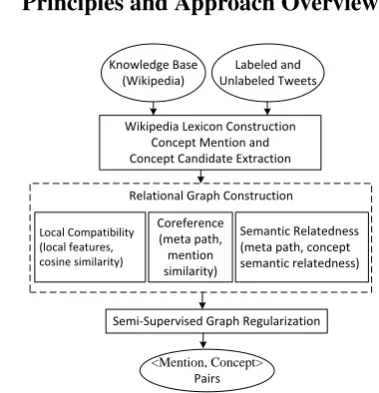
semantic relatedness relations. The overview of our approach is as illustrated in Figure 2.
4 Relational Graph Construction
We first construct the relational graphG=hV, Ei, whereV ={v1, ..., vn}is a set of nodes andE =
{e1, ..., em}is a set of edges. Eachvi = hmi, cii
represents a tuple of mentionmi and its referent concept candidateci. An edge is added between two nodes vi and vj if there is a proposed rela-tion based on the three principles described in sec-tion 3.1.
4.1 Local Compatibility
cap-ture the importance and relevance of a mentionm
to a tweett, as well as the correctness of its link-age to a conceptc. We have designed a number of features which are similar to those commonly used in wikification and entity linking work (Meij et al., 2012; Guo et al., 2013; Mihalcea and Cso-mai, 2007).
Mention FeaturesWe define the following fea-tures based on information from mentions.
• IDFf(m) = log(df|C(m|)), where|C|is the total
number of concepts in Wikipedia anddf(m)is the total number of concepts in whichmoccurs, andf indicates the field property, including ti-tle,content, andanchor.
• Keyphraseness(m) = |Ca(m)|
df(m) to measure
how likelymis used as an anchor in Wikipedia, where Ca(m) is the set of concepts where m appears as an anchor.
• LinkP rob(m) = Pc∈Ca(m)count(m,c)
P
c∈Ccount(m,c) , where
count(m, c)indicates the number of occurrence
ofminc.
• SNIL(m)andSNCL(m)to count the number of concepts that are equal to or contain a sub-n-gram ofm, respectively (Meij et al., 2012). Concept Features The concept features are solely based on Wikipedia, including the number of incoming and outgoing links forc, and the num-ber of words and characters inc.
Mention + Concept Features This set of fea-tures considers information from both mentions and concepts:
• prior popularity prior(m, c) = count(m,c)
P
c0count(m,c0), where count(m, c) mea-sures the frequency of the anchor links fromm
tocin Wikipedia.
• T Ff(m, c) = count|ff|(m,c) to measure the rela-tive frequency ofmin each field representation
fofc, normalized by the length off. The fields includetitle, sentence, paragraph, content and
anchor.
• NCT(m, c), T CN(m, c), and T EN(m, c) to
measure whether m contains the title of c, whether the title ofc containsm, and whether
mequals to the title ofc, respectively.
Context Features This set of features include (i) Context Capitalization features, which indicate whether the current mention, the token before, and the token after are capitalized. (ii) tf-idf based fea-tures, which include the dot product of two word
vectorsvc andvt, and the average tf-idf value of common items invc andvt, where vcand vt are the top 100 tf-idf word vectors incandt.
Local Compatibility Computation For each node vi = hmi, cii, we collect its local features as a feature vectorFi =hf1, f2, ..., fdi. To avoid features with large numerical values that domi-nate other features, the value of each feature is re-scaled using feature standardization approach. The cosine similarity is then adopted to compute the local compatibility of two nodes and construct a k nearest neighbor (kNN) graph, where each node is connected to its k nearest neighboring nodes. We compute the weight matrix that rep-resents the local compatibility relation as:
Wijloc=
cosine(Fi, Fj) j∈kNN(i)
0 Otherwise
4.2 Meta Path
Mention
Hashtag
Tweet User
post-1
post contain-1
contain
[image:4.595.308.507.278.435.2]contain-1 contain
Figure 3: Schema of the Twitter network. In this subsection, we introduce the concept meta path which will be used to detect corefer-ence (section 4.3) and semantic relatedness rela-tions (section 4.4).
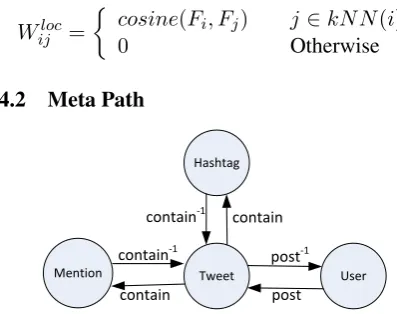
A meta-path is a path defined over a network and composed of a sequence of relations between different object types (Sun et al., 2011b). In our experimental setting, we can construct a natu-ral Twitter network summarized by the network schema in Figure 3. The network contains four types of objects: Mention (M), Tweet (T), User
(U), and Hashtag (H). Tweets and mentions are connected by links “contain” and “contained by” (denoted as “contain−1”); and other linked
rela-tionships can be described similarly.
We then define the following five types of meta paths to connect two mentions as:
• “M - T - M”,
• “M - T - U - T - M”,
• “M - T - H - T - M”,
• “M - T - U - T - M - T - H - T - M”,
Each meta path represents one particular seman-tic relation. For instance, the first three paths are
basic ones expressing the explicit relations that two mentions are from the same tweet, posted by the same user, and share the same #hashtag, re-spectively. The last two paths are concatenated
ones which are constructed by concatenating the first three simple paths to express the implicit rela-tions that two menrela-tions co-occur with a third men-tion sharing either the same authorship or #hash-tag. Such complicated paths can be exploited to detect more semantically-related mentions from wider contexts. For example, the relational link between “narita airport” and “Japan” would be missed without using the path “narita airport - t1 - u1- t2- american - t3- h1- t4- Japan” since they
don’t directly share any authorships or #hashtags.
4.3 Coreference
A coreference relation (Principle 2) usually occurs across multiple tweets due to the highly redundant information in Twitter. To ensure high precision, we propose a simple yet effective approach utiliz-ing the rich social network relations in Twitter.
We consider two mentionsmi andmj corefer-ential ifmi and mj share the same surface form or one is an abbreviation of the other, and at least one meta path exists betweenmiandmj. Then we define the weight matrix representing the corefer-ential relation as:
Wijcoref =
1.0 ifmiandmj are coreferential, andci =cj
0 Otherwise
4.4 Semantic Relatedness
Ensuring topical coherence (Principle 3) has been beneficial for wikification on formal texts (e.g., News) by linking a set of semantically-related mentions to a set of semantically-related concepts simultaneously (Han et al., 2011; Ratinov et al., 2011; Cheng and Roth, 2013). However, the short-ness of a single tweet means that it may not pro-vide enough topical clues. Therefore, it is impor-tant to extend this evidence to capture semantic re-latedness information from multiple tweets.
We define the semantic relatedness score be-tween two mentions as SR(mi, mj) = 1.0 if at least one meta path exists between mi and mj, otherwiseSR(mi, mj) = 0. In order to compute the semantic relatedness of two concepts ci and
cj, we adopt the approach proposed by (Milne and
Witten, 2008a):
SR(ci, cj) = 1−log max(log(|C||C)−i|,log min(|Cj|)−log|C|Ci∩Cj| i|,|Cj|) , where |C| is the total number of concepts in Wikipedia, andCi andCj are the set of concepts that have links tociandcj, respectively.
Then we compute a weight matrix representing the semantic relatedness relation as:
Wrel
ij =
SR(Ni, Nj) ifSR(Ni, Nj)≥δ
0 Otherwise
whereSR(Ni, Nj) = SR(mi, mj)×SR(ci, cj)
andδ = 0.3, which is optimized from a
develop-ment set.
4.5 The Combined Relational Graph
hawks, Atlanta Hawks
uconn, Connecticut
Huskies bucks,
Milwaukee Bucks
kemba walker, Kemba Walker 0.404
gators, Florida Gators men's basketball
now, Now
days, Day tonight, Tonight
0.932
0.764 0.665 0.467
0.563
[image:5.595.321.508.292.411.2]0.538 0.447
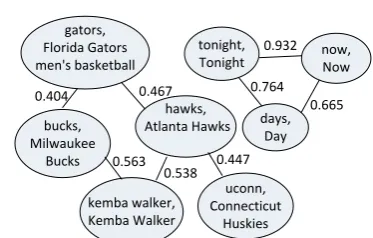
Figure 4: A example of the relational graph con-structed for the example tweets in Figure 1. Each node represents a pair of hm, ci, separated by a comma. The edge weight is obtained from the lin-ear combination of the weights of the three pro-posed relations. Not all mentions are included due to the space limitations.
Based on the above three weight matricesWloc,
Wcoref, and Wrel, we first obtain their corre-sponding transition matrices Ploc, Pcoref, and
Prel, respectively. The entryP
ij of the transition matrixP for a weight matrixW is computed as
Pij = PWij
kWik such that
P
kPik = 1. Then we
obtain the combined graphGwith weight matrix
W, whereWij = αPijloc+βPijcoref +γPijrel. α,
β, and γ are three coefficients between 0 and 1 with the constraint thatα+β+γ = 1. They con-trol the contributions of these three relations in our semi-supervised graph regularization model. We choose transition matrix to avoid the domination of one relation over others. An example graph of
novel graph representation has two advantages: (i) It can easily incorporate more features related to both mentions and concepts. (ii) It is more appro-priate for our graph-based semi-supervised model since it is difficult to assign labels to a pair of men-tion and concept in the referent graph.
5 Semi-supervised Graph Regularization Given the constructed relational graph with the weighted matrixW and the label vector Y of all nodes, we assume the firstlnodes are labeled as
Yland the remainingunodes (u=n−l) are ini-tialized with labelsY0
u. Then our goal is to refine
Y0
u and obtain the final label vectorYu.
Intuitively, if two nodes are strongly connected, they tend to hold the same label. We propose a novel semi-supervised graph regularization frame-work based on the graph-based semi-supervised learning algorithm (Zhu et al., 2003):
Q(Y) =µ Xn
i=l+1
(yi−yi0)2+12
X
i,j
Wij(yi−yj)2.
The first term is a loss function that incorporates the initial labels of unlabeled examples into the model. In our method, we adopt prior popular-ity (section 4.1) to initialize the labels of the un-labeled examples. The second term is a regular-izer that smoothes the refined labels over the con-structed graph.µis a regularization parameter that controls the trade-off between initial labels and the consistency of labels on the graph. The goal of the proposed framework is to ensure that the refined labels of unlabeled nodes are consistent with their strongly connected nodes, as well as not too far away from their initial labels.
The above optimization problem can be solved directly since Q(Y) is convex (Zhu et al., 2003; Zhou et al., 2004). Let I be an identity matrix andDW be a diagonal matrix with entriesDii = P
jWij. We can split the weighted matrixW into four blocks asW =
Wll Wlu
Wul Wuu
, whereWmnis anm×nmatrix.Dwis split similarly. We assume that the vector of the labeled examplesYlis fixed, so we only need to infer the refined label vector of the unlabeled examplesYu. In order to minimize
Q(Y), we need to findY∗
u such that
∂Q
∂Yu
Yu=Yu∗
= (Duu+µIuu)Yu−WuuYu−
WulYl−µYu0= 0.
Therefore, a closed form solution can be derived asY∗
u = (Duu+µIuu−Wuu)−1(WulYl+µYu0). However, for practical application to a large-scale data set, an iterative solution would be more efficient to solve the optimization problem. Let
Yt
u be the refined labels after thetth iteration, the iterative solution can be derived as:
Yt+1
u = (Duu+µIuu)−1(WuuYut+WulYl+µYu0).
The iterative solution is more efficient since (Duu+µIuu)is a diagonal matrix and its inverse is very easy to compute.
6 Experiments
In this section we compare our approach with state-of-the-art methods as shown in Table 1. 6.1 Data and Scoring Metric
For our experiments we use a public data set (Meij et al., 2012) including 502 tweets posted by 28 verified users. The data set was annotated by two annotators. We randomly sample102 tweets for development and the remaining for evaluation. We use a Wikipedia dump on May 3, 2013 as our knowledge base, which includes30million pages. For computational efficiency, we also filter some mention candidates by applying the preprocess-ing approach proposed in (Ferragina and Scaiella, 2010), and remove all the concepts with prior pop-ularity less than2%from an mention’s concept set for each mention, similar to (Guo et al., 2013).
A mention and concept pairhm, ciis judged as correct if and only if m is linkable and c is the correct referent concept for m. To evaluate the performance of a wikification system, we use the standard precision, recall and F1 measures.
6.2 Experimental Results
combina-Methods Descriptions
TagMe The same approach that is described in (Ferragina and Scaiella, 2010), which aims to annotate short texts based on prior popularity and semantic relatedness of concepts. It is basically an unsupervised approach, except that it needs a development set to tune the probability threshold for linkable mentions. Meij A state-of-the-art system described in (Meij et al., 2012), which is a supervised approach based on the random forest model. It performs mention detection and disambiguation jointly, and it is trained from 400 labeled tweets.
SSRegu1 Our proposed model based on Principle 1, using 200 labeled tweets.
SSRegu12 Our proposed model based on Principle 1 and 2, using 200 labeled tweets.
SSRegu13 Our proposed model based on Principle 1 and 3, using 200 labeled tweets.
[image:7.595.73.521.63.174.2]SSRegu123 Our proposed full model based on Principle 1, 2 and 3, using 200 labeled tweets. Table 1: Description of Methods.
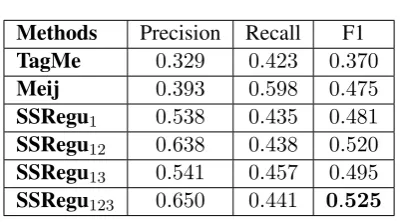
Methods Precision Recall F1 TagMe 0.329 0.423 0.370 Meij 0.393 0.598 0.475 SSRegu1 0.538 0.435 0.481
SSRegu12 0.638 0.438 0.520
SSRegu13 0.541 0.457 0.495
SSRegu123 0.650 0.441 0.525
Table 2: Overall Performance.
tions of values from 0 to1 at 0.1 intervals1. In order to randomize the experiments and make the comparison fair, we conduct20test runs for each method and report the average scores across the20 trials.
The relatively low performance of the baseline system TagMe demonstrates that only relying on prior popularity and topical information within a single tweet is not enough for an end-to-end wik-ification system for the short tweets. As an exam-ple, it is difficult to obtain topical clues in order to link the mention “Clinton” toHillary Rodham Clintonby relying on the single tweet “ wolfblitzer-cnn: Behind the scenes on Clinton’s Mideast trip #cnn”. Therefore, the system mistakenly links it to the most popular conceptBill Clinton.
In comparision with the supervised baseline proposed by (Meij et al., 2012), our model
SSRegu1 relying on local compatibility already achieves comparable performance with 50% of labeled data. This is because that our model performs collective inference by making use of the manifold (cluster) structure of both labeled and unlabeled data, and that the local compat-ibility relation is detected with high precision2
(89.4%). For example, the following three pairs
of mentions and conceptshpelosi, Nancy Pelosii,
hobama, Barack Obamai, and hgaddafi,
Muam-1These three coefficients are slightly different with
differ-ent training data, a sample of them is:α= 0.4,β= 0.5, and
γ= 0.1
2Here we define precision as the percentage of links that
holds the same label.
mar Gaddafiihave strong local compatibility with each other since they share many similar char-acteristics captured by the local features such as string similarity between the mention and the con-cept. Suppose the first pair is labeled, then its pos-itive label will be propagated to other unlabeled nodes through the local compatibility relation, and correctly predict the labels of other nodes.
Incorporating coreferential or semantic related-ness relation intoSSRegu1 provides further gains, demonstrating the effectiveness of these two re-lations. For instance, “wh” is correctly linked to
White House by incorporating evidence from its coreferential mention “white house”. The corefer-ential relation (Principle 2) is demonstrated to be more beneficial than the semantic relatedness re-lation (Principle 3) because the former is detected with much higher precision (99.7%) than the latter (65.4%).
Our full model SSRegu123 achieves significant improvement over the supervised baseline (5% ab-solute F1 gain with 95.0% confidence level by the Wilcoxon Matched-Pairs Signed-Ranks Test), showing that incorporating global evidence from multiple tweets with fine-grained relations is ben-eficial. For instance, the supervised baseline fails to link “UCONN” and “Bucks” in our examples toConnecticut HuskiesandMilwaukee Bucks, re-spectively. Our full model corrects these two wrong links by propagating evidence through the semantic links as shown in Figure 4 to obtain mu-tual ranking improvement. The best performance of our full model also illustrates that the three re-lations complement each other.
[image:7.595.80.281.193.304.2]Methods TagMe Meij SSRegu123
Accuracy 0.710 0.779 0.772 Table 3: Disambiguation Performance.
Methods Precision Recall F1 SSRegu12 0.644 0.423 0.510
SSRegu13 0.543 0.441 0.486
SSRegu123 0.657 0.419 0.512
Table 4: The Performance of Systems Without Us-ing Concatenated Meta Paths.
achieved reasonable performance. In fact, mention detection actually is the performance bottleneck of a tweet wikification system (Guo et al., 2013). Our system performs better in identifying the promi-nent mention.
6.3 Effect of Concatenated Meta Paths In this work, we propose a unified framework uti-lizing meta path-based semantic relations to ex-plore richer relevant context. Beyond the basic
meta paths, we introduce concatenated ones by concatenating the basic ones. The performance of the system without using the concatenated meta paths is shown in Table 4. In comparison with the system based on all defined meta paths, we can clearly see that the systems using concate-nated ones outperform those relying on the sim-ple ones. This is because the concatenated meta paths can incorporate more relevant information with implicit relations into the models by increas-ing1.6%coreference links and9.3%semantic re-latedness links. For example, the mention “narita airport” is correctly disambiguated to the concept “Narita International Airport” with higher confi-dence since its semantic relatedness relation with “Japan” is detected with the concatenated meta path as described in section 4.2.
6.4 Effect of Labeled Data Size
5 0 1 0 0 1 5 0 2 0 0 2 5 0 3 0 0 3 5 0 4 0 0 0 . 3 0
0 . 3 5 0 . 4 0 0 . 4 5 0 . 5 0 0 . 5 5 0 . 6 0
F
1
L a b e l e d T w e e t S i z e
[image:8.595.310.502.297.441.2]S S R e g u 1 2 3 M e i j
Figure 5: The effect of Labeled Tweet Size.
In previous experiments, we experimentally set the number of labeled tweets to be200for over-all performance comparision with the baselines. In this subsection, we study the effect of labeled data size on our full model. We randomly sam-ple 100tweets as testing data, and randomly
se-lect 50, 100, 150, 200, 250, and 300 tweets as
labeled data. 20 test runs are conducted and the average results are reported across the 20 trials, as shown in Figure 5. We find that as the size of the labeled data increases, our proposed model achieves better performance. It is encouraging to see that our approach, with only 31.3% labeled tweets (125out of400), already achieves a perfor-mance that is comparable to the state-of-the-art su-pervised model trained from 100% labeled tweets. 6.5 Parameter Analysis
0 . 1 0 . 5 1 2 5 1 0 2 0 3 0 4 0 5 0 0 . 3 0
0 . 3 5 0 . 4 0 0 . 4 5 0 . 5 0 0 . 5 5 0 . 6 0
F
1
R e g u l a r i z a t i o n P a r a m e t e r µ
S S R e g u
1 2 3
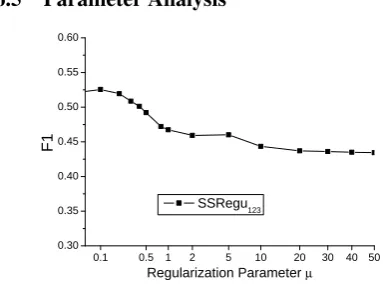
Figure 6: The effect of parameterµ. In previous experiments, we empirically set the parameter µ = 0.1. µ is the regularization pa-rameter that controls the trade-off between initial labels and the consistency of labels on the graph. Whenµincreases, the model tends to trust more in the initial labels. Figure 6 shows the performance of our models by varyingµfrom0.02 to50. We can easily see that the system performce is stable
whenµ < 0.4. However, whenµ≥ 0.4, the
sys-tem performance dramatically decreases, showing that prior popularity is not enough for an end-to-end wikification system.
7 Related Work
[image:8.595.90.265.613.753.2]corefer-ent named corefer-entity mcorefer-entions spread throughout dif-ferent documents (Entity Linking) (McNamee and Dang, 2009; Ji et al., 2010; Zhang et al., 2010; Ji et al., 2011; Zhang et al., 2011; Han and Sun, 2011; Han et al., 2011; Gottipati and Jiang, 2011; He et al., 2013; Li et al., 2013; Guo et al., 2013; Shen et al., 2013; Liu et al., 2013).
A significant portion of recent work considers the two sub-problemsmention detectionand men-tion disambiguamen-tion separately and focus on the latter by first defining candidate concepts for a deemed mention based on anchor links. Men-tion disambiguaMen-tion is then formulated as a rank-ing problem, either by resolvrank-ing one mention at each time (non-collective approaches), or by dis-ambiguating a set of relevant mentions simulta-neously (collective approaches). Non-collective methods usually rely on prior popularity and con-text similarity with supervised models (Mihalcea and Csomai, 2007; Milne and Witten, 2008b; Han and Sun, 2011), while collective approaches fur-ther leverage the global coherence between con-cepts normally through supervised or graph-based re-ranking models (Cucerzan, 2007; Milne and Witten, 2008b; Han and Zhao, 2009; Kulkarni et al., 2009; Pennacchiotti and Pantel, 2009; Ferrag-ina and Scaiella, 2010; Fernandez et al., 2010; Radford et al., 2010; Cucerzan, 2011; Guo et al., 2011; Han and Sun, 2011; Han et al., 2011; Rati-nov et al., 2011; Chen and Ji, 2011; Kozareva et al., 2011; Cassidy et al., 2012; Shen et al., 2013; Liu et al., 2013). Especially note that when apply-ing the collective methods to short messages from social media, evidence from other messages usu-ally needs to be considered (Cassidy et al., 2012; Shen et al., 2013; Liu et al., 2013). Our method is a collective approach with the following novel advancements: (i) A novel graph representation with fine-grained relations, (ii) A unified frame-work based on meta paths to explore richer rele-vant context, (iii) Joint identification and linking of mentions under semi-supervised setting.
Two most similar methods to ours were pro-posed by (Meij et al., 2012; Guo et al., 2013) by performing joint detection and disambiguation of mentions. (Meij et al., 2012) studied several supervised machine learning models, but without considering any global evidence either from a sin-gle tweet or other relevant tweets. (Guo et al., 2013) explored second order entity-to-entity rela-tions but did not incorporate evidence from
multi-ple tweets.
This work is also related to graph-based semi-supervised learning (Zhu et al., 2003; Smola and Kondor, 2003; Zhou et al., 2004; Talukdar and Crammer, 2009), which has been success-fully applied in many Natural Language Process-ing tasks (Niu et al., 2005; Chen et al., 2006). We introduce a novel graph that incorporates three fine-grained relations. Our work is further re-lated to meta path-based heterogeneous informa-tion network analysis (Sun et al., 2011b; Sun et al., 2011a; Kong et al., 2012; Huang et al., 2013), which has demonstrated advantages over homoge-neous information network analysis without dif-ferentiating object types and relational links.
8 Conclusions
We have introduced a novel semi-supervised graph regularization framework for wikification to si-multaneously tackle the unique challenges of an-notation and information shortage in short tweets. To the best of our knowledge, this is the first work to explore the semi-supervised collective inference model to jointly perform mention detection and disambiguation. By studying three novel fine-grained relations, detecting semantically-related information with semantic meta paths, and ex-ploiting the data manifolds in both unlabeled and labeled data for collective inference, our work can dramatically save annotation cost and achieve bet-ter performance, thus shed light on the challenging wikification task for tweets.
Acknowledgments
References
A. Blum, J. Lafferty, M. Rwebangira, and R. Reddy. 2004. Semi-supervised learning using randomized mincuts. InProceedings of the Twenty-first Interna-tional Conference on Machine Learning, ICML ’04.
Razvan Bunescu. 2006. Using encyclopedic knowl-edge for named entity disambiguation. In EACL, pages 9–16.
T. Cassidy, H. Ji, L. Ratinov, A. Zubiaga, and H. Huang. 2012. Analysis and enhancement of wik-ification for microblogs with context expansion. In
Proceedings of COLING 2012.
Z. Chen and H. Ji. 2011. Collaborative ranking: A case study on entity linking. InProc. EMNLP2011.
J. Chen, D. Ji, C Tan, and Z. Niu. 2006. Rela-tion extracRela-tion using label propagaRela-tion based semi-supervised learning. InProceedings of the 21st In-ternational Conference on Computational Linguis-tics and 44th Annual Meeting of the Association for Computational Linguistics.
X. Cheng and D. Roth. 2013. Relational inference for wikification. InProceedings of the 2013 Con-ference on Empirical Methods in Natural Language Processing.
Silviu Cucerzan. 2007. Large-scale named entity dis-ambiguation based on wikipedia data. In EMNLP-CoNLL 2007.
S. Cucerzan. 2011. Tac entity linking by performing full-document entity extraction and disambiguation. InProc. TAC 2011 Workshop.
N. Fernandez, J. A. Fisteus, L. Sanchez, and E. Mar-tin. 2010. Webtlab: A cooccurence-based approach to kbp 2010 entity-linking task. InProc. TAC 2010 Workshop.
P. Ferragina and U. Scaiella. 2010. Tagme: on-the-fly annotation of short text fragments (by wikipedia entities). In Proceedings of the 19th ACM inter-national conference on Information and knowledge management, CIKM ’10.
S. Gottipati and J. Jiang. 2011. Linking entities to a knowledge base with query expansion. In Proceed-ings of the 2011 Conference on Empirical Methods in Natural Language Processing.
Y. Guo, W. Che, T. Liu, and S. Li. 2011. A graph-based method for entity linking. In Proc. IJC-NLP2011.
S. Guo, M. Chang, and E. Kiciman. 2013. To link or not to link? a study on end-to-end tweet entity linking. InProceedings of the 2013 Conference of the North American Chapter of the Association for Computational Linguistics: Human Language Tech-nologies.
B. Hachey, W. Radford, J. Nothman, M. Honnibal, and J. Curran. 2013. Evaluating entity linking with wikipedia.Artif. Intell.
X. Han and L. Sun. 2011. A generative entity-mention model for linking entities with knowledge base. In
Proc. ACL2011.
X. Han and J. Zhao. 2009. Named entity disam-biguation by leveraging wikipedia semantic knowl-edge. InProceedings of the 18th ACM conference on Information and knowledge management, CIKM 2009.
X. Han, L. Sun, and J. Zhao. 2011. Collective entity linking in web text: A graph-based method. InProc. SIGIR2011.
J. He, M. de Rijke, M. Sevenster, R. van Ommering, and Y. Qian. 2011. Generating links to background knowledge: A case study using narrative radiology reports. In Proceedings of the 20th ACM inter-national conference on Information and knowledge management. ACM.
Z. He, S. Liu, Y. Song, M. Li, M. Zhou, and H. Wang. 2013. Efficient collective entity linking with stack-ing. InProceedings of the 2013 Conference on Em-pirical Methods in Natural Language Processing.
H. Huang, Z. Wen, D. Yu, H. Ji, Y. Sun, J. Han, and H. Li. 2013. Resolving entity morphs in censored data. InProceedings of the 51st Annual Meeting of the Association for Computational Linguistics (Vol-ume 1: Long Papers).
H. Ji, R. Grishman, H.T. Dang, K. Griffitt, and J. El-lis. 2010. Overview of the tac 2010 knowledge base population track. InText Analysis Conference (TAC) 2010.
H. Ji, R. Grishman, and H.T. Dang. 2011. Overview of the tac 2011 knowledge base population track. In
Text Analysis Conference (TAC) 2011.
X. Kong, P. Yu, Y. Ding, and J. Wild. 2012. Meta path-based collective classification in heterogeneous information networks. In Proceedings of the 21st ACM International Conference on Information and Knowledge Management, CIKM ’12.
Z. Kozareva, K. Voevodski, and S. Teng. 2011. Class label enhancement via related instances. In Proc. EMNLP2011.
S. Kulkarni, A. Singh, G. Ramakrishnan, and S. Chakrabarti. 2009. Collective annotation of wikipedia entities in web text. InKDD.
X. Liu, Y. Li, H. Wu, M. Zhou, F. Wei, and Y. Lu. 2013. Entity linking for tweets. InProceedings of the 51st Annual Meeting of the Association for Com-putational Linguistics (Volume 1: Long Papers). P. McNamee and H.T. Dang. 2009. Overview of the
tac 2009 knowledge base population track. InText Analysis Conference (TAC) 2009.
E. Meij, W. Weerkamp, and M. de Rijke. 2012. Adding semantics to microblog posts. In Proceed-ings of the fifth ACM international conference on Web search and data mining, WSDM ’12.
R. Mihalcea and A. Csomai. 2007. Wikify!: linking documents to encyclopedic knowledge. In Proceed-ings of the sixteenth ACM conference on Conference on information and knowledge management, CIKM ’07.
D. Milne and I.H. Witten. 2008a. Learning to link with wikipedia. InAn effective, low-cost measure of semantic relatedness obtained from wikipedia links. the Wikipedia and AI Workshop of AAAI.
D. Milne and I.H. Witten. 2008b. Learning to link with wikipedia. InProceeding of the 17th ACM con-ference on Information and knowledge management, pages 509–518. ACM.
Z. Niu, D. Ji, and C. Tan. 2005. Word sense dis-ambiguation using label propagation based semi-supervised learning. InProceedings of the 43rd An-nual Meeting of the Association for Computational Linguistics (ACL’05).
M. Pennacchiotti and P. Pantel. 2009. Entity extraction via ensemble semantics. InProc. EMNLP2009. W. Radford, B. Hachey, J. Nothman, M. Honnibal, and
J. R. Curran. 2010. Cmcrc at tac10: Document-level entity linking with graph-based re-ranking. In
Proc. TAC 2010 Workshop.
L. Ratinov and D. Roth. 2012. Learning-based multi-sieve co-reference resolution with knowledge. In
EMNLP.
L. Ratinov, D. Roth, D. Downey, and M. Anderson. 2011. Local and global algorithms for disambigua-tion to wikipedia. InProc. of the Annual Meeting of the Association of Computational Linguistics (ACL). W. Shen, J. Wang, P. Luo, and M. Wang. 2013. Link-ing named entities in tweets with knowledge base via user interest modeling. In Proceedings of the 19th ACM SIGKDD International Conference on Knowledge Discovery and Data Mining, KDD ’13. A. Smola and R. Kondor. 2003. Kernels and
regular-ization on graphs.COLT.
Y. Sun, R. Barber, M. Gupta, C. Aggarwal, and J. Han. 2011a. Co-author relationship prediction in hetero-geneous bibliographic networks. InProceedings of the 2011 International Conference on Advances in Social Networks Analysis and Mining, ASONAM ’11.
Y. Sun, J. Han, X. Yan, P. Yu, and T. Wu. 2011b. Path-sim: Meta path-based top-k similarity search in het-erogeneous information networks. PVLDB, 4(11). P. Talukdar and K. Crammer. 2009. New regularized
algorithms for transductive learning. In Proceed-ings of the European Conference on Machine Learn-ing and Knowledge Discovery in Databases: Part II, ECML PKDD ’09.
D. Vitale, P. Ferragina, and U. Scaiella. 2012. Clas-sification of short texts by deploying topical annota-tions. InECIR, pages 376–387.
K. Wang, C. Thrasher, and B. Hsu. 2011. Web scale nlp: A case study on url word breaking. In Proceed-ings of the 20th International Conference on World Wide Web, WWW ’11.
W. Zhang, J. Su, C. Tan, and W. Wang. 2010. En-tity linking leveraging automatically generated an-notation. InProceedings of the 23rd International Conference on Computational Linguistics (Coling 2010).
W. Zhang, J. Su, and C. L. Tan. 2011. A wikipedia-lda model for entity linking with batch size changing. In
Proc. IJCNLP2011.
D. Zhou, O. Bousquet, T. Lal, J. Weston, and B. Sch¨olkopf. 2004. Learning with local and global consistency. In Advances in Neural Information Processing Systems 16.