60
L2 Processing Advantages of Multiword Sequences: Evidence from
Eye-Tracking
Elma Kerz
RWTH Aachen University elma.kerz@
ifaar.rwth-aachen.de
Arndt Heilmann
RWTH Aachen University arndt.heilmann@ ifaar.rwth-aachen.de
Stella Neumann
RWTH Aachen University stella.neumann@ ifaar.rwth-aachen.de
Abstract
A substantial body of research has demon-strated that native speakers are sensitive to the frequencies of multiword sequences (MWS). Here, we ask whether and to what extent intermediate-advanced L2 speakers of English can also develop the sensitivity to the statistics of MWS. To this end, we aimed to replicate the MWS frequency effects found for adult na-tive language speakers based on evidence from self-paced reading and sentence recall tasks in an ecologically more valid eye-tracking study. L2 speakers’ sensitivity to MWS fre-quency was evaluated using generalized linear mixed-effects regression with separate mod-els fitted for each of the four dependent mea-sures. Mixed-effects modeling revealed sig-nificantly faster processing of sentences con-taining MWS compared to sentences contain-ing equivalent control items across all eye-tracking measures. Taken together, these find-ings suggest that, in line with emergentist ap-proaches, MWS are important building blocks of language and that similar mechanisms un-derlie both native and non-native language processing.
1 Introduction
1.1 Emergentist approaches and statistical learning
A widely held assumption in the language sci-ences, including psycholinguistics, has long been the ‘words and rules’ view (Levelt,1993; Jackend-off and JackendJackend-off, 2002;Pinker, 1999): In this view, speakers/writers generate sentences by com-bining words according to the grammatical rules of their language, and listeners/readers compre-hend sentences by looking up words in their men-tal lexicon and combining them using the same rules. This view has been challenged recently by an accumulating body of evidence demonstrating that language users are highly sensitive not only to
the frequencies of individual words but also to the frequencies of word sequences (see, e.g., Chris-tiansen and Arnon,2017, for a recent overview). This questions the strict compartmentalization be-tween the lexicon as a storage of individual words and a grammar as a set of rules or constrained used to combine them.
orienta-tions has been the recognition that language con-sists of complex, highly variable patterns occur-ring in sequence, and as such can be described in terms of statistical or distributional relations among language units (see, e.g., Redington and Chater, 1997). Thus, learning a language heav-ily involves figuring out the statistics inherent in language input. This is supported by a large body of evidence from the literature on statistical learn-ing. Statistical learning – defined as the mecha-nism by which language users discover the pat-terns inherent in the language input based on its distributional properties – has been shown to facil-itate the acquisition of various aspects of language knowledge, including phonological learning (e.g., Maye et al., 2008; Thiessen and Saffran, 2003), word segmentation (e.g.,Onnis et al.,2008; Saf-fran et al., 1996), learning the graphotactic and morphological regularities of written words (e.g., Pacton et al.,2005), learning to form syntactic and semantic categories and structures (e.g.,Lany and Saffran,2010;Saffran and Wilson,2003; Thomp-son and Newport,2007). Furthermore, an impres-sive body of evidence has been accumulating over the last years indicating a close relationship be-tween individual differences in statistical learning ability and variation in native language learning in both child and adult L1 populations (e.g.,Conway et al.,2010;Kidd and Arciuli,2016;Misyak and Christiansen, 2012; Siegelman and Frost, 2015), and in adult L2 populations (e.g.,Ettlinger et al., 2016;Frost et al.,2013;Onnis et al.,2016). Thus, from an emergentist perspective, language acqui-sition is essentially an ‘intuitive statistical learning problem’ (Ellis,2008, p. 376).
Emergentist approaches have developed a grow-ing interest in the role of multiword sequences (henceforth MWS), also commonly referred to as ’formulaic sequences’ (Wray, 2013). MWS are succinctly defined as variably-sized compositional recurring sequence patterns comprised of multiple words (for a recent overview, seeArnon and Chris-tiansen,2017). Three mechanisms that have been proposed to underpin frequency effects specifi-cally in learning word sequences are described as follows (Diessel, 2007): [1] increased frequency causes the strengthening of linguistic representa-tions, [2] increased frequency causes the strength-ening of expectations and [3] increased frequency leads to the automatization of chunks. The fre-quency with which building blocks of language
occur is thus a driving force behind chunking and, all else being equal, each exposure to a given se-quence of words (sounds or graphemes) will affect its subsequent processing. But why is there a need for chunking? To ameliorate the effects of the ‘real-time’ constraints on language processing im-posed by the limitations of human sensory system and human memory in combination with the con-tinual deluge of language input (cf.,Christiansen and Chater,2016a,b, for the ‘Now-or-Never bot-tleneck’), through constant exposure to (both au-ditory and visual) language input, humans learn to rapidly and efficiently recode incoming infor-mation into larger sequences. The fact that lan-guage is abundant in statistical regularities at mul-tiple levels of language representations and that humans are able to detect such regularities via sta-tistical learning allows for such chunking to take place. The by-products of statistical learning and chunking enable anticipatory language processing humans rely on to integrate the greatest possible amount of available information as fast as pos-sible. Processing a MWS as a chunk will min-imize memory load and speed up integration of the MWS with prior context (see, a chunk-based computational model presented in a recent study byMcCauley and Christiansen,2019).
1.2 MultiWord Frequency Effects in Online Processing
There is now an extensive body of evidence demonstrating that language users are sensitive to the input frequency across all levels of lin-guistic analysis (Ellis,2002;Diessel,2007; Juraf-sky, 2003). An accumulating body of evidence now suggests that frequency effects also extend to the processing of MWS. Children and adults are shown to be sensitive to the statistics of MWS and rely on knowledge of such statistics to facil-itate language processing and boost their acquisi-tion (for overviews, see,Christiansen and Arnon, 2017;Shaoul and Westbury,2011).
thresh-old. The threshold-approach studies aimed to de-termine whether and to what extent MWS – i.e., more precisely ‘lexical bundles’ (LB)– are pro-cessed faster over less frequent counterparts (non-LB). The stimulus material is typically derived from language corpora based on predefined quency criteria, while sequences differing in fre-quency matched on other properties were created as control stimuli. Biber and Conrad(1999) pro-posed that for a sequence of words to be con-sidered to be concon-sidered a MWS, it must occur at least ten times per million in a corpus for se-quences between two and four words long, and at least five times per million for longer sequences. Among these studies, (Tremblay et al.,2011) is the most relevant for the purposes of the present study. They created a dichotomous category for their stimuli based on Biber’s threshold criteria. Their sequences were matched on words in non-final position. Rather than presenting isolated phrases they embedded their sequences in the full senten-tial context, as inI sat in the middle of the bullet train. To examine sequence reading performance Tremblay et al. conducted three self-paced reading experiments: word-by-word reading, portion-by-portion reading and whole sentence reading. The three self-paced reading experiments showed that LBs have an online processing facilitatory effects over equivalent NLBs, i.e. in all of these exper-iments, sentences with LB were read faster than those with non-LB. The magnitude of the whole-string frequency effect increased with the length of the presentation window (i.e. word-by-word:
∼ 50 − 65ms; portion-by-portion: ∼ 120ms;
sentence-by-sentence:∼380ms). The authors in-terpreted this incremental facilitatory effect as be-ing linked to an increased opportunity to “skip” words.
While there has been an increased interest in the role of MWS in L2 online processing, most of the available research has focused on either non-compositional phrases, i.e. idioms (e.g. kick the bucket) or shorter compositional MWS includ-ing binomials (e.g. bride and groom) or collo-cations,, i.e. frequently recurring two-word se-quences (e.g. perfectly natural) (see,Conklin and Schmitt, 2012, for a review). However, much less is known whether and to what extent adult L2 speakers can develop sensitivities to the fre-quency of compositional – i.e. syntactically reg-ular and semantically transparent – MWS larger
than two words. The few existing studies have produced inconsistent results: Some studies found frequency effects in processing of MWS in non-native speakers (e.g.Jiang and Nekrasova,2007), whereas other studies found no such effects (e.g. Babaei et al., 2015). In addition, these previ-ous studies have demonstrated frequency effects of MWS in a lexical (phrasal) decision task and/or acceptability judgment tasks using a self-paced reading paradigm.
1.3 The Present Study
As reviewed above, a processing advantage for MWS in native speakers is well attested. However, much less is known whether this extends to non-native (L2) speakers. The few existing L2 studies that have addressed this question have produced mixed results. The main goal of the present study is to replicate the processing advantage of MWS found for adult native language speakers based on evidence from self-paced reading and sentence re-call tasks (Tremblay et al., 2011) in an ecologi-cally more valid eye-tracking study in a group of L2 speakers. Eye movements of thirty participants were recorded using both early and late measures (first fixation duration, first-pass reading time, to-tal reading time and fixation count). In line with emergentist accounts we predict that L2 speakers are sensitive to the statistics of MWS – to the fre-quencies of lexical bundles (LBs) – as evident in faster reading times across these four eye-tracking measures.
2 Method
2.1 Participants
Thirty L1 German L2 speakers of English (27 fe-male) at the RWTH Aachen University partici-pated in the study. There were 27 female and 3 male (mean age = 24.5; SD = 5.1). All
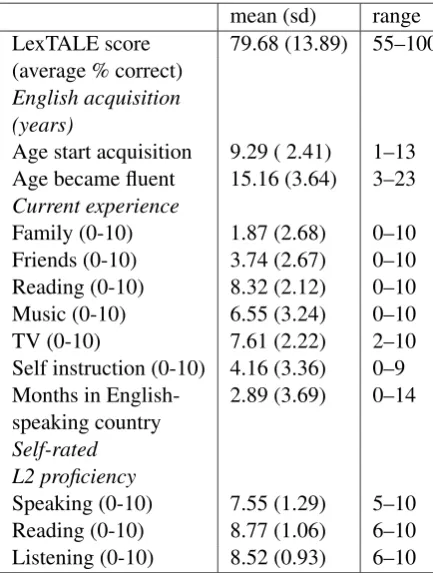
(LEAP-Q;Marian et al.,2007). Table 1 reports de-tails on age of English acquisition, exposure, and proficiency of the L2 speakers group. The tested L2 group reached an average LexTALE score of
79.68, supporting their classification as
interme-diate to advanced. Regarding their English ac-quisition, the L2 speakers started learning En-glish around the age of 9 and reported to have ac-quired fluency at around 15 years of age. On aver-age, their current experience with English comes mainly from reading (mean score of 8.32 out of 10), watching TV (mean score of 7.61 out of 10) and listening to music (mean score of 6.55 out of 10). Self-ratings of their English language profi-ciency based on a 10-point scale were relatively high (all mean scores greater 7.5).
mean (sd) range LexTALE score 79.68 (13.89) 55–100 (average % correct)
English acquisition (years)
Age start acquisition 9.29 ( 2.41) 1–13 Age became fluent 15.16 (3.64) 3–23
Current experience
Family (0-10) 1.87 (2.68) 0–10 Friends (0-10) 3.74 (2.67) 0–10 Reading (0-10) 8.32 (2.12) 0–10 Music (0-10) 6.55 (3.24) 0–10 TV (0-10) 7.61 (2.22) 2–10 Self instruction (0-10) 4.16 (3.36) 0–9 Months in English- 2.89 (3.69) 0–14 speaking country
Self-rated L2 proficiency
[image:4.595.72.289.290.577.2]Speaking (0-10) 7.55 (1.29) 5–10 Reading (0-10) 8.77 (1.06) 6–10 Listening (0-10) 8.52 (0.93) 6–10
Table 1: Summary of LexTALE scores and self-report information on English acquisition, exposure, and pro-ficiency)
2.2 Material
We used the same stimulus material as in Trem-blay et al.(2011). This material comprised of pairs of short sentences (mean length of sentences= 8.5
words (SD = 0.7)) that differed in exactly one
word. An example of such a pair is presented in (1a) and (1b):
1a I sat in themiddleof the bullet train.
1b I sat in thefrontof the bullet train.
The underlined portions in the sentences mark an MWS of either four or five words. The words in bold print are the words that distinguish MWS that are lexical bundles (LBs) – here in the mid-dle of the– from those that are not (NLBs) – here
in the front of the. Following Biber and Conrad (1999), the distinction of ‘lexical bundlehood’ was based on the frequencies of the MWS obtained from the spoken subcorpus of the BNC with fre-quency thresholds set to at least 10 occurrences per million words (for four-grams) and 5 occur-rences per million (for five-grams). As shown in (1a) and (b), the MWS – LBs or NLBs – were em-bedded after the second word of the sentence and were followed by two more words. The frequency of the words occurring before and after the MWS were controlled. The sentence material comprised a total of 20 such pairs – 40 sentences containing LBs and NLBs – as well as 40 filler sentences (20 of which made sense and 20 were nonsensical). The sentence material was split into two counter-balanced lists, list A and list B, each of which con-tained 10 sentences that concon-tained LBs, 10 sen-tences that contained NLBs, 10 filler sensen-tences that were meaningful, and 10 filler sentences that were nonsensical. A complete list of the stimulus material can be found inTremblay et al.(2011).
2.3 Procedure
ac-tually read and processed the material. Eye move-ments were recorded using a Tobii Tx300 remote eye tracker that records binocular gaze data at 300 Hz and filtered with the Tobii fixation filter with standard settings (velocity threshold = 30 pix-els/sample; distance threshold). The experiment took about 15 minutes (incl. calibration and ex-planation).
2.4 Statistical analysis
Eye movements were analyzed based on data col-lected from four measures: (1) first fixation du-ration (FFD), i.e. time spent initially fixating the MWS region, (2) first pass reading time (FPRT), i.e. sum of all the fixations made in the MWS re-gion until the point of fixation leaves the rere-gion, (3) total reading time (TRT), i.e. sums all fix-ation times made within a MWS region, includ-ing those fixations made when readinclud-ing the re-gion and (4) the number of regressive saccades into the MWS region (COUNT).1 L2 speakers’
sensitivity to MWS frequency was evaluated us-ing mixed-effect regression models implemented with the lme4 package (Bates et al.,2014) in the R environment (R Core Team, 2018). Separate models were fitted for each of the four dependent measures gathered in the eye-tracking experiment (FFD, FPRT, TRT, COUNT). Fixation times were logged (natural log) to reduce the nonnormality of their distributions. In each model, the depen-dent measure was regressed onto the predictor lex-ical bundlehood (dummy coded: LB vs. NLB). In addition, two control variables (length of MWS (in characters) and participants’ LexTALE scores, a measure of L2 vocabulary size) were entered into each model as fixed effects. All models had the maximal random-effects structure justified by the design (Barr et al.,2013), which included by-subject random intercepts and slopes for lexical bundlehood as well as random intercepts for items.
3 Results
Prior to the analyses, – for each eye tracking mea-sure – all trials that were more than 2 standard deviations above or below the participant’s mean
1FFD and FPRT are ‘early measures’ that are indicative of early processes during reading (e.g. familiarity checks, access to orthographic/phonological information and lexical meaning, cf.Reichle et al.,1998). TRT and COUNT are ‘late measures’ taken to reflect later processes (e.g. reanalysis of information, integration of information in discourse and re-covery from processing difficulties; cf.Rayner,1998).
score were removed. This led to a loss of data of about 5% (4.9% for FFD, 4.4% for FPRT, 4.7%
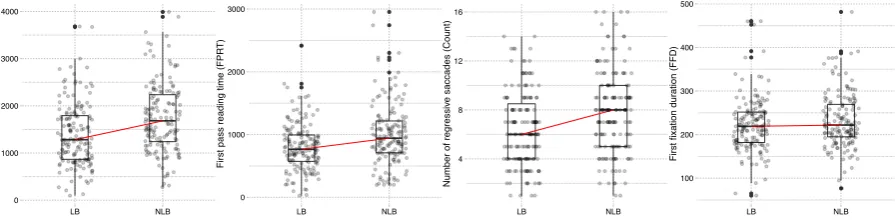
for TTR, and4.8%for COUNT). Figure 1 shows
the distributions of all four eye-tracking depen-dent measures for multiword sequences (MWS) that are lexical bundles (LB; left) and those that are not lexical bundles (NLB; right). The plots in Figure 1 suggest a processing advantage of MWS that are LB over those that are NLB for three out of the four eye tracking measures. On av-erage, participants exhibited shorter total reading times (TRT) (LB:M = 1397.59, SD = 672.38,
M edian = 1283.00; NLB: M = 1752.64,
SD= 730.06,M edian= 1681.50), shorter first
pass reading times (FPRT) (LB: M = 800.75,
SD = 374.76, M edian = 766; NLB: M = 1002.61, SD = 490.85, M edian = 943) and
a smaller number of regressive saccades to the region of interest (COUNT) (LB: M = 6.46,
SD = 3.04, M edian = 6; NLB: M = 7.82,
SD = 3.36, M edian = 8). The duration of
first fixation (FFD) was about the same across LBs and NLBs (LB : M = 222.44, SD = 63.04,
M edian = 219; NLB: M = 232.38, SD =
62.25,M edian= 221.92).
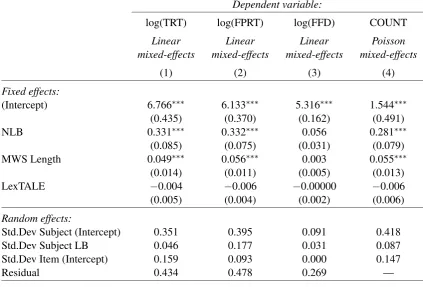
The results of the mixed effects models are pre-sented in Table 2. The top part of Table 2 presents the information regarding the effects of our key predictor variable, lexical bundlehood, and the two control variables, MWS length (in characters) and LexTALE scores. The ‘Intercept’ row lists the mean fixation times (for the TRT, FPRT and FFD measures) and regressive saccade count (for the COUNT measure) for LBs on the log scale. The ‘NLB’ row indicates the difference in log fixation times – or, in the case of the COUNT model, re-gressive saccade counts – between LBs and NLBs. The results show that – for all dependent vari-ables except FFD, which only approached sig-nificance – lexical bundlehood was found to be a significant predictor of eye movements, even after controlling for the effects of MWS length and LexTALE scores: Participants were signif-icantly faster in processing sentences containing LBs compared to sentences containing equivalent control items with NLBsN LBT RT: estimate =
0.33, SE = 0.09, t = 3.9, p < 0.001). After
0 1000 2000 3000 4000
LB NLB
Total reading time (TR
T)
0 1000 2000 3000
LB NLB
First pass reading time (FPR
T)
4 8 12 16
LB NLB
Number of regressiv
e saccades (Count)
100 200 300 400 500
LB NLB
First fixation dur
[image:6.595.77.525.62.172.2]ation (FFD)
Figure 1: Distributions of all four dependent measures from the eye-tracking experiments for multiwords sequences that are lexical bundles (LB) or not (NLB). Red lines connect the median values of the two contrasted MWS types.
ms faster on average. In comparison, (Tremblay et al.,2011) report a processing advantage of LB of 380ms in their self-paced reading time study (sentence-by-sentence presentation) on native En-glish speakers . First pass reading times (FPRT) of LBs were (exp(6.13 + 0.33)−exp(6.13) =)
181 ms faster (N LBF P RT: estimate = 0.33,
SE = 0.08, t = 4.41, p < .001).
Re-garding the COUNT measure, the model pre-dicted an average increase of (exp(1.544 + 0.281) -exp(1.544)=) 1.52 regressive saccades for NLBs relative to LBs (N LBCOU N T:estimate = 0.28,
SE = 0.08, t = 3.58, p < .001). The
difference in first fixation duration between LBs and NLB was just over (exp(5.316 + 0.056) −
exp(5.316) =) 11ms, which was marginally
sig-nificant (N LBF F D: estimate = 0.06, SE =
0.01, t = 1.81, p = 0.07)). The bottom part of
Table 2 presents the variability in the data that is attributable to random effects (e.g. some partic-ipants exhibited overall faster reading times than others). We found that – across the four eye track-ing measures - there was a relatively large amount of variability in reading speed between partici-pants (TRT: SD = 0.47, FPRT: SD = 0.39;
FFD:SD = 0.09; COUNT:0.42) and relatively
little between items (TRT: SD = 0.16, FPRT:
SD = 0.0.09; FFD: SD = 0; COUNT: 0.15).
The standard deviation for the by-subject random slopes for lexical bundlehood were minimal (all
SD <0.2), indicating that the LB effect was
con-sistent across subjects. This pattern of results is line with the results reported in (Tremblay et al., 2011).
4 Discussion
The main goal of the present study was to de-termine whether non-native (L2) speakers can develop sensitivity to the statistics of
composi-tional multiword sequences (MWS) larger than two words. To this end, the study aimed to repli-cate the processing advantage of such sequences found for native speakers (Tremblay et al.,2011) in a group of L2 speakers of English. As re-viewed in Section 1, (Tremblay et al., 2011)per-formed three self-paced reading studies to inves-tigate the facilitatory effects of lexical bundles (LBs) and found that the magnitude of the whole-string frequency effect increased with the length of the presentation window. We were able to replicate the MWS frequency effects using eye-tracking methodology: Mixed-effects modeling revealed that lexical bundlehood was a significant predictor of eye movements, even after controlling for the effects of MWS length and LexTale scores and after adjusting for the individual variation be-tween subjects and items: Participants were signif-icantly faster in processing sentences containing LBs compared to sentences containing equivalent control items with NLBs for all dependent vari-ables except first fixation duration (FFD), which approached significance (p <0.1). Similar results
Dependent variable:
log(TRT) log(FPRT) log(FFD) COUNT
Linear Linear Linear Poisson
mixed-effects mixed-effects mixed-effects mixed-effects
(1) (2) (3) (4)
Fixed effects:
(Intercept) 6.766∗∗∗ 6.133∗∗∗ 5.316∗∗∗ 1.544∗∗∗
(0.435) (0.370) (0.162) (0.491) NLB 0.331∗∗∗ 0.332∗∗∗ 0.056 0.281∗∗∗
(0.085) (0.075) (0.031) (0.079) MWS Length 0.049∗∗∗ 0.056∗∗∗ 0.003 0.055∗∗∗
(0.014) (0.011) (0.005) (0.013) LexTALE −0.004 −0.006 −0.00000 −0.006
(0.005) (0.004) (0.002) (0.006)
Random effects:
Std.Dev Subject (Intercept) 0.351 0.395 0.091 0.418 Std.Dev Subject LB 0.046 0.177 0.031 0.087 Std.Dev Item (Intercept) 0.159 0.093 0.000 0.147
Residual 0.434 0.478 0.269 —
[image:7.595.86.510.238.525.2]Note: *p < .05; **p < .01; ***p < .001
develop the sensitivity to the statistics of MWS. At a more general theoretical level, the results of the present study are consistent with emergentist accounts that challenge dual-system views of guage and instead argue for single-systems of lan-guage. More importantly, the results indicate that similarities between L1 and late L2 learning are more striking than the differences and, therefore, that unified theoretical models rather than separate ones are needed to account for the mechanisms used for L1 and L2 learning (see, e.g., MacWhin-ney, 2017). Emergentist accounts have proposed such mechanisms, namely that of statistical learn-ing and chunklearn-ing (see Section 1.1 for more de-tails). Sensitivity to the statistics of multiword sequences facilitates chunking - required to inte-grate the greatest possible amount of available in-formation as fast as possible so at to overcome the fleeting nature of linguistic input and the limited nature of our memory for sequences of linguistic input (Now-or-Never bottleneck, seeChristiansen and Chater,2016a).
Some of the questions left open by the current study may provide interesting avenues for future work. First, we investigated sensitivity to ‘sim-ple statistics‘ – i.e. corpus-derived frequencies – of MWS in non-native speakers. The question arises whether similar results could be obtained for ‘more complex’ distributional statistics using association measures, such as transitional proba-bility or mutual information or using information-theoretic measures, such as entropy as well as measures that capture the variability of MWS. Second, the stimulus material used in this study was derived from a corpus representing spoken language. In the light of growing evidence that the statistics of written input play a crucial role in the development of linguistic knowledge – as it pro-vides a source of substantial change in the statis-tics of an individual’s language experience (Sei-denberg and MacDonald,2018) – it would be im-portant to determine whether language users can ’tune to’ multiple statistics inherent in different registers/genres. And, third, it would be impor-tant to determine whether the ability to tune to the statistics of MWS is subject to individual differ-ences, and if so, to what extent these differences are linked to a host of experience-related, cogni-tive and affeccogni-tive factors.
References
Inbal Arnon and Morten H Christiansen. 2017. The role of multiword building blocks in explaining l1–l2 differences. Topics in Cognitive Science, 9(3):621–636.
Inbal Arnon and Neal Snider. 2010. More than words: Frequency effects for multi-word phrases. Journal of Memory and Language, 62(1):67–82.
Samaneh Babaei, Ferdos Taleb Najafabadi, and Zahra Fotovatnia. 2015. Processing of lexical bundles by persian speaking learners of english. Journal of Teaching Language Skills, 33(4):1–18.
Colin Bannard and Danielle Matthews. 2008. Stored word sequences in language learning: The effect of familiarity on children’s repetition of four-word combinations. Psychological Science, 19(3):241– 248.
Dale J Barr, Roger Levy, Christoph Scheepers, and Harry J Tily. 2013. Random effects structure for confirmatory hypothesis testing: Keep it maximal.
Journal of Memory and Language, 68(3):255–278. Douglas Bates, Martin Maechler, Ben Bolker, Steven
Walker, et al. 2014. lme4: Linear mixed-effects models using eigen and s4. R package version, 1(7):1–23.
Clay Beckner, Richard Blythe, Joan Bybee, Morten H Christiansen, William Croft, Nick C Ellis, John Hol-land, Jinyun Ke, Diane Larsen-Freeman, and Tom Schoenemann. 2009. Language is a complex adap-tive system: Position paper. Language Learning, 59(s1):1–26.
Douglas Biber and Susan Conrad. 1999. Lexical bun-dles in conversation and academic prose. Language and Computers, 26:181–190.
Franklin Chang, Gary S Dell, and Kathryn Bock. 2006. Becoming syntactic. Psychological Review, 113(2):234.
Nick Chater and Morten H Christiansen. 2018. Lan-guage acquisition as skill learning. Current opinion in behavioral sciences, 21:205–208.
Morten H Christiansen and Inbal Arnon. 2017. More than words: The role of multiword sequences in lan-guage learning and use. Topics in cognitive science, 9(3):542–551.
Morten H Christiansen and Nick Chater. 2016a. Cre-ating language: IntegrCre-ating evolution, acquisition, and processing. MIT Press.
Morten H Christiansen and Nick Chater. 2016b. The now-or-never bottleneck: A fundamental constraint on language. Behavioral and Brain Sciences, 39.
Christopher M Conway, Althea Bauernschmidt, Sean S Huang, and David B Pisoni. 2010. Implicit sta-tistical learning in language processing: Word pre-dictability is the key. Cognition, 114(3):356–371. Holger Diessel. 2007. Frequency effects in language
acquisition, language use, and diachronic change.
New Ideas in Psychology, 25(2):108–127.
Philip Durrant and Alice Doherty. 2010. Are high-frequency collocations psychologically real? inves-tigating the thesis of collocational priming. Corpus Linguistics and Linguistic Theory, 6(2):125–155. Philip Durrant and Norbert Schmitt. 2009. To what
ex-tent do native and non-native writers make use of collocations? IRAL-International Review of Applied Linguistics in Language Teaching, 47(2):157–177. Nick Ellis. 2008. The associative learning of
construc-tions, learned attention, and the limited l2 endstate. In Peter Robinson and Nick Ellis, editors,Handbook of cognitive linguistics and second language acqui-sition, chapter 15, pages 372–405. Routledge. Nick C Ellis. 2002. Frequency effects in language
pro-cessing: A review with implications for theories of implicit and explicit language acquisition. Studies in Second Language Acquisition, 24(2):143–188. Nick C. Ellis. 2019. Essentials of a theory of
lan-guage cognition. The Modern Language Journal, 103(S1):39–60.
Nick C Ellis and Diane Larsen-Freeman. 2006. Lan-guage emergence: Implications for Applied Linguis-tics. Introduction to the special issue. Applied Lin-guistics, 27(4):558–589.
Marc Ettlinger, Kara Morgan-Short, Mandy Faretta-Stutenberg, and Patrick Wong. 2016. The relation-ship between artificial and second language learn-ing. Cognitive Science, 40(4):822–847.
Ram Frost, Noam Siegelman, Alona Narkiss, and Liron Afek. 2013. What predicts successful literacy acqui-sition in a second language? Psychological Science, 24(7):1243–1252.
Mireia Hern´andez, Albert Costa, and Inbal Arnon. 2016. More than words: multiword frequency ef-fects in non-native speakers. Language, Cognition and Neuroscience, 31(6):785–800.
Ray Jackendoff and Ray S Jackendoff. 2002. Founda-tions of language: Brain, meaning, grammar, evolu-tion. Oxford University Press, USA.
Nan AN Jiang and Tatiana M Nekrasova. 2007. The processing of formulaic sequences by second lan-guage speakers. The Modern Language Journal, 91(3):433–445.
Dan Jurafsky. 2003. Probabilistic modeling in psy-cholinguistics: Linguistic comprehension and pro-duction. In Rens Bod, Jennifer Hay, and Ste-fanie Jannedy, editors,Probabilistic linguistics, vol-ume 21. Mit Press Cambridge, MA.
Elma Kerz and Daniel Wiechmann. 2017. Indi-vidual differences in l2 processing of multi-word phrases: Effects of working memory and personal-ity. In Computational and Corpus-Based Phrase-ology. EUROPHRAS 2017, pages 306–321. Lecture Notes in Computer Science, Springer. vol 10596.
Evan Kidd and Joanne Arciuli. 2016. Individual differences in statistical learning predict children’s comprehension of syntax. Child development, 87(1):184–193.
Evan Kidd, Seamus Donnelly, and Morten H Chris-tiansen. 2017. Individual differences in language acquisition and processing. Trends in Cognitive Sci-ences, pages 154–169.
Jill Lany and Jenny R Saffran. 2010. From statistics to meaning: Infants’ acquisition of lexical categories.
Psychological Science, 21(2):284–291.
Kristin Lemh¨ofer and Mirjam Broersma. 2012. Intro-ducing lextale: A quick and valid lexical test for advanced learners of english. Behavior Research Methods, 44(2):325–343.
Willem JM Levelt. 1993. Speaking: From intention to articulation, volume 1. MIT press.
Brian MacWhinney. 2012. The logic of the unified model. In Susan. M. Gass and Alison Mackey, ed-itors, The Routledge handbook of second language acquisition, pages 211–227. Routledge London & New York.
Brian MacWhinney. 2017. A shared platform for studying second language acquisition. Language Learning, 67(S1):254–275.
Brian MacWhinney and William O’Grady. 2015. The handbook of language emergence. John Wiley & Sons.
Viorica Marian, Henrike K Blumenfeld, and Margarita Kaushanskaya. 2007. The language experience and proficiency questionnaire (leap-q): Assessing lan-guage profiles in bilinguals and multilinguals. Jour-nal of Speech, Language, and Hearing Research.
Jessica Maye, Daniel J Weiss, and Richard N Aslin. 2008. Statistical phonetic learning in infants: Fa-cilitation and feature generalization. Developmental Science, 11(1):122–134.
Stewart M McCauley and Morten H Christiansen. 2019. Language learning as language use: A cross-linguistic model of child language development.
Psychological review, 126(1):1.
Jennifer B Misyak and Morten H Christiansen. 2012. Statistical learning and language: An individual dif-ferences study. Language Learning, 62(1):302–331.
Rosamond Mitchell, Florence Myles, and Emma Josephine Marsden. 2013. Second Language Learn-ing Theories: Third edition, 3rd edition. Routledge.
Luca Onnis, Stefan L Frank, Hongoak Yun, and Matthew Lou-Magnuson. 2016. Statistical learning bias predicts second-language reading efficiency. In
Proceedings of the 38th Annual Meeting of the Cog-nitive Science Society, pages 2105–2110.
Luca Onnis, Heidi R Waterfall, and Shimon Edel-man. 2008. Learn locally, act globally: Learn-ing language from variation set cues. Cognition, 109(3):423–430.
S´ebastien Pacton, Michel Fayol, and Pierre Perruchet. 2005. Children’s implicit learning of graphotactic and morphological regularities.Child Development, 76(2):324–339.
Steven Pinker. 1999.Words and rules: The ingredients of language. Basic Books.
R Core Team. 2018. R: A Language and Environment for Statistical Computing. R Foundation for Statis-tical Computing, Vienna, Austria.
Keith Rayner. 1998. Eye movements in reading and information processing: 20 years of research. Psy-chological bulletin, 124(3):372.
Martin Redington and Nick Chater. 1997. Probabilis-tic and distributional approaches to language acqui-sition. Trends in Cognitive Sciences, 1(7):273–281.
Erik D Reichle, Alexander Pollatsek, Donald L Fisher, and Keith Rayner. 1998. Toward a model of eye movement control in reading. Psychological review, 105(1):125.
Jenny R Saffran, Richard N Aslin, and Elissa L New-port. 1996. Statistical learning by 8-month-old in-fants.Science, 274(5294):1926–1928.
Jenny R Saffran and Diana P Wilson. 2003. From syl-lables to syntax: multilevel statistical learning by 12-month-old infants. Infancy, 4(2):273–284.
Mark S Seidenberg and Maryellen C MacDonald. 2018. The impact of language experience on lan-guage and reading: A statistical learning approach.
Topics in Language Disorders, 38(1):66–83.
Cyrus Shaoul and Chris Westbury. 2011. Formulaic sequences: Do they exist and do they matter? The mental lexicon, 6(1):171–196.
Noam Siegelman and Ram Frost. 2015. Statistical learning as an individual ability: Theoretical per-spectives and empirical evidence. Journal of Mem-ory and Language, 81:105–120.
Anna Siyanova-Chanturia, Kathy Conklin, and Norbert Schmitt. 2011. Adding more fuel to the fire: An eye-tracking study of idiom processing by native and non-native speakers. Second Language Research, 27(2):251–272.
Erik D Thiessen and Jenny R Saffran. 2003. When cues collide: use of stress and statistical cues to word boundaries by 7-to 9-month-old infants. Develop-mental Psychology, 39(4):706.
Susan P Thompson and Elissa L Newport. 2007. Sta-tistical learning of syntax: The role of transitional probability. Language Learning and Development, 3(1):1–42.
Antoine Tremblay, Bruce Derwing, Gary Libben, and Chris Westbury. 2011. Processing advantages of lexical bundles: Evidence from self-paced read-ing and sentence recall tasks. Language Learning, 61(2):569–613.
Alison Wray. 2013. Formulaic language. Language Teaching, 46(3):316–334.