Proceedings of the Fourth Conference on Machine Translation (WMT), Volume 3: Shared Task Papers (Day 2) pages 106–111 106
SOURCE: SOURce-Conditional Elmo-style Model
for Machine Translation Quality Estimation
Junpei Zhou∗ Zhisong Zhang∗ Zecong Hu∗
Language Technologies Institute Carnegie Mellon University
{junpeiz, zhisongz, zeconghu}@andrew.cmu.edu
Abstract
Quality estimation (QE) of machine transla-tion (MT) systems is a task of growing im-portance. It reduces the cost of post-editing, allowing machine-translated text to be used in formal occasions. In this work, we de-scribe our submission system in WMT 2019 sentence-level QE task. We mainly explore the utilization of pre-trained translation models in QE and adopt a bi-directional translation-like strategy. The strategy is similar to ELMo, but additionally conditions on source sentences. Experiments on WMT QE dataset show that our strategy, which makes the pre-training slightly harder, can bring improvements for QE. In WMT-2019 QE task, our system ranked in the second place on En-De NMT dataset and the third place on En-Ru NMT dataset.
1 Introduction
The quality of machine translation systems have been significantly improved over the past few years (Chatterjee et al.,2018), especially with the development of neural machine translation (NMT) models (Sutskever et al., 2014; Bahdanau et al., 2014). Despite such inspiring improvements, some machine translated texts are still error-prone and unreliable compared to those by professional humans. It is often desirable to have human ex-perts perform post-editing on machine-translated text to achieve a balance between cost and cor-rectness. Correspondingly, we may also want to develop automatic quality estimation systems to judge the quality of machine translation outputs, leading to the development of the Machine Trans-lation Quality Estimation task. The task of QE aims to evaluate the output of a machine trans-lation system without access to reference transla-tions. It would allow human experts to concentrate
∗
equal contribution
on translations that are estimated of low-quality, further reducing post-editing cost.
In this work, we focus on sentence-level QE and describe our submission to the WMT 2019 QE task. Sentence-level QE aims to predict a score for the entire source–translation pair that in-dicates the effort required for further post-editing. The goals of the task are two-fold: 1) to pre-dict the required post-editing cost, measured in HTER (Snover et al.,2006); 2) to rank all sentence pairs in descending translation quality.
press the button drück den Knopf
SRC Input
SRC Vectors TRG Vectors
QE Vectors
(Masked) TRG Input
Source Encoder Target Decoder QE Encoder
MT Module (Trained with Parallel Data) QE Module (Trained with QE Data)
QE Score Token Reconstruction Loss Regression Loss
[image:2.595.115.487.67.237.2]Gold HTER Score
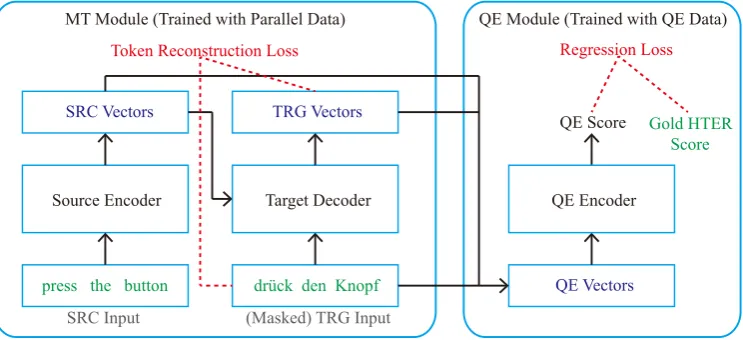
Figure 1: The architecture of our QE system, which consists of two modules: 1) the MT Module encodes the bilingual information and can be pre-trained with large parallel data, 2) the QE Module adopts the source and target representations from the MT Module and further encodes those information followed by a final linear layer for QE scoring.
2 System
2.1 Basic Framework
We follow previous works and adopt the end-to-end styled model for the QE scoring task. The overall system architecture is shown in Figure1. The system consists of two components: 1) a pre-trained MT module which learns the representa-tions of the source and target sentences, 2) a QE scorer which takes the representations from the MT module as inputs and predicts the translation quality score.
The MT module is pre-trained on large paral-lel corpus. It is trained to predict each token in the translated sentence by using the information in source sentence and tokens in the translated sen-tence. Details of the model will be described in Section2.2.
In the QE scorer module, the problem can be cast as a regression task, where the QE score is predicted given the source and target sentences. The original inputs are encoded by the pre-trained MT module, whose outputs are taken as input fea-tures for this module. We basically follow the model architecture ofWang et al.(2018). For each token, a quality vector is formed as:
qj = Concat(←z−j,−→zj, etj−1, etj+1, fjmm), (1)
where←z−j,−→zj are state vectors produced by the bi-directional Transformer, and et
j−1, etj+1 are
em-bedding vectors. The “mismatching feature”fjmm
is formed by extracting the score corresponding
to yj, the highest score in the distribution, their difference, and an indicator of whetheryj has the highest score. After this, the quality vectors are viewed as another sequence and encoded by the Bi-LSTM/Transformer Quality Estimator to pre-dict the QE score. The loss function for training is mean squared error which is typical for regression tasks.
2.2 Pre-trained Translation Models
Bilingual Expert We start with a short descrip-tion for the model of Wang et al. (2018). The model can be seen as a token-level reconstruction-styled translation model: each target word yj is predicted given a source sentence and all other target words {. . . , yj−1, yj+1, . . .}. This setting
W1 ... W... i-1 Wi Wi+1 ... W... n SRC
TRG
Forw. Decoder Back. Decoder Loss
a) Bilingual Expert
W1 ... W... i-1 Wi Wi+1 ... W... n SRC
TRG
Forw. Decoder Back. Decoder Back-Loss Forw-Loss
b) Elmo Style
W1 ... W... i-1 Wi Wi+1 ... W... n SRC
TRG
[image:3.595.73.282.67.337.2]Full Decoder Loss c) BERT Style
Figure 2: Illustration of reconstruction loss for the token “Wi” in different pre-training strategies. a) In Bilingual Expert, one reconstruction loss is computed for each token, conditioned on the entire target con-text provided by the Forward and Backward decoders. b) With Elmo-Style, it is equivalent to training bidi-rectional translation models. Two reconstruction losses are computed for each token, each only depending on one side of the context. c) With BERT-Style, certain inputs are masked out (colored in grey) and a masked-LM is learned. One reconstruction loss is computed for each masked token.
{←z−1, . . . ,←−zmt}are computed as:
c1, . . . , cms =Encoder(x1, . . . , xms), −
→z
1, . . . ,−→zmt =
−−−−−→
Decoder(y1, . . . , ymt, c1, . . . , cms), ←z−
1, . . . ,←−zmt =
←−−−−−
Decoder(y1, . . . , ymt, c1, . . . , cms).
Both encoder and decoders use Trans-former (Vaswani et al., 2017) as their backbone for its better performances in machine translation tasks.
After obtaining these representations, the model is trained with the token reconstruction cross-entropy loss for each target token with contextual information from both sides:
logp(yj |yi6=j, x) = softmax(ff([−→zj−1;←z−j+1])).
(2) Here “ff” denotes a feed-forward layer. Note that we cannot use representations that captureyj,
therefore, we use the forward representation of the previous token−→zj−1and the backward
representa-tion of the next token←z−j+1.
SOURCE In the Bilingual Expert model, each target token is predicted given all target tokens on both sides. However, this training scheme makes too much information visible to the model, such that the model could predict the target word even without seeing the source sentence.
For example, we can easily infer that the miss-ing word in “He loves playmiss-ing and his favorite basketball player is Michael Jordan” is “basketball”. In another words, too much visi-ble information on the target side provides an in-ductive bias that pushes the model towards learn-ing a bi-directional language model instead of a translation-like model, by omitting the informa-tion on the source sentence.
We want to force our model to exploit the re-lationship between the source tokens and target tokens. Thus, we no longer make the words on both sides visible to our model at the same time. Instead, we separate the two directions, so that the model must predict each target word de-pending only on the source sentence and target words on one side. More specifically, we com-pute two losses, `1 and `2. The cross-entropy
loss `1 is derived by predicting the target word
yj based on the source sentence {x0, . . . , xms} and left-side target words {y0, . . . , yj−1}.
An-other cross-entropy loss `2 is derived by
predict-ing yj based on the source sentence and right-side target words {yj+1, . . . , ymt}. This train-ing scheme corresponds to the strategy used in ELMo (Peters et al., 2018), but the difference is that here we condition on additional source in-formation, hence the name SOURce-Conditional Elmo-style (SOURCE) model.
Dataset Parallel QE
train dev test
En-De-SMT
[image:4.595.82.280.63.145.2]32.8M 26299 1000 1926 En-De-NMT 13442 1000 1023 En-Ru 8.0M 15089 1000 1023
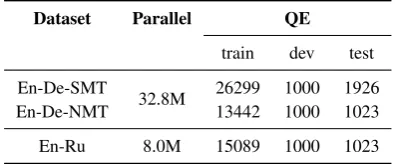
Table 1: Statistics of the parallel data and QE data.
From empirical results of SOURCE, we find that although the prediction accuracy on MT par-allel data decreases, the final performance on QE increases significantly. This shows that decreas-ing the visible information makes token-prediction more difficult, and forces the model to learn more useful structures from the data, which in turn be-comes features of higher quality for the QE task.
2.3 Model Ensemble
We perform model ensembling by stacking, which means we use the prediction results of different models on the development set as new features, and train a simple regression model to predict the actual development set labels. Finally, the regres-sion model is applied on the predictions of differ-ent models on test set. We use ridge regression here as the regression model. We also use grid search and cross-validation to select the regular-ization weight for ridge regression.
We train both the pre-trained MT module and the QE scorer module with different hyper-parameters to produce different models for en-sembling. For the pre-trained MT module, tog-gled hyper-parameters include number of lay-ers, number of self-attention heads, learning rate, label-smoothing rate, warm-up steps, and dropout rates. For the QE scorer module, toggled hyper-parameters include number of layers, hidden size, percentage of augmented data, encoder type (LSTM or Transformer), and dropout rate.
3 Experiments
3.1 Settings
Our system is evaluated on the WMT18/19 QE sentence-level task. The main metric is the Pear-son’srcorrelation score between predicted scores and ground-truth HTER scores. There are other metrics including Mean Absolute Error (MAE) and Root Mean Squared Error (RMSE) for scoring and the Spearman’s ρ rank correlation for rank-ing. We evaluate our models on datasets in the
WMT 18/19 shared task with different translation systems: WMT-18 De-SMT, WMT-18/19 En-De-NMT, WMT-19 En-Ru-NMT. For experiments on WMT-19 data, we report results based on offi-cial evaluation results.
Data For the parallel data used in pre-training of the MT module, we collect large-scale parallel corpora for En-De and En-Ru from the WMT-18 translation task. Officially pre-processed data1are utilized. To make it compatible with QE data, we re-escaped certain punctuation tokens. To reduce the corpus size, we further apply a more strict fil-tering step by discarding sentence pairs with too many overlapping words in their source and target sentences (> 0.9 for En-De, > 0.5 for En-Ru). Finally, we obtain 32.1M EN-De and 7.8M En-Ru sentence pairs and mix it with the training set of the QE data (using post-edited sentences as target). Our mixing strategy is to mix one copy of QE data for every 1M of parallel data. The statistics of the mixed parallel data and QE data are summarized in Table1.
FollowingWang et al.(2018), we also prepare artificial data via round-trip translation ( Junczys-Dowmunt and Grundkiewicz,2016,2017). Since the QE data are obtained with two kinds of transla-tion systems: SMT and NMT, we also prepare two kinds of artificial data. For simplicity, we take the back-translated corpus by the Edinburgh’s transla-tion system,2which contains 3.6M back-translated sentences for En-De and 1.9M for En-Ru. We fur-ther train a SMT system with Moses and decode the English sentence back to German. For NMT, we simply take a pre-trained NMT system (also Edinburgh’s system3) for decoding.
Implementation We implement our system from scratch in Python with TensorFlow (Abadi et al., 2015) and OpenNMT (Klein et al., 2017). Because of limited resources, we manually search for good hyper-parameters by heuristics evaluated on the development set. The training of the MT module takes around 4 to 5 days and the training of the QE module takes a couple of hours with one GPU.
1
http://data.statmt.org/wmt18/
translation-task/preprocessed/. According to the official script, the data is processed with tokenization, cleaning and truecase with standard Moses scripts.
2
http://data.statmt.org/rsennrich/ wmt16_backtranslations/.
System test 2018 En-De-SMT test 2018 En-De-NMT
Pearsonr↑ MAE↓ RMSE↓ Pearsonr↑ MAE↓ RMSE↓ Spearmanρ↑
Alibaba (ensemble) 0.7397 0.0937 0.1362 0.5012 0.1131 0.1742 0.6049 JXNU (ensemble) 0.7000 0.0962 0.1382 0.5129 0.1114 0.1749 0.6052 SOURCE (ours, ensemble) — — — 0.5474 0.1123 0.1623 0.6155
SOURCE (ours) 0.6970 0.1009 0.1409 0.4956 0.1197 0.1797 — Bilingual Expert (our impl.) 0.6645 0.1089 0.1488 0.4447 0.1240 0.1791 — melaniad 0.4877 0.1316 0.1675 0.4198 0.1359 0.1770 — cscarton 0.4872 0.1321 0.1714 0.3808 0.1297 0.1785 —
Table 2: Evaluation results on the test sets of WMT-18 En-De-SMT and WMT-18 NMT. The two leading teams only provide ensemble results on 2018 test data. We re-implement Alibaba’s single model (Bilingual Expert) and achieved similar results on 2017 data as reported in their paper. We test that Bilingual Expert on 2018 data to make a fair comparison for single model. With limited computational resource, we only run the ensemble for En-De-NMT, because in WMT2019 they only requires NMT submission.
System En-De-NMT En-Ru-NMT
Pearsonr↑ Spearmanρ↑ Pearsonr↑ Spearmanρ↑
UNBABEL 0.5718 0.6221 0.5923 0.5388 SOURCE (ours) 0.5474 0.5947 0.4575 0.4039
NJU 0.5433 0.5694 – –
ETRI 0.5260 0.5745 0.5327 0.5222
Table 3: Evaluation results on the WMT-19 QE sentence-level shared task. Here we only show the top four teams.
3.2 Results
WMT-18 En-De-SMT Results are shown on the left side of Table2. We can see that our SOURCE model significantly outperforms the state-of-the-art single model from the previous year (Bilingual Expert) and is comparable to the ensemble model from JXNU.
WMT-18 En-De-NMT We evaluate our model through CodaLab, which is recommended by the host. Results are shown on the right side of Table 2. The results are similar to the SMT ones, our sin-gle SOURCE model can obtain results comparable to the best ensemble systems. It is worth men-tioning that our ensemble model significantly out-performs the best system from the previous year on both scoring (Pearson r) and ranking (Spear-manρ) subtasks.
WMT-19 En-De-NMT and En-Ru-NMT The official result from WMT-19 is shown in Table3. Our system achieves the second place on En-De and the third place on En-Ru. It is worth men-tioning that due to the limitation of computational resource, we train far fewer models for En-Ru than En-De, so it is reasonable that our system performs
much better on the En-De dataset.
4 Conclusion and Discussion
Empirical results indicate that decreasing the visi-ble information makes token-prediction more dif-ficult, and forces the model to learn more useful structures from the data, which in turn becomes features of higher quality for the QE task. The experimental results on WMT-18 shows the effec-tiveness of our SOURCE model as well as our stacking ensemble strategy. According to the offi-cial evaluation results on WMT-19 dataset, our en-semble SOURCE modela chieves the second place on En-De dataset and the third place on En-Ru dataset.
We will explore the BERT-style structure to bet-ter condition on source sentences in the future.
References
Moore, Derek Murray, Chris Olah, Mike Schus-ter, Jonathon Shlens, Benoit Steiner, Ilya Sutskever, Kunal Talwar, Paul Tucker, Vincent Vanhoucke, Vijay Vasudevan, Fernanda Vi´egas, Oriol Vinyals, Pete Warden, Martin Wattenberg, Martin Wicke, Yuan Yu, and Xiaoqiang Zheng. 2015. TensorFlow: Large-scale machine learning on heterogeneous sys-tems. Software available from tensorflow.org.
Dzmitry Bahdanau, Kyunghyun Cho, and Yoshua Ben-gio. 2014. Neural machine translation by jointly learning to align and translate. arXiv preprint arXiv:1409.0473.
Rajen Chatterjee, Matteo Negri, Raphael Rubino, and Marco Turchi. 2018. Findings of the WMT 2018 shared task on automatic post-editing. In Proceed-ings of the Third Conference on Machine Transla-tion: Shared Task Papers, pages 710–725.
Jacob Devlin, Ming-Wei Chang, Kenton Lee, and Kristina Toutanova. 2018. Bert: Pre-training of deep bidirectional transformers for language understand-ing. arXiv preprint arXiv:1810.04805.
Kai Fan, Bo Li, Fengming Zhou, and Jiayi Wang. 2018. “bilingual expert” can find translation errors. CoRR, abs/1807.09433.
Marcin Junczys-Dowmunt and Roman Grundkiewicz. 2016. Log-linear combinations of monolingual and bilingual neural machine translation models for
au-tomatic post-editing. In Proceedings of the First
Conference on Machine Translation, pages 751– 758, Berlin, Germany.
Marcin Junczys-Dowmunt and Roman Grundkiewicz. 2017. An exploration of neural sequence-to-sequence architectures for automatic post-editing. In Proceedings of the Eighth International Joint Conference on Natural Language Processing (Vol-ume 1: Long Papers), pages 120–129, Taipei, Tai-wan.
Hyun Kim and Jong-Hyeok Lee. 2016. A recurrent neural networks approach for estimating the quality of machine translation output. InProceedings of the 2016 Conference of the North American Chapter of the Association for Computational Linguistics: Hu-man Language Technologies, pages 494–498, San Diego, California.
G. Klein, Y. Kim, Y. Deng, J. Senellart, and A. M. Rush. 2017. OpenNMT: Open-Source Toolkit for Neural Machine Translation.ArXiv e-prints.
Guillaume Lample and Alexis Conneau. 2019. Cross-lingual language model pretraining. arXiv preprint arXiv:1901.07291.
Matthew E. Peters, Mark Neumann, Mohit Iyyer, Matt Gardner, Christopher Clark, Kenton Lee, and Luke Zettlemoyer. 2018. Deep contextualized word rep-resentations. InProc. of NAACL.
Matthew Snover, Bonnie Dorr, Richard Schwartz, Lin-nea Micciulla, and John Makhoul. 2006. A study of translation edit rate with targeted human annotation. In Proceedings of association for machine transla-tion in the Americas, volume 200.
Ilya Sutskever, Oriol Vinyals, and Quoc V Le. 2014. Sequence to sequence learning with neural net-works. InAdvances in neural information process-ing systems, pages 3104–3112.
Ashish Vaswani, Noam Shazeer, Niki Parmar, Jakob Uszkoreit, Llion Jones, Aidan N Gomez, Łukasz Kaiser, and Illia Polosukhin. 2017. Attention is all you need. InAdvances in Neural Information Pro-cessing Systems, pages 5998–6008.