440
Baseline Needs More Love: On Simple Word-Embedding-Based Models
and Associated Pooling Mechanisms
Dinghan Shen1, Guoyin Wang1, Wenlin Wang1, Martin Renqiang Min2 Qinliang Su3, Yizhe Zhang4, Chunyuan Li1, Ricardo Henao1, Lawrence Carin1
1Duke University 2NEC Laboratories America 3Sun Yat-sen University 4Microsoft Research
Abstract
Many deep learning architectures have been proposed to model the composition-ality in text sequences, requiring a sub-stantial number of parameters and ex-pensive computations. However, there has not been a rigorous evaluation re-garding the added value of sophisticated compositional functions. In this paper, we conduct a point-by-point comparative study between Simple Word-Embedding-based Models (SWEMs), consisting of parameter-free pooling operations, rela-tive to word-embedding-based RNN/CNN models. Surprisingly, SWEMs exhibit comparable or even superior performance in the majority of cases considered. Based upon this understanding, we propose two additional pooling strategies over learned word embeddings: (i) a max-pooling operation for improved interpretability; and (ii) a hierarchical pooling operation, which preserves spatial (n-gram) informa-tion within text sequences. We present experiments on 17 datasets encompassing three tasks: (i) (long) document classifi-cation; (ii) text sequence matching; and (iii) short text tasks, including classifica-tion and tagging.
1 Introduction
Word embeddings, learned from massive unstruc-tured text data, are widely-adopted building blocks for Natural Language Processing (NLP). By rep-resenting each word as a fixed-length vector, these embeddings can group semantically simi-lar words, while implicitly encoding rich linguis-tic regularities and patterns (Bengio et al., 2003;
Mikolov et al., 2013; Pennington et al., 2014).
Leveraging the word-embedding construct, many deep architectures have been proposed to model the compositionality in variable-length text se-quences. These methods range from simple op-erations like addition (Mitchell and Lapata,2010;
Iyyer et al.,2015), to more sophisticated compo-sitional functions such as Recurrent Neural Net-works (RNNs) (Tai et al., 2015;Sutskever et al.,
2014), Convolutional Neural Networks (CNNs) (Kalchbrenner et al., 2014; Kim, 2014; Zhang et al., 2017a) and Recursive Neural Networks (Socher et al.,2011a).
Models with more expressive compositional functions, e.g., RNNs or CNNs, have demon-strated impressive results; however, they are typ-ically computationally expensive, due to the need to estimate hundreds of thousands, if not millions, of parameters (Parikh et al., 2016). In contrast, models with simple compositional functions often compute a sentence or document embedding by simply adding, or averaging, over the word em-bedding of each sequence element obtained via,
e.g., word2vec (Mikolov et al., 2013), or GloVe
(Pennington et al.,2014). Generally, such a Sim-ple Word-Embedding-based Model (SWEM) does not explicitly account for spatial, word-order in-formation within a text sequence. However, they possess the desirable property of having signif-icantly fewer parameters, enjoying much faster training, relative to RNN- or CNN-based models. Hence, there is a computation-vs.-expressiveness tradeoff regarding how to model the composition-ality of a text sequence.
compare SWEM-based models with existing re-current and convolutional networks in a point-by-point manner. Specifically, we consider 17 datasets, including three distinct NLP tasks: doc-ument classification (Yahoo news, Yelp reviews,
etc.),natural language sequence matching(SNLI, WikiQA, etc.) and (short) sentence classifica-tion/tagging(Stanford sentiment treebank, TREC,
etc.). Surprisingly, SWEMs exhibit comparable or even superior performance in the majority of cases considered.
In order to validate our experimental findings, we conduct additional investigations to understand to what extent the word-order informationis uti-lized/required to make predictions on different tasks. We observe that in text representation tasks, many words (e.g., stop words, or words that are not related to sentiment or topic) do not meaning-fully contribute to the final predictions (e.g., sen-timent label). Based upon this understanding, we propose to leverage a max-pooling operation di-rectly over the word embedding matrix of a given sequence, to select its mostsalientfeatures. This strategy is demonstrated to extract complementary features relative to the standard averaging opera-tion, while resulting in a more interpretable model. Inspired by a case study on sentiment analysis tasks, we further propose a hierarchical pooling
strategy to abstract and preserve the spatial infor-mation in the final representations. This strategy is demonstrated to exhibit comparable empirical results to LSTM and CNN on tasks that are sensi-tive to word-order features, while maintaining the favorable properties of not having compositional parameters, thus fast training.
Our work presents a simple yet strong base-line for text representation learning that is widely ignored in benchmarks, and highlights the gen-eral computation-vs.-expressiveness tradeoff asso-ciated with appropriately selecting compositional functions for distinct NLP problems. Furthermore, we quantitatively show that the word-embedding-based text classification tasks can have the similar level of difficulty regardless of the employed mod-els, using the subspace training (Li et al.,2018) to constrain the trainable parameters. Thus, accord-ing to Occam’s razor, simple models are preferred.
2 Related Work
A fundamental goal in NLP is to develop expres-sive, yet computationally efficient compositional
functions that can capture the linguistic structure of natural language sequences. Recently, several studies have suggested that on certain NLP ap-plications, much simpler word-embedding-based architectures exhibit comparable or even superior performance, compared with more-sophisticated models using recurrence or convolutions (Parikh et al., 2016; Vaswani et al., 2017). Although complex compositional functions are avoided in these models, additional modules, such as atten-tion layers, are employed on top of the word em-bedding layer. As a result, the specific role that the word embedding plays in these models is not emphasized (or explicit), which distracts from un-derstanding how important the word embeddings alone are to the observed superior performance. Moreover, several recent studies have shown em-pirically that the advantages of distinct composi-tional functions are highly dependent on the spe-cific task (Mitchell and Lapata,2010;Iyyer et al.,
2015; Zhang et al., 2015a; Wieting et al., 2015;
Arora et al., 2016). Therefore, it is of interest to study the practical value of the additional expres-siveness, on a wide variety of NLP problems.
SWEMs bear close resemblance to Deep Aver-aging Network (DAN) (Iyyer et al.,2015) or fast-Text (Joulin et al., 2016), where they show that average pooling achieves promising results on cer-tain NLP tasks. However, there exist several key differences that make our work unique. First, we explore a series of pooling operations, rather than only average-pooling. Specifically, a hierarchi-calpooling operation is introduced to incorporate spatial information, which demonstrates superior results on sentiment analysis, relative to average pooling. Second, our work not only explores when simple pooling operations are enough, but also in-vestigates the underlying reasons, i.e., what se-mantic features are required for distinct NLP prob-lems. Third, DAN and fastText only focused on one or two problems at a time, thus a compre-hensive study regarding the effectiveness of vari-ous compositional functions on distinct NLP tasks,
3 Models & training
Consider a text sequence represented as X (ei-ther a sentence or a document), composed of a se-quence of words: {w1, w2, ...., wL}, where L is the number of tokens,i.e., the sentence/document length. Let{v1, v2, ...., vL}denote the respective word embeddings for each token, wherevl 2RK. The compositional function, X ! z, aims to combine word embeddings into a fixed-length sen-tence/document representationz. These represen-tations are then used to make predictions about se-quenceX. Below, we describe different types of functions considered in this work.
3.1 Recurrent Sequence Encoder
A widely adopted compositional function is de-fined in a recurrent manner: the model succes-sively takes word vector vt at position t, along with the hidden unit ht 1 from the last position
t 1, to update the current hidden unit viaht = f(vt, ht 1), wheref(·)is the transition function.
To address the issue of learning long-term de-pendencies, f(·) is often defined as Long
Short-Term Memory (LSTM) (Hochreiter and Schmid-huber,1997), which employsgatesto control the flow of information abstracted from a sequence. We omit the details of the LSTM and refer the in-terested readers to the work byGraves et al.(2013) for further explanation. Intuitively, the LSTM en-codes a text sequence considering its word-order information, but yields additional compositional parameters that must be learned.
3.2 Convolutional Sequence Encoder
The Convolutional Neural Network (CNN) archi-tecture (Kim, 2014; Collobert et al., 2011; Gan et al., 2017; Zhang et al., 2017b; Shen et al.,
2018) is another strategy extensively employed as the compositional function to encode text se-quences. The convolution operation considers windows of n consecutive words within the se-quence, where a set of filters (to be learned) are applied to these word windows to generate corre-sponding feature maps. Subsequently, an aggre-gation operation (such as max-pooling) is used on top of the feature maps to abstract the most salient semantic features, resulting in the final representa-tion. For most experiments, we consider a single-layer CNN text model. However, Deep CNN text models have also been developed (Conneau et al.,
2016), and are considered in a few of our experi-ments.
3.3 Simple Word-Embedding Model (SWEM)
To investigate the raw modeling capacity of word embeddings, we consider a class of models with no additional compositional parameters to en-code natural language sequences, termed SWEMs. Among them, the simplest strategy is to compute the element-wise average over word vectors for a given sequence (Wieting et al., 2015; Adi et al.,
2016):
z= 1
L L
X
i=1
vi. (1)
The model in (1) can be seen as an average pool-ing operation, which takes the mean over each of theKdimensions for all word embeddings, result-ing in a representationzwith the same dimension as the embedding itself, termed here SWEM-aver. Intuitively, z takes the information of every se-quence element into account via the addition op-eration.
Max Pooling Motivated by the observation that, in general, only a small number of key words con-tribute to final predictions, we propose another SWEM variant, that extracts the most salient fea-tures from every word-embedding dimension, by taking the maximum value along each dimension of the word vectors. This strategy is similar to the max-over-time pooling operation in convolutional neural networks (Collobert et al.,2011):
z=Max-pooling(v1, v2, ..., vL). (2)
We denote this model variant as SWEM-max. Here the j-th component of z is the maximum element in the set {v1j, . . . , vLj}, where v1j is, for example, thej-th component ofv1. With this
pooling operation, those words that are unimpor-tant or unrelated to the corresponding tasks will be ignored in the encoding process (as the com-ponents of the embedding vectors will have small amplitude), unlike SWEM-averwhere every word contributes equally to the representation.
Considering that SWEM-averand SWEM-max
Model Parameters Complexity Sequential Ops CNN n·K·d O(n·L·K·d) O(1)
LSTM 4·d·(K+d) O(L·d2+L·K·d) O(L)
[image:4.595.74.289.65.106.2]SWEM 0 O(L·K) O(1)
Table 1: Comparisons of CNN, LSTM and SWEM architectures. Columns correspond to the number ofcompositionalparameters, computational com-plexity and sequential operations, respectively.
learned. As a result, the models only exploit intrin-sic word embedding information for predictions.
Hierarchical Pooling Both SWEM-aver and SWEM-maxdo not take word-order or spatial in-formation into consideration, which could be use-ful for certain NLP applications. So motivated, we further propose a hierarchicalpooling layer. Let vi:i+n 1 refer to the local window consisting of
n consecutive words words, vi, vi+1, ..., vi+n 1.
First, an average-pooling is performed on each local window, vi:i+n 1. The extracted features
from all windows are further down-sampled with aglobalmax-pooling operation on top of the rep-resentations for every window. We call this ap-proach SWEM-hierdue to its layered pooling.
This strategy preserves the local spatial infor-mation of a text sequence in the sense that it keeps track of how the sentence/document is constructed from individual word windows,i.e.,n-grams. This formulation is related to bag-of-n-grams method (Zhang et al., 2015b). However, SWEM-hier
learns fixed-length representations for then-grams that appear in the corpus, rather than just capturing their occurrences via count features, which may potentially advantageous for prediction purposes.
3.4 Parameters & Computation Comparison
We compare CNN, LSTM and SWEM wrt their parameters and computational speed. K denotes the dimension of word embeddings, as above. For the CNN, we usento denote the filter width (as-sumed constant for all filters, for simplicity of analysis, but in practice variable nis commonly used). We definedas the dimension of the final sequence representation. Specifically,drepresents the dimension of hidden units or the number of fil-ters in LSTM or CNN, respectively.
We first examine the number of compositional parametersfor each model. As shown in Table1, both the CNN and LSTM have a large number of parameters, to model the semantic compositional-ity of text sequences, whereas SWEM has no such
parameters. Similar toVaswani et al.(2017), we then consider the computational complexity and the minimum number of sequential operations re-quired for each model. SWEM tends to be more efficient than CNN and LSTM in terms of compu-tation complexity. For example, considering the case whereK =d, SWEM is faster than CNN or
LSTM by a factor ofndord, respectively. Further, the computations in SWEM are highly paralleliz-able, unlike LSTM that requiresO(L)sequential
steps.
4 Experiments
We evaluate different compositional functions on a wide variety of supervised tasks, including document categorization, text sequence matching (given a sentence pair, X1, X2, predict their
re-lationship,y) as well as (short) sentence classifi-cation. We experiment on 17 datasets concerning natural language understanding, with correspond-ing data statistics summarized in the Supplemen-tary Material. Our code will be released to encour-age future research.
We use GloVe word embeddings withK= 300
(Pennington et al., 2014) as initialization for all our models. Out-Of-Vocabulary (OOV) words are initialized from a uniform distribution with range
[ 0.01,0.01]. The GloVe embeddings are
ployed in two ways to learn refined word em-beddings: (i) directly updating each word em-bedding during training; and (ii) training a 300-dimensional Multilayer Perceptron (MLP) layer with ReLU activation, with GloVe embeddings as input to the MLP and with output defining the re-fined word embeddings. The latter approach cor-responds to learning an MLP model that adapts GloVe embeddings to the dataset and task of in-terest. The advantages of these two methods dif-fer from dataset to dataset. We choose the bet-ter strategy based on their corresponding perfor-mances on the validation set. The final classifier is implemented as an MLP layer with dimension se-lected from the set[100,300,500,1000], followed
by a sigmoid or softmax function, depending on the specific task.
Adam (Kingma and Ba,2014) is used to opti-mize all models, with learning rate selected from the set[1⇥10 3,3⇥10 4,2⇥10 4,1⇥10 5]
Model Yahoo! Ans. AG News Yelp P. Yelp F. DBpedia
Bag-of-means⇤ 60.55 83.09 87.33 53.54 90.45
Small word CNN⇤ 69.98 89.13 94.46 58.59 98.15
Large word CNN⇤ 70.94 91.45 95.11 59.48 98.28
LSTM⇤ 70.84 86.06 94.74 58.17 98.55
Deep CNN (29 layer)† 73.43 91.27 95.72 64.26 98.71
fastText‡ 72.0 91.5 93.8 60.4 98.1
fastText (bigram)‡ 72.3 92.5 95.7 63.9 98.6
SWEM-aver 73.14 91.71 93.59 60.66 98.42
SWEM-max 72.66 91.79 93.25 59.63 98.24
SWEM-concat 73.53 92.66 93.76 61.11 98.57
[image:5.595.136.462.64.194.2]SWEM-hier 73.48 92.48 95.81 63.79 98.54
Table 2: Test accuracy on (long) document classification tasks, in percentage. Results marked with⇤are
reported inZhang et al.(2015b), with†are reported inConneau et al.(2016), and with‡are reported in
Joulin et al.(2016).
Politics Science Computer Sports Chemistry Finance Geoscience
philipdru coulomb system32 billups sio2 (SiO2) proprietorship fossil justices differentiable cobol midfield nonmetal ameritrade zoos
impeached paranormal agp sportblogs pka retailing farming
impeachment converge dhcp mickelson chemistry mlm volcanic
[image:5.595.103.497.252.323.2]neocons antimatter win98 juventus quarks budgeting ecosystem
Table 3: Top five words with the largest values in a given word-embedding dimension (each column corresponds to a dimension). The first row shows the (manually assigned) topic for words in each column.
employed on the word embedding layer and final MLP layer, with dropout rate selected from the set[0.2,0.5,0.7]. The batch size is selected from [2,8,32,128,512].
4.1 Document Categorization
We begin with the task of categorizing documents (with approximately 100 words in average per document). We follow the data split inZhang et al.
(2015b) for comparability. These datasets can be generally categorized into three types: topic categorization (represented by Yahoo! Answer and AG news),sentiment analysis(represented by Yelp Polarity and Yelp Full) and ontology clas-sification (represented by DBpedia). Results are shown in Table2. Surprisingly, on topic prediction tasks, our SWEM model exhibits stronger perfor-mances, relative to both LSTM and CNN compo-sitional architectures, this by leveraging both the average and max-pooling features from word em-beddings. Specifically, our SWEM-concatmodel even outperforms a 29-layer deep CNN model (Conneau et al., 2016), when predicting topics. On the ontology classification problem (DBpedia dataset), we observe the same trend, that SWEM exhibits comparable or even superior results, rela-tive to CNN or LSTM models.
Since there are no compositional parameters in SWEM, our models have an order of
mag-nitude fewer parameters (excluding embeddings) than LSTM or CNN, and are considerably more computationally efficient. As illustrated in Ta-ble 4, SWEM-concat achieves better results on Yahoo! Answer than CNN/LSTM, with only 61K parameters (one-tenth the number of LSTM pa-rameters, or one-third the number of CNN param-eters), while taking a fraction of the training time relative to the CNN or LSTM.
Model Parameters Speed
CNN 541K 171s
LSTM 1.8M 598s
SWEM 61K 63s
Table 4: Speed & Parameters on Yahoo! Answer dataset.
[image:5.595.352.477.505.553.2]LSTM models can both capture this type of infor-mation via convolutional filters or recurrent transi-tion functransi-tions. However, as suggested above, such word-order patterns may be much less useful for predicting the topic of a document. This may be attributed to the fact that word embeddings alone already provide sufficient topic information of a document, at least when the text sequences con-sidered are relatively long.
4.1.1 Interpreting model predictions
Although the proposed SWEM-maxvariant gener-ally performs a slightly worse than SWEM-aver, it extracts complementary features from
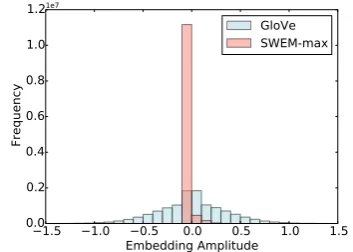
SWEM-aver, and hence in most cases SWEM-concat ex-hibits the best performance among all SWEM variants. More importantly, we found that the word embeddings learned from SWEM-maxtend to be sparse. We trained our SWEM-maxmodel on the Yahoo datasets (randomly initialized). With the learned embeddings, we plot the values for each of the word embedding dimensions, for the entire vocabulary. As shown in Figure 1, most of the values are highly concentrated around zero, indicating that the word embeddings learned are very sparse. On the contrary, the GloVe word embeddings, for the same vocabulary, are consid-erably denser than the embeddings learned from SWEM-max. This suggests that the model may only depend on a few key words, among the en-tire vocabulary, for predictions (since most words do not contribute to the max-pooling operation in SWEM-max). Through the embedding, the model learns the important words for a given task (those words with non-zero embedding components).
Figure 1: Histograms for learned word em-beddings (randomly initialized) of SWEM-max
and GloVe embeddings for the same vocabulary, trained on the Yahoo! Answer dataset.
In this regard, the nature of max-pooling pro-cess gives rise to a more interpretable model. For
a document, only the word with largest value in each embedding dimension is employed for the fi-nal representation. Thus, we suspect that semanti-cally similar words may have large values in some shared dimensions. So motivated, after training the SWEM-maxmodel on the Yahoo dataset, we selected five words with the largest values, among the entire vocabulary, for each word embedding dimension (these words are selected preferentially in the corresponding dimension, by the max op-eration). As shown in Table3, the words chosen wrt each embedding dimension are indeed highly relevant and correspond to a common topic (the topics are inferred from words). For example, the words in the first column of Table 3 are all po-litical terms, which could be assigned to the Pol-itics & Government topic. Note that our model can even learn locally interpretable structure that is not explicitly indicated by the label informa-tion. For instance, all words in the fifth column areChemistry-related. However, we do not have a chemistry label in the dataset, and regardless they should belong to theSciencetopic.
4.2 Text Sequence Matching
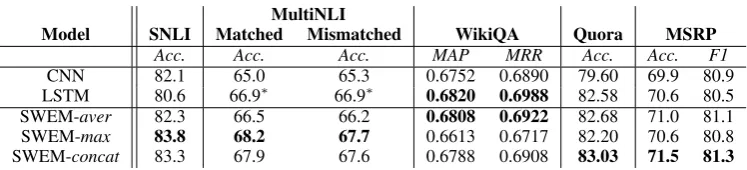
To gain a deeper understanding regarding the mod-eling capacity of word embeddings, we further vestigate the problem of sentence matching, in-cluding natural language inference, answer sen-tence selection and paraphrase identification. The corresponding performance metrics are shown in Table5. Surprisingly, on most of the datasets con-sidered (except WikiQA), SWEM demonstrates the best results compared with those with CNN or the LSTM encoder. Notably, on SNLI dataset, we observe that SWEM-max performs the best among all SWEM variants, consistent with the findings inNie and Bansal(2017);Conneau et al.
(2017), that max-pooling over BiLSTM hidden units outperforms average pooling operation on SNLI dataset. As a result, with only 120K param-eters, our SWEM-maxachieves a test accuracy of 83.8%, which is very competitive among state-of-the-art sentence encoding-based models (in terms of both performance and number of parameters)1.
The strong results of the SWEM approach on these tasks may stem from the fact that when matching natural language sentences, it is suffi-cient in most cases to simply model the word-level
1See leaderboard athttps://nlp.stanford.edu/
[image:6.595.86.263.546.672.2]MultiNLI
Model SNLI Matched Mismatched WikiQA Quora MSRP
Acc. Acc. Acc. MAP MRR Acc. Acc. F1
CNN 82.1 65.0 65.3 0.6752 0.6890 79.60 69.9 80.9
LSTM 80.6 66.9⇤ 66.9⇤ 0.6820 0.6988 82.58 70.6 80.5
SWEM-aver 82.3 66.5 66.2 0.6808 0.6922 82.68 71.0 81.1
SWEM-max 83.8 68.2 67.7 0.6613 0.6717 82.20 70.6 80.8
[image:7.595.112.486.64.149.2]SWEM-concat 83.3 67.9 67.6 0.6788 0.6908 83.03 71.5 81.3
Table 5: Performance of different models on matching natural language sentences. Results with⇤ are
for Bidirectional LSTM, reported inWilliams et al.(2017). Our reported results on MultiNLI are only trained MultiNLI training set (without training data from SNLI). For MSRP dataset, we follow the setup inHu et al.(2014) and do not use any additional features.
alignments between two sequences (Parikh et al.,
2016). From this perspective, word-order informa-tion becomes much less useful for predicting rela-tionship between sentences. Moreover, consider-ing the simpler model architecture of SWEM, they could be much easier to be optimized than LSTM or CNN-based models, and thus give rise to better empirical results.
4.2.1 Importance of word-order information
One possible disadvantage of SWEM is that it ig-nores the word-order information within a text se-quence, which could be potentially captured by CNN- or LSTM-based models. However, we em-pirically found that except for sentiment analysis, SWEM exhibits similar or even superior perfor-mance as the CNN or LSTM on a variety of tasks. In this regard, one natural question would be: how important are word-order features for these tasks? To this end, we randomly shuffle the words for every sentence in the training set, while keeping the original word order for samples in the test set. The motivation here is to remove the word-order features from the training set and examine how sensitive the performance on different tasks are to word-order information. We use LSTM as the model for this purpose since it can captures word-order information from the original training set.
Datasets Yahoo Yelp P. SNLI
Original 72.78 95.11 78.02
Shuffled 72.89 93.49 77.68
Table 6: Test accuracy for LSTM model trained on original/shuffled training set.
The results on three distinct tasks are shown in Table 6. Somewhat surprisingly, for Yahoo and SNLI datasets, the LSTM model trained on shuf-fled training set shows comparable accuracies to those trained on the original dataset, indicating
Negative: Friendly staff and nice selection of
vegetar-ian options. Foodis just okay,not great.
Makes me wonder why everyone likes
food fight so much.
Positive: The store is small, but it carries specialties
that are difficult to find in Pittsburgh. Iwas
particularly excitedto find middle eastern
chili sauce and chocolate covered turkish delights.
Table 7: Test samples from Yelp Polarity dataset for which LSTM gives wrong predictions with shuffled training data, but predicts correctly with the original training set.
that word-order information does not contribute significantly on these two problems,i.e., topic cat-egorization and textual entailment. However, on the Yelp polarity dataset, the results drop notice-ably, further suggesting that word-order does mat-ter for sentiment analysis (as indicated above from a different perspective).
Notably, the performance of LSTM on the Yelp dataset with a shuffled training set is very close to our results with SWEM, indicating that the main difference between LSTM and SWEM may be due to the ability of the former to capture word-order features. Both observations are in consistent with our experimental results in the previous section.
Case Study To understand what type of sen-tences are sensitive to word-order information, we further show those samples that are wrongly pre-dicted because of the shuffling of training data in Table7. Taking the first sentence as an example, several words in the review are generally positive,
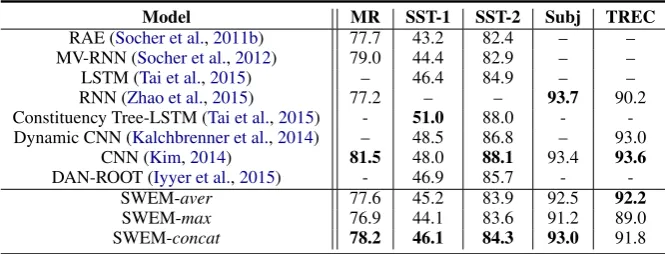
Model MR SST-1 SST-2 Subj TREC
RAE (Socher et al.,2011b) 77.7 43.2 82.4 – – MV-RNN (Socher et al.,2012) 79.0 44.4 82.9 – –
LSTM (Tai et al.,2015) – 46.4 84.9 – –
RNN (Zhao et al.,2015) 77.2 – – 93.7 90.2
Constituency Tree-LSTM (Tai et al.,2015) - 51.0 88.0 - -Dynamic CNN (Kalchbrenner et al.,2014) – 48.5 86.8 – 93.0
CNN (Kim,2014) 81.5 48.0 88.1 93.4 93.6
DAN-ROOT (Iyyer et al.,2015) - 46.9 85.7 -
-SWEM-aver 77.6 45.2 83.9 92.5 92.2
SWEM-max 76.9 44.1 83.6 91.2 89.0
[image:8.595.129.462.57.184.2]SWEM-concat 78.2 46.1 84.3 93.0 91.8
Table 8: Test accuracies with different compositional functions on (short) sentence classifications.
considering word-order features. It is worth noting the hints for predictions in this case are actually n-gram phrases from the input document.
4.3 SWEM-hierfor sentiment analysis
As demonstrated in Section 4.2.1, word-order in-formation plays a vital role for sentiment analysis tasks. However, according to the case study above, the most important features for sentiment predic-tion may be some keyn-gram phrase/words from the input document. We hypothesize that incor-porating information about the local word-order,
i.e., n-gram features, is likely to largely mitigate the limitations of the above three SWEM variants. Inspired by this observation, we propose using an-other simple pooling operation termed as hierar-chical (SWEM-hier), as detailed in Section 3.3. We evaluate this method on the two document-level sentiment analysis tasks and the results are shown in the last row of Table2.
SWEM-hiergreatly outperforms the other three SWEM variants, and the corresponding accuracies are comparable to the results of CNN or LSTM (Table 2). This indicates that the proposed hi-erarchical pooling operation manages to abstract spatial (word-order) information from the input sequence, which is beneficial for performance in sentiment analysis tasks.
4.4 Short Sentence Processing
We now consider sentence-classification tasks (with approximately 20 words on average). We experiment on three sentiment classification datasets,i.e., MR, SST-1, SST-2, as well as subjec-tivity classification (Subj) and question classifica-tion (TREC). The corresponding results are shown in Table 8. Compared with CNN/LSTM com-positional functions, SWEM yields inferior accu-racies on sentiment analysis datasets, consistent with our observation in the case of document
cat-egorization. However, SWEM exhibits compara-ble performance on the other two tasks, again with much less parameters and faster training. Further, we investigate two sequence tagging tasks: the standard CoNLL2000 chunking and CoNLL2003 NER datasets. Results are shown in the Supple-mentary Material, where LSTM and CNN again perform better than SWEMs. Generally, SWEM is less effective at extracting representations from
shortsentences than from long documents. This may be due to the fact that for a shorter text se-quence, word-order features tend to be more im-portant since the semantic information provided by word embeddings alone is relatively limited.
Moreover, we note that the results on these rela-tively small datasets are highly sensitive to model regularization techniques due to the overfitting is-sues. In this regard, one interesting future di-rection may be to develop specific regularization strategies for the SWEM framework, and thus make them work better on small sentence classi-fication datasets.
5 Discussion
5.1 Comparison via subspace training
We usesubspace training(Li et al.,2018) to mea-sure the model complexity in text classification problems. It constrains the optimization of the trainable parameters in a subspace of low dimen-sion d, the intrinsic dimension dint defines the
minimumdthat yield a good solution. Two mod-els are studied: the SWEM-max variant, and the CNN model including a convolutional layer fol-lowed by a FC layer. We consider two settings:
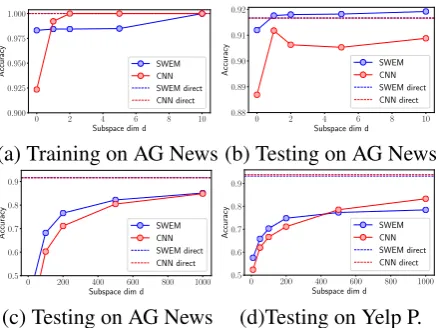
(1) The word embeddings are randomly intial-ized, and optimized jointly with the model param-eters. We show the performance of direct and sub-space training on AG News dataset in Figure 2
0 2 4 6 8 10
Subspace dim d
0.900
0.925
0.950
0.975
1.000
Accuracy
SWEM CNN SWEM direct CNN direct
0 2 4 6 8 10
Subspace dim d 0.88
0.89 0.90 0.91 0.92
Accuracy
SWEM CNN SWEM direct CNN direct
(a) Training on AG News (b) Testing on AG News
0 200 400 600 800 1000
Subspace dim d
0.5 0.6 0.7 0.8 0.9
Accuracy
SWEM CNN SWEM direct CNN direct
0 200 400 600 800 1000
Subspace dim d
0.5 0.6 0.7 0.8 0.9
Accuracy
SWEM CNN SWEM direct CNN direct
[image:9.595.71.291.60.224.2](c) Testing on AG News (d)Testing on Yelp P. Figure 2: Performance of subspace training. Word embeddings are optimized in (a)(b), and frozen in (c)(d).
testing. The subspace training yields similar ac-curacy with direct training for very smalld, even when model parameters are not trained at all (d= 0). This is because the word embeddings have
the full degrees of freedom to adjust to achieve good solutions, regardless of the employed mod-els. SWEM seems to have an easier loss landspace than CNN for word embeddings to find the best so-lutions. According to Occam’s razor, simple mod-els are preferred, if all mod-else are the same.
(2) The pre-trained GloVe are frozen for the word embeddings, and only the model parameters are optimized. The results on testing datasets of AG News and Yelp P. are shown in Figure2(c)(d), respectively. SWEM shows significantly higher accuracy than CNN for a large range of low sub-space dimension, indicating that SWEM is more parameter-efficient to get a decent solution. In Figure 2(c), if we set the performance threshold as 80% testing accuracy, SWEM exhibits a lower dint than CNN on AG News dataset. However,
in Figure2(d), CNN can leverage more trainable parameters to achieve higher accuracy whendis large.
5.2 Linear classifiers
To further investigate the quality of representa-tions learned from SWEMs, we employ a linear classifier on top of the representations for pre-diction, instead of a non-linear MLP layer as in the previous section. It turned out that utiliz-ing a linear classifier only leads to a very small performance drop for both Yahoo! Ans. (from
73.53% to 73.18%) and Yelp P. datasets (from 93.76%to93.66%) . This observation highlights
that SWEMs are able to extract robust and
infor-mative sentence representations despite their sim-plicity.
5.3 Extension to other languages
We have also tried our concat and SWEM-hier models on Sogou news corpus (with the same experimental setup as (Zhang et al.,2015b)), which is aChinesedataset represented by Pinyin (a phonetic romanization of Chinese). SWEM-concat yields an accuracy of 91.3%, while
SWEM-hier (with a local window size of 5) ob-tains an accuracy of96.2%on the test set. Notably,
the performance of SWEM-hier is comparable to the best accuracies of CNN (95.6%) and LSTM
(95.2%), as reported in (Zhang et al.,2015b). This
indicates that hierarchical pooling is more suitable than average/max pooling for Chinese text classifi-cation, by taking spatial information into account. It also implies that Chinese is more sensitive to lo-cal word-order features than English.
6 Conclusions
We have performed a comparative study between SWEM (with parameter-free pooling operations) and CNN or LSTM-based models, to represent text sequences on 17 NLP datasets. We further validated our experimental findings through ad-ditional exploration, and revealed some general rules for rationally selecting compositional func-tions for distinct problems. Our findings regard-ing when (and why) simple poolregard-ing operations are enough for text sequence representations are sum-marized as follows:
• Simple pooling operations are surprisingly ef-fective at representing longer documents (with hundreds of words), while recurrent/convolutional compositional functions are most effective when constructing representations for short sentences.
• Sentiment analysis tasks are more sensitive to word-order features than topic categorization tasks. However, a simple hierarchical pooling layer proposed here achieves comparable results to LSTM/CNN on sentiment analysis tasks.
• To match natural language sentences,e.g.,
tex-tual entailment, answer sentence selection, etc., simple pooling operations already exhibit similar or even superior results, compared to CNN and LSTM.
References
Yossi Adi, Einat Kermany, Yonatan Belinkov, Ofer Lavi, and Yoav Goldberg. 2016. Fine-grained anal-ysis of sentence embeddings using auxiliary predic-tion tasks.ICLR.
Sanjeev Arora, Yingyu Liang, and Tengyu Ma. 2016. A simple but tough-to-beat baseline for sentence em-beddings. InICLR.
Yoshua Bengio, R´ejean Ducharme, Pascal Vincent, and Christian Jauvin. 2003. A neural probabilistic lan-guage model.JMLR, 3(Feb):1137–1155.
Ronan Collobert, Jason Weston, L´eon Bottou, Michael Karlen, Koray Kavukcuoglu, and Pavel Kuksa. 2011. Natural language processing (almost) from scratch. JMLR, 12(Aug):2493–2537.
Alexis Conneau, Douwe Kiela, Holger Schwenk, Loic Barrault, and Antoine Bordes. 2017. Supervised learning of universal sentence representations from natural language inference data. EMNLP.
Alexis Conneau, Holger Schwenk, Lo¨ıc Barrault, and Yann Lecun. 2016. Very deep convolutional net-works for natural language processing. arXiv preprint arXiv:1606.01781.
Zhe Gan, Yunchen Pu, Ricardo Henao, Chunyuan Li, Xiaodong He, and Lawrence Carin. 2017. Learning generic sentence representations using convolutional neural networks. InEMNLP, pages 2380–2390.
Alex Graves, Navdeep Jaitly, and Abdel-rahman Mo-hamed. 2013. Hybrid speech recognition with deep bidirectional lstm. InAutomatic Speech Recognition and Understanding (ASRU), 2013 IEEE Workshop on, pages 273–278. IEEE.
Sepp Hochreiter and J¨urgen Schmidhuber. 1997. Long short-term memory. Neural computation, 9(8):1735–1780.
Baotian Hu, Zhengdong Lu, Hang Li, and Qingcai Chen. 2014. Convolutional neural network architec-tures for matching natural language sentences. In
NIPS, pages 2042–2050.
Mohit Iyyer, Varun Manjunatha, Jordan Boyd-Graber, and Hal Daum´e III. 2015. Deep unordered compo-sition rivals syntactic methods for text classification. InACL, volume 1, pages 16 81–1691.
Armand Joulin, Edouard Grave, Piotr Bojanowski, and Tomas Mikolov. 2016. Bag of tricks for efficient text classification. arXiv preprint arXiv:1607.01759.
Nal Kalchbrenner, Edward Grefenstette, and Phil Blunsom. 2014. A convolutional neural net-work for modelling sentences. arXiv preprint arXiv:1404.2188.
Yoon Kim. 2014. Convolutional neural networks for sentence classification. EMNLP.
Diederik Kingma and Jimmy Ba. 2014. Adam: A method for stochastic optimization. arXiv preprint arXiv:1412.6980.
Chunyuan Li, Heerad Farkhoor, Rosanne Liu, and Ja-son Yosinski. 2018. Measuring the intrinsic dimen-sion of objective landscapes. InInternational Con-ference on Learning Representations.
Tomas Mikolov, Ilya Sutskever, Kai Chen, Greg S Cor-rado, and Jeff Dean. 2013. Distributed representa-tions of words and phrases and their compositional-ity. InNIPS, pages 3111–3119.
Jeff Mitchell and Mirella Lapata. 2010. Composition in distributional models of semantics.Cognitive sci-ence, 34(8):1388–1429.
Yixin Nie and Mohit Bansal. 2017. Shortcut-stacked sentence encoders for multi-domain infer-ence. arXiv preprint arXiv:1708.02312.
Bo Pang, Lillian Lee, and Shivakumar Vaithyanathan. 2002. Thumbs up?: sentiment classification using machine learning techniques. InEMNLP, pages 79– 86. ACL.
Ankur P Parikh, Oscar T¨ackstr¨om, Dipanjan Das, and Jakob Uszkoreit. 2016. A decomposable attention model for natural language inference.EMNLP.
Jeffrey Pennington, Richard Socher, and Christopher Manning. 2014. Glove: Global vectors for word representation. InEMNLP, pages 1532–1543.
Dinghan Shen, Martin Renqiang Min, Yitong Li, and Lawrence Carin. 2017. Adaptive convolutional fil-ter generation for natural language understanding.
arXiv preprint arXiv:1709.08294.
Dinghan Shen, Yizhe Zhang, Ricardo Henao, Qinliang Su, and Lawrence Carin. 2018. Deconvolutional latent-variable model for text sequence matching.
AAAI.
Richard Socher, Brody Huval, Christopher D Man-ning, and Andrew Y Ng. 2012. Semantic composi-tionality through recursive matrix-vector spaces. In
EMNLP, pages 1201–1211. Association for Compu-tational Linguistics.
Richard Socher, Cliff C Lin, Chris Manning, and An-drew Y Ng. 2011a. Parsing natural scenes and nat-ural language with recursive nenat-ural networks. In
ICML, pages 129–136.
Richard Socher, Jeffrey Pennington, Eric H Huang, Andrew Y Ng, and Christopher D Manning. 2011b. Semi-supervised recursive autoencoders for predict-ing sentiment distributions. InEMNLP, pages 151– 161. Association for Computational Linguistics.
Ilya Sutskever, Oriol Vinyals, and Quoc V Le. 2014. Sequence to sequence learning with neural net-works. InNIPS, pages 3104–3112.
Kai Sheng Tai, Richard Socher, and Christopher D Manning. 2015. Improved semantic representations from tree-structured long short-term memory net-works. arXiv preprint arXiv:1503.00075.
Ashish Vaswani, Noam Shazeer, Niki Parmar, Jakob Uszkoreit, Llion Jones, Aidan N Gomez, Lukasz Kaiser, and Illia Polosukhin. 2017. Attention is all you need. NIPS.
John Wieting, Mohit Bansal, Kevin Gimpel, and Karen Livescu. 2015. Towards universal paraphrastic sen-tence embeddings. ICLR.
Adina Williams, Nikita Nangia, and Samuel R Bow-man. 2017. A broad-coverage challenge corpus for sentence understanding through inference. arXiv preprint arXiv:1704.05426.
Shiliang Zhang, Hui Jiang, Mingbin Xu, Junfeng Hou, and Lirong Dai. 2015a. The fixed-size ordinally-forgetting encoding method for neural network lan-guage models. In Proceedings of the 53rd Annual Meeting of the Association for Computational Lin-guistics and the 7th International Joint Conference on Natural Language Processing (Volume 2: Short Papers), volume 2, pages 495–500.
Xiang Zhang, Junbo Zhao, and Yann LeCun. 2015b. Character-level convolutional networks for text clas-sification. InNIPS, pages 649–657.
Yizhe Zhang, Zhe Gan, Kai Fan, Zhi Chen, Ricardo Henao, Dinghan Shen, and Lawrence Carin. 2017a. Adversarial feature matching for text generation. In
ICML.
Yizhe Zhang, Dinghan Shen, Guoyin Wang, Zhe Gan, Ricardo Henao, and Lawrence Carin. 2017b. Deconvolutional paragraph representation learning.
NIPS.