Looking at Unbalanced Specialized Comparable Corpora
for Bilingual Lexicon Extraction
Emmanuel Morin and Amir Hazem
Universit´e de Nantes, LINA UMR CNRS 6241
2 rue de la houssini`ere, BP 92208, 44322 Nantes Cedex 03, France
{emmanuel.morin,amir.hazem}@univ-nantes.fr
Abstract
The main work in bilingual lexicon ex-traction from comparable corpora is based on the implicit hypothesis that corpora are balanced. However, the historical context-based projection method dedicated to this task is relatively insensitive to the sizes of each part of the comparable corpus. Within this context, we have carried out a study on the influence of unbalanced specialized comparable corpora on the quality of bilingual terminology extraction through different experiments. Moreover, we have introduced a regression model that boosts the observations of word co-occurrences used in the context-based pro-jection method. Our results show that the use of unbalanced specialized comparable corpora induces a significant gain in the quality of extracted lexicons.
1 Introduction
The bilingual lexicon extraction task from bilin-gual corpora was initially addressed by using par-allel corpora (i.e. a corpus that contains source texts and their translation). However, despite good results in the compilation of bilingual lex-icons, parallel corpora are scarce resources, es-pecially for technical domains and for language pairs not involving English. For these reasons, research in bilingual lexicon extraction has fo-cused on another kind of bilingual corpora com-prised of texts sharing common features such as domain, genre, sampling period, etc. without hav-ing a source text/target text relationship (McEnery and Xiao, 2007). These corpora, well known now as comparable corpora, have also initially been introduced as non-parallel corpora (Fung, 1995; Rapp, 1995), and non-aligned corpora (Tanaka and Iwasaki, 1996). According to Fung and
Che-ung (2004), who range bilingual corpora from par-allel corpora to quasi-comparable corpora going through comparable corpora, there is a continuum from parallel to comparable corpora (i.e. a kind of filiation).
The bilingual lexicon extraction task from com-parable corpora inherits this filiation. For instance, the historical context-based projection method (Fung, 1995; Rapp, 1995), known as thestandard approach, dedicated to this task seems implicitly to lead to work with balanced comparable corpora in the same way as for parallel corpora (i.e. each part of the corpus is composed of the same amount of data).
In this paper we want to show that the assump-tion that comparable corpora should be balanced for bilingual lexicon extraction task is unfounded. Moreover, this assumption is prejudicial for spe-cialized comparable corpora, especially when in-volving the English language for which many doc-uments are available due the prevailing position of this language as a standard for international scientific publications. Within this context, our main contribution consists in a re-reading of the standard approach putting emphasis on the un-founded assumption of the balance of the spe-cialized comparable corpora. In spespe-cialized do-mains, the comparable corpora are traditionally of small size (around 1 million words) in comparison with comparable corpus-based general language (up to 100 million words). Consequently, the ob-servations of word co-occurrences which is the ba-sis of the standard approach are unreliable. To make them more reliable, our second contribution is to contrast different regression models in order to boost the observations of word co-occurrences. This strategy allows to improve the quality of ex-tracted bilingual lexicons from comparable cor-pora.
2 Bilingual Lexicon Extraction
In this section, we first describe the standard ap-proach that deals with the task of bilingual lexi-con extraction from comparable corpora. We then present an extension of this approach based on re-gression models. Finally, we discuss works related to this study.
2.1 Standard Approach
The main work in bilingual lexicon extraction from comparable corpora is based on lexical con-text analysis and relies on the simple observation that a word and its translation tend to appear in the same lexical contexts. The basis of this obser-vation consists in the identification of “first-order affinities” for each source and target language: “First-order affinities describe what other words are likely to be found in the immediate vicinity of a given word” (Grefenstette, 1994, p. 279). These affinities can be represented by context vec-tors, and each vector element represents a word which occurs within the window of the word to be translated (e.g. a seven-word window approxi-mates syntactic dependencies). In order to empha-size significant words in the context vector and to reduce word-frequency effects, the context vectors are normalized according to an association mea-sure. Then, the translation is obtained by compar-ing the source context vector to each translation candidate vector after having translated each ele-ment of the source vector with a general dictio-nary.
The implementation of the standard approach can be carried out by applying the following three steps (Rapp, 1999; Chiao and Zweigenbaum, 2002; D´ejean et al., 2002; Morin et al., 2007; Laroche and Langlais, 2010, among others): Computing context vectors We collect all the
words in the context of each wordiand count their occurrence frequency in a window of
n words around i. For each word i of the source and the target languages, we obtain a context vectorvi which gathers the set of
co-occurrence words j associated with the number of times thatj andioccur together
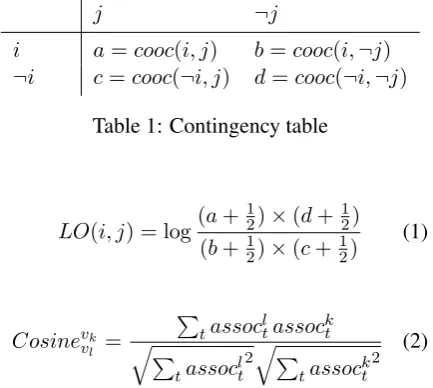
cooc(i, j). In order to identify specific words in the lexical context and to reduce word-frequency effects, we normalize context vec-tors using an association score such as Mu-tual Information, Log-likelihood, or the dis-counted log-odds (LO) (Evert, 2005) (see
equation 1 and Table 1 whereN = a+b+ c+d).
Transferring context vectors Using a bilingual dictionary, we translate the elements of the source context vector. If the bilingual dictio-nary provides several translations for an ele-ment, we consider all of them but weight the different translations according to their fre-quency in the target language.
Finding candidate translations For a word to be translated, we compute the similarity be-tween the translated context vector and all target vectors through vector distance mea-sures such as Jaccard or Cosine (see equa-tion 2 where associ
j stands for “association
score”,vkis the transferred context vector of
the word k to translate, and vl is the
con-text vector of the word l in the target lan-guage). Finally, the candidate translations of a word are the target words ranked following the similarity score.
j ¬j
i a=cooc(i, j) b=cooc(i,¬j)
[image:2.595.311.528.398.592.2]¬i c=cooc(¬i, j) d=cooc(¬i,¬j)
Table 1: Contingency table
LO(i, j) = log(a+21)×(d+12)
(b+ 1
2)×(c+12)
(1)
Cosinevk
vl =
∑
tassocltassockt
√∑
tassoclt2√∑tassockt2
(2)
This approach is sensitive to the choice of pa-rameters such as the size of the context, the choice of the association and similarity measures. The most complete study about the influence of these parameters on the quality of word alignment has been carried out by Laroche and Langlais (2010).
References Domain Languages Source/Target Sizes
Tanaka and Iwasaki (1996) Newspaper EN/JP 30/33 million words
Fung and McKeown (1997) Newspaper EN/JP 49/60 million bytes of data
Rapp (1999) Newspaper GE/EN 135/163 million words
Chiao and Zweigenbaum (2002) Medical FR/EN 602,484/608,320 words
D´ejean et al. (2002) Medical GE/EN 100,000/100,000 words
Morin et al. (2007) Medical FR/JP 693,666/807,287 words
Otero (2007) European Parliament SP/EN 14/17 million words
Ismail and Manandhar (2010) European Parliament EN/SP 500,000/500,000 sentences
Bouamor et al. (2013) Financial FR/EN 402,486/756,840 words
- Medical FR/EN 396,524/524,805 words
Table 2: Characteristics of the comparable corpora used for bilingual lexicon extraction
Bouamor et al., 2013, among others) with the im-plicit hypothesis that comparable corpora are bal-anced. As McEnery and Xiao (2007, p. 21) ob-serve, a specialized comparable corpus is built as balanced by analogy with a parallel corpus: “Therefore, in relation to parallel corpora, it is more likely for comparable corpora to be designed as general balanced corpora.”. For instance, Ta-ble 2 describes the comparaTa-ble corpora used in the main work dedicated to bilingual lexicon extrac-tion for which the ratio between the size of the source and the target texts is comprised between 1 and 1.8.
In fact, the assumption that words which have the same meaning in different languages should have the same lexical context distributions does not involve working with balanced comparable corpora. To our knowledge, no attention1 has
been paid to the problem of using unbalanced comparable corpora for bilingual lexicon extrac-tion. Since the context vectors are computed from each part of the comparable corpus rather than through the parts of the comparable corpora, the standard approach is relatively insensitive to dif-ferences in corpus sizes. The only precaution for using the standard approach with unbalanced cor-pora is to normalize the association measure (for instance, this can be done by dividing each entry of a given context vector by the sum of its associ-ation scores).
2.2 Prediction Model
Since comparable corpora are usually small in spe-cialized domains (see Table 2), the discrimina-1We only found mention of this aspect in Diab and Finch
(2000, p. 1501) “In principle, we do not have to have the same size corpora in order for the approach to work”.
tive power of context vectors (i.e. the observa-tions of word co-occurrences) is reduced. One way to deal with this problem is to re-estimate co-occurrence counts by a prediction function (Hazem and Morin, 2013). This consists in as-signing to each observed co-occurrence count of a small comparable corpora, a new value learned beforehand from a large training corpus.
In order to make co-occurrence counts more discriminant and in the same way as Hazem and Morin (2013), one strategy consists in ad-dressing this problem through regression: given training corpora of small and large size (abun-dant in the general domain), we predict word co-occurrence counts in order to make them more reliable. We then apply the resulting regression function to each word co-occurrence count as a pre-processing step of the standard approach. Our work differs from Hazem and Morin (2013) in two ways. First, while they experienced the linear re-gression model, we propose to contrast different regression models. Second, we apply regression to unbalanced comparable corpora and study the impact of prediction when applied to the source texts, the target texts and both source and target texts of the used comparable corpora.
We use regression analysis to describe the rela-tionship between word co-occurrence counts in a large corpus (the response variable) and word co-occurrence counts in a small corpus (the predictor variable). As most regression models have already been described in great detail (Christensen, 1997; Agresti, 2007), the derivation of most models is only briefly introduced in this work.
model (Lin), a generalized linear model which is the logistic regression model (Logit) and non lin-ear regression models such as polynomial regres-sion model (P olyn) of order n. Given an input
vector x ∈ Rm, where x1,...,xm represent
fea-tures, we find a prediction yˆ ∈ Rm for the
co-occurrence count of a couple of wordsy ∈ R us-ing one of the regression models presented below:
ˆ
yLin=β0+β1x (3)
ˆ
yLogit= 1 + exp(−1(β
0+β1x)) (4)
ˆ
yP olyn =β0+β1x+β2x2+...+βnxn (5)
whereβiare the parameters to estimate.
Let us denote by f the regression function and by cooc(wi, wj) the co-occurrence count of the
wordswiandwj. The resulting predicted value of
cooc(wi, wj), noted coocˆ (wi, wj) is given by the
following equation:
ˆ
cooc(wi, wj) =f(cooc(wi, wj)) (6)
2.3 Related Work
In the past few years, several contributions have been proposed to improve each step of the stan-dard approach.
Prochasson et al. (2009) enhance the represen-tativeness of the context vector by strengthening the context words that happen to be transliterated words and scientific compound words in the target language. Ismail and Manandhar (2010) also sug-gest that context vectors should be based on the most important contextually relevant words (in-domain terms), and thus propose a method for fil-tering the noise of the context vectors. In another way, Rubino and Linar`es (2011) improve the con-text words based on the hypothesis that a word and its candidate translations share thematic similari-ties. Yu and Tsujii (2009) and Otero (2007) pro-pose, for their part, to replace the window-based method by a syntax-based method in order to im-prove the representation of the lexical context.
To improve the transfer context vectors step, and increase the number of elements of translated context vectors, Chiao and Zweigenbaum (2003) and Morin and Prochasson (2011) combine a stan-dard general language dictionary with a special-ized dictionary, whereas D´ejean et al. (2002) use
the hierarchical properties of a specialized the-saurus. Koehn and Knight (2002) automatically induce the initial seed bilingual dictionary by us-ing identical spellus-ing features such as cognates and similar contexts. As regards the problem of words ambiguities, Bouamor et al. (2013) carried out word sense disambiguation process only in the target language whereas Gaussier et al. (2004) solve the problem through the source and target languages by using approaches based on CCA (Canonical Correlation Analysis) and multilingual PLSA (Probabilistic Latent Semantic Analysis).
The rank of candidate translations can be im-proved by integrating different heuristics. For in-stance, Chiao and Zweigenbaum (2002) introduce a heuristic based on word distribution symme-try. From the ranked list of candidate translations, the standard approach is applied in the reverse direction to find the source counterparts of the first target candidate translations. And then only the target candidate translations that had the ini-tial source word among the first reverse candidate translations are kept. Laroche and Langlais (2010) suggest a heuristic based on the graphic similarity between source and target terms. Here, candidate translations which are cognates of the word to be translated are ranked first among the list of trans-lation candidates.
3 Linguistic Resources
In this section, we outline the different textual re-sources used for our experiments: the comparable corpora, the bilingual dictionary and the terminol-ogy reference lists.
3.1 Specialized Comparable Corpora
For our experiments, we used two specialized French/English comparable corpora:
Breast cancer corpus This comparable corpus is composed of documents collected from the Elsevier website2. The documents were taken
7.4 million words). We split the English doc-uments into 14 parts each containing about 530,000 words.
Diabetes corpus The documents making up the French part of the comparable corpus have been craweled from the web using three keywords: diab`ete (diabetes), alimentation
(food), and ob´esit´e (obesity). After a man-ual selection, we only kept the documents which were relative to the medical domain. As a result, 65 French documents were ex-tracted (about 257,000 words). The English part has been extracted from the medical website PubMed3 using the keywords:
dia-betes, nutrition and feeding. We only kept the free fulltext available documents. As a re-sult, 2,339 English documents were extracted (about 3,5 million words). We also split the English documents into 14 parts each con-taining about 250,000 words.
The French and English documents were then normalised through the following linguistic pre-processing steps: tokenisation, part-of-speech tag-ging, and lemmatisation. These steps were car-ried out using the TTC TermSuite4 that applies
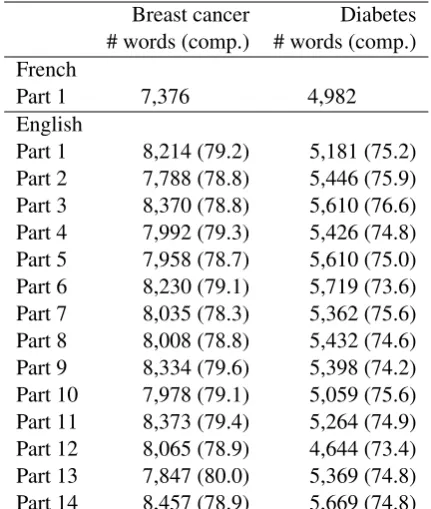
the same method to several languages including French and English. Finally, the function words were removed and the words occurring less than twice in the French part and in each English part were discarded. Table 3 shows the number of dis-tinct words (# words) after these steps. It also indicates the comparability degree in percentage (comp.) between the French part and each English part of each comparable corpus. The comparabil-ity measure (Li and Gaussier, 2010) is based on the expectation of finding the translation for each word in the corpus and gives a good idea about how two corpora are comparable. We can notice that all the comparable corpora have a high degree of comparability with a better comparability of the breast cancer corpora as opposed to the diabetes corpora. In the remainder of this article, [breast cancer corpusi]for instance stands for the breast cancer comparable corpus composed of the unique French part and the English parti(i∈[1,14]). 3.2 Bilingual Dictionary
The bilingual dictionary used in our experiments is the French/English dictionary ELRA-M0033
3http://www.ncbi.nlm.nih.gov/pubmed/ 4http://code.google.com/p/ttc-project
Breast cancer Diabetes
# words (comp.) # words (comp.) French
Part 1 7,376 4,982
English
Part 1 8,214 (79.2) 5,181 (75.2)
Part 2 7,788 (78.8) 5,446 (75.9)
Part 3 8,370 (78.8) 5,610 (76.6)
Part 4 7,992 (79.3) 5,426 (74.8)
Part 5 7,958 (78.7) 5,610 (75.0)
Part 6 8,230 (79.1) 5,719 (73.6)
Part 7 8,035 (78.3) 5,362 (75.6)
Part 8 8,008 (78.8) 5,432 (74.6)
Part 9 8,334 (79.6) 5,398 (74.2)
Part 10 7,978 (79.1) 5,059 (75.6)
Part 11 8,373 (79.4) 5,264 (74.9)
Part 12 8,065 (78.9) 4,644 (73.4)
Part 13 7,847 (80.0) 5,369 (74.8)
[image:5.595.308.524.62.317.2]Part 14 8,457 (78.9) 5,669 (74.8)
Table 3: Number of distinct words (# words) and degree of comparability (comp.) for each compa-rable corpora
available from the ELRA catalogue5. This
re-source is a general language dictionary which con-tains only a few terms related to the medical do-main.
3.3 Terminology Reference Lists
To evaluate the quality of terminology extrac-tion, we built a bilingual terminology reference list for each comparable corpus. We selected all French/English single words from the UMLS6
meta-thesaurus. We kept only i) the French sin-gle words which occur more than four times in the French part and ii) the English single words which occur more than four times in each English part
i7. As a result of filtering, 169 French/English
single words were extracted for the breast can-cer corpus and 244 French/English single words were extracted for the diabetes corpus. It should be noted that the evaluation of terminology ex-traction using specialized comparable corpora
of-5http://www.elra.info/
6http://www.nlm.nih.gov/research/umls 7The threshold sets to four is required to build a
Breast cancer corpus
1 2 3 4 5 6 7 8 9 10 11 12 13 14
Balanced 26.1 26.2 21.0 27.0 22.8 27.1 26.3 25.8 29.2 23.3 21.7 29.6 29.1 26.1 Unbalanced 26.1 31.9 34.7 36.0 37.7 36.4 36.6 37.2 39.8 40.5 40.6 42.3 40.9 41.6
Diabetes corpus
1 2 3 4 5 6 7 8 9 10 11 12 13 14
[image:6.595.104.493.63.171.2]Balanced 13.6 13.5 11.9 14.6 14.6 11.0 16.5 10.5 12.9 13.3 15.2 11.8 13.0 14.3 Unbalanced 13.6 17.5 18.9 21.2 23.4 23.8 24.8 24.7 24.7 24.4 24.8 25.2 26.0 24.9
Table 4: Results (MAP %) of the standard approach using the balanced and unbalanced comparable corpora
ten relies on lists of a small size: 95 single words in Chiao and Zweigenbaum (2002), 100 in Morin et al. (2007), 125 and 79 in Bouamor et al. (2013).
4 Experiments and Results
In this section, we present experiments to evaluate the influence of comparable corpus size and pre-diction models on the quality of bilingual termi-nology extraction.
We present the results obtained for the terms be-longing to the reference list for English to French direction measured in terms of the Mean Average Precision (MAP) (Manning et al., 2008) as fol-lows:
MAP(Ref) = |Ref1 | |Ref∑|
i=1
1
ri (7)
where|Ref|is the number of terms of the refer-ence list andri the rank of the correct candidate
translationi.
4.1 Standard Approach Evaluation
In order to evaluate the influence of corpus size on the bilingual terminology extraction task, two ex-periments have been carried out using the standard approach. We first performed an experiment using each comparable corpus independently of the oth-ers (we refer to these corpora as balanced corpora). We then conducted a second experiment where we varied the size of the English part of the compara-ble corpus, from 530,000 to 7.4 million words for the breast cancer corpus in 530,000 words steps, and from 250,000 to 3.5 million words for the di-abetes corpus in 250,000 words steps (we refer to these corpora as unbalanced corpora). In the ex-periments reported here, the size of the context windowwwas set to 3 (i.e. a seven-word window
that approximates syntactic dependencies), the re-tained association and similarity measures were the discounted log-odds and the Cosine (see Sec-tion 2.1). The results shown were those that give the best performance for the comparable corpora used individually.
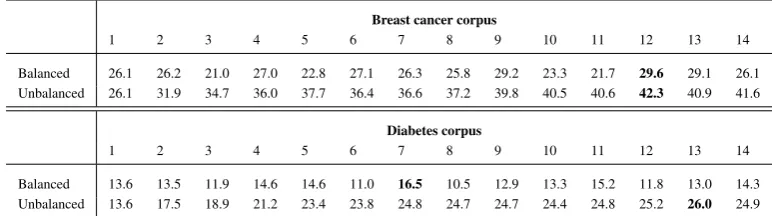
Table 4 shows the results of the standard ap-proach on the balanced and the unbalanced breast cancer and diabetes comparable corpora. Each column corresponds to the English part i (i ∈
[1,14]) of a given comparable corpus. The first line presents the results for each individual com-parable corpus and the second line presents the re-sults for the cumulative comparable corpus. For instance, the column 3 indicates the MAP obtained by using a comparable corpus that is composed i) only of[breast cancer corpus 3](MAP of 21.0%), and ii) of[breast cancer corpus 1, 2 and 3](MAP of 34.7%).
As a preliminary remark, we can notice that the results differ noticeably according to the compa-rable corpus used individually (MAP variation be-tween 21.0% and 29.6% for the breast cancer cor-pora and between 10.5% and 16.5% for the dia-betes corpora). We can also note that the MAP of all the unbalanced comparable corpora is al-ways higher than any individual comparable cor-pus. Overall, starting with a MAP of 26.1% as provided by the balanced[breast cancer corpus 1], we are able to increase it to 42.3% with the un-balanced [breast cancer corpus 12](the variation observed for some unbalanced corpora such as
Balanced breast cancer corpus
1 2 3 4 5 6 7 8 9 10 11 12 13 14
No prediction 26.1 26.2 21.0 27.0 22.8 27.1 26.3 25.8 29.2 23.3 21.7 29.6 29.1 26.1
Sourcepred 26.5 26.0 23.0 30.0 25.4 30.1 28.3 29.4 32.1 24.9 24.4 30.5 30.1 29.0
T argetpred 19.5 20.0 17.2 23.4 19.9 23.1 21.4 21.6 24.1 19.3 18.1 26.6 24.3 22.6
Sourcepred+T argetpred 23.9 21.9 20.5 25.8 23.5 25.3 24.1 26.1 27.4 22.5 21.0 25.6 28.5 24.6
Balanced diabetes corpus
1 2 3 4 5 6 7 8 9 10 11 12 13 14
No prediction 13.6 13.5 11.9 14.6 14.6 11.0 16.5 10.5 12.9 13.3 15.2 11.8 13.0 14.3
Sourcepred 13.9 14.3 12.6 15.5 14.9 10.9 17.6 11.1 14.0 14.2 16.4 13.3 13.5 15.7
T argetpred 09.8 09.0 08.3 11.9 10.1 08.0 15.9 07.3 10.8 10.0 10.1 08.8 10.8 10.2
[image:7.595.78.521.62.212.2]Sourcepred+T argetpred 10.9 11.0 09.0 13.6 11.8 08.6 15.4 07.7 12.8 11.5 11.9 10.5 11.7 11.8
Table 5: Results (MAP %) of the standard approach using the Linregression model on the balanced breast cancer and diabetes corpora (comparison of predicting the source side, the target side and both sides of the comparable corpora)
4.2 Prediction Evaluation
The aim of this experiment is two-fold: first, we want to evaluate the usefulness of predicting word co-occurrence counts and second, we want to find out whether it is more appropriate to apply predic-tion to the source side, the target side or both sides of the bilingual comparable corpora.
Breast cancer Diabetes
No prediction 29.6 16.5
Lin 30.5 17.6
P oly2 30.6 17.5
P oly3 30.4 17.6
[image:7.595.79.282.395.487.2]Logit 22.3 13.6
Table 6: Results (MAP %) of the standard ap-proach using different regression models on the balanced breast cancer and diabetes corpora
4.2.1 Regression Models Comparison
We contrast the prediction models presented in Section 2.2 to findout which is the most appropri-ate model to use as a pre-processing step of the standard approach. We chose the balanced corpora where the standard approach has shown the best results in the previous experiment, namely[breast cancer corpus12]and[diabetes corpus7].
Table 6 shows a comparison between the standard approach without prediction noted No prediction and the standard approach with pdiction models. We contrast the simple linear re-gression model (Lin) with the second and the third order polynomial regressions (P oly2 andP oly3)
and the logistic regression model (Logit). We
can notice that except for theLogitmodel, all the regression models outperform the baseline (No prediction). Also, as we can see, the results obtained with the linear and polynomial regres-sions are very close. This suggests that both linear and polynomial regressions are suitable as a pre-processing step of the standard approach, while the logistic regression seems to be inappropriate according to the results shown in Table 6.
That said, the gain of regression models is not significant. This may be due to the regression pa-rameters that have been learned from a training corpus of the general domain. Another reason that could explain these results is the prediction pro-cess. We applied the same regression function to all co-occurrence counts while learning mod-els for low and high frequencies should have been more appropriate. In the light of the above results, we believe that prediction can be beneficial to our task.
4.2.2 Source versus Target Prediction
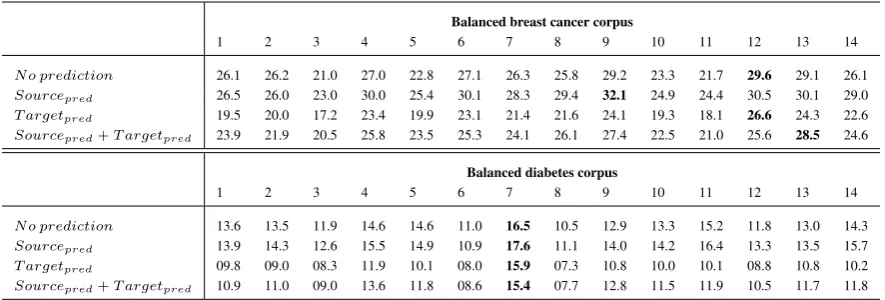
Table 5 shows a comparison between the standard approach without prediction notedNo prediction
and the standard approach based on the predic-tion of the source side notedSourcepred, the
tar-get side noted T argetpred and both sides noted
Sourcepred+T argetpred. If prediction can not
1 2 3 4 5 6 7 8 9 10 11 12 13 14 0
5 10 15 20 25 30 35 40 45 50
[English-i]-French breast cancer corpus
MAP
(%)
Balanced Balanced+Prediction Unbalanced Unbalanced+Prediction
(a)
1 2 3 4 5 6 7 8 9 10 11 12 13 14 0
5 10 15 20 25 30 35
[English-i]-French diabetes corpus
MAP
(%)
Balanced Balanced+Prediction Unbalanced Unbalanced+Prediction
[image:8.595.80.520.61.260.2](b)
Figure 1: Results (MAP %) of the standard approach using the best configurations of the prediction models (Linfor Balanced+P rediction andP oly2 for Unbalanced+P rediction) on the breast
cancer and the diabetes corpora
leads us to the opposite configuration where the target side isntimes bigger than the source side. Finally, predicting both sides may simulate a large comparable corpora on both sides. In this experi-ment, we chose to use the linear regression model (Lin) for the prediction part. That said, the other regression models have shown the same behavior asLin.
We can see that the best results are obtained by theSourcepredapproach for both comparable
cor-pora. We can also notice that predicting the tar-get side and both sides of the comparable corpora degrades the results. It is not surprising that pre-dicting the target side only leads to lower results, since it is well known that a better characterization of a word to translate (given from the source side) leads to better results. We can deduce from Ta-ble 5 that source prediction is the most appropriate configuration to improve the quality of extracted lexicons. This configuration which simulates the use of unbalanced corpora leads us to think that using prediction with unbalanced comparable cor-pora should also increase the performance of the standard approach. This assumption is evaluated in the next Subsection.
4.3 Predicting Unbalanced Corpora
In this last experiment we contrast the standard approach applied to the balanced and unbalanced corpora noted Balanced and Unbalanced with the standard approach combined with the predic-tion model noted Balanced + P rediction and
Unbalanced+P rediction.
Figure 1(a) illustrates the results of the exper-iments conducted on the breast cancer corpus. We can see that the Unbalanced approach sig-nificantly outperforms the baseline (Balanced). The big difference between the Balanced and
the Unbalanced approaches would indicate that
the latter is optimal. We can also notice that the prediction model applied to the balanced corpus (Balanced + P rediction) slightly outperforms the baseline while theUnbalanced+P rediction
approach significantly outperforms the three other approaches (moreover the variation observed with
the Unbalanced approach are lower than the
Unbalanced+P rediction approach). Overall,
the prediction increases the performance of the standard approach especially for unbalanced cor-pora.
The results of the experiments conducted on the diabetes corpus are shown in Figure 1(b). As for the previous experiment, we can see that the
Unbalanced approach significantly outperforms
theBalancedapproach. This confirms the unbal-anced hypothesis and would motivate the use of unbalanced corpora when they are available. We can also notice that theBalanced+P rediction
corpora, prediction shows a positive impact on the performance of the standard approach.
5 Conclusion
In this paper, we have studied how an unbalanced specialized comparable corpus could influence the quality of the bilingual lexicon extraction. This as-pect represents a significant interest when working with specialized comparable corpora for which the quantity of the data collected may differ depend-ing on the languages involved, especially when in-volving the English language as many scientific documents are available. More precisely, our dif-ferent experiments show that using an unbalanced specialized comparable corpus always improves the quality of word translations. Thus, the MAP goes up from 29.6% (best result on the balanced corpora) to 42.3% (best result on the unbalanced corpora) in the breast cancer domain, and from 16.5% to 26.0% in the diabetes domain. Addition-ally, these results can be improved by using a pre-diction model of the word co-occurrence counts. Here, the MAP goes up from 42.3% (best result on the unbalanced corpora) to 46.9% (best result on the unbalanced corpora with prediction) in the breast cancer domain, and from 26.0% to 29.8% in the diabetes domain. We hope that this study will pave the way for using specialized unbalanced comparable corpora for bilingual lexicon extrac-tion.
Acknowledgments
This work is supported by the French National Re-search Agency under grant ANR-12-CORD-0020.
References
Alan Agresti. 2007. An Introduction to Categorical
Data Analysis (2nd ed.). Wiley & Sons, Inc., Hobo-ken, New Jersey.
Dhouha Bouamor, Nasredine Semmar, and Pierre Zweigenbaum. 2013. Context vector disambigua-tion for bilingual lexicon extracdisambigua-tion from
compa-rable corpora. In Proceedings of the 51st Annual
Meeting of the Association for Computational Lin-guistics (ACL’13), pages 759–764, Sofia, Bulgaria.
Yun-Chuang Chiao and Pierre Zweigenbaum. 2002. Looking for candidate translational equivalents in
specialized, comparable corpora. InProceedings of
the 19th International Conference on Computational Linguistics (COLING’02), pages 1208–1212, Tapei, Taiwan.
Yun-Chuang Chiao and Pierre Zweigenbaum. 2003. The Effect of a General Lexicon in Corpus-Based Identification of French-English Medical Word
Translations. InThe New Navigators: from
Profes-sionals to Patients, Actes Medical Informatics Eu-rope, pages 397–402.
Ronald Christensen. 1997. Log-Linear Models and
Logistic Regression. Springer-Verlag, Berlin. Herv´e D´ejean, Fatia Sadat, and ´Eric Gaussier. 2002.
An approach based on multilingual thesauri and model combination for bilingual lexicon extraction. InProceedings of the 19th International Conference on Computational Linguistics (COLING’02), pages 218–224, Tapei, Taiwan.
Mona T. Diab and Steve Finch. 2000. A Statistical Word-Level Translation Model for Comparable
Cor-pora. InProceedings of the 6th International
Con-ference on Computer-Assisted Information Retrieval (RIAO’00), pages 1500–1501, Paris, France.
Stefan Evert. 2005. The Statistics of Word
Cooccur-rences: Word Pairs and Collocations. Ph.D. thesis, Universit¨at Stuttgart, Germany.
Pascale Fung and Percy Cheung. 2004.
Multi-level bootstrapping for extracting parallel sentences
from a quasi-comparable corpus. In Proceedings
of the 20th International Conference on Computa-tional Linguistics (COLING’04), pages 1051–1057, Geneva, Switzerland.
Pascale Fung and Kathleen McKeown. 1997. Finding Terminology Translations from Non-parallel
Cor-pora. In Proceedings of the 5th Annual Workshop
on Very Large Corpora (VLC’97), pages 192–202, Hong Kong.
Pascale Fung. 1995. Compiling Bilingual Lexicon Entries from a non-Parallel English-Chinese
Cor-pus. In Proceedings of the 3rd Annual Workshop
on Very Large Corpora (VLC’95), pages 173–183, Cambridge, MA, USA.
Pascale Fung. 1998. A Statistical View on Bilin-gual Lexicon Extraction: From Parallel Corpora to Non-parallel Corpora. In David Farwell, Laurie
Gerber, and Eduard Hovy, editors, Proceedings of
the 3rd Conference of the Association for Machine Translation in the Americas (AMTA’98), pages 1– 16, Langhorne, PA, USA.
´Eric Gaussier, Jean-Michel Renders, Irena Matveeva,
Cyril Goutte, and Herv´e D´ejean. 2004. A
Geometric View on Bilingual Lexicon Extraction
from Comparable Corpora. In Proceedings of the
42nd Annual Meeting of the Association for Com-putational Linguistics (ACL’04), pages 526–533, Barcelona, Spain.
Gregory Grefenstette. 1994. Corpus-Derived First,
Second and Third-Order Word Affinities. In
Amir Hazem and Emmanuel Morin. 2013. Word co-occurrence counts prediction for bilingual ter-minology extraction from comparable corpora. In Proceedings of the Sixth International Joint Confer-ence on Natural Language Processing (IJCNLP’13), pages 1392–1400, Nagoya, Japan.
Azniah Ismail and Suresh Manandhar. 2010. Bilingual lexicon extraction from comparable corpora using
in-domain terms. InProceedings of the 23rd
Inter-national Conference on Computational Linguistics (COLING’10), pages 481–489, Beijing, China.
Philipp Koehn and Kevin Knight. 2002. Learning a translation lexicon from monolingual corpora. In Proceedings of the ACL-02 Workshop on Unsuper-vised Lexical Acquisition (ULA’02), pages 9–16, Philadelphia, PA, USA.
Audrey Laroche and Philippe Langlais. 2010. Revis-iting Context-based Projection Methods for Term-Translation Spotting in Comparable Corpora. In Proceedings of the 23rd International Conference on Computational Linguistics (COLING’10), pages 617–625, Beijing, China.
Bo Li and ´Eric Gaussier. 2010. Improving corpus comparability for bilingual lexicon extraction from
comparable corpora. InProceedings of the 23rd
In-ternational Conference on Computational Linguis-tics (COLING’10), pages 644–652, Beijing, China.
Christopher D. Manning, Prabhakar Raghavan, and
Hinrich Schtze. 2008. Introduction to Information
Retrieval. Cambridge University Press, New York, NY, USA.
Anthony McEnery and Zhonghua Xiao. 2007. Paral-lel and comparable corpora: What are they up to? In Gunilla Anderman and Margaret Rogers, editors, Incorporating Corpora: Translation and the Lin-guist, Multilingual Matters, chapter 2, pages 18–31. Clevedon, UK.
Emmanuel Morin and Emmanuel Prochasson. 2011. Bilingual lexicon extraction from comparable cor-pora enhanced with parallel corcor-pora. InProceedings of the 4th Workshop on Building and Using Compa-rable Corpora (BUCC’11), pages 27–34, Portland, OR, USA.
Emmanuel Morin, B´eatrice Daille, Koichi Takeuchi, and Kyo Kageura. 2007. Bilingual Terminology Mining – Using Brain, not brawn comparable
cor-pora. In Proceedings of the 45th Annual
Meet-ing of the Association for Computational LMeet-inguistics (ACL’07), pages 664–671, Prague, Czech Republic.
Pablo Gamallo Otero. 2007. Learning bilingual lexi-cons from comparable english and spanish corpora. InProceedings of the 11th Conference on Machine Translation Summit (MT Summit XI), pages 191– 198, Copenhagen, Denmark.
Carol Peters and Eugenio Picchi. 1998.
Cross-language information retrieval: A system for com-parable corpus querying. In Gregory Grefenstette, editor, Cross-language information retrieval, chap-ter 7, pages 81–90. Kluwer Academic Publishers. Emmanuel Prochasson and Pascale Fung. 2011. Rare
Word Translation Extraction from Aligned
Compa-rable Documents. InProceedings of the 49th Annual
Meeting of the Association for Computational Lin-guistics (ACL’11), pages 1327–1335, Portland, OR, USA.
Emmanuel Prochasson, Emmanuel Morin, and Kyo Kageura. 2009. Anchor points for bilingual lexicon
extraction from small comparable corpora. In
Pro-ceedings of the 12th Conference on Machine Trans-lation Summit (MT Summit XII), pages 284–291, Ot-tawa, Canada.
Reinhard Rapp. 1995. Identify Word Translations in
Non-Parallel Texts. InProceedings of the 35th
An-nual Meeting of the Association for Computational Linguistics (ACL’95), pages 320–322, Boston, MA, USA.
Reinhard Rapp. 1999. Automatic Identification of Word Translations from Unrelated English and
Ger-man Corpora. In Proceedings of the 37th Annual
Meeting of the Association for Computational Lin-guistics (ACL’99), pages 519–526, College Park, MD, USA.
Rapha¨el Rubino and Georges Linar`es. 2011. A multi-view approach for term translation spotting. In Pro-ceedings of the 12th International Conference on Computational Linguistics and Intelligent Text Pro-cessing (CICLing’11), pages 29–40, Tokyo, Japan. Kumiko Tanaka and Hideya Iwasaki. 1996. Extraction
of Lexical Translations from Non-Aligned Corpora. InProceedings of the 16th International Conference on Computational Linguistics (COLING’96), pages 580–585, Copenhagen, Denmark.
Kun Yu and Junichi Tsujii. 2009. Extracting bilin-gual dictionary from comparable corpora with
de-pendency heterogeneity. In Proceedings of the