Proceedings of the 49th Annual Meeting of the Association for Computational Linguistics:shortpapers, pages 242–247,
Data-oriented Monologue-to-Dialogue Generation
Paul Piwek
Centre for Research in Computing The Open University Walton Hall, Milton Keynes, UK
Svetlana Stoyanchev Centre for Research in Computing
The Open University Walton Hall, Milton Keynes, UK [email protected]
Abstract
This short paper introduces an implemented and evaluated monolingual Text-to-Text gen-eration system. The system takes mono-logue and transforms it to two-participant di-alogue. After briefly motivating the task of monologue-to-dialogue generation, we de-scribe the system and present an evaluation in terms of fluency and accuracy.
1 Introduction
Several empirical studies show that delivering in-formation in the form of a dialogue, as opposed to monologue, can be particularly effective for educa-tion (Craig et al., 2000; Lee et al., 1998) and per-suasion (Suzuki and Yamada, 2004). Information-delivering or expository dialogue was already em-ployed by Plato to communicate his philosophy. It is used primarily to convey information and possibly also make an argument; this in contrast with dra-matic dialogue which focuses on character develop-ment and narrative.
Expository dialogue lends itself well for presenta-tion through computer-animated agents (Prendinger and Ishizuka, 2004). Most information is however locked up as text in leaflets, books, newspapers, etc. Automatic generation of dialogue from text in monologue makes it possible to convert information into dialogue as and when needed.
This paper describes the first data-oriented
monologue-to-dialogue generation system which re-lies on the automatic mapping of the discourse relations underlying monologue to appropriate
se-quences of dialogue acts. The approach is data-oriented in that the mapping rules have been auto-matically derived from an annotated parallel mono-logue/dialogue corpus, rather than being hand-crafted.
The paper proceeds as follows. Section 2 reviews existing approaches to dialogue generation. Section 3 describes the current approach. We provide an evaluation in Section 4. Finally, Section 5 describes our conclusions and plans for further research.
2 Related Work
For the past decade, generation of information-delivering dialogues has been approached primarily as an AI planning task. Andr´e et al. (2000) describe a system, based on a centralised dialogue planner, that creates dialogues between a virtual car buyer and seller from a database; this approach has been extended by van Deemter et al. (2008). Others have used (semi-) autonomous agents for dialogue gener-ation (Cavazza and Charles, 2005; Mateas and Stern, 2005).
With the creation of the publicly available1 CODA parallel corpus of monologue and dialogue (Stoy-anchev and Piwek, 2010a), it has, however, become possible to adopt a data-oriented approach. This cor-pus consists of approximately 700 turns of dialogue, by acclaimed authors such as Mark Twain, that are aligned with monologue that was written on the ba-sis of the dialogue, with the specific aim to express the same information as the dialogue.2 The mono-logue side has been annotated with discourse rela-tions, using an adaptation of the annotation guide-lines of Carlson and Marcu (2001), whereas the di-alogue side has been marked up with didi-alogue acts, using tags inspired by the schemes of Bunt (2000), Carletta et al. (1997) and Core and Allen (1997). As we will describe in the next section, our ap-proach uses the CODA corpus to extract mappings from monologue to dialogue.
3 Monologue-to-Dialogue Generation Approach
Our approach is based on five principal steps:
I Discourse parsing: analysis of the input mono-logue in terms of the underlying discourse rela-tions.
II Relation conversion: mapping of text annotated with discourse relations to a sequence of dia-logue acts, with segments of the input text as-signed to corresponding dialogue acts.
III Verbalisation: verbal realisation of dialogue acts based on the dialogue act type and text of the corresponding monologue segment.
IV Combination Putting the verbalised dialogues acts together to create a complete dialogue, and
V Presentation: Rendering of the dialogue (this can range for simple textual dialogue scripts to computer-animated spoken dialogue).
1
computing.open.ac.uk/coda/data.html
2
Consequently, the corpus was not constructed entirely of pre-existing text; some of the text was authored as part of the corpus construction. One could therefore argue, as one of the re-viewers for this paper did, that the approach is not entirely data-driven, if data-driven is interpreted as ‘generated from unadul-terated, free text, without any human intervention needed’.
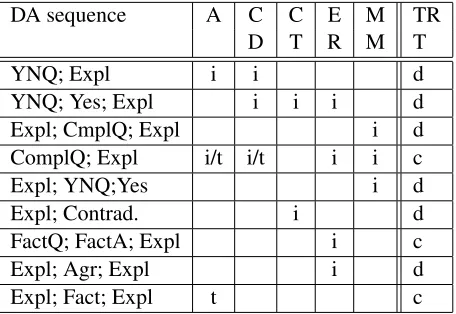
For step I we rely on human annotation or existing discourse parsers such asDAS (Le and Abeysinghe, 2003) and HILDA (duVerle and Prendinger, 2009). For the current study, the final step, V, consists sim-ply of verbatim presentation of the dialogue text. The focus of the current paper is with steps II and III (with combination, step IV, beyond the scope of the current paper). Step II is data-oriented in that we have extracted mappings from discourse relation occurrences in the corpus to corresponding dialogue act sequences, following the approach described in Piwek and Stoyanchev (2010). Stoyanchev and Pi-wek (2010b) observed in the CODA corpus a great variety of Dialogue Act (DA) sequences that could be used in step II, however in the current version of the system we selected a representative set of the most frequent DA sequences for the five most com-mon discourse relations in the corpus. Table 1 shows the mapping from text with a discourse relations to dialogue act sequences (i indicates implemented mappings).
DA sequence A C C E M TR
D T R M T
YNQ; Expl i i d
YNQ; Yes; Expl i i i d
Expl; CmplQ; Expl i d
ComplQ; Expl i/t i/t i i c
Expl; YNQ;Yes i d
Expl; Contrad. i d
FactQ; FactA; Expl i c
Expl; Agr; Expl i d
[image:2.612.314.542.370.527.2]Expl; Fact; Expl t c
Table 1: Mappings from discourse relations (A = Attribu-tion, CD = CondiAttribu-tion, CT = Contrast, ER = Explanation-Reason, MM = Manner-Means) to dialogue act sequences (explained below) together with the type of verbalisation transformation TR being d(irect) or c(omplex).
Verbalisation, step III, takes a dialogue act type and the specification of its semantic content as given by the input monologue text. Mapping this to the appropriate dialogue act requires mappings that vary in complexity.
For example, Expl(ain)can be generated by sim-ply copying a monologue segment to dialogue utter-ance. The dialogue actsYesandAgreement can be generated using canned text, such as “That is true” and “I agree with you”.
In contrast,ComplQ (Complex Question), FactQ (Factoid Question), FactA (Factiod Answer) and
YNQ (Yes/No Question) all require syntactic ma-nipulation. To generate YNQ and FactQ, we use the CMU Question Generation tool (Heilman and Smith, 2010) which is based on a combination of syntactic transformation rules implemented with tregex (Levy and Andrew, 2006) and statistical methods. To generate the Compl(ex) Q(uestion)in theComplQ;ExplDialogue Act (DA) sequence, we use a combination of the CMU tool and lexical trans-formation rules.3 The GEN example in Table 2
il-lustrates this: The input monologue has a Manner-Means relations between the nucleus ‘In September, Ashland settled the long-simmering dispute’ and the satellite ‘by agreeing to pay Iran 325 million USD’. The satellite is copied without alteration to the Ex-plain dialogue act. The nucleus is processed by ap-plying the following template-based rule:
Decl⇒How Yes/No Question(Decl)
In words, the input consisting of a declarative sen-tence is mapped to a sequence consisting of the word ‘How’ followed by a Yes/No-question (in this case “Did Ashland settle the long-simmering dispute in December?’) that is obtained with the CMU QG tool from the declarative input sentence. A similar ap-proach is applied for the other relations (Attribution, Condition and Explanation-Reason) that can lead to aComplQ; Expldialogue act sequence (see Table 1). Generally, sequences requiring only copying or canned text are labelledd(irect)in Table 1, whereas those requiring syntactic transformation are labelled
c(omplex).
3
In contrast, the ComplQ in the DA sequence Expl;ComplQ;Expl is generated using canned text such as ‘Why?’ or ‘Why is that?’.
4 Evaluation
We evaluate the output generated with both complex and direct rules for the relations of Table 1.
4.1 Materials, Judges and Procedure
The input monologues were text excerpts from the Wall Street Journal as annotated in the RST Dis-course Treebank4. They consisted of a single sen-tence with one internal relation, or two sensen-tences (with no internal relations) connected by a single relation. To factor out the quality of the discourse annotations, we used the gold standard annotations of the Discourse Treebank and checked these for correctness, discarding a small number of incorrect annotations.5 We included text fragments with a variety of clause length, ordering of nucleus and satellite, and syntactic structure of clauses. Table 2 shows examples of monologue/dialogue pairs: one with a generated dialogue and the other from the cor-pus.
Our study involved a panel of four judges, each fluent speakers of English (three native) and ex-perts in Natural Language Generation. We collected judgements on 53 pairs of monologue and corre-sponding dialogue. 19 pairs were judged by all four judges to obtain inter-annotator agreement statistics, the remainder was parcelled out. 38 pairs consisted of WSJ monologue and generated dialogue, hence-forth GEN, and 15 pairs ofCODAcorpus monologue and human-authored dialogue, henceforth CORPUS (instances of generated and corpus dialogue were randomly interleaved) – see Table 2 for examples.
The two standard evaluation measures for lan-guage generation, accuracy and fluency (Mellish and Dale, 1998), were used: a) accuracy: whether a dialogue (from GEN or CORPUS) preserves the in-formation of the corresponding monologue (judge-ment: ‘Yes’ or ‘No’) and b)monologue and dialogue fluency: how well written a piece of monologue or dialogue from GEN or CORPUS is. Fluency judge-ments were on a scale from 1 ‘incomprehensible’ to 5 ‘Comprehensible, grammatically correct and nat-urally sounding’.
4www.isi.edu/∼marcu/discourse/Corpora.html 5
GEN Monologue
In September, Ashland settled the long-simmering dispute by agreeing to pay Iran 325 million USD.
Dialogue(ComplQ; Expl) A: How did Ashland settle the
long-simmering dispute in December? B: By agreeing to pay Iran 325
million USD.
CORPUS Monologue
If you say “I believe the world is round”, the “I” is the mind.
Dialogue(FactQ; FactA)
A: If you say “I believe the world is round”, who is the “I” that is speaking?
B: The mind.
Table 2: Monologue-Dialogue Instances
4.2 Results
Accuracy Three of the four judges marked 90%
of monologue-dialogue pairs as presenting the same information (with pairwise κ of .64, .45 and .31). One judge interpreted the question differently and marked only 39% of pairs as containing the same information. We treated this as an outlier, and ex-cluded the accuracy data of this judge. For the in-stances marked by more than one judge, we took the majority vote. We found that 12 out of 13 instances (or 92%) of dialogue and monologue pairs from the CORPUSbenchmark sample were judged to contain the same information. For the GEN monologue-dialogue pairs, 28 out of 31 (90%) were judged to contain the same information.
Fluency Although absolute agreement between
judges was low,6 pairwise agreement in terms of Spearman rank correlation (ρ) is reasonable (aver-age: .69, best: .91, worst: .56). For the subset of in-stances with multiple annotations, we used the data from the judge with the highest average pair-wise agreement (ρ = .86)
The fluency ratings are summarised in Figure 1. Judges ranked both monologues and dialogues for
6
[image:4.612.322.535.89.244.2]For the four judges, we had an average pairwiseκof.34 with the maximum and minimum values of.52and.23, respec-tively.
Figure 1: Mean Fluency Rating for Monologues and Dia-logues (for 15 CORPUSand 38 GENinstances) with 95% confidence intervals
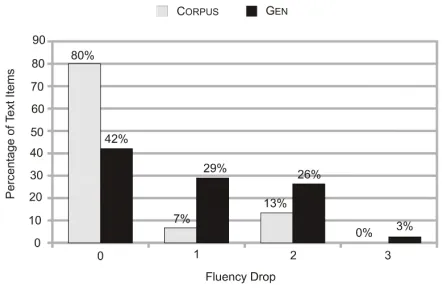
[image:4.612.326.547.455.599.2]the GEN sample higher than for the CORPUS sam-ple (possibly as a result of slightly greater length of the CORPUSfragments and some use of archaic lan-guage). However, the drop in fluency, see Figure 2, from monologue to dialogue is greater for GEN sam-ple (average: .89 points on the rating scale) than the CORPUSsample (average: .33) (T-test p<.05), sug-gesting that there is scope for improving the genera-tion algorithm.
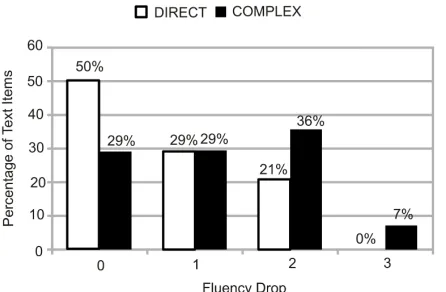
Direct versus Complex rules We examined the difference in fluency drop between direct and com-plex rules. Figure 3 shows that the drop in fluency for dialogues generated with complex rules is higher than for the dialogues generated using direct rules (T-test p<.05). This suggests that use of direct rules is more likely to result in high quality dialogue. This is encouraging, given that Stoyanchev and Piwek (2010a) report higher frequencies in professionally authored dialogues of dialogue acts (YNQ, Expl) that can be dealt with using direct verbalisation (in con-trast with low frequency of, e.g.,FactQ).
Figure 3: Decrease in Fluency Score from Monologue to Dialogue comparing Direct (24 samples) and Complex (14 samples) dialogue generation rules
5 Conclusions and Further Work
With information presentation in dialogue form be-ing particularly suited for education and persua-sion, the presented system is a step towards mak-ing information from text automatically available as dialogue. The system relies on discourse-to-dialogue structure rules that were automatically ex-tracted from a parallel monologue/dialogue corpus. An evaluation against a benchmark sample from the human-written corpus shows that both accuracy and fluency of generated dialogues are not worse than that of human-written dialogues. However, drop in fluency between input monologue and output dia-logue is slightly worse for generated diadia-logues than for the benchmark sample. We also established a dif-ference in quality of output generated with complex versus direct discourse-to-dialogue rules, which can
be exploited to improve overall output quality. In future research, we aim to evaluate the accu-racy and fluency of longer stretches of generated di-alogue. Additionally, we are currently carrying out a task-related evaluation of monologue versus dia-logue to determine the utility of each.
Acknowledgements
We would like to thank the three anonymous reviewers for their helpful comments and sug-gestions. We are also grateful to our col-leagues in the Open University’s Natural Lan-guage Generation group for stimulating discussions and feedback. The research reported in this pa-per was carried out as part of the CODA re-search project (http://computing.open.ac.uk/coda/) which was funded by the UK’s Engineering and Physical Sciences Research Council under Grant EP/G020981/1.
References
E. Andr´e, T. Rist, S. van Mulken, M. Klesen, and S. Baldes. 2000. The automated design of believable dialogues for animated presentation teams. In Jus-tine Cassell, Joseph Sullivan, Scott Prevost, and Eliz-abeth Churchill, editors, Embodied Conversational
Agents, pages 220–255. MIT Press, Cambridge,
Mas-sachusetts.
H. Bunt. 2000. Dialogue pragmatics and context spec-ification. In H. Bunt and W. Black, editors, Abduc-tion, Belief and Context in Dialogue: Studies in
Com-putational Pragmatics, volume 1 ofNatural Language
Processing, pages 81–150. John Benjamins.
J. Carletta, A. Isard, S. Isard, J. Kowtko, G. Doherty-Sneddon, and A. Anderson. 1997. The reliability of a dialogue structure coding scheme. Computational Linguistics, 23:13–31.
L. Carlson and D. Marcu. 2001. Discourse tagging reference manual. Technical Report ISI-TR-545, ISI, September.
M. Cavazza and F. Charles. 2005. Dialogue Gener-ation in Character-based Interactive Storytelling. In
Proceedings of the AAAI First Annual Artificial Intel-ligence and Interactive Digital Entertainment Confer-ence, Marina Del Rey, California, USA.
M. Core and J. Allen. 1997. Coding Dialogs with the DAMSL Annotation Scheme. InWorking Notes: AAAI Fall Symposium on Communicative Action in
S. Craig, B. Gholson, M. Ventura, A. Graesser, and the Tutoring Research Group. 2000. Overhearing dia-logues and monodia-logues in virtual tutoring sessions.
International Journal of Artificial Intelligence in Ed-ucation, 11:242–253.
D. duVerle and H. Prendinger. 2009. A novel discourse parser based on support vector machines. InProc 47th Annual Meeting of the Association for Computational Linguistics and the 4th Int’l Joint Conf on Natural Language Processing of the Asian Federation of
Nat-ural Language Processing (ACL-IJCNLP’09), pages
665–673, Singapore, August.
M. Heilman and N. A. Smith. 2010. Good question! statistical ranking for question generation. InProc. of
NAACL/HLT, Los Angeles.
Huong T. Le and Geehta Abeysinghe. 2003. A study to improve the efficiency of a discourse parsing system. InProceedings 4th International Conference on Intel-ligent Text Processing and Computational Linguistics
(CICLing-03), Springer LNCS 2588, pages 101–114.
J. Lee, F. Dinneen, and J. McKendree. 1998. Supporting student discussions: it isn’t just talk. Education and
Information Technologies, 3:217–229.
R. Levy and G. Andrew. 2006. Tregex and tsurgeon: tools for querying and manipulating tree data struc-tures. In 5th International Conference on Language Resources and Evaluation (LREC 2006)., Genoa, Italy. William C. Mann and Sandra A. Thompson. 1988. Rhetorical structure theory: Toward a functional the-ory of text organization. Text, 8(3):243–281.
M. Mateas and A. Stern. 2005. Structuring content in the faade interactive drama architecture. InProc. of Artifi-cial Intelligence and Interactive Digital Entertainment (AIIDE), Marina del Rey, Los Angeles, June.
C. Mellish and R. Dale. 1998. Evaluation in the context of natural language generation. Computer Speech and
Language, 12:349–373.
P. Piwek and S. Stoyanchev. 2010. Generating Exposi-tory Dialogue from Monologue: Motivation, Corpus and Preliminary Rules. In Human Language Tech-nologies: The 2010 Annual Conference of the North American Chapter of the Association for Computa-tional Linguistics, pages 333–336, Los Angeles, Cali-fornia, June.
P. Piwek, H. Hernault, H. Prendinger, and M. Ishizuka. 2007. T2D: Generating Dialogues between Virtual Agents Automatically from Text. In Intelligent
Vir-tual Agents: Proceedings of IVA07, LNAI 4722, pages
161–174. Springer Verlag.
H. Prendinger and M. Ishizuka, editors. 2004. Life-Like Characters: Tools, Affective Functions, and Applica-tions. Cognitive Technologies Series. Springer, Berlin. V. Rus, A. Graesser, A. Stent, M. Walker, and M. White. 2007. Text-to-Text Generation. In R. Dale and
M. White, editors, Shared Tasks and Comparative Evaluation in Natural Language Generation: Work-shop Report, Arlington, Virginia.
S. Stoyanchev and P. Piwek. 2010a. Constructing the CODA corpus. InProcs of LREC 2010, Malta, May. S. Stoyanchev and P. Piwek. 2010b. Harvesting re-usable
high-level rules for expository dialogue generation. In
6th International Natural Language Generation Con-ference (INLG 2010), Dublin, Ireland, 7-8, July. S. V. Suzuki and S. Yamada. 2004. Persuasion through
overheard communication by life-like agents. InProcs of the 2004 IEEE/WIC/ACM International Conference on Intelligent Agent Technology, Beijing, September. K. van Deemter, B. Krenn, P. Piwek, M. Klesen,