Evaluation of Automatically Identified Index Terms
for Browsing Electronic Documents I
Nina Wacholder, Judith L. Klavans and D a v i d K. E v a n s Columbia University
D e p a r t m e n t o f C o m p u t e r Science and C e n t e r for R e s e a r c h on Information A c c e s s
1. Abstract
We present an evaluation of domain- independent natural language tools for use in the identification of significant concepts in documents. Using qualitative evaluation, we compare three shallow processing methods for extracting index terms, i.e., terms that can be used to model the content of documents. We focus on two criteria: quality and coverage. In terms of quality alone, our results show that technical term (TT) extraction [Justeson and Katz 1995] receives the highest rating. How- ever, in terms of a combined quality and cover- age metric, the Head Sorting (HS) method, described in [Wacholder 1998], outperforms both other methods, keyword (KW) and TT.
2. Introduction
In this paper, we consider the problem of how to evaluate the automatic identification of index terms that have been derived without recourse to lexicons or to other kinds of domain-specific information. By index terms, we mean natural language expressions that constitute a meaning- ful representation of a document for humans. The premise of this research is that if signifi- cant topics coherently represent information in a document, these topics can be used as index terms that approximate the content of individ- ual documents in large collections of electronic documents.
We compare three shallow processing methods for identifying index terms:
• K e y w o r d s (KW) are terms identified by counting frequency of stemmed words in a document;
Technical terms (TT) are noun phrases (NPs) or subparts of NPs repeated more than twice in a document [Justeson and Katz 1995];
Head sorted terms (HS) are identified by a method in which simplex noun phrases (as defined below) are sorted by head and then ranked in decreasing order of fre- quency [Wacholder 1998].
The three methods that we evaluated are do- main-independent in that they use statistical and/or linguistic properties that apply to any natural language document in any field. These methods are also corpus-independent, in that the ranking of terms for an individual document is not dependent on properties of the corpus.
2.1 Overview o f methods and results
Subjects were drawn from two groups: professionals and students. Professionals in- cluded librarians and publishing professionals familiar with both manual and automatic text indexing. Students included undergraduate and graduate students with a variety of academic interests.
To assess terms, we used a standard qualitative ranking technique. We presented subjects with an article and a list of terms identified by one of the three methods. Subjects were asked to answer the following general question: "Would this term be useful in an electronic index for this article?" Terms were rated on a scale of 1 to 5, where 1 indicates a high quality term that should definitely be in- cluded in the index and 5 indicates a junk term that definitely should not be included. For ex-
1 This research was partly funded by NSF IRI 97-12069, "Automatic identification of significant topics in do- main independent full text documents" and NSF IRI 97-53054, "Computationally tractable methods for docu-
ample, the phrase court-approved affirmative action plans received an average rating of 1 from the professionals, meaning that it was ranked as useful for the article; the KW af- firmative received an average rating of 3.75, meaning that it was less useful; and the KW action received an average ranking of 4.5, meaning that it was not useful.
The goal of our research is to determine which method, or combination of methods, provides the best results. We measure results in terms of two criteria: quality and coverage. By quality, we mean that evaluators ranked terms high on the 1 to 5 scale from highest to lowest. By coverage, we mean the thoroughness with which the terms cover the significant top- ics in the document. Our methodology permits us to measure both criteria, as shown in Figure 4.
Our results from both the professionals and students show that TTs are superior with re- spect to quality; however, there are only a small number of TTs per document, so they do not provide adequate coverage in that they are not fully representative of the document as a whole. In contrast, KWs provide good cover- age but relatively poor quality in that KWs are vague, and not well filtered. SNPs, which have been sorted using HS and filtered, provide a better balance of quality and coverage.
From our study, we draw the following conclusions:
• The KW approach identifies some useful index terms, but they are mixed in with a large number of low-ranked terms.
• The TT approach identifies high quality terms, but with low coverage, i.e., rela- tively few indexing terms.
• The HS approach achieves a balance be- tween quality and coverage.
3. Domain-independent metrics for identi- fying significant topics
In order to identify significant topics in a document, a significance measure is needed, i.e., a method for determining which concepts in the document are relatively important for a given task. The need to determine the impor- tance of a particular concept within a document is motivated by a range of applications, in- cluding information retrieval [Salton 1989],
3 0 3
automatic determination of authorship [Mosteller and Wallace 1963], similarity met- rics for cross-document clustering [Hatzivas- siloglou et al. 1999], automatic indexing [Hodges et al. 1996] and input to summariza- tion [Paice 1990].
For example, one of the earlier appli- cations using frequency for identifying signifi- cant topics in a document was proposed by [Luhn 1958] for use in creating automatic ab- stracts. For each document, a list of stop- listed stems was created, and ranked by fre- quency; the most frequent keywords were used to identify significant sentences in the original document. Luhn's premise was that emphasis, as indicated by repetition of words and collo- cation is an indicator of significance. Namely, "the more often certain words are found in each other's company within a sentence, the more significance may be attributed to each of these words." This basic observation, although re- fined extensively by later summarization tech- niques (as reviewed in [Paice 1990]), relies on the capability of identifying significant con- cepts.
The standard IR technique known as tf*idf [Salton 1989] seeks to identify docu- ments relevant to a particular query by relativ- izing keyword frequency in a document as compared to frequency in a corpus. This method can be used to locate at least some im- portant concepts in full text. Although it has been effective for information retrieval, for other applications, such as human-oriented in- dexing, this technique is impractical. Ambigu- ity of stems (trad might refer to trader or tradition) and of isolated words (state might be a political entity or a mode of being) means that lists of keywords have not usually been used to represent the content of a document to human beings. Furthermore, humans have a difficult time processing stems and parts of words out of phrasal context.
This algorithm identifies candidate TTs in a corpus by locating NPs consisting of nouns, adjectives, and sometimes prepositional phrases. TTs are defined as those NPs, or their subparts, which occur above some frequency threshold in a corpus. However, as [Boguraev and Kennedy 1998] observe, the TT technique may not characterize the full content of docu- ments. Indeed, even in a technical document, TTs do not provide adequate coverage of the NPs in a document that contribute to its con- tent, especially since TTs are by definition multi-word. A truly domain-general method should apply to both technical and non- technical documents. The relevant difference between technical and non-technical documents is that in technical documents, many of the topics which are significant to the document as a whole may be also TTs.
[Wacholder 1998] proposed the method of Head Sorting for identifying signifi- cant topics that can be used to represent a source document. HS also uses a frequency measure to provide an approximation of topic significance. However, instead of counting fre- quency of stems or repetition of word se- quences, this method counts frequency of a relatively easily identified grammatical element, heads of simplex noun phrases (SNPs). For common NPs (NPs whose head is a common noun), an SNP is a maximal NP that includes premodifiers such as determiners and posses- sives but not post-nominal constituents such as prepositions or relativizers. For example, the well-known book is an SNP but the well-known book on asteroids includes two SNPs, well- known book and asteroids. For proper names, an SNP is a name that refers to a single entity. For example, Museum of the City of New York, the name of an organization, is an SNP even though the organizational name incorporates a city name. Others, such as [Church 1988], have discussed a similar concept, sometimes called simple or base NPs.
The HS approach is based on the as- sumption that nominal elements can be used to convey the gist of a document. SNPs, which are semantically and syntactically coherent, appear to be at a good level of detail for con- tent representation of the document. '
SNPs are identified by a system [Evans 1998; Evans et al. 2000] which sequentially parses text that has been tagged with part of speech using a finite state machine. Next, the complete list of SNPs identified in a document is sorted by the head of the phrase, which, at least for English-language common SNPs, is almost always the last word. The intuitive justi- fication for sorting SNPs by head is based on the fundamental linguistic distinction between head and modifier: in general, a head makes a greater contribution to the syntax and seman- tics of a phrase than does a modifier. This lin- guistic insight can be extended to the document level. If, as a practical matter, it is necessary to rank the contribution to a whole document made by the sequence of words constituting an NP, the head should be ranked more highly than other words in the phrase. This distinction is important in linguistic theory; for example, [Jackendoff 1977] discusses the relationship of heads and modifiers in phrase structure. It is also important in NLP, where, for example, [Strzalkowski 1997] and [Evans and Zhai 1996] have used the distinction between heads and modifiers to add query terms to informa- tion retrieval systems.
Powerful corpus processing techniques have been developed to measure deviance from an average occurrence or co-occurrence in the corpus. In this paper we chose to evaluate methods that depend only on document-internal data, independent of corpus, domain or genre. We therefore did not use, for example, tf*idf, the purely statistical technique that is the used by most information retrieval systems, or [Smadja 1993], a hybrid statistical and sym- bolic technique for identifying collocations.
4. Experimental Method
To evaluate techniques, we performed a quali- tative user evaluation in which the terms identi- fied by each method were compared for usefulness as index terms.
4.1 Subjects
4.2 Data
For this experiment, we selected three articles from the 1990 Wall Street Journal contained in the Tipster collection of docu- ments. The articles were about 500 words in length.
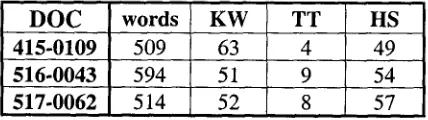
To compare methods, each article was processed three times: 1) with SMART to identify stemmed keywords [Salton 1989]; 2) with an implementation of the TT algorithm based on [Justeson and Katz 1995]; and 3) with our implementation of the HS method. Output for one article is shown in Appendix A. Figure 1 shows the articles selected, their length in words and the number of index terms from each method for each article presented to the subjects.
D O C words KW TT HS
415-0109 509 63 4 49
516-0043 594 51 9 54
[image:4.612.92.306.328.388.2]517-0062 514 52 8 57
Figure 1: Word and term count, by type, per article
The number of TTs is much lower than the number of KWs or HSs. This presented us with a problem: on the one hand, we were concerned about preserving the integrity of the three methods, each of which has their own logic, and at the same time, we were concerned to present lists that were balanced relative to each other. Toward this end, we made several deci- sions about presentation of the data:
1. Threshold: So that no bias would be un- intentionally introduced, we presented subjects with all terms output by each method, up to a specified cut-off poin- However, using lists of equal length for each method would have necessitated either omitting HSs and KWs or changing the definition of TTs. Therefore we made the following decisions:
• For TTs, we included all identified terms;
• For HSs, we included all terms whose head occurred more than once in the document;
3 0 5 .
.
• For KWs, we included all terms in or- der of decreasing frequency, up to the point where we observed diminishing quality and where the number of KWs approximated the number of HSs. Order: For the KW and TT approach, order is not significant. However, for the HS approach, the grouping together of phrases with common heads is, we claim, one of the advantages of the method. We therefore alphabetized the KWs and TTs in standard left to right order and alphabet- ized the HSs by head, e.g., trust account precedes money market fund.
Morphological expansion: The K W ap- proach identifies stems which represent a set of one or more morphological variants of the stem. Since in some cases the stem is not an English word, we expanded each stem to include the morphological variants that actually occurred in the article. For example, for the stem reject, we listed re- jected and rejecting but did not list rejects,
which did not occur in the article.
4.3 Presentation to subjects
Each subject was presented with three articles. For one article, the subject received a head sorted list of HSs; for another article, the sub- ject received a list of technical terms, and for the third article, the subject saw a list of key- words. No time limit was placed on the task.
5. Results
Our results for the three types of terms, by document, are shown in Figure 2. Although we asked subjects to rate three articles, some vol- unteers rated only two. All results were in- cluded.
Doc
900405-0109
900516-0043 3.73 900517-0062 2.98
3.27 Avg of Avgs
Figure 2: Average index terms
Avg KW rating
3.08
Avg Avg T T H S rating rating
1.45 2.71 2.19 2.71 1.7 3.25
[image:4.612.338.549.606.739.2]5.1 Quality
For the three lists of index terms, TTs received the highest ratings for all three documents--an average of 1.79 on the scale of 1 to 5, with 1 being the best rating. HS came in second, with an average of 2.89, and KW came in last with an average of 3.27. It should be noted that av- eraging the average conceals the fact that the number of TTs is much lower than the other two types of terms, as shown in Figure 1.
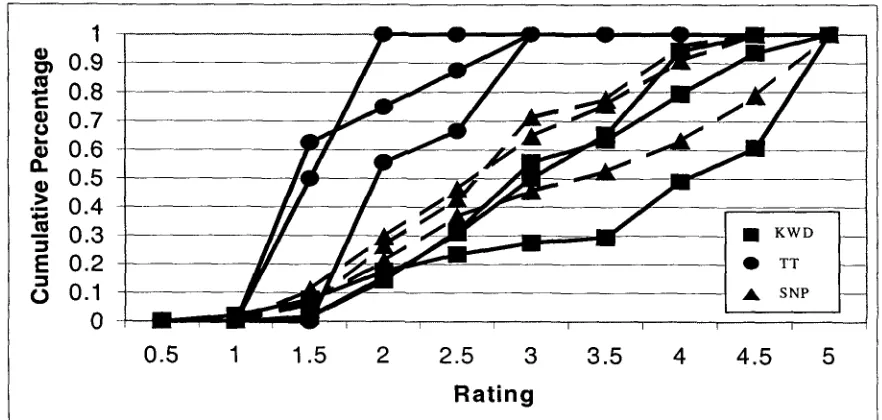
Figure 3 (included before Appendix A) shows cumulative rankings of terms by method. The X axis represents ratings awarded by sub- jects. The Y axis reflects the percentage of terms receiving a given rank or better. All data series must reach 100% since every term has been assigned a rating by the evaluators. At any given data point, a larger value indicates that a larger percentage of that series' data has that particular rating or better. For example, 100% of the TTs have a rating of 3 or better; while only about 30% of the terms of the low- est-scoring KW document received a score of 3 or better. In two out of the three documents, HS terms fall between TTs and KWs.
5.2 Coverage
The graph in Figure 3 shows results for quality, not coverage. In contrast, Figure 4, which shows the total number of terms rated at or below specified rankings, allows us to meas- ure quality and coverage. (1 is the highest rat- ing; 5 is the lowest.) This figure shows that the HS method identifies more high quality terms than the TT method does.
~
od HSNumber of terms ranked at or better than
2 3 4 5
27 75 124 166 41 96 132 160 15 21 21 21
Figure 4: Running total of terms identified at or below a specified rank
TT clearly identifies the highest quality terms: 100% of TTs receive a rating of 2 or better. However, only 8 TTs received a rating of 2 or better (38% of the total), while 41 HSs re-
ceived a rating of 2 or better (26% of the total). This indicates that the TT method misses many high quality terms. KW, the least discriminat- ing method in terms of quality, also provides better coverage than does TT.
This result is consistent with our observa- tion that TT identifies the highest quality terms, but there are very few of them: an average of 7 per 500 words compared to over 50 for HS and KW. Therefore there is a need for additional high quality terms. The list of HSs received a higher average rating than did the list of KWs, as shown in Figure 2. This is consistent with our expectation that phrases containing more content-bearing modifiers would be perceived as more useful index terms than would single word phrases consisting only of heads.
5.3 Ranking variability
The difference in the average ratings for the list of KWs and the list of head-sorted SNPs was less than expected. The small differ- ence in average ratings for the HS list and the KW list can be explained, at least in part, by two factors: 1) Differences among profession- als and students in inter-subject agreement and reliability; 2) A discrepancy in the rating of single word terms across term types.
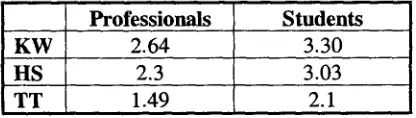
22 students and 7 professionals par- ticipated in the study. Figure 5 shows differ- ences in the ratings of professionals and of students.
KW HS TT
Professionals Students
2.64 3.30
2.3 3.03
1.49 2.1
Figure 5: Average ratings, by term type, of professionals and students
[image:5.612.357.565.507.566.2]Street Journal' was included on the HS list only because it is specified as the document source. However, four of the eight students assigned this term a high rating (1 or 2); this is puzzling because the document is about asbestos-related disease. The other four students assigned a 4 or 5 to 'Wall Street Journal', as we expected. But the average score for this term was 3, due to the anomalous ratings. We therefore have more confidence in the reliability of the profes- sional ratings, even though there are relatively few of them.
We examined some of the differences in rating for term types. Single word index terms are rated more highly by professionals when they appear in the context of other single word index terms, but are downrated in the context of phrasal expansions that make the meaning of the one-word term more specific. The KW list and HS list overlap when the SNP consists only of a single word (the head) or only of a head modified by determiners. When the same word appears in both lists in identical form, the token in the KW list tends to receive a better rating than the token does when it appears in the HS list, where it is often followed by expansions of the head. For example, the word exposure re- ceived an average rating of 2.2 when it ap- peared on the KW list, but a rating of only 2.75 on the HS list. However, the more specific phrase racial quotas, which immediately fol- lowed quota on the HS list received a rating of 1.
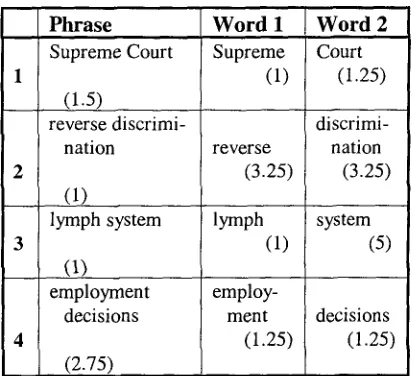
To better understand these differences, we selected 40 multi-word phrases and examined the average score that the phrase received in the TT and HS lists, and compared it to the aver- age ratings that individual words received in the KW list. We found that in about half of the cases (21 of 40), the phrase as a whole and the individual words in the phrase received similar scores, as in Example 1 in Figure 6. In just over one-fourth of the cases (12 of 40), the phrase scored well, but scores from the indi- vidual words were rated from good to poor, as in Example 2. In about one-eighth of the cases (6 of 40), the phrase scored well, but the indi- vidual words scored poorly, as in Example 3. Finally, in only one case, shown in Example 4 of Figure 6, the phrase scored poorly but the individual words scored well.
3 0 7
Phrase Supreme Court
(1.5)
reverse discrimi- I nation
(1)
lymph system
employment decisions
(2.75)
Word 1 Supreme (1)
reverse (3.25)
lymph (1)
employ- ment
(1.25)
Word 2 Court
(1.25)
discrimi- nation
(3.25)
system (5)
decisions (1.25)
Figure 6: Comparison of scores of phrases and single words
This shows that single words in isolation are judged differently than the same word when presented in the context of a larger phrase. These results have important implications in the design of indexing tools.
6. Conclusion
Our results show that the head sorting technique outperforms two other indexing methods, technical terms and keywords, as measured by balance of quality and coverage. We have performed a qualitative evaluation of three techniques for identifying significant terms in a document, driven by an indexing task. Such an applicati;on can be used to create a profile or thumbnail of a document by pre- senting to users a set of terms which can be considered to be a representation of the content of the document. We have used human judges to evaluate the effectiveness of each method. This research is a contribution to the overall evaluation of computational linguistic tools in terms of their usefulness for human-oriented computational applications.
8. References
Boguraev, Branimir and Kennedy, Christopher (1998) "Applications of term identification terminology: domain description and content characterisation", Natural Language Engi- neering 1(1): 1-28.
[image:6.612.336.543.69.257.2]Conference on Applied Natural Language Processing, pp. 136-143.
Evans, David A. and Chengxiang Zhai (1996) "Noun-phrase analysis in unrestricted text for information retrieval", Proceedings of the 34th Annual Meeting of the Association for Computational Linguistics, pp. 17-24.24-27 June 1996, University of California, Santa Cruz, California, Morgan Kaufmann Pub- lishers.
Evans, David K. (1998) LinklT Documentation, Columbia University Department of Com- puter Science Report.
Evans, David K., Klavans, Judith, and Wacholder, Nina (2000) "Document processing with LinklT", RIAO Conference, Paris, France, to appear.
Hatzivassiloglou, Vasileios, Judith L. Klavans and Eleazar Eskin (1999) "Detecting text simi- larity over short passages: exploring linguis- tic feature combinations via machine learning", Proceedings of the EMNLP/VLC- 99 Joint SIGDAT Conference on Empirical Methods in NLP and Very Large Corpora, June 21-22, 1999, University of Maryland, College Park, MD.
Hedges, Julia, Shiyun Yie, Ray Reighart and Lois Boggess (1996) "An automated system that assists in the generation of document in- dexes", Natural Language Engineering 2(2): 137-160.
Jackendoff, Ray (1977) X-bar Syntax: A Study of Phrase Structure, MIT Press, Cambridge, MA.
Justeson, John S. and Slava M. Katz (1995) "Technical terminology: some linguistic properties and an algorithm for identification in text", Natural Language Engineering 1(1):9-27.
Luhn, Hans P. (1958) "The automatic creation of literature abstracts", IBM Journal, 159-165. Mosteller, Frederick and David L. Wallace (1963)
"Inference in an authorship problem", Jour- nal of the American Statistical Association 58(302):275-309. Available at
http://www.jstor.org/.
Paice, Chris D. (1990) "Constructing literature abstracts by computer: techniques and pros- pects". Information Processing & Manage- ment 26(1): 171-186.
Salton, Gerald (1989) Automatic Text Processing: The Transformation, Analysis and Retrieval of lnformation by Computer. Addison- Wesley, Reading, MA.
Smadja, Frank (1993) "Retrieving collocations from text", Computational Linguistics 19(1):143-177.
Strzalkowski, Thomas (1997) "Building effective queries in natural language information re- trieval", Proceedings of the ANLP, ACL, Washington, DC., pp.299-306.
[image:7.612.119.560.534.744.2]Wacholder, Nina (1998) "Simplex NPS sorted by head: a method for identifying significant topics within a document", Proceedings of the Workshop on the Computational Treat- ment of Nominals, pp.70-79. COLING-ACL '98, Montreal, Canada, August 16, 1998.
Figure 3: Cumulative ranking of terms, by method
0.9
0.8
~ 0.7
i•.
0.60.5 0 . 4
~ o.a
0.2
¢~ 0.1
0
0.5
1
1.5
2
2.5 3R a t i n g
Appendix A: Terms identified in WSJ900405-0109
HSs amendments Hatch amendment other amendments attempts
bias job bias
intentional bias bill
committee
Senate labor Committee court
Supreme Court co-workers decisions
Supreme Court decisions employment decisions Democrats
discrimination reverse discrimination employees
women employees employers groups
civil-rights groups conservative policy
groups Orrin Hatch health
discriminatory impact Job-Bias Measure basic employment anti-
discrimination law 1866 civil-rights law lawsuits
lawmakers legislation
comprehensive legislation more modest measure minority/minorities panel
plans
court-approved affirmative action plans
discriminatory seniority plans practices
employment practices quotas
racial quotas fight/rights equal rights year
Keywords action
address/addressing adopt/adopted affirmative agree aimed
alleged/alleging amend
approved attempt/attempts bias
bill Bush challenge circumstances civil clears committee court/Court decision Democrats discrimination
employment/employers/employees force/Force
give/giving GOP groups Hatch health ~gh impact job justify labor/Labor law lawmakers lawsuits
legislative/legislation make
measure
minority/minorities Mr.
overturning panel plans policy practices quotas racial
rejected/rejecting reverse
rights rules/ruling safety Sen./Sens. Senate shown street
Supreme; vote/voted
women workers year
Technical t e r m s