1
The effectiveness of and
experience with an innovative
split-sleep schedule in healthy
nurses
A mixed method study
Marleen van der Stouwe - S1666665
April 2017
Master thesis health psychology
Supervisors:
Dr. E. Taal (University of Twente)
Dr. C. H. C. Drossaert (University of Twente)
I
Acknowledgement
The current thesis is the final mandate of the master in Health Psychology at University of Twente. This project started almost a year ago with an internship and turned into a master thesis project at Philips Research in Eindhoven. After this year with a lot of ups and downs, some long train travels to Eindhoven, early mornings, incredible sprints at train stations, I proudly present this thesis. I have learned a great deal about conducting and reporting scientific research. There are a couple of people I wish to thank.
First of all I would like to thank Dr. Erik Taal for his support and critical feedback on the project and my thesis as being my first supervisor. Next, I would like to thank Dr. Anouk van der Lans for her optimism, support, and critical remarks as supervisor at Philips Research. In addition, I wish to thank Dr. Stans Drossaert for her valuable feedback and critics on my thesis which really have helped to take my writing to a higher level.
Furthermore, I want to thank the project team at Philips Research, colleagues and students who supported me. Finally I would like to thank my family and friends for their interest and support.
II
Abstract
Background
Shift work is currently becoming increasingly more common, however it has two major hazards: It increases the risk of occupational accidents and injuries, as well as the development of (chronic) disease. One of the contributing risk factors is sleep deprivation. It is known that a split-sleep schedule can be an effective countermeasure for shift workers with sleep deprivation. However, existing split-sleep schedules are not effective on successive night shifts or require significant work-environmental changes. This study therefore focussed on testing an innovative split-sleep schedule and exploring
participants’ experiences with it by adopting the Theory of Planned Behaviour (TPB).
Methods
The sample consisted of 18 nurses who were randomly assigned to a split-sleep group (who were given sleep advice and slept 5/6 hours during the day and 2/3 hours during the evening) or to a consolidated group (who slept as they usually do). The following outcomes were observed: objective sleep (measured with the Actiwatch), alertness (measured with the psychomotor vigilance task) and subjective sleepiness (measured with the Karolinska sleepiness scale). After the study, participants were interviewed based on TPB in order to explore their attitudes, subjective norm, perceived behavioural control, and intentions for continuation.
Results
Preliminary results show two trends. Firstly, the total sleeping time (TST) during two nights after the night-shift series was higher (p = 0.09) for the split-sleep group, indicating that this group slept more hours during the two nights after the night-shift series compared to the consolidated group. Secondly, the split-sleep group had fewer lapses during the night shift (p = 0.09), indicating higher alertness during the night shift compared to the consolidated group. Participants in the split-sleep group were generally positive and found it easy to follow the split-sleep schedule. Frequently named advantages were enjoying more of the day, finding it easier to plan meals and to eat and experiencing positive effects during the night shift. Important disadvantages that participants named were the influence on their social life, having to change daily schedule and being preoccupied with sleep. Participants found it easier to follow and were more probable to continue with the split-sleep schedule when it was personalized to the individual shift worker. Participants in the consolidated group were generally more negative, as they perceived some difficulty in following the schedule. In general, the consolidated group perceived the same advantages and disadvantages, however did not mention a perceived positive effect during the night shift. Two participants dropped out, as they were unable to sleep during the evening-sleep opportunity in the night-shift series.
Conclusions
The innovative split-sleep schedule appears to be promising for the majority of shift workers who are able to sleep during the evening. The split-sleep schedule is beneficial shortly after a night-shift series as well. Important implementation strategies are personalizing the split-sleep schedule and informing society about split-sleep and its advantages. However, current results are preliminary and further research is therefore needed.
III
Index
Page
1.
Introduction
1
1.1 Risk factors foroccupational accidents and injuries, and diseases 2
1.2 Split-sleep 4
1.2.1 Different kinds of split-sleep schedules 5
1.3 The innovative split-sleep schedule 7
1.4 Experiences with the split-sleep schedule 9
1.5 Summary 10
2.
Method
11
2.1 Sample 11
2.1.1 The split-sleep schedule 11
2.2 Procedure 12
2.3 Measures 15
2.3.1 Objective sleep 15
2.3.2 Alertness 15
2.3.3 Subjective sleepiness 16
2.4 Exit interview 17
2.5 Analyses 18
2.5.1 Quantitative analyses 18
2.5.2 Qualitative analyses 18
3.
Results
20
3.1 Sample description 20
3.1.1 Dropouts 21
3.2 The effectiveness of the split-sleep schedule 22
3.3 Experience and attitudes with the split-sleep schedule 24 3.3.1 Attitudes towards the split-sleep schedule split-sleep group 24 3.3.2 Subjective norm towards the split-sleep schedule split-sleep group 28 3.3.3 Perceived behavioural control towards the split-sleep schedule split-sleep group 29
3.3.4 Intentions split-sleep group 31
3.3.5 Interventions improvements split-sleep group 33 3.3.6 Expectations of consolidated group towards the split-sleep schedule 34
4.
Discussion
41
4.1 Main findings, reflection on literature and interpretation 41
4.1.1 The consolidated group 44
4.1.2 Thoughts on the long-term influence of shift work for both sleep groups 45
4.2 Strengths and limitations 45
4.3 Implementation recommendations 47
4.4 Future research 48
4.5 Overall conclusion 48
1
Shift work is currently becoming increasingly more prevalent. Sleep deprivation is common among shift workers and can lead to occupational accidents and/or health problems. Therefore, the current study focussed on the effects of adopting an innovative sleep schedule in order to decrease sleep deprivation. This may prevent occupational accidents and injuries, and in the long term diminish the development of (chronic) diseases.Though the term ‘shift work’ appears to be straightforward, it can have different meanings. While most articles do not define it, Åkerstedt (1998) distinguishes four types of shift work: day work, permanent shift work, rotating shift work and roster shift work. This distinction is the result of differences in working hours and the flexibility of the work schedule, rather than only the days of the week. Roster shift work is mostly used in health care and forms the basis of the definition of shift work for this report. Shift work was defined as: working on a roster schedule that is flexibly implemented, has no clear sequence and in which all days of the week were considered as workdays. Thus, shift workers can be scheduled to work on mornings, evenings, nights, weekdays and weekend days.
Most employees in the Netherlands work outside of office hours (8 a.m. to 6 p.m.). According to Centraal Bureau voor de Statistiek (CBS; CBS, 2014), only 15% of the working population in the Netherlands works entirely during the daytime on weekdays, which entails that 85% of the working population works irregularly. This is a slight increase of 4.3% compared to 2000 (CBS, 2014). Of the 85% of irregular workers, 25.2% works entirely irregularly and thus fits the definition of a shift worker that is adopted here.
Although shift work is increasingly more common, it is associated with certain hazards. The first is the well-known association of shift work with occupational accidents and injuries. Folkard and Tucker (2003) argue that, compared to working a morning shift, working a night shift increases the risk of accidents and injuries at work by 30.4%. De Castro et al. (2010) found in a large sample of Philippine nurses a 54% increased risk of being injured at work and a 48% increased risk of involvement in occupational accidents. In addition, Dembe, Erickson, Delbos, and Banks (2006) found in previously gained data a hazard ratio of 1.15 for irregular shifts. Thus, working on an irregular roster increases the risk of occupational accidents by 15%, although few data are available.
2
of developing coronary heart disease after ten years. Furthermore, shift work increases the risk of diabetes type 2 by 3% (Pan, Schernhammer, Sun, & Hu, 2011), with risk increases of 6% after three years of exposure to shift work, 10% after ten years of exposure and up to 24% after twenty years of exposure. Finally, peptic ulcer disease was rated to be 2.18 times more frequent in shift workers compared to day workers. Thus, shift work is not without risks and the more shifts and/or the more time spent working in shifts, the higher the risk to develop (chronic) diseases (Segawa, Nakazawa, & Tsukamoto, in: Khanijow, Praksash, Emsellem, Borum, & Doman, 2015).1.1Risk factors for occupational accidents and injuries, and diseases
Different risk factors contribute to occupational accidents and injuries, and the development of (chronic) diseases. Though the precise relations are not clear, it is recognized that the following three risk factors play a role: sleep deprivation, lifestyle changes and disrupted social life (Bøggild & Knutsson, 1999; Kecklund & Axelsson, 2016; Härmä, 2006). Each of these are explained in what follows.
Firstly, shift work is associated with a disrupted sleep-wake cycle (Kecklund & Axelsson, 2016). The underlying mechanism is the circadian rhythm: the natural rhythm of the body that fosters wakefulness and sleepiness (Bass, 2012). The circadian rhythm can be considered as an internal biological clock that promotes wakefulness during the biological day and reinforces sleep during the biological night (Gonnissen et al., 2013). The master of the circadian clock, called the suprachiasmatic nucleus (SCN), is located close to the hypothalamus and consists of thousands of light-sensitive neurons (Morris, Aeschback, & Scheer, 2012), which is why the system is tightly synchronized with the
environment’s light and darkness. In addition, it has the ability to slowly adjust to external cues such as light (Cipolla-Neto, Amaral, Afeche, Tan, & Reiter, 2014; Morris et al., 2012). The SCN communicates through hormones, the endocrine (a collection of glands that, among other things, regulates growth and the metabolic system) and neural signals, resulting in bodily processes that are coherent with time for optimal performance (Haus & Smolensky, 2013). Therefore, mammals are active during the day and asleep during the night. However, as shift workers’ work and sleep times rotate within the 24-hour cycle, their light exposure changes. Since shift workers may work and sleep at times at which the circadian rhythm normally promotes activity, an association exists between shift work and the disruption of the normal sleep-wake cycle.
3
during the day after a night shift (Chatzitheochiari & Arber, 2009; Ohayon, Smolensky, & Roth, 2010; Åkerstedt & Wright, 2009). Consequently, they miss two to four hours of sleep each day following a night shift and become sleep deprived.Sleep deprivation may be a mediator between shift work and the increased risk of occupational accidents and injuries, and unwanted health outcomes (Kecklund & Axelsson, 2016). Firstly, sleep deprivation is associated with sleepiness, reduced alertness and performance during a night shift, which may lead to occupational accidents and injuries during the night shift (Åkerstedt, 1995; Åkerstedt, 1998; Belenky, Wu, & Jackson, 2011; Rajaratnam & Arendt, 2001; Wagstaff & Sigstad Lie, 2011). For example, Härmä et al. (2002) found in a large group of locomotive engineers that the odds of feeling severely sleepy was six to fourteen times higher during night shifts compared to day shifts. In addition, 49% reported severe sleepiness during the night shift.
Secondly, due to sleep deprivation, numerous endocrine rhythms become altered, which can negatively influence health (Costa, Haus, & Stevens, 2010). For example, the neuro-endocrine system control’s cell growth and changes in the system’s feedback loop may result in abnormal cell growth (Haus & Smolensky, 2013). This is an important cause of tumour growth. In addition, long-term exposure to sleep deprivation is associated with DNA changes, which make people even more sensitive to diseases such as cancers and can be passed on to future generations (Haus & Smolensky, 2013). Moreover, sleep deprivation has a negative influence on the immune system, as this system is closely integrated within the endocrine system’s feedback loops. After sleep deprivation, the activity of T-helper cells is decreased. T-helper cells are important for the production of T-killer cells, which fight diseases (Haus & Smolensky, 2013). Finally, there is evidence that sleep deprivation negatively influences glucose tolerance and insulin reaction: Spiegel, Leproult and Van Cauter (1999) found that sleep deprivation decreases tolerance to glucose and the acute reaction of insulin to glucose, which can result in high blood sugar and eventually diabetes type 2 (Spiegel, Leproult, & Van Cauter, 1999; Knutson & Van Cauter, 2008). Therefore, shift workers are more vulnerable to viruses, infections, diabetes type 2, and cancer.
4
should be examined with regard to meal timing, food choice and variation of energy metabolism at night. Cain, Filtness, Philips, and Anderson (2015) found in a simulated night-shift experiment that night workers had a significantly higher preference for high-fat foods for breakfast, compared to a control group. This preference may lead to weight gain and eventually to obesity. Furthermore, Khanijow et al. (2015) argue that the irregular timing of meals (which is common among shift workers) may result in peptic ulcer disease. Secondly, shift work is associated with increased smoking, higher alcohol intake and less exercise compared to day work (Nea, Kearney, Livingstone, Pourshahidi, & Corish, 2015; Bøggild & Knutsson, 1999). This may make shift workers less healthy compared to day workers, although the evidence is not entirely convincing.The third and final risk factor for disease development is disrupted social life. Shift work and especially night-shift work is associated with a disrupted social life. White and Keith (1990) found that shift work has a modest negative effect on marriage quality and it is also associated with an increased probability of divorce from 7% to 11% within three years. While working in shifts, the amount of time spent with spouse and family may be unsatisfying, as the shift worker is either sleeping or very tired from the lack of sleep or from poor sleep (Finn, 1981). In addition, shift workers are not always able to attend all social and family-related activities, which may result in stress and social isolation (Frost, Kolstad, & Bonde, 2009). Stress and social isolation may influence a person’s health negatively and Pisarski, Bohle, and Callan (1998) found that social support has a direct influence on self-reported psychological and physical wellbeing. Therefore, having low social support may lead to poorer self-reported health. However, (recent) literature on this topic is scarce, possibly because the increase of shift work makes social disruptions less problematic.
All in all, the abovementioned aspects negatively influence work activities and increase shift
workers’ risk of developing (chronic) diseases. Although it is clear that shift work has major negative side effects, it is inescapable for some occupations (e.g., nurses, pilots, doctors or bakers). In high-responsibility jobs, accidents are extremely unwanted, as people’s lives are on the line, thereby finding a solution is needed.
1.2Split-sleep
5
There are many options for split-sleep. The first is through napping strategies. Taking naps during the night shift is a well-known countermeasure against sleep deprivation, because napping during the night shift may prevent a decline in alertness and improve performance during the night shift (Tremaine et al., 2010; Ruggiero & Redeker, 2014). McDonald et al. (2013) studied medical residents in a real-life setting, who worked on a rotating schedule (either a day or night shift, with rotations lasting for four weeks). During the study, participants who worked the night shift split their sleep into one main diurnal sleep period and a nocturnal nap on a chosen time. The authors found that night-shift workers who split their sleep had an equivalent total sleeping time (TST), reaction time and learning ability compared to those of day workers who slept during the night. The authors conclude that the total time spent in bed within 24 hours was the determining factor for these results. In addition, Ruggiero and Redeker (2014) suggest that shift workers who nap during the night shift may nevertheless be sleep deprived. In the authors’ literature review, the participants in most studies that were included slept shortly during daytime (between four and six hours). Therefore, napping during the night shift appears to only be an effective countermeasure for occupational accidents and injuries, and not for unwanted health outcomes. Consequently, Ruggiero and Redeker (2014) propose that nap interventions should focus on improving the TST within 24 hours and that napping during the night shift should not be used as a replacement for gaining sufficient sleep during the day after a night shift.6
2013), which may result in higher health-care costs. Therefore, sleeping during the night shift may not be the best generally applicable solution by which to tackle sleep deprivation.The second and less recently studied nap strategy is sleeping before sleep deprivation occurs (e.g., before a night shift). These so-called prophylactic naps should reduce the homeostatic sleep pressure (the desire to sleep) during the night shift. The sleep pressure is a result of prior time spent awake (Takahashi, 2003; Garbarino et al., 2004), which may positively influence performance and alertness during the night shift. The classic study of Bonnet (1991) found that participants who slept before a period of sleep deprivation were more alert and performed better during their first night of sleep deprivation compared to those in a no-nap condition. Even though these naps are less sensitive to sleep inertia, no positive results were found in the second night of sleep loss (Hofer-Tinguely, et al., 2005; Bonnet, 1991). Therefore, prophylactic naps may not be effective for successive night shifts.
The second split-sleep strategy is to divide sleep opportunities more equally. Mollicone, Van Dongen, Rogers, and Dinges (2008) found that splitting sleep into 50% to 80% of the TST during the night and a nap (of 20% to 50%) during the day had no adverse effect on attention and subjective sleepiness during the day. In addition, Roach et al. (2015) conducted a laboratory study comparing consolidated sleep with an equally divided split-sleep schedule. Both groups followed forced desynchronised sleep schedules within 28 hours and therefore slept during every sleep opportunity at different circadian times. No differences were found regarding TST and the authors suggest that split-sleep has no adverse effects. In addition, Jackson et al. (2014) conducted a laboratory study with healthy volunteers who were divided into three different groups: night-time sleep, daytime sleep and split-sleep. Participants in the split-sleep group split their sleep into equal sleep opportunities (50% from 3 a.m. to 8 a.m. and 50% from 3 p.m. to 8 p.m.). Though the split-sleep group slept significantly more hours and had lower subjective sleepiness compared to the day-sleep group, no differences were found in alertness. It therefore appears to be interesting to try to increase shift workers’ total time spent in bed by following a split-sleep schedule. However, one disadvantage is that the equally divided split-sleep schedule requires, as with napping during the night shift, significant work-environment changes (Fallis et al., 2011), which make the implementation of a certain schedule less probable in a real-life setting.
7
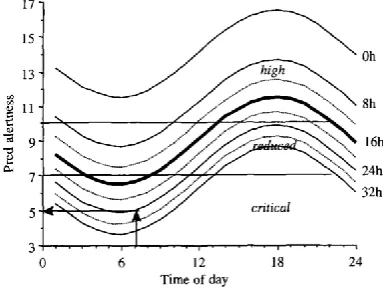
The innovative split-sleep schedule is based on the prediction models of Åkerstedt and Folkard (1995; 1996a; 1996b). The authors created three models by which to predict sleep duration, sleep-onset latency (SOL; the time between bed time and the beginning of sleep) and alertness at different times within the 24-hour cycle (Figures 1, 2 and 3). Each model consists of curves, which represent the circadian variation over the time of day within 24 hours. The numbers on the right vertical axis represent prior time awake, while the left vertical axis represents the prediction value of sleep duration, SOL or alertness. Circadian influence, homeostatic influence, prior time awake and long work hours were contributing factors to sleep duration, SOL and alertness.Firstly, the prediction model for sleep duration predicts that the higher the prior time awake, the longer the sleep duration. Therefore, after a night shift when prior time awake is long, shift work may not appear to have an adverse impact on sleep duration during daytime. However, sleeping during the day takes place at the circadian peak, when the circadian rhythm promotes activity. The model therefore predicts that day sleep results in lower sleep duration compared to night sleep and that the sleep duration when going to bed in the morning (e.g., around 8 a.m.) is of around five hours (until 1 p.m. / 2 p.m.). In addition, according to the model, it is possible to nap during the early evening, as prior time awake is at maximal six hours.
Secondly, the prediction model for SOL predicts that the longer the time awake, the shorter the SOL. For example, the model predicts that the SOL is around five minutes in the morning after 12 hours of being awake, which is low. When napping during the early evening, the predicted SOL is between 20 and 25 minutes. Therefore, the nap should be between two and three hours.
8
Figure 1. Predictive model of sleep duration (Åkerstedt & Folkard, 1996b). Each curve represents the predicted total sleep time, after a given number of prior hours awake. By drawing a vertical line at a certain time of day towards the appropriate curve and a horizontal line towards the left, the predicted duration of sleep can be observed.
[image:12.595.316.515.84.231.2]Figure 2. Predictive model of sleep latency (Åkerstedt & Folkard, 1996a). Each curve represents the circadian variation of sleep latency at a certain time of day, after a certain number of awake hours (right side). The sleep latency is calculated by drawing a vertical line towards the appropriate curve and drawing a horizontal line towards the left.
[image:12.595.78.270.342.487.2]9
AttitudesPerceived behavioural
control
In addition to the effectiveness of a split-sleep schedule, it is necessary to understand participants’
experiences with it. These data are essential in creating a split-sleep schedule that fits shift workers and their environment, which makes the target group’s implementation of the schedule more probable.
There is insufficient data available about these experiences. However, according to Bonnefond et al. (2001), the satisfaction with a nocturnal nap during the night shift increased over time. After six months, two thirds of the participants believed that they were “very well adapted” to the naps during the night shifts, which indicates that finding comfort with a split-sleep schedule does not occur immediately. The remainder of the studies regarding split-sleep are focused on effectiveness and eliminated the subjects’ experiences.
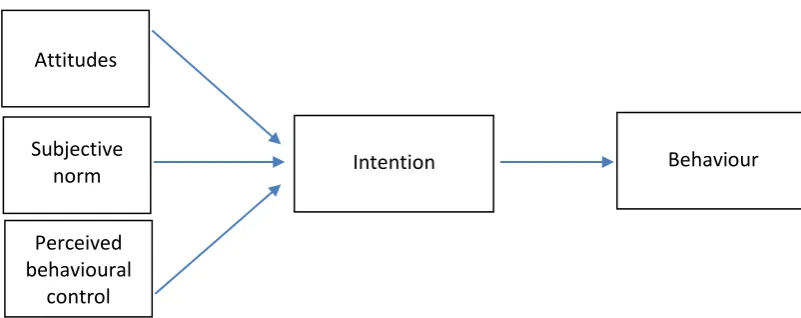
The current study therefore examines participants’ experiences with the split-sleep schedule by adopting the explanatory model of the Theory of Planned Behaviour (TPB; Ajzen, 1991): a model that has proved to be successful in behavioural-change programs for a variety of health problems, such as diet, exercise and, to lesser extent, sleep (Gratton, Povey, & Clark-Carter, 2007; Darker, 2007; Knowlden, Sharma, Bernard, 2012). The TPB can also be used to explore motivations and barriers for specific health-related behaviours, such as sleep behaviour (Brennan et al., 2016; Lao, Tao, & Wu, 2016). The theory is mostly applied on an individual level, as in the current study, and proposes that behaviour is directly influenced by one’s intention to perform that behaviour and indirectly influenced by three constructs: attitudes, social norm and perceived control (see Figure 5). Attitudes refer to a
person’s thoughts and feelings towards certain behaviour. The subjective norm refers to people’s
[image:13.595.137.538.591.750.2]thoughts, feelings and opinions on what their environment thinks and feels towards a particular behaviour. Finally, the perceived behavioural control is a person’s individual evaluation of his/her self-efficacy. The power of TPB is that the three core constructs are changeable. By exploring these constructs, clear recommendations for the implementation of the split-sleep schedule in a real-life setting can be found.
Figure 5. Theory of Planned Behaviour (Ajzen, 1991). Subjective
10
1.5SummaryIn summary, shift work has two major hazards (increased accidental risk and unwanted health outcomes) and three associated risk factors: sleep deprivation, lifestyle changes and a disturbed social life. Though a split-sleep schedule appears to be an effective countermeasure against sleep deprivation, existing split-sleep schedules have the major disadvantage that they require significant work-environmental changes. This forms the motivation for creating an innovative split-sleep schedule in the current study, which focuses on the effectiveness of the split-sleep schedule and on
participants’ experiences with it in a real-life setting, in order to create implementation recommendations. This leads to the following research questions:
1. What is the effectiveness of a split-sleep schedule on objective sleep, alertness, and subjective sleepiness of nurses who work night shifts in a real- life setting?
2. What are the effects of the split-sleep schedule on two nights after the night-shift series on objective sleep of nurses who work night shifts in a real-life setting?1
Hypotheses
1. The split-sleep schedule leads to higher TST during the night-shift series compared to a continuous sleep schedule.
2. The split-sleep schedule leads to higher alertness during night shifts compared to the continuous sleep schedule.
3. The split-sleep schedule leads to a lower self-reported sleepiness during night shifts compared to the continuous sleep schedule.
3. What are participants’ experiences, attitudes, subjective norm, perceived behavioural control and intentions towards the split-sleep schedule?
4. What are the recommendations for implementing a split-sleep schedule for nurses who work night shifts in a real-life setting?
11
The study was initiated by Philips Research and took place at, and in collaboration with, the Catharina Hospital Eindhoven. On 5/23/2016 the internal commission of biomedical experiments of Philips approved the study.2.1Sample
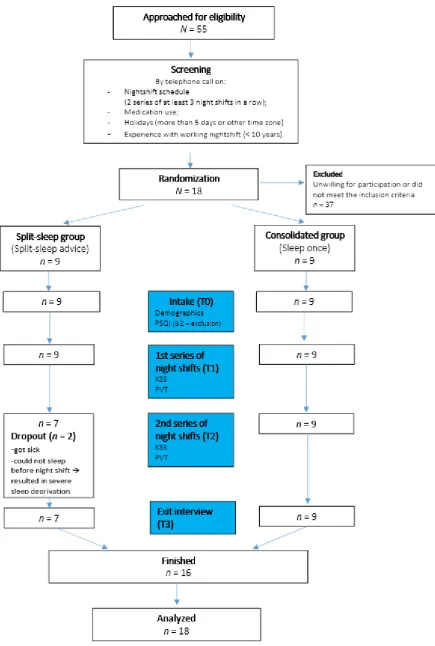
The sample consisted of 18 nurses and was recruited at the Catharina Hospital in Eindhoven2. All participants were required to work during four to eight weeks in two series of at least three night shifts in order to be included. The night shifts started around 11 p.m. and lasted until around 7.30 a.m. Nurses with ten or more years of experience were excluded from participation due to the possibility that they already developed coping strategies, which could negatively influence their compliance with the split-sleep schedule. In order to ensure that participants with major sleep problems were excluded, the Pittsburgh Sleep Quality Index (PSQI) of Buysse et al. (1988) was completed. This questionnaire distinguishes good and poor sleepers with an easily and quickly calculated score. The cut-off sore was eight or higher (Han, Yuan, Zhang, & Fu, 2016). None of the participants needed to be excluded, as none of them scored ≥8 on the PSQI questionnaire. Other exclusion criteria were the use of sleep medication, taking holidays for more than five days or traveling to another time zone.
The nurses were sampled through convenience sampling. They were sent an information letter and they could sign up via e-mail or telephone. In addition, anonymous rosters were sent to the research team and when nurses fitted the inclusion criteria, their e-mail addresses were requested and they were approached actively by e-mail, providing them with short and detailed information.
The nurses were divided randomly into two groups, the split-sleep condition (n = 9) and the consolidated condition (n = 9). This division was created by drawing lots between two participants in order to ensure that both had the same chances of being in one of the groups. Drawing lots was the easiest way of doing so, as participants signed up gradually. Participants in the split-sleep group received the advice to split their sleep (see paragraph 2.1.1 for an explanation) and the consolidated group slept once per day, as usual.
2.1.1 Split-sleep schedule
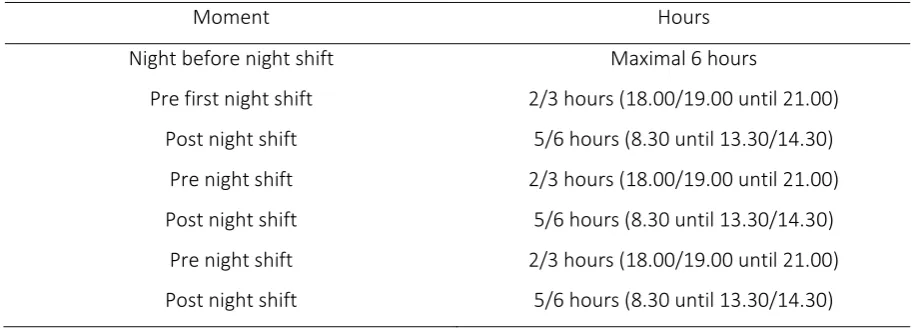
The split-sleep group received the advice to split their sleep (see Table 1). The first sleep opportunity was approximately 70% of the TST (within 24 hours), and was obtained during daytime. The second sleep opportunity was 30% of the TST and was obtained during the (early) evening: the equivalent of five to six hours after a night shift and two to three hours before the next night shift. Participants were
12
advised to sleep the night before their first night shift for a maximum of 70% (six hours) of the TST in order to increase the desire to sleep, the so-called sleep pressure, before the first night shift. In other words, by limiting the sleep on the preceding night, participants felt sufficiently sleepy to sleep before their first night shift. The evening nap before the first night shift served as a shift-over to the split-sleep schedule. Outside of the night-shift series, participants could split-sleep as usual.Table 1
The split-sleep schedule for one series of three night shifts
Moment Hours
Night before night shift Maximal 6 hours
Pre first night shift 2/3 hours (18.00/19.00 until 21.00) Post night shift 5/6 hours (8.30 until 13.30/14.30)
Pre night shift 2/3 hours (18.00/19.00 until 21.00) Post night shift 5/6 hours (8.30 until 13.30/14.30)
Pre night shift 2/3 hours (18.00/19.00 until 21.00) Post night shift 5/6 hours (8.30 until 13.30/14.30)
2.2Procedure
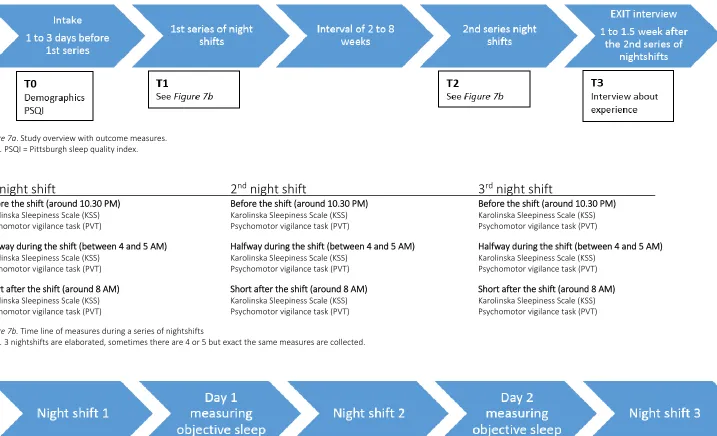
After the application, potential participants were screened, provided with an oral explanation of the study, and called to verify the inclusion and exclusion criteria (see Figure 6). When a nurse was still willing to participate, an inclusion appointment was scheduled. This intake took place between one and three days before the first night-shift series. During the intake, the Informed Consent was signed,
participants were offered an explanation of all of the study’s procedures, provided materials, shown
14
Figure 7a. Study overview with outcome measures.
Note. PSQI = Pittsburgh sleep quality index.
1
stnight shift
2
ndnight shift
3
rdnight shift
Before the shift (around 10.30 PM) Before the shift (around 10.30 PM) Before the shift (around 10.30 PM) Karolinska Sleepiness Scale (KSS) Karolinska Sleepiness Scale (KSS) Karolinska Sleepiness Scale (KSS) Psychomotor vigilance task (PVT) Psychomotor vigilance task (PVT) Psychomotor vigilance task (PVT)
Halfway during the shift (between 4 and 5 AM) Halfway during the shift (between 4 and 5 AM) Halfway during the shift (between 4 and 5 AM) Karolinska Sleepiness Scale (KSS) Karolinska Sleepiness Scale (KSS) Karolinska Sleepiness Scale (KSS)
Psychomotor vigilance task (PVT) Psychomotor vigilance task (PVT) Psychomotor vigilance task (PVT) Short after the shift (around 8 AM) Short after the shift (around 8 AM) Short after the shift (around 8 AM) Karolinska Sleepiness Scale (KSS) Karolinska Sleepiness Scale (KSS) Karolinska Sleepiness Scale (KSS) Psychomotor vigilance task (PVT) Psychomotor vigilance task (PVT) Psychomotor vigilance task (PVT)
Figure 7b. Time line of measures during a series of nightshifts
Note. 3 nightshifts are elaborated, sometimes there are 4 or 5 but exact the same measures are collected.
15
2.3.1 Objective sleepThe objective sleep was measured with Philips Respironics’ Actiwatch Spectrum PRO (Philips Respironics, n.d.): a wrist-worn watch that measures sleep through an accelerator and is validated against the gold standard, the polysomnography (PSG) (Kushida et al., 2001; Endinger, Means, Stechuchak, & Olsen, 2004; Mantua, Gravel, & Spencer, 2016). Participants were instructed to wear the watch as much as possible on days and nights during their study participation. They were told to dismiss the watch at work (due to hygiene reason), during showering, exercising and swimming (the watch is not waterproof). Participants were asked to press the event-marker button on the watch every morning when they tried to fall asleep and in the afternoon when they got out of bed. In addition, the split-sleep group was asked to press the marker button in the evening when they tried to fall asleep and when they got out of bed again. Furthermore, participants were asked to keep a sleep diary during the study. When there were no marker-button data present, the bed and rise times were taken out of the diary.
Primary outcome variables were the average daily TST (sleep time in minutes) during the night shifts and the two nights after both night-shift series. Secondary outcome variables (monitored for explorative purposes) were the average daily SOL and sleep efficiency (SE) during and two nights after the night shifts (for both groups). In addition, the SOL and SE during the second sleep opportunity were calculated for the split-sleep group as well. The SOL is the time between lying in bed and falling asleep in minutes, while the SE is a percentage: 100% x TST / total time in bed (TIB). Figure 7c presents an overview of the objective sleep measures.
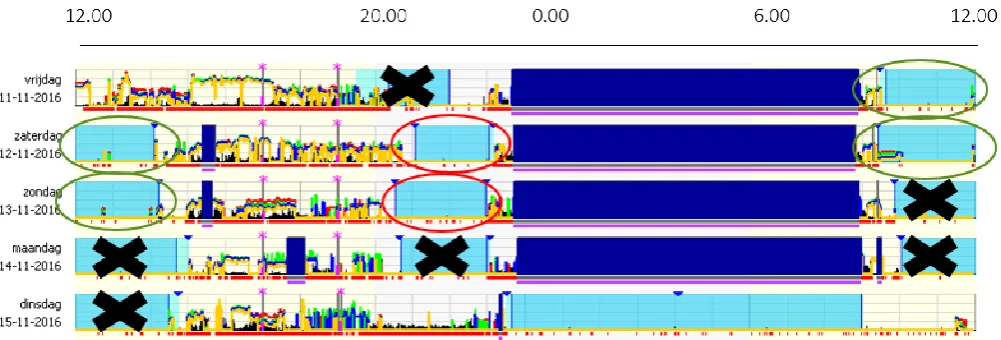
In order to create a valid comparison with the consolidated group, the split-sleep group’s TST after a night shift (green circles in Figure 8) and TST before the next night shift (red circles in Figure 8) were summed up. The SOL and SE were not summed, as this does not create a valid comparison. In addition, due to possible differences over successive night shifts, only sleep data between the first and second night shift, and data between the second and third night shift (which all participants provided) were included for analyses, in order to create a valid comparison (black crosses represent excluded data in Figure 8). The sleep data of the included nights were averaged.
2.3.2 Alertness
16
Figure 8. Overview data analyses of objective sleep. At the top, the time of day is presented. The dark blue bars represent the night shift, the light blue bars represent sleep intervals, the green circles represent sleep data after the night shift, the red circles represent the data before the next night shift and the black crosses represent data that were excluded.
The PVT was performed three times during the night shift: at the beginning, (pre) middle (mid) and end (post) (T1 and T2, see Figure 7a, 7b). The outcome measures were the number of lapses (reaction time >500 ms) and mean response time (1/reaction time in s).
For both groups, data from the first night were excluded, as split-sleep for the split-sleep group had not yet taken place. As the amount of night shifts differed between participants and in order to eliminate the influence of successive night shifts (Folkard, Lombardi & Tucker, 2005), only data from the second and third night shift were included for analysis (which all participants provided). The remainder of the data were excluded. Subsequently, the data of the three time points (pre, mid and post night shift) of the second and third night shift were averaged.
2.3.3 Subjective sleepiness
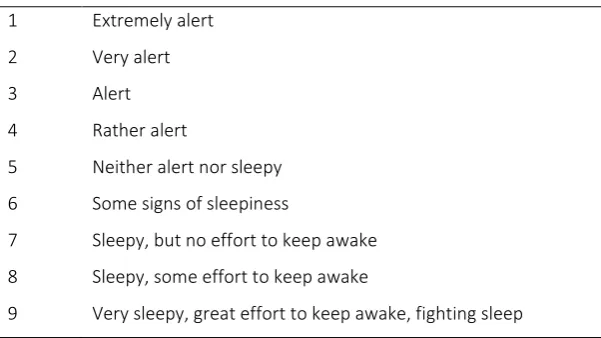
Subjective sleepiness was measured with the Karolinska sleepiness scale (KSS; Åkerstedt and Gillberg (1990), which consist of one question (“how sleepy or alert do you feel at this moment?”) and a one-dimensional scale of sleepiness/alertness with nine response options. A low score indicates alertness and a high score represent sleepiness (see Table 2). The KSS is frequently used in the measurement of subjective sleepiness when standard objective measures are not feasible. The scale is validated against EEG, which is considered to be the golden standard (Kaida et al., 2006). During the study, subjective sleepiness was measured at the same times as alertness (T1 and T2, see Figure 7a, 7b). The KSS was administrated by an online survey, from which data were collected with Verint Enterprise software.
17
The Karolinska Sleepiness Scale (KSS)1 Extremely alert 2 Very alert
3 Alert
4 Rather alert
5 Neither alert nor sleepy 6 Some signs of sleepiness
7 Sleepy, but no effort to keep awake 8 Sleepy, some effort to keep awake
9 Very sleepy, great effort to keep awake, fighting sleep
2.4Exit interview
At the end of the study, an interview was scheduled with participants in order to explore their experiences, attitudes, subjective norm, perceived behavioural control and intentions with the split-sleep schedule (T3 in Figure 7a). Participants who were assigned to the consolidated group were asked to imagine that they had followed the split-sleep schedule. These interviews were used to develop recommendations for the implementation of the split-sleep schedule and were semi-structured. An interview protocol was written (see Appendix A), though the questions could be posed in a different order and further questions could be asked in order to gain more information (Tong, Sainsbury, & Craig, 2007). The questions were based on the TPB and the important topics were attitudes towards the split-sleep schedule (e.g., “what are the positive and negative sides of the split-sleep schedule?”), subjective norm (e.g., “what do you think your direct environment thinks of the split-sleep schedule?”), perceived behavioural control (e.g., “how difficult was it to comply with the schedule on a
[image:21.595.67.368.108.277.2]18
2.5AnalysesThe analyses were made in IBM SPSS statistics (version 23). In addition, the Actiwatch data were imported with the Respironics Actiware 5 software (version 6.9). During the study, two participants dropped out. The available data from the two dropouts were averaged and included in the analyses in order to prevent a positive overestimation of the results. When data were missing regarding alertness and subjective sleepiness, it was assumed that these data were missing at random, as the tests were frequently aborted and it was assumed that the nurses had to do so in order to take care of patients. By averaging the data, the missing data were averaged out, thereby not influencing the result in an over- or underestimation.
2.5.1 Quantitative analyses
For the primary and secondary quantitative outcome measures (objective sleep, alertness and subjective sleepiness), data were explored by boxplots. When an outlier occurred, the Cook’s distance
test was performed in order to observe the outlier’s impact on the model. According to Cook and Weisberg in Fields (2009), when the influence is more than one, the outlier had to be removed. However, none of the outliers were removed. After reviewing a histogram, it was concluded that all measures were not normally distributed. For all primary outcome variables medians, interquartile ranges and Mann-Whitney tests were therefore calculated and performed. For the secondary outcome variables, medians, interquartile ranges and Mann-Whitney tests were calculated and performed on data from post night shift and two nights after the night-shift series for and between both groups. Furthermore, for explorative purposes, the SOL for the split-sleep group between post night and pre night shift were tested with a Wilcoxon Signed rank test. As the split-sleep group had to fall asleep two times, no analyses were made for the total objective sleep regarding the SOL. In addition, due to the influence of the SOL on SE (the SE becomes underestimated when participants have less total time in bed in one sleep opportunity), no statistical tests performed for SE either.
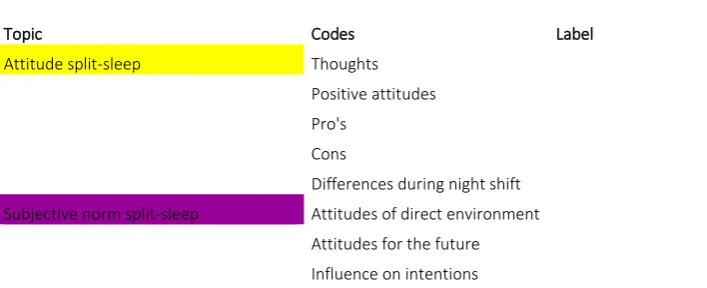
2.5.2 Qualitative analyses
19
Part of coding schemeTopic Codes Label Quote
Attitude split-sleep Thoughts Positive attitudes Pro's
Cons
Differences during night shift Subjective norm split-sleep Attitudes of direct environment
Attitudes for the future Influence on intentions
[image:23.595.69.423.104.248.2]20
3. ResultsThis chapter presents the results of the conducted research. Firstly, the sample is described regarding characteristics, sleep and health, and concludes with a description of the dropouts. Secondly, the results on effectiveness are reported. Finally, the results of the qualitative section regarding the experiences, attitudes, subjective norm, perceived behavioural control and intentions are presented.
3.1Sample description
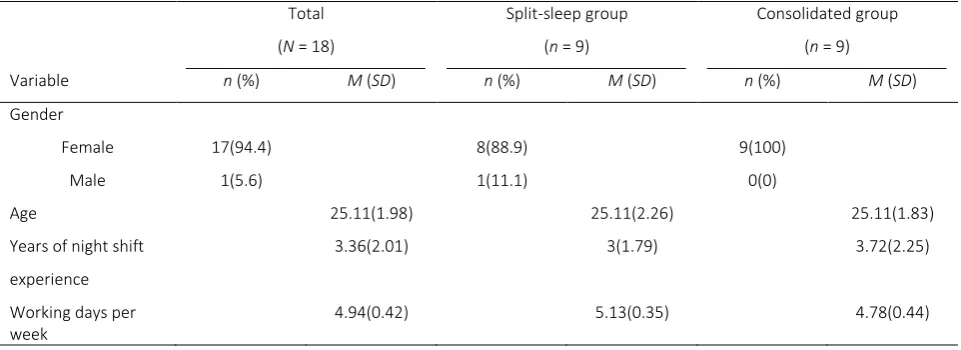
The sample consisted mostly of young female nurses who worked full time and had no more than seven years of experience with working night shifts (Table 4). In general, the participants reviewed their sleep as fine during a series of night shifts before the study (Table 5). None of the participants reported sleep problems. Variable sleep patterns due to work schedule, processing stressful day events and behaviour-related reasons (e.g., going to bed too late or exercising late) were arguments for not giving a perfect score. In addition, the nurses reported being healthy and having no serious health complaints (Table 5). Two participants had mild health complaints, namely small bladder and bowel issues.
[image:24.595.66.547.574.749.2]In general, participants assumed that working night shifts is not healthy, which was mostly based on their own complaints or that of their colleagues. Participants had limited knowledge about long-term risks, though breast cancer was frequently named. The risk of unwanted health outcomes is occasionally discussed among colleagues, mostly when complaints occur. Finally, nurses who have sleeping problems and/or health complaints during a night-shift series work fewer night shifts compared to relatively good sleepers. Therefore, only nurses who were good sleepers during the night-shift series could be included for the current study.
Table 4
Characteristics of participants divided in total, experimental and consolidated group Total
(N = 18)
Split-sleep group (n = 9)
Consolidated group (n = 9)
Variable n (%) M (SD) n (%) M (SD) n (%) M (SD)
Gender Female
Male
17(94.4) 1(5.6)
8(88.9) 1(11.1)
9(100) 0(0)
Age 25.11(1.98) 25.11(2.26) 25.11(1.83)
Years of night shift experience
3.36(2.01) 3(1.79) 3.72(2.25)
Working days per week
4.94(0.42) 5.13(0.35) 4.78(0.44)
21
Numbers and percentages of the self-rated score regarding sleep pattern and health (n = 16)Topic Score 1 to 10 Frequency
n (%) Sleep pattern (missing 2) 4 1 (6.25)
7 6 (37.5)
8 6 (37.5)
9 3 (18.75)
Health (missing 2) 6.5 1 (6.25)
7 3 (18.75)
7.5 2 (12.50)
8 3 (18.75)
9 4 (25.00)
10 3 (18.75)
Note.n = numbers; % = percentages; Score scale was between 1 and 10, where 1 is very poor and 10 extremely good. Only the named numbers are presented.
3.1.1 Dropouts
The two dropouts were questioned afterwards about their reasons for dropping out. They named not falling asleep or sleeping too short during the evening nap and therefore becoming seriously sleep deprived (“… ’s avonds kwam ik niet in slaap… [ik heb maximaal] een half uurtje gedoezeld… op een gegeven moment kom je al met al best wel wat uurtjes [slaap] te kort… En dat breekt je dan wel op na
drie nachten…”). Reasons for not sleeping or having difficulty with falling asleep during the evening
nap were feeling too alert and not feeling tired, being afraid to wake up very tired and being afraid to oversleep. Strategies that the drop-outs applied in trying to fall asleep during the evening were being active or doing little to nothing during the day (e.g., “…dan ging ik mezelf een beetje moe maken, dus flink opstaan en flink wat doen…ik dacht van... misschien slaap ik dan wel… de dag erna dacht ik van dan doe ik vrij weinig, ga ik mezelf een beetje sloom houden… [maar het hielp niet]”).
[image:25.595.66.375.111.308.2]22
3.2The effectiveness of the split-sleep schedulePrior to the tests, it was expected that the primary outcomes would entail that the split-sleep schedule led to more objective sleep, higher alertness and lower subjective sleepiness during the night shifts. The results show no significant differences for objective sleep (Table 6 and boxplots in appendix C). However, a trend was found for TST two nights after the night-shift series. Therefore, it appears that on the two nights after the night-shift series, the split-sleep group had more TST compared to the consolidated group (p = 0.09). In addition, no differences in alertness were observed. Nevertheless, a trend towards significance was again found for the number of lapses. It appears that the split-sleep group had fewer lapses than the consolidated group (p = 0.09), which indicates a higher alertness. Both trends indicate that there is a possibility of finding a difference between both groups with the planned total sample of 40 nurses. Finally, no differences were found for subjective sleepiness between both groups.
23
Medians, interquartile ranges and p-values for objective sleep, alertness and subjective sleepiness between groupsSplit-sleep group (n = 9)
Mdn (IQR)
Consolidated group (n = 9)
Mdn (IQR)
Test statistic
U
p-values
Primary outcomes Objective sleep
TST (in min) 370.50(358.00;395.00) 360.50(330.75;373.50) 31.00 0.201
TST two nights after night-shift series (in min; missing 1)
477.50(454.50;500.88) 459.75(411.50;481.17) 22.00 0.089
Alertness Number of lapses (RTs > 500 ms)
5.22(2.17;6.58) 8.42(5.08;11.83) 25.00 0.086
Response time (1/RT in s) 3276.17(3220.83;3479.07) 3230.81(2798.85;3512.75) 37.00 0.379
Subjective sleepiness
KSS score (missing 2) 5.00(4.79;5.26) 4.75(4.58;5.33) 25.00 0.755
Secondary outcomes Objective sleep
SOL post shift (in min) 4.50(2.50;5.50) 4.00(1.50;6.33) 38.500 0.430
SOL Pre shift (in min) 7.50(4.33;13.50) Not applicable Not applicable Not applicable
SOL two nights after night-shift series (in min; missing 1)
6.00(2.63;11.50) 6.50(5.00;21.00) 28.000 0.221
SE post shift (in percentage) 89.06(84.69;89.98) 84.98(77.95;89.16) Not applicable Not applicable
SE pre shift (in percentage) 76.78(73.74; 79.91) Not applicable Not applicable Not applicable
SE two nights after night shift-series (in min; missing 1)
87.15(82.99; 89.18) 83.75(81.84;88.13) 23.000 0.106
[image:27.842.37.749.75.472.2]24
3.3Experience and attitudes with the split-sleep scheduleThe results of the interviews are reported for both conditions separately, as both groups provided different data. The split-sleep group provided the actual experiences with the split-sleep schedule, which can be used to improve the split-sleep schedule. The consolidated group provided data about their perceived experiences, which provides important recommendations for promotion, as in real life most shift workers will not first test the split-sleep schedule during a study.
3.3.1 Attitudes towards the split-sleep schedule split-sleep group Thoughts
[image:28.595.73.529.392.541.2]In general participants in the split-sleep group were quite positive about the split-sleep schedule (Table 7). Participants were more positive when they fell asleep easily: “…maar vaak sliep ik wel, omdat je ’s ochtends kort slaapt, dan val je ’s avonds tochwel in slaap”.Two participants had to adapt to the split-sleep schedule, especially to the sleep opportunity during the evening.
Table 7
Thoughts of participants towards the split-sleep schedule in the split-sleep group (n = 7)
Thoughts n (%) Sample quote
Feasible 2 (28.6) “Op zich wel redelijk [te doen]”.
Acceptable 3 (42.9) “Prima, dat ga ik voortaan altijd doen…”
Adapt to the split-sleep schedule 2 (28.6) “Wel even wennen dat je verplicht naar bed moet... eerst had ik meer
zoiets van moet ik nu alweer gaan slapen [ik merkte] een beetje
frustratie… [Tijdens de tweede serie] had ik meer zoiets van, nu moet
ik gaan slapen dus dan deed ik dat maar gewoon”
Note. n = frequency; % = percentages.
Advantages
Participants mentioned a wide range of advantages, which are summarized in Table 8. One important advantage, which was named frequently, was enjoying more of the day (e.g., “ik merk wel dat ik iets meer aan mijn dag heb…”). Two participants found it easier to have a social life besides work when
following the split-sleep schedule:
“Ligt eraan, als mijn vriend vrij is dan heb je die dag 's middags nog wat aan elkaar. Dan kun je
25
alert during the night shift or felt better rested. However, workload at the department during the night shift may seem to play a role as well: “…op deze afdeling is het echt ontzettend druk in de nachtdienst… Je bent de hele tijd bezig en we hebben eigenlijk helemaal geen tijd om in te kakken”.One participant provided an explanation for the increased alertness during the night shift. He said:
‘since you just got out of bed in the evening it feels like a morning to your body’: “als je ervoor nog een klein beetje slaapt dan heb je het idee dat je aan een nieuwe dag begint… je houdt je lichaam een
beetje voor de gek, …maar dat werkt wel… qua wakkerheid enenergie, scheelt dat een heel stuk”.
In addition, participants found it easier to plan meals and to eat. With the split-sleep schedule one participant was hungrier during dinner time, and therefore ate more than usually when working night shifts, resulting in not feeling hungry during the shift. The split-sleep schedule helped with eating regularly (like they would normally do outside their night shifts) as well.
“Als je ’s avonds wakker wordt… dan heb ik niet altijd honger. [Met als gevolg] dat je dan
eigenlijk te weinig gegeten hebt voordat je naar de nachtdienst gaat. Maar dat had ik bij deze reeksen niet... want je bent dan al [een tijdje] wakker en dan ga je een keer eten. Dus voor mij was het fijner... je eetpatroon is ook eerder normaal, zoals je het anders zou doen...”.
Other important advantages were: getting extra sleep, having more regularity, and two participants found it easier to shift back to their normal rhythm or did so faster. However, the experienced difference in shifting seems personal, since others did not notice any differences when shifting back: “Het terug omschakelen is nog steeds een ramp, maar ik weet niet of dat te maken heeft
[image:29.595.71.529.575.688.2]met het gesplitst slapen of met de nachtdienst…”. Finally, one participant said that the split-sleep schedule helped him against oversleeping during the day and therefore he felt less tired.
Table 8
Advantages named by the split-sleep group (n = 7)
Advantages Expressions n (%) Sample quote
Enjoy more of the day See more of the day 4 (57.1) “… je ziet wat meer van de dag…”
Feel fitter during the day 2 (28.6) “je bent wat fitter overdag…”
See day light 2 (28.6) … in de winter zie je dan nog een beetje daglicht…”
26
Advantages Expressions n (%) Sample quote
Easier to have a social life
2 (28.6) “… je kunt ’s middags inderdaad nog wat afspreken… ’s avonds kun je gewoon minder doen… dus je hebt toch iets meer een sociaal leven als je 2 keer slaapt”.
Feeling positive effects during the night shift
More alert in beginning/during the night shift
3 (42.9) “Toch had ik ’s nachts het idee dat ik iets meer alert was”.
Feeling better rested 2 (28.6) “… maar verder was ik ’s nachts wel beter uitgerust”.
First part of the night is less difficult than before
1 (14.3) “... en dat is met 2 keer slapen, het tweede gedeelte blijft zwaar. Maar met 1 keer slapen dan
had ik altijd al dat het eerste gedeelte al rot was”.
Easier to stay awake during the night shift
1 (14.3) “… het wel wat makkelijker om wakker te blijven, tijdens je nachtdienst”.
Feeling less tired in the morning 1 (14.3) “… waardoor je ’s ochtends minder moe bent…”
Depends on workload department
2 (28.6) “… deze afdeling is wel echt ontzettend druk in de
nachtdienst… Je bent de hele tijd bezig en we
hebben geen tijd om in te kakken”.
Easier to plan meals and to eat
3 (42.9) “… je bent al [een tijdje] wakker en dan ga je eten. Dus voor mij was het fijner… je eetpatroon is eerder normaal, zoals je het normaal zou doen…”
Extra sleep 1 (14.3) “… met nachtdiensten kan ik sowieso niet goed
slapen… dan ben ik heel blij als ik ’s avonds nog even moet gaan slapen”.
Created more regularity
1 (14.3) “... maar echt in een reeks van 3 of 4 dan is het wel
veel fijner. Dan heb je veel meer rust en
regelmaat”.
Easier or faster shifting back to normal rhythm
2 (28.6) “De dag dat ik uit de nachtdienst kom… dan ga ik
altijd een paar uurtjes slapen en dat komt meer
overeen met in twee delen slapen dan in één stuk… je bent eerder teruggeschakeld”.
Helped against oversleeping
1 (14.3) “Ik merk voor mezelf… dat ik eigenlijk gewoon wat strenger voor mezelf ben… anders ga je over je slaap grens heen en dan blijf je moe”.
27
Participants mentioned a number of disadvantages as well. These are summarized in Table 9. Although two participants viewed the influence of the split-sleep schedule on their social lives as an advantage, four participants thought the split-sleep schedule had a rather negative influence on their social lives. Since the participants woke up when most people were working and went to bed when their environment was off duty. Participants that viewed this as a disadvantage were generally more active during the evening rather than during the day.“...vooral het sociale leven, het leven wat ik met mijn vriend heb.... we eten samen en daarna ga ik weer redelijk snel slapen en dan is hij net thuis en dan spreek je elkaar maar heel even... sommige mensen die tot 17.00 uur slapen kunnen dan ’s avonds nog gewoon dingen gaan
doen, maar als je zo gesplitst [slaapt] dan [kan dat niet]…, ’s middags doe je ook niet echt iets...”.
[image:31.595.74.501.450.700.2]Furthermore, being preoccupied with sleep, having to change daily structure regarding eating and activities, finding it hard to get out of bed, and experiencing physical complaints (e.g., feeling nauseous) were reported disadvantages. Finally, one participant did not really see disadvantages and thinks it is very personal how long and at what times one is comfortable sleeping.
Table 9
Disadvantages named by the split-sleep group (n = 7) Disadvantages n (%) Sample quote
Social life 4 (57.1) “… mensen kunnen dan ’s avonds nog dingen gaan doen…’s middags doe je ook niet echt iets…”
Preoccupied with sleep
2 (28.6) “je bent dan heel veel bezig met slapen…je bent continu aan het rekenen… om je uren te halen”.
Having to change daily structure
2 (28.6) “… je moet je eetpatroon aanpassen... en ’s avonds naar bed gaan terwijl je nog van alles wil gaan doen”.
Difficulty getting out of bed
2 (28.6) “… alleen ik vond het lastig om dan weer uit bed te moeten”.
Physical complaints 1 (14.3) “… om half 2 ging ik er uit… dan was ik hartstikke misselijk…”
None, it is personal 1 (14.3) “Nee, ik denk dat het gewoon ligt aan hoe iemand slaapt. Als iemand gewoon in 1 ruk
tot 18.00 uur slaapt dan denk ik dat dat gewoon goed is”.
28
3.3.2 Subjective norm towards the split-sleep schedule split-sleep groupAlmost half of the participants thought that following the split-sleep schedule was harder for their direct environment compared to consolidated sleep (Table 10). The main reason was being less sociable, since participants went to bed in the evening when they usually had some quality time with their partner. Furthermore, some practical issues (e.g., dinner had to be advanced in order to have enough time to sleep) and following the sleep schedule in weekends were perceived as factors that made it more difficult for the environment:
“Nou ik heb misschien ook de pech gehad dat ik altijd in het weekend nachtdiensten heb gehad, want doordeweeks zou het geen probleem zijn. Want dan is hij toch aan het werk als ik slaap, maar in het weekend dan is hij natuurlijk thuis en dan slaap ik… En [in de middag] wou
hij me persé mee naar buiten hebben en ik dacht nee, daar heb ik helemaal geen zin in en moet dat nou. Ik ben nu aan het wennen dat ik vijf uur geslapen heb en doe maar een beetje rustig aan”.
The other half said that their partner found it acceptable towards the split-sleep schedule, since they work only one night shift series a month and thought it is their own responsibility. Half of the participants thought their partner would not mind if they continue with the split-sleep schedule, since they work not only night shifts. Two participants were directly asked and said that the opinion of their partner would withhold them to continue with the split-sleep schedule (e.g., “Ik zou het wel zo blijven doen, dan”). The other were not asked directly, however no one mentioned that they would be
[image:32.595.75.525.535.718.2]influenced by their direct environment regarding their decision.
Table 10
The subjective norm towards the split-sleep schedule in split-sleep group (n = 7) Subjective norm Expression n (%) Sample quote
More difficult for direct environment
Less sociable 3 (42.9) “Ik denk dat hetiets lastiger is geweest…om daarin zijn weg te vinden en zijn planning aan te passen”.
Advance dinner 1 (14.3) “… je moet je eetpatroon aanpassen... en ’s avonds naar bed gaan terwijl je nog van alles wil gaan doen”.
Harder in weekends 1 (14.3) “… doordeweeks zou het geen probleem zijn, want dan is hij
aan het werk…nu [in de middag] wilde hij me persé mee naar buiten hebben… ik had daar helemaal geen zin in. Ik [dacht] ben net aan het wennen aan 5 uur slaap…doe maar beetje rustig aan”.
29
Neutral Own responsibility 1 (14.3) “… op zich vindt hij het niet heel erg… hij accepteert dat wel.Hij zegt: jij moet zorgen dat je fit bent…”
Acceptable 3 (42.9) “… op zich vindt hij het niet heel erg en hij zegt ook van ik ben
blij dat het niet altijd is…”
Subjective norm towards continuation
Would not mind 4 (57.1) “neuh dat vinden ze niet erg…”
Influence on implementation
None 2 (28.6) “Ik zou het wel zo blijven doen”.
Note. n = frequency; % = percentages.
3.3.3 Perceived behavioural control towards the split-sleep schedule split-sleep group
[image:33.595.72.538.510.721.2]With an average score of 3.4 on a scale from 1 to 10, participants found the schedule quite easy to follow (Table 11).
Table 11
Frequencies and percentages of the self-rated score regarding difficulty executing the split-sleep schedule in the split-sleep group (n = 7)
Score (1 to 10) (missing 2)
Frequency
n (%)
Perceived behavioural control
1.5 1 (14.3)
2 2 (28.6)
3 1 (14.3)
4 1 (14.3)
4.5 1 (14.3)
7 1 (14.3)
30
When participants fell asleep easily they rated the split-sleep schedule with a low score (e.g., “Ik vond het echt niet moeilijk namelijk. Ik kan gewoon goed slapen”; Table 12). One participant scored farabove the average and gave a seven. Reasons were feeling tired during the day and finding it hard to go back to bed again, because she wanted to spent time with her partner. Factors that made it more difficult were: social life, not feeling rested after the first sleep opportunity (e.g., “…als je om 13.30 uur wakker wordt dan heb je 5 uurtjes geslapen, dus mijn lichaam denkt dan van, ‘ik moet nog heel even”),
bounded to specific sleep times, and working more than 2 or 3 night shifts in a row:
“... de eerste nachtdiensten zou ik het een drie geven of zo, dan is het wel goed te doen... dan
heb ik gewoon nog meer energie... Maar [het is] niet zo gemakkelijk als in één stuk slapen. [maar na drie nachtdiensten]… was het toch echt wel een zes/zeven... Want dan wil je gewoon
echt een keer lang slapen zeg maar. Iedere keer die korte stukjes, en op een gegeven moment ben je gewoon gebroken... het ritme wat je omgooit, het kost dan meer energie”.
[image:34.595.75.524.493.697.2]Personalizing the sleep schedule to wishes of the participants was an important factor to make it easier for participants to follow the split-sleep schedule. For example, shorten the nap in the evening (so there is more time to clean the kitchen after dinner), take the nap earlier in the evening (so there is more time to prepare for the night shift), and flexible implementation of the sleeping times. In addition, living alone and change planning (e.g., plan less activities during the evening and plan activities during the day) made it also easier to follow the schedule.
Table 12
Perceived behavioural control towards the split-sleep schedule in split-sleep group (n = 7) Perceived behavioural control n (%) Sample quote
Factors that make it easy
Fell asleep easily 2 (28.6) “Ik vond het echt niet moeilijk namelijk. Ik kan gewoon goed slapen”.
Factors that make it difficult
Social life 3 (42.9) “Ik denk dan dat … het sociale aspect het misschien wat lastiger maakt. Dat je ’s avonds geen sociaal leven zou kunnen hebben”.
Not feeling rested 1 (14.3) “… als je om 13.30 uur wakker wordt dan heb je 5 uurtjes geslapen, dus mijn lichaam denkt dan van, ‘ik moet nog heel even”.
31
Perceived behavioural control n (%) Sample quoteBounded to specific sleep times 1 (14.3) “Maar het is was niet super gemakkelijk, omdat je ook soms denkt ik wil niet gebonden zijn aan bepaalde tijden dat ik moet slapen”.
Working more than 2 or 3 night shifts in a row
1 (14.3) ”...want de eerste nachtdiensten … is het wel goed te doen... dan heb ik
gewoon nog meer energie... Maar niet zo gemakkelijk als in 1 stuk slapen.
En de laatste 2 nachtdiensten… dan wil je gewoon echt een keer lang
slapen zeg maar. Iedere keer die korte stukjes dan op een gegeven moment dan ben je gewoon gebroken... het ritme wat je omgooit, het kost
dan meer energie”.
Factors that make the schedule easier
Personalize the sleep schedule 3 (42.9) “... ja nou dan zou je ’s avonds die tijd moeten verkorten...” or “Ik vond het wel fijn om van 18:00 tot 20:00 te slapen [i.p.v. 19.00 tot 21:00 uur”.
Living alone 1 (14.3) “… ik kan mijn vriend dumpen. Hahaha dan is het makkelijker om naar bed te gaan”.
Change planning 2 (28.6) “Je hebt ook een huishouden en dingen te doen, maar als je dat minder
hebt dan ga je misschien ook sneller ’s avonds ook naar bed”.
Note.n = frequency.
3.3.4 Intentions split-sleep group
All participants were open to continue with the slit-sleep schedule when they are not able to sleep enough during the day, have no activities planned during the evening, wanting to enjoy more of the day during winter or with nice weather, when the sleep schedule is personalized, and finally when the night shift series is short, e.g., only 2 or 3 night shifts (Table 13). One participant would try to continue with the split-sleep schedule however, would replace the nap in bed for a resting period on the couch. Furthermore, three participants were not planning on continuation of the split-sleep schedule when they slept enough, since it is closer to their rhythm or when they have already planned activities. Participants would not postpone or advance these planned activities. Furthermore, one participant is only planning for implementation when the current study proves that the split-sleep schedule is effective. Finally, one participant does not care about the health influences and will not be influenced by the results of the current study. In her opinion the health damage is already done:
“neuh, want dan is het kwaadtoch al geschied, hahaha… dat is hetzelfde als een patiënt tegen
mij zegt met longkanker ik ben gestopt met roken dan denk ik ‘ja die 2 maanden extra maakt