University of Warwick institutional repository: http://go.warwick.ac.uk/wrap
This paper is made available online in accordance with
publisher policies. Please scroll down to view the document
itself. Please refer to the repository record for this item and our
policy information available from the repository home page for
further information.
To see the final version of this paper please visit the publisher’s website.
Access to the published version may require a subscription.
Author(s): T. Nagel, S. Schuh, D.-J. Kusterer, T. Stahn, S. Dreizler,
M. R. Schreiber, B. T. Gänsicke, S. D. Hügelmeyer
Article Title: SDSS J212531.92–010745.9 – the first definite PG 1159
close binary system
Year of publication: 2006
Link to published article:
http://dx.doi.org/10.1051/0004-6361:200600009
Publisher statement: © ESO 2006. T. Nagel et al. (2006). SDSS
A&A 448, L25–L28 (2006)
DOI: 10.1051/0004-6361:200600009
c
ESO 2006
Astronomy
&
Astrophysics
SDSS J212531.92–010745.9 – the first definite PG 1159 close
binary system
T. Nagel
1, S. Schuh
2, D.-J. Kusterer
1, T. Stahn
2, S. D. Hügelmeyer
2, S. Dreizler
2,
B. T. Gänsicke
3, and M. R. Schreiber
41 Institut für Astronomie und Astrophysik, Eberhard-Karls-Universität Tübingen, Sand 1, 72076 Tübingen, Germany
e-mail:[email protected]
2 Institut für Astrophysik, Georg-August-Universität Göttingen, Friedrich-Hund-Platz 1, 37077 Göttingen, Germany 3 Department of Physics, University of Warwick, Coventry, CV4 7AL, Great Britain
4 Departamento de Fisica y Meteorologia, Facultad de Ciencias, Universidad de Valparaiso, Valparaiso, Chile
Received 14 December 2005/Accepted 19 January 2006
ABSTRACT
Aims.The archival spectrum of SDSS J212531.92−010745.9 shows not only the typical signature of a PG 1159 star, but also indicates the presence of a companion. Our aim was the proof of the binary nature of this object and the determination of its orbital period.
Methods. We performed time-series photometry of SDSS J212531.92−010745.9. We observed the object during 10 nights, spread over one month, with the Tübingen 80 cm and the Göttingen 50 cm telescopes. We fitted the observed light curve with a sine and simulated the light curve of this system with thenightfallprogram. Furthermore, we compared the spectrum of SDSS J212531.92−010745.9 with NLTE models, the results of which also constrain the light curve solution.
Results.An orbital period of 6.95616(33) h with an amplitude of 0.354(3) mag is derived from our observations. A pulsation period could not be detected. For the PG 1159 star we found, as preliminary results from comparison with our NLTE models,Teff∼90 000 K, logg∼7.60, and the abundance ratio C/He∼0.05 by number fraction. For the companion we obtained with a mean radius of 0.4±0.1R, a mass of 0.4±
0.1M, and a temperature of 8200 K on the irradiated side, good agreement between the observed light curve and thenightfallsimulation, but we do not regard those values as final.
Key words.stars: AGB and post-AGB – white dwarfs – binaries: close
1. Introduction
PG 1159 stars are hot hydrogen-deficient (pre-)white dwarfs with effective temperatures between 75 000 and 200 000 K, and logg =5.5–8.0 (Werner 2001). They are in the transition be-tween the asymptotic giant branch (AGB) and cooling white dwarfs. Spectra of PG 1159 stars are dominated by absorption lines of He
ii
, Civ
and Ovi
.Current theory suggests (e.g. Werner 2001) that they are the outcome of a late helium-shell flash, a phenomenon that drives the currently observed fast evolutionary rates of three well-known objects (FG Sge, Sakurai’s object, V605 Aql). Flash-induced envelope mixing produces a H-deficient stellar surface. The photospheric composition then essentially reflects that of the region between the H- and He-burning shells in the precur-sor AGB star. The He-shell flash forces the star back onto the AGB. The subsequent, second post-AGB evolution explains the existence of Wolf-Rayet central stars of planetary nebulae and their successors, the PG 1159 stars.
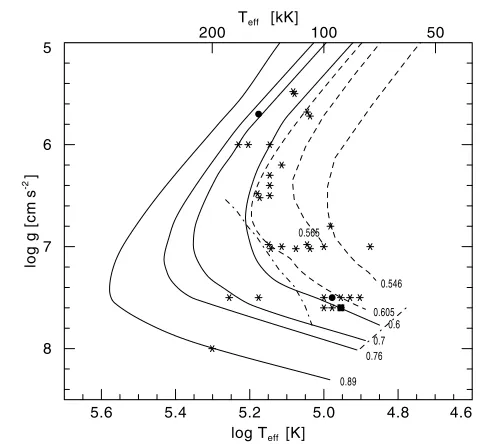
Currently, 37 PG 1159 stars are known. Figure 1 shows their position in a logTeff-logg-diagram. Two of them have been found to be binary stars. These are NGC 246 (e.g. Bond & Ciardullo 1999), which is a resolved visual binary, and PG 2131+066 (Wesemael et al. 1985). Concerning the latter, it is still unclear whether it is a close binary (Paunzen et al. 1998) or a resolved visual binary with an M2V star as compan-ion (Reed et al. 2000).
2. The spectrum of SDSS J212531.92–010745.9
The spectrum of SDSS J212531.92−010745.9 (u=17.15,g = 17.54,r=17.75,i=17.79,z=17.83), taken on Sept. 6th 2002, is from the Sloan Digital Sky Survey (SDSS) archive Data Release (DR) 4. The spectrum shows significant features that are typical for PG 1159 stars, for example the strong C
iv
ab-sorption lines at 4650−4700 Å and Heii
at 4686 Å (Fig. 2). Furthermore, the spectrum shows features which indicate the presence of a companion. The Balmer series of hydrogen isLetter to the Editor
L26 T. Nagel et al.: The first definite PG 1159 close binary system
200 100 50
8 7 6 5
5.6 5.4 5.2 5.0 4.8 4.6
Teff [kK]
log Teff [K]
log g [cm
[image:3.595.58.298.81.303.2]s -2 ] 0.546 0.565 0.605 0.6 0.7 0.76 0.89
Fig. 1. Positions of the known PG 1159 stars in the log Teff
-logg-diagram. The two known binary systems are shown as black
dots, the new one is shown as square. Post-AGB evolutionary tracks are taken from Schönberner (1983, dashed lines, 0.546 M and 0.565 M), Blöcker (1995, dashed line, 0.605 M), and Wood & Faulkner (1986, solid lines) (labels: mass inM). The dashed-dotted lines represent the theoretical red (Quirion et al. 2004) and blue edge (Gautschy priv.comm.) of the GW Vir instability strip.
seen in emission, Hα–Hδcan clearly be identified. This is prob-ably due to a cool companion which is heated up by irradiation from the hydrogen-deficient PG 1159 star.
Figure 2 shows the observed spectrum (texp = 3703 s) of SDSS J212531.92−010745.9. Overlayed are a PG 1159 NLTE model spectrum with Teff = 90 000 K, logg = 7.60, C/He = 0.05, and N/He = 0.01, a blackbody model spec-trum with T =8200 K for the irradiated companion, and the sum of the two model spectra. The parameters of both stel-lar components are estimates obtained from a qualitative com-parison of our NLTE models to the single SDSS spectrum. Detailed parameters for both stars need to be derived from a full two-component analysis of orbital phase resolved spec-troscopy. The effective temperature in particular may be lower or higher by 20 000 K. The surface temperature of the com-panion’s irradiated side was also constrained withnightfall
simulations, see below.
The overall shape of the observed spectrum is well fitted with the combination of a PG 1159 star and a cool, irradi-ated companion, but especially the C
iv
spectral lines of the PG 1159 model atmosphere are not strong enough. There is another PG 1159 star showing this phenomenon (Hügelmeyer et al., in prep.), and also none of the deep absorption lines which some DO white dwarfs show can be fitted (e.g. Werner et al. 1995).The spectral signatures of an A star, as one would expect for the companion with 8200 K surface temperature at the ir-radiated side, cannot be seen in the observation. This may be because the irradiation from the PG 1159 leads to a temperature inversion in the upper layers of the companion’s atmosphere up
Table 1.Observation log. All observations are performed with clear
filter.
Date texp[s] tcycle[s] Duration [s] Telescope
2005/09/21 90 98 18 900 80 cm
2005/09/22 90 98 18 899 80 cm
2005/09/23 90 98 21 758 80 cm
2005/09/23 180 194 14 873 50 cm
2005/10/06 240 248 10 202 50 cm
2005/10/07 240 246 14 897 50 cm
2005/10/08 240 248 9298 50 cm
2005/10/10 90 98 19 852 80 cm
2005/10/11 240 248 17 872 50 cm
2005/10/18 90 98 16 532 80 cm
2005/10/26 90 98 20 095 80 cm
toτRoss=1, which causes the observed emission line spectrum (Barman et al. 2004).
3. Photometry of SDSS J212531.92–010745.9
Photometric observations of SDSS J212531.92−010745.9 were performed during 10 nights (Table 1) using the Tübingen 80 cm f/8 telescope with an SBIG ST-7E CCD camera and the Göttingen 50 cm f/10 telescope with an SBIG STL-6303E CCD camera. To achieve good time resolution we chose clear filter exposures with a binning of 2×2 pixels to reduce read-out time. The exposure time wastexp=90 s for the observations with the 80 cm telescope. In the case of the 50 cm telescope, the exposure time wastexp=180 s andtexp=240 s. The observing conditions were good during the nights, considering that the telescopes are located in the cities of Tübingen and Göttingen. All images were bias and dark current corrected, then aper-ture photometry was performed using our IDL software TRIPP (Time Resolved Imaging Photometry Package, Schuh et al. 2003). The relative flux of the object was calculated with re-spect to the same two comparison stars (SDSS J212530.60– 010921.0 and SDSS J212528.83–010828.5) for all nights, which were tested for stability. The resulting light curve is dis-played in Fig. 3.
To analyse the combined light curve of all nights, we used CAFE (Common Astronomical Fit Environment, Göhler, priv. comm.), a collection of routines written in IDL. The bright-ness variation is probably caused by a reflection effect. The companion is, due to the small separation, heated up on one side by irradiation from the PG 1159 star, and the orbital mo-tion then leads to a variable light curve. We fitted the combined light curve of all nights with a sine, achieving best results for a period of 6.95616(33) h (Fig. 3). The observed variability has a mean amplitude of 0.354(3) mag.
To check if the observed light curve can be explained by a PG 1159 star and an irradiated companion and for an impres-sion of what the system geometry might look like we simu-lated the light curve of the binary system for an orbital period of 6.95616 h with the program nightfall. Figure 4 shows
[image:3.595.321.565.117.292.2]Fig. 2.Spectrum of SDSS J212531.92−010745.9 (gray line, exposure time 3703 s), a PG 1159 NLTE model spectrum withTeff =90 000 K, logg=7.60, and C/He=0.05, N/He=0.01 (thin black line), a blackbody spectrum withT=8200 K (dashed line), representing the contribution from the irradiated companion, and the total model spectrum (thick black line). The Balmer series in emission (top), belonging to the companion, and some helium and carbon lines (bottom), belonging to the PG 1159 star, are marked.
1 2 3 4
0.5 0.0 −0.5
16 17 18 19
0.5 0.0 −0.5
21 22 23 24
0.5 0.0 −0.5
∆
m [mag]
26 27 28 29
0.5 0.0 −0.5
32 33 34 35
JD−2453635 [days] 0.5
[image:4.595.62.502.393.596.2]0.0 −0.5
Fig. 3.Light curve of all nights, overplotted the best sine fit with a period of 6.95616 h.
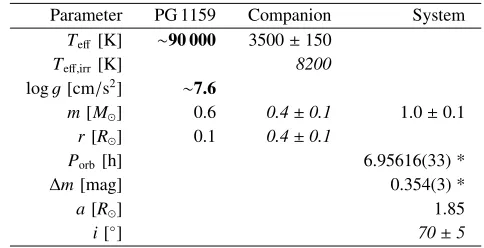
the simulated and observed light curves of all nights, folded onto the orbital period. For the PG 1159 star we assumedTeff= 90 000 K, a mass of 0.6Mand a radius of 0.1R. For the com-panion we varied the mass from 0.1Mto 0.7M. We found that the observed light curve can be reproduced best with an M dwarf with an effective temperature of 3500±150 K, a mean radius of 0.4±0.1Rand a mass of about 0.4±0.1M. For the inclination of this system we obtained 70±5◦. Due to the irradiation by the PG 1159 star the surface of the companion would be heated up to a surface temperature of 8200 K, which, in combination with the PG 1159 star, reproduces the overall shape of the observed spectrum quite well, as can be seen in
Fig. 2. The broad dip at the minimum of the light curve is well reproduced by this system configuration, too. In Table 2 we list all stellar and system parameters assumed and derived. We found that ellipsoidal variation due to geometrical defor-mation of the stars cannot generate the observed light curve. In the above configuration, calculated by nightfall according to the geometry in Djurasevic (1992), the equatorial radius of the M dwarf is only 4.5% larger than its polar radius, and the PG 1159 star is not affected by deformation above the numeri-cal limit ofnightfall.
Because the object is positioned in the GW Vir instabil-ity strip (Fig. 1), we also looked for pulsation periods below
L28 T. Nagel et al.: The first definite PG 1159 close binary system
Fig. 4. Simulated light curve of a binary system, consisting of
a PG 1159 star (Teff =90 000 K) and an M dwarf (Teff =3500 K, heated up to 8200 K), calculated withnightfall(black line) and the observed light curve of all nights, folded onto the orbital period. The shape of the light curve is well resampled, especially the broad dips.
Table 2. Stellar and system parameters of SDSS J212531.92–
010745.9, assumed (normal font) or derived from comparison with NLTE model spectra (boldface), photometric analysis (*) and night-fall simulation (italic).
Parameter PG 1159 Companion System
Teff [K] ∼90 000 3500±150
Teff,irr[K] 8200
logg[cm/s2] ∼7.6
m[M] 0.6 0.4±0.1 1.0±0.1
r[R] 0.1 0.4±0.1
Porb[h] 6.95616(33) *
∆m[mag] 0.354(3) *
a[R] 1.85
i[◦] 70±5
two hours in the light curve of SDSS J212531.92−010745.9. Therefore, we calculated a Lomb-Scargle periodogram (Scargle 1982) for the night with the best S/N (2005/10/26). But observational noise precludes detection of any periodic-ity with amplitudes below about 50 mmag. The amplitudes of pulsating PG 1159 stars normally are of the order of a few per-cent of a magnitude, and SDSS J212531.92−010745.9 is fainter than HE1429-1209, for which we recently discovered pulsation with the Tübingen 80 cm telescope (Nagel & Werner 2004). Our 80 cm telescope might therefore just be too small to detect pulsation below 50 mmag in this case.
4. Conclusions
1. The spectrum of SDSS J212531.92−010745.9 from DR4 of the Sloan Digital Sky Survey shows the signature of a PG 1159 star plus emission from a cool irradiated companion.
2. We performed time-series photometry during 10 nights with the Tübingen 80 cm and the Göttingen 50 cm tele-scopes and detected a period of 6.95616(33) h with an am-plitude of 0.354(3) mag. This represents the orbital period of the binary system. Thus, SDSS J212531.92−010745.9 is the first close PG 1159 binary without any doubts.
3. From a first comparison with NLTE model spectra we derived, as preliminary results, an effective temperature of 90 000 K, logg ∼7.60 and the abundance ratio C/He∼ 0.05 for the PG 1159 component. A detailed, quantitative NLTE spectral analysis of the PG 1159 star and the irradi-ated companion has to be done next. We will report on the results in a subsequent paper.
4. We simulated the light curve of the binary system with an orbital period of 6.95616 h usingnightfall. A good agreement with the observed light curve was obtained for a mean radius of 0.4±0.1R, a mass of 0.4±0.1Mand a temperature of the irradiated surface of about 8200 K for the companion.
To determine the system parameters more precisely, high-resolution phase-resolved spectroscopy of SDSS J212531.92– 010745.9 is necessary. It should then be possible to derive both the companion’s variable light contribution to the overall spec-trum as well as dynamical masses for both components from radial velocity measurements of their distinct line systems.
Acknowledgements. We thank T.-O. Husser, R. Lutz and E. Nagel for supporting the observations. We acknowledge the use of
CAFE 5.1, an astronomical fit enviroment, written by Eckart Göhler. We acknowledge the use of the nightfall program for the light curve synthesis of eclipsing binaries written by Rainer Wichmann (http://www.lsw.uni-heidelberg.de/∼rwichman/ Nightfall.html). B.T.G. was supported by a PPARC Advanced Fellowship.
References
Barman, T. S., Hauschildt, P. H., & Allard, F. 2004, ApJ, 614, 338 Blöcker, T. 1995, A&A, 299, 755
Bond, H. E., & Ciardullo, R. 1999, PASP, 111, 217 Djurasevic, G. 1992, Ap&SS, 196, 241
Nagel, T., & Werner, K. 2004, A&A, 426, L45
Paunzen, E., König, M., & Dreizler, S. 1998, A&A, 331, 162 Quirion, P. O., Fontaine, G., & Brassard, P. 2004, ApJ, 610, 436 Reed, M. D., Kawaler, S. D., & O’Brien, M. S. 2000, ApJ, 545, 429 Scargle, J. D. 1982, ApJ, 263, 835
Schönberner, D. 1983, ApJ, 272, 708
Schuh, S. L., Dreizler, S., Deetjen, J. L., & Göhler, E. 2003, Baltic Astron., 12, 167
Werner, K. 2001, Ap&SS, 275, 27
Werner, K., Dreizler, S., Heber, U., et al. 1995, A&A, 293, 75 Wesemael, F., Green, R. F., & Liebert, J. 1985, ApJS, 58, 379 Wood, P. R., & Faulkner, D. J. 1986, ApJ, 307, 659
[image:5.595.59.301.383.507.2]