Technology (IJRASET)
Degrade Document Image Enhancement Using
morphological operator
Er. Varun Kumar1, Ms.Navdeep Kaur2, Er.Vikas3
Abstract- Document imaging is an information technology category for systems capable of replicating documents commonly used in business. Author have used edge detection technique for detecting the edges of the old documents manuscripts, though the technique were new and also the outputs were improved from the existing technique but not that much accurate. In the proposed system we will try to implement existing system using morphological operators and will improve the values of parameters like PSNR, F-Measure and NRM.
Key-Words- Resolution, Threshold, Sauvola, Binarization, NRM and Dilation
I. INTRODUCTION
A. Document Image
Document imaging is an information technology category for systems capable of replicating documents commonly used in business. Document imaging systems can take many forms including microfilm, on demand printers, facsimile machines, copiers, multifunction printers, document scanners, computer output microfilm (COM) and archive writers. Document Imaging means the conversion of paper files (of any size or description) or microfilm fiche to digital images. Document imaging is a form of enterprise content management. In the early days of content management technologies, the term "document imaging" was used interchangeably with "document image management" as the industry tried to separate itself from the micrographic and reprographic technologies.
[image:2.612.199.413.531.714.2]Document Image Binarization is performed in the preprocessing stage for document analysis and it aims to Segment the foreground text from the document background. A fast and accurate document image binarization technique is important for the ensuing document image processing tasks such as optical character recognition (OCR). Though document image binarization has been studied for many years, the thresholding of degraded document images is still an unsolved problem due to the high inter/intra-variation between the text stroke and the document background across different document images. As illustrated in Fig. 1, the handwritten text within the degraded documents often shows a certain amount of variation in terms of the stroke width, stroke brightness, stroke connection, and document background. In addition, historical documents are often degraded by the bleed through as illustrated in Fig. 1(a) and (c) where the ink of the other side seeps through to the front. In addition, historical documents are often degraded by different types of imaging artifacts as illustrated in Fig. 1(e). These different types of document degradations tend to induce the document thresholding error and make degraded document image binarization a big challenge to most state-of-the-art techniques.
Fig 1.1: Document Image
Technology (IJRASET)
characters, symbols and graphics. In many practical applications, we only need to keep the content of the document, so it is sufficient to represent text and diagrams in binary format which will be more efficient to transmit and process instead of the original gray-scale image. It is essential to threshold the document image reliably in order to extract useful information and make further processing such as character recognition and feature extraction, especially for those poor quality document images with shadows, non-uniform illumination, low contrast, large signal-dependent noise, smear and smudge. Therefore, thresholding a scanned gray-scale image into two levels is the first step and also a critical part in most document image analysis systems since any error in this stage will propagate to all later phases.
Document Image Binarization aims to segment the foreground text from the document background and is performed in the preprocessing stage for document analysis. For the ensuing document image processing tasks such as optical character recognition (OCR), a fast and accurate document image binarization technique is essential. Though document image binarization has been developed for many years, the thresholding of degraded document images is still an unsolved problem due to the high inter/intra- variation between the document background and the text stroke across different document images.
B. Faint Handwritten Image
1) Enhancement: Enhancement of faint strokes is necessary for further processing. To avoid the enhancement of noise, a Wiener filter was first applied. The enhancement can be divided into two steps.
1. Use 3x3 windows to enhance the image by finding the maximum and minimum grey value in the window. 2. Mini=min (elements in the window) Maxi= max
(Elements in the window)Compare „pixel –mini‟ and „maxi –pixel‟, where „pixel‟ is the pixel-value. If the former is greater, the “pixel‟ is closer to the highest grey value than the lowest value in this window; hence the value of „pixel‟ is set to the highest grey value („pixel‟=„maxi‟). If the former is smaller, then the value of „pixel‟ is set to the lowest grey value („pixel‟=„mini‟).
2) Thresholding: A new weighted method based on mean gradient direction is proposed for thresholding faint strokes. Handwritten English or Western-style scripts normally contain strokes written in several directions.
II. RELATED WORK
Bolan Su et al [1] “Robust Document Image Binarization Technique for Degraded Document Images” Segmentation of content from badly corrupted archive pictures is an exceptionally difficult task because of the high buries/intravariation between the archive foundation and the forefront content of distinctive archive pictures. In this paper, we propose a novel archive picture binarization strategy that addresses these issues by utilizing versatile picture contrast. The versatile picture difference is a mix of the neighborhood picture contrast and the neighborhood picture angle that is tolerant to content and foundation variety created by distinctive sorts of record corruptions. In the proposed procedure, a versatile differentiation guide is first developed for a data debased report picture. The differentiation guide is then binarized and joined with Canny's edge map to distinguish the content stroke edge pixels. The archive content is further fragmented by a neighborhood edge that is evaluated taking into account the intensities of recognized content stroke edge pixels inside a neighborhood window. The proposed system is basic, powerful, and includes least parameter tuning. It has been tried on three open datasets that are utilized as a part of the late archive picture binarization challenge (DIBCO) 2009 & 2011 and written by hand DIBCO 2010 and accomplishes correctness’s of 93.5%, 87.8%, and 92.03%, separately, that are fundamentally higher than or near to that of the best performing systems reported in the three challenges. Tests on the Beckley journal dataset that comprises of a few testing awful quality record pictures likewise demonstrate the prevalent execution of our proposed technique, contrasted and different strategies.
Technology (IJRASET)
Broad investigations over diverse datasets including the Document Image Binarization Contest (DIBCO)2009 and Handwritten Document Image Binarization Competition(H-DIBCO)2010 demonstrate that our proposed structure beats most cutting edge strategies essentially.
Chi, Z et al [3] “A two-stage binarization approaches for document images” Binarization of a gray scale document picture is a standout amongst the most essential ventures for programmed report preparing. The paper displays a two-stage archive picture binarization approach. The methodology applies a district based binarization system first to the entire picture and uses a neural system based binarization procedure to those content squares in which a decent character division can't be attained to at the first stage. Trial results on various record pictures demonstrate that our two-stage binarization methodology performs better than other binarization methods as far as character division quality and processing time.
Valizadeh, M et al [4] “Degraded document image binarization based on combination of two complementary algorithms” In this paper we consolidate two binarization algorithms that are correlative to one another. The fundamental thought is to choose the better calculation in every piece of record picture. There are calculations that legitimately recognize the content from the foundation in the areas near to the content, yet get wrong in the districts a long way from the content and present some piece of foundation as content. We propose another binarization calculation that adequately dispenses with foundation and dependably extricates a few sections of every character. At that point as per the separation of every pixel structure the content, the suitable calculation is chosen to binarize that pixel. Proposed strategy is material for different sorts of debased record pictures. After far reaching examination, the proposed binarization calculation exhibit prevalent execution against four well-know binarization calculations on an arrangement of corrupted record pictures captured with camera.
Biswas, B et al [5] “A Global-to-Local Approach to Binarization of Degraded Document Images” This article manages binarization of degraded document pictures. In the proposed methodology, canny edge picture of the data corrupted record picture is gotten in the wake of smearing it with a Gaussian channel. Next, the dark estimations of the two pixels of the info picture at the left and right of every edge pixel are noted to structure a histogram of these dim qualities which has two different tops and the most reduced valley between them gives the worldwide limit esteem. Every pixel with dim worth more prominent than the above edge is turned as foundation pixel. A little square window is considered around every non-foundation pixel and certain straightforward measurements are figured on the dark estimations of the pixels of this little window taking into account which the said pixel is turned either foundation or frontal area. Such a nearby thresholding technique at the recent stage can productively handle different debasements in the record. The binarized picture so got is at long last subjected to certain regular post-handling operations. The proposed technique has been contrasted and a couple of existing binarization systems.
Armanfard, N et al [6] “Document image binarization by using texture-edge descriptor” In this paper we propose another methodology for content locale extraction in cam caught archive pictures. Composition Edge Descriptor, TED, is used for content locale extraction. TED is a 8-bit twofold number which its bits are structural. This structural bits and extraordinary content district qualities in record pictures make TED a proper descriptor for content area extraction. Applying remarkable water stream system to the content districts removed by TED brings about quick and great quality report picture binarization. Exploratory results show the viability of our technique for content district extraction and record picture binarization.
Gatos, B. et al [7] “Improved document image binarization by using a combination of multiple binarization techniques and adapted edge information” This paper displays another versatile methodology for record picture binarization. The proposed strategy is for the most part taking into account the blend of a few state- of-the-workmanship binarization philosophies and in addition on the productive fuse of the edge data of the dark scale source picture. An improvement step taking into account numerical morphology operations is additionally included to deliver a fantastic result while safeguarding stroke data. The proposed strategy exhibited unrivaled execution against six (6) extraordinary procedures on various corrupted manually written and machine- printed reports. The execution assessment is in light of visual criteria and on a target assessment technique.
Technology (IJRASET)
III. PROPOSED MODEL
In the purposed work different enhancement approaches have been used for the enhancing the old documents on which different contents are not easy to visualize. These images of the different documents have been enhanced by using different filter for the removal of the noise from the image. In the purposed work the noisy document image is load. The image loaded is much noisy so that content available on that particular image is not so easy to be read. To enhance the image quality the image is firstly transform in the gray scale format so too easy the computation process. The gray scale image undergoes the Gaussian filter for preprocessing. The Gaussian filter removes the noise available in the image. After the filtration process the intensity value of the image has been adjusted by 1%. These values of the image reduced or increased by 1% to change the visualization of the image. After the adjustment of different intensity values of the image Dilation of the image have to be done. Dilation is the process which changes the pixel value for output pixel value on the basis of neighbor pixel values. The neighbor pixel is higher than that is replaced with the particular pixel value. After the process of dilation morphological operation of the close is implement which get the closer pixel group according to the different disk values. After this image is erodes using morphological fundamental step that provides the enhanced image. After the process of erosion the estimated background is subtracted from the erodes image and the threshold value based the ostu method is implemented to refine the quality of the image. This ostu method divides the image into different regions and on the basis of the threshold value these regions are manipulated for the refinement of the image. The pixel values greater than the threshold values are considered and lower than that threshold are changes to zero. After this the canny edge detection and sauvola operator is used for the output results of the image. After the process of the morphological operations the parameters of the image are measure. The parameters measure are Peak signal Noise ratio and F-measure.
IV. RESULTS
Noisy documented or hand written material images has to be enhanced by using different morphological operations. These operators implemented on the image have been used for the enhancement of the image on the basis of different parameters. These operators divide the image into different regions and enhance the quality of the image by using threshold based ostu method. The ostu operator enhances the quality of the image on the basis of different parameters that has been selected by using particular threshold value for particular region. The results of the purposed system are explained below.
a) Original Image
b) Gray Scale Image
Technology (IJRASET)
d) Dilated Image
e) Erodes Image
f) ostu based Image
g) Sauvola Operator
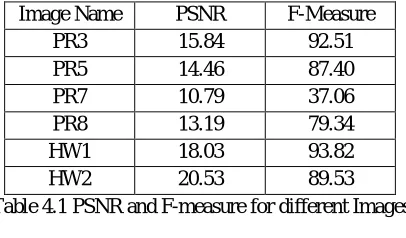
These are the images that have been generated after the execution of each morphological operator on the noised image. For the performance evolution of the purposed algorithm different parameters have been studied that parameters are PSNR and F-measure. These parameters are described below.
Image Name PSNR F-Measure
PR3 15.84 92.51
PR5 14.46 87.40
PR7 10.79 37.06
PR8 13.19 79.34
HW1 18.03 93.82
[image:6.612.206.409.534.653.2]HW2 20.53 89.53
Table 4.1 PSNR and F-measure for different Images
V. CONCLUSION
Technology (IJRASET)
these are either scanned from document or hand written data images. By using various morphological operators on the dataset we can conclude that the morphological operators enhance the quality of the image and the blurriness available in the image get reduces so that the content available can be easily seen.
REFERENCES
[1] Bolan Su, Shijian Lu, and Chew Lim Tan “Robust Document Image Binarization Technique for Degraded Document Images” IEEE Transactions on Image Processing, pp. 1408-1417, vol.22, 2013.
[2] Bolan Su, Shijian Lu, Tan, C.L. “Combination of Document Image Binarization Techniques” IEEE International Conference on Document Analysis and Recognition, pp. 22-26, 2011.
[3] Chi, Z, Wong, K.W. “A two-stage binarization approach for document images” Proceedings of 2001 International Symposium on Intelligent Multimedia, Video and Speech Processing, pp. 275-278, 2001.
[4] Valizadeh, M, Komeili, M. , Armanfard, N. , Kabir, E. “Degraded document image binarization based on combination of two complementary algorithms” IEEEInternational Conference on Advances in Computational Tools for Engineering Applications, pp. 595-599, 2009.
[5] Biswas, B, Bhattacharya, U. , Chaudhuri, B.B. “A Global-to-Local Approach to Binarization of Degraded Document Images” 22nd International Conference on Pattern Recognition, pp. 3008-3013, 2014.
[6] Armanfard, N, Valizadeh, M. , Komeili, M. , Kabir, E. “Document image binarization by using texture-edge descriptor” IEEE 14th International CSI on Computer Conference, pp. 134-139, 2009.
[7] Gatos, B. , Pratikakis, I. , Perantonis, S.J. “Improved document image binarization by using a combination of multiple binarization techniques and adapted edge information” 19th International Conference on Pattern Recognition, pp. 1-4, 2008.