Faculty of Electrical Engineering,
Mathematics & Computer Science
Large Scale Online
Readability Assessment
Rutger Varkevisser M.Sc. Thesis November 2016
Supervisors:
The internet is an incredible resource for information and learning. By using search engines like Google, information is usually just a click away. Unless you are a child, in which case most of the information on the web is either (way) too difficult to read and/or understand, or impossible to find. This research aims to successfully com-bine the areas of readability assessment and gamification in order to provide a tech-nical and theoretical foundation for the creation of an automatic large scale child feedback readability assessment system. In which correctly assessing the readabil-ity level of online (textual) content for children is the central focus. The importance of having correct readability scores for online content, is that it provides children with a guideline on the difficulty level of textual content on the web. It also allows for external programs i.e. search engines, to potentially take readability scores into account based on the known age/proficiency of the user. Having children actively participate in the process of determining readability levels should improve any cur-rent systems which usually rely on fully automated systems/algorithms or human (adult) perception.
The first step in the creation of the aforementioned tool is to make sure the un-derlying process is scientific valid. This research has adapted the Cloze-test as a method of determining the readability of a text. The Cloze-test is an already estab-lished and researched method of readability assessment, which works by omitting certain words from a text and tasking the user with filling in the open spots with the correct words. The resulting overall score determining the readability level.
For this research we want to digitize and automate this process. However, while the validity of the Cloze-test and its results in an offline (paper) environment have been proven, this is not the case for any digital adaptation. Therefore the first part of this research focusses on this central issue. By combining the areas of readability assessment (the Cloze-test), gamification (the creation of a digital online adaptation of the Cloze-test) and child computer interaction (a user-test on the target audience with the developed tool) this validity was examined and tested. In the user-test the participants completed several different Cloze-test texts, half of them offline (on pa-per) and the other half in a recreated online environment. This was done to measure the correlation between the online scores and the offline scores, which we already
SUMMARY iv
know are valid. Results of the user-test confirmed the validity of the online version by showing significant correlations between the offline and online versions via both a Pearson correlation coefficient and Spearman’s rank-order analysis.
With the knowledge that the online adaptation of the Cloze-test is valid for de-termining readability scores, the next step was to automate the process of creating Cloze-tests from texts. Given that the goal of the project was to provide the basis of a scalable gamified approach, and scalable in this context means automated. Sev-eral methods were developed to mimic the human process of creating a Cloze-test (i.e. looking at the text and selecting which words to omit given a set of general guidelines). Included in these methods were TF.IDF and NLP approaches in or-der to find suitable extraction words for the purposes of a Cloze-test. These were tested by comparing the classification performance of each method with a ’baseline’ of manually classified/marked set of texts. The final versions of the aforementioned methods were tested, and resulted performance scores of around 50%, i.e. how well they emulated human performance in the creation of Cloze-tests. A combination of automated methods resulted in an even bigger performance score of 63%. The best performing individual method was put to the test in a small Turing-test style user-test which showed promising results. Presented with 2 manually- and 1 automatically created Cloze-test participants attained similar scores across all tests. Participants also gave contradicting responses when asked which of the 3 Cloze-tests was auto-mated.
This research concludes the following:
1. Results of offline- and online Cloze-tests are highly correlated.
2. Automated methods are able to correctly identify 63% of suitable Cloze-test words as marked by humans.
3. Users gave conflicting reports when asked to identify the automated test in a mix of both automated- and human-made Cloze-tests.
I would like to start by sincerely thanking all my supervisors; Theo, Djoerd and Thijs who have assisted- and provided me with feedback throughout this project. I could not have done this without you.
While doing parts of my research at the WizeNoze offices I was able to ask ques-tions and receive feedback from some of the team members located there. These included experts in Information Retrieval (IR), Machine Learning (ML), Natural Lan-guage Processing (NLP), Child Computer Interaction (CCI) and others. I would like to thank all of the WizeNoze team, especially Hanna, Gerben and Rosa for helping me out during my time there.
Another big thank you goes to everyone who participated in either user-test for this research. Including Elsbeth, Diana and Remco, the teachers of the classes of children which participated in one of those user-tests. Your help and input were invaluable.
Finally I would like to sincerely thank my parents who have supported me through-out this phase of my life.
Contents
Summary iii
Preface v
List of acronyms viii
1 Introduction 1
1.1 WizeNoze . . . 2
1.2 Motivation . . . 3
1.3 Research Goals & Questions . . . 3
1.4 Methodology . . . 5
1.5 Thesis Structure . . . 5
2 Literature Review 7 2.1 Readability Assessment . . . 7
2.2 Gamification . . . 11
2.3 Child Computer Interaction . . . 15
2.4 Conclusion . . . 18
3 Stage A: Digital Conversion Assessment 20 3.1 Motivation . . . 20
3.2 Research Questions and Hypothesis . . . 21
3.3 Research Design . . . 22
3.3.1 Core Features . . . 22
3.3.2 Study Design . . . 29
3.4 Results & Analysis . . . 32
3.4.1 General Statistics . . . 32
3.4.2 Online and Offline Cloze-test Correlation . . . 36
3.4.3 Questionnaire Analysis . . . 40
3.4.4 General Observations . . . 42
3.5 Discussion . . . 43
4 Stage B: Cloze Automatization 45
4.1 The Basics . . . 46
4.2 Interval Classification Method . . . 48
4.3 Custom Classification Method . . . 50
4.4 NLP Classification Method . . . 54
4.5 TF.IDF Method . . . 57
4.6 Method Comparison . . . 60
4.7 Application and Results . . . 62
4.7.1 User-Test Details . . . 62
4.7.2 Test Results and Analysis . . . 63
4.8 Discussion . . . 65
5 Conclusions & Future Work 67 5.1 Conclusion . . . 67
5.2 Future Work . . . 70
Bibliography 72
Appendices
A Comparison of School Year Equivalents (US/UK/NL/FR) 75
B User-Test Cloze Forms 77
C Online Cloze-test Procedure 88
D Online Questionnaire 93
E User-Test Questionnaire Results 95
List of acronyms
AI Artificial Intelligence
AVI Analyse Voor Individualiseringsvormen
CCI Child Computer Interaction
GWAP Games With A Purpose
HCI Human Computer Interaction
IDF Inverse Document Frequency
IR Information Retrieval
ML Machine Learning
NARA Neale Analysis of Reading Ability
NLP Natural Language Processing
POS Part-of-speech
TF Term Frequency
Introduction
As the years go by, more and more people all around the world now have access to the internet. In the last 8 recorded years alone, the percentage of users who have access to the internet via any means (computer, phone, tv, etc. . . ), has gone up by more than 23% to a global internet penetration level of 40.7% in 2014 [1]. These numbers, of course, are much higher when only looking at the westernised world. This is exemplified in Figure 1.1 where the internet penetration is shown at a global-and a European scale in the last 8 recorded years.
Figure 1.1: Internet users (per 100 people), graph sourced from [1]
This increase in internet penetration across the world now also allows for more people to access the wealth of information which can be found online. This is es-pecially useful for children who can use the web to help them with school work or in order to teach themselves all sorts of things. Another result of the omnipresent nature of the internet is that children nowadays grow up using the internet and the various devices which are connected to it,Digital Natives, as some people describe them [2].
CHAPTER 1. INTRODUCTION 2
However, the rise of the internet has also enormously changed the way we deal with information. Children grow up in a society where (digital) information is more accessible than ever. This accessibility also introduces a (major) problem. Everyone can post anything they want online without verification. This means that people are now easily confronted with partial, wrong or potentially damaging information. This is particularly true for children who (generally) do not yet possess the skill of judging information for its reliability, usability and readability.
And it is that last feature, readability, that is the focus of this particular research. And for a good reason. As mentioned in the paragraphs before, the internet is ab-solutely filled with useful information, if you know where to look. Now there are already various methods and tools out there which can help you, as a user, to sort through the abundance of online content to find good, verified and factual informa-tion. The problem of readability comes into play when talking about the difficulty of those pieces of content. Research has shown that in order to read and have a good understanding of a text, around 95% of the words have to be known by the reader [3]. Naturally children have smaller vocabulary sizes, depending on their age, which mean they generally have a hard time reading and understanding various texts which are not specifically made for them.
Therefore readability is an important feature to know for pieces of (textual) con-tent in order to assess the difficulty, and pocon-tentially inform the readers, the concon-tent creators, or other internet services (e.g. search engines), that a particular piece of content is suited to people of certain age- or reading comprehension levels. The addition of such a feature would greatly benefit children, whom currently often have to look through pages and pages of online content before they find something they can actually understand.
This research investigates methods to automatically ascertain readability levels of textual documents by doing research and user-testing, culminating in the develop-ment of readability assessdevelop-ment tool. Which provide a theoretical and technological foundation for a potential future gamified approach to this problem of large scale readability assessment.
1.1 WizeNoze
engine JouwZoekMachine1. While this classification process for content in their
search-engine is working well, the goal is to always keep striving to make it better for the children viewing the content. And since the ideal method of assessing readability by asking children directly about the difficulty of textual content is not viable, the idea of automatic readability assessment via child-feedback with potentially similar results was well received.
1.2 Motivation
Giving children the ability to quickly ascertain whether (online) content is easy enough for them to understand is a goal of this research. With this research we hope to suc-cessfully combine two areas of research, readability assessment and gamification, and provide a technical and theoretical foundation for the creation of an automatic large scale child feedback readability assessment tool. The purpose of this tool would be to include children directly in the process of determining readability levels of texts, instead of purely relying on automated algorithms or human (adult) percep-tion.
Previous work in the field of readability assessment (see Section 2.1) has largely remained focused on traditional (paper) methods and formulas, and has widely stayed away from (partial) automation with the current technological advances. One of the goals for this research is to take the current knowledge/information from tra-ditional readability assessment methods and attempt to translate those findings into a digital system.
The gamification of traditionally non-gaming interactions/actions is another part of this research, as the ultimate goal of this research (if proven to be effective) is to have children play and interact with an online system. While the gamification aspect is not the main focus of this research, it certainly is something that needs to be accounted for, as any future system using these, or similar methods of collecting feedback on readability levels on a large scale, have to be interesting and compelling enough for children to use.
1.3 Research Goals & Questions
There are two themes to this research. Readability assessment and gamification. These two themes will be combined in order for this research to be a success.
Concerning readability assessment (see Section 2.1), we have chosen to utilize theCloze-test method because of its widespread use, the potential for automation
CHAPTER 1. INTRODUCTION 4
and the possibility of gamification. This choice was made based on the preliminary work and research done for this project. In this preliminary work, a prototype system was developed wherein multiple digitized and gamified approaches of the Cloze-test readability assessment method were tested and evaluated. The results of which showed promise for using such a digitized adaptation of a ’standard’ readability as-sessment method, and was therefore adapted for this project as well.
By using a modified/enhanced version of the prototype system, this research hopes to determine whether that system, a combination of a digitized and gamified traditional readability assessment method, can accurately measure readability. If not, what changes can be made to make it work as intended?
Another aspect of this research, once the readability assessments accuracy has been established, is scalability. Scalability in the context of this research means that we want to design the system in such a way that it allows for hundreds to thousands of users (children) to be able to play and interact with the tool, while the system is continually processing and handling the actions and results and also adding and up-dating content without major human involvement. While the development of a com-pletely functioning scalable system is outside the scope of this research, scalability itself is heavily emphasized in the development of a digital readability assessment tool.
The main research goal is as follows:
• Delivering the technological and theoretical foundation of a scientifically sub-stantiated readability assessment tool which provides the basis for a future gamified approach of large scale readability assessment.
In addition to the main research goal the following items are the various sub-goals which together with the main research goal determine the successful outcome of this research.
• Any online or digitized readability result must reflect/correspond to that of (tra-ditional) offline Cloze-test results. I.e. the measurements have to be remain valid.
• The final readability assessment tool must be developed in such a way in that it emphasizes scalability and that it provides a basis for any future gamified adaptations of the tool.
Based on the research goals as stated above, the following are the research questions which this research attempts to answer.
2. Assuming we are able to assess the readability correctly, how can the devel-oped system and its results be made scalable?
1.4 Methodology
In order to answer the research questions and attain the research goals as stated in the previous section, this research project has divided itself into two main stages. A research stage and a developmental stage. With the results of the first stage defining the foundation of the second stage.
The focus of the first stage, Stage A (see Chapter 3), is on answering the ques-tion whether or not the digitizaques-tion of the tradiques-tional (paper) Cloze-tests has any influence on the validity of the results. To answer this question a user-test was set up with children of similar ages, and tasked them with filling in a couple of Cloze-test texts, of different difficulty levels, with everything being identical in both the paper as the online version apart from the method of interaction.
The second stage, Stage B (see Chapter 4), is focussed on researching whether or not the process of converting a ’regular’ text into a Cloze-test text can be autom-atized. This is done by emulating the (regular) manual process in creating these Cloze-test texts into potential automated systems. Finally the result of these auto-mated Cloze-test texts are tested by performing a Turing-test style test wherein the automatically generated Cloze-tests are compared to manually created ones. This developed tool should then provide a technological and theoretical basis for future readability assessment applications.
Each of the previously mentioned chapters contain a comprehensive description and in-depth analysis of the topics therein and a discussion and analyses of the results. The final result of these chapters, and therefore this research, should be a technological and theoretical blueprint for the continued research and develop-ment into a system capable of detecting readability levels and presenting them in a gamified manner.
1.5 Thesis Structure
In the following chapter (Chapter 2) the reader will be introduced to relevant re-search into fields relating to this study. This will include topics such as readability assessment, gamification and child computer interaction.
CHAPTER 1. INTRODUCTION 6
Chapter 4 (stage B) looks at the method of automating the process of extracting words from a text for the purposes of a Cloze-test, and whether the automated systems can provide a similar level of outcome compared to a manually constructed test.
Literature Review
This research aims to take elements from various fields of research and attempt to successfully combine them for use in this project. The following sections will outline some of major points gained from research into the different fields.
2.1 Readability Assessment
When talking about readability you have to look at your audience and their abilities when it comes to reading and comprehending textual content. For this particular project the targeted audience are children, and what differentiates children from adults is their rapid rate of acquired (textual) knowledge. Children learn words in different ways, most of which are learned through daily social interactions with others without any (special) effort required and is therefore learned implicitly [4].
When a child starts to read, newly acquired words are stored together with cur-rent knowledge. An explicit growth of a child’s vocabulary size begins from the mo-ment they go to school. The reason why this is important to this research is that vocabulary size is highly correlated with reading comprehension [5]. A good exam-ple of this rapid growth can be seen in Figure 2.1.
The implications of a low vocabulary size in a child or person in general, whether due to age or proficiency, is that it can affect the person’s desire to read or lead to avoiding reading altogether. This severely hinders their progress and development of reading comprehension skills. The children who do have the ability to read well tend to read more and improve their readability and reading comprehension abilities [7]. This is corroborated by research done by Biemiller (2003) which shows a high correlation (.91) between vocabulary size and reading comprehension/readability skills [8].
The reason why a small vocabulary size affects the ability to read a text well has also been researched. Research by Appel & Vermeer (1994) showed that in order to
CHAPTER 2. LITERATURE REVIEW 8
Figure 2.1: Vocabulary size of Dutch children in primary education [6]
read and have a good understanding of a text, 95% of the words have to be known by the reader. If readers do not know or understand > 5% of the words in a text,
they will have a problem understanding and reading it. The implication of this is that in order to reach that 95% text coverage, a minimum vocabulary size of around 5000 words is required for being able to seamlessly read everyday texts [3].
Almost every country in the world have their own method of standardized as-sessment of reading ability in children. Examples of these are the Neale Analysis of Reading Ability (NARA) system in the UK, and the Analyse Voor Individualiseringsvormen (AVI) system in the Netherlands. These assessment systems provide a grading scale on which the reading abilities of a child are measured. For example, the (Dutch) AVI system is made out of 12 different levels which signify various stages of a child’s progress through the school system1.
• AVI start; Entry level; prior to groep 3
• AVI M3/E3; Mid groep 3 / End of groep 3
• AVI M4/E4; Mid groep 4 / End of groep 4
• AVI M5/E5; Mid groep 5 / End of groep 5
• AVI M6/E6; Mid groep 6 / End of groep 6
• AVI M7/E7; Mid groep 7 / End of groep 7
• AVI Plus; Anything above E7
These ’ratings’ signify the reading comprehension of children through the primary education system. In the AVI system, as shown above, a child should theoretically be at the level corresponding to the groep (grade) he/she is in. These levels can be higher or lower depending on the (reading) skill level of the child. But to assess the reading comprehension level itself there has to be some form of testing. Two of the methods which these tests can consist of are listed below [9]:
• Multiple Choice; Multiple choice is different from other tasks as it asks the user to select which of the four (or more) responses is the correct answer to a question. This task has a higher demand on the user because it forces them to compare the different options. The multiple choice format is usually suitable for (large scale) group administration, and has the advantage of an easy scoring system. It is also highly flexible in nature and can be converted/included to suit the needs of other tasks.
• Cloze- and C-tasks; Cloze- and C-tasks are methods in which words, or part of words are deleted in a certain interval and the reader is tasked to fill in the correct replacement. These tasks can easily be administered to groups, which is helpful for assessing large numbers of students/children and scoring is very simple as it is just a percentage of the total number of correct replacements.
The reason for singling out the previously listed methods is that they are the ones most suited to be adopted for automatization in a digital environment. The multiple choice method is very well known and widely used, but when thinking about a digital adaptation for assessing readability there is one big (foreseeable) issue. The issue is in the ’generation’ of meaningful options besides the answer. Whatever the method for asking the question is, for the correct application of a multiple-choice type test it is needed that all the options make sense in some way as to make the reader think about which answer to choose. This becomes immediately more complicated when talking about an adoption into a fully automated system which will have to automatically generate those other options.
CHAPTER 2. LITERATURE REVIEW 10
selects holes by deleting words in a regular frequency, i.e. every third, fourth or sixth word. The advantage of this approach is that it is less sensitive to the (inade-quate) choices or assumptions of the researcher. However, the disadvantage of this method is that it can create holes in places where the answer is too difficult to give since the selected words might rely on extra-textual knowledge, or too easy because of their grammatical- or lexical predictability. In the rational fill approach the holes are chosen by the researcher i.e. only deleting nouns or verbs. This approach has the advantage that the selected words only call on contextual knowledge, both in-and outside of the context of the sentence [11]. Note that in the Cloze-test example paragraph in Figure 2.2 the omitted words are ambiguous and do not seem to have one clear answer, this would suggest that a rational fill approach would be better suited to score the Cloze-test containing this paragraph.
After selecting an approach it is the reader’s task to read the text and fill in the words. Cloze-tests have clear quantifiable results [12] and guidelines [13] have been written to aid in constructing these tests. The Cloze-test is currently widely used in teaching environments (i.e. learning a second language [14]), since it ’forces’ students to read more carefully, use contextual clues and become actively involved into what they were reading [15].
Figure 2.2: Example Cloze-test paragraph2
As opposed to straight up readability formulas, this research/project wants to know and take into account (some) factors about the reader. For example, if the text is easy, but the context of it is unknown to children thereby causing them to make mistakes, is something that does affect the overall readability and is information we want to know. Both the C-test, and even more so the Cloze-test, can give us that information (on a large scale) by requiring users/readers to fill in words which contain contextual information about the text.
There are multiple methods to score the reader’s performance with these meth-ods. These are exact- and semantic scoring. In the exact scoring method the answer given is only marked as correct if the reader fills in the exact word which was removed from the text. In the semantic scoring method both the exact word and words which are correct at a contextual level are marked as correct. This method solves the ’issue’ of readers filling in words which are synonyms or contextually cor-rect but not counted as corcor-rect in theexact scoring method.
The validity of Cloze-test in particular have been examined and are compared to that of the ’regular’ assessment methods such as; open questions and multiple-choice questions [4]. A validation experiment from Kamalski (2005) showed that Cloze-tests have a high correlation with questions that measure conceptual under-standing. In the area of internal reliability the Cloze-test scores even higher then the ’regular’ assessment methods. A recent study by Gellert & Elbro (2012) also found a strong (.84) correlation between the Cloze-test and traditional ’regular’ tests [16].
2.2 Gamification
With over 350 million players around the world [17] and revenues in excess of $91.5 billion3, overtaking both the music- and film industry, the gaming industry is now
looked at by both researchers and companies for clues on how to improve their research and/or products.
In both interaction design and digital marketing, the concept of using game de-sign elements in non-game contexts in order to motivate and increase user activity and retention, is on the rise [18]. This is known asgamification or’serious games’. While the term ’gamification’ is relatively recent its application in various forms, ar-eas and fields can be dated back millennia starting with military applications and eventually moving towards education and business in the mid to late 1990s [19].
Within the gamification spectrum there are different areas which applications can focus on. One of these areas is the area in which the computer assists humans in performing and/or completing real-life tasks by making them more fun and inter-active. An example of which is the fitness applicationZombies, Run!4, which uses interactive storytelling and rewards for the purposes of motivating and increasing the users’ real life running and therefore their stamina and fitness levels. This research focusses on another area of gamification, namely Games With A Purpose (GWAP)s, also known as ’serious games’.
GWAPs are games that ask users to perform basic tasks which cannot be auto-mated. In these games the task the users are asked to perform have a side effect where the action(s) they are taking result in a useful computation [20]. What this basically means is that humans ’train’ computers with the results of their actions. Machine learning algorithms can take the input of thousands of these users and use it to train themselves in areas which are (usually) incredibly difficult to automate e.g. computer vision problems. Another big part of GWAPs is the ability to make ’work’ fun. Human Computer Interaction (HCI) researchers have recognized the
3Source: Gamesindustry.biz
(http://www.gamesindustry.biz/articles/2015-04-22-gaming-will-hit-usd91-5-billion-this-year-newzoo).
CHAPTER 2. LITERATURE REVIEW 12
[image:20.595.173.456.151.384.2]importance and fun in user interfaces. By creating interfaces which use game-like interaction it is possible to increase the enjoyment and engagement between the user and the software.
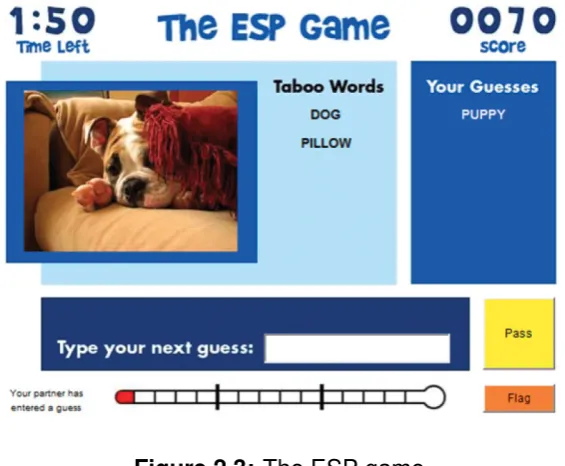
Figure 2.3: The ESP game
An example of this type of game is the ESP Game developed by Luis von Ahn5 (2006), the pioneer of GWAPs. In the ESP game (see Figure 2.3), two players are randomly paired for two-and-a-half minutes as they are shown a series of images to label. The game itself does not directly ask them to label the images however, but rather both players must try to enter the same word as their ’partner’ for each image on the screen. Neither players can see their partner’s words. When the players agree on a word, each is given a new image to label. The goal is then to agree with the partner on words for as many images as possible. The words the players agree on for each image can then be used as labels for images throughout the web, as they are extremely accurate. This in turn greatly improves image search technologies which relies heavily on image data (such as labels) in order to correctly retrieve a set of relevant images. This is a perfect example of a task which humans are (currently) much better at than computers. While labelling images is normally a pretty boring task to do, by gamifying the process the players are provided with a form of entertainment, and the system uses the input of the players to further train its algorithms. A win/win situation.
The rules of a GWAP should encourage players to correctly perform the neces-sary steps to solve the problem and should, if possible, involve a probabilistic
guar-5Luis von Ahn is one of the biggest pioneers in crowd-sourcing technologies. He is the founder
antee that the game’s output is correct, even if the players do not want it to be cor-rect. In his research, von Ahn also describes how to build a (successful) GWAP [20]. According to him building a GWAP should start with first creating a game so that its structure encourages computation and correctness of the output. The next step is to implement methods which improve player enjoyment and increase the challenge level [21]. Since the success of almost every GWAP rests on its ability to attract and retain the attention of players, it is important to keep in mind certain factors which have been shown to improve the challenge level of the game.
First thing to note is having atimed responsein the game. By setting time limits for game sessions it introduces challenge into the game. When completing assign-ments within the time limits extra points may be given. Research has shown that goals that are both well-specified and challenging lead to higher levels of effort and task performance than goals that are too easy or vague [22]. The second method, and maybe most direct method for motivation isscore keeping. By awarding points for each instance of successful output during the game it increases player motiva-tion and also provides players with performance feedback. Introducingplayer skill levelscan also have a positive effect on your game. By earning points players have the ability to increase their skill level, which in turn motivates players to keep playing in order to increase that level. A simple addition ofhigh score listscan act as a mo-tivating tool for players to perform better and/or keep playing. By including multiple lists (e.g. hourly/daily/all time) goals of increasing difficulty can be defined. The final factor which is mentioned by von Ahn is to includerandomnessinto the game. By including randomness it keeps the game interesting and engaging to players. It also adds a bit of uncertainty whether the task can be completed within the time limit.
While these methods help making the game more challenging and enjoyable for the players, it is very important to know whether or not the output of the actual games can be trusted. Players will always try and circumvent the game’s default systems in order to attain a high score or just to mess with the system. Von Ahn describes several mechanisms that have proved to be successful which can be ap-plied to guard against player collusions and guaranteeing the correctness of the computations across all game types and structures.
• Random Matching; Random matching vastly lowers the chance of players knowing their partners identity and therefore preventing cheating behavior.
CHAPTER 2. LITERATURE REVIEW 14
probability of correct answers. I.e. the answers/results of players who are not intended on ’properly’ playing the game e.g. giving bogus answers, should now be filtered out.
• Repetition; The game should be designed so it does not consider an output correct until a certain number of players have entered it. This strategy for determining correctness enables any GWAP to guarantee correct output with high probability.
• Taboo Outputs; By preventing the players to enter certain words, a larger dataset can be acquired to describe the image it is associated with. For exam-ple, players are tasked to describe a picture wherein a dog is chasing a ball in the park. Taboo outputs could contain the words: ’dog’, ’ball’ and ’park’ in order to get more additional information on the elements in the picture.
Before concluding this section on gamification, there is one more aspect of gam-ification that is interesting to examine further. That is the replayability aspect of gamification. Especially important for repetitive tasks such as the one proposed in this research.
To get a better understanding of how to tackle this aspect we can look towards the gaming sector where this is a major factor. A study by Frattessi et al. [23] analyzed existing research on play and replayability and condensed this into five different specific aspects that they believe is a driving force for replayability. The following is a condensed summation of the five factors:
1. Difficulty; difficulty uses a form of competition and challenge to generate re-playability.
2. Completion; completion feeds upon the natural curiosity of players and en-courages them to try each possible scenario. Designers can enhance this factor by adding achievements and unlockables to the game.
3. Social Aspects; players want to be the best, but this threshold is always in flux. Direct competition and high score tables take advantage of natural competitive nature of players.
4. Randomization; the most obvious solution to keeping something new and interesting is to keep changing it. A properly randomized game will keep a player’s interest as the experience varies ever so slightly.
While these factors might be more specifically aimed at video games, it does provide an insight into elements which can potentially aid this research.
2.3 Child Computer Interaction
Reading this section you might be wondering why we changed the ’standard’ HCI with CCI. The reason for this is that children are very different in their interaction with computers compared to adults. And even within this group of children there are large differences. At different ages, children’s relation with computers and other interactive technologies vary widely, reflecting on their changing interests. A study by Markopoulos & Bekker (2003) describes four stages of development in children [24] using the model from Acuff & Reiher (1997) [25]. From the four stages two are especially relevant to this research, as it comprises of the targeted user group.
• Rule/role stage (8-12 years-old); In this stage the interest from children gen-erally shift from fantasy towards reality. They start to play in groups/pairs and are more interested in competition. Products targeting this age group can therefore also be more complex and challenging, incorporating elements of variation and competition within their design. A big change for this group is that they shift from learning to read towards reading to learn. They can un-derstand abstract terms and complex sentences and also develop the ability to (critically) analyse what they are reading. This shift also brings a rapidly expanding vocabulary size (see Figure 2.1 on page 8) and writing and spelling also greatly improve within this stage. The children in this stage also start using laptops, phones and tablets with a more serious design and look, mov-ing away from the colourful design for products targetmov-ing the earlier stages. This is the first stage were (a part of) the targeted audience start to emerge. Because of the much improved ability to read, write and interact with digital systems/devices, this is an audience we are interested in targeting.
CHAPTER 2. LITERATURE REVIEW 16
Keeping the characteristics of the above mentioned user groups in mind, we now turn our attention towards the design process when it comes to these user groups, and the limitations that arise as a result.
One of the skills needed for operating (input) devices such as mobile phones and computers, are fine motor skills [26]. These skills are first learned around the age of 3 years old and rapidly progress afterwards. Older children (7+) see the speed of their movements increase and the variability in their movements decrease. Also important in the interaction of children with computers is something calledbimanual coordination. Bimanual coordination involves coordinating the use of both hands in time and space. Specifically to the computer, this means that they are able to perform multiple key strokes on the keyboard and a combination between keyboard and mouse. The very basic of bimanual coordination start around 2 years-old, and increases significantly in complexity with every year [27].
The visual complexity of the program should be taken into account when design-ing for children, since they cannot process visual information as quickly as adults can [28]. One suggested method for children is to start with a very basic visual model, and gradually introducing more actions and objects to the user interface as they become proficient with the system [29].
Within user interfaces it is very important to allow for rapid actions, since children will often be less patient compared to adult software users. Children require quick feedback, and if they do not get it, they are likely to move to another activity. This includes giving feedback on the status of an action (e.g. loading % or progress bars) and should be able to interact with the system and cancel the action if they wish to do so. To encourage the exploration of technologies it is important to allow for the reversibility of actions, depending on the type of application of your program. A final (action) design element which can be very helpful (specifically) to children is making actions incremental. This will help children and avoid the need for them to formulate complex instructions. Combined with timely and informative feedback, this can help children accomplish otherwise (very) complex tasks [30].
any spelling correction [32].
The above mentioned topics cover some of the (visual) design aspects for creat-ing an interactive environment for children. These guidelines help us think and relate our design decisions to a children’s perspective but a (big) problem remains in the design process itself. Because the design is made by adults for children there will almost always be some misalignment between what the developer/designer think is best, given their previous experiences and preferences, and what children actu-ally want. To help this process Markopoulos et al. [24] discusses the potential of including children in some way in the design process.
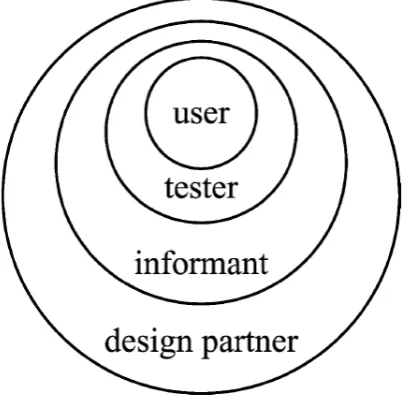
A model introduced by Druin (2002), see Figure 2.4, illustrates the relation of the various roles children can play during the design process. The inner circle represent the traditional role of children as end-users of technology, with no involvement in its design. Moving outwards from the inner circles in the diagram of Figure 2.4, the role of children changes in two ways: first it becomes more active and responsible and second, children get involved in more stages of the design activity. A more common and pragmatic view is to include children as testers of products i.e. usability test. The more radical approach, shown in the outer layers of the diagram shown in Figure 2.4 is that children should act as designers.
[image:25.595.213.419.454.656.2]For the purposes of this research we incorporate children mainly as the two inner circles of the diagram as shown in Figure 2.4, as a user and a tester.
Figure 2.4: The four roles that children may have in the design of new technologies7
One research which combined the elements ofgamificationfrom Section 2.2 and CCI is a study done by van den Bosch et al. (2010). In their study they developed
CHAPTER 2. LITERATURE REVIEW 18
a GWAP-based collaborative approach to common sense resource development, specifically aimed at children [34]. The study contained two distinct phases. In the first phase of the game children were given a concept to describe (e.g. ’house’) for which they could choose from a limited number of templates (e.g. ’isA’). In the second phase, to provide a type of in-game human validation typical to GWAPs, children were asked to guess the given concept based on another user’s assertion with the subject hidden (e.g. ’. . . is a means of transport’).
Results of the study by van den Bosch et al. showed that children (aged 10-12) were able to draw upon their common sense knowledge and their language skills to describe concrete and abstract words in the form of valuable assertions. A noteworthy observation made during the study was that the participating children reported to the researchers how much they liked doing the task and had fun doing it. Overall, they concluded that their study indicated that using a child-oriented GWAP could lead to common sense knowledge resource creation. Additionally, they believe that the age range of 10-12 years-old is the right target for the type of GWAP they used in their study.
This study, while not exactly like the one we are proposing to do in this research, shows us a couple of things. First of all, the study was done on a similar age group we attempt to target for this research, and proved that GWAPs or gamified systems targeting that age group can be successful and fun. Secondly results from the study by van den Bosch et al. showed that children can be ’used’ to obtain and gain knowledge for several purposes. Lastly, the study showed us that a project such as theirs, using some form of textual assessment, is viable for the targeted age-group and can be successfully done.
2.4 Conclusion
These three topics, readability, gamification and Child Computer Interaction
form the basis of the research presented in this document. Because of the broad scope of these fields of research this study looks at certain relevant topics within these field and attempts to apply it where applicable.
One of the major questions surrounding the readability topic for this research is whether the digitization and automation of the Cloze-test is possible while retaining its validity of assessing readability of a text. This has not been done before and is therefore a very interesting part of this research.
dating back to the early 1950s. We can certainly apply (some) lessons learned from different gamification research, but the application is restricted in the sense that it is crucial that the validity of the original Cloze-test is retained.
Chapter 3
Stage A: Digital Conversion
Assessment
The central theme of this study is whether it is possible to create and sustain a scientifically accurate automated digital readability assessment system. This stage, stage A, is the first and crucial step in the successful creation of such a system. The reason for this stage being the first step is because it pertains to one of the core topics of this research, readability assessment. Before any further steps can be taken into factors such as enjoyment, accessibility and interactivity, we need to know whether or not the readability that is measured via the proposed system is actually scientifically valid. In order to answer this question a user-test was set up.
This chapter will detail the motivation, design, execution, results, analysis and discussion of a user-test into the digitization of the Cloze-test readability assessment method.
3.1 Motivation
The core of this entire study is based on the premise that we are able to extract the readability level of a given text by applying a readability assessment method. The method that was researched and chosen for this research is the ’Cloze-test’ method (see Section 2.1 on page 7).
The Cloze-test has been used for a long time as a measurement of readability. In short, the Cloze-test takes a (regular) text for which the readability needs to be assessed and omits a number of words from the text. The user is then tasked with filling in the blank spaces in the text with the correct words, or via a method such as multiple choice. The readability itself is scored by taking the percentage of correct answers from the total number of answers given. The scoring is measured
as follows1:
• > 60% correct replacements - independent reading level
• 40-60% correct replacements - instructional reading level
• < 40% correct replacements - frustration levels
This brings us to the central question. This research uses the Cloze-test as a core method for assessing readability, however since we are attempting to build a large scale online system, we have to digitize this process. Now while the validity of the readability assessment of ’regular’ (paper) Cloze-tests have already been re-searched and proven [16], this is not the case for any possible digital adaptation. This means that before we can continue onwards with this study we first need to prove whether or not any differences are introduced by the digitization of the Cloze-test.
3.2 Research Questions and Hypothesis
Given the problem as described in the previous section, the following central re-search question was formulated for this stage of the rere-search which the user-test will seek to answer.
Does the online adaptation of the Cloze-test measure similar results as the offline (paper) version?
In addition to the main research goal of the user-test as stated above, there are several additional questions we can attempt to answer following the results of the user-test. These might not all be critical for the success or failure of this project but could give us insight into various aspects of readability and the target audience.
• Given that we perform a user-test on classes from different grades, is there a significant difference in performance results between those classes?
• Is there a significant difference in results between boys and girls?
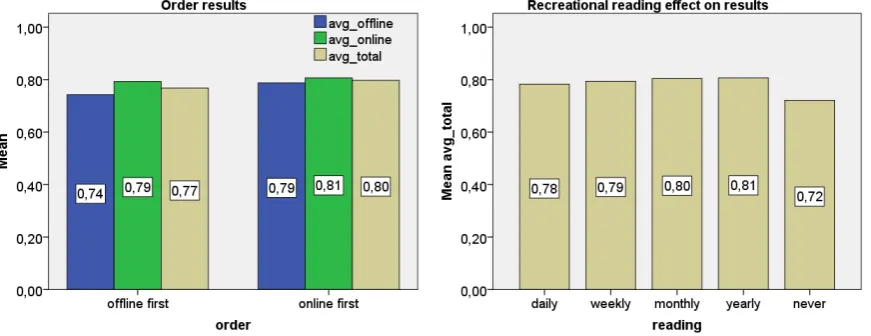
• Does the order in which the participant take the test, online or offline first, affect the outcome in a significant way?
• Is the amount of recreational reading done by a participant an indicator of improved performance?
CHAPTER 3. STAGE A: DIGITAL CONVERSION ASSESSMENT 22
3.3 Research Design
In order to answer the central research question and other questions posed in the previous section a user-test had to be designed. This user-test had to incorporate all the features needed to reach a definitive and scientifically valid answer to the question on whether the online version of the Cloze-test is statistically identical to the offline version.
The following subsections will detail the design and procedure of the user-test. Instead of describing the entire (online) system and all of its functionalities in depth, section 3.3.1 will list a number of features which are core to the user-test and the system. Section 3.3.2 will detail the general outline of the user-test.
3.3.1 Core Features
Cloze-Test
As previously mentioned in this chapter, the core method chosen for this research is the Cloze-test. Much about this particular method has already been mentioned in previous sections of this report, see section 2.1 and section 3.1, but there are a number of things about the Cloze-test method which are pertinent for both the online- and offline portions of this user-test and warrant further explanation.
The Cloze-test method is a method for assessing readability by omitting words from a text and having the user fill them in. As mentioned in section 2.1 there are two approaches which are commonly used when it comes to creating Cloze-test, a fixed-ratio approach and a selective (fixed-rational fill) approach. While the fixed-fixed-ratio approach would be much easier to implement and test, both online and offline, we wanted to avoid having omitted words in the texts where the answer was either too difficult to give, since they might rely on extra-textual knowledge, or too easy because of their grammatical- or lexical predictability. Therefore we chose to use a selective (rational) approach which has the advantage of being able to only select words which call on contextual knowledge, both in- and outside of the context of the sentence/text.
While this choice of using a selective approach did result in having to spend more time creating the Cloze-tests, there were a few useful aides available to assist in this process. Guidelines have already been written on how to convert a text into a good Cloze-test. For this research we have adopted the guidelines from Kraf, Lentz & Pander Maat [13] as previously used in a research by Raaijmakers [4]. These guidelines list the following:
2. Do not omit words in the text when only little textual knowledge is required in order to fill in the hole:
• ’function’-words (prepositions, determiners, conjunctions, pronouns). • Name or technical term which is used for the first time.
• Names and numbers. • Auxiliary verbs. • Copular verbs.
3. Do not omit words where there is local lexical predictability.
• I.e. words part of a common expression.
4. Try to omit nouns and verbs wherever possible, since these words usually contain the most information.
• Try to use as little adverbs and adjectives as possible.
One of the constraints in this stage of the research was the maximum allotted time for participants (school children) who took part in this user-test. In order to give each participant enough time to finish 4 tests, we chose to limit the size of each Cloze-test and omit a maximum of 9 words from each text
With this in mind and by using the guidelines as previously mentioned we went through each of the 10 different texts (more on the texts in section 3.3.2) and se-lected around 7-9 words in a relatively steady interval throughout the text to be omitted.
The final step in the creation of the Cloze-tests was the decision on the method in which the participants give the answers. There were 3 viable options:
1. Exact fill; the user is tasked to write down the correct answer on each open spot in the text.
2. Multiple Choice; the user is tasked to select the correct answer from a list of several possible options for each open spot in the text.
3. Drag and Drop; underneath the ’clozefied’ text all words that are removed from that text are listed randomly, the user is then tasked to link each word with the correct open spot in the text.
CHAPTER 3. STAGE A: DIGITAL CONVERSION ASSESSMENT 24
and dropfeature was removed as a possibility as this particular approach is not very well researched. This left the choice between the exact fill and the multiple choice method. While the exact fill approach is the most common, used and researched Cloze-test approach there were a number of (potential) issues that made me decide on using the multiple choice method instead.
There are several elements introduced when designing a Cloze-test which re-quires the users to fill in the answer. Both for the online and offline portions of the test. For one thing, it introduces typing into the equation for the online part. This is a skill which not all children possess quite well (yet) and might result in a lot of misspelling of words and increases the time required for the test itself. Additionally it also greatly increases the time spent analysing the results, since (depending on how you do your scoring) multiple answers might be correct in a given open spot in the text. Additionally where do you draw the line then in what answer is correct or not? Also at what point do misspelled or mistyped words become wrong answers?
To avoid these problems the choice was made to use the multiple choice format. This is also a format which has been proven to give accurate results in terms of readability scores [35]. A study by Alderson (1990) showed that providing choices for the deleted words lessens the participants memory load and makes the test taking process easier and faster [36].
While the multiple-choice approach does have its own drawbacks e.g. more time is required in the creation process of the test, for the purposes of this particular research we believe it is the better choice compared to the Exact-fill method. While we were now required to think of (3) possible options for each omitted word in a Cloze-test, the time requirement for a participant taking the test is reduced, scoring is made much easier since there is only 1 single correct answer for each open spot in the text, and the differences between the offline and online test can be kept to a minimum without requiring the participant to possess certain computer skills (like typing).
Offline and Online Tests
Using the previously established blueprint (the multiple-choice Cloze-test), there is now a basis for comparing the offline readability results with the online results. How-ever, this blueprint still had to be implemented.
To start the process of creating multiple Cloze-test, 10 online texts on various subjects were taken that were near, or slightly above or below the targeted user-group reading proficiency level, using the WizeScan program2(more on this in sec-2WizeScan is a chrome plug-in developed by WizeNoze which assesses the difficulty of text on
tion 3.3.2).
In order to convert each of the 10 text fragments into Cloze-tests suitable for the user-test several steps had to be taken. At first, we went through each text fragment and marked all words suitable for deletion via the guidelines as described in the previous section. Secondly, given the participant time constraints of the user-test a total of around 7-10 words out of all marked words per text fragment were selected in a relatively consistent interval. Finally the last in this process was to think of three substitute answers for each removed word from each text, since we are using the multiple-choice Cloze-test as a blueprint for this user-test. The resulting (offline) stories are added as a appendix to this report and can be found in Appendix B on page 77.
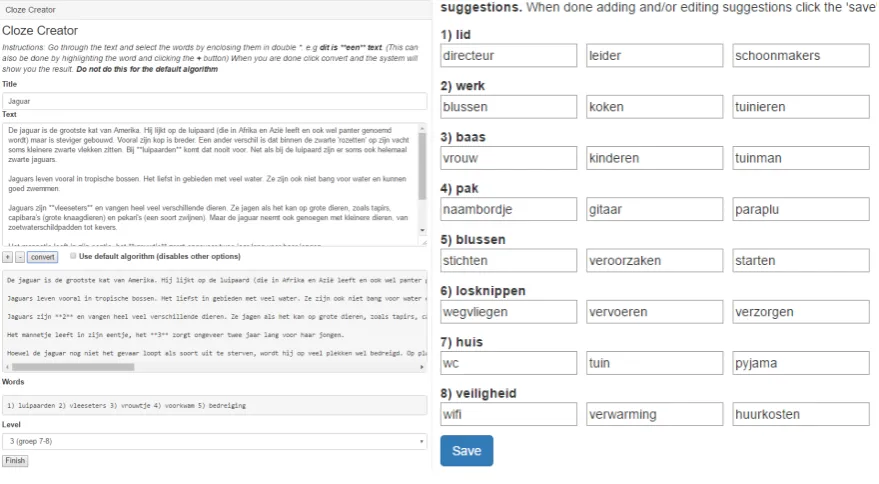
Having created the offline Cloze-test, all the stories plus the omitted words and their three suggestions each now had to be converted for use in the online system. To do this smoothly a few online (admin) tools were created to assist in this process. These tools can be seen in Figures 3.1 and 3.2. To convert the offline text into a Cloze-test format the tool seen in Figure 3.1 was used. This tool allowed the user to paste a text and manually mark the words which you want to extract from a text for Cloze-test purposes. Additionally you can give a title to a text and select the base difficulty level for the text. After completing all these options the text would be saved in a database, along with the extracted words, title and level for use in the online Cloze environment.
Another ability that had to be implemented in the online system which was the ability to add additional options (words) for each word extracted from the text for use in multiple-choice or other potential formats which uses additional choices besides the correct ones. This tool can be seen in Figure 3.2 and shows how for each word there are a maximum of three potential additional answers. Again, the result of changes with this tool were saved in a database which links the additional answers with the actual correct answer together.
Although the goal was to keep the Cloze-test as identical as possible, there were some (small) differences between the online- and the offline test. As explained in the paragraph above for both the on- and offline versions there were now four possible options to choose from for each open position in a Cloze-test. The correct answers plus three additional options. As can be seen in Appendix B, each open spot in the text was labelled with a number indicating the position in the text and each possible answer was labelled with a, b, c or d. To ensure a random distribution on the position of each answer for each word in the Cloze-text, a random number generator was used to generate a number between 1 and 4 which corresponded with a position (a/b/c/d) of the possible answers. This was done differently in the online version. As
CHAPTER 3. STAGE A: DIGITAL CONVERSION ASSESSMENT 26
Figure 3.1: Cloze-test creator Figure 3.2: Word substitutions
opposed to the offline version where the correct position (a/b/c/d) for each extracted word from the text was fixed, this was digitally randomized for each user in the online version. This was done in an effort to prevent the blind copying of answers (e.g. 1=a, 2=c, 3=c, etc. . . ) from other participants who might have the same text either on- or offline.
The final difference between the offline and online test is that in the online tests it shows, after having selected an answer for each of the missing words, what the score was and which answers were wrong and which were not, and asks the par-ticipants to correct any mistakes made. This, of course, was not possible for the offline tests. This distinction between tests was made in order to safeguard against potential miss clicking of the ’complete’ button and otherwise randomized guessing. For every ’attempt’ of the participant the system would log the result and would give additional data to analyze.
Tracking Data and Privacy
an interesting insight into the participants, the system or the user-test itself.
Before listing the various pieces of data that were collected during this user-test we want to emphasize the notion of privacy. For any user-test privacy would be important, but given that the participants in this user-test were children attending primary school, extra measures were taken to ensure anonymity. Firstly, no identifi-able information was gathered. We deliberately did not ask for any name-, address-, e-mail-, phone or any other identifiable contact information of any participant. Nor did we ask for any school records and/or results for any of the participants. Addition-ally no single participant results were shown to any teacher, parent or anyone else not associated with this research.
The following is a list of data that was collected during the course of this user-test. Starting with the information from the offline Cloze-tests3:
• ID; Every offline Cloze-test form was marked with an ID number (1-100). This was done in order for us to keep track of the tests that were completed and assist with the gathering of data for the final analyses.
• Code; A 3 character code was written on the top right of each paper for the participants to use when accessing the online part of the user-test. This code was required to ensure that each participant got the correct combinations of offline and online tests (more on this in Section 3.3.2). It is therefore also used to track and link the results for a single participant for both the offline and online tests. The reason for using a code instead of a number (like the ID) to link the stories is that it would be to easy for the participant to make a mistake and enter the wrong number which would interfere with the distribution of texts between the offline and online versions.
• Offline Results; For the offline Cloze-test every participant was asked to cir-cle or otherwise mark one of the multiple-choice options for each removed word from the text. Afterwards the results were digitized and converted to a percentage (%) score for each Cloze-test.
As can be seen relatively little data was gathered from the offline Cloze-tests. A lot more could be, and was, gathered from the online Cloze-tests and its subsequent questionnaire. These include the following4:
• Age; One of three personal data items asked from each participant. Used for analytical purposes.
3The offline Cloze-test forms as shown in Appendix B of this report do not show the data as listed
for the offline-tests since these were participant specific.
4Questionnaire data items are marked with a (*). The questionnaire itself can be seen in Appendix
CHAPTER 3. STAGE A: DIGITAL CONVERSION ASSESSMENT 28
• Groep5; Second piece of personal data. The ’groep’ data is used to perform the final analysis between the results of different classes.
• Gender; The gender identification is used for analytical purposes e.g. analysing whether there is a significant difference in the results of males vs females.
• Online Results; This is the same data as previously described for the offline results but in digital form and stored in an online database.
• Mistakes; All mistakes made by the participants while performing the online Cloze-test were recorded and stored. Mistakes are made when a participant selects the wrong answer for an omitted word and has clicked the ’Done’ but-ton.
• Attempts; An attempt is counted every time a participant clicks the ’Done’ button after having filled out all the answers on the Online Cloze-test or trying to correct previous mistakes. This data is used to track the participants’ progress in a single online Cloze-test and is therefore linked with the ’Online Results’.
• Time; While not possible for the offline version of the Cloze-test, we were able to track the time a participant needed to complete each online Cloze-test. The time was recorded in ’attempts’ (see previous item) in seconds. The initial measurement (for the first attempt) of each online Cloze-test started when the page loaded and ended the first time the ’Done’ button was clicked. For any subsequent attempts the timer recorded the time between the previous- and the next click of the ’Done’ button.
• Reading*; One factor of interest was in seeing whether the amount of ca-sual reading (outside of school) done by a participant is an indication of their performance in the Cloze-test, both off- and online. Potential answers were: never/daily/weekly/monthly/yearly.
• Dyslexia*; Dyslexia can (potentially) be a major influence in the results and overall performance of a participant in any environment where reading is re-quired. Therefore we felt it would be pertinent to include this in the question-naire and thereby the analysis of the results of this user-test. Potential answers were:yes/no/I don’t know.
• AVI-level*; The AVI-level (see Section 2.1) is the Dutch method for standard-ized assessment of reading ability in children. Potential answers were: AVI-E5/M6/E6/M7/E7/Plus/I don’t know.
• Enjoyment*; One of three questions using a Likert-scale response type us-ing smilies emoticons with an accompanyus-ing label. It asked what the par-ticipant thought of the Online-test. Potential answers were: very unenjoy-able/unenjoyable/average/enjoyable/very enjoyable.
• Perceived Difficulty*; This question asked the participants what they thought of the difficulty level. Potential answers were: very hard/hard/normal/easy/very easy.
• Comparison Online/Offline*; This question asked the participants whether they thought the online Cloze-test was easier or harder compared to the offline Cloze-test. Potential answers were: much harder/harder/similar/easier/much easier.
3.3.2 Study Design
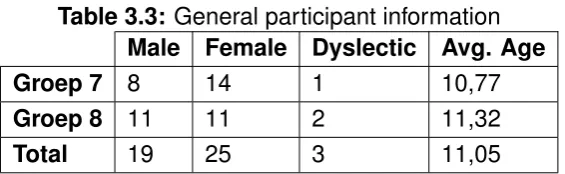
This section details the general outline and overall design of the user-test and vari-ous elements that are a part of that process. The aim of this user-test was to have around 40-60 participating children from groep 7&8 of the Dutch primary school sys-tem in this study. Averaging around 20-30 students per class this meant we required around 2 full classes.
This user-test required participants to complete multiple Cloze-tests, both of-fline and online. Given the nature of this study and the time allowed to perform it, this required finding a good balance between the number of Cloze-tests each stu-dent would be able to complete and the total time required. In order to get a good time estimation we contacted an expert in child user-testing and the teachers of the classes where the user-test was schedules to take place. Based on our needs and the experts’ input the final number of Cloze-test each child would need to complete was set at 4. Given that 2 tests each would not provide us with enough data since we did not have enough participants to offset this. Also having 3 tests each would cause inconsistency when switching between the off- and online versions of the test. As mentioned earlier in this chapter the decision was made to use 10 different texts for use in the Cloze-test. In earlier iterations of the user-test the number of texts was set at 4, but having this few texts would not allow for a detailed ranking of the results of each text in order to determine and analyse the correlation between the off- and online Cloze-tests.
CHAPTER 3. STAGE A: DIGITAL CONVERSION ASSESSMENT 30
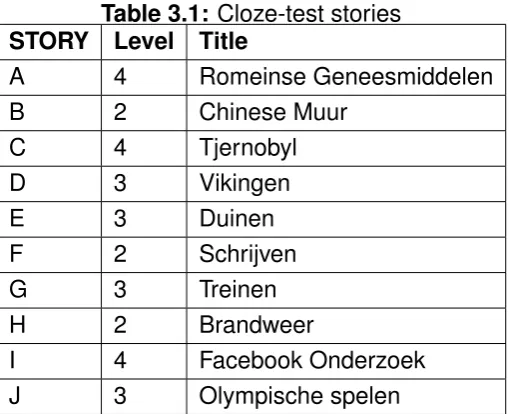
text as being suitable to children in groep 7/8 (our targeted group in this user-test). A text level of 2 is one difficulty level lower and signifies a (slightly) easier text. A text level of 4 signifies a (slightly) more difficult text. By looking at this level feature and including it in the selection process of choosing the stories we made sure that texts were not too difficult, or too easy for the targeted user-group of this study. It also provided us with a basic ranking system between stories (by difficulty) which we would later use to compare to the ranking of the stories by overall results.
Table 3.1: Cloze-test stories
STORY Level Title
A 4 Romeinse Geneesmiddelen
B 2 Chinese Muur
C 4 Tjernobyl
D 3 Vikingen
E 3 Duinen
F 2 Schrijven
G 3 Treinen
H 2 Brandweer
I 4 Facebook Onderzoek
J 3 Olympische spelen
[image:38.595.187.442.227.434.2]Since our goal was to use the participants overall results for both the offline and online Cloze-test to determine a ranking of texts, the 10 texts need to be logically distributed between both the offline and online versions of test. To ensure a (rela-tively) even distribution of texts between participants and the different versions, the following user-testing schema was set-up, see Table 3.2.
Table 3.2: Sample distribution of texts and versions
Offline Online code
1 A B C D P6L
2 B C D E J6S
3 C D E F V7T
4 D E F G W2F
5 E F G H W6Q
6 F G H I C6Y
7 G H I J L8G
8 H I J A X2Z
9 I J A B K4U
Table 3.2 shows a sample distribution of 10 texts (A-J) for 10 users (after which the cycle repeats except for the ’code’ which is unique to each user) to ensure a relatively even distribution. Additionally the column ’code’ contains the tracking code of that particular user which is used to ensure that every participant receives the correct stories, see also Section 3.3.1.
In the example of Table 3.2 User 1 would complete Cloze-testsAandBon paper, while completing C and D online. User 2 would complete Cloze-tests B and C on paper, while completingDandEonline. This distribution method ensures that every story gets used for both offline and online versions.
[image:39.595.91.536.310.403.2]Moving on from the distribution of Cloze-tests, Figure 3.3 below shows a flow diagram of the user-test and within its various steps.
Figure 3.3:Stage A user-test flow diagram
The flow diagram as shown in Figure 3.3 is relatively self-explanatory but there are a few parts which warrant further explanation. After step B in the diagram the path splits into 2 different options, offline (C(1)) and online (D(1)). This split is done to prevent the order effect of always beginning with either version (offline or online). To ensure the validity of the outcome of this user-test a split was made that alternated the starting version of each participant.
[image:39.595.90.532.630.710.2]Another part which requires additional highlighting is the online portion of the user-test. A flow diagram of which is shown in Figure 3.46.
Figure 3.4: Stage A online user-test flow diagram
6Examples of the actual pages the participants worked through for the online version are included
![Figure 2.1: Vocabulary size of Dutch children in primary education [6]](https://thumb-us.123doks.com/thumbv2/123dok_us/9803545.481524/16.595.148.480.83.286/figure-vocabulary-size-dutch-children-primary-education.webp)